Your books may balance while still hiding the questions that matter. Which property drains cash? Which commission split is wrong? Are owner funds recorded correctly?
Accounting software for real estate should reflect how money moves across properties, deals, entities, and owners. A generic ledger can record income. It takes careful setup to produce useful property or commission reporting.
Grand View Research valued the global real estate software market at $12.8 billion in 2025. Cloud software held the largest market share, reflecting the shift away from disconnected spreadsheets and local files.
The decision comes down to workflow fit. Choose a system that gives your team dependable numbers without rebuilding reports before every tax deadline or leadership meeting.
What’s inside
This guide compares 13 real estate accounting programs for agents, brokerages, investors, landlords, and property managers.
We prioritized tools using these criteria:
- Workflow fit: Commission, rental, property, or multi entity accounting
- Reporting depth: Property results, consolidated financials, or owner reporting
- Operational coverage: Rent, invoices, expenses, leasing, or procurement
- Tax readiness: Categorization, records, accountant access, and Schedule E support
- Scaling fit: Cost, implementation scope, portfolio capacity, and migration effort
The list ranges from lightweight accounting software for real estate agents to financial systems for complex portfolios.
TL;DR
- Best overall for small real estate teams: QuickBooks Online offers flexible bookkeeping and broad accountant support
- Best for real estate agents: Realtyzam focuses on commissions, expenses, receipts, and tax reports
- Best for rental property investors: REI Hub provides property reporting and Schedule E outputs
- Best for property managers: Buildium connects accounting with leasing, rent, maintenance, and owner communications
- Best for larger property management portfolios: AppFolio combines financial workflows with broader portfolio operations
- Best for complex entities: Sage Intacct supports dimensional analysis and multi entity consolidation, while NetSuite adds broader business management
What is real estate accounting software?
Real estate accounting software helps agents, brokerages, investors, landlords, and property managers track money by property, deal, tenant, owner, agent, or entity.
The category includes general accounting platforms and specialized property accounting software. General tools handle ledgers, invoices, bills, bank reconciliation, and financial statements. Real estate specific systems connect those records to leases, rent, maintenance, investor reporting, or owner statements.
Property level reporting is the key distinction. A company wide profit figure tells leadership whether the business made money. It does not show whether one rental, development, or managed portfolio weakened margins.
Tax preparation is another central use case. Investors may need Schedule E reporting, while agents need clean expense categories and commission records. Growing firms often need accountant access, entity consolidation, and reliable closing processes.
Core capabilities to look for
- Income and expense tracking
- Property level financial reporting
- Commission and split tracking
- Bank and credit card feeds
- Receipt capture and document storage
- Rent collection and tenant ledgers
- Trust or escrow accounting
- Schedule E reporting support
- Multi entity consolidation
- Owner or investor reporting
- Transaction rules and workflow automation
General accounting vs real estate specific accounting
General accounting tools fit businesses that need flexible bookkeeping, invoicing, accountant collaboration, and standard financial reports. They usually require deliberate configuration for properties or agents.
Real estate specific software works better when accounting depends on property operations. Common requirements include tenant ledgers, owner statements, leasing, rent collection, and trust accounting.
| Need | General accounting tool | Real estate specific tool |
|---|---|---|
| Agent expenses | Strong fit | May exceed the requirement |
| Commission splits | Requires configuration | Usually a closer workflow fit |
| Rental portfolio | Basic property tracking | Dedicated property reporting |
| Trust accounting | Limited specialist support | Often built around property operations |
| Multi entity reporting | Varies by platform | Available in larger financial systems |
When to use real estate accounting software
Replace spreadsheets before tax season gets ugly
Spreadsheets become fragile when you add properties, bank accounts, shared bills, and missing receipts. Reconciliation takes longer because every correction depends on manual review.
If tax preparation starts with several browser tabs and a folder called “receipts maybe,” your system already consumes leadership time. Real estate bookkeeping software creates repeatable categories and clearer records.
Track commissions, escrow, and agent expenses cleanly
Agents need visibility into commission income, referral fees, desk costs, and marketing expenses. Brokerages may also need commission splits and clean separation of escrow or trust funds.
Not every agent needs a property management platform. Choose real estate brokerage accounting software around the money flow you manage today.
See property performance without rebuilding reports
Landlords and investors need property level profit statements, cash flow data, and portfolio reporting. Property managers also need owner statements and tenant level records.
The right system gives operators a dependable weekly picture without stitching together five dashboards. It should also survive accountant review and leadership scrutiny.
Real estate accounting software comparison
This table gives you a fast shortlist. The deeper entries explain which workflow each product handles best and where you may need more setup.
Pricing reflects vendor information supplied for November 2026. Promotional rates can change after introductory periods. G2 ratings use current listings where available.
| # | Product | Best for | Key differentiator | Pricing | G2 rating |
|---|---|---|---|---|---|
| 1 | QuickBooks Online | Small real estate teams | Flexible cloud accounting with accountant collaboration | Free tier, paid plans from $19 monthly promotional | 4.0/5 |
| 2 | Realtyzam | Individual real estate agents | Agent specific commissions, expenses, and tax reports | From $11.58 monthly with annual billing | 5.0/5 |
| 3 | REI Hub | Rental property investors | Property bookkeeping with Schedule E reporting | Free tier, Professional from $9 monthly annually | N/A |
| 4 | Buildium | Residential property managers | Accounting connected to rent, leasing, and maintenance | From $65 monthly | 4.4/5 |
| 5 | AppFolio | Growing property firms | Portfolio operations with accounting and investor tools | Property Manager custom pricing | 4.6/5 |
| 6 | Sage Intacct | Multi entity real estate firms | Dimensional reporting and consolidation | Custom pricing | 4.3/5 |
| 7 | NetSuite | Larger real estate organizations | Financial management inside a broader ERP | Custom pricing | 4.1/5 |
| 8 | FreshBooks | Solo agents and service teams | Straightforward invoicing and expense tracking | From $2.30 monthly promotional | 4.5/5 |
| 9 | Zoho Books | Budget conscious small teams | Low entry cost within the Zoho product suite | Free tier, paid plans from $15 monthly annually | 4.4/5 |
| 10 | Xero | Small firms with advisor support | Cloud bookkeeping and bank reconciliation | From $27 monthly | 4.4/5 |
| 11 | MRI Software | Complex property operators | Property, leasing, facilities, and finance coverage | Broader platform priced by quote | 4.2/5 |
| 12 | Yardi | Large property portfolios | Integrated property and investment management | Breeze from $1 per unit monthly | 4.1/5 |
| 13 | Striven | Firms needing broader operations | Accounting with CRM, projects, inventory, and HR | From $35 per user monthly | 4.5/5 |
Best 13 tools for real estate accounting software
The entries begin with small team bookkeeping and agent focused software. Later options cover property management, multi entity finance, and complex portfolio operations.
1. QuickBooks Online
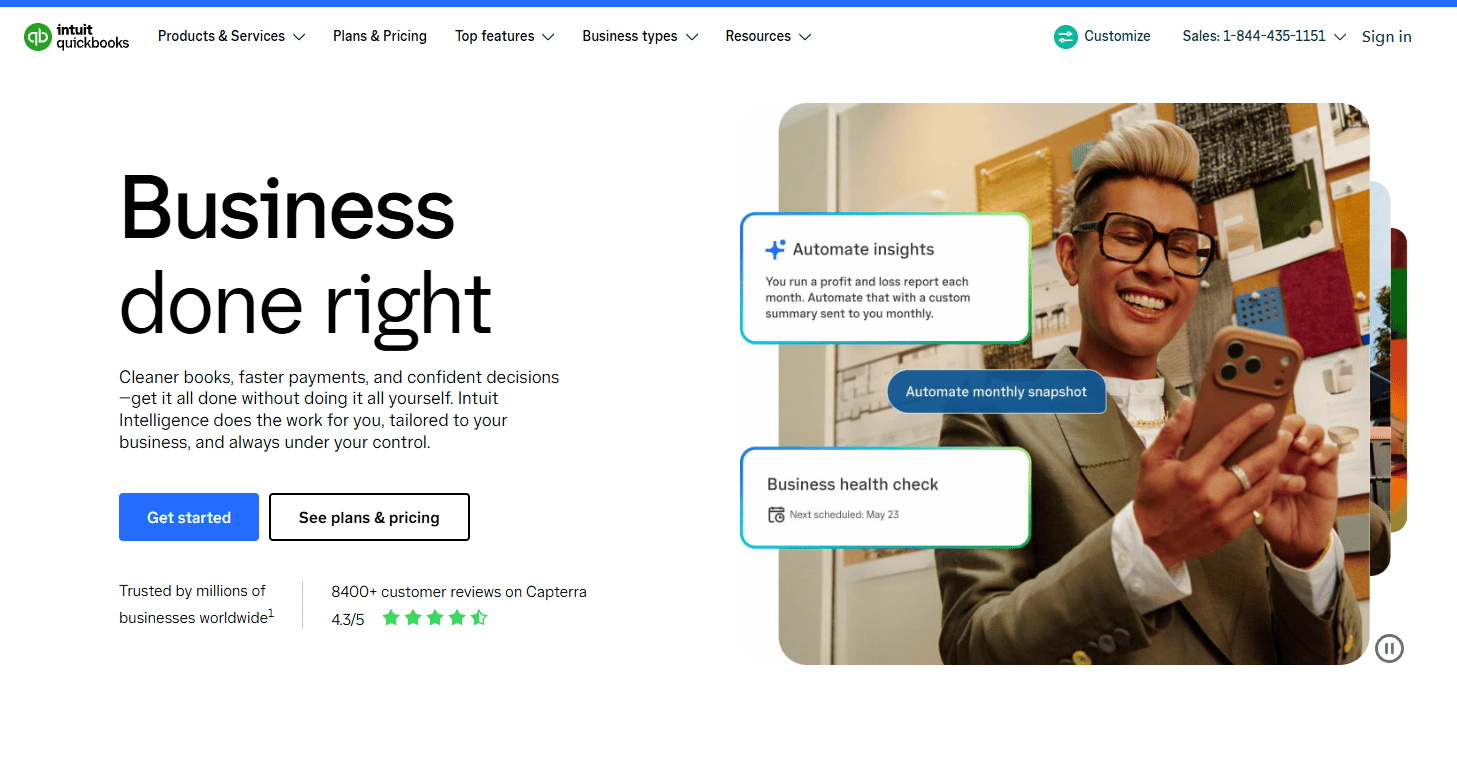
QuickBooks Online is cloud accounting software for bookkeeping, invoicing, payments, forecasting, and financial reporting. It works as a flexible default for small real estate businesses that want familiar accounting workflows.
The platform is not specific to real estate. Teams must configure their accounts and reporting structure around properties, agents, entities, or projects.
Best for: Small real estate teams and brokerages that want flexible bookkeeping with accountant collaboration.
Key features
- Automated bookkeeping and transaction categorization
- Invoice creation and online payments
- Financial reporting and forecasting
- Accountant collaboration
Why choose QuickBooks Online: Choose it when accountant familiarity and broad financial coverage matter. Property specific reporting requires a thoughtful setup and may need connected applications.
QuickBooks Online pricing: A free tier is available. Simple Start costs $19 monthly for three months, then $38 monthly.
Essentials, Plus, and Advanced promotional prices are $42.50, $70, and $170 monthly. Their standard monthly rates are $85, $140, and $340.
G2 rating: 4.0/5
2. Realtyzam
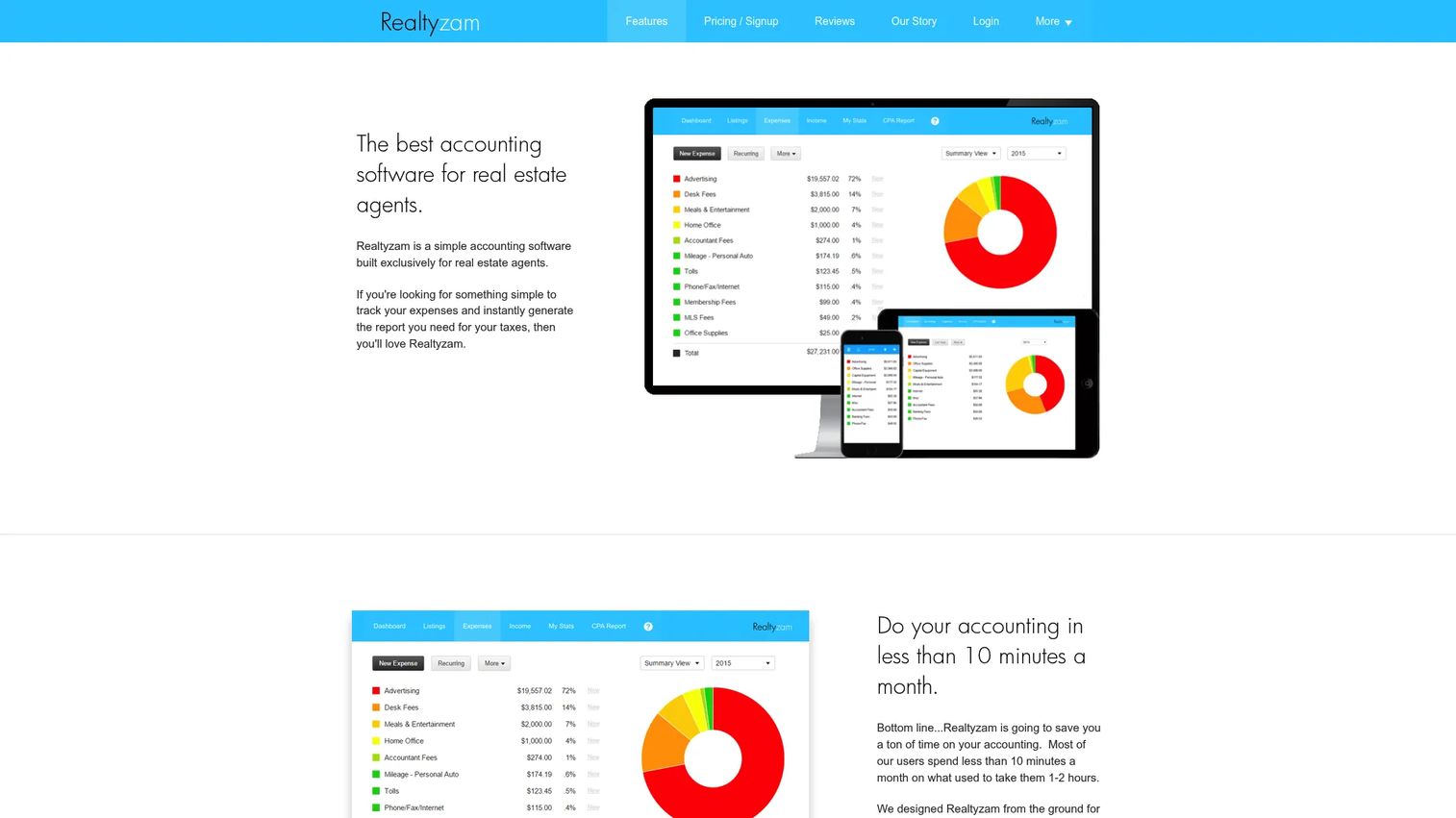
Realtyzam is realtor accounting software built exclusively for real estate agents. It downloads transactions from connected financial accounts and supports expense categorization, receipt storage, and tax reports.
Its narrower scope is deliberate. The software focuses on commission income and agent bookkeeping rather than tenant operations or complex portfolio consolidation.
Best for: Individual agents and small teams that need agent specific records without a large finance system.
Key features
- Automatic transaction downloads
- Custom expense categories
- Receipt uploading and linking
- Quarterly and annual tax reports
- Mobile applications
Why choose Realtyzam: Use it when commissions, deductible expenses, and receipts drive the accounting workload. Property managers and multi entity investors need broader operational reporting.
Realtyzam pricing: The paid plan costs $11.58 monthly with annual billing or $14 month to month. A 30 day trial requires no credit card.
The service may remain free until two properties sell or recorded activity reaches $3,000.
G2 rating: 5.0/5
3. REI Hub
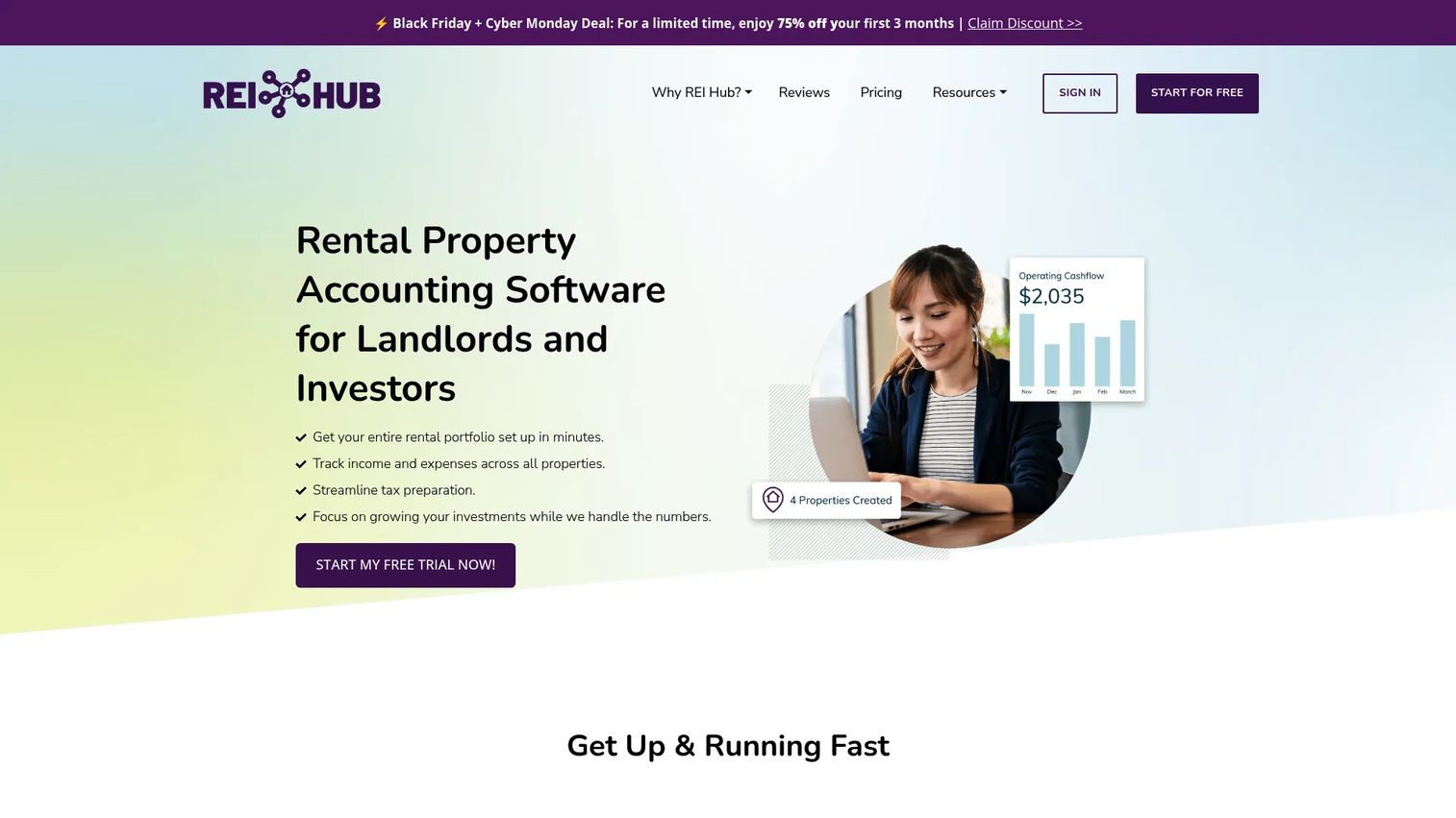
REI Hub is rental property accounting software for landlords and real estate investors. It organizes bookkeeping around properties and imports transactions from connected banks.
Reporting includes Schedule E outputs, profit and loss statements, cash flow reports, and balance sheets. This makes it a practical option for owners who need tax ready records without a full property management platform.
Best for: Landlords and investors who need property focused books and Schedule E reporting.
Key features
- Property based accounting
- Automatic bank transaction imports
- Custom booking rules
- Schedule E reports
- Cash flow and balance sheets
Why choose REI Hub: It fits owners focused on rental profitability and tax preparation. Teams needing leasing, tenant portals, or maintenance operations should compare broader property management systems.
REI Hub pricing: A free plan is available across portfolio sizes. Professional starts at $9 monthly for three units with annual billing.
Professional costs $15 for up to 10 units, $27 for up to 20, or $48 for unlimited units. Monthly billing costs more, and a 14 day trial is included.
4. Buildium
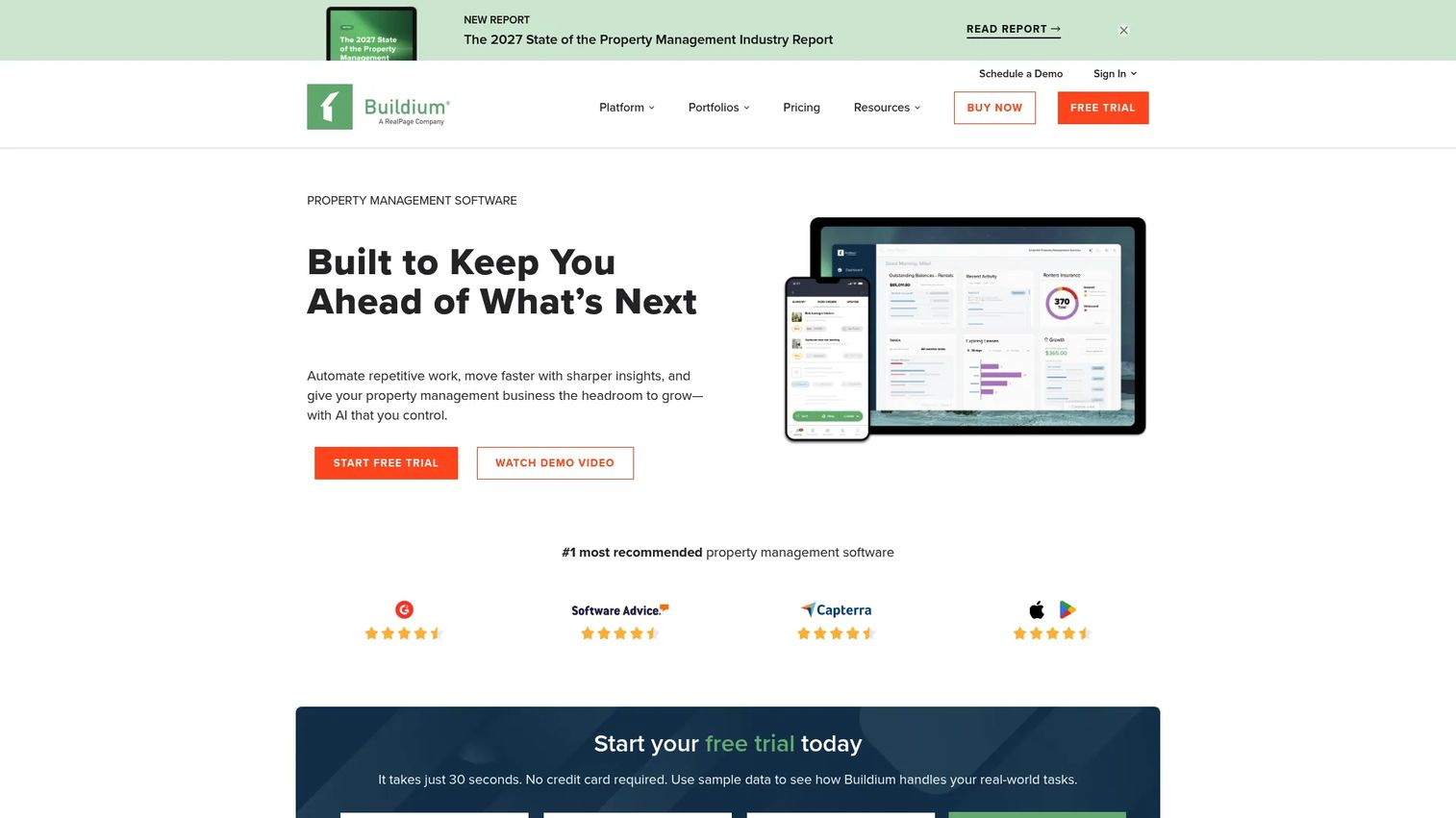
Buildium combines property management accounting software with leasing, maintenance, payments, and resident communications. It supports residential rentals, community associations, commercial properties, and mixed portfolios.
Accounting sits inside the operating workflow. Teams can manage financial reporting alongside online rent, bills, applications, and tenant screening.
Best for: Property managers who need accounting connected to residents, owners, leasing, and maintenance.
Key features
- Property accounting and financial reporting
- Online rent and bill payments
- Leasing and tenant screening
- Maintenance work order management
- Resident and owner portals
Why choose Buildium: Choose it when rent and owner accounting must stay connected to daily property operations. It carries more functionality than most solo landlords or agents require.
Buildium pricing: Essential starts at $65 monthly, Growth at $202, and Premium at $420. Every plan includes a 14 day trial.
Premium adds an open API plus expanded automation, eSignatures, and inspections.
G2 rating: 4.4/5
5. AppFolio

AppFolio provides accounting and portfolio operations for property management and real estate investment firms. Its coverage includes leasing, maintenance, reporting, communications, and financial workflows.
Resident, owner, and vendor portals connect outside stakeholders to the operating system. Investment firms can also use investor financials and an investment CRM.
Best for: Growing property management firms that need accounting tied to portfolio operations.
Key features
- Property accounting and reports
- Marketing and leasing management
- Work orders and inspections
- Resident and owner portals
- Investment financial reporting
Why choose AppFolio: It suits firms that have outgrown separate bookkeeping and operating tools. Buyers should evaluate the platform against portfolio size and implementation scope.
AppFolio pricing: Property Manager offers Core, Plus, and Max through custom pricing, with a 50 unit minimum for residential plans. Investment Manager Core starts at $650 monthly.
G2 rating: 4.6/5
6. Sage Intacct

Sage Intacct is cloud financial management software for growing and midsize organizations. It supports accounts payable, receivables, general ledger management, and financial reporting.
Dimensions help finance teams analyze results across entities, properties, departments, projects, or other reporting structures. Consolidation supports firms that have moved beyond single company books.
Best for: Multi entity real estate firms needing stronger financial control and consolidated reporting.
Key features
- Multi entity financial consolidation
- Multi dimensional analysis
- Accounts payable automation
- Accounts receivable management
- Custom dashboards and reports
Why choose Sage Intacct: Choose it when consolidation and leadership reporting have become recurring finance problems. Its scope exceeds what an individual agent or small landlord needs.
Sage Intacct pricing: Custom pricing. The quote reflects company size, industry, and selected modules.
G2 rating: 4.3/5
7. NetSuite
NetSuite is a cloud business management suite covering ERP, accounting, CRM, commerce, HR, and operational workflows. Its financial tools support organizations with multiple subsidiaries and broader control requirements.
The platform extends beyond real estate investment accounting software. Procurement, inventory, order management, and analytics can sit within the same business system.
Best for: Larger real estate organizations that need accounting inside a wider ERP.
Key features
- Financial management and accounting
- Global business management
- Multi subsidiary consolidation
- Procurement and supply chain workflows
- Analytics and custom reporting
Why choose NetSuite: Consider it when financial reporting must connect with procurement and company wide operations. Implementation and licensing require a larger commitment than small business accounting software.
NetSuite pricing: Custom pricing. The annual license includes the core platform, selected modules, and user licenses, plus a one time implementation fee.
G2 rating: 4.1/5
8. FreshBooks

FreshBooks offers cloud invoicing and accounting for freelancers, service businesses, and growing teams. It covers expenses, receipts, time tracking, project profitability, and online payments.
For real estate, the closest fit is a solo agent or service provider billing clients. It is not a deep property accounting platform.
Best for: Solo agents and small real estate service teams needing invoicing and basic books.
Key features
- Recurring invoices
- Expense and receipt tracking
- Built in time tracking
- Online payment collection
- Project profitability reports
Why choose FreshBooks: Choose it when ease and client billing outweigh property reporting depth. Rental portfolios and trust accounting require a more specialized system.
FreshBooks pricing: Lite starts at a promotional $2.30 monthly for four months, then $23. Plus costs $4.30 before returning to $43.
Premium costs $7 during the promotion, then $70 monthly. All plans include a 30 day trial.
G2 rating: 4.5/5
9. Zoho Books
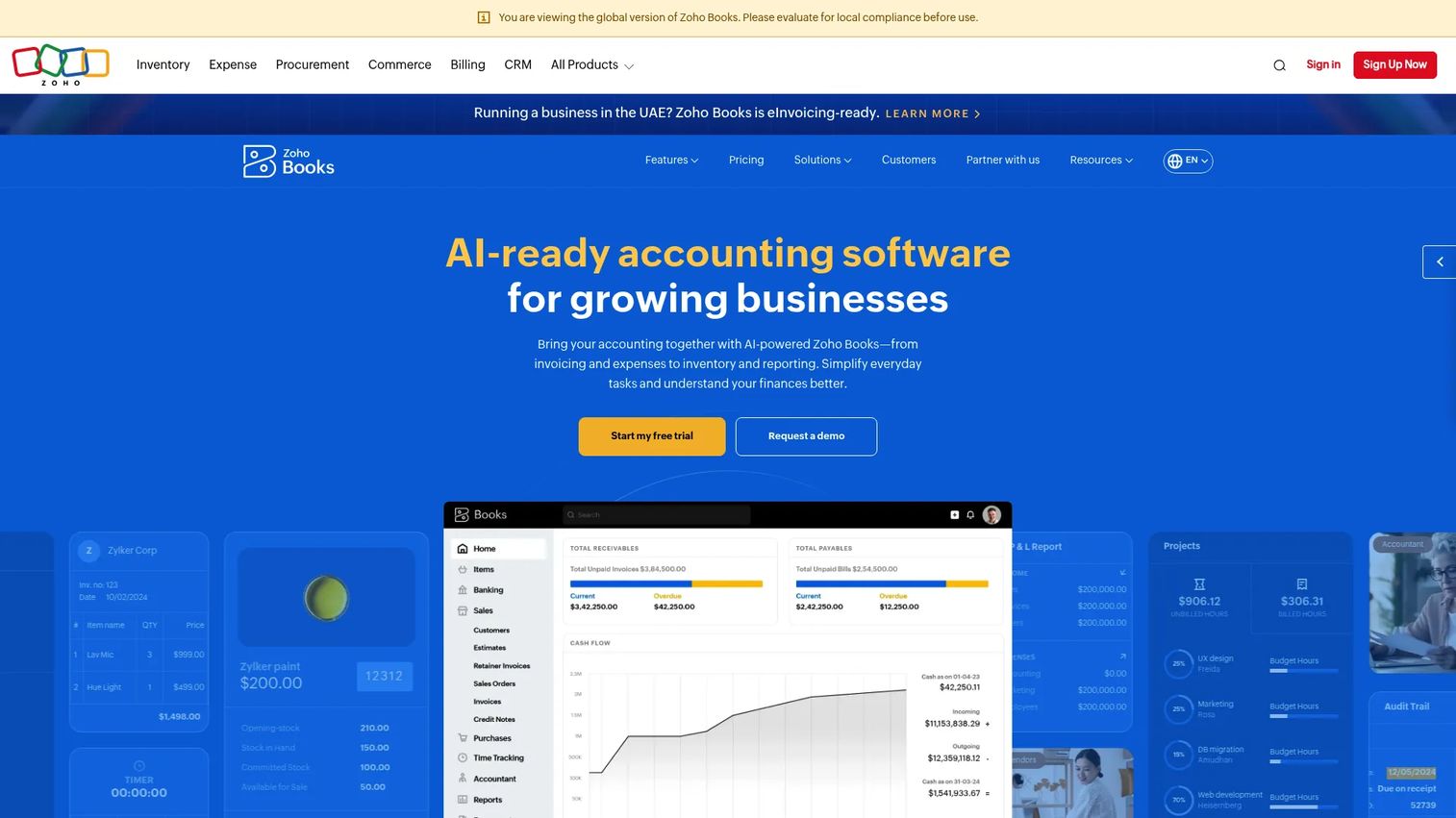
Zoho Books is cloud accounting software for invoicing, banking, expenses, inventory, and financial reporting. It fits smaller teams that already use other Zoho business applications.
With careful setup, the product can support simpler property or brokerage bookkeeping. Its core focus remains general business accounting.
Best for: Cost conscious real estate teams that want accounting within the Zoho suite.
Key features
- Bank feeds and reconciliation
- Invoices and expense management
- Financial dashboards and reports
- Customer and vendor portals
- Multi currency transactions
Why choose Zoho Books: It earns consideration when cost and connected business applications matter. Deep property operations or trust accounting call for specialized software.
Zoho Books pricing: A free plan is available. Standard costs $15 monthly with annual billing or $20 month to month.
Annual rates rise to $40 for Professional, $60 for Premium, $120 for Elite, and $240 for Ultimate.
G2 rating: 4.4/5
10. Xero

Xero provides cloud accounting for small businesses. Its feature set includes invoicing, bank reconciliation, expenses, bills, projects, and financial reporting.
Tracking categories and connected applications can adapt it to basic real estate workflows. More complex portfolios may need a dedicated accounting software for property management.
Best for: Small real estate firms wanting cloud bookkeeping with advisor support.
Key features
- Online invoicing and quotes
- Bank connections and reconciliation
- Bill and expense management
- Project tracking
- Multi currency accounting
Why choose Xero: Use it when straightforward books and connected applications meet your requirements. Property ledgers and owner reporting may need extra configuration or another platform.
Xero pricing: Early costs $27 monthly, Growing costs $59, and Established costs $97. Applicable taxes are extra.
G2 rating: 4.4/5
11. MRI Software
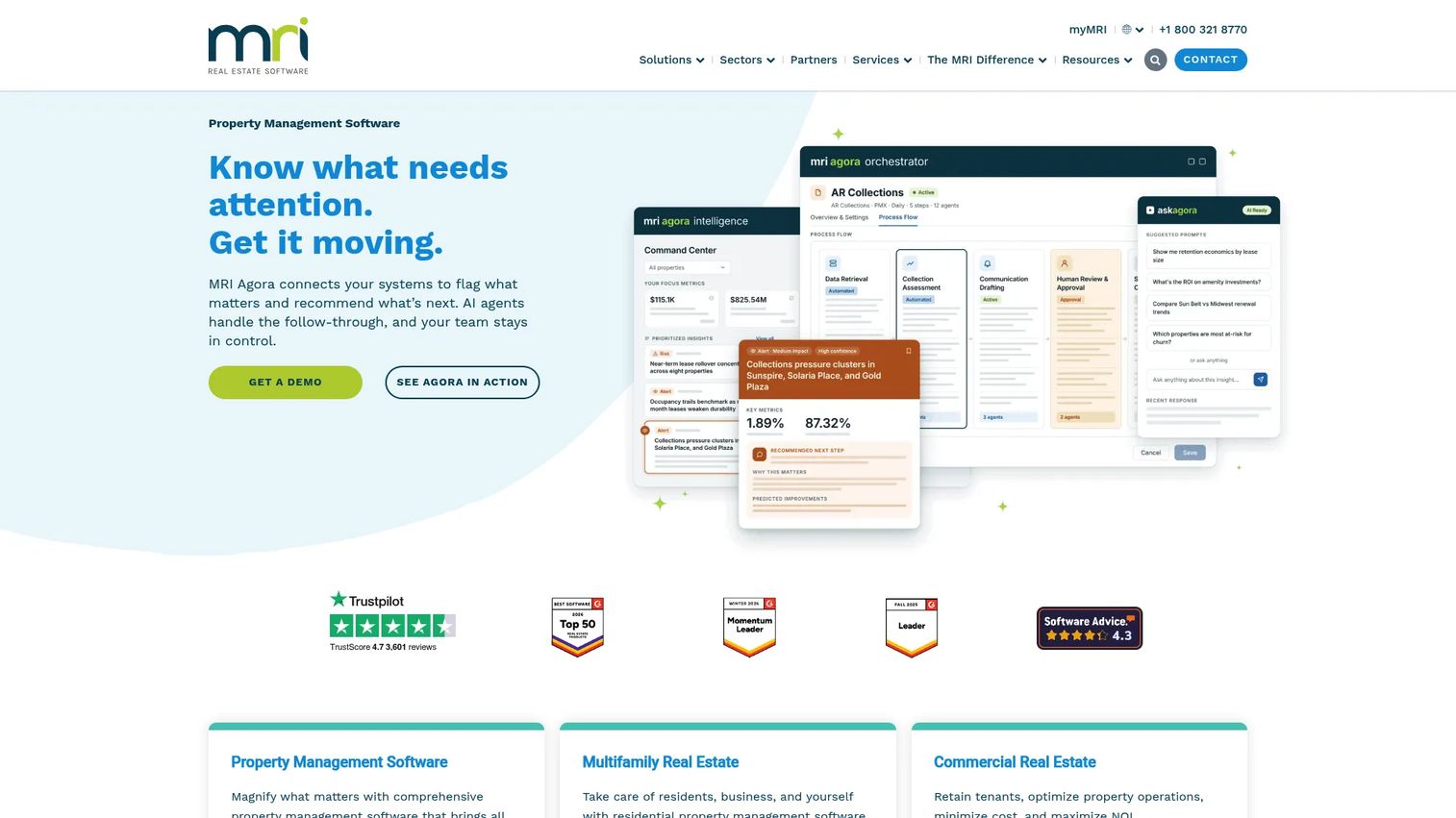
MRI Software provides real estate software across property management, leasing, facilities, finance, investment, and workplace operations. It serves owners, operators, property managers, and occupiers.
The platform is relevant for commercial real estate accounting software evaluations because financial records connect to broader portfolio processes. Buyers can select products around their property type and operating model.
Best for: Commercial and complex property operators needing configurable portfolio software.
Key features
- Property management and accounting
- Leasing and resident workflows
- Facilities and maintenance management
- Service request tracking
- Work order management
Why choose MRI Software: It fits firms where property accounting sits inside a wider operating portfolio. Define required products before evaluating implementation or services.
MRI Software pricing: The broader MRI platform uses custom pricing. MRI OnLocation starts at $60 monthly or $634 annually, but that price covers the OnLocation product specifically.
G2 rating: 4.2/5
12. Yardi
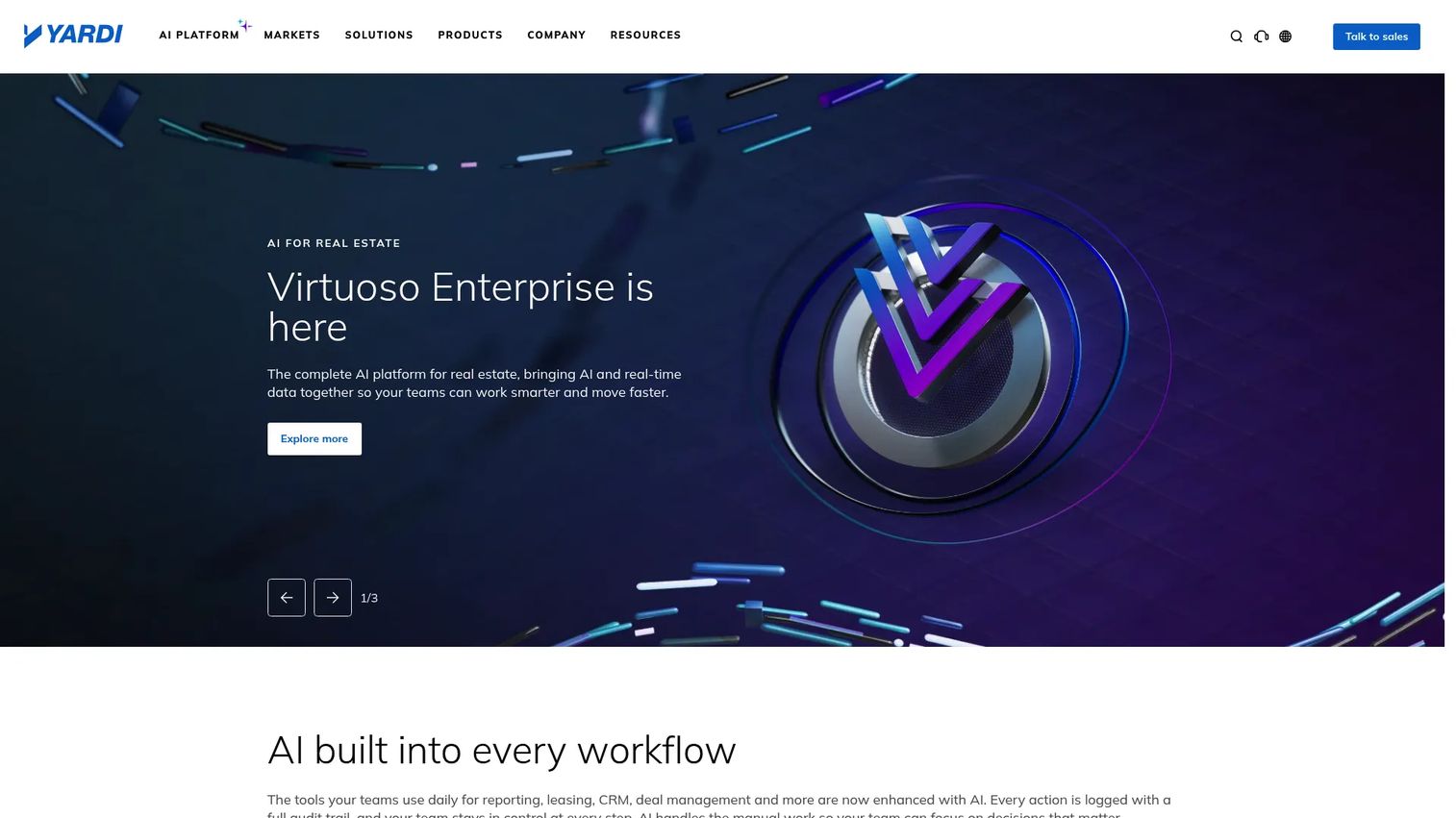
Yardi combines property management, accounting, investment management, leasing, and resident tools. Its products support diverse real estate portfolios and operating models.
The platform can connect financial reporting with tenant activity and asset performance. Larger organizations can evaluate its broader suite, while Breeze offers a defined entry point.
Best for: Real estate owners and operators managing larger or varied property portfolios.
Key features
- Integrated property management and accounting
- Leasing and tenant portals
- Investment management tools
- Asset performance reporting
- Energy management workflows
Why choose Yardi: Choose it when accounting needs to remain embedded in property operations. Treat the decision as an operating system selection rather than a bookkeeping purchase.
Yardi pricing: Yardi Breeze starts at $1 per unit monthly. Breeze Premier starts at $2 per unit monthly.
Other Yardi products use custom pricing.
G2 rating: 4.1/5
13. Striven
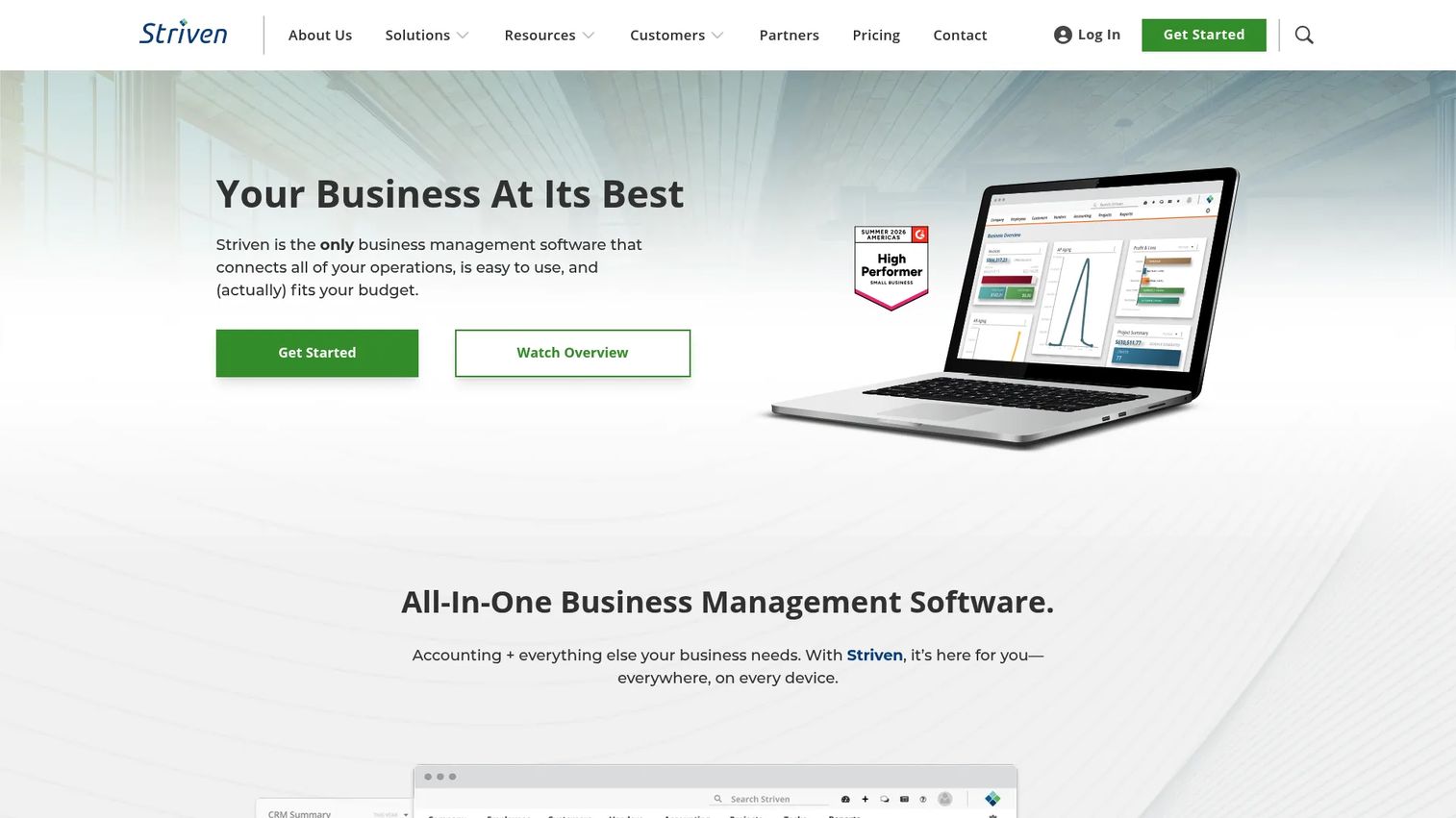
Striven combines accounting with CRM, projects, inventory, HR, reporting, and workflows. It gives small and midsize businesses an alternative to separate operational applications.
Real estate service firms can connect client management with financial records and project delivery. Rent heavy businesses still need to confirm whether a property platform is necessary.
Best for: Real estate firms wanting accounting plus broader business management.
Key features
- Accounting and financial management
- CRM and sales management
- Project and inventory tools
- Reporting and analytics
- Workflow management
Why choose Striven: It fits firms whose accounting problems are tied to projects and client operations. It does not provide the same property focus as dedicated management platforms.
Striven pricing: Standard costs $35 per user monthly, while Enterprise costs $70. Accounts with fewer than five users add $25 per user.
Free customer, vendor, and career portal options are available.
G2 rating: 4.5/5
Considerations when choosing real estate accounting software
Match the tool to the money flow
Start with the transactions creating risk or reporting drag. Agent commissions differ from rental income, owner distributions, or trust deposits.
A highly rated system still creates work if its underlying model does not match your business.
Check property level reporting before you buy
Ask vendors to show a property profit statement using your reporting structure. Check support for tags, classes, entities, owner statements, and portfolio reporting.
A company total cannot tell you which duplex or office asset is weakening margin.
Confirm tax reporting support
Review Schedule E outputs, 1099 workflows, deductible expense categories, mileage records, and fixed asset support. Confirm accountant access before migration.
Software organizes records. Your accountant should validate tax treatment and filing outputs.
Know when spreadsheets are no longer cheap
Spreadsheets look inexpensive until month end close consumes leadership time. Missing receipts and manual reconciliations also weaken trust in weekly reporting.
Move when the hidden cleanup cost exceeds the subscription and migration work.
Evaluate migration and implementation effort
Review data import, opening balances, bank connections, property setup, and user permissions. Confirm who owns the chart of accounts after launch.
Larger platforms require implementation planning. The handoff matters as much as the feature list because leadership should not become the permanent system administrator.
Conclusion
The right real estate accounting software follows your money flow.
QuickBooks Online provides flexible small team accounting. Realtyzam focuses on agent commissions and expenses, while REI Hub serves rental investors.
Buildium connects accounting to residential property operations. AppFolio fits growing management firms that want a broader operating platform.
Sage Intacct and NetSuite suit organizations with complex entities or stronger control requirements. MRI Software and Yardi cover larger property portfolios.
Shortlist two or three products based on your operating model:
- Agents and brokerages should test commission and expense workflows
- Rental investors should review property reports and tax outputs
- Property managers should inspect tenant ledgers and owner statements
- Multi entity operators should test consolidation and leadership reporting
Run the same sample month through every shortlisted system. Compare the resulting reports, setup work, and migration cost before signing.
If your team also explains complex software workflows to buyers, Start your journey with Guideflow today!
FAQs
QuickBooks Online is a practical starting point for small teams needing flexible bookkeeping and accountant collaboration. Realtyzam fits individual agents, while REI Hub focuses on rental investors.
Choose according to whether your primary income comes from commissions, rent, or property operations.
Realtyzam is accounting software for real estate agents who need commission, expense, receipt, and tax tracking. QuickBooks Online offers broader bookkeeping, while FreshBooks works for simple invoicing and expenses.
Agents should also check mileage support and accountant access before choosing.
Yes. QuickBooks Online can support agents, small brokerages, and investors with a carefully designed chart of accounts and reporting structure.
Property operations such as rent rolls, tenant ledgers, owner statements, or trust accounting may require specialized software.
REI Hub is a strong option for rental property accounting and Schedule E reporting. Buildium fits owners or managers who also need leasing, payments, and tenant operations.
AppFolio is aimed at growing property management firms with broader portfolio workflows.
Move when bank reconciliation takes too long or separate properties need dependable reporting. Multiple owners, agents, loans, or entities add further pressure.
Spreadsheets have become expensive when tax preparation requires cleanup and leadership cannot trust weekly numbers.
Core features include income tracking, expenses, bank feeds, receipt storage, and financial reports. Real estate specific needs may include property reporting, commission workflows, rent records, or Schedule E support.
Property managers should also evaluate owner statements and trust accounting.
Usually. Agents focus on commissions, deductible expenses, receipts, and tax reports.
Property managers need tenant ledgers, rent collection, owner reporting, maintenance bills, and security deposit records. Trust accounting may also be required for their operating model.
It can be worthwhile when one property generates many transactions or short term rental payouts. A rental specific product can also reduce tax preparation work.
Simple books may be enough when the property has one bank account and limited monthly activity. The value increases as receipts, loans, and reporting requirements multiply.