

You closed the verbal yes on Tuesday. It's Friday, and the quote still isn't out.
Pricing needed sign-off. The discount tripped an approval nobody owned. Legal wanted one line changed. Finance flagged a margin you already promised. Meanwhile the buyer went quiet, and the competitor who quoted same-day is now the one setting the agenda.
That gap between "yes" and "signed" is where deals leak. And it's rarely a selling problem. It's a quoting problem: pricing logic buried in spreadsheets, approvals living in email threads, and version chaos where three people are editing three different quotes.
The money at stake is real. The global quoting software market was valued at USD 2.89 billion in 2024 and is projected to reach USD 6.0 billion by 2031, growing at 11.2% CAGR, according to Verified Market Research (2024). Teams are buying this software because manual quoting stopped scaling.
This guide is a practical buyer's guide to quoting software for account executives, RevOps, and sales leaders who want faster turnaround, tighter pricing controls, and a cleaner path to signed. We'll define the category, separate quoting software from CPQ software, compare eight tools, and give you a checklist to match a tool to your sales motion.
What's inside
This guide covers the best quoting software and sales quoting software tools for 2026, from lightweight quote builders to full CPQ software and quote-to-cash platforms. We picked tools that a sales team actually lives in day to day, not just names off a market map.
We evaluated each tool on four things that matter to revenue teams:
- Pricing controls and margin protection: discount rules, pricing logic, and guardrails that stop revenue leakage
- Approval workflows: how fast a quote moves through finance, legal, and the deal desk
- CRM integration and quote-to-cash: how cleanly it connects to your stack and downstream billing
- Ease of adoption: whether reps use it without a mandate
TL;DR
- Best for control and downstream workflow visibility: QuoteWerks, with centralized quotes, version control, and quote-to-cash handoffs.
- Best for document-heavy quotes: PandaDoc CPQ, which blends a quote builder with polished proposals and eSignature.
- Best for teams already deep in Salesforce: Salesforce Revenue Cloud, for enterprise quote-to-cash on one platform.
- Best for complex configuration: Conga CPQ and Oracle CPQ, for rule-heavy products and global pricing.
- Best for recurring and usage-based revenue: Zuora, tying quotes to subscription billing.
- Best for modern, interactive quotes: Qwilr, for web-based proposals buyers actually enjoy reading.
What quoting software is
Quoting software is a sales tool that lets teams create, price, approve, and send accurate customer quotes from a central system instead of stitching them together in spreadsheets and documents. It replaces manual quote creation with standardized templates, controlled pricing, and structured approval workflows.
The difference between quoting software and basic document creation is control. A Word doc or spreadsheet has no pricing rules, no approval routing, and no version history. Quoting software enforces the logic: it pulls approved products and prices, applies discount rules, routes anything out of policy for sign-off, and keeps one source of truth for every quote.
CPQ software (configure, price, quote) is the more advanced layer on top. It handles product configuration, complex pricing, and rule-based bundling for teams selling configurable or multi-product deals. CPQ accounts for a large share of this category: Future Market Insights (2024) projects the CPQ segment will make up 39.2% of global quote management software revenue in 2025.
Core capabilities most quotation software includes:
- Quote builder and templates: reusable, branded quotes built in minutes
- Pricing controls: approved catalogs, discount management, and margin protection
- Approval workflows: automated routing to finance, legal, and the deal desk
- CRM integration: two-way sync with Salesforce, HubSpot, and Microsoft Dynamics
- eSignature and payments: close and collect without leaving the quote
- Version control: one live quote, full audit trail, no orphaned copies
- Analytics: quote-view tracking and win-rate reporting
Quoting software vs CPQ software
The names get used interchangeably, but the distinction matters when you're buying.
| Dimension | Quoting software | CPQ software |
|---|---|---|
| Core job | Create, price, and send quotes fast | Configure complex products, then price and quote |
| Pricing logic | Standard catalogs and discount rules | Rule-based configuration, bundling, dependencies |
| Best fit | Straightforward SKUs and services | Configurable, multi-product, or usage-based deals |
| Approval depth | Simple to moderate routing | Deep, multi-tier governance |
| Typical buyer | SMB and mid-market sales teams | Mid-market and enterprise revenue teams |
A simple quoting tool is enough when your pricing is mostly fixed and your discount logic fits on one page. You need full CPQ when reps can misconfigure a deal, when bundles have dependencies, or when pricing changes by region, currency, term, or volume. Many tools in this list do both, which is why the line blurs.
Why quoting software matters now
Manual quoting has a cost you can measure. Every hour a rep spends rebuilding a quote is an hour not spent selling. Every pricing error is margin gone. Every approval stuck in someone's inbox is a deal losing momentum against a competitor who moved faster.
Quoting software attacks four problems at once: speed, accuracy, consistency, and governance. Speed shortens the gap between verbal yes and signed. Accuracy kills the pricing mistakes that erode margin. Consistency means every rep quotes the same way. Governance gives finance and legal visibility without turning them into a bottleneck.
For AEs specifically, this is late-stage risk reduction. The deals that die in the final stretch often die on friction, not on fit. A clean quote-to-cash motion removes surprises when the money is closest.
When to use quoting software
Speed up quote turnaround
The fastest quote often wins. After a discovery or demo call, the buyer's intent is highest and their attention is shortest. Quoting software lets a rep turn a verbal agreement into a branded, accurate quote in minutes instead of hunting for the latest price list and rebuilding a template. In competitive deals, same-day beats same-week almost every time.
Protect pricing and margin
Discounting is where margin quietly leaks. Quoting software applies pricing rules, caps discounts, and routes anything out of policy to the right approver before the quote ever reaches the buyer. That means fewer pricing mistakes, less over-discounting, and margin protection baked into the workflow rather than enforced after the fact.
Standardize approvals and handoffs
Approvals stall deals when nobody knows who owns the next step. Quoting software makes approval workflows explicit: discount thresholds trigger finance, non-standard terms trigger legal, and everyone sees where the quote sits. That visibility across the deal desk cuts the back-and-forth with procurement and shortens the path from quote to signature.
Comparison table
The table below sorts tools by relevance to quoting software buyers, leading with the workflow-heavy options and moving toward CPQ and revenue-lifecycle platforms. Pricing reflects publicly listed starting tiers where available; several enterprise CPQ tools use custom pricing, which we note directly. G2 ratings are the current published scores.
| # | Product | Best for | Key differentiator | Pricing | G2 rating |
|---|---|---|---|---|---|
| 1 | QuoteWerks | Control and downstream workflow visibility | Centralized quotes with deep CRM, PSA, and accounting integrations | From $50/mo per concurrent user | 4.4/5 |
| 2 | PandaDoc CPQ | Document-heavy quotes | Quote builder plus polished proposals and eSignature | Free plan; paid from $19/mo | 4.7/5 |
| 3 | Salesforce Revenue Cloud | Salesforce-native teams | Quote-to-cash on one enterprise platform | From $150/user/mo | 4.2/5 |
| 4 | Conga CPQ | Complex configuration | Rule-based configuration and deep approval governance | Custom pricing | 4.2/5 |
| 5 | Zuora | Recurring and usage-based revenue | Quotes tied to subscription billing and revenue recognition | Custom pricing | 3.9/5 |
| 6 | DealHub.io | CPQ without heavy admin | Guided selling and no-code configuration | Custom pricing | 4.7/5 |
| 7 | Oracle CPQ | Large, global teams | Multi-currency, multilingual, enterprise pricing rules | From $240/mo | 4.0/5 |
| 8 | Qwilr | Modern, interactive quotes | Web-based proposals with eSign and engagement tracking | From $35/user/mo | 4.6/5 |
1. QuoteWerks
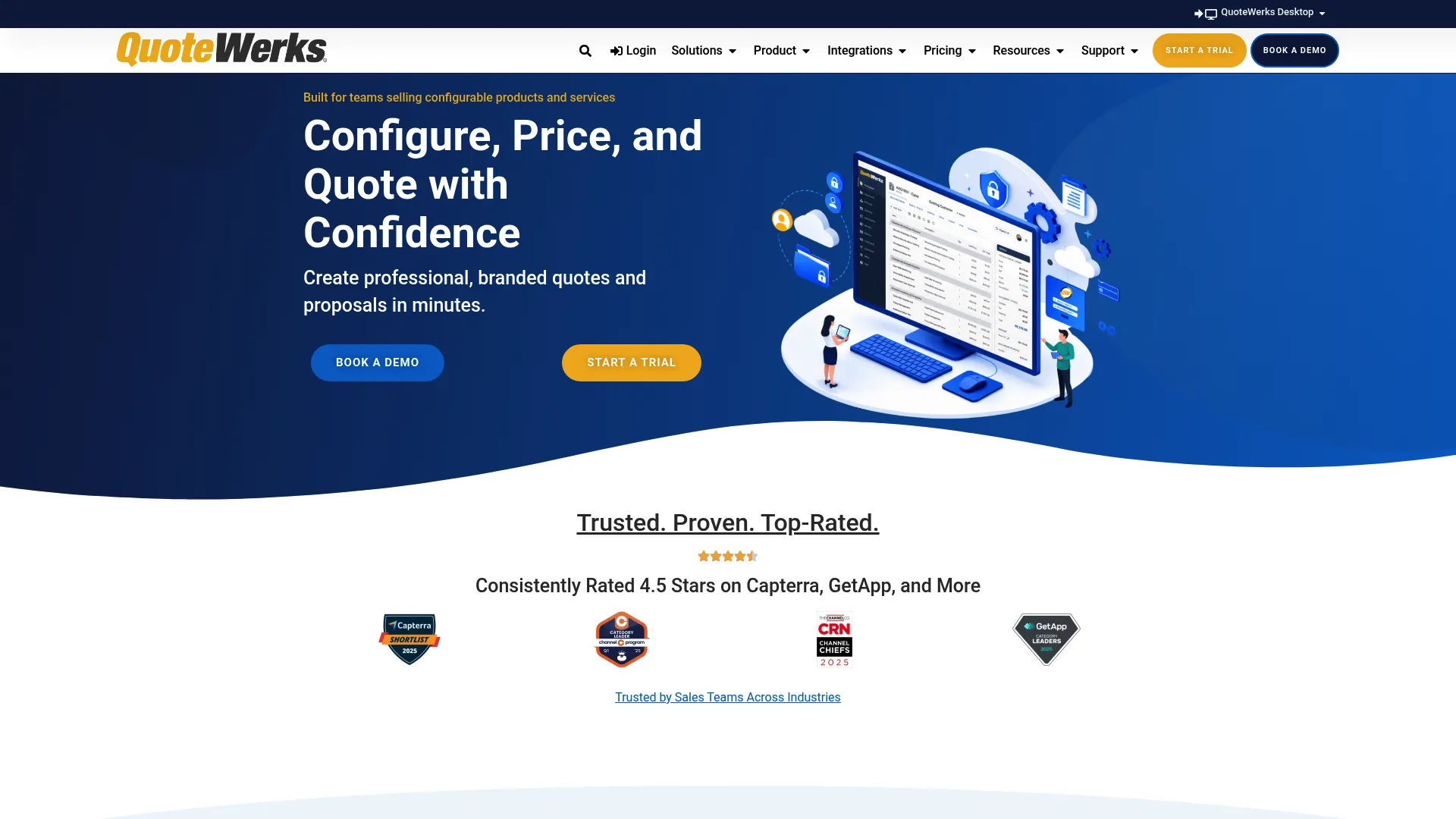
QuoteWerks is CPQ and quoting software built for teams that want centralized control over quotes and clear visibility into what happens downstream. It creates and prices quotes, generates proposals, and pulls real-time pricing from distributors, so reps aren't working off a stale price list. It's a strong fit for sales teams that need version control and a clean audit trail on every quote.
Where QuoteWerks earns its place is the handoff. Quotes don't die at "sent." The tool supports quote-view tracking, eSignature, and online payment collection, then hands the deal off to CRM, PSA, and accounting integration so the transaction keeps moving without re-keying data. That quote-to-cash coverage is why control-focused teams pick it.
Best for: SMB and mid-market sales teams that want CPQ with strong integrations and concurrent-user licensing.
Key strengths
- Quote creation and proposal generation from a central library
- Product and pricing management with real-time distributor pricing
- CRM, PSA, and accounting integration for downstream handoffs
- Quote delivery with eSignature and online payments
Why choose QuoteWerks: If your pain is scattered quotes, version chaos, and blind handoffs to finance, QuoteWerks centralizes the whole motion and its concurrent-user licensing suits teams where not everyone quotes at once.
QuoteWerks pricing: Three web editions billed on a 12-month term. Essential is $50/mo per concurrent user, Balanced is $78/mo per concurrent user, and Pinnacle is $102/mo per concurrent user. Annual billing includes one month free.
2. PandaDoc CPQ
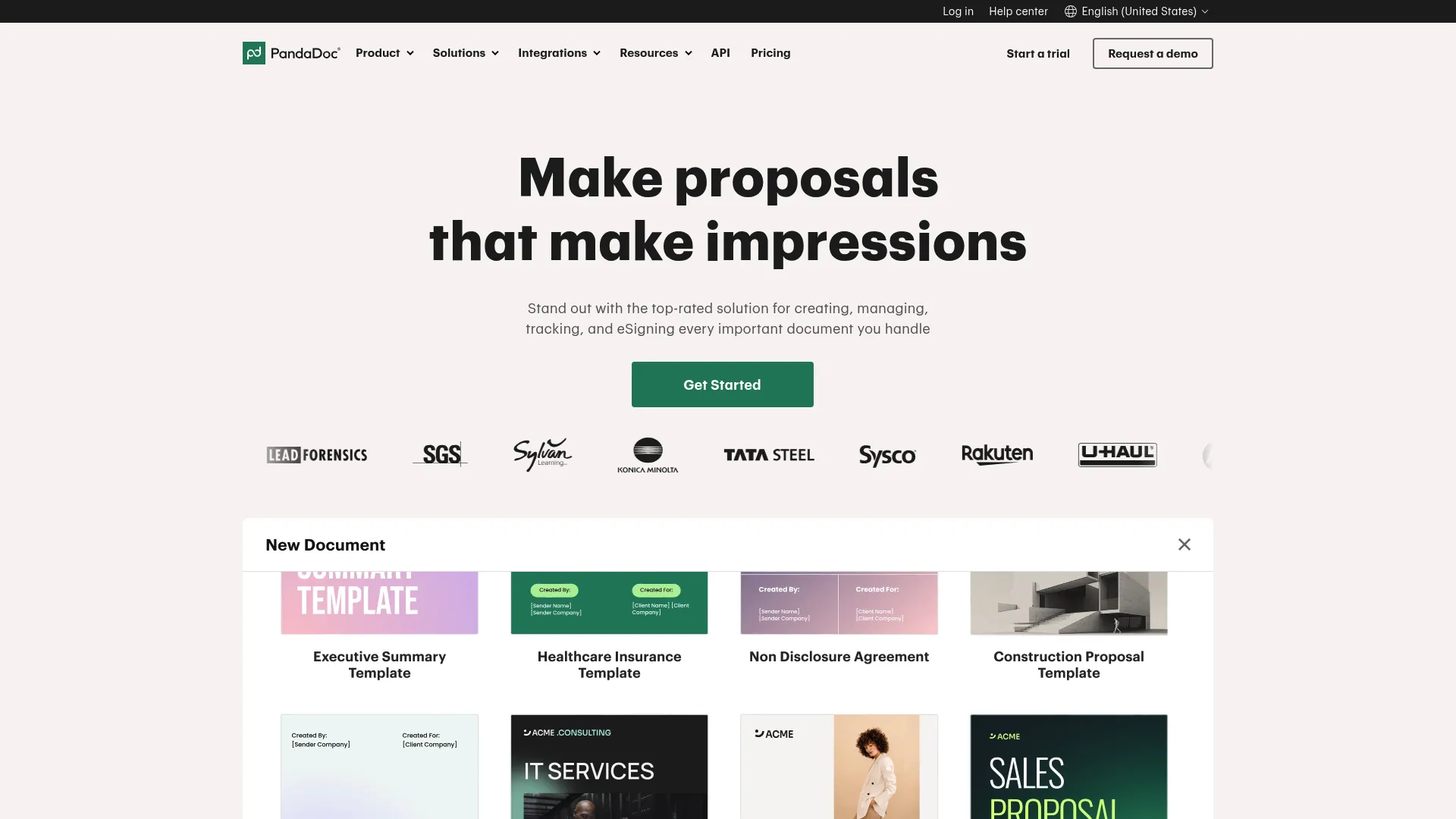
PandaDoc CPQ blends a quote builder with a document workflow, so the quote and the proposal live in the same place. It fits teams that care about how a quote looks and reads, not just what it prices. You get configured quotes, guided selling, and built-in approval workflows alongside templates, a content library, and branding controls.
The pitch here is presentation plus process. Reps build on-brand quotes and proposals from reusable templates, collaborate on them, then route for approval and send for eSignature. PandaDoc is often a better fit than heavier CPQ platforms when your deals are straightforward but your documents need to be sharp and your close motion needs eSign and payments in one flow.
Best for: Teams that want document automation with CPQ on top of eSignature and quote workflows.
Key strengths
- CPQ for configured quotes with guided selling
- Built-in approval workflows and discount management
- Templates, content library, and branding controls
- eSignature, pricing tables, and payments in one document
Why choose PandaDoc CPQ: Choose it when the quote is also the pitch. The document experience is the differentiator, and CPQ sits on top rather than dominating the workflow.
PandaDoc CPQ pricing: A Free plan is available. Starter is $19 per seat per month billed annually, Business is $49 per seat per month billed annually, and Enterprise (which includes CPQ) uses per-seat or per-document pricing through sales.
3. Salesforce Revenue Cloud
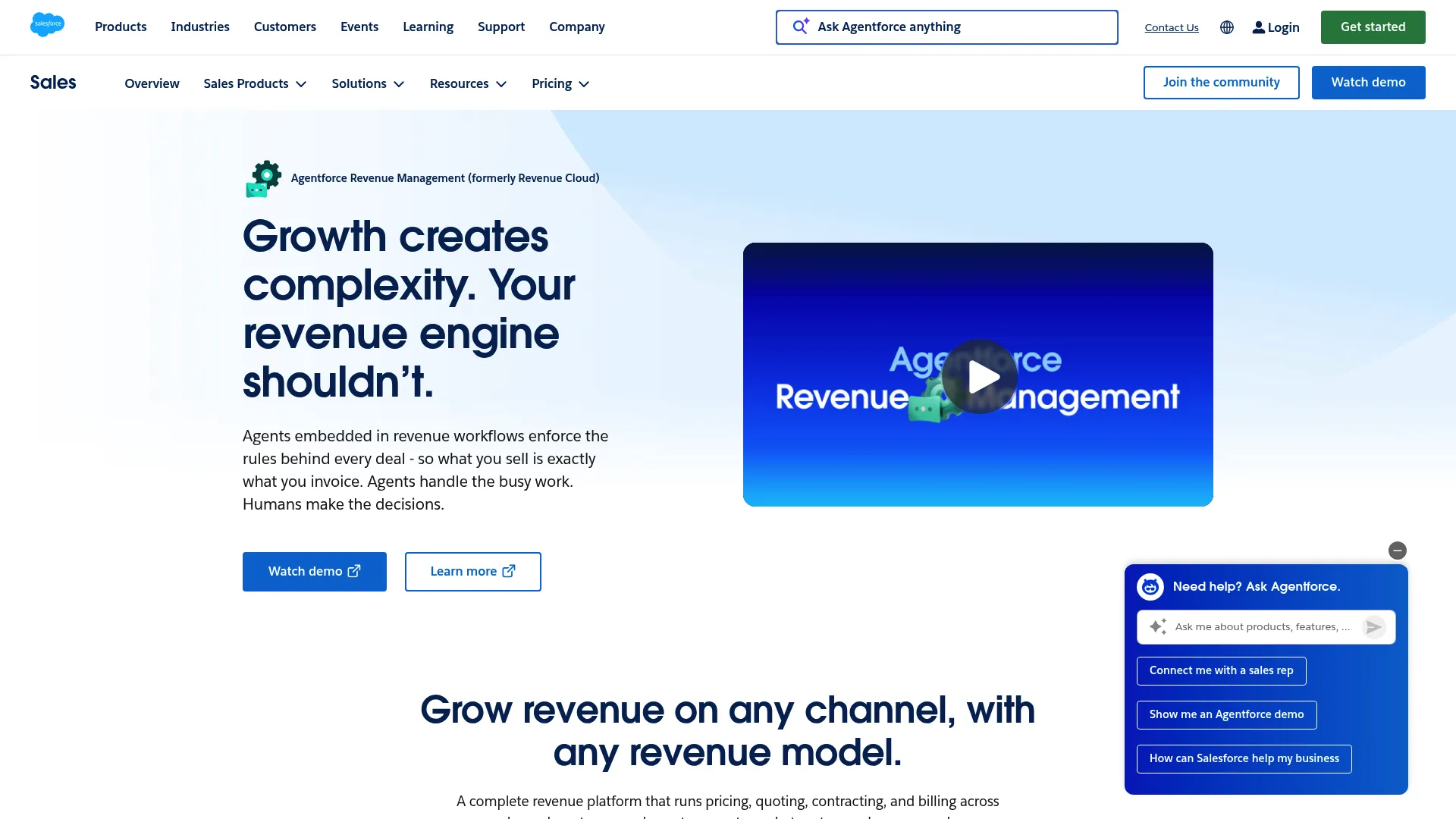
Salesforce Revenue Cloud handles quoting, pricing, approvals, and the full revenue lifecycle for teams that already run on Salesforce. It covers revenue pricing and quoting, contracts and orders, and subscription and asset lifecycle management, so the quote is one step in a connected quote-to-cash motion rather than a standalone document.
For enterprise AEs orchestrating multi-stakeholder deals, the value is that everything sits inside the CRM they already use. Pricing logic, approval routing, and complex quote generation reference the same records as the opportunity, which cuts the swivel-chair work between systems. The tradeoff is real: this is a platform decision, and its value depends on already being committed to the Salesforce ecosystem.
Best for: Mid-market to enterprise teams needing quote-to-cash and revenue lifecycle automation on Salesforce.
Key strengths
- Revenue pricing and quoting inside the CRM
- Contracts, orders, and subscription lifecycle management
- Native CRM integration with opportunity and account data
- AI and analytics on the Advanced edition
Why choose Salesforce Revenue Cloud: If Salesforce is already your system of record, keeping quote-to-cash on the same platform removes integration seams. If it isn't, the ecosystem dependency is a heavy commitment.
Salesforce Revenue Cloud pricing: Revenue Cloud Growth is $150/user/month billed annually and includes quoting, order capture, and subscriptions. Revenue Cloud Advanced is $200/user/month billed annually and adds contracts, orders, consumption, invoicing, and AI and analytics.
4. Conga CPQ
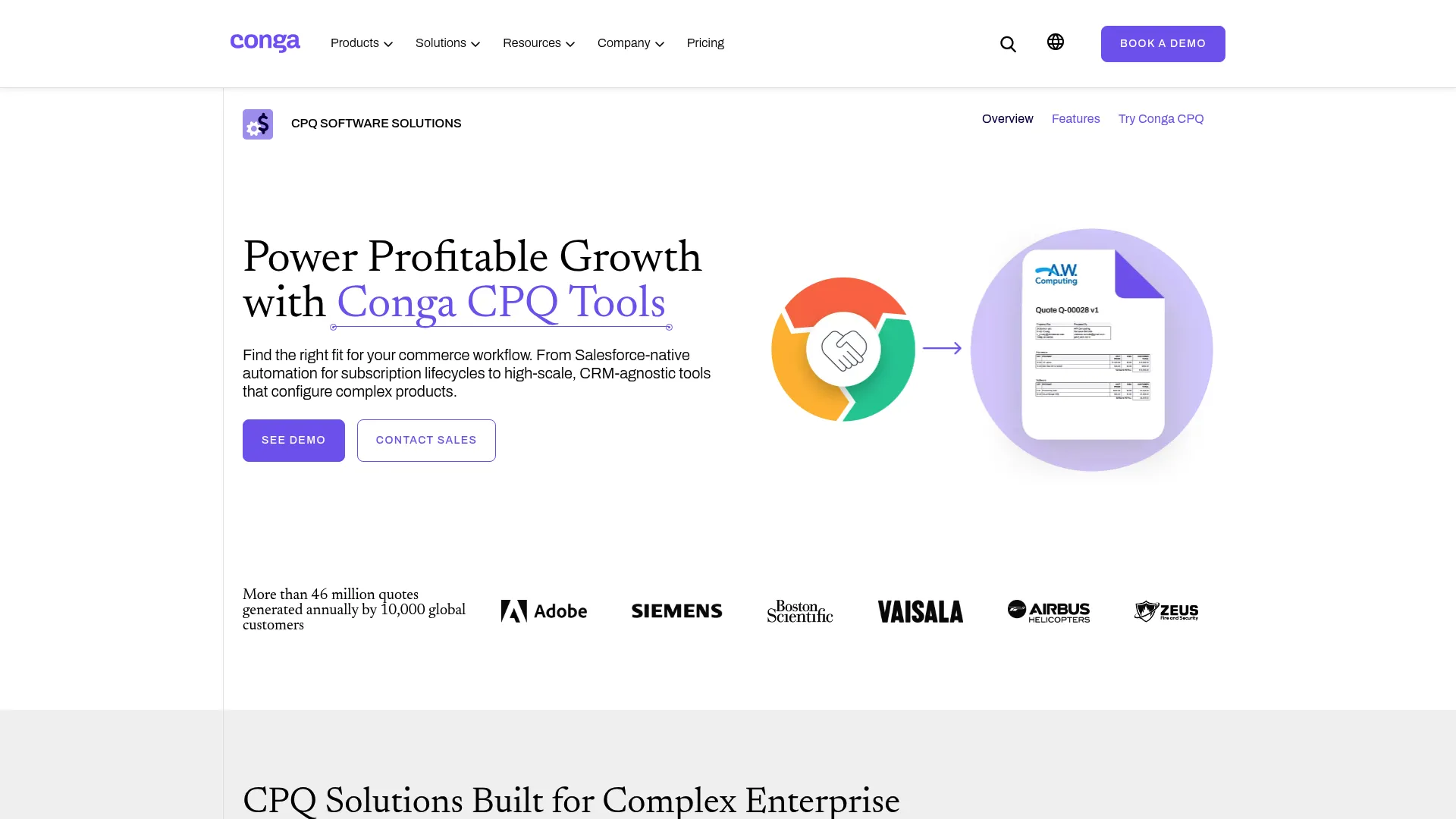
Conga CPQ is enterprise CPQ software for teams selling complex, configurable products and subscriptions. It handles guided configuration, product search, and rule-based pricing, then generates proposals and manages subscriptions and renewals downstream. This is built for deals where a rep could misconfigure a quote without guardrails.
The strength is governance. Conga layers pricing, discounting, and approval workflows on top of configuration, so quotes stay accurate and within policy even when the product logic is intricate. Teams with tiered discounts, dependent options, and multi-step approvals get the control that lighter quoting tools don't attempt. It makes sense over a simple quote builder when misconfiguration or margin leakage is a genuine risk.
Best for: B2B teams with complex quoting, layered pricing rules, and subscription lifecycles.
Key strengths
- Guided configuration and product search
- Pricing, discounting, and approval workflows
- Proposal generation from configured quotes
- Subscription and renewal management
Why choose Conga CPQ: Pick it when your quotes are genuinely complex and governance is non-negotiable. For simple SKU-based quoting, it's more machinery than you need.
Conga CPQ pricing: Conga does not publish public pricing; the vendor scopes pricing to your business and directs buyers to request a quote.
5. Zuora
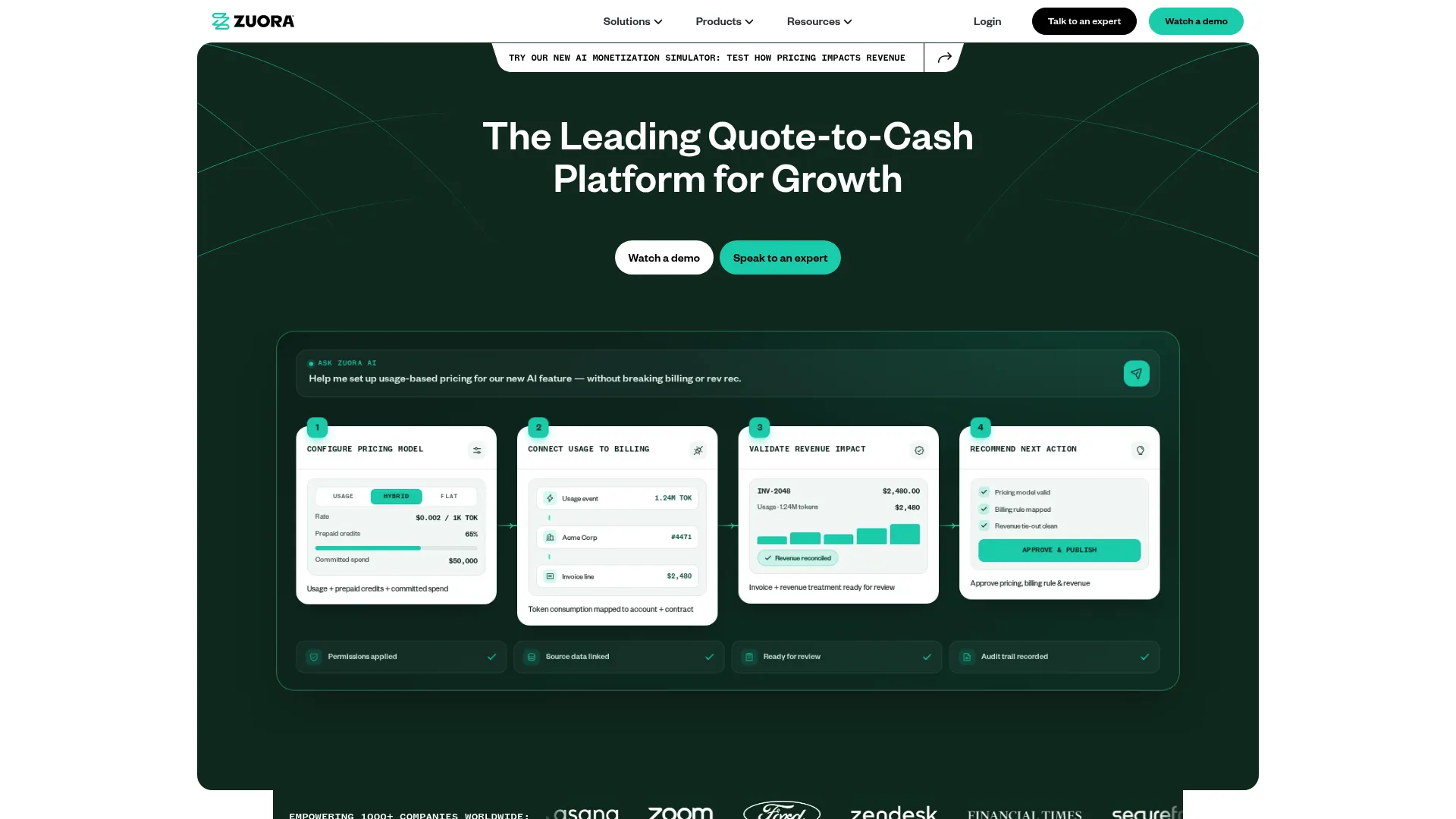
Zuora is an enterprise monetization platform built for recurring, usage-based, and subscription revenue. Quoting here isn't a standalone act; it's the front end of a subscription lifecycle that runs through billing and revenue recognition. If your pricing depends on usage, terms, and renewals, Zuora ties the quote directly to what gets billed.
The advantage is lifecycle alignment. Zuora connects usage pricing, quoting, billing, and revenue recognition so a discount or term change on the quote flows through to invoicing and collections without a manual reconciliation. Low-code SDKs and APIs handle the integrations into the rest of the stack. It's strongest for subscription-heavy businesses where the complexity lives in billing, not just in the quote.
Best for: Large businesses needing subscription billing and revenue recognition at scale.
Key strengths
- Usage pricing, quoting, billing, and revenue recognition in one platform
- Order-to-cash streamlining with billing and collections
- Discounting aligned to subscription terms and renewals
- Low-code SDKs and APIs for integration
Why choose Zuora: Choose it when the hard part of your revenue is subscription billing, not quote creation. For one-time or transactional sales, it's aimed at a different problem.
Zuora pricing: Zuora uses quote-based pricing and does not publish public rates; pricing is scoped through sales.
6. DealHub.io
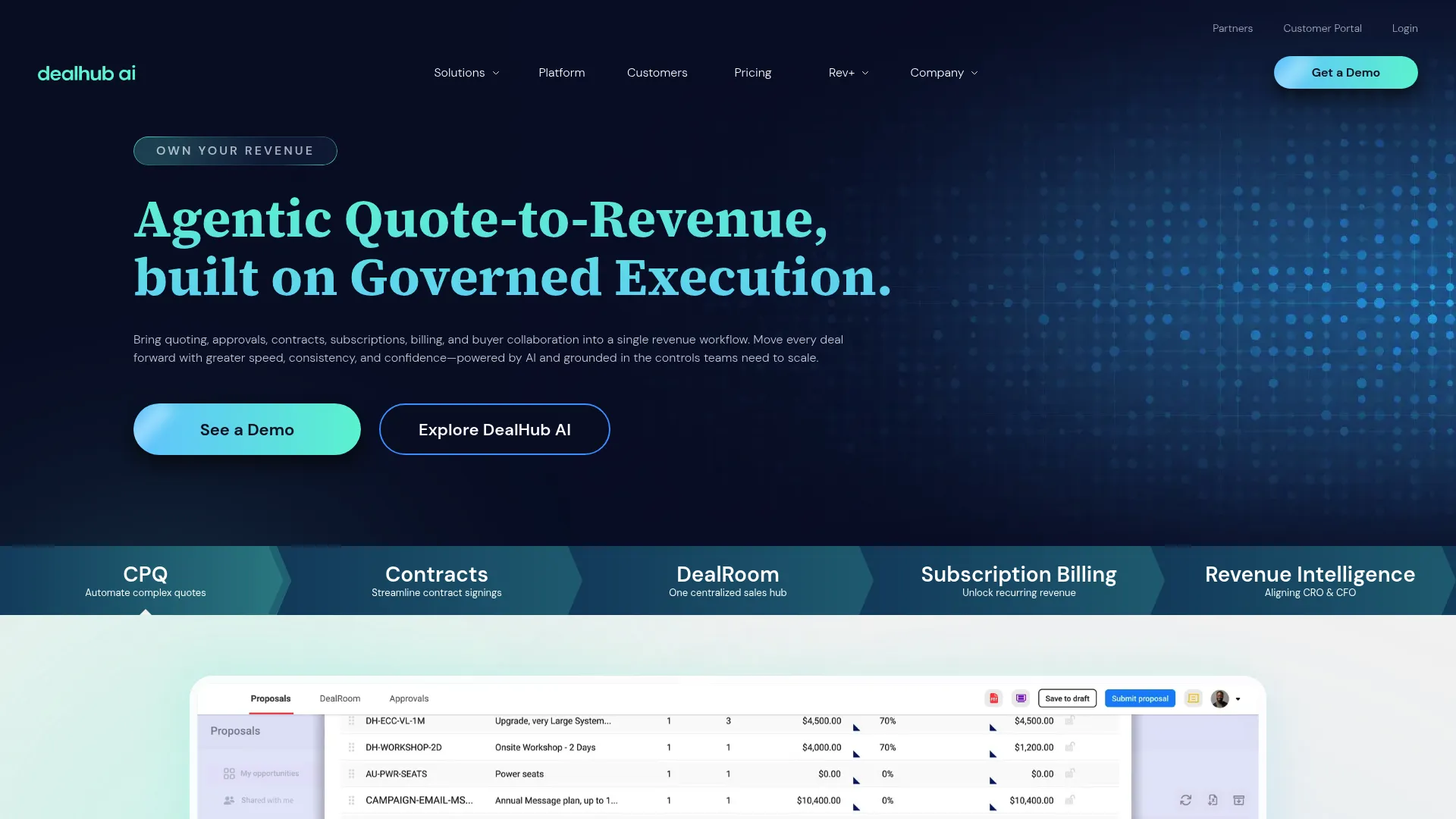
DealHub.io is a quote-to-revenue platform that delivers CPQ depth with a no-code approach to configuration. It covers guided selling, pricing rules, approvals, and quote creation, then extends into subscription management, billing, and revenue intelligence. The draw is CPQ capability without the heavy administrative overhead that enterprise CPQ can carry.
For revenue teams, DealHub sits well when you want guided selling and structured approval routing but don't want a months-long configuration project to stand it up. No-code configuration means the deal desk can adjust rules without a developer queue. It suits mid-market and enterprise teams that want the governance of CPQ and the agility to change it themselves.
Best for: B2B revenue teams needing an enterprise CPQ and quote-to-revenue platform without heavy admin.
Key strengths
- CPQ with guided selling, pricing rules, and approvals
- No-code configuration the deal desk can manage
- Subscription management with renewals and usage-based pricing
- Billing and revenue intelligence with forecasting
Why choose DealHub.io: Choose it when you want CPQ governance and quote-to-revenue coverage but need to configure and adjust without leaning on engineering.
DealHub.io pricing: DealHub does not disclose public pricing; the site directs buyers to request custom pricing or a demo.
7. Oracle CPQ
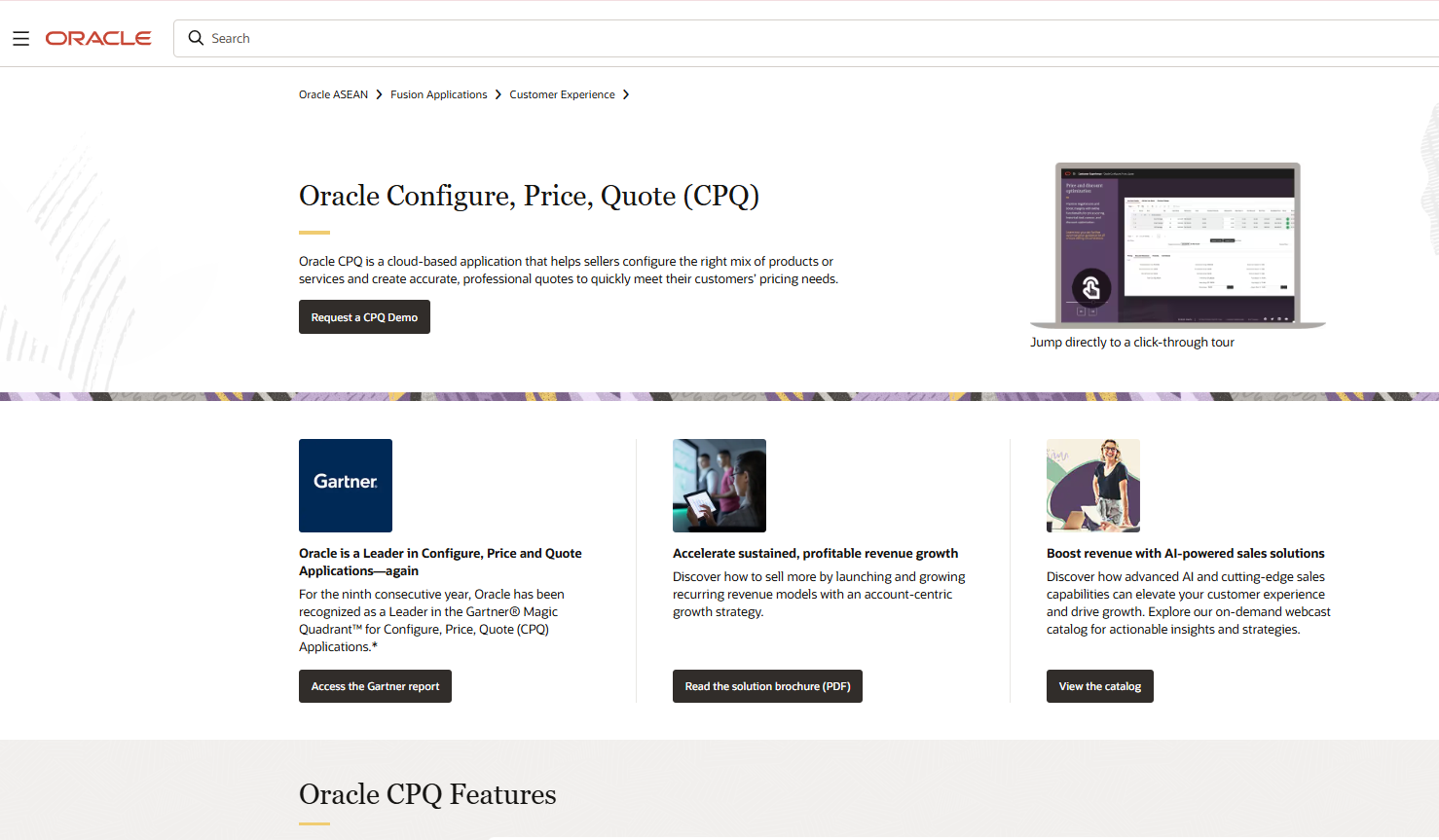
Oracle CPQ is enterprise-grade CPQ software for large, global teams with complex pricing structures. It handles guided selling, product configuration, real-time pricing, discounting, and approvals, then generates quotes and proposals with eSignature integration. Multilingual and multi-currency support make it a fit for organizations selling across regions.
The reason large enterprises reach for Oracle CPQ is scale and consistency. Dynamic pricing rules, templates, and clause management keep quotes accurate across markets, and the platform ties into broader revenue lifecycle processes. This is an enterprise commitment: implementation is a project, and the payoff is standardized configure-price-quote across a global sales org. Large enterprises dominate this space, representing 62.5% of quote management software revenue in 2025, per Future Market Insights (2024).
Best for: Enterprises needing complex configure-price-quote workflows and revenue lifecycle integration.
Key strengths
- Guided selling and product configuration
- Real-time pricing, discounting, and approvals
- Quote and proposal generation with eSignature
- Multilingual and multi-currency support
Why choose Oracle CPQ: Choose it when you sell globally at enterprise scale and need consistent pricing governance across regions, currencies, and languages.
Oracle CPQ pricing: Oracle's public global price list shows CPQ Cloud Service starting at $240/month, with add-ons such as CPQ Channel User at $35/month and the Salesforce connector at $5/month. Support is bundled into each subscription license.
8. Qwilr
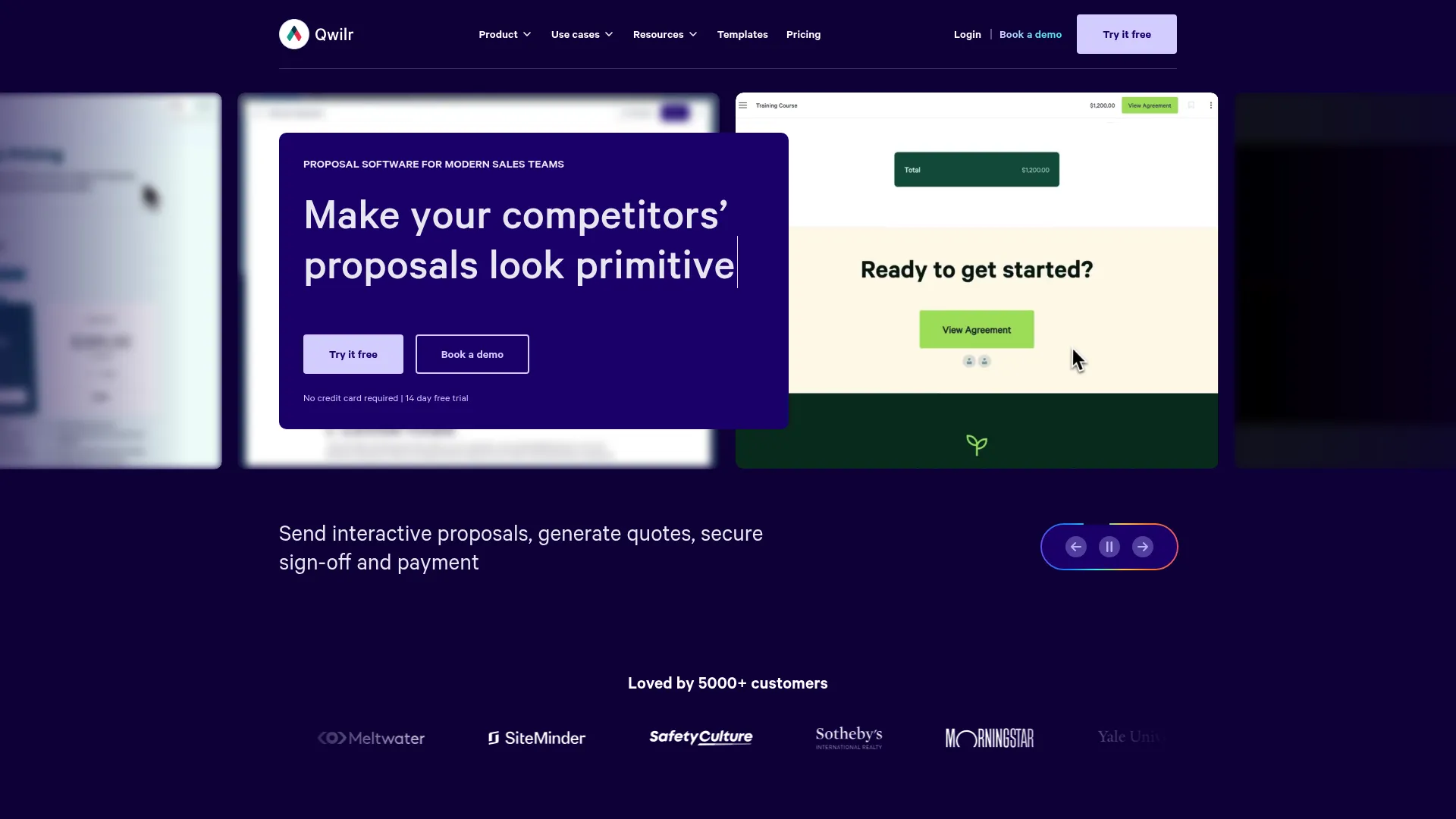
Qwilr turns quotes into web-based, interactive pages instead of static PDFs. For sales teams that care about presentation and speed, it makes a quote feel modern: on-brand pages with pricing, embedded video, and reusable content that buyers can actually engage with. It's proposal and quote software with eSignature and payments built in.
The differentiator is the buyer experience and the signal it generates. Qwilr tracks engagement, so reps see when a quote is opened and what the buyer looks at, then get alerts to follow up at the right moment. QwilrPay handles eSign and payment collection in the same page. It's a strong choice for teams that want quotes to feel less like paperwork and more like a polished, trackable experience.
Best for: Sales teams that need interactive proposals with eSign, payments, and engagement tracking.
Key strengths
- Interactive proposals with pricing, video, and reusable content
- eSignatures and payments via QwilrPay
- Buyer engagement tracking, alerts, and automation
- On-brand pages that replace static PDFs
Why choose Qwilr: Choose it when presentation and buyer engagement matter as much as pricing mechanics. It's lighter on deep CPQ configuration and heavier on the customer-facing experience.
Qwilr pricing: Starter is $35 per user/month with a 14-day free trial and one user. Growth is $55 per user/month on annual billing with a five-user minimum, and Scale is $75 per user/month on annual billing with a ten-user minimum.
Considerations
Pricing model
Quoting tools price in three patterns: per-seat, per-concurrent-user, and custom enterprise quotes. Per-seat scales with headcount; concurrent-user licensing, like QuoteWerks, suits teams where not everyone quotes at once. Always verify whether the listed price is monthly or annual, since annual billing often changes the number and the commitment.
CRM integration
Your quoting tool should read from and write to your CRM without manual re-keying. Salesforce, HubSpot, and Microsoft Dynamics integrations are table stakes, but depth varies: check whether the sync is two-way, whether it maps custom fields, and whether quote status flows back to the opportunity. Weak CRM integration recreates the data silos you're trying to escape.
Approval depth
Match approval depth to your governance reality. Simple discount thresholds routed to one approver are enough for many SMB teams. Enterprise deals with tiered discounts, non-standard terms, and legal review need multi-step, rule-based approval workflows. Buying more governance than you need slows reps down; buying less exposes margin.
Quote-to-cash support
Decide how far downstream you need the tool to reach. Some tools stop at quote creation and eSignature; others carry the transaction through billing, invoicing, and revenue recognition. If your complexity lives in subscription billing or usage-based revenue, prioritize full quote-to-cash coverage over quote creation alone.
Security and compliance
For mid-market and enterprise buyers, security review is a real gate. Look for SSO, audit trails, granular access controls, and documented data handling. Enterprise deals often require SOC 2 or ISO 27001 evidence before procurement signs off, so confirm compliance posture early rather than at the finish line.
Conclusion
The right quoting software depends on your sales motion, not on a feature count.
If you want centralized control and clean downstream handoffs, QuoteWerks is the practical pick. If your quotes double as your pitch, PandaDoc CPQ blends the quote builder and proposal into one document. Teams already committed to Salesforce should keep quote-to-cash on Salesforce Revenue Cloud. For genuinely complex, configurable deals, Conga CPQ and Oracle CPQ bring the configuration and governance depth, with Oracle suited to global, multi-currency scale. Subscription-heavy businesses should look at Zuora, where the quote connects directly to billing. DealHub.io fits teams that want CPQ depth without heavy admin, and Qwilr wins when the buyer experience and engagement tracking matter most.
Next step: name your biggest quoting bottleneck, whether it's turnaround, margin protection, approvals, or quote-to-cash, then shortlist the two tools above that attack it directly. Run a live quote through each with a real deal, not a demo dataset, and see which one moves faster from verbal yes to signed.
FAQs
Quoting software helps teams create, price, and send quotes quickly from a central system. CPQ software adds a configuration layer for complex or configurable products, applying rules and dependencies before pricing. Choose CPQ when reps could misconfigure a deal or when pricing changes by product, term, region, or volume.
Not always at first. If your pricing is fixed and you send a few quotes a week, a template may be enough. Manual quoting starts to break when volume rises, discounts need approval, or pricing errors start costing margin. That's the point where a simple quote builder pays for itself.
It depends on complexity and integrations. A lightweight quoting tool or quote builder can be live in days, especially with a standard CRM integration. Full CPQ software with rule-based configuration, deep approval workflows, and ERP integration is a project measured in weeks or months, since it touches pricing logic and multiple systems.
Yes, and integration depth is one of the biggest buying criteria. Most tools connect to Salesforce, HubSpot, and Microsoft Dynamics, and many offer accounting and ERP integration for downstream billing. Check whether the CRM integration is two-way, whether it maps your custom fields, and whether quote status syncs back to the opportunity.
Templates, pricing controls, approval workflows, eSignature, and version control do the heavy lifting. Templates speed quote creation, pricing controls protect margin, approvals route deals without stalling, eSignature closes them, and version control keeps one source of truth. Each feature maps to a business outcome: faster turnaround, fewer errors, and cleaner governance.
Centralize pricing so reps quote from an approved catalog, not a copied spreadsheet. Add approval workflows that flag out-of-policy discounts before the quote reaches the buyer. Standardize templates so every quote follows the same structure. Together, these three moves eliminate most manual quoting mistakes.
Start with workflow fit: does it match how your reps already sell? Then weigh speed of quote turnaround, approval depth against your governance needs, CRM integration quality, and how far the tool carries quote-to-cash. Security and compliance matter early for mid-market and enterprise buyers facing procurement review.
They overlap but aren't identical. Quoting software focuses on pricing, approvals, and accurate quotes. Proposal software focuses on the customer-facing document and presentation. Some tools, like PandaDoc CPQ and Qwilr, blend both, pairing a quote builder with polished, trackable proposals and eSignature in one workflow.