Hiring teams rarely need more applicants. They need better evidence before interviews consume recruiter and manager time.
Resumes reward polished presentation. Unstructured interviews often reward confidence. Manager scorecards can drift when each interviewer interprets readiness differently.
Pre-employment testing software gives teams a structured way to assess skills, judgment, aptitude, and role fit earlier. According to Survale's 2025 research, 53% of surveyed employers used pre-employment assessments or selection tests.
That matters for enablement leaders involved in sales hiring. An SDR writing exercise or AE discovery scenario can reveal readiness gaps before onboarding begins.
The hard part is choosing candidate screening tools that fit the role without creating irrelevant hurdles. You also need clear scoring, a fair candidate experience, and evidence managers can use responsibly.
What’s inside
This guide compares 16 pre hire assessment tools for recruiting teams, hiring managers, People Ops, and enablement leaders supporting sales hiring.
The shortlist covers:
- Skills, aptitude, technical, behavioral, and personality assessments
- Work samples, job simulations, video interviews, and gamified assessments
- Buyer criteria covering role fit, reporting, candidate experience, and workflow alignment
- Current pricing details and G2 ratings where verified
- Practical examples for SDR, AE, sales manager, and customer-facing roles
Tools were selected for assessment relevance, scoring depth, candidate experience, hiring workflow fit, and buyer visibility.
TL;DR
- Best overall for broad testing: TestGorilla covers many job families with 350 plus science-backed tests
- Best for cognitive and behavioral signal: Criteria combines validated assessments with structured interviewing
- Best technical skills testing software: TestDome offers work samples across 130 plus skills
- Best for practical work samples: Vervoe evaluates candidates through job-related tasks and automated grading
- Best structured video screening: VidCruiter supports interview guides, rating rubrics, scheduling, and recorded interviews
- Best simple online testing platform: ClassMarker supports custom tests, automatic grading, access controls, and certificates
What is pre employment testing software?
Pre employment testing software helps employers assess candidates before hire through structured tests, work samples, job simulations, or video interviews.
These platforms standardize part of the evaluation process before interviews or offers. Hiring teams can compare candidates against defined role criteria instead of relying only on resumes and conversation.
Good hiring assessment software supports human decisions rather than making the final choice. Recruiters and managers still need structured interviews, reference information, and appropriate professional judgment.
For sales enablement teams, assessment data can also shape onboarding. A candidate who shows strong discovery judgment but weaker product learning may need a different ramp plan.
Common assessment types
- Skills tests: Role-specific abilities, software fluency, writing, or sales scenarios
- Cognitive ability tests: Reasoning, problem-solving, and learning speed
- Personality assessments: Work style, behavioral tendencies, or workplace preferences
- Situational judgment tests: Decisions within realistic workplace situations
- Technical assessments: Coding, data analysis, spreadsheets, or domain knowledge
- Work samples: Practical tasks that resemble the target job
- Video assessments: Structured responses, presentation skills, or communication
- Gamified assessments: Candidate evaluation through game-based tasks
A sales hiring process might combine a writing test with a discovery scenario. An engineering process may prioritize coding work samples and technical reasoning instead.
Core features to look for
- Test libraries and role templates
- Custom assessment builders
- Structured scoring rubrics
- Candidate communications
- Anti-cheating and proctoring controls
- Assessment scoring and reporting
- Validity evidence and audit records
- Applicant tracking system integrations
- Accessibility and accommodation workflows
The right feature set depends on what the job requires. Avoid collecting assessment data that managers cannot connect to role performance.
When to use pre employment testing software
Screen high-volume applicant pools
Use pre-employment assessment software when resume review creates a bottleneck. A short, job-related screen can help recruiters segment applicants before scheduling interviews.
Keep the test close to the work. Unrelated hurdles increase candidate effort without adding useful hiring signal.
Validate role readiness before interviews
Skills testing software helps managers examine specific capabilities before investing interview time. Sales teams can assess written communication, discovery judgment, objection handling, or learning agility.
The results can also improve the candidate-to-ramp handoff. Enablement teams gain an early view of common readiness gaps across a hiring cohort.
Standardize hiring decisions across teams
Structured assessments give interviewers a shared evidence source. That can reduce manager-by-manager scoring differences when several departments hire for the same role.
Use scores alongside structured interviews and human review. A test should inform the decision, not make it automatically.
Pre employment testing software comparison
The table below compares 16 employment testing software platforms by use case, differentiation, pricing, and G2 rating.
Prices reflect verified vendor information from November 2026. Quote-based entries require a conversation with the vendor. G2 ratings appear only where a current listing was confirmed.
| # | Product | Best for | Key differentiator | Pricing | G2 rating |
|---|---|---|---|---|---|
| 1 | TestGorilla | Broad candidate screening | 350 plus science-backed tests | Free plan, Core from $215 monthly per account, billed annually | 4.5/5 |
| 2 | Criteria | Cognitive and behavioral assessment | Validated assessments plus structured interviews | Custom pricing | 4.4/5 |
| 3 | HiPeople | Assessments with reference checks | 400 plus validated tests and reference workflows | Contact HiPeople for a quote | 4.6/5 |
| 4 | eSkill | Customized role testing | 70,000 plus questions across 600 plus subjects | Custom annual pricing | 4.5/5 |
| 5 | Wonderlic | Cognitive and role-fit insight | Cognitive, personality, and motivation measures | Custom pricing | 4.2/5 |
| 6 | TestDome | Technical and practical screening | Work samples with automated scoring | From $20 per candidate | 4.6/5 |
| 7 | Vervoe | Work-sample assessment | Interactive job tasks with automated grading | Custom pricing | 4.6/5 |
| 8 | HR Avatar | Job simulations | Assessments, interviews, and reference checks | From $50 per candidate credit | N/A |
| 9 | EmployTest | Straightforward employment tests | Credit-based catalog with 200 plus assessments | From $229 for five credits | N/A |
| 10 | Prevue Assessments | Job-fit profiles | Aptitude, motivation, and personality reporting | From $195 monthly | N/A |
| 11 | VidCruiter | Structured video interviewing | Interview guides and rating rubrics | Custom pricing | N/A |
| 12 | Spark Hire | Collaborative video screening | Video interviews with recruiting workflows | From $249 monthly, billed annually | 4.7/5 |
| 13 | Pulsifi | Talent analytics | Role-fit analytics and predictive hiring | From $2,800 yearly | 4.2/5 |
| 14 | The Talent Games | Gamified hiring | Game-based cognitive and situational assessment | Contact The Talent Games for a quote | 4.1/5 |
| 15 | ClassMarker | Custom online tests | Secure test delivery and automatic grading | 30-day free trial, paid pricing by quote | 4.4/5 |
| 16 | ProProfs Quiz Maker | Simple knowledge assessments | AI-assisted quiz creation and reporting | Free plan, paid from $19.99 monthly | 4.4/5 |
Best 16 tools for pre employment testing software
1. TestGorilla
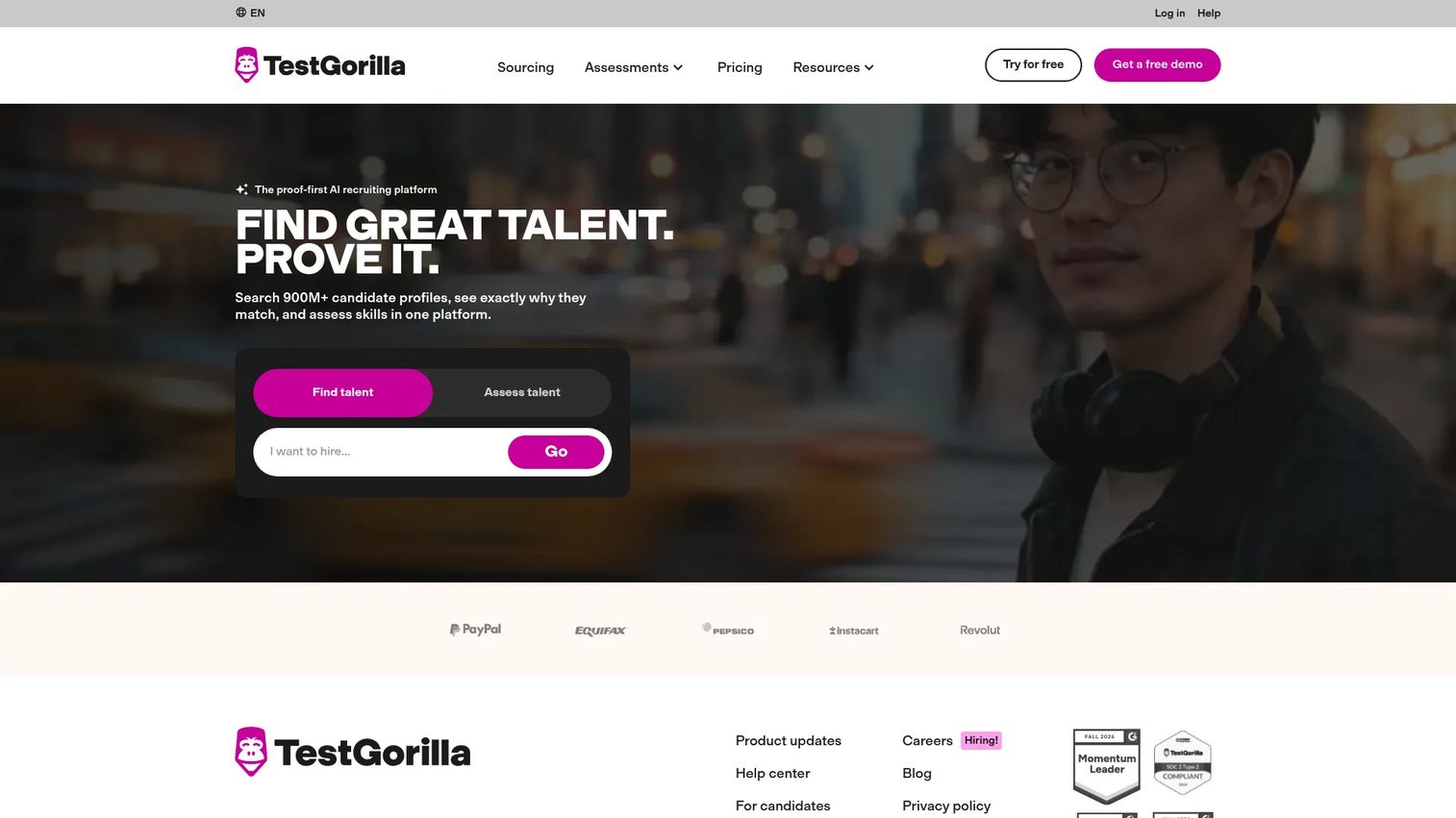
TestGorilla combines candidate sourcing with broad pre-employment assessment software. Its library contains more than 350 science-backed tests covering skills and job-related capabilities.
Hiring teams can add qualifying questions, video responses, and resume scoring. The breadth suits companies recruiting across several departments rather than one specialist function.
Best for: Recruiting teams that need broad test coverage across many job families.
Key features
- 350 plus science-backed skills tests
- AI interviews and video questions
- Resume scoring and qualifying questions
- Custom assessment creation
- Candidate ranking and ATS integrations
Why choose TestGorilla: Choose it when speed and test-library breadth matter. Sales teams can assess writing, reasoning, or role knowledge before managers begin interviews.
The platform also suits centralized recruiting operations supporting several hiring managers. Standardized tests can create a shared starting point before each team applies its interview process.
TestGorilla pricing: Free assessment and sourcing plans are available. Assessment Core starts at $215 monthly per account, billed annually, while Plus starts at $520.
Sourcing Core costs $74 monthly per seat. Sourcing Plus costs $134 monthly per seat, with both billed annually.
G2 rating: 4.5/5
2. Criteria
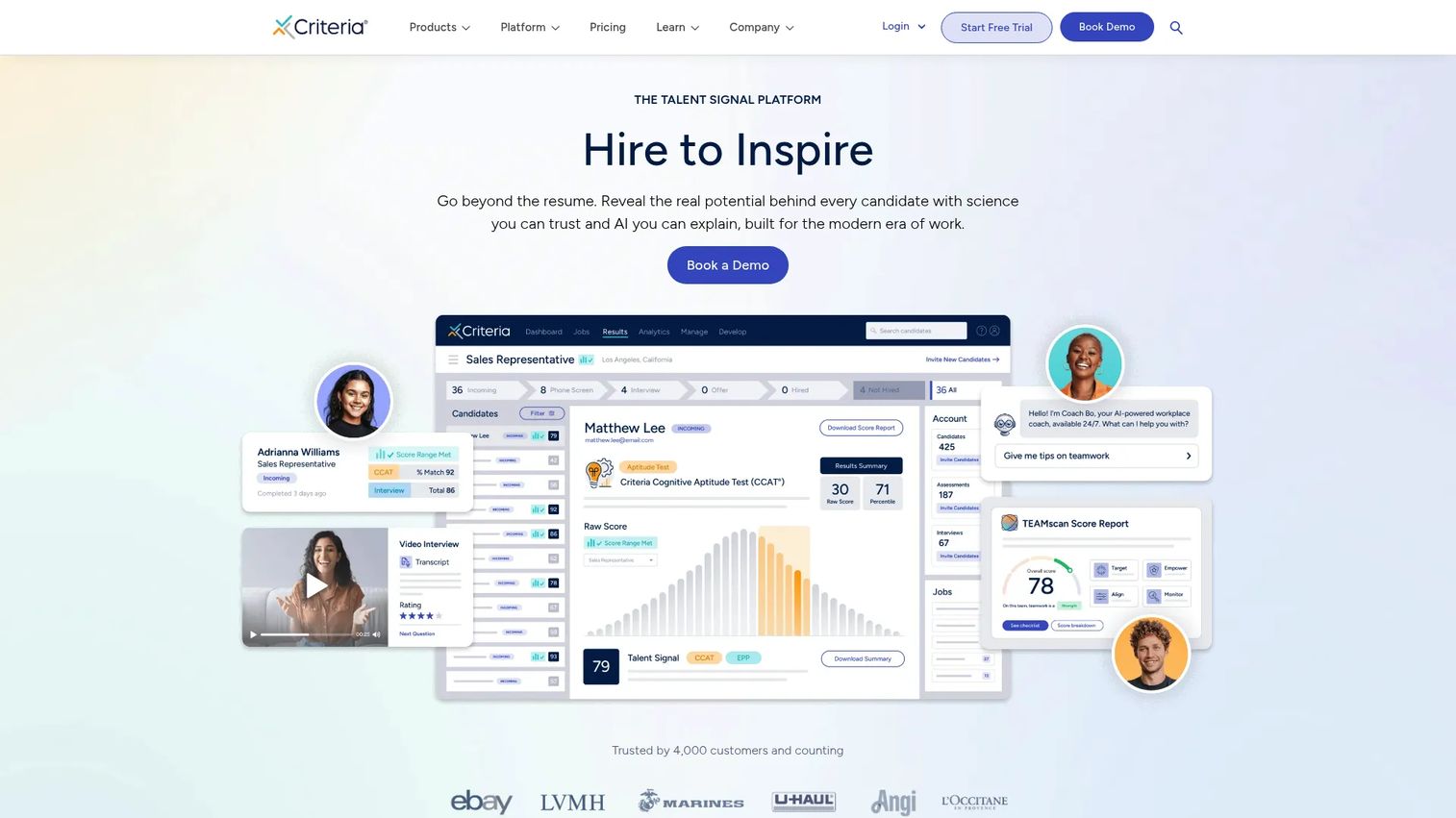
Criteria offers cognitive aptitude, personality, emotional intelligence, risk, and skills assessments. It also provides asynchronous and real-time video interviewing.
The platform focuses heavily on assessment science and structured hiring signal. Mobile-friendly and game-based formats can support candidate experience across different applicant groups.
Best for: Organizations seeking cognitive and behavioral assessments with stronger validity framing.
Key features
- Cognitive aptitude and personality assessments
- Emotional intelligence and risk measures
- Structured video interviewing
- Mobile-friendly adaptive assessments
- Reporting, analytics, SSO, and ATS integrations
Why choose Criteria: Choose Criteria when managers need consistent evidence before interviews. Its cognitive ability tests can help evaluate learning agility for sales roles with complex products.
Interview capabilities also let recruiting teams connect assessment results with structured follow-up questions. That connection can help managers discuss evidence instead of relying on broad impressions.
Criteria pricing: Criteria Assess, Interview, and Hire use custom pricing. Criteria Develop and AI capabilities are available as add-ons or upgrades.
G2 rating: 4.4/5
3. HiPeople
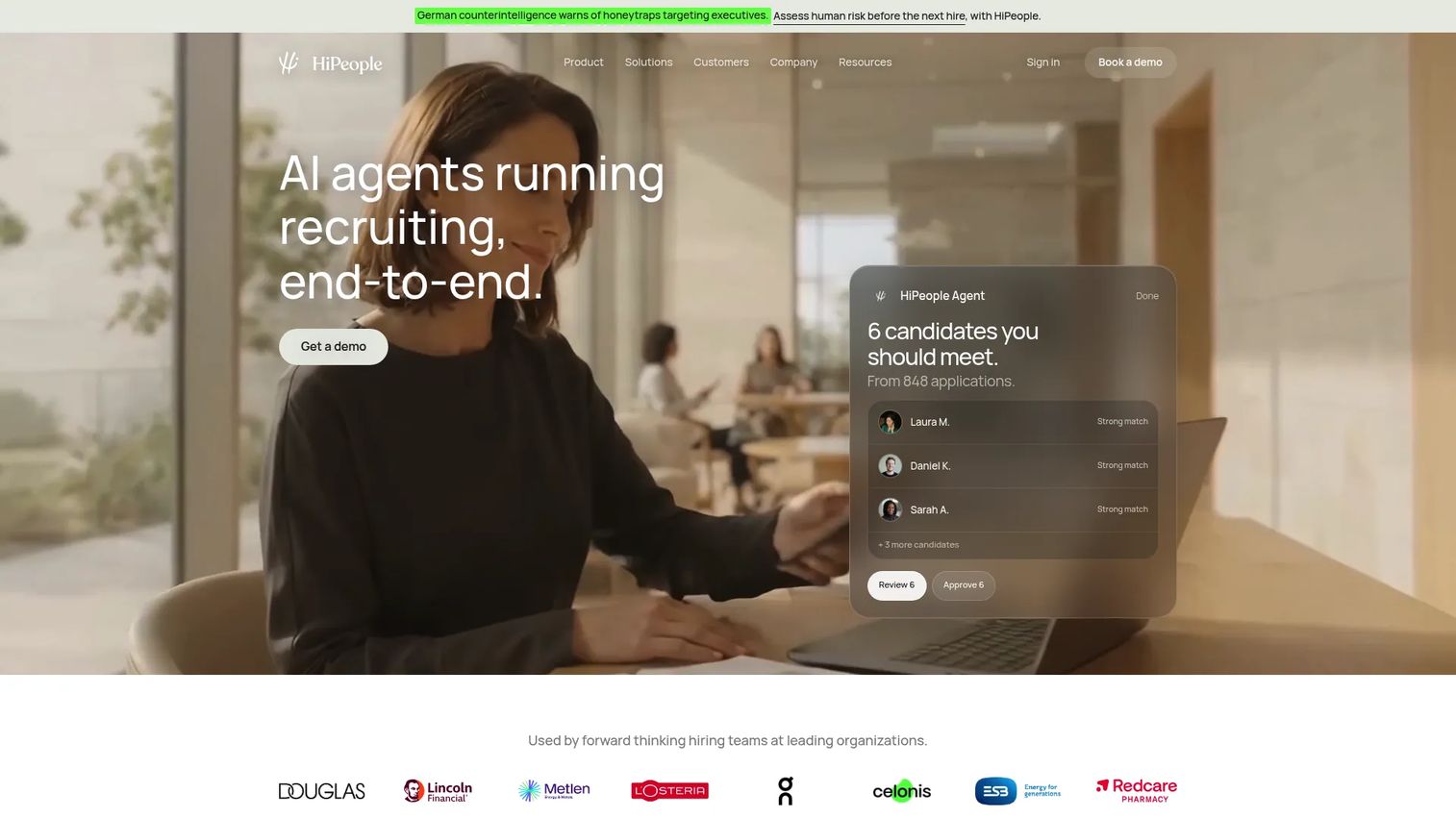
HiPeople combines application screening, candidate assessments, AI interviews, interview notes, and reference checks. Its assessment library includes more than 400 validated tests.
Hiring teams can use 15 question types and create custom tests. Multilingual assessment support can help companies recruiting across regions.
Best for: Teams wanting candidate assessments and reference insights within one workflow.
Key features
- 400 plus validated tests
- 15 assessment question types
- AI-assisted candidate interviews
- Automated reference checks
- Multilingual and custom assessments
Why choose HiPeople: Choose HiPeople when recruiters need more context than one test score provides. Assessment results and structured references can give managers different evidence before making a decision.
This combination may suit enablement leaders supporting sales hiring. Recruiters can examine role readiness while references provide context about previous performance patterns.
HiPeople pricing: Contact HiPeople for a quote. A first-party plan structure or starting price was not available in the verified research.
G2 rating: 4.6/5
4. eSkill
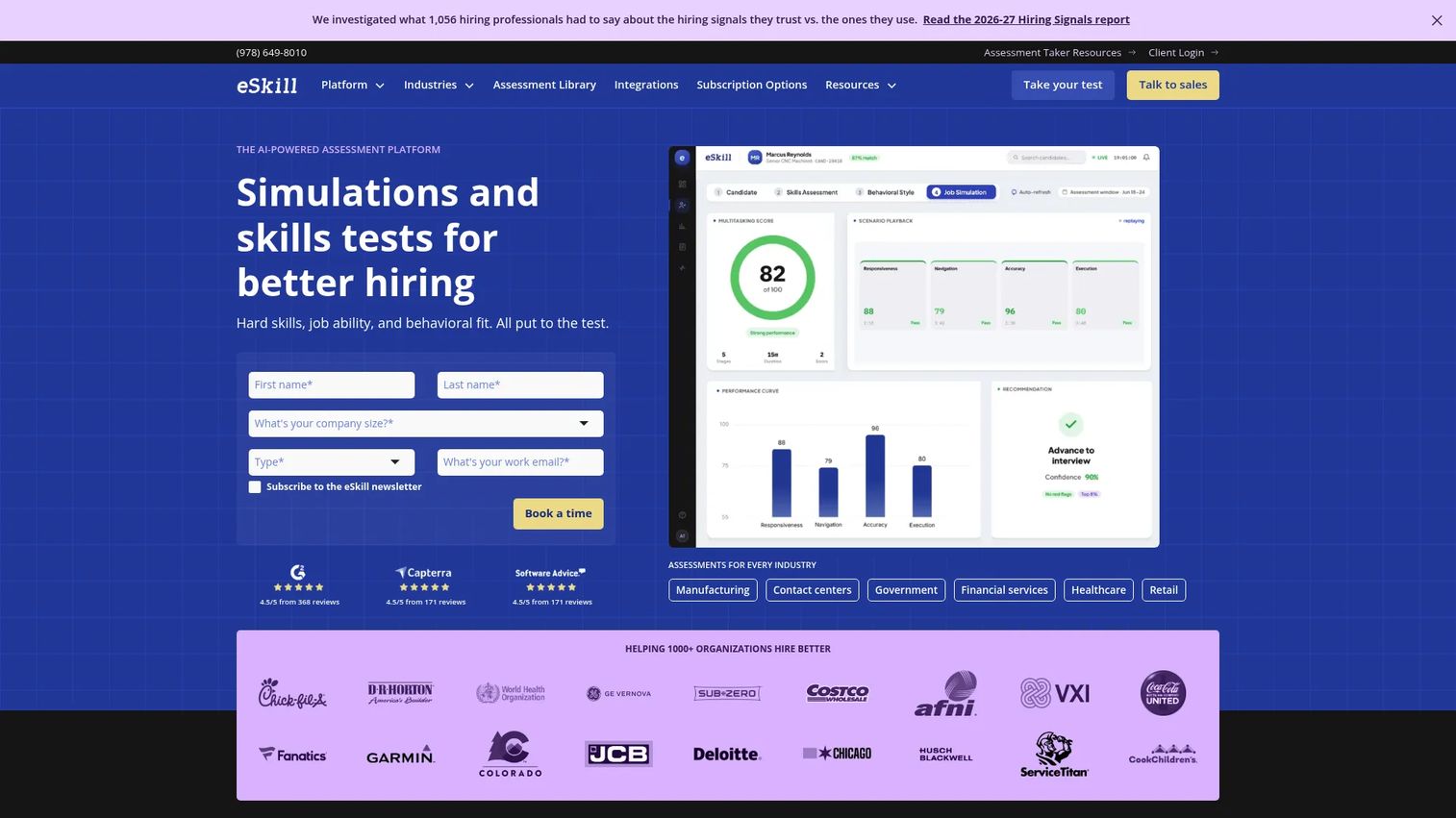
eSkill provides customizable skills testing software for hiring and workforce assessment. Its library contains more than 70,000 questions covering over 600 subjects.
Teams can combine library content with custom questions and job-based configurations. Available assessment types include behavioral tests, cognitive aptitude measures, simulations, and one-way interviews.
Best for: Organizations that need assessments closely matched to specific job requirements.
Key features
- 70,000 plus assessment questions
- Coverage across 600 plus subjects
- Custom mix-and-match tests
- Video responses and one-way interviews
- Proctoring controls and ATS integrations
Why choose eSkill: Choose eSkill when standard tests feel too broad for your roles. Hiring managers can build role-specific assessments around tasks candidates will perform.
For sales hiring, that could mean combining product comprehension with written responses or customer scenarios. The same platform can support later internal skill validation.
eSkill pricing: Growth supports up to 500 candidates annually. Scale supports up to 1,000, while Custom serves higher volumes through annual subscriptions.
Contact eSkill for a quote.
G2 rating: 4.5/5
5. Wonderlic
Wonderlic provides science-backed talent assessments for hiring and employee development. Wonderlic Select measures cognitive ability, personality, and motivation.
Candidate comparison reports use measurable, job-relevant data. Structured interview guides help managers turn results into consistent follow-up questions.
Best for: Organizations using cognitive and workplace behavior assessments at scale.
Key features
- Cognitive ability testing
- Personality and motivation measures
- Job-specific candidate insights
- Structured interview guides
- Employee development support
Why choose Wonderlic: Choose Wonderlic when managers need comparable role-fit information without interpreting raw psychometric data alone. Its reporting can support shared calibration across interviewers.
For sales hiring, cognitive measures may help assess learning demands. Personality and motivation information can add context when paired with role-based interviews.
Wonderlic pricing: Custom pricing depends on the package, employee count, and organizational requirements. Packages include implementation, training, and ongoing support.
G2 rating: 4.2/5
6. TestDome
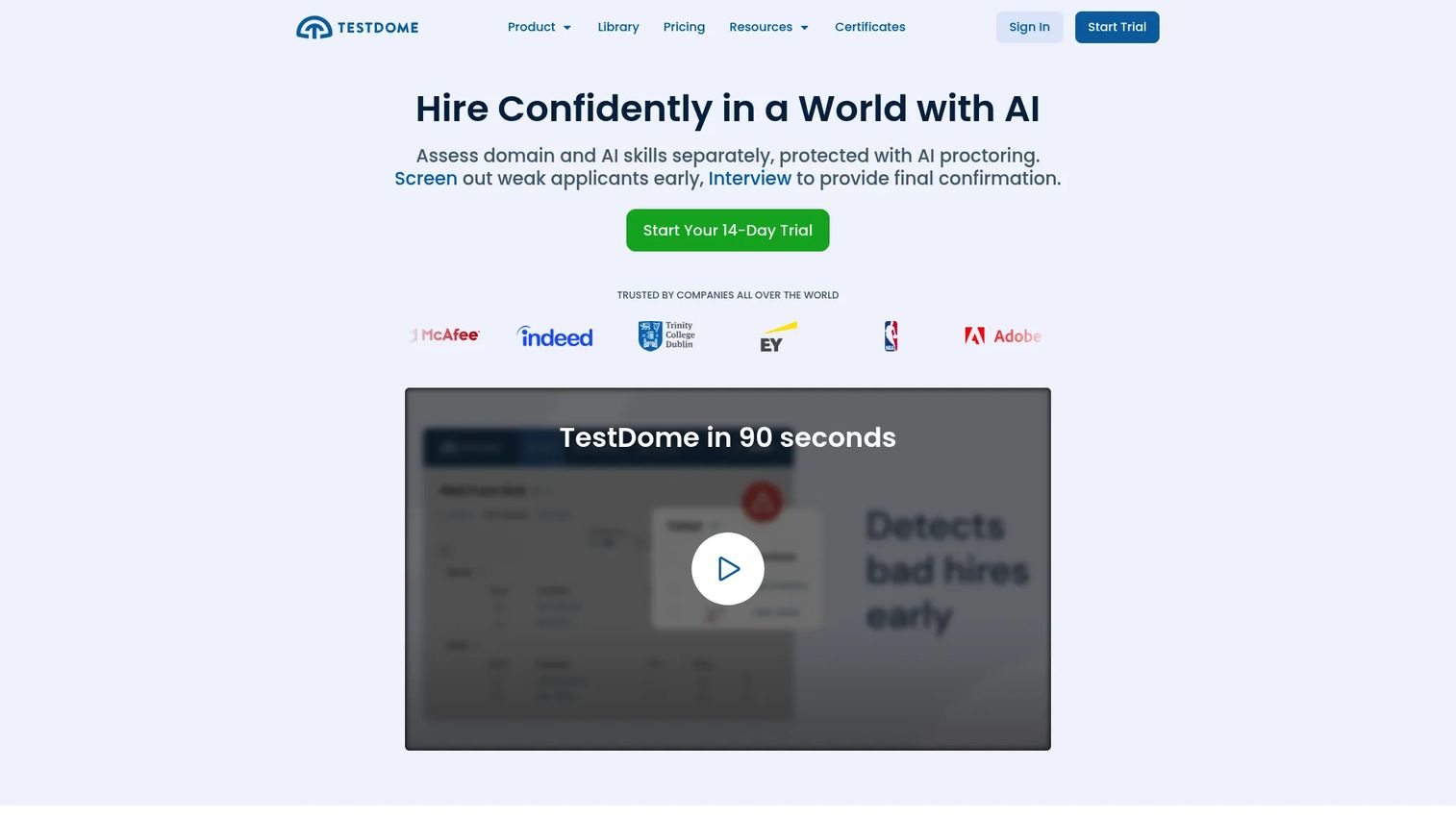
TestDome provides practical work-sample assessments and collaborative coding interviews. Its library covers more than 130 skills through over 2,000 questions.
The platform supports technical and nontechnical hiring across programming, data, finance, and customer service. Automated scoring helps recruiters compare candidates before specialist interviews.
Best for: Teams hiring technical, analytical, or skills-heavy roles.
Key features
- 2,000 plus assessment questions
- Coverage across 130 plus skills
- Automated work-sample scoring
- Webcam and screen proctoring
- Collaborative coding interviews
Why choose TestDome: Choose TestDome when practical skill evidence matters more than resume claims. Candidate comparisons include skill breakdowns and downloadable reports.
Its pay-per-candidate model also suits teams with variable hiring volumes. Packs do not expire, which reduces pressure to use credits within a subscription period.
TestDome pricing: Starter costs $100 for five candidates. Larger prepaid packs reduce the rate from $20 to as little as $7 per candidate.
All public packs include the platform's features. Enterprise plans use custom pricing.
G2 rating: 4.6/5
7. Vervoe
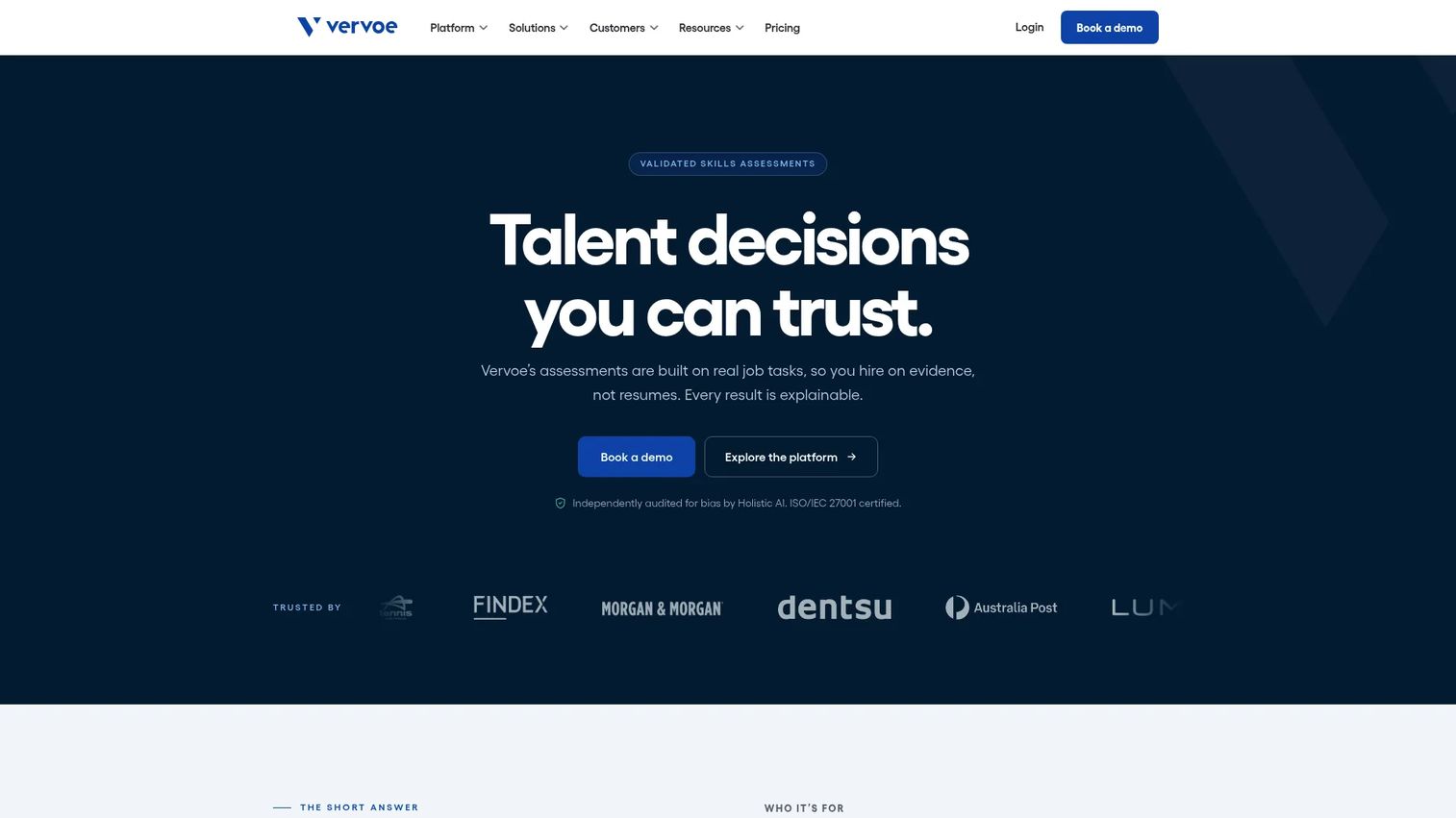
Vervoe evaluates candidates through job-related tasks rather than resume screening alone. Interactive formats include video, audio, coding, spreadsheets, presentations, and file uploads.
The platform can generate role-specific assessments from job descriptions. Automated grading and candidate ranking help hiring teams process larger applicant pools consistently.
Best for: Enterprise or high-volume teams using practical work-sample assessments.
Key features
- Role-specific assessment generation
- Automated grading and ranking
- Video, audio, and coding tasks
- Spreadsheets and presentation exercises
- Assessment analytics and candidate feedback
Why choose Vervoe: Choose Vervoe when managers want to see how candidates perform representative tasks. This approach works well for sales writing exercises or customer-facing presentation assessments.
Explainable scoring can support manager review, while integrity checks help protect assessment quality. Integrations cover applicant tracking, HR systems, APIs, and workflow automation.
Vervoe pricing: Custom enterprise pricing applies. Contact Vervoe for a quote.
G2 rating: 4.6/5
8. HR Avatar
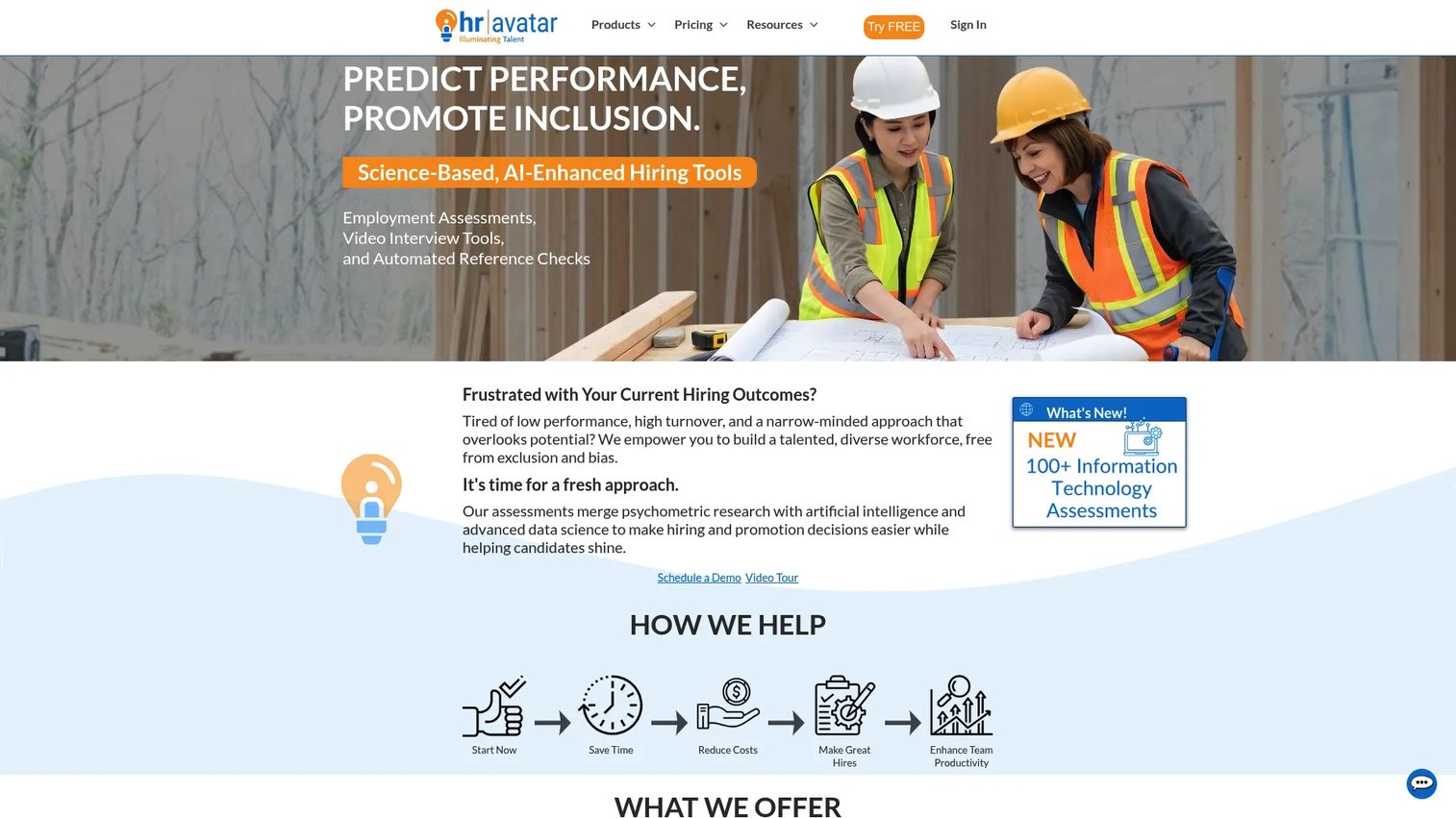
HR Avatar combines employment assessments, video interviews, reference checks, and remote proctoring. Its assessment approach includes job simulations and science-backed candidate screening.
A custom test builder gives teams control over role content. Advanced reports collect results into a format recruiters and hiring managers can review together.
Best for: Teams seeking job simulations with interviews and reference checks.
Key features
- Science-backed employment assessments
- Recorded and live video interviews
- Automated reference checks
- Remote assessment proctoring
- Custom tests and advanced reporting
Why choose HR Avatar: Choose HR Avatar when communication and decision-making need to appear within the same evaluation. Simulations can resemble role situations more closely than isolated questions.
For a sales role, that could mean assessing judgment alongside a recorded response. Credits also cover multiple screening activities for each candidate during a 90-day period.
HR Avatar pricing: One candidate credit costs $50. Packs range from $350 for ten credits to $12,300 for 500 credits.
Unlimited and enterprise packages use custom pricing.
9. EmployTest
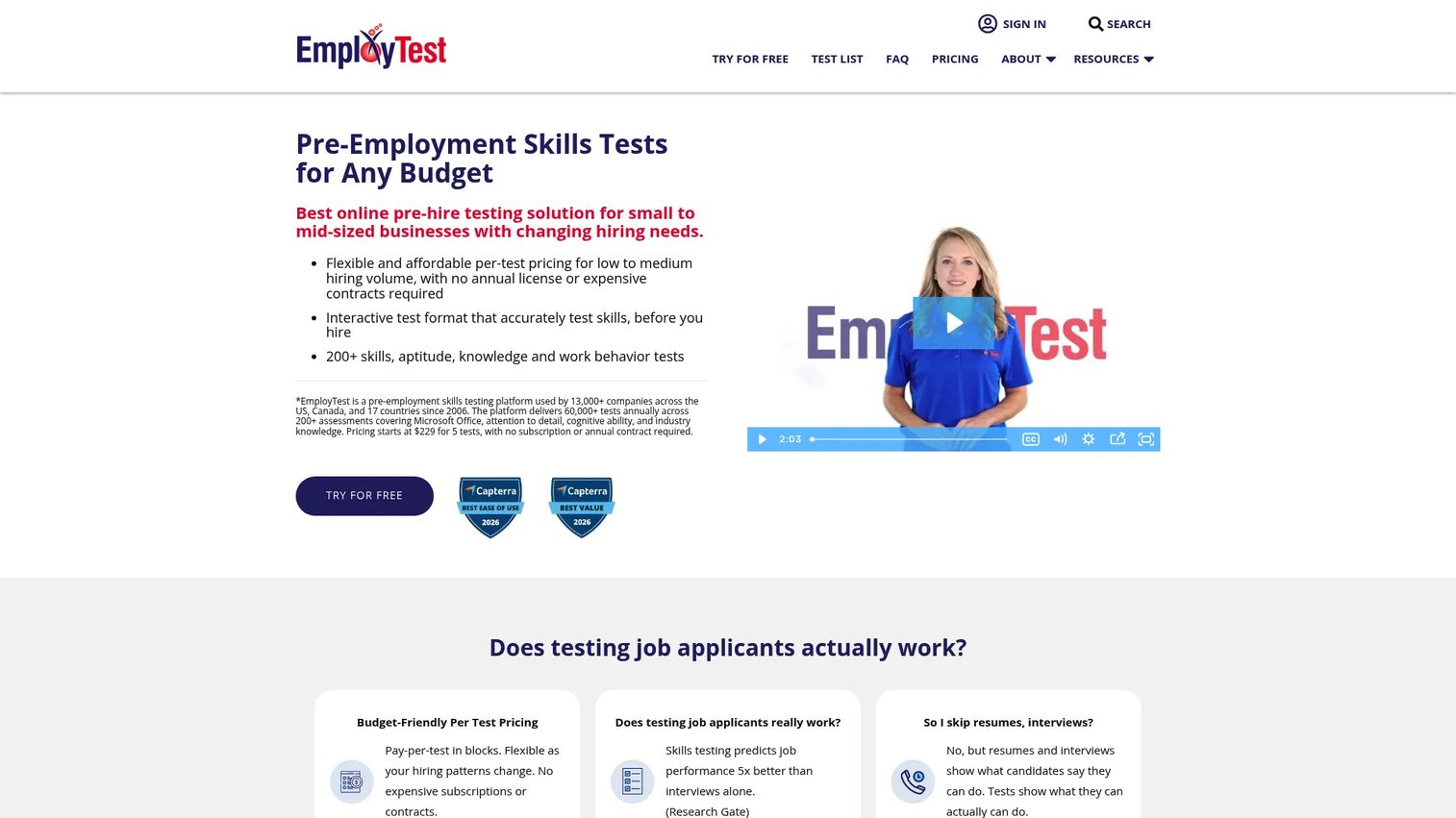
EmployTest offers more than 200 assessments across job skills, aptitude, behavior, software knowledge, and industry topics. Recruiters can send tests by email and receive automatically scored reports.
The platform also supports custom assessments built from job descriptions. Interactive computer-skills simulations cover software-based work.
Best for: Small and midsize teams needing straightforward employment tests.
Key features
- 200 plus pre-employment assessments
- Job-description-based custom tests
- Microsoft Office skills simulations
- Automatic scoring and reports
- Percentile rankings and interview recommendations
Why choose EmployTest: Choose EmployTest when you need common assessments without a broad system rollout. Credit packs suit employers with defined or intermittent hiring demand.
Reports include percentile rankings and follow-up recommendations. Those outputs can help managers move from a score into more structured interview questions.
EmployTest pricing: Packs start at $229 for five credits. Ten credits cost $349, while 25 cost $599.
A 100-credit pack costs $1,999. Annual licenses cover employers running at least 500 tests yearly.
10. Prevue Assessments
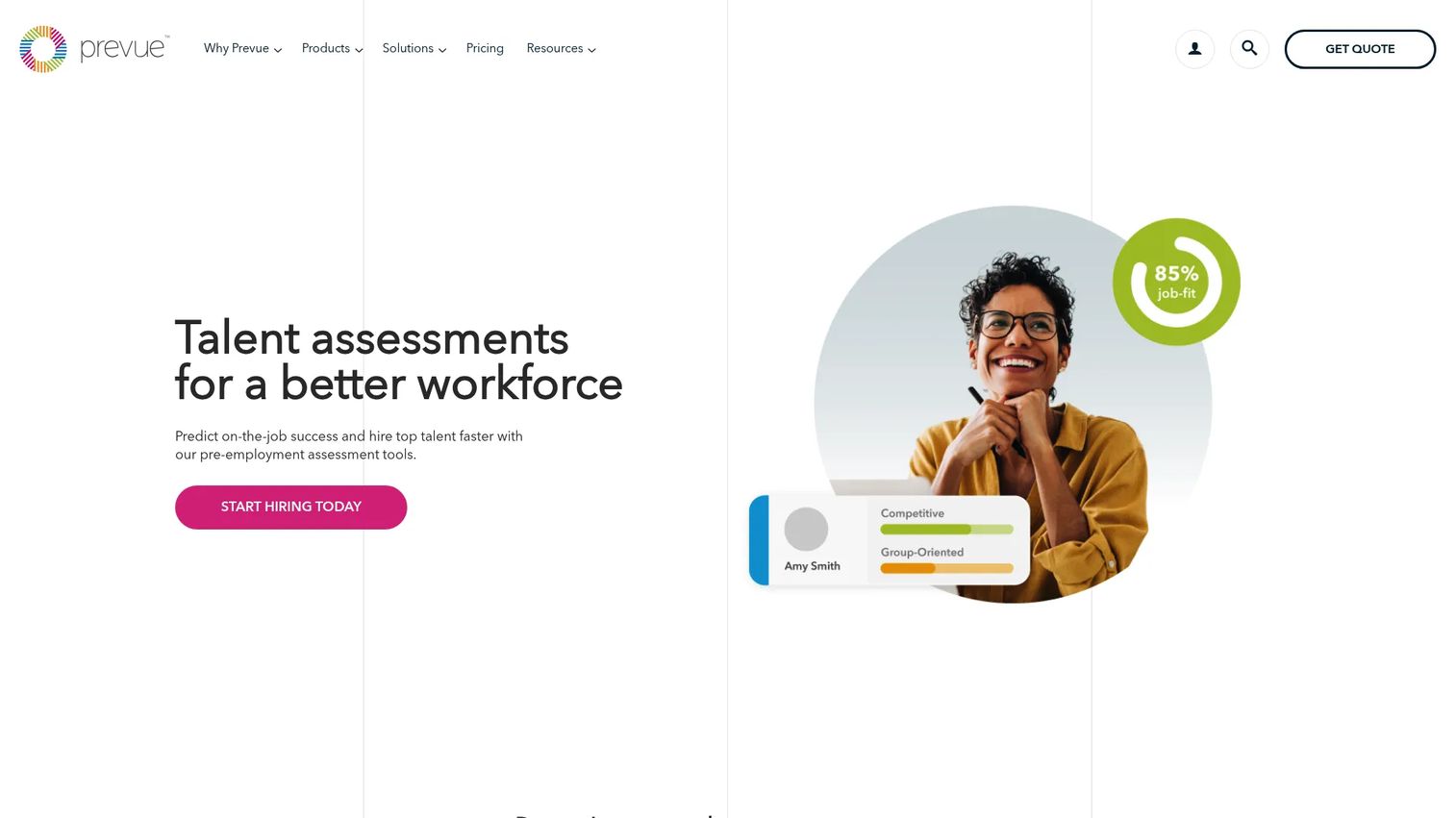
Prevue Assessments measures aptitude, motivation, personality, workplace culture, work ethic, and skills. Its aptitude component covers words, numbers, shapes, and learning speed.
Custom job benchmarking connects candidate results with role expectations. Job-Fit reports give hiring managers a structured view for comparison.
Best for: Teams wanting role-fit profiles and behavioral hiring insight.
Key features
- Aptitude and learning-speed assessment
- Personality and motivation measures
- Custom job benchmarking
- Job-Fit candidate reports
- Skills testing and ATS capabilities
Why choose Prevue Assessments: Choose Prevue when managers need reports that connect assessment results to role expectations. The approach can support interview preparation and cross-manager calibration.
Sales leaders can define role benchmarks before hiring begins. Enablement teams can then use recurring assessment patterns to plan cohort onboarding.
Prevue Assessments pricing: Essentials starts at $195 monthly. Standard, Premium, and Prevue Skills use custom pricing.
11. VidCruiter
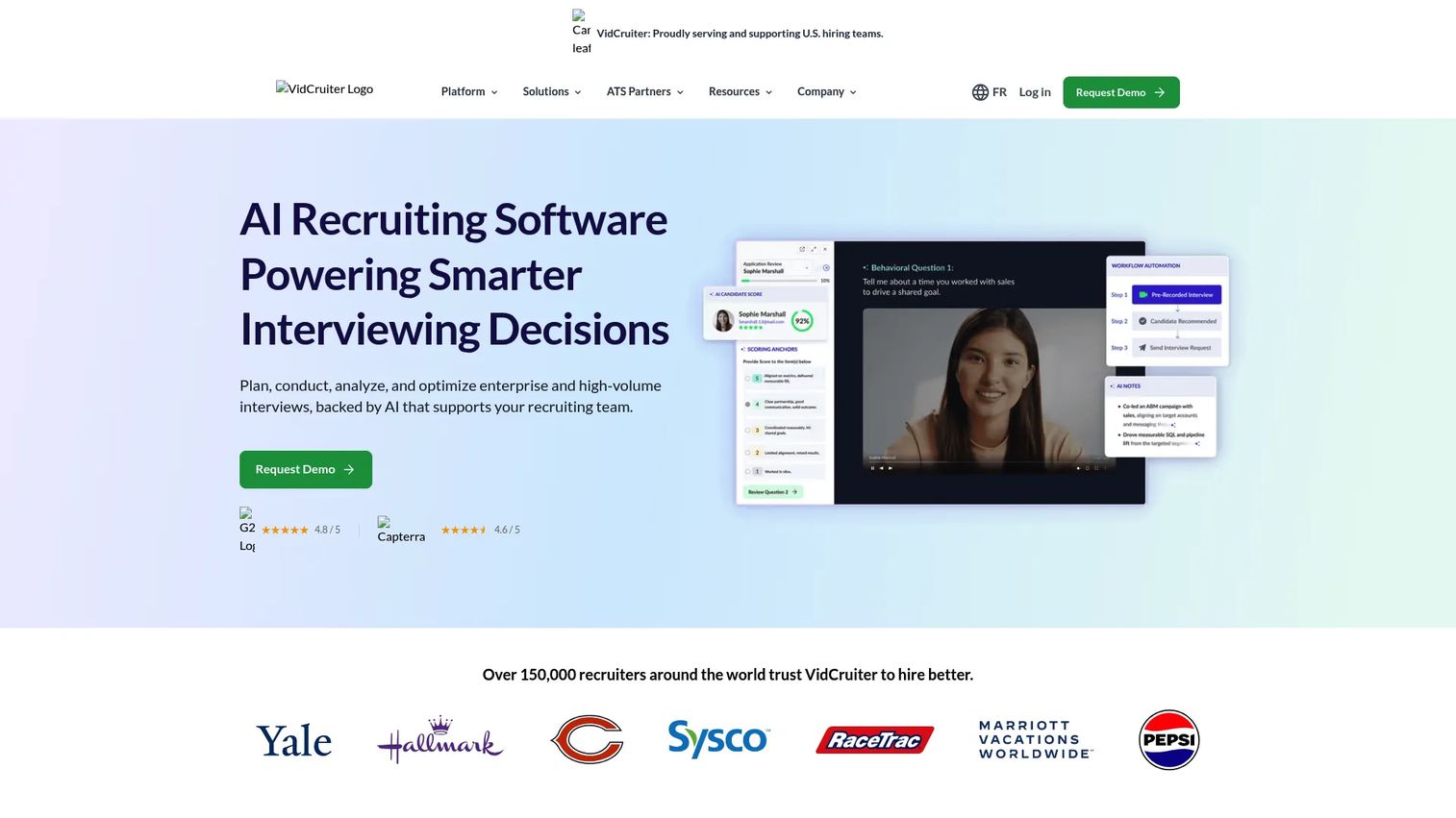
VidCruiter is an interview management platform for planning, scheduling, conducting, and scoring structured interviews. It supports prerecorded and live video formats.
Hiring teams can use interview guides and rating rubrics to standardize evaluation. AI transcription and summaries assist reviewers working across larger candidate pools.
Best for: Enterprise and high-volume teams requiring structured video interview workflows.
Key features
- Prerecorded and live video interviews
- Automated interview scheduling
- Structured guides and rating rubrics
- AI transcription and summaries
- Reference checks and applicant tracking
Why choose VidCruiter: Choose VidCruiter when interview consistency matters as much as test performance. Rating rubrics help recruiters and managers use the same criteria.
This fit is especially relevant for customer-facing hiring. Recorded responses let sales leaders evaluate communication before committing to a live panel.
VidCruiter pricing: Custom pricing applies. Submit the vendor's pricing form to request a quote.
12. Spark Hire
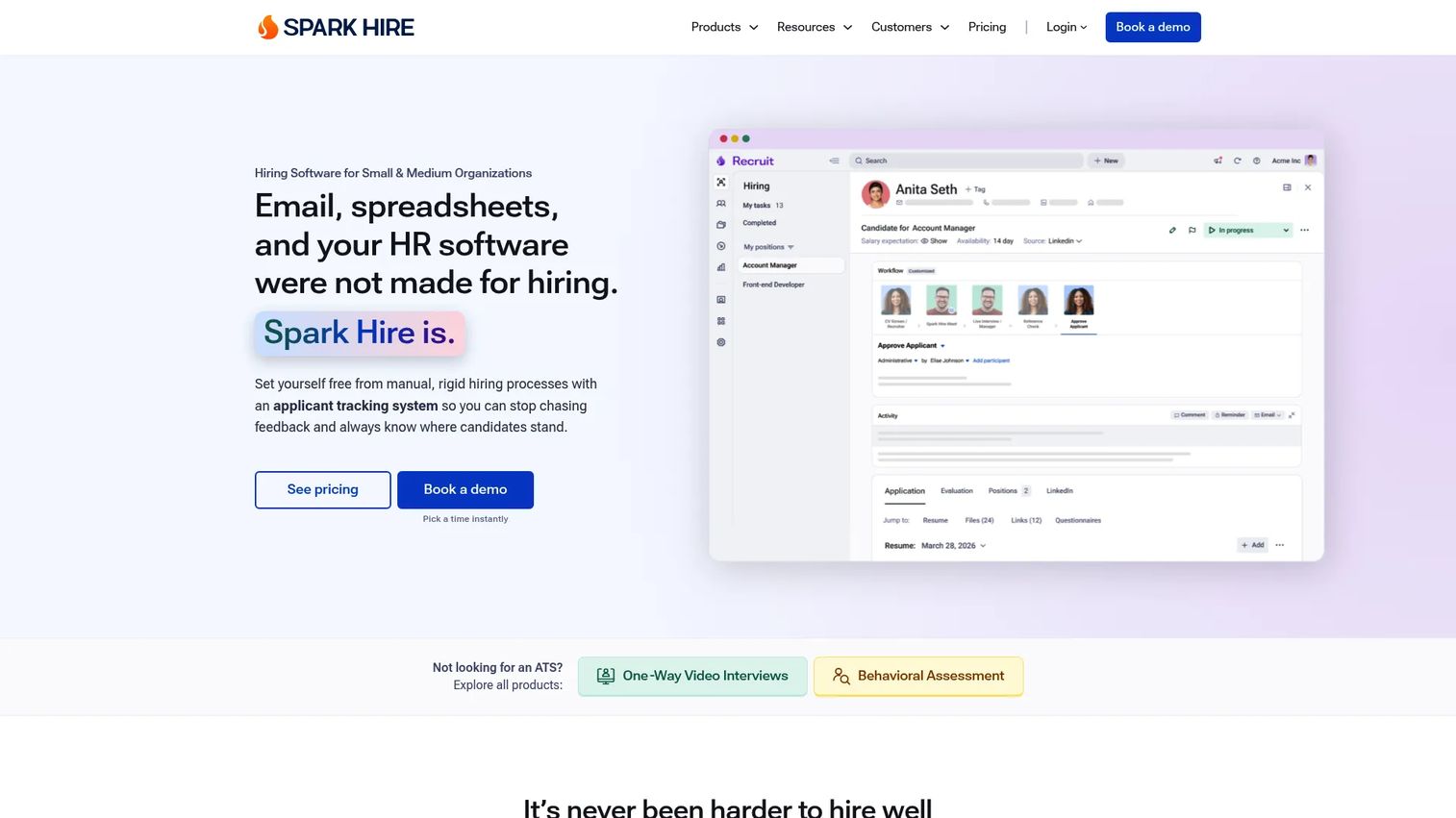
Spark Hire combines applicant tracking with one-way and live video interviews. Recruiting capabilities also include predictive behavioral assessments and automated reference checks.
AI transcription and summaries help reviewers process recorded responses. Scheduling and team collaboration support a shared hiring workflow.
Best for: Small and midsize employers using video screening for customer-facing roles.
Key features
- One-way and live video interviews
- AI transcription and interview summaries
- Predictive behavioral assessments
- Automated reference checks
- Scheduling and hiring-team collaboration
Why choose Spark Hire: Choose Spark Hire when communication quality is central to the role. Sales, support, and customer success candidates can answer structured questions before live interviews.
The broader recruiting package also helps teams coordinate candidate movement. That can reduce handoff gaps between recruiting, hiring managers, and enablement.
Spark Hire pricing: Video Interviews costs $299 monthly or $249 monthly when billed annually. Recruit Pro starts at $335 monthly, billed annually.
Recruit Growth costs $499 monthly, billed annually. No free employer tier was verified.
G2 rating: 4.7/5
13. Pulsifi
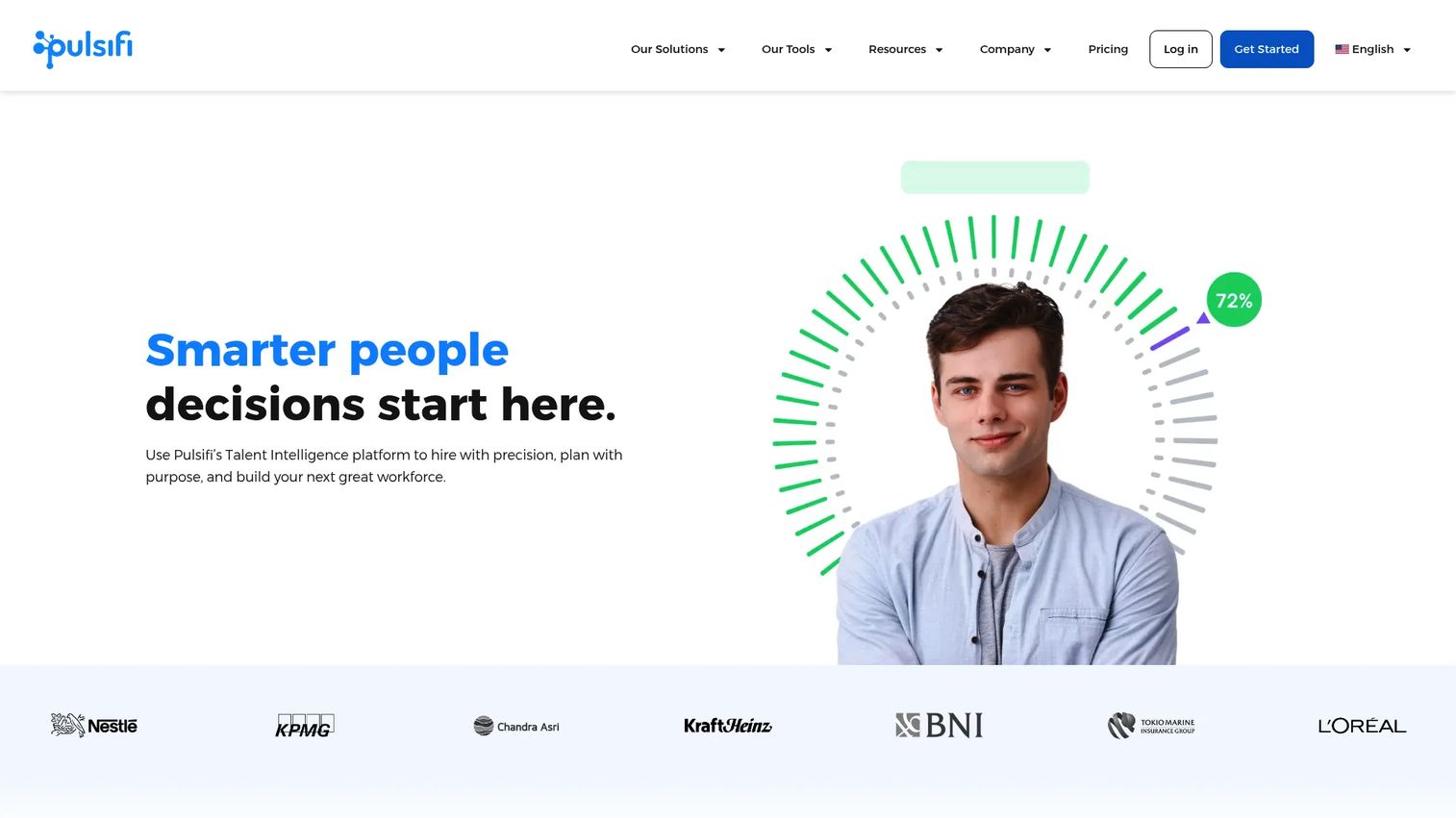
Pulsifi combines online assessments with talent intelligence and workforce planning. Its capabilities include role-fit analytics, resume analysis, automated shortlisting, and AI video interview analysis.
The platform also supports organizational-fit evaluation and individual development plans. This broader scope connects pre-hire assessment with later talent decisions.
Best for: Organizations wanting people analytics alongside candidate evaluation.
Key features
- Online assessments and proctoring
- Role-fit and organizational-fit analytics
- Resume analysis and automated shortlisting
- AI video interview analysis
- Talent mapping and development plans
Why choose Pulsifi: Choose Pulsifi when a single test score does not provide enough context. Its profiles connect candidate information with broader talent analytics.
The platform may suit organizations that want hiring data to inform workforce planning. Enablement teams can also use role-fit patterns when planning development after hiring.
Pulsifi pricing: Lite costs $2,800 yearly and includes 2,800 annual credits. Pro costs $8,000 yearly with 9,000 credits.
Enterprise uses custom pricing.
G2 rating: 4.2/5
14. The Talent Games
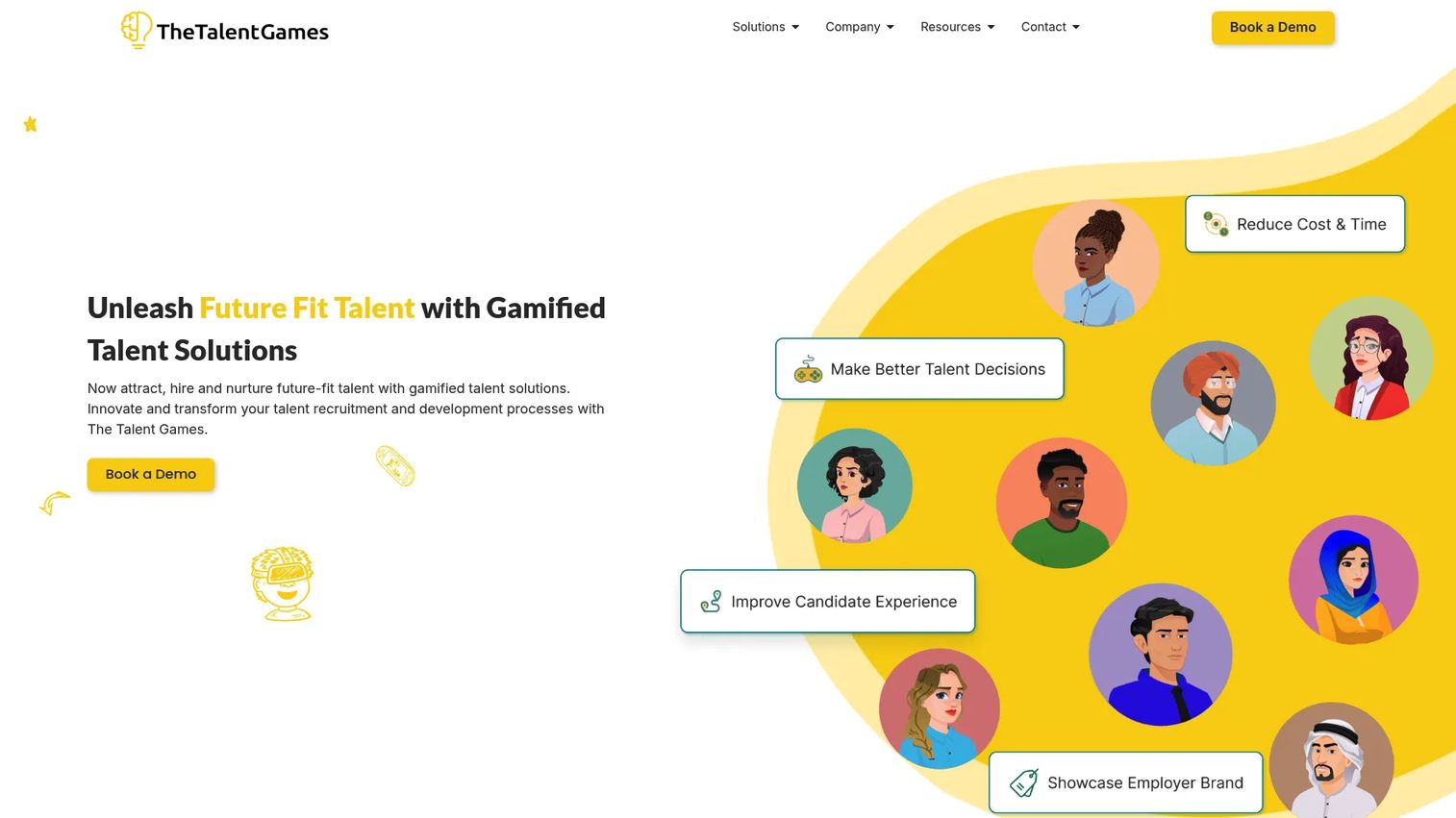
The Talent Games provides gamified assessments for high-volume and early-career recruitment. Its formats cover cognitive ability, aptitude, situational judgment, culture fit, and job-specific evaluation.
Custom branding lets employers shape the candidate-facing experience. Candidate analytics give hiring teams reporting after completion.
Best for: Employers prioritizing engagement in graduate or high-volume hiring.
Key features
- Gamified cognitive and aptitude assessments
- Situational judgment evaluation
- Culture-fit and job-specific tests
- AI-assisted interview workflows
- Candidate analytics and custom branding
Why choose The Talent Games: Choose it when candidate engagement and employer presentation carry extra weight. Game-based experiences can differentiate campus or early-career hiring programs.
The format still needs the same role-relevance review as conventional testing. Make sure game mechanics measure capabilities connected to the job.
The Talent Games pricing: Contact The Talent Games for a quote.
G2 rating: 4.1/5
15. ClassMarker
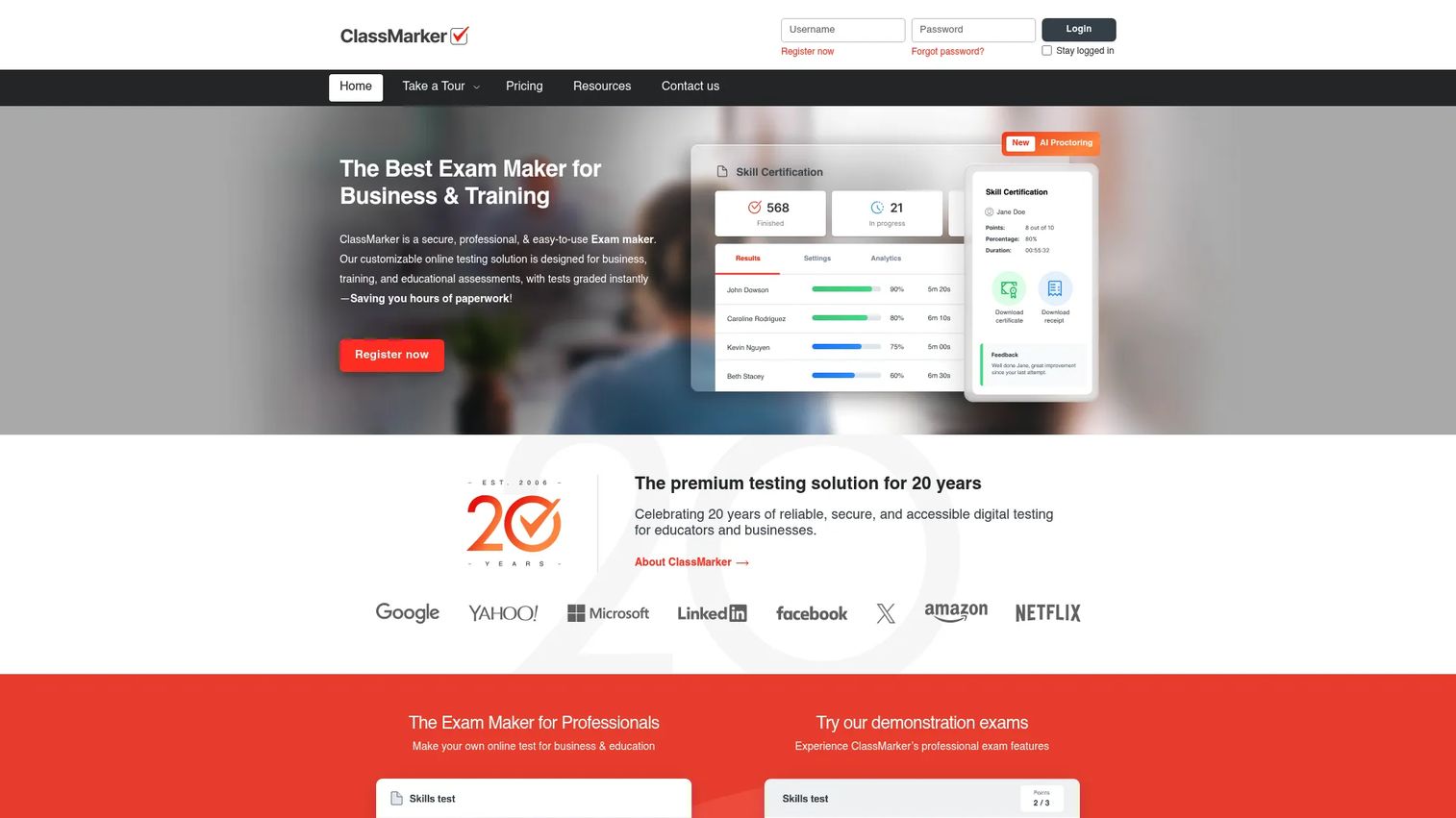
ClassMarker is a secure online testing platform for businesses and training providers. Teams can create custom tests, reuse question banks, and automate grading.
The platform is broader than dedicated candidate assessment software. It works best when hiring managers already know what knowledge they need to evaluate.
Best for: Teams building custom job-knowledge tests without a full HR assessment suite.
Key features
- Custom tests with varied question types
- Reusable and randomized question banks
- AI exam proctoring
- Automatic grading and result exports
- Certificates, access controls, and webhooks
Why choose ClassMarker: Choose ClassMarker when you have established questions and need secure delivery. It works for product knowledge or role-specific screening.
Enablement teams can also use the platform after hiring for certification-style assessments. That continuity may simplify the handoff from recruiting into readiness programs.
ClassMarker pricing: A 30-day free trial is available. Professional plans and 12-month credit packs use quote-based pricing.
G2 rating: 4.4/5
16. ProProfs Quiz Maker
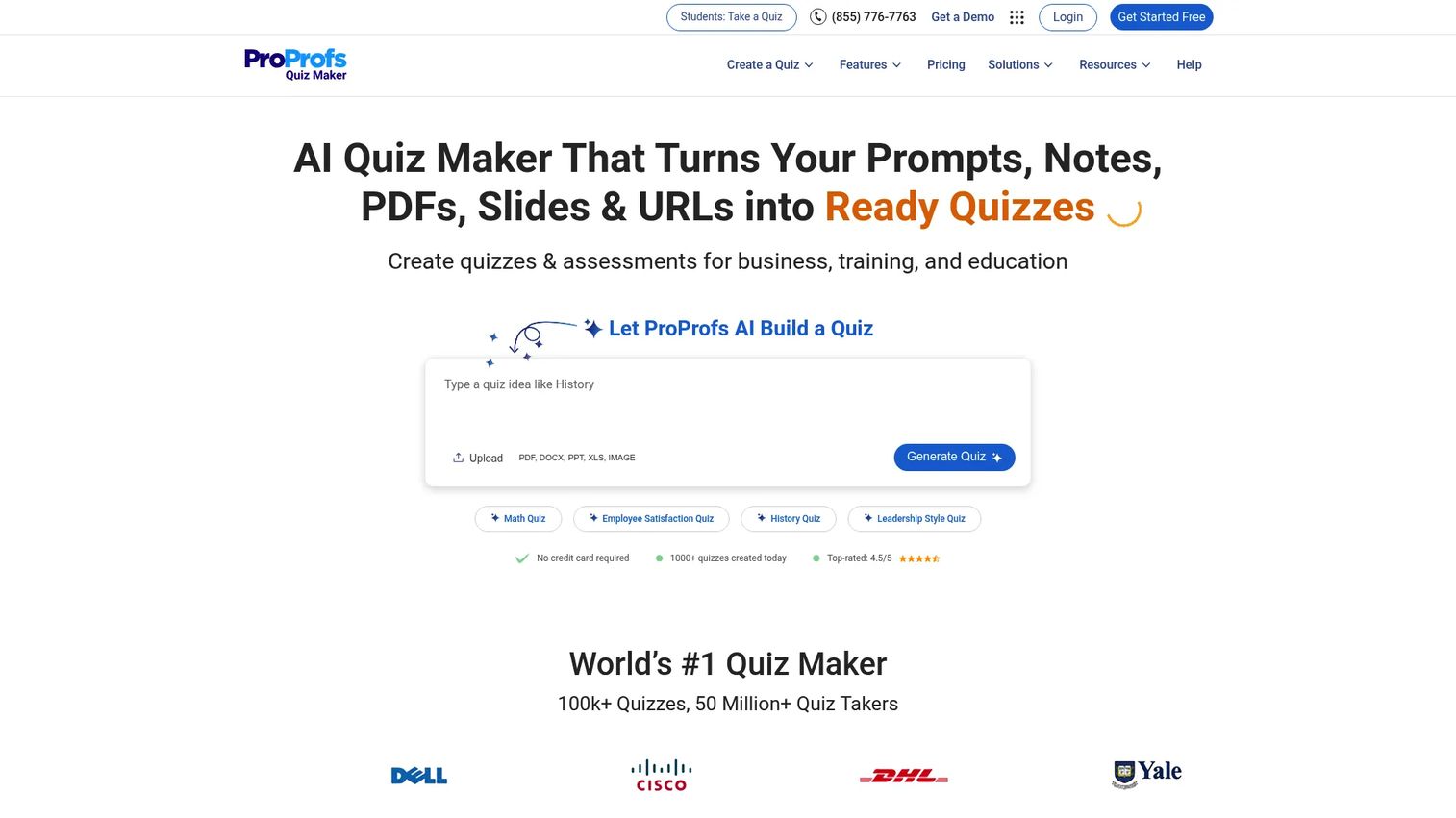
ProProfs Quiz Maker creates and grades quizzes, exams, and training assessments. AI-assisted creation helps teams draft questions from existing material.
The platform includes more than 20 question types and over 100 templates. Reports can be exported in PDF, spreadsheet, or CSV formats.
Best for: Small teams needing simple knowledge checks or role-specific screening quizzes.
Key features
- AI quiz generation and editing
- 20 plus question formats
- Automated grading and custom scoring
- Timers, randomization, and exam controls
- Reports, certificates, and custom branding
Why choose ProProfs Quiz Maker: Choose ProProfs when the assessment is knowledge-based and straightforward. It fits teams that need fast test creation rather than deep psychometric analysis.
The same system can support pre-hire screening and post-hire certification. That gives enablement teams continuity when assessing product knowledge after onboarding begins.
ProProfs Quiz Maker pricing: A free plan supports short quizzes with 12 questions. Essentials starts at $19.99 per 100 active quiz takers monthly, billed annually.
Business starts at $39.99 under the same usage model.
G2 rating: 4.4/5
Considerations when choosing pre employment testing software
Match the test to the job
Start with tasks the employee will perform. An SDR assessment might test writing and discovery judgment, while a data role needs technical exercises.
Avoid measuring traits that have no clear relationship with the work. More test data does not automatically create better hiring signal.
Ask for validity evidence
Ask each vendor how its assessments were developed and validated. Content validity examines whether questions represent the job, while criterion validity connects results with relevant outcomes.
Request plain documentation that hiring managers can understand. Structured scoring should make the link between evidence and decisions visible.
Monitor adverse impact
Review selection outcomes for patterns across candidate groups where lawful and appropriate. The four-fifths rule is a recognized monitoring concept, but it is not a complete legal test.
Work with qualified HR, compliance, or legal partners when interpreting results. Software reporting cannot replace professional advice.
Protect candidate experience
Check completion time, mobile access, instructions, accessibility, and accommodation workflows. Long or confusing assessments can increase candidate drop-off.
Tell applicants what the test measures and how results enter the process. Clear expectations protect trust even when candidates do not advance.
Connect assessment data to hiring workflow
Examine applicant tracking integrations, score exports, recruiter visibility, and interview guides. Managers need usable evidence inside their existing process.
For enablement leaders, connect assessment patterns to onboarding without turning hiring scores into permanent labels. Use the data to plan support, then measure readiness again.
Conclusion
The right pre employment testing software depends on the evidence your role demands.
TestGorilla and eSkill provide broad skills coverage across job families. Criteria, Wonderlic, and Prevue Assessments focus more heavily on aptitude or behavioral insight.
Choose TestDome when technical skill proof drives the decision. Vervoe and HR Avatar fit teams that prefer practical tasks or job simulations.
VidCruiter and Spark Hire make more sense when structured video responses matter. ClassMarker or ProProfs Quiz Maker can cover simpler knowledge-based assessments.
Before buying, shortlist three platforms and run the same role through each. Compare scoring clarity, candidate effort, manager confidence, and workflow fit.
For sales hiring, test a realistic scenario rather than generic sales knowledge. An AE discovery exercise or SDR writing task creates evidence that can inform selection and ramp planning.
Keep human review central. The best assessment adds structure to the decision without pretending one score explains the whole candidate.
FAQs
Pre employment testing software helps employers evaluate candidates before hire. It can deliver skills tests, cognitive assessments, personality measures, work samples, job simulations, or video interviews.
The software provides structured evidence for hiring decisions. It should support human review rather than make final employment decisions automatically.
Common formats include skills tests, cognitive ability tests, personality assessments, situational judgment tests, and job simulations. Technical exercises and work samples measure applied capability.
Video assessments examine structured responses or communication. Gamified formats present cognitive or situational tasks through game mechanics.
Pre-employment testing is commonly used in the United States. Assessments should be job-related, consistently administered, and reviewed for adverse impact.
Requirements vary by assessment and hiring context. Work with HR, legal, or compliance partners for legal interpretation.
Match the assessment type to the role's essential tasks. Then review validity evidence, candidate experience, scoring clarity, accessibility, and applicant tracking integrations.
Pilot the software with one role before broader rollout. Compare whether different managers interpret the results consistently.
Structured assessments can reduce some inconsistency found in unstructured interviews. They do not remove bias by default.
Poorly designed tests can introduce or amplify unfair outcomes. Monitor results, examine job relevance, and use assessments as one decision input.
Skills testing measures learned abilities or job-specific tasks. Examples include writing an outreach email, analyzing a spreadsheet, or completing a coding exercise.
Cognitive testing measures reasoning, problem-solving, or learning speed. Use either format only when the measured capability connects to the role.
Assessment length should reflect the role and hiring stage. A short early screen generally requires less candidate effort than a detailed work sample.
Explain the expected time before candidates begin. Longer technical tasks usually fit later stages, after both sides have established interest.
Use short, role-related screens before interviews when applicant volume is high. This approach helps recruiters prioritize candidates without demanding extensive work.
Place deeper work samples after an initial conversation. Candidates are more likely to invest time once they understand the role and process.