You've run the kickoff call. You've sent the setup guide. Three weeks later, the customer is still on step one, your inbox has four tickets about basic configuration, and leadership is asking why adoption numbers are flat.
Slow time to value is rarely one catastrophic failure. It is usually a chain of small delays: Customers skip documentation, miss a setup step, wait too long for a CSM response, or never reach the feature that makes the product click. According to OnRamp's State of Onboarding report (2025), 48% of customers abandon onboarding when they do not see value quickly. That number lands differently when you are the one carrying the renewal conversation.
The good news is that the same report found 65% of companies using digital onboarding reduced TTV by at least 25%. The right tool matters, though, because "time to value tools" is not one category. Some software shortens the gap through guided product education. Others measure where users get stuck. Others automate the CS workflows that keep accounts from going dark between milestones.
This guide maps 12 tools to those specific jobs so you can identify which bottleneck you are actually solving.
What's inside
This guide is for Customer Success Managers, Onboarding Managers and CS-focused Account Managers at B2B SaaS companies. Items were chosen by evaluating their fit across four TTV jobs:
- Self-serve and guided product education
- In-app onboarding guidance and activation
- CS health scoring, journey automation and risk management
- Product analytics and onboarding drop-off measurement
Selection criteria: Measurable TTV impact, analytics depth, CS workflow fit and pricing clarity.
TL;DR
- Best for guided product education: Guideflow helps CS and onboarding teams shorten time to first value with interactive demos, completion tracking and drop-off step visibility
- Best for in-app onboarding: Userflow, Userpilot and Appcues build contextual guidance directly inside the product
- Best for enterprise CS programs: Gainsight and ChurnZero fit teams managing complex health scoring and lifecycle automation
- Best for product analytics: Amplitude and Pendo measure activation events and reveal where users stop engaging
- Best for support-led TTV: Intercom and Zendesk cut repeated "how do I?" questions through messaging, help centers and AI automation
What is time to value software?
Time to value software helps SaaS teams reduce and measure the time between a customer's starting point and the first meaningful outcome they achieve with the product.
The category spans several distinct jobs. A tool that excels at one rarely covers all of them.
Core capabilities to look for:
- Guided product education and interactive demos
- Onboarding checklists and in-app prompts
- Completion rate tracking
- Drop-off step analysis
- Customer health scoring
- Product usage and feature adoption analytics
- Support ticket deflection
- CRM and CS platform synchronization
- Segmentation by plan, persona or lifecycle stage
TTV has four distinct milestones CS teams track:
- Time to first value (TTFV): The first meaningful success moment, such as completing a core workflow or connecting an integration
- Time to basic value: The customer reaches the promised baseline outcome they purchased for
- Time to desired ROI: The customer sees the business result that justified the contract
- Time to expanded value: The customer adopts advanced features or additional use cases
Userpilot's 2025 benchmark data puts the average time to value across 62 B2B SaaS companies at roughly 1 day, 12 hours and 23 minutes for simpler products. Complex enterprise products extend that window significantly. Most CS teams measure only averages, which hides the accounts that are genuinely stuck. Track median TTV and the 75th and 90th percentile to see where your tail risk actually lives.
When to use time to value tools
Onboard customers without adding more live calls
Your best onboarding sessions still depend on a CSM being present. Scale that beyond 20 accounts and the quality drops. Time to value tools package that education into self-serve interactive demos, checklists and automated sequences that customers can access anytime. Guideflow fits here when customers need to experience product flows between sessions rather than wait for the next scheduled call.
Find the step where customers get stuck
Slow TTV is often a single broken moment: A setup field that confuses every new user, an integration step that requires a support ticket, or an activation event that the UI buries. Tools with completion tracking, drop-off analytics and product event data help CS and product teams stop guessing and fix the actual blocker.
Prove CS impact with adoption data
"We trained them" does not hold up in a QBR. CS leaders need onboarding completion rates, activation milestones and feature adoption data tied to retention outcomes. The right TTV tool gives you the numbers to show which accounts are progressing and which ones need intervention before they churn.
Time to value tools comparison
The table below maps each tool to its primary TTV job. Pricing reflects verified figures from each vendor's pricing page at time of writing. G2 ratings are sourced from each tool's current G2 listing.
| # | Product | Best for | Key differentiator | Pricing | G2 rating |
|---|---|---|---|---|---|
| 1 | Guideflow | Guided product education | Interactive demos with completion and drop-off analytics | Free plan available; paid plans from $40/month | 5.0/5 |
| 2 | Userflow | In-app onboarding flows | No-code flows, checklists and an AI Adoption Agent | From $300/month | 4.8/5 |
| 3 | Userpilot | Product-led onboarding | In-app experiences plus session replay and agent analytics | From $299/month | 4.6/5 |
| 4 | Appcues | In-app activation campaigns | Product tours, checklists and experimentation | From $9,000/year | 4.6/5 |
| 5 | Pendo | Product adoption analytics | Usage data combined with in-app guides and feedback | Free plan; paid plans by request | 4.4/5 |
| 6 | ChurnZero | CS automation and health | Health scores, success plays and journey automation | Contact sales | 4.7/5 |
| 7 | Gainsight | Enterprise CS programs | Customer health, lifecycle management and adoption insights | Contact sales | 4.5/5 |
| 8 | Totango | Customer journey orchestration | SuccessBLOCs and lifecycle tracking | Contact sales | 4.5/5 |
| 9 | Vitally | Modern CS team operations | Customer 360 and playbook automation | Contact sales | 4.5/5 |
| 10 | Intercom | Support-assisted onboarding | AI-first messaging, help center and automation | From $29 per seat/month | Not verified |
| 11 | Zendesk | Support ticket deflection | Help center, ticketing and AI agents | From $19 agent/month (annual) | 4.3/5 |
| 12 | Amplitude | Product and activation analytics | Activation funnels, cohorts and behavioral analytics | Free plan; paid plans from $0 (Plus) | 4.5/5 |
Best 12 tools for improving time to value
1. Guideflow
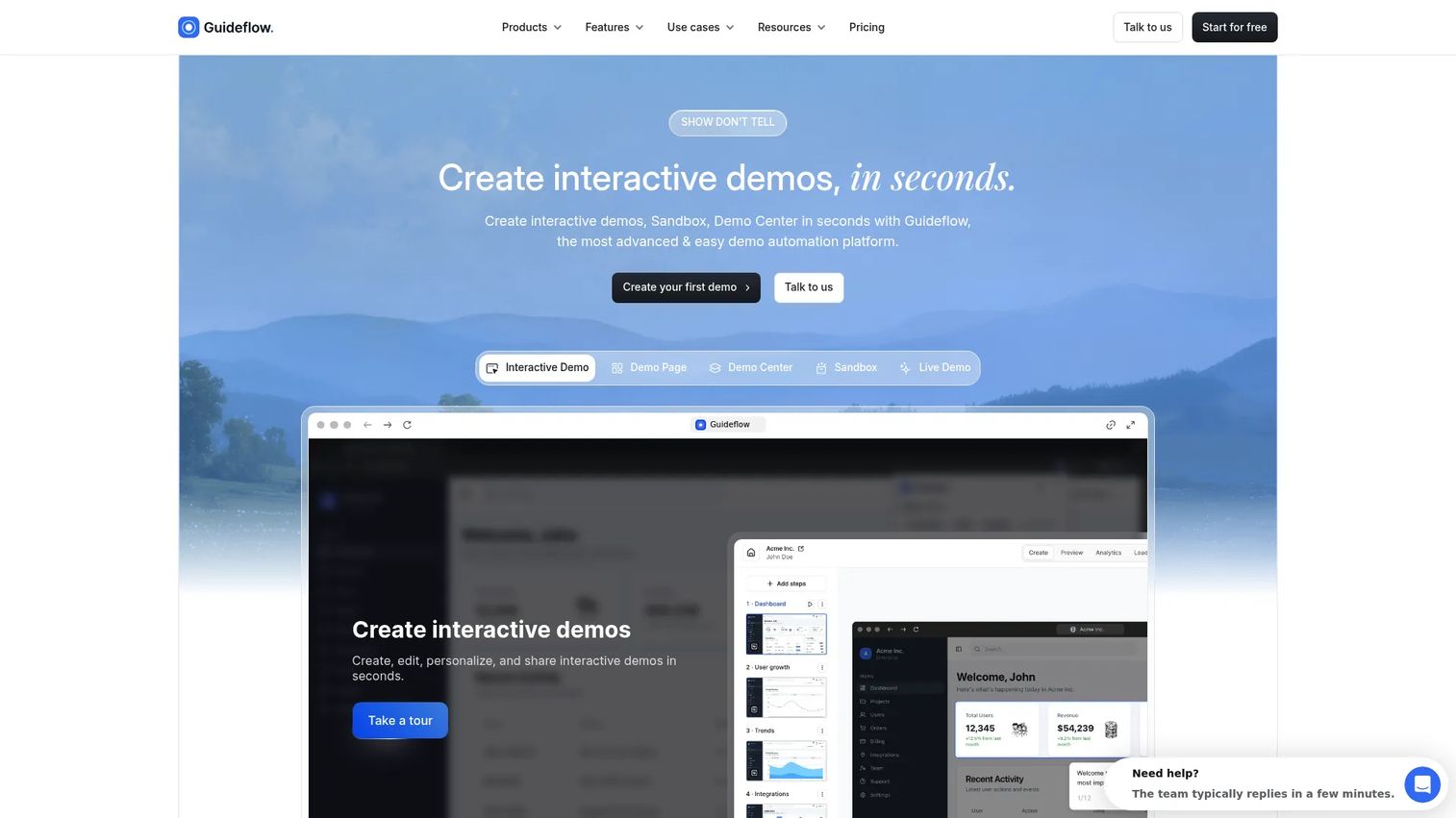
Guideflow is a demo automation platform that turns product flows into guided, clickable experiences customers can complete on their own schedule. CS, onboarding and support teams capture product workflows in minutes, then share them through links, email, help center embeds or a Demo Center library organized by use case or customer segment. The platform covers five demo formats: Interactive demos, demo centers, sandboxes for free-form product exploration, mobile demos and live demos for onboarding calls and QBRs.
Best for: Customer Success and onboarding teams that want customers to experience product value without depending on another scheduled training session.
Key features
- Interactive demos with step-by-step guided product paths
- Demo Center libraries organized by use case or persona
- Sandbox environments for free exploration and workflow validation
- Completion rate and drop-off step analytics
- Sharing via links, embeds, email or help center placement
Why choose Guideflow: Guideflow fits best when product understanding is the main TTV bottleneck. If your customers mainly need health scoring or ticket routing, pair Guideflow with a CS platform or helpdesk rather than replacing those tools.
Guideflow pricing: A free plan is available. Paid plans start at $40/month (Solo), with Startup at $599/month and Advanced at $1,799/month. Enterprise pricing requires a quote.
G2 rating
5.0/5 from 142 reviews.
Start your journey with Guideflow today!
2. Userflow
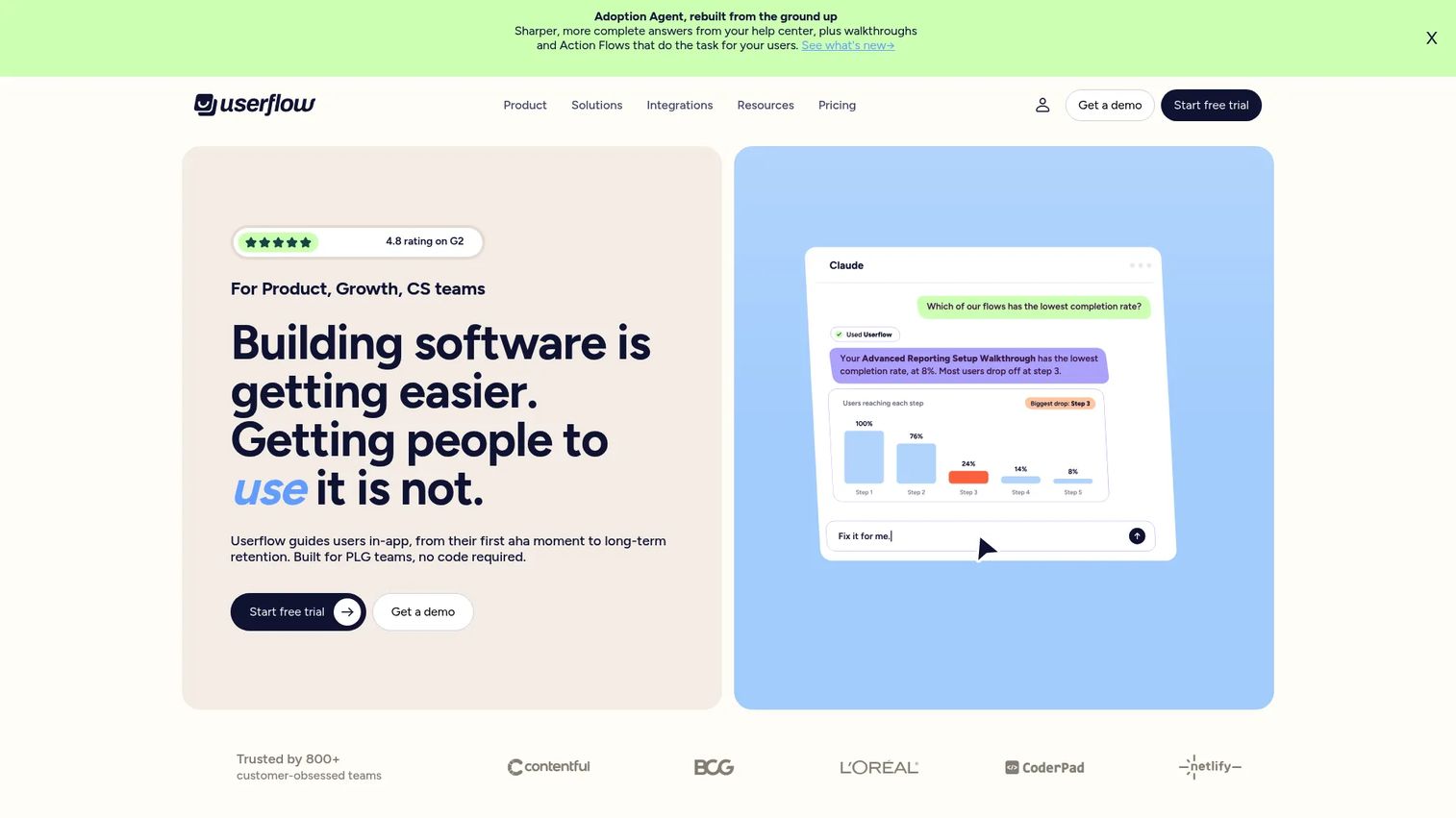
Userflow is an AI-powered product adoption platform for building in-app onboarding flows, checklists, tooltips and resource centers without engineering work. Its Adoption Agent feature can trigger action flows automatically based on user behavior, and FlowAI tools help teams build, translate and analyze content faster. Userflow also supports NPS surveys, product analytics dashboards and integrations with CRM and marketing platforms.
Best for: Product-led SaaS teams building onboarding guidance directly inside their application.
Key features
- In-app flows, tours and guided onboarding sequences
- Onboarding checklists and resource centers
- AI Adoption Agent with automated action flows
- In-app surveys and NPS collection
- User and company-level segmentation and targeting
Why choose Userflow: Userflow is the right fit when the value moment happens inside the product and you need guidance that adapts to where each user is in their journey. Teams that primarily need external education assets or CS health scoring will want a different layer.
Userflow pricing: Essentials starts at $300/month (or $240/month billed annually). Studio starts at $500/month (or $400/month billed annually). Enterprise pricing is custom. A 14-day free trial is available; no permanent free tier exists.
G2 rating
4.8/5.
3. Userpilot
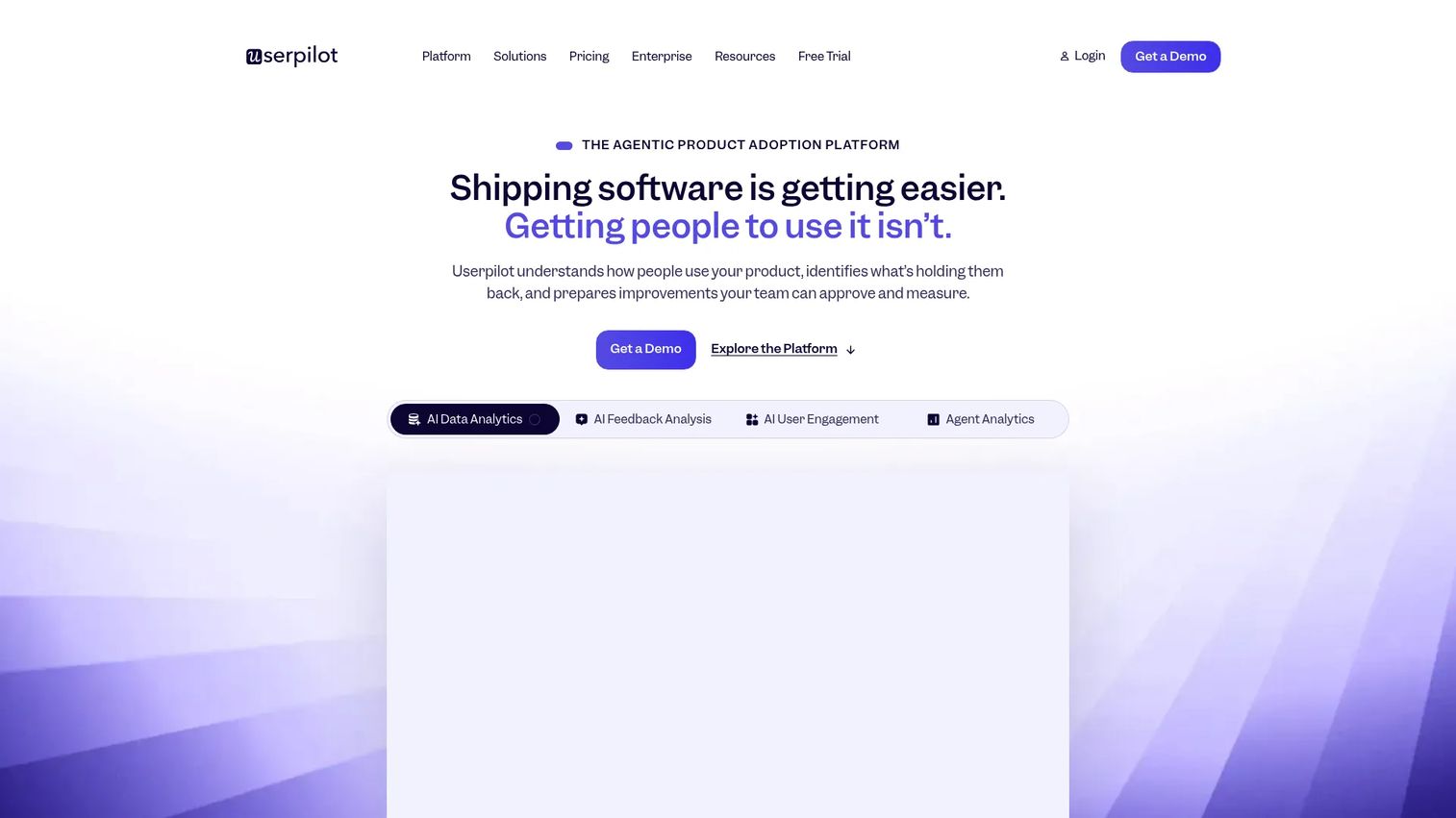
Userpilot describes itself as an agentic product adoption platform that combines in-app onboarding, product analytics, session replay and user feedback in one tool. Its AI agent Lia can analyze user behavior and surface recommendations for improving activation. The Starter plan supports up to 2,000 monthly active users, making it accessible for growing CS teams without enterprise budgets.
Best for: Product and CS teams that need both in-app guidance and behavioral measurement without buying two separate platforms.
Key features
- In-app onboarding flows and checklists
- Product analytics and feature adoption tracking
- Session replay for watching where users get stuck
- NPS and feedback surveys
- AI agent analytics and recommendations
Why choose Userpilot: Userpilot pays off when you have clean product events defined and a clear activation model. Teams without instrumented events will spend meaningful setup time before seeing analytical value.
Userpilot pricing: Starter is $299/month. Growth starts from $849/month. Enterprise pricing requires a conversation. No permanent free tier; a 14-day trial is available.
G2 rating
4.6/5.
4. Appcues
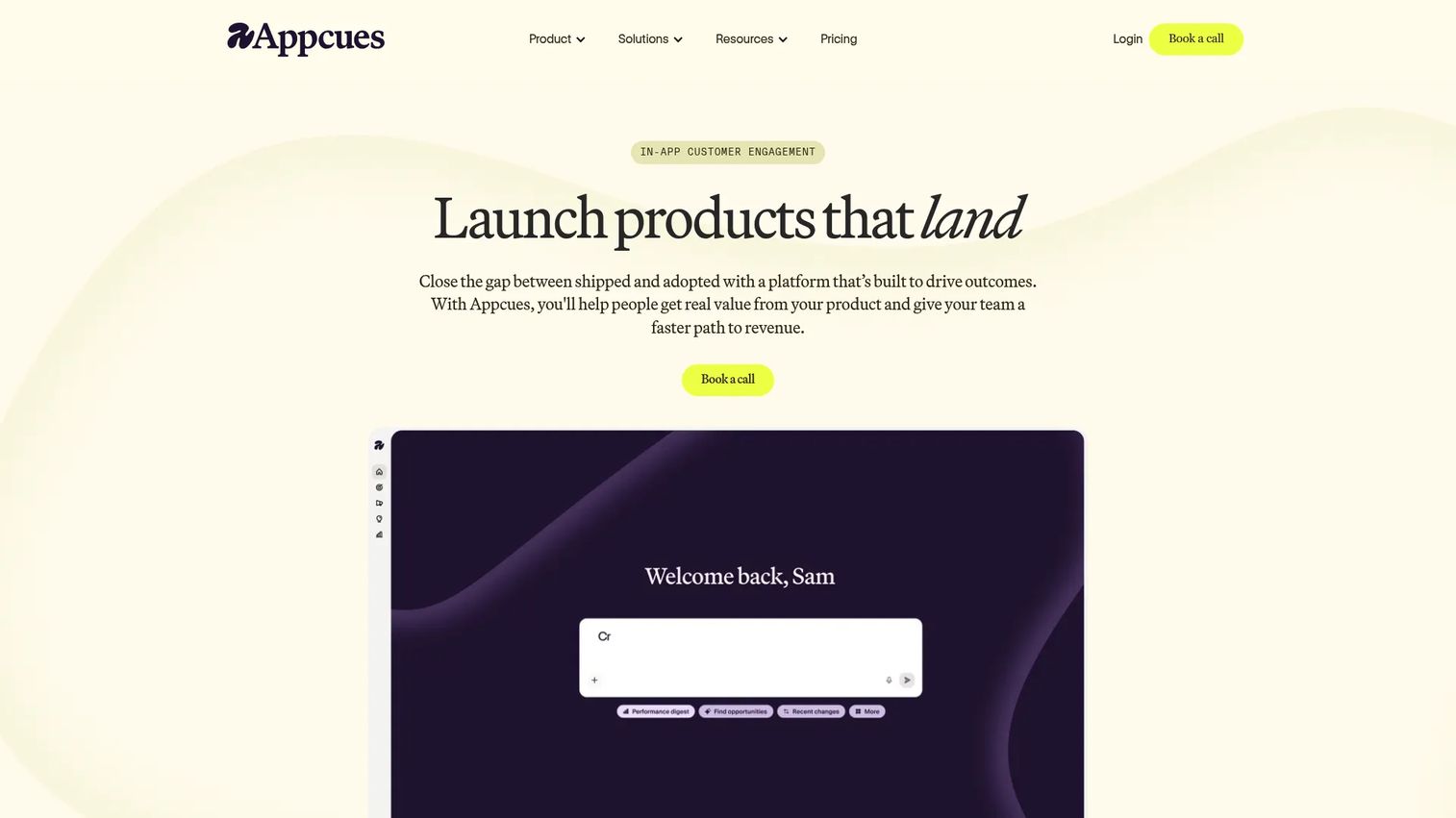
Appcues is a customer engagement platform for building product tours, checklists, in-app announcements and launchpads without code. It supports audience targeting based on user attributes and behavior, and includes A/B testing and control experiments to optimize onboarding flows over time. Teams can also collect NPS and custom survey responses directly in-product.
Best for: SaaS teams launching structured in-app onboarding campaigns that need proven activation patterns out of the box.
Key features
- Product tours and guided onboarding flows
- Checklists and launchpad navigation
- In-app announcements and banners
- Audience targeting and segmentation
- A/B experimentation on onboarding experiences
Why choose Appcues: Appcues works well when the activation event is clearly defined and the team wants to run experiments to improve it. The annual commitment at the Grow tier ($9,000/year) is a real consideration for teams earlier in their growth stage.
Appcues pricing: The Grow plan starts at $9,000/year for up to 50,000 monthly active users. Enterprise pricing is custom. A free trial is available.
G2 rating
4.6/5.
5. Pendo
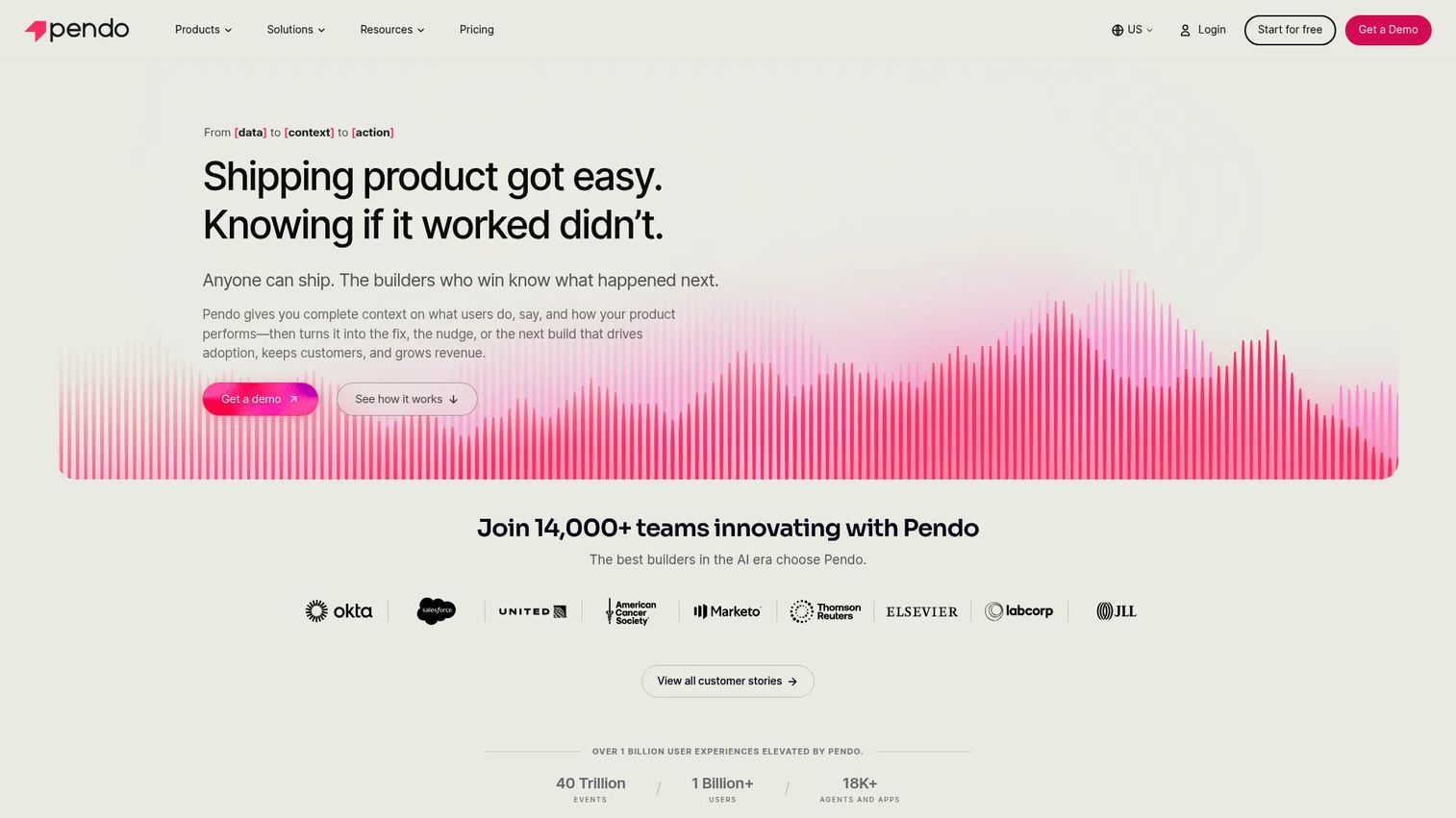
Pendo is a product experience platform combining product analytics, in-app guides, user feedback, NPS, session replay and journey orchestration. Its strength is connecting what users do inside the product to guided experiences that respond to that behavior. Pendo also offers a free plan supporting up to 500 monthly active users and a free Novus beta with no MAU limits.
Best for: Product and CS teams that need product usage data alongside in-app guidance without managing two separate systems.
Key features
- Product analytics: Funnels, feature adoption, paths and user journeys
- No-code in-app guides and resource centers
- NPS, CSAT and PMF feedback surveys
- Session replay for behavioral insight
- Journey orchestration across in-app and email
Why choose Pendo: Pendo fits teams where the product analytics story is as important as the guidance layer. It is broader than a focused onboarding tool, so teams with a narrow activation problem may find it more than they need initially.
Pendo pricing: A free plan is available for up to 500 MAUs. Paid plans (Base, Core, Ultimate) are priced by MAU volume and functionality; request pricing directly from Pendo. The Novus beta is free during open beta.
G2 rating
4.4/5.
6. ChurnZero
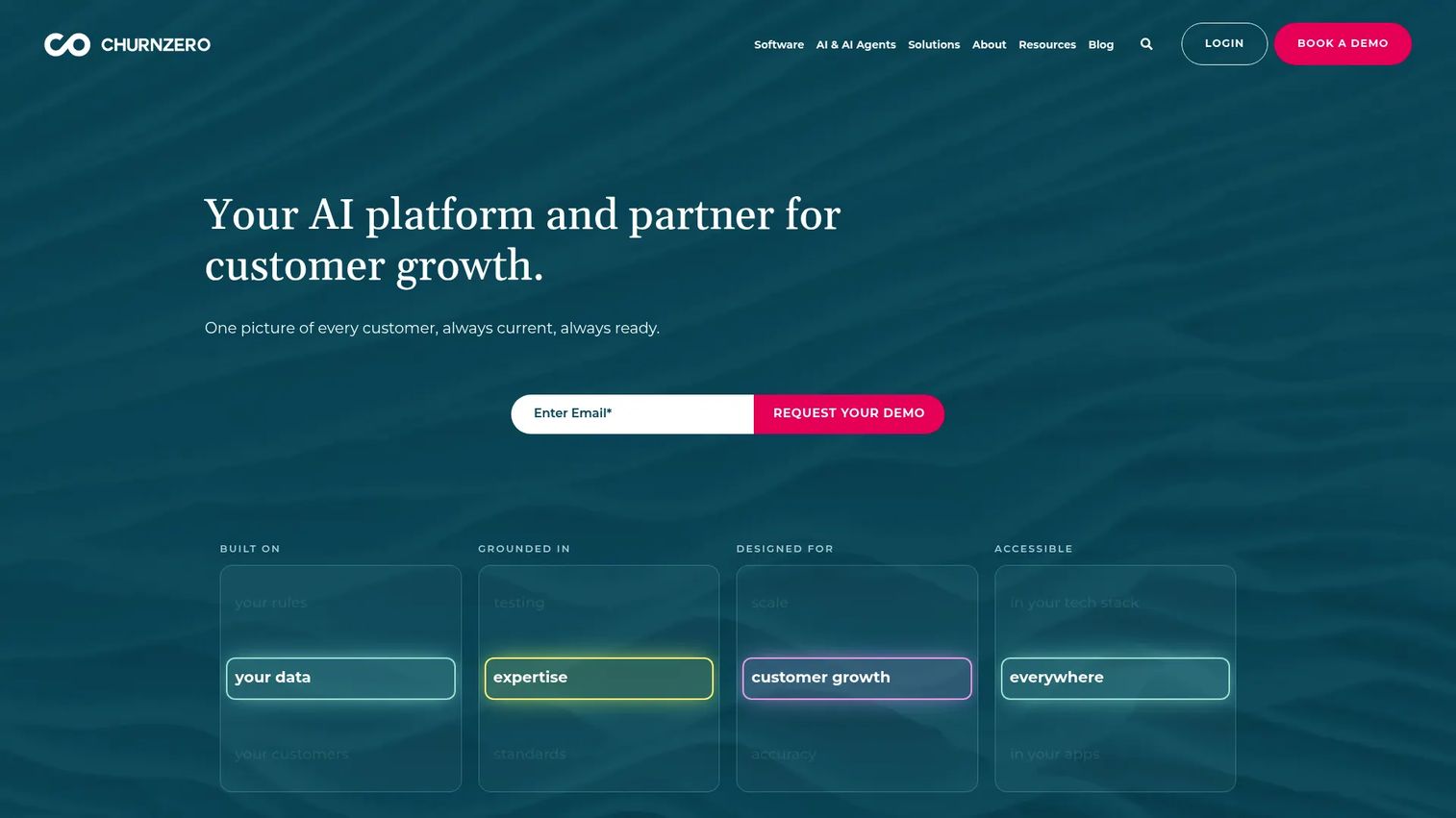
ChurnZero is an AI-powered customer success platform built around account health, journey automation, CS plays and in-app engagement. It surfaces churn risk and expansion signals from product usage and CRM data, then triggers automated workflows so CSMs can intervene before accounts go quiet. The platform supports 70+ native integrations and includes an in-app Success Center for customer self-service.
Best for: CS teams managing many accounts who need automated intervention triggers when onboarding stalls or adoption drops.
Key features
- Customer health scores and churn-risk detection
- Automated success plays and journey workflows
- 360-degree account profiles and usage intelligence
- In-app communications and Success Centers
- AI-assisted summaries and recommendations
Why choose ChurnZero: ChurnZero is strongest when CS team capacity is the constraint and you need the system to flag at-risk accounts without a CSM manually reviewing every dashboard. It is a CS operations platform, not a product education tool.
ChurnZero pricing: Contact their sales team for a quote based on your seat count and account volume.
G2 rating
4.7/5.
7. Gainsight
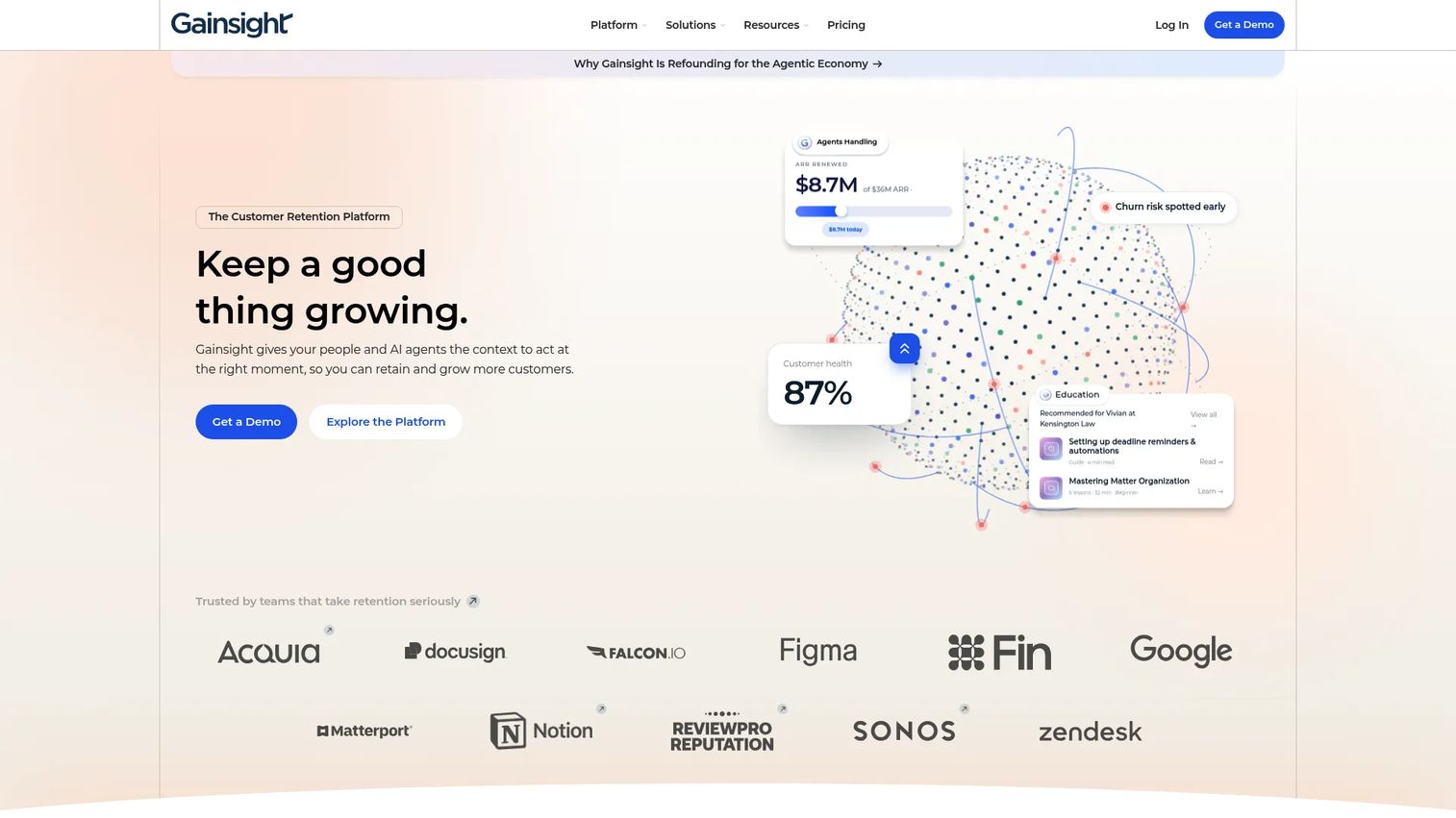
Gainsight is an enterprise customer success platform covering customer health, lifecycle management, success plans, adoption insights and digital customer journeys. It is used by large CS organizations that need structured onboarding milestone tracking, cross-functional account visibility and automated engagement at scale. Gainsight also offers a Product Experience module and a customer community product alongside its core CS platform.
Best for: Enterprise CS organizations running formal onboarding programs with dedicated CS Ops support.
Key features
- Customer health scorecards with multi-metric weighting
- Success plans and playbooks with automated triggers
- Digital customer journeys and in-app engagement
- Account 360 and cross-team visibility
- Adoption insights tied to renewal and expansion signals
Why choose Gainsight: Gainsight is the right choice when CS complexity justifies a dedicated CS Ops function to configure and maintain it. Smaller teams without that support often find the ramp to value slower than alternatives.
Gainsight pricing: Contact sales for a quote. G2 reviewers report enterprise contracts typically run into the tens of thousands annually.
G2 rating
4.5/5.
8. Totango
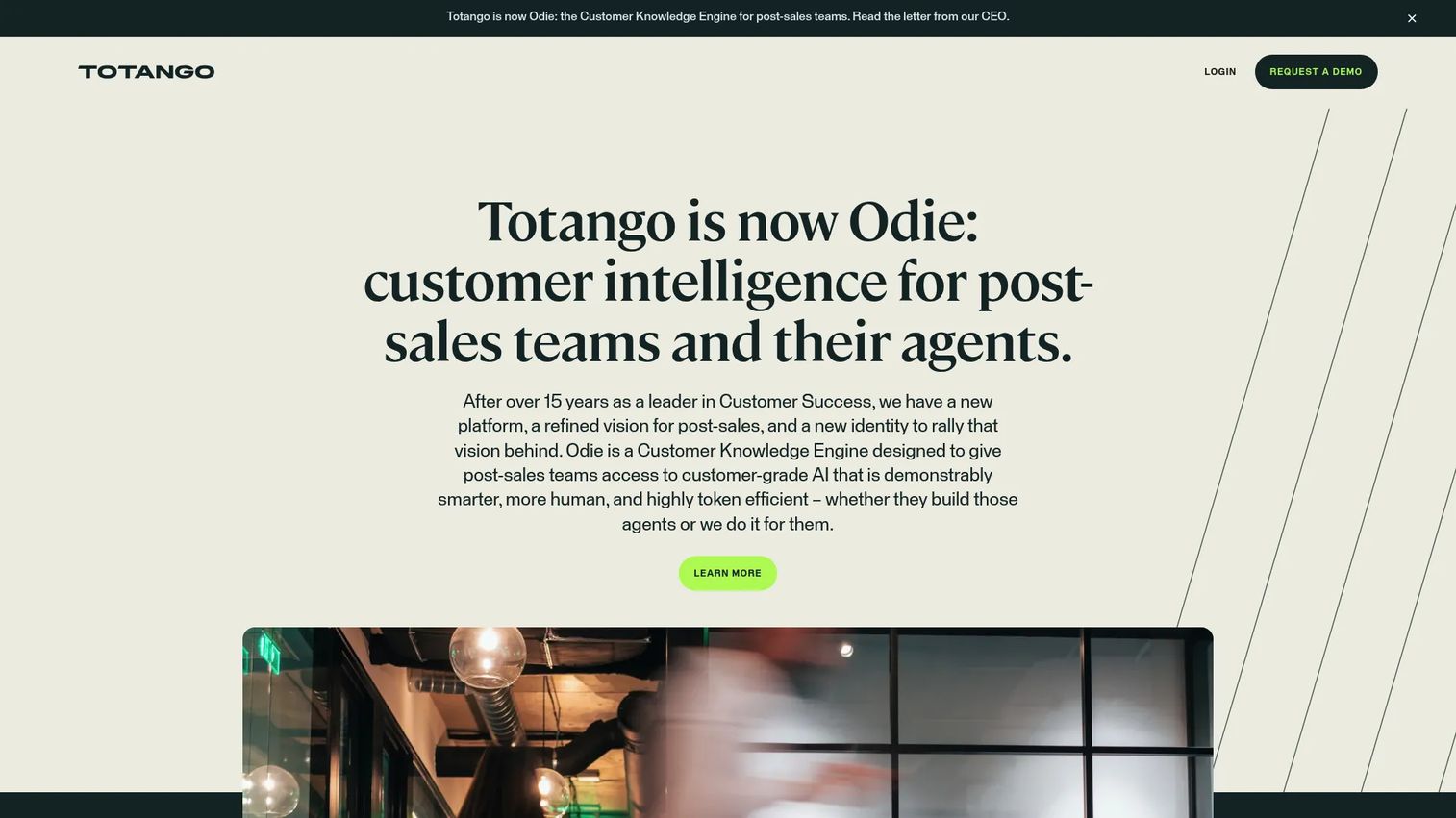
Totango (now also known as Odie) is a customer success platform built around customer lifecycle orchestration, health monitoring and SuccessBLOC playbooks. SuccessBLOCs are pre-built templates for common CS motions including onboarding, adoption, renewal and expansion, which helps teams get started without building every workflow from scratch. The Enterprise plan includes 10 practitioner seats and 2,000 customer accounts; Premier expands to 20 seats and 10,000 accounts.
Best for: CS teams that want lifecycle-based onboarding and adoption tracking with pre-built CS templates.
Key features
- Portfolio management and customer health monitoring
- SuccessBLOCs: Pre-built onboarding and adoption playbooks
- Automated SuccessPlays based on health changes
- Customer data management and segmentation
- Integrations with CRM and product analytics tools
Why choose Totango: Totango fits teams that think in lifecycle stages and want repeatable CS motions without building everything from zero. Product-level education still requires a separate layer outside the platform.
Totango pricing: Enterprise and Premier plans are available, priced through sales.
G2 rating
4.5/5.
9. Vitally
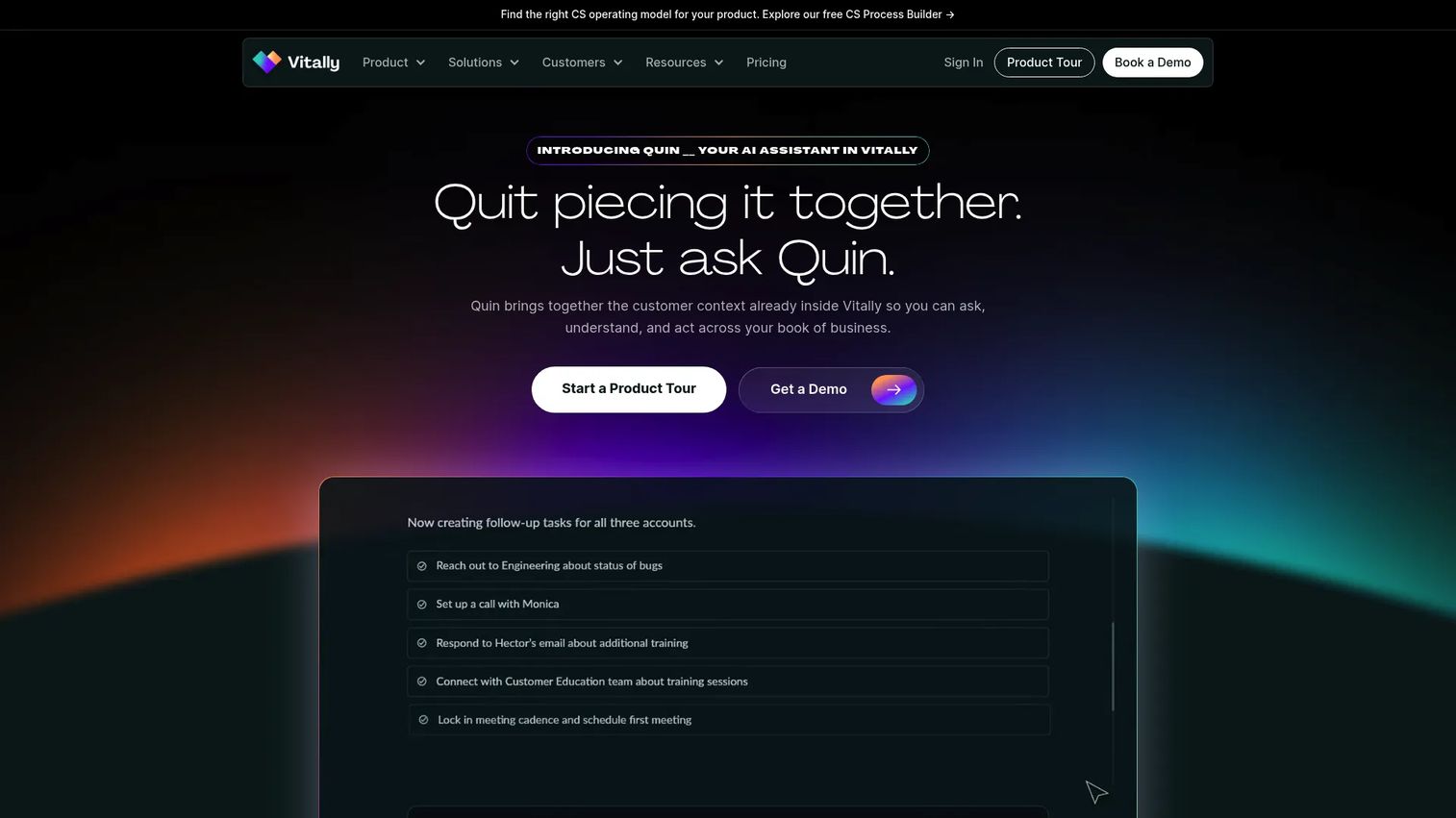
Vitally is a customer success platform combining customer 360 views, health scores, automated playbooks, project management and collaboration in one workspace. It pulls product usage data, CRM records and support activity into a single account view so CSMs can spot onboarding gaps without toggling between systems. Vitally also includes NPS collection and customer segmentation.
Best for: Modern B2B SaaS CS teams that want account visibility and playbook automation without the configuration overhead of enterprise platforms.
Key features
- Customer 360 with product usage, CRM and support data
- Automated playbooks and workflow triggers
- Health scores and goal tracking
- Customer projects and onboarding milestone management
- NPS surveys and segmentation
Why choose Vitally: Vitally is a good fit for CS teams that want a modern workspace without a CS Ops team to configure it. The platform focuses on process orchestration rather than product-level education.
Vitally pricing: Three plans are offered (Tech-Touch, Hybrid-Touch, High-Touch) with the same core feature set.
G2 rating
4.5/5.
10. Intercom
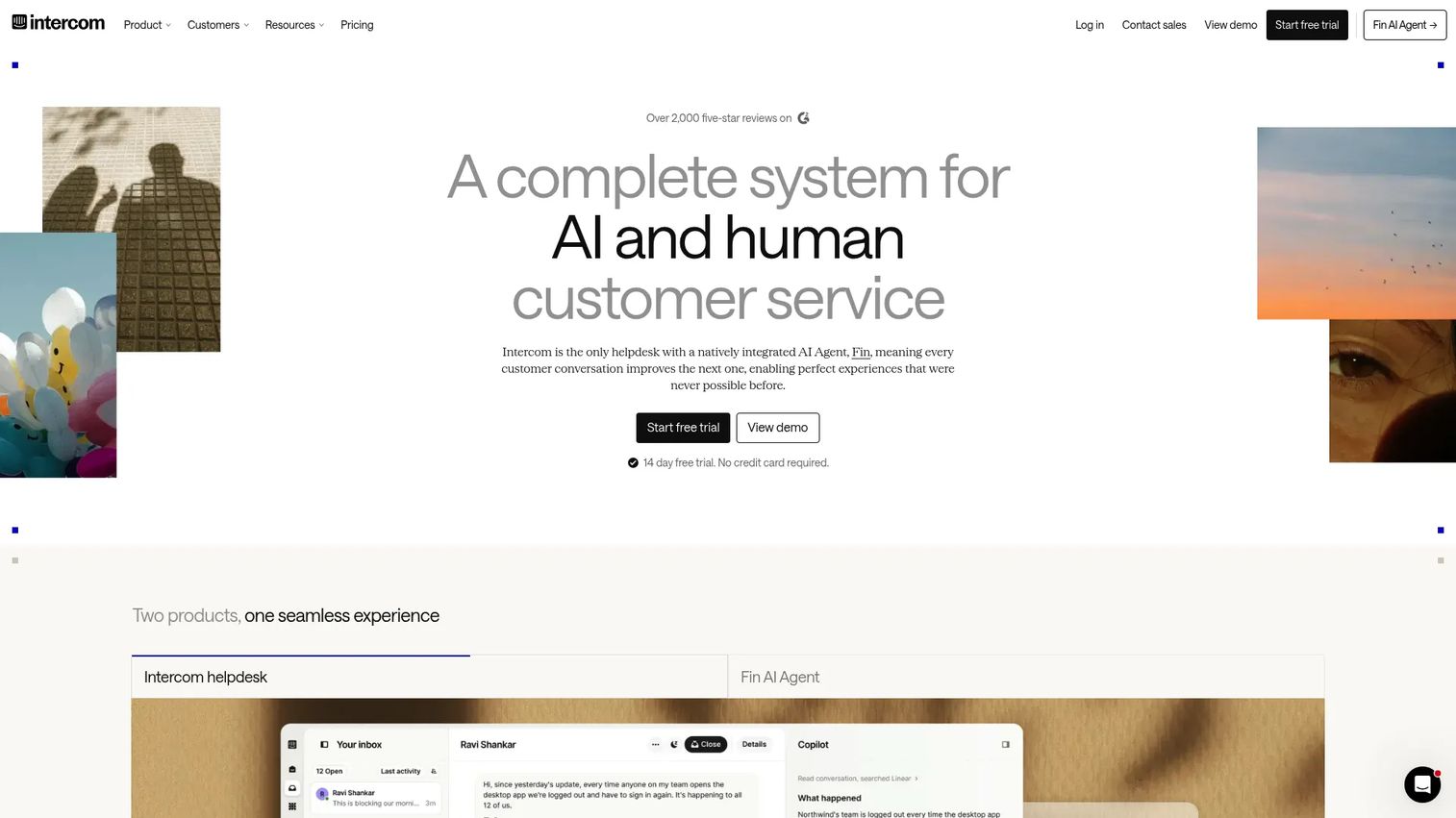
Intercom is an AI-first customer service platform combining a Fin AI Agent, live chat, ticketing, help center, product tours and outbound messaging. Its knowledge hub and automation workflows mean customers can get answers without waiting for a CSM, which removes one of the most common delays in early-stage onboarding. Intercom's Fin AI Agent is priced separately at $0.99 per resolved outcome.
Best for: Teams whose TTV slowdowns come from unanswered questions and support delays rather than product complexity.
Key features
- AI-powered omnichannel inbox and ticketing
- Fin AI Agent for automated resolution
- Help center with knowledge hub
- Outbound messaging and lifecycle campaigns
- Workflows automation and routing
Why choose Intercom: Intercom fits best when the gap between contract and value is filled with support requests rather than guided education. For teams that need product adoption measurement, pair it with an analytics layer.
Intercom pricing: Essential starts at $29 per seat/month (annual). Advanced is $85 per seat/month and Expert is $132 per seat/month. Fin AI Agent is billed at $0.99 per resolved outcome.
11. Zendesk
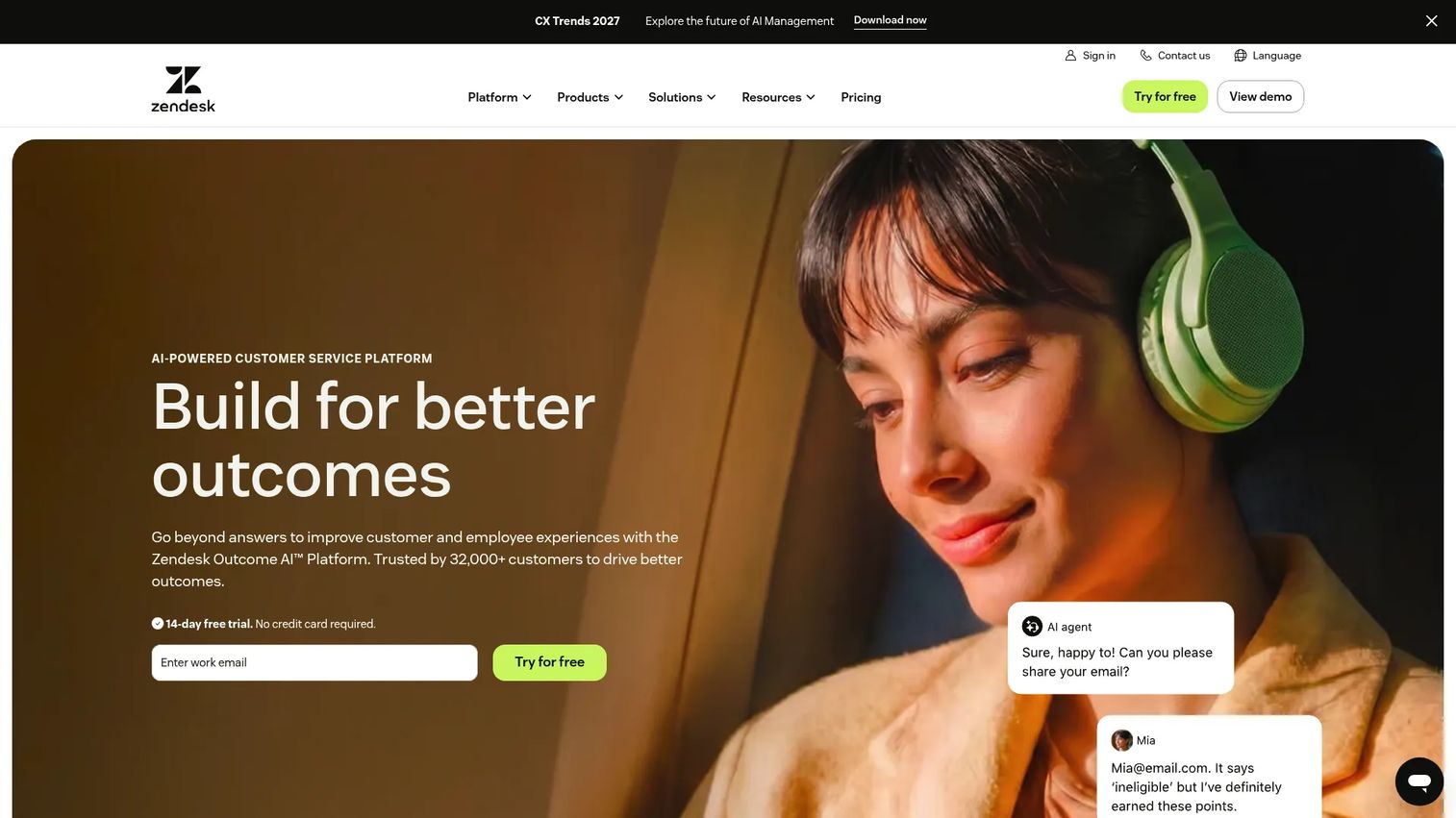
Zendesk is an AI-powered customer service platform for ticketing, omnichannel routing, help center management and AI agent automation. For CS teams whose TTV is blocked by support queue volume, Zendesk's self-service tools and AI agents deflect repetitive setup questions before they reach a CSM. It supports messaging, live chat, telephony and email within one platform.
Best for: Support-led teams reducing repetitive onboarding questions through scalable self-service and ticket automation.
Key features
- Ticketing and email support management
- AI agents and workflow automation
- Knowledge base and self-service help center
- Omnichannel routing (messaging, chat, voice, email)
- Analytics and support reporting
Why choose Zendesk: Zendesk supports TTV indirectly by removing friction from the support path, not through guided product education. Teams whose customers mainly need a faster response loop will get more from Zendesk than those whose customers need a product tour.
Zendesk pricing: Support Team is $19 agent/month paid annually ($25 monthly). Suite Team is $55 agent/month paid annually ($69 monthly). Suite Professional is $115 agent/month paid annually ($149 monthly). A 14-day free trial is available.
G2 rating
4.3/5.
12. Amplitude
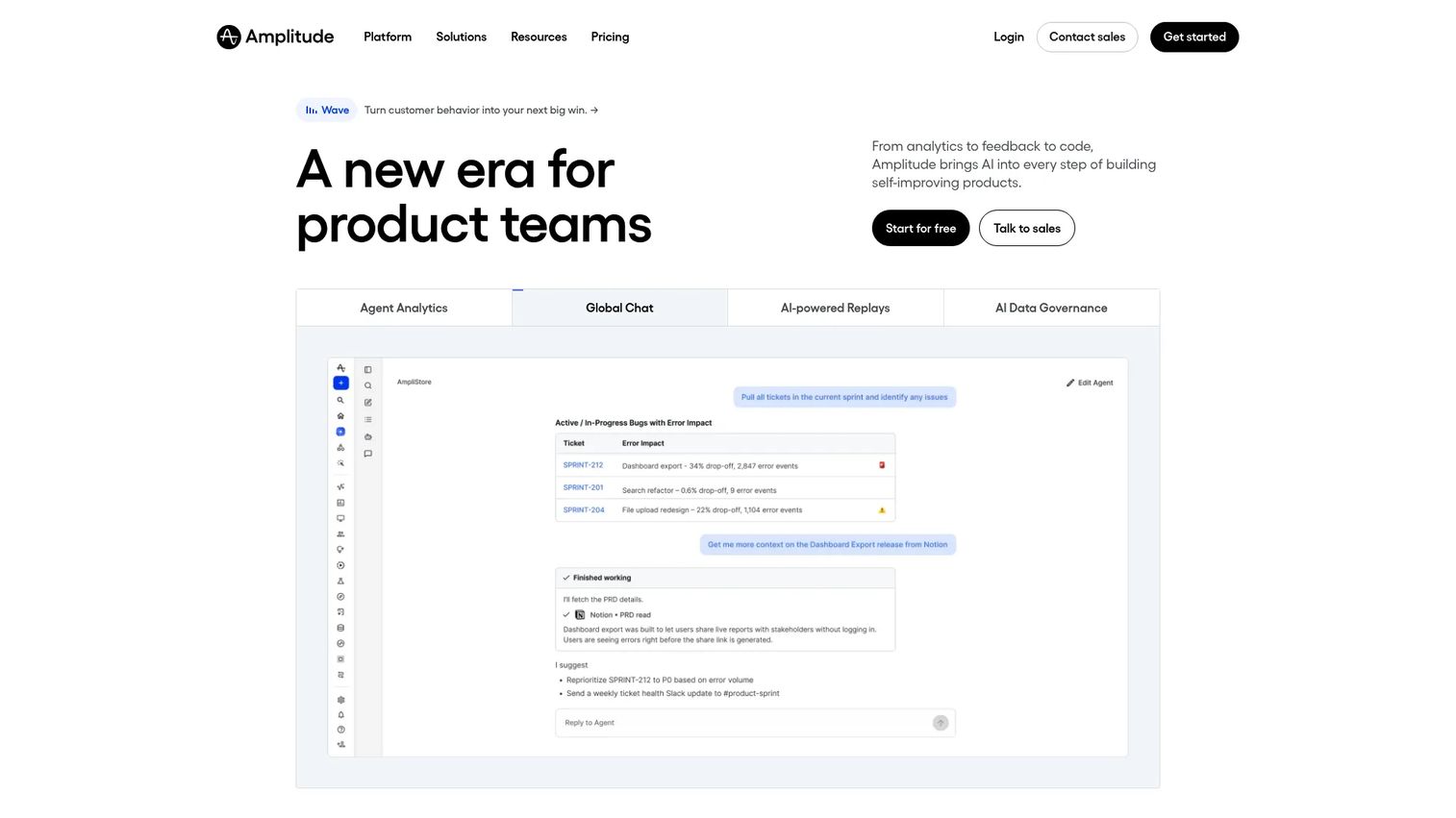
Amplitude is a digital analytics platform for understanding user behavior through product analytics, session replay, cohort analysis and experimentation. Its 2025 Product Benchmark Report found that 91% of new users may drop off within the first 14 days, which makes activation funnel visibility a critical input for any TTV program. Amplitude helps teams define the value event, measure how many users reach it and segment the data by plan, acquisition source or persona.
Best for: Product and growth teams that need to define and measure the activation events that predict retention.
Key features
- Product analytics with funnels, paths and retention curves
- Session replay and behavioral heatmaps
- Feature and web experimentation
- Cohort analysis and segmentation
- AI-powered analytics and anomaly detection
Why choose Amplitude: Amplitude tells you where users get stuck and which behaviors correlate with retention. It does not fix the experience on its own; teams still need education, CS or support tools to act on what the data shows.
Amplitude pricing: A free plan is available with 2M events/month and unlimited seats. The Plus plan starts at $0 and scales by usage. Growth and Enterprise plans use custom event-based pricing.
G2 rating
4.5/5.
Considerations when choosing time to value tools
Match the tool to your TTV bottleneck
The most common buying mistake in this category is purchasing a health score platform when the real problem is that customers do not understand the product. Map your biggest TTV delay first: Education, guided activation, CS process management or analytics. Buy into that category before expanding.
Define the start event and value event first
TTV measurement is only as useful as the events you define. Your start event might be contract signed, first login or onboarding kickoff; your value event might be first report created, first integration connected or first teammate invited. Tools analyze different parts of that span. Confirm which part of the journey each tool covers before you commit.
Track median and percentile TTV, not averages
Average TTV hides the accounts that are genuinely stuck. If your average is two weeks but your 90th percentile is six weeks, you have a tail-risk problem. Look for tools that surface median, 75th percentile and 90th percentile reporting for CS leaders.
Look for completion and drop-off data
Knowing that a customer attended training is not the same as knowing they completed it. Tools with onboarding completion tracking and drop-off step visibility give you the signal to intervene before an account goes dark. This applies to guided demos, in-app flows and onboarding checklist tools alike.
Check stack fit before buying
The CSM persona spec reveals a real frustration: Too many disconnected systems. Before adding another tool, confirm its integrations with your CRM, helpdesk and product analytics stack. A tool that syncs account health to your CRM or fires a Slack alert when an account misses a milestone is worth significantly more than one that requires a manual export.
Conclusion
Slow time to value usually traces back to one of four bottlenecks: Customers who do not understand the product, customers who lack in-app guidance at the right moment, CS teams without visibility into where accounts stall, or support queues that delay simple questions.
Guideflow addresses the product education bottleneck through interactive demos, demo centers, sandboxes and mobile demos, with completion and drop-off analytics to show where customers lose momentum. Userflow, Userpilot and Appcues handle in-app onboarding. Pendo and Amplitude surface the behavioral data that shows where users stop. ChurnZero, Gainsight, Totango and Vitally manage the CS workflows that keep onboarding on track. Intercom and Zendesk cut the support delays that extend time to first value for customers who just need a faster answer.
Start by naming the bottleneck. Then choose the category that fixes it.
Start your journey with Guideflow today!
FAQs
Time to value tools are software platforms that help SaaS teams reduce or measure the time between a customer's start event and their first meaningful outcome with the product. The category includes guided product education, in-app onboarding, CS health and journey automation, product analytics and support automation. No single tool covers all of those jobs, which is why most CS stacks combine two or more.
TTV equals the elapsed time between a defined start event and a defined value event. A start event might be contract signed, account created or first login. A value event might be first report created, first integration connected or first workflow completed. Track median TTV and the 90th percentile alongside the average, since averages hide the accounts that are genuinely stuck.
Time to first value (TTFV) is the specific moment a customer achieves their first meaningful success with the product, such as completing a core workflow. Time to value is a broader term that can also refer to later milestones: Reaching the promised baseline outcome, seeing the business ROI they purchased for, or adopting expanded features. CSMs typically focus on TTFV first because it predicts whether the customer will reach those later milestones.
The answer depends on which bottleneck you have. If customers do not understand the product, guided product education tools shorten TTV fastest. If customers need contextual prompts at specific steps, in-app onboarding tools are more effective. If the team does not know where users get stuck, analytics tools provide the visibility needed to fix the right problem. Buying a health score platform when the real issue is product comprehension adds cost without reducing TTV.
Practical approaches include replacing repeated live explanations with self-serve product education, adding guided checkpoints at activation steps, tracking onboarding completion rather than just attendance, monitoring drop-off steps to find specific friction points, and triggering CS follow-up automatically when accounts miss milestone targets. Scaling these approaches does not require more CSMs; it requires the right tool for each job.
Activation rate, onboarding completion rate and feature adoption are the most direct proxies for TTV progress. Support ticket volume and CSAT reflect the friction customers experience. NPS and retention data show whether value delivery is translating to customer satisfaction and renewal likelihood. Expansion signals such as seat growth or tier upgrades indicate that customers have moved beyond basic value.
Analytics tools show where friction happens, but they do not fix it. Amplitude or Pendo can tell you that 60% of users drop off at step three of your onboarding flow. Acting on that signal still requires a guided experience, a CS intervention, an in-app prompt or a support improvement at that specific step. Analytics is the diagnostic layer; education and CS tools are the action layer.
Interactive demos fit when customers need to understand product flows, complete setup steps or adopt features without scheduling another live call. They work particularly well in onboarding emails that arrive before the first session, help center articles where text explanations fall short, support replies that answer recurring setup questions and Demo Center libraries where customers can self-serve education by use case or feature.