Your claims data lives in one system. Clinical records live in three EHRs that do not talk to each other. Social determinants sit in a spreadsheet someone updates twice a year. And your value-based care contract expects you to close care gaps across all of it, on a deadline.
That fragmentation is the real problem population health management software has to solve. Not dashboards. Not another registry. The job is pulling scattered clinical, claims, and social data into one place, finding the patients who need attention before they end up in the ED, and proving it to a payer.
The market reflects how urgent this has become. Software accounted for 43.55% of population health management revenue in 2025, with cloud deployment holding a 56.85% share of delivery modes, according to Mordor Intelligence (2024). In the U.S. alone, the software segment was valued at USD 9.91 billion in 2024, per Technavio (2024). The category is not niche anymore. It is a core layer of how risk-bearing organizations operate.
But that growth also means more vendors, more overlapping feature claims, and more noise. A platform built for a 40-hospital system with an Epic backbone solves a different problem than one built for a federally qualified health center reporting UDS measures. Picking the wrong one costs a migration cycle you cannot get back.
This guide compares nine population health platforms on the criteria that actually decide fit: data aggregation, interoperability, care coordination workflow, and value-based care reporting depth.
What's inside
This is a buyer's decision guide for healthcare leaders, operations teams, and product managers at health-tech companies evaluating population health management software in 2026. We built the shortlist around four selection criteria: how well each platform aggregates clinical, claims, and social data; the depth and breadth of its EHR integration and interoperability; the strength of its care coordination and gap-closure workflows; and its support for value-based care contracts and quality reporting. We prioritized tools that serve distinct buyer profiles, from multi-EHR enterprise systems to safety-net community providers, so you can pattern-match to your own data maturity and care model.
TL;DR
- Best for multi-EHR analytics: Arcadia, for organizations that need EHR-agnostic data aggregation and deep population insights across a mixed environment.
- Best for enterprise data unification: Innovaccer, for large systems wanting a unified data model plus care navigation workflows.
- Best for safety-net and community providers: Azara Healthcare, for FQHCs and community health centers focused on quality reporting and outreach.
- Best for Epic-centered systems: Epic Healthy Planet, for organizations already standardized on Epic that want native point-of-care alerts.
- Best for advanced analytics teams: Health Catalyst, for organizations prioritizing clinical analytics and quality improvement infrastructure.
- Best for payer-tied risk contracts: Optum Population Health Solutions, for organizations working with large claims datasets and risk adjustment.
These are population health tools, not a single product. The right pick depends on your EHR environment, your data volume, and the reporting your contracts demand.
What is population health management software
Population health management software is a category of healthcare technology that aggregates clinical, claims, pharmacy, and social data across a patient population, identifies at-risk cohorts through risk stratification, supports care coordination across settings, and measures outcomes against quality and value-based care targets. It sits above the EHR as an analytics and workflow layer, turning fragmented records into cohort-level insight and actionable care team tasks.
Unlike a single EHR, which manages one care setting's data, population health analytics software normalizes data from many sources to give a longitudinal view of every patient in a panel or attributed population. That view drives the two things risk-bearing organizations care about most: finding the patients who need proactive intervention, and reporting performance to payers.
Core capabilities to expect:
- Data aggregation and interoperability: ingest and normalize clinical, claims, pharmacy, lab, and SDoH data across multiple EHRs and standards.
- Risk stratification: score and segment patients by clinical risk, cost, and rising-risk trajectory.
- Care coordination: registries, care gap identification, task management, and outreach workflows for care teams.
- Quality and value-based care reporting: track HEDIS, MIPS, ACO, and contract-specific measures with performance dashboards.
- Patient engagement: automated outreach, reminders, and campaign tools tied to identified gaps.
- Clinical analytics: benchmarking, utilization analysis, and population insights for operational decisions.
The best population health management solutions combine analytics depth with workflow that lands inside the care team's daily routine, not in a report nobody opens.
When to use population health management software
Population health management platforms are not for every organization at every stage. Here is where they earn their place.
Unify fragmented data for care teams
If your clinical data lives across multiple EHRs, your claims data comes from payers on a lag, and your social risk data is manual, care teams are working blind. Population health software normalizes those feeds into one longitudinal record. Use it when no single system gives you a complete view of the patient.
Support value-based care contracts
Risk-bearing contracts demand you report on quality measures and manage total cost of care. Value-based care software tracks contract performance, flags open gaps, and quantifies where you stand against targets. Use it the moment your revenue depends on outcomes, not just volume.
Prioritize outreach and intervention
Care teams cannot call every patient. Risk stratification ranks who needs attention now, from rising-risk diabetics to patients overdue on screenings. Use it to make proactive intervention systematic instead of reactive.
Coordinate across EHRs and settings
When patients move between primary care, specialists, hospitals, and post-acute settings, gaps open in the handoffs. Care coordination software with registries and task management keeps the care team aligned across settings. Use it when transitions of care are where your quality and cost problems live.
Comparison table
Here is a side-by-side view of all nine population health platforms, sorted by relevance to buyers evaluating analytics depth, EHR fit, and value-based care support. Pricing across this category is quote-based and tied to population size, data sources, and services, so most vendors do not publish public numbers.
| # | Product | Best for | Key differentiator | Pricing | G2 rating |
|---|---|---|---|---|---|
| 1 | Arcadia | Multi-EHR analytics | EHR-agnostic data lakehouse and care management | Custom | 5.0/5 |
| 2 | Innovaccer | Enterprise data unification | Unified data model plus AI-driven workflows | Custom | Not available |
| 3 | Azara Healthcare | Safety-net and community providers | Quality reporting and outreach for FQHCs | Custom | Not available |
| 4 | Epic Healthy Planet | Epic-centered systems | Native point-of-care alerts inside Epic | Custom | 4.3/5 |
| 5 | Health Catalyst | Advanced analytics teams | Data platform and analytics applications | Custom | 5.0/5 |
| 6 | Oracle Health Health Data Intelligence | Large systems and Oracle customers | Cloud-based, AI-enabled data integration | Custom | 4.1/5 |
| 7 | Optum Population Health Solutions | Payer-tied risk contracts | Claims-data scale and risk adjustment | Custom | Not available |
| 8 | athenahealth Population Health | Ambulatory organizations | Care coordination native to athenaOne | Custom | 3.4/5 |
| 9 | NextGen Healthcare Population Health Analytics | Smaller and specialty provider groups | Ambulatory analytics and reporting | Custom | Not available |
Best population health management software for 2026
1. Arcadia
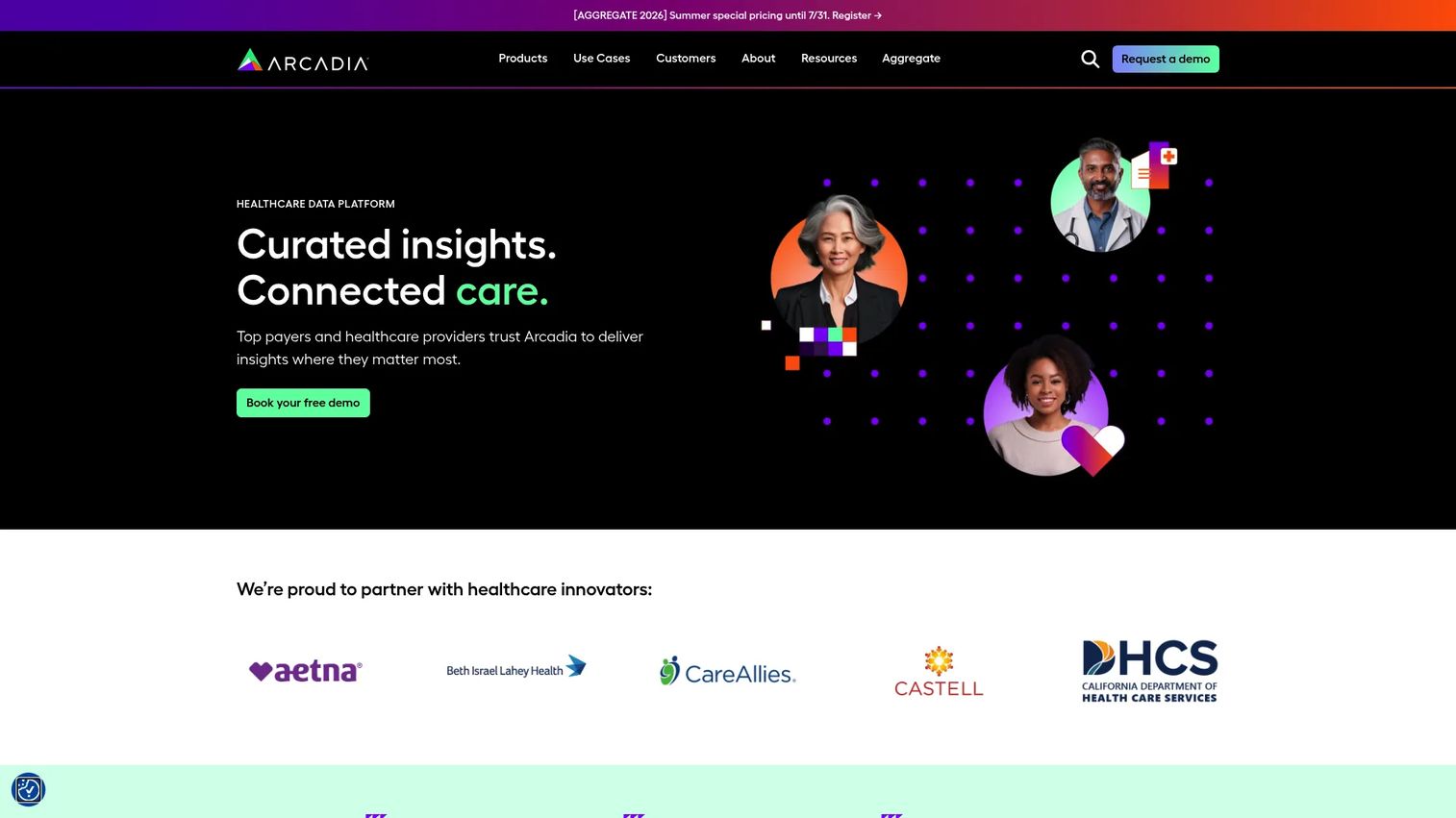
Arcadia is a healthcare data and analytics platform built for population health, care management, and value-based care. Its core strength is a data lakehouse that aggregates clinical, claims, and other data across a mixed EHR environment, which makes it a strong fit for organizations that were never standardized on a single system.
Best for: Healthcare organizations that need population health analytics and care management across multiple EHRs.
Key strengths
- Data lakehouse for healthcare analytics across sources
- Care management and patient outreach workflows
- Benchmarking, dashboards, and network analytics
Why choose Arcadia: If your organization grew through mergers or partnerships and now runs several EHRs, Arcadia's EHR-agnostic aggregation is the differentiator. It is built to normalize messy, multi-source data into population insights and care management workflows rather than assuming a clean single-vendor backbone.
Arcadia pricing: Pricing is quote-based and available through a demo request.
2. Innovaccer
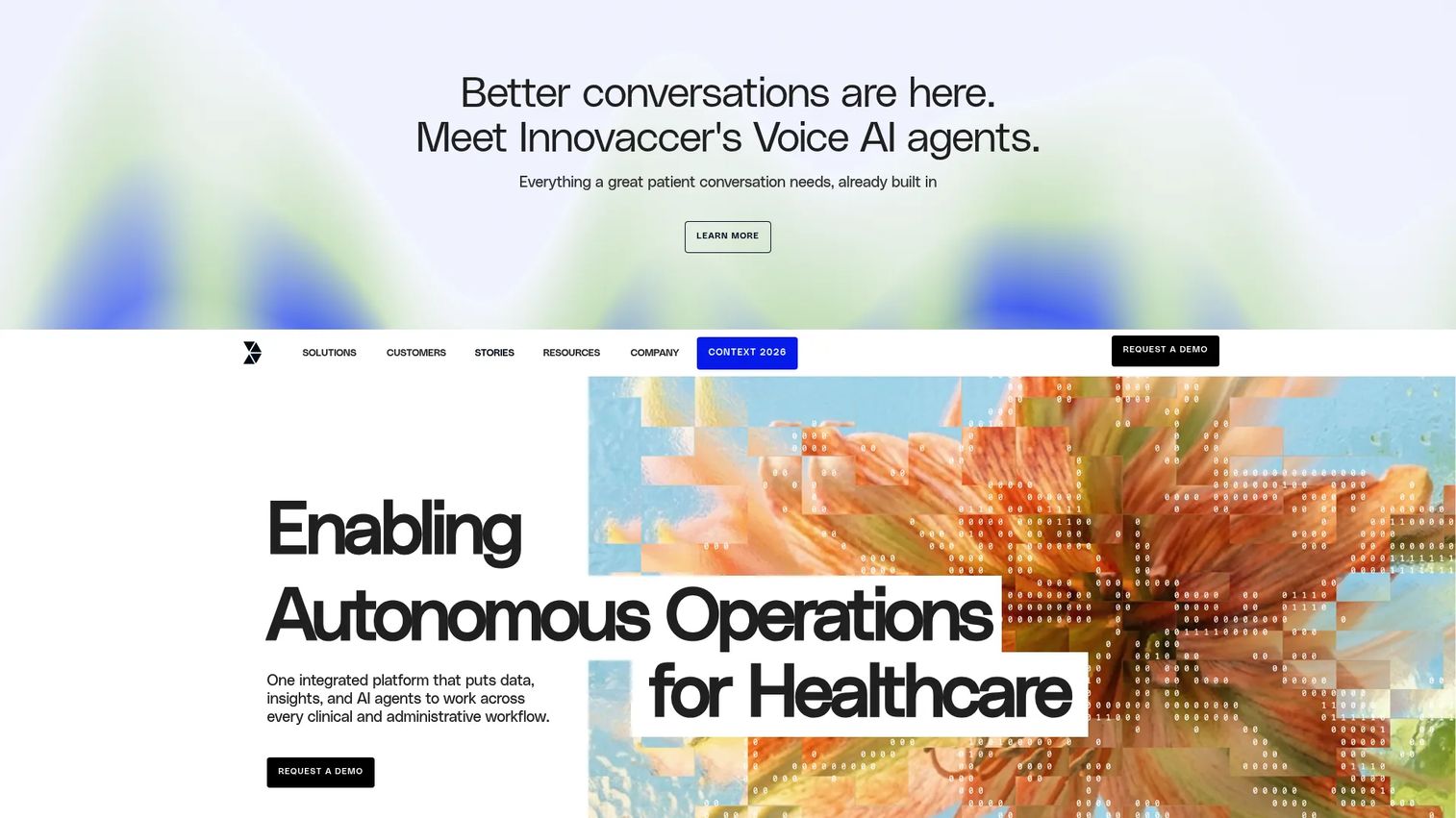
Innovaccer is a healthcare intelligence platform centered on unified data, AI agents, and workflow automation. Its Gravity data platform pulls disparate sources into a single longitudinal record, then layers care navigation and analytics on top, which suits large systems running enterprise population health workflows.
Best for: Healthcare organizations that need a unified data and AI operations platform at enterprise scale.
Key strengths
- Healthcare Intelligence Platform (Gravity)
- AI-powered assistants, agents, and copilots
- Data activation and healthcare analytics
Why choose Innovaccer: Innovaccer fits organizations that want to consolidate their population health analytics software, care coordination, and automation on one data foundation. The unified data model reduces the number of disconnected tools care teams juggle, and the AI layer is aimed at surfacing action rather than static reports.
Innovaccer pricing: Pricing is quote-based through a demo request.
3. Azara Healthcare
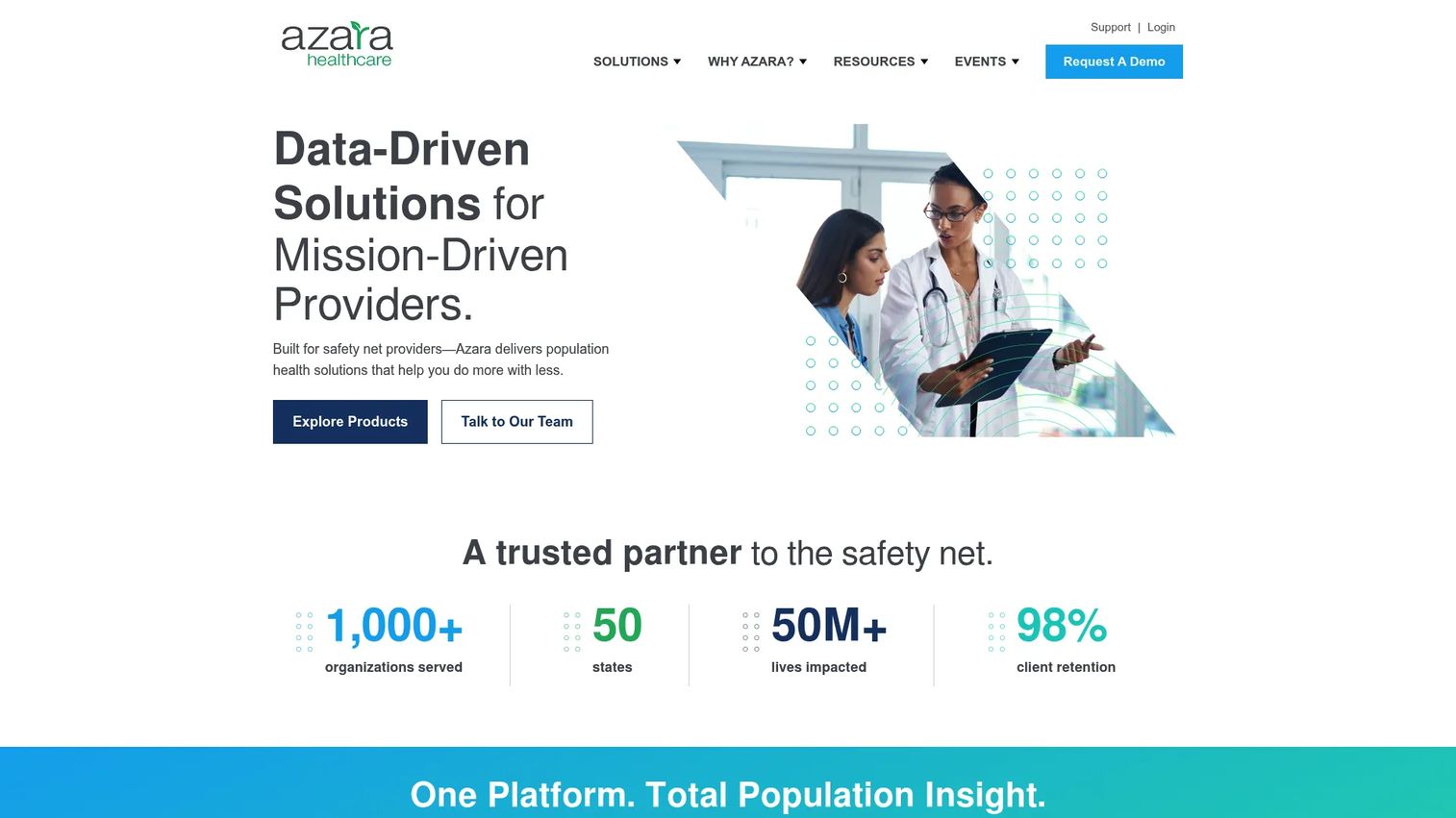
Azara Healthcare focuses on safety-net and community providers, including federally qualified health centers and community health centers. It centers on quality reporting, patient outreach, and care coordination tuned to the measures and workflows these organizations live and die by.
Best for: FQHCs and community health centers focused on quality reporting and outreach.
Key strengths
- Quality reporting for safety-net measures
- Patient outreach and engagement workflows
- Care coordination for community providers
Why choose Azara Healthcare: Safety-net organizations have reporting requirements that enterprise platforms treat as an afterthought. Azara builds around them. If your priority is UDS and quality improvement reporting, patient outreach, and care coordination for an underserved population, it targets that reality directly rather than forcing a generic enterprise workflow.
Azara Healthcare pricing: Pricing is quote-based and tied to organization size and scope.
4. Epic Healthy Planet
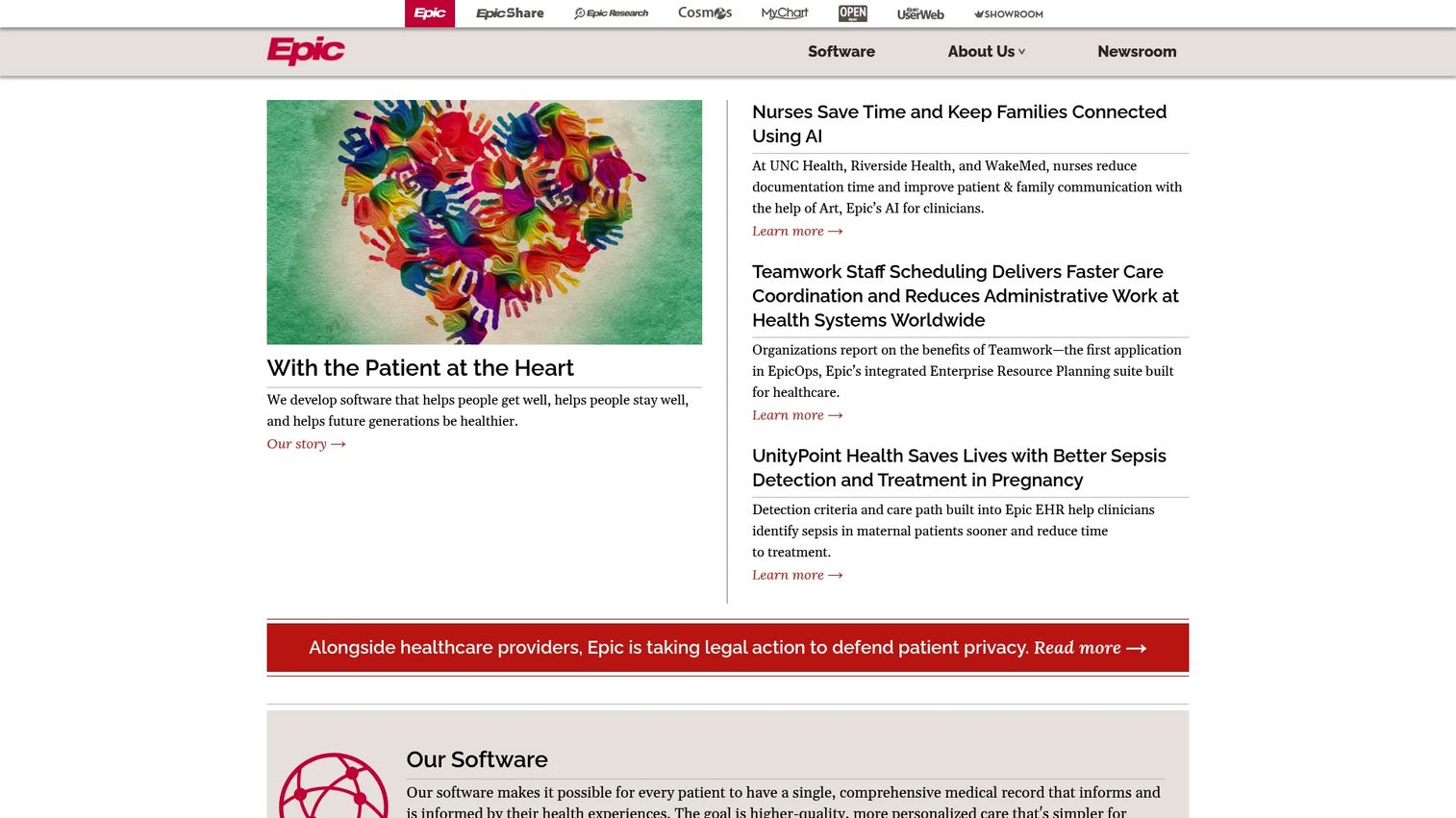
Epic Healthy Planet is Epic's population health module for monitoring care gaps, risk, outreach, and care management. Its advantage is native EHR fit: point-of-care alerts and longitudinal care management surface directly inside the Epic workflow clinicians already use.
Best for: Large healthcare organizations already standardized on Epic.
Key strengths
- Sharing and aggregating data across a network
- Care management across the continuum
- Social drivers of health support
Why choose Epic Healthy Planet: For Epic-centered health systems, the value is that population health lives where clinicians already work. There is no separate login, no context switch, and care gap alerts appear at the point of care. That native integration is hard for any third-party platform to match inside an Epic environment.
Epic Healthy Planet pricing: Pricing is quote-based and part of Epic's broader licensing.
5. Health Catalyst
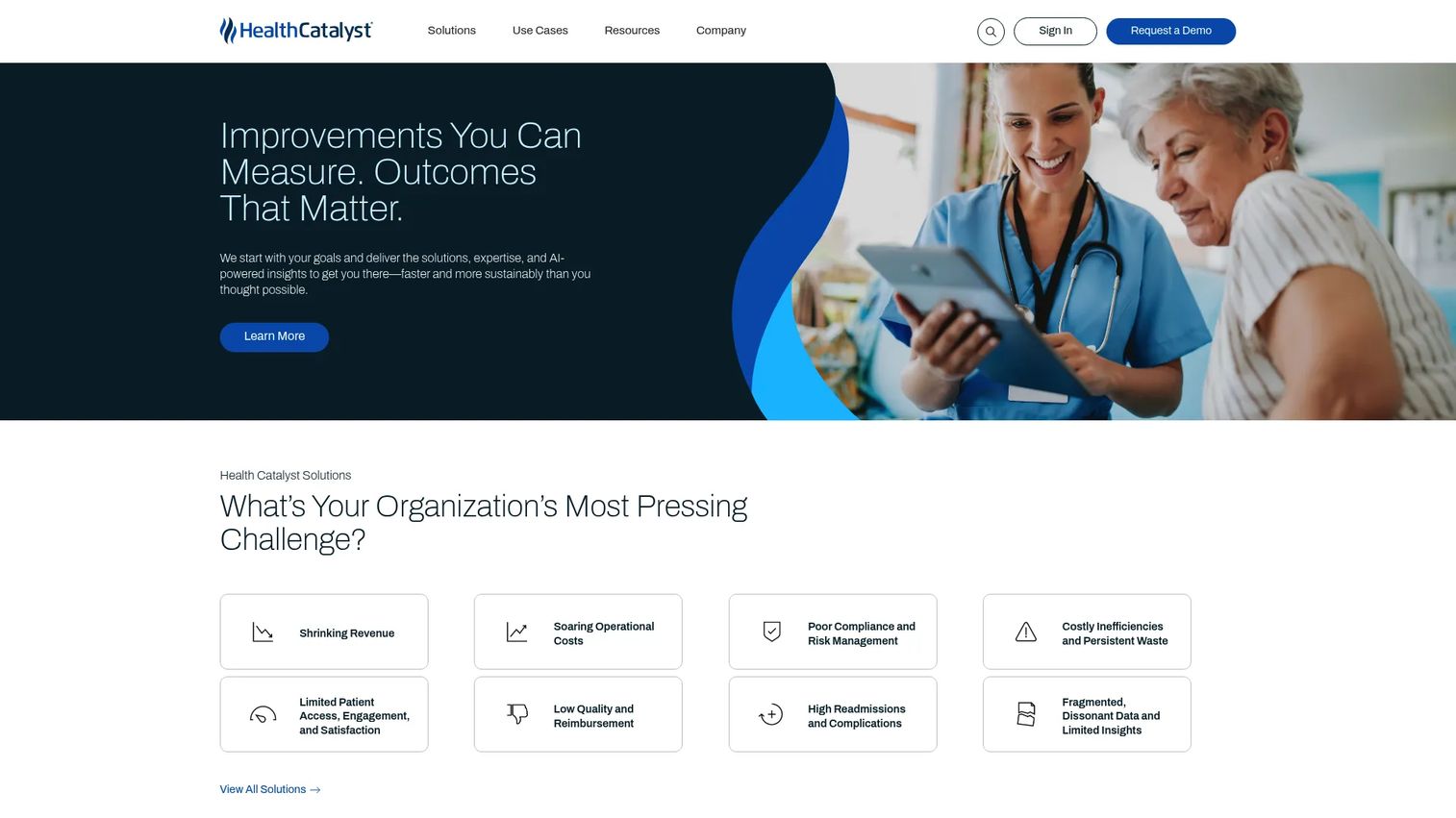
Health Catalyst is a healthcare data and analytics provider focused on clinical, financial, and operational improvement. Its population health tools sit on a broad data platform with analytics applications, making it a fit for organizations that prioritize advanced healthcare analytics infrastructure.
Best for: Healthcare organizations seeking deep analytics, revenue cycle, and operational improvement.
Key strengths
- Data platform and analytics applications
- Revenue cycle and price transparency solutions
- Population health and value-based care tools
Why choose Health Catalyst: Health Catalyst suits organizations that treat data and analytics as core infrastructure, not a bolt-on. If you want a platform that supports population health alongside quality improvement, revenue cycle, and operational analytics, its breadth is the differentiator. It pairs technology with services for teams building analytics maturity.
Health Catalyst pricing: Pricing is quote-based through a demo or contact process.
6. Oracle Health Health Data Intelligence
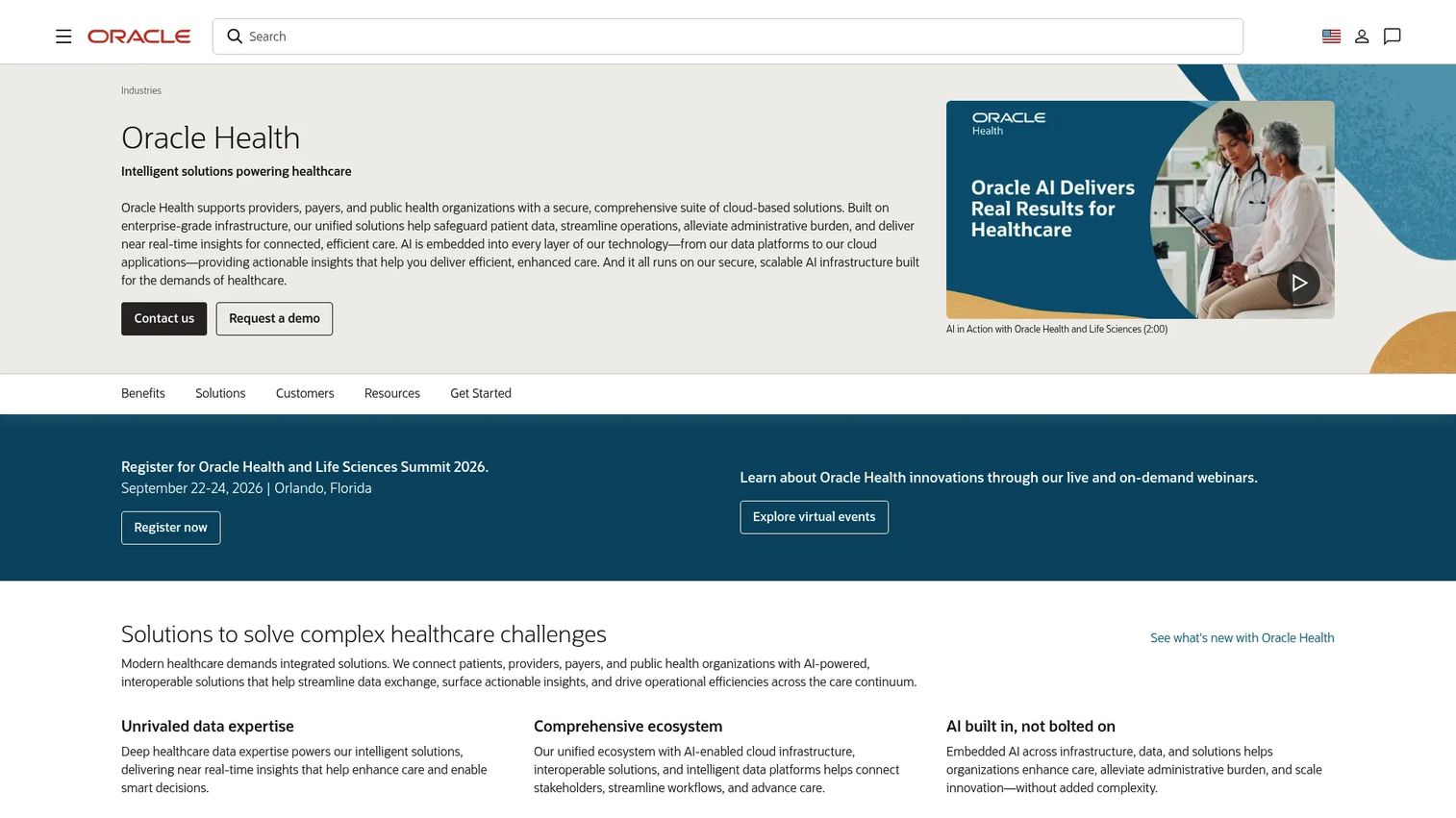
Oracle Health Health Data Intelligence is a cloud-based, AI-enabled healthcare data platform for integrating, analyzing, and activating clinical and operational data. It is EHR-agnostic and built for enterprise-scale data integration, which makes it a fit for large systems and Oracle Health customers pursuing a modernization path.
Best for: Healthcare organizations that need a unified, AI-driven data platform for population health and operational analytics.
Key strengths
- EHR-agnostic integration across clinical, claims, SDoH, and pharmacy data
- Prebuilt reports, advanced analytics, and AI/ML models for longitudinal records
- Care quality, care coordination, and value-based care workflow support
Why choose Oracle Health Health Data Intelligence: Organizations already invested in Oracle Health or planning a cloud data modernization get a platform designed for scale. The EHR-agnostic integration and AI/ML models target the enterprise problem of activating clinical and operational data across a large, complex environment.
Oracle Health Health Data Intelligence pricing: Pricing is quote-based via Oracle's contact and demo flow.
7. Optum Population Health Solutions
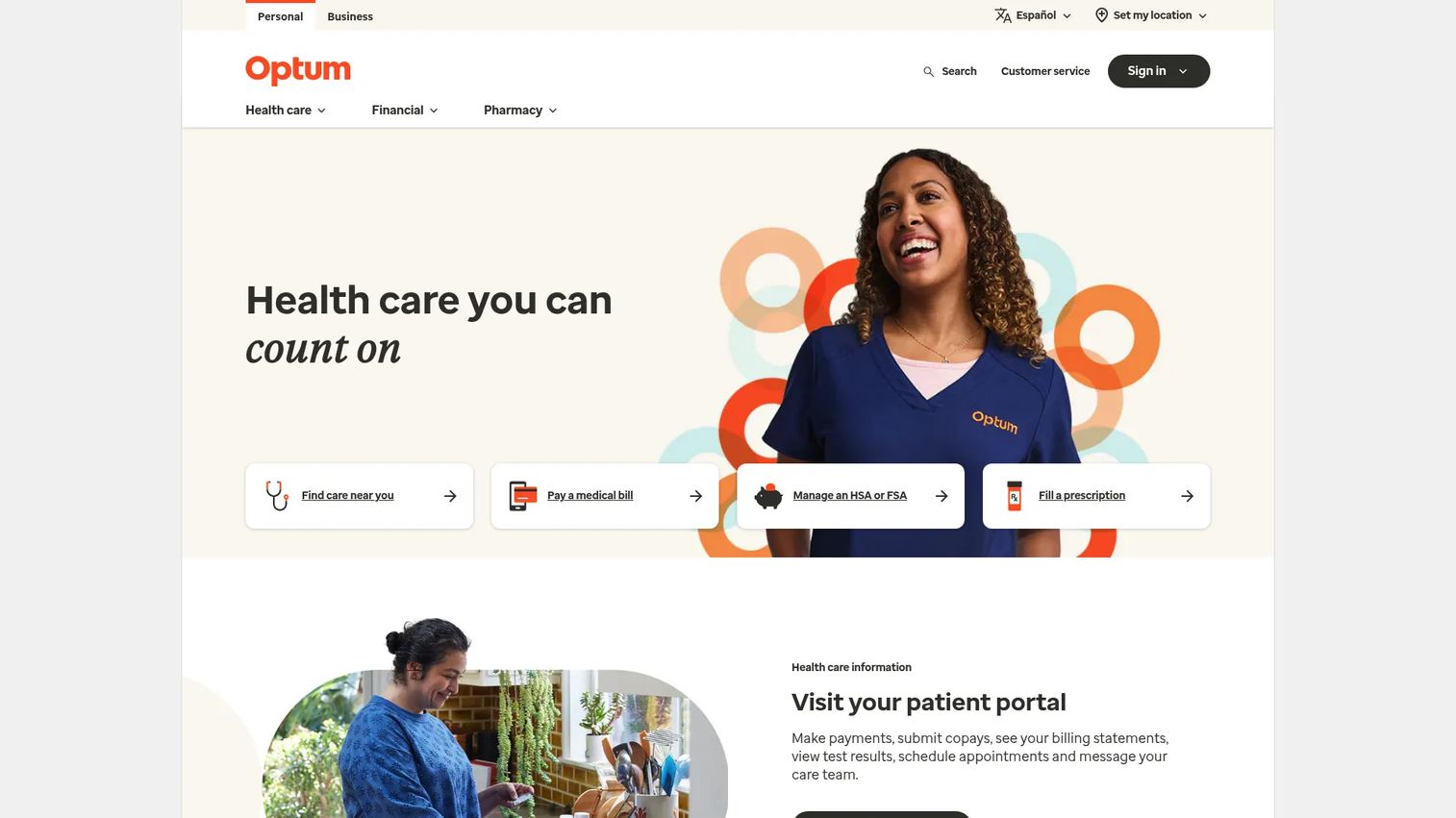
Optum Population Health Solutions brings claims-data scale, risk adjustment, and value-based care support to health plans, providers, and health systems. Its NCQA-accredited population health program and payer-side infrastructure make it a strong fit for organizations tied to risk-bearing contracts.
Best for: Health plans, providers, and health systems in payer-tied, risk-bearing arrangements.
Key strengths
- Population health analytics consulting
- Value-based care and risk-management support
- NCQA-accredited population health program
Why choose Optum Population Health Solutions: Optum's advantage is scale and proximity to payer infrastructure. For organizations whose contracts revolve around risk adjustment and total cost of care, the claims-data depth and value-based care support address the payer-provider network use case directly. It suits risk-bearing organizations more than small ambulatory groups.
Optum Population Health Solutions pricing: Pricing is not published publicly and depends on the engagement. Contact Optum for a quote.
8. athenahealth Population Health
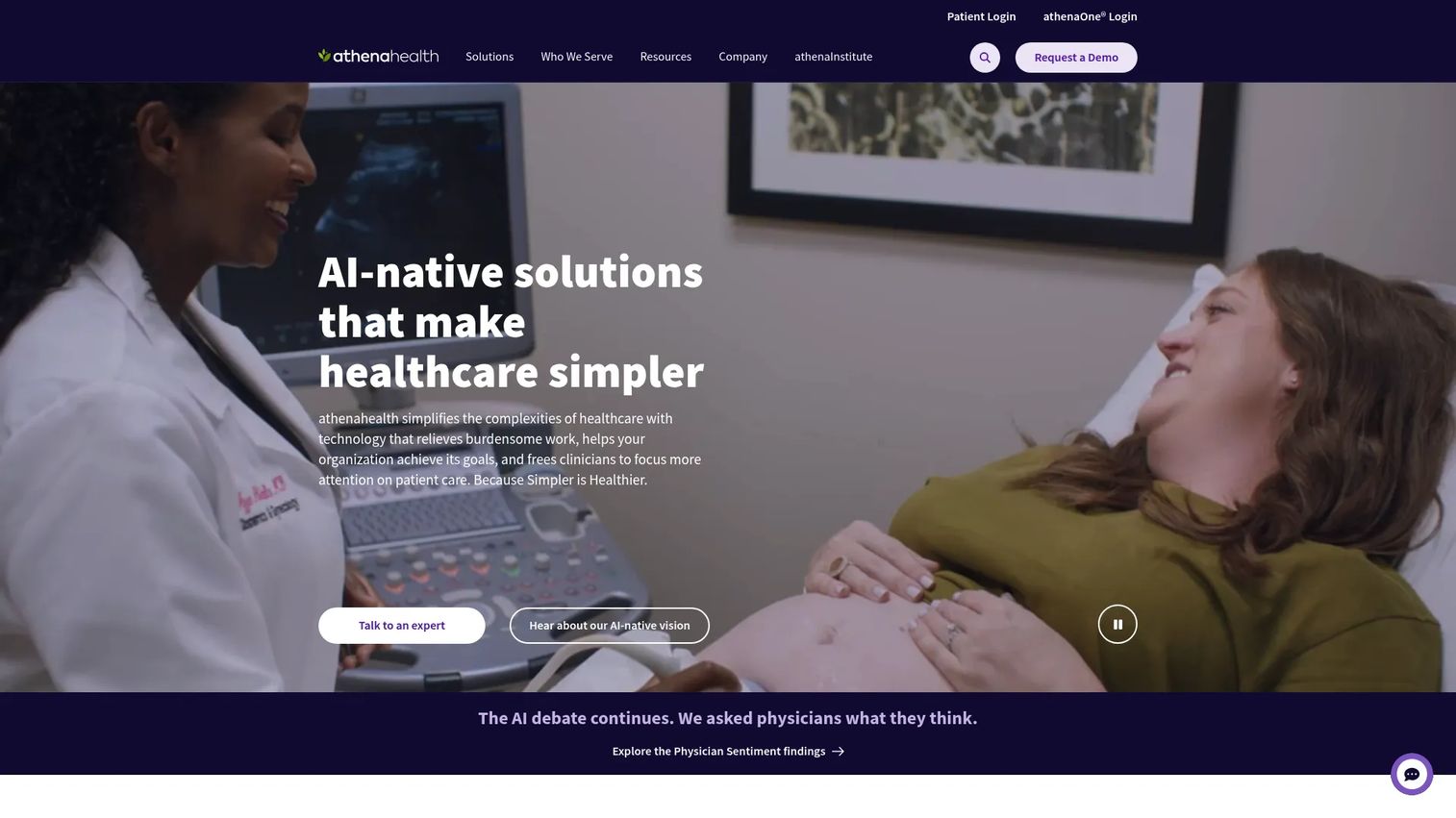
athenahealth Population Health delivers population health management tools native to athenaOne, aimed at value-based care workflows. Care coordination, care and diagnosis gap alerts, and automated outreach surface inside the clinical workflow, which fits ambulatory-heavy organizations.
Best for: Ambulatory healthcare organizations managing value-based care and care-gap closure.
Key strengths
- Care coordination surfaced in clinical workflows
- Alerts for care and diagnosis gaps with automated outreach
- Care program visibility and reporting support
Why choose athenahealth Population Health: For physician practices and ambulatory organizations already on athenaOne, population health lives inside the existing workflow with network benchmarking on top. The value is proximity to daily practice operations and gap closure rather than heavyweight enterprise analytics.
athenahealth Population Health pricing: Pricing is individualized and based on a percent of collections.
9. NextGen Healthcare Population Health Analytics
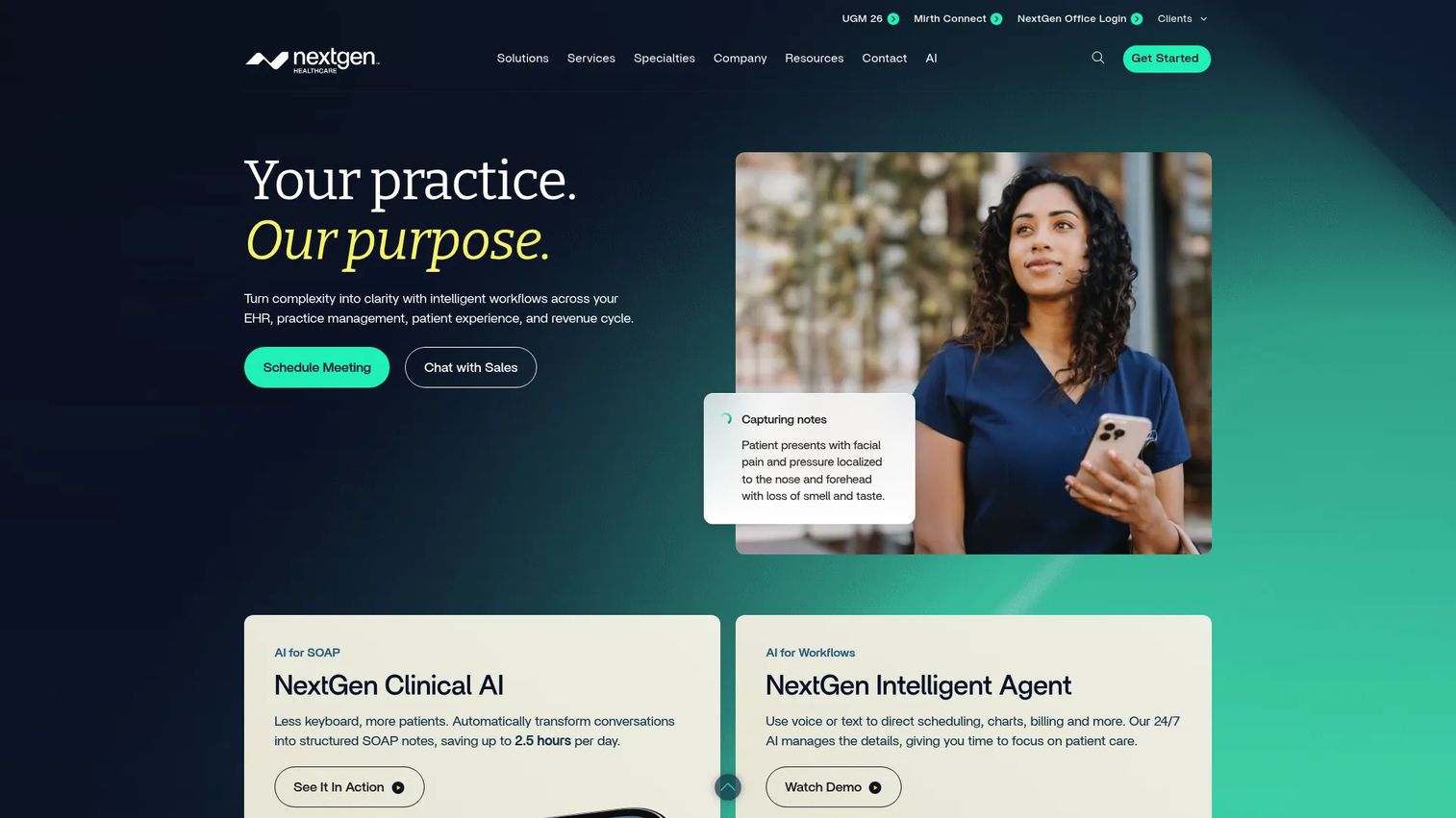
NextGen Healthcare Population Health Analytics targets ambulatory and community practice fit with reporting and analytics designed for smaller and specialty-heavy provider groups. It pairs population health analytics with the ambulatory workflows these organizations run day to day.
Best for: Smaller or specialty-heavy provider groups.
Key strengths
- Ambulatory-focused population health analytics
- Reporting for value-based care and quality measures
- Care coordination for community practices
Why choose NextGen Healthcare Population Health Analytics: NextGen fits provider groups that need population health analytics scaled to their size, without the overhead of an enterprise platform built for 40-hospital systems. For specialty groups and community practices, the ambulatory focus and reporting depth match the operational reality.
NextGen Healthcare Population Health Analytics pricing: Pricing is quote-based and tied to practice size and scope.
Considerations
Before you shortlist, pressure-test each platform against the criteria that decide whether it works in production, not in a sales demo.
Data aggregation and interoperability
The whole category lives or dies on this. Ask how each platform ingests claims, clinical, pharmacy, lab, and social data, and which standards it supports. Push on EHR integration specifics: which systems, how deep, and how often data refreshes. A platform that normalizes multi-source data cleanly is worth more than one with prettier dashboards.
Care coordination and workflow fit
Analytics that never reach the care team change nothing. Look for registries, care gap identification, outreach, and task management that land inside daily workflow. The test is whether a care coordinator can act on a flagged gap without leaving the tool or waiting for a report.
Value-based care and quality reporting
Match reporting depth to your contracts. A safety-net center needs UDS and HEDIS reporting; an ACO needs risk stratification and total-cost-of-care tracking. Confirm the platform tracks your specific measures and quantifies contract performance, not just generic quality dashboards.
Implementation and change management
Population health platforms are not plug-and-play. Ask about data migration timelines, governance requirements, and who owns the integration work. The operational overhead and cross-team coordination are real, so scope them before signing, not after.
ROI and measurement
Define success upfront. Track gap closure rates, reduced readmissions, quality performance against contract targets, and staff time saved on manual reporting. A platform earns its cost when those numbers move, so instrument them from day one.
Conclusion
The best population health management software depends entirely on your environment. Arcadia and Oracle Health Health Data Intelligence fit multi-EHR and enterprise data-integration needs. Innovaccer suits large systems consolidating data and workflows on one platform. Azara Healthcare is built for safety-net and community providers. Epic Healthy Planet wins inside Epic-centered systems. Health Catalyst fits teams prioritizing analytics infrastructure. Optum Population Health Solutions serves payer-tied risk contracts. athenahealth Population Health and NextGen Healthcare Population Health Analytics fit ambulatory and smaller provider groups.
There is no universal best. The right tool tracks to your data maturity, your EHR backbone, and your care model.
Next step: shortlist two or three vendors that match your profile, then run a structured evaluation against your real data sources, your contract measures, and your care team's daily workflow. Score them on data aggregation, interoperability, coordination workflow, and reporting depth. Let the platform prove it works on your data before you commit to a migration.
FAQs
It aggregates clinical, claims, pharmacy, and social data across a patient population, identifies at-risk cohorts through risk stratification, supports care coordination across settings, and measures outcomes against quality and value-based care targets. In short, it turns fragmented records into cohort-level insight and care team action.
Population health software works at the cohort and population level, aggregating data and identifying which groups of patients need attention. Care management software focuses on the individual patient's care plan and ongoing management. Most population health platforms include care management workflows, but the starting point is population-level analytics and risk stratification.
Yes, in almost every case. EHR integration is how the platform pulls clinical data into its longitudinal record. Without it, you are left with claims data alone, which lags and misses clinical detail. Strong interoperability across multiple EHRs is what separates platforms built for mixed environments from those that assume a single-vendor backbone.
Data aggregation and interoperability come first, since the category depends on unifying scattered sources. After that: risk stratification to prioritize outreach, care coordination workflows that reach the care team, and value-based care reporting matched to your contracts. Patient engagement and clinical analytics round out the core set.
Track gap closure rates, reduced readmissions, quality performance against contract targets, and staff time saved on manual reporting. In value-based care, contract performance and shared savings are the clearest measures. Instrument these metrics before implementation so you have a baseline to compare against.
Risk-bearing organizations benefit most: ACOs, systems in value-based contracts, and FQHCs with quality reporting mandates. If your revenue depends on outcomes and total cost of care rather than volume alone, population health platforms move from nice-to-have to core infrastructure. Organizations with fragmented data across multiple EHRs gain the most from aggregation.
Population health analytics is the measurement layer: aggregating data, stratifying risk, and reporting on cohorts and outcomes. Population health management is the broader practice that includes analytics plus the care coordination, outreach, and intervention workflows that act on those insights. Analytics tells you who and why; management is what you do about it.
Shortlist two or three vendors that match your EHR environment, data maturity, and care model, then score them on data aggregation, interoperability, care coordination workflow, and value-based care reporting depth. Run the evaluation against your real data sources and contract measures, and confirm implementation timelines and governance requirements before you sign.