

Recognition breaks the moment a team stops fitting in one room. A manager who used to notice every win now oversees three time zones and two Slack channels. The praise still happens, but it happens quietly, inconsistently, and only when someone remembers.
That gap is expensive. The global peer-to-peer employee recognition software market was valued at USD 2.2 billion in 2025 and is projected to reach USD 5 billion by 2033 at an 11% CAGR, according to OpenPR (2025). Buyers are spending because manual praise does not scale into a repeatable program.
Here is the actual problem. Manager-only recognition misses most of the work. Peers see the effort managers never do: the late save, the quiet assist, the ticket someone quietly cleared. Peer recognition software captures those moments, makes them visible, and ties them to rewards people actually want. The question is which platform fits your workflow, your integrations, and your budget.
What's inside
This guide is for HR, People Ops, RevOps, and enablement leaders comparing peer recognition software for distributed teams. If you own adoption and need a tool people actually use, this is the shortlist.
We evaluated each platform on five criteria:
- Peer-to-peer recognition workflow and how fast it drives daily use
- Rewards catalog depth and global fulfillment
- Integrations and daily workflow fit (Slack, Microsoft Teams, HRIS)
- Analytics, reporting, and program governance
- Support for hybrid and remote teams
Tools were chosen using category fit, integration depth, public pricing signal, and current G2 review data.
TL;DR
- Best all-in-one for enterprise: Achievers, for teams needing recognition, global rewards, and service awards with deeper analytics.
- Best for fast peer-to-peer adoption: Bonusly, for lightweight social recognition with a free tier and rewards.
- Best for Microsoft-first workplaces: Recognize, for teams standardized on Microsoft 365 and Teams.
- Best for recognition plus employee listening: WorkTango, for HR teams that want surveys and insights alongside recognition.
- Best for simple peer recognition and culture: Motivosity, for growing teams wanting quick adoption.
- Best for rewards flexibility: Nectar or Awardco, depending on how deep your rewards program needs to go.
What is peer recognition software
Peer recognition software is an employee recognition platform that lets coworkers publicly appreciate each other's work, often paired with points, rewards, and analytics. The core shift from generic engagement tools is direction: recognition flows sideways between peers, not just top-down from managers.
It differs from broad employee engagement software in scope. Engagement platforms measure sentiment across surveys, eNPS, and pulse checks. Peer-to-peer recognition software focuses on the recognition workflow itself, then layers rewards and reporting on top.
Core features to expect:
- Peer-to-peer recognition: coworkers send public or private appreciation tied to values
- Rewards catalogs and redemption: points convert to gift cards, experiences, or company swag
- Manager recognition and celebrations: birthdays, work anniversaries, and milestone automation
- Analytics and dashboards: participation rates, recognition frequency, and culture trends
- Integrations: Slack, Microsoft Teams, Workday, and other HRIS systems
- Mobile access and global support: recognition from any device, with rewards fulfillment across regions
Why it matters: recognition frequency correlates with retention. When appreciation is visible and consistent, people stay longer, managers get culture signals earlier, and distributed teams feel connected instead of siloed. An employee rewards platform turns that culture goal into a measurable program.
When to use peer recognition software
Scale recognition beyond manager praise
Manager-only recognition has a ceiling. One manager cannot witness every contribution across a growing team. Peer recognition captures the everyday wins managers miss, the small assists that keep work moving. If your recognition depends on a manager remembering, it will be inconsistent by design.
Support hybrid and remote teams
Distributed teams lose the hallway moment. There is no visible nod across a desk. Recognition has to live where work happens, inside Slack, Microsoft Teams, and on mobile. A visible feed of appreciation gives remote employees the signal that their work registered, without waiting for a formal review cycle.
Connect recognition to rewards and retention
Recognition alone works for culture. Add a rewards layer when you want to reinforce behavior and give appreciation tangible weight. This is a budget and program-maturity decision. Early programs often start with social recognition, then introduce an employee rewards platform once participation is steady.
Comparison table
Here is how the top seven platforms compare on fit, rewards model, integrations, pricing, and current G2 rating. Use it to narrow to two or three before reading the full sections.
| # | Product | Best for | Key differentiator | Pricing | G2 rating |
|---|---|---|---|---|---|
| 1 | Achievers | Enterprise recognition and rewards | Global rewards marketplace and service awards | Custom pricing | 4.6/5 |
| 2 | Bonusly | Fast peer-to-peer adoption | Free tier plus lightweight social recognition | Free; from $5/user/mo | 4.7/5 |
| 3 | Recognize | Microsoft-first workplaces | Deep Microsoft 365 and Teams fit | Custom pricing | 4.7/5 |
| 4 | WorkTango | Recognition plus employee listening | Recognition combined with surveys and insights | Custom pricing | 4.7/5 |
| 5 | Motivosity | Simple peer recognition and culture | Social platform plus recognition in one hub | From $3,000/yr | 4.7/5 |
| 6 | Nectar | Recognition plus internal comms | Recognition, surveys, and comms together | Custom pricing | 4.7/5 |
| 7 | Awardco | Rewards flexibility and depth | Configurable rewards with a large marketplace | From $3,000 | 4.9/5 |
Ratings and pricing reflect current G2 listings and vendor pricing pages as of the 2026 update. Several vendors publish tier names but quote by request, so treat custom pricing as a signal to scope your program before the call.
Best 7 peer recognition software for 2026
1. Achievers
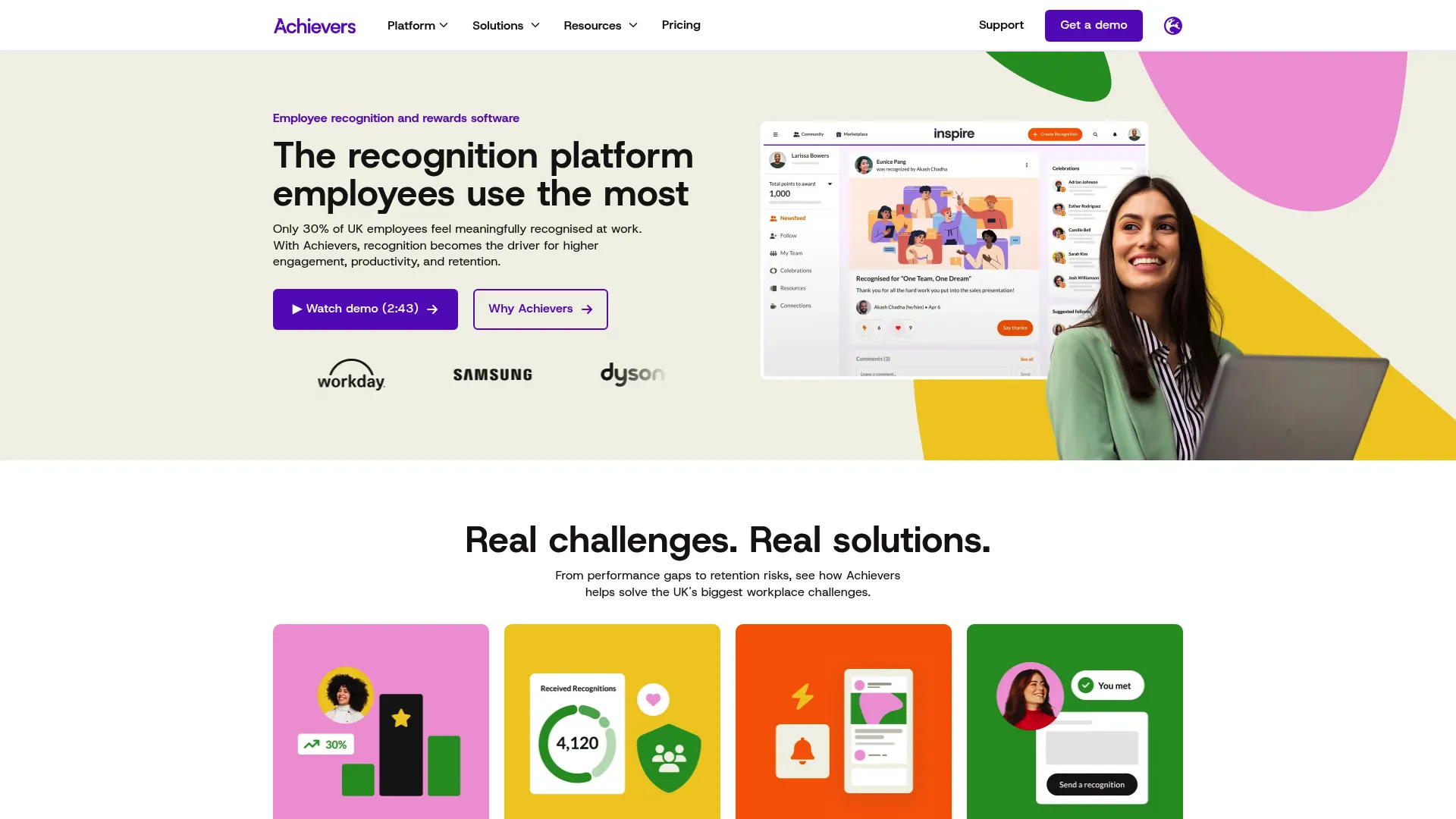
Achievers is an employee recognition and rewards platform built for mid-market and enterprise teams that need scale. It pairs peer-to-peer recognition with a global rewards marketplace and service awards, then wraps analytics around the whole program. If governance and measurable adoption matter to your buying committee, this is the platform designed for that pressure.
The differentiator is breadth. Achievers handles monetary and non-monetary recognition, ties milestones and years-of-service celebrations into the same system, and supports global fulfillment for distributed workforces. AI-powered engagement tooling helps surface where recognition is thin so you can act before participation drops.
Best for: mid-market and enterprise teams needing recognition, rewards, and service awards in one governed system.
Key strengths
- Monetary and non-monetary recognition
- Global rewards marketplace
- Years of service and milestone celebrations
Why choose Achievers: it fits organizations that treat recognition as a measurable program, not a perk. When you need reporting your leadership will trust and rewards that work across regions, the depth here earns its seat.
Achievers pricing: Achievers uses custom pricing. The pricing page asks you to request a quote and does not display public prices, with plans spanning the recognition and reward platform and years-of-service programs.
2. Bonusly
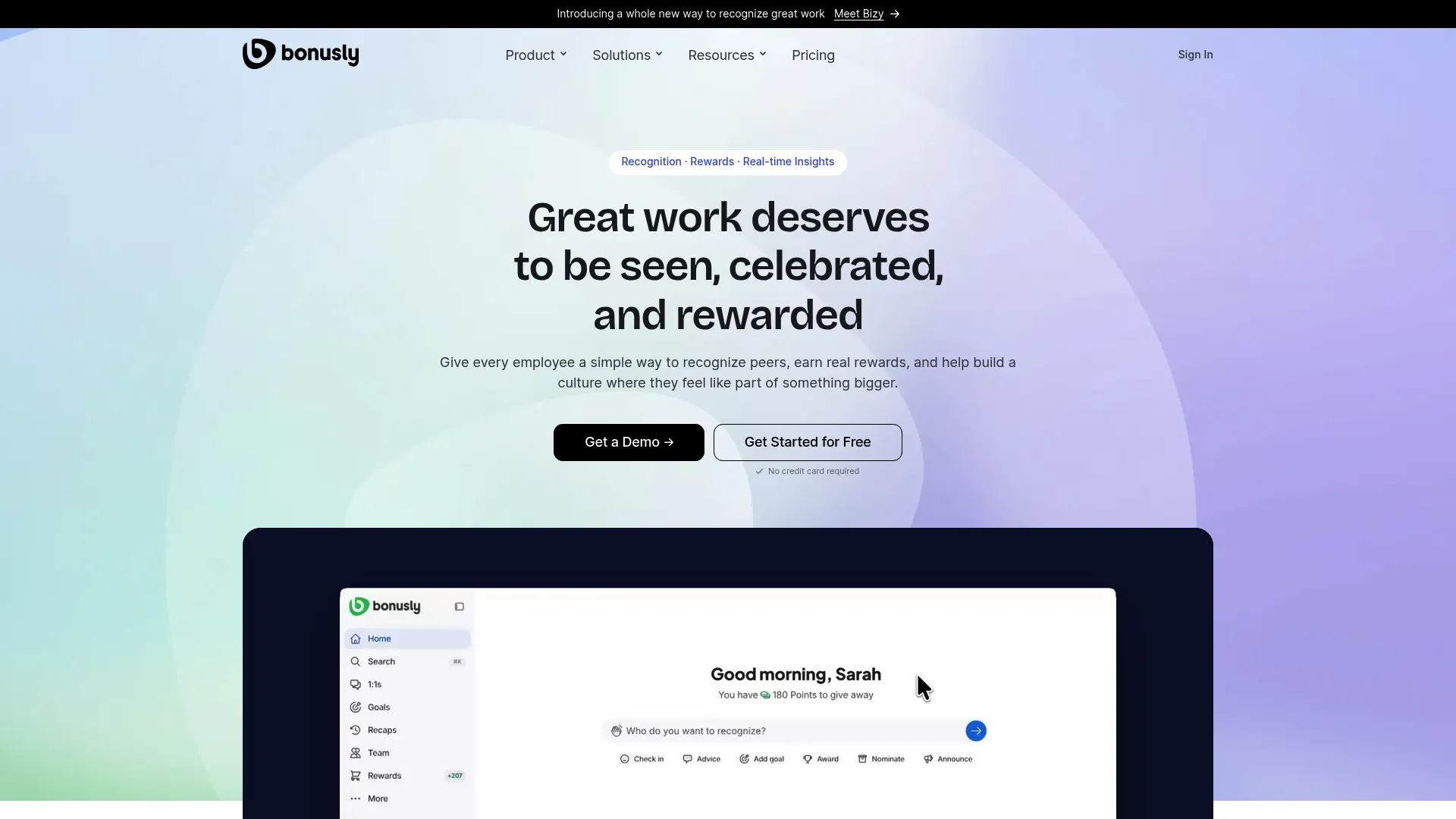
Bonusly is built around frequent, lightweight appreciation. Small point allotments let everyone recognize peers often, which is what drives the daily habit most programs struggle to build. It is one of the easier platforms to get adopted quickly because the workflow is simple and social.
Recognition lives inside the tools people already use, with Slack and Microsoft Teams integrations that keep appreciation in the flow of work. Points convert to a rewards catalog, automated milestones handle birthdays and anniversaries, and employee analytics show where recognition is concentrated.
Best for: teams that want peer recognition with rewards and engagement analytics, with fast adoption.
Key strengths
- Peer-to-peer recognition
- Rewards catalog
- Automated milestones
- Integrations
- Employee analytics
Why choose Bonusly: the free tier and low entry price make it a low-risk way to test whether daily peer recognition sticks before committing budget to a larger rollout.
Bonusly pricing: free forever for up to 8 users. Team + Bizy starts at $5 per user per month monthly, or $50 per user per year annually. Team without Bizy is $3 per user per month or $30 per user per year. Organization plans use custom pricing.
3. Recognize
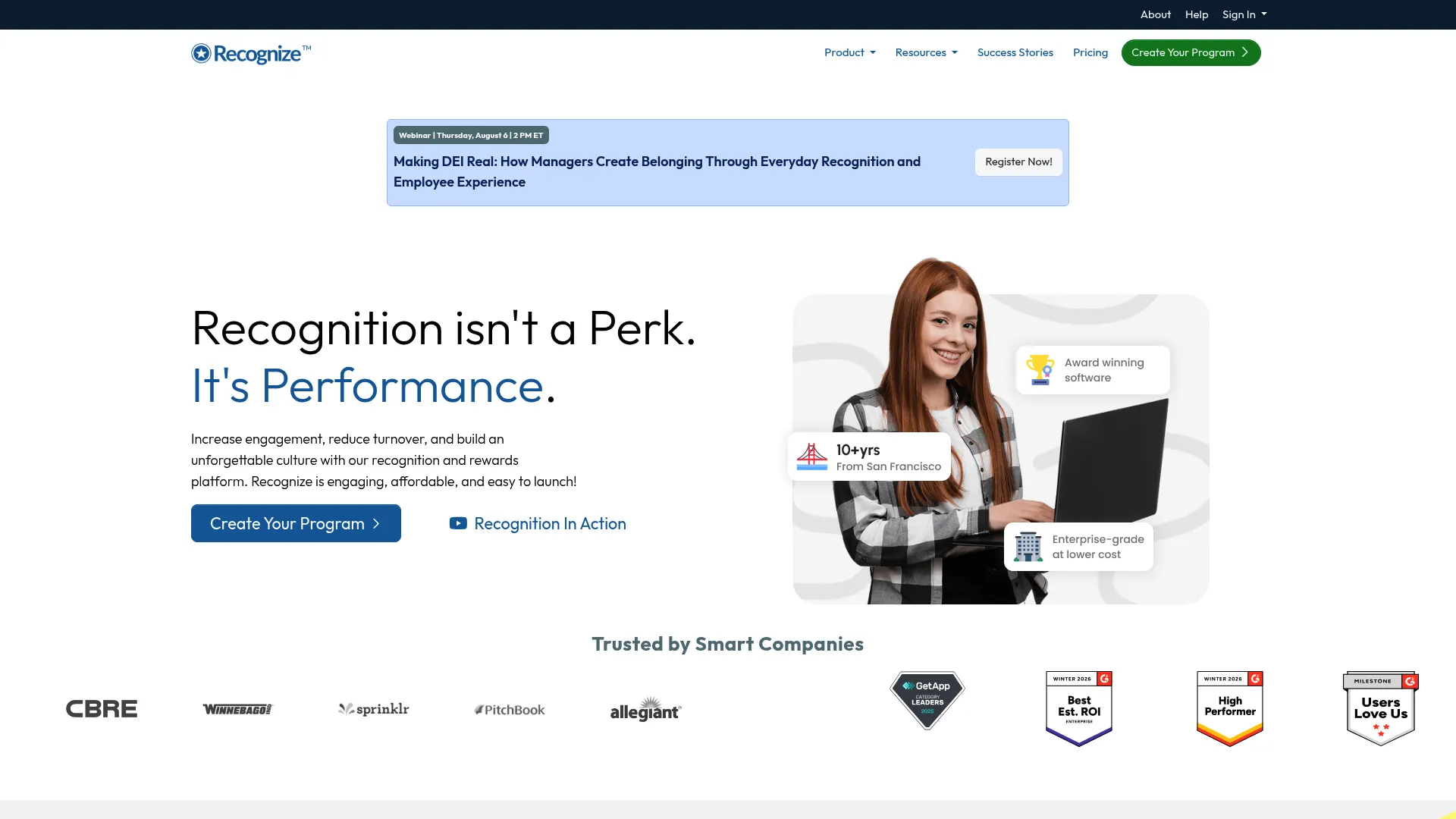
Recognize is an employee recognition and rewards platform built for teams living inside Microsoft 365. If your workday runs through Teams and Outlook, recognition that shows up natively in those tools removes the friction that usually kills adoption. That native fit is the whole reason to shortlist it.
Beyond the Microsoft angle, Recognize covers peer-to-peer recognition, employee rewards and gift cards, and the supporting workflows: nominations, anniversaries, incentives, and surveys. Enterprise controls make it viable for larger, distributed organizations that need governance without leaving their existing stack.
Best for: mid-market and enterprise teams needing recognition and rewards tied into Microsoft 365.
Key strengths
- Peer-to-peer employee recognition
- Employee rewards and gift cards
- Nominations, anniversaries, incentives, and surveys
Why choose Recognize: for a Microsoft-standardized workplace, the deep ecosystem fit means recognition happens where people already work, which is the single biggest driver of adoption.
Recognize pricing: Recognize shows three tiers, Start-Up, Mid-Market, and Enterprise, and charges annually based on organization size and active user count. Public numeric prices are not displayed, and a free trial is offered.
4. WorkTango
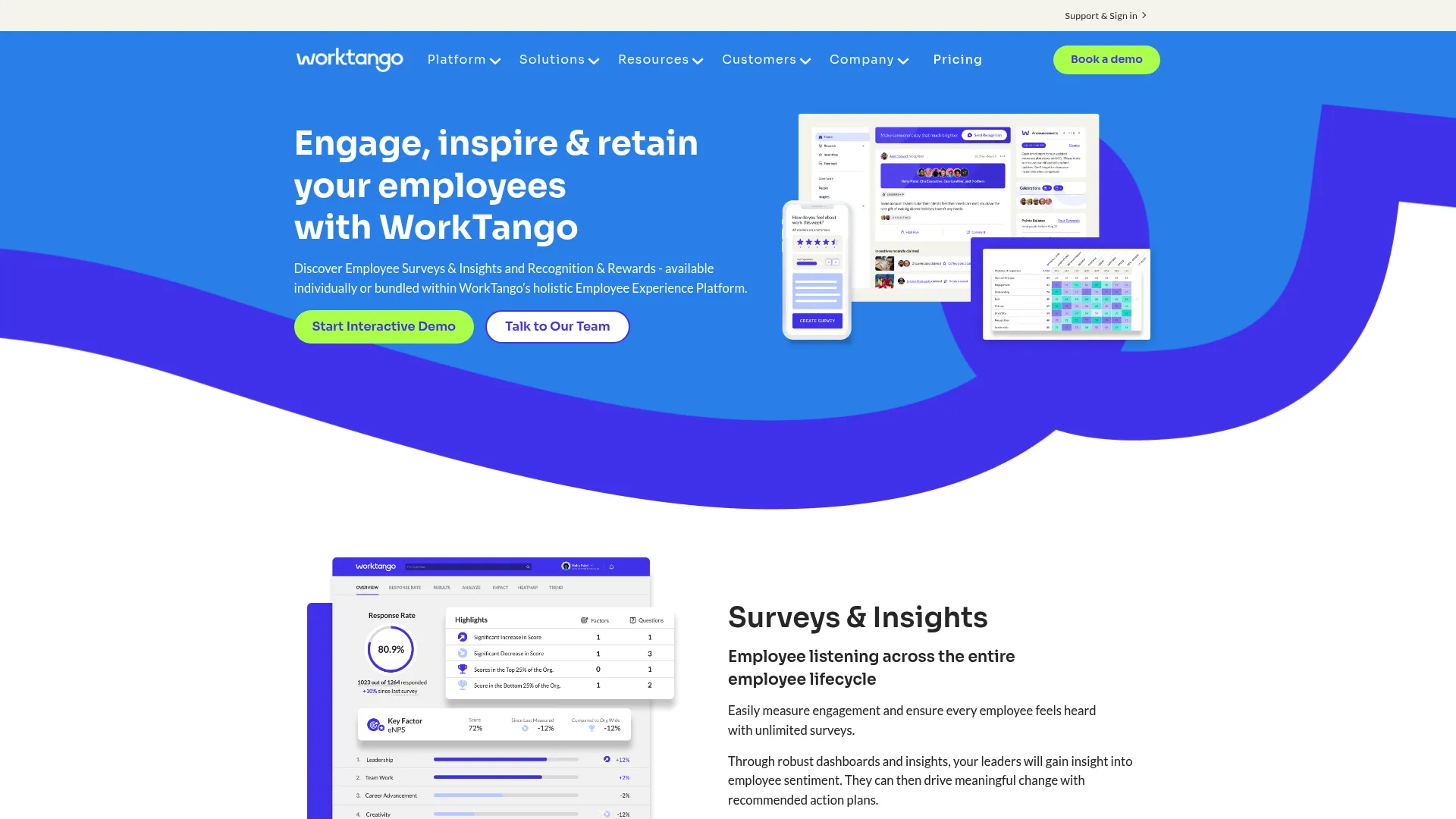
WorkTango positions recognition inside a larger employee experience motion. It combines recognition and rewards with surveys and insights, so the same platform that captures appreciation also captures sentiment. For HR teams that want to connect the two signals, that pairing is the point.
The platform runs on AI-powered dashboards, analytics, and recommended actions, which means recognition data feeds into a wider picture of engagement. Manager visibility is strong, and the survey layer gives leaders early warning on culture trends that recognition volume alone might miss.
Best for: organizations wanting a configurable recognition platform paired with employee listening.
Key strengths
- Employee recognition and rewards
- Employee surveys and insights
- AI-powered dashboards, analytics, and recommended actions
Why choose WorkTango: choose it when recognition is one part of a bigger employee experience strategy, and you want surveys and recognition reporting living in the same system rather than two disconnected tools.
WorkTango pricing: WorkTango lists three products, employee surveys and insights, recognition and rewards, and the combined employee experience platform. Pricing is by request, billed per year, with no public numeric price shown and no free tier.
5. Motivosity
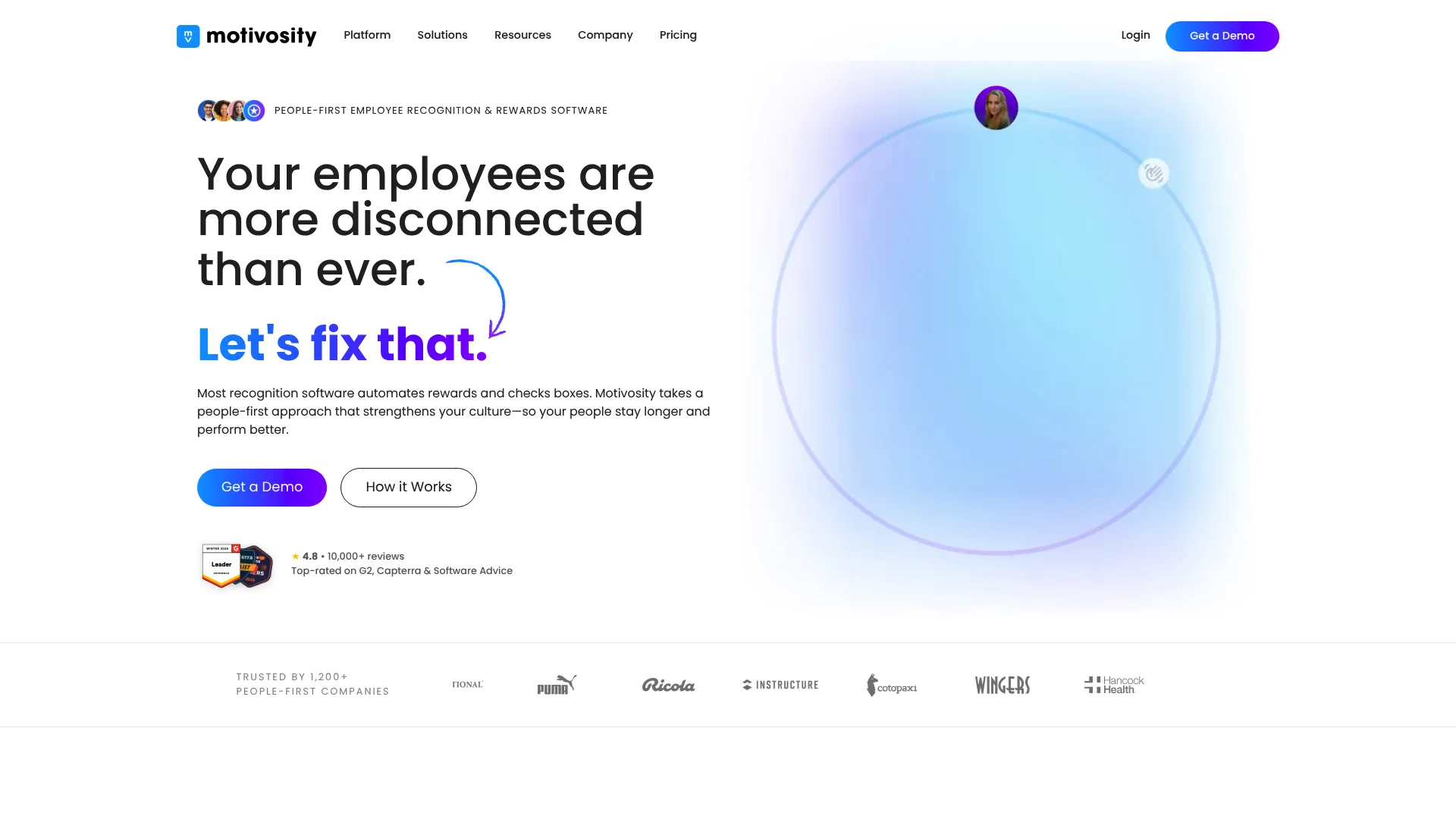
Motivosity is a people-first recognition platform focused on appreciation, social connection, and culture. It leans into the social feed as the center of gravity, making recognition feel like a natural part of the day rather than a formal process. That makes it a strong fit for growing teams that want adoption without heavy setup.
The platform combines peer-to-peer recognition and rewards with an employee social platform and communication hub, plus real-time reporting and analytics. Manager visibility and culture analytics round out a package aimed at teams that want to see and shape their culture as it forms.
Best for: mid-market and enterprise teams wanting recognition, rewards, and culture analytics in one platform.
Key strengths
- Peer-to-peer recognition and rewards
- Employee social platform and communication hub
- Real-time reporting and analytics
Why choose Motivosity: it fits teams that want quick adoption and a social, connection-first feel, where recognition builds culture rather than sitting inside a rigid workflow.
Motivosity pricing: Motivosity uses custom pricing based on company size and selected modules. Small business plans start at $3,000 annually, with a platform fee plus additional modules layered on top.
6. Nectar
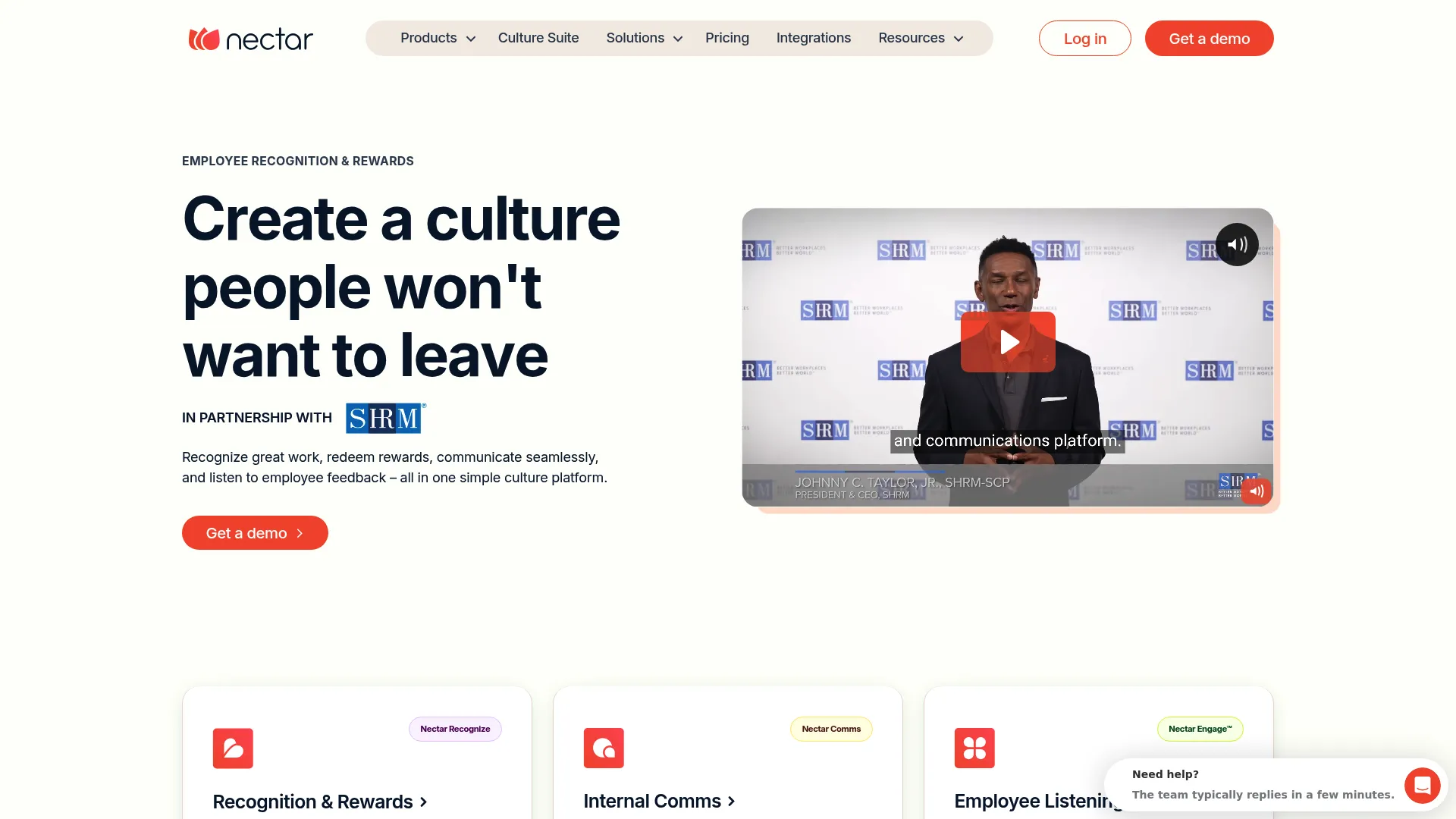
Nectar combines recognition with internal communications and employee listening in one platform. It handles both peer-to-peer and manager recognition, then adds engagement surveys and comms across the channels teams already use. For mid-market teams that want more than recognition alone, that combination reduces tool sprawl.
The internal communications layer spans email, Slack, and Teams, so recognition and company messaging share one system. Nectar's configurable rewards and automated moments keep the program running without constant manual effort, which matters when you are managing a distributed workforce.
Best for: mid-market teams wanting recognition plus internal comms and employee listening together.
Key strengths
- Peer-to-peer and manager recognition
- Employee engagement surveys and eNPS
- Internal communications across email, Slack, and Teams
Why choose Nectar: pick it when you want recognition, surveys, and internal comms in one place, and prefer configurable rewards over a rigid points-only model.
Nectar pricing: Nectar's pricing page shows product bundles and a request-a-demo flow. No public numeric subscription price is displayed on the current pricing page.
7. Awardco
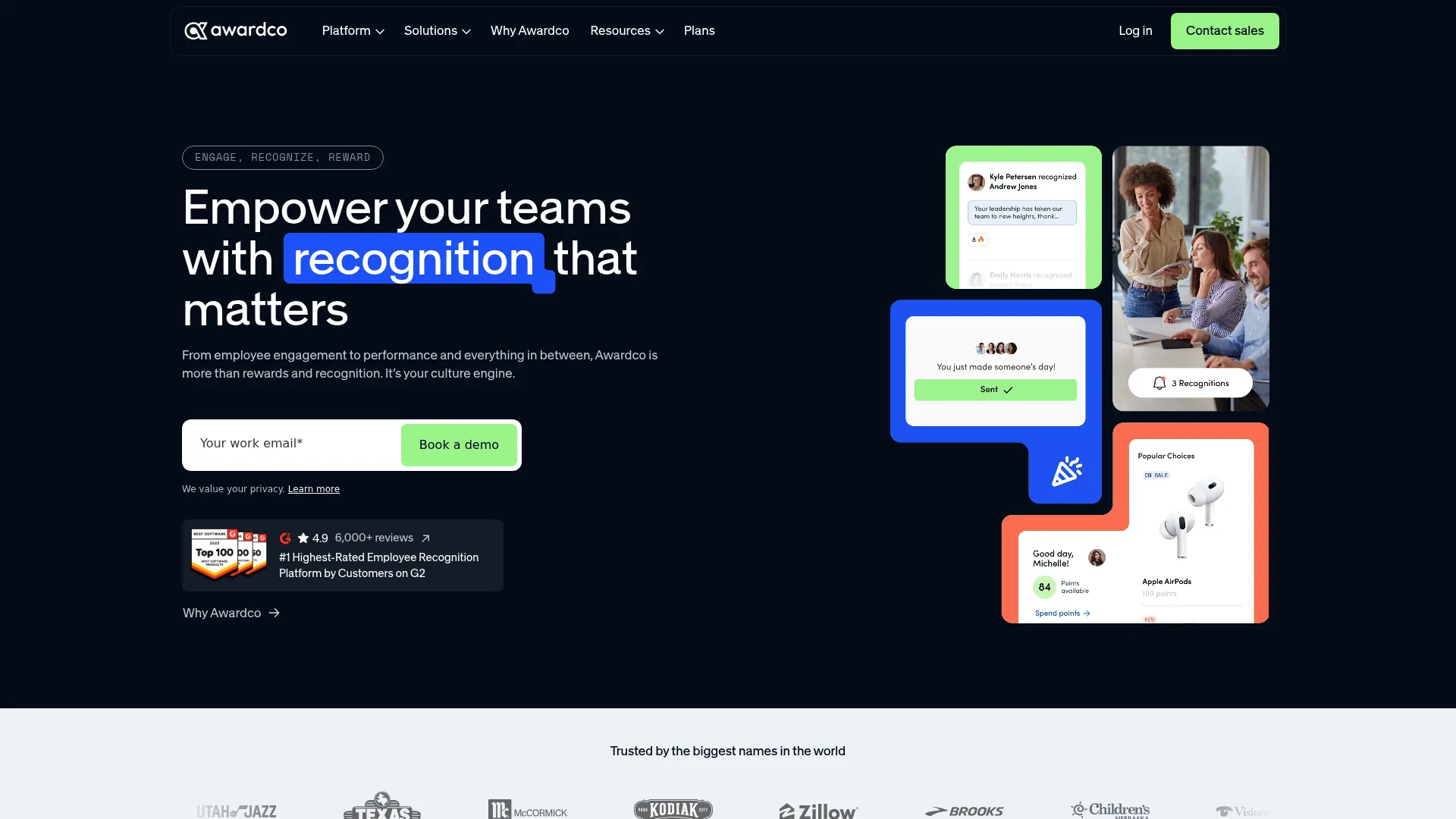
Awardco is built around rewards depth. It carries the highest G2 rating on this list at 4.9/5, and its configurable recognition programs pair with one of the broadest rewards marketplaces available. For reward-heavy programs where redemption options make or break participation, this is the platform to scope.
Awardco covers recognition programs and milestones, a global rewards marketplace, and employee listening with internal communications. That range lets you run recognition, service awards, and rewards fulfillment from a single system, which simplifies governance for larger, distributed teams.
Best for: mid-market and enterprise teams wanting configurable recognition and rewards programs.
Key strengths
- Recognition programs and milestones
- Global rewards marketplace
- Employee listening and internal communications
Why choose Awardco: if reward flexibility and fulfillment depth are your priority, the marketplace breadth here is hard to match, and the 4.9/5 G2 rating reflects strong user sentiment.
Awardco pricing: Awardco's plans page lists Standard, Scale, Enterprise, Service Awards Only, and Automated tiers. New startups and small businesses with 100 employees or fewer can reach out for flexible packages starting at $3,000. Individual tier prices are not shown publicly.
Considerations
Reward catalog depth
Verify what employees can actually redeem, and where. A rich catalog in one country can be thin in another. Check global availability, fulfillment costs, and whether points work for the regions your team lives in. A rewards program only motivates if the rewards feel worth earning.
Integrations and daily workflow
Recognition dies when it lives in a separate tab. Confirm the platform fits into Slack, Microsoft Teams, and your HRIS, including Workday, so recognition happens in the flow of work. Deep integration is the difference between a program people use daily and one they forget by week two.
Analytics and ROI
Your reporting should show participation rates, recognition frequency by team, and culture trends over time. Look for dashboards that connect recognition activity to retention and engagement signals. Without that, you are running a program you cannot defend at budget time.
Governance and permissions
Decide early who approves rewards, sets budgets, and manages the program. Strong platforms let you control point allotments, set spending limits, and assign admin roles by team. Governance keeps the program fair and keeps finance comfortable.
Mobile and hybrid access
Distributed teams need to recognize from anywhere. Confirm the mobile experience is fast and full-featured, not a stripped-down afterthought. If recognition requires a laptop, remote and frontline employees get left out of the culture the program is meant to build.
Conclusion
The right platform depends on your adoption model, rewards needs, and integration stack. Achievers and Awardco fit enterprise programs that need rewards depth and governance, with Awardco leading on marketplace flexibility. Bonusly and Motivosity suit teams prioritizing fast, social peer-to-peer adoption. Recognize is the clear pick for Microsoft-first workplaces. WorkTango and Nectar work best when recognition sits alongside surveys, insights, and internal comms.
Do not buy on feature lists alone. Shortlist two or three platforms that match your integration stack and budget, then run a pilot with one team. Measure participation, manager adoption, and how quickly recognition becomes a daily habit. Adoption is the only metric that separates a real recognition program from a tool nobody opens.
FAQs
Peer recognition software lets coworkers publicly appreciate each other's work, usually paired with points, rewards, and analytics. Unlike top-down programs, it captures recognition flowing sideways between peers. The goal is to make everyday contributions visible and tie appreciation to rewards employees actually want.
Recognition frequency correlates with how long people stay. When appreciation is visible and consistent, employees feel their work registers, which strengthens their connection to the team. Frequent peer recognition also gives managers early culture signals, so they can act before disengagement turns into a resignation.
Look for peer-to-peer recognition, a rewards catalog with redemption, manager and milestone celebrations, analytics dashboards, and integrations with Slack, Microsoft Teams, and your HRIS. Governance controls for budgets and approvals matter for larger teams. Mobile access is essential for hybrid and remote workforces.
Most platforms embed recognition directly inside Slack and Microsoft Teams, so employees can send appreciation without switching apps. Recognition posts appear in shared channels, making wins visible to the whole team. This in-workflow delivery is the single biggest driver of daily adoption.
Yes. Remote teams lose the informal recognition that happens naturally in an office. A visible recognition feed and mobile access replace the hallway moment with something distributed teams can see and share. Consistent recognition helps remote employees feel connected rather than isolated.
Track participation rates, manager adoption, and recognition frequency as leading indicators. Then connect those to engagement scores and retention as lagging outcomes. The clearest signal is whether recognition becomes a sustained daily habit rather than a spike after launch that fades.
Recognition software focuses on the specific workflow of appreciating and rewarding work. Engagement software is broader, measuring sentiment through surveys, eNPS, and pulse checks. Recognition is one workflow within the larger engagement umbrella. Several platforms on this list combine both.
Pricing varies by team size, rewards model, and enterprise packaging. Some platforms offer a free tier or per-user pricing starting around a few dollars per user monthly. Others quote custom pricing with annual minimums, and small business packages often start near $3,000 annually.
For large teams, prioritize enterprise governance, deep reporting, and global rewards fulfillment. Achievers and Awardco are built for that scale, with configurable programs, service awards, and broad rewards marketplaces. Compare how each handles permissions, budgets, and multi-region fulfillment before deciding.
Hybrid teams need recognition in the flow of work, so prioritize Slack and Microsoft Teams integrations plus strong mobile access. Bonusly and Motivosity make peer recognition fast and social, while Recognize fits Microsoft-first hybrid workplaces. The best choice is the one that meets your team where they already work.