You published 80 auction lots. Guests are bidding on their phones. And you are still watching a spreadsheet to track who won what, who paid, and who needs a reminder before the event closes.
That gap between the bid and the payment is where most auctions leak money. Someone wins a lot, walks out the door, and never gets an invoice. A max-bid does not fire because the notification never went out. A donor abandons checkout because the payment step asked for too much. The software you pick decides whether those moments run themselves or land on your team at 11pm.
The market has grown up around exactly this problem. The global online auction software market is projected to reach USD 7.4 billion by 2034, up from USD 2.8 billion in 2024, a 10.2% CAGR according to Market.us (2024). Adoption of the workflows that reduce manual chaos is already high: 74% automation adoption, 69% mobile bidding usage, and 71% cloud deployment across auction operators, per Market Growth Reports (2024). Buyers are not asking whether software helps. They are asking which platform fits their specific auction motion.
That is the real question this guide answers. The right tool for a nonprofit silent auction is rarely the right tool for a professional auctioneer running simulcast real estate sales. Below, the nine platforms worth shortlisting for 2026, organized by the job they do best.
What's inside
This guide is for anyone choosing an online auction platform: nonprofit fundraising teams, event organizers, schools and clubs, and professional auctioneers. It covers nonprofit-first, auctioneer-first, and event-led tools so you can match the platform to your workflow instead of a generic feature list.
We selected and ranked platforms on four criteria that decide whether an auction runs cleanly: bidding experience (including mobile bidding and real-time updates), payment handling and checkout, admin and bidder management controls, and pricing clarity. Each entry notes who it fits best, whether that is silent auctions, live auctions, or a branded auction website.
TL;DR
- Best overall for nonprofits: Givebutter, a free fundraising stack with donor management and mobile bidding.
- Best for auctioneers: Auctioneer Software, for white-label online, live, and simulcast auctions.
- Best all-in-one administration: AuctionMethod, commission-free branded auction operations.
- Best for live auction operations: Auction Flex, desktop clerking, cashiering, and online bidding.
- Best for mobile bidding and events: Handbid, mobile-first bidding with ticketing and registration.
- Best for larger fundraising teams: OneCause, fundraising infrastructure across auctions and giving.
- Best for event-led auctions: Accelevents, auctions inside a full event platform.
- Best for schools and community auctions: BiddingOwl, simple setup with a performance-fee model.
- Best for budget-conscious organizers: Auctria, with a free tier for smaller nonprofits.
What online auction software is
Online auction software is a platform that lets organizers publish items, accept bids online, manage bidders, collect payments, and close out winners without running the process by hand.
At its core, auction website software replaces the spreadsheets, paper bid sheets, and manual invoicing that break down the moment an event scales past a few dozen lots. It handles the full lifecycle: setup, bidding, and settlement. The strongest auction management software adds real-time bidding updates and automated payment reminders so nothing stalls between the winning bid and the paid invoice.
Core features across most auction bidding software:
- Lot and item management: upload lots, photos, descriptions, starting bids, and increments.
- Bidder registration: capture bidder details, cards on file, and paddle numbers.
- Live bidding updates: real-time bid feeds, outbid alerts, and max-bid automation.
- Payments and checkout: card processing, self-checkout, and receipts.
- Notifications and reporting: SMS and email reminders, plus auction reporting on revenue and bidder activity.
Categories split by audience. Nonprofit auction software leans toward donor experience and fundraising. Auctioneer software leans toward cataloging, clerking, and simulcast bidding. Event platforms fold auctions into ticketing and registration.
How online auction software works
The flow is consistent across most platforms. An organizer sets up the auction: creates the event, uploads lots, sets starting bids and increments, and configures a payment processor. Bidders then register, usually adding a card on file so checkout is one tap at the end.
During the auction, bidding happens in real time. In a silent auction, guests place bids from their phones and get outbid alerts instantly. Max-bid automation raises their bid to a preset ceiling without them watching the screen. In a live auction, a clerk records bids from the floor and online bidders simultaneously, and the software keeps both in sync.
When the auction closes, the platform assigns winners and triggers checkout. This is where mobile bidding and payment reminders earn their keep. Instead of chasing winners, the system sends automated checkout nudges, charges cards on file, and issues receipts. Post-win follow-up that used to consume a volunteer's evening runs on its own, and fewer payments slip through.
Run a nonprofit silent auction
Fundraising teams need donor-friendly bidding and payment collection that feels effortless for guests. Silent auction software should let a guest scan a QR code, browse lots, and bid from their seat without downloading anything heavy or creating friction at checkout.
Mobile bidding matters here more than anywhere. Guest participation rises when bidding is a tap away, and outbid alerts keep the competitive energy alive throughout the night. The right nonprofit auction software captures donor data cleanly so your CRM stays current after the event.
Manage a live auction or hybrid event
Professional auctioneers and hybrid events need real-time updates, tight auction pacing, and fast checkout. Live auction software has to keep floor bids and online bids in one running record, so a simulcast sale does not desync when an online bidder jumps in during a hot lot.
A branded bidder experience and clear admin controls matter for credibility. Auctioneers running real estate or estate sales want their own domain, their own branding, and clerking tools that hold up under volume, not a generic hosted page.
Replace spreadsheets and manual follow-up
Teams juggling lots, winners, invoices, and reminders across tabs are the clearest fit for auction management software. When you are tracking hundreds of items and payments by hand, the admin overhead is the real cost, not the software.
The payoff is fewer missed payments and less late-night reconciliation. Automated invoicing, checkout reminders, and card-on-file charging turn settlement from a manual scramble into a background process. That is where an online auction platform pays for itself.
How the shortlist compares
We ranked these nine tools by fit for a specific auction motion, then by pricing clarity and bidding experience. Nonprofit-focused tools lead for fundraising teams, auctioneer-focused tools for commercial sales, and event platforms for organizers who run auctions inside a larger program. Pricing and ratings below are from each vendor's published pricing and G2 where available.
| # | Product | Intent | Key use case | Pricing | G2 rating |
|---|---|---|---|---|---|
| 1 | Givebutter | Nonprofit | Free all-in-one fundraising with mobile bidding | $0/month; Plus from $29/month | 4.8/5 |
| 2 | Auctioneer Software | Auctioneer | White-label live, online, and simulcast auctions | Setup fee plus monthly | Not rated |
| 3 | AuctionMethod | Auctioneer | Commission-free branded auction operations | From $100/month | Not rated |
| 4 | Auction Flex | Auctioneer | Desktop clerking, cashiering, online bidding | From $60/month | Not rated |
| 5 | Handbid | Nonprofit/event | Mobile bidding with ticketing and registration | From $1,396/year | 4.7/5 |
| 6 | OneCause | Nonprofit | Fundraising across auctions, giving, peer-to-peer | From $200 pay-as-you-go | 4.7/5 |
| 7 | Accelevents | Event | Auctions inside a full event platform | From $7,500/event | 4.7/5 |
| 8 | BiddingOwl | Nonprofit | Simple charity auctions, performance-fee model | Free; 5% on online auctions | Not rated |
| 9 | Auctria | Nonprofit | Budget-friendly auctions with a free tier | Free; paid from $375/year | Not rated |
1. Givebutter
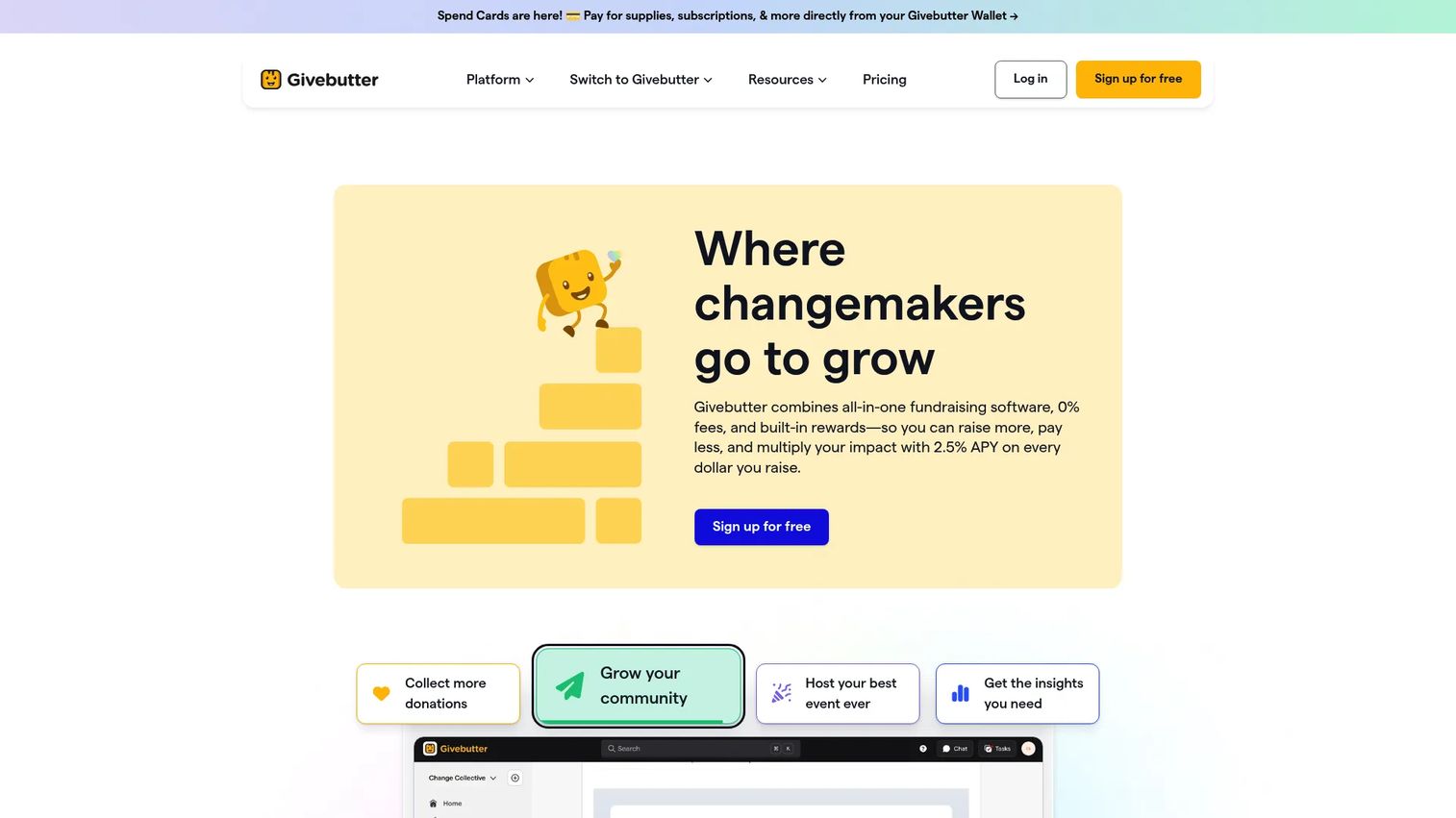
Givebutter is a free fundraising and donor management platform built for nonprofits, and it handles auctions as part of a broader giving stack. Instead of bolting an auction onto a spreadsheet, you run bidding, donation forms, and donor records in one place. For fundraising teams, that consolidation is the whole point: the auction feeds the same CRM that powers your year-round appeals.
Best for: Nonprofits that want a free all-in-one fundraising stack with optional paid CRM upgrades.
Key strengths
- Donation forms: capture gifts and auction payments through the same branded checkout.
- Donor management and CRM: every bidder becomes a contact record you can steward after the event.
- Fundraising pages: launch campaign and event pages that sit alongside your auction.
Why choose Givebutter: The free-forever core plan is rare in this category, and it removes the biggest objection for small nonprofits: cost before proof. You get mobile bidding, donor data, and fundraising pages without a subscription, and you only pay when you want the Plus CRM features. For a team that wants nonprofit auction software and donor management under one login, this is the cleanest starting point.
Givebutter pricing: The core platform is free forever at $0/month. Givebutter Plus starts at $29/month for expanded CRM and automation features and is contact-based beyond that. There is a genuine free tier, not a limited trial, which is why it leads this list for budget-conscious fundraising teams. Givebutter holds a 4.8/5 rating on G2.
2. Auctioneer Software
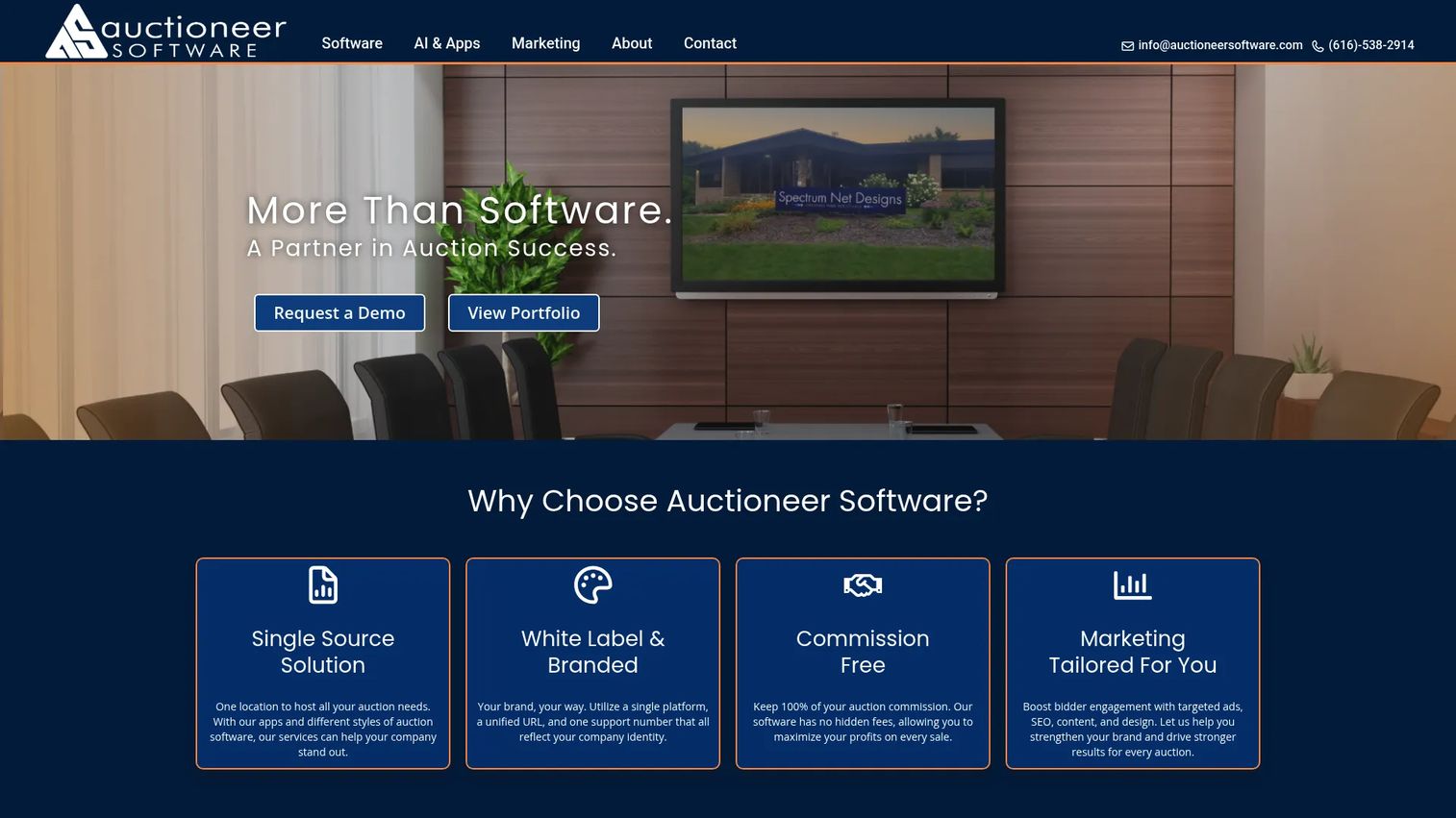
Auctioneer Software is built for professional auction companies running live, online-only, simulcast, and multi-parcel real estate auctions. This is auctioneer software in the commercial sense: white-label tooling for operators whose auctions are the business, not a fundraising event once a year. It handles the workflows that estate, equipment, and real estate auctioneers actually run.
Best for: Auction companies needing white-label online and simulcast auction tooling.
Key strengths
- Flexible auction types: run online-only, live, or simulcast auctions from one platform.
- Interactive map and combination bidding: handle multi-parcel real estate lots with map-based and combination bids.
- Live bidder registration and approval: register and vet bidders in real time before they bid.
Why choose Auctioneer Software: For a commercial auctioneer, the deciding factor is whether the platform handles simulcast bidding and multi-parcel real estate without breaking. This tool is purpose-built for that, with combination bidding and bidder approval that generic event platforms do not offer. If your auctions are your revenue and you need your own branded auction website, this fits the motion.
Auctioneer Software pricing: The site states pricing includes a one-time setup fee plus a monthly payment, but no public numeric price is published. Auctioneers should request a quote based on auction volume and features. There is no verified G2 rating for the platform, so weigh it on a demo and reference calls rather than review scores.
3. AuctionMethod
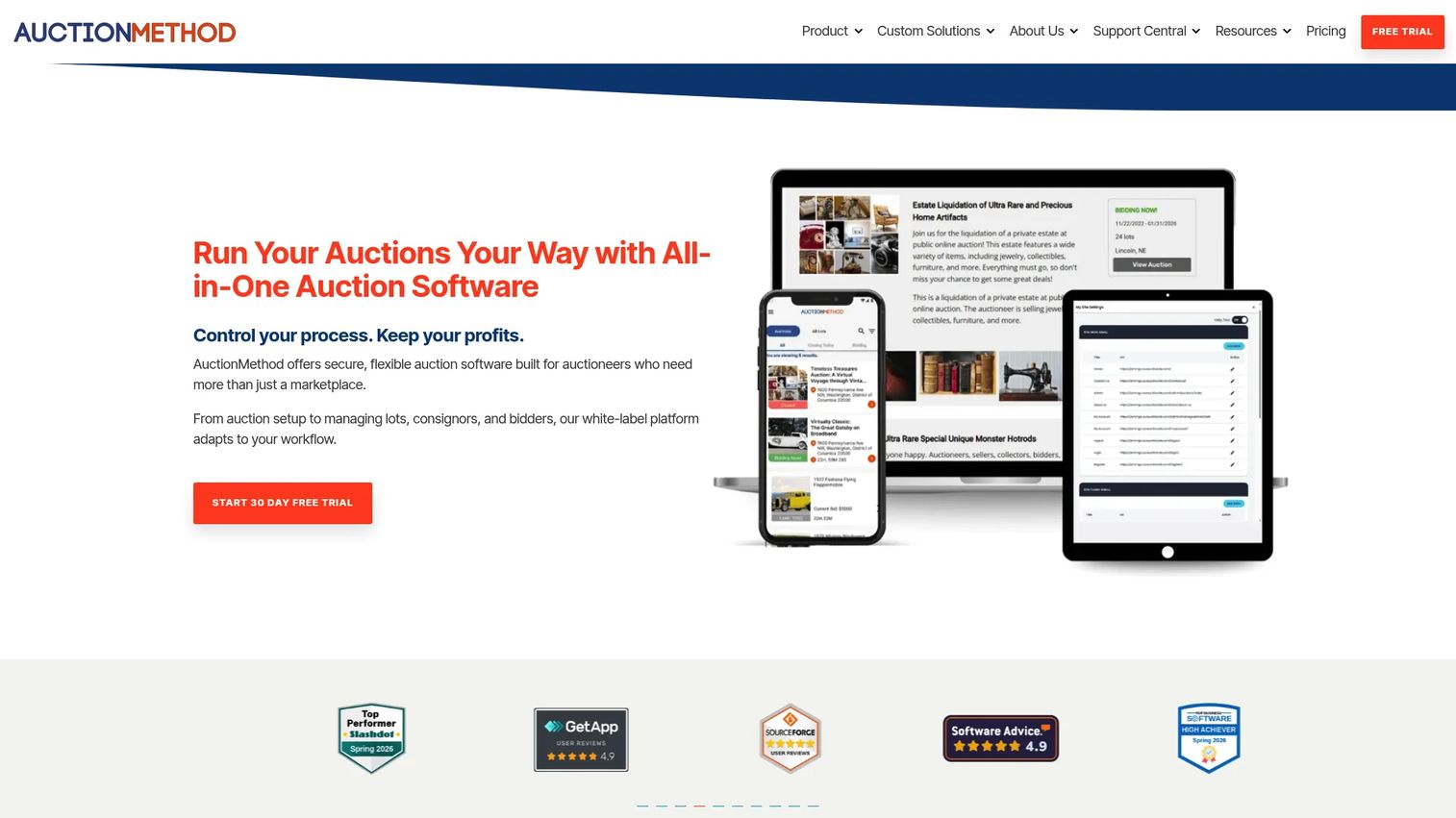
AuctionMethod is cloud-based auction software for managing timed, live, fixed-price, and other auction workflows, with white-label hosting and a commission-free model. The pitch is simple: run your whole operation, from setup through settlement, on a branded platform that does not take a cut of every lot. For auction businesses tired of per-lot fees, that pricing model is the draw.
Best for: Auction businesses that want a branded, commission-free platform for online auction operations.
Key strengths
- Unlimited scale: unlimited auctions, bids, lots, items, photos, and admin users at every tier.
- White-labeled websites: branded auction sites on hosted infrastructure you control.
- Broad integrations: connect payment processors, email tools, CRMs, and more.
Why choose AuctionMethod: The commission-free, no-contract structure changes the math for high-volume sellers. When you are not paying a percentage on every winning bid, a flat monthly fee becomes predictable and often cheaper at scale. Teams that want one system for cataloging, bidding, payments, and reporting without per-event surcharges will find the model clean.
AuctionMethod pricing: Plans are public and month-to-month with no contract and no commission. Growth starts at $100 per month, Scale at $750 per month, and Custom Solutions from $1,500 per month. There are no per-lot, per-event, or per-photo charges, which makes budgeting straightforward for operators running frequent auctions.
4. Auction Flex
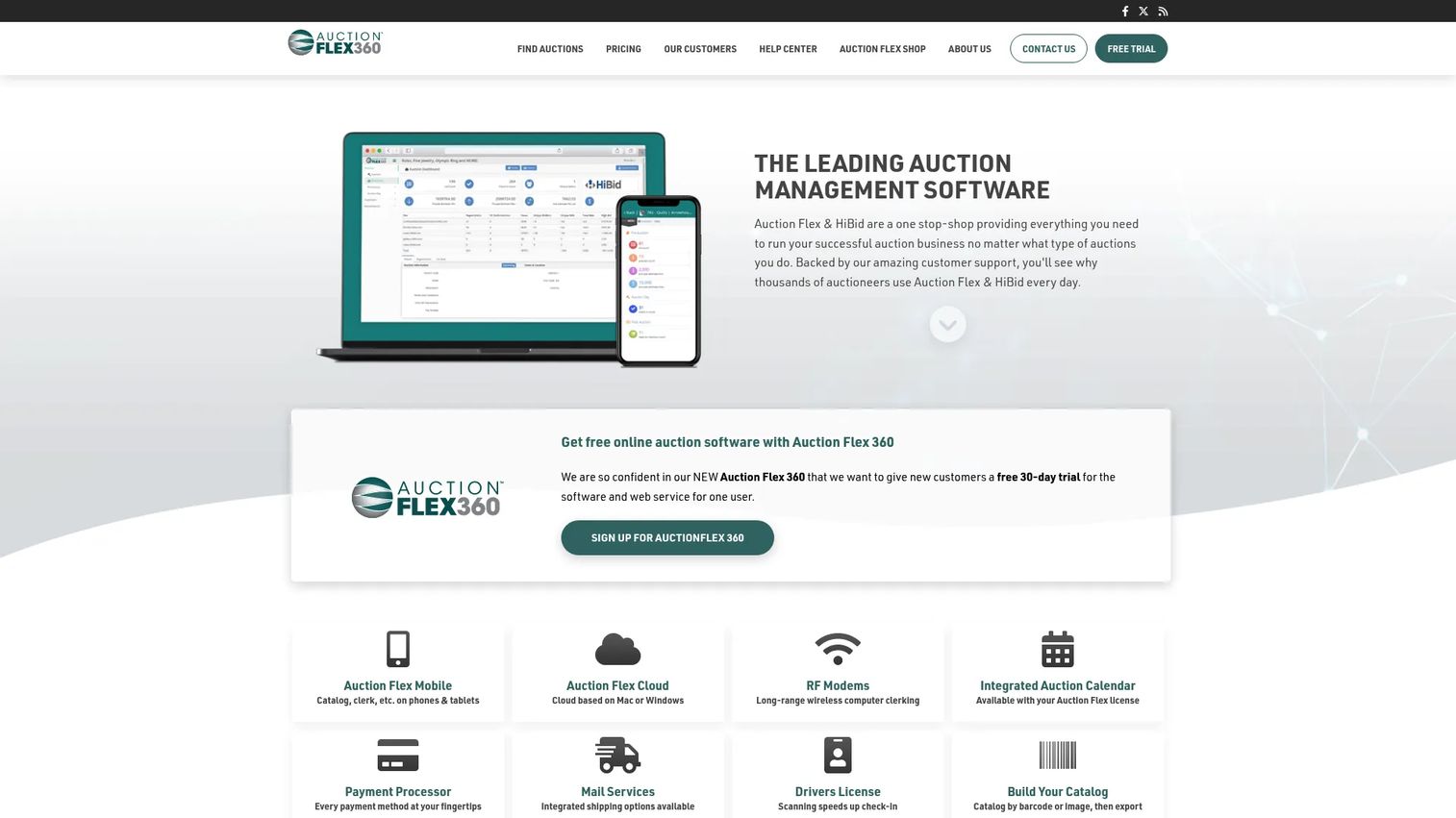
Auction Flex is auction management software for live, online, and webcast auctions, with deep roots in desktop clerking and cashiering. This is the tool for auctioneers who run the floor and want tight control over cataloging, clerking, and accounting, with online bidding layered on through HiBid integration. It fits operators who treat the clerking desk as the command center.
Best for: Auctioneers needing desktop auction management with optional online bidding.
Key strengths
- Cataloging and clerking: build catalogs and clerk live sales at speed.
- Cashiering and accounting: handle settlement and seller accounting in one system.
- HiBid integration: extend live sales online for webcast and internet bidding.
Why choose Auction Flex: Auctioneers who prioritize floor operations over a slick guest app will value the depth here. The clerking and cashiering tools are built for volume live sales, and the HiBid connection brings online bidders into the same event. It scales by workstation, so a solo auctioneer and a multi-desk operation can both run it.
Auction Flex pricing: Rental plans scale by workstation count, starting at $60.00 per month for one workstation and rising in steps to $150.00 per month for unlimited workstations. Outright purchase pricing is also listed on the site, and a support agreement runs $295.00 for 12 months. There is no free tier. The platform has no verified G2 review score, so evaluate it on a trial and peer references.
5. Handbid
Handbid is an auction and event technology platform built around mobile bidding, ticketing, and registration for fundraising events. If your priority is guest participation on the night, Handbid centers the mobile experience: bidders use the app to bid, get outbid alerts, and check out without a line. It fits nonprofits and event teams that want the room bidding on their phones.
Best for: Nonprofits and event teams running auctions and fundraising events.
Key strengths
- Mobile bidding: app-based bidding with real-time outbid alerts to keep guests engaged.
- Ticketing and registration: sell tickets and register attendees in the same platform.
- White-label auctions: brand the bidding experience to your organization.
Why choose Handbid: The mobile-first design is the differentiator. Teams that have watched engagement dip when bidding is clunky will notice the difference when guests can bid from their table in two taps. Pairing ticketing and registration with the auction means one system runs the whole event, from RSVP to checkout.
Handbid pricing: Handbid's own pricing page describes packages as custom rather than fixed tiers. G2 lists a public plan called The Big Event at $1,396.00 per year, with a larger plan available on request. There is no free tier. Handbid holds a 4.7/5 rating on G2, which reflects its standing among fundraising event teams.
6. OneCause
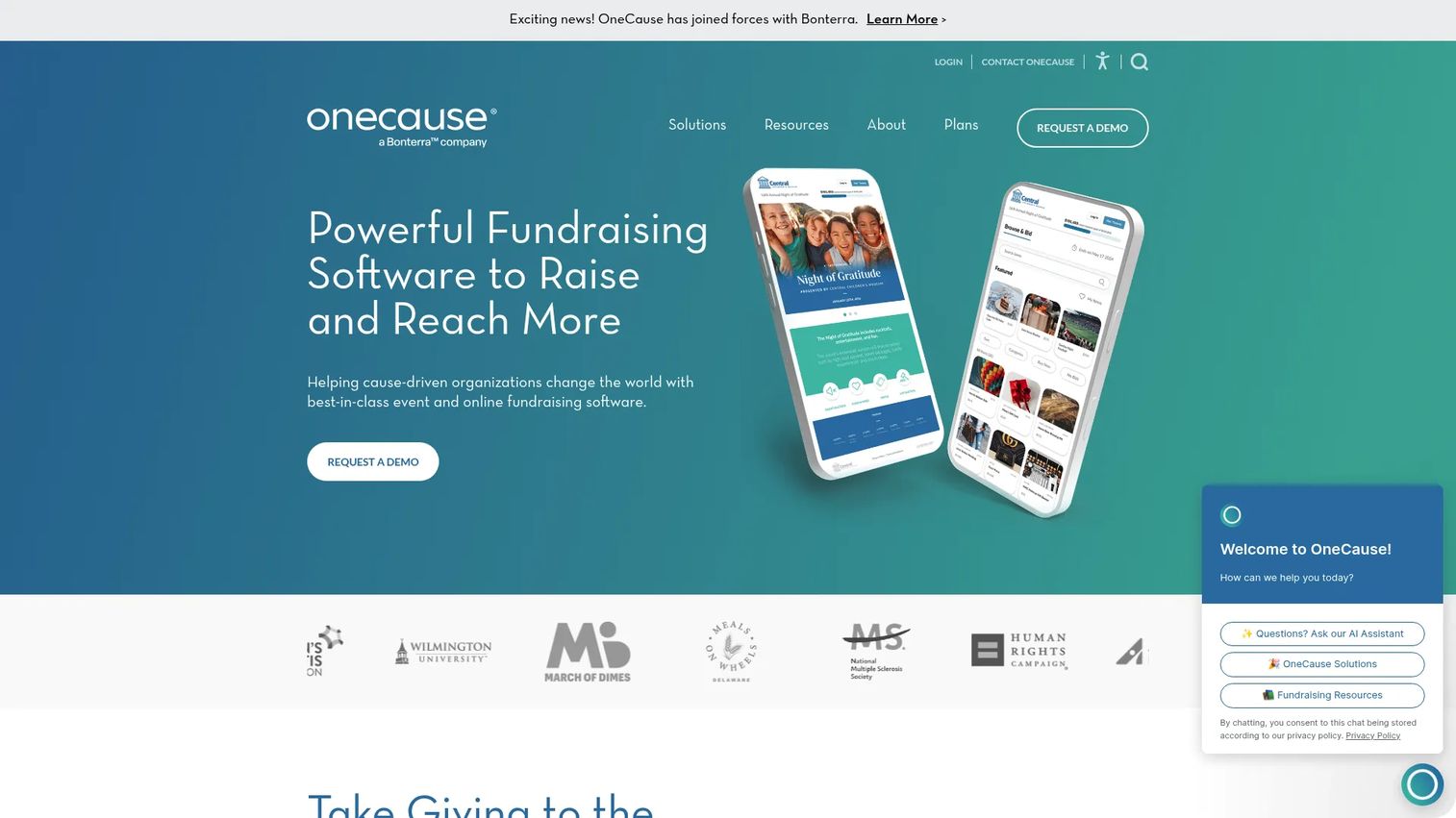
OneCause is nonprofit fundraising software spanning online giving, auction and event fundraising, peer-to-peer campaigns, and text-to-give. For larger fundraising teams, the appeal is breadth: auctions sit inside a fuller fundraising infrastructure, so a gala auction connects to year-round giving and donor engagement. It suits teams that run more than one fundraising motion.
Best for: Nonprofits needing fundraising software for events, auctions, peer-to-peer, and online donations.
Key strengths
- Online fundraising and Text2Give: accept online gifts and text-to-give alongside auctions.
- Auction and event fundraising: run silent and live auction bidding with event tools.
- Peer-to-peer fundraising: extend campaigns to supporter-led fundraising pages.
Why choose OneCause: Teams that have outgrown a single-event tool and want fundraising infrastructure around their auctions are the fit. The platform ties auction revenue to broader giving data, which matters when leadership wants a full picture of donor activity, not just one night's proceeds. It is a step up in scope for growing development teams.
OneCause pricing: OneCause offers several packages. Pay-As-You-Go starts at just $200, a Professional Auction & Event plan runs $2,995 as an annual subscription, and a Custom Quote is available through sales. The tiered structure lets small events start light and larger programs commit to a flat annual rate. OneCause holds a 4.7/5 rating on G2, listed there as Bonterra OneCause.
7. Accelevents
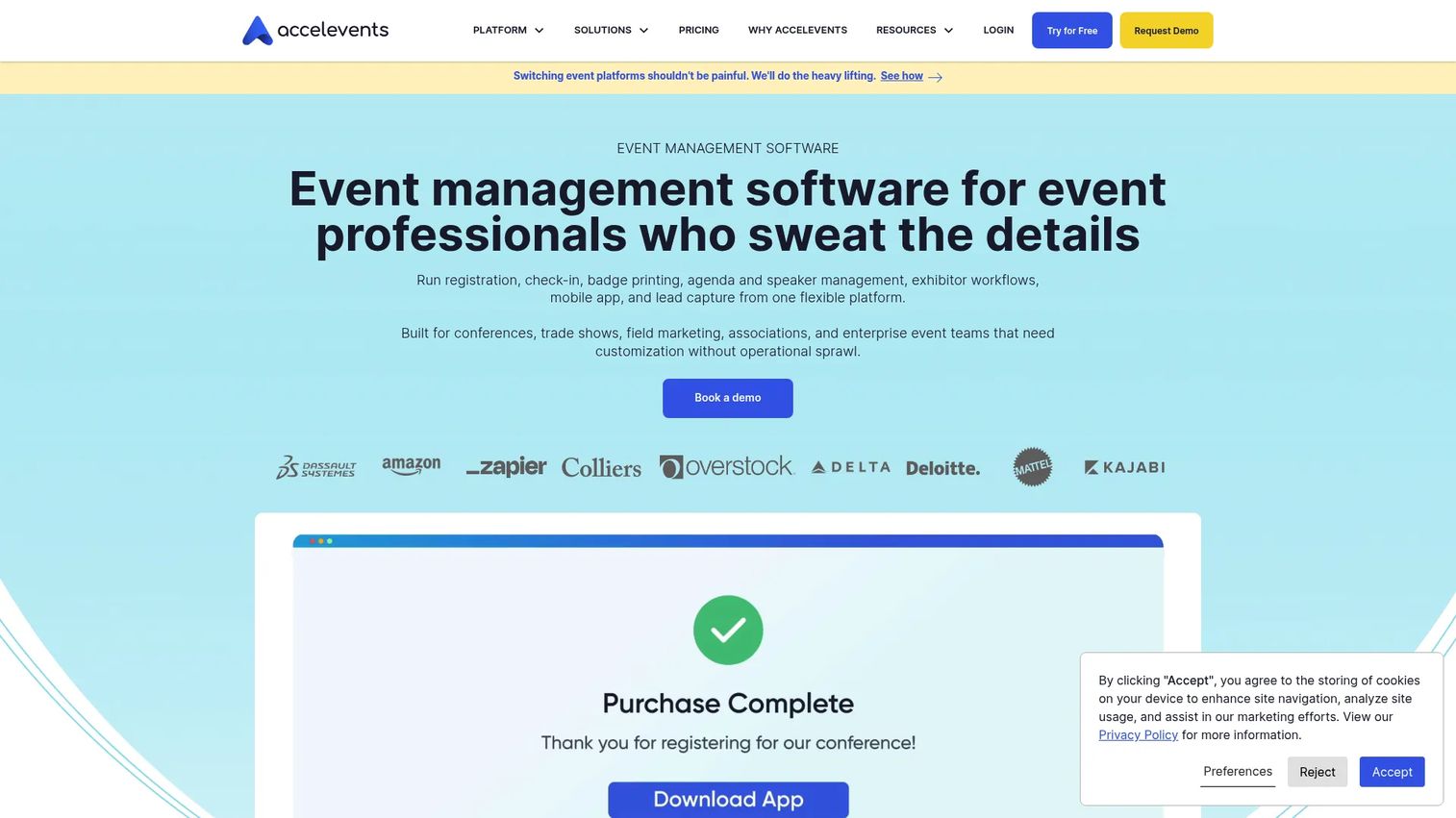
Accelevents is event management software for virtual, hybrid, and in-person events, with auctions available as part of the platform. This is the pick when the auction is one component of a larger program: a conference, a hybrid fundraiser, or a multi-session event where registration, agenda, and bidding all need to live together. Event teams get one system instead of stitching an auction tool onto an event tool.
Best for: Teams running conferences, trade shows, and other complex event programs.
Key strengths
- Registration: manage attendee registration across virtual, hybrid, and in-person formats.
- Badge printing and check-in: handle on-site check-in and badges for larger events.
- Agenda and speaker management: run sessions and speakers alongside fundraising activity.
Why choose Accelevents: For event-led auctions, centralizing operations beats juggling separate tools. When your fundraiser is really a full event with sessions, sponsors, and an auction, running it all in one platform reduces the handoffs where details get lost. It fits organizations whose auction is part of a bigger production.
Accelevents pricing: Professional starts at $7,500 for a single event, Business at $13,500 for multiple events, and Enterprise and White Label plans are custom-priced. There is no confirmed free tier on the pricing page. The pricing reflects its positioning as a full event platform rather than a standalone auction tool. Accelevents holds a 4.7/5 rating on G2.
8. BiddingOwl
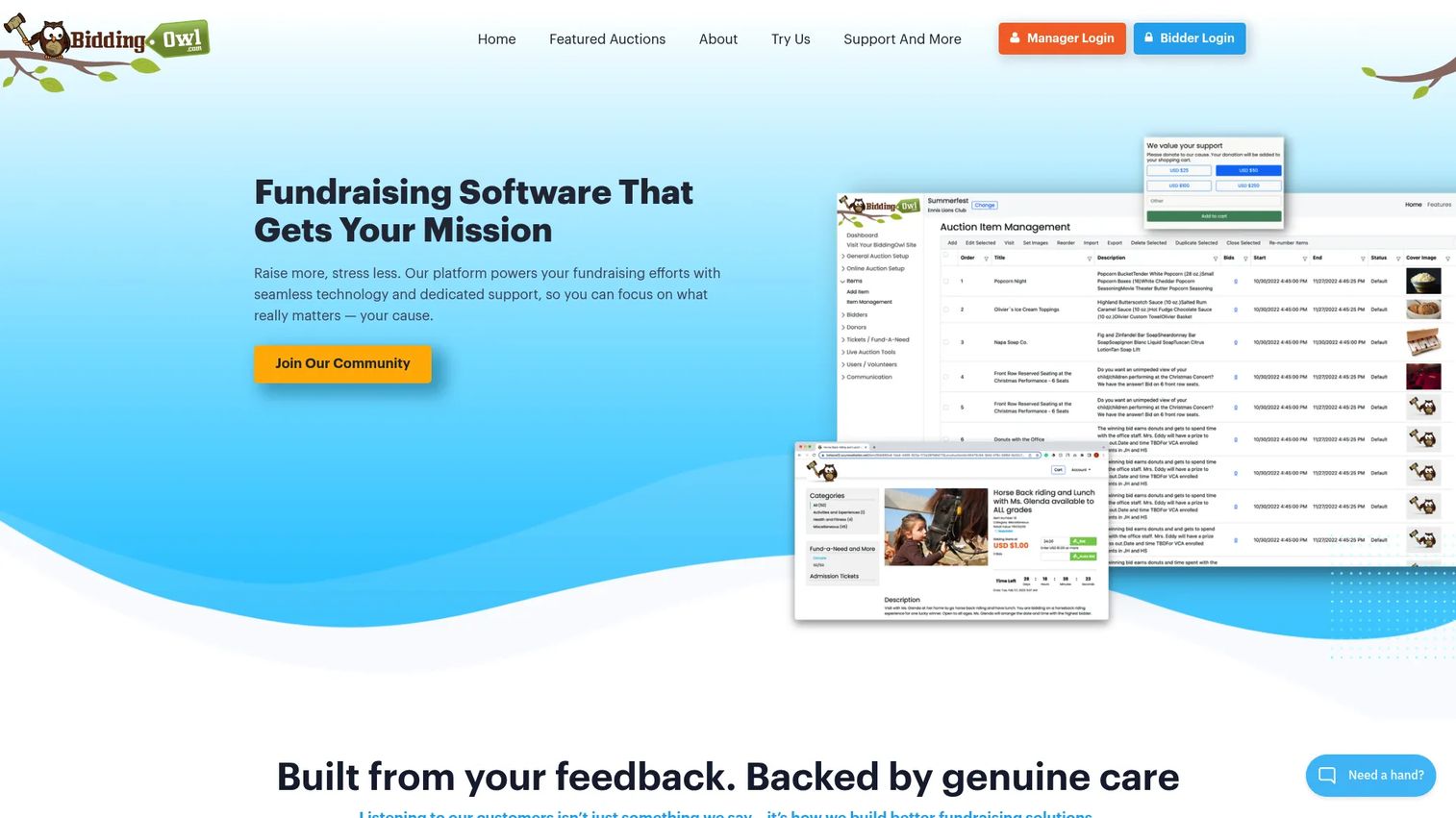
BiddingOwl is online auction management software for nonprofit fundraising and charity events, built for straightforward setup and small teams. Schools, clubs, and community groups that want simple bidding and checkout without a large budget are the target. The performance-fee model means you pay only when you run an online auction, which keeps entry cost near zero.
Best for: Nonprofits running charity auctions and fundraising events.
Key strengths
- Automated bidding: max-bid increments so supporters can set a ceiling and step away.
- Real-time updates: email and SMS alerts keep bidders informed during the event.
- Payment integrations: process payments through Stripe and PayPal.
Why choose BiddingOwl: For a small team, the fee-based model removes the risk of paying a subscription for an event that happens once or twice a year. You get automated bidding, real-time alerts, and card processing without committing to a monthly plan. It is silent auction software sized for schools and community groups rather than large development teams.
BiddingOwl pricing: There is no monthly fee for standard fundraiser use. BiddingOwl charges a 5% performance fee only when you run an online or mobile auction, calculated on the winning bid amount. Other listed fundraising activities are offered as a free service. That structure makes it one of the lowest-commitment options for occasional auctions.
9. Auctria
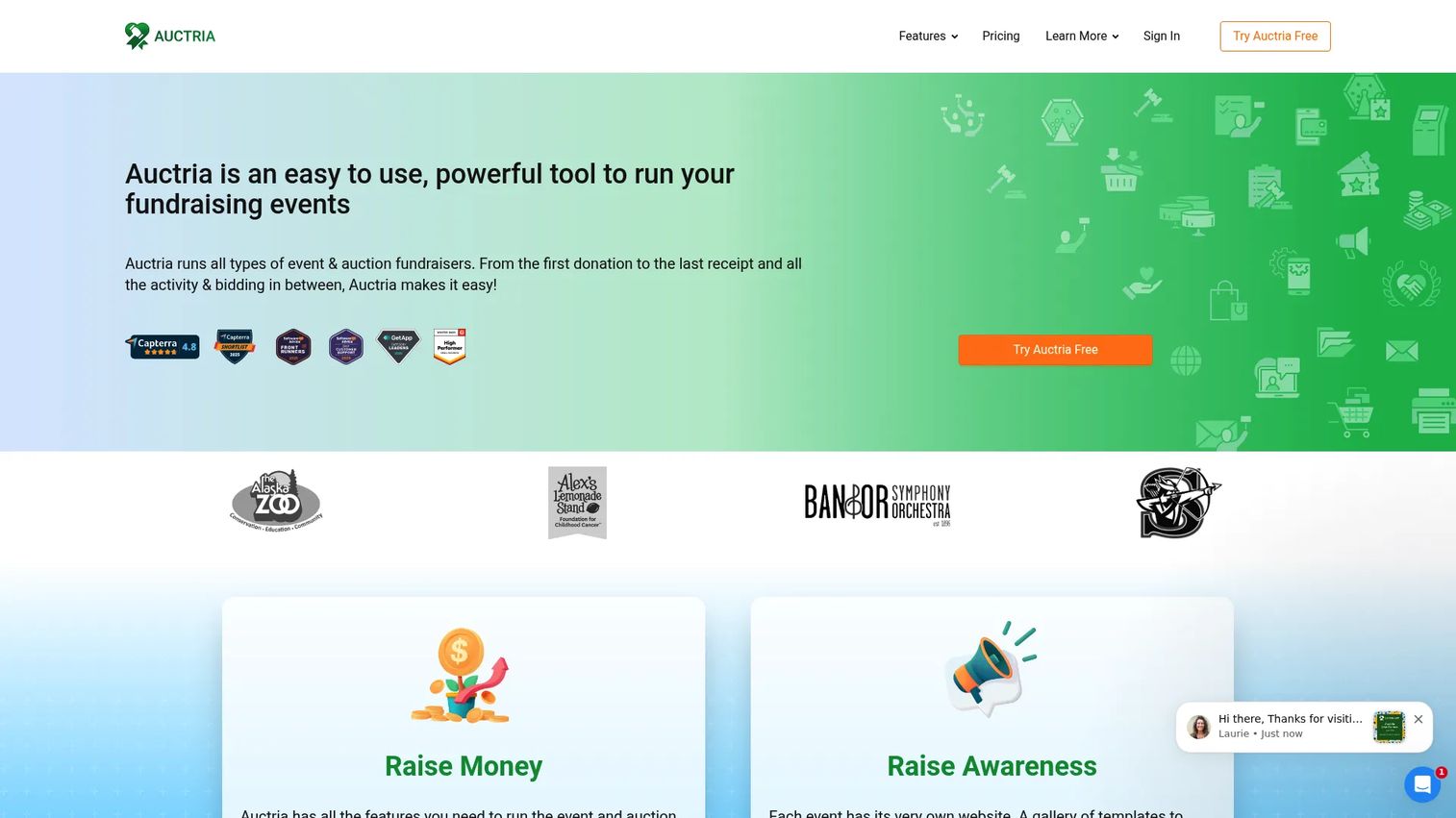
Auctria is fundraising event and auction software for nonprofits, covering silent, live, and online auctions plus tickets, sponsorships, donations, paddle raises, and raffles. It appeals to teams that want practical bidder management and reporting without heavy complexity or a large upfront cost. The free tier makes it a genuine option for smaller organizations testing the waters.
Best for: Nonprofits running auctions and fundraising events.
Key strengths
- Multiple auction formats: run silent, live, and online auctions from one platform.
- Broad fundraising tools: manage tickets, sponsorships, donations, paddle raises, and raffles.
- Custom event sites and reporting: build branded event websites with bidding automation and auction reporting.
Why choose Auctria: Budget-conscious nonprofits get real functionality at the free tier and a clear upgrade path as they grow. The income-based licensing means you pay in proportion to what you raise, which aligns cost with scale. For a team that wants full auction management software without enterprise pricing, it hits the practical middle.
Auctria pricing: Three public license tiers scale by annual income. Explorer is free for organizations up to $10,000 in annual income, Emerald is $375 per year up to $50,000, and Diamond is $750 per year with unlimited income tracking. Optional concierge and assist services are available on top. The free entry point makes it an easy first platform to try.
What to check before you buy
Before committing, run every shortlisted tool through the same operational checklist. The demo will look polished. These are the details that decide whether it holds up on event night.
Bidder flow and mobile bidding
Test the guest path end to end on a phone. How many taps from QR scan to first bid? Does registration ask for too much? Mobile bidding is now a core feature, not a nice-to-have, so if the guest experience is clunky, participation drops regardless of everything else.
Payment processing and checkout
Check which processors are supported, what fees apply, and whether cards can be stored for one-tap checkout. Payment processing and self-checkout are where auctions leak revenue. Confirm the platform handles automated invoicing and receipts, not just the initial charge.
Checkout reminders and follow-up
Ask how the platform handles post-win follow-up. Automated checkout and reminders, SMS nudges, and card-on-file charging are what stop payments from slipping through after guests leave. This is often the difference between a clean settlement and a week of chasing invoices.
Admin controls and bidder management
Look at how you manage lots, approve bidders, and pull auction reporting. Strong bidder management and clear admin controls matter more as volume grows. For auctioneers, check for fraud prevention and bidder approval; for nonprofits, check that donor data flows cleanly into your CRM.
Pricing model and fit
Match the pricing model to your frequency. A flat monthly fee suits high-volume auctioneers, a performance fee suits occasional charity auctions, and a free tier suits small teams proving the concept. Read whether pricing is per-lot, per-event, commission-based, or flat before you sign.
Choosing the right platform
The best online auction software is the one that fits your auction motion, not the one with the longest feature list. Nonprofits running silent auctions should shortlist Givebutter, Auctria, and BiddingOwl for their donor focus and low entry cost. Larger fundraising teams that want infrastructure around their events should look at OneCause and Handbid for mobile bidding and breadth.
Professional auctioneers running live, online, or simulcast sales belong with Auctioneer Software, AuctionMethod, or Auction Flex, depending on whether you prioritize white-label branding, commission-free pricing, or deep clerking. Event teams whose auction is part of a bigger program should evaluate Accelevents.
Whatever your motion, do not buy on the demo alone. Shortlist two or three tools, then test three things on each: the bidder flow on a real phone, the payment and checkout flow, and the admin workflow for managing lots and winners. The platform that runs those three cleanly is the one that will run your event without landing on your team at 11pm.
FAQs
For most nonprofits, Givebutter is the strongest starting point because it combines free fundraising, donor management, and mobile bidding in one platform. Auctria and BiddingOwl are close alternatives for smaller teams that want low-commitment pricing. The deciding factors are donor-friendly bidding, clean payment handling, and how easily the platform captures donor data for follow-up.
Auction Flex and Auctioneer Software are built for live and simulcast bidding, with clerking, cashiering, and real-time syncing between floor and online bidders. The features that matter for live auctions are real-time bid updates, tight auction pacing, and fast checkout so winners pay before they leave. Professional auctioneers should prioritize these over guest-app polish.
Yes. Givebutter offers a free-forever core plan, Auctria has a free Explorer tier for organizations under $10,000 in annual income, and BiddingOwl charges only a 5% performance fee on online auctions with no monthly cost. Free online auction software works well for smaller events, though larger programs usually upgrade for advanced reporting, integrations, and higher volume.
At minimum, auction bidding software should include bidder registration, lot and item management, real-time bidding with max-bid automation, payment processing and checkout, and automated notifications. Reporting on revenue and bidder activity rounds it out. For events, mobile bidding is now essential; for auctioneers, cataloging, clerking, and bidder approval matter most.
Prioritize mobile bidding, automated reminders, a smooth donor experience, and admin simplicity. Silent auction software lives or dies on how easily guests can bid from their phones and how few taps checkout takes. Test the guest flow on a real device, confirm outbid alerts fire instantly, and check that payment collection is one tap at close.
Most platforms do. Automated checkout nudges, SMS and email reminders, and card-on-file charging are standard in modern auction management software. These features handle post-win follow-up so your team is not chasing invoices after the event. Confirm the specific reminder cadence and whether the platform charges stored cards automatically at close.
Auctioneer software is built for commercial auction companies and centers on cataloging, clerking, cashiering, and simulcast or multi-parcel real estate sales. Broader auction platform software and nonprofit auction software focus on events, fundraising, and donor experience. The right choice depends on whether auctions are your core business or a fundraising activity.
Yes, and it is now a core feature rather than an add-on. Mobile bidding usage sits at 69% across auction operators according to Market Growth Reports (2024), so most platforms support app or browser-based bidding, outbid alerts, and mobile checkout. For silent auctions and events, a strong mobile bidding experience is one of the biggest drivers of guest participation.