Last updated: October 2026. Author: Team Guideflow.
Your domain model looks clean in code. Then it hits the database. References become foreign keys, inheritance becomes table design, and every release adds another mapping decision your engineering team has to carry.
This is the object-relational impedance mismatch in practice. It does not kill products, but it compounds. The cost shows up in sprint velocity, in the time engineers spend writing and maintaining ORM layers instead of shipping features, and in schema migration work that follows every meaningful product change.
Object-oriented databases, also called OODBMS platforms, store application objects directly. They preserve object identity, relationships, and in some systems behavior, without requiring translation into rows and foreign keys. The global database market reached $8.52 billion in 2025 and is projected to grow at 8.7% CAGR through 2030, according to The Business Research Company (2026), which reflects sustained investment in specialized persistence approaches.
The harder question for a product team is not whether object databases exist. It is whether direct object persistence reduces enough operational complexity to justify a narrower ecosystem, specialized hiring, and a platform that may be harder to integrate with your analytics, BI, and data infrastructure.
What's inside
This guide covers seven actively evaluated object-oriented database platforms as of 2026. It is written for product managers and engineering leaders who need enough technical context to assess architecture tradeoffs, not just feature lists.
Selection criteria:
- Object-model support, including identity, inheritance, and references
- Documentation quality and evidence of active project or vendor maintenance
- Language ecosystem alignment (Java, Python, Smalltalk, C++, .NET)
- Deployment model fit (embedded, client-server, distributed)
- Licensing clarity and pricing verifiability
TL;DR
- Best for Java teams: ObjectDB supports JPA and JDO with embedded and client-server deployment, giving Java applications direct object persistence through familiar APIs
- Best for Python persistence: ZODB stores Python objects natively, preserving object identity across transactions without a separate mapping layer
- Best for embedded applications: Perst fits compact Java and .NET deployments where an external database server is unnecessary overhead
- Best for rich object modeling: ODABA combines object-oriented data modeling with relational interoperability options and support for complex domain structures
- Best for legacy Smalltalk environments: GemStone/S and Objectivity/DB serve established enterprise systems with specific language and architecture requirements
- Legacy evaluation: ObjectStore remains relevant for teams maintaining existing C++ or Java object database deployments
What is an object oriented database?
An object-oriented database management system (OODBMS) is a database management system that stores application objects directly, including their state, identity, relationships, and in some systems behavior, rather than translating every object into relational rows and tables.
This approach is distinct from the relational model, where every entity maps to rows, foreign keys handle relationships, and joins reconstruct object graphs at query time. An OODBMS eliminates or reduces that translation work by making the persistent store match the application's native object model.
Core characteristics
- Objects: Stored entities that mirror application-level objects, including their current state
- Object identity: A durable identifier that remains distinct from an object's current values, unlike a primary key which encodes a value
- Classes: Definitions describing object structure and in some systems behavior
- References: Direct relationships between objects, traversable without joins
- Inheritance: Child types reuse and extend parent properties at the model level
- Polymorphism: Code works with related object types through a shared interface
- Persistence: Object state survives process restarts and transactions
Object-oriented databases vs relational databases
| Dimension | Object-oriented database | Relational database |
|---|---|---|
| Primary unit of storage | Object | Row |
| Relationships | Object references | Foreign keys and joins |
| Application mapping | Direct persistence | ORM or custom mapping layer |
| Inheritance | Native or model-level | Often modeled with multiple tables |
| Query pattern | Object traversal or vendor queries | SQL joins and set operations |
| Ecosystem | Specialized | Broad tooling and talent pool |
Adjacent categories worth distinguishing
Document databases store JSON-like records and can represent complex structures, but they do not necessarily preserve language-native object identity. Graph databases optimize for relationship traversal across nodes and edges and excel at graph-first query patterns. Object storage handles files and blobs under keys, not application object graphs. Object-relational databases add object-like extensions to relational engines without becoming full OODBMS platforms.
When to use an object oriented database
Persist complex object graphs without a mapping layer
OODBMS platforms fit applications where the domain model includes deeply nested structures, shared references, and rich inheritance hierarchies. CAD systems, simulation engines, digital twins, and complex configuration models are classic examples. The value is fewer translation decisions at every release boundary.
Build around a language-native domain model
Language alignment often determines fit more than any other factor. Java teams may evaluate JPA or JDO compatibility. Python teams working with traversal-heavy object graphs may prefer native persistent classes. Smalltalk organizations running long-lived enterprise systems may need a persistent object environment that matches their runtime.
Pause before choosing if SQL access is a core requirement
If product analytics, finance, customer support, and data teams depend on SQL or warehouse pipelines, an OODBMS can create downstream access work. BI tooling, ad hoc reporting, and cross-language service access all assume a SQL-compatible interface most object databases do not provide natively. Measure reduced mapping work against added integration cost before committing to a proof of concept.
Object oriented database comparison
The table below reflects verified pricing and ratings from each vendor's official source, checked October 2026. Several enterprise platforms require direct vendor contact for commercial terms. G2 ratings are listed where a verified product-specific listing exists; N/A reflects the absence of a verifiable review count, not a quality judgment.
| # | Product | Best for | Key differentiator | Pricing | G2 rating |
|---|---|---|---|---|---|
| 1 | ObjectDB | Java apps using JPA or JDO | Pure-Java OODBMS, embedded and client-server modes | Free (limited); Server license from £500 | N/A |
| 2 | ZODB | Python object persistence | Native persistent Python objects with ACID transactions | Open source | 4.5/5 |
| 3 | Perst | Embedded Java and .NET apps | Compact dual-license embedded OODBMS | Free (GPL); commercial license via McObject | N/A |
| 4 | ODABA | Rich object modeling with relational interoperability | Terminology-oriented object model with C++, C#, OSI interfaces | Free (GPL); commercial development license via RUN-Software | N/A |
| 5 | GemStone/S | Legacy Smalltalk enterprise systems | Persistent multi-user Smalltalk object server | Contact GemTalk Systems | N/A |
| 6 | Objectivity/DB | Distributed complex-data environments | Distributed object persistence for large-scale technical workloads | Contact vendor | 4.0/5 |
| 7 | ObjectStore | Existing C++ or Java object database deployments | Mature object database with in-memory caching and distributed architecture | Contact IgniteTech | 4.5/5 |
Best 7 object oriented databases for 2026
1. ObjectDB
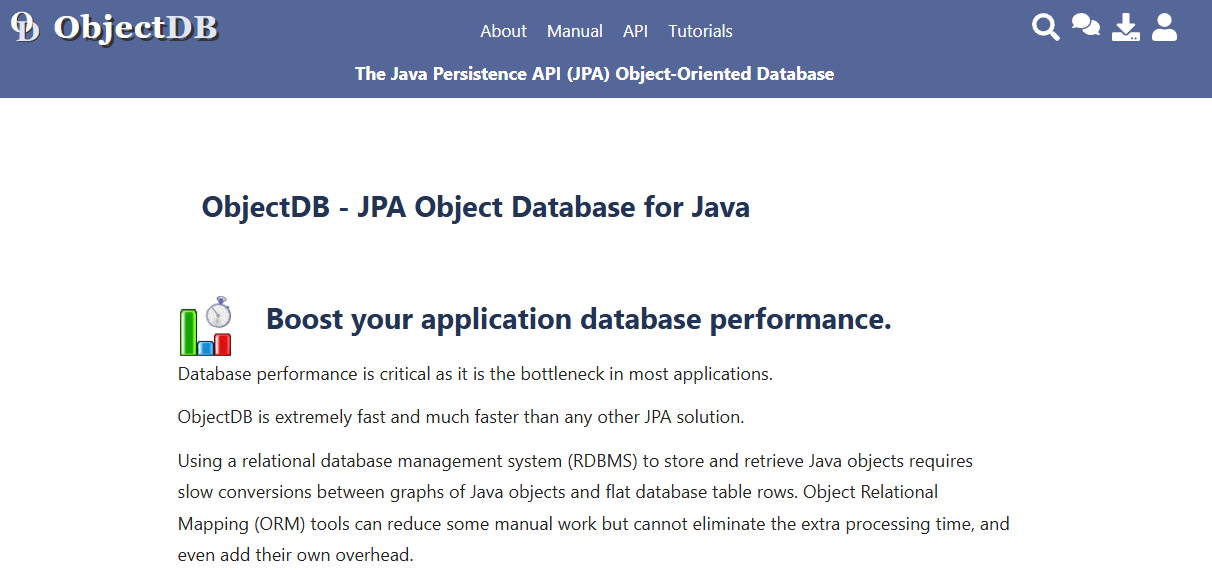
ObjectDB is a pure-Java object-oriented database management system that stores Java objects and object graphs directly, without requiring relational mapping. It supports both JPA and JDO, the two standard Java persistence APIs, which means teams can adopt it without leaving familiar persistence conventions behind. ObjectDB runs in embedded mode inside the application process or in client-server mode as a standalone database server.
Best for: Java teams that want direct object persistence while keeping JPA or JDO familiarity.
Key features
- JPA and JDO API support for standard Java persistence
- Embedded and client-server deployment modes
- Single-file database storage per database
- Transactions and lock management built in
- Database Explorer visual management tool
Why choose ObjectDB: ObjectDB makes the most sense when Java is the durable center of your architecture and you want to reduce ORM overhead without adopting a proprietary application model. If your team already knows JPA, the migration cost to ObjectDB is lower than most OODBMS alternatives.
ObjectDB pricing: The free license covers commercial use with limits of 10 entity classes and one million entities per database file. The Server License costs £500 (one-time, includes all version 2.x updates), and the Site License costs £2,500 under the same terms. OEM licensing requires contacting ObjectDB sales directly.
2. ZODB
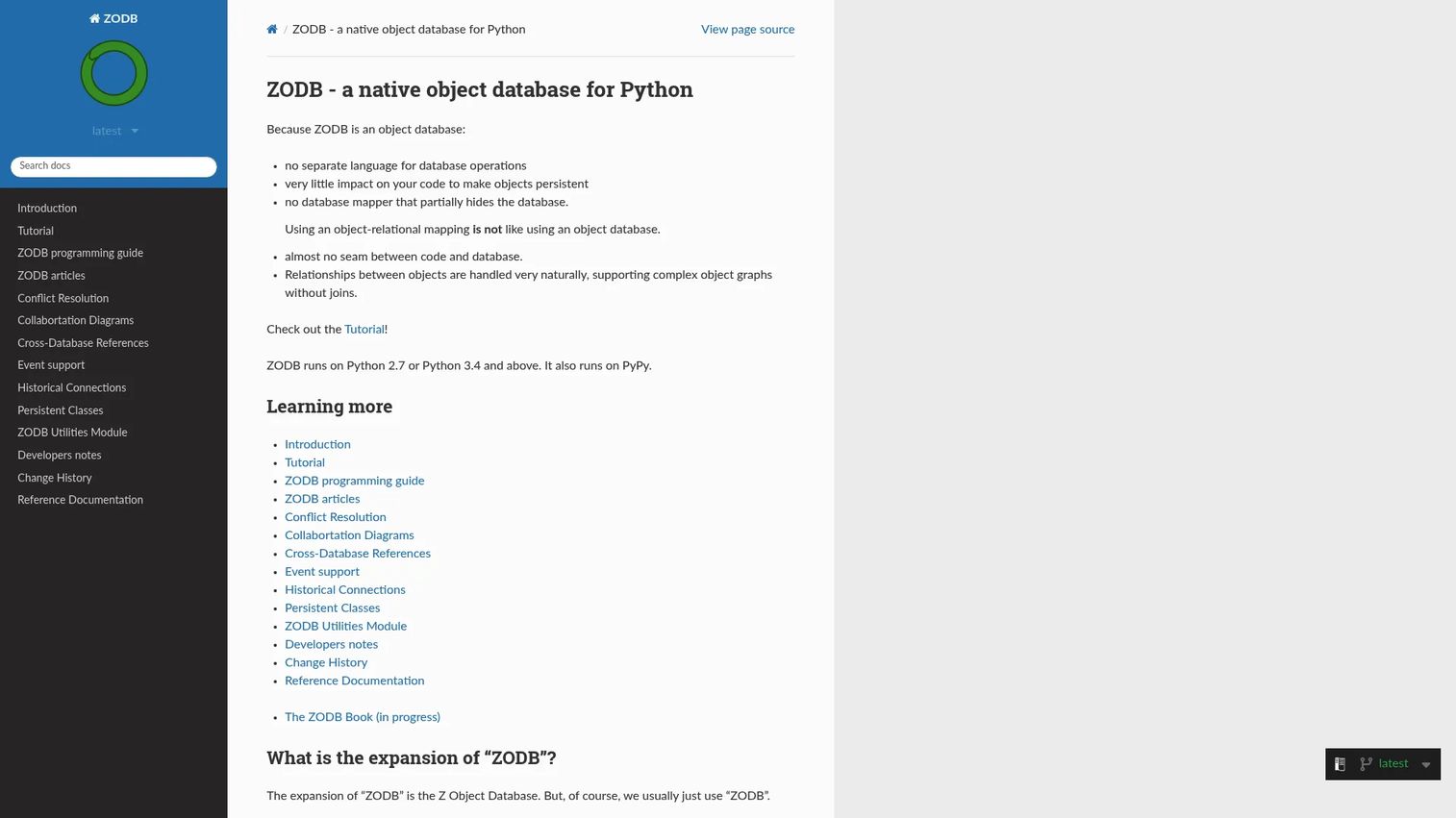
ZODB is a native object database and persistence system for Python. Persistent objects retain their identity across saves and loads, and the database handles object references directly rather than flattening them into rows. ACID transactions with snapshot isolation protect data consistency. The storage architecture is pluggable, meaning teams can swap back ends without changing application code.
Best for: Python teams with object-heavy domain models where access patterns follow object traversal rather than broad ad hoc queries.
Key features
- Native persistent Python classes with identity preservation
- ACID transactions and snapshot isolation
- Pluggable layered storage back ends
- BTree-based scalable containers for large object collections
- Automatic garbage collection of unreferenced objects
Why choose ZODB: ZODB is the natural fit when the Python application's object graph is the primary access path and you want persistence to feel like a natural extension of the language. Note that ZODB does not provide a general query engine, so search-centric applications need explicit indexes or a supplementary approach for query patterns that cannot follow object references.
ZODB pricing: ZODB is open source. Verify the current license from the project documentation or the package repository before publication.
G2 rating: 4.5/5 (verified October 2026, based on 1 review on G2).
3. Perst
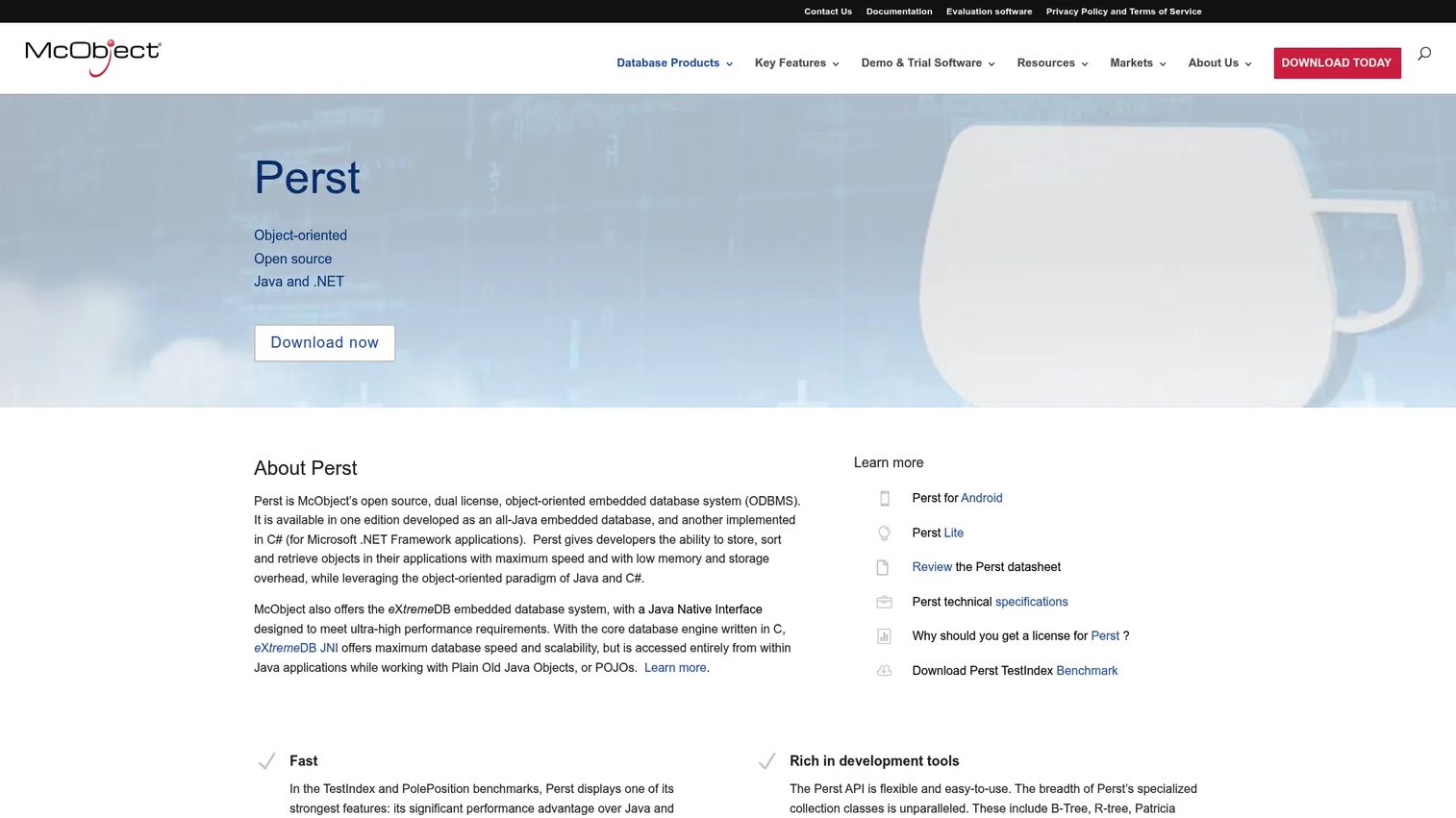
Perst is an embedded object-oriented database for Java and .NET applications, developed by McObject. It is designed to run in-process with the application, making it suitable for constrained environments like Android or .NET desktop applications where an external database server adds unnecessary overhead. Perst supports transparent persistence of Java and .NET objects and provides a range of specialized index types.
Best for: Developers building compact, high-performance embedded applications in Java or .NET who need in-process object persistence.
Key features
- Transparent persistence for Java and .NET objects
- Specialized index support: B-Tree, R-Tree, Patricia Trie, KD-Tree, and T-Tree
- ACID transactions with automatic recovery
- Replication and encryption support
- Full-text search capability
Why choose Perst: The case for Perst is an embedded deployment where operational overhead from a standalone database server is a meaningful cost. Before anchoring a new long-lived product on it, verify current ecosystem activity, the most recent release date, and whether McObject offers commercial support for your platform and runtime version.
Perst pricing: The source code is available under GPL v3 at no cost. Commercial licensing for projects that do not fit the GPL terms requires contacting McObject directly. McObject does not display a commercial license price on its pricing page.
4. ODABA
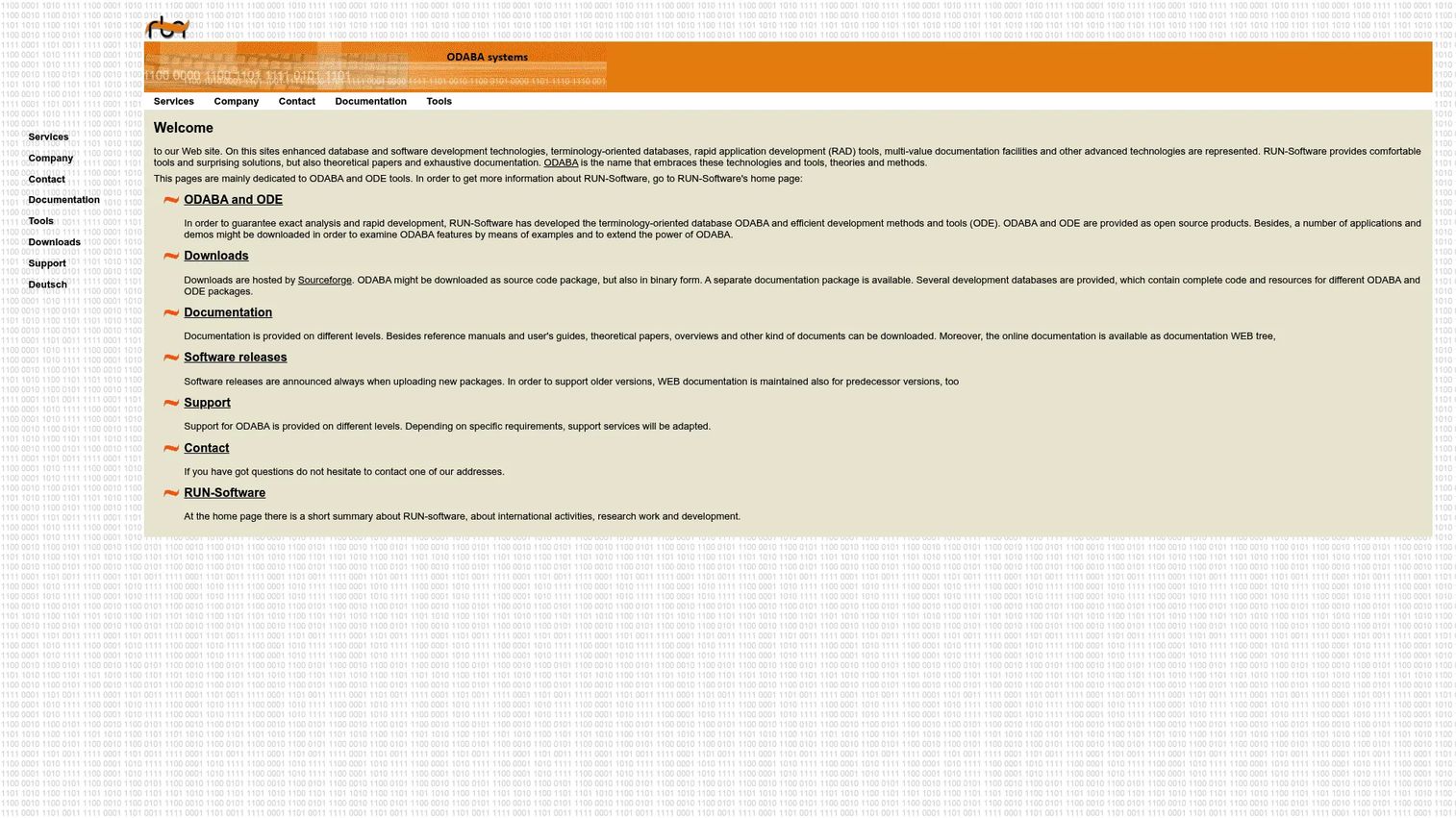
ODABA is a terminology-oriented database system and development environment that supports object-oriented database modeling with inheritance, attributes, references, inverse relationships, and set relations. It offers C++, C#, and OSI (ODABA Script Interface) access interfaces and supports data exchange in CSV, XML, JSON, and other formats. ODABA version 17.3.1 was listed on the project download page as of March 15, 2026, indicating active maintenance at the time of this article.
Best for: Developers and organizations building complex, terminology-oriented applications that require rich object modeling and some degree of relational interoperability.
Key features
- Object-oriented modeling with inheritance, references, and inverse relationships
- C++, C#, and OSI access interfaces
- Local, LAN, replication, and HTTP server support
- Data exchange with CSV, XML, and JSON formats
- GUI application development tools and database maintenance utilities
Why choose ODABA: ODABA fits specialized domain models where richer object semantics matter more than broad SQL ecosystem access. Assess the operational complexity of its object manager and mapping layer against your team's capacity before committing. The GPL availability means you can evaluate it without upfront cost; commercial development licenses are available from RUN-Software for non-GPL projects.
ODABA pricing: ODABA is available under the GPL at no cost. Commercial development licensing for non-GPL products requires contacting RUN-Software. No numeric commercial price is displayed on the ODABA download or documentation pages.
5. GemStone/S
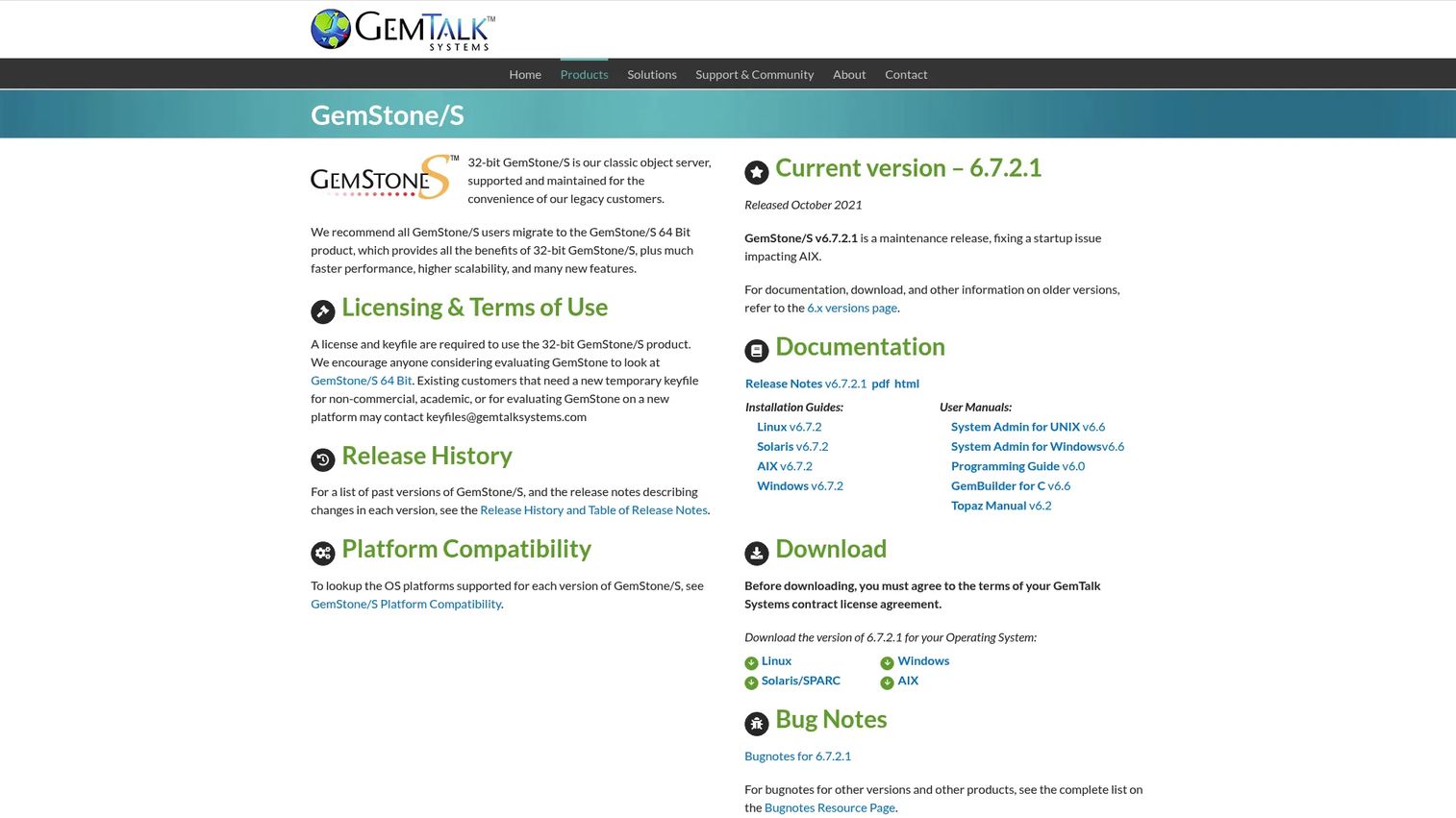
GemStone/S is a persistent object server built around the Smalltalk environment. It combines an object-oriented database with a multi-user Smalltalk virtual machine, allowing persistent objects to be shared across multiple users with transactional integrity. GemTalk Systems' official product page identifies GemStone/S (32-bit) as a legacy product and recommends migration to the 64-bit edition for new work.
Best for: Organizations maintaining existing 32-bit GemStone/S deployments or evaluating the GemTalk product line for an established Smalltalk environment.
Key features
- Object-oriented database combined with a multi-user Smalltalk virtual machine
- Transactional multi-user object server
- Platform compatibility covering Linux, Solaris/SPARC, Windows, and AIX
- Administrative tools for object management and access control
Why choose GemStone/S: GemStone/S is not a default choice for a new SaaS product without existing Smalltalk capabilities. Its value is in organizations where Smalltalk is already the runtime and a persistent object server matches the operating model. For new evaluations, GemTalk recommends the 64-bit GemStone/S product line.
GemStone/S pricing: Licensing requires a keyfile from GemTalk Systems. Pricing is not displayed; contact GemTalk Systems directly for current commercial terms.
G2 rating: N/A at publication. GemTalk Systems has a G2 seller profile, but no product-specific review score was verified for GemStone/S.
6. Objectivity/DB
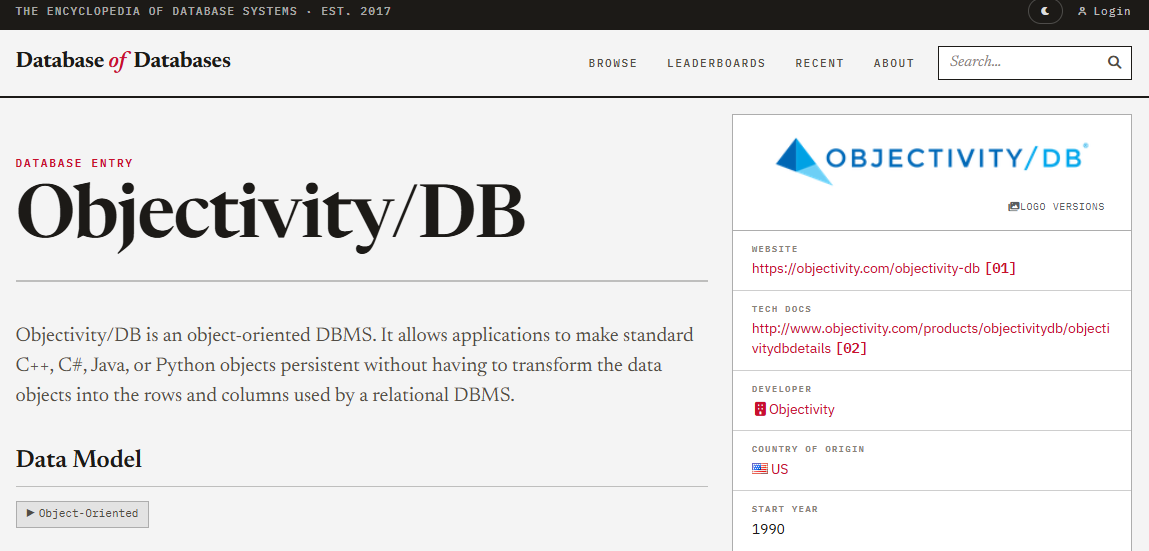
Objectivity/DB is an object-oriented database technology designed for complex analytical and large-scale data requirements. It supports distributed object persistence, object identity and references, and transactional data management across enterprise environments. The vendor describes it as suited to organizations managing complex, highly interconnected data at scale.
Best for: Specialized engineering, scientific, or distributed-data environments where complex connected data and distributed deployment are central constraints.
Key features
- Distributed object persistence across nodes
- Object identity and direct object references
- Transactional data management
- Support for complex, highly interconnected object models
- Enterprise deployment architecture
Why choose Objectivity/DB: Objectivity/DB belongs on a shortlist for high-specialization environments. The vendor's first-party site requires direct contact for pricing and deployment details. Run a vendor-led technical validation covering operations, support SLAs, integration points, and procurement requirements before proceeding to a proof of concept.
Objectivity/DB pricing: Contact Objectivity directly for current pricing. No pricing is displayed on the vendor's site.
G2 rating: 4.0/5 (verified October 2026, based on 6 reviews on G2).
7. ObjectStore
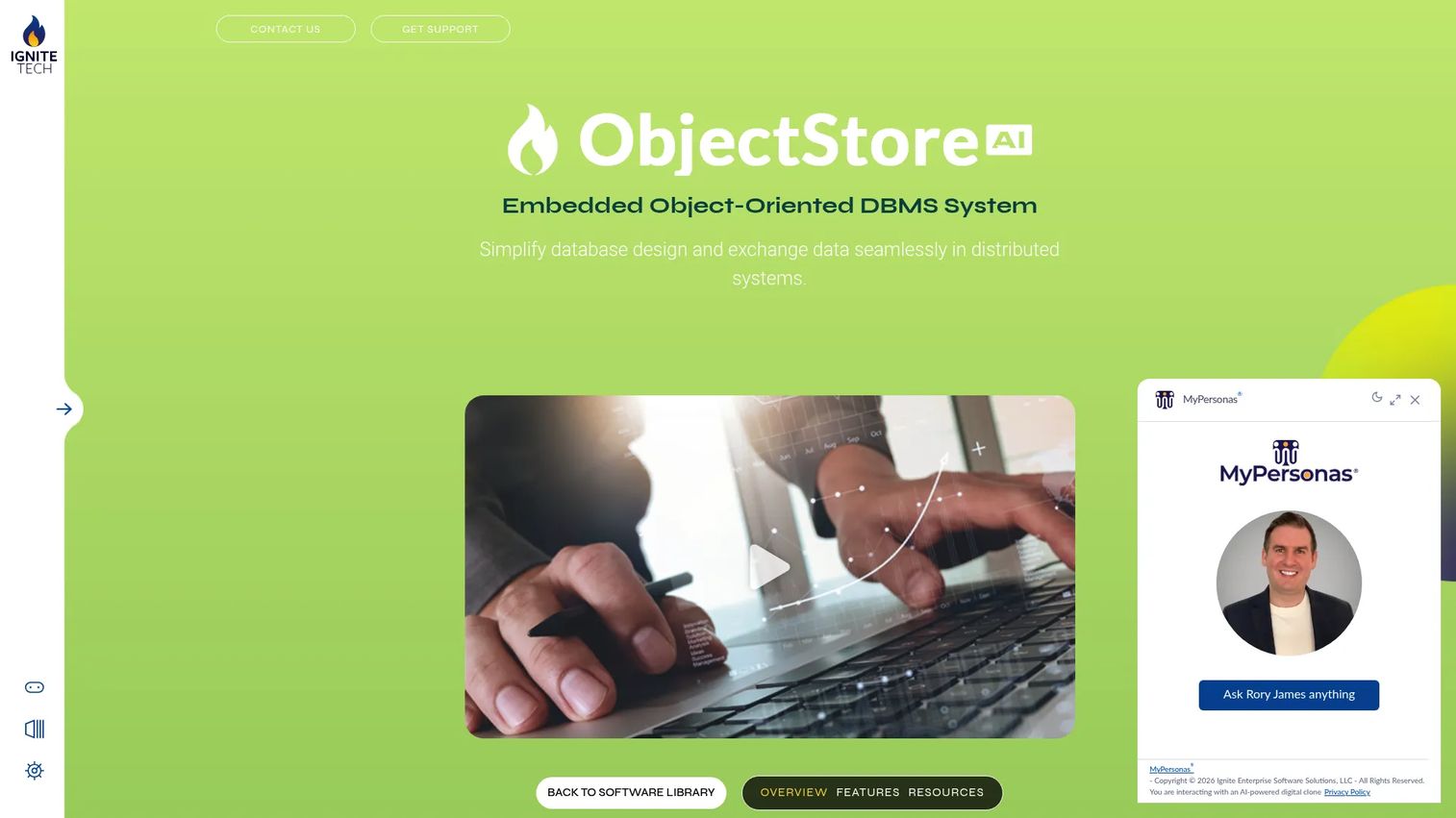
ObjectStore is an enterprise object-oriented database for C++ and Java applications, now managed by IgniteTech. It supports native C++ and Java integration with ACID compliance, distributed architecture for on-premise and cloud environments, and in-memory caching for real-time data access. The product's homepage includes an AI documentation guide, indicating active product investment from the current owner.
Best for: Organizations building high-performance, relationship-centric applications that need embedded object persistence and real-time responsiveness, or teams already running ObjectStore deployments.
Key features
- Native C++ and Java integration with ACID compliance
- In-memory caching and real-time data responsiveness
- Distributed architecture supporting on-premise and cloud environments
- Advanced object-oriented data management
- ObjectStore AI documentation guide
Why choose ObjectStore: ObjectStore remains relevant for two situations: Teams maintaining an existing ObjectStore deployment, and new projects that need the specific combination of C++ or Java native integration, distributed architecture, and in-memory caching. Product managers evaluating it for a new workload should verify current support SLAs, release cadence, migration paths, and IgniteTech's commercial terms directly before committing.
ObjectStore pricing: Contact IgniteTech for current licensing and support terms. Pricing is not displayed on the ObjectStore product site.
G2 rating: 4.5/5 (verified October 2026, based on 3 reviews on G2).
Considerations when choosing an object oriented database
Language and runtime fit
The database should match the language your product will depend on for years, not only the current prototype. A Java OODBMS creates a fundamentally different operating model from a Python-native object database or a Smalltalk object server. Evaluate hiring availability and long-term runtime commitment before selecting a language-specific platform.
Query and reporting requirements
Identify every team that needs access to the data beyond the application itself. Product analytics, finance, customer support, and data engineering teams typically assume SQL or warehouse-compatible access. An object database may require additional tooling, views, or export pipelines to serve those use cases. Include this integration work in the proof of concept, not as a follow-up task.
Maintenance status and vendor viability
Treat platform maturity as a feature. Verify current release dates, active support channels, security update cadence, and documentation freshness before committing to any platform in this category. A technically sound database still creates operational risk if the support escalation path is unclear or the expertise pool is narrow.
Schema evolution and release cadence
Object models change as products ship. Test versioning behavior, backward compatibility, migration tooling, and rollback procedures under conditions that resemble your actual release cadence. A proof of concept that skips schema evolution testing is incomplete for production planning purposes.
Integration and migration cost
Map every downstream system: BI tools, event pipelines, backup systems, observability, and data exports. Include CRM syncs and analytics platform connections. The proof of concept should cover integration surface area, not only object persistence benchmarks.
Conclusion
Each platform in this list targets a specific language, deployment model, or workload context.
ObjectDB is the clearest fit for Java teams that want JPA or JDO alignment without building a relational mapping layer. ZODB suits Python applications where the object graph is the primary access path. Perst fits constrained embedded deployments in Java or .NET. ODABA offers rich object modeling for complex domain structures where some relational interoperability is also required. GemStone/S and Objectivity/DB serve specialized environments with specific language and distribution requirements. ObjectStore is most relevant for existing deployments and teams evaluating legacy migration constraints.
Start with the access pattern, not the database label. If your application traverses stable object graphs and the language ecosystem has a strong fit, an OODBMS deserves a proof of concept. If SQL access, analytics pipelines, and general-purpose hiring drive the architecture, test the relational or document route first. The opportunity cost of a wrong platform choice compounds across every release, migration, and integration sprint.
Start your journey with Guideflow today!
FAQs
An object-oriented database management system stores application objects directly, preserving their identity, state, and relationships across transactions and process restarts. Instead of translating every object into rows and foreign keys, an OODBMS makes the persistent store match the application's native object model. This approach can reduce or eliminate the object-relational mapping layer that most relational database applications require.
A relational database stores data in rows and tables, uses foreign keys to represent relationships, and reconstructs object graphs through SQL joins at query time. An object-oriented database stores objects directly and traverses relationships through object references. Relational databases have a far broader ecosystem, tooling, and talent pool, making them the stronger default for most product architectures.
Yes, but selectively. They remain relevant for language-specific persistence in Java and Python ecosystems, embedded applications, specialized enterprise environments, and complex domain models where ORM overhead is a meaningful cost. Product maturity and support quality vary significantly by platform, so verify current maintenance status before committing to any OODBMS for a new workload.
No. "NoSQL" covers a wide range of database categories including document, graph, key-value, and column-family stores. An OODBMS is defined specifically by its ability to store and manage application objects directly. Some OODBMS platforms share characteristics with NoSQL databases, such as schema flexibility, but they are a distinct category with their own architecture and access model.
No. Object storage, such as S3-compatible systems, stores files and binary blobs under keys. It is optimized for large-scale file retrieval, not for persisting application objects and their relationships. An object database persists application-level objects with identity, state, and direct references between them. The terms sound similar but address different storage problems entirely.
Avoid an OODBMS when heavy SQL reporting is a core product requirement, when multiple services in different languages need to share the data store, when warehouse-first analytics drives the data architecture, or when hiring for specialized database expertise creates meaningful risk. If the data team, support team, and finance team all depend on SQL access, adding an object database creates a parallel access layer that adds cost without removing complexity.
Most OODBMS platforms support transactions, concurrency controls, and rollback behavior. ZODB provides ACID transactions with snapshot isolation. ObjectDB includes transaction and lock management. Verify the specific consistency model, locking behavior, recovery process, and backup tooling for any platform you evaluate, since implementations differ meaningfully across the products in this category.
They can reduce or remove ORM work when the database persists application objects directly, because the mapping layer becomes unnecessary. This shifts the design decision into the database platform choice itself, and it does not remove the need for schema discipline, lifecycle management, performance instrumentation, or integration planning. Teams trading ORM complexity for OODBMS specialization should model the full operating cost, not only the mapping layer they eliminate.