Healthcare training programs are not short on content. The real shortage is safe, repeatable, measurable practice time. Learners need to make real decisions, see consequences, and repeat cases before they reach actual patients. Live simulation labs help, but they do not scale cleanly across cohorts, campuses, or time zones. Instructor availability becomes the bottleneck. Rare scenarios stay rare.
The medical simulation software market hit $210 million in 2025 and is projected to reach $460 million by 2030 at a 16.7% compound annual growth rate, according to MarketsandMarkets (2026). That growth signals serious institutional investment in software that closes the gap between classroom theory and clinical readiness.
Choosing the right platform requires understanding which training job you are actually solving. Virtual patient practice, VR immersion, simulation center operations, and AI conversation training are distinct categories. Picking the wrong one means spending money on capability your team cannot use, and maintaining a system your VP will inherit on day one.
This guide helps you shortlist by simulation type first, then evaluate each platform on the criteria that determine whether it earns its place in the stack.
What's inside
This guide compares 10 medical simulation software platforms for 2026.
- Who it is for: Founders, executives, simulation center directors, and clinical education leaders evaluating software for medical schools, hospitals, nursing programs, and EMS training
- Selection criteria: Clinical realism, assessment depth, deployment model, integration fit, and scalability
- Coverage: Virtual patients, VR simulation, simulation management, manikin-connected workflows, and AI conversation training
- Pricing and ratings: Sourced from vendor pricing pages and G2 listings at time of publication
TL;DR
- Best for virtual clinical practice: Full Code Medical Simulation offers 250+ cases across 31 specialties with AI tutoring, scoring, and a free tier
- Best for enterprise simulation center management: EMS SIMULATIONiQ covers AV capture, debriefing, competency tracking, and multi-site reporting
- Best for clinical reasoning and adaptive patients: Body Interact delivers real-time virtual patients whose condition changes based on learner decisions
- Best for immersive VR training: Oxford Medical Simulation and SimX both support immersive scenario-based clinical learning for teams
- Best for manikin-connected programs: Laerdal Medical and CAE Healthcare pair physical simulators with connected software ecosystems
- Best for nursing assessment and case-based reasoning: Shadow Health and i-Human Patients support structured digital patient encounters and diagnostic workflows
- Best for scalable AI conversation practice: SimConverse delivers photorealistic AI patient conversations with rubric-level analytics and LTI integration
What is medical simulation software?
Medical simulation software is digital software that lets healthcare learners practice clinical skills, decision-making, communication, diagnosis, treatment, and team-based care in simulated patient scenarios.
It covers a broad range of delivery modes and training jobs, and choosing the right category matters as much as choosing the right vendor.
Core types of medical simulation software
- Virtual patient simulators: Screen-based or mobile platforms where learners interact with digital patients, order tests, make diagnoses, and receive feedback
- VR and mixed reality simulators: Headset-based platforms delivering immersive clinical environments for decision-making, procedures, and team scenarios
- Simulation management platforms: Operations software for scheduling, AV capture, debriefing, competency tracking, and reporting across simulation centers
- Manikin-connected ecosystems: Hardware and software combinations linking physical patient simulators to scenario control and assessment tools
- AI conversation simulators: Platforms where learners conduct spoken or typed dialogues with AI patients for communication and clinical reasoning practice
- Clinical skills and competency assessment tools: Case-based platforms focused on diagnostic reasoning, history-taking, and standardized patient encounters
Key features to look for
- Scenario libraries with specialty coverage
- Adaptive patient physiology that responds to learner choices
- Scoring, feedback, and remediation pathways
- Simulation debriefing tools
- Competency tracking and cohort reporting
- LMS integrations and single sign-on
- Device flexibility across mobile, tablet, desktop, or headset
- Analytics exportable for accreditation and board review
- Clinical validation through peer review or faculty authorship
- Implementation and support services
When to use medical simulation software
Train clinical reasoning before patient contact
Virtual patient simulators and VR platforms let learners make real decisions, observe consequences, and repeat cases as many times as needed. Medical schools use them to build diagnostic reasoning before rotations. Nursing programs use them for assessment practice. EMS teams use them for high-acuity scenario rehearsal. The key benefit is volume: A learner can complete dozens of cases in the time a live lab might support one.
Standardize competency across cohorts or sites
Software makes it possible to compare performance across learners, instructors, campus locations, and hospital sites with consistent scoring. This matters most when programs need to demonstrate accreditation readiness, track remediation, and give leadership a board-level view of clinical preparedness across the organization.
Reduce the bottleneck around live simulation labs
Software does not replace hands-on lab sessions. Procedures, equipment handling, and instructor-led debriefing still require physical presence. What simulation software does is expand practice outside scheduled lab time, so learners arrive at lab sessions better prepared and instructors can focus high-value time on team training, edge cases, and complex debriefing rather than first-pass clinical reasoning.
Medical simulation software comparison
The table below gives a starting point for shortlisting. Pricing and G2 ratings should be verified against current vendor pages before procurement. Most platforms in this category price through institutional quotes, so the figures below reflect what is publicly available.
| # | Product | Best for | Key differentiator | Pricing | G2 rating |
|---|---|---|---|---|---|
| 1 | Full Code Medical Simulation | Virtual clinical practice | 250+ cases, AI tutoring, free tier | Free; paid from $11.99/mo | Not listed |
| 2 | EMS SIMULATIONiQ | Enterprise simulation center management | AV capture, debriefing, multi-site reporting | Quote-based | Not listed |
| 3 | Body Interact | Clinical reasoning and adaptive patients | Real-time adaptive physiology | From €49.99/mo (individual) | Not listed |
| 4 | Oxford Medical Simulation | VR clinical training | AI-driven VR scenarios, no-code authoring | Quote-based | Not listed |
| 5 | SimX | Team-based VR simulation | Multiplayer immersive scenarios | Quote-based | 4.3/5 |
| 6 | Laerdal Medical | Manikin-connected simulation ecosystems | Hardware plus software across specialties | Quote-based | 4.5/5 |
| 7 | CAE Healthcare | Simulation program infrastructure | Patient simulators, center management | Quote-based | Not listed |
| 8 | Shadow Health | Nursing assessment practice | Digital standardized patients for health assessment | Quote-based | Not listed |
| 9 | i-Human Patients | Diagnostic reasoning education | Graded virtual patient encounters with feedback | Quote-based | Not listed |
| 10 | SimConverse | AI conversation simulation | Photorealistic AI avatars with rubric analytics | Quote-based | Not listed |
Best 10 medical simulation software tools for 2026
1. Full Code Medical Simulation
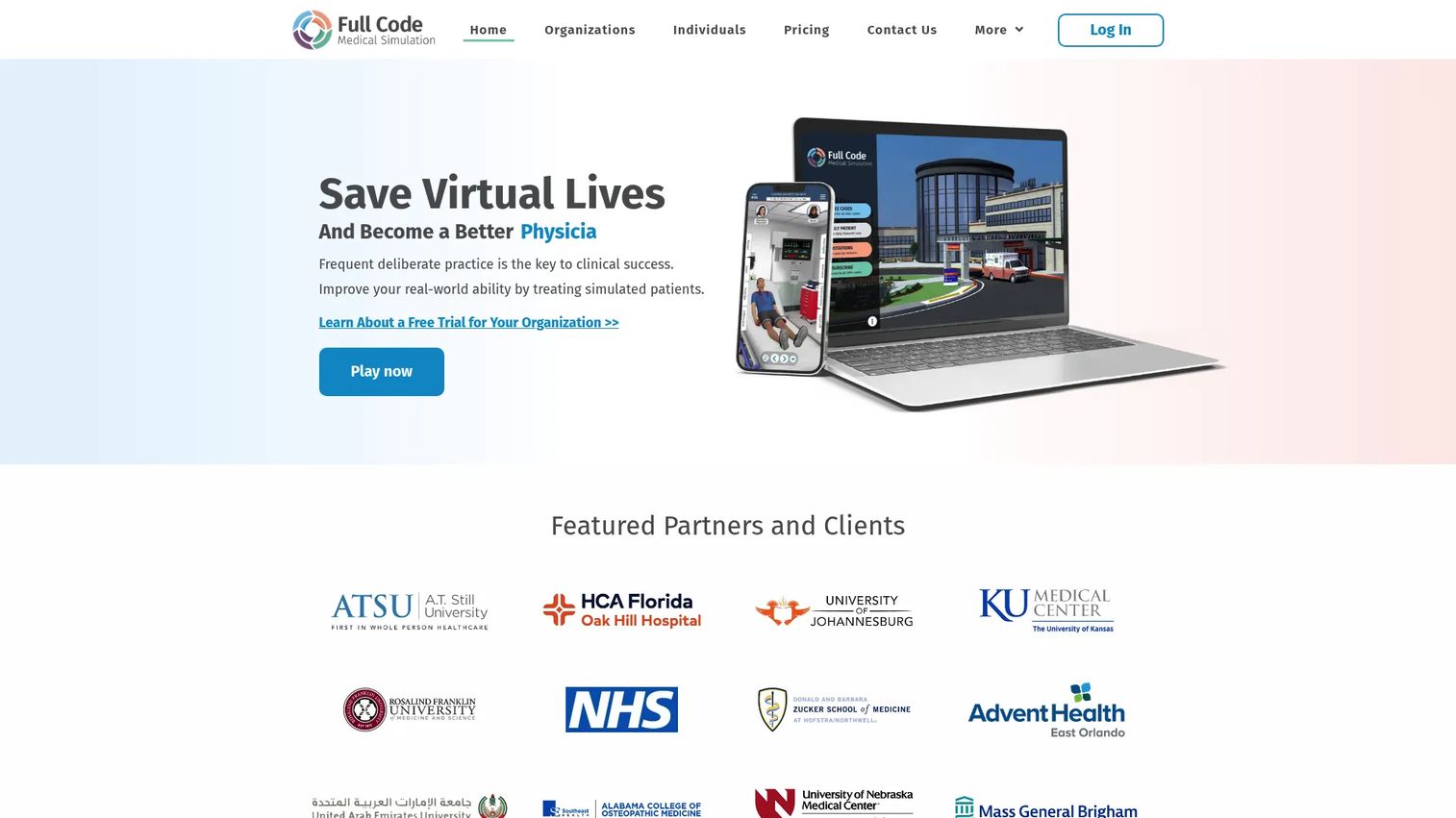
Full Code Medical Simulation is a virtual clinical practice platform built by clinicians, covering 250+ simulation cases across 31 specialties. Learners interact with AI-powered patients, work through realistic medical imaging, and receive detailed case scoring and debriefs. The platform runs on mobile, tablet, and desktop, giving learners access outside scheduled lab time. An organizational dashboard lets education teams assign cases, track learner portfolios, and view analytics across cohorts.
Best for: Medical schools, residency programs, hospital education teams, and individual clinicians needing repeatable virtual clinical case practice.
Key features
- 250+ cases across 31 specialties
- AI-powered patient conversations and AI tutor support
- Real medical imaging integrated into cases
- Detailed scoring, debriefs, and learner portfolios
- Organizational dashboard with assignments and analytics
Why choose Full Code Medical Simulation: Full Code suits programs that want broad clinical case exposure and deliberate practice without depending on lab scheduling. The free tier lets individual learners and small programs start before committing to institutional pricing.
Full Code Medical Simulation pricing: A free plan is available. Individual paid plans start at $11.99 per month (or $71.99 annually). The Pro + CME plan is $99.99 per year. The Program plan for organizations runs $120 per seat annually. Enterprise pricing is handled through a sales quote. An optional Case Creator add-on is $15,000 per year.
2. EMS SIMULATIONiQ
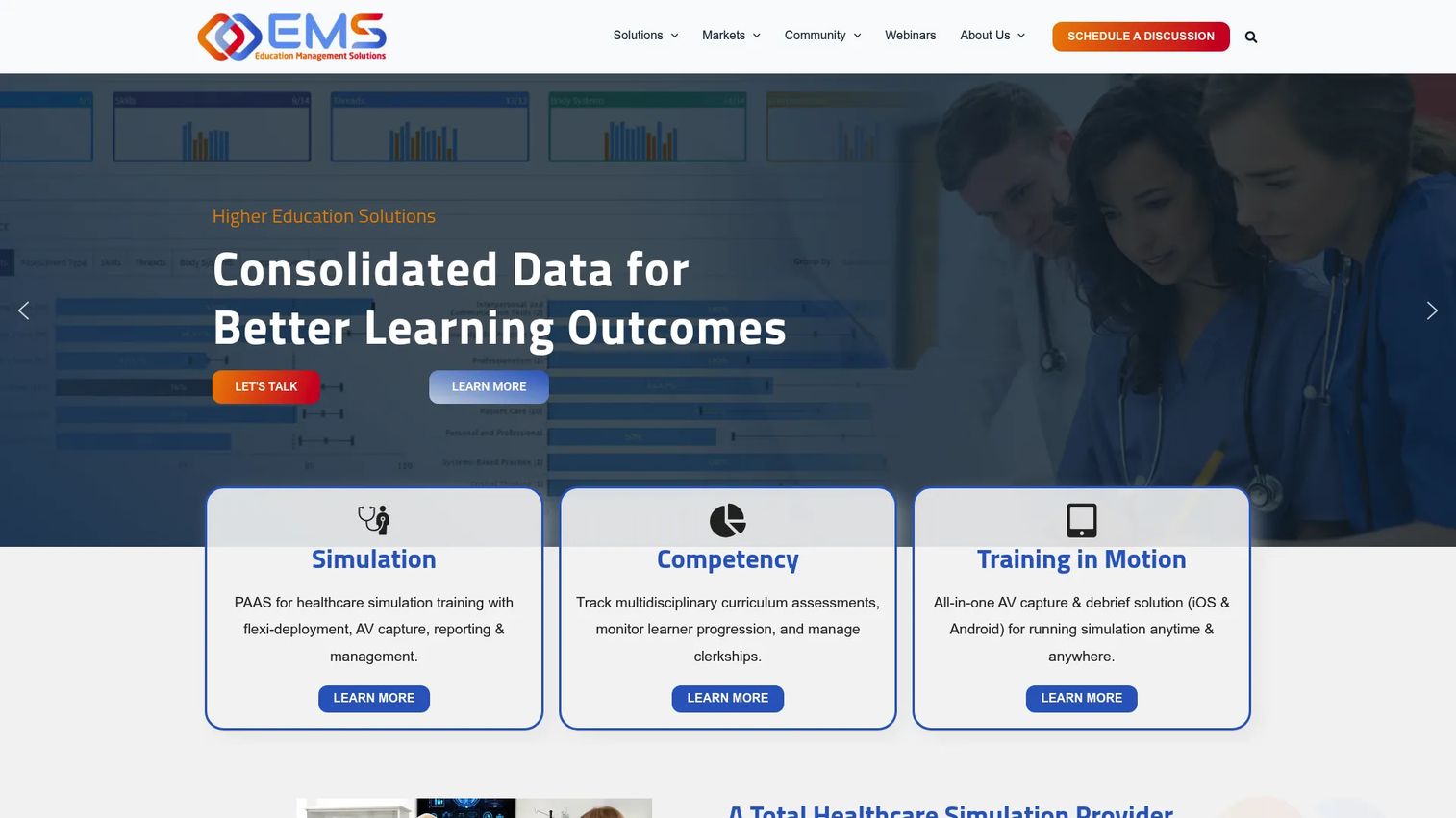
EMS SIMULATIONiQ is a healthcare simulation management platform designed for institutions that run complex simulation operations. The product covers the full operational workflow: Scheduling, AV capture and playback, debriefing analytics, competency assessment, and multi-site reporting. It integrates with manikins, measurement devices, and LMS platforms, and supports both cloud and on-premises deployment. Solutions include Enterprise, Pro, Pro Plus, and One Room configurations depending on center size and volume.
Best for: Simulation centers, hospitals, and healthcare education institutions managing high-volume, multi-site simulation programs that need governance, reporting, and structured debriefing.
Key features
- HD audio-video capture, playback, and bookmarking
- Simulation scheduling and case management
- Assessment checklists, rubrics, and cohort analytics
- Simulator and vital-sign integration
- Cloud or on-premises deployment options
Why choose EMS SIMULATIONiQ: This is the operations-heavy choice. If your team needs to manage scheduling, capture every session, run structured debriefs, and produce accreditation-ready reports across multiple sites, SIMULATIONiQ is built for that workflow. It gives program directors visibility that a spreadsheet or LMS alone cannot provide.
EMS SIMULATIONiQ pricing: Pricing is quote-based across all tiers. Contact the EMS sales team with your site count, session volume, and integration requirements to get a scoped proposal.
3. Body Interact
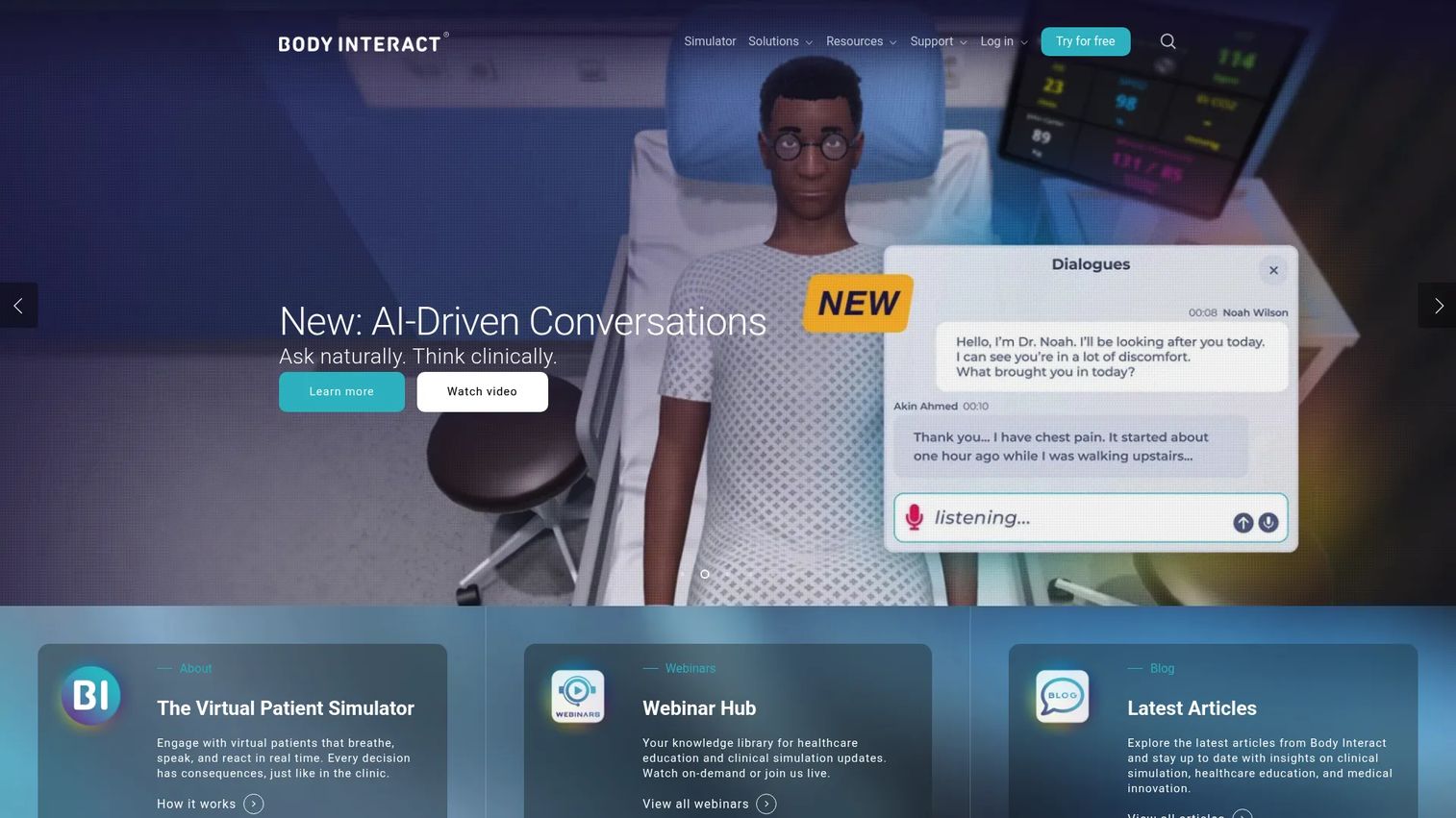
Body Interact is a virtual patient simulator focused on clinical reasoning and real-time patient interaction. Learners conduct physical examinations, order investigations, administer medications, and monitor vital signs on 3D virtual patients whose physiology adapts based on each decision. AI-driven conversations support typed and spoken natural language dialogue. BI Studio provides faculty dashboards for learner performance tracking and OSCE configuration. A scenario authoring tool allows institutions to build custom cases.
Best for: Medical, nursing, EMS, and allied health programs that teach diagnostic reasoning, clinical decision-making, and management of deteriorating patients.
Key features
- 3D virtual patients with real-time adaptive physiology
- AI-driven typed and spoken patient dialogue
- Physical examination, investigation, and medication workflows
- BI Studio dashboards for OSCE setup and learner tracking
- BI Editor for custom scenario authoring
Why choose Body Interact: Choose it when learner decisions need to visibly change the patient's condition in real time. This reinforces the cause-and-effect reasoning that clinical practice demands, rather than presenting a static scenario with a predetermined correct path.
Body Interact pricing: The Clinical Learning Journey individual subscription starts at €49.99 per month, billed monthly, or €119.99 per three months. Institutional pricing for schools and hospitals is available through a sales contact request on the vendor's site.
4. Oxford Medical Simulation
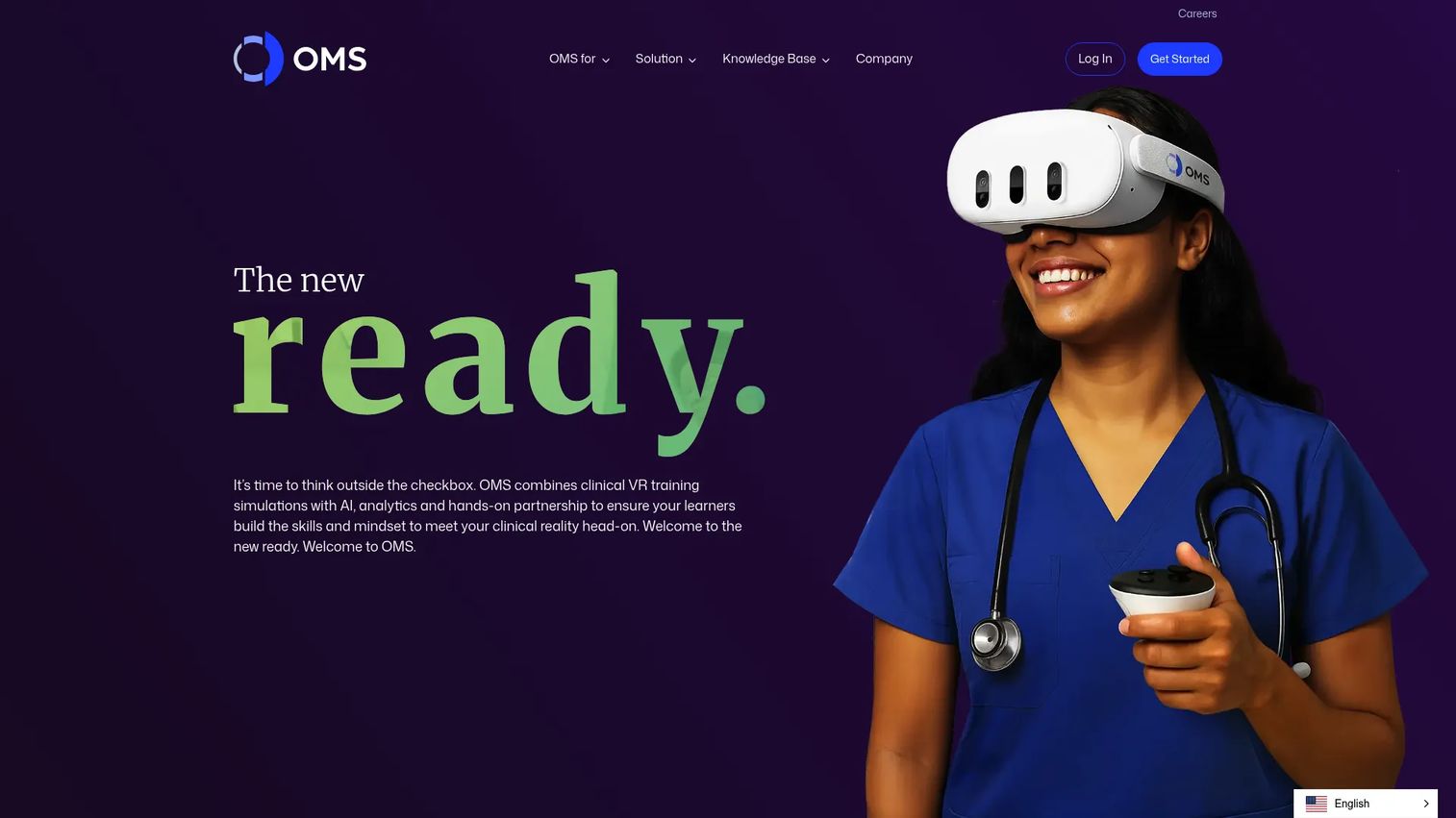
Oxford Medical Simulation delivers immersive, AI-powered VR clinical simulations for healthcare education and workforce readiness. Scenarios cover clinical reasoning, communication, procedural skills with haptic feedback, and multi-learner team collaboration. Learners receive objective feedback and structured debriefing. The platform runs on VR headsets and also supports screen-based delivery on Mac and Windows, giving programs flexibility across budgets and environments. A no-code authoring tool called OMS Create lets faculty build custom scenarios without developer support.
Best for: Healthcare systems, medical schools, and nursing programs that want immersive VR training for clinical judgment, communication skills, and team performance.
Key features
- VR and screen-based clinical scenarios
- AI-driven patient and team communication
- Procedural skills with haptic feedback
- Multi-learner team collaboration support
- OMS Create no-code scenario authoring
Why choose Oxford Medical Simulation: Oxford Medical Simulation fits programs where immersion and scenario realism are the priority. The no-code authoring tool matters for institutions that want to build specialty-specific or region-specific cases without engineering resources.
Oxford Medical Simulation pricing: Pricing is quote-based. The vendor describes subscription and pay-per-use arrangements but does not display figures. Request pricing directly through the vendor's site.
5. SimX
SimX is a VR and mixed reality medical simulation platform designed for team-based clinical training. It supports co-located and remote multiplayer scenarios, letting groups of learners practice together in immersive environments regardless of physical location. An AI Assistant and autonomous scenario launch capability reduce faculty dependency for individual practice sessions. A no-code Scenario Editor allows custom case development. Advanced recording, reporting, and performance tracking give instructors session-level visibility into learner behavior.
Best for: Hospitals, universities, military medical teams, nursing programs, and EMS organizations that need immersive, distributed, team-based simulation.
Key features
- Multiplayer VR for co-located and remote learners
- AI Assistant and autonomous headset-launched scenarios
- No-code Scenario Editor for custom case development
- Advanced assessment, recording, and performance tracking
- Cross-platform and wireless VR headset support
Why choose SimX: SimX suits programs that need group simulation at scale, particularly when teams are geographically distributed. The multiplayer architecture means instructors can run team scenarios without every learner being in the same room.
SimX pricing: Pricing is quote-based. SimX customizes cost by program size, module selection, and headset requirements. Reach out through the vendor's get-started page for a proposal.
G2 rating: 4.3/5.
6. Laerdal Medical
Laerdal Medical is one of the longest-established names in healthcare simulation, offering a connected ecosystem of patient simulators, manikins, software, and training services. Manikins cover emergency care, nursing, obstetrics, pediatrics, and trauma scenarios. Simulation management and debriefing run through SimCapture, and LLEAP software controls and assesses simulator behavior during training. Virtual simulation and online learning products extend practice beyond physical lab sessions. Training and technical services are available for program setup and ongoing support.
Best for: Healthcare organizations, medical schools, emergency services, and military programs that are building or expanding physical simulation programs with connected software workflows.
Key features
- Patient simulators and manikins across clinical specialties
- SimCapture for simulation management, recording, and debriefing
- LLEAP software for simulator control and assessment
- Virtual simulation and online learning products
- Educational and technical services for program support
Why choose Laerdal Medical: Laerdal fits institutions that need hardware and software to work together as one training program, not two separate procurement decisions. If your team is already running or planning a physical simulation center, Laerdal's integrated approach reduces the integration burden significantly.
Laerdal Medical pricing: Products and programs are priced through a quote or sales inquiry. Contact the Laerdal team with your institution's simulation scope, manikin requirements, and software needs.
G2 rating: 4.5/5 (based on 2 reviews).
7. CAE Healthcare
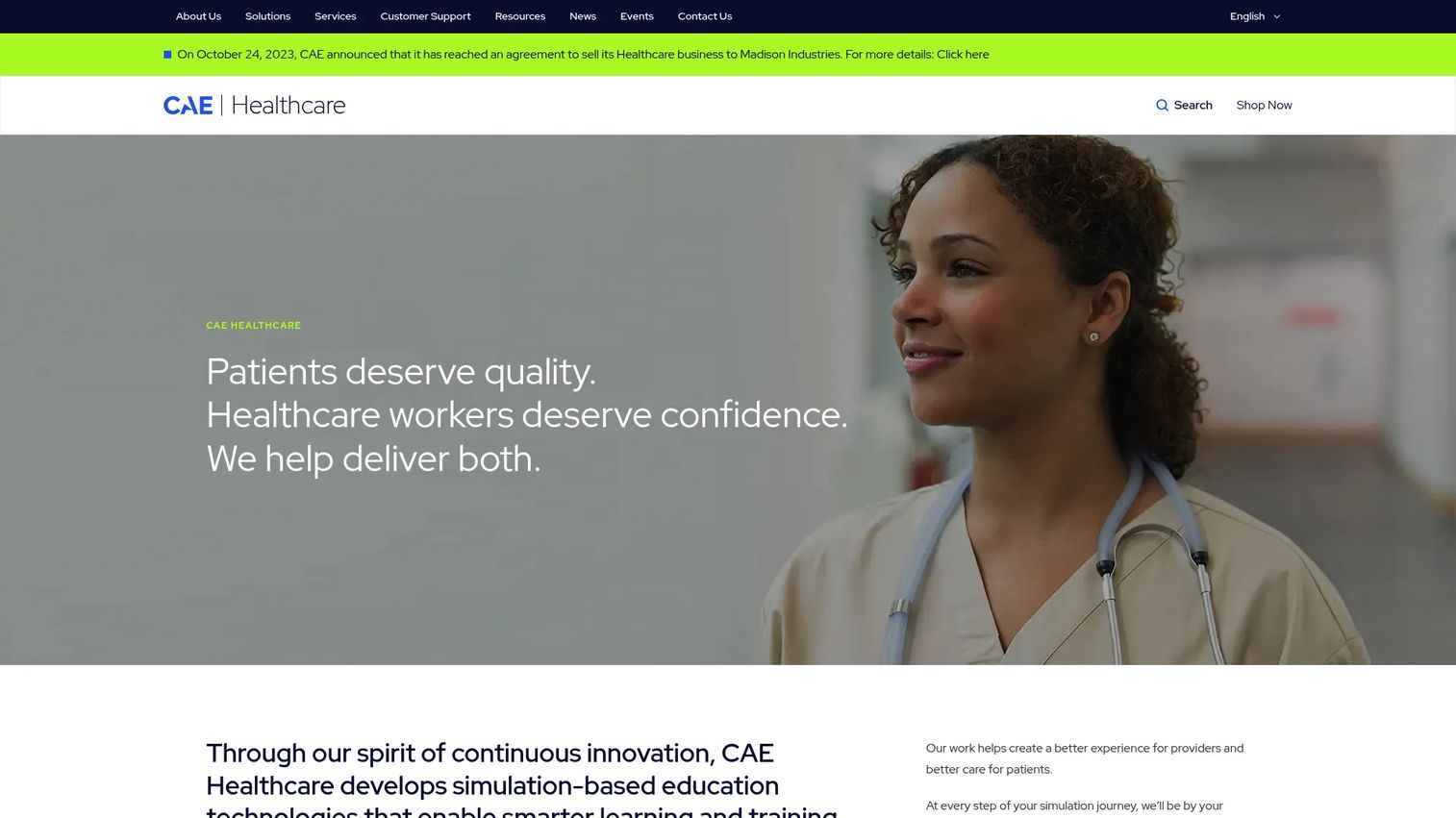
CAE Healthcare provides simulation-based education technologies spanning patient simulators, ultrasound and surgical training, simulation center management, and distance-learning tools. Patient simulators include physiological modeling that responds to clinical interventions. Ultrasound and interventional simulation support procedural skills development. Digital and distance-learning products extend training access beyond the physical center. CAE Healthcare positions its offering as a patient-safety improvement infrastructure for healthcare institutions.
Best for: Simulation centers and healthcare institutions buying simulation as a program, including patient simulators, center management, and clinical scenario content under one vendor relationship.
Key features
- Patient simulators with physiological modeling
- Ultrasound and interventional simulation
- Surgical and procedural skills training
- Simulation center management and debriefing
- Digital and distance-learning tools
Why choose CAE Healthcare: CAE Healthcare suits institutions that want to consolidate hardware, software, and training services under a single vendor. This reduces the coordination overhead when managing a multi-modality simulation program and gives program directors a single point of contact for support and maintenance.
CAE Healthcare pricing: Pricing is not publicly listed. Contact CAE Healthcare's sales team for a quote covering your specific simulators, software modules, and center configuration.
8. Shadow Health
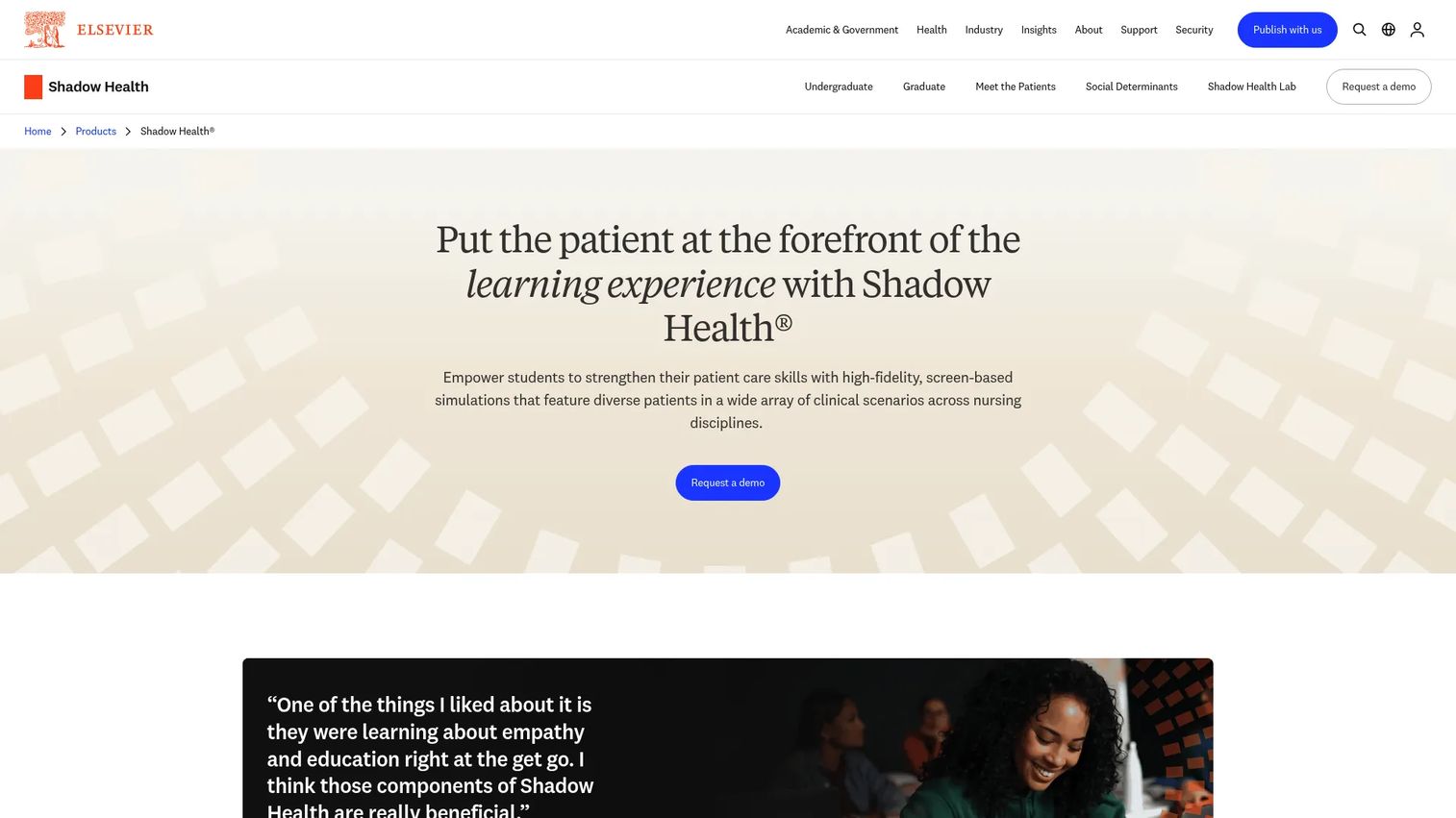
Shadow Health, a Digital Clinical Experiences product from Elsevier, provides digital standardized patient encounters primarily for nursing education. Learners conduct patient interviews, complete health assessments, and practice clinical documentation in a structured digital environment. Faculty tools track individual and cohort performance, and assignments integrate into academic workflows. The product is widely used across nursing schools and allied health programs that need scalable, repeatable clinical assessment practice.
Best for: Nursing education programs and allied health courses that need structured digital patient assessment, documentation practice, and faculty reporting tools.
Key features
- Digital standardized patient encounters
- Health assessment and patient interview practice
- Clinical documentation workflows
- Learner performance tracking and feedback
- Faculty assignment and reporting tools
Why choose Shadow Health: Shadow Health is the focused choice when nursing assessment practice, rather than simulation center operations or immersive VR, is the primary training need. Its structured encounter format and integration with academic workflows make it straightforward to embed in existing curricula.
Shadow Health pricing: Academic pricing depends on course, learner count, and institution. Contact Elsevier or the Shadow Health team directly to get a scoped quote for your program.
9. i-Human Patients
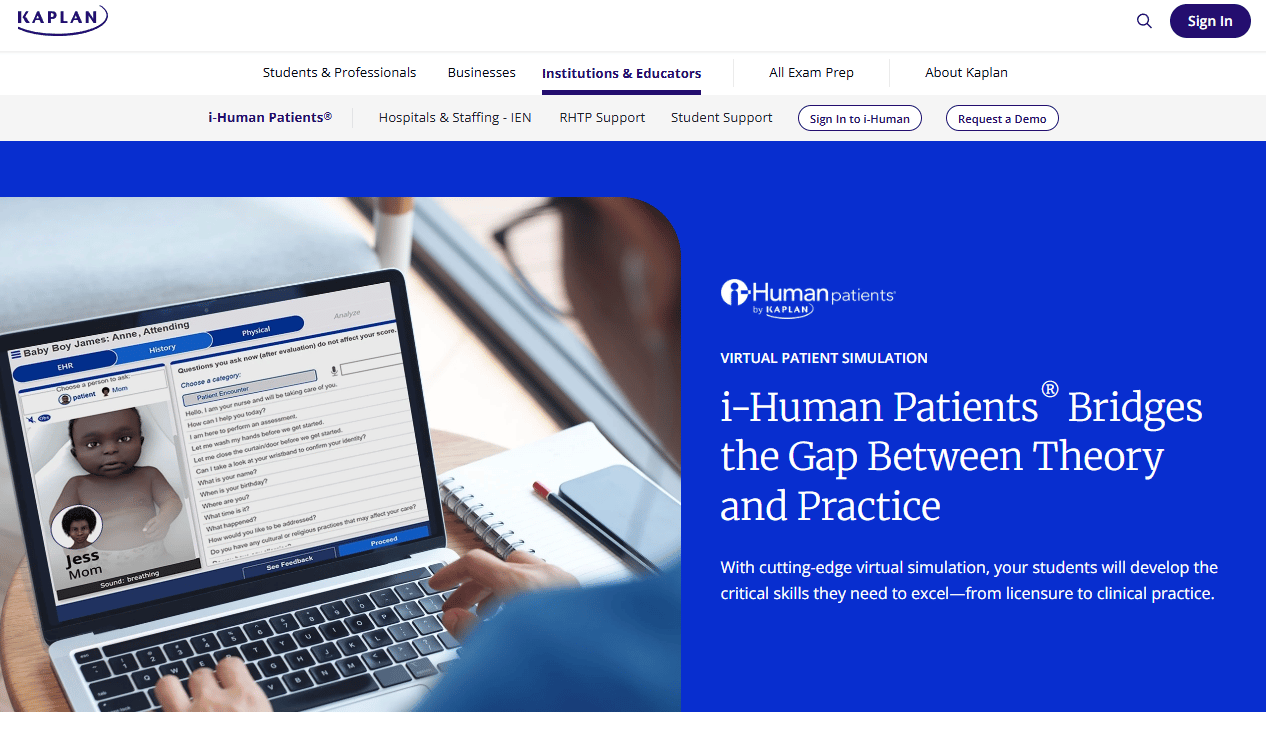
i-Human Patients is a virtual patient platform designed for case-based clinical education. Learners engage in history-taking, physical assessment, differential diagnosis, diagnostic testing, and treatment planning within structured patient encounters. Every encounter is fully graded, and personalized feedback with rationales helps learners understand where their reasoning diverged from optimal care. Actionable analytics and progress tracking give faculty visibility into learner development over time. Cases cover a range of clinical presentations across medicine, nursing, and allied health.
Best for: Medical, nursing, and allied health programs that need learners to practice the full clinical reasoning path through structured, graded virtual patient encounters.
Key features
- Interactive virtual patient encounters across clinical presentations
- Full grading with personalized feedback and rationales
- History-taking, physical assessment, and diagnostic reasoning
- Actionable analytics and progress tracking for faculty
- Realistic avatars and diverse case libraries
Why choose i-Human Patients: i-Human suits programs where structured, graded case completion is the goal. The full-path reasoning approach, from history through treatment planning, ensures learners are not just practicing isolated skills but developing integrated clinical judgment.
i-Human Patients pricing: Institutional and course-based pricing is handled through a sales inquiry. The product homepage redirects through Kaplan, so contact the i-Human team or Kaplan directly with program size and course needs to get current pricing.
10. SimConverse
SimConverse is an AI experiential-learning platform for communication, clinical reasoning, and conversational simulation. Learners interact with photorealistic AI avatars capable of complex reasoning, multi-turn dialogue, and personalized feedback. Faculty can customize character visuals, voices, scenarios, rubrics, and written artifacts without coding. The platform handles cohort management, LTI integration, SSO, and automatic reminders, reducing administrative overhead for large programs. Analytics run from institution level down to rubric heatmaps, and accreditation-ready exports are supported. SimConverse also holds SOC 2, ISO 27001, GDPR, and FERPA compliance capabilities.
Best for: Universities and healthcare education institutions that need scalable AI patient conversation practice, communication skills training, and curriculum-mapped simulation with enterprise governance.
Key features
- Photorealistic AI avatars with complex reasoning
- Customizable characters, voices, rubrics, and scenarios
- Institution-to-rubric-level analytics with heatmaps
- LTI and SSO integration with automatic cohort management
- Accreditation exports and compliance capabilities
Why choose SimConverse: SimConverse is the right choice when communication and conversation practice are the core training gap, particularly for programs that need to scale those scenarios across large cohorts without scaling instructor time. The analytics depth, including rubric heatmaps and accreditation exports, gives program leaders the board-level reporting signal they need.
SimConverse pricing: Pricing is quote-based. Book a demo through the vendor's site to discuss cohort size, scenario scope, and integration requirements.
Considerations when choosing medical simulation software
Match the platform to the simulation job
Virtual patient cases, VR scenarios, manikin-connected systems, and simulation management platforms solve different problems. A feature checklist can hide a category mismatch. Decide first whether you need practice volume, operational oversight, immersive team training, or communication skill development, then evaluate vendors within that category.
Verify clinical credibility
Look for peer-reviewed case authorship, faculty review workflows, accreditation alignment, and specialty coverage that matches your curriculum. Broad "clinically validated" language without a named review process is not a sufficient signal. Ask vendors specifically how cases are authored, reviewed, and updated when clinical guidelines change.
Check assessment and reporting depth
Scoring, feedback, remediation pathways, cohort comparison, and data exportability all matter at different levels of the organization. For executives and boards, the question is whether the platform produces reports that answer the question: Are our learners reaching competency, and where are they falling short? Verify what analytics are available at each pricing tier before committing.
Map integrations before procurement
LMS compatibility, SSO support, manikin system connections, VR headset requirements, AV capture dependencies, and data export formats all need to be confirmed against your existing infrastructure. A platform that does not connect to your LMS adds administrative friction and creates data silos that defeat the purpose of competency tracking.
Model instructor workload
A platform that looks scalable can still generate significant maintenance work. Ask who builds cases, who updates scenarios when clinical protocols change, who reviews learner performance, and who owns debriefing facilitation. Some tools offload all authoring to vendor teams; others expect significant faculty involvement. Know which model fits your staffing before signing.
Conclusion
The right medical simulation software depends on the training job, not the vendor's overall reputation.
For virtual patient and case-based learning, Full Code Medical Simulation, Body Interact, Shadow Health, and i-Human Patients are all credible choices, each with a distinct emphasis on specialty breadth, adaptive physiology, nursing assessment, or full-path diagnostic reasoning.
EMS SIMULATIONiQ is the operational choice for simulation centers that need scheduling, AV capture, debriefing, and multi-site reporting in one system.
Oxford Medical Simulation and SimX suit programs investing in immersive VR, with Oxford strong on individual clinical judgment and SimX designed for team-based distributed scenarios.
Laerdal Medical and CAE Healthcare fit institutions that are building or expanding physical simulation programs and want hardware and software governed under one vendor relationship.
SimConverse fills a distinct gap: Scalable AI conversation practice with enterprise-grade analytics and accreditation export support.
Shortlist by simulation type first. Then evaluate pricing structure, clinical content quality, deployment burden, and reporting depth before procurement. The platforms with the strongest fit for your training job will surface quickly once the category decision is clear.
If your team sells complex healthcare or SaaS software, use interactive product experiences to show buyers how your platform works before a live call. Start your journey with Guideflow today!
FAQs
Medical simulation software is digital software that lets healthcare learners practice clinical skills, decision-making, communication, and patient management in simulated scenarios rather than with real patients. It covers virtual patients, VR environments, AI conversation partners, simulation center management systems, and manikin-connected software platforms.
The right choice depends on the program's primary training goal. Full Code Medical Simulation and i-Human Patients work well for case-based virtual clinical practice and diagnostic reasoning. Body Interact is a strong fit for programs that want adaptive patient physiology. Oxford Medical Simulation and SimX suit schools investing in VR-based immersive training. Most programs use more than one platform across different course levels.
Hospital needs typically center on staff onboarding, competency verification, team training, and simulation center operations. EMS SIMULATIONiQ suits hospitals running structured simulation centers with multi-site reporting requirements. Laerdal Medical and CAE Healthcare fit institutions with physical manikin-based training programs. SimX supports team-based VR scenarios for emergency or procedural teams. Body Interact works for individual clinical reasoning practice outside lab hours.
Virtual patient simulation is typically screen-based or mobile. Learners interact with a digital patient through a browser or app, making decisions and receiving feedback without a headset. VR medical simulation uses immersive headsets to place the learner inside a three-dimensional clinical environment. The difference matters for learning objectives: Screen-based tools scale easily and require no hardware; VR adds presence and spatial realism but requires headsets, space, and higher per-seat cost.
No. Software expands practice volume and standardizes case exposure, but hands-on labs remain essential for procedural skill development, equipment handling, and instructor-facilitated team debriefing. The practical value of simulation software is that it prepares learners to arrive at lab sessions ready to focus on higher-order skills rather than first-pass clinical reasoning.
The answer depends on the simulation job. For clinical reasoning practice, scenario quality, adaptive physiology, and feedback depth are the priority. For simulation center operations, scheduling, AV capture, debriefing tools, and multi-site reporting matter more. Across all categories, competency tracking, faculty controls, and data exportability determine whether the platform earns its place in an accreditation-ready training program.
Pricing across this category varies by vendor, product type, learner count, site count, hardware requirements, and support model. Full Code Medical Simulation is the most transparent, with individual plans starting at $11.99 per month and organizational plans from $120 per seat annually. Body Interact's individual Clinical Learning Journey starts at €49.99 per month. Most enterprise and institutional platforms, including EMS SIMULATIONiQ, Laerdal, CAE Healthcare, SimX, Oxford Medical Simulation, Shadow Health, i-Human Patients, and SimConverse, price by quote only. Verify current figures directly with each vendor's sales team before building a procurement budget.
Full Code Medical Simulation, Body Interact, and SimConverse all support AI-driven patient conversations, though in different ways. Full Code and Body Interact embed AI conversation within broader clinical simulation cases, where dialogue is one element of a full patient encounter. SimConverse is purpose-built for conversational simulation, with photorealistic AI avatars, customizable rubrics, and analytics designed specifically around communication practice at scale.