The sales forecast says production can ship. Purchasing shows enough components. Then the shop floor discovers a shortage halfway through the work order.
Finance faces a different version of the same problem. Inventory valuation doesn’t reconcile, purchase commitments sit outside the accounting system, and nobody trusts the weekly numbers.
This operational gap is common. According to Aptean’s 2025 Manufacturing Trends and Technology Report, 49% of manufacturers manage inventory partly or completely manually. The same report found that 59% plan to optimize inventory levels with technology.
Basic stock tools can track finished goods. Manufacturing inventory management software must also understand bills of materials, subassemblies, work in progress, traceability, and replenishment.
The right system gives your operating team reliable production data without routing every exception through one experienced employee.
What’s inside
This guide is for manufacturers replacing spreadsheets, basic accounting inventory, or disconnected warehouse systems. Use it to build a shortlist before your operations and finance leaders run deeper evaluations.
We selected tools using four criteria:
- Support for manufacturing inventory rather than basic stock tracking
- Coverage for BOMs, WIP, traceability, costing, and MRP
- Fit across smaller manufacturers and multi site operations
- Connections between inventory, production, purchasing, and finance
You’ll find a comparison table, 14 detailed product reviews, a buyer checklist, and practical FAQs. Shortlist by production complexity and reporting requirements rather than brand familiarity.
TL;DR
- Best for regulated manufacturing: QT9 ERP connects production inventory with quality management, traceability, accounting, and shop floor operations
- Best for scaling manufacturers: NetSuite ERP supports inventory, procurement, finance, and multi entity reporting in a broad cloud ERP
- Best for established ERP environments: SAP Business One or Business Central connects inventory with finance and operational reporting
- Best for flexible workflows: Odoo Inventory offers a free single app plan and modular connections to manufacturing
- Best for smaller manufacturers: InFlow Manufacturing, Katana, or MRPeasy provides structured BOM, purchasing, and production workflows
- Best for accounting led teams: Fishbowl Advanced or QuickBooks Enterprise adds inventory depth while preserving familiar finance processes
What is manufacturing inventory management software?
Manufacturing inventory management software tracks raw materials, components, work in progress, finished goods, and production stock movements throughout manufacturing.
Unlike basic inventory software, these systems model how stock changes during production. They connect sales demand with component requirements, purchasing activity, work orders, and completed goods.
Production inventory management software can also help finance teams understand how materials, labor, and overhead affect inventory value. Operations leaders use the same data to identify shortages and plan production.
An inventory management system for manufacturing typically covers these capabilities:
- BOM management: Tracks components required to build finished goods
- WIP tracking: Shows materials consumed during active production
- Lot and serial traceability: Connects finished goods with source materials
- MRP: Converts demand into purchasing and production plans
- Barcode scanning: Supports structured receiving, picking, and stock movement
- Reorder automation: Triggers purchasing from defined stock thresholds
- Cost tracking: Connects inventory value with labor and overhead
- Accounting integration: Keeps inventory valuation and financial records aligned
More advanced platforms may also support quality holds, expiration dates, warehouse routes, production scheduling, and multiple facilities.
The core distinction is straightforward. Basic inventory apps track what you buy and sell. Inventory and manufacturing software also tracks what happens between those events.
That boundary matters once your business uses nested BOMs, serialized components, or open production orders. At that point, operator memory becomes a poor system of record.
When to use manufacturing inventory management software
Replace spreadsheets before production errors scale
Spreadsheets become risky when several buyers manage more SKUs across multiple locations. Cycle counts drift, formulas break, and raw material availability becomes difficult to confirm.
Use inventory software for manufacturing when one experienced operator holds the process together. Their knowledge should inform the system rather than substitute for it.
Control BOMs, WIP, and component shortages
Manufacturers need to know whether they can build what sales has promised. That requires BOM explosion, subassembly tracking, open work orders, and component availability.
A manufacturing inventory management system connects demand with material requirements. It gives purchasing and production teams a shared view of shortages before work begins.
Prove traceability, costing, and margin
Lot history and serial records matter when teams must trace finished goods back to source materials. Accurate cost rollups also affect gross margin and working capital reporting.
Use a dedicated system when board reporting depends on trusted inventory values. Finance should be able to reconcile stock without rebuilding the operating story in spreadsheets.
Manufacturing inventory management software comparison
This table provides a quick shortlist by operating model. Compare product fit before comparing feature counts.
Pricing reflects vendor information reviewed for this article. Quote based ERP costs usually change with users, modules, facilities, implementation, and deployment choices.
G2 ratings are listed separately from pricing. Cin7 Core has no rating shown because a current G2 product rating wasn’t confirmed in the supplied research.
| # | Product | Best for | Key differentiator | Pricing | G2 rating |
|---|---|---|---|---|---|
| 1 | QT9 ERP | Regulated manufacturers | ERP with quality and traceability | Custom pricing | 4.9/5 |
| 2 | NetSuite ERP | Scaling manufacturers | Broad cloud ERP across business functions | Custom pricing | 4.0/5 |
| 3 | SAP Business One | SAP centered SMBs | Finance led manufacturing ERP | Custom pricing | 4.3/5 |
| 4 | Odoo Inventory | Flexible modular workflows | Connected inventory and manufacturing apps | Free plan, paid from $24.90 per user monthly | 4.2/5 |
| 5 | Microsoft Dynamics 365 Business Central | Microsoft stack teams | ERP inventory inside Microsoft workflows | From $80 per user monthly for Essentials | 4.0/5 |
| 6 | DELMIAWorks | Shop floor focused manufacturers | Plant level manufacturing ERP | Custom pricing | 4.1/5 |
| 7 | inFlow Manufacturing | Small and midsize manufacturers | BOM, barcode, and production workflows | From $169 monthly, billed annually | 4.4/5 |
| 8 | Katana | Growing product businesses | Visual manufacturing and inventory control | Free plan, Core from $299 monthly | 4.4/5 |
| 9 | MRPeasy | Smaller manufacturers needing MRP | Production planning and purchasing depth | From $49 per user monthly | 4.6/5 |
| 10 | Fishbowl Advanced | QuickBooks connected manufacturers | Manufacturing and warehouse depth | Manufacturing from $675 monthly | 4.0/5 |
| 11 | Cin7 Core | Multichannel manufacturers | Inventory across channels and warehouses | From $349 monthly | Not confirmed |
| 12 | Unleashed | Product businesses with light manufacturing | Inventory and purchasing visibility | Core from $69 monthly | 4.1/5 |
| 13 | QuickBooks Enterprise | Finance led small manufacturers | Accounting first inventory workflows | From $2,210 yearly | 4.3/5 |
| 14 | Xero | Small manufacturers using cloud accounting | Accounting with inventory connections | From $27 monthly | 4.4/5 |
Best 14 tools for manufacturing inventory management software
1. QT9 ERP
QT9 ERP combines production, inventory, purchasing, accounting, and shop floor management in a manufacturing ERP. Its traceability and quality capabilities make it relevant for manufacturers operating under strict process controls.
The platform supports lot and serial records alongside MRP planning and forecasting. Supplier portals and electronic batch records extend that control beyond the warehouse.
For a founder, the main appeal is connected accountability. Inventory records, production activity, and quality operations live within the same operating system.
Best for: Manufacturers that need inventory, quality management, purchasing, and traceability in one ERP system.
Key features
- MRP planning and forecasting
- Lot and serial traceability
- Integrated accounting
- Quality management
- Shop floor control
Why choose QT9 ERP: Choose QT9 when inventory mistakes create recall, audit, or quality exposure. It fits teams that need stock records connected to production and quality controls.
QT9 ERP pricing
Custom pricing. User count, deployment, facilities, and implementation requirements drive the quote.
G2 rating
4.9/5
2. NetSuite ERP
NetSuite ERP is a cloud ERP covering finance, inventory, orders, procurement, warehouse operations, and analytics. It also supports CRM, human resources, commerce, and professional services workflows.
That breadth suits manufacturers whose inventory decisions affect several subsidiaries or business functions. Reporting and dashboards can give leadership a shared operating view across locations.
NetSuite makes the most sense after separate finance and operations tools start creating reconciliation work. Implementation fees and optional modules make the total investment broader than the software subscription.
Best for: Growing manufacturers that need inventory connected to finance, purchasing, subsidiaries, and reporting.
Key features
- Financial management
- Inventory and order control
- Procurement workflows
- Warehouse management
- Analytics and dashboards
Why choose NetSuite ERP: Choose NetSuite when inventory decisions have become finance and reporting decisions. It fits operators who need a broad cloud ERP across entities and product lines.
NetSuite ERP pricing
Custom pricing. The core platform, optional modules, users, implementation, and partner services determine the annual subscription cost.
G2 rating
4.0/5
3. SAP Business One

SAP Business One brings finance, purchasing, inventory, sales, and operational reporting into an ERP for small and midsize businesses. It includes inventory and warehouse capabilities alongside accounting and financial controls.
The product also covers procurement, accounts payable, customer management, and business intelligence. Mobile apps and a web client support access outside a fixed workstation.
This platform fits manufacturers that want SAP infrastructure without adopting a much broader corporate ERP program. Partner selection remains an important part of the implementation decision.
Best for: Small and midsize manufacturers that want ERP inventory within the SAP environment.
Key features
- Financial management
- Inventory and warehouse control
- Procurement workflows
- Business intelligence
- Mobile access
Why choose SAP Business One: Use SAP Business One when accounting control carries equal weight with operational visibility. It suits teams that want purchasing and inventory connected to finance.
SAP Business One pricing
Custom pricing. Licensing, partner implementation, users, and deployment determine the total cost.
G2 rating
4.3/5
4. Odoo Inventory
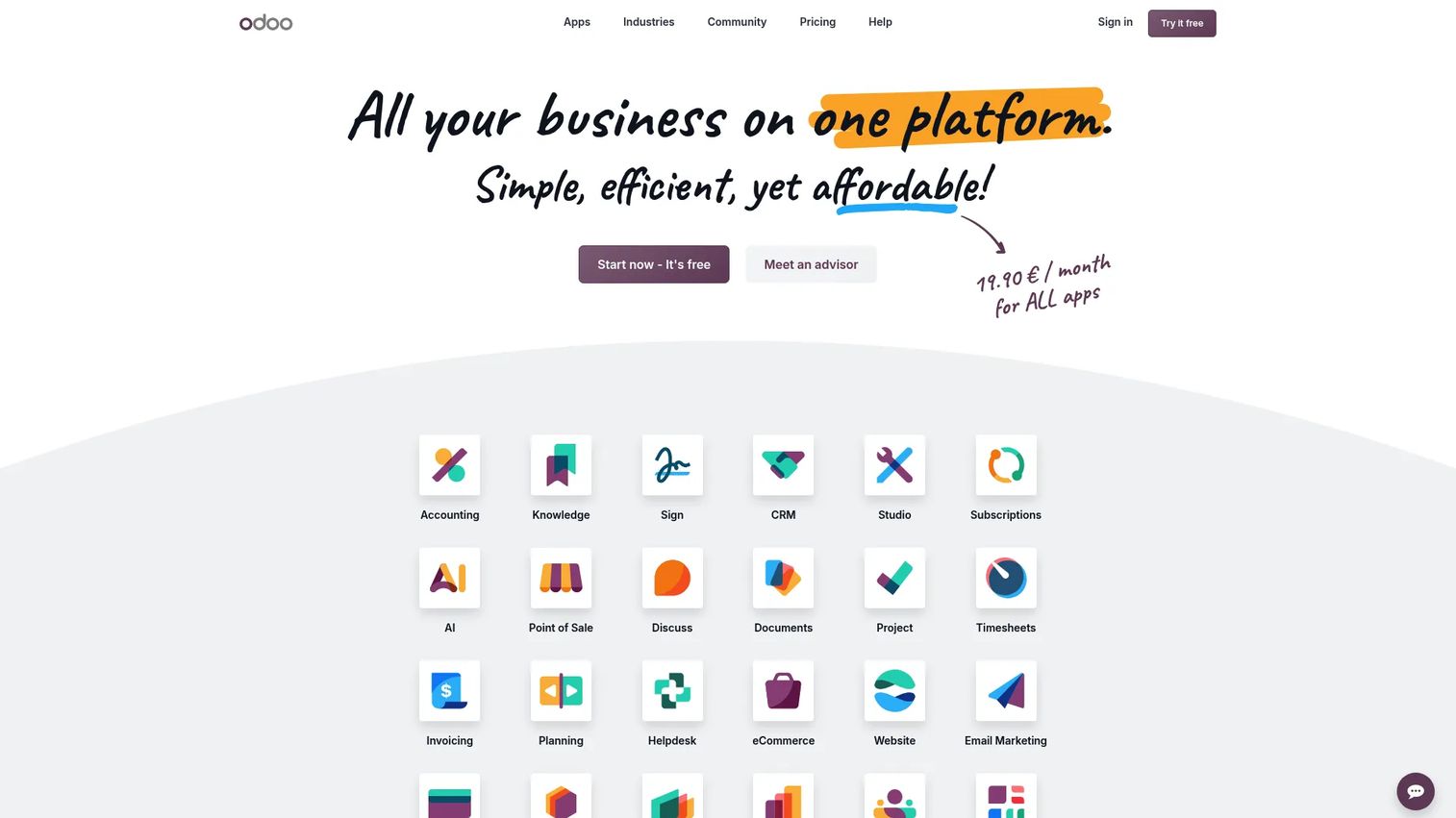
Odoo Inventory manages stock, replenishment, warehouse operations, shipping, and inventory valuation. Manufacturers can connect it with Odoo’s Manufacturing, Purchase, Sales, Accounting, and Barcode apps.
Its modular structure lets a business start with one operational area and add more applications later. Multi warehouse support and configurable routes suit companies with evolving fulfillment processes.
Odoo also supports lot tracking, serial records, expiration dates, and landed costs. The flexibility increases the importance of good implementation ownership.
Best for: Manufacturers that want modular inventory software they can extend across business functions.
Key features
- Multi warehouse management
- Lot and serial tracking
- Automated replenishment
- Barcode supported operations
- Inventory valuation
Why choose Odoo Inventory: Odoo fits companies that want flexible inventory manufacturing software without adopting every module at once. Assign clear ownership for configuration and process design.
Odoo Inventory pricing
One App Free costs $0. Standard starts at $24.90 per user monthly, billed yearly, while Custom costs $49 per user monthly.
G2 rating
4.2/5
5. Microsoft Dynamics 365 Business Central
Microsoft Dynamics 365 Business Central is an ERP for small and midsize businesses covering finance, sales, service, projects, and supply chain operations. Inventory, warehouse, and manufacturing management sit within the wider platform.
The product connects with Microsoft 365 and supports automated workflows. Copilot features are also included in Microsoft’s positioning, though buyers should evaluate the specific workflow rather than the label.
Manufacturing capabilities sit in the Premium plan. That packaging gives buyers a clear distinction between general operations and production requirements.
Best for: Manufacturers that want finance and inventory inside established Microsoft workflows.
Key features
- Finance management
- Inventory planning
- Warehouse management
- Manufacturing control
- Microsoft 365 integration
Why choose Microsoft Dynamics 365 Business Central: This product fits companies already operating within Microsoft tools. It also suits buyers comfortable with a partner led implementation model.
Microsoft Dynamics 365 Business Central pricing
Essentials costs $80 per user monthly, paid yearly. Premium costs $110 and adds manufacturing, while a 30 day trial is available.
G2 rating
4.0/5
6. DELMIAWorks

DELMIAWorks is manufacturing ERP software connecting customer activity with production and shipping. Its core coverage includes planning, scheduling, monitoring, inventory, warehousing, and quality management.
The product focuses on plant level execution rather than treating manufacturing as an accounting extension. Production insights help operations leaders connect material availability with work happening on the floor.
Its fit includes midmarket discrete manufacturers across plastics, automotive, aerospace, medical devices, and industrial equipment. That manufacturing focus distinguishes it from broader horizontal ERP platforms.
Best for: Midmarket manufacturers that need plant inventory connected to production execution.
Key features
- Production planning
- Shop floor monitoring
- Inventory management
- Quality management
- Warehouse control
Why choose DELMIAWorks: Choose DELMIAWorks when inventory is inseparable from plant execution. It suits operators who need a manufacturing specific backbone for production and material movement.
DELMIAWorks pricing
Custom pricing. Deployment scope, users, modules, and implementation services determine the quote.
G2 rating
4.1/5
7. inFlow Manufacturing
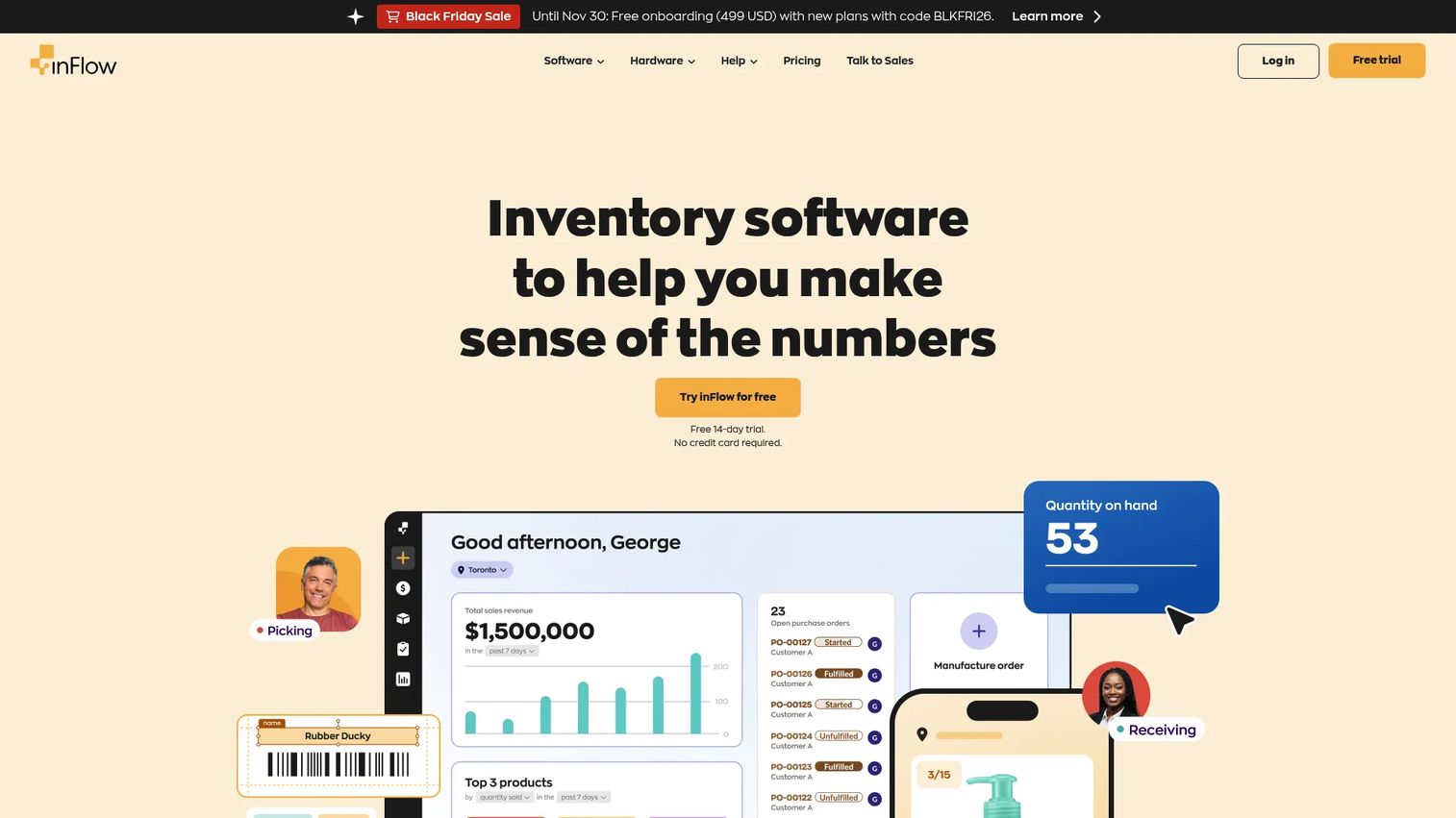
inFlow Manufacturing combines inventory software with manufacture orders, BOM management, production operations, and barcode workflows. It also tracks labor, timesheets, components, and finished goods.
Lot, batch, and serial records support traceability across production. Purchasing, sales, invoicing, and accounting connections cover the surrounding commercial workflow.
The product targets smaller and midsize manufacturers that need more structure without starting a broad ERP program. Its pricing and defined plans make early budget screening straightforward.
Best for: Small and midsize manufacturers moving from spreadsheets into structured production inventory workflows.
Key features
- Manufacture orders
- BOM management
- Labor tracking
- Barcode scanning
- Lot and serial records
Why choose inFlow Manufacturing: inFlow fits teams that need BOM inventory software and practical barcode control. It provides manufacturing depth without requiring a full business system replacement.
inFlow Manufacturing pricing
Start Up costs $169 monthly when billed annually. A 14 day trial is available, and higher plans start at $399 monthly.
G2 rating
4.4/5
8. Katana

Katana is cloud manufacturing and inventory software for growing product businesses. It combines inventory, purchasing, order management, warehouse workflows, and production insights.
The platform supports barcode scanning, traceability, kits, bundles, and multicurrency operations. Its manufacturing controls help teams connect demand with production and material availability.
Katana is a practical candidate for manufacturers that want visual control without moving into a large ERP program. The free plan also provides a defined entry point for small catalogs.
Best for: Growing manufacturers that need inventory tied closely to production planning.
Key features
- Manufacturing management
- Production insights
- Inventory control
- Barcode traceability
- Purchasing workflows
Why choose Katana: Katana works for teams that need to see how demand affects production and materials. It also fits product businesses combining manufacturing with sales operations.
Katana pricing
The Free plan supports up to 30 SKUs. Core starts at $299 monthly, while Advantage uses custom pricing.
G2 rating
4.4/5
9. MRPeasy
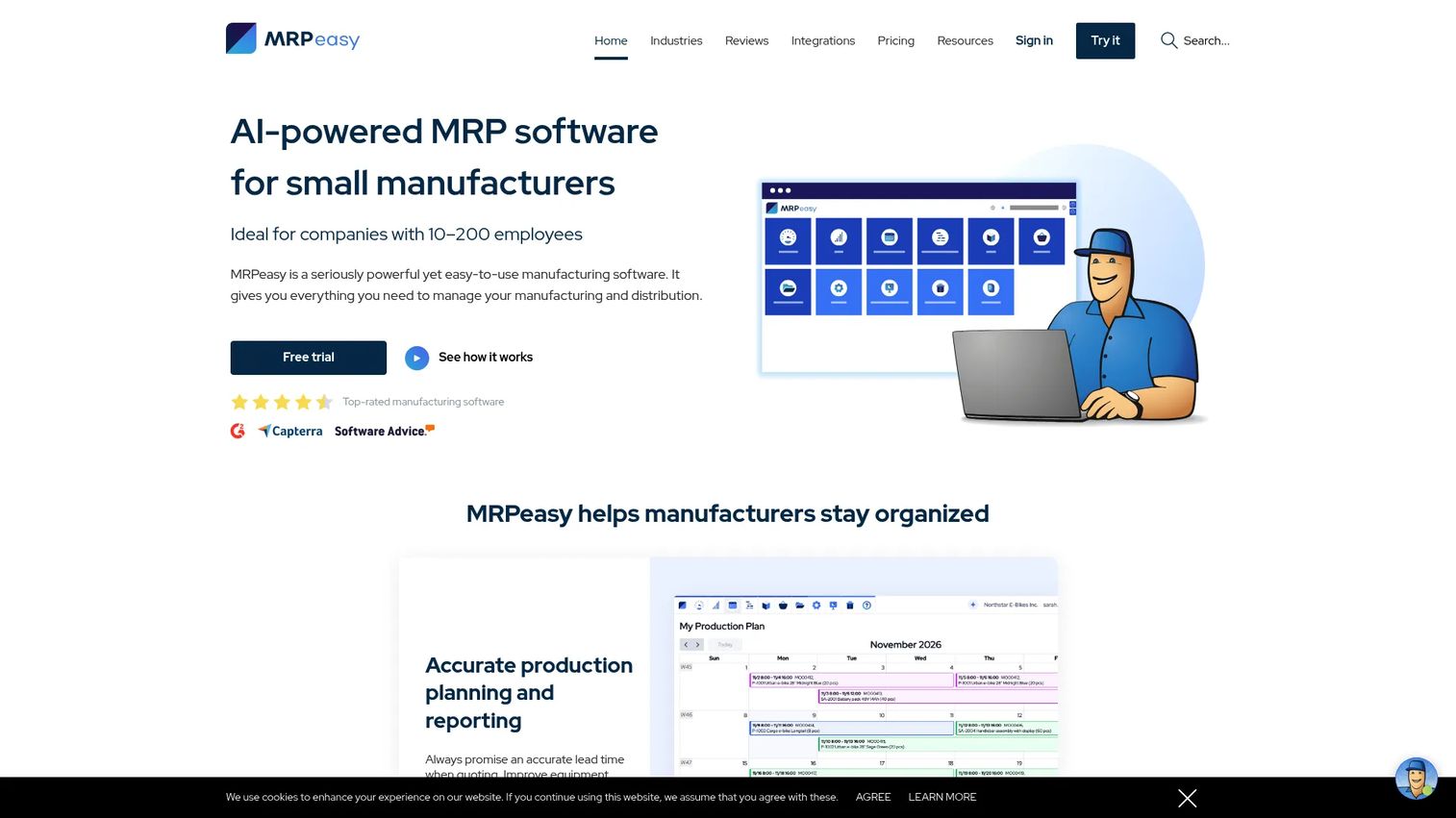
MRPeasy is cloud manufacturing ERP software for small and midsize manufacturers. It covers production planning, BOMs, inventory, warehouse management, purchasing, and sales.
The software is particularly relevant when planning drives the buying decision. Higher plans add capabilities including quality control, serial numbers, barcodes, multiple production sites, and API access.
MRPeasy offers four clearly priced tiers. That makes it easier for an operations lead to compare capability requirements with user costs before a trial.
Best for: Smaller manufacturers that need MRP and production planning without a large ERP budget.
Key features
- MRP planning
- BOM management
- Production reporting
- Inventory control
- Purchase management
Why choose MRPeasy: MRPeasy fits when the central problem is turning demand into production and purchasing actions. Its tiered model supports gradual increases in operational depth.
MRPeasy pricing
Starter costs $49 per user monthly. Professional starts at $69, and annual billing includes one month free.
G2 rating
4.6/5
10. Fishbowl Advanced
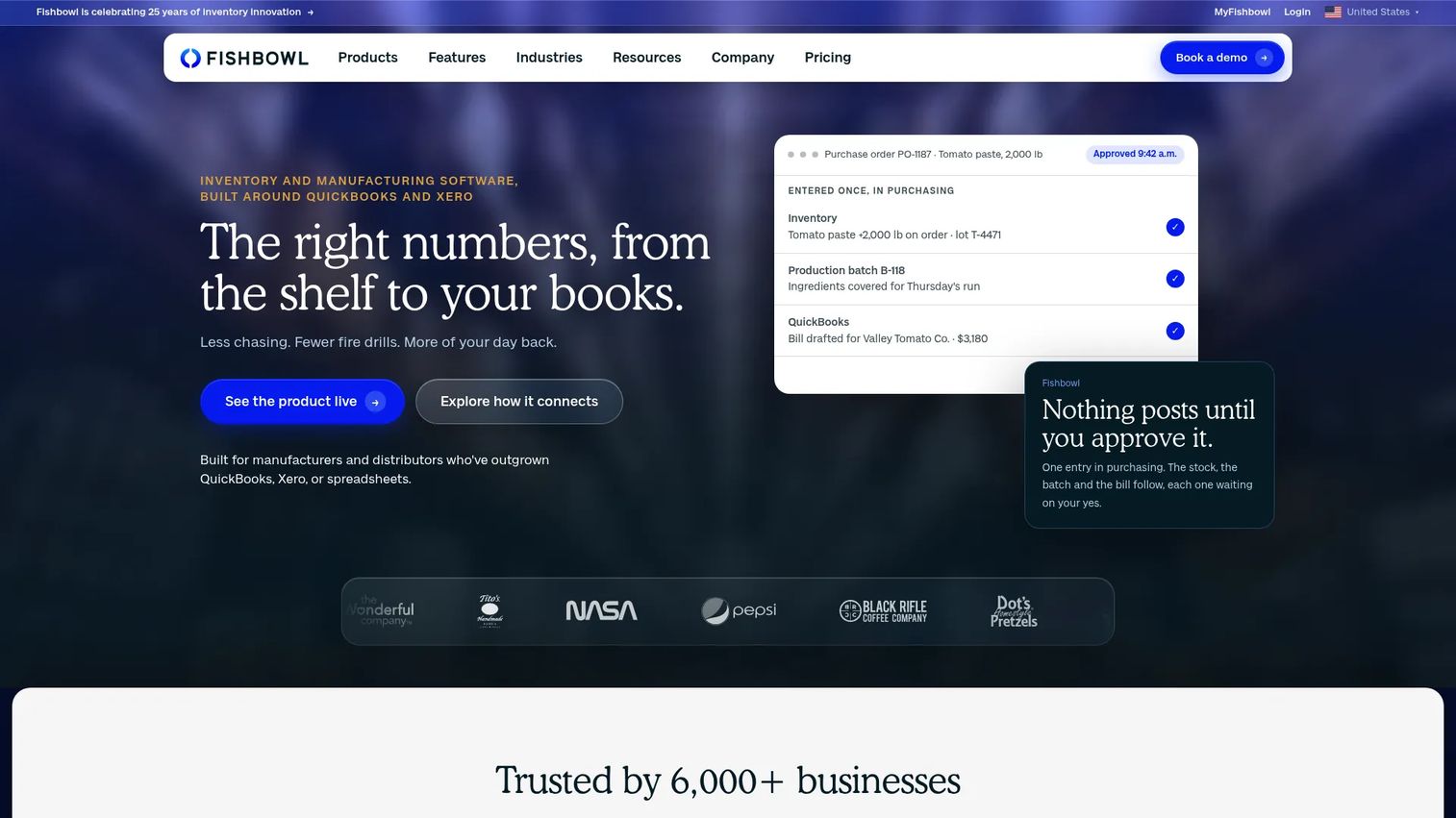
Fishbowl Advanced provides manufacturing and warehouse inventory management for production and distribution businesses. Its manufacturing product covers BOMs, subassemblies, work orders, production scheduling, and MRP.
The platform also supports lot tracking, multi warehouse operations, barcode scanning, and made to order builds. Connections with QuickBooks and Xero help preserve established accounting workflows.
Fishbowl is worth considering when operational inventory has outgrown the accounting system. It adds production and warehouse depth without requiring an immediate finance migration.
Best for: Manufacturers that want stronger inventory and production controls while retaining existing accounting software.
Key features
- Bills of materials
- Work orders
- Production scheduling
- Lot traceability
- Mobile barcode scanning
Why choose Fishbowl Advanced: Fishbowl fits QuickBooks connected businesses that need manufacturing and warehouse control. It can reduce pressure for an early accounting replacement.
Fishbowl Advanced pricing
Advanced Manufacturing starts at $675 monthly. User count and deployment determine the final price.
G2 rating
4.0/5
11. Cin7 Core
Cin7 Core is cloud inventory software for manufacturers, retailers, ecommerce sellers, and wholesalers. It connects inventory with orders, warehouse activity, manufacturing, sales channels, and accounting platforms.
Manufacturing features include bill of materials tracking and production jobs. Barcode scanning supports warehouse execution, while demand forecasting helps teams plan replenishment.
Cin7 Core fits businesses whose inventory complexity comes from several sales channels and locations. Its plan limits cover users, integrations, and annual sales order volumes.
Best for: Manufacturers selling through ecommerce, wholesale, and multiple warehouses.
Key features
- Multichannel inventory
- Warehouse management
- Barcode scanning
- BOM tracking
- Demand forecasting
Why choose Cin7 Core: Cin7 Core suits product businesses that need multi location inventory management across several channels. Evaluate order volume and integration limits against expected growth.
Cin7 Core pricing
Standard costs $349 monthly. Pro costs $599, while Advanced costs $1,199 monthly.
12. Unleashed
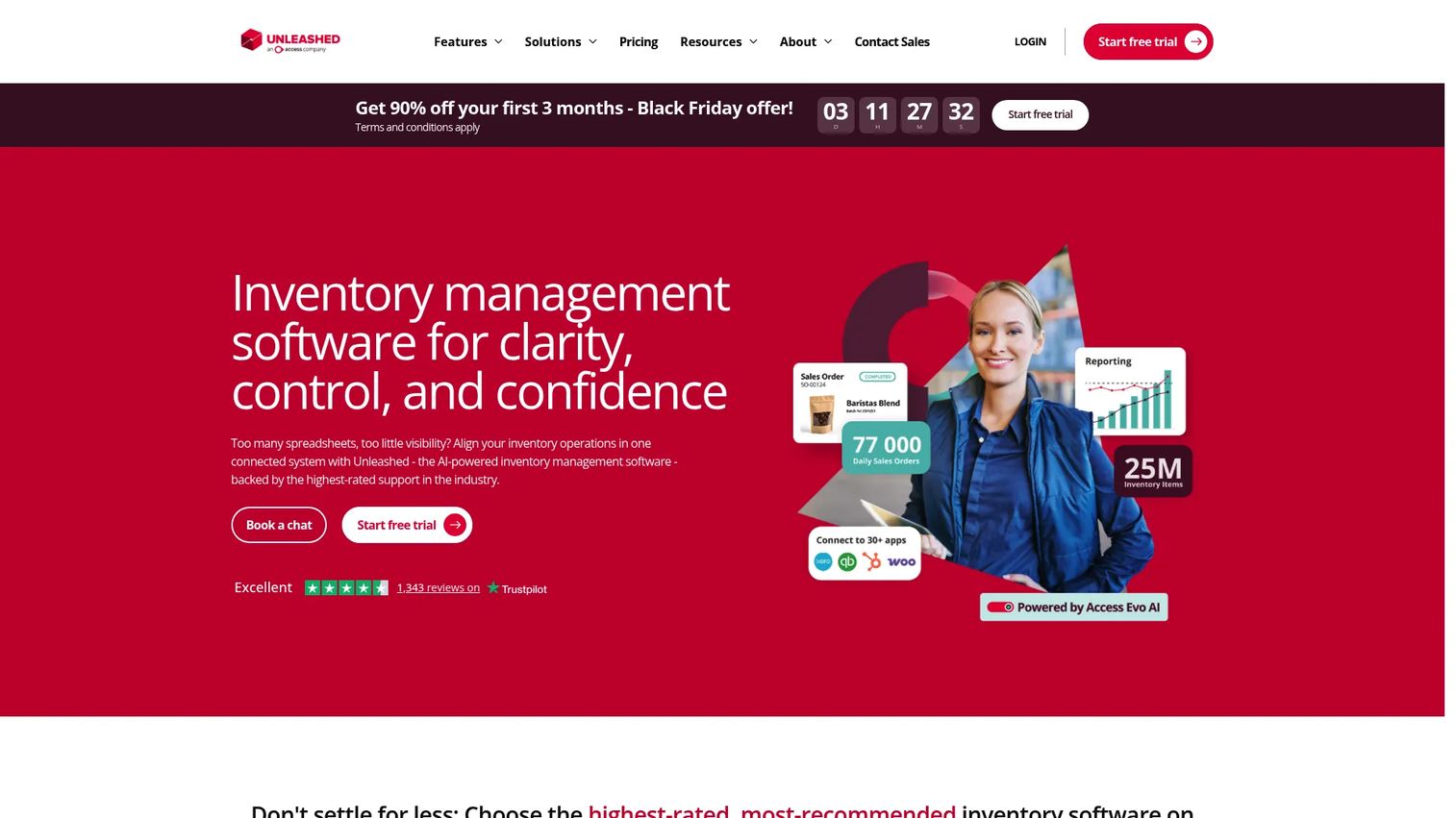
Unleashed is cloud inventory management software for product businesses, distributors, retailers, and manufacturers. It covers stock, purchasing, sales orders, production, and business reporting.
Manufacturing support includes bills of materials alongside batch and serial tracking. Multi warehouse management and barcode capabilities extend its use across physical operations.
Unleashed is a stronger fit when stock visibility and purchasing matter more than deep plant execution. Optional modules can increase the total monthly cost.
Best for: Product businesses needing inventory, purchasing, and light manufacturing support.
Key features
- Inventory management
- Multi warehouse control
- Batch and serial tracking
- Bills of materials
- Business reporting
Why choose Unleashed: Unleashed fits teams that need reliable purchasing and stock visibility with production support. Plant heavy operations should test its workflow depth carefully.
Unleashed pricing
Core costs $69 monthly. Optional modules start at $49 per device or $119 monthly, and a 14 day trial is available.
G2 rating
4.1/5
13. QuickBooks Enterprise
QuickBooks Enterprise is desktop accounting software with advanced inventory, reporting, job costing, and multi company capabilities. Inventory controls cover warehouses and bins, while reporting supports finance led oversight.
The platform supports up to 40 users and includes more than 200 customizable reports. Platinum adds Advanced Inventory alongside pricing and approval capabilities.
QuickBooks Enterprise remains accounting first. It fits moderate manufacturing needs better than complex production environments requiring deep MRP or shop floor execution.
Best for: Small manufacturers that want stronger inventory within an accounting led system.
Key features
- Advanced inventory
- Warehouse and bin tracking
- Job costing
- Custom reporting
- Multi company management
Why choose QuickBooks Enterprise: Choose it when finance owns the process and production complexity remains moderate. Familiar accounting workflows can reduce internal adoption work.
QuickBooks Enterprise pricing
Gold costs $2,210 yearly. Platinum costs $2,717 yearly and includes Advanced Inventory.
G2 rating
4.3/5
14. Xero

Xero is cloud accounting software for small businesses. Its core functions include invoicing, bank reconciliation, bills, expenses, reporting, inventory, and multicurrency accounting.
Manufacturers can use Xero for basic stock and financial workflows. Its app connections provide a path to dedicated production or inventory products as operational requirements increase.
Xero works best when accounting is the immediate priority and manufacturing complexity remains limited. Dedicated production software becomes more important once BOMs, WIP, or MRP drive daily decisions.
Best for: Small manufacturers prioritizing cloud accounting and connected inventory applications.
Key features
- Cloud accounting
- Inventory management
- Purchase tracking
- Financial reporting
- Multicurrency accounting
Why choose Xero: Xero fits early manufacturing businesses that need clean finance workflows before deeper production control. Its connected app model supports later specialization.
Xero pricing
Early costs $27 monthly. Growing costs $59, while Established costs $97 monthly.
G2 rating
4.4/5
Considerations when choosing manufacturing inventory management software
Match the tool to your production model
Compare the system against make to stock, make to order, engineer to order, process manufacturing, or assembly workflows. A finished goods tool may struggle with nested BOMs or batch formulas.
Ask your operations leader to map the production model before reviewing vendors. This prevents familiar software from winning despite poor operational fit.
Check BOM, WIP, and MRP depth
Run one complete workflow during evaluation. Start with sales demand, explode the BOM, trigger a shortage, create purchasing activity, and complete the production order.
Verify how the system handles subassemblies and work in progress inventory tracking. Production screens should match the team’s daily decisions.
Verify traceability and audit needs
Test lot history, serial records, batch tracking, expiration dates, and nonconforming inventory. Confirm whether users can trace materials backward and finished goods forward.
This evaluation supports operational control. It doesn’t replace legal, regulatory, or quality advice.
Calculate implementation cost
Subscription price shows only part of the investment. Include migration, implementation partners, training, barcode hardware, integrations, and internal process work.
For a founder, the useful comparison is VP time. A cheaper platform can cost more if senior operators spend months rebuilding workflows around it.
Prioritize reporting leadership can trust
Inventory reporting should connect with gross margin, working capital, stockouts, purchasing commitments, and forecast accuracy. Finance and operations must reach the same answer.
Board ready reporting starts with disciplined transaction data. A dashboard cannot repair inconsistent receiving or production processes.
Conclusion
The best manufacturing inventory software depends on the operating problem you need to control.
Start with QT9 ERP or DELMIAWorks when traceability, quality operations, and plant execution drive the decision. Scaling manufacturers should evaluate NetSuite ERP, SAP Business One, or Business Central for broader finance connectivity.
Smaller manufacturers moving beyond spreadsheets have a different shortlist. inFlow Manufacturing, Katana, and MRPeasy offer focused production workflows without requiring a broad ERP rollout.
Fishbowl Advanced fits businesses retaining their accounting platform. Cin7 Core and Unleashed suit product companies balancing inventory with distribution. QuickBooks Enterprise and Xero remain accounting led options for moderate requirements.
Pick two candidates, then run the same production scenario through each. Create a BOM, receive components, issue materials, complete production, trace a lot, and reconcile the financial result.
Choose the system your team can operate every week. The longest feature list won’t fix a process nobody follows.
FAQs
Manufacturing inventory management software tracks raw materials, components, work in progress, finished goods, and production stock movements. It connects inventory with BOMs, purchasing, production orders, traceability, and costing.
The system helps manufacturers understand what is available, committed, consumed, and completed. More advanced platforms also connect these records with accounting and quality workflows.
There is no universal winner because production models and reporting requirements differ. QT9 ERP and DELMIAWorks fit regulated or plant focused manufacturing, while NetSuite ERP supports scaling businesses.
Smaller manufacturers should compare inFlow Manufacturing, Katana, and MRPeasy. Finance led teams may prefer SAP Business One, Business Central, or an accounting connected product.
Warehouse software tracks receiving, storage, picking, packing, and shipping. Manufacturing inventory software also tracks BOMs, work orders, component consumption, yield, scrap, and finished goods.
Some platforms cover both areas. The deciding question is whether the system understands how stock changes during production.
ERP fits teams that need finance, purchasing, production, quality, and inventory inside one system. It becomes valuable when several entities or departments rely on the same operational data.
Standalone software can work when the immediate problem involves stock control, BOMs, barcodes, or production planning. It usually requires less organizational change than a broad ERP rollout.
Core features include BOM management, MRP, WIP tracking, lot and serial traceability, barcode scanning, and reorder points. Purchasing, costing, reporting, and accounting connections also affect daily control.
Prioritize the features that match your production model. Process manufacturing, discrete assembly, and made to order operations require different workflows.
Pricing ranges from free entry plans to several hundred dollars monthly. Larger ERP projects usually use custom pricing tied to users, modules, facilities, deployment, and implementation.
Budget beyond the license. Include migration, barcode equipment, training, partner services, integrations, and the time your operating leaders spend on rollout.
Both can support basic accounting and inventory workflows. They suit smaller businesses with moderate production complexity or connected manufacturing applications.
Dedicated production software becomes more important for deeper BOMs, WIP, MRP, barcodes, and traceability. Test those requirements before relying on accounting software alone.
Create a BOM and receive the required components. Trigger a reorder point, issue a work order, consume materials, and receive the finished goods.
Next, trace a lot or serial number through the workflow. Finish by reconciling inventory value with accounting and checking whether finance trusts the result.