Your security team can see suspicious traffic. The harder question is whether it can block that traffic without breaking a customer workflow.
That tension sits at the center of every intrusion detection and prevention decision. NIST defines IDPS technologies as systems that monitor networks and hosts for security incidents and policy violations, then alert, block, or contain activity based on deployment and configuration. The global IDPS market reached $6.41 billion in 2025 and is projected to grow to $6.88 billion in 2026, according to Mordor Intelligence (2026). Most teams expanding their posture face the same operational question: How do you get usable detection signal without flooding your incident queue, and how do you enforce prevention without creating hidden reliability risk?
This guide compares seven tools across enterprise inline prevention platforms and open source detection engines. The goal is a decision framework that helps product and security teams align on operating model before they commit to hardware, subscriptions, or staffing.
What's inside
This guide covers seven intrusion detection and prevention systems evaluated for 2026. It is written for product managers, security architects, and infrastructure leads who must translate threat prevention requirements into platform decisions.
Tools were selected and evaluated on:
- Prevention mode: Whether the tool can block inline or only alerts
- Deployment flexibility: Support for physical, virtual, cloud, and hybrid environments
- Operational overhead: Rules, tuning, storage, and staffing requirements
- Integration depth: SIEM, SOAR, and CRM-adjacent tooling fit
Pricing and G2 ratings must be verified against live sources on the publish date.
TL;DR
- Best for enterprise NGFW standardization: Palo Alto Networks Advanced Threat Prevention, for teams running security policy across on-premises and cloud deployments from one control plane
- Best for Cisco-centric environments: Cisco Secure Firewall Threat Defense, for organizations that need Snort 3 intrusion policies inside an existing Cisco security operating model
- Best for integrated firewall and IPS operations: Fortinet FortiGate IPS, for teams that want threat prevention, segmentation, and security services inside one FortiGate architecture
- Best for centralized policy governance: Check Point Quantum IPS, for enterprises managing intrusion prevention across a Check Point gateway estate
- Best open source IPS engine: Suricata, for security engineering teams with the capacity to operate inline prevention, structured telemetry, and rule pipelines themselves
- Best for passive network visibility: Zeek, for teams that need deep network evidence and behavioral context before defining prevention policy
What are intrusion detection and prevention systems?
An intrusion detection and prevention system, or IDPS, monitors network or host activity for malicious behavior, policy violations, or known attack patterns, then alerts, blocks, or contains the activity based on its deployment and configuration.
IDS, IPS, and IDPS explained
The three terms are related but not interchangeable.
| Capability | IDS | IPS | IDPS |
|---|---|---|---|
| Detects suspicious activity | Yes | Yes | Yes |
| Creates alerts or logs | Yes | Yes | Yes |
| Inline enforcement path | No | Yes | Yes (optional) |
| Can block, reset, or quarantine traffic | No | Yes | Yes (when configured) |
An intrusion detection system monitors traffic and generates alerts. An intrusion prevention system adds an enforcement layer, often inline, that can block, rate-limit, or reset connections. IDPS is the umbrella term covering platforms with one or both capabilities.
Core IDPS deployment models
Placement determines what a tool can observe and whether it can safely take blocking actions.
- Network-based IDPS (NIPS): Sits inline or on a span port to monitor traffic between segments
- Host-based IDPS (HIPS): Runs on individual systems to monitor local activity and process behavior
- Wireless IDPS (WIPS): Monitors wireless traffic and rogue access point activity
- Cloud and virtual appliance: Deployed as virtual sensors or cloud-native controls for east-west and north-south inspection
- Passive network monitoring: Analyzes a copy of traffic for visibility without enforcement, using network behavior analysis to surface anomalies
Detection methods to evaluate
No single method covers every threat. Evaluate which combination fits your environment:
- Signature-based detection: Matches traffic against known attack patterns; fast and precise but misses novel threats
- Anomaly-based detection: Establishes a baseline and flags deviations; catches new behavior but requires tuning
- Stateful protocol analysis: Tracks connection state and enforces expected protocol behavior
- Reputation and threat intelligence matching: Compares IPs, domains, and hashes against external feeds
- Policy-based detection: Flags violations of defined network or application rules
- Network behavior analysis: Identifies unusual traffic patterns across flows over time
A caution worth repeating: No detection method removes the need for tuning. Signature coverage has gaps against novel exploits. Anomaly thresholds produce false positives when normal traffic patterns shift.
How IDPS fits into layered security
Each control layer does a distinct job:
- Firewalls enforce traffic policy at the perimeter and between segments
- IDPS analyzes threats within allowed traffic and can block malicious patterns
- SIEM aggregates and correlates events from multiple sources for triage
- SOAR coordinates workflow and response actions after detections
- Zero Trust and microsegmentation limit blast radius when a compromise occurs
When to use intrusion detection and prevention systems
Block known exploits at the network edge
Use an inline IPS when external-facing services, branch connectivity, or data center ingress points need enforcement against known exploit patterns. The key discipline is staged rollout: Run in alert-only mode first, validate false positives against real application traffic, then move selective policies to block. This matters especially for product teams: A prevention rule that interrupts a customer-facing API call looks the same as an outage. Document who approves block policies and who owns rollback before you enforce anything broadly.
Investigate suspicious behavior without interrupting traffic
A passive IDS or network security monitoring platform works well when your team needs behavioral context first. Use this approach to baseline normal traffic, run forensic investigation after incidents, and tune detection before moving to prevention. Passive tools still require capacity planning, packet-loss monitoring, and integration into an existing SIEM workflow. Visibility without ownership of the alert queue just creates a different kind of backlog.
Extend detection into cloud and hybrid environments
Cloud and hybrid deployments require separate architectural planning. Virtual firewalls, cloud-native network sensors, and workload telemetry each cover different traffic paths. Map where customer traffic, internal services, and sensitive systems actually flow before selecting a platform. Encrypted traffic reduces inspection depth unless you design for TLS decryption or metadata analytics. That design decision involves security, legal, and product teams, not only the firewall administrator.
Intrusion detection and prevention systems comparison
The table below covers two categories: Enterprise platforms that combine firewalling with inline prevention, and open source engines where your team owns the full operating model. Pricing for enterprise platforms is quote-based and varies by appliance, throughput, subscription bundle, and support level. Open source engines carry no software cost but require real infrastructure, staffing, and rule management.
Verify all G2 ratings and pricing against live sources before publishing.
| # | Product | Best for | Key differentiator | Pricing | G2 rating |
|---|---|---|---|---|---|
| 1 | Palo Alto Networks Advanced Threat Prevention | Enterprise NGFW inline prevention | ML and deep learning blocking across NGFW and cloud | Quote-based; Cloud NGFW add-on from $0.45/hr | Verify before publishing |
| 2 | Cisco Secure Firewall Threat Defense | Cisco-centric security teams | Snort 3 intrusion policies with Cisco Talos intelligence | Quote-based; subscription 1, 3, or 5-year terms | 4.2/5 |
| 3 | Fortinet FortiGate IPS | Integrated firewall and IPS | Configurable IPS sensors with FortiGuard signature updates | Quote-based; bundled with FortiGuard subscriptions | 4.7/5 |
| 4 | Check Point Quantum IPS | Centralized policy governance | Thousands of preemptive protections inside Check Point gateways | Quote-based | 4.5/5 |
| 5 | Snort | Rule-driven open source IDS/IPS | GPLv2 engine with Cisco Talos subscriber rules | Free engine; Business rules $399/sensor/year | Verify before publishing |
| 6 | Suricata | High-performance open source IDS and IPS | Multi-threaded inspection with Eve JSON output | Free and open source | Verify before publishing |
| 7 | Zeek | Passive network visibility | High-fidelity transaction logs and extensible scripting | Free and open source | Verify before publishing |
Best 7 intrusion detection and prevention systems for 2026
1. Palo Alto Networks Advanced Threat Prevention

Palo Alto Networks Advanced Threat Prevention is an inline threat prevention service built for next generation firewall environments. It uses machine learning and deep learning to detect and block known exploits, evasive command-and-control traffic, and zero-day threats in real time. The offering supports physical NGFWs, VM-Series virtual firewalls, CN-Series container firewalls, and Prisma Access cloud-delivered environments where applicable. Palo Alto Networks has positioned Advanced Threat Prevention as the current standard subscription for enhanced IPS capability; the older Threat Prevention subscription is end-of-sale for new customers.
Best for: Large enterprises standardizing threat prevention policy across complex hybrid environments from a single NGFW management plane.
Key features
- Inline machine learning and deep learning for zero-day exploit blocking
- Vulnerability, anti-spyware, and command-and-control protection
- Custom Snort and Suricata signature compatibility
- Advanced Threat Prevention Plus adds Frontier Virtual Patching for unpatched vulnerabilities
- Central policy management across physical, virtual, and cloud deployments
Why choose Palo Alto Networks Advanced Threat Prevention: Choose this when security architecture already centers on Palo Alto Networks firewalls and your team needs consistent prevention policy across on-premises and cloud traffic without operating a separate sensor infrastructure.
Palo Alto Networks Advanced Threat Prevention pricing: The Advanced Threat Prevention add-on for Cloud NGFW for AWS starts at $0.45 per hour (up to 3 Availability Zones). Standard NGFW appliance and Prisma Access subscription pricing is quote-based; contact an authorized reseller for a configuration-specific figure.
PM angle: Centralized policy management means your security and infrastructure teams maintain consistent controls as services migrate between environments. That consistency reduces the change-management overhead that falls on product teams during release cycles.
2. Cisco Secure Firewall Threat Defense
Cisco Secure Firewall Threat Defense is an enterprise network security platform with intrusion prevention built around Snort 3 and the Cisco Talos threat intelligence library. The Threat subscription includes Security Intelligence filtering and IPS, with terms available for one, three, or five years. Management runs through Cisco Secure Firewall Management Center, which provides centralized policy control, event correlation, and reporting across deployments. The platform also includes an Encrypted Visibility Engine that can inspect TLS traffic context without full decryption.
Best for: Organizations with existing Cisco security or networking investments that need intrusion policies integrated into a consistent operating model.
Key features
- Snort 3 intrusion policies with Cisco Talos rule updates
- Security Intelligence filtering for known malicious IPs, URLs, and domains
- Application visibility and control
- Encrypted Visibility Engine for TLS traffic context
- Centralized management via Cisco Secure Firewall Management Center
- Subscription terms: 1-year, 3-year, or 5-year
Why choose Cisco Secure Firewall Threat Defense: This fits teams that need IPS tightly integrated with an existing Cisco security operating model. Assess rule tuning workflow, management architecture, and encrypted traffic handling early in the evaluation; these decisions affect deployment timelines and feature availability across appliance configurations.
Cisco Secure Firewall Threat Defense pricing: Pricing is quote-based and depends on appliance model, virtual instance, throughput, support level, and subscription term. The IPS capability sits within the Threat subscription, which is separate from the base Essentials license. Request a configuration-specific quote from Cisco or an authorized reseller.
G2 rating: 4.2/5
PM angle: Licensing and hardware choices require alignment across product, infrastructure, and security teams before purchase. Each combination affects throughput with inspection enabled, available features, and deployment timeline, all of which carry opportunity cost against other platform work.
3. Fortinet FortiGate IPS
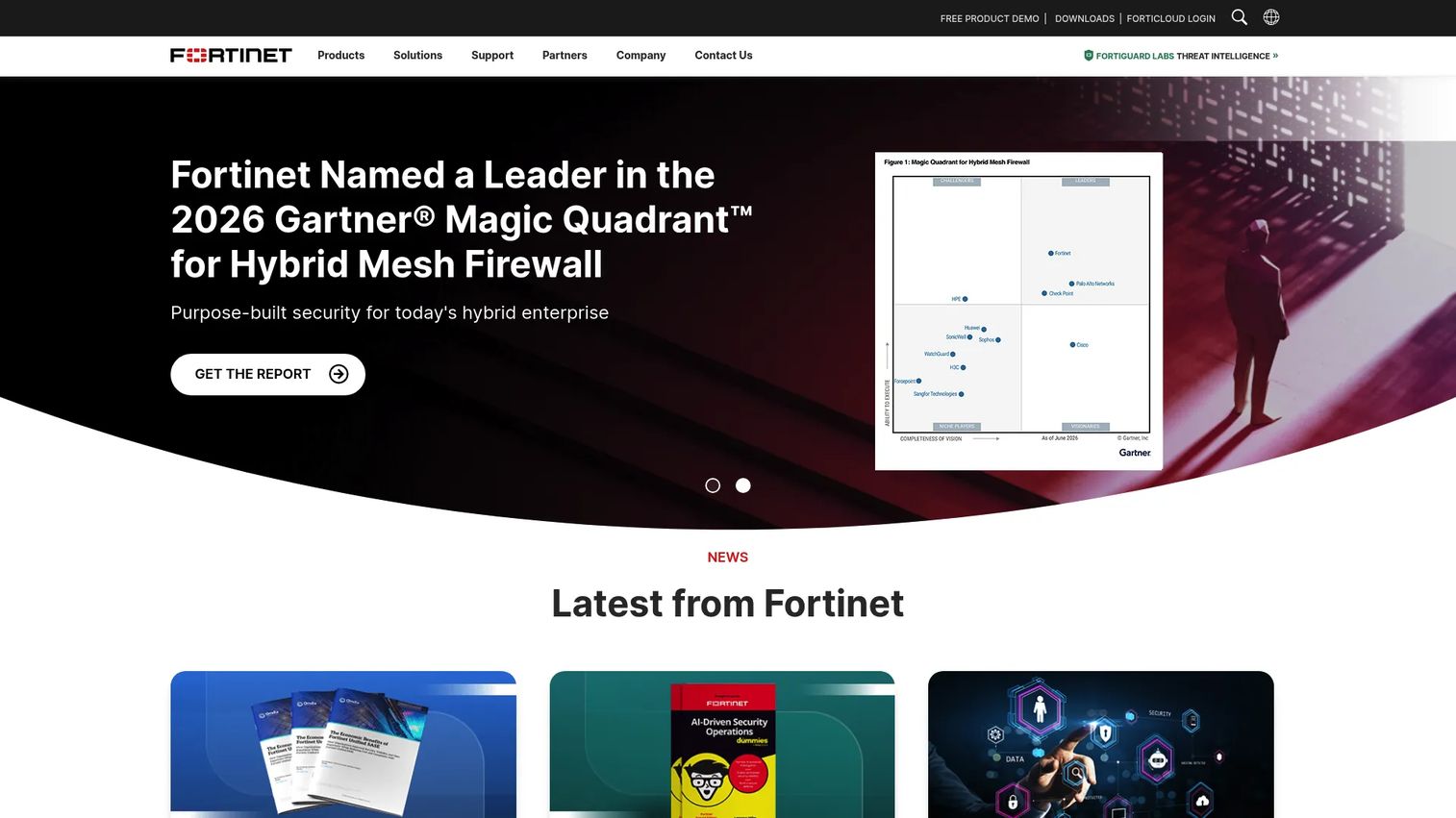
Fortinet FortiGate IPS is intrusion prevention built into FortiGate firewall policies and powered by FortiGuard security services. The platform uses signature matching, deep packet inspection of encrypted payloads, behavioral and anomaly-based detection, and near-real-time FortiGuard signature updates. Configurable IPS sensors allow teams to combine signatures, filters, botnet command-and-control blocking, and rate-based signatures into policy profiles. Preloaded sensor templates cover common risk profiles and service types, reducing initial configuration time.
Best for: Teams that want IPS, firewalling, and network segmentation managed through a single FortiGate operating model.
Key features
- Configurable IPS sensors with signature and filter matching
- Deep packet inspection of encrypted traffic
- Behavioral and anomaly-based detection
- Botnet command-and-control blocking
- Virtual patching for unpatched vulnerabilities
- Near-real-time FortiGuard signature updates
Why choose Fortinet FortiGate IPS: Choose this when your team needs broad network security controls alongside intrusion prevention and wants to consolidate management. Validate throughput with security inspection enabled before finalizing hardware selection; raw firewall performance figures do not reflect inspection overhead.
Fortinet FortiGate IPS pricing: FortiGate IPS is available as an a-la-carte FortiGuard subscription and within Unified Threat Protection and Enterprise Protection bundles. Fortinet or a reseller for appliance and subscription pricing by model.
G2 rating: 4.7/5 (verified from G2's FortiGate IPS listing).
PM angle: Sensor templates and policy-based enforcement function as reusable security configurations. When product teams ship new services or environments, security controls can reference an existing template rather than requiring a full policy rebuild, which reduces release-day friction.
4. Check Point Quantum IPS

Check Point Quantum IPS is intrusion prevention integrated into Check Point Next Generation Firewalls and managed through Check Point's centralized security management architecture. The platform includes thousands of signature and behavioral preemptive protections, automatic updates for emerging threats, and SmartEvent integration for visibility and reporting. The vendor claims low false-positive rates through acceleration technologies embedded in the enforcement engine.
Best for: Enterprises that need centrally managed intrusion prevention across a Check Point network security estate, with governance running through SmartConsole or the Infinity Portal.
Key features
- Thousands of signature and behavioral preemptive protections
- Automatic updates with real-time threat intelligence
- SmartEvent integration for visibility and reporting
- Unified deployment across Check Point gateways
- Centralized policy management through Check Point management tools
Why choose Check Point Quantum IPS: This fits teams where policy governance, gateway administration, and threat prevention already run through Check Point tools. Compare operational workflows, logging architecture, and integration fit with your SIEM before committing, rather than making the decision on protection count alone.
Check Point Quantum IPS pricing: Pricing depends on gateway capacity, subscription bundle, support level, and deployment type. Confirm current SKUs and contract details through an authorized reseller.
G2 rating: 4.5/5
PM angle: Every security rule becomes part of the release and change-management process when product traffic, partner integrations, and customer-facing services evolve. Policy lifecycle governance determines how quickly your team can safely add, modify, or retire detection controls after a product change.
5. Snort
Snort is an open source network intrusion prevention system that supports three operating modes: Packet sniffer, packet logger, and full intrusion prevention. Its rule-driven detection engine matches traffic against a customizable ruleset, and the engine can run inline to drop packets that match prevention rules. Snort 3 introduced a modular plugin architecture with more than 200 plugins, making it adaptable to a wide range of deployment contexts, from lab environments to production network segments. Teams can use community rules, registered rules available with a free account, or subscriber rules from Cisco Talos for earlier access to protection coverage.
Best for: Security teams with rule-writing and sensor-operations expertise that need a configurable, proven open source IDS/IPS engine.
Key features
- Rule-driven detection with customizable rule language
- Inline packet blocking mode for active prevention
- Packet sniffer and packet logger modes
- Snort 3 modular plugin system (200+ plugins)
- Community, registered, and Cisco Talos subscriber rules
Why choose Snort: Choose Snort when your team can own rule tuning, sensor deployment, and ongoing operations. The software cost is negligible under GPLv2, but the operating model requires a named maintainer, change review processes, rollback plans, and instrumentation to track detection quality over time.
Snort pricing: The Snort engine is free under the GPL v2 license. Subscriber rule access costs $29.99 per sensor per year for personal or educational use, and $399 per sensor per year for business deployments. An Integrator tier is available for commercial integration use; contact Snort for terms.
PM angle: Open source rule ownership requires the same instrumentation discipline as any other platform dependency. Without a named owner, defined update cadence, and rollback plan, the detection program becomes technical debt that engineering and product teams eventually inherit.
6. Suricata

Suricata is a free, open source IDS, IPS, and network security monitoring engine maintained by the Open Information Security Foundation. Its multi-threaded architecture handles high-throughput inspection across parallel CPU cores, making it well suited for environments where single-threaded engines hit performance limits. Suricata produces structured JSON event output through its Eve log, including per-protocol logs for HTTP, DNS, TLS, and file metadata. The engine can run in passive IDS mode, inline IPS mode using drop or reject rules, or as a network security monitoring platform for offline PCAP analysis.
Best for: Security engineering teams that need high-performance open source detection with structured telemetry, inline prevention capability, and flexibility across deployment modes.
Key features
- IDS and inline IPS modes with drop and reject rules
- Multi-threaded traffic inspection for high-throughput environments
- Eve JSON event output with protocol-level logging
- Live rule reloads without sensor restart
- TLS, HTTP, and DNS logging for downstream analysis
Why choose Suricata: Suricata fits well when your team needs detailed network telemetry alongside detection and prevention, particularly if security events feed into a SIEM or data platform. Plan for rule management, capture performance monitoring, and alert triage ownership before deploying at scale; the telemetry value depends on what happens after the event is generated.
Suricata pricing: The Suricata engine is free and open source. Budget separately for sensor infrastructure, rule feeds, storage, log pipeline capacity, and the engineering time required to operate and maintain the deployment.
PM angle: The Eve JSON output model is worth thinking about as a data instrumentation problem. The network event stream that Suricata produces can correlate with product telemetry, user sessions, and incident timelines, which makes it useful beyond the security team for investigation and release-impact analysis.
7. Zeek
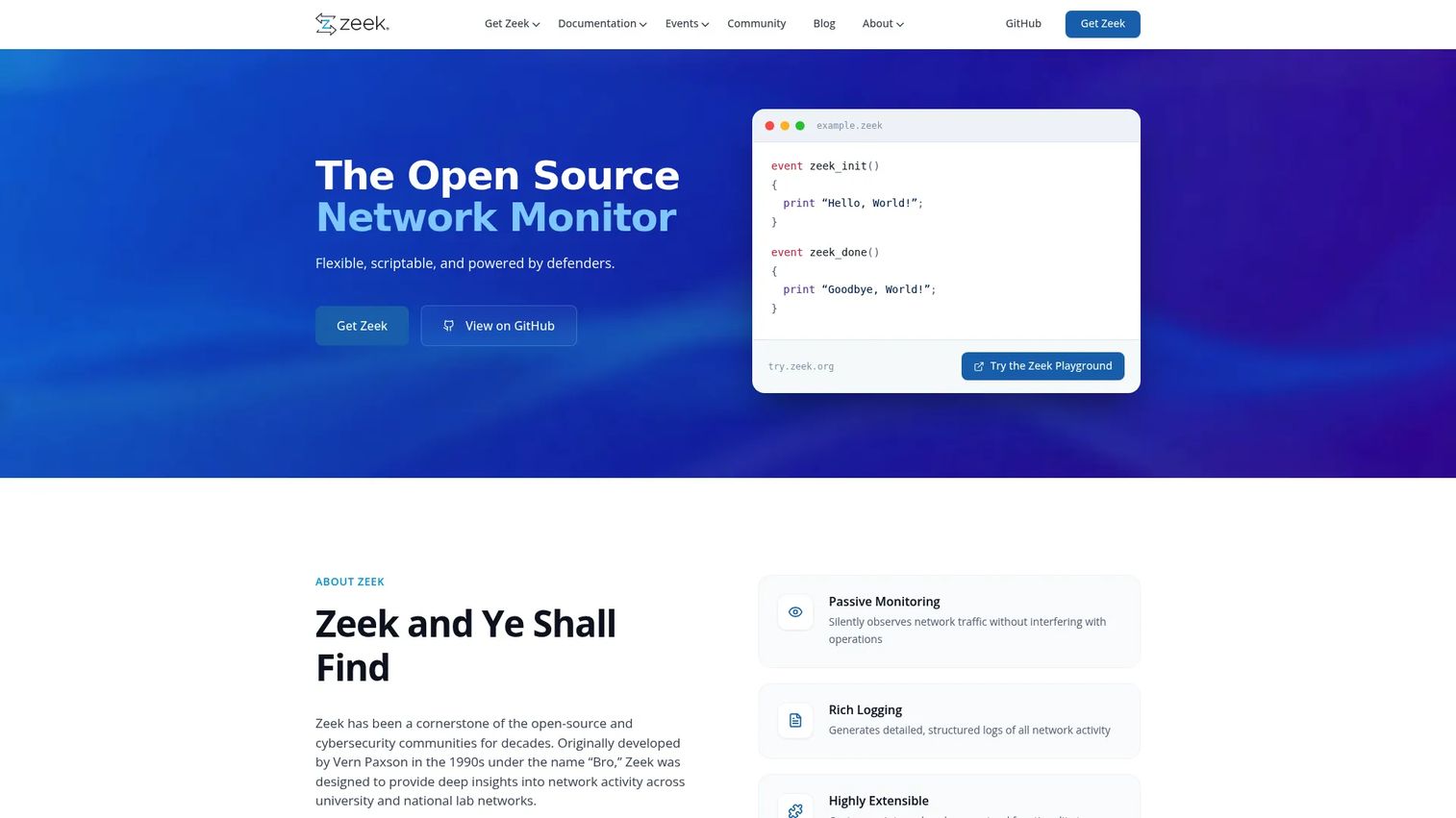
Zeek is a passive open source network security monitoring platform that generates high-fidelity transaction logs, file content analysis, and customizable outputs for investigation, audit, and capacity work. Rather than applying prevention rules inline, Zeek scripts the analysis of observed traffic to produce structured records of what happened across application-layer protocols. The platform is extensible through its scripting language and package ecosystem. Be precise about what Zeek does: It is primarily a visibility and analysis platform, not an inline IPS replacement.
Best for: Teams that need deep network evidence, behavioral context, and forensic data to inform prevention policy, audit requirements, or incident investigation.
Key features
- Passive network traffic monitoring with no enforcement path
- Deep application-layer protocol analysis
- Rich structured logging with JSON and custom output formats
- Extensible scripting and package ecosystem
- Threat detection through log analysis and behavioral correlation
Why choose Zeek: Choose Zeek when your highest-value security investment is better evidence and faster investigation rather than more automatic blocking. Organizations commonly pair Zeek with a separate enforcement layer, using Zeek's telemetry to validate detection logic and investigate incidents while an IPS or NGFW handles blocking.
Zeek pricing: Zeek is open source under a BSD license and available at no software cost. Budget for sensor hardware, storage and log pipeline infrastructure, analyst workflows, and operational ownership.
PM angle: Zeek illustrates a broader product decision: Sometimes the most valuable security investment is better evidence, not faster blocking. Teams that cannot yet validate what normal traffic looks like will get more from Zeek's logs than from a prevention policy they cannot confidently tune.
Considerations when choosing an intrusion detection and prevention system
Match prevention mode to business risk
Alert-only mode, selective inline blocking, and full inline prevention carry different outage exposure. Customer-facing traffic flows require staged enforcement: Define the policy, test it in a contained segment, validate false-positive impact on real application behavior, then expand. Establish who can approve block policies and who owns the rollback procedure before any rule goes live.
Measure false positives before expanding coverage
Track alert precision, reversed blocks, mean time to validate, and coverage gaps as formal metrics rather than qualitative impressions. Product managers should ask for instrumentation that separates malicious events from customer behavior that looks unusual but is legitimate. Without that distinction, expanding prevention coverage creates operational noise that engineering teams must absorb.
Plan for encrypted traffic and privacy constraints
TLS decryption, metadata analysis, certificate logging, and flow-based inspection each carry different security, privacy, and performance implications. Decryption is not automatically appropriate; security architecture, policy, and legal teams must define acceptable inspection boundaries before the platform is configured. Metadata-only approaches preserve privacy but reduce detection depth for payload-dependent signatures.
Design the SIEM and incident workflow first
Alerts without triage ownership create backlog that defeats the investment. Before deploying any IDPS, require event normalization, severity mapping, case management integration, and a defined feedback loop from incident responders back to rule owners. Alert volume that exceeds triage capacity produces the same outcome as no detection at all.
Budget for operations, not only licenses
Enterprise platforms combine hardware, subscriptions, support contracts, and management infrastructure. Open source tools shift those costs into engineering time, rule management, storage, sensor capacity, and on-call ownership. Ask for a three-year operating model, including staffing assumptions, before committing to either approach.
How to choose the right intrusion detection and prevention system for your team
Choose an enterprise platform when inline prevention must scale across environments
Palo Alto Networks Advanced Threat Prevention, Cisco Secure Firewall Threat Defense, Fortinet FortiGate IPS, and Check Point Quantum IPS each fit organizations where inline prevention needs to operate consistently across data centers, branch locations, and cloud environments. The differentiating factors are your existing security estate and management architecture. Teams already running Palo Alto Networks NGFWs get the most from Advanced Threat Prevention's unified policy model. Cisco-centric environments benefit from Threat Defense's native integration with existing Cisco tools and Talos intelligence. Fortinet FortiGate IPS suits teams that want IPS as one part of a broader FortiGate security architecture. Check Point Quantum IPS fits enterprises where security policy governance runs through Check Point SmartConsole. For each option, validate throughput with inspection enabled against your actual traffic volume, not the appliance's rated firewall throughput.
Choose an open source engine when customization and telemetry control matter most
Snort and Suricata both fit teams with security engineering capacity to operate sensors, maintain rules, and own incident response workflows. Snort's rule language is the more established standard; Suricata's multi-threaded architecture handles higher throughput and produces richer structured telemetry through Eve JSON. The software license is free for both, but neither option removes the need for sensor infrastructure, rule feed subscriptions, storage, and experienced engineers. If your team cannot name the person who will own rule updates and alert triage after deployment, open source is not the lower-overhead path.
Choose passive network analysis when visibility comes before enforcement
Zeek fits when your team needs to understand what normal traffic looks like before defining any prevention policy. Its log output covers application-layer transactions across protocols, file activity, and behavioral patterns, giving investigators and analysts the evidence base to validate detection logic. Organizations often run Zeek alongside a separate enforcement layer, using the transaction logs to tune detection rules and investigate incidents. If your environment currently has no baseline, starting with Zeek's visibility before activating inline blocking reduces the false-positive risk that creates engineering incidents.
Start with a contained pilot before setting global blocking policies
Regardless of which platform you choose, run a defined pilot on one segment, one service class, or a development environment before expanding. Require baseline metrics, documented test cases, escalation paths, and a rollback plan before the pilot begins. The artifact that earns cross-team confidence is a one-page decision record listing the risk owner, expected detection signal, false-positive threshold, rollback procedure, and the date at which enforcement will be evaluated for expansion.
Conclusion
Choosing an intrusion detection and prevention system is an operating model decision as much as a technology one. Network prevention requires confidence in your traffic context, a clear owner for every policy, and a response workflow that can absorb the alerts your platform generates.
The right route depends on your security estate and team capacity:
- Palo Alto Networks Advanced Threat Prevention for enterprise NGFW standardization with ML-driven blocking
- Cisco Secure Firewall Threat Defense for Cisco-centered environments needing Snort 3 intrusion policies
- Fortinet FortiGate IPS for integrated firewall, segmentation, and IPS operations
- Check Point Quantum IPS for centralized policy governance across a Check Point gateway estate
- Snort for rule-driven open source detection and prevention with Cisco Talos subscriber rules
- Suricata for high-performance open source IDS/IPS with structured Eve JSON telemetry
- Zeek for passive network visibility and forensic investigation before enforcement
Start by mapping your highest-risk traffic paths, your current alert backlog, and the team that will own every policy after launch. Those three answers will narrow the list faster than any feature comparison.
Start your journey with Guideflow today!
FAQs
An intrusion detection system monitors traffic and generates alerts or logs when it identifies suspicious activity. An intrusion prevention system adds an enforcement path, typically inline, that can block, rate-limit, reset, or quarantine traffic. IDPS is the umbrella term for platforms that provide detection, prevention, or both capabilities in a single deployment.
An IPS can block some suspicious or exploit-like behavior through anomaly detection, protocol analysis, reputation matching, and behavioral controls. It cannot guarantee prevention of every zero-day threat, because unknown exploits by definition lack prior signatures. Layered controls including patching, network segmentation, endpoint telemetry, and incident response remain necessary regardless of prevention coverage.
Start in alert-only mode when traffic sensitivity or false-positive risk is high. Move selected policies inline after validating detection accuracy, testing rollback procedures, and obtaining approval from application owners. Enforcement should expand in stages rather than switching on globally, particularly for customer-facing flows where blocked sessions look identical to outages.
Yes, when the organization has the engineering capacity to operate sensors, update rules, manage storage, tune detections, and investigate alerts. Tools like Snort and Suricata run in production environments at significant scale. The software license may carry no cost, but the operating model requires real staffing and infrastructure investment; treat the total operating cost the same way you would treat an enterprise subscription.
IDPS focuses on detecting and optionally blocking intrusions at the network or host level. Network detection and response, or NDR, emphasizes broader network telemetry, behavioral analytics, and investigation support across the full network environment. Many organizations run both: An IPS enforces selected blocking controls while NDR provides deeper context for investigation and threat hunting. The two categories have meaningful overlap in tooling and are increasingly purchased together.
Encryption limits payload inspection because the contents of TLS sessions are not readable without decryption. Teams can address this through TLS decryption where policy permits, by inspecting certificate metadata and flow behavior, or by relying on endpoint and identity telemetry to supplement network visibility. Each approach carries different tradeoffs across security coverage, privacy review, performance overhead, and legal constraints. No single answer applies across all environments; the inspection boundary is a decision that security, legal, and product teams must make jointly.
Track false-positive rate, confirmed detections, prevented incidents, reversed blocks, and alert-to-triage time as your baseline metrics. Add performance impact on key customer flows so that policy changes do not create hidden reliability risk. Tie those measures to your release management process: A security rule update and a product release that go live at the same time make it harder to attribute any incident to its source.
PCI DSS includes requirements for intrusion detection and prevention controls on networks that handle cardholder data. Several of the platforms in this guide are deployed in PCI-scoped environments. No tool automatically makes an environment compliant; compliance depends on how the platform is configured, what traffic it monitors, how alerts are handled, and what other controls are in place. Treat compliance requirements as inputs to your architecture design, and validate the final configuration against the specific requirements with your security and compliance team.
A wireless IDPS monitors wireless network traffic and can identify unauthorized or rogue access points operating on the network. Detection typically involves scanning for unrecognized BSSIDs, monitoring for deauthentication attacks, and comparing observed access points against an authorized device list. Rogue access point detection is a capability that sits within wireless IDPS specifically and is separate from the network-based IPS capabilities covered by most of the platforms in this guide.