Clinical teams don't lack communication channels. They lack reliable, routed, auditable communication that reaches the right person at the right time. Pagers, personal phones, EHR inboxes, nurse call systems, and manual call trees all exist simultaneously, and urgent messages still fall through the gaps between them.
The scale of the problem is not abstract. According to a 2024 survey by Becker's Healthcare and TigerConnect, 86% of clinicians regularly switch between communication systems during a single shift, and 76% struggle to identify the right person to contact. These are not edge cases. They are the baseline experience across most hospital environments today.
Clinical communication and collaboration software addresses this directly by replacing fragmented workflows with structured, role-aware, auditable message routing. For healthcare founders, operators, and clinical technology buyers, understanding which platforms are built for this job, and which are point tools dressed up as platforms, is the difference between a system that works at scale and one that creates new failure modes.
This guide maps the market so you can shortlist faster.
What's inside
This guide compares 15 clinical communication and collaboration software products evaluated for healthcare workflow fit, secure messaging capability, EHR interoperability, and review presence.
- Who it's for: Healthcare CIOs, clinical informatics leaders, hospital IT directors, digital health founders, and senior operators building a shortlist
- Selection criteria: Category relevance, care-team workflow coverage, secure messaging and alerting depth, integration breadth, and verified review presence
- What we cover: Secure messaging, clinical alerting, escalation, on-call scheduling, EHR integration, and implementation fit
- Pricing and ratings: Verified against vendor pages and live G2 listings; custom pricing confirmed by checking first before writing it
TL;DR
- Best overall for enterprise clinical collaboration: TigerConnect, for health systems that need secure messaging, role-based teams, EHR integration, and downtime communication under one contract
- Best for critical alerting and escalation: OnPage, for teams where missed alerts are the primary operational risk and persistent delivery matters
- Best for EHR-native workflows: Epic, for organizations already standardized on Epic that want communication embedded in the clinical record
- Best for health systems standardizing communication across roles: Vocera Platform, for hospitals that need voice, messaging, and alarm notifications across frontline clinical staff
- Best for provider scheduling and routing: PerfectServe Unite, for organizations where on-call schedules and intelligent routing drive communication performance
- Best for secure texting and lightweight care-team messaging: QliqCHAT, for home-based and distributed care teams that need HIPAA-compliant messaging without a large enterprise footprint
What is clinical communication and collaboration software?
Clinical communication and collaboration software is healthcare software that securely routes messages, alerts, tasks, and patient-context communication between care-team members across clinical workflows.
This category is distinct from general workplace messaging. Consumer messaging apps connect people to people. Clinical communication platforms must understand patient context, on-call schedules, escalation logic, message urgency, clinician identity, and audit requirements, all at the same time.
Core capabilities the category covers:
- Secure clinical messaging: HIPAA-supporting encrypted messaging between clinicians, care teams, and sometimes patients
- Critical alerts and clinical results: Routing lab results, vitals alarms, and urgent notifications to the responsible clinician automatically
- Role-based routing: Directing messages to whoever currently holds a role or assignment, not just a named individual
- EHR and clinical system integration: Connecting messaging to patient records, nurse call systems, scheduling, and monitoring tools
- Closed-loop notification: Delivery confirmation, acknowledgement tracking, escalation on non-response, and full audit trail
- Task and workflow coordination: Consults, transfers, discharge coordination, and care handoffs managed through structured workflows
- Voice and paging support: VoIP calling, paging replacement, and hands-free communication for frontline staff
- Analytics and governance: Message volume, response times, escalation frequency, and interruption management reporting
The global clinical communication and collaboration market was valued at $3.35 billion in 2025 and is projected to reach $8.14 billion by 2030, according to Grand View Research (2025). The buying pressure behind that growth is straightforward: 39% of healthcare professionals say communicating with one or more care-team groups is difficult or very difficult, per TigerConnect's State of Healthcare Communications (2024).
The category earns its complexity premium. Getting this wrong shows up in delayed responses, missed escalations, and clinical errors.
When to use clinical communication and collaboration software
Route urgent alerts to the right clinician
When a critical lab result, an alarm event, or a code-team activation needs to reach a specific clinician immediately, manual call chains fail. A clinical communication platform routes that alert automatically, based on who is currently on duty for that role, escalates if there is no acknowledgement, and closes the loop when the clinician acts. This is where the category earns its core value.
Coordinate care across shifts and departments
Handoffs, consults, discharges, and interdisciplinary rounding all require knowing who is responsible for a patient at any given moment. Static contact lists go stale within hours. Role-based communication, tied to live scheduling data, routes the right message to whoever holds the assignment, not to whoever's name appeared on a list printed last week.
Replace fragmented paging and messaging workflows
Most hospitals still run parallel communication channels: Legacy pagers, personal phones, EHR inbox messages, and nurse call alerts that don't connect to each other. A clinical communication platform consolidates those into one auditable channel, with controls over who can reach whom and what happens when a message goes unread. Many organizations phase the transition by department or use case rather than switching all at once.
Clinical communication and collaboration software comparison
The 15 platforms below cover the range from broad enterprise suites to focused alerting tools and EHR-embedded communication. Use the table as a first filter, then read the item sections for workflow and implementation detail.
Pricing was verified against each vendor's website. Where no public price exists, the table says custom pricing. G2 ratings were checked live; N/A indicates no current G2 listing.
| # | Product | Best for | Key differentiator | Pricing | G2 rating |
|---|---|---|---|---|---|
| 1 | TigerConnect | Enterprise health systems | Broad platform: Messaging, roles, EHR, downtime | Custom pricing | 4.5/5 |
| 2 | OnPage | Critical alerting and on-call routing | Persistent alert-until-read delivery | From $13.99/user/month | 4.3/5 |
| 3 | Epic | Epic-standardized health systems | EHR-native communication and patient context | Custom pricing | 4.2/5 |
| 4 | MH-Cure | Hospital care-team coordination | Mobile-first clinical communication | Custom pricing | 4.0/5 |
| 5 | Mobile Heartbeat | Enterprise clinical communication | Broad integration: EHR, nurse call, telemetry | Custom pricing | 4.0/5 |
| 6 | symplr Clinical Communications | HIPAA-compliant unified communication | On-call scheduling plus real-time EHR integration | Custom pricing | 4.5/5 |
| 7 | CareAware Connect | Oracle Health-aligned organizations | Secure voice, text, and near-real-time collaboration | Custom pricing | N/A |
| 8 | Vocera Platform | Frontline clinical teams with voice needs | Voice, messaging, and alarm notifications in one | Custom pricing | 4.3/5 |
| 9 | Imprivata Cortext | (Legacy product, no longer offered) | Secure texting with identity support | N/A | N/A |
| 10 | PerfectServe Unite | Schedule-aware provider routing | Intelligent routing by role, schedule, and urgency | Custom pricing | 3.5/5 |
| 11 | Zebra Workcloud Sync | Frontline workforce on Zebra devices | Push-to-talk, messaging, and task coordination | Custom pricing | N/A |
| 12 | Connexall | Alarm management and event-driven workflows | Vendor-neutral alarm routing and clinical interoperability | Custom pricing | N/A |
| 13 | MEDITECH Expanse | MEDITECH-centered health systems | EHR-embedded workflows with AI documentation support | Custom pricing | N/A |
| 14 | QliqCHAT | Distributed and home-based care teams | Secure messaging with patient-centered group chats | Custom pricing | 4.6/5 |
| 15 | Spok Care Connect | Paging modernization and hospital infrastructure | Unified messaging, paging, alerting, and contact center | Custom pricing | 3.8/5 |
Best 15 clinical communication and collaboration software for 2026
The tools below are ordered by how directly they address the core clinical communication job. Platforms built specifically for healthcare workflows appear first. EHR-embedded options and infrastructure-layer tools follow. Each entry covers workflow fit, key capabilities, pricing, and what makes it the right or wrong choice for a given environment.
1. TigerConnect
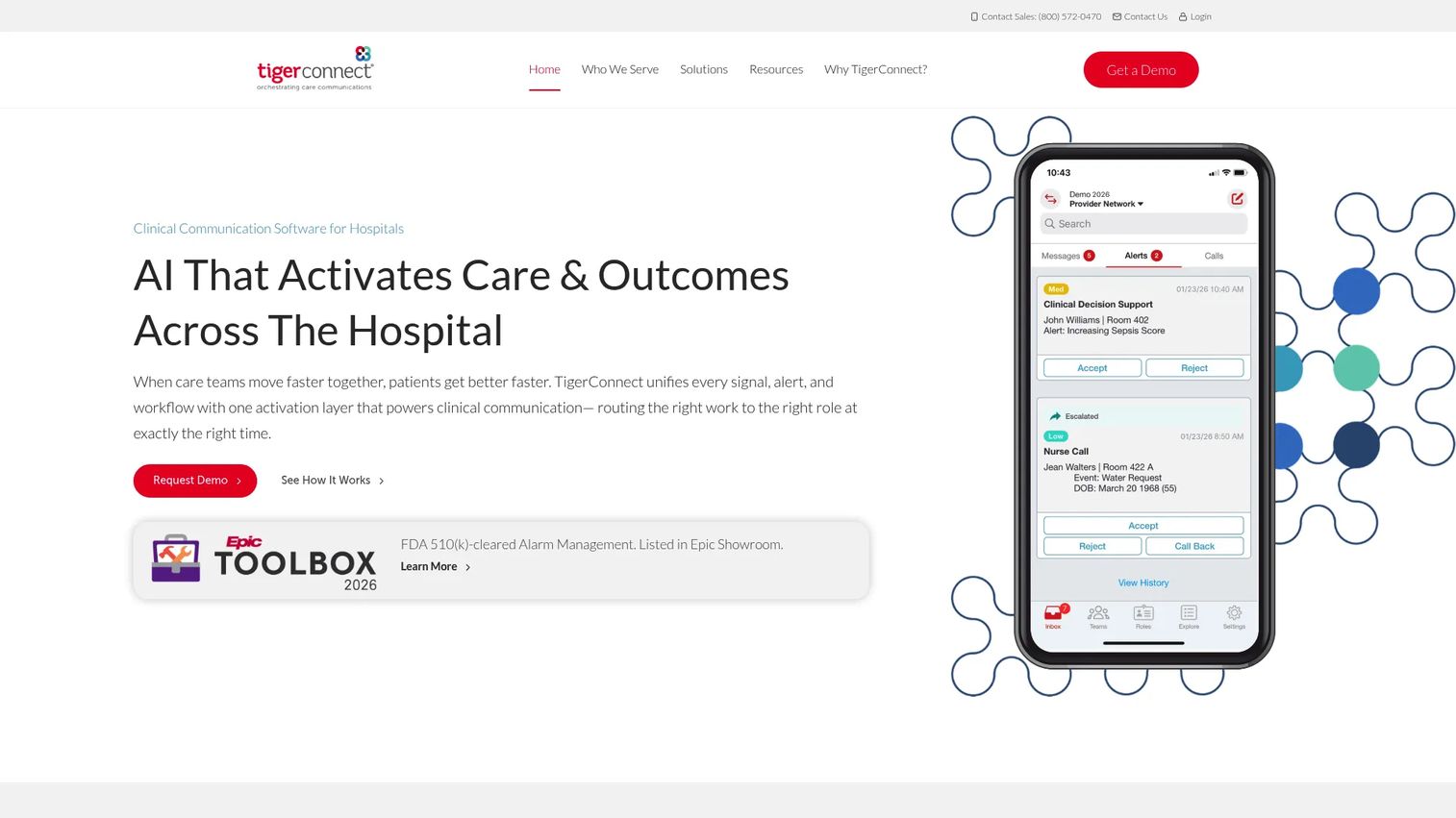
TigerConnect is a healthcare communication and care-activation platform that connects clinical teams, signals, alerts, and workflows. It covers secure messaging, role-based care teams, patient-context communication, EHR integration, and downtime communication in a single contract. It is built for health systems that need a platform, not a point messaging app.
Best for: Enterprise health systems standardizing clinical communication across care teams and departments.
Key features
- Secure, HIPAA-compliant messaging with end-to-end encryption
- Role-, team-, and schedule-based communication with escalation
- Voice and video communication with patient-context messaging
- EHR integration across major systems
- Downtime communication continuity
Why choose TigerConnect: Choose TigerConnect when the organization needs a broad enterprise communication layer that connects messaging, alerting, and clinical workflow data across departments. It suits buyers who want one contract to replace a fragmented stack.
TigerConnect pricing: TigerConnect uses fixed-price, fixed-quantity subscription contracts. Contact sales for a quote. No self-serve pricing is published.
G2 rating: 4.5/5
2. OnPage
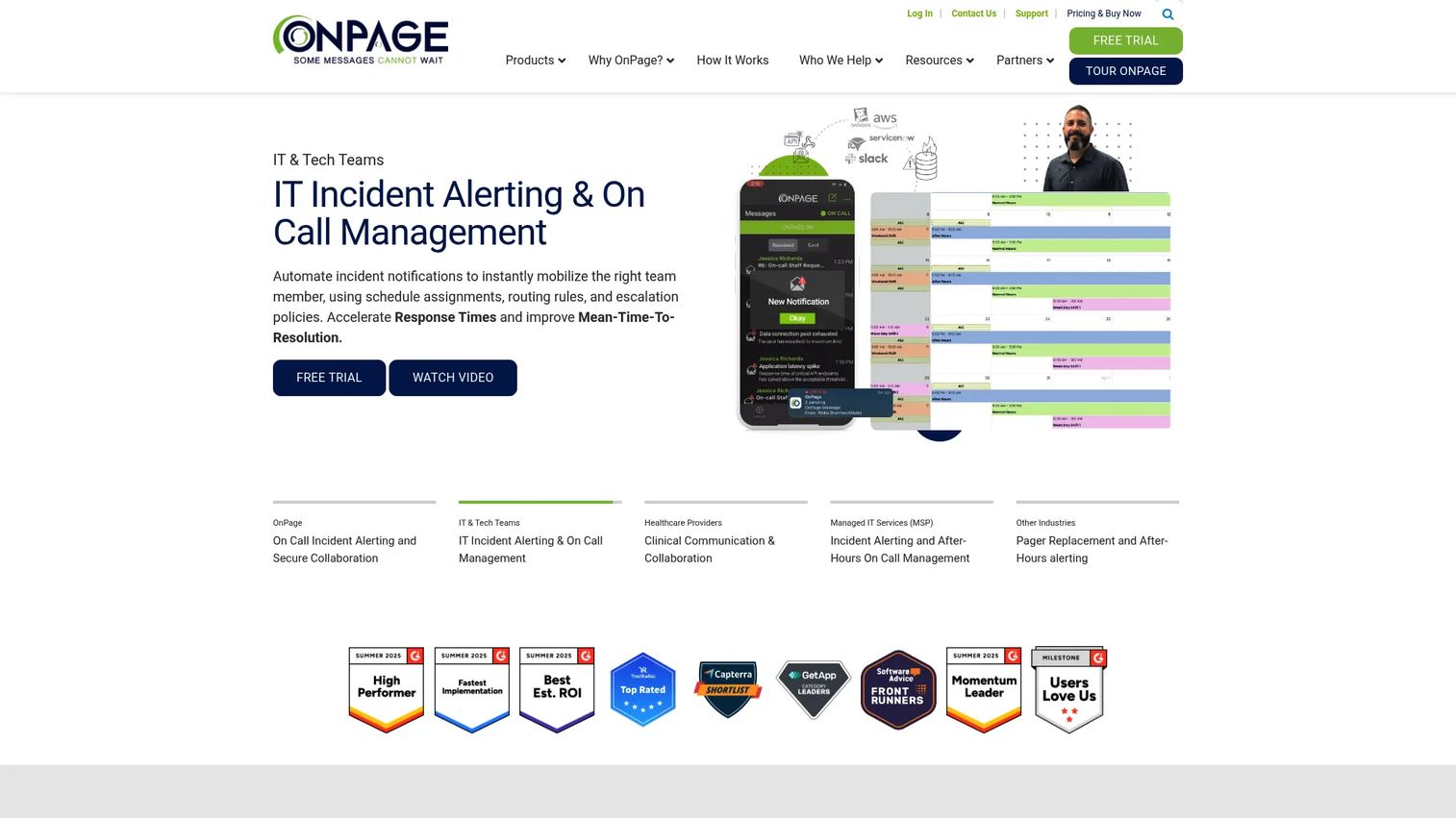
OnPage is a critical communications and incident-management platform built for teams where missed alerts are not acceptable. Its core differentiator is persistent, alert-until-read delivery: Messages continue sending until the recipient acknowledges, then escalate automatically if they don't. It covers on-call scheduling, HIPAA-compliant secure messaging, escalation policies, and a public API for clinical system integration.
Best for: Healthcare, IT, and operations teams that need reliable alerting, on-call routing, and post-event reporting.
Key features
- Persistent critical alerts with alert-until-read behavior
- Configurable on-call schedules, rotations, and escalation policies
- HIPAA-compliant two-way secure messaging
- Dedicated lines, live call routing, and voicemail
- BlastIT mass notification capability
- Real-time message status, audit trails, and performance reports
Why choose OnPage: OnPage is the right fit when missed alerts and manual escalation chains are the primary risk. Its fail-safe routing and post-event reporting make it straightforward to prove the communication loop closed.
OnPage pricing: Plans start at $13.99 per user, per month (paid yearly). Enterprise Silver runs $22.99/user/month and Enterprise Gold is $28.99/user/month, both billed yearly. A 7-day trial with no credit card required is available.
G2 rating: 4.3/5
3. Epic
Epic is a comprehensive EHR platform with clinical communication embedded throughout the clinical record and workflow. For organizations already running Epic, the value is tight patient-context integration: Messaging happens where documentation happens. Scheduling, patient records, and team visibility are native rather than bolted on.
Best for: Hospitals and health systems already standardized on Epic that want communication close to the clinical record.
Key features
- EHR-native messaging with patient context
- Care-team visibility and clinical workflow alignment
- Patient scheduling, insurance verification, and engagement via MyChart
- AI capabilities for clinical documentation and operations
- Enterprise governance and interoperability
Why choose Epic: Epic's communication tools work best when the goal is keeping clinical messaging inside the EHR environment, not running a separate platform. Multi-entity systems or organizations with cross-system routing needs should still evaluate standalone clinical communication tools alongside it.
Epic pricing: Pricing uses a volume-based model, with options for a one-time license plus annual maintenance or a monthly subscription. Implementation and certain analytics tools may be priced separately. Contact Epic for a quote.
G2 rating: 4.2/5
4. MH-Cure
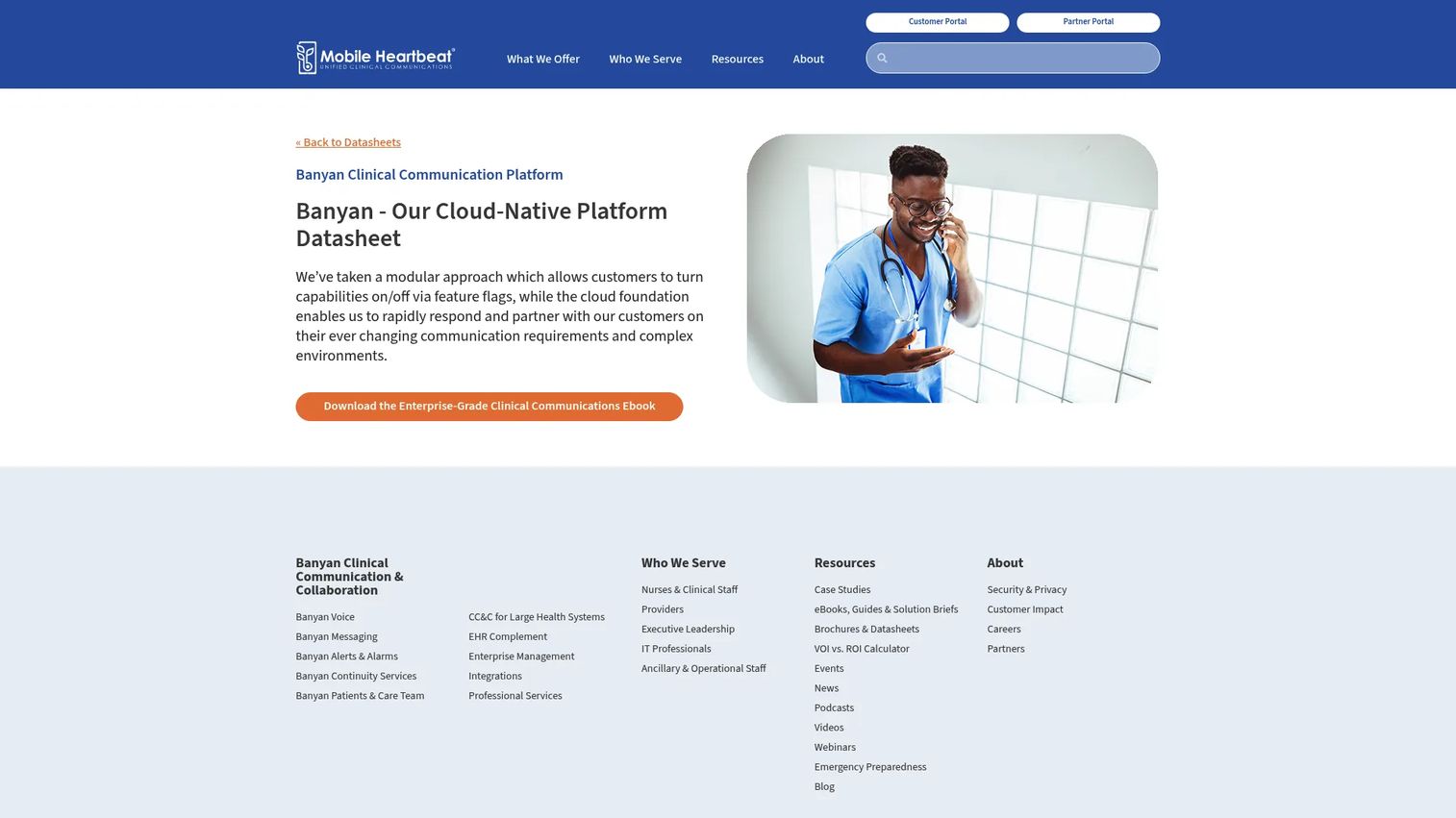
MH-Cure is a clinical communication and collaboration platform for healthcare organizations focused on mobile-first care-team coordination. It covers secure messaging, patient-centric communication, and staff directory functionality. The platform is associated with Mobile Heartbeat's broader product portfolio and targets hospitals seeking mobile-driven clinical communication.
Best for: Healthcare organizations coordinating clinical communication across hospital teams with a mobile-first approach.
Key features
- Secure clinical messaging
- Patient-centric communication workflows
- Staff directory and care-team coordination
- Mobile collaboration support
- Alerts and notifications
Why choose MH-Cure: MH-Cure fits organizations where mobile-first clinical communication is the starting point. Buyers evaluating this platform should confirm current product status and integration depth with the vendor directly.
MH-Cure pricing: Contact the vendor for pricing.
G2 rating: 4.0/5
5. Mobile Heartbeat
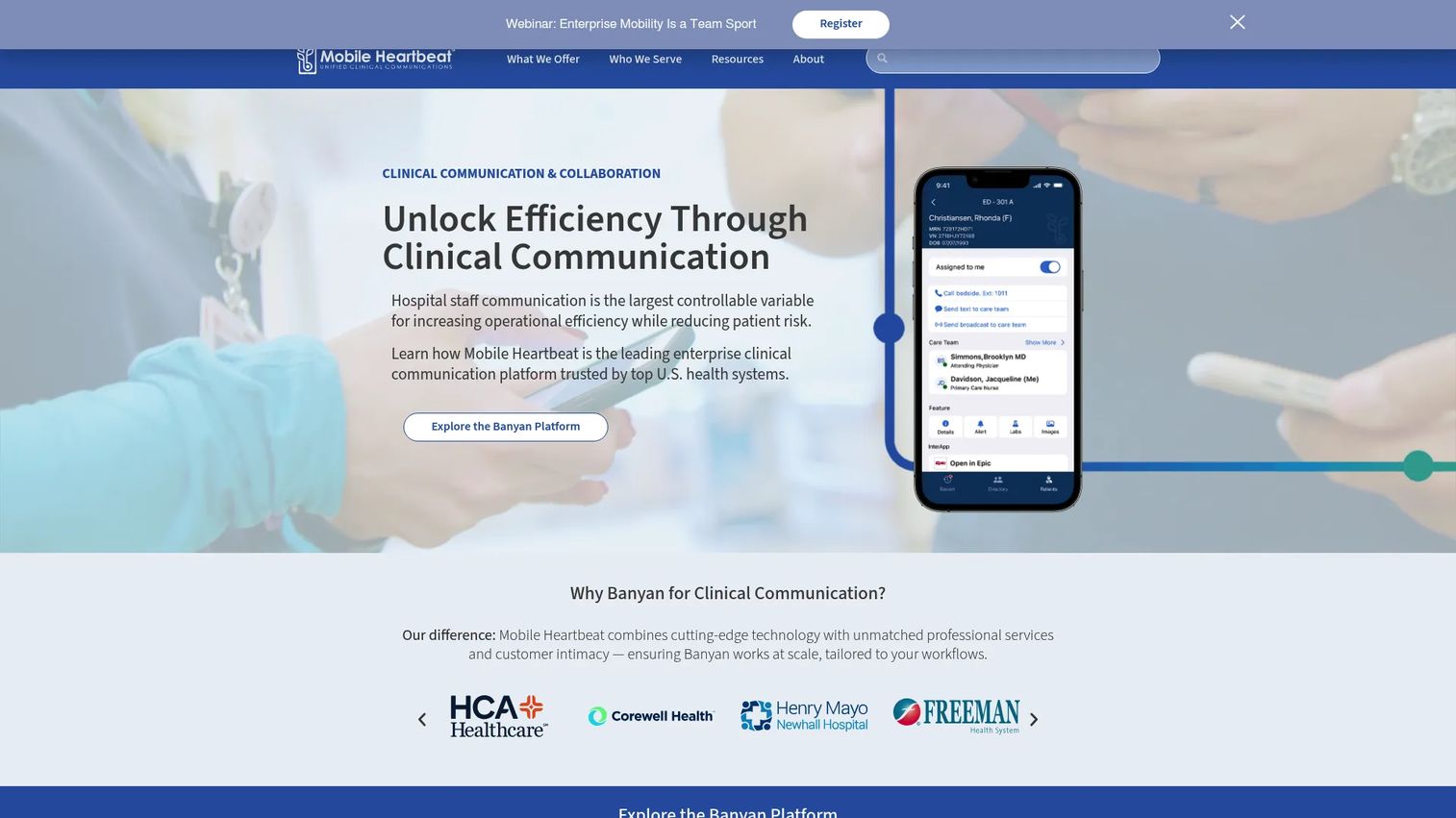
Mobile Heartbeat provides enterprise clinical communication software for health systems replacing fragmented phone and pager workflows. Its platform covers secure messaging, high-quality VoIP calling, enterprise directory with dynamic roles and care teams, broadcast and alarm management, and integration with EHR, nurse call, telemetry, and scheduling systems. Applications run on iOS, Android, and desktop.
Best for: Health systems replacing fragmented phone and pager workflows with an integrated mobile clinical communication environment.
Key features
- Secure messaging and high-quality VoIP calling
- Enterprise directory with dynamic roles and care teams
- Broadcast, paging, and alert and alarm management
- EHR, nurse call, telemetry, and scheduling integrations
- iOS, Android, and desktop application support
Why choose Mobile Heartbeat: Mobile Heartbeat is a strong fit when the organization needs broad integration across clinical systems, not just a messaging layer. Its integration depth across nurse call, telemetry, and scheduling makes it useful for organizations managing communication across multiple clinical data sources.
Mobile Heartbeat pricing: Contact sales for a quote.
G2 rating: 4.0/5
6. symplr Clinical Communications
symplr Clinical Communications is a secure, role-based healthcare communication platform for messaging, calls, alerts, critical results, scheduling, and care-team collaboration. It is part of a broader healthcare operations portfolio, which makes it appealing to organizations that want to consolidate clinical communication with workforce and compliance tooling under one vendor.
Best for: Hospitals and healthcare organizations needing unified, HIPAA-compliant communication with on-call scheduling built in.
Key features
- Secure role-based messaging
- On-call scheduling with real-time schedule integration
- Voice calls, critical results routing, and clinical alerts
- EHR integration
- Care-team coordination and reporting
Why choose symplr Clinical Communications: Choose symplr when the buyer already uses other symplr products or values vendor consolidation across healthcare operations. Verify integration depth with your specific EHR and scheduling systems before committing.
symplr Clinical Communications pricing: Contact sales for a quote.
G2 rating: 4.5/5
7. CareAware Connect
CareAware Connect is Oracle Health's clinical communication offering. Oracle describes current capabilities under Oracle Health Messenger, which covers secure voice, text messaging, video conferencing, near-real-time collaboration, and workflow support. The product is relevant primarily for organizations already operating inside the Oracle Health environment.
Best for: Oracle Health-aligned organizations evaluating clinical communication within their existing EHR ecosystem.
Key features
- Secure care-team messaging
- Voice communication and video conferencing
- Near-real-time collaboration
- Workflow and alert management
- Oracle Health ecosystem alignment
Why choose CareAware Connect: CareAware Connect is a logical evaluation for organizations already on Oracle Health infrastructure. Buyers outside that ecosystem should confirm current product scope and availability with Oracle directly before including it in a shortlist.
CareAware Connect pricing: Contact Oracle for a quote.
8. Vocera Platform
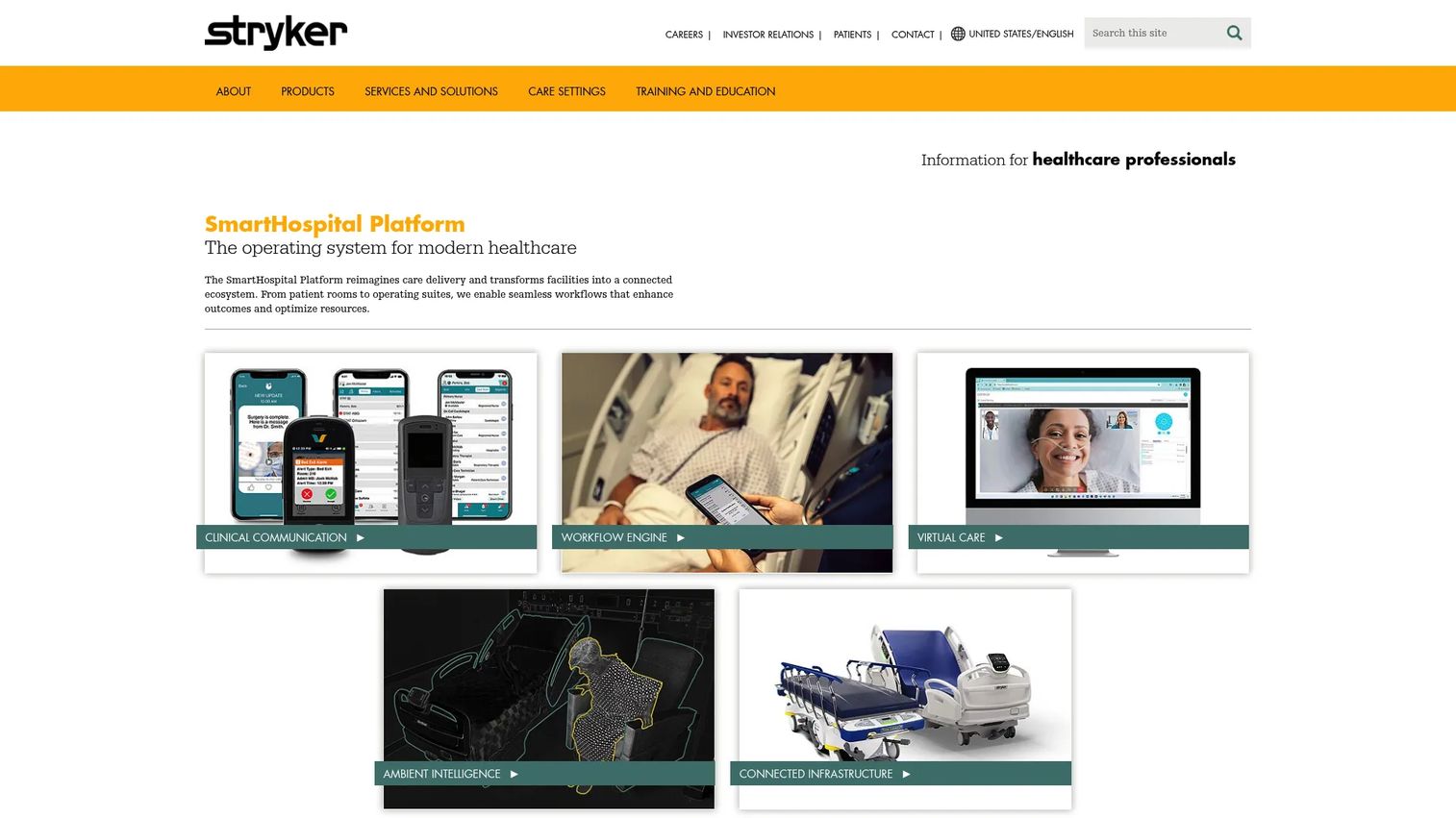
Vocera Platform, now part of Stryker, connects clinicians through voice communication, secure messaging, and alarm and alert notifications. Its Vina interface provides prioritized communications, patient-context conversation history, and message audit trails. The platform supports dedicated Vocera devices (Vina, Smartbadge, Minibadge, and B-Series Badge) alongside mobile applications, and offers high-availability active-standby clustering for environments where uptime is non-negotiable.
Best for: Hospitals needing voice-enabled, mobile, and hands-free communication across frontline clinical teams including nursing and acute care.
Key features
- Secure messaging, phone calls, and alarm and alert notifications
- Vina Web interface with patient-context conversation history and audit trails
- Support for Vocera Vina, Smartbadge, Minibadge, and B-Series Badge devices
- Integration with clinical and operational systems
- High-availability active-standby clustering
Why choose Vocera Platform: Vocera is a strong fit when frontline workflow, hands-free communication, and device-integrated alerting matter more than messaging breadth. Acute care, nursing, and high-acuity environments where mobility is a constraint are where it performs best.
Vocera Platform pricing: Contact Stryker or Vocera for a quote.
G2 rating: 4.3/5
9. Imprivata Cortext
Imprivata Cortext was a secure clinical texting platform for HIPAA-compliant messaging and care-team coordination. According to Imprivata's official product information, Cortext has been discontinued and is no longer offered. Organizations that previously used Cortext should evaluate current Imprivata identity and access products or alternative clinical messaging platforms.
Best for: N/A. The product is no longer available.
Key features
- Secure text and photo messaging (legacy)
- Message archiving and audit trails (legacy)
- Group texting and searchable staff directory (legacy)
Why choose Imprivata Cortext: This product is no longer offered. If you are evaluating Imprivata's current portfolio, contact the vendor to understand what replaces Cortext's use cases within their current product set.
10. PerfectServe Unite
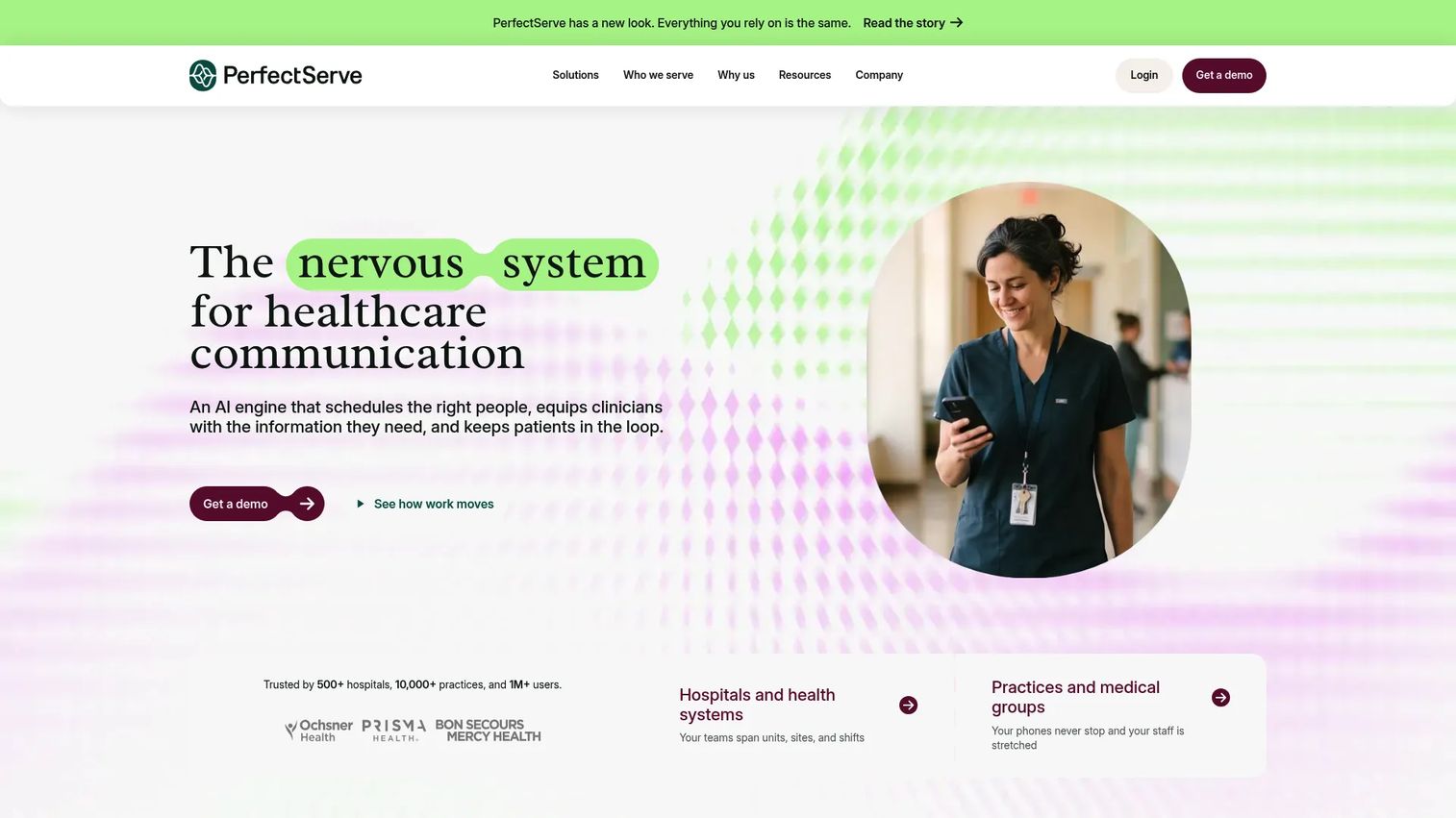
PerfectServe Unite is an integrated healthcare platform combining clinical communication, provider scheduling, patient engagement, and practice communication. Its differentiating capability is intelligent routing: Messages reach the right clinician based on who is currently on call, what role they hold, and how urgent the message is, automatically. It also covers operator console workflows and patient text messaging.
Best for: Healthcare organizations where provider schedules and on-call routing drive communication performance, particularly for consults and after-hours coverage.
Key features
- Secure clinical messaging with patient context
- Intelligent routing based on roles, schedules, and urgency
- Automated provider schedule creation and management
- Patient text messaging and video visits
- Operator console and communication workflows
Why choose PerfectServe Unite: PerfectServe is the right call when routing logic is the core problem. If clinicians regularly receive messages meant for the wrong person, or on-call handoffs create gaps in coverage, the schedule-aware routing model addresses that directly.
PerfectServe Unite pricing: Custom pricing based on organization size and selected solutions. Contact sales for a quote.
G2 rating: 3.5/5
11. Zebra Workcloud Sync
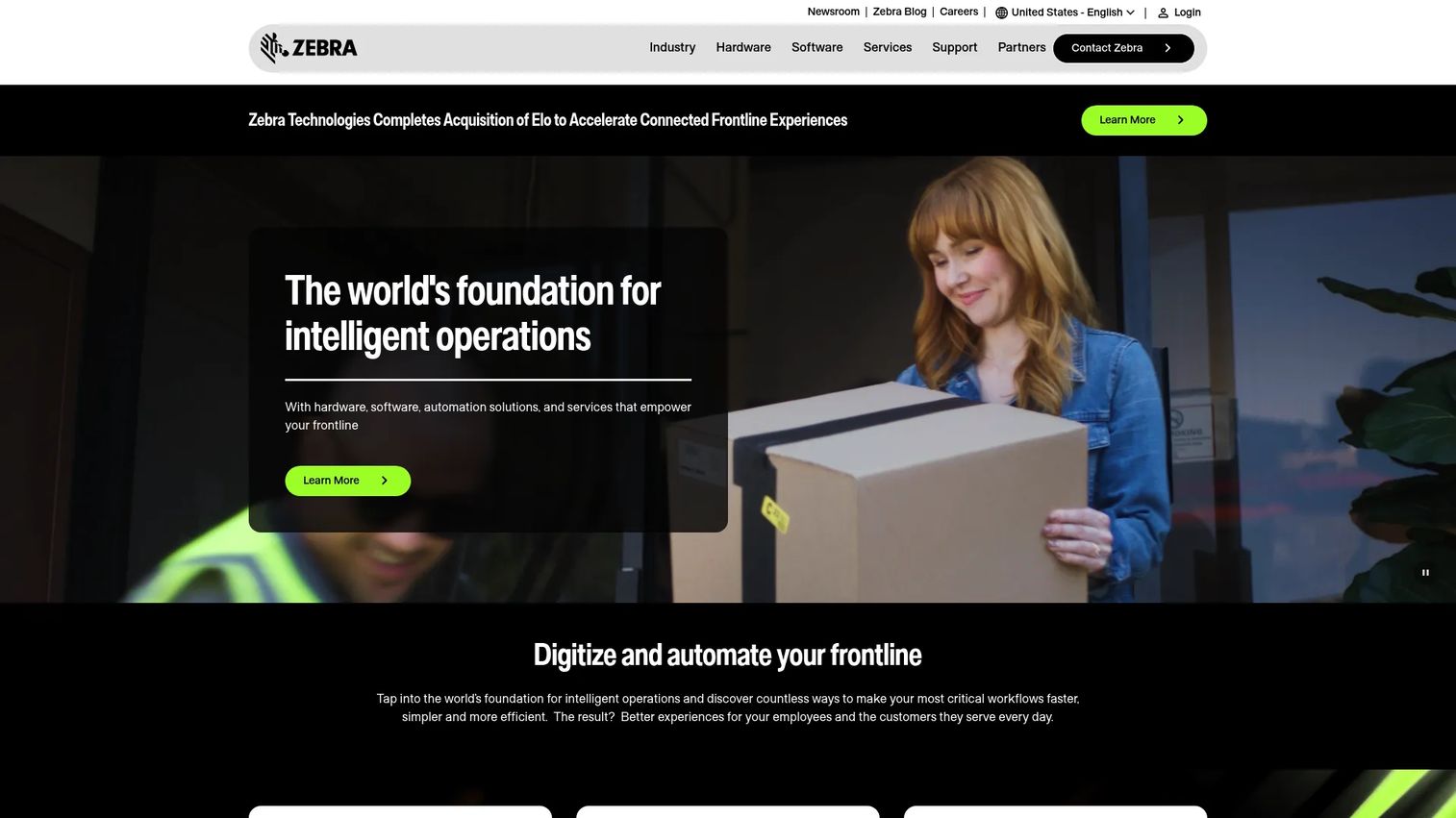
Zebra Workcloud Sync is a real-time frontline communication and collaboration solution from Zebra Technologies. It covers push-to-talk, voice and video calling, multimedia messaging, task tracking, and locationing. For healthcare, the strongest fit is in organizations already running Zebra devices across their frontline workforce and looking to unify communication within that device ecosystem.
Best for: Healthcare teams already using Zebra devices or deploying a frontline workforce communication strategy across shared hospital devices.
Key features
- Instant push-to-talk communication
- Voice and video calling
- Multimedia messaging
- Task tracking and coordination
- Locationing and discreet duress calling
Why choose Zebra Workcloud Sync: Choose Zebra Workcloud Sync when communication sits inside a broader Zebra device and workforce strategy. It is a logical fit for frontline staff on managed devices. Organizations primarily evaluating clinical communication platforms, rather than device-ecosystem communication tools, should compare it against purpose-built healthcare messaging platforms.
Zebra Workcloud Sync pricing: Contact Zebra for a quote.
12. Connexall
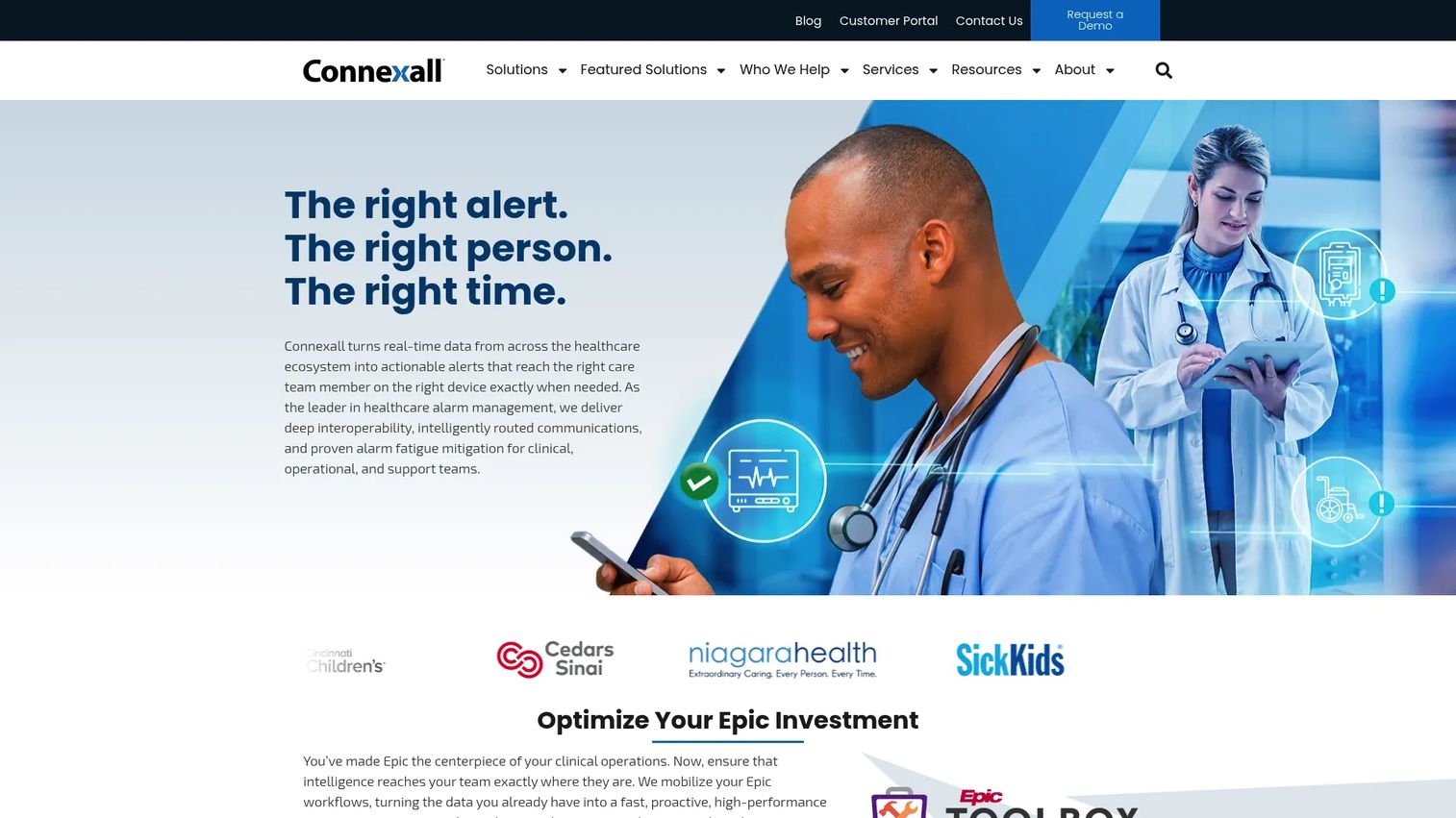
Connexall is a healthcare communication and alarm-management platform that turns real-time clinical data into intelligently routed alerts and workflows. Its architecture is vendor-neutral, with deep interoperability across clinical systems including Epic, RTLS, and bedside monitors. MobileConnex delivers alarm notifications, secure messaging, web requests, and assignment visibility to mobile devices.
Best for: Hospitals focused on alarm fatigue reduction, event-driven clinical workflows, and interoperability across a diverse system stack.
Key features
- Healthcare alarm management with intelligent alert routing and alarm-fatigue mitigation
- Deep interoperability across clinical, operational, and building systems
- MobileConnex alarm notifications, secure messaging, and assignment visibility
- Epic and RTLS integration
- Workflow automation and escalation rules
Why choose Connexall: Connexall is the right fit when the problem starts with alarm management rather than general messaging. Its vendor-neutral approach suits organizations with heterogeneous system environments where no single EHR dominates.
Connexall pricing: Contact the vendor for a quote.
13. MEDITECH Expanse
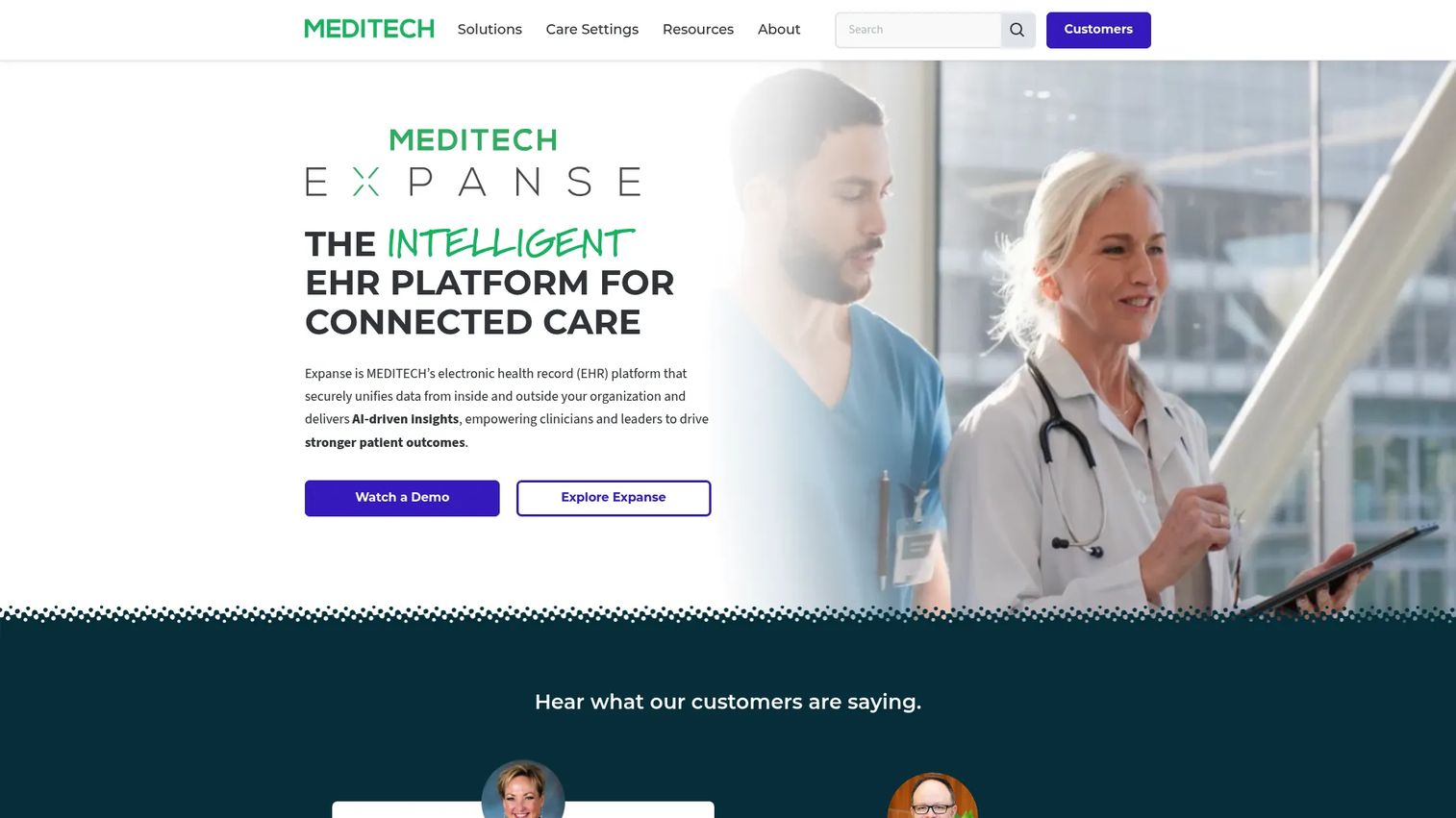
MEDITECH Expanse is a fully integrated, interoperable EHR platform covering clinical, administrative, and business workflows. Its communication and collaboration capabilities are embedded in the clinical record, with AI-powered ambient listening and documentation support, mobile workflows through Expanse Now and Expanse Point of Care, and interoperable longitudinal patient data accessible across the care continuum.
Best for: Hospitals and health systems standardized on MEDITECH that want communication embedded in their broader EHR environment.
Key features
- AI-powered ambient listening and documentation support
- Interoperable longitudinal patient data and intelligent search
- Mobile workflows through Expanse Now and Expanse Point of Care
- EHR-embedded care-team coordination
- Enterprise health records across acute, ambulatory, and revenue cycle
Why choose MEDITECH Expanse: Choose MEDITECH Expanse when communication strategy sits inside a MEDITECH-centered clinical system. Organizations with cross-system communication needs, or those managing communication outside the MEDITECH environment, should evaluate a standalone clinical communication platform alongside it.
MEDITECH Expanse pricing: Contact MEDITECH for a quote.
14. QliqCHAT
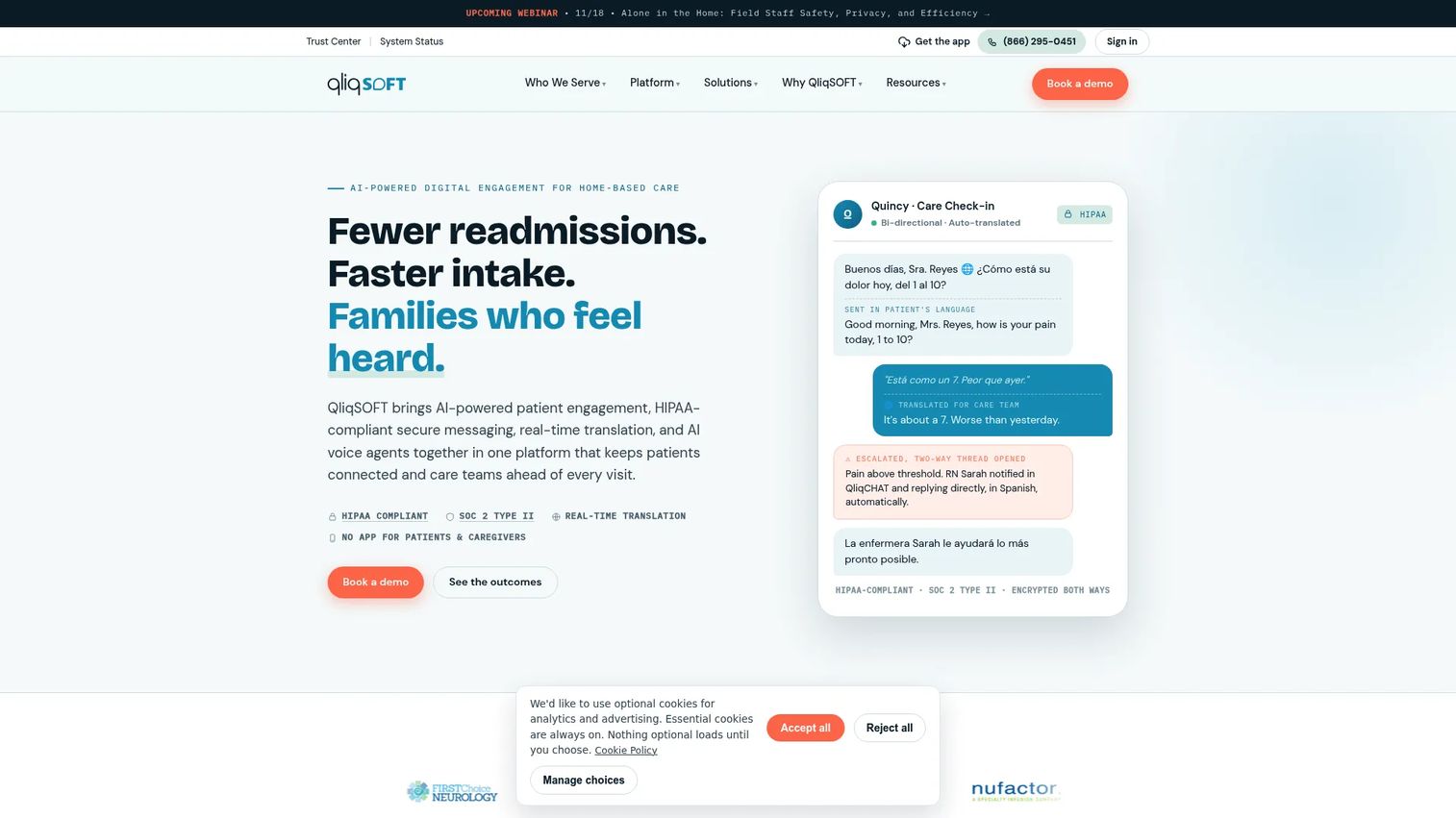
QliqCHAT, from QliqSOFT, is HIPAA-compliant care-team collaboration software for secure messaging, patient-centered group chats, on-call scheduling, caller ID masking, and field-staff safety. It syncs group chat notes to EMRs and provides GPS safety alerting for field clinicians, making it particularly well-suited for home-based care teams and distributed clinical staff.
Best for: Home-based healthcare organizations and distributed care teams that need HIPAA-compliant messaging without a large enterprise footprint.
Key features
- Secure HIPAA-compliant staff texting
- Patient-centered group chats with EMR collaboration-note syncing
- On-call scheduling and escalation routing
- Caller ID masking and GPS safety alerting for field clinicians
- Priority flags and acknowledgment requests
Why choose QliqCHAT: QliqCHAT is the right fit for teams that need focused, HIPAA-compliant messaging rather than a large enterprise communication suite. Its field-staff safety features and distributed-care design make it a strong match for home health, hospice, and community care organizations.
QliqCHAT pricing: Pricing uses per-seat, per-active-patient, and per-survivor meters. Exact rates require a quote from the vendor.
G2 rating: 4.6/5
15. Spok Care Connect
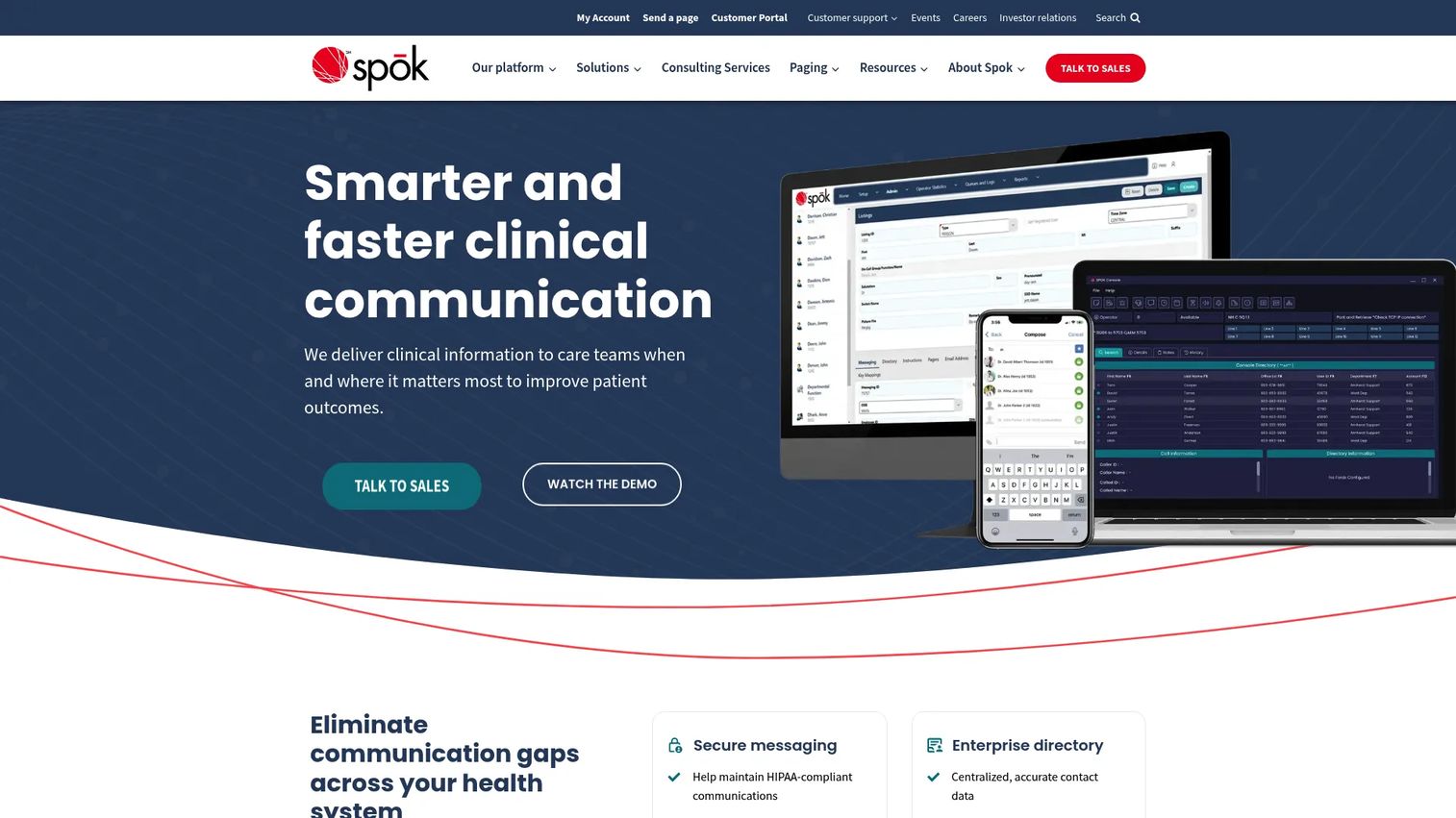
Spok Care Connect is a unified healthcare communications platform integrating secure messaging, paging, alerting, scheduling, directories, contact center operations, and clinical workflows. Its angle is modernizing legacy hospital communication infrastructure: Organizations that still depend on paging and operator workflows can migrate those capabilities into a unified platform rather than replacing them overnight.
Best for: Hospitals modernizing paging, operator console, and clinical messaging workflows, particularly those with an existing Spok footprint.
Key features
- Secure messaging and care-team collaboration
- Enterprise directory and on-call scheduling
- Clinical alerting and EHR integration
- Contact center and operator console support
- Paging and encrypted paging workflows
- Emergency notification and incident management
Why choose Spok Care Connect: Spok is a strong fit when paging modernization and hospital communication infrastructure are the primary drivers. Organizations that have invested in Spok's paging infrastructure can migrate incrementally rather than replacing everything simultaneously.
Spok Care Connect pricing: Contact sales for a quote.
Considerations when choosing clinical communication and collaboration software
Before committing to a platform, run it through these four filters.
Workflow fit beats feature count
A platform must match actual clinical workflows: Consults, critical results, nurse call, transfers, discharge coordination, after-hours coverage, and incident communication. Ask vendors to demonstrate routing in your specific scenario, not a generic demo. A feature list that looks complete on paper may not handle the routing logic your environment requires.
Interoperability decides long-term value
The right platform connects to your EHR, nurse call system, on-call scheduling tool, monitoring equipment, lab systems, identity provider, and ITSM stack. Ask for integration references from health systems of comparable size and complexity. Integrations that are "available" but rarely deployed are a risk. Request a list of live customers using the specific integration you need.
Escalation logic must be visible and auditable
Delivery confirmation is not the same as clinical resolution. Evaluate whether the platform tracks acknowledgement, escalation, closure, and response time, and whether that data is exportable for reporting. The audit trail matters during Joint Commission reviews and adverse-event investigations. Sent is not resolved.
Security claims need proof, not assertions
Encryption, access controls, audit logs, identity management, and HIPAA-supporting controls are table stakes. Ask for HITRUST certification evidence, SOC 2 Type II reports, or equivalent documentation. No platform makes your organization compliant with any regulation by itself, but the right platform provides controls you can build a compliance program around.
Adoption depends on clinical reality
A platform that clinicians don't use consistently fails regardless of its capabilities. Evaluate device support (personal devices, shared devices, BYOD), clinician interruption management, and rollout and training support. Physician adoption and nursing adoption often require different rollout strategies. Ask vendors how they handle the first 90 days.
Conclusion
The clinical communication and collaboration market has matured enough that most enterprise platforms cover the basics: Secure messaging, some level of EHR integration, and on-call awareness. The differentiation shows up in routing logic depth, interoperability breadth, escalation reliability, and how well the platform survives contact with real clinical workflows.
For broad enterprise clinical collaboration, TigerConnect is the strongest starting point for health systems that need a platform, not a point tool. OnPage leads for teams where critical alerting and escalation reliability are the primary risk. Epic and MEDITECH Expanse fit organizations that want communication embedded in their existing EHR. Vocera Platform and Mobile Heartbeat cover frontline mobile communication needs. PerfectServe Unite is the right evaluation for organizations where on-call routing drives outcomes. QliqCHAT and Spok Care Connect address focused secure messaging and paging modernization respectively.
The right evaluation sequence: Start with workflow fit, then verify integration depth, then pressure-test governance and adoption. Don't start from vendor feature lists. Start from the question of what breaks when a message doesn't reach the right clinician at the right time, and work backward from there.
Start your journey with Guideflow today!
FAQs
Clinical communication and collaboration software is healthcare software that securely routes messages, alerts, tasks, and patient-context communication between care-team members. It differs from general messaging by understanding on-call schedules, escalation logic, clinical urgency, and audit requirements, and by integrating with EHRs, nurse call systems, and scheduling tools.
Secure texting is one capability within the category. A full clinical communication platform adds role-based routing, on-call schedule awareness, patient context, escalation on non-response, closed-loop audit trails, and integration with clinical systems. Secure texting alone does not know who is currently responsible for a patient or what to do when a message goes unread.
The highest-priority integrations are EHR, on-call scheduling, nurse call, clinical monitoring systems, lab and critical results, identity management, and enterprise directories. Organizations with complex device environments should also evaluate push notification infrastructure and device management integration. Ask for reference customers using your specific EHR integration before signing.
Closed-loop communication means a message generates a delivery confirmation, an acknowledgement, an escalation if the recipient does not respond within a defined window, and a final audit trail showing resolution. The loop is not closed until the responsible clinician acts or the workflow reaches defined closure. Platforms that only confirm delivery, not acknowledgement and resolution, do not support true closed-loop communication.
Sometimes, and the answer depends on workflows, coverage requirements, downtime procedures, and organizational policy. Many hospitals phase pager replacement by department or use case rather than switching all at once. Emergency medicine and critical care environments often retain pagers longer due to redundancy requirements. The key question is whether the platform provides reliable delivery in environments with intermittent connectivity and during network downtime.
Ask vendors to demonstrate routing logic using your actual on-call scenario, not a generic example. Request to see the escalation behavior when a message goes unread, the downtime communication workflow, the EHR integration in a real patient context, and the reporting available after a critical event. Also ask how long implementation takes for a comparable health system, what support is included during rollout, and what the first 90-day adoption rate looks like for similar organizations.
For organizations standardized on a single EHR with a relatively contained communication environment, EHR-native messaging can cover most needs. Multi-entity systems, organizations with cross-system communication requirements, or health systems managing communication across diverse clinical roles will typically need broader routing, directory, alerting, and external communication coverage that EHR-native tools don't provide.
Track response time to critical alerts before and after implementation, escalation completion rates, missed alert frequency, call volume to the operator console, pager replacement cost savings, and clinician interruption counts. Staff satisfaction scores and nurse turnover, where communication friction is a contributing factor, also provide useful signal. Establish a baseline before go-live so you have data to compare. Avoid accepting vendor-supplied ROI projections without understanding the underlying assumptions.