Your inbound stack is supposed to compound. In practice, it often becomes a pile of tools each claiming credit for the same lead.
The global marketing automation software market reached $7.23 billion in 2025, according to Fortune Business Insights, yet most marketing teams still wrestle with attribution gaps, rising CAC, and traffic that never becomes qualified pipeline. The tools exist. The integration quality and strategic fit often do not.
The right inbound marketing tools help you attract qualified traffic, capture demand, nurture it, and hand sales a signal they can trust. Each tool in a well-built inbound stack owns a job: Search, content, capture, automation, CRM, analytics, creative, or product experience. When those jobs are covered without excessive overlap, the stack compounds instead of collapses.
This guide cuts through the noise. It covers 15 inbound marketing tools, compares pricing and G2 ratings, and helps growth marketers answer the consolidation question every CFO eventually asks.
What's inside
This guide covers 15 inbound marketing tools across the core inbound jobs: SEO, CMS, lead capture, marketing automation, CRM, analytics, creative production, and product experience. Tools were selected based on:
- Channel fit across content, SEO, automation, CRM, analytics, and product experience
- Integration quality with CRM, CMS, email, and reporting workflows
- Time-to-value for small and mid-market marketing teams
- Ability to prove pipeline impact or reduce manual work
Pricing and G2 ratings reflect live sources checked at generation time.
TL;DR
- Best for interactive product experiences: Guideflow helps B2B SaaS teams turn inbound traffic into self-serve product exploration with interactive demos, sandboxes, demo centers, mobile demos, and live demos
- Best all-in-one inbound platform: HubSpot Marketing Hub covers landing pages, email, forms, and CRM in one system
- Best for enterprise B2B automation: Salesforce Marketing Cloud Account Engagement for teams running on Salesforce CRM
- Best for SEO and competitive research: Semrush for keyword intelligence and organic channel strategy
- Best for attribution and web measurement: Google Analytics as the baseline for inbound channel reporting
- Best for lean creative production: Canva for teams that need on-brand assets without a design dependency
What is inbound marketing software?
Inbound marketing software is a set of tools that helps teams attract qualified audiences, convert visitors into leads, nurture those leads, measure performance, and support sales with context.
No single product covers every inbound job. The category is a stack, and the most common components are:
- Content and CMS: Blog publishing, landing pages, gated resources, and SEO-optimized web pages
- SEO and search intelligence: Keyword research, technical site audits, rank tracking, and competitor analysis
- Lead capture: Forms, CTAs, progressive profiling, and interactive product experiences
- Marketing automation: Email workflows, contact segmentation, lead scoring, and nurture sequences
- CRM and sales handoff: Contact records, lifecycle stages, lead routing, and pipeline reporting
- Analytics and attribution: Channel performance, conversion tracking, and pipeline influence
- Creative and production: Visual assets, lead magnets, ad creative, and campaign collateral
- AI assistance: Content ideation, research synthesis, draft acceleration, and campaign variation
Inbound marketing tools help teams:
- Attract visitors through search, content, and social
- Capture leads through forms, demos, and gated assets
- Nurture demand through automated workflows
- Measure ROI and channel performance
- Support sales with qualified, context-rich leads
Inbound versus outbound
Inbound earns attention through helpful content, useful experiences, and product access that lets buyers self-educate. Outbound initiates contact directly through cold email, advertising, or account-based outreach. Modern B2B teams often run both motions, but inbound tools carry the most weight when buyers research before they ever speak to a rep. According to the Content Marketing Institute (2025), 97% of B2B marketers had a content strategy, which signals how central inbound has become to pipeline generation.
When to use inbound marketing tools
Build a repeatable lead generation engine
Inbound tools matter most when traffic, content, forms, and email live in separate systems with no shared record. The goal is a path from first visit to qualified lead that runs without manual intervention. CMS, automation, and CRM tools make that path repeatable.
Prove which channels create pipeline
Growth marketers fighting attribution debates need UTM discipline, CRM sync, conversion events, and funnel reporting tied together. When those elements connect cleanly, the channel performance story becomes defensible in a board meeting.
Convert interest into product engagement
Static landing pages and recorded videos can explain value, but they cannot replicate the experience of using a product. Interactive product experiences let B2B SaaS prospects explore workflows, validate use cases, and qualify themselves before a sales call, which shifts the first conversation from education to evaluation.
Inbound marketing tools comparison
Inbound marketing tools are not interchangeable. Some own the system of record. Others handle SEO intelligence, lead capture, product experiences, campaign production, or project coordination. The table below maps each tool to its primary job, pricing entry point, and G2 rating.
| # | Product | Best for | Key differentiator | Pricing | G2 rating |
|---|---|---|---|---|---|
| 1 | HubSpot Marketing Hub | All-in-one inbound platform | CRM-native marketing, forms, email, and reporting | Free tier; Starter from $20/mo per Core Seat | 4.4/5 |
| 2 | Salesforce Marketing Cloud Account Engagement | Enterprise B2B lead nurturing | Deep Salesforce CRM alignment for B2B teams | From $1,250/org/month (annual) | 4.1/5 |
| 3 | Semrush | SEO and competitive research | Keyword, content, and competitor intelligence | Free tier; SEO plan from $117.33/mo (annual) | N/A (Capterra 4.6/5) |
| 4 | WordPress | Flexible inbound CMS | Open-source publishing with a broad plugin market | Free software; hosting separate | N/A |
| 5 | Adobe Marketo Engage | Complex enterprise automation | Advanced segmentation, nurture, and governance | Custom pricing (Growth, Select, Prime, Ultimate) | 4.1/5 |
| 6 | Guideflow | Interactive product experiences | Self-serve demos that convert inbound interest | Free tier; Solo from $35/mo | 5.0/5 |
| 7 | ActiveCampaign | SMB and mid-market automation | Email, CRM, and automation for growth teams | Starter, Plus, Pro, Enterprise (contact-scaled) | 4.4/5 |
| 8 | Salesforce CRM | Sales and marketing alignment | Revenue system of record for pipeline | Free Suite available; Starter from $25/user/mo | 4.4/5 |
| 9 | Ahrefs | SEO research and backlink analysis | Strong backlink data and competitive SEO tools | Free account; Starter from $29/mo | 4.5/5 |
| 10 | Fluent Forms | WordPress lead capture | Flexible form building for WordPress funnels | Free plugin; paid from $47/year | 4.5/5 |
| 11 | Yoast SEO | WordPress on-page SEO | Real-time SEO guidance inside WordPress editor | Free plugin; Premium from $118.80/year | 4.5/5 |
| 12 | Canva | Campaign creative production | Fast on-brand design without a designer | Free tier; Pro from $144/year | 4.7/5 |
| 13 | Asana | Campaign project management | Work tracking for launches and content operations | Free plan; Starter from $10.99/user/mo (annual) | 4.4/5 |
| 14 | Google Analytics | Web analytics and measurement | Traffic, events, and conversion analysis | Free | 4.5/5 |
| 15 | ChatGPT | AI-assisted content and research | Fast ideation, drafting, and content repurposing | Free tier; Go from $8/mo | 4.6/5 |
Pricing and ratings verified November 2026 from each tool's pricing page and G2 listing.
Best 15 inbound marketing tools for 2026
1. HubSpot Marketing Hub
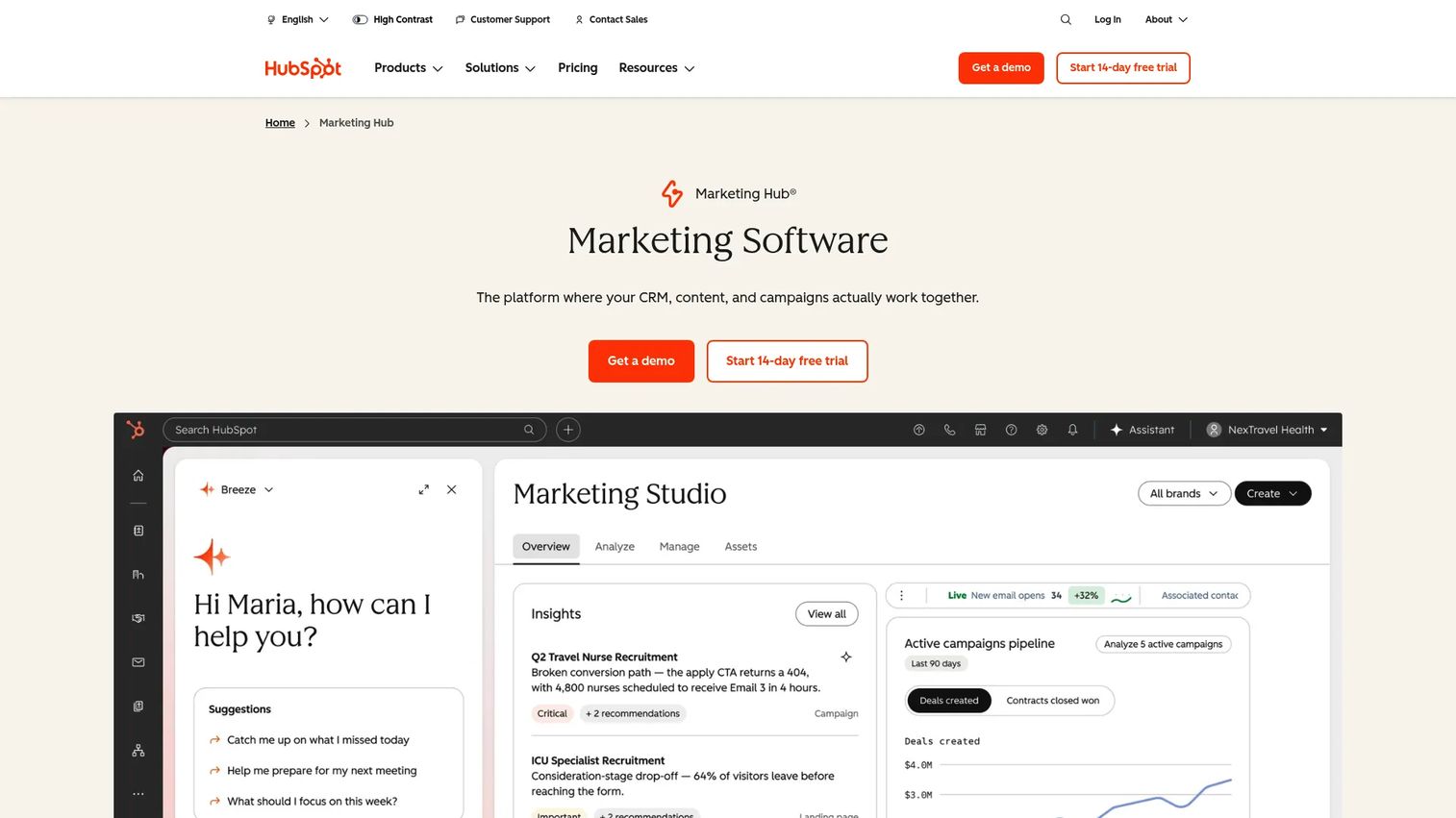
HubSpot Marketing Hub is the most complete all-in-one platform for inbound marketing. It combines landing pages, email marketing, forms, marketing automation, CRM-connected reporting, and content tools inside one system. For teams asking "what does this replace?", HubSpot often displaces four or five separate tools at once.
Best for: B2B teams that want a central platform for inbound campaigns, contact management, automation, and pipeline reporting.
Key features
- CRM-native contact segmentation and lifecycle stages
- Email marketing workflows and campaign automation
- Landing pages, forms, and lead capture tools
- Campaign attribution reporting tied to CRM data
- Social media management and SEO recommendations
Why choose HubSpot Marketing Hub: HubSpot is the strongest consolidation bet for teams that want to stop stitching together a landing page builder, email tool, and basic CRM. The CRM-native reporting means attribution stays in one place instead of breaking across platforms.
HubSpot Marketing Hub pricing: Free tools are available with no time limit. Paid plans start at $20/month per Core Seat for Starter, $890/month for Professional, and $3,600/month for Enterprise (billed annually).
HubSpot holds a 4.4/5 rating on G2 based on over 15,000 reviews.
2. Salesforce Marketing Cloud Account Engagement
Salesforce Marketing Cloud Account Engagement is the enterprise B2B marketing automation layer for teams already built around Salesforce CRM. It covers lead generation, nurturing, scoring, grading, and pipeline reporting, all natively connected to the Salesforce data model.
Best for: Enterprise and mid-market B2B marketing teams that run Salesforce CRM and need advanced lead management aligned to sales.
Key features
- Lead scoring, grading, and automation rules
- Salesforce CRM campaign alignment and sync
- B2B email nurture and personalization
- Account-based segmentation
- Marketing ROI and pipeline reporting
Why choose [Salesforce Marketing Cloud Account Engagement](https://www.salesforce.com/marketing/b2b- marketing-automation/): Choose this when sales and marketing alignment matters more than fast setup. The Salesforce-native architecture means lead data flows directly into sales workflows. Teams without deep Salesforce investment will find the complexity and price hard to justify.
Salesforce Marketing Cloud Account Engagement pricing: Plans are billed annually. Growth+ starts at $1,250/org/month. Plus+ is $2,750/org/month. Advanced+ is $4,400/org/month. Premium+ is $15,000/org/month. No free tier is available.
Salesforce Marketing Cloud Account Engagement holds a 4.1/5 rating on G2.
3. Semrush
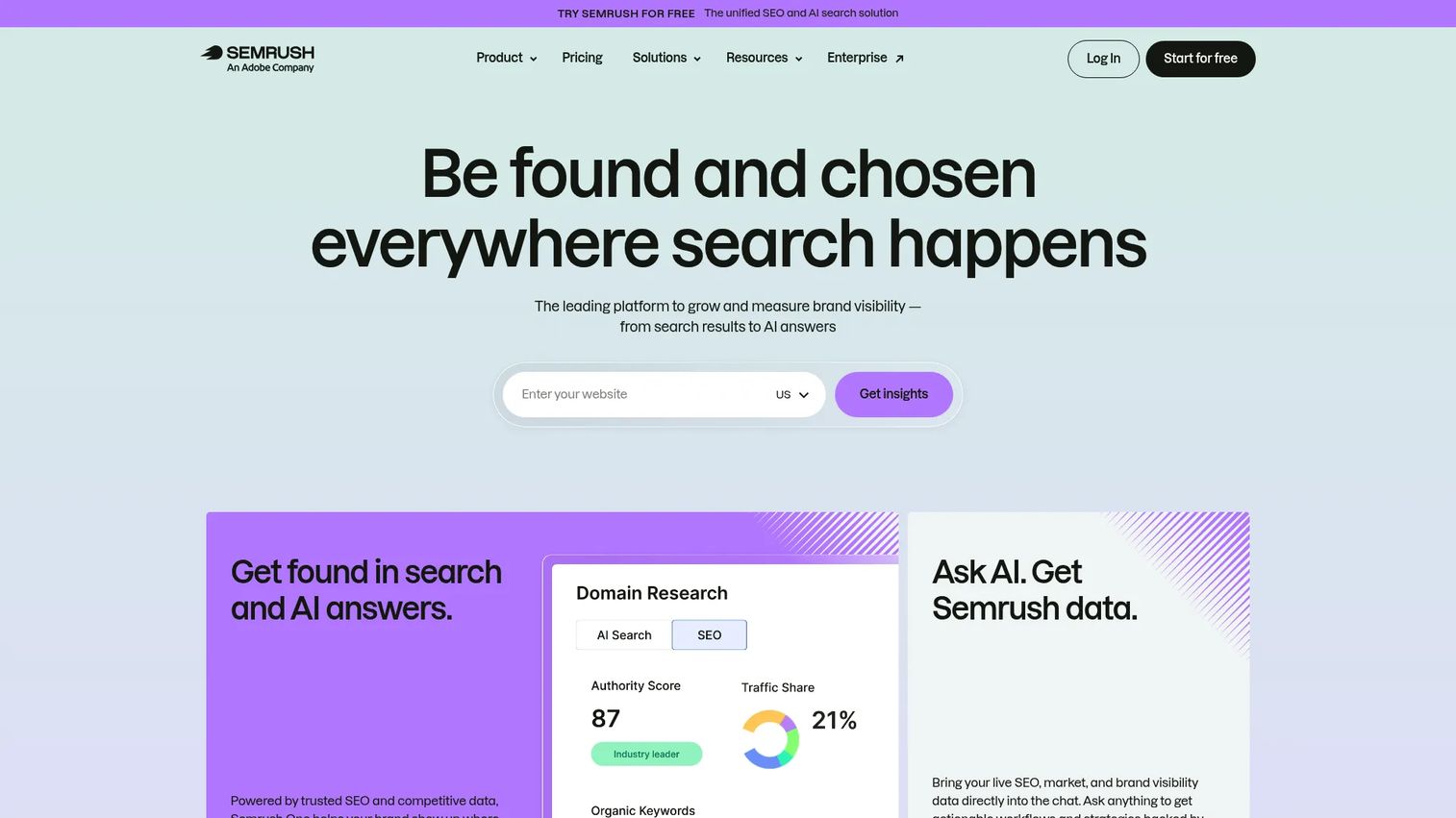
Semrush is the search intelligence platform that inbound teams use when organic traffic is a primary pipeline channel. It covers keyword research, competitor analysis, technical site audits, rank tracking, and content optimization in one workflow.
Best for: Growth marketers and SEO teams that need broad search intelligence, competitor visibility, and content performance data.
Key features
- Keyword research and SERP competitor analysis
- Technical site audits and issue tracking
- Position tracking and rank monitoring
- Content optimization and topic research
- AI visibility and prompt tracking for AI search
Why choose Semrush: Semrush is the right call when inbound depends on owning organic search rankings and understanding competitive positioning. It helps teams decide what to publish, what to update, and which SERP positions are worth defending.
Semrush pricing: A free tier is available with limited access. The SEO plan starts at $117.33/month (billed annually) or $139/month billed monthly. The Starter plan is $165.17/month annually. Pro+ is $248.17/month annually. Advanced pricing requires contacting sales.
4. WordPress
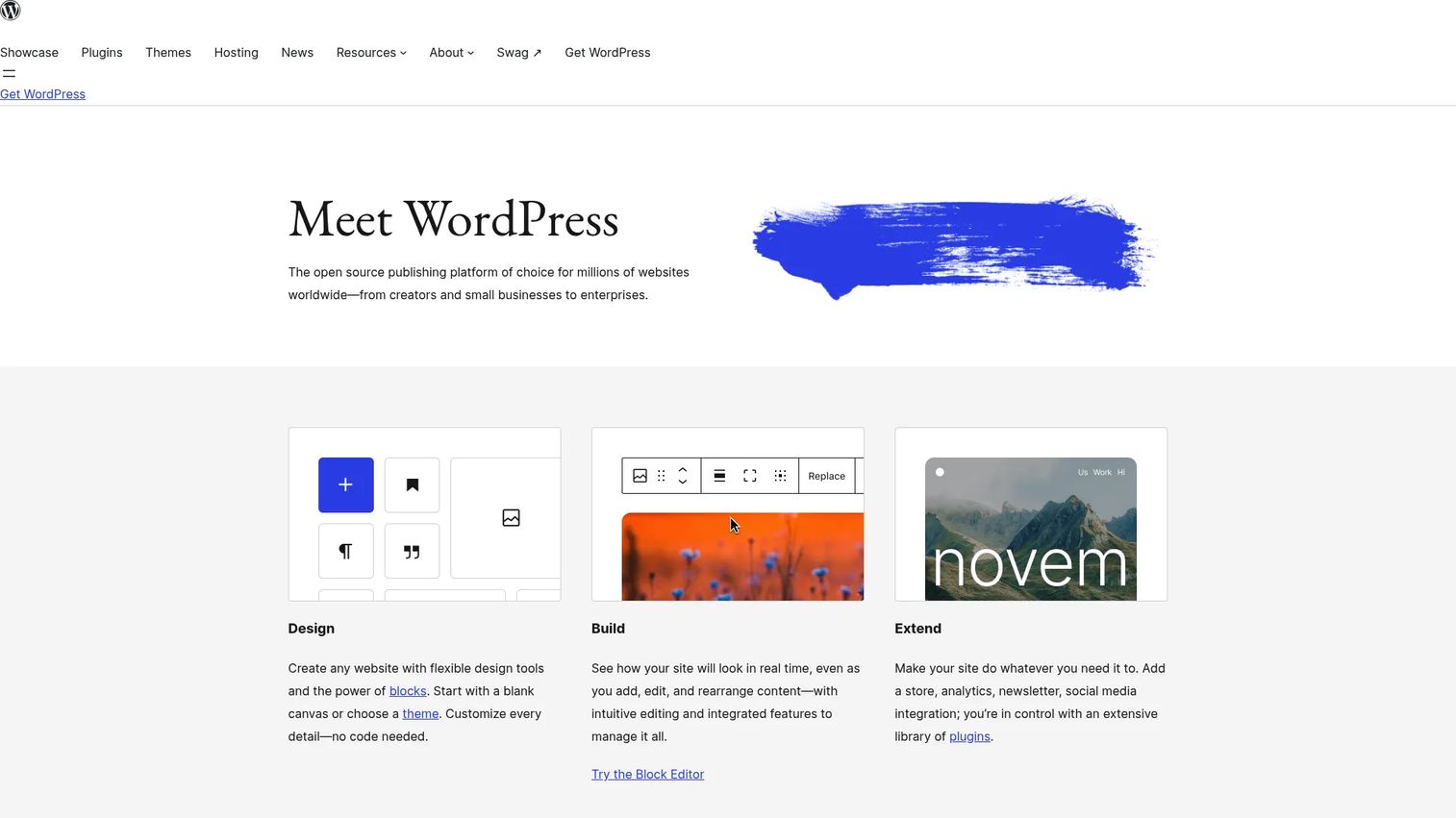
WordPress is the open-source CMS that powers a significant share of the web. For inbound marketers, it is the publishing foundation for blogs, landing pages, and content hubs. Its plugin ecosystem makes it extensible for SEO, forms, analytics, and CRM integrations without custom development.
Best for: Teams that need publishing flexibility, full content ownership, and a large ecosystem of plugins and integrations.
Key features
- Blog publishing with drafts, scheduling, and revision history
- Flexible plugin ecosystem for SEO, forms, and analytics
- Custom themes and block-based page building
- Role-based user management
- REST API for custom integrations
Why choose WordPress: WordPress is the right foundation when you need control over content architecture and integration choices. The trade-off is ongoing hosting, security, and plugin maintenance, which requires either technical ownership or a managed hosting provider.
WordPress pricing: The WordPress software is free and open source. Hosting and domain registration are purchased separately. Hosting costs vary widely by provider, starting from a few dollars per month for shared hosting and scaling with traffic and performance requirements.
5. Adobe Marketo Engage
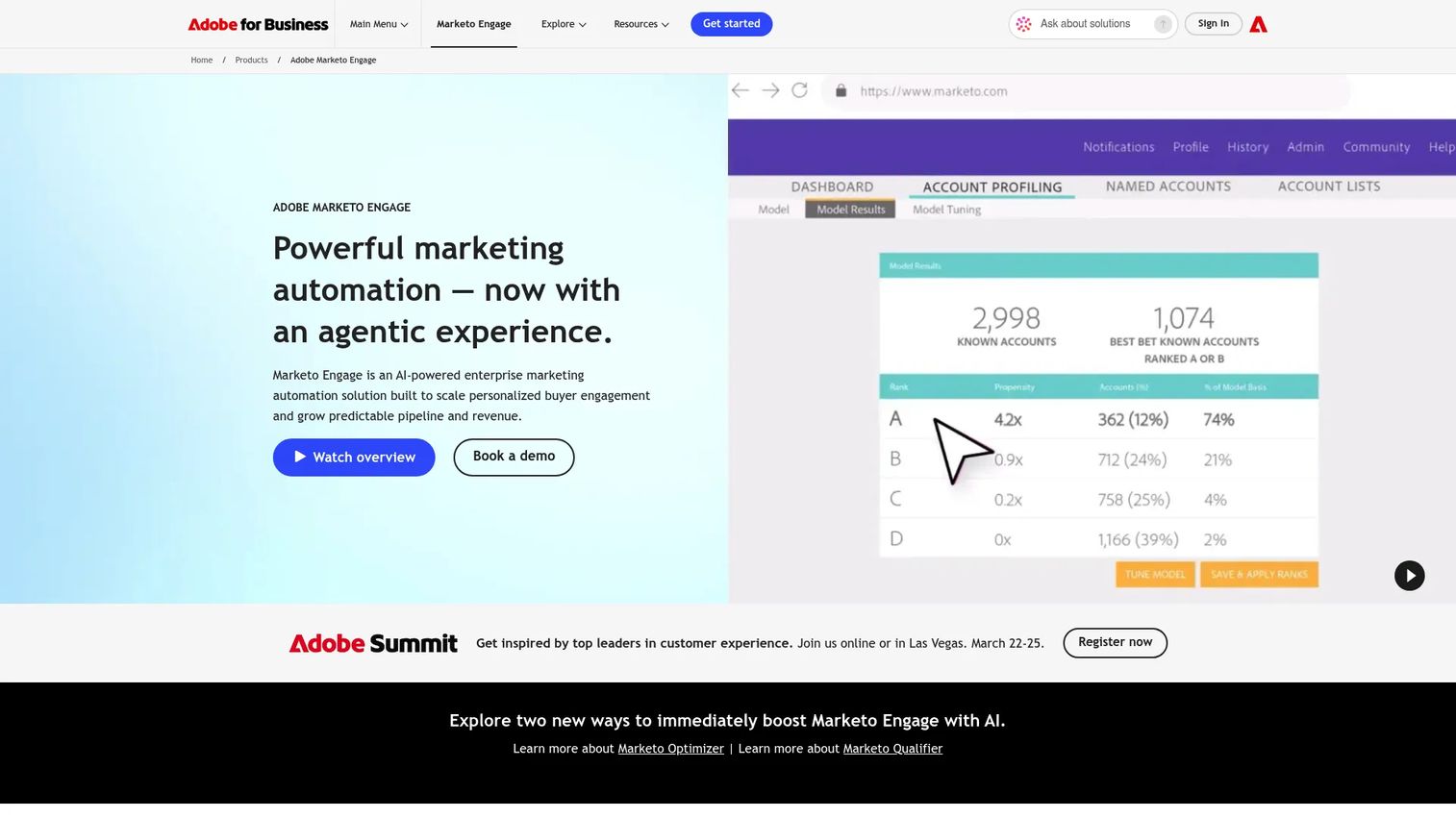
Adobe Marketo Engage is an enterprise marketing automation platform for teams running complex, multi-segment nurture programs at scale. It handles advanced segmentation, multi-step campaigns, lead scoring, and revenue attribution across long B2B buying cycles.
Best for: Enterprise marketing operations teams with complex buyer journeys, multiple product lines, and mature campaign governance requirements.
Key features
- Advanced segmentation and account-based targeting
- Multi-step nurture programs and campaign orchestration
- Lead scoring, routing, and CRM integration
- Dynamic content and AI-assisted personalization
- Revenue attribution and marketing analytics
Why choose Adobe Marketo Engage: Marketo excels when the inbound marketing operation requires governance, advanced routing logic, and campaign coordination across large teams. It carries significant setup and operational overhead, which enterprise teams with dedicated marketing ops typically absorb in exchange for depth.
Adobe Marketo Engage pricing: Adobe offers four packages: Growth, Select, Prime, and Ultimate. Contact Adobe for pricing on each. Reviewer-reported ranges on G2 suggest enterprise contracts often start above $25,000 annually, scaling with database size and feature requirements.
Adobe Marketo Engage holds a 4.1/5 rating on G2.
6. Guideflow
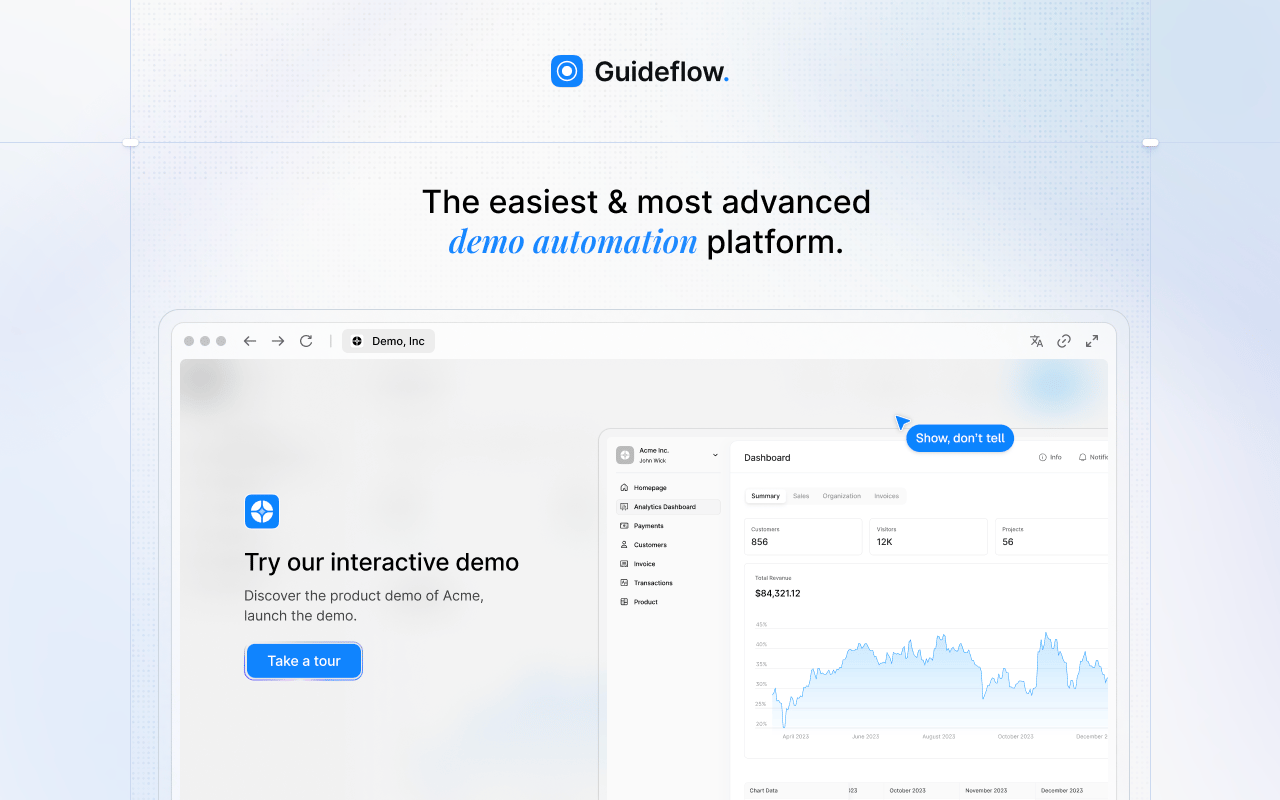
Guideflow is the interactive product experience layer in an inbound marketing stack. Where other tools attract, capture, and nurture, Guideflow converts interest into product engagement by letting prospects explore your product before they ever book a call. It is built for B2B SaaS teams that need visitors to experience the product, not just read about it.
Best for: B2B SaaS marketers who need landing page traffic, email clicks, and ad visitors to engage with the product before a sales conversation.
Key features
- Interactive demos for guided, clickable product walkthroughs
- Sandboxes for open product exploration and self-validation
- Demo centers for organized, branded product experience hubs
- Mobile demos optimized for device-native product experiences
- Engagement analytics tied to lead scoring and CRM sync
Why choose Guideflow: When static pages, PDFs, and video walkthroughs are not enough to show product value, Guideflow closes the gap. Interactive demos let users experience the product at their own pace through a guided path. Sandboxes give users full freedom to explore the product on their own terms. Demo centers give teams a branded hub to organize, distribute, and track all their demos. Live demos add real-time conversation and personalized storytelling. Mobile demos let users experience a mobile product exactly as it feels on their device. The engagement data from every interaction feeds back into CRM and lead scoring, so sales knows who explored what before they pick up the phone.
Guideflow pricing: A free plan is available with up to 5 guideflows, unlimited viewers, and one team member. The Solo plan is $35/month. Growth is $499/month. Advanced is $1,499/month. Enterprise pricing is available on request.
Guideflow holds a 5.0/5 rating on G2.
Start your journey with Guideflow today!
7. ActiveCampaign
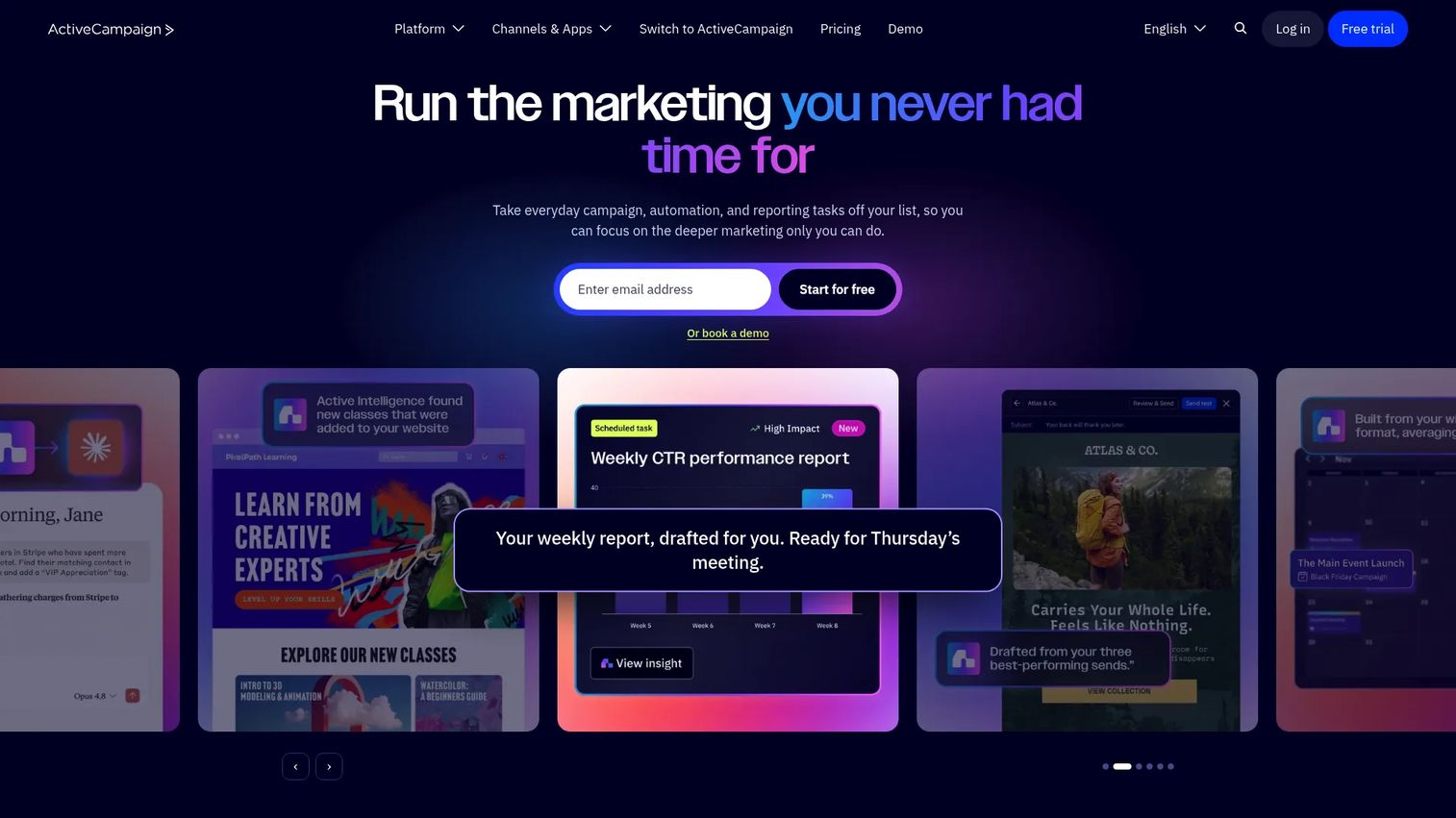
ActiveCampaign is a marketing automation platform for small and mid-market teams that need email, segmentation, CRM pipelines, and lead scoring without an enterprise-level implementation project. It supports multi-step automation across email, SMS, and web with a practical builder that most teams can configure without dedicated ops support.
Best for: SMB and mid-market teams that need marketing automation depth without the complexity and cost of enterprise platforms.
Key features
- Multi-step email automation with branching logic
- Contact segmentation and predictive sending
- CRM pipelines and contact profiles
- Lead scoring and conditional content
- 1,000+ integrations including ecommerce and CRM tools
Why choose ActiveCampaign: ActiveCampaign fits teams that need automation sophistication but cannot justify an enterprise marketing operations hire to run it. It sits between basic email tools and full enterprise platforms, covering most mid-market automation needs at a price that scales with contact list size.
ActiveCampaign pricing: Plans are billed annually and scale with contact list size. Tiers include Starter, Plus, Pro, and Enterprise. The official FAQ states pricing starts at $15 for accounts with fewer than 1,000 contacts. A 14-day free trial is available; no permanent free tier exists.
ActiveCampaign holds a 4.4/5 rating on G2.
8. Salesforce CRM
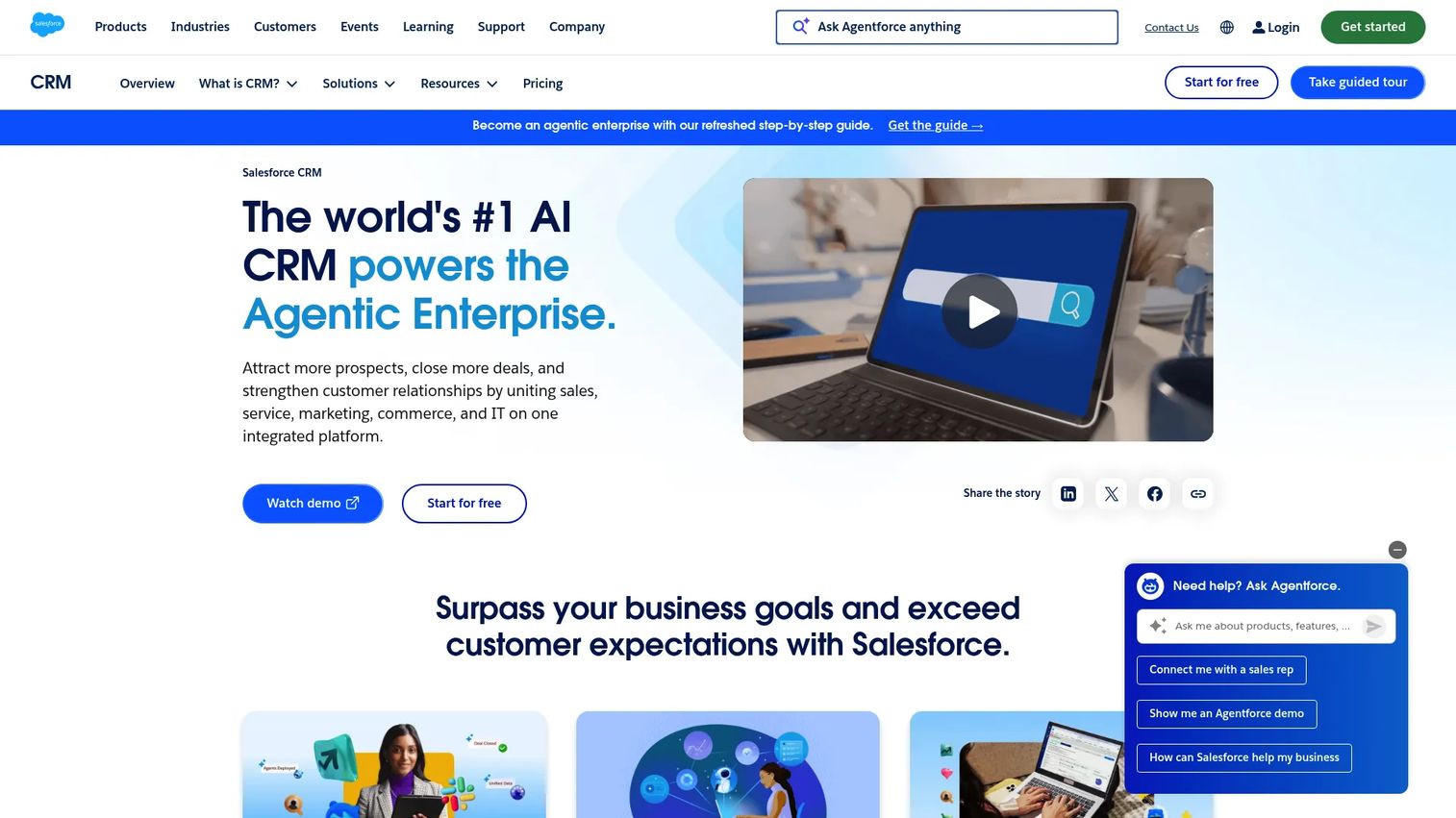
Salesforce CRM is the revenue system of record that connects inbound marketing activity to sales pipeline. For inbound teams, it matters most at the handoff: Routing qualified leads to reps, tracking campaign influence on opportunities, and reporting on what actually closed.
Best for: B2B teams that need marketing, sales, and RevOps aligned around pipeline data in a shared system of record.
Key features
- Contact records, account management, and opportunity tracking
- Lead routing and assignment rules
- Workflow automation and sales flows
- Campaign influence and attribution reporting
- Customizable dashboards and reporting
Why choose Salesforce CRM: Salesforce is the right choice when pipeline reporting needs to hold up under leadership scrutiny. It is not the simplest tool in the stack, but when it integrates with marketing automation, the attribution story becomes much cleaner than any spreadsheet alternative.
Salesforce CRM pricing: A Free Suite is available. Starter Suite is $25/user/month (billed monthly or annually). Pro Suite is $100/user/month (billed annually). Enterprise Edition is $175/user/month. Sales Cloud plans extend higher with Core at $195/user/month, Advanced at $395/user/month, and Max at $550/user/month (all billed annually).
Salesforce CRM holds a 4.4/5 rating on G2.
9. Ahrefs
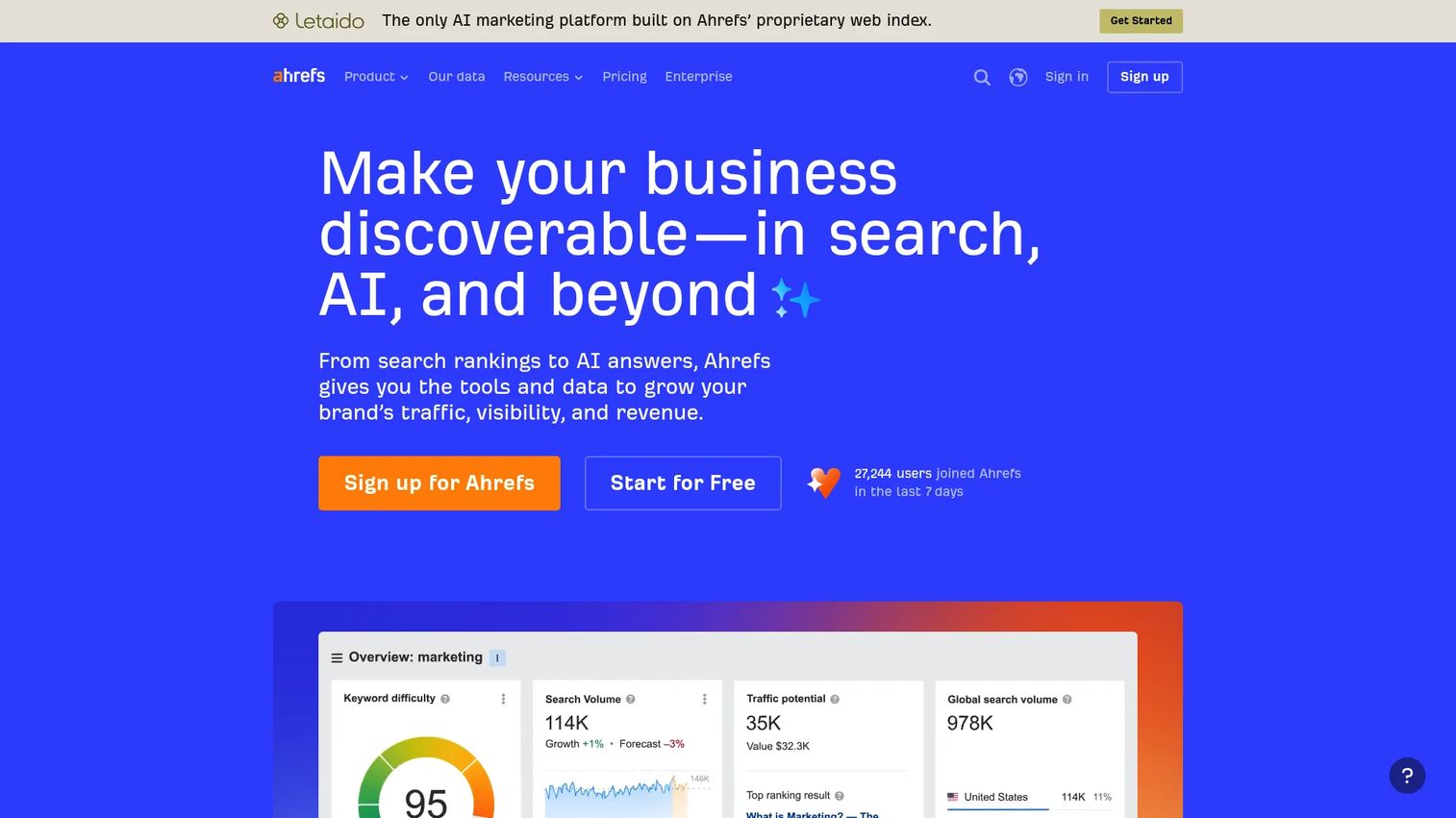
Ahrefs is an SEO platform known primarily for its backlink index and keyword intelligence. Inbound teams use it to find content opportunities, analyze competitor rankings, audit technical site health, and identify gaps in their link profile.
Best for: SEO-led inbound teams that compete in search and need backlink intelligence alongside keyword and content research.
Key features
- Site Explorer for backlink and organic traffic analysis
- Keywords Explorer for search volume and difficulty data
- Site Audit for technical SEO issues
- Rank Tracker for SERP position monitoring
- Content Gap for identifying missing keyword coverage
Why choose Ahrefs: Ahrefs earns its place when organic growth depends on outranking established competitors. The backlink data is a differentiator for teams building link strategies, and the content gap tool helps prioritize editorial work by showing exactly where competitors rank and you do not.
Ahrefs pricing: A free account is available with limited access. The Starter plan is $29/month. Lite is $129/month. Standard is $249/month. Advanced is $449/month. Enterprise pricing requires contacting sales. Annual billing saves up to 17%.
Ahrefs holds a 4.5/5 rating on G2.
10. Fluent Forms
Fluent Forms is a WordPress form builder for inbound lead capture, newsletter signups, gated asset delivery, surveys, and payment collection. It runs directly inside WordPress and connects to CRM and email tools for lead follow-up.
Best for: WordPress teams that need flexible, conversion-focused forms without moving to a full marketing automation platform.
Key features
- Drag-and-drop builder with 65+ input field types
- Conditional logic and multi-step form flows
- Payment and donation forms
- CRM and email integrations
- Visual reporting and lead management
Why choose Fluent Forms: Fluent Forms fits inbound teams running WordPress who need better conversion points across blog posts, landing pages, and lead magnets. It handles complexity that basic WordPress contact forms do not, without requiring a platform switch.
Fluent Forms pricing: A free version of the plugin is available. Paid plans are annual or lifetime. The Single Site annual license is $47/year. The Agency license is $95/year. The Unlimited license is $179/year. Lifetime options are also available starting at $244 for a single site.
Fluent Forms holds a 4.5/5 rating on G2.
11. Yoast SEO
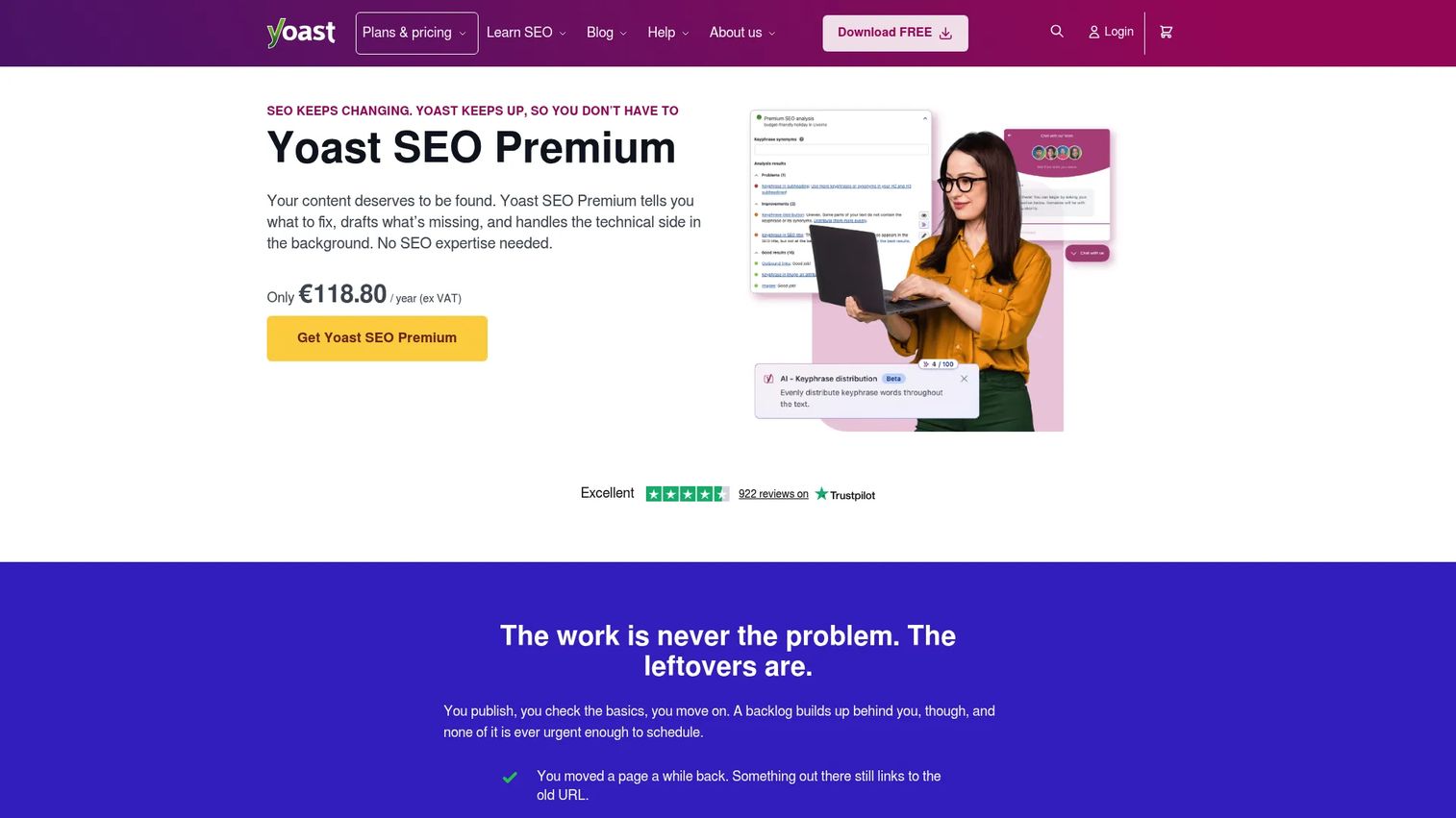
Yoast SEO is a WordPress plugin that brings real-time SEO and readability guidance directly into the publishing workflow. It handles metadata, XML sitemaps, structured data, and internal linking suggestions without requiring manual technical configuration.
Best for: WordPress content teams that need SEO guardrails and technical optimization baked into the publishing experience.
Key features
- Real-time on-page SEO and readability analysis
- Metadata controls and AI-assisted title generation
- XML sitemaps and automated structured data
- Redirect management
- Internal linking suggestions
Why choose Yoast SEO: Yoast keeps content technically cleaner at the moment of publishing, which matters when inbound depends on a steady content output. It does not replace keyword research, but it reduces the number of SEO mistakes that make it into print.
Yoast SEO pricing: The core Yoast SEO plugin is free. Yoast SEO Premium costs $118.80/year (ex VAT). The Yoast WooCommerce SEO bundle is $178.80/year. Yoast SEO AI+ is $358.80/year. All paid plans are billed annually.
Yoast SEO holds a 4.5/5 rating on G2.
12. Canva
Canva is a visual design platform built for teams that need to produce campaign creative without waiting on a designer. Social posts, ad creative, lead magnets, webinar slides, and infographics are all within reach for non-designers through Canva's template library and brand management tools.
Best for: Lean marketing teams that need to ship on-brand creative quickly across multiple channels and formats.
Key features
- Drag-and-drop editor with 1,000+ design types
- Brand Kits for consistent colors, fonts, and logos
- AI design tools including resize and background removal
- Real-time collaboration and approval workflows
- Asset export across web and print formats
Why choose Canva: Design bottlenecks kill inbound momentum. Canva removes the dependency on a dedicated designer for campaign assets, which lets teams run more tests, launch faster, and produce content at a pace that SEO and paid channels actually require.
Canva pricing: A free plan is available with core design features. Canva Pro is $144/year for one person. Canva Business is $250/year per person. Enterprise pricing requires contacting sales. All paid plans are billed annually.
Canva holds a 4.7/5 rating on G2.
13. Asana
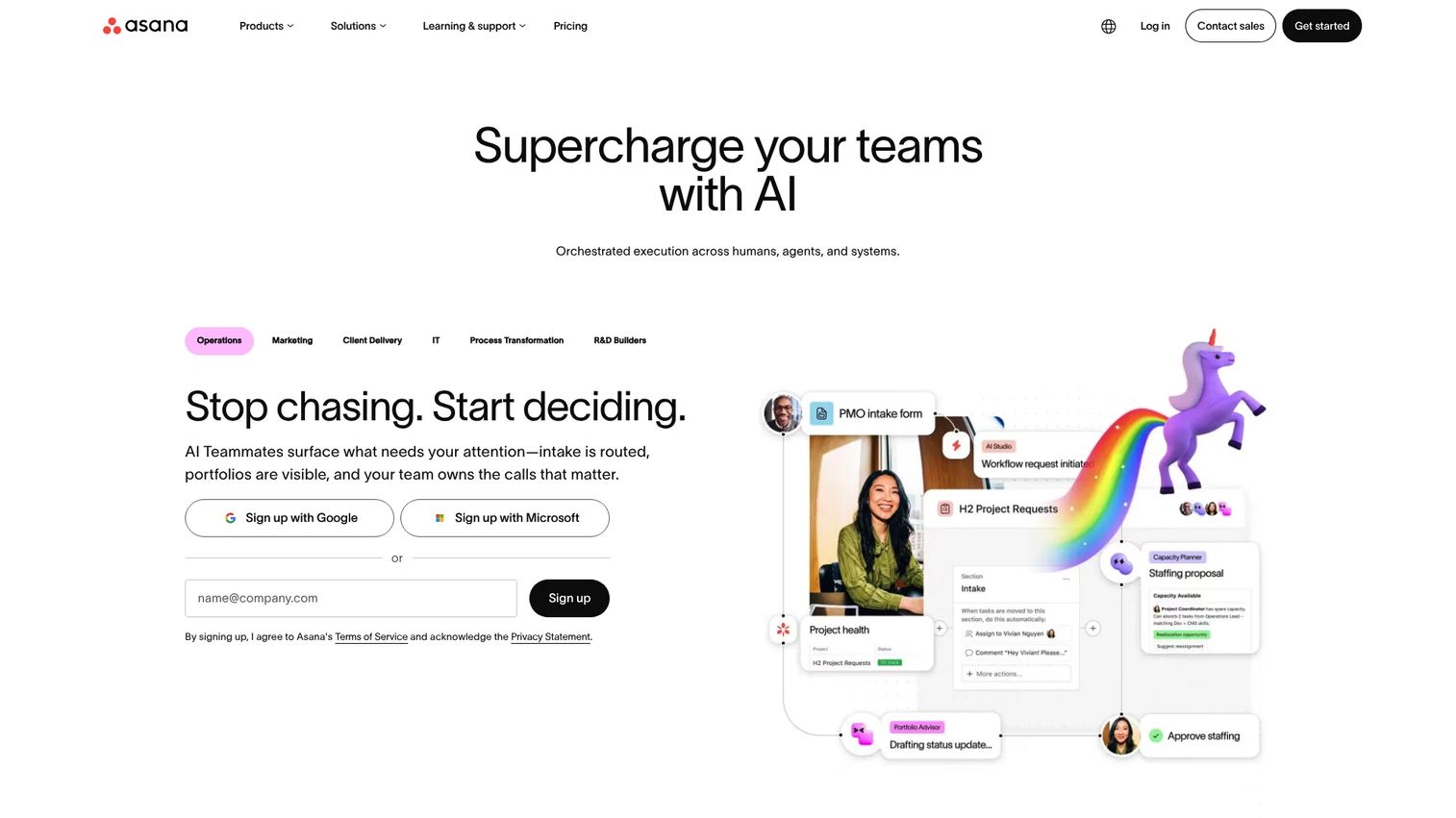
Asana is a work management platform for coordinating marketing campaigns, content calendars, launch timelines, and approvals across teams. For inbound marketers, it is the operational layer that keeps content operations, SEO projects, and campaign launches from falling apart when ownership is unclear.
Best for: Marketing teams coordinating cross-functional inbound work including content, SEO, design, lifecycle campaigns, and product launches.
Key features
- Task and project management with owners and deadlines
- Campaign calendars and launch timeline views
- Workflow automation with rules and templates
- Approval tracking and stakeholder visibility
- Goals, portfolios, and progress reporting
Why choose Asana: Inbound marketing fails most often not because the tools are wrong but because ownership and timelines are unclear. Asana provides the shared operating layer that keeps recurring inbound work, from content refreshes to quarterly campaigns, running on schedule.
Asana pricing: A Personal plan is free forever for up to 2 users. Starter is $10.99/user/month billed annually ($13.49 billed monthly). Advanced, Enterprise, and Enterprise+ tiers require contacting sales for pricing.
Asana holds a 4.4/5 rating on G2.
14. Google Analytics
Google Analytics is the web analytics baseline for inbound marketing measurement. It tracks where visitors come from, what they do on the site, which pages drive conversions, and how inbound channels compare on engagement and goal completion.
Best for: Teams that need baseline website and acquisition reporting across inbound channels at no cost.
Key features
- Traffic acquisition and channel attribution reports
- Event tracking and conversion measurement
- Landing page engagement and performance analysis
- Audience segmentation and cohort reporting
- BigQuery export for advanced analysis
Why choose Google Analytics: Every inbound stack needs a web analytics foundation. Google Analytics covers that job for free. Its limitation is that it tells you about site behavior, not pipeline revenue. Connecting GA4 data to CRM outcomes requires clean UTM tagging, consistent event naming, and a CRM integration to close the attribution loop.
Google Analytics pricing: Google Analytics (GA4) is free. An enterprise version, Google Analytics 360, is available for high-volume needs and is priced through sales.
Google Analytics holds a 4.5/5 rating on G2.
15. ChatGPT
ChatGPT is an AI assistant that inbound teams use to accelerate research, ideation, content drafting, and campaign variation. It speeds up the upstream work of content creation without replacing subject matter expertise, original data, or brand judgment.
Best for: Marketers who need to move faster on research synthesis, content outlines, email variations, and campaign briefs.
Key features
- Content ideation and outline generation
- Draft generation for blog posts, emails, and ads
- Research synthesis from uploaded documents
- Messaging variation for A/B testing
- File uploads and data analysis
Why choose ChatGPT: ChatGPT saves real time on early-stage content work and campaign iteration. The honest trade-off is that it generates plausible text, not authoritative insight. Every output still needs expert review, original research where claims matter, and brand-specific editing before it goes into production.
ChatGPT pricing: A free plan is available. The Go plan is $8/month. Plus is $20/month. Pro, Business, and Enterprise plans are available; pricing for those tiers requires contacting OpenAI.
ChatGPT holds a 4.6/5 rating on G2.
Considerations when choosing inbound marketing tools
Start with the job, not the category name
Map each tool you are evaluating to a specific job: Attract traffic, capture leads, nurture contacts, score intent, route to sales, or measure outcomes. If a tool does not replace a manual process or a paid subscription you already have, question whether it belongs in the stack at all.
Verify integration quality before committing
For growth marketers, integration quality is often the difference between attribution leadership trusts and another spreadsheet nobody believes. Ask specifically about CRM sync behavior, event tracking schema, UTM handling, and lifecycle stage alignment before signing.
Measure speed to first useful output
A platform that takes six months to configure will not help a team under pipeline pressure this quarter. Prioritize tools where the team can ship a first landing page, workflow, or demo within days of signing, not weeks after implementation.
Separate activity metrics from pipeline influence
Traffic, opens, clicks, and form fills are inputs, not outcomes. Before adding a measurement tool, confirm it can connect channel activity to qualified pipeline or influenced revenue. Clean tracking and consistent CRM stages are prerequisites, not afterthoughts.
Watch for stack overlap before adding anything new
Growth marketers already manage too many subscriptions. Before purchasing, ask what the new tool replaces, who owns it after onboarding, and what happens to the data if you cancel. Overlap between automation, CRM, and analytics tools is where budgets and attribution both break.
Conclusion
The right inbound marketing stack depends on which jobs are uncovered and which tools your team will use consistently.
For teams wanting one broad platform, HubSpot Marketing Hub covers the most ground from day one. Salesforce-first organizations should evaluate Salesforce Marketing Cloud Account Engagement and Salesforce CRM as a connected pair. When organic search is a primary pipeline channel, Semrush and Ahrefs each earn a close look, with Semrush favoring content and competitive intelligence and Ahrefs favoring backlink analysis. WordPress teams running inbound content operations benefit from adding Yoast SEO for on-page guidance and Fluent Forms for lead capture.
For B2B SaaS teams where static landing pages are not converting product interest into buyer engagement, Guideflow closes that gap. Interactive demos guide the story, sandboxes let visitors validate freely, demo centers organize every experience into a branded hub, live demos add the human layer, and mobile demos meet users on any device. When production speed or coordination is the bottleneck, Canva, Asana, and ChatGPT each address a specific constraint without requiring heavy implementation.
Before adding any new tool, fix the measurement foundation. Google Analytics paired with clean UTM discipline and CRM sync is what turns inbound activity into a revenue story leadership will believe.
Start your journey with Guideflow today!
FAQs
Inbound marketing tools are software products that help teams attract audiences through content, search, and self-serve experiences, convert visitors into leads, nurture those leads through automated workflows, and measure performance against pipeline outcomes. The stack typically includes a CMS, SEO research tool, lead capture forms, marketing automation, CRM, and web analytics, with additional tools for creative production, project management, and product experience depending on the team's motion.
There is no single best tool across every B2B context. HubSpot Marketing Hub is the strongest starting point for teams that want a consolidated inbound platform. Salesforce Marketing Cloud Account Engagement fits Salesforce-native enterprise teams that need advanced lead management. Guideflow is the right addition for B2B SaaS teams where product-led conversion is the bottleneck, turning inbound traffic into self-serve product exploration before a sales call.
A practical minimum stack covers five jobs: A CMS for content publishing, an SEO tool for search intelligence, a lead capture method such as forms or interactive demos, an email automation platform for nurturing, and a CRM for sales handoff and pipeline reporting. Web analytics rounds out the foundation. For B2B SaaS teams, adding interactive product experiences becomes important once traffic volume makes conversion rates a meaningful lever.
Inbound tools help buyers discover and evaluate a company through helpful content, search results, and self-serve product access. The buyer initiates the engagement. Outbound tools help teams initiate contact through cold email, calls, advertising, or account-based outreach, where the seller initiates the engagement. Modern B2B teams run both motions, but inbound tools carry the most weight when buyers research independently before engaging with sales.
Free tools work well for early-stage teams covering core jobs: WordPress for publishing, Google Analytics for measurement, Canva Free for creative assets, and Guideflow's free plan for initial interactive demos. Paid tools become necessary when the team needs automation workflows, CRM attribution, campaign governance, advanced segmentation, or the scale that free-tier limits block.
They connect visitor sources through UTM-tagged channels, capture engagement through forms and product demos, track nurture activity through automation platforms, and sync qualified leads into CRM with attribution context. The revenue story is only as strong as the data hygiene underneath it. Clean events, consistent lifecycle stages, and a CRM that marketing and sales both trust are what convert inbound activity into a defensible pipeline number.
Interactive demos fit at the conversion and evaluation stage of the inbound funnel. After a visitor lands on a page or clicks through an email, an interactive demo lets them explore the product independently rather than waiting for a scheduled call. For B2B SaaS teams, this creates a product-qualified signal before the first sales conversation, which helps reps prioritize follow-up based on what the prospect actually explored.
Small teams should cover the highest-priority jobs first: A CMS, basic analytics, lead capture, and a simple email tool. Avoid tools that require a dedicated operator to run. Prioritize products with free tiers that scale into paid plans rather than committing to contracts before you know what the team will use consistently. Add automation, attribution, and advanced tooling once the basic pipeline path is running and generating data worth analyzing.