Highspot renewal conversations rarely start with "we love everything about it." They start with something more specific: Adoption is lower than expected, reps are still searching Slack for the right deck, the readiness program needs more depth, or buyer-facing content lands as a static PDF when it should show the product. Those gaps are driving enablement managers to look at Highspot alternatives, and the field splits cleanly by job.
The best Highspot alternative depends on the job you need to fill: Guideflow for buyer-facing interactive demo content, Seismic for enterprise enablement breadth, Mindtickle for rep readiness and certification, and Showpad for content-led enablement. Some teams replace Highspot outright. Others keep it and add a specialized tool beside it. This guide covers 12 Highspot competitors across sales enablement platforms, readiness tools, digital sales rooms, knowledge management, and demo automation, with pricing and G2 ratings for each.
TL;DR
- Best for buyer-facing interactive demo content: Guideflow, a demo automation platform where reps send and embed interactive demos instead of static PDFs, organized in branded demo centers with step-level analytics.
- Best full-platform replacement: Seismic for enterprise teams that need content governance, AI, and analytics at scale.
- Best content-led enablement: Showpad for teams that care most about sales content experience, coaching, and buyer engagement.
- Best for readiness and certification: Mindtickle, with structured onboarding, AI role play, and a Readiness Index.
- Best for internal knowledge and answers: Guru for teams whose main Highspot pain is rep answer findability.
- Best for digital sales rooms: GetAccept for deal-stage buyer collaboration and proposals.
- Pricing reality: Most enterprise enablement platforms use quote-based pricing. Only Paperflite and GetAccept publish entry tiers. Guideflow starts free, with paid annual plans from $35 per user per month.
What's inside
- What Highspot is and what it does well
- Why enablement managers look for Highspot alternatives
- A 12-tool comparison table with category labels, G2 ratings, and pricing
- Ranked cards covering all 12 tools
- Use-case routing by enablement job
- When to stay with Highspot
- FAQs for enablement leaders
What is Highspot?
Highspot is a sales enablement platform used to manage sales content, guide sellers, support training, and measure how enablement activity connects to revenue execution. It sits in the revenue enablement platform category alongside Seismic and Showpad, serving organizations that need content management, rep guidance, learning, and analytics in one system.
Its core strengths include sales content management and discovery, content governance and version control, rep guidance through plays and digital rooms, training and readiness programs, and analytics that tie enablement activity to pipeline outcomes. The platform integrates with major CRMs and GTM tools, and has expanded its AI capabilities in recent product cycles. Highspot earns consistently high enterprise G2 ratings and holds strong adoption with large go-to-market organizations.
Teams typically buy it for content governance, readiness, and enablement measurement. Those same areas are where the gaps appear when the platform does not fully fit the team's specific job.
Why teams look for Highspot alternatives
Teams usually look for Highspot competitors when the platform is too broad, too expensive, or not specialized enough for the job at hand.
The scope outpaces the actual need
Not every enablement team needs a full platform that covers governance, training, scoring, and analytics. Some need one job done well: Trusted answers inside the CRM, structured onboarding with certifications, or buyer-facing demo content that travels after the call. A full enablement suite bought for one of those jobs tends to underperform because the complexity belongs to a different use case.
Reps still cannot find the right content
Content findability is the most persistent Highspot complaint on G2. The library grows, governance improves, and reps still search Slack for the deck they need. G2 reviewers frequently cite search relevance and content discoverability as the main gap. Enablement managers who have invested in organization and tagging but still face low content adoption often look for platforms with stronger in-workflow delivery.
Readiness and coaching need more depth
Highspot includes training and readiness features, but several G2 reviewers note that organizations wanting deep certification programs, AI role play, manager coaching workflows, and a dedicated Readiness Index often find more purpose-built fit in Mindtickle or Allego. The need for rep behavior change through practice, not just content access, is a frequent driver for looking at alternatives.
Buyer-facing content is too static
PDFs, decks, and slide links leave the conversation when the rep does. Enablement managers with GTM teams running outbound, follow-up, onboarding, or partner content increasingly need content that shows the product rather than describing it. When buyers want to experience the product at their own pace, static assets do not meet that standard. Impressions, completion rates, and lead signals from buyer-facing demos give the enablement team data that a sent PDF cannot.
How we picked these Highspot alternatives
We selected 12 tools based on real capability overlap with jobs Highspot is bought to fill, pricing sourced from each vendor's pricing page, G2 ratings from each tool's live G2 listing, and CRM and workflow fit for sales enablement teams. The list spans two categories: Full sales enablement platforms and specialized tools for readiness, digital sales rooms, knowledge management, and demo automation. Category labels appear throughout so readers can tell a full-platform swap from a narrow addition. The global sales enablement platform market was valued at $4.21 billion in 2025 and is forecast to grow at 19.65% CAGR through 2031, according to Mordor Intelligence (2026). Tools where pricing or G2 data could not be sourced were excluded.
Highspot alternatives at a glance
The table below leads with Guideflow as the demo automation pick, then covers full-platform replacements and the remaining specialized tools. Guideflow fills a specific buyer-facing demo job rather than serving as a full Highspot replacement.
| # | Tool | Category | Best for | G2 rating | Free plan | Starting price |
|---|---|---|---|---|---|---|
| 1 | Guideflow | Demo automation platform | Buyer-facing interactive demo content | 5.0 | Yes | $35/user/month (annual) |
| 2 | Seismic | Sales enablement platform | Enterprise content governance and analytics | 4.6 | No | Quote-based |
| 3 | Showpad | Sales enablement platform | Content-led enablement and coaching | 4.6 | No | Quote-based |
| 4 | Mindtickle | Sales readiness platform | Onboarding, certification, and AI role play | 4.7 | No | Quote-based |
| 5 | Allego | Sales enablement platform | Video coaching and distributed revenue teams | 4.6 | No | Quote-based |
| 6 | Mediafly | Revenue enablement platform | Content, value selling, and buyer engagement | 4.4 | No | Quote-based |
| 7 | SalesHood | Sales readiness platform | Onboarding programs and guided selling | 4.6 | No | Quote-based |
| 8 | Paperflite | Buyer engagement platform | Content sharing and buyer engagement tracking | 4.7 | No | $27.50/user/month (annual) |
| 9 | Guru | Knowledge management platform | Internal answers and in-workflow knowledge | 4.7 | No | Quote-based |
| 10 | GTM Buddy | Revenue activation platform | In-flow content activation and AI guidance | 4.8 | No | Quote-based |
| 11 | GetAccept | Digital sales room | Proposals, contracts, and deal-stage engagement | 4.6 | No | $25/user/month |
| 12 | Bigtincan Engagement | Sales enablement platform | Buyer engagement and AI-assisted meeting workflows | 4.1 | No | Quote-based |
The best Highspot alternatives in 2026
1. Guideflow (demo automation platform)
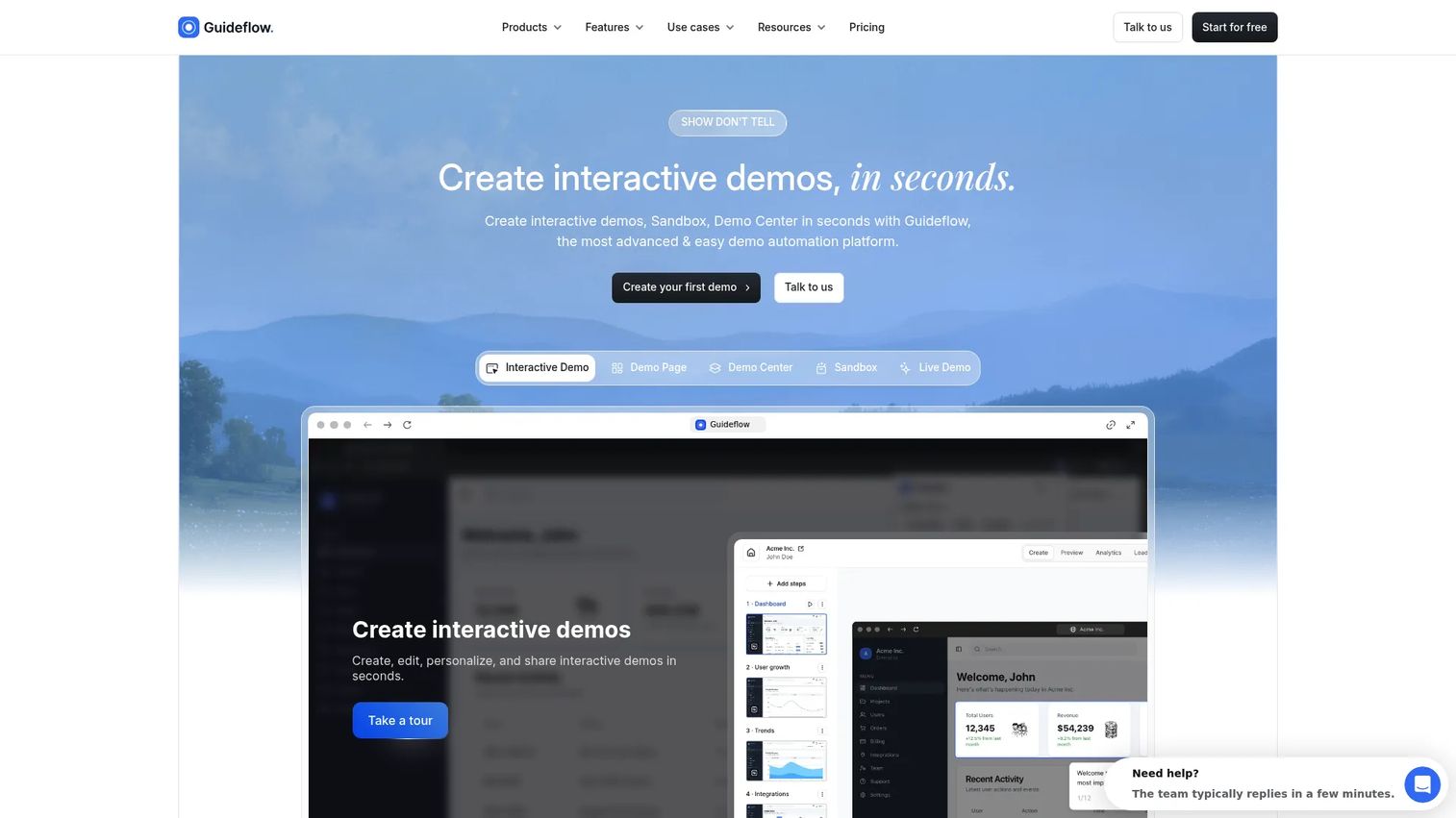
Guideflow is not a Highspot replacement. It fills the specific job Highspot does not cover: Turning buyer-facing product content from a static deck into an interactive demo a prospect can click through at their own pace. For enablement teams whose reps send PDFs after calls and get silence back, Guideflow gives both the rep and the enablement manager something measurable.
Best for: Enablement teams that want reps to send, embed, and organize interactive demos instead of relying on static follow-up links.
What it is: Guideflow is a demo automation platform with six demo formats: Interactive demos, demo pages, demo centers, sandboxes, live demos, and mobile demos. Demos are captured through the Chrome extension or the native app. Step content and CTAs are written automatically. The editor supports text, images, graphs, and branching. Guideflow integrates with HubSpot, Salesforce, Pipedrive, Zoho, and Marketo through its integrations layer.
Key features:
- Interactive demos buyers click through, with step-level completion, drop-off, and viewer flow analytics
- Demo centers as branded hubs for organizing and distributing demos by use case or persona
- Capture through the Chrome extension or the native app, with screenshot, HTML, and video modes
- Translation into more than 30 languages, with AI voiceover
- Company-level visitor identification; CRM records created when a viewer identifies through an in-demo form or personalized link
Where Guideflow falls short: Guideflow does not provide sales content governance, approval workflows, coaching, certifications, or rep scorecards. Teams whose primary need is a full enablement platform should use Guideflow alongside an enablement platform rather than replacing it. The platform rewards a structured demo content workflow, so teams sending only ad hoc one-off recordings will not use it at capacity.
Pricing: Free plan available. Annual plans: Solo $35 per user per month, Growth $499 per month, Advanced $1,499 per month, Enterprise from $2,999 per month. Enterprise adds SSO, advanced governance, and enterprise security.
G2 rating: 5.0
How it compares to Highspot: Highspot manages and governs enablement content. Guideflow makes the buyer-facing product content itself interactive and measurable after the call. The two tools address different layers of the enablement stack.
Start your journey with Guideflow today!
2. Seismic (sales enablement platform)
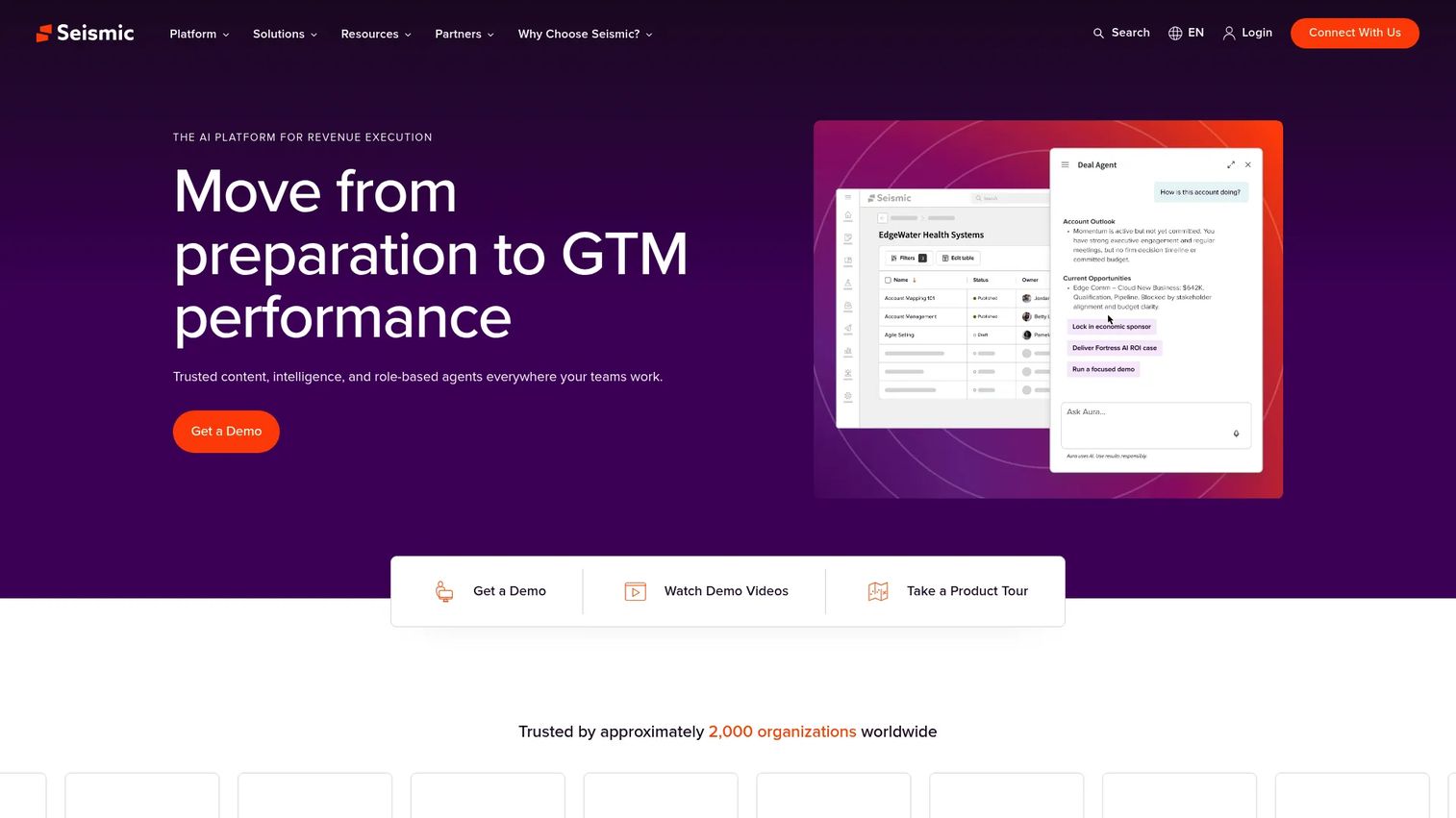
Seismic is widely considered the most direct full-platform alternative to Highspot for enterprise organizations. Its Enablement Cloud covers content management, learning, coaching, digital sales rooms, and AI-powered analytics in a single system designed for large go-to-market teams.
Best for: Enterprise GTM organizations replacing Highspot with an equivalent or broader sales enablement platform.
What it is: Seismic is an AI-powered sales enablement platform that unifies content, learning, coaching, buyer engagement, and enablement intelligence. It competes directly with Highspot at the enterprise tier and holds a 4.6 G2 rating.
Key features:
- Content management with personalized content delivery and governance
- Learning, onboarding, training, and coaching modules
- Digital Sales Rooms for buyer engagement
- AI-powered recommendations, workflow automation, and enablement analytics
- CRM and enterprise business-system integrations
Where Seismic falls short: G2 reviewers frequently cite implementation complexity and the admin load required to maintain a large Seismic deployment. Teams without dedicated enablement operations staff often find the ramp to full utilization longer than expected. Pricing requires a quote, and contracts for enterprise deployments can carry significant module and seat costs, making budget comparison difficult upfront.
Pricing: Seismic's terms reference subscription fees specified in customer order forms, covering editions such as Content Professional and Content Enterprise Premier. Contact Seismic for a quote.
G2 rating: 4.6
How it compares to Highspot: Seismic is the strongest like-for-like alternative when the goal is a mature enterprise enablement suite. Teams migrating from Highspot for feature depth or vendor preference will find Seismic covers the same surface area.
3. Showpad (sales enablement platform)
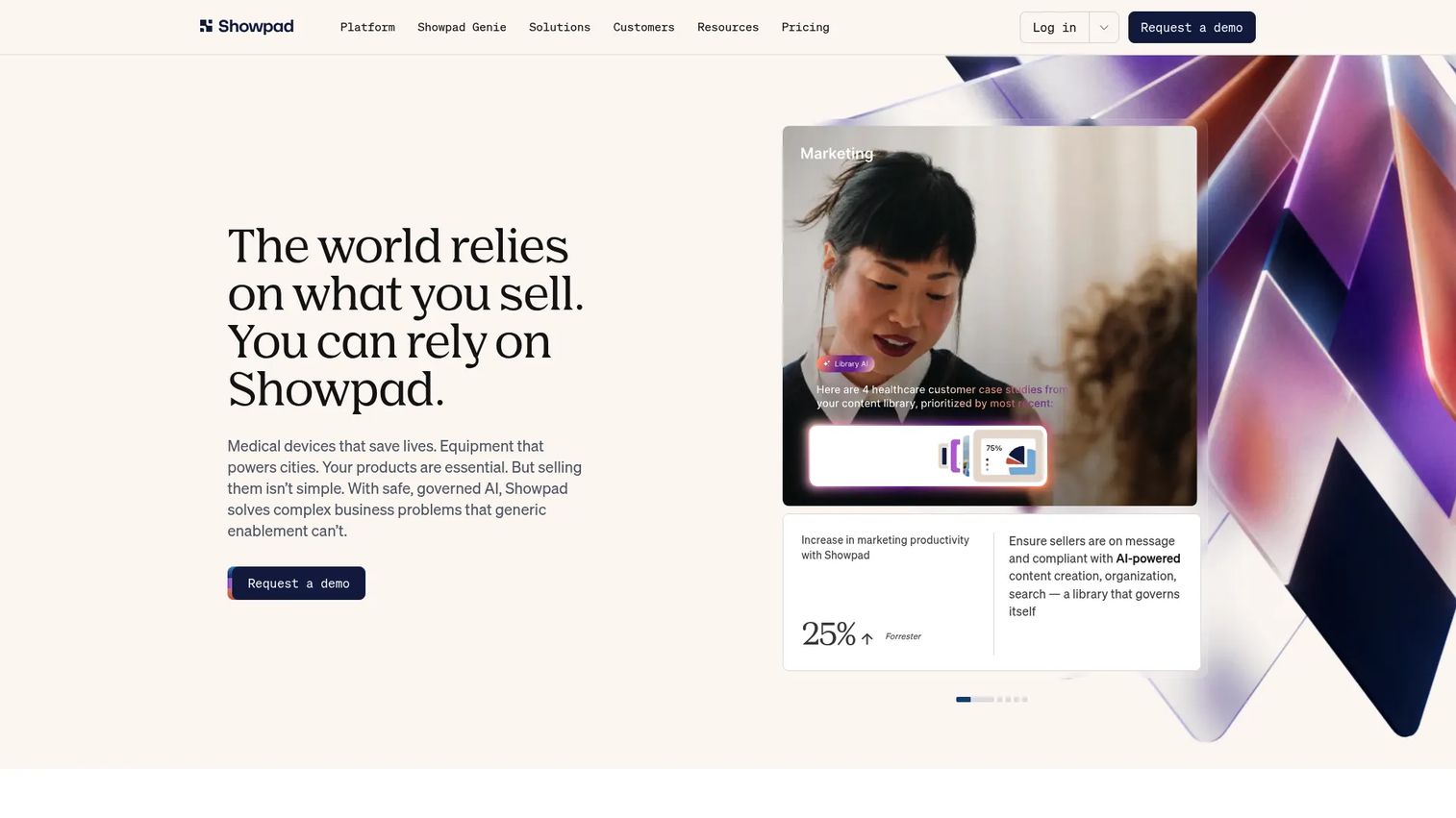
Showpad positions itself as an AI-native revenue effectiveness platform, with particular strength in content experience, seller readiness, and buyer engagement. It tends to resonate with mid-market to enterprise field-selling teams that want content and coaching to work together.
Best for: Enablement teams whose top priority is a connected content and coaching experience for field sellers.
What it is: Showpad combines sales content management, Shared Spaces for buyer engagement, seller readiness and training, and an AI suite including Genie Assistant, Roleplay AI, and Authoring AI. It offers Professional, Advanced, and Expert packages on a quote-based model.
Key features:
- Sales content management and AI-powered content recommendations
- Seller readiness with Roleplay AI and certifications
- Shared Spaces for buyer-facing collaboration
- Genie Assistant and Field Seller Agent for AI guidance
- Enablement analytics and revenue intelligence
Where Showpad falls short: G2 reviewers note that search and content discovery can require careful taxonomy setup to perform well. Some reviewers report that reporting depth in lower tiers does not match what large enterprise teams expect from a mature enablement platform. All plans are quote-based, which makes upfront cost comparisons difficult.
Pricing: Quote-based across Professional, Advanced, and Expert editions.
G2 rating: 4.6
How it compares to Highspot: A strong alternative when the priority is content experience and coaching combined, particularly for teams that find Highspot's training features sufficient but want better content adoption analytics.
4. Mindtickle (sales readiness platform)
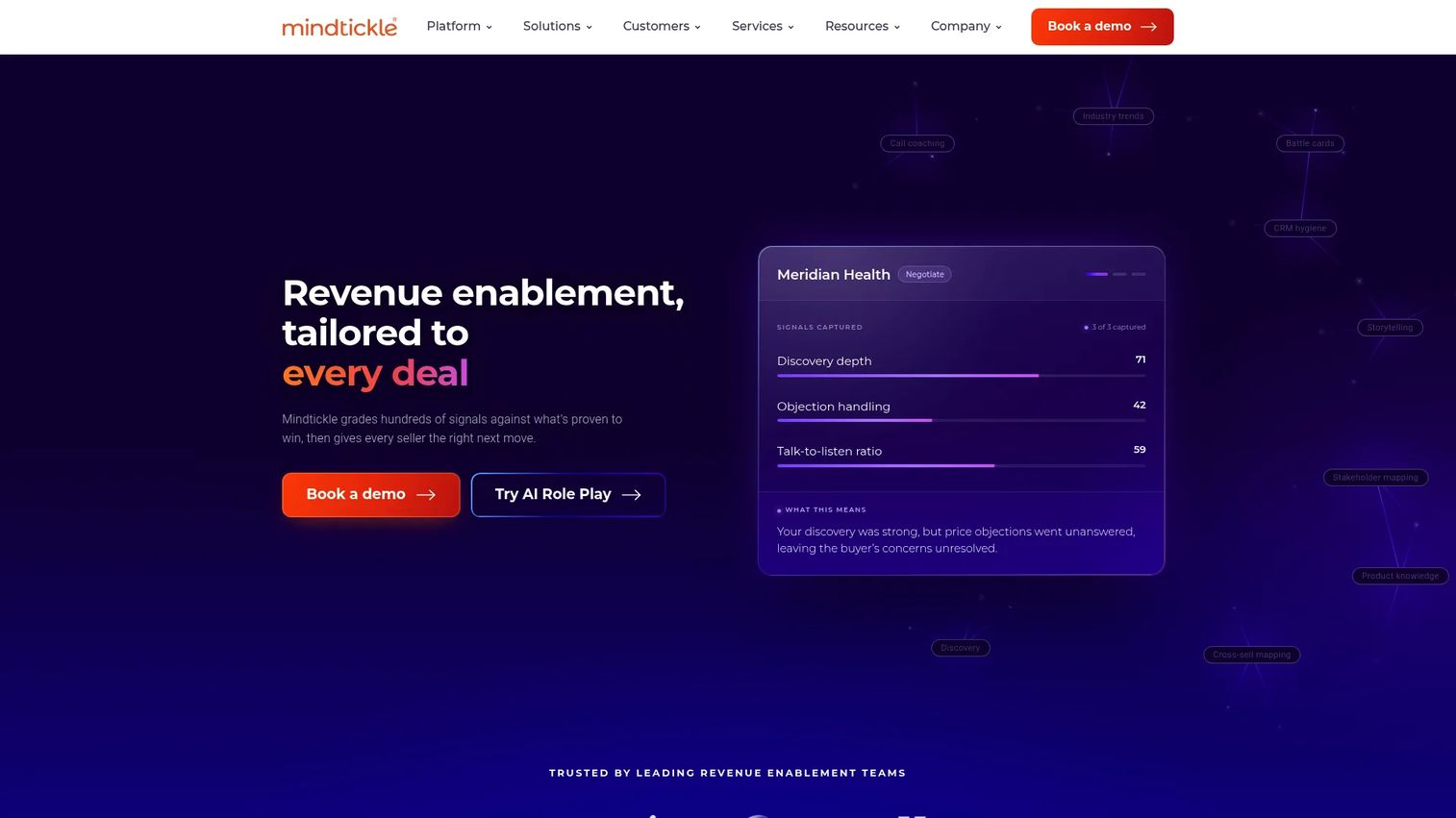
Mindtickle is the strongest purpose-built option when readiness, rep behavior change, and certification are the core gap. It runs training, AI role play, coaching, and conversation intelligence in a platform designed around measurable rep readiness.
Best for: Enablement managers whose main Highspot gap is structured onboarding, certification programs, and rep practice.
What it is: Mindtickle is a revenue enablement platform for sales training, coaching, content management, conversation intelligence, and seller-readiness analytics. Its Readiness Index gives managers a scored view of rep preparedness. G2 rates it 4.7.
Key features:
- Sales training, onboarding programs, and certification paths
- AI role play and personalized coaching workflows
- Conversation intelligence with call recording, transcription, and scoring
- Sales content management and digital sales rooms
- Readiness Index and enablement performance analytics
Where Mindtickle falls short: Mindtickle does not publish pricing, and enterprise contracts are quote-based with complexity driven by seat count and module selection. G2 reviewers note that the platform requires meaningful program design investment to operate at its best. Teams looking primarily for content governance rather than rep readiness may find the depth uneven.
Pricing: Quote-based.
G2 rating: 4.7
How it compares to Highspot: Mindtickle outpaces Highspot when the job is changing rep behavior through practice, certification, and AI coaching rather than content access alone.
5. Allego (sales enablement platform)
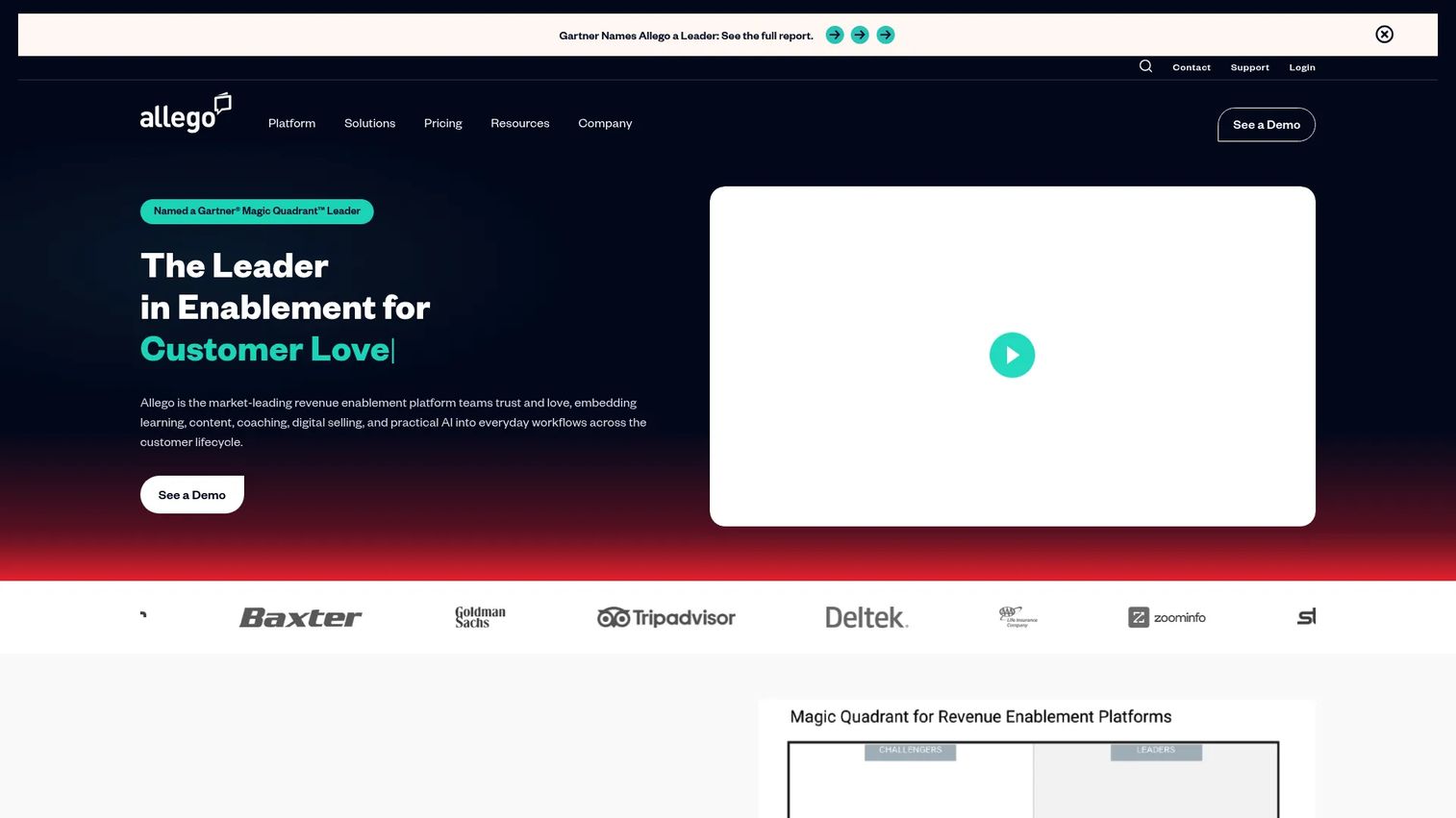
Allego combines sales content management, modern learning, AI role play, conversation intelligence, and digital sales rooms. It has a particular track record with distributed revenue teams and organizations that need video-based coaching alongside content enablement.
Best for: Revenue teams that need video coaching, peer learning, and content enablement to carry equal weight.
What it is: Allego is a revenue enablement platform that covers learning, coaching, content management, conversation intelligence, digital rooms, and practical AI agents. It is built for distributed or high-velocity selling environments.
Key features:
- Modern learning, onboarding, and AI role play
- Conversation intelligence with call recording and analysis
- Content management with AI-powered search and recommendations
- Digital sales rooms and Deal Navigator
- AI agents for seller guidance
Where Allego falls short: Allego's pricing is per user per month, billed annually upfront, with typical contracts running three years. G2 reviewers note that the multi-year commitment and lack of published prices make budgeting conversations with procurement difficult. Some reviewers report that the content management depth does not match the platform's coaching and learning strength.
Pricing: Quote-based, per user per month, billed annually. Typical contracts are three years.
G2 rating: 4.6
How it compares to Highspot: A stronger fit when coaching and video-based learning need to sit at the same level as content management. Teams whose main Highspot gap is practice and conversation intelligence will find Allego more purpose-built for those jobs.
6. Mediafly (revenue enablement platform)
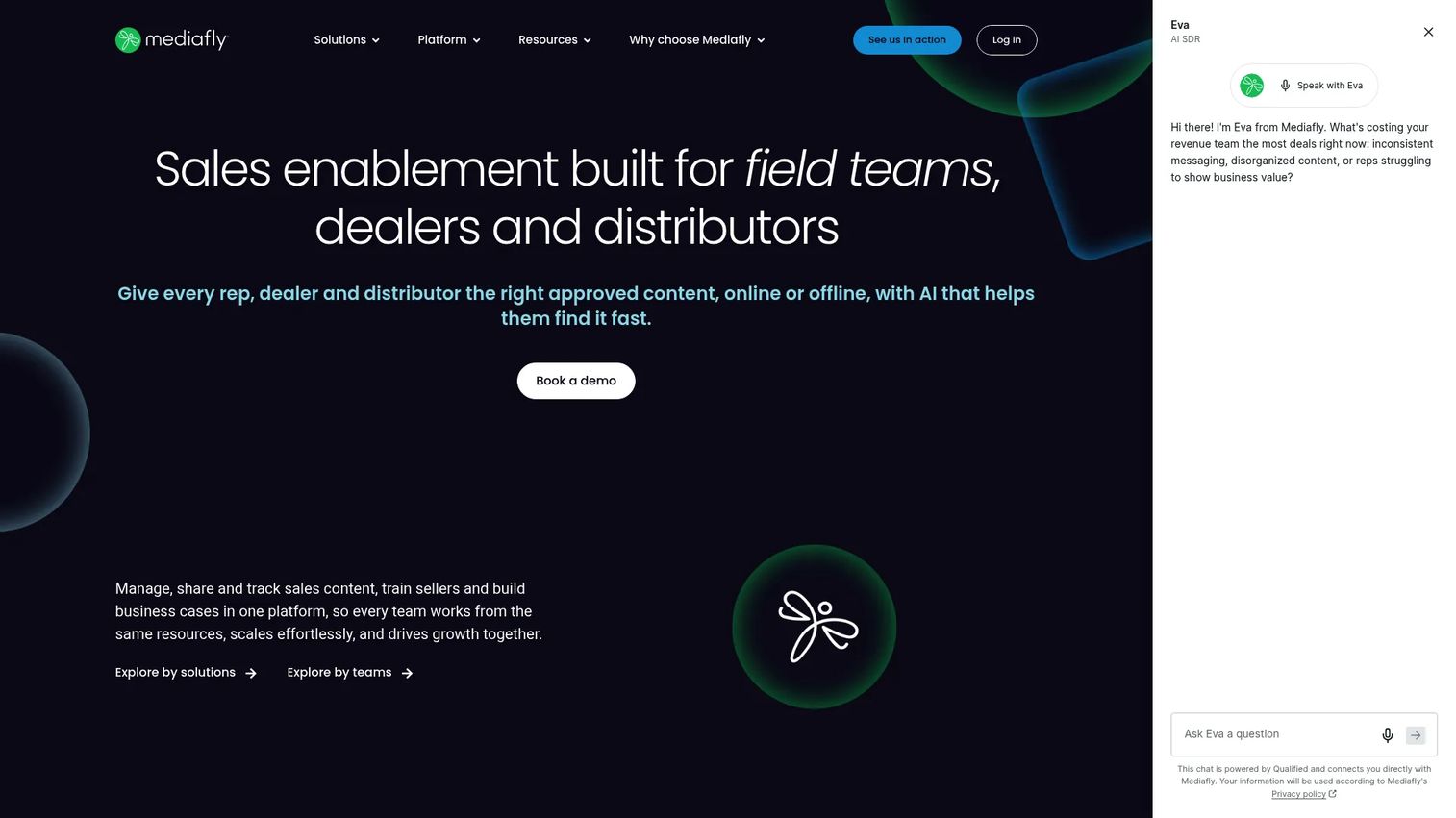
Mediafly adds value-selling tools to the standard enablement stack, making it a fit for revenue teams where financial justification and ROI conversations are part of the sales process alongside content and coaching.
Best for: Enterprise B2B revenue teams that need content enablement, value selling, and buyer engagement to connect.
What it is: Mediafly is an enterprise revenue enablement platform combining AI-powered content management, digital sales rooms, ROI and TCO calculators, Salesforce-native learning, and an AI Command Center. It holds a 4.4 G2 rating.
Key features:
- AI-powered sales content management and governance
- Digital sales rooms, branded workspaces, and buyer engagement analytics
- ROI, TCO, and business-value assessment tools
- Salesforce-native learning, onboarding, certification, and coaching
- AI search, content summaries, and Command Center recommendations
Where Mediafly falls short: G2 reviewers note that Mediafly's complexity can outpace the needs of teams that only require content management without the value-selling layer. Implementation and content buildout require significant effort. No public pricing exists, so cost visibility requires a sales conversation.
Pricing: Quote-based. Pricing is customized by selected modules, user counts, and integration requirements. Contact Mediafly for a quote.
G2 rating: 4.4
How it compares to Highspot: Mediafly earns its place when value-selling tools and buyer engagement analytics need to live alongside content enablement. Teams whose sales conversations involve financial justification will find capabilities Highspot does not cover.
7. SalesHood (sales readiness platform)
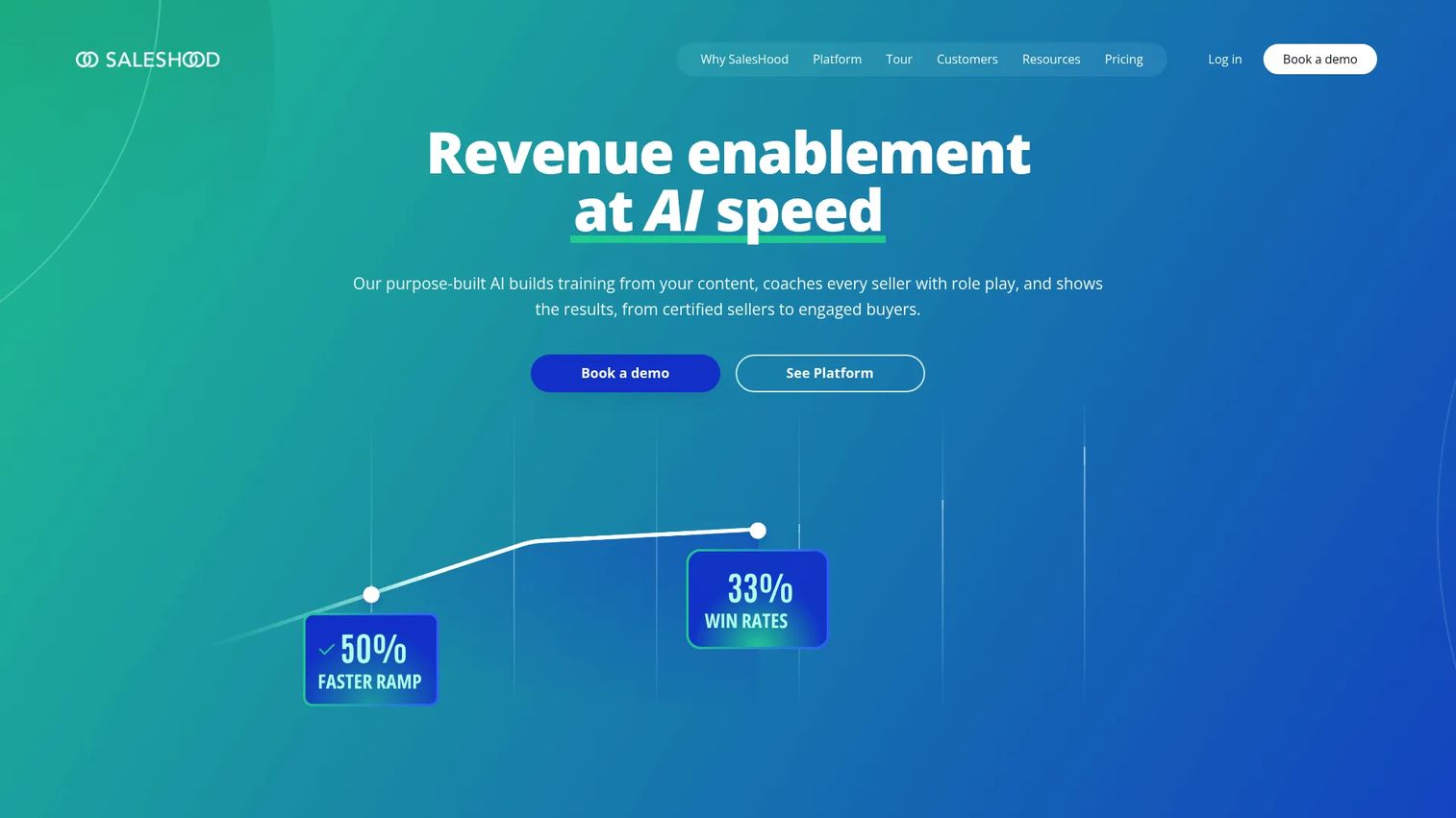
SalesHood is an AI-powered revenue enablement platform built around content management, onboarding programs, coaching, and guided selling. Its Digital Sales Rooms with mutual action plans add a buyer-facing layer to the readiness core.
Best for: Revenue teams building structured onboarding paths and ongoing manager-led coaching programs.
Key features:
- AI-powered sales content search and centralized content management
- Learning programs, onboarding, certifications, AI role play, and personalized coaching
- Digital Sales Rooms with mutual action plans, buyer engagement tracking, and AI call recaps
Where SalesHood falls short: G2 reviewers note that administration and program design require hands-on ownership to work well. SalesHood lists Essential, Pro, and Unlimited editions on its pricing page but displays no public prices for any tier, making budget comparison difficult. Some reviewers report that reporting depth and CRM integration quality vary by edition.
Pricing: Contact SalesHood for a quote.
G2 rating: 4.6
How it compares to Highspot: Better fit when the core need is manager-led readiness programs and guided selling motions rather than broad enterprise content governance.
8. Paperflite (buyer engagement and content platform)
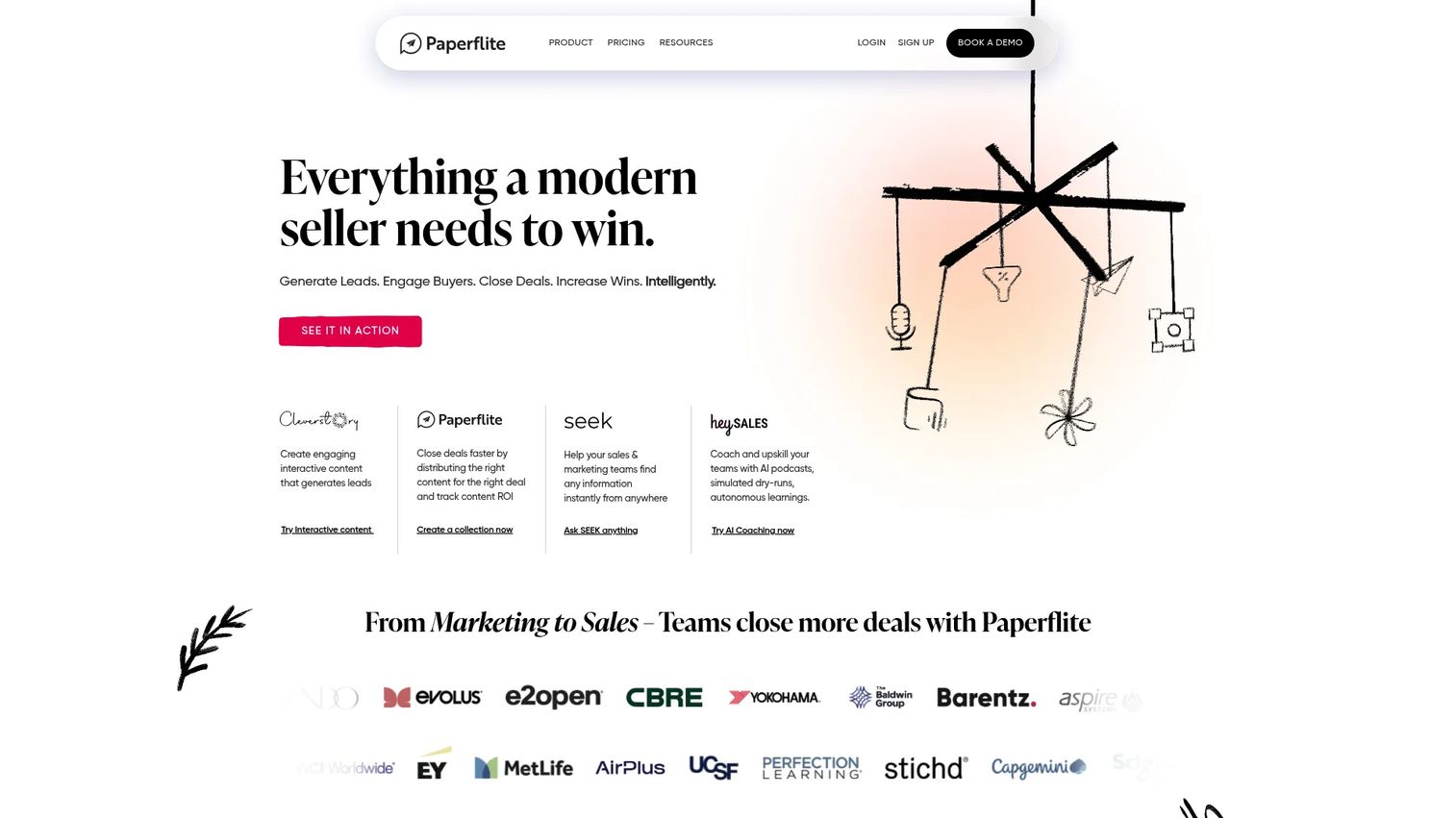
Paperflite publishes entry-tier pricing and focuses on content organization, personalized buyer microsites, engagement tracking, and digital deal rooms. It sits in the buyer engagement space rather than the full enablement platform category.
Best for: B2B sales and marketing teams that need centralized content management, buyer-facing content experiences, and engagement analytics without buying another enterprise enablement suite.
What it is: Paperflite is an AI-powered revenue enablement platform for organizing, sharing, personalizing, and measuring sales and marketing content. It covers content intelligence, curation, personalized microsites, digital deal rooms, and predictive deal insights.
Key features:
- Content curation, centralized management, and AI-powered content discovery
- Personalized content microsites and collections for buyer-facing sharing
- Digital deal rooms with predictive deal insights
- Content intelligence and engagement tracking
- CRM, email, and cloud-storage integrations
Where Paperflite falls short: Paperflite does not cover readiness, coaching, or certifications, so teams replacing Highspot's full scope will need to address those jobs separately. G2 reviewers mention that search and customization options can require setup investment. The minimum of five users on annual plans makes it less flexible for small teams.
Pricing: Annual billing, minimum five users. Plans: "I Got Wings" $27.50 per user per month, "I Believe I Can Fly" $47.50 per user per month, "Touch The Sky" $57 per user per month. Enterprise pricing is a custom quote.
G2 rating: 4.7
How it compares to Highspot: A narrower content-sharing and buyer engagement alternative for teams whose Highspot pain is static content delivery rather than full enablement governance.
9. Guru (knowledge management platform)
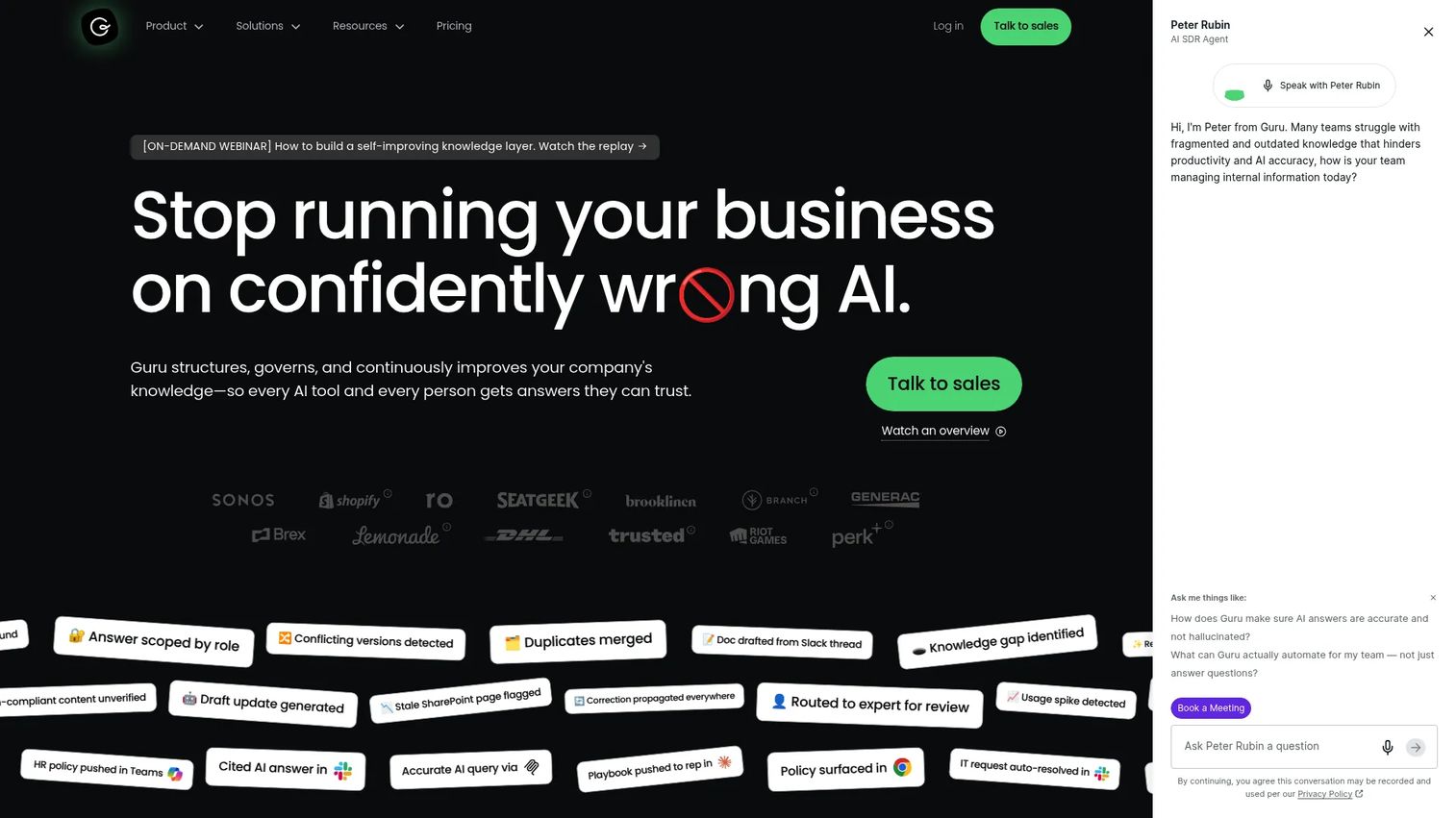
Guru addresses the rep answer-findability problem specifically. If the main Highspot complaint is that reps cannot surface trusted answers inside their daily workflow, Guru is built for that job.
Best for: Organizations where the core pain is reps spending time searching for trusted answers rather than content governance or readiness.
What it is: Guru is a governed AI knowledge platform that structures, verifies, and delivers trusted answers across an organization. It connects more than 100 source connectors, applies permission-aware search, and automates knowledge verification and maintenance.
Key features:
- 100-plus source connectors and unified knowledge index
- Permission-aware search and ingestion
- Automated verification, maintenance, and content updates
Where Guru falls short: Guru is not a full sales enablement platform and was not built for coaching, certification, or buyer engagement. G2 reviewers note that knowledge sprawl can develop without strong governance ownership, and AI answer accuracy improves significantly only after a well-organized knowledge base is in place. No public pricing is displayed.
Pricing: Quote-based. Guru's pricing page describes custom packages based on organizational scale, knowledge complexity, and AI maturity. Contact Guru for a quote.
G2 rating: 4.7
How it compares to Highspot: Better for surfacing trusted answers in-workflow than for governing and distributing sales content across a full GTM team.
10. GTM Buddy (revenue activation platform)
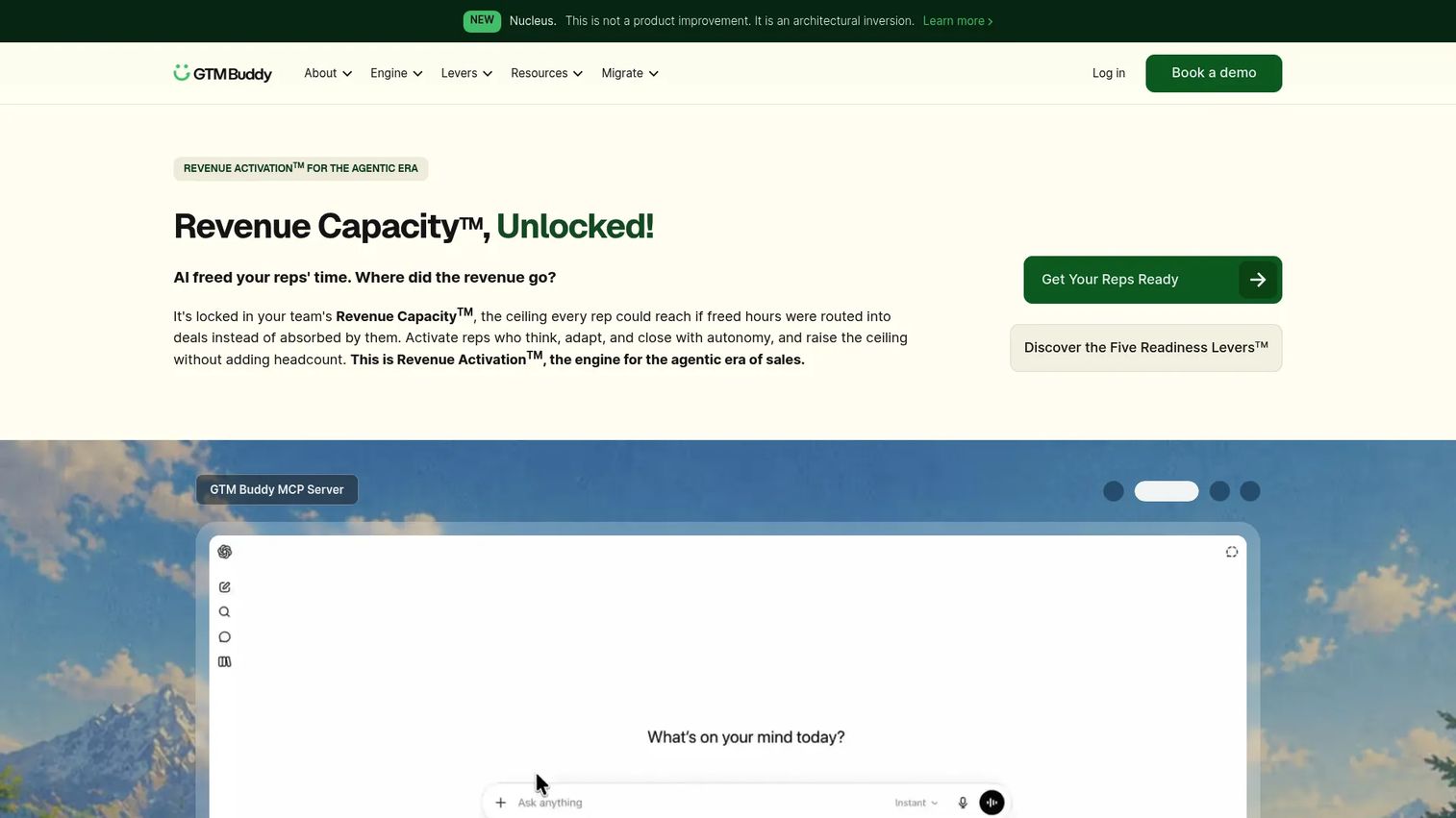
GTM Buddy focuses on activating content inside seller workflows rather than building a static library. Its AI recommendations, in-flow delivery across CRM and email, and Ask Buddy assistant address the content adoption problem from the workflow side.
Best for: Revenue teams whose main enablement gap is content adoption inside seller workflows rather than content creation or readiness programs.
What it is: GTM Buddy is a revenue activation platform combining AI guidance, content, coaching, learning, buyer engagement, deal signals, and RFP automation. It emphasizes contextual content delivery at the moment a rep needs it.
Key features:
- In-flow activation across CRM, email, and meetings
- Content hub with auto-tagging and plain-language search
- AI Roleplay and coaching precision based on deal-relevant moments
- Ask Buddy AI assistant with sourced answers
- Digital Sales Room and RFP response automation
Where GTM Buddy falls short: GTM Buddy's effectiveness depends heavily on CRM and content hygiene upstream. G2 reviewers note that setup and integration configuration require investment before in-flow recommendations become reliable. No public pricing was found on GTM Buddy's site or its G2 listing.
Pricing: Quote-based.
G2 rating: 4.8
How it compares to Highspot: A stronger fit when the core problem is activating existing content in the moment of need rather than governing a content library or running readiness programs.
11. GetAccept (digital sales room)
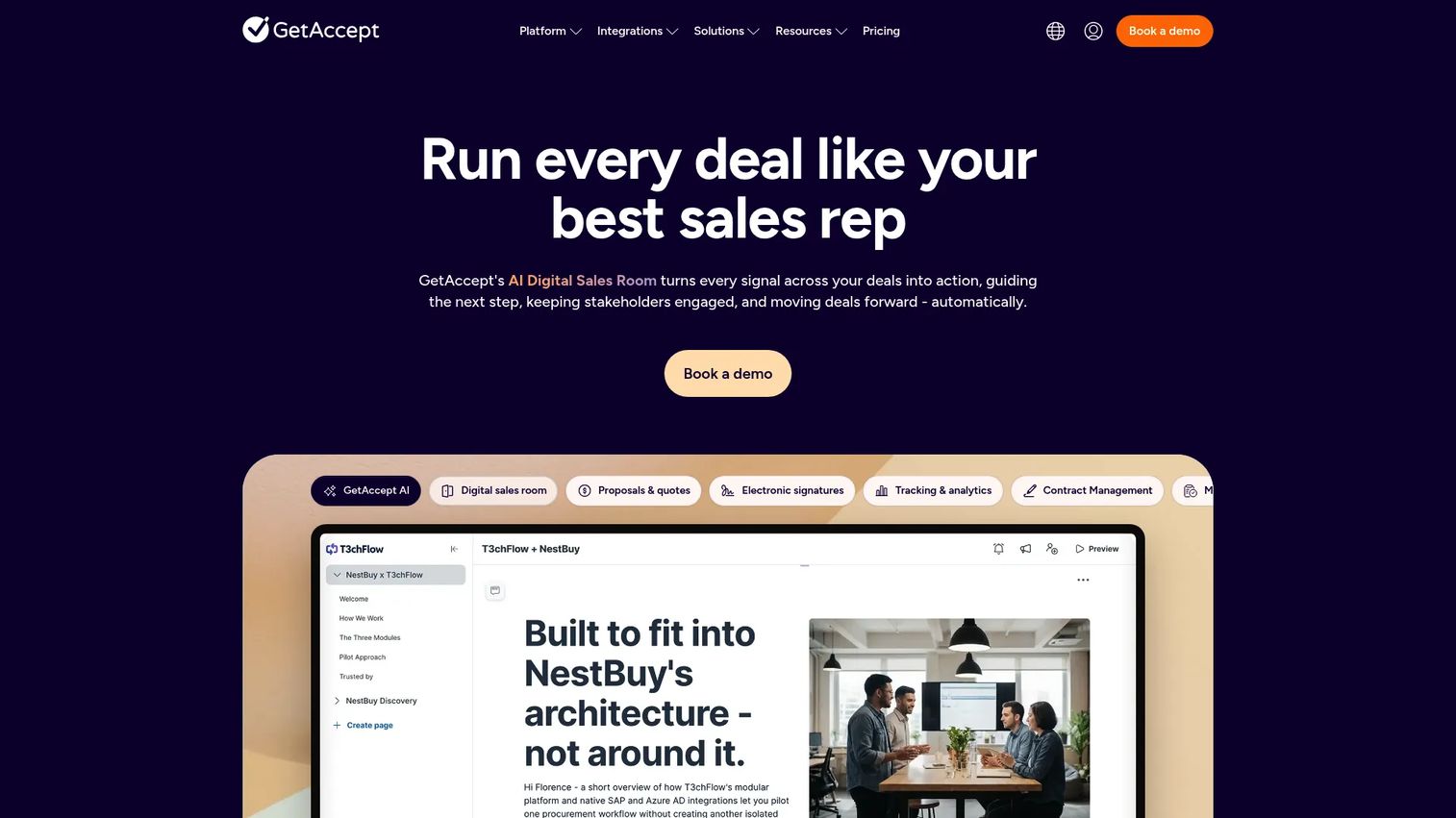
GetAccept covers the deal-execution layer: Proposals, quotes, electronic signatures, contract management, mutual action plans, and buyer engagement within live opportunities. It publishes entry-tier pricing, which is unusual in this field.
Best for: Revenue teams managing proposals, contracts, and stakeholder engagement during active deal cycles.
What it is: GetAccept is an AI-powered digital sales room platform for proposals, quotes, e-signatures, contract management, engagement, and deal analytics. It offers eSign and Professional plans with published pricing, plus an Enterprise tier on a custom quote.
Key features:
- Digital sales rooms with mutual action plans and buyer engagement tracking
- Electronic signatures and contract management
- Proposals, quotes, and CPQ on Enterprise
- AI editor, smart content, meeting summarizer, and AI knowledge base
- CRM integrations and tracking analytics
Where GetAccept falls short: GetAccept does not cover sales readiness, coaching, or broad content governance. G2 reviewers note that document workflow complexity and admin requirements increase on higher-volume deployments. Some reviewers report integration depth with specific CRMs requires configuration effort.
Pricing: eSign $25 per user per month (monthly or annually, 12-month agreement). Professional $49 per user per month (annually, minimum five users). Enterprise: Contact sales.
G2 rating: 4.6
How it compares to Highspot: Built for deal execution and buyer collaboration rather than internal enablement operations. Teams whose Highspot pain is in live deal stages will find GetAccept addresses a different layer than Highspot covers.
12. Bigtincan Engagement (sales enablement platform)
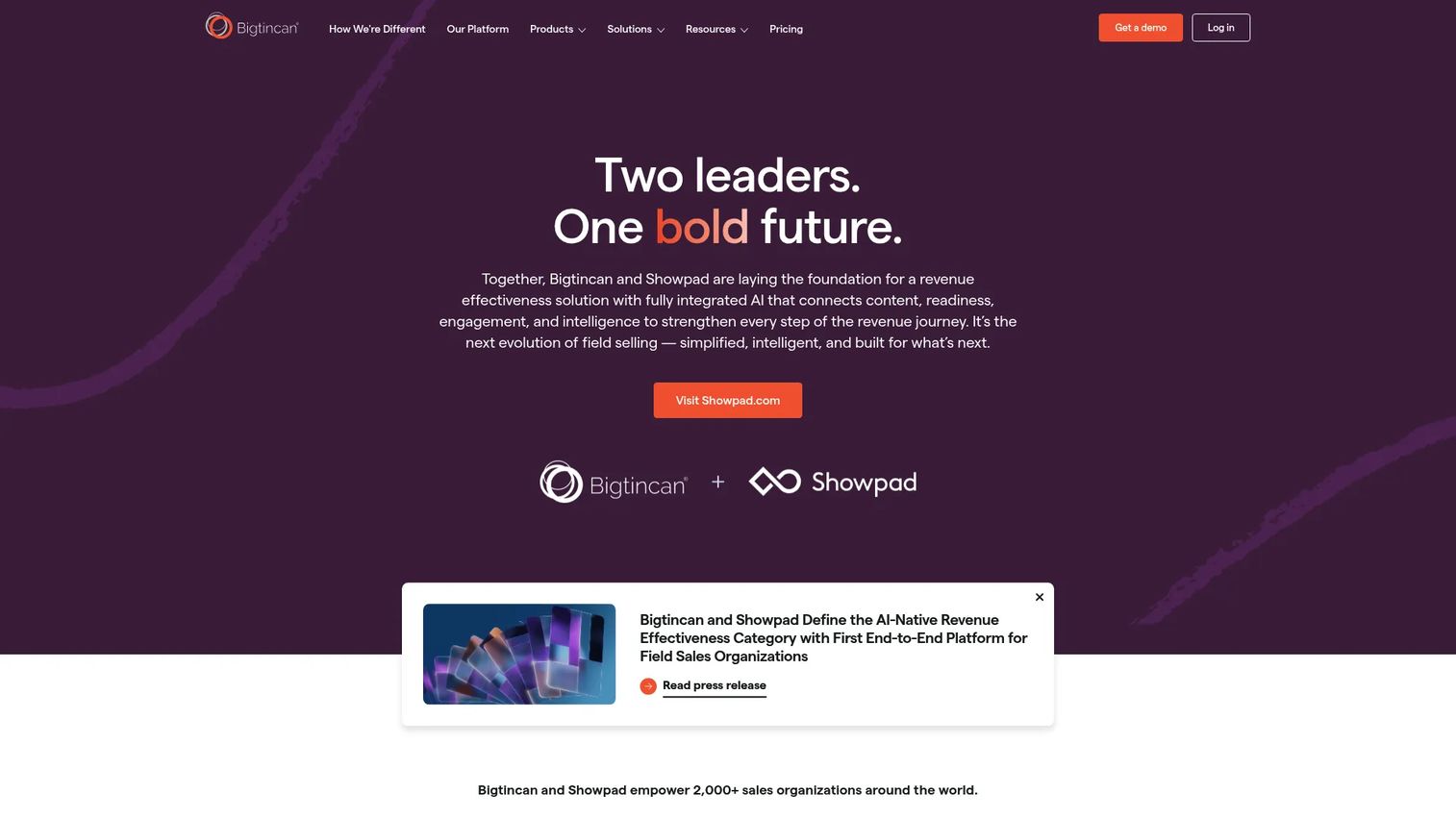
Bigtincan Engagement focuses on buyer experience during meetings and in digital sales rooms, with AI meeting intelligence, conversation insights, and engagement analytics. It covers the buyer-attention layer rather than internal content governance.
Best for: Mid-market and enterprise revenue teams that need buyer engagement tracking, personalized sales experiences, and AI-assisted meeting workflows.
What it is: Bigtincan Engagement helps revenue teams create measurable buyer experiences through video meetings with buyer-attention tracking, MeetingsAI for notes and CRM logging, conversation intelligence, personalized digital sales rooms, and email and link sharing with engagement analytics.
Key features:
- Video conferencing with buyer-attention tracking
- MeetingsAI for meeting notes, transcripts, and CRM logging
- Conversation intelligence with clarity, pace, and tone insights
- Personalized digital sales rooms
- Reporting and analytics for content and buyer engagement
Where Bigtincan Engagement falls short: G2 reviewers note that Bigtincan Engagement's 4.1 rating reflects mixed feedback on reliability and admin experience. Platform complexity can be a friction point for smaller teams. Essential and Elite editions are available, but no public pricing is displayed. Implementation effort is a recurring G2 theme.
Pricing: Quote-based. Bigtincan lists Essential and Elite editions but displays no public prices. Contact Bigtincan for a quote.
G2 rating: 4.1
How it compares to Highspot: Covers buyer engagement analytics and AI meeting intelligence rather than the full enablement platform scope. Teams that specifically need meeting-level buyer signals will find capabilities Highspot does not prioritize.
Which Highspot alternative is best for buyer-facing demo content?
Guideflow is the best fit when the job is making product content interactive and measurable after the call.
Enablement managers handling product launches, competitive follow-up, post-demo leave-behinds, onboarding, and partner content increasingly need content that shows the product rather than describing it. When a rep sends a deck, the conversation ends. When a rep sends an interactive demo, the buyer clicks through the product at their own pace, and the enablement team sees step-level completion, drop-off, and viewer flow. Demo centers organize that content into a branded hub organized by use case or persona. For teams whose Highspot gap is static buyer-facing content, Guideflow addresses that specific job. It does not replace content governance, coaching, or certifications, so it typically sits beside an enablement platform rather than replacing one.
Which Highspot alternative is best for sales readiness and coaching?
Mindtickle, Allego, and SalesHood are the strongest fits when readiness, certification, and coaching are the core gaps.
Mindtickle suits structured readiness programs at scale, with a Readiness Index, AI role play, and conversation intelligence built around rep behavior change. Allego fits better when video coaching and distributed team learning need to work alongside content. SalesHood is the right choice for teams building onboarding paths and manager-led coaching programs tied to plays and certifications. All three go deeper on rep readiness than Highspot does in its training features. Guideflow can support training and onboarding with interactive demos that show how workflows operate, but it does not provide certifications or rep scorecards.
Which Highspot alternative is best for content governance?
Seismic and Showpad are the most natural options when governed sales content at enterprise scale is the primary job.
Both platforms handle version control, ownership, approval workflows, permissions, CRM integration, and analytics across a full content library. Seismic tends to fit teams that need the broadest surface area and most mature governance infrastructure. Showpad fits teams that prioritize content experience and rep adoption alongside governance. These are the situations where the cost and implementation effort of an enterprise enablement platform earns its place, because the governance capabilities are built for that specific job and the alternatives cannot match them without significant workarounds.
Which Highspot alternative is best for digital sales rooms?
GetAccept is the strongest fit for deal-stage buyer collaboration and proposals.
Digital sales rooms cover a different job than demo centers. A demo center, like those in Guideflow, is an organized branded hub where buyer-facing demos live by use case or persona. A digital sales room is a shared deal space where proposals, contracts, mutual action plans, and stakeholder engagement happen during live opportunities. GetAccept publishes pricing, covers the full e-signature and proposal workflow, and includes AI tools for meeting recaps and smart content. Paperflite covers some digital deal room functionality alongside its content-sharing capabilities. Teams comparing GetAccept and Paperflite should map the tool to whether their gap is in deal execution or in content sharing and buyer engagement.
What is the cheapest Highspot alternative?
Paperflite has the lowest published entry tier among the full-service tools, at $27.50 per user per month on annual billing.
GetAccept starts at $25 per user per month for its eSign tier, which covers electronic signatures and document workflows. Guideflow has a free plan. Most enterprise enablement platforms, including Seismic, Showpad, Mindtickle, Allego, Mediafly, SalesHood, Guru, GTM Buddy, and Bigtincan Engagement, use quote-based pricing. For those platforms, the cost drivers to ask about are seat count, module selection, contract length, implementation services, and CRM integration requirements. A quote-based platform that fits the job often costs less in outcome than a published-price platform that requires workarounds.
When should you stay with Highspot?
Stay with Highspot when adoption is working, the renewal cost is defensible against the value delivered, and the main jobs are content governance, rep guidance, readiness, and enterprise enablement analytics in one platform.
Specific reasons to stay:
- Sellers and managers actively use the platform, and content usage by asset, stage, and segment is visible.
- CRM integration is live and trusted, with engagement data flowing into pipeline reporting.
- Leadership uses the enablement analytics for quarterly reviews and strategy.
- Switching costs, including data migration, rep retraining, and integration reconfiguration, outweigh the gap you are trying to close.
For teams with strong Highspot adoption who want to close a narrow gap, adding a specialized tool beside Highspot is often the right answer. A team might keep Highspot for internal enablement and add Guideflow for buyer-facing demos, or add Guru for in-workflow knowledge delivery, or add GetAccept for deal-stage digital rooms.
Why teams switch from Highspot to Guideflow for buyer-facing demo content
The switch happens when reps are sending product follow-up as a PDF or slide link and getting silence. Highspot governs and distributes that content well. What it does not do is make the content itself interactive, measurable, or capable of showing the product to a buyer who was never on the call.
Guideflow fits enablement managers in four specific ways. Reps can send an interactive demo as a leave-behind after a call, embedded in an email, shared in outbound, or dropped into a partner portal. The buyer clicks through the product at their own pace. Demo centers organize the team's full library of interactive demos by use case, persona, or stage, so reps find and send the right demo quickly. Analytics show step-level completion, drop-off, and viewer flow, with impressions and conversion tracked at the demo level. Visitor identification works at the company level, and CRM records are created when a viewer identifies through an in-demo form or a personalized link, so pipeline data stays clean. Guideflow supports translation into more than 30 languages, which matters for teams running global outbound or partner programs.
Guideflow does not handle content governance, coaching, or certifications. Teams that need those capabilities alongside interactive demos typically keep an enablement platform and add Guideflow for the buyer-facing content layer.
Start your journey with Guideflow today!
FAQs
There is no single best answer, because the right Highspot alternative depends on the job being replaced. Guideflow is the best choice when the specific need is buyer-facing interactive demo content, demo centers, and post-call engagement analytics. Seismic is the strongest full-platform replacement for enterprise teams. Mindtickle is the best fit for readiness, certification, and AI coaching. Showpad suits teams prioritizing content experience and adoption.
Sales enablement managers typically need to close one of several gaps: Content governance, rep readiness, buyer-facing content quality, or in-workflow knowledge delivery. Seismic and Showpad address content governance at enterprise scale. Mindtickle and Allego address rep readiness and coaching. Guideflow addresses buyer-facing demo content. Guru addresses in-workflow knowledge findability. Mapping the tool to the specific job produces a better outcome than comparing feature lists across platforms designed for different purposes.
No. Guideflow is a demo automation platform for buyer-facing interactive demo content, demo centers, and demo analytics. It does not provide sales content governance, approval workflows, coaching, certifications, or rep scorecards. Teams that need those capabilities should keep a sales enablement platform in the stack and use Guideflow to add interactive, measurable product content to the buyer-facing layer.
Sales enablement software manages how sellers learn, access content, and execute consistently. It covers content governance, training programs, rep readiness, coaching, and analytics across the enablement operation. Demo automation software helps teams create, share, and measure interactive product demos that buyers can experience at their own pace. The two categories solve different problems and often coexist in a mature GTM stack.
Mindtickle, Allego, and SalesHood are the three strongest options. Mindtickle goes deepest on structured readiness programs with a Readiness Index, AI role play, and conversation intelligence. Allego suits teams where video coaching and distributed learning need to run alongside content. SalesHood is the right fit for manager-led onboarding programs and guided selling motions tied to certifications and plays.
GetAccept is the strongest purpose-built digital sales room option, with published pricing, proposals, e-signatures, mutual action plans, and buyer engagement analytics. Paperflite includes digital deal rooms as part of its broader content-sharing platform. Demo centers in Guideflow are a different concept: They organize interactive demos into a branded buyer-exploration hub, while digital sales rooms are collaborative deal spaces for active opportunities.
Compare by the job being replaced, not by feature checklist length. The key questions are: What enablement job is underperforming (content governance, rep readiness, buyer engagement, in-workflow answers, deal execution), what adoption is required, what CRM integration must work from day one, and what implementation effort the team can support. Pricing models also differ significantly. Most enterprise platforms use quote-based annual contracts. Mapping contract terms, seat counts, and required modules gives a more accurate cost comparison than a headline price.
Yes, and many teams do. Coexistence is often the right answer. A team might keep Highspot for internal content governance, rep training, and analytics while adding Guideflow for buyer-facing interactive demos and demo center organization. Similarly, a team might keep Highspot and add Guru for in-workflow knowledge delivery, or add GetAccept for deal-stage buyer rooms. The goal is to close a specific gap without replacing a platform where adoption is already working.