Healthcare training teams assign courses while also proving workforce readiness across rotating shifts, changing requirements, and credential deadlines.
A completion checkbox rarely answers the questions leadership asks. Who can perform the procedure? Which certification expires next month? Can you produce the correct training record during an audit?
This category keeps growing alongside those demands. Mordor Intelligence reported in 2026 that compliance training represented 30.12% of healthcare LMS applications during 2025. Hospitals and health systems accounted for 50.94% of demand.
The right healthcare LMS connects clinical staff training with competency tracking, CE credits, certification management, and audit reporting. Your shortlist should reflect how work happens across locations and shifts, rather than focusing on course delivery alone.
What’s inside
This guide is for healthcare training, HR, compliance, clinical education, and enablement leaders evaluating learning management systems for healthcare.
We selected platforms based on:
- Healthcare fit across providers, hospitals, and care organizations
- Compliance workflows and reporting depth
- Competency, credential, and certification tracking
- Learner access, mobile delivery, and accessibility
- Integrations with HRIS and workforce systems
You’ll find a 15 product comparison, detailed vendor reviews, a buyer checklist, and practical FAQs. Pricing comes from vendor pages, while ratings reflect current G2 listings supplied for this review.
TL;DR
- Best for large healthcare systems: HealthStream supports healthcare learning, credentialing, workforce development, and competency management
- Best for healthcare content depth: Relias combines healthcare course libraries with skills checklists, mobile access, and requirements tracking
- Best for compliance operations: MedTrainer connects learning with credentialing, policies, documentation, and enterprise reporting
- Best for long term care: Healthcare Academy focuses on staff education and digital competency documentation
- Best general LMS options: TalentLMS, Absorb LMS, LearnUpon LMS, and iSpring Learn support flexible internal or external programs
- Best for mobile workforces: Connecteam brings courses, quizzes, checklists, and team communication to deskless staff
What is healthcare LMS software?
Healthcare LMS software is a learning management system designed to assign, deliver, track, and report training for healthcare workforces.
These platforms support compliance courses, clinical education, competency development, credentials, and continuing education. They also give administrators records that show who completed an assigned activity and when it happened.
A healthcare compliance LMS usually serves several learner groups. Nurses may need clinical education and CE credits. Managers may need skills checklists or competency records. Compliance teams need overdue training reports and policy evidence.
The strongest platforms also account for operational realities. Clinical learners work across departments, locations, and shifts. Mobile access matters because many staff members rarely sit at a desk.
Key capabilities to look for
- Compliance assignment and completion tracking
- Credential and certification expiration alerts
- Competency checklists and skills validation
- Continuing education credit tracking
- Audit reports and learning transcripts
- Mobile access for shift based teams
- HRIS and SSO integrations
- Accessible navigation and learning content
Healthcare LMS versus a traditional LMS
A traditional LMS hosts courses, assigns learners, and records completion. That foundation works for standard employee education.
Learning management systems for healthcare often add workforce requirements beyond basic delivery. These can include role based assignments, credential records, competency validation, and continuing education documentation.
A healthcare LMS should also provide reporting that supports internal reviews or external audits. Buyers should test whether reports show course versions, assignment dates, completion status, and overdue learners.
The distinction matters because course completion and demonstrated competency are different records. Watching a module confirms participation. A manager signoff or skills assessment provides stronger evidence of readiness.
The best LMS for healthcare depends on which evidence your organization must maintain. Start with the records you need, then evaluate the learner experience and content library.
When to use a healthcare LMS
Train clinical staff across roles and locations
Use a healthcare LMS when onboarding varies by department, site, or manager. Central assignment rules help standardize required education across nurses, administrators, allied health workers, and care teams.
An LMS for hospitals can also segment paths by role or location. That structure supports consistent readiness without forcing every learner through irrelevant material.
Prove compliance before an audit
A healthcare training system helps organize assignments, due dates, transcripts, and completion records. Administrators can identify overdue learners before a report request arrives.
Ask each vendor to demonstrate version history and report exports. The platform should show which course version a learner completed.
Track competencies, credentials, and continuing education
Healthcare workforce training extends beyond online course completion. Teams may need manager signoffs, practical skills records, certificate renewals, or CE documentation.
Credential tracking also gives leaders advance notice of upcoming expirations. This visibility supports workforce planning and reduces manual spreadsheet reviews.
Healthcare LMS comparison
The comparison below separates healthcare specific platforms from broader learning systems. It also includes mobile workforce software and external education platforms.
Pricing requires careful interpretation. Some vendors sell individual courses separately from enterprise subscriptions. Others price by active users, total learners, modules, or annual platform access.
Use this table to build an initial shortlist. Then validate audit reporting, competency workflows, mobile access, and HRIS integrations with your own training scenario.
| # | Product | Best for | Key differentiator | Pricing | G2 rating |
|---|---|---|---|---|---|
| 1 | HealthStream | Large healthcare systems | Healthcare learning, credentialing, and workforce readiness | Courses from $15; enterprise platform: Custom pricing | 4.3/5 |
| 2 | Relias | Healthcare and human services | Healthcare content with competency and compliance workflows | Custom pricing | 4.0/5 |
| 3 | MedTrainer | Compliance heavy organizations | Learning connected to credentialing and documentation | Custom pricing | 4.4/5 |
| 4 | Healthcare Academy | Long term and post acute care | Care focused education and digital competencies | Individual courses from $10; organization plans: Custom pricing | N/A |
| 5 | TalentLMS | Growing healthcare teams | Quick deployment with flexible course delivery | Free plan; paid plans from $119 monthly | 4.6/5 |
| 6 | Absorb LMS | Mid market and enterprise teams | Scalable administration across multiple training audiences | Custom pricing | 4.6/5 |
| 7 | LearnUpon LMS | Multi audience healthcare training | Separate portals for employees and external learners | Custom pricing | 4.5/5 |
| 8 | iSpring Learn | Internal course creation | LMS paired with content authoring workflows | From $6.91 per user monthly | 4.6/5 |
| 9 | Litmos | Enterprise learning programs | Broad compliance and capability training | From $8,000 annually | 4.3/5 |
| 10 | Bridge | Employee development programs | Connected learning, skills, and performance management | From $15,000 annually | 4.2/5 |
| 11 | Connecteam | Mobile healthcare workforces | Phone based training and workforce communication | Free plan; paid plans from $29 monthly | 4.6/5 |
| 12 | SkyPrep | Straightforward LMS administration | Course automation with reporting and certifications | Custom pricing | 4.6/5 |
| 13 | Tovuti LMS | Engaging digital learning | Built in authoring with virtual classroom tools | From $7,500 annually | 4.6/5 |
| 14 | Thought Industries | External healthcare education | Branded customer and partner learning programs | Academy: Custom pricing; Lens Pro: $499 monthly | 4.1/5 |
| 15 | Learn2Care | Home care agencies | Caregiver education and compliance tracking | From $9.90 per caregiver monthly | 4.6/5 |
Best 15 healthcare LMS for compliance training in 2026
1. HealthStream
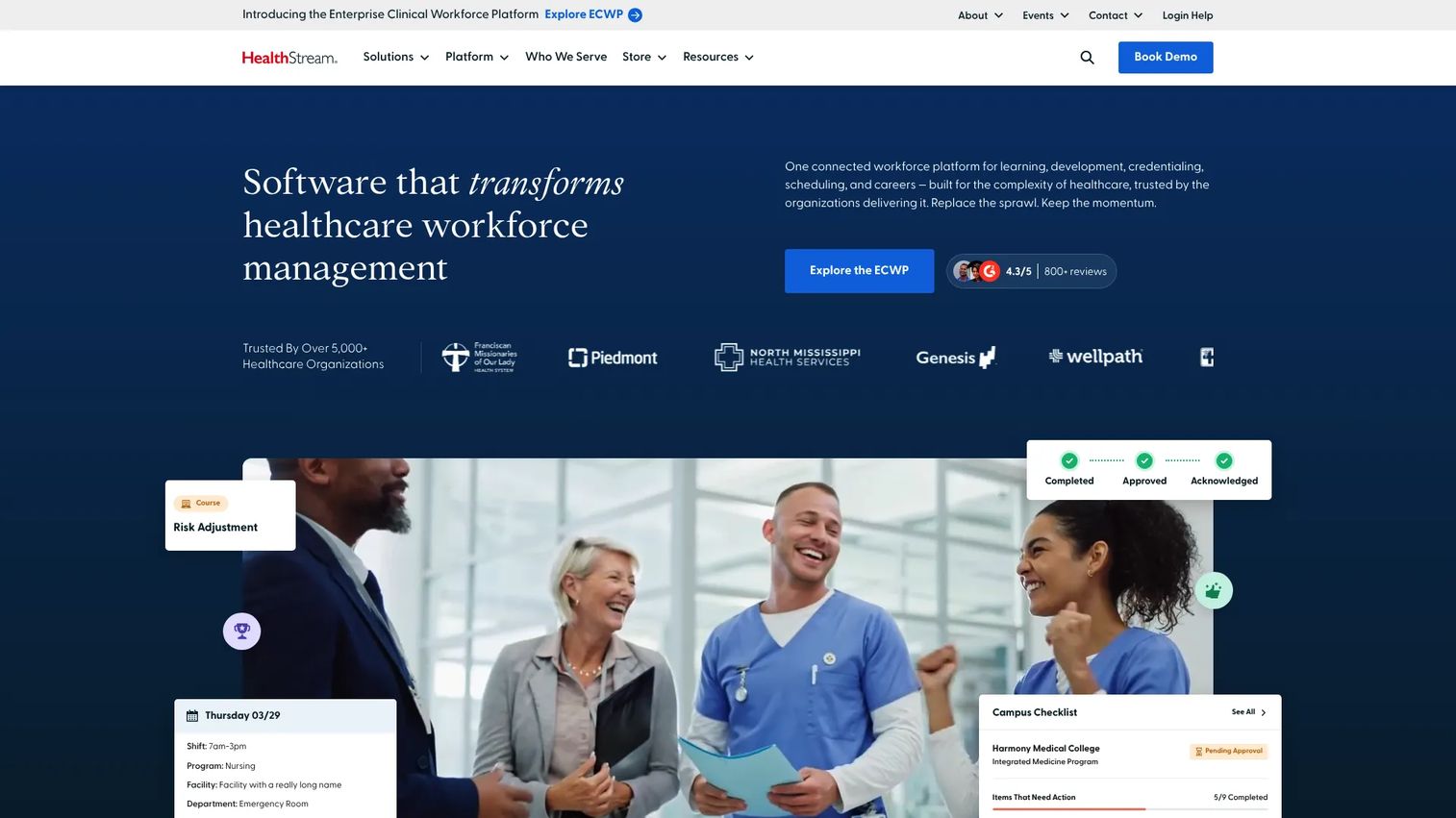
HealthStream is a healthcare workforce management platform covering learning, clinical development, credentialing, scheduling, and compliance. Its scope fits large provider networks managing workforce readiness across many facilities.
The platform also supports primary source verification and career development. These capabilities extend its role beyond standard course administration.
Best for: Large healthcare systems and provider networks managing complex learning, credentialing, and competency programs.
Key features
- Healthcare workforce learning
- Clinical competency management
- Credentialing and verification
- Quality and compliance management
- Workforce reporting and development
Why choose HealthStream: HealthStream fits organizations that want healthcare specific workforce infrastructure rather than a general LMS. It also covers adjacent requirements such as credentialing and workforce scheduling.
Training leaders can use a healthcare focused system to align assignments with clinical roles. Credentialing teams gain access to related verification workflows within the broader platform.
HealthStream suits buyers whose evaluation spans several departments. Learning, compliance, clinical development, and workforce operations may each have separate requirements.
Before purchase, test the exact reports your organization needs. Also confirm how learning records connect with scheduling, credentialing, and existing HR systems.
HealthStream pricing: Individual CME courses start at $15, with free courses also available. Contact HealthStream for an enterprise platform quote.
G2 rating: 4.3/5.
2. Relias
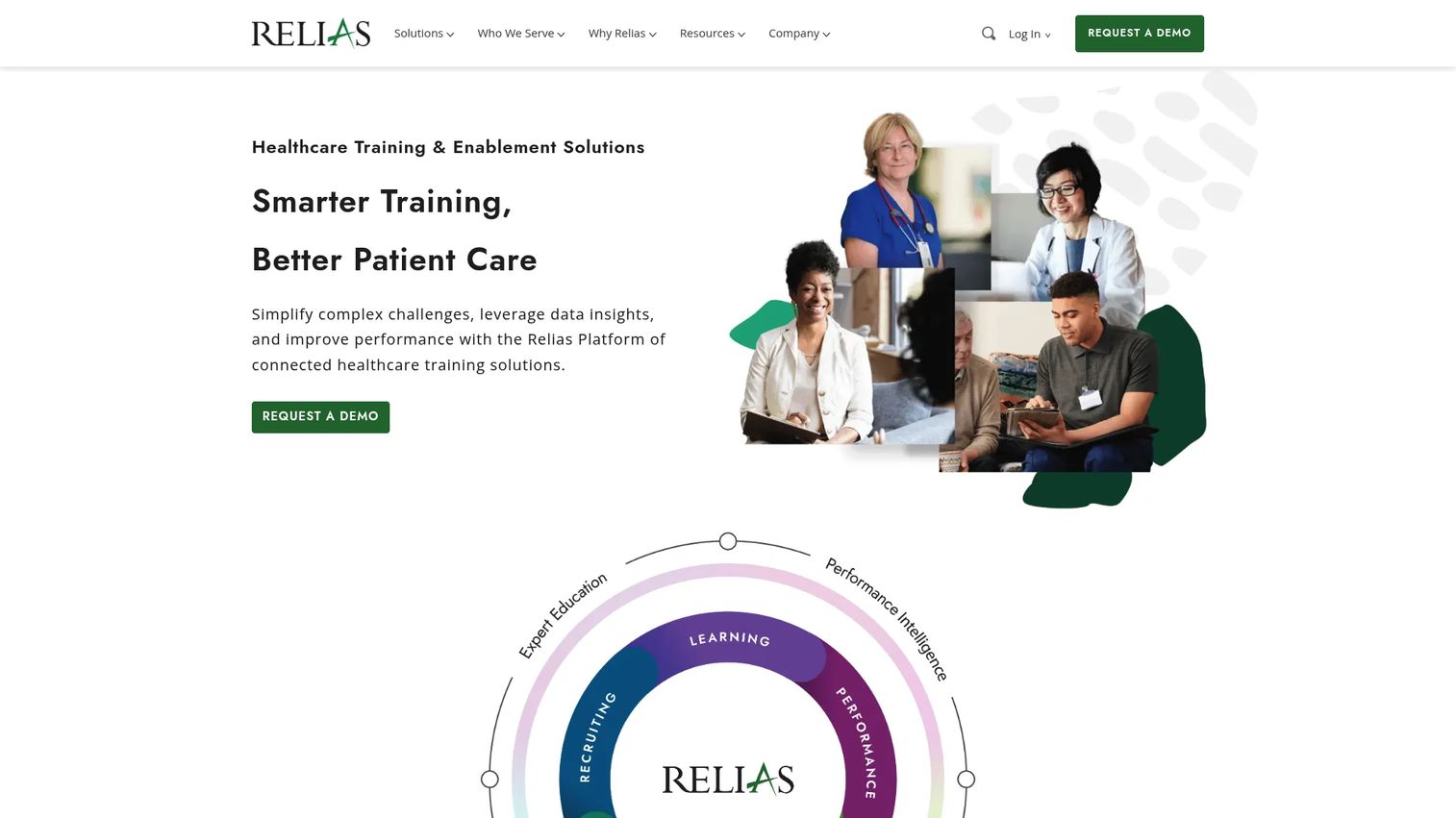
Relias provides healthcare and human services training across learning, compliance, quality, and performance. Its course depth makes it relevant when internal teams cannot create every required program themselves.
The platform includes competency tracking, skills checklists, scenario based learning, and personalized learning paths. Mobile access supports staff who complete education away from a desktop.
Best for: Healthcare and human services organizations that need content depth alongside LMS administration.
Key features
- Personalized learning paths
- Mobile and microlearning access
- Skills and competency tracking
- Advanced requirements reporting
- Policy and procedure management
Why choose Relias: Choose Relias when course content carries as much weight as LMS functionality. Its healthcare focus covers behavioral health, human services, and other provider settings.
Requirements tracking gives administrators another layer beyond standard completion reports. Skills checklists and scenario based education can also support readiness programs.
This fit matters for small enablement teams with limited content production capacity. A supplied library reduces the need to build every course internally.
During evaluation, map the available content against job roles and state requirements. Confirm which courses include continuing education support for your learner groups.
Review how administrators update assignments when a worker changes location or responsibility. The workflow should preserve records while applying the new learning path.
Relias pricing: Custom pricing. Relias did not provide a verified starting amount in the supplied research.
G2 rating: 4.0/5.
3. MedTrainer
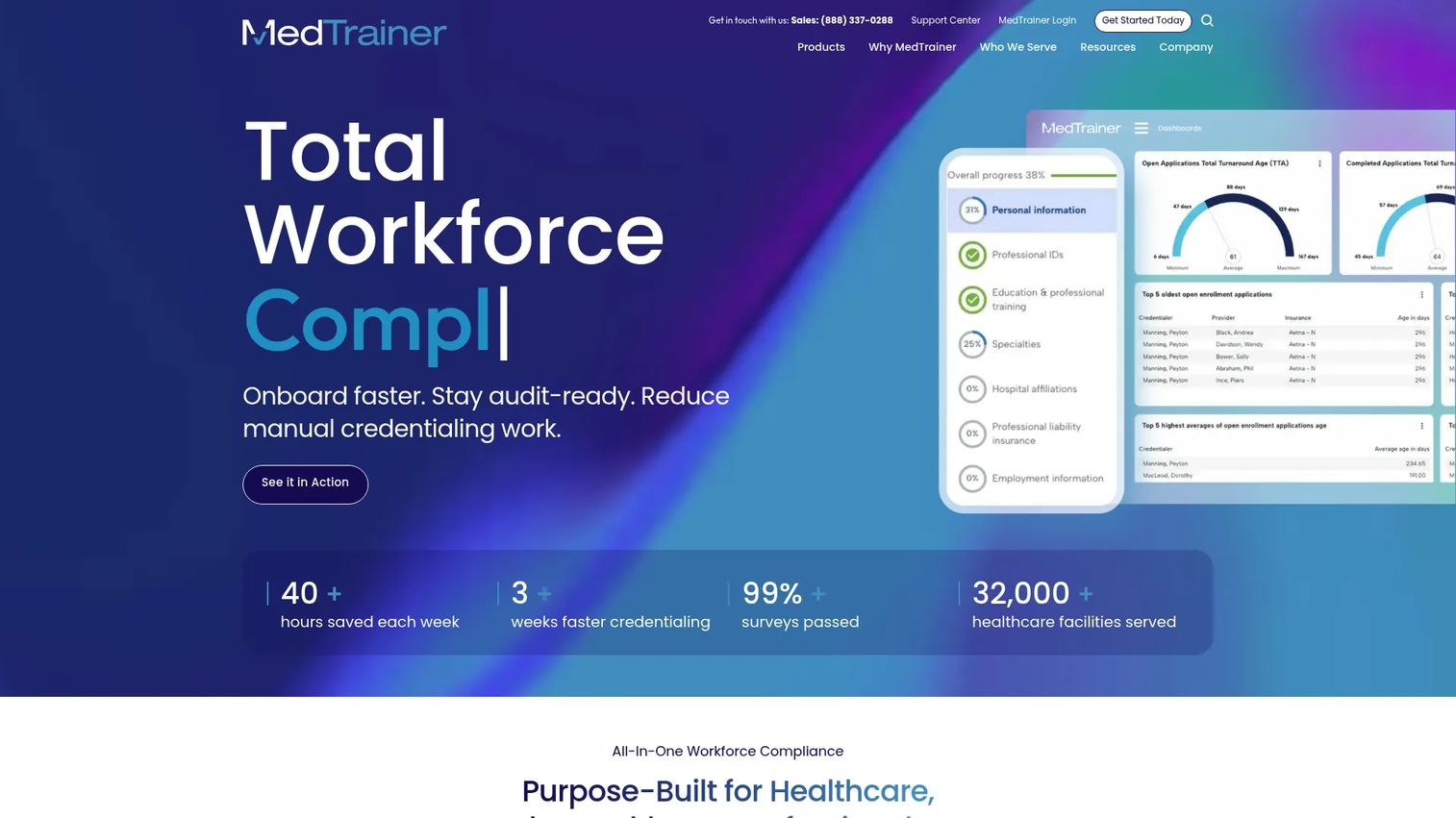
MedTrainer combines healthcare learning with credentialing and compliance operations. Its LMS includes nearly 1,000 courses, more than 300 CEU courses, and real time reporting.
The wider platform covers policies, documents, incident reporting, and provider credentialing. That connected structure helps compliance teams manage evidence across related workflows.
Best for: Healthcare organizations connecting training records with credentialing, policies, and compliance documentation.
Key features
- Healthcare compliance courses
- CEU course library
- Credentialing and verification
- Policy and document management
- Enterprise compliance reporting
Why choose MedTrainer: MedTrainer fits teams that need training evidence within a wider compliance process. It brings learning records closer to credential checks and policy management.
The three product tiers are Select, Premier, and Signature. Buyers can select modules according to their compliance operations and workforce structure.
This platform makes particular sense when separate systems create administrative duplication. A compliance manager can review training while coordinating related provider or policy records.
Ask the vendor to demonstrate an end to end scenario. Assign a course, capture a policy acknowledgement, review a credential, and export the resulting evidence.
Also inspect role permissions before rollout. Healthcare organizations often need different access for learning administrators, managers, credentialing staff, and compliance owners.
MedTrainer pricing: Custom pricing across Select, Premier, and Signature. Quotes reflect licensed users, selected modules, and industry content.
G2 rating: 4.4/5.
4. Healthcare Academy
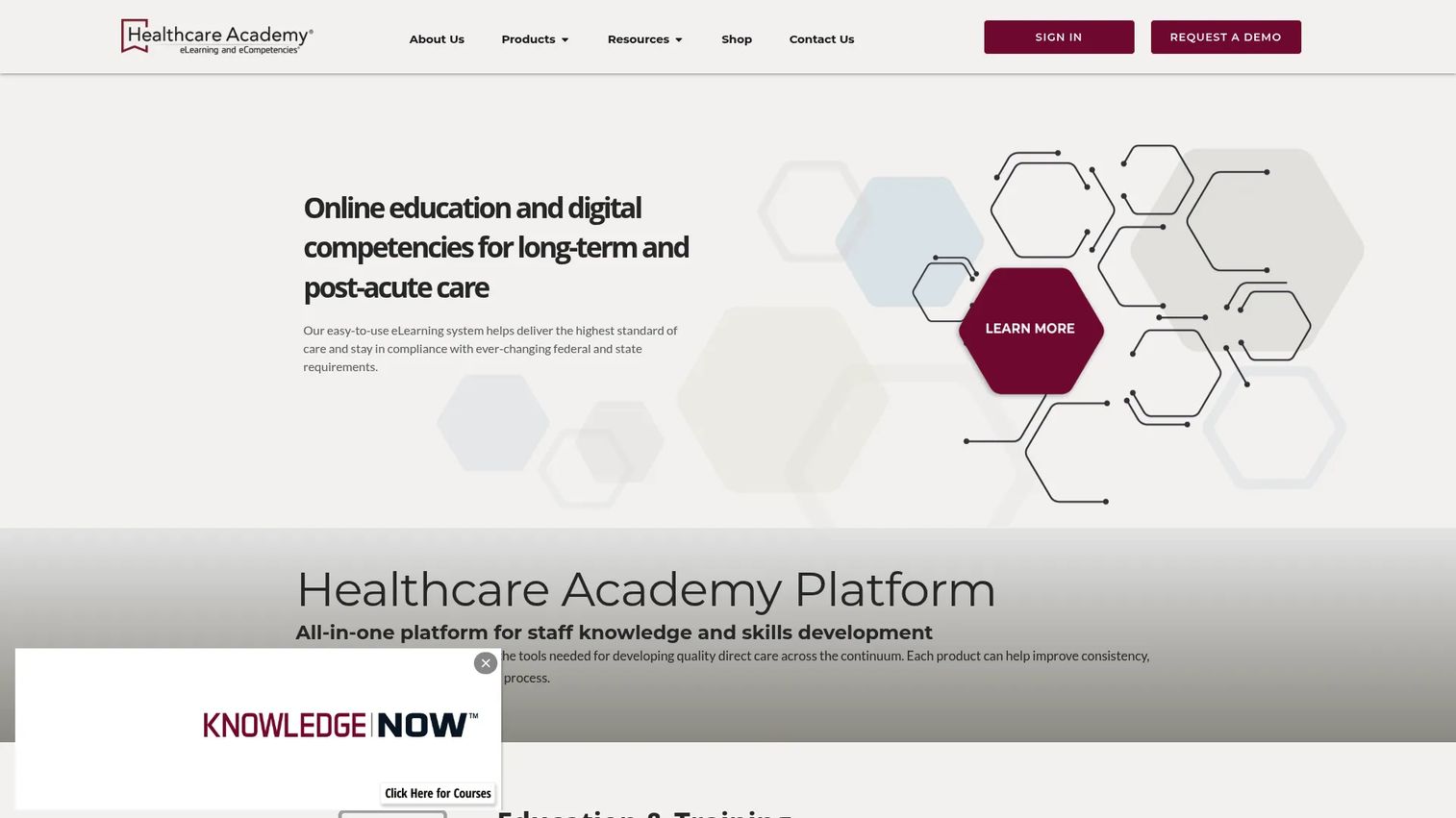
Healthcare Academy provides online education for long term and post acute care organizations. Its course libraries cover skilled nursing, assisted living, and individual continuing education.
The platform also provides digital competency evaluation through eCompetencies and eSkills. Administrators can assign courses, manage enrollment, create content, and automate reports.
Best for: Long term care and post acute organizations training frontline care teams.
Key features
- Long term care courses
- Digital competency documentation
- Course assignment and enrollment
- Automated learning reports
- Continuous platform access
Why choose Healthcare Academy: The platform fits care organizations that want education and competency documentation aligned with long term care. Its focus is narrower than a broad corporate LMS.
Digital competency tools give buyers a route beyond course completion. That distinction matters when managers must document practical readiness.
Healthcare Academy also provides learner access through its training portal. Authentication options include company SAML sign in alongside standard account access.
Evaluate the platform using a frontline caregiver workflow. Test login, course completion, competency documentation, and reporting from a mobile device.
Buyers should also inspect how course libraries align with each facility type. Skilled nursing and assisted living teams may need different assignments or competency records.
Healthcare Academy pricing: Individual courses start at $10 as one time purchases. Contact Healthcare Academy for organizational platform pricing.
5. TalentLMS
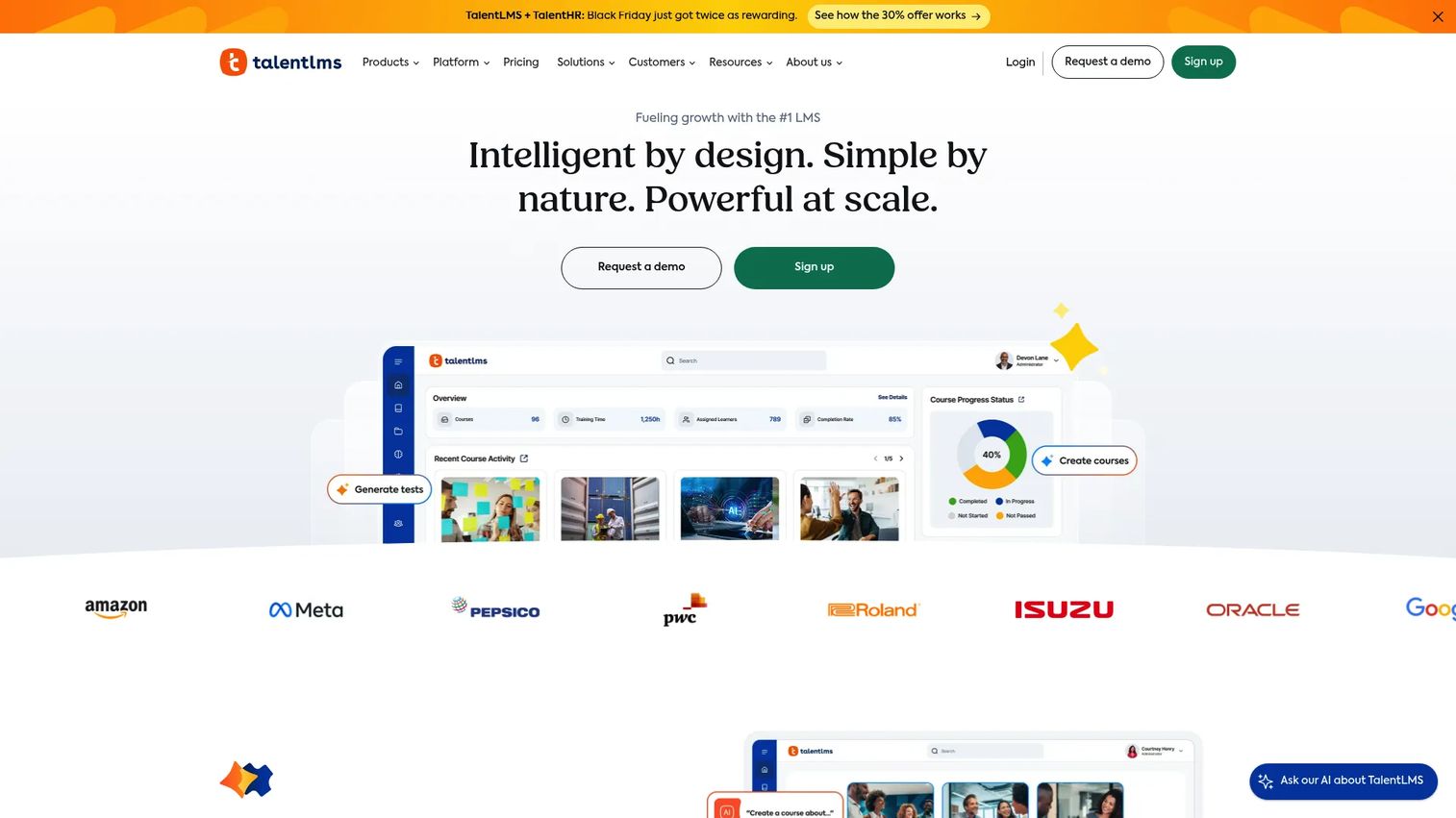
TalentLMS is a cloud LMS for employee, partner, and customer education. Healthcare teams can use it for onboarding, internal courses, assessments, learning paths, and reporting.
It offers customizable portals and branches for organizing different learner populations. SSO, API access, automation, and custom reports support growing programs.
Best for: Smaller healthcare teams seeking a configurable LMS with a free starting option.
Key features
- Unlimited course creation
- Custom training branches
- Learning paths and automations
- Analytics and custom reports
- SSO and API access
Why choose TalentLMS: TalentLMS suits teams that prioritize deployment speed and straightforward administration. A free plan also gives buyers room to test the learner and administrator experience.
The platform serves several audiences without specializing in healthcare compliance. Buyers with complex credentialing or competency requirements may need connected systems.
Branches can separate departments, facilities, or external learners. That structure supports governance while keeping each audience’s portal relevant.
Test reporting carefully during procurement. Confirm whether the available fields answer your audit and leadership questions without manual spreadsheet work.
Healthcare buyers should also review content accessibility and mobile behavior. Use real courses, longer assessments, and common learner devices during testing.
TalentLMS pricing: The free plan supports five users and ten courses. Core starts at $119 monthly, while Grow starts at $229 monthly.
G2 rating: 4.6/5.
6. Absorb LMS
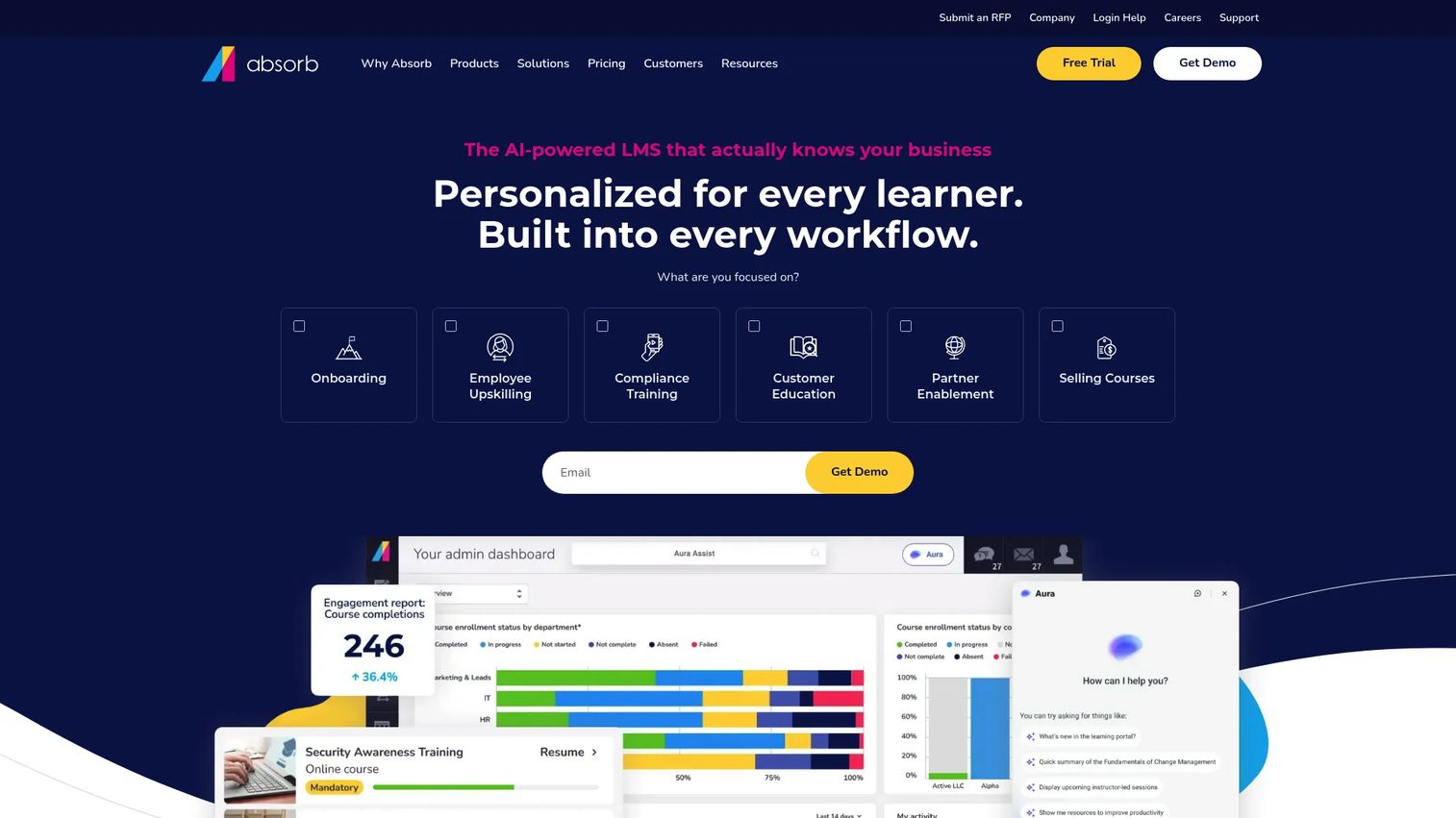
Absorb LMS is a cloud platform for delivering and reporting organizational training. It supports employees, customers, partners, and compliance learners.
Administrators can manage groups and departments while creating separate learner portals. The system supports SCORM, xAPI, AICC, instructor led training, and enterprise integrations.
Best for: Mid market and enterprise healthcare organizations with broad workforce learning programs.
Key features
- Course and test creation
- Custom learner portals
- Instructor led training
- Department and group management
- Reporting and analytics
Why choose Absorb LMS: Absorb works for organizations that need a scalable general LMS across many learner groups. It offers a wider training foundation than a healthcare specific course library.
Support for common learning standards helps teams migrate existing content. Custom portals can also give different facilities or audiences a focused experience.
Healthcare buyers should validate role based assignments and reporting against their requirements. Ask how the platform stores course versions and historical transcripts.
Integration scope deserves equal attention. Confirm how employee records, terminations, role changes, and manager assignments move between your HRIS and LMS.
The platform can support compliance education, but buyers should assess healthcare content separately. Determine whether you will license courses from another source or build them internally.
Absorb LMS pricing: Custom pricing. Quotes reflect learner volume, portals, integrations, contract terms, and support requirements.
G2 rating: 4.6/5.
7. LearnUpon LMS
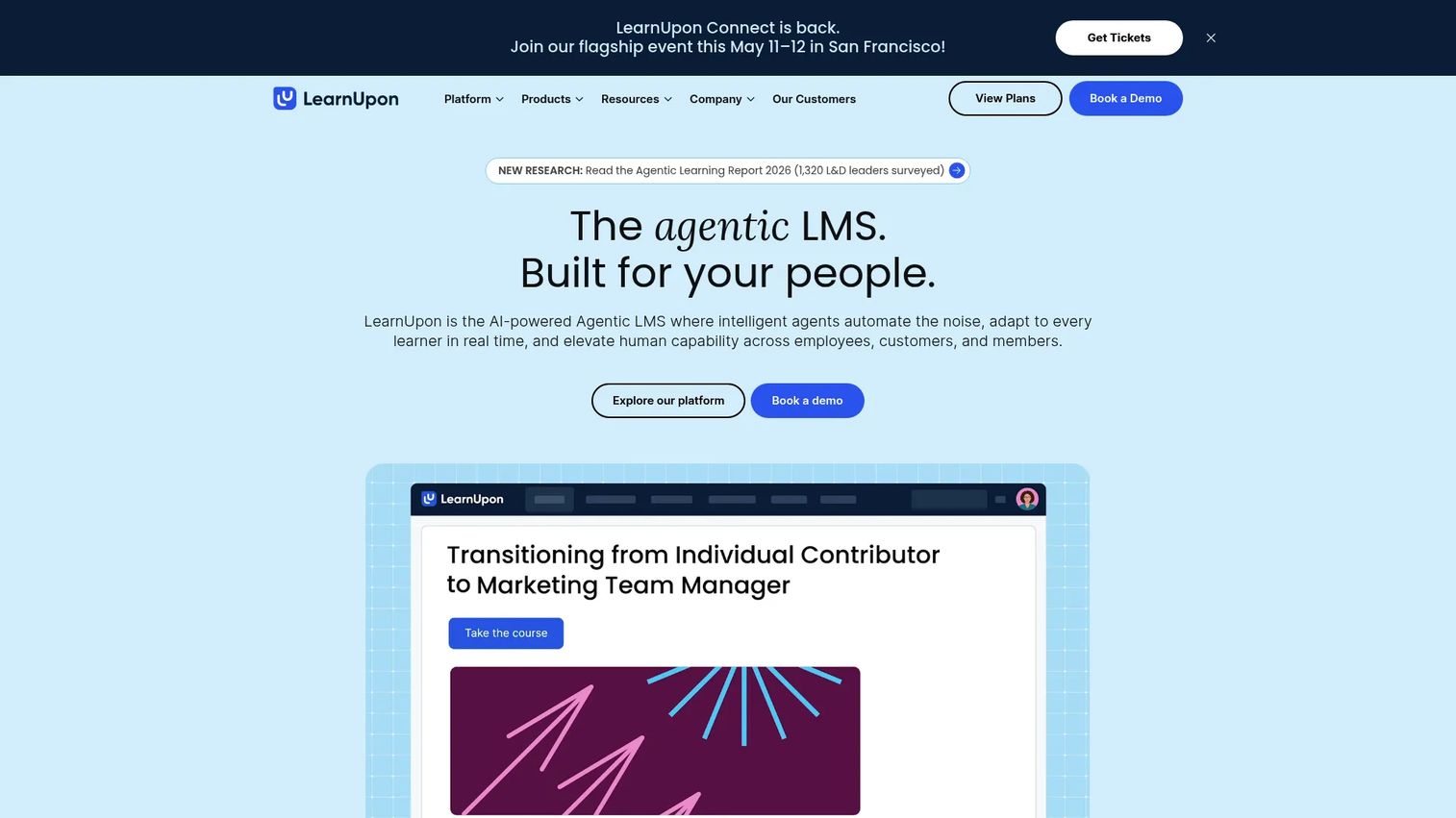
LearnUpon LMS supports employee, customer, partner, and association learning. Its portal model helps organizations separate branded environments for different audiences.
The platform includes course authoring, learning journeys, skills management, live learning, reporting, and ecommerce. It also supports SCORM and xAPI content.
Best for: Healthcare organizations educating internal teams and external audiences through separate portals.
Key features
- Multiple branded learning portals
- Learning journeys and skills
- Live webinar delivery
- SCORM and xAPI support
- Reporting and analytics
Why choose LearnUpon LMS: Choose LearnUpon when healthcare education extends beyond employees. Suitable scenarios include patient education programs, partner onboarding, or healthcare software customer training.
Separate offerings cover employee learning, customer education, and associations. Each option has a stated learner minimum.
This model can help training leaders maintain governance across audiences. Internal compliance learners should not share the same experience or reporting structure as external customers.
Ask the vendor to demonstrate movement between portals and reports. Confirm whether administrators can consolidate data while preserving audience boundaries.
Healthcare teams should also test the skills workflow against competency requirements. Skills management may support development, while clinical validation can require different evidence.
LearnUpon LMS pricing: Custom pricing. Employee plans start from 100 users, customer education from 300, and association plans from 150.
G2 rating: 4.5/5.
8. iSpring Learn
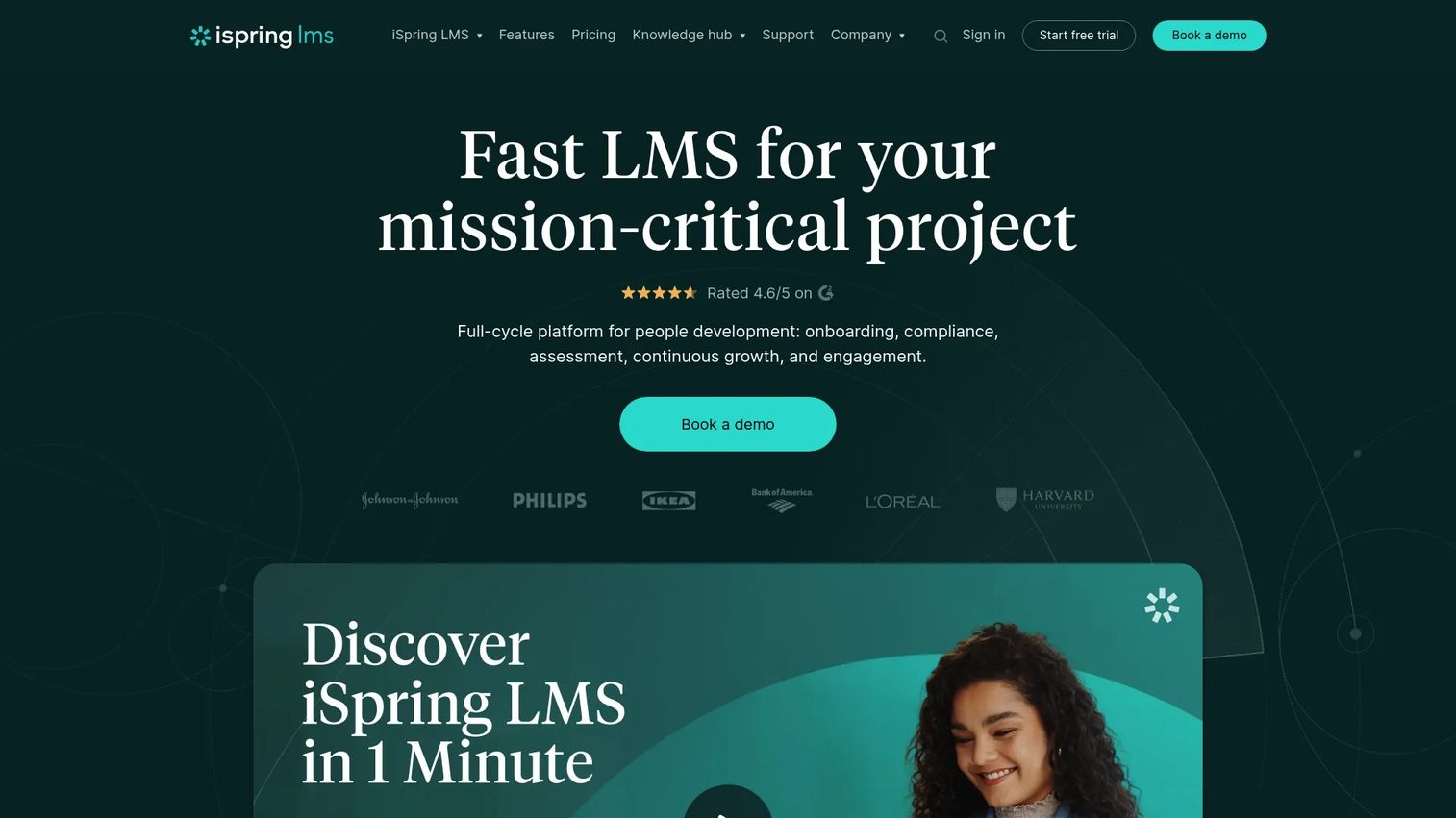
iSpring Learn, now branded iSpring LMS, combines learning administration with course creation workflows. It supports onboarding, compliance, assessments, employee development, and ongoing education.
Its content tools cover courses, quizzes, images, and translations. Administrators can also create learning tracks, assignments, development plans, and onboarding checklists.
Best for: Healthcare training teams that create and update courses internally.
Key features
- Course and quiz creation
- Learning tracks and assignments
- Onboarding checklists
- Mobile learning application
- Learner progress reporting
Why choose iSpring Learn: iSpring fits teams that want authoring and delivery within the same product family. This can shorten updates when procedures or policies change.
The platform supports SCORM content and several media formats. Reporting covers learner activity, quizzes, progress, and simulations.
Its active user pricing model counts learners who sign in during a month. That structure may suit organizations with rotating education schedules.
Test the authoring workflow with the people who will maintain courses. Fast creation has little value if every update still depends on one specialist.
Mobile access also deserves a practical trial. Ask shift based employees to complete a module, resume progress, and retrieve a certificate from their usual devices.
iSpring Learn pricing: Business starts at $6.91 per active user monthly, billed at $8,286 annually for 100 users. A 30 day trial is available.
G2 rating: 4.6/5.
9. Litmos
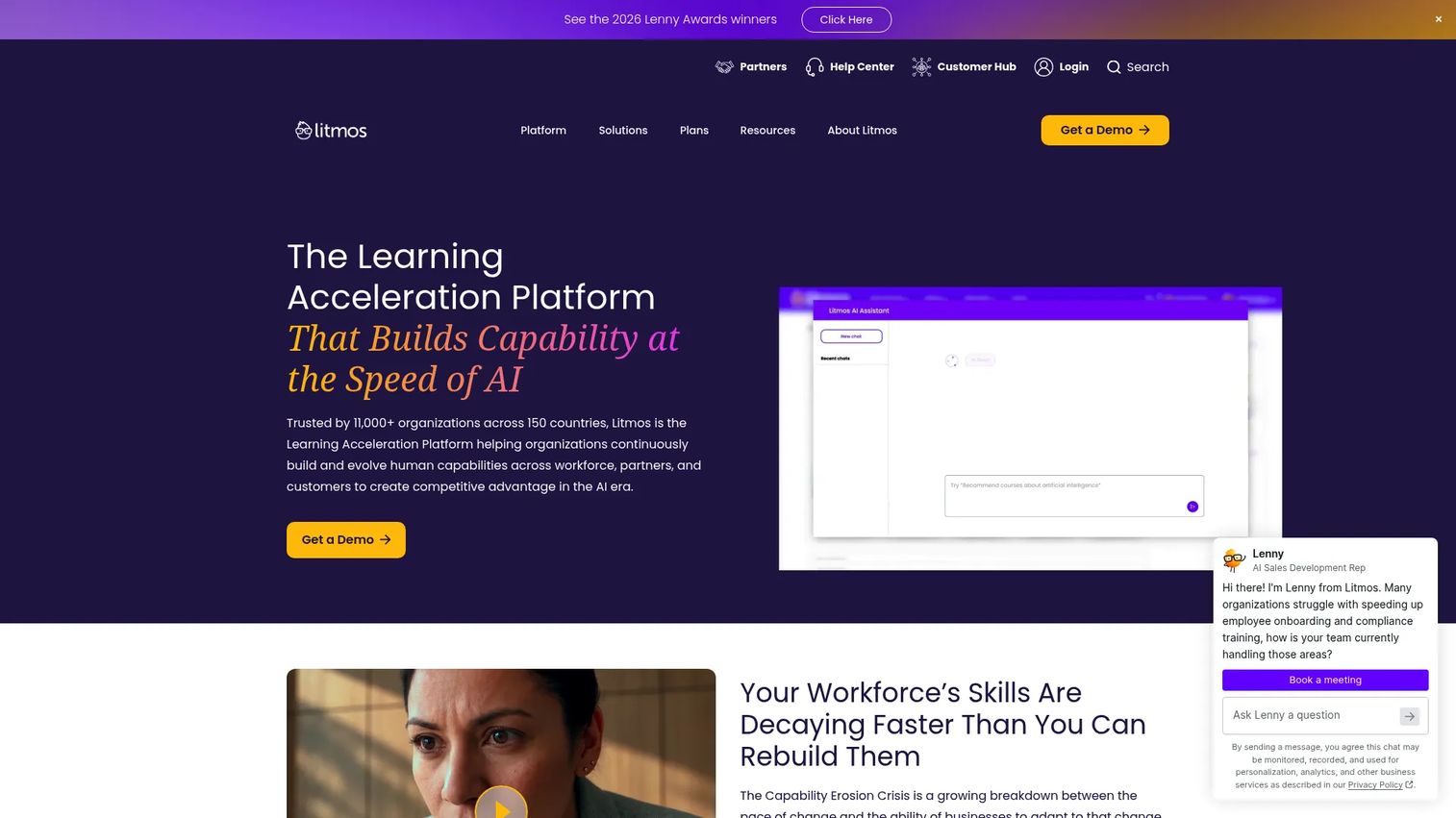
Litmos delivers training for employees, customers, and partners. Its platform supports compliance education, learning paths, assignments, and common content standards.
The system also includes AI assisted authoring and insights. Healthcare teams can use it as a broad enterprise LMS while sourcing specialist content separately.
Best for: Mid market and enterprise healthcare organizations running broad learning programs.
Key features
- Learning paths and assignments
- SCORM and xAPI support
- AICC content compatibility
- AI assisted course authoring
- Compliance training administration
Why choose Litmos: Litmos fits buyers that want mature LMS administration across several audiences. It supports capability training alongside required education.
The Foundation plan provides core learning tools. Platinum adds advanced administration, authoring, compliance, and engagement capabilities.
Healthcare buyers should map each requirement to the relevant plan. Feature access and add ons can affect the total cost beyond the starting subscription.
Content strategy is another decision point. Determine which healthcare courses come from internal teams and which require additional libraries.
Before signing, request a reporting demonstration using overdue learners and multiple facilities. Confirm that administrators can export the fields required by compliance leaders.
Litmos pricing: Foundation starts at $8,000 annually. Platinum starts at $15,000 annually, while Platinum AI uses custom pricing.
G2 rating: 4.3/5.
10. Bridge
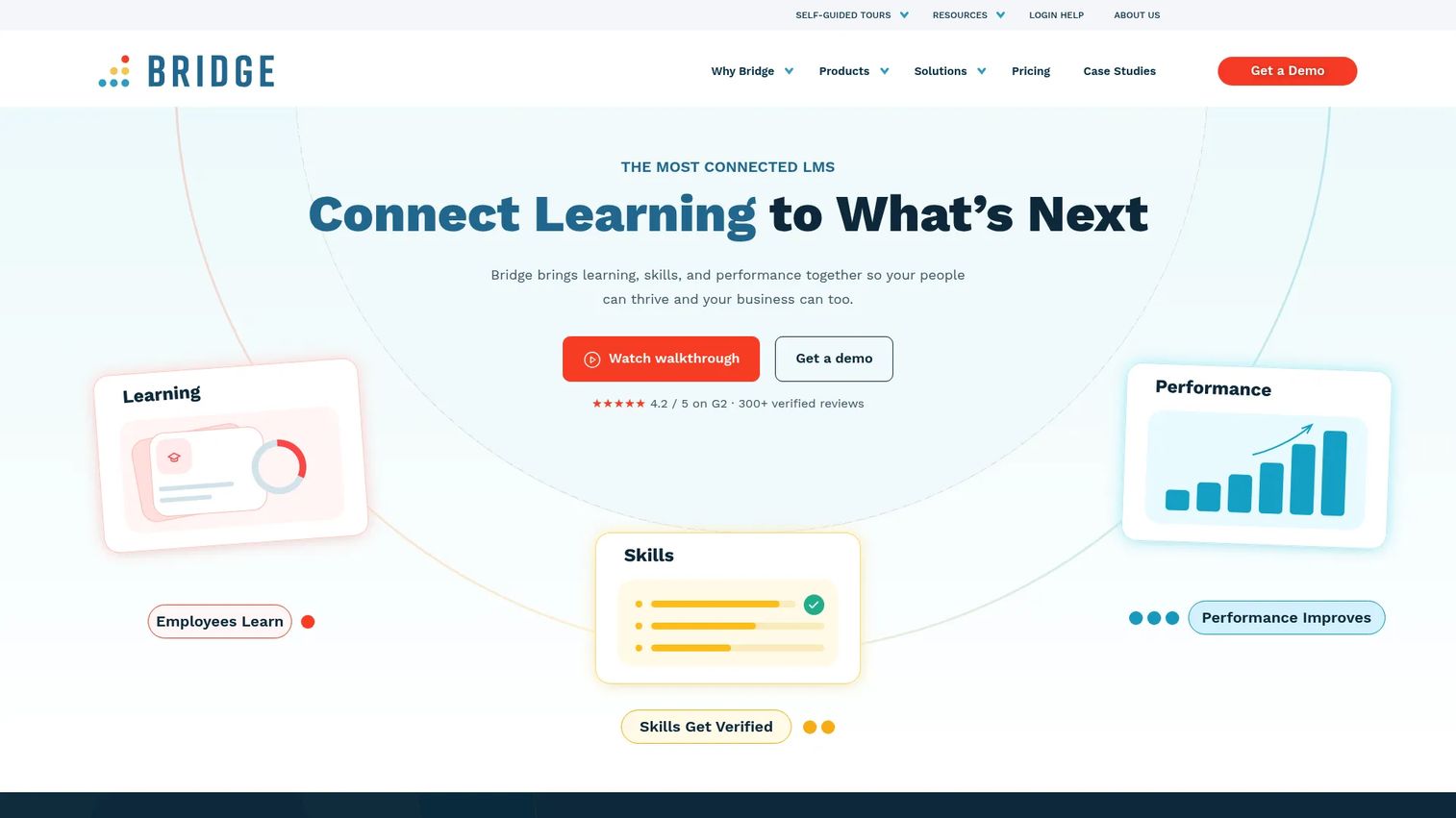
Bridge combines learning management with skills development and performance management. It supports course assignments, content standards, reporting, and dashboards.
Its talent features cover skill gaps, career paths, reviews, goals, feedback, and manager conversations. This makes learning part of a wider employee development system.
Best for: Healthcare organizations connecting workforce learning with skills and performance programs.
Key features
- Learning management and authoring
- Skills libraries and taxonomies
- Skill gap identification
- Performance reviews and goals
- Manager feedback workflows
Why choose Bridge: Bridge suits organizations that view training as part of employee development. It can connect learning activity with skills and performance conversations.
The platform is broader than a healthcare compliance LMS. Buyers will need to validate clinical content, credential tracking, and audit evidence separately.
Its skills tools may help learning leaders map development priorities. However, a skills taxonomy does not automatically replace practical competency validation.
Bring managers into the evaluation process. Their adoption affects whether performance conversations and development plans become useful records.
Also test administrator workload during role changes. The system should update assignments without creating duplicate learner profiles or disconnected histories.
Bridge pricing: Plans start at $15,000 annually. Learning, talent, and expanded performance packages use custom quotes.
G2 rating: 4.2/5.
11. Connecteam
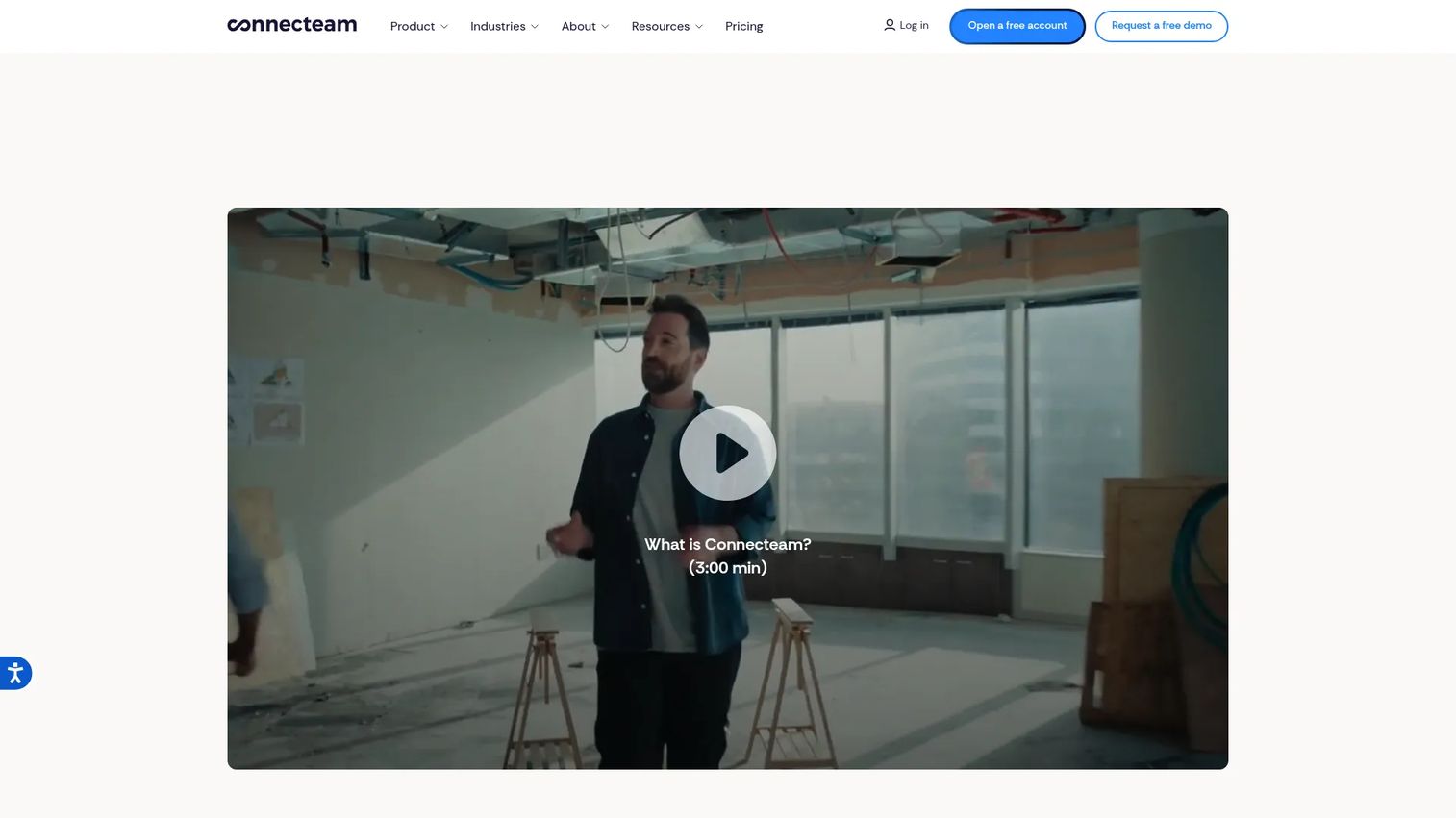
Connecteam is an employee management application for deskless and distributed workforces. It combines mobile courses and quizzes with scheduling, tasks, forms, and team communication.
Healthcare organizations can use it for lightweight training across mobile staff. Checklists and knowledge resources also support day to day execution.
Best for: Small and midsize healthcare teams needing phone based training and workforce coordination.
Key features
- Mobile courses and quizzes
- Employee checklists and forms
- Team chat and updates
- Task and schedule management
- Mobile knowledge resources
Why choose Connecteam: Connecteam fits workers who spend limited time at desks. Training lives beside the operational tools employees already access on their phones.
Its scope includes communications and workforce management. That breadth may reduce tool switching for distributed care teams.
The platform is better aligned with lightweight education than deep clinical competency infrastructure. Buyers should confirm certification, CE, and credential requirements independently.
Test the application during a normal shift. Learners should find assigned content without searching through unrelated workforce features.
Pricing is organized across Operations, Communications, and HR and Skills hubs. Confirm which hubs your training workflow requires before calculating total cost.
Connecteam pricing: A free Small Business plan is available. Annual billing starts at $29 monthly for Basic, covering the first 30 users.
G2 rating: 4.6/5.
12. SkyPrep
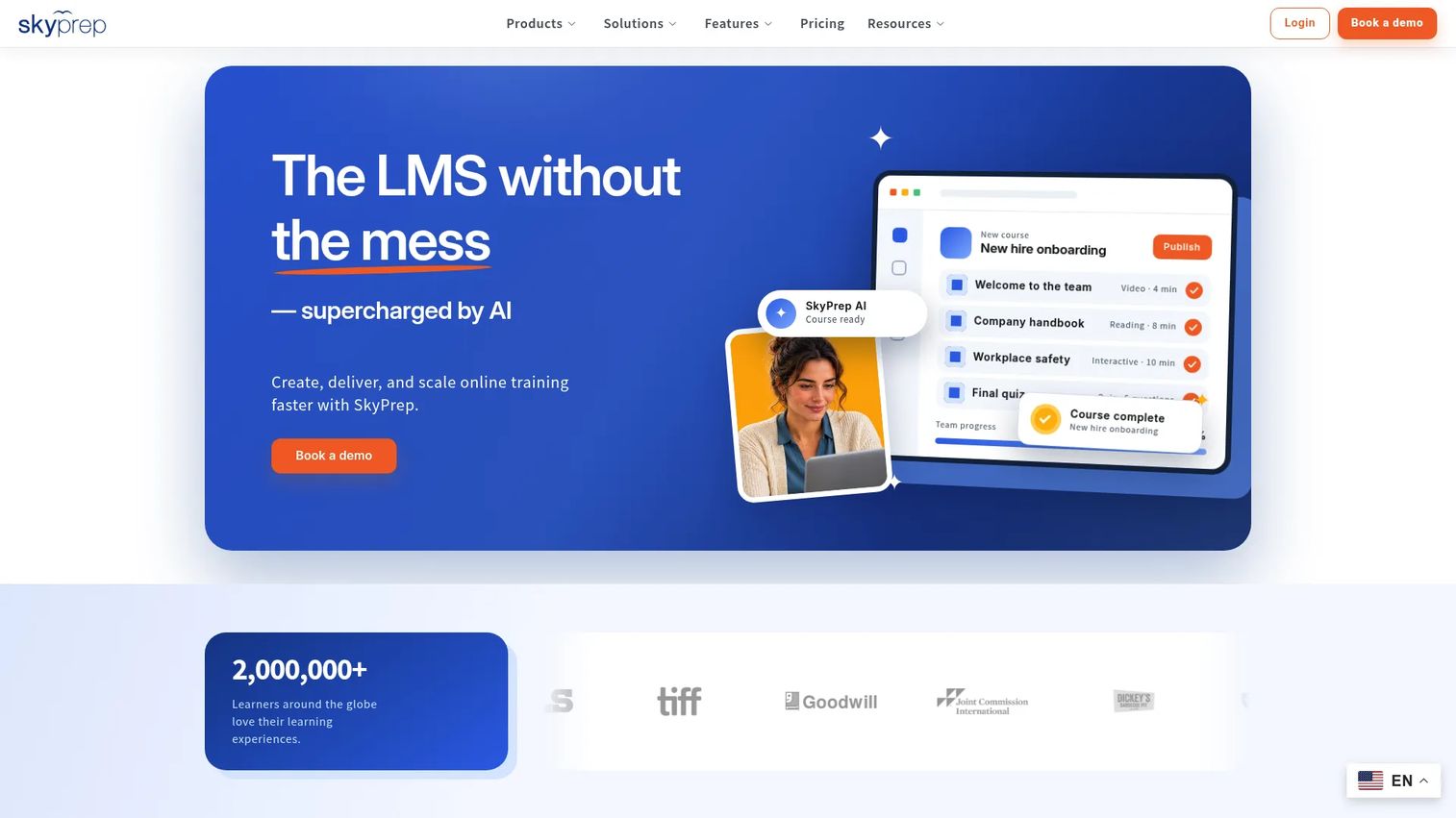
SkyPrep is a cloud LMS for creating, delivering, and tracking organizational training. It supports employees, customers, partners, and compliance learners.
The platform includes automated assignments, learning paths, certifications, and reporting. Branding controls and API access support broader deployment.
Best for: Healthcare teams seeking straightforward course administration with workflow automation.
Key features
- Course creation and management
- Automated learner assignments
- Learning paths and certifications
- Reporting and analytics
- API and integration access
Why choose SkyPrep: SkyPrep fits teams that prioritize administrative clarity and course delivery. Its automation rules can reduce manual enrollment work.
The platform supports SCORM content and custom branding. Gamification is available for teams that want additional learner engagement mechanisms.
Healthcare buyers should examine the depth of compliance reporting. Ask whether exports include assignment dates, completions, versions, and overdue status.
Credential management may require another system. Clarify how certificates and renewals work before using the platform for regulated training records.
SkyPrep plans begin at 100 active users. Additional capacity comes in bundles of 100, which affects budget planning for smaller organizations.
SkyPrep pricing: Custom pricing for Lite, Premium, and Enterprise. Every plan begins with 100 active users.
G2 rating: 4.6/5.
13. Tovuti LMS
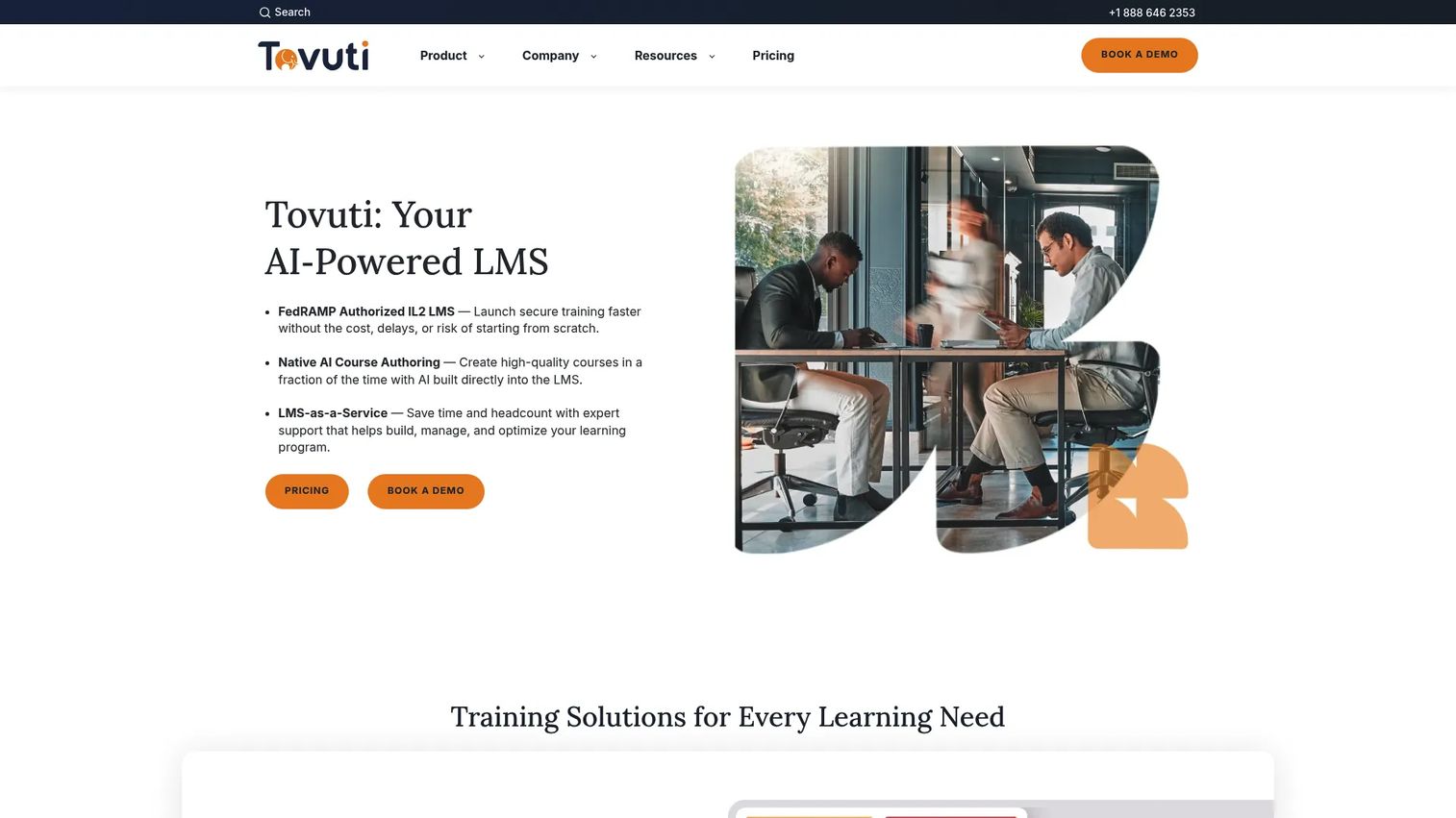
Tovuti LMS combines learning management with interactive course authoring and virtual classroom tools. It supports employee, customer, partner, and compliance programs.
The platform includes learning paths, assignments, certifications, badges, and reporting dashboards. Branded portals and mobile applications extend the learner experience.
Best for: Healthcare teams prioritizing digital course creation and learner engagement.
Key features
- Interactive course authoring
- Virtual classrooms and events
- Automated learning assignments
- Certifications and badges
- Branded portals and mobile apps
Why choose Tovuti LMS: Tovuti works for teams replacing static course materials with richer digital learning. Its built in authoring reduces dependence on a separate content tool.
A single platform plan covers the core LMS. Optional services and AI authoring add ons expand the package.
Healthcare organizations should validate reporting against audit scenarios. Engaging content still needs clear evidence behind assignments and completion.
Test accessibility across courses created inside the platform. Review captions, keyboard navigation, screen reader behavior, and structured page order.
The annual starting price covers the first 100 learners. Budgeting should account for growth beyond that initial learner group.
Tovuti LMS pricing: The full platform starts at $7,500 annually for the first 100 learners. Optional services and authoring add ons cost extra.
G2 rating: 4.6/5.
14. Thought Industries
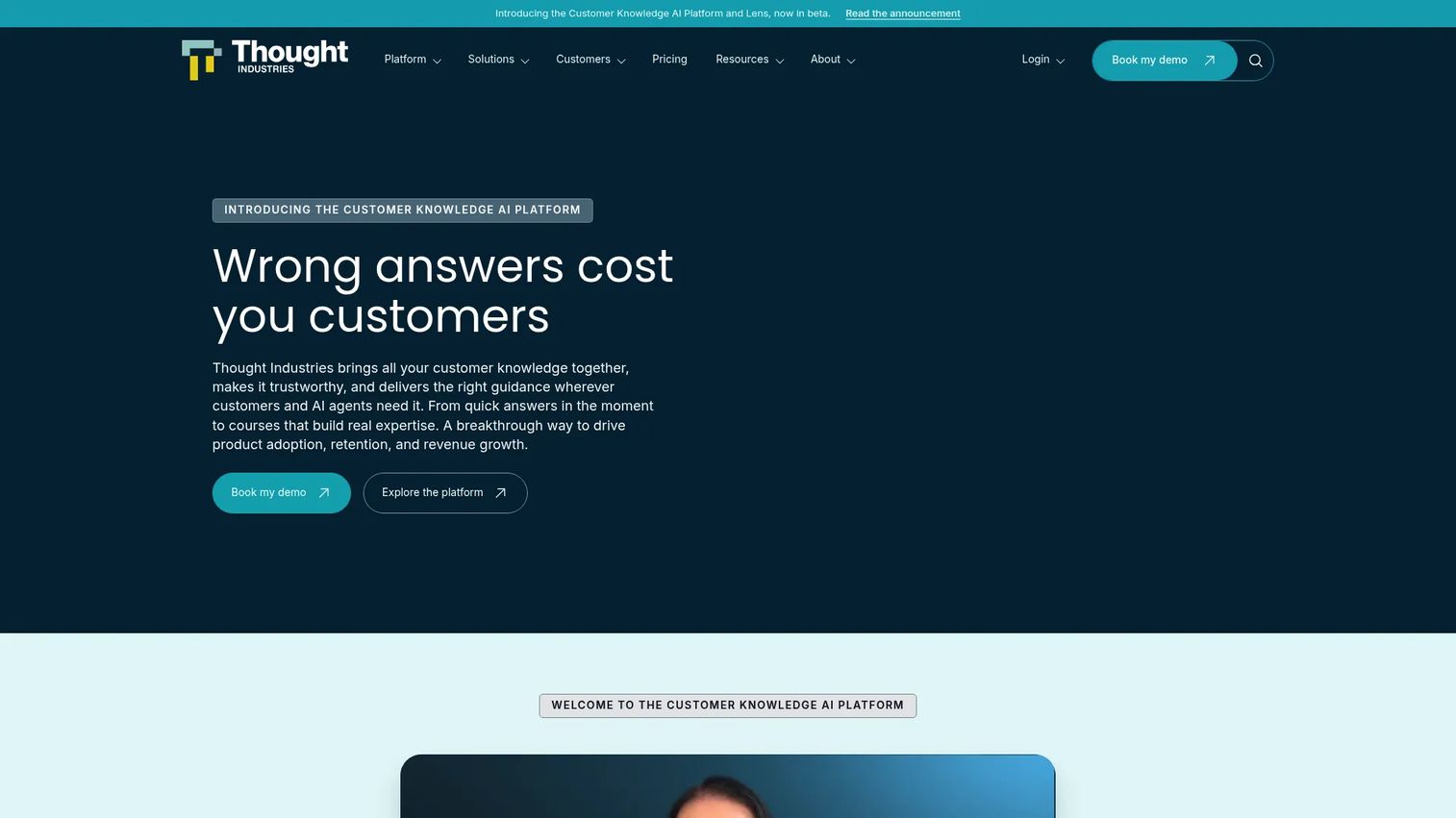
Thought Industries focuses on customer, partner, and product education. Its Academy platform supports branded sites, course storefronts, certifications, subscriptions, and live training.
This positioning differs from an internal hospital LMS. It fits healthcare software companies, medical technology vendors, and service organizations educating external audiences.
Best for: Healthcare organizations delivering customer or partner education outside their employee base.
Key features
- Branded customer academies
- Learning paths and certifications
- Course storefront and subscriptions
- Live external training
- AI assisted course authoring
Why choose Thought Industries: Choose this platform when the learner sits outside your workforce. It supports commercial education and branded customer learning programs.
Academy has Starter, Professional, and Enterprise packages. Its external education focus includes white labeling and team purchasing.
Lens is a separate knowledge product with free and paid plans. Buyers should distinguish its pricing from Academy during comparison.
For healthcare software enablement, test how customer accounts and teams are structured. Reporting should show engagement across organizations, not only individual learners.
This platform is a weaker match for hospital staff compliance because its core orientation is external education. Internal workforce buyers should prioritize employee focused LMS requirements.
Thought Industries pricing: Academy uses custom pricing. Lens Pro costs $499 monthly, while Lens Pro Plus costs $999 monthly.
G2 rating: 4.1/5.
15. Learn2Care
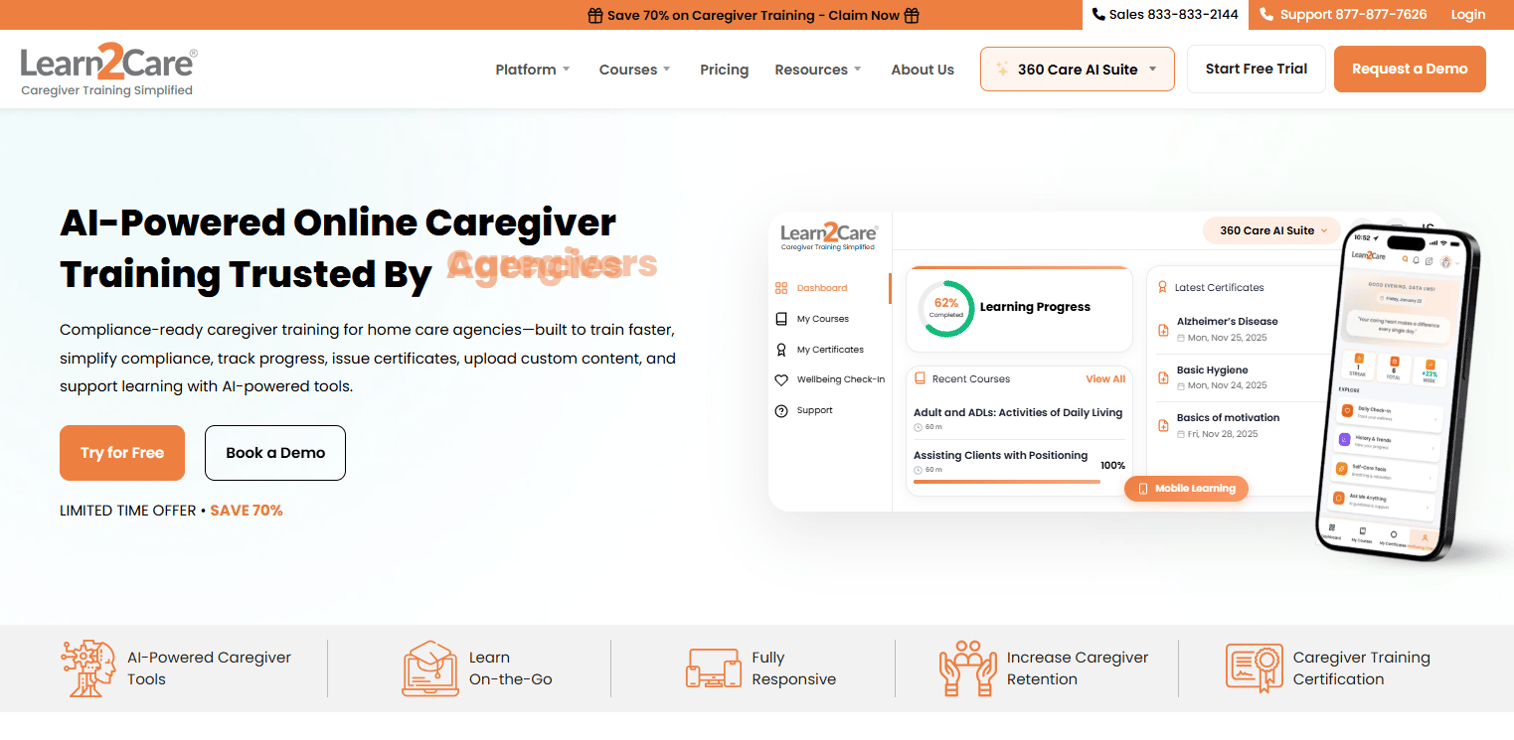
Learn2Care is a caregiver training and compliance platform for home care agencies. It provides more than 300 caregiver courses with configurable learning paths.
The platform also tracks progress and issues completion certificates. A mobile friendly caregiver portal supports frontline staff access.
Best for: Home care agencies that need caregiver onboarding, education, and compliance tracking.
Key features
- More than 300 caregiver courses
- Configurable learning paths
- Progress and certificate tracking
- Mobile friendly caregiver portal
- Custom PDF and SCORM uploads
Why choose Learn2Care: Learn2Care fits care focused organizations that want prepared content and straightforward learner administration. Its caregiver orientation makes the course library relevant to home care teams.
Organizations can upload PDF, DOC, and SCORM materials alongside supplied courses. This supports agency specific policies or onboarding content.
The platform also includes several AI tools for course building and caregiver support. Evaluate each feature against your governance requirements before rollout.
Test the mobile portal with caregivers who use older devices or limited bandwidth. A polished administrator view matters less if frontline learners cannot complete assignments easily.
Buyers should also confirm reporting fields for client or regulatory reviews. Completion certificates alone may not cover every evidence requirement.
Learn2Care pricing: Starter costs $9.90 per caregiver monthly. Growth costs $10.70 per caregiver monthly, while Enterprise uses custom pricing.
G2 rating: 4.6/5.
Considerations when choosing a healthcare LMS
Compliance coverage
Map required courses, assignment rules, due dates, policy attestations, and report exports before comparing vendors. Requirements vary across hospitals, post acute providers, and home care agencies.
Ask whether the platform includes relevant content or only delivers courses you provide. Course library costs can materially change total spending.
Competency and credential tracking
Determine whether the system records training, demonstrated competency, or both. Check for manager signoffs, skills checklists, expiration alerts, and certification renewals.
A completion report cannot prove practical ability. Build that distinction into your readiness framework before implementation.
Reporting and audit readiness
Request sample reports before signing a contract. Each report should identify the learner, assignment, completion date, course version, and overdue status.
Test exports using a multi site scenario. Avoid assuming dashboard visibility will meet every audit reporting requirement.
Learner access and accessibility
Review mobile access, SSO, captions, screen reader behavior, and structured navigation. Include shift based learners in the pilot.
Check offline or low bandwidth support where staff connectivity varies. Authentication must also work outside a corporate desktop environment.
Integrations and total cost
Calculate licensing, implementation, content migration, course libraries, integrations, and ongoing administration. Include support costs and planned learner growth.
HRIS integrations should automate new hires, role changes, manager relationships, and departures. Manual reconciliation creates another source of outdated records.
Conclusion
The best healthcare LMS supports proof of readiness, rather than stopping at proof of course completion.
HealthStream fits large healthcare systems with broad workforce requirements. Relias stands out when healthcare content and competency workflows carry equal weight.
MedTrainer connects learning with wider compliance operations. Healthcare Academy serves long term and post acute care, while Learn2Care focuses on home care agencies.
General platforms offer different strengths. TalentLMS supports smaller programs, while Absorb LMS and Litmos serve broader enterprise learning. LearnUpon works across internal and external audiences.
Connecteam brings training closer to mobile healthcare workers. Thought Industries serves customer and partner education rather than hospital workforce compliance.
Shortlist three vendors before scheduling evaluations. Give each provider the same practical test:
- Assign a role based training path
- Track an expiring certification
- Produce a multi site compliance report
- Demonstrate mobile access with SSO
- Export complete learner transcripts
The vendor that handles your evidence requirements with the least administrative cleanup deserves the next conversation.
FAQs
A healthcare LMS is software for assigning, delivering, tracking, and reporting workforce education. It can support compliance courses, competencies, credentials, CE credits, and learning transcripts.
Healthcare specific platforms may also connect training with credentialing or workforce development. Capabilities vary considerably between products.
A regular LMS manages course delivery, learners, assessments, and completion records. A healthcare LMS adds workflows suited to clinical and regulated workforce education.
Those workflows may include competency validation, certification renewals, role based requirements, and audit evidence. Buyers should verify each capability rather than relying on a healthcare label.
The best LMS for hospitals depends on workforce size, reporting requirements, and existing systems. Large hospitals often need multi site administration, SSO, HRIS integrations, and role based assignments.
Competency workflows and credential records may also influence the choice. Test vendors with a hospital specific scenario before making a decision.
Many healthcare LMS platforms support continuing education records or courses. Support may include certificates, transcripts, credit values, and renewal tracking.
Verify the accrediting bodies covered by the course library. Also inspect certificate formats and how administrators export CE records.
Start with assignment rules, due dates, reminders, and policy attestations. Then evaluate course version history, overdue reporting, transcript exports, and administrator permissions.
The platform should show who completed each requirement and when. It should also preserve the relevant course version.
Pricing can depend on learner count, active users, modules, or content libraries. Implementation, integrations, support, and migration may add further costs.
Published starting prices in this guide range from individual course purchases to annual platform subscriptions. Several enterprise vendors provide custom quotes.
Many platforms provide responsive portals or mobile applications. The quality of the learner experience varies by product and course format.
Test mobile learning with normal staff workflows. Include SSO, longer modules, assessments, certificate access, and low bandwidth conditions.
Ask the vendor to produce an audit report using sample learner data. Then assign a role based path and track an expiring certification.
Request a CE certificate and export a complete transcript. Finally, test an HRIS update and the mobile learner experience.