Your organic dashboard shows clicks and conversions. Then leadership asks whether AI answers recommend your company, and the report has nothing useful to say.
GEO tools address that measurement gap. Some monitor brand mentions and citations. Others help improve content or connect AI referral traffic to conversion events.
The buying decision starts with a familiar question: Does this replace something we already pay for?
Adding another dashboard makes sense only when it answers a question your existing stack cannot resolve. A citation monitor serves a different purpose from an editorial optimizer. Neither replaces the analytics you need to measure what visitors do after arriving.
Here, GEO means Generative Engine Optimization, rather than geology equipment or GIS developer software. Generative AI SEO tools belong in the conversation, but their capabilities vary considerably.
Before committing budget, identify the missing evidence. Do you need to understand which answers mention your brand, which pages earn citations, or which visits become qualified leads?
What’s inside
- The shortlist: Seventeen GEO platforms and supporting resources, organized around practical marketing jobs rather than interchangeable feature lists.
- Coverage: Dedicated monitoring products, enterprise search platforms, content optimization software, and analytics or technical resources.
- Selection criteria: AI search coverage, citation evidence, reporting fit, and entry cost.
- Evidence: Vendor product information and pricing, alongside available G2 ratings, from research dated November 24, 2026.
- Buying guidance: What to evaluate before adding a subscription, including overlap with your current SEO stack.
- Scope: A documentation-based comparison, not a claim of hands-on testing or guaranteed improvements in AI recommendations.
TL;DR
- Best starting shortlist: Otterly.ai combines prompt research with AI search visibility monitoring. It suits marketers establishing a repeatable GEO process.
- Best for connected measurement: LLM Pulse combines LLM visibility tracking with crawler analytics and AI traffic reporting.
- Best enterprise shortlist: Profound, Conductor, and BrightEdge address larger search intelligence programs, with different approaches to content operations.
- Best for content-led work: Evaluate Frase alongside Surfer SEO and Clearscope. Their current offerings include visibility measurement as well as optimization.
- Best reporting foundation: Google Search Console and Google Analytics 4 provide free measurement foundations. Data Studio brings reporting together.
- Best technical resource: llms.txt is an open proposal for organizing content for AI agents, rather than a visibility platform or ranking guarantee.
What is GEO software?
GEO software helps marketers measure and improve how brands and content appear in generative AI answers.
These systems include ChatGPT, Perplexity, Gemini, and Google AI Overviews. Generative engine optimization tools examine visibility within answers, including the sources those answers reference.
The term needs clarification. Geological tools are physical field equipment. Geospatial tools serve mapping and spatial analysis, including the GeoTools developer project. This article focuses on marketing software and resources for Generative Engine Optimization.
Common capabilities include:
- AI brand monitoring: Identify mentions and examine how answers describe your company
- AI citation tracking: Record referenced domains and source URLs
- Competitive benchmarking: Compare share of voice in AI answers
- Prompt research: Find relevant questions and query variants
- Technical analysis: Examine crawler activity and content accessibility
- AI search analytics: Connect visibility reporting with available referral data
- Content optimization: Improve pages against identified information gaps
Not every product covers every function. Prompt research tools help decide what to monitor. Citation platforms show which sources appear. Analytics software measures visits and subsequent actions.
Keep those measurements separate. A brand mention establishes presence within an observed answer. A citation identifies a referenced source. Referral traffic records a visit when attribution information reaches your analytics system.
None of those signals alone establishes revenue impact.
For example, an AI answer may mention your company while citing an independent review. Your website analytics would not explain that appearance. Conversely, a referral session tells you someone arrived, without necessarily revealing the entire answer they read.
AI search optimization tools also differ in how they support action. Some recommend content changes; others provide publishing workflows or structured data capabilities.
The practical boundary is straightforward. GEO monitoring measures observed AI answers. SEO platforms address broader search performance, while reporting tools organize data collected elsewhere. Evaluate which combination closes your gap without duplicating subscriptions.
When to use GEO tools
Track brand visibility inside AI answers
Use monitoring when prospects report finding you through AI answers, but your team cannot explain what those answers say. Establish a prompt set covering category discovery and purchase comparisons.
Separate branded questions from queries that never mention your company. Otherwise, reporting can overstate discovery by counting answers that were explicitly asked about you.
Monitor citations before traffic shows up
Citation monitoring helps when you need to understand which sources appear during buyer research. Review the referenced URL alongside the answer rather than treating every domain mention equally.
An independent comparison and your pricing page serve different purposes. Give each observation a clear owner, whether that means updating content or investigating inaccurate positioning.
Turn AI search into a reportable channel
Introduce recurring measurement when leadership needs a consistent view of AI visibility. Define the monitored surfaces and reporting period before presenting trends.
Keep answer-level evidence separate from website outcomes, then connect them where attribution supports it. Your reporting should distinguish observed exposure from measured conversion rather than imply every mention generates pipeline.
GEO tools comparison
The best GEO tools for 2026 fall into four practical groups: Dedicated GEO platforms, enterprise SEO suites, content optimization products, and supporting resources.
Those boundaries overlap. Several editorial platforms now include AI search monitoring, making existing subscriptions worth reviewing before purchasing another specialist.
Use the table to shortlist by job, then inspect the pricing units. A weekly monitoring configuration differs from daily tracking. Annual billing also changes the apparent entry cost.
Prices retain their source currency. G2 scores reflect the listings available in the November 24, 2026 research; “N/A” means no applicable rating was available.
| # | Product | Best for | Key differentiator | Pricing | G2 rating |
|---|---|---|---|---|---|
| 1 | Otterly.ai | Starting AI visibility monitoring | Prompt research and multi-engine tracking | From $29/month | 4.7/5 |
| 2 | LLM Pulse | Connecting visibility and traffic | Answer, crawler, and referral analytics | From €49/month with weekly tracking | 5.0/5 |
| 3 | Profound | Enterprise AI intelligence | Prompt demand research and content operations | Custom pricing; free trial | 4.5/5 |
| 4 | Athena HQ | Acting on GEO findings | Citation intelligence and optimization actions | Free Essential; Starter $295/month | 4.9/5 |
| 5 | Scrunch AI | Brand accuracy and discoverability | Response monitoring and page optimization | Core $250/month | 4.6/5 |
| 6 | LLMrefs | Citation-focused reporting | Source tracking and competitive positions | $79/month | N/A |
| 7 | WordLift | Structured content foundations | Knowledge graphs and schema markup | $879/month annually; $1,100 monthly | 4.7/5 |
| 8 | Conductor | Enterprise SEO and AEO operations | Search visibility with website monitoring | Custom pricing | 4.5/5 |
| 9 | BrightEdge | Enterprise search intelligence | Demand research and AI search measurement | Custom pricing | 4.4/5 |
| 10 | Frase | Content production and monitoring | Research-to-publishing workflow | $39/month annually; $49 monthly | 4.8/5 |
| 11 | Surfer SEO | Content optimization and AI visibility | Content guidance with search analytics | Discovery €49/month annually; analytics €82/month annually | 4.8/5 |
| 12 | Clearscope | Editorial quality and discoverability | Content grading with visibility tracking | Essentials $129/month | 4.9/5 |
| 13 | RankShift | Recurring AI visibility reporting | Prompt tracking and reporting integrations | Starter $92/month; $82/month annually | N/A |
| 14 | Google Search Console | Organic search baselines | Search performance and indexing information | Free | 4.7/5 |
| 15 | Google Analytics 4 | Referral and conversion measurement | Website and app behavioral analytics | Standard version free | 4.5/5 |
| 16 | Data Studio | Shared marketing dashboards | Visualization across connected data sources | Free; Pro $9/user/project/month | 4.4/5 |
| 17 | llms.txt | Organizing content for AI agents | Open Markdown file proposal | Free implementation; internal labor costs | N/A |
Best 17 GEO tools for AI search visibility in 2026
1. Otterly.ai
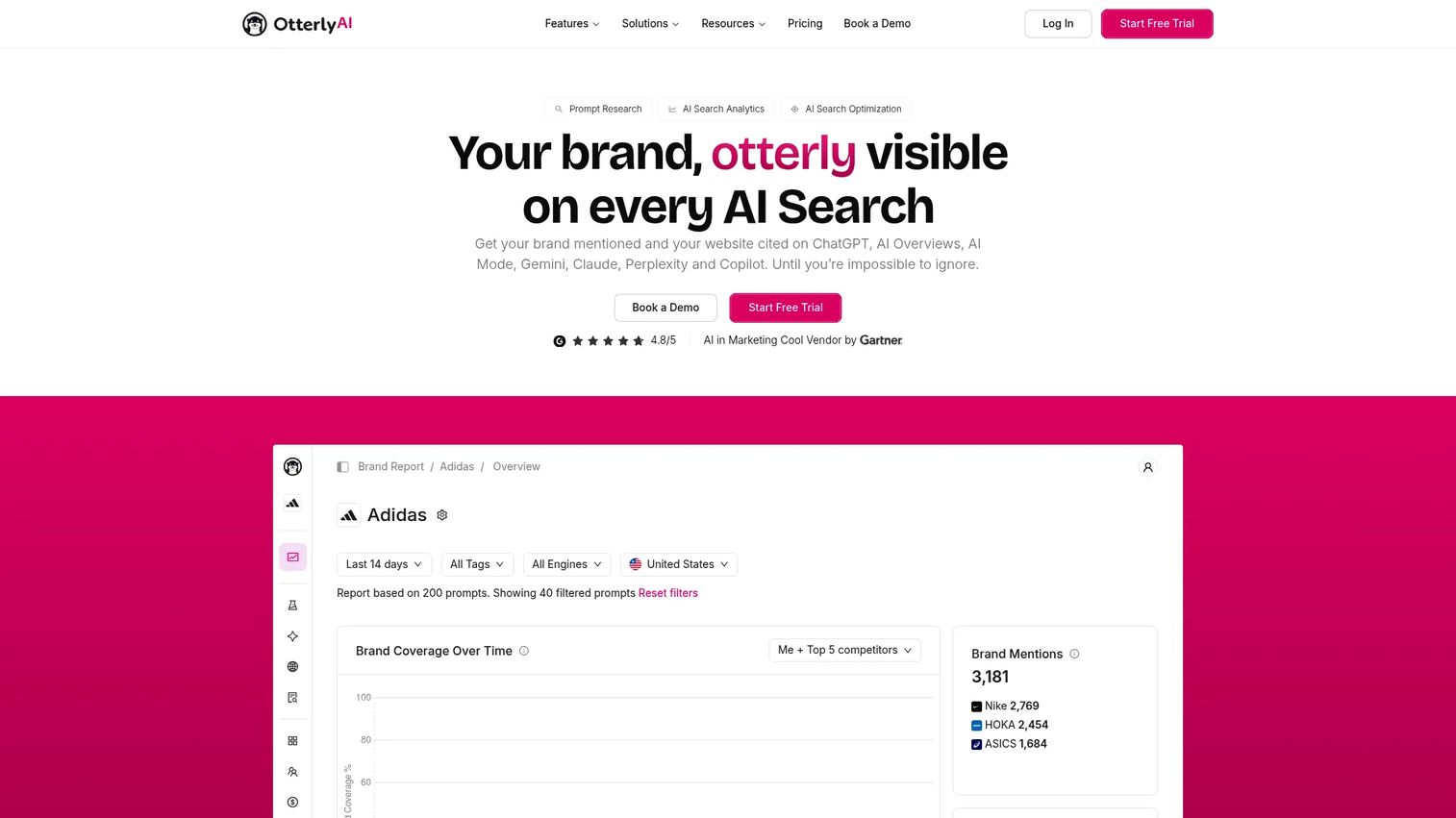
Otterly.ai combines AI search monitoring with content analysis and recommendations. Its documented coverage includes ChatGPT, Google AI Overviews, Perplexity, Microsoft Copilot, Google AI Mode, Gemini, and Claude. That gives marketers a starting point for comparing how different answer engines present their brand. Prompt research helps establish the questions worth monitoring before a team commits to a reporting routine.
Best for: Growth teams starting GEO tracking and agencies building recurring visibility reports for clients.
Key features
- AI prompt research
- Multi-engine brand visibility monitoring
- Citation and competitor analysis
- Content audits and AI-readiness analysis
- GEO recommendations
Why choose Otterly.ai: Choose it when your first priority is establishing an observable baseline across relevant engines. During evaluation, use questions from sales conversations and inspect whether the resulting evidence supports specific content decisions.
Otterly.ai pricing: Lite costs $29/month, Standard $189/month, and Premium $489/month; Enterprise has custom pricing. A seven-day free trial is available.
G2 rating: 4.7/5.
2. LLM Pulse
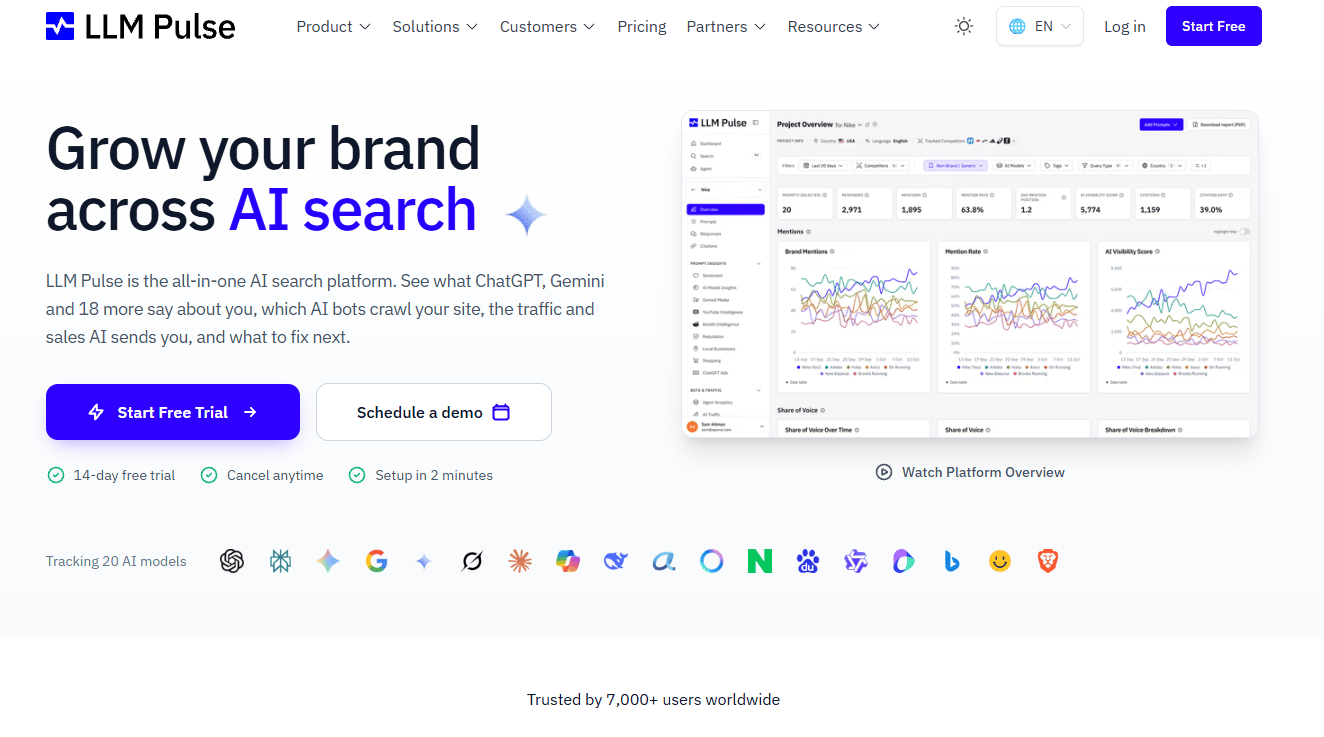
LLM Pulse brings AI answer monitoring together with traffic and crawler analytics. Its reporting covers mentions and citations, alongside sentiment and competitor benchmarking. This combination suits marketers who need to distinguish what AI systems say from what agents access and visitors subsequently do. Recommendations and GEO Writer add an execution layer beyond reporting.
Best for: Marketing teams connecting AI visibility observations with technical access and acquisition measurement.
Key features
- Prompt tracking and share-of-voice analysis
- Citation and sentiment monitoring
- AI crawler and agent analytics
- AI traffic and ChatGPT Shopping tracking
- API and reporting integrations
Why choose LLM Pulse: Evaluate it when separate monitoring and analytics subscriptions are creating fragmented reporting. Compare tracking frequencies carefully, since a weekly configuration answers a different operational question from daily monitoring.
LLM Pulse pricing: Weekly tracking, billed monthly, costs €49 for Starter, €99 for Growth, and €299 for Scale. Applicable weekly plans offer a 14-day trial.
G2 rating: 5.0/5.
3. Profound
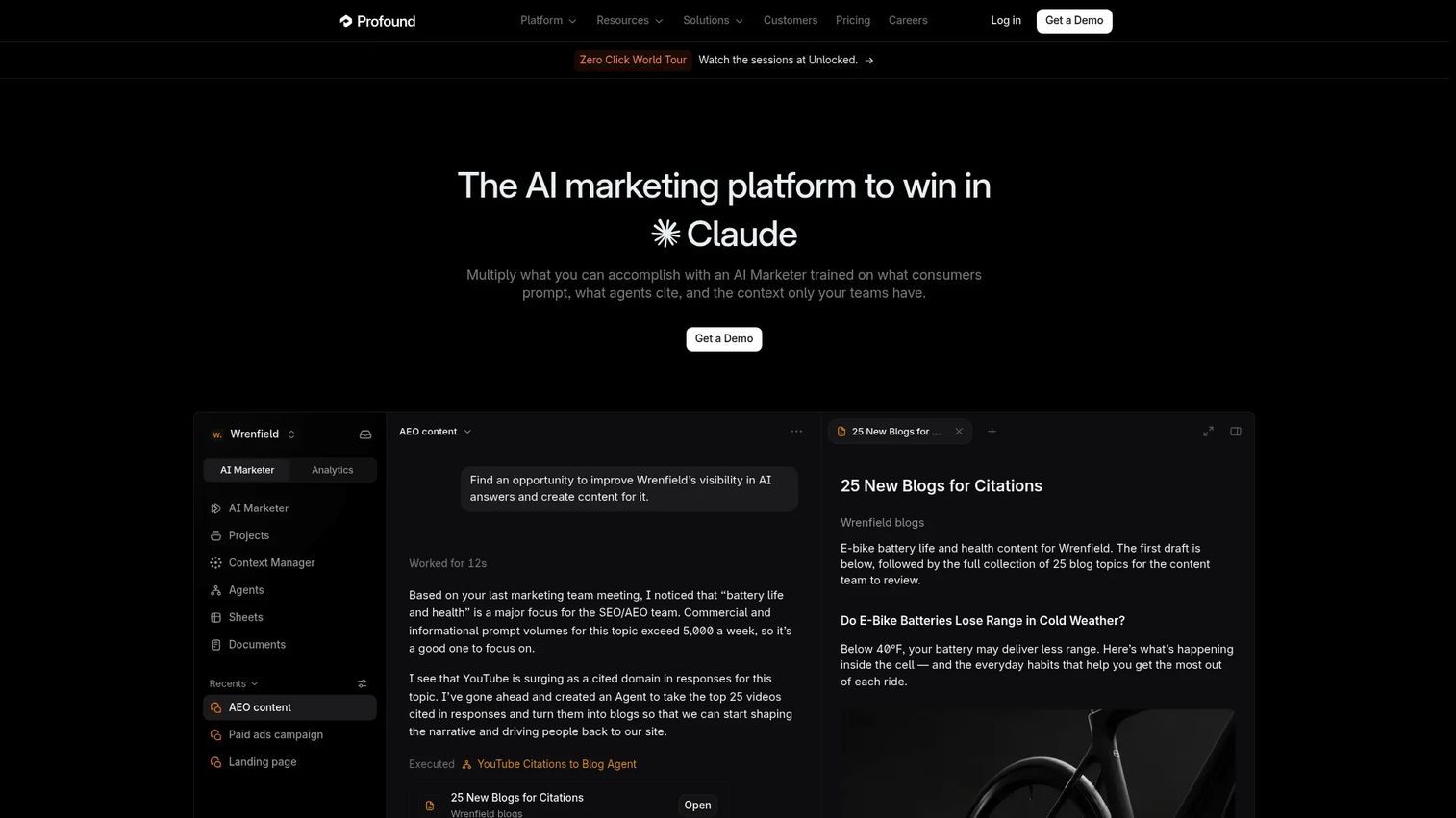
Profound is an AI marketing platform combining answer-engine intelligence with content operations. Prompt demand research helps teams investigate the questions worth prioritizing. Its monitoring also covers citations and competitive visibility, while crawler analysis and traffic attribution support broader investigation. Agents, Documents, and CMS publishing workflows connect findings to production.
Best for: Enterprise marketing teams evaluating AI visibility across a substantial content operation.
Key features
- Prompt volume and demand research
- Answer Engine Insights
- Citation and competitive analysis
- AI crawler monitoring
- Content agents and CMS publishing
Why choose Profound: Consider it when leadership needs market-level evidence and the content team needs an operational path from findings to publication. Evaluate the research outputs against your planning process before expanding the implementation.
Profound pricing: Custom pricing. A seven-day free trial includes limited credits and 50 prompts daily.
G2 rating: 4.5/5.
4. Athena HQ
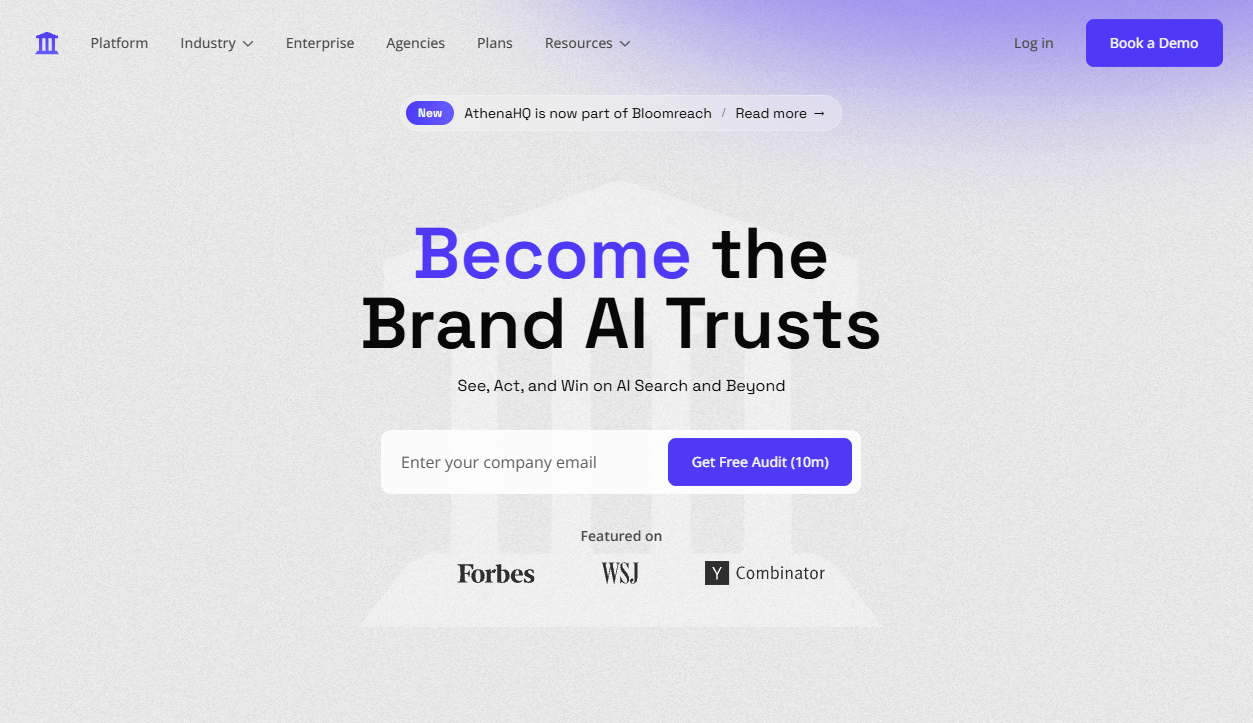
Athena HQ combines AI search visibility measurement with recommended optimization actions. The platform covers prompt analysis and source intelligence, alongside brand sentiment and competitor benchmarking. Its documented capabilities extend into on-page and off-page GEO work, including PR monitoring. That makes it relevant when several marketing functions need to act on the same findings.
Best for: Growth and brand teams converting visibility gaps into recurring content or PR tasks.
Key features
- Cross-platform visibility tracking
- Prompt and response analysis
- Citation intelligence
- Content optimization recommendations
- PR monitoring and press kits
Why choose Athena HQ: Shortlist it when your main challenge is assigning action after a report identifies a gap. During evaluation, ask content and PR owners to assess whether the recommendations fit their weekly workflow.
Athena HQ pricing: Essential is free; Starter costs $295/month and includes 3,600 monthly credits. Enterprise has custom pricing.
G2 rating: 4.9/5.
5. Scrunch AI
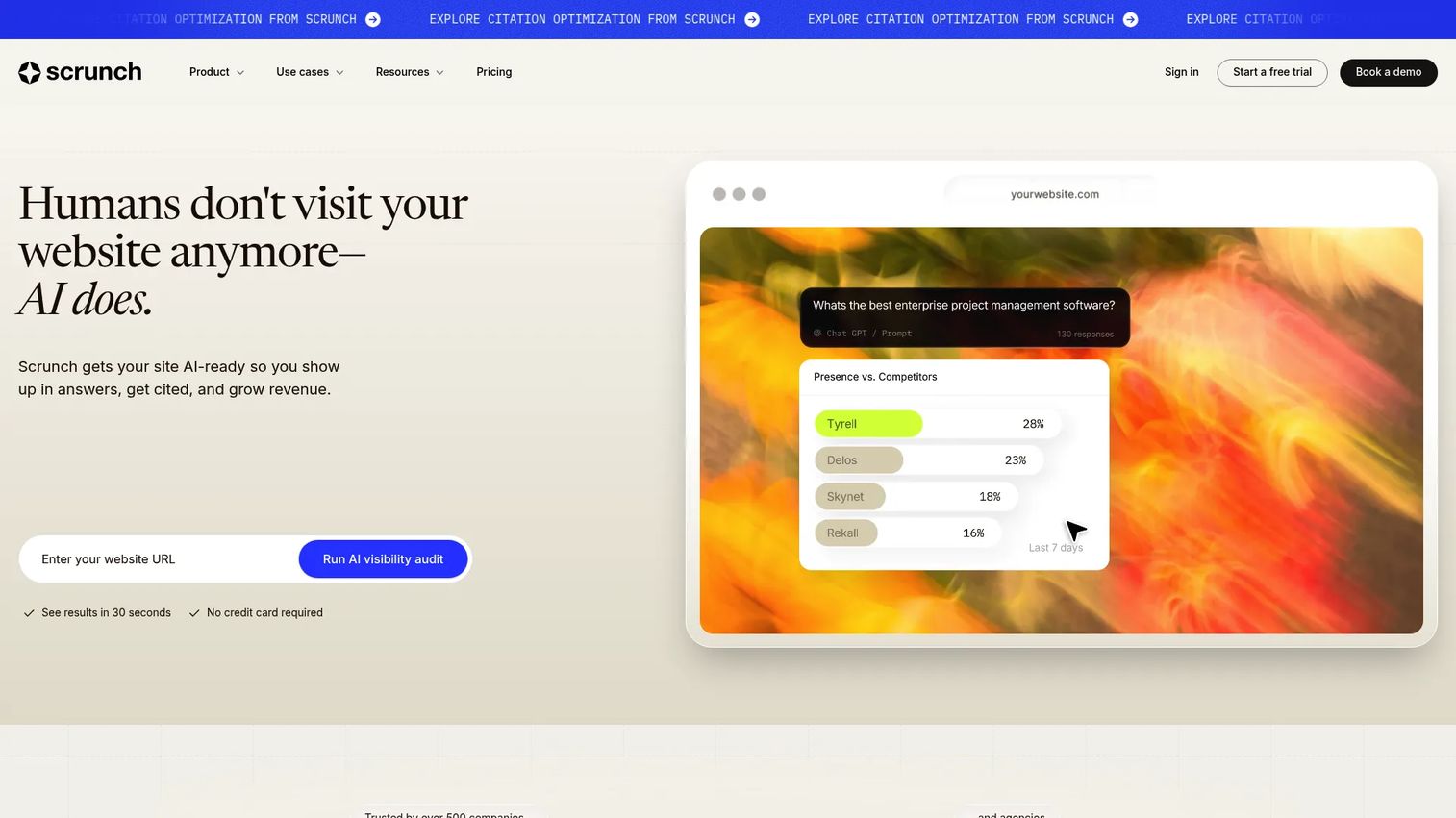
Scrunch AI focuses on how brands appear across AI answers and how website content supports that presence. Its platform combines response monitoring with page optimization and content generation. Agent-traffic tracking and AI referral reporting add another perspective on discovery. Marketing teams can use these capabilities to investigate inaccurate descriptions and prioritize the pages supporting important buyer questions.
Best for: Brand and content teams responsible for accurate company descriptions across AI search surfaces.
Key features
- AI response monitoring
- Citation target monitoring
- Page optimization
- AI referrals and agent-traffic tracking
- Data exports and MCP access
Why choose Scrunch AI: Evaluate it when brand accuracy is as important as mention volume. Review account limits against your operating model, particularly if separate product lines or regional teams need distinct reporting.
Scrunch AI pricing: Core costs $250/month, with a seven-day free trial. Enterprise has custom pricing.
G2 rating: 4.6/5.
6. LLMrefs
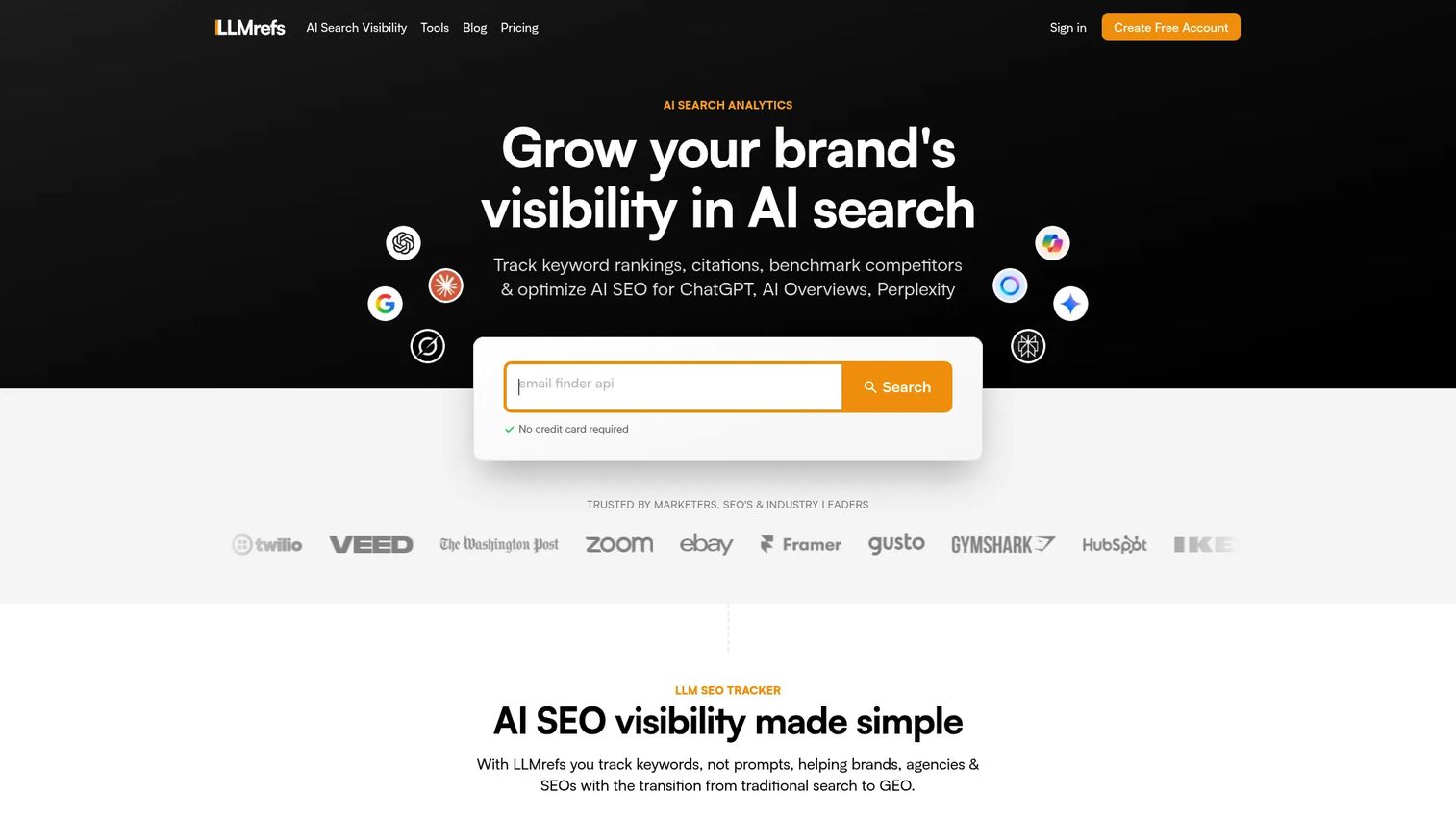
LLMrefs tracks AI search visibility with an emphasis on citations and competitive positions. It supports geographic targeting and language-specific analysis, which matters when buyer questions differ across markets. Weekly reports provide a recurring review cadence. CSV export and API access let teams carry findings into reporting workflows beyond the product itself.
Best for: SEO teams investigating which source URLs appear in answers and how competitors compare.
Key features
- Citation and source tracking
- Competitive share-of-voice reporting
- Geographic and language targeting
- Weekly visibility reports
- CSV export and API access
Why choose LLMrefs: Choose it when the question behind your reporting is which sources appear, rather than simply whether your brand receives mentions. Test relevant regional prompts before treating a global visibility average as actionable.
LLMrefs pricing: The All in One plan costs $79/month. A seven-day trial is available without a credit card.
7. WordLift
WordLift approaches search optimization through knowledge graphs and structured content. Its current platform also includes an AI Visibility Monitor and content creation capabilities. This makes it relevant when your team wants to work on the information underlying search discovery. Evaluate it around entity consistency and machine-readable content, alongside the visibility reports you expect to produce.
Best for: Marketing and SEO teams investing in structured data and connected content foundations.
Key features
- Knowledge graph creation
- Schema markup and data integration
- AI Visibility Monitor
- Content creation and optimization
- Search research and rank tracking
Why choose WordLift: Consider it when product facts and entity relationships need a more consistent structure across your site. Treat that work as an information-quality initiative; the presence of markup alone does not establish business impact.
WordLift pricing: Business+ costs $879/month billed yearly or $1,100 month to month. Enterprise has custom pricing.
G2 rating: 4.7/5.
8. Conductor
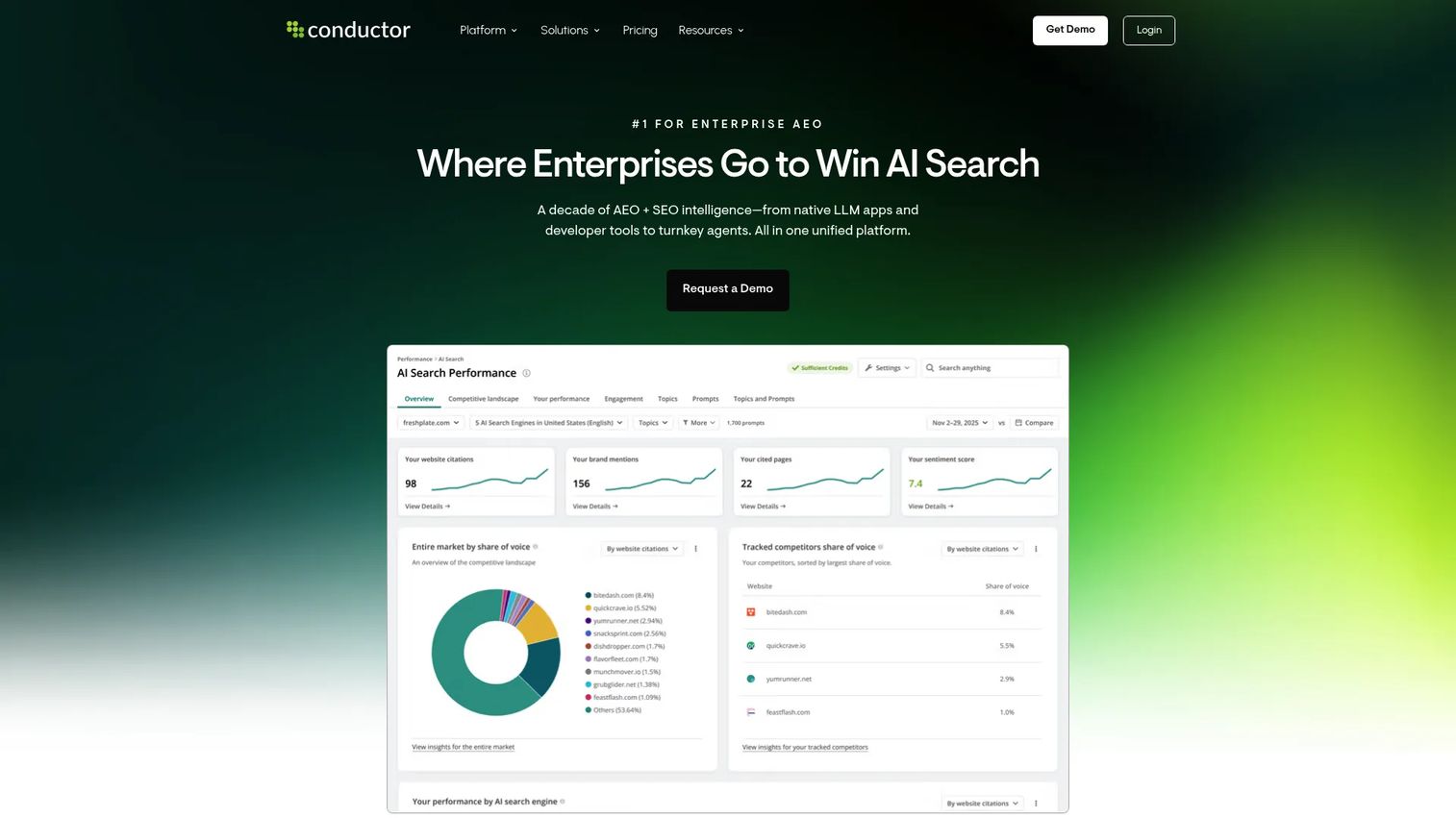
Conductor combines enterprise AEO and SEO capabilities with website monitoring. Its product coverage includes answer-engine visibility and content optimization, supported by research and custom reporting. For a mature search team, the attraction is evaluating GEO inside an established operating process. Technical health and editorial planning can remain part of the same purchasing conversation.
Best for: Enterprise teams coordinating AI search measurement with broader organic marketing operations.
Key features
- AI search visibility tracking
- Topic and keyword research
- Content generation and optimization
- Continuous website monitoring
- Custom reporting and analytics
Why choose Conductor: Evaluate it when consolidating search operations matters more than buying a standalone tracker. Ask stakeholders to map existing research and monitoring subscriptions against the proposed package before approving additional spend.
Conductor pricing: Custom, usage-based pricing across Essentials, Growth, and Enterprise. A three-week free trial is available.
G2 rating: 4.5/5.
9. BrightEdge
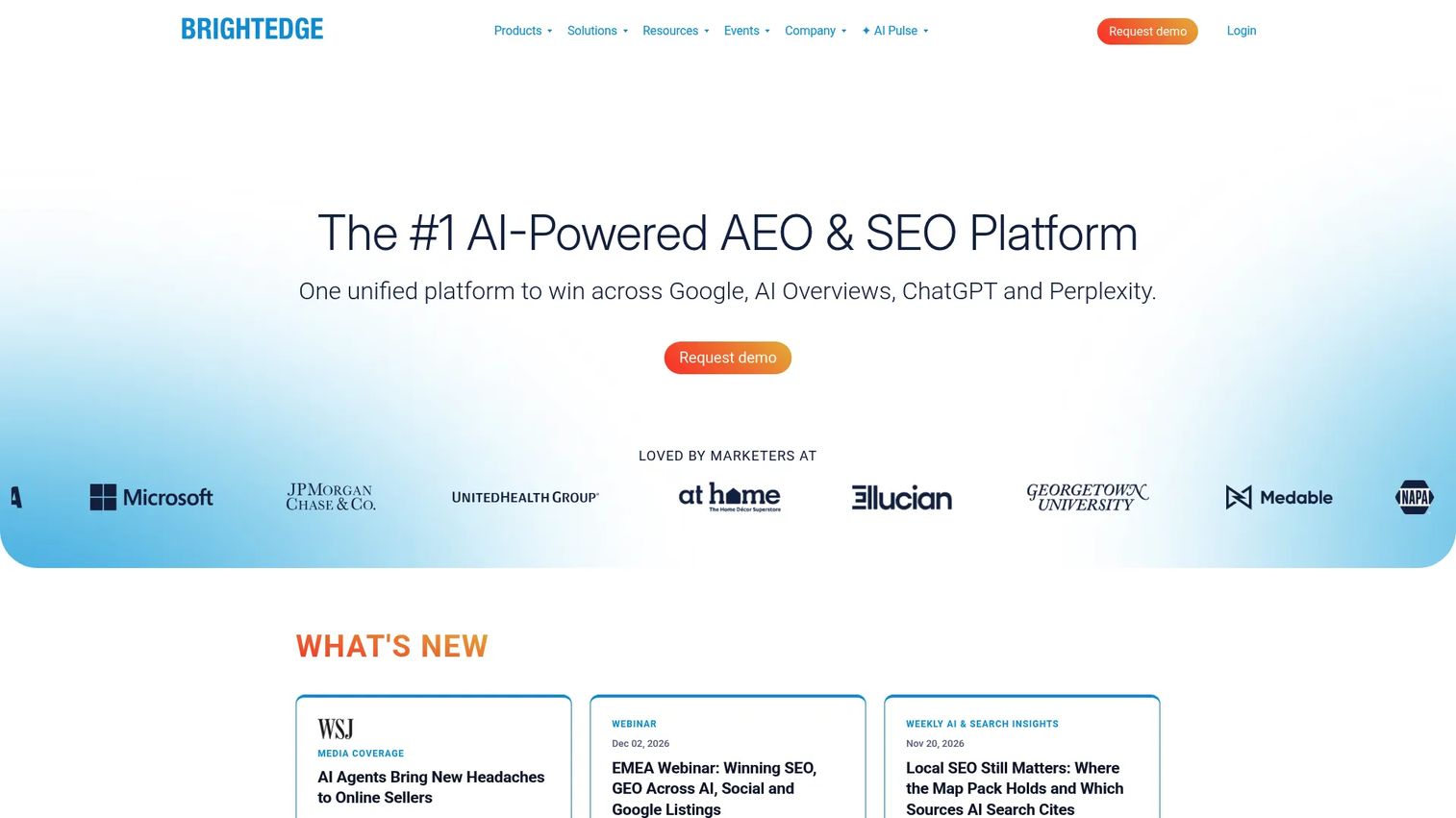
BrightEdge combines enterprise SEO intelligence with AI search measurement. Its documented coverage includes ChatGPT, Perplexity, and Google AI Overviews. Data Cube supports demand research, while ContentIQ handles technical site auditing. StoryBuilder provides a reporting layer for teams that need search performance communicated beyond the SEO function.
Best for: Large marketing organizations managing traditional search and AI visibility within an enterprise reporting program.
Key features
- Data Cube demand research
- AI search visibility measurement
- ContentIQ technical auditing
- StoryBuilder dashboards
- Competitive Share of Voice analysis
Why choose BrightEdge: Consider it when AI Overviews tracking must sit alongside established demand and website analysis. Existing customers should first evaluate their current coverage before adding a separate GEO subscription.
BrightEdge pricing: Custom pricing.
G2 rating: 4.4/5.
10. Frase
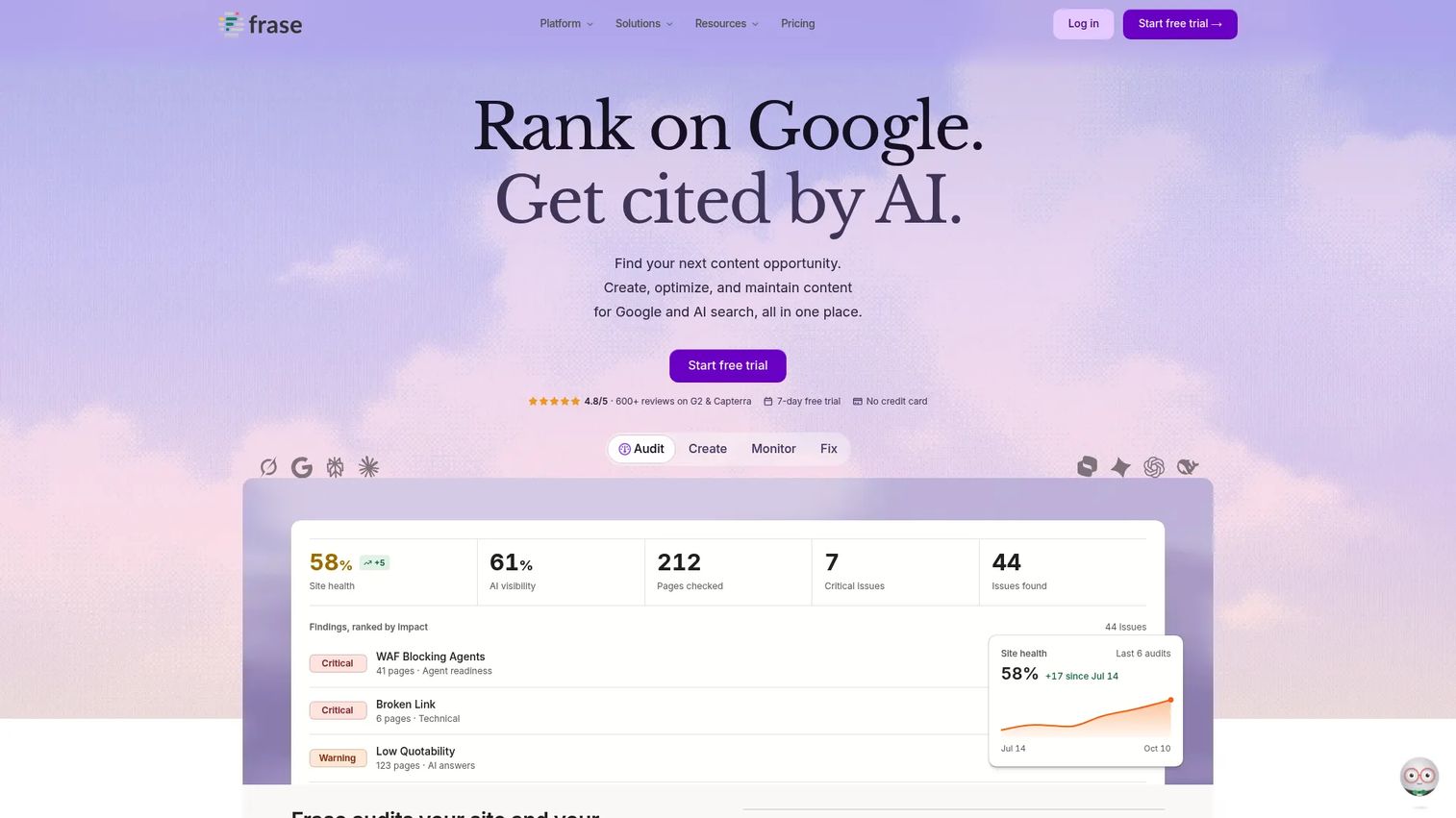
Frase connects content research and production with optimization and AI visibility monitoring. Its current offering extends beyond briefs into CMS publishing and ongoing content review. Content Guard monitors pages and drafts fixes, giving teams an execution path after publication. This is relevant when the bottleneck is maintaining a working content process rather than collecting another report.
Best for: Content teams seeking an integrated workflow from topic investigation to performance review.
Key features
- Topic research and content briefs
- SEO and GEO content scoring
- AI Visibility tracking
- CMS publishing connections
- Content Guard monitoring
Why choose Frase: Evaluate it when research findings repeatedly stall before becoming published updates. Assess its brief-building workflow alongside your prompt research tools, using a buyer question your current content answers poorly.
Frase pricing: Starter costs $39/month billed yearly or $49 monthly. Paid plans offer a seven-day trial without a credit card.
G2 rating: 4.8/5.
11. Surfer SEO
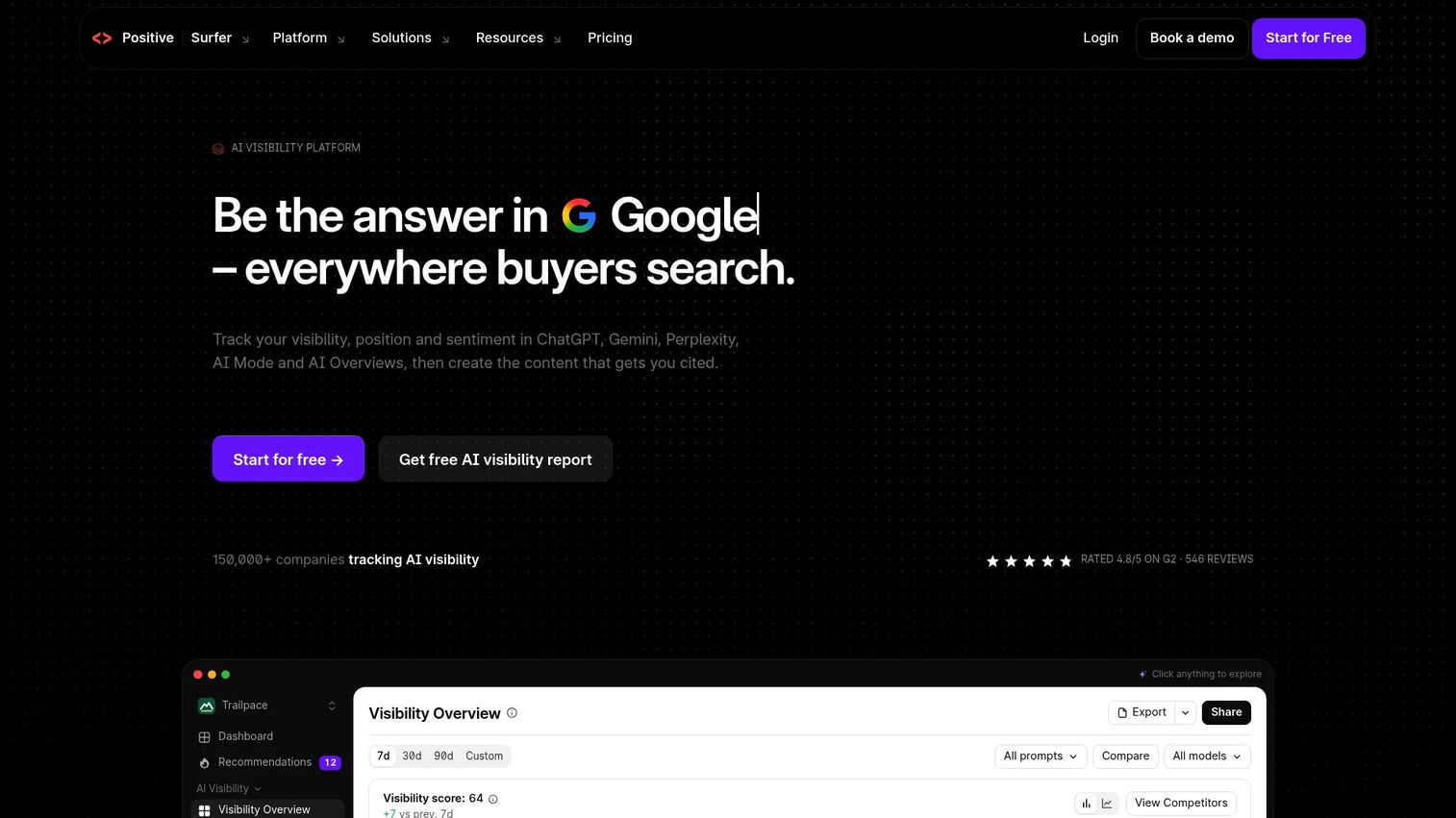
Surfer SEO now combines AI visibility measurement with its content optimization workflow. Content Editor provides guidance during drafting, while Content Audit identifies opportunities across existing pages. Topical Map and Keyword Research support planning before production begins. For marketers already paying for editorial software, its expanded coverage makes subscription overlap worth examining.
Best for: Content teams improving page coverage while adding measurement across traditional and AI search.
Key features
- AI search visibility tracking
- Content Editor guidance
- Content Audit
- Topical Map and Keyword Research
- AI writing and internal linking
Why choose Surfer SEO: Choose it when writers need practical guidance and the search team needs feedback on discoverability. Compare the content package with the separately listed analytics option rather than assuming the entry price includes everything.
Surfer SEO pricing: Discovery costs €49/month and AI Search Analytics €82/month, both billed yearly. A seven-day free trial is available.
G2 rating: 4.8/5.
12. Clearscope
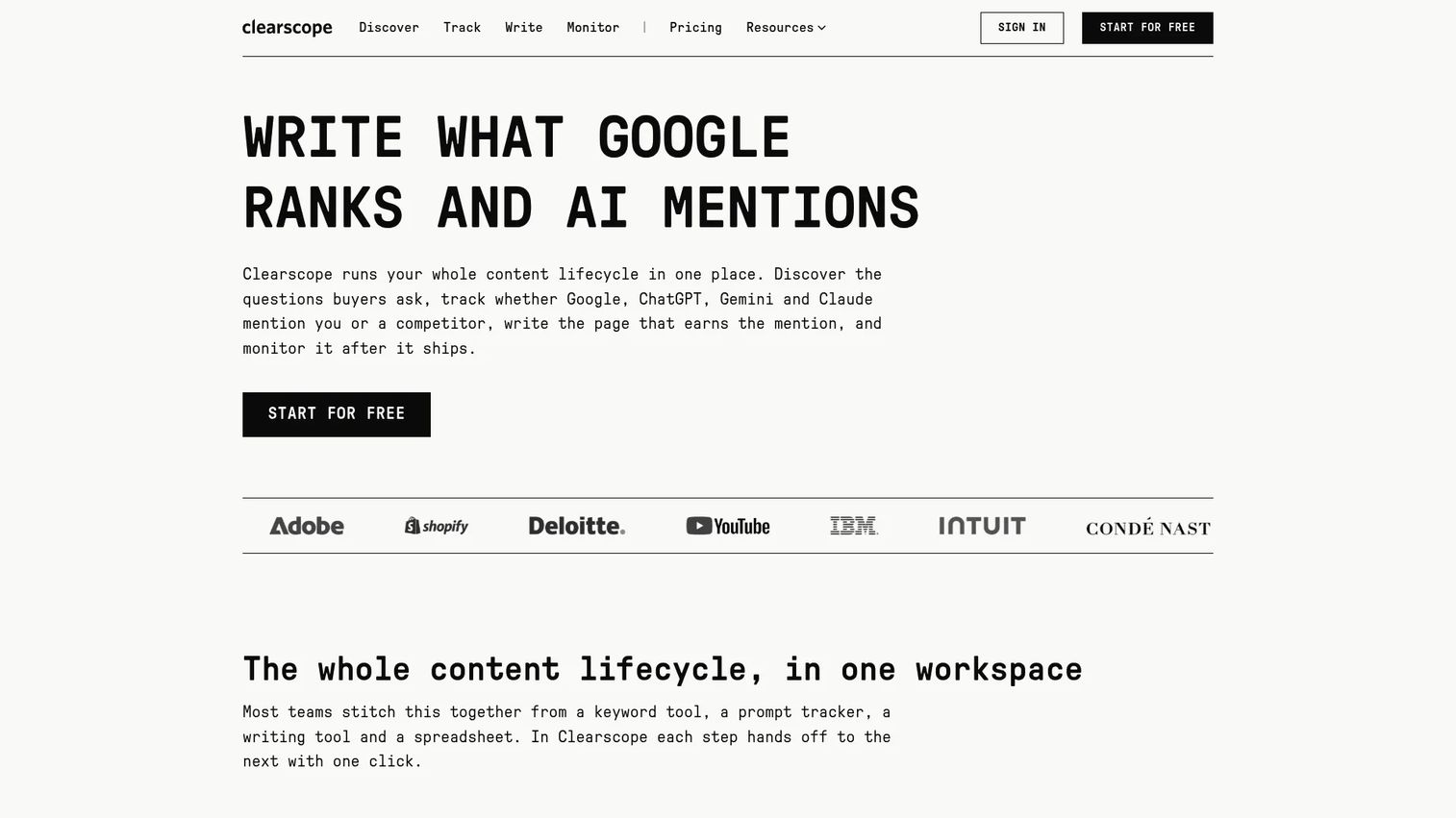
Clearscope combines editorial optimization with discoverability monitoring. Its content inventory includes Striking Distance and Content Decay views, helping teams prioritize existing pages. Visibility tracking covers Google, Gemini, ChatGPT, and Claude. Integrations with familiar writing environments make it relevant when adoption depends on keeping editors close to their current process.
Best for: Editorial teams maintaining content quality while monitoring search and AI answer visibility.
Key features
- Real-time Content Grades
- Semantic term recommendations
- Topic and keyword discovery
- Content inventory monitoring
- Google Docs and Word integrations
Why choose Clearscope: Evaluate it when inconsistent editorial execution is slowing optimization work. Compare tracked-query and page allowances with the content inventory you intend to maintain, rather than buying around a single campaign.
Clearscope pricing: Essentials costs $129/month and Business $399/month; Enterprise has custom pricing. A 14-day free trial is available.
G2 rating: 4.9/5.
13. RankShift
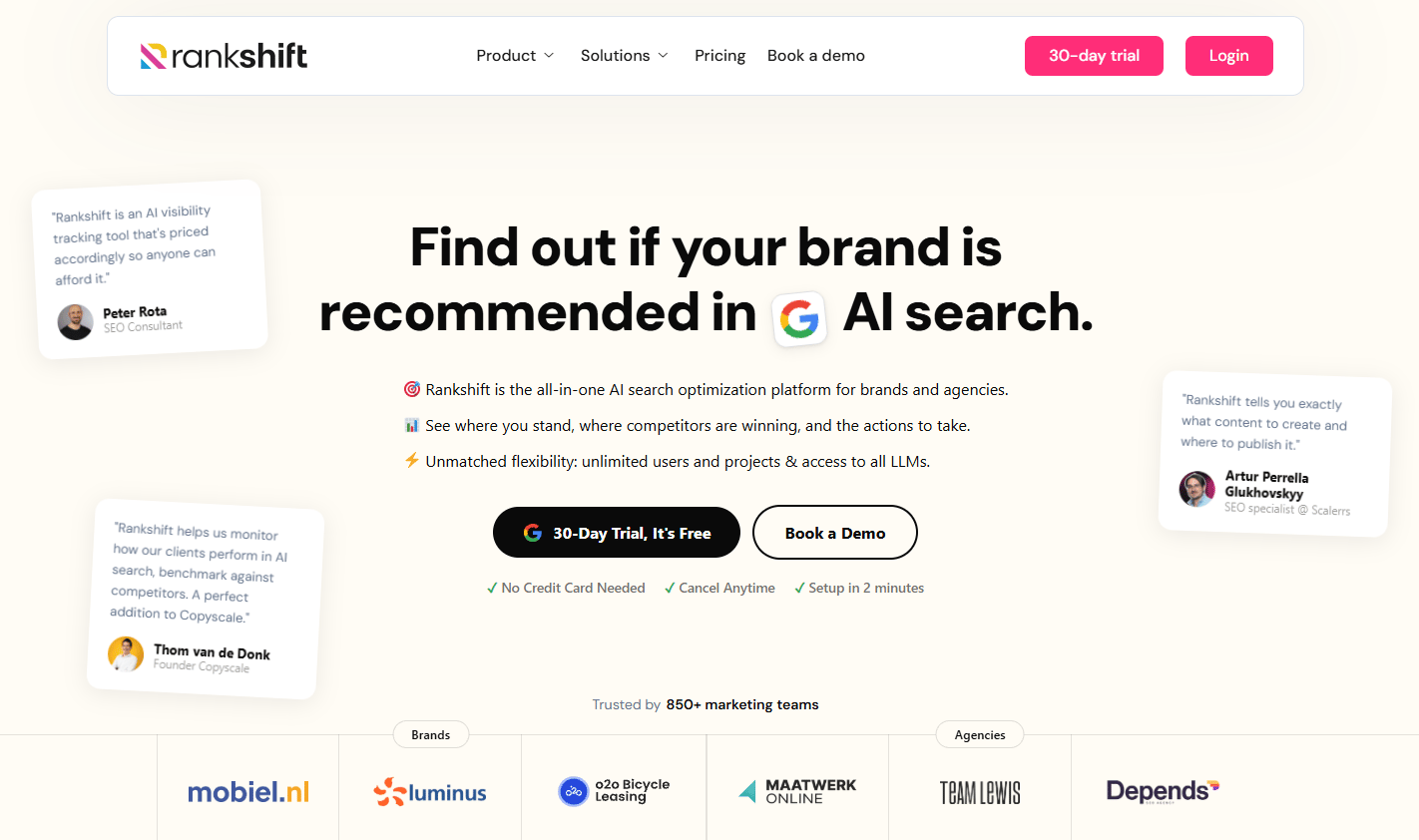
RankShift tracks brand presence across AI answers and supports recurring reporting. Alongside citation analysis, it includes content brief generation and crawler analytics. Its documented reporting connections include Looker Studio, a REST API, and MCP access. That combination suits teams trying to move observations into a shared reporting process rather than maintain another isolated dashboard.
Best for: Marketing teams reviewing prompt-level visibility changes on a recurring schedule.
Key features
- AI visibility and prompt tracking
- Citation and sentiment analysis
- Competitor benchmarking
- AI crawler analytics
- Reporting integrations and REST API
Why choose RankShift: Shortlist it when reporting access across projects matters, since its credit-based plans include unlimited projects and seats. Evaluate credit consumption against your intended monitoring schedule before estimating the ongoing budget.
RankShift pricing: Starter costs $92/month or $82/month billed annually. Professional costs $210/month and Business $473/month on monthly billing.
14. Google Search Console
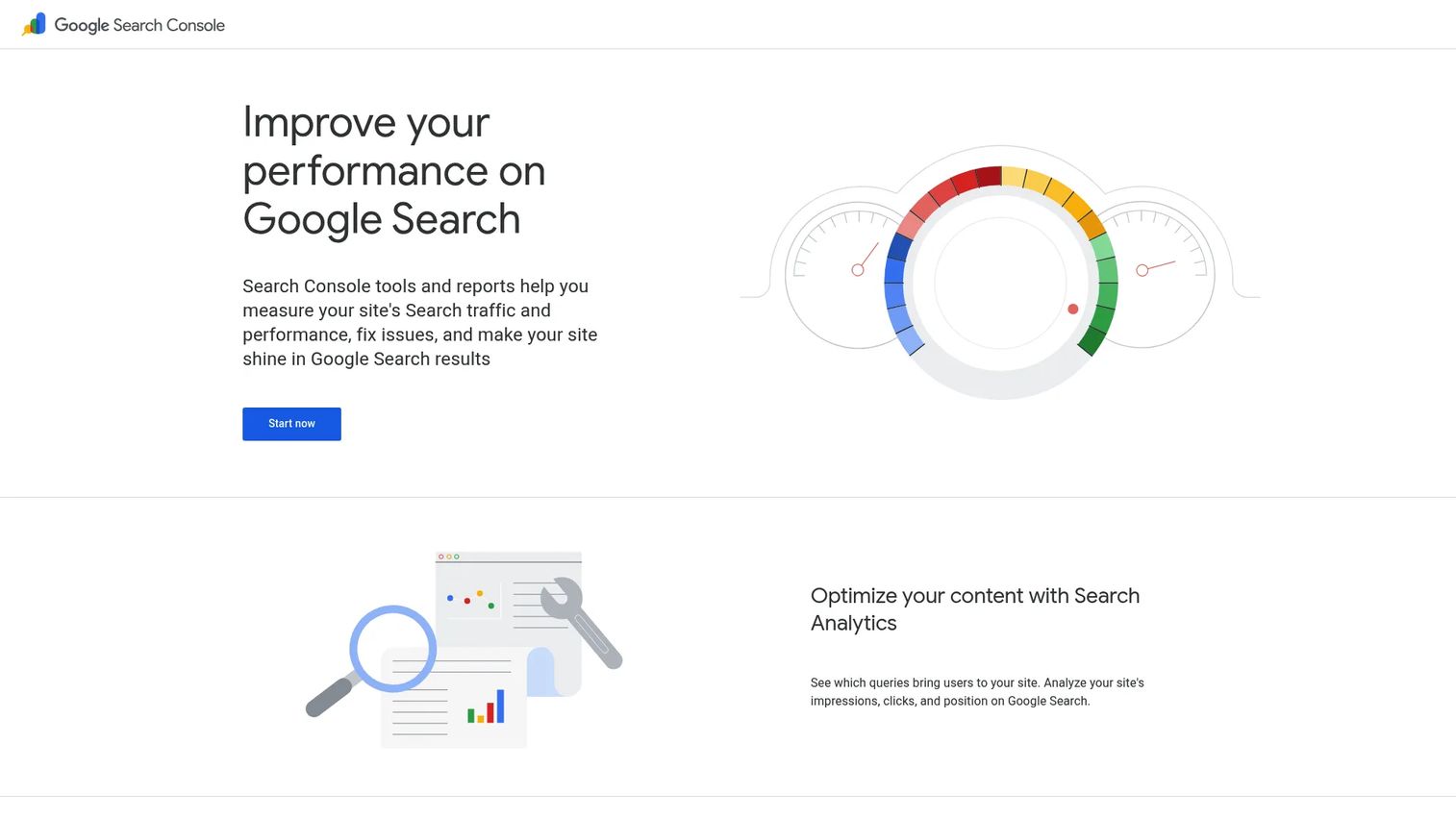
Google Search Console provides the search-performance and indexing baseline that GEO analysis needs beside it. Query and page reporting help you understand your existing organic footprint. URL Inspection and sitemap monitoring support investigation when important content is difficult to discover. Keep its role clear when presenting AI search findings to stakeholders.
Best for: Any marketing team establishing organic search and technical baselines before buying specialist GEO software.
Key features
- Query and page performance
- Indexing reports
- URL Inspection
- Sitemap submission and monitoring
- Security and Core Web Vitals reports
Why choose Google Search Console: Use it to investigate whether a visibility problem coincides with indexing or broader organic performance changes. It supports that diagnosis rather than replacing cross-engine answer monitoring or dedicated AI Overviews tracking.
Google Search Console pricing: Free.
G2 rating: 4.7/5.
15. Google Analytics 4
Google Analytics 4 measures website and app behavior after visitors arrive. For GEO programs, its value is connecting identifiable AI referral traffic to meaningful actions. Acquisition reports provide the entry point, while Explorations support deeper investigation. Interpret those sessions alongside visibility evidence, since an answer interaction does not always produce an attributable website visit.
Best for: Growth marketers connecting AI referral traffic with conversion behavior on owned properties.
Key features
- Acquisition and engagement reports
- Event and conversion measurement
- Explorations and custom analysis
- Cross-platform attribution
- BigQuery export
Why choose Google Analytics 4: Use it when stakeholders ask what happened after discovery, including whether visitors completed a commercially meaningful action. Define those actions before evaluating channel performance, and avoid treating direct traffic as evidence of an AI referral.
Google Analytics 4 pricing: The standard version is free. Analytics 360 uses custom pricing through authorized Google Partners.
G2 rating: 4.5/5 for Google Analytics.
16. Data Studio
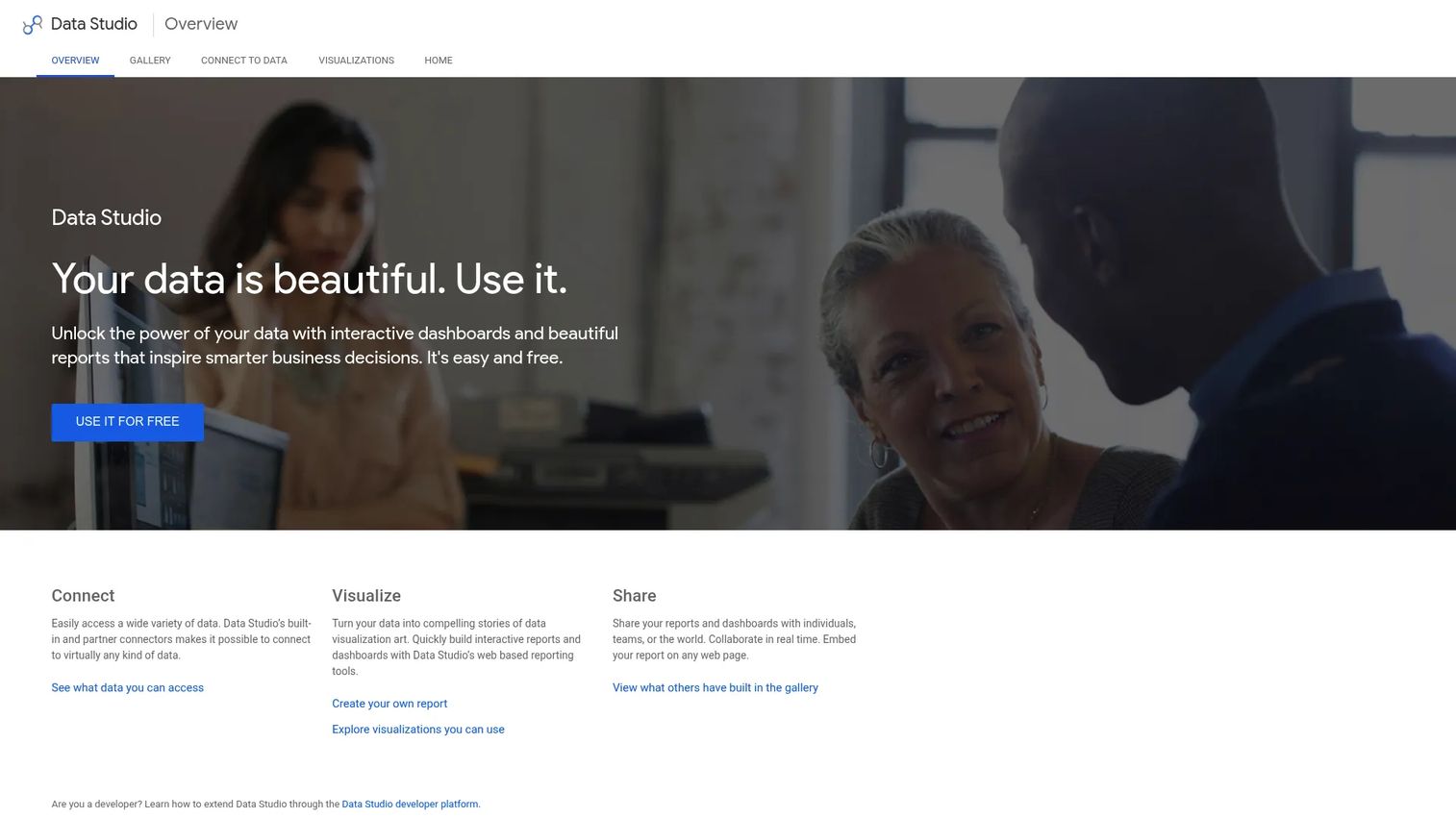
Data Studio is Google’s reporting and visualization product for combining data in shareable dashboards. Google documentation identifies Data Studio as the current name following its April 2026 change from Looker Studio. For GEO reporting, the useful distinction is between collecting evidence and presenting it. This product handles the presentation layer using connected sources.
Best for: Marketers bringing acquisition metrics and available GEO exports into a shared reporting view.
Key features
- Customizable dashboards and reports
- Drag-and-drop charts and tables
- Data source connections
- Collaboration and report sharing
- Website and intranet embedding
Why choose Data Studio: Choose it when the reporting gap is presentation rather than missing monitoring data. Label source systems and refresh dates clearly, especially when combining scheduled exports with continuously updated website analytics.
Data Studio pricing: Self-service reporting is free. Data Studio Pro costs $9 per user per project per month.
G2 rating: 4.4/5.
17. llms.txt
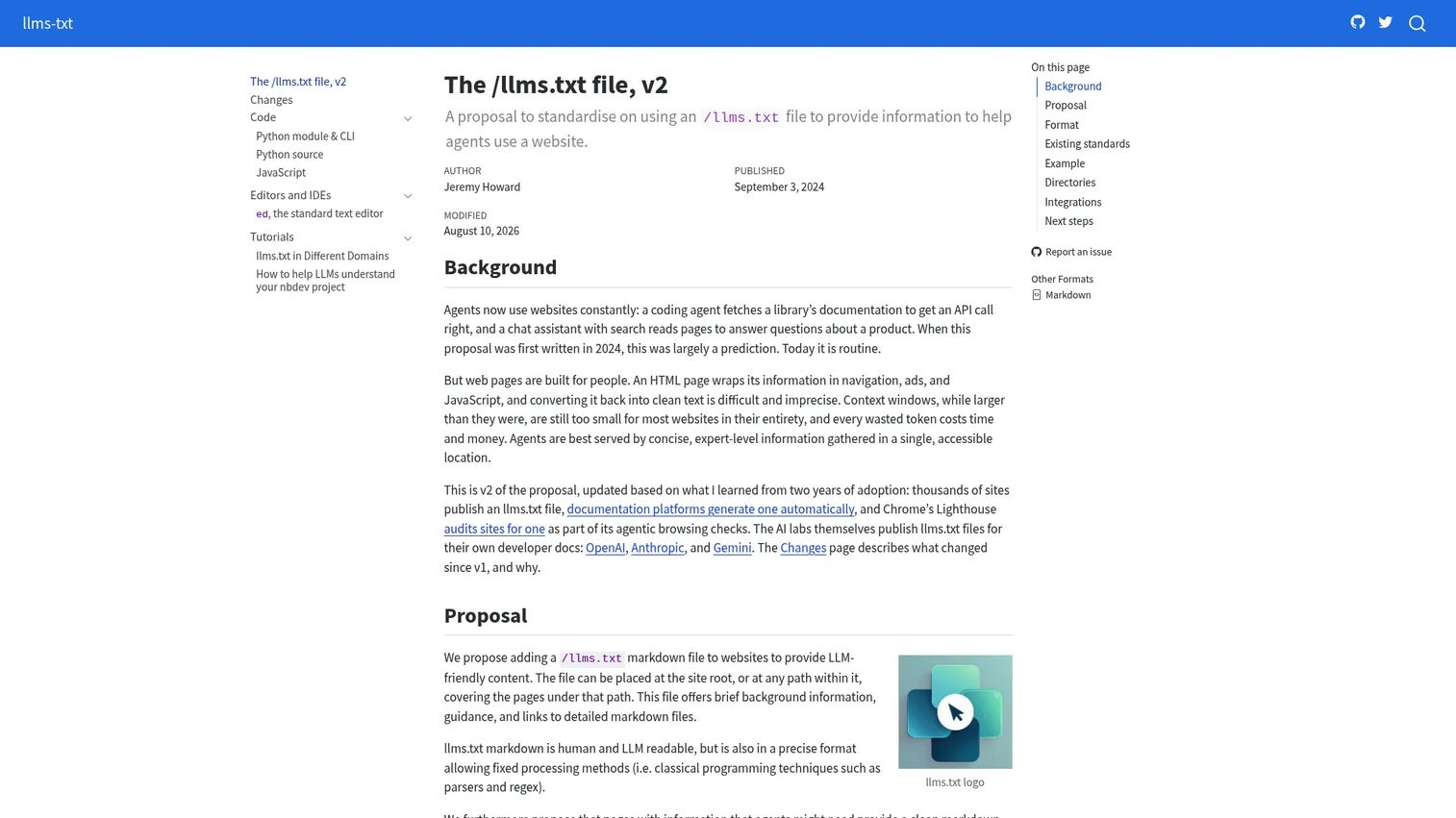
llms.txt is an open proposal for a Markdown file that helps AI agents navigate website information. Publishers curate important links and supporting context in a readable format. It belongs in a technical GEO toolkit as a resource, rather than a software platform. Its presence alone does not demonstrate that an AI system accessed or cited your pages.
Best for: Documentation publishers and technical SEO teams organizing useful content for AI agents.
Key features
- LLM-readable Markdown format
- Curated links to detailed content
- Page-level Markdown support
- Resource discovery link relations
- Python parser and CLI
Why choose llms.txt: Consider it when you can maintain a clear set of authoritative resources alongside your documentation. Keep AI crawler accessibility checks separate, and measure observed agent behavior rather than assuming the file changes retrieval.
llms.txt pricing: Free to implement. Internal costs come from preparation and maintenance.
Considerations when choosing GEO tools
Start with the job you need done
Write down the question your current stack cannot answer. Choose monitoring for missing answer evidence, or improve reporting when you already have the underlying data.
A new subscription should replace a manual task or close a defined measurement gap.
Check model and surface coverage
List the engines relevant to your buyers, including any regional or language requirements. Ask how often answers refresh and what settings influence collection.
Compare equivalent prompt sets before accepting a visibility score as a useful benchmark.
Look for citation-level evidence
Inspect the answer and referenced URL behind each reported appearance. Distinguish a company mention from a link to your website.
AI brand monitoring becomes more actionable when analysts can explain why an observation matters to content or positioning.
Connect GEO data to your existing stack
Test the export or integration path during evaluation. Confirm who will maintain the dashboard and reconcile differences between source systems.
URL-level attribution should have a defined meaning, whether it describes a cited page or a destination receiving referral sessions.
Confirm the cost of your reporting cadence
Price the required prompt volume and refresh frequency, alongside user access and historical data. Compare annual commitments against the pilot’s evidence.
Ask which existing subscription becomes unnecessary if the new platform performs as expected.
Choose the missing measurement before buying another platform
The right GEO tool depends on the evidence your team needs next.
Otterly.ai is a practical starting shortlist for recurring monitoring. LLM Pulse deserves attention when you want visibility connected with crawler and traffic analysis. Profound suits a broader AI intelligence evaluation.
Enterprise search teams should examine Conductor or BrightEdge within their existing operations. Content-led organizations can compare Frase with Surfer SEO and Clearscope before buying separate optimization software.
Start with your current analytics baseline. Then select a defined set of buyer questions and evaluate one monitoring product against them.
Use the findings to assign work. A citation gap may justify a content update; inconsistent entity information may warrant structured data work. A reporting gap may need only a better dashboard.
Keep a record of what changed and what outcome you expected. The purchasing case becomes stronger when the platform supports decisions your team can explain.
For a separate product education initiative, explore Guideflow.
Start your journey with Guideflow today!
FAQs
GEO tools help marketers investigate how brands and content appear in generative AI answers. In this context, GEO means Generative Engine Optimization, rather than geological equipment or geospatial software. The toolkit includes answer monitoring and content optimization, plus supporting analytics and technical resources. Choose the category that answers your reporting question before comparing individual products.
SEO addresses visibility in search results and the website foundations supporting that visibility. GEO examines how generative systems mention brands or reference content within their answers. AEO, or answer engine optimization, overlaps with GEO through its focus on answer inclusion. Treat generative AI SEO tools as potentially overlapping capabilities, then inspect what each product measures.
Review your existing subscription before purchasing another product, because several SEO and content platforms now include AI visibility features. Compare their supported engines and underlying answer evidence with the questions your team needs to resolve. A dedicated monitor makes sense when that comparison reveals a specific gap. Avoid paying twice for substantially overlapping reporting.
Track brand mentions and cited URLs, then compare competitive visibility across a stable set of buyer questions. Review sentiment and factual accuracy where your platform provides the underlying answer. Measure available referral sessions and conversion events separately in website analytics. Together, these perspectives explain observed presence and measured behavior without presenting either as complete revenue attribution.
Free resources can support a useful baseline, especially when the immediate task is website measurement or dashboard creation. Manual answer checks can also help define which questions deserve recurring monitoring. Paid platforms become useful when repeated collection and competitive reporting consume meaningful team time. Decide whether automation changes an operational decision before expanding the budget.
Monitoring platforms generally collect answers to selected prompts and identify relevant brand mentions or citations. They compare observations across engines or reporting periods, although collection methods differ by vendor. Ask how location and other settings affect the results you see. A dashboard represents observed answers under its methodology, rather than a complete census of every buyer interaction.
llms.txt is an open proposal for a Markdown file containing context and curated links to important website resources. It helps organize information for AI agents, but should not be treated as proof of crawler access or answer inclusion. Maintain it alongside the content it references. Continue investigating technical access and observed traffic through separate measurement methods.
Identify the missing job first, whether that is citation monitoring, content improvement, referral reporting, or technical investigation. Build an evaluation around buyer questions your team already encounters, rather than a vendor’s sample dashboard. Compare the resulting evidence with your current subscriptions and assign someone to act on it. Purchase when the tool supports a repeatable decision worth its ongoing cost.