Your campaign dashboard shows growth. Finance reports flat revenue. The AI assistant gives a confident explanation, but nobody can trace its answer.
Knowledge graph tools address the relationships behind those disagreements. They connect business entities with the context needed to interpret them across systems.
For digital marketers, that can mean connecting an account’s campaign engagement to product usage and a closed opportunity. It can also mean identifying which revenue definition a dashboard uses.
Interest in this infrastructure is growing. MarketsandMarkets’ 2026 forecast projects 31.6% compound annual growth for the global knowledge graph market. That forecast signals investment, not a reason to buy another platform.
Your purchase still needs a specific job. An enterprise knowledge graph supporting AI retrieval requires different capabilities from a catalog documenting attribution inputs.
Before adding knowledge graph software, identify what it will replace or improve. Otherwise, you risk buying another data system while the reporting disagreement continues.
What’s inside
- The shortlist: Seventeen knowledge graph tools spanning graph databases, semantic platforms, metadata catalogs, entity services, and open-source frameworks
- Architecture fit: How graph models and query languages affect implementation choices
- Business relevance: Where connected data supports customer intelligence, campaign reporting, content discovery, and AI retrieval
- Evaluation criteria: Data integration, governance, AI capabilities, and deployment requirements
- Commercial context: Vendor pricing models and available G2 ratings from research dated November 24, 2026
- Buying guidance: Questions to bring to your data team before committing to a platform
The comparisons use vendor documentation and supplied research, rather than a hands-on performance benchmark.
TL;DR
- Best starting point for property graph applications: Neo4j combines Cypher with managed deployment and graph analytics for relationship-heavy applications.
- Best for enterprise semantic layers: Stardog connects distributed data through virtualization and reasoning, with a free cloud option.
- Best AWS-native option: Amazon Neptune fits teams that already operate their data infrastructure on AWS.
- Best for governed metadata: Compare OvalEdge, Atlan, Collibra, and DataHub when reporting trust or ownership is the immediate problem.
- Best open-source routes: Apache Jena fits RDF development. JanusGraph suits distributed graph infrastructure with engineering ownership.
- Best approach for marketers: Choose the category that resolves a measurable reporting, customer intelligence, or content discovery problem before comparing vendors.
What are knowledge graph tools?
Knowledge graph tools model entities and their relationships as connected data, adding context that teams can query and interpret across systems.
An entity might be a customer account or campaign. Relationships describe connections, such as an account attending an event or purchasing a product.
The practical value comes from preserving those connections alongside their meaning. A relationship can show which source supplied the information and how your organization defines it.
Core types of knowledge graph tools
- Graph databases: Store connected records and support queries that follow relationships
- RDF stores: Represent information as subject, predicate, and object statements
- Semantic platforms: Add ontologies, reasoning, shared definitions, and integration capabilities
- Metadata graphs: Connect datasets with owners, policies, lineage, and business context
- GraphRAG tooling: Retrieves graph-connected context to support answers generated by large language models
RDF means Resource Description Framework. SPARQL is a query language for RDF data.
An ontology defines concepts and the relationships between them. For example, it can specify how subsidiaries relate to parent accounts.
Property graphs instead represent entities as nodes and connections as edges, with properties attached to either. Their query languages vary by platform.
Key capabilities to evaluate
Look beyond knowledge graph visualization. A useful picture does not establish whether a platform supports your operating requirements.
Prioritize these capabilities:
- Entity modeling and matching rules
- Query support appropriate to your engineering team
- Ontology or taxonomy management
- Connections to existing data sources
- Ownership, lineage, access controls, and quality signals
- Graph analytics or semantic reasoning
- Retrieval capabilities for AI applications
GraphRAG combines graph relationships with retrieval-augmented generation. It supports LLM grounding by supplying relevant context rather than relying entirely on a model’s learned information.
Vector search can complement this approach by finding similar content. Graph connections add explicit relationships that similarity alone does not describe.
Knowledge graph tools versus graph databases
A graph database provides storage and queries. A broader knowledge graph platform may also manage business meaning and governance.
Some products cover both. Metadata catalogs address a related job by describing your data assets, rather than becoming the application database itself.
When to use knowledge graph tools
Connect customer data across systems
Consider a knowledge graph database when valuable questions require following relationships across customer records and business activity. Customer 360 and recommendation engines are examples.
For marketing, start with an account journey spanning campaign engagement, product events, support activity, and revenue. Define entity resolution rules before treating separate records as the same customer.
A connected model supports analysis, but attribution still needs an agreed methodology.
Ground AI answers in explainable context
Use GraphRAG when answers need relationships and business definitions beyond document similarity. Semantic search can then retrieve context associated with an entity or topic.
Ask the implementation team to preserve source references and enforce permissions during retrieval. LLM grounding should make supporting evidence inspectable.
Test difficult questions, including ambiguous account names and conflicting definitions, rather than evaluating only answers everyone already knows.
Govern metrics and data lineage
Choose a metadata-oriented platform when teams disagree about the source or ownership of a metric. Data lineage helps trace a dashboard back to its inputs.
For CAC or ROAS reporting, document the calculation and approved datasets before expanding the catalog. Give business owners responsibility for definitions.
The buying case should identify which reconciliation task disappears and how the team will measure that improvement.
Knowledge graph tools comparison
These knowledge graph tools serve different architectural jobs. Compare products within the relevant category before treating the whole list as interchangeable.
For example, a data catalog can improve trust in an attribution dashboard without becoming its underlying graph database. An RDF framework requires a different operating model from managed infrastructure.
Pricing below reflects the supplied November 24, 2026 research. Usage rates are not equivalent to total monthly costs.
“N/A” means the research did not establish a current G2 aggregate rating. Several available scores describe vendor portfolios rather than individual products; their source scope appears below the table.
| # | Product | Best for | Key differentiator | Pricing | G2 rating |
|---|---|---|---|---|---|
| 1 | Neo4j | Property graph applications | Cypher and graph data science | Free; Professional $0.09/GB/hour | 4.5/5 |
| 2 | Stardog | Enterprise semantic layers | Virtualization and semantic reasoning | Free; Enterprise custom pricing | N/A |
| 3 | Amazon Neptune | AWS graph workloads | Managed graph infrastructure | Usage-based; example $0.348/hour | N/A |
| 4 | TigerGraph | Deep relationship analytics | Graph and vector analysis | Free options; Savanna $45/GB/month | 4.6/5 |
| 5 | OvalEdge | Governed metadata | Cataloging with lineage and quality | Custom pricing | 5.0/5 |
| 6 | Ontotext GraphDB | RDF and inference | SPARQL and standards-based reasoning | Free; Enterprise custom pricing | N/A |
| 7 | Graphwise | Governed AI context | Semantic modeling and GraphRAG | Request a quote | 4.2/5 |
| 8 | data.world | Collaborative data discovery | Knowledge graph-based catalog | Custom pricing | 4.2/5 |
| 9 | Google Enterprise Knowledge Graph | Entity reconciliation | Entity matching and stable identifiers | Ask Google Cloud for current terms | N/A |
| 10 | AllegroGraph | Semantic AI applications | Graph, vector, and document storage | Free; Enterprise custom pricing | 5.0/5 |
| 11 | PoolParty Semantic Suite | Content taxonomies | Semantic enrichment and classification | Custom pricing | N/A |
| 12 | Atlan | Enterprise metadata context | Enterprise Data Graph and column lineage | Custom pricing | 4.5/5 |
| 13 | Collibra | Enterprise governance | Stewardship and policy workflows | Custom pricing | 4.2/5 |
| 14 | DataHub | Engineering-led metadata management | Metadata APIs and lineage | Request current licensing and cloud terms | 4.4/5 |
| 15 | ArangoDB | Multimodel applications | AQL across connected data models | Free evaluation/noncommercial edition; commercial custom pricing | 4.6/5 |
| 16 | Apache Jena | Custom RDF development | Java framework with SPARQL infrastructure | Free and open source | N/A |
| 17 | JanusGraph | Distributed graph infrastructure | Pluggable storage and Gremlin | Free and open source | N/A |
Best 17 tools for knowledge graph software
1. Neo4j
Neo4j is a native graph database for applications built around connected information. Its property graph model supports use cases such as recommendations and identity analysis. Teams can deploy it through managed AuraDB or operate it themselves.
Best for: Organizations building relationship-heavy applications with dedicated development ownership.
Key features
- Native property graph modeling
- Cypher declarative queries
- Graph analytics and data science
- ACID transactions and clustering
- Managed AuraDB deployment
For marketers, a useful evaluation starts with an account-level question. Ask which contacts engaged with a campaign before another person at the same company purchased.
That exercise tests the connections your team needs, rather than the appearance of a graph visualization. Include duplicate records and inconsistent account names.
Cypher provides a way to express graph relationships in queries. Your implementation still needs rules for entity resolution and ownership of incoming data.
Why choose Neo4j: Choose it when connected analysis belongs inside an application or data product. Budget for engineering ownership alongside database capacity.
Neo4j pricing: AuraDB Free costs $0; Professional costs $0.09/GB/hour and Business Critical costs $0.20/GB/hour. Dedicated cloud contracts use custom pricing.
G2 rating: 4.5/5.
2. Stardog
Stardog provides a semantic AI platform for connecting enterprise information through knowledge graphs. It combines modeling tools with data virtualization and reasoning. Its standards support includes RDF and SPARQL.
Best for: Enterprises creating a governed semantic layer across distributed sources.
Key features
- Stardog Designer ontology modeling
- Virtual graph queries
- Inference Engine
- Stardog Explorer visual exploration
- SHACL data-quality constraints
The buying question is whether shared meaning across systems matters more than consolidating every record first. Stardog supports virtualization as well as materialization.
A marketing evaluation could compare how finance and demand generation define a customer. Build those distinctions into the model before asking an AI system to explain revenue.
Have your data team test source access and query behavior against representative workloads. Business stakeholders should review whether the resulting definitions match operational practice.
Why choose Stardog: It fits organizations that need consistent concepts across existing data sources. Assign ownership of the ontology before expanding the semantic layer.
Stardog pricing: Cloud Free includes up to one million edges, three databases, and shared hosting. Enterprise uses custom pricing.
3. Amazon Neptune
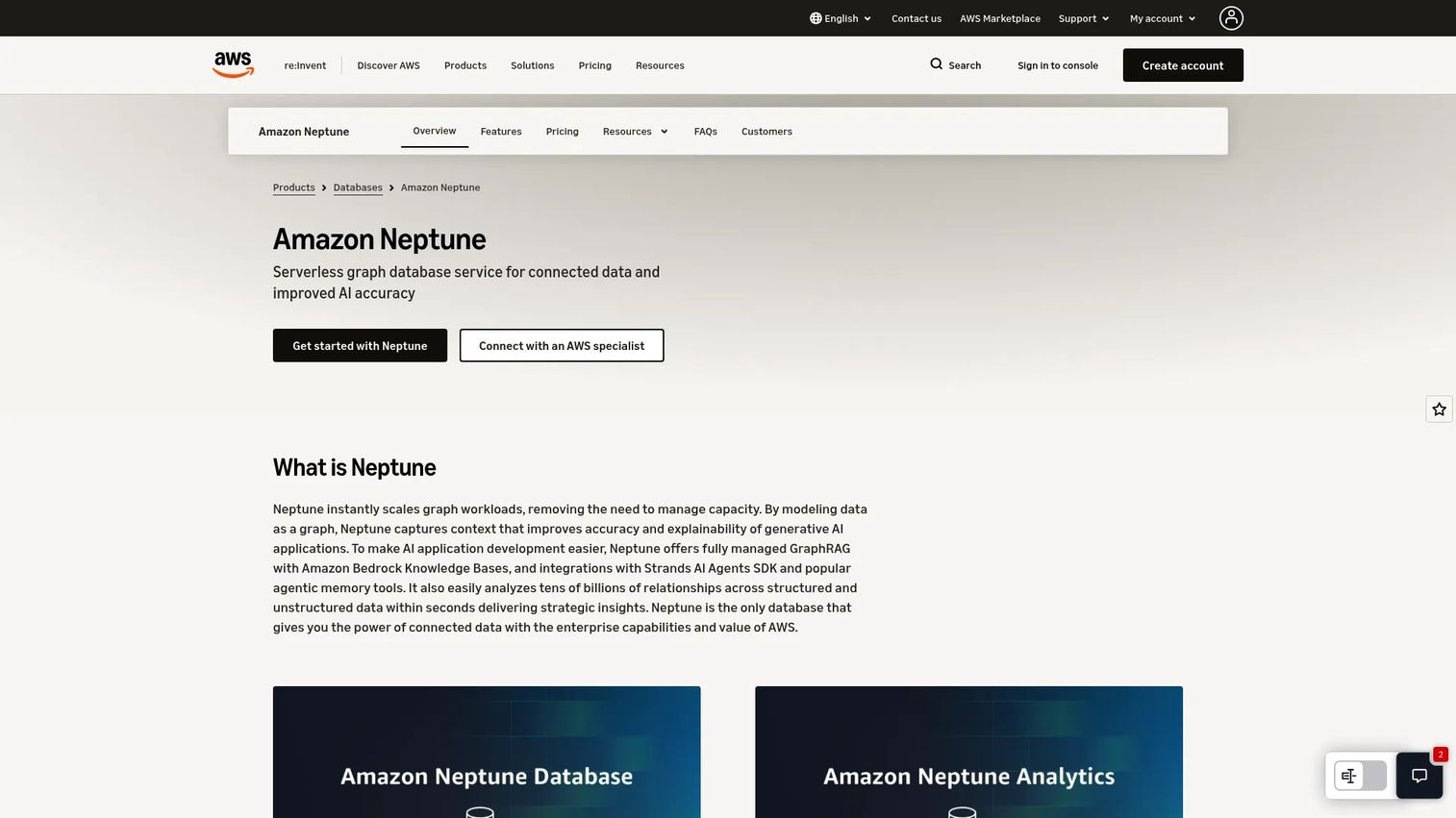
Amazon Neptune is a fully managed graph database service for highly connected datasets. It supports Gremlin, openCypher, and SPARQL queries. AWS also documents graph algorithms, vector search, and GraphRAG integrations across the Neptune offering.
Best for: Teams that already manage their infrastructure and procurement through AWS.
Key features
- Property graph and RDF querying
- Serverless capacity scaling
- Read replica support
- Graph analytics
- GraphRAG integrations
Neptune is an infrastructure decision for the data team, even when marketing sponsors the business case. Define the customer intelligence application before comparing instance configurations.
For example, ask engineers to model product adoption across related business accounts. The pilot should include access requirements and the expected pattern of analytical queries.
Evaluate the specific Neptune components required for your workload. A database query workload and a graph analytics workload need separate cost assumptions.
Why choose Amazon Neptune: Existing AWS operations make it a relevant shortlist candidate. Compare service configuration and usage costs against the queries your application will run.
Amazon Neptune pricing: On-demand pricing includes a $0.348/hour db.r5.large example in US East, N. Virginia. Serverless bills per capacity-unit second; a 30-day trial covers specified usage.
4. TigerGraph
TigerGraph focuses on graph databases and deep relationship analysis. Its platform combines graph analytics with vector search for AI and machine learning workloads. GraphStudio provides a visual development interface.
Best for: Organizations evaluating large connected-data workloads and deep-link analytics.
Key features
- GSQL query language
- Hybrid graph and vector search
- In-database graph algorithm library
- GraphStudio visual development
- Role-based access controls
Growth teams can use the evaluation to explore relationship-based segmentation. An example question is whether connected accounts share adoption patterns that flat audience lists overlook.
Test that hypothesis with representative data and agreed success criteria. Ask engineers to measure query behavior under the anticipated workload instead of accepting a generic scale claim.
Savanna’s capacity-based pricing also deserves attention during budgeting. The relevant comparison includes the configuration needed for your application, rather than a headline unit rate.
Why choose TigerGraph: Choose it when graph analysis is central to the project. A recommendation engine or customer network investigation provides a clearer evaluation than general reporting.
TigerGraph pricing: Savanna costs $45/GB/month, and Business Critical costs $126/GB/month for continuous US/Tier 1 service. Community is free; a Savanna trial is available.
G2 rating: 4.6/5.
5. OvalEdge
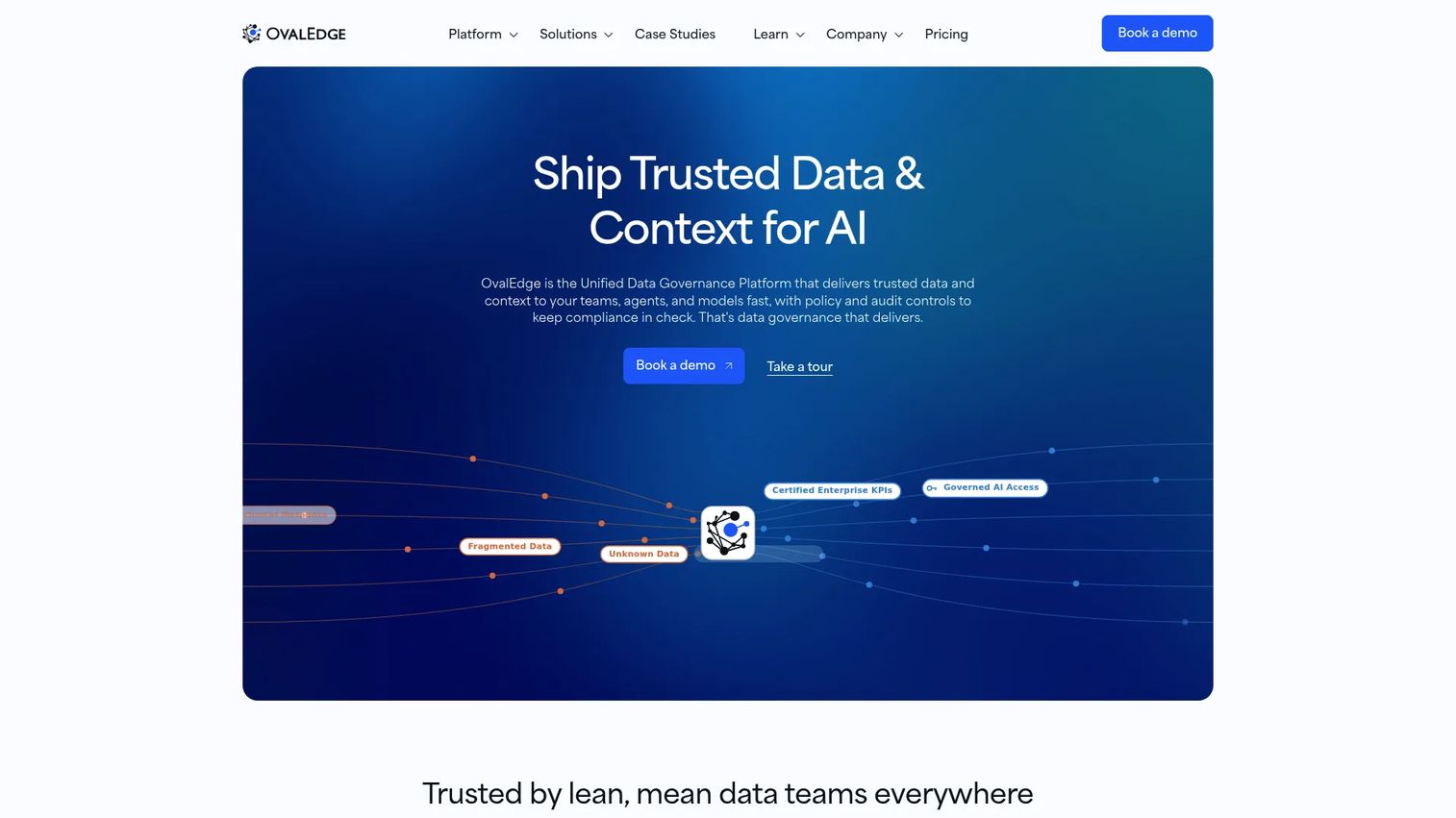
OvalEdge combines data cataloging with governance and quality management. Its metadata relationships support discovery and lineage investigations. The platform also includes sensitive-data classification and business glossary capabilities.
Best for: Organizations whose immediate problem is trust in reporting inputs.
Key features
- Data catalog and native connectors
- Automated lineage and impact analysis
- Business glossary
- Sensitive-data classification
- Data-quality monitoring
This is a governance-oriented purchase rather than a substitute for an application graph database. Its relevance begins with understanding the information your business already uses.
For a marketing pilot, choose a disputed funnel report. Ask the team to identify the underlying datasets and explain who approves each definition.
Then test an upstream change. Can the people responsible find the affected dashboard and understand what needs attention?
That workflow gives marketing operations a concrete acceptance test. It also makes the implementation conversation more useful than counting connected assets.
Why choose OvalEdge: It fits teams prioritizing data ownership and traceable reporting. Start with the metrics leadership challenges most often.
OvalEdge pricing: Custom pricing, determined by connected systems, connector capabilities, and author users.
G2 rating: 5.0/5
6. Ontotext GraphDB
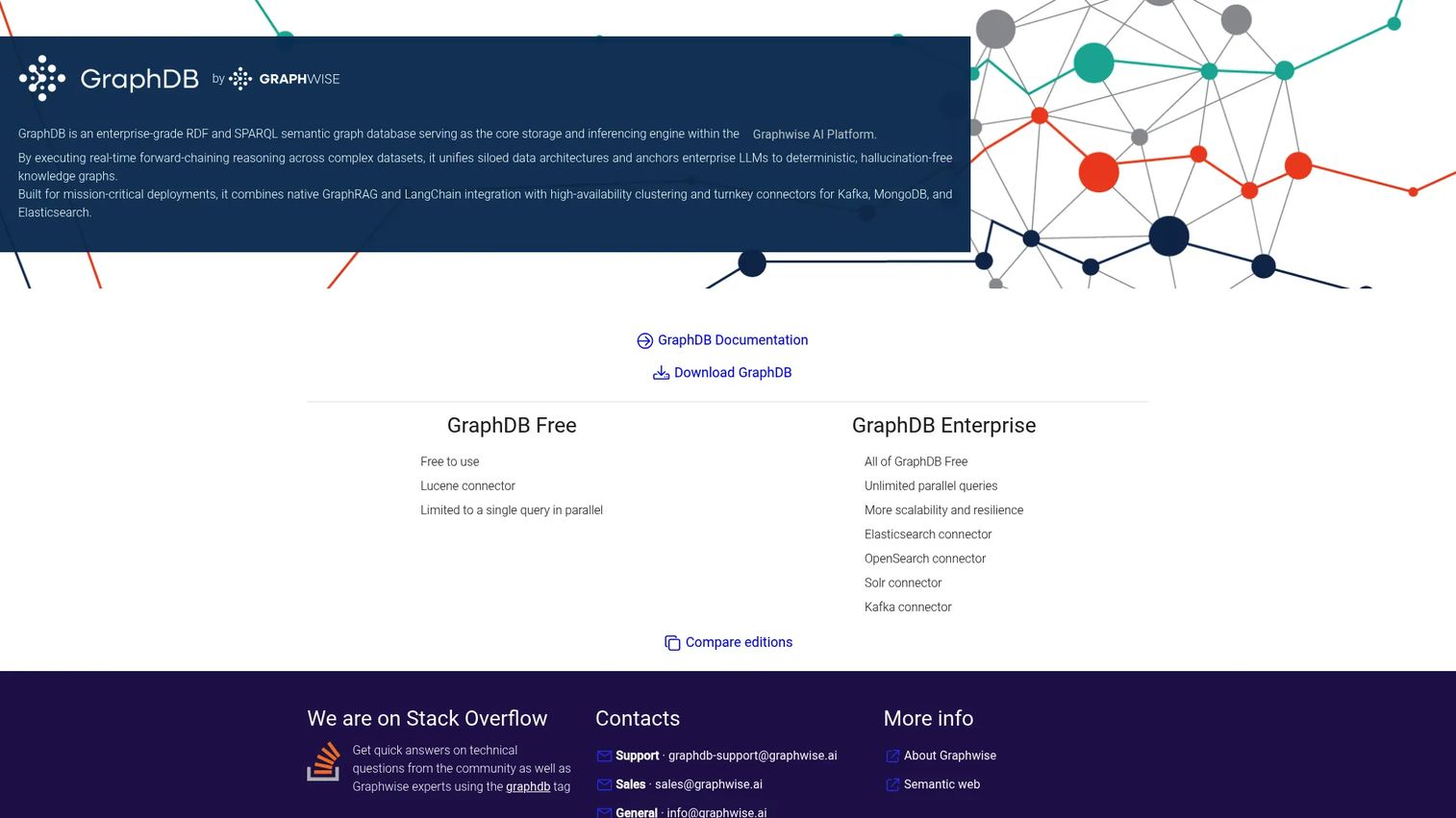
Ontotext GraphDB is an RDF database for semantic knowledge graphs. It supports SPARQL queries and forward-chaining reasoning. Its Workbench interface and connectors support linked-data development and integration.
Best for: Technical teams building standards-based graphs with formal semantic models.
Key features
- SPARQL 1.1 support
- RDF4J compatibility
- RDFS and OWL reasoning
- GeoSPARQL and geospatial indexing
- GraphRAG capabilities
RDF is useful when relationships need explicit meaning across sources. Reasoning can derive additional relationships from the rules your knowledge engineers define.
A content discovery project might model product families and the topics associated with each. The pilot should test whether those relationships improve retrieval for ambiguous queries.
Ask the implementation team to explain every inferred result. Marketing stakeholders should be able to distinguish a supplied fact from a relationship derived by a rule.
Edition selection also matters. GraphDB Free has limited parallel queries, while Enterprise adds scaling and resilience capabilities.
Why choose Ontotext GraphDB: It belongs on the shortlist when RDF and ontology-driven reasoning are architectural requirements. Plan for knowledge engineering support.
Ontotext GraphDB pricing: GraphDB Free is free to use. GraphDB Enterprise uses custom pricing.
7. Graphwise
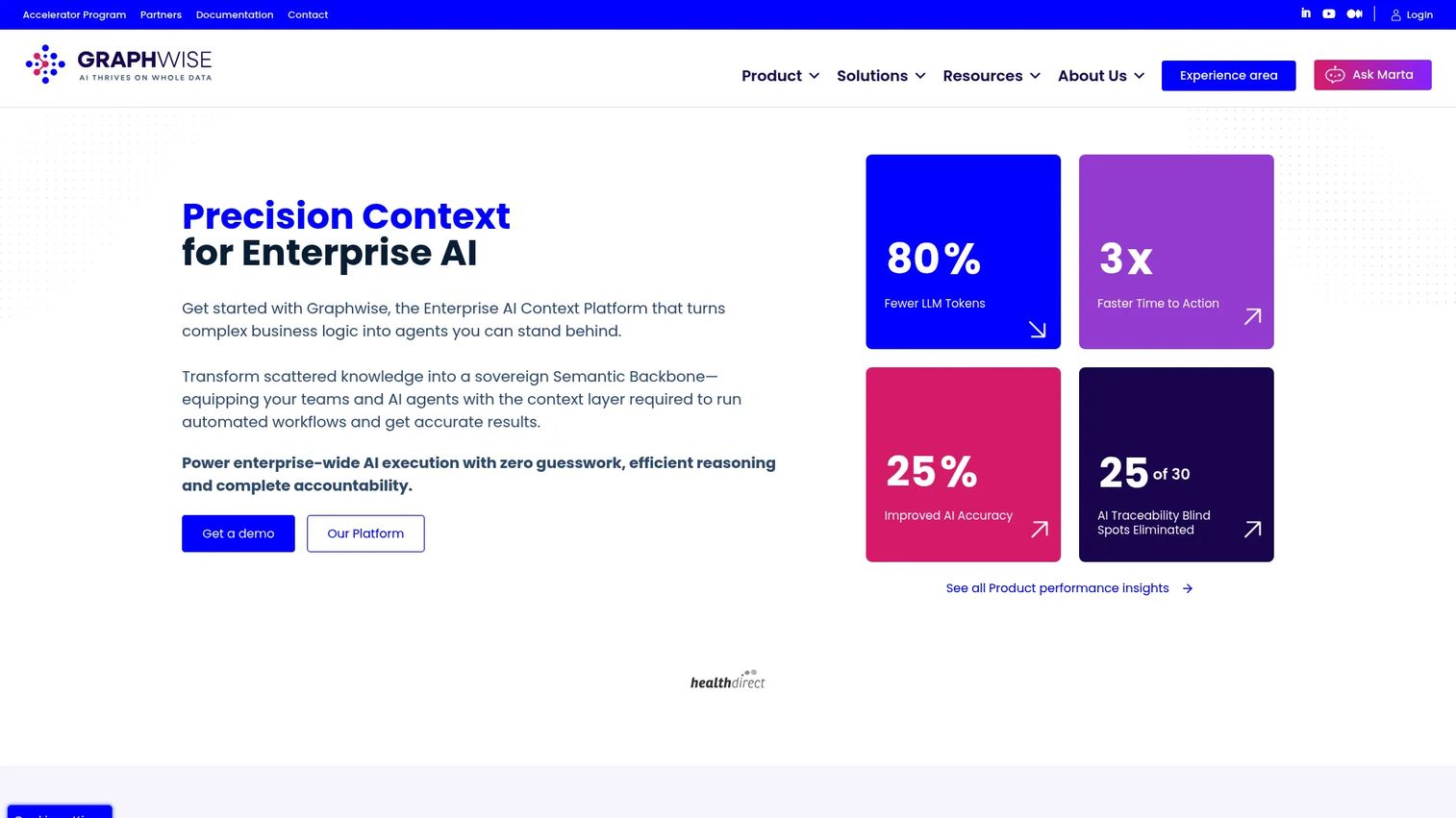
Graphwise positions its platform around enterprise AI context. It connects corporate information through semantic modeling and knowledge graph pipelines. Its offering includes GraphDB and capabilities for taxonomy management and text enrichment.
Best for: Enterprises building governed context for AI retrieval and search.
Key features
- GraphRAG retrieval
- AI-assisted ontology modeling
- Knowledge graph pipelines
- Semantic text analytics
- Automated data ingestion
Evaluate Graphwise at the platform level, rather than treating it as unrelated to every other entry. Its offering overlaps with GraphDB, which also appears separately here.
For a marketing use case, map approved product claims to source documents and relevant customer segments. Ask how the system preserves context when several documents discuss the same entity.
A good evaluation includes reconciliation questions. Which account or product does a passage refer to, and what evidence supports that match?
The desired result is a traceable answer grounded in your organization’s concepts. Define those concepts with the people who own them.
Why choose Graphwise: Consider it when the project combines semantic modeling with governed AI retrieval. Clarify the product scope to avoid purchasing overlapping capabilities.
Graphwise pricing: Request a quote.
G2 rating: 4.2/5.
8. data.world
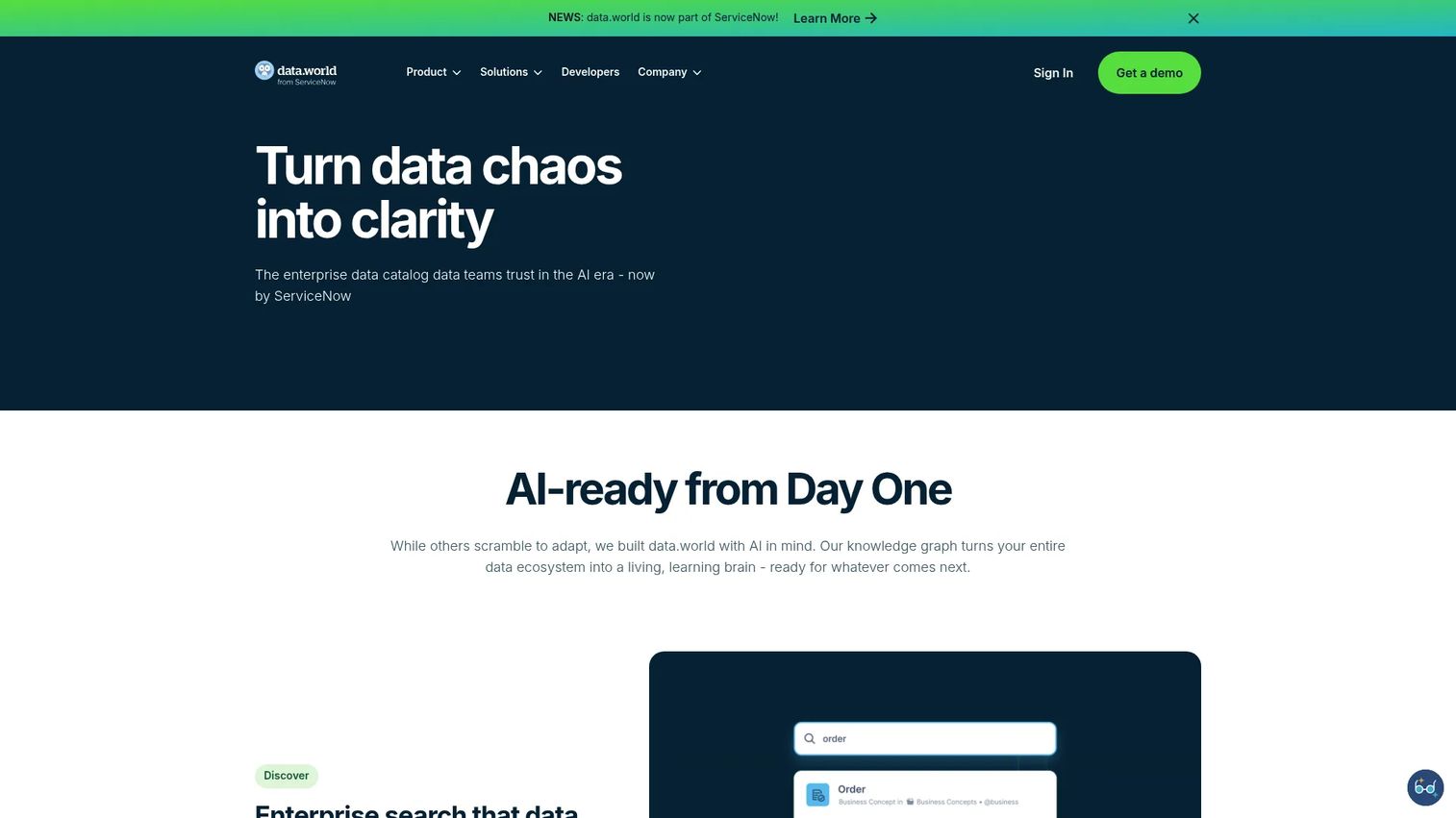
data.world provides an enterprise catalog built on a knowledge graph foundation. It connects metadata with business concepts to support discovery and governance. Collaboration and lineage capabilities make it relevant to business users working with data teams.
Best for: Organizations seeking shared context around available datasets.
Key features
- AI-assisted data discovery
- Semantic search
- Knowledge graph architecture
- Governance workflows and lineage
- DataOps collaboration
This is a useful category to investigate when marketers cannot identify the approved dataset for a decision. Adding another analytical database would address a different problem.
Use a pilot involving a recurring audience or campaign analysis. Ask a business user to locate the relevant data and understand its intended use.
Have an analyst review the same asset. Compare whether both people reach the same interpretation without relying on private messages or an undocumented spreadsheet.
The catalog should support a shared working process. Decide which existing documentation becomes redundant after adoption.
Why choose data.world: It fits cross-functional discovery and governance work. Evaluate whether business users can interpret data context, not simply locate asset names.
data.world pricing: Custom pricing across Essentials, Standard, Enterprise, and Enterprise+.
G2 rating: 4.2/5.
9. Google Enterprise Knowledge Graph
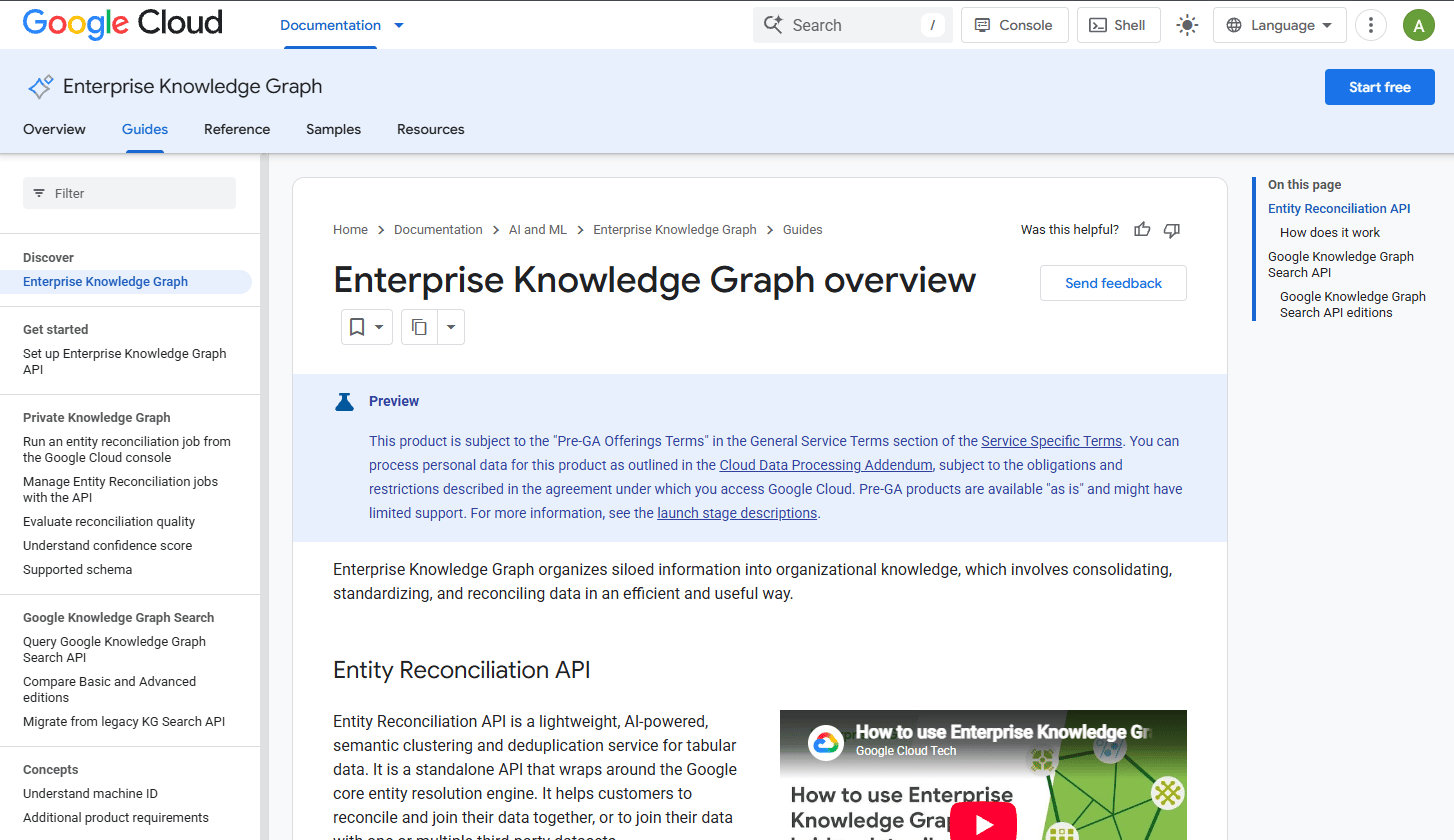
Google Enterprise Knowledge Graph provides documented entity reconciliation and knowledge graph search capabilities. These include deduplication for tabular data and entity linking. It should be evaluated as an entity service rather than a general-purpose graph database.
Best for: Organizations investigating entity matching and reconciliation within Google Cloud.
Key features
- Tabular entity reconciliation
- Entity search and lookup
- Google Place ID linking
- BigQuery source support
- REST and gRPC APIs
For marketers, the clearest evaluation involves duplicate or ambiguous business records. Ask whether separate entries refer to the same organization or physical location.
Stable identifiers can support that workflow. Your team still needs acceptance criteria for uncertain matches and a process for reviewing exceptions.
There is an important availability check before procurement. The supplied product landing page returned a 404 during research, although official documentation described the capabilities.
Treat product access and commercial packaging as initial qualification questions. Do not design a production dependency before Google Cloud establishes the current service path.
Why choose Google Enterprise Knowledge Graph: Evaluate it for entity resolution and knowledge lookup. It addresses a narrower job than an enterprise semantic platform.
Google Enterprise Knowledge Graph pricing: Ask Google Cloud for current availability and commercial terms.
10. AllegroGraph
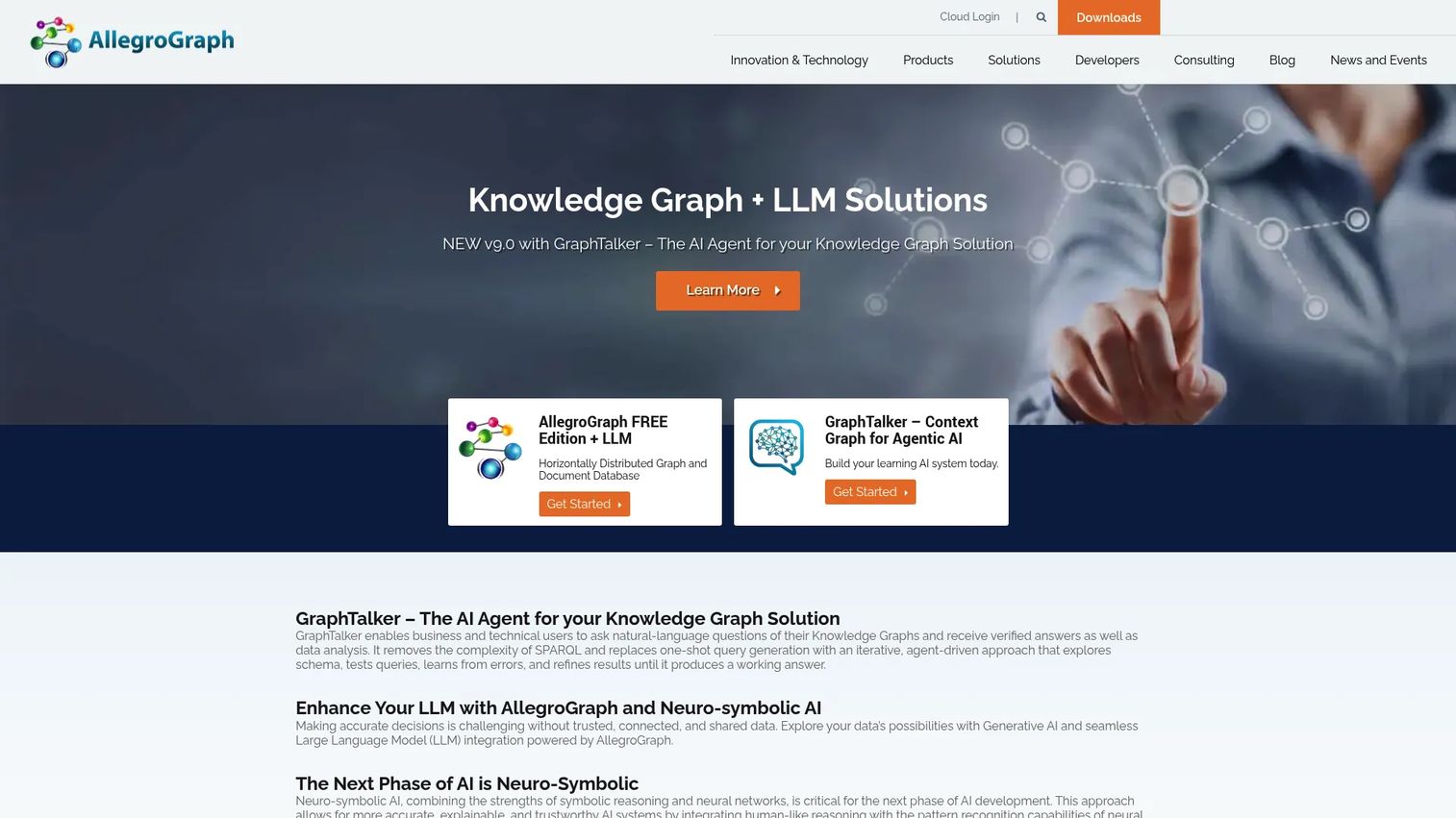
AllegroGraph combines graph, vector, and document storage for enterprise knowledge applications. Its semantic capabilities include RDF and SPARQL support. GraphTalker adds a natural-language interface, while security controls operate at the triple level.
Best for: Technical teams building governed semantic applications with advanced reasoning requirements.
Key features
- RDF and SPARQL support
- GraphTalker natural-language interface
- Vector and document storage
- Geo-temporal reasoning
- Triple-level security
A relevant evaluation might involve account relationships across territories and time periods. Ask the technical team to demonstrate how the model represents changing organizational connections.
Include questions that require both document context and structured relationships. Check whether users can inspect the evidence behind an answer.
Security belongs in the same pilot. Build test cases around information different groups should access, rather than reviewing permissions separately from retrieval.
AllegroGraph is technical infrastructure. Marketing should own the business question and acceptance criteria while engineering owns the implementation plan.
Why choose AllegroGraph: Consider it when semantic depth and detailed access controls matter to the application. Match those requirements to a specific workload.
AllegroGraph pricing: A Free Edition is available. Enterprise uses custom pricing through hourly or annual subscriptions.
G2 rating: 5.0/5
11. PoolParty Semantic Suite
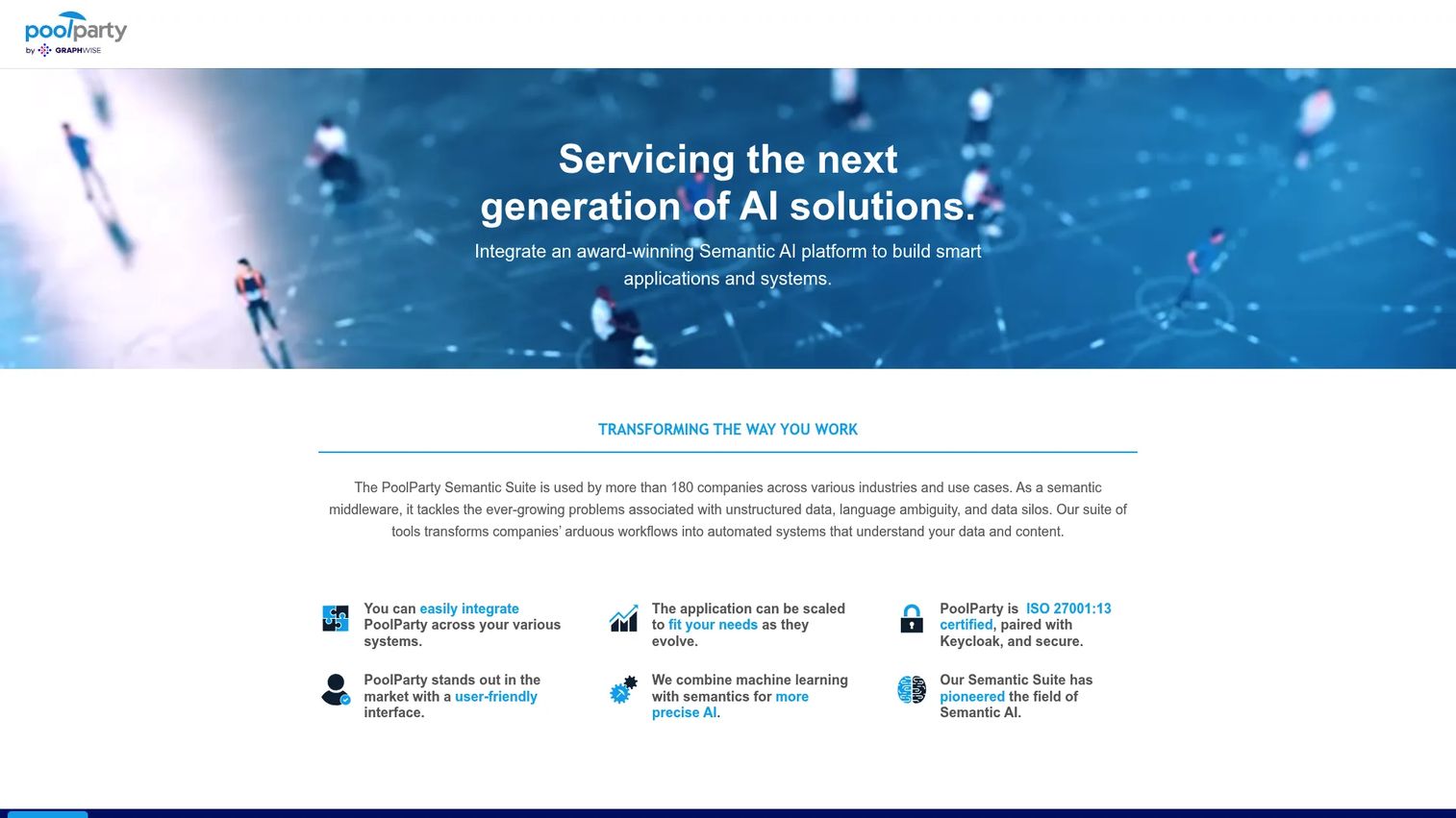
PoolParty Semantic Suite focuses on taxonomies, ontologies, and semantic enrichment. Its capabilities include text classification and corpus analysis. The platform supports semantic search and recommender applications built around structured knowledge.
Best for: Content and knowledge teams managing controlled vocabularies across large information collections.
Key features
- Taxonomy and ontology management
- Automated text classification
- Corpus analysis
- Semantic enrichment
- Semantic search
PoolParty has a direct connection to content operations. A shared vocabulary can organize how teams describe product categories and customer problems.
For a pilot, choose content with inconsistent tagging. Include synonyms and older terminology that still appears in customer searches.
Ask editors to review classification results against a defined taxonomy. Measure the manual corrections needed and identify who approves changes to the vocabulary.
This evaluation also exposes organizational questions. Product marketing and content teams need an agreement about how labels change when positioning evolves.
Why choose PoolParty Semantic Suite: It fits content intelligence and terminology governance. Choose it for semantic enrichment rather than treating it as a general application database.
PoolParty Semantic Suite pricing: Custom pricing with modular packaging.
12. Atlan
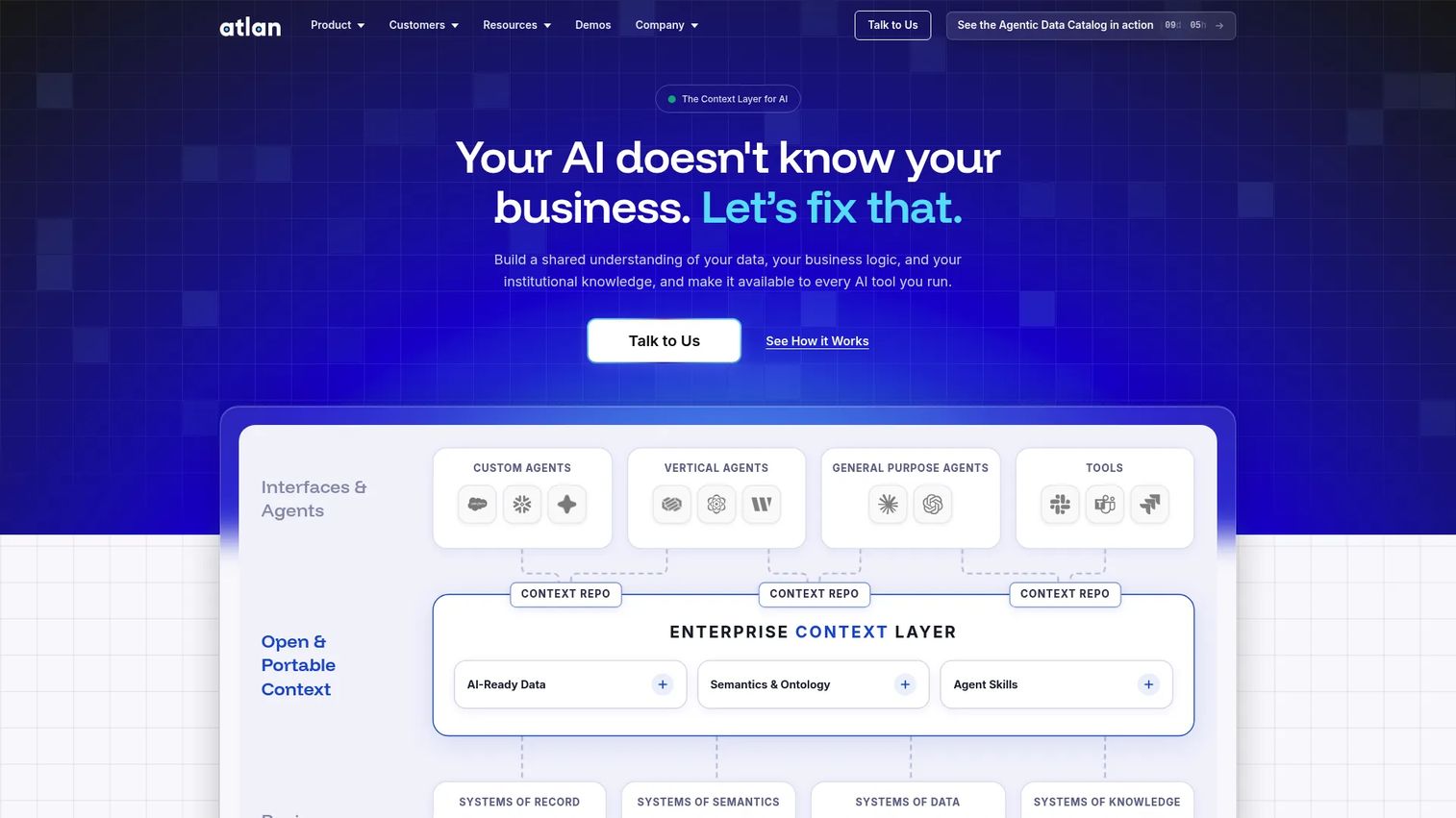
Atlan connects enterprise metadata with business knowledge through its Enterprise Data Graph. Its catalog and column-level lineage provide context for data users. Context Agents assist with tasks including descriptions and glossary creation.
Best for: Data teams making business context accessible across a complex data estate.
Key features
- Enterprise Data Graph
- Metadata cataloging
- Column-level lineage
- Context Agents
- AI-assisted glossary descriptions
For marketing operations, the value begins with understanding dashboard inputs. A metric should have an identifiable source and a business explanation.
Choose a report affected by frequent schema or definition changes. Ask analysts to trace a column through the relevant data assets.
Then involve the campaign owner. Evaluate whether they can interpret the resulting context without requesting another explanation from engineering.
Pricing also requires workload planning. Atlan’s model considers cataloged assets and paid seats, alongside Flexi Credits and optional additions.
Why choose Atlan: It fits teams prioritizing discoverable context and detailed lineage. Include business-user adoption in the pilot rather than evaluating technical coverage alone.
Atlan pricing: Custom pricing, determined by edition, cataloged assets, paid seats, Flexi Credits, and add-ons.
G2 rating: 4.5/5.
13. Collibra
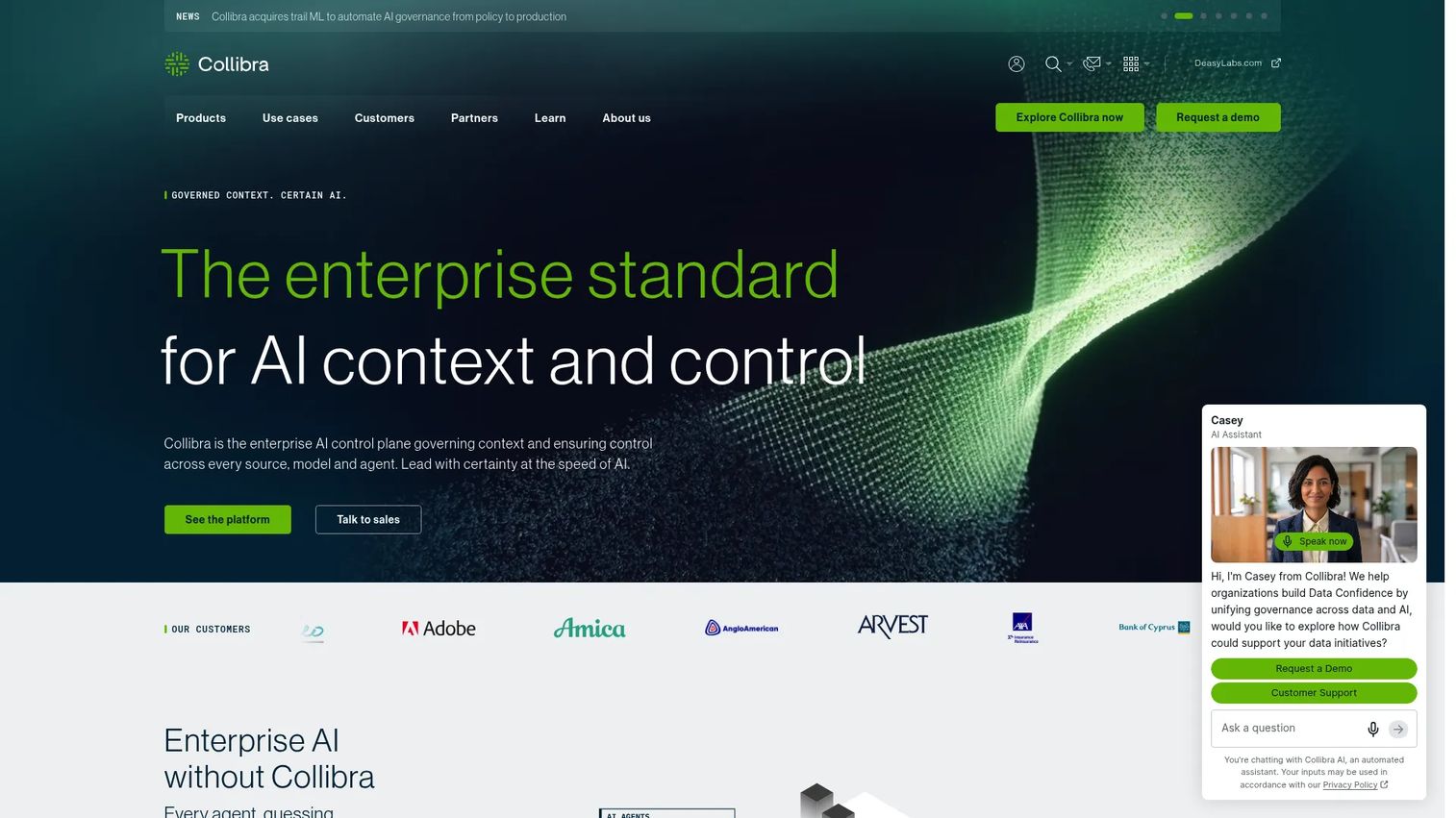
Collibra provides enterprise data and AI governance. Its platform covers cataloging, stewardship, lineage, and policy workflows. Data quality and privacy capabilities support broader organizational oversight.
Best for: Large organizations formalizing responsibility for data and AI use.
Key features
- Data catalog and classification
- Business glossaries
- Stewardship and policy workflows
- Data lineage
- Data quality and observability
Collibra belongs in a knowledge graph evaluation when governance is the central requirement. The purchasing conversation should involve the people responsible for approved definitions and data use.
For marketing, a useful pilot starts with a disputed executive metric. Identify who can change its definition and who must review that change.
Then examine a proposed audience dataset. Ask which policies apply and how the approval process is recorded.
These workflows test organizational fit. A broad governance purchase needs named stewards, not only an implementation team.
Why choose Collibra: Choose it when ownership and policy execution are enterprise requirements. A narrowly scoped analytical application may need a different category first.
Collibra pricing: Custom pricing through its sales or account team.
G2 rating: 4.2/5.
14. DataHub
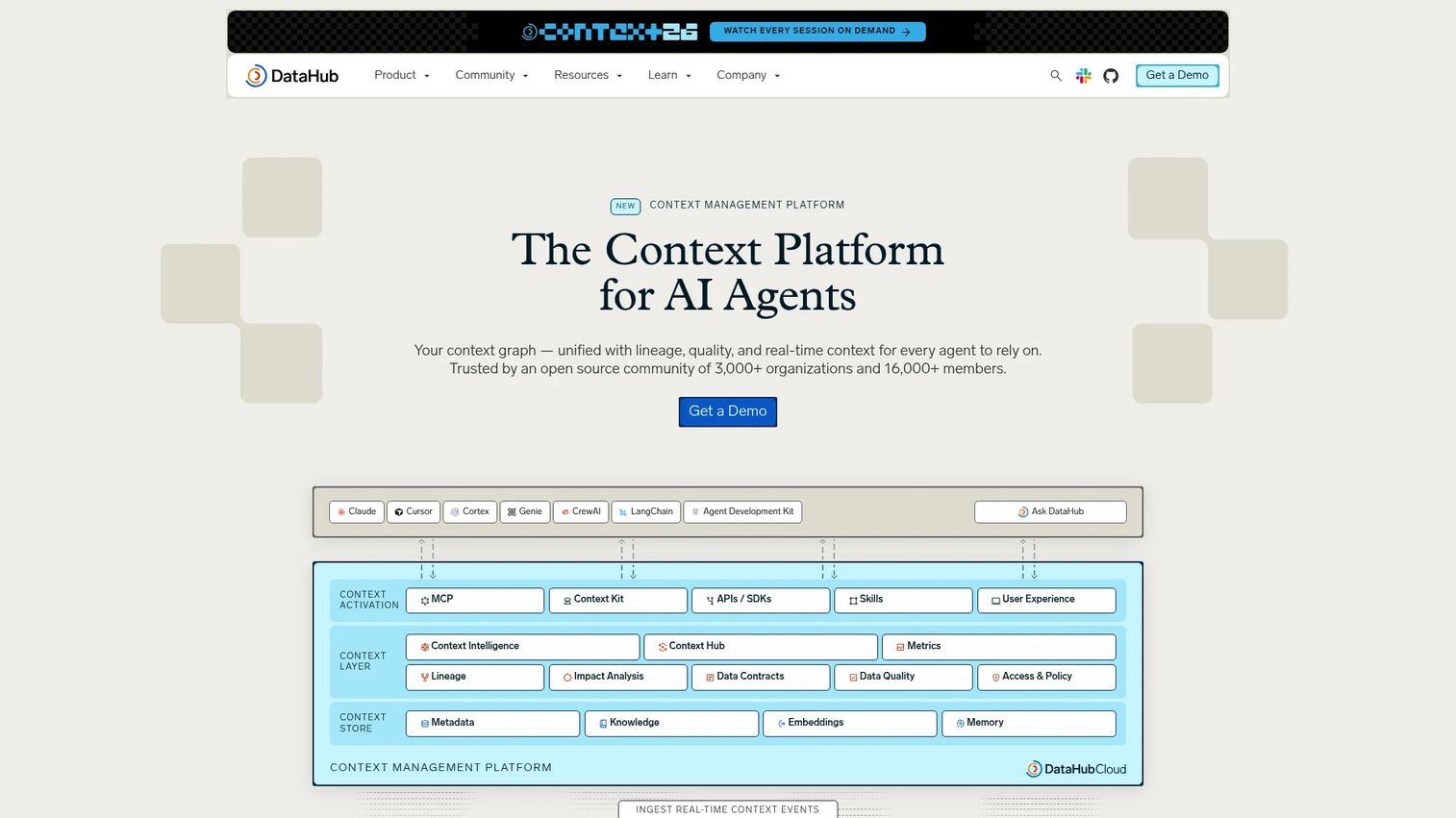
DataHub provides metadata management and discovery capabilities for data teams. Its offering includes lineage, governance, quality, and observability. APIs and SDKs make it relevant to engineering-led context management.
Best for: Teams that want metadata infrastructure connected to existing engineering workflows.
Key features
- Data discovery
- Lineage tracking
- Governance and PII tracking
- UI-based ingestion
- APIs and SDKs
DataHub’s relevance to marketing is usually indirect. It supports the context behind reporting rather than campaign execution itself.
An evaluation could follow a broken conversion report back to its inputs. Ask whether the responsible team can identify affected assets and investigate the upstream issue.
Also test how metadata enters the system. Document the work required when a new pipeline or reporting asset becomes part of the stack.
Separate the open-source project discussion from managed offering terms. The supplied research did not establish current cloud pricing or licensing details.
Why choose DataHub: It fits engineering-led metadata programs where extensibility matters. Establish who operates the service and maintains ingestion before rollout.
DataHub pricing: Request current licensing and managed-cloud terms.
G2 rating: 4.4/5
15. ArangoDB
ArangoDB is a graph-native multimodel database. It combines document and graph capabilities with vector, key-value, and search models. AQL provides a query layer across those models.
Best for: Application teams working with connected records and flexible document data.
Key features
- Graph and document models
- Vector and search capabilities
- AQL query language
- Distributed sharding
- Automatic failover
The consolidation question is especially relevant here. Ask whether an application needs several data models and what combining them changes operationally.
For a customer-facing recommendation system, your pilot might connect product documents with account relationships. Engineering should compare the full query workflow against the existing architecture.
Avoid evaluating consolidation only by counting databases. Include query development and operational ownership in the assessment.
Commercial terms need careful attention. The current Community Edition is free for evaluation and noncommercial use, which does not establish free commercial production rights.
Why choose ArangoDB: Consider it when the application requires graph traversal alongside other data models. Evaluate the licensing fit before moving a prototype into production.
ArangoDB pricing: Community Edition is free for evaluation and noncommercial use. Commercial, managed-cloud, platform, and OEM offerings use custom pricing.
G2 rating: 4.6/5.
16. Apache Jena
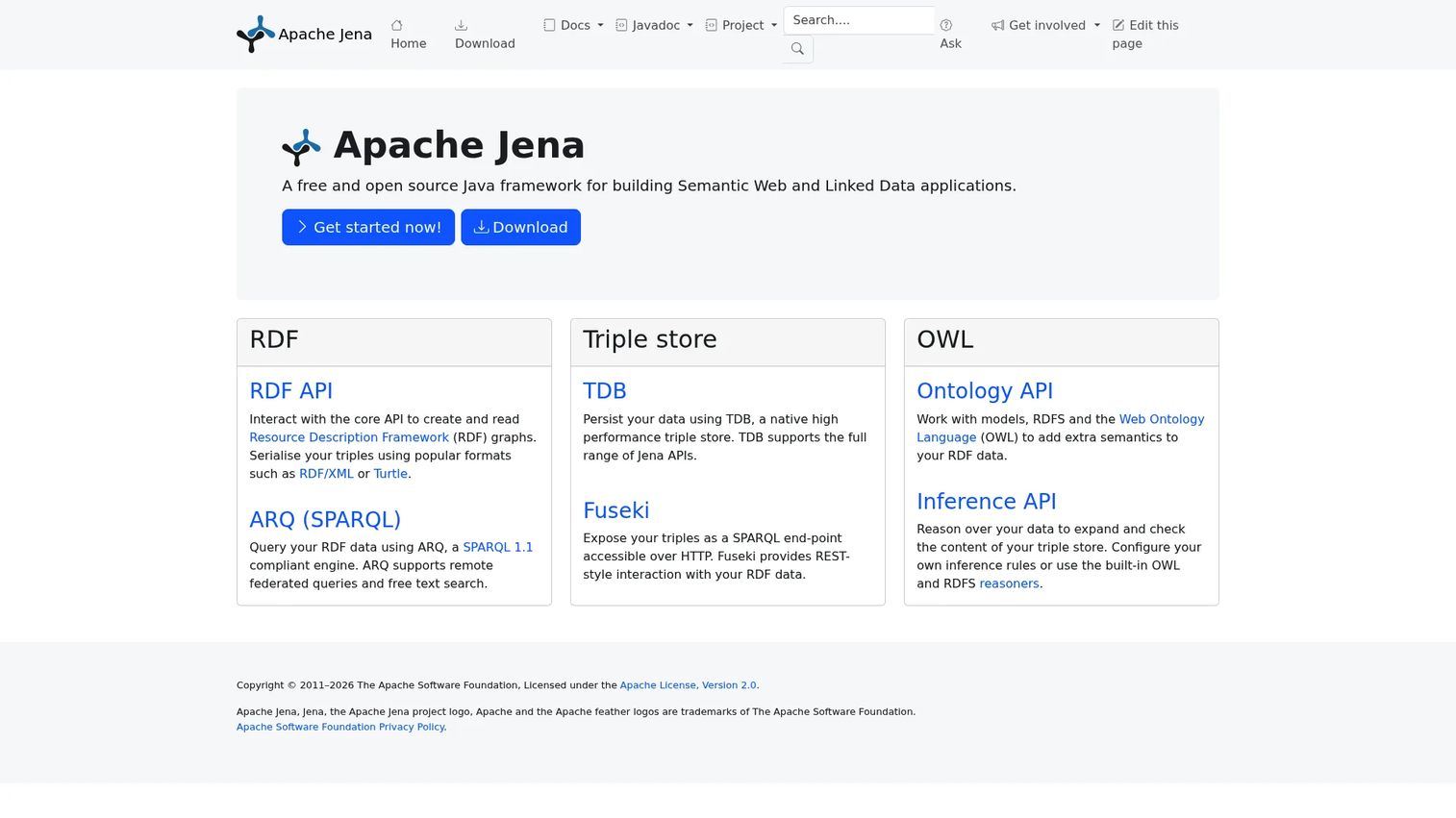
Apache Jena is a free, open-source Java framework for Semantic Web and Linked Data applications. It provides RDF handling and a SPARQL engine. Its components include persistent storage and an HTTP-based query service.
Best for: Developers building custom RDF systems with direct control over implementation.
Key features
- RDF creation and serialization
- ARQ SPARQL query engine
- OWL and RDFS ontology APIs
- TDB persistent storage
- Fuseki HTTP query service
Jena is a framework, so compare it against a build decision rather than a packaged business platform. Your team determines the surrounding application and operating process.
A useful pilot could publish an internal vocabulary as queryable RDF. Ask developers to demonstrate how business users would submit corrections and consume the results.
The engineering estimate should cover more than initial development. Include access management and the interface people will use to maintain knowledge.
For a marketing sponsor, the important question is ownership. A free framework still needs a funded team responsible for the system it powers.
Why choose Apache Jena: It suits custom semantic development where Java expertise and engineering capacity are available. Choose a packaged platform if business-managed workflows dominate the requirement.
Apache Jena pricing: Free and open source.
17. JanusGraph
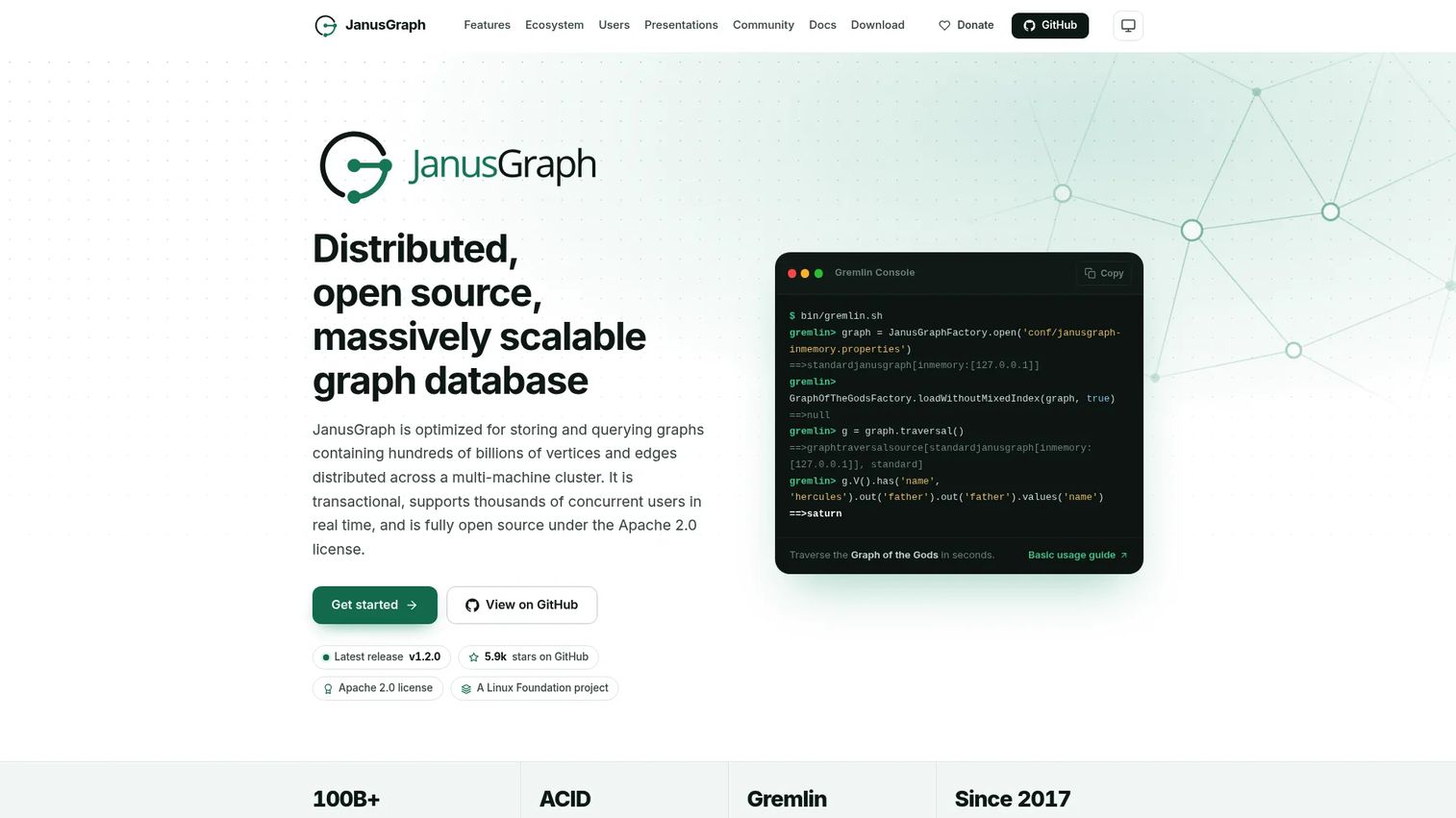
JanusGraph is an open-source distributed graph database. It supports Gremlin traversal and integrates with pluggable storage backends. Separate indexing integrations support search requirements across large graph deployments.
Best for: Engineering teams that need distributed graph infrastructure and control over backend selection.
Key features
- Gremlin and TinkerPop integration
- Distributed graph storage
- Pluggable storage backends
- External indexing integrations
- Spark graph analytics integration
JanusGraph is an infrastructure choice rather than a direct marketing purchase. Its role is to support applications that need connected-data access at scale.
Ask engineers to explain the proposed storage and indexing architecture. The evaluation should include backup procedures and operational responsibility.
For a customer intelligence project, define the required relationship queries first. Then test them with the backend configuration your team plans to operate.
The licensing model removes a commercial license requirement, but the operating budget remains important. Include compute and specialist maintenance when comparing it with managed services.
Why choose JanusGraph: Choose it when distributed systems expertise is available and backend flexibility is valuable. Avoid selecting it solely because the software is free.
JanusGraph pricing: Free and open source under the Apache 2.0 license.
Considerations when choosing knowledge graph tools
Start with the graph model
Choose property graphs for connected application records, RDF for semantic statements, or metadata graphs for context about data assets. Write a representative question before evaluating architecture.
Ask each vendor to show how its model represents the relationships your team needs.
Match the query language to your team
Cypher, SPARQL, Gremlin, GSQL, and AQL imply different development workflows. Let the engineers responsible for production assess fit.
Business stakeholders should define acceptance criteria without needing to become query-language specialists.
Check governance and lineage depth
Trace an executive metric to its source and identify who owns its definition. Then test how changes reach affected users.
For marketing, semantic metadata should help explain discrepancies in CAC or funnel reporting.
Evaluate AI and GraphRAG readiness
Ask for entity resolution, source provenance, permission handling, and an explanation of retrieval behavior. A vector search feature alone does not establish governed AI context.
Include conflicting evidence in the pilot and inspect how the system handles it.
Plan for adoption and maintenance
Assign owners for connectors and business definitions before implementation. Include schema changes and recurring review work in the operating budget.
Success should mean a measurable improvement, such as less report reconciliation or more reliable retrieval, rather than a larger graph.
Choose the category before choosing the vendor
Start with the work your team needs to complete.
For graph database applications, compare Neo4j with Amazon Neptune, TigerGraph, ArangoDB, and JanusGraph. Your deployment preferences and query workload should narrow that field.
For semantic modeling and reasoning, investigate Stardog, Ontotext GraphDB, AllegroGraph, Graphwise, or PoolParty Semantic Suite. Apache Jena provides a framework route for custom RDF development.
When the immediate problem is finding trusted data, evaluate OvalEdge, data.world, Atlan, Collibra, or DataHub. Google Enterprise Knowledge Graph warrants a separate availability check for entity reconciliation requirements.
Bring marketing operations and the data owner into the same evaluation. Agree on a pilot question and define how success will affect the existing workflow.
Then compare total operating cost against that outcome. A platform earns its place when it improves a decision or replaces recurring work.
Write down the relationships your team cannot answer today. Choose the category that models them with an operating model your team can sustain.
FAQs
Knowledge graph tools represent entities and their connections so teams can query information with context. The category includes graph databases, semantic platforms, metadata catalogs, and retrieval infrastructure. Buyers should distinguish tools that store business records from tools that describe data assets, because those products address different problems. Start by identifying whether you need an application database or a governed knowledge layer.
A graph database stores and queries connected data, while a knowledge graph organizes relationships with meaning and context. Ontologies can define concepts, and governance can establish ownership or approved usage. Some platforms provide both database infrastructure and semantic capabilities. Ask which components are included, which require configuration, and which your engineering team must build before comparing overall cost.
Choose according to your data model and retrieval requirements rather than the GraphRAG label alone. Property graph approaches suit relationship traversal; RDF platforms support ontology-driven context and semantic reasoning. Neptune, TigerGraph, GraphDB, and Graphwise have documented capabilities relevant to these workloads. Evaluate answer evidence and access controls alongside retrieval quality, using questions that require connections across several sources.
Yes, particularly when decisions depend on connections between customer identities, campaign activity, product behavior, and revenue. Marketers usually work with data or engineering teams to implement the underlying infrastructure. A practical pilot should target a recurring decision, such as identifying related accounts or finding an approved reporting dataset. Connecting touchpoints supports analysis, but it does not independently prove which campaign caused a purchase.
Apache Jena suits RDF and SPARQL development, while JanusGraph addresses distributed graph infrastructure with Gremlin. DataHub is also relevant when the project concerns metadata management rather than an application graph. The right choice depends on the model and the engineering team responsible for operation. Compare deployment work and maintenance commitments, and review current licensing separately from any managed service subscription.
Some catalogs use knowledge graph architecture to connect metadata and business concepts. Those products can coexist with graph databases serving customer-facing or analytical applications. A catalog helps people understand available data, while another platform may store the connected records used by an application. Evaluate the workflow you want to replace before assuming overlapping graph terminology means duplicate functionality.
Costs range from free open-source software to usage-based infrastructure and enterprise contracts. Managed databases may charge by capacity and operating time, while governance platforms can price around assets or users. Free licensing still leaves infrastructure and engineering expenses. Compare a representative production workload, including support requirements, rather than treating a trial or entry-level rate as the final budget.
Evaluate the data model and query workflow first, then examine integration coverage and governance requirements. Test a difficult business question using representative records, including ambiguous entities and conflicting definitions. Ask the team responsible for operations to estimate maintenance and deployment costs. Approve the purchase only after agreeing on ownership and a measurable outcome, such as reduced reconciliation work or more traceable AI answers.