Your rankings report looks healthy, but AI answers keep naming competitors. Leadership wants an explanation, and another dashboard won’t explain the gap.
Entity SEO tools help you investigate how clearly your website describes your business and its expertise. The useful ones connect that diagnosis to work your team can ship, from better content briefs to structured data deployment.
The infrastructure is already widespread. HTTP Archive’s Web Almanac, reported in 2026, found that 50% of homepages used structured data in 2025. Having markup, however, says little about whether it describes the right entities.
For digital marketers, the buying question starts with workflow ownership. Who resolves inconsistent product names? Who connects related pages? Who measures AI search visibility alongside organic pipeline?
Those jobs require different capabilities. Buying a broad platform for a narrow schema problem adds cost without fixing the handoff. Start with the missing work, then choose software that replaces a manual process or fills a documented gap.
What’s inside
- A shortlist of 14 tools and resources: Dedicated semantic platforms alongside broader SEO suites, structured data software, and open knowledge bases.
- Entity identification and relationships: Options for resolving ambiguous names and finding authoritative references.
- Implementation and content coverage: Capabilities for maintaining schema, improving briefs, and connecting relevant pages.
- Commercial fit: Entry pricing, available free access, and suitability for different team sizes.
- A practical buying framework: Recommendations for marketers balancing execution speed with measurable organic growth.
Product details come from vendor documentation. Pricing and G2 ratings follow source research dated November 24, 2026; resources without a verifiable rating carry “N/A.”
TL;DR
- Best dedicated entity SEO platform: InLinks combines entity-based content optimization with automated internal linking and schema.
- Best broad SEO suite: Semrush suits marketers consolidating research and content planning while tracking AI search visibility.
- Best free knowledge source: Wikidata provides stable identifiers and structured relationships for entity research.
- Best Google entity lookup: Google Knowledge Graph Search API supports programmatic research. Treat it as a lookup resource, not a control panel.
- Best enterprise shortlist: Evaluate seoClarity for technical operations, Conductor for content workflows, and BrightEdge for performance reporting.
- Best schema-focused option: Schema App fits structured data operations. AlsoAsked serves a different job, question research, with paid access from $12/month.
What is entity SEO?
Entity SEO makes the people, organizations, products, places, and concepts on a website identifiable to search engines. It connects those things through clear attributes and relationships.
A keyword is a phrase someone searches. An entity is the thing that phrase describes. “Apple,” for example, needs context to distinguish a company from a fruit.
A topic is the broader subject around those entities. Payment processing can include payment providers, transaction types, regulatory concepts, and individual products. Entity-based content optimization examines whether a page explains the relevant relationships rather than repeating a phrase.
A knowledge graph represents these connections as structured information. Stable identifiers distinguish similarly named things, while entity disambiguation helps associate a reference with the correct subject.
Schema markup expresses facts in machine-readable form. JSON-LD is a common format for describing an organization or connecting an article to its author. Accurate markup should support the visible page, with consistent references across the website.
An entity SEO tool can support several parts of this work. Look for capabilities that match the task:
- Entity extraction and recognition
- Entity disambiguation and identifier matching
- Structured data and JSON-LD support
- Knowledge graph references
- Entity-based content optimization
- Internal linking recommendations
- Topic and question coverage
- AI search visibility signals
Semantic SEO is the broader practice of organizing content around meaning and context. Entity SEO contributes a more explicit account of what each page discusses.
AI search adds another measurement surface. Clear descriptions help systems interpret your material, but no platform can guarantee citations or inclusion in generated answers.
For marketers, separate implementation metrics from business outcomes. Track corrected references and deployed markup as operational progress. Evaluate qualified organic visits and influenced pipeline independently.
If you’re comparing an “SEO entity tool,” ask which output it produces. A question map, a schema deployment, and an entity lookup solve different problems. None replaces crawlability, useful content, or a coherent website.
When to use entity SEO tools
Clarify what your brand is known for
Start here when product names overlap or different pages describe your company differently. Document the organization and its products, then check the external references associated with each.
Assign someone to resolve naming disagreements before automating deployment. A clear entity inventory gives content and technical teams a shared reference for future changes.
Build content around connected topics
Use entity research when your calendar contains many articles but weak coverage of a commercially important subject. Identify the concepts buyers need explained, then map existing pages against those requirements.
Turn missing relationships into specific editorial tasks. Ask writers to explain how a product supports a workflow rather than inserting additional terminology into an existing draft.
Make structured data easier to maintain
Schema operations become more important when templates or business facts change frequently. Review Organization, Product, Article, FAQPage, and BreadcrumbList markup where relevant.
Check that sameAs references identify the intended entity rather than a loosely related website. Give each shared property an owner, and include markup review in publishing QA.
Entity SEO tools comparison
These entity SEO tools cover different jobs. Dedicated platforms support semantic content work; broader suites provide research and measurement around it. Open knowledge bases supply reference data rather than publishing workflows.
Use the table to identify a category before comparing vendors. A high rating doesn’t make an API interchangeable with a schema management platform.
Prices below identify entry access where the billing terms are established. Annual subscriptions show monthly equivalents. Custom pricing means you’ll need a quote, while free open-data resources can still require development time.
For InLinks, the available pricing document establishes free access but leaves billing frequency unclear. The table therefore avoids presenting a paid amount as a monthly subscription.
| # | Product | Best for | Key differentiator | Pricing | G2 rating |
|---|---|---|---|---|---|
| 1 | InLinks | Dedicated entity SEO workflows | Semantic content analysis with linking and schema automation | Free plan available | 4.9/5 |
| 2 | Semrush | Consolidating SEO workflows | Broad research plus AI visibility monitoring | Free; SEO from $117.33/month annually | 4.4/5 |
| 3 | Wikidata | Entity research | Open identifiers and interconnected statements | Free | N/A |
| 4 | Google Knowledge Graph Search API | Google entity lookup | Read-only access to ranked entity results | Free within quota | N/A |
| 5 | Ahrefs | Content and link research | Competitive intelligence and backlink analysis | Free access; Starter $29/month | 4.5/5 |
| 6 | seoClarity | Enterprise SEO operations | Technical analysis and automated execution | From $2,500/month | 4.5/5 |
| 7 | Yext | Multi-location brand data | Governed business facts across listings and properties | Custom pricing | 4.4/5 |
| 8 | Conductor | Enterprise content operations | Content optimization with website monitoring | Custom pricing | 4.5/5 |
| 9 | BrightEdge | Enterprise performance reporting | Search visibility, dashboards, and forecasting | Custom pricing | 4.4/5 |
| 10 | SE Ranking | Agency and in-house SEO | Consolidated research, audits, and reporting | Core from $103.20/month annually | 4.8/5 |
| 11 | WordLift | Content knowledge graphs | Semantic infrastructure and optimization | Business+ from $879/month annually | 4.7/5 |
| 12 | Schema App | Structured data governance | JSON-LD deployment and entity management | Custom pricing | 4.7/5 |
| 13 | AlsoAsked | Question-led content research | Connected People Also Ask maps | Free searches; Basic $12/month | N/A |
| 14 | DBpedia | Linked data research | Open graph data and entity-linking services | Free resources | N/A |
Best 14 tools for entity SEO
1. InLinks
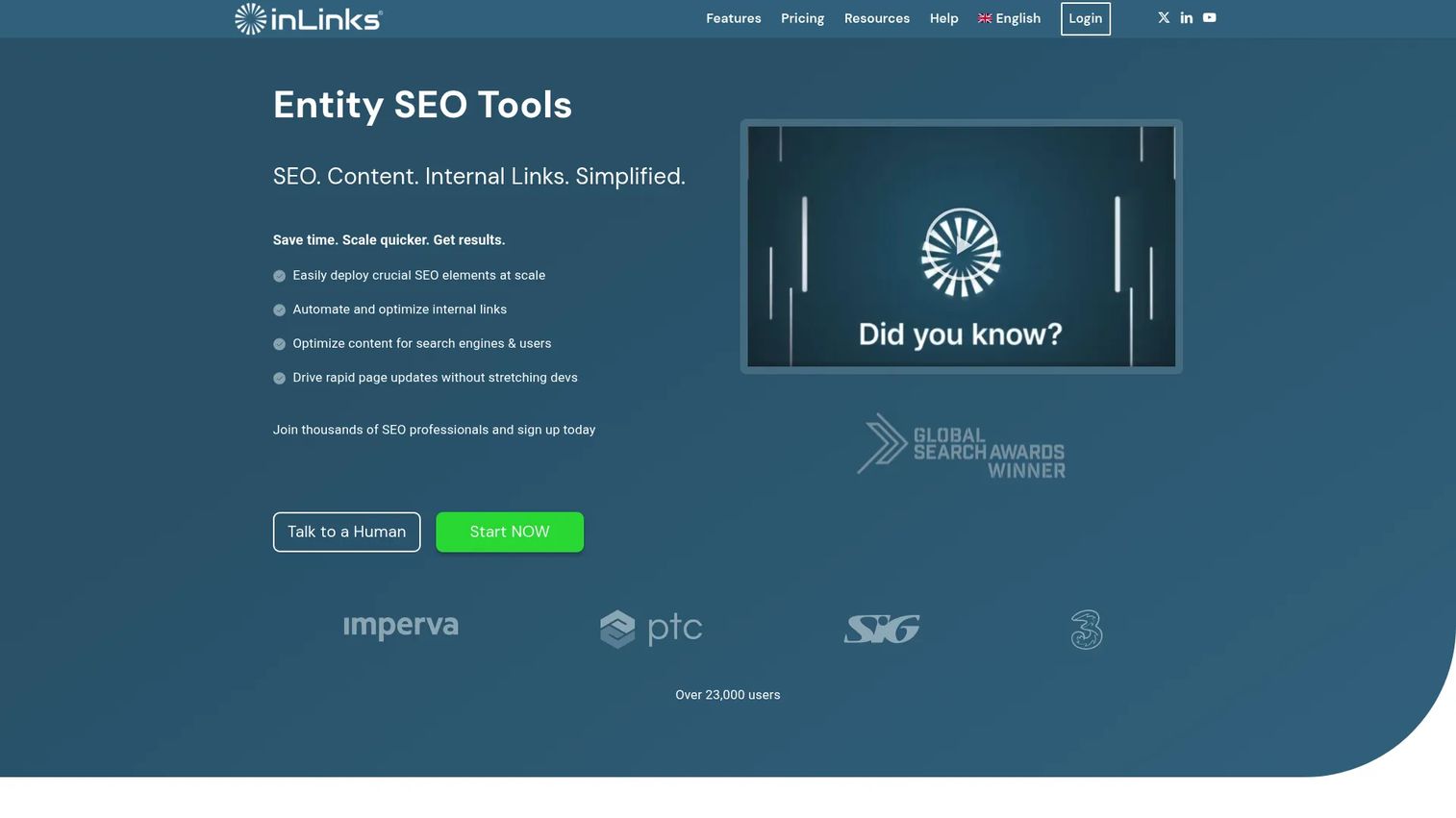
InLinks is the most direct category match here, with a dedicated focus on entity SEO and semantic content analysis. Its workflow connects page optimization with the relationships expressed across a website. That makes it relevant when your current process stops at keyword recommendations.
Best for: SEO teams and agencies that want entity-focused editorial work connected to implementation.
For a growth team, the useful evaluation starts with an existing topic cluster. Choose a commercial page and its supporting articles, then inspect whether the recommendations reflect the product’s meaning.
Pay particular attention to ambiguous terminology. A technically relevant entity may still distract from the page’s purpose. Your editor should be able to explain why each suggested relationship helps the reader.
Key features
- Content auditing and optimization
- Automated internal linking
- Automated FAQ and About schema
- Knowledge graph building
- Market trend analysis
Why choose InLinks: Choose it when content revisions and site connections belong in the same operating process. Its category fit is stronger than a general research suite’s.
During evaluation, measure the work left after recommendations arrive. Record how many suggestions become approved changes and whether the team can maintain them through product updates.
Also review automated outputs before publication. A useful pilot should establish who approves links and who owns structured data QA. Keep those responsibilities explicit instead of treating automation as editorial approval.
This approach gives you a defensible purchasing case. Compare time spent preparing and implementing changes against your existing workflow, rather than judging value by the volume of recommendations.
InLinks pricing: A free plan is available; request paid billing terms from InLinks before purchasing.
G2 rating: 4.9/5.
2. Semrush
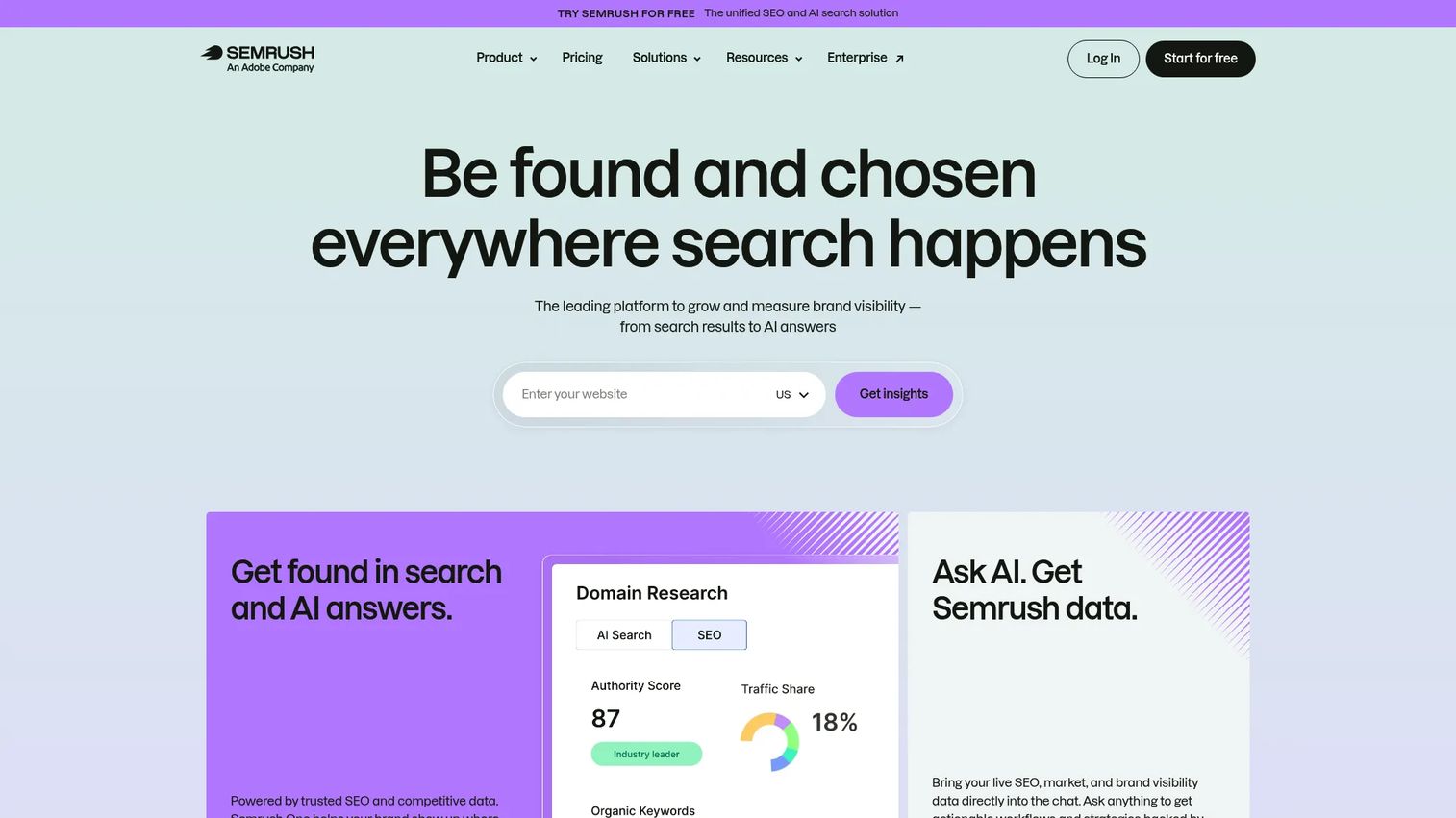
Semrush covers a broader visibility program than dedicated entity software. It brings organic research and AI search monitoring into a platform that also serves content and competitive analysis. For marketers facing tool sprawl, that breadth makes consolidation the central buying argument.
Best for: Digital marketing teams that want entity work inside an established SEO program.
Start by listing the subscriptions and spreadsheet processes you expect to replace. Then distinguish the work you’ll execute in the platform from recommendations that still require another system.
For example, topical research can inform a revised content brief. Deployment ownership remains a separate question. Ask your evaluator to take an insight through the full publishing process, including measurement after release.
Key features
- Keyword and competitor research
- AI visibility and brand sentiment tracking
- Technical site audits
- Content optimization
- Rank tracking and backlink analysis
Why choose Semrush: Choose it when broad organic visibility matters more than building a dedicated content knowledge graph. Existing research workflows provide a practical starting point.
Include a fixed set of commercial topics in your pilot. Compare the recommended content opportunities with what your sales team hears during qualification.
Keep AI visibility reporting separate from attributed revenue. A mention can indicate exposure without proving a website visit or an opportunity. Define how those signals enter your reporting before presenting a combined performance story.
The purchasing test is operational. Can the team retire another subscription, produce a stronger brief, or shorten reporting preparation? Those outcomes are more useful than counting available modules.
Semrush pricing: Free access is available; SEO costs $117.33/month billed annually or $139 monthly. Starter and Pro+ cost $165.17 and $248.17/month annually, respectively.
G2 rating: 4.4/5.
3. Wikidata
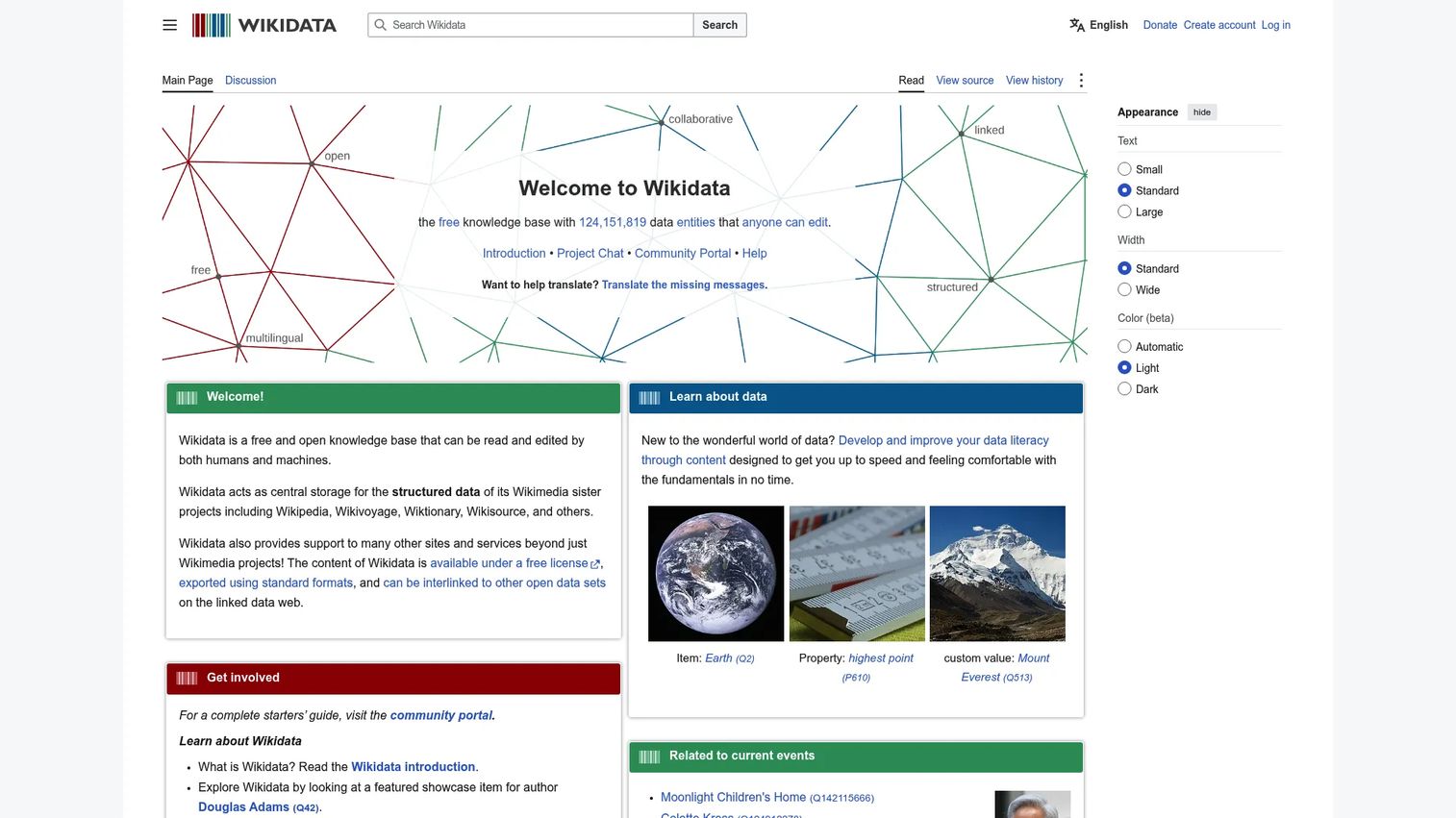
Wikidata is a collaborative knowledge base, not a conventional SEO dashboard. It organizes information into interconnected items and statements. Technical teams can use those records to investigate names and relationships before connecting external references to website content.
Best for: Technical SEOs and content strategists researching entity identity and authoritative connections.
Its role is particularly clear when a name has several meanings. Search for the intended subject, inspect the record, and compare its attributes with your own source material.
A matching label alone isn’t enough. Review the description and supporting references before reusing an identifier. This is a research task that benefits from editorial judgment, even when access is programmatic.
Key features
- Structured items and statements
- Multilingual labels and data
- SPARQL Query Service
- Programmatic APIs
- CC0 data reuse
Why choose Wikidata: Use it when you need openly reusable reference data rather than another subscription. It supplies research material for a larger implementation workflow.
For a practical pilot, create an inventory of important subjects already covered on your site. Record the preferred name and any matching identifier, alongside the page responsible for explaining that subject.
Keep uncertain matches out of production until someone reviews them. This prevents a seemingly convenient external reference from connecting your page to the wrong organization or concept.
Wikidata also supports knowledge graph research across languages. Teams working internationally should compare meanings and relationships, rather than assuming translated labels refer to identical subjects.
Budget staff time for this work. Free access removes licensing cost, but your organization still needs someone to interpret records and maintain its own entity inventory.
Wikidata pricing: Free, with data available for reuse under CC0.
4. Google Knowledge Graph Search API
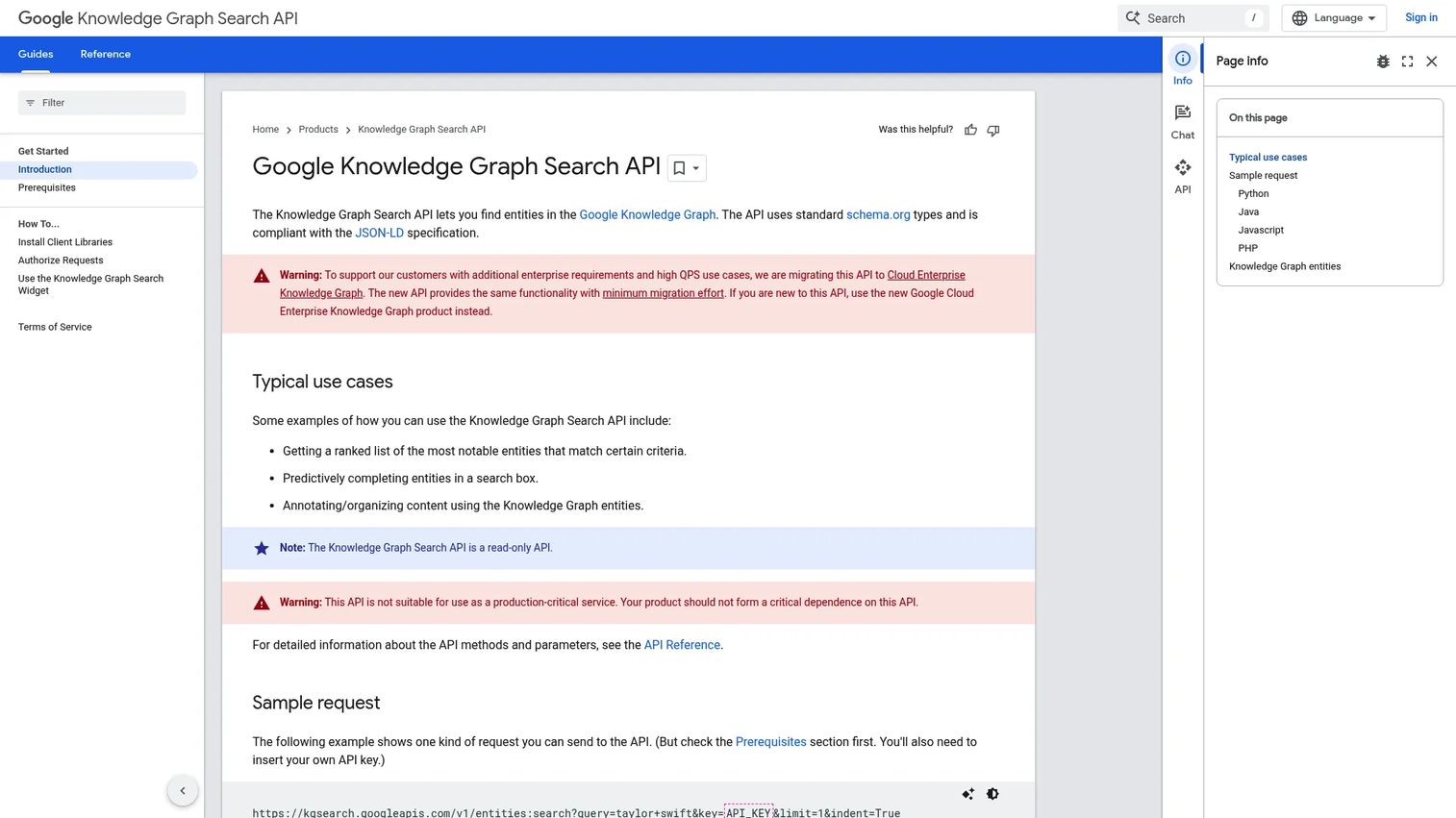
Google Knowledge Graph Search API is a read-only interface for finding entities in Google’s Knowledge Graph. It returns ranked search results through HTTP requests. Developers can incorporate those responses into research or annotation workflows.
Best for: Technical SEO teams investigating how an entity appears through Google’s lookup interface.
The important boundary is control. Querying the service retrieves information; it doesn’t submit changes to Google or create a Knowledge Panel.
Use it as evidence within a broader review. Compare returned results with the organization’s official name and website. Keep a record of ambiguous matches for manual investigation rather than treating the first result as definitive.
Key features
- Ranked entity search results
- Entity autocomplete support
- JSON-LD responses
- Schema.org-compatible data
- API-key authentication
Why choose Google Knowledge Graph Search API: Use it for programmatic entity research when a manual lookup process no longer fits. It requires someone comfortable handling API responses.
Google’s documentation warns against relying on this API for production-critical services. Enterprise and high-volume requirements are moving toward Google’s Cloud Enterprise Knowledge Graph offering.
That warning matters when scoping an internal project. A research script and a customer-facing dependency have different reliability requirements. Give engineering the intended use before committing the API to an operational process.
Also avoid reading an unsuccessful lookup as a complete diagnosis of search visibility. The response is one observation, not a ranking assessment or an explanation of citation behavior.
For marketers, the useful deliverable is an annotated entity inventory with unresolved questions. A collection of raw responses won’t help your content team decide what to change.
Google Knowledge Graph Search API pricing: Free for up to 100,000 read calls daily per project; higher quota can be requested.
5. Ahrefs
Ahrefs supports entity strategy through competitive research and link intelligence. Its broader SEO platform helps teams examine which pages cover a subject and where competing sites attract visibility. It also offers AI-search monitoring through Brand Radar.
Best for: SEO teams prioritizing content opportunities and the external references surrounding a topic.
Treat its role as research and measurement. Begin with the commercial subject you want to strengthen, then compare your existing coverage with relevant competing pages.
Look beyond the number of missing keywords. Ask which buyer questions remain unanswered and whether your website contains an appropriate destination for each. A gap becomes useful when it produces a specific editorial decision.
Key features
- Site Explorer competitive analysis
- Keywords Explorer research
- Site Audit technical checks
- Rank Tracker monitoring
- Content Explorer discovery
Why choose Ahrefs: Choose it when your entity work starts with understanding topical competition and link patterns. It fits teams that already organize SEO around research-led priorities.
A strong evaluation should include the handoff to content. Have the marketer produce a brief with a defined audience and a concrete question the page must answer.
Then assess reporting requirements separately. If AI search visibility is central to the purchase, include the relevant product costs in your budget rather than assuming entry access covers everything.
For attribution, maintain consistent topic groups across reports. That makes it easier to compare research priorities with later organic visits and qualified conversions.
Avoid presenting backlink volume as proof that an entity is correctly represented. Use the data to investigate sources and competitors, then validate the underlying claims editorially.
Ahrefs pricing: Ahrefs Free is available; Starter costs $29/month and Lite costs $129/month. Brand Radar AI starts at $199/month.
G2 rating: 4.5/5.
6. seoClarity
seoClarity is an enterprise SEO and AI search optimization platform. Its coverage extends from research into technical analysis and execution. That range makes it relevant when entity work must operate across large websites rather than a small collection of articles.
Best for: Enterprise teams coordinating SEO across multiple domains or markets.
The buying case should start with operational bottlenecks. Identify where recommendations wait for approval and where teams lose visibility after implementation.
Bring technical stakeholders into the evaluation early. A platform demonstration should follow one issue from discovery to the proposed change, then show how the outcome would be monitored.
Key features
- Enterprise rank tracking
- AI content analysis
- Technical crawling and site auditing
- Log file analysis
- SEO testing and automated execution
Why choose seoClarity: Choose it when entity-related improvements need enterprise technical analysis and coordinated execution. A narrow lookup requirement alone doesn’t justify this scope.
Its AI-search capabilities include monitoring citations and sentiment, alongside answer accuracy. For a brand team, the accuracy dimension deserves a distinct review process.
Define what counts as an incorrect statement about your company. Assign someone to inspect the source material and decide whether a content correction is warranted.
Keep that process separate from traffic reporting. Fixing an inaccurate description is an information-quality task, even when no attributable visit follows.
Before procurement, document the domains and keyword coverage your team needs. Ask for an implementation plan that names owners on both sides. This makes the commercial comparison about usable coverage rather than a platform demonstration.
seoClarity pricing: Research & Content starts at $2,500/month, Technical SEO at $3,200/month, and Enterprise at $4,500/month. Final quotes vary by domains, keywords, and package.
G2 rating: 4.5/5.
7. Yext
Yext addresses entity management through structured brand information. It connects business facts with listings and digital properties. This makes it particularly relevant when the problem involves many locations rather than the topical coverage of a publication.
Best for: Multi-location brands that need consistent business information across customer-facing destinations.
Consider the operating problem before comparing it with content software. A location that changes its opening hours creates a different workflow from an article missing an important concept.
Your evaluation should follow a business update from its original owner to the places where customers encounter it. Identify who approves changes and how exceptions are handled.
Key features
- Knowledge Graph for structured brand data
- Listings distribution
- Review monitoring and response
- Entity-focused pages
- Scout visibility intelligence
Why choose Yext: Choose it when location data and brand facts need coordinated management. Its fit is strongest where inconsistency creates ongoing operational work.
Build the pilot around representative locations. Include a straightforward record and one with unusual requirements, such as different departments or overlapping services.
Ask local stakeholders to review the resulting information. A centrally approved naming convention still needs to reflect what customers encounter at the business.
For marketing measurement, distinguish data quality from acquisition outcomes. Track whether required fields are accurate, then examine local visibility and conversion performance separately.
This keeps reporting useful for both operations and growth. It also prevents a listings project from being judged solely by changes in aggregate organic traffic.
Yext warrants attention when distributed facts are the source of confusion. For a content team seeking article briefs, a semantic content platform addresses a different job more directly.
Yext pricing: Custom pricing, typically billed annually. No free plan is available.
G2 rating: 4.4/5.
8. Conductor
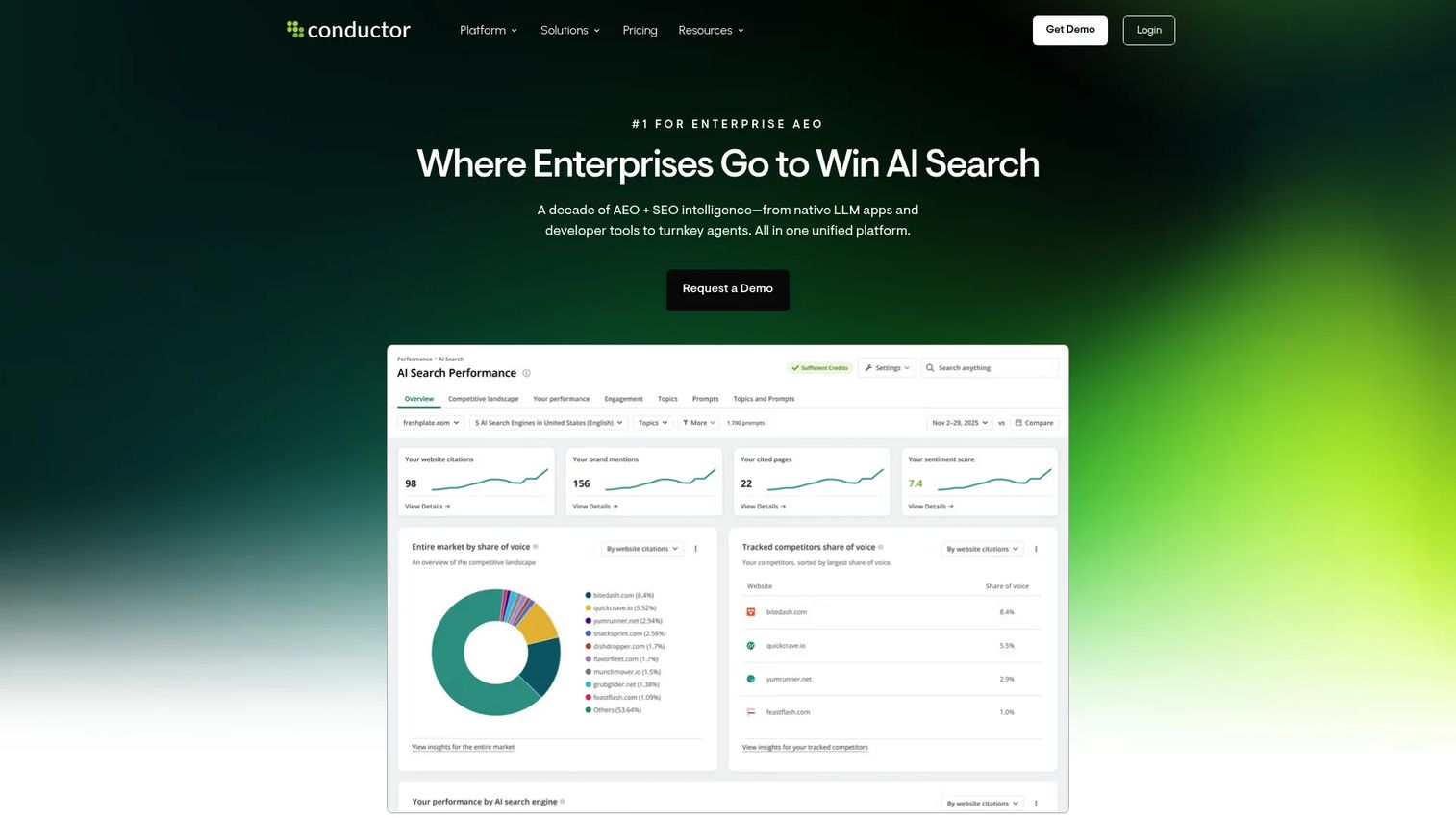
Conductor combines enterprise search visibility with content creation and technical website monitoring. Its role in entity SEO is coordinating a broader organic marketing program. Teams can investigate coverage while keeping website changes in view.
Best for: Large marketing organizations connecting editorial decisions with SEO performance and site health.
For a content leader, the central question is whether insights reach the people responsible for publishing. Include writers and technical owners in the evaluation, rather than limiting it to the reporting team.
Choose an existing page that needs revision. Follow the recommendation into a brief, then document how stakeholders would review the proposed changes.
Key features
- AI-search visibility tracking
- Content generation and optimization
- Content scoring
- Topical-authority insights
- Website monitoring and change tracking
Why choose Conductor: Choose it when content improvement and technical monitoring share an enterprise operating process. It suits a wider program than isolated schema maintenance.
A useful pilot should also examine change ownership. If a page’s performance shifts after publication, your team needs a record of what changed and who can investigate.
Evaluate reporting from the stakeholder’s perspective. An editorial lead needs different information from a technical specialist or a finance reviewer.
Avoid combining those audiences into an oversized dashboard. Specify the decision each report should support before assessing how the platform presents it.
Conductor’s commercial structure includes Essentials, Growth, and Enterprise plans. Map expected usage to the package discussion, then ask which recurring workflows each team will adopt.
The strongest purchase case is a documented process improvement. Show how research moves into published work and how the organization responds when monitoring identifies a problem.
Conductor pricing: Custom, usage-based pricing across Essentials, Growth, and Enterprise. A free trial is available.
G2 rating: 4.5/5.
9. BrightEdge
BrightEdge is an enterprise SEO and AI search platform with content performance reporting. It fits organizations that need a consistent view across large search programs. Entity work enters through content recommendations and the measurement of broader visibility.
Best for: Enterprise marketers reporting search performance across markets and extensive content libraries.
Start with the decisions leadership expects your reports to support. Those might include allocating editorial resources or prioritizing a category with weak organic coverage.
Then identify the evidence needed for each decision. A useful dashboard should distinguish an observed performance change from a forecast or recommendation.
Key features
- Keyword research and reporting
- Content recommendations
- ContentIQ technical auditing
- Competitive share-of-voice tracking
- Custom dashboards and forecasting
Why choose BrightEdge: Choose it when enterprise reporting and content prioritization are central purchasing requirements. Evaluate its entity relevance through the actual recommendations your team receives.
Bring a familiar category into the evaluation. Ask the platform team to show how it would organize your pages and identify work worth prioritizing.
Challenge the grouping before accepting the report. If unrelated pages appear together, the resulting summary may not answer the business question you intended.
BrightEdge also covers AI search visibility measurement. Decide how that reporting will sit alongside existing organic performance reviews without implying that mentions equal revenue.
For procurement, request a demonstration using the dimensions your company reports internally. Examples include market and product line.
A platform earns its place when stakeholders can make decisions from its output. If analysts still need to reconstruct every report manually, include that work in the cost comparison.
BrightEdge pricing: Custom pricing.
G2 rating: 4.4/5.
10. SE Ranking
SE Ranking provides broad SEO tooling for agencies and in-house teams. Its contribution to entity SEO comes through research and content workflows, supported by audits and reporting. It belongs on the shortlist when the wider SEO stack needs consolidation.
Best for: Marketing teams seeking shared research and measurement without an enterprise platform buying process.
Avoid choosing it solely because an entry price looks accessible. Model the package around the work your team performs regularly, including client or project requirements.
For an agency, test whether the reporting process fits how account teams communicate results. An internal SEO specialist may care more about moving from an audit finding to an approved change.
Key features
- Rank tracking
- Keyword and competitor research
- Website and on-page audits
- Backlink research and monitoring
- Content marketing tools
Why choose SE Ranking: Choose it when your entity strategy sits inside everyday SEO operations. It offers a broader working environment than a standalone question-research tool.
The platform also covers local marketing and AI visibility tracking. Include those areas in the evaluation only if someone will own the resulting work.
Run the trial against a defined backlog. Select content research and a technical issue, then record the steps needed to turn each finding into action.
Ask the people who will use it weekly to perform those tasks. A polished sales presentation gives less useful adoption evidence than a completed workflow.
For ROI, compare subscription cost with tools you can retire and manual reporting you can remove. Keep expected traffic gains separate until your own measurement supports them.
SE Ranking pricing: Core costs $103.20/month annually or $129 monthly; Growth costs $223.20 annually or $279 monthly. A 14-day trial is available, without a permanent free plan.
G2 rating: 4.8/5.
11. WordLift
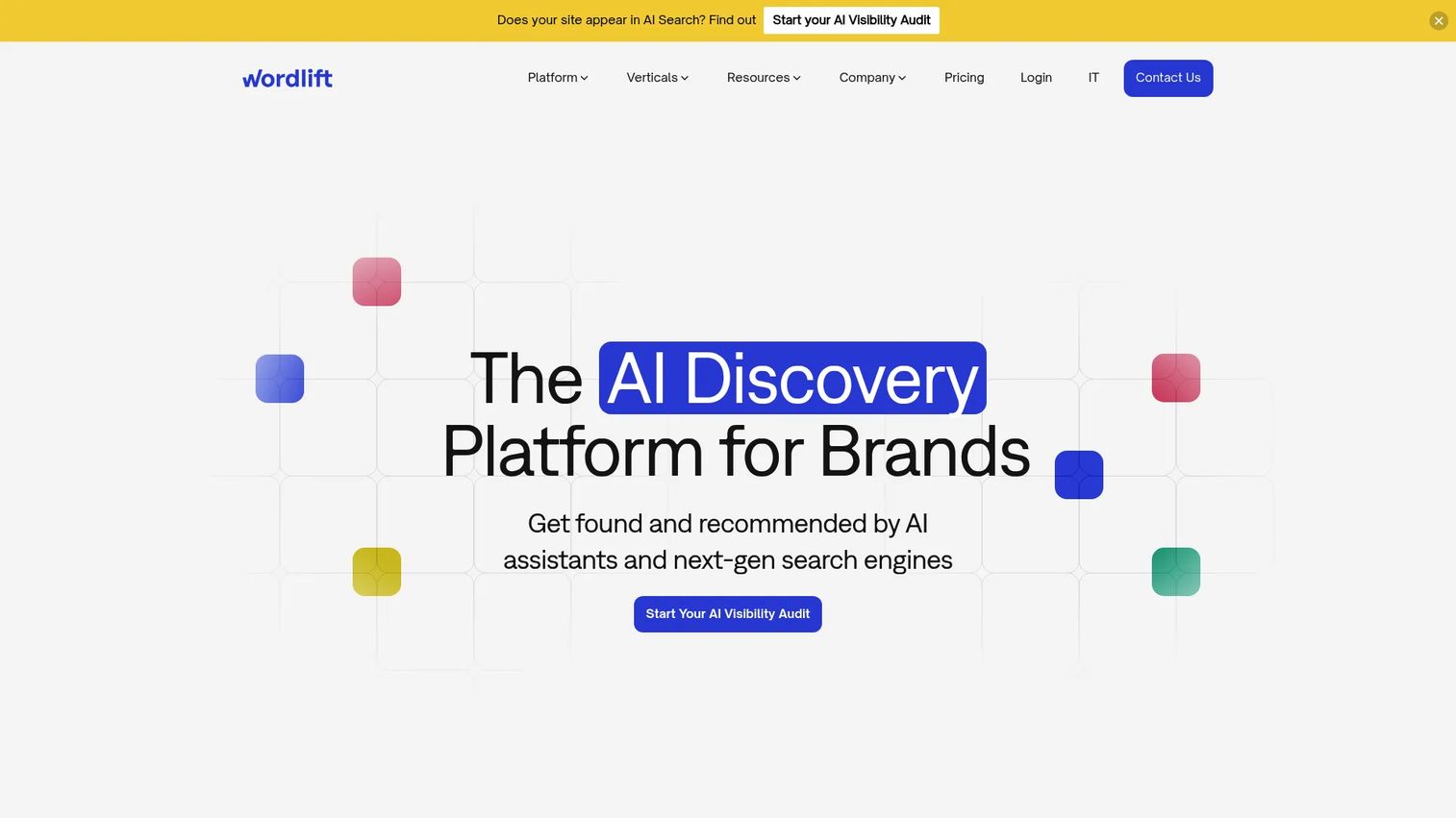
WordLift focuses on semantic content and knowledge graph infrastructure. It connects structured information with optimization work. That makes it relevant when your team wants relationships between content assets to become an explicit, maintained resource.
Best for: SEO and content teams investing in a reusable content knowledge graph.
Begin with the data model rather than a writing task. Decide which entities matter to your website and where their authoritative descriptions should live.
A publisher might organize authors and subjects. An ecommerce team would start with its product information. The useful structure comes from the business, not from maximizing the number of extracted entities.
Key features
- Knowledge Graph creation and management
- Content creation and optimization
- SEO research and analysis
- Schema and data integration tools
- Optimization audits and rank tracking
Why choose WordLift: Choose it when knowledge graph building is an ongoing program with an accountable owner. Its semantic focus suits teams connecting content beyond individual briefs.
During evaluation, inspect how the proposed model handles duplicate names and changing facts. Ask who will review relationships after the initial implementation.
Also define what downstream work should become easier. Examples include maintaining shared descriptions or producing research from an established set of subjects.
Keep those expectations specific. “Better semantic SEO” is difficult to assess, while a reliable entity inventory and a repeatable update process are observable outputs.
WordLift’s commercial scope includes strategic support. Use that conversation to establish responsibility for modeling decisions and ongoing maintenance.
This is a different investment from purchasing a low-cost content editor. Assess the value of the graph itself, alongside the publishing tasks it supports.
WordLift pricing: Business+ costs $879/month billed yearly or $1,100 monthly; Enterprise has custom pricing. A free trial is available, without a free plan.
G2 rating: 4.7/5.
12. Schema App
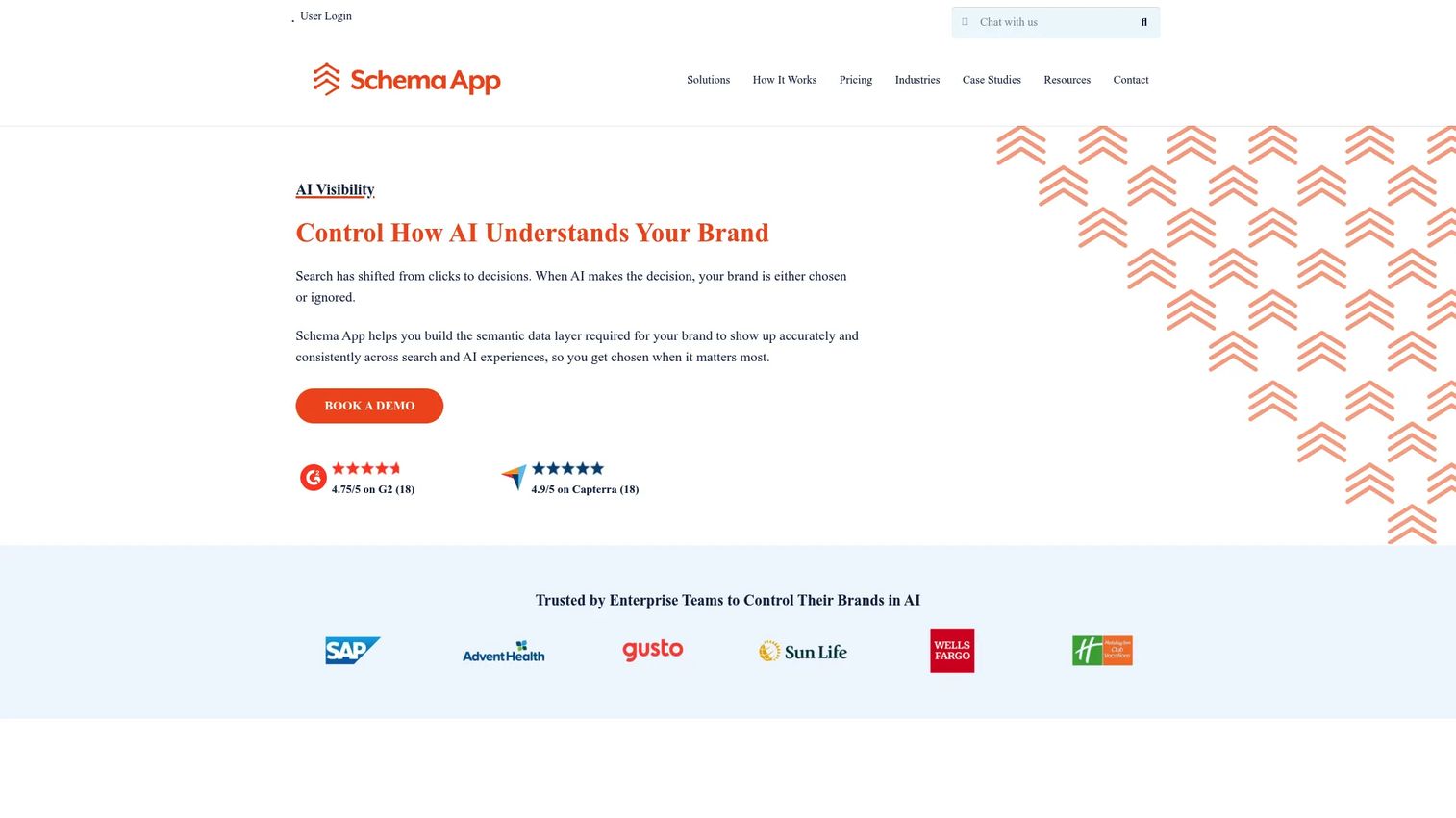
Schema App specializes in structured data and content knowledge graphs. It supports JSON-LD management across website templates and shared entities. Its strongest fit is operational, where teams already know what their pages represent and need reliable implementation.
Best for: Enterprise teams governing schema markup across complex websites.
This distinction matters for buyers. A structured data project needs decisions about the business facts being expressed, alongside a deployment process.
Before evaluating software, identify your canonical organization and product records. Note where templates reuse those facts and where conflicting descriptions currently appear.
Key features
- No-code JSON-LD generation and deployment
- Schema App Highlighter for templated pages
- Entity linking across authoritative knowledge bases
- Deployment and markup-health monitoring
- Entity Hub management and reporting
Why choose Schema App: Choose it when structured data operations are the core requirement. Its focus is more specific than general keyword or content research.
Review the service model during procurement. Schema App states that new customers cannot purchase its platform as a standalone service.
That makes implementation ownership an important part of the buying conversation. Establish which decisions your team makes and which work the provider handles.
A pilot should include a shared entity referenced across several templates. Test the review process for a changed business fact, rather than evaluating only the initial generation of markup.
Also separate schema validation from factual accuracy. A technically acceptable implementation still needs to describe the visible content correctly.
For a digital marketer, the measurable operational benefit is reduced ambiguity around ownership and maintenance. Evaluate those outcomes before attaching an expected search uplift to the project.
Schema App pricing: Custom pricing based on website scope, complexity, and support. Enterprise subscriptions do not include free trials.
G2 rating: 4.7/5.
13. AlsoAsked
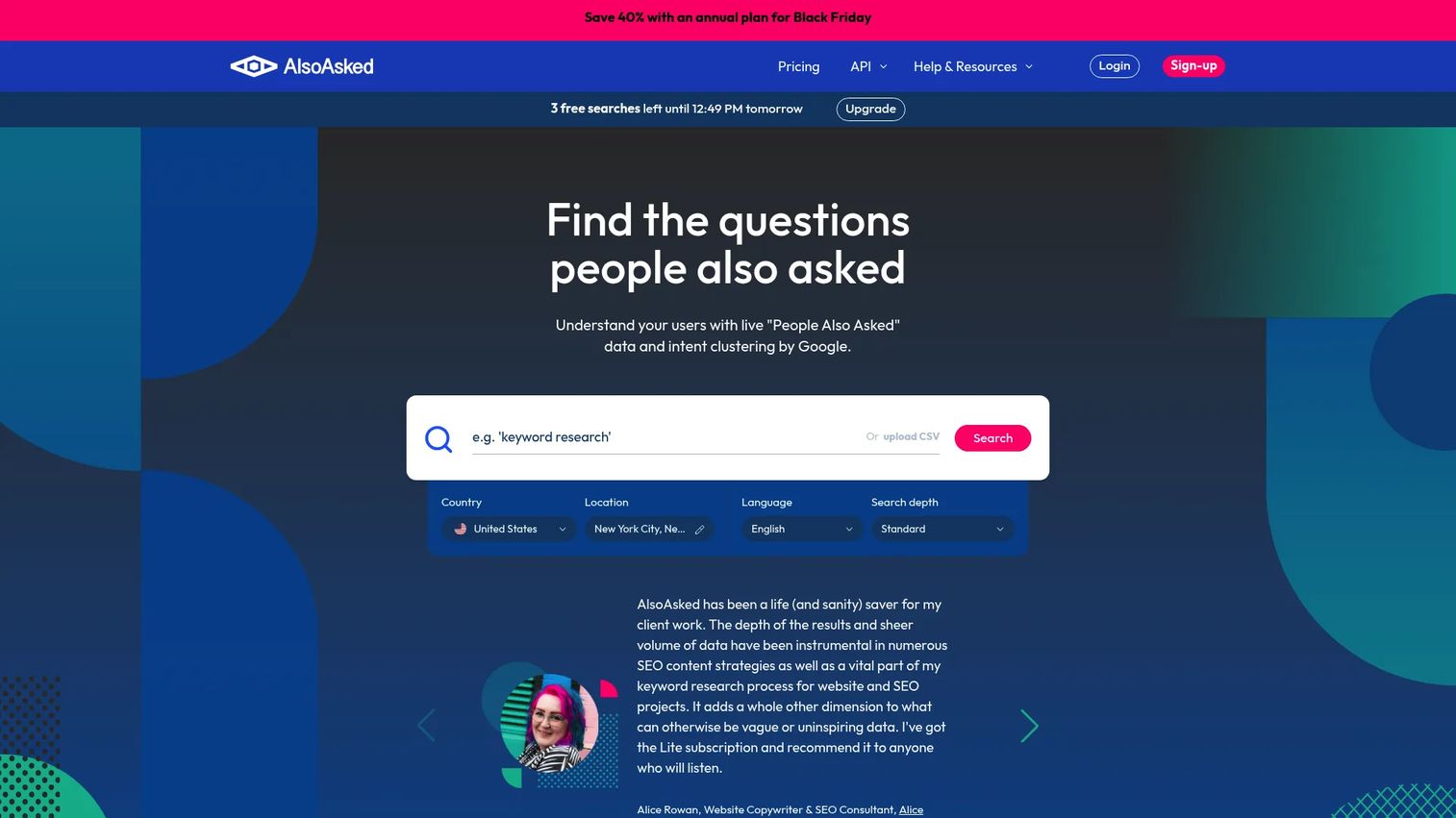
AlsoAsked maps questions from Google’s People Also Ask results. It gives content teams a visual account of related questions around a search topic. Its entity SEO role is research, particularly understanding which explanations belong near each other.
Best for: Content marketers developing question-led briefs and topic clusters.
Use the maps to investigate how searchers approach a subject. Then compare those questions with the journey your buyers take before selecting a product.
Not every related question deserves its own article. Some belong in a section of an existing page; others fall outside your commercial focus.
Key features
- Live People Also Ask data
- Visual question relationship maps
- PNG and CSV exports
- Bulk and deep searches
- API access
Why choose AlsoAsked: Choose it when the missing input is question research. Its focused output suits editorial planning rather than schema deployment.
A practical pilot starts with a subject your team knows well. Review the resulting map with a product specialist and identify questions that require original expertise.
Use that review to improve the brief’s structure. For each proposed section, specify the question being answered and the evidence the writer needs.
Keep the research distinct from a content quota. Publishing every discovered question can create overlapping pages without improving the reader’s understanding.
Country-level research is useful when planning regional content. Ask local reviewers whether the wording reflects the intended audience before turning findings into a shared global brief.
For a lean team, the purchasing case is straightforward. Compare the time needed to build a useful brief with your current manual research process.
AlsoAsked pricing: Free searches are available; Basic costs $12/month, Lite $23, and Pro $47. Their monthly allowances are 100, 300, and 1,000 credits, respectively.
14. DBpedia
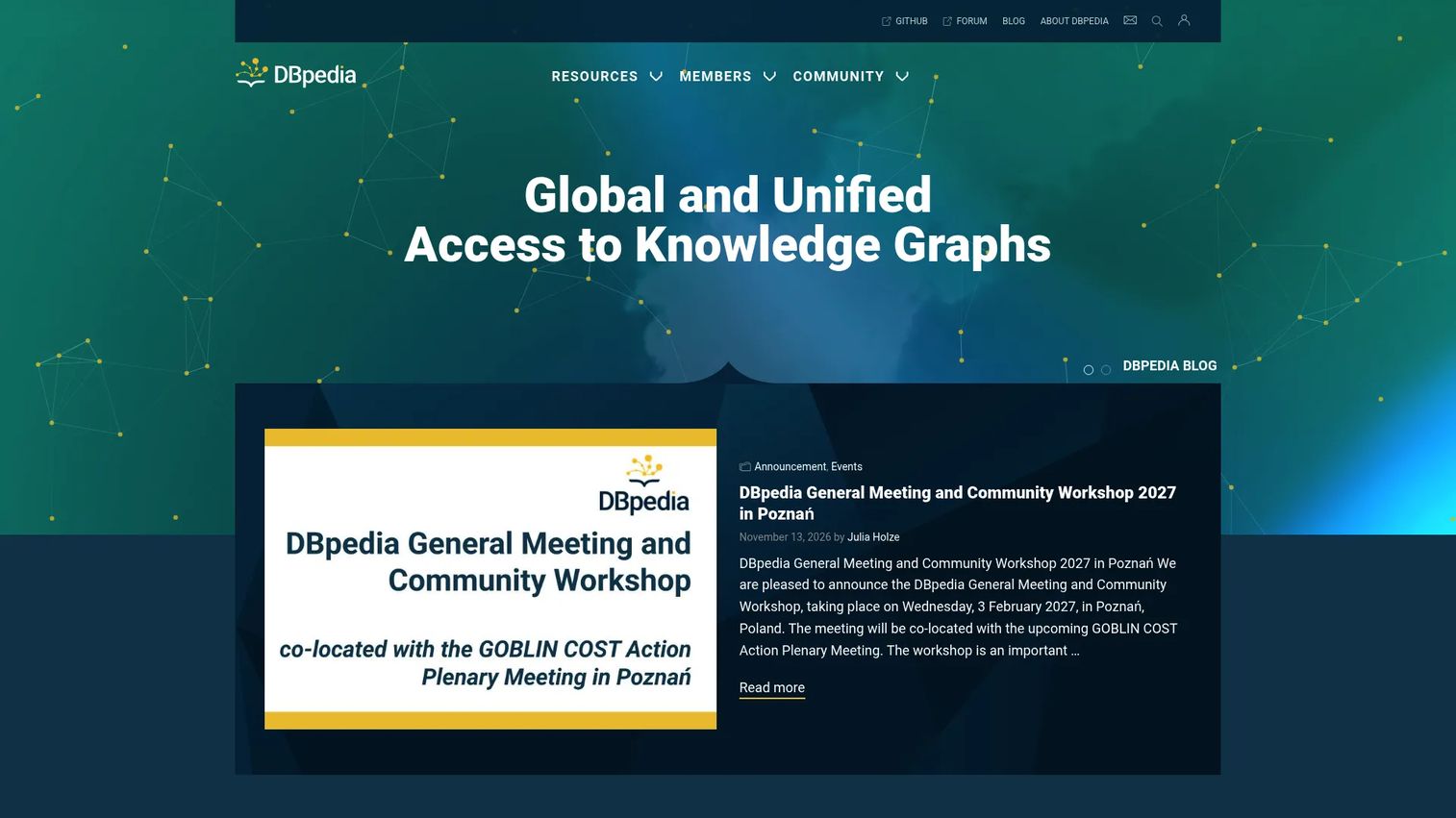
DBpedia provides an open knowledge graph built from Wikimedia information. It offers structured data for research and software development. Advanced SEO teams can use it to explore entity relationships or support their own annotation processes.
Best for: Technical SEOs and developers working with linked open data.
Its value comes from what your team can build or investigate with the data. There is no conventional content brief waiting at the end of a query.
Define the research question first. You might need to resolve references across a document collection or inspect how related subjects are represented.
Key features
- SPARQL and Linked Data access
- DBpedia Lookup search
- DBpedia Ontology
- Databus cataloging and versioning
- DBpedia Spotlight entity linking
Why choose DBpedia: Use it when an open data layer fits your technical workflow. It is a research resource rather than a replacement for a marketing platform.
For evaluation, ask a technical owner to produce a small, inspectable output. That might be a set of candidate matches for subjects already covered on your website.
Have an editor review the results before connecting them to production content. Entity linking needs context, particularly when familiar words have several meanings.
Record where imported references came from and how you will revisit them. A useful data pipeline requires maintenance decisions, even when the underlying source is freely available.
DBpedia is also relevant to knowledge graph building when your team needs linked-data interfaces. Budget development effort alongside the time required to review matches.
For most digital marketers, the first step is a conversation with a technical collaborator. If nobody owns data interpretation, begin with a more directly actionable research workflow.
Considerations when choosing entity SEO tools
Match the platform to the job
Write down the output you need before requesting demonstrations. A maintained schema deployment requires different software from an entity lookup or an editorial brief.
Avoid buying enterprise scope to solve a research task that occurs occasionally. Ask what existing work the purchase replaces.
Inspect structured data depth
Review JSON-LD deployment and markup-health monitoring, along with support for the schema types your site uses. Check how shared entities and sameAs references are maintained.
Include a changed template in the evaluation. Initial setup reveals less than the process for keeping facts consistent.
Test workflow ownership
Name the person who receives recommendations and the person who can implement them. Include CMS permissions and publishing review in the trial.
If every action still requires an unplanned engineering ticket, account for that dependency in your rollout schedule.
Evaluate relevance before volume
Use a topic your specialists understand to assess entity identification and suggested relationships. Ask reviewers to explain which recommendations improve the page.
A long list of related terms is a weak purchasing signal. Prioritize accurate, actionable findings over impressive-looking coverage scores.
Model cost against adoption
Price the expected domains, locations, or content volume, including any separately purchased capabilities. Compare that total with subscriptions you can retire.
Set a baseline for implementation time and qualified organic conversions. Track AI visibility separately, then investigate its relationship with pipeline rather than assuming attribution.
Choose the workflow before the platform
InLinks is the most direct match for a dedicated entity SEO workflow. Schema App fits teams whose central challenge is structured data implementation and maintenance.
Wikidata and DBpedia serve technical research. Google Knowledge Graph Search API adds a Google-specific lookup layer, while AlsoAsked supports question-led editorial planning.
For broader operations, compare Semrush and Ahrefs against the tools you already use. SE Ranking also belongs in that consolidation discussion.
Enterprise teams should evaluate seoClarity, Conductor, and BrightEdge against their operating model rather than treating them as interchangeable dashboards. Yext addresses distributed brand facts, and WordLift centers the investment on semantic content infrastructure.
Start with a small, representative set of pages. Define the output you expect, assign its owner, and record the time required to implement it.
The purchase should leave your team with clearer responsibilities and work it can complete. Prove that before expanding the contract.
Start your journey with Guideflow today!
FAQs
Entity SEO tools support the identification and organization of things discussed on a website, including businesses, people, products, and concepts. Capabilities range from content analysis to structured data deployment, while knowledge bases provide reference material for research. Choose an entity checker for an audit task, then distinguish that requirement from ongoing content optimization or implementation. The category includes complementary resources rather than a uniform set of interchangeable platforms.
Keyword SEO focuses on the phrases people use to search and the pages intended to answer them. Entity SEO clarifies the subjects behind those phrases, including their attributes and connections. Both belong in an organic strategy because language research identifies demand while entity work improves the clarity of your content. A useful brief combines the searcher’s question with a precise explanation of the subject.
Entity-focused work can make brand descriptions and topical relationships clearer, but it cannot guarantee an AI citation. Some platforms also monitor visibility in generated answers, which is a measurement capability rather than proof of causation. Keep a stable set of commercial questions for monitoring and record content changes separately. Compare visibility trends with qualified visits and pipeline without treating every mention as an attributable conversion.
Schema App is the focused choice here for enterprise structured data operations, including JSON-LD deployment and entity governance. InLinks connects schema automation with semantic content work, while WordLift supports a broader content knowledge graph approach. Select the tool according to whether the immediate requirement is implementation, maintenance, or research. Validation should examine technical output and whether the markup accurately represents the visible page.
Wikidata and DBpedia are open knowledge resources rather than conventional SEO platforms. They support entity research through structured information and relationships that technical teams can inspect or query. Their value increases when someone owns the process of matching records to the subjects on your website. Free access does not remove the need for editorial review or the development work required to integrate data.
These tools can support consistent descriptions and authoritative references, but none can guarantee a Google Knowledge Panel. Treat entity clarity as the goal you control, including accurate names and matching structured data. An API lookup retrieves information rather than requesting a panel or changing Google’s records. Avoid making panel creation the sole acceptance criterion for a project your team cannot directly control.
Look for a tool that produces an output your team can implement within its existing publishing process. Evaluate content relevance and structured data requirements, then inspect reporting and total cost. If an SEO entity tool creates another recommendation queue without an owner, adoption will be difficult to demonstrate. Build the business case around completed work and qualified organic outcomes, with AI visibility reported as a separate signal.
Small teams should start with the narrowest capability that addresses their documented problem. A focused content workflow or open-data research process may be enough before dedicated governance becomes necessary. Enterprise platforms warrant evaluation when coordination across sites or stakeholders creates recurring operational work. Before upgrading, identify which current tasks exceed your existing tools and who will use the additional capabilities each week.