A parking team runs a lot on manual patches. Permits live in a spreadsheet. Approvals happen over email. Enforcement depends on someone walking the lot with a clipboard. Occupancy is a guess until the complaints roll in.
Each patch works alone. Together they create the exact problem car park software is supposed to solve: more admin, not less.
The market has noticed. The global parking management software market reached US$2.6 billion in 2026 and is growing at a 17.2% CAGR through 2033, according to Persistence Market Research (2026). More than 71% of that revenue came from the software segment, not hardware. Buyers are moving off clipboards and spreadsheets fast.
The catch: "parking software" covers everything from a booking widget to a full parking management system with permits, enforcement workflows, occupancy dashboards, and payment processing. Pick the wrong one and you replace one set of manual work with another. This guide breaks down the difference and shortlists the tools worth your evaluation time.
What's inside
This guide is for parking operators, facilities teams, property managers, campuses, and municipalities evaluating a parking management application in 2026.
Each tool was assessed against the criteria that actually decide fit for operations teams:
- Permit and enforcement depth: how well the system handles approvals, renewals, and rule violations
- Real-time occupancy and reporting: live dashboards, utilization trends, exports
- LPR and access control support: license plate recognition, gate integration, camera-based enforcement
- Integrations and payment handling: API access, payment gateway, building and identity systems
No generic category filler. Just practical differences between platforms and who each one fits.
TL;DR
- Best for digital permits and paperless parking: ParkingPass, with LPR enforcement and guest vehicle registration
- Best for sensor-driven guidance and dashboards: ParkHelp, tied to occupancy hardware and live data
- Best for workplace and visitor parking: Parkable, for allocating limited spaces fairly
- Best for flexible parking operations: Flex Parking, with per-park pricing and peer-to-peer sharing
- Best for desk-plus-parking workflows: Tidaro, when parking sits inside broader workspace booking
- Best for enterprise parking orchestration: Wayleadr, for multi-site allocation and EV charging
- Best for event and venue parking: ParkHub, when throughput and event-day coordination lead
What is car park software
Car park software is a system for managing parking permits, occupancy, payments, enforcement, vehicle tracking, and access across one or more locations. It replaces the spreadsheets, email threads, and manual patrols that most parking operations start with.
There is a real difference between a basic booking tool and a full parking management system. A booking tool reserves a space. A parking management system handles the full operational stack: who is allowed to park, how they pay, how rules get enforced, and how utilization gets reported. The second category is what operations and facilities teams usually need.
Core features of a parking management system include:
- Permit management: issue, approve, and renew digital parking permits without paper
- Visitor registration: guest parking management with self-service or host approval
- Enforcement workflows: flag violations, issue notices, and track exceptions
- Occupancy dashboards: real-time reporting on how full each lot is
- Payment processing: collect parking payments through an integrated payment gateway
- Vehicle tracking and LPR: license plate recognition (LPR, also called ANPR) for enforcement and access
- API and integrations: connect to gates, payment systems, building infrastructure, and identity tools
The strongest digital parking management system ties these together so one change (a new resident, a revoked permit, a full lot) updates everywhere at once. That is the difference between software that reduces admin and software that just moves it.
When to use
Manage permits without spreadsheets
Permit administration breaks down fast. A spreadsheet works for 50 permits. At 500, with renewals, guest passes, and revocations, email approvals turn into a backlog. Car park software cuts the manual approval loops by moving requests, approvals, and renewals into one self-service workflow. Residents or employees apply, rules auto-check eligibility, and permits issue without a person retyping data.
Enforce rules with LPR and real-time alerts
Manual enforcement misses violations and creates disputes. License plate recognition earns its cost when your lot has real turnover or strict eligibility rules. Camera-based enforcement reads plates against your permit list and flags mismatches in real time. That ties directly to compliance and cleaner occupancy visibility, since every vehicle in the lot is accounted for automatically.
Track occupancy across locations
One lot is easy to eyeball. Multi-location parking is not. Once you run several sites, multi-site reporting and occupancy dashboards become essential for utilization planning and capacity decisions. Real-time reporting shows which lots fill first, when demand peaks, and where you are overselling or underusing space. That data drives smarter allocation and honest reporting to stakeholders.
Comparison table
The table below compares the shortlist by best use case, key differentiator, pricing, and G2 rating. Pricing for parking software is often community-specific or quote-based, so some entries show custom pricing where no public figure is available. Ratings reflect verified G2 listings where confirmed.
| # | Product | Best for | Key differentiator | Pricing | G2 rating |
|---|---|---|---|---|---|
| 1 | ParkingPass | Digital permits and enforcement | LPR plus guest registration | Community-specific | Not listed |
| 2 | ParkHelp | Sensor-driven guidance | Occupancy hardware and signage | Custom | Not listed |
| 3 | Parkable | Workplace and visitor parking | Flexible allocation and sharing | Custom quote | 4.9/5 |
| 4 | Flex Parking | Flexible parking operations | Per-park pricing, peer sharing | From $5/park/mo | Not listed |
| 5 | Tidaro | Desk-plus-parking workflows | Unified workspace booking | From €15/mo | 4.8/5 |
| 6 | Wayleadr | Enterprise parking orchestration | AI allocation, EV charging | Custom | 4.9/5 |
| 7 | ParkHub | Event and venue parking | Mobile POS and reporting | Custom | Not listed |
Best 7 car park software for 2026
1. ParkingPass
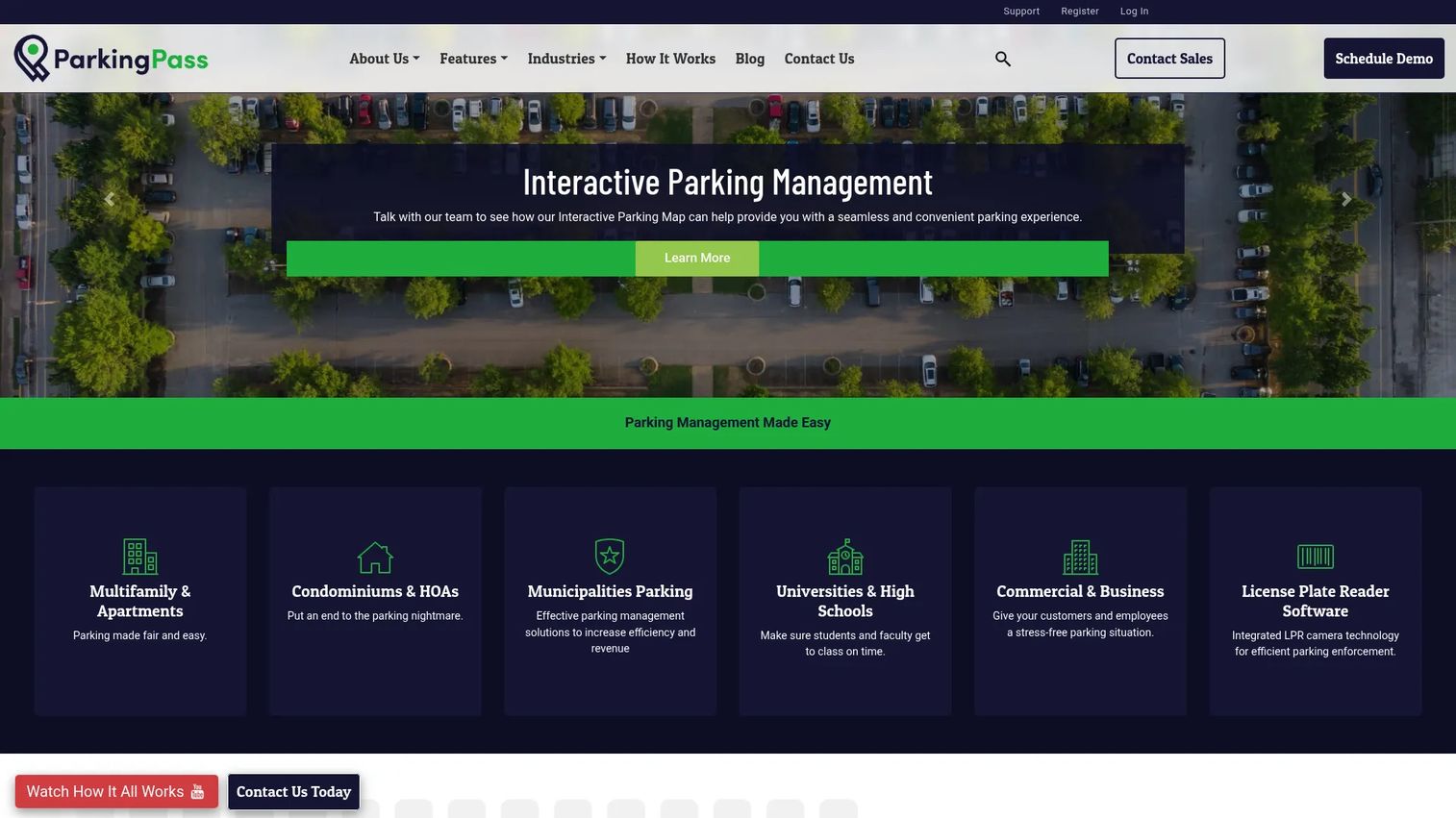
ParkingPass is built for property managers and HOAs that need digital parking enforcement and permit management in one place. It combines license plate recognition, e-permits, and a resident approval portal so guest vehicles, resident permits, and enforcement all run through the same workflow. If your main pain is paperless parking and stopping unauthorized vehicles, this is the natural starting point.
The platform leans into digital permit workflows and LPR-based enforcement, which matters most when turnover is high and eligibility rules are strict. Guests register their vehicle, residents approve, and the system checks plates automatically.
Best for: Property managers, HOAs, campuses, and mixed-property parking operations that lead with permits and enforcement.
Key strengths
- License plate recognition for automated enforcement
- Digital e-permits with no paper handling
- Guest vehicle registration and resident approval portal
- Online approvals tied to permit rules
Why choose ParkingPass: It fits when permit handling and enforcement are the whole problem, not a side feature. The resident-and-guest approval model is a strong match for multifamily and community parking.
ParkingPass pricing: ParkingPass sets pricing per community rather than publishing a single rate card. The price you see is shown during registration or through your property manager, since it depends on the specific community setup.
ParkingPass does not have a verified G2 rating available at the time of writing.
2. ParkHelp
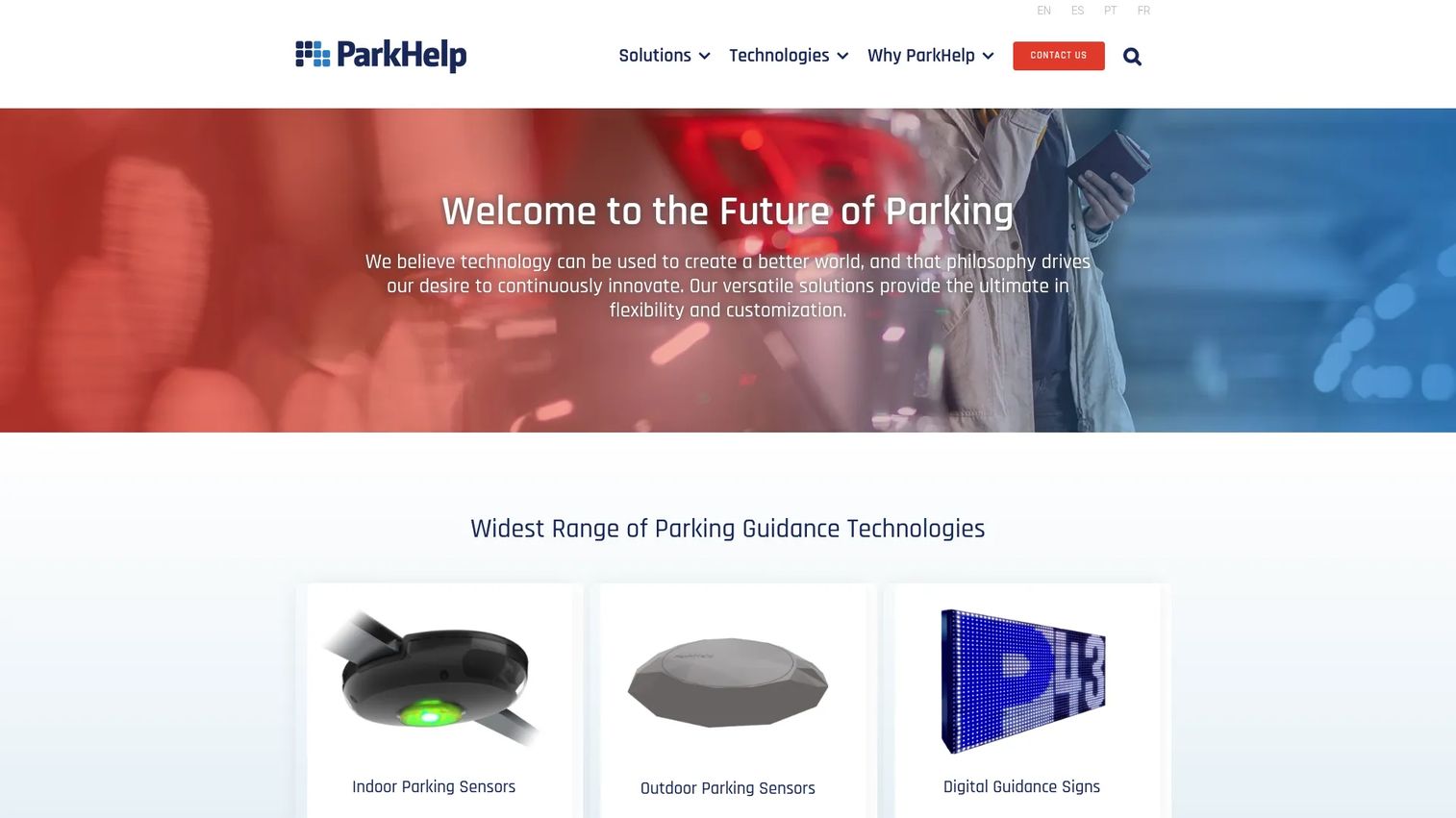
ParkHelp is a parking guidance and mobility provider for indoor, outdoor, and camera-based environments. Where most tools on this list start with software, ParkHelp starts with the physical lot: sensors, guidance signs, and camera-based detection feeding a live occupancy picture. That makes it a fit for commercial operators whose parking is tied to infrastructure.
The value shows up when occupancy has to be accurate to the space, not the estimate. Indoor and outdoor sensors track availability, and digital signs route drivers to open spots in real time.
Best for: Commercial parking operators and facilities teams that need live occupancy visibility and driver guidance.
Key strengths
- Indoor parking sensors and guidance
- Outdoor parking sensors for open lots
- Digital guidance signs that route drivers
- Real-time occupancy detection
Why choose ParkHelp: It is the right call when your parking operation is anchored to hardware and live occupancy data rather than permit administration. The sensor-and-signage model suits garages and large commercial sites.
ParkHelp pricing: ParkHelp doesn't list pricing on its website. Since each system involves hardware and installation tailored to the site, costs are worked out directly with the vendor on a case-by-case basis.
ParkHelp does not have a verified G2 rating available at the time of writing.
3. Parkable
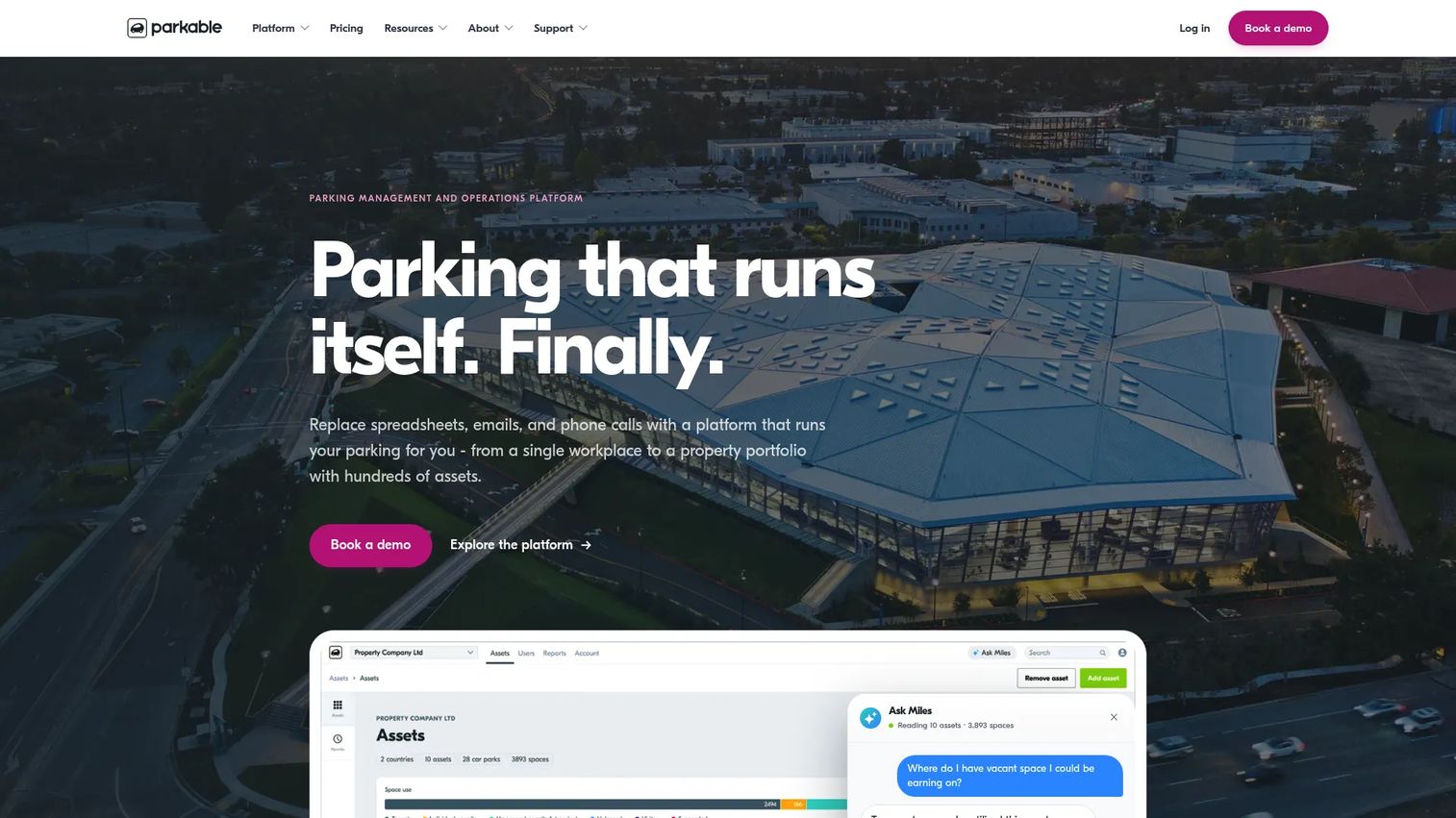
Parkable is parking management software for workplaces and property portfolios. Its core job is allocating limited spaces fairly across staff, tenants, and visitors. Employees book, release, or share spaces from a mobile app, and admins see real-time occupancy, compliance, and usage data. When demand outstrips supply, the sharing and oversell logic keeps utilization high.
The platform automates access, permits, payments, and issue resolution, so the operations team spends less time fielding "who took my spot" messages and more time on planning.
Best for: Offices, workplace parking programs, and property managers who need to allocate scarce spaces without manual coordination.
Key strengths
- Permit, booking, sharing, oversell, and access options
- Real-time occupancy, compliance, and usage data
- Automated access, permits, payments, and issue resolution
- Mobile-first booking for staff and tenants
Why choose Parkable: Choose it when the challenge is fairness and utilization, not enforcement. It shines where parking is a perk to distribute rather than a lot to patrol.
Parkable pricing: Parkable doesn't share pricing on its site. Instead, they ask interested buyers to request a custom quote, since costs shift depending on how many properties are involved and which features get added on.
Parkable holds a 4.9 out of 5 rating on G2.
4. Flex Parking
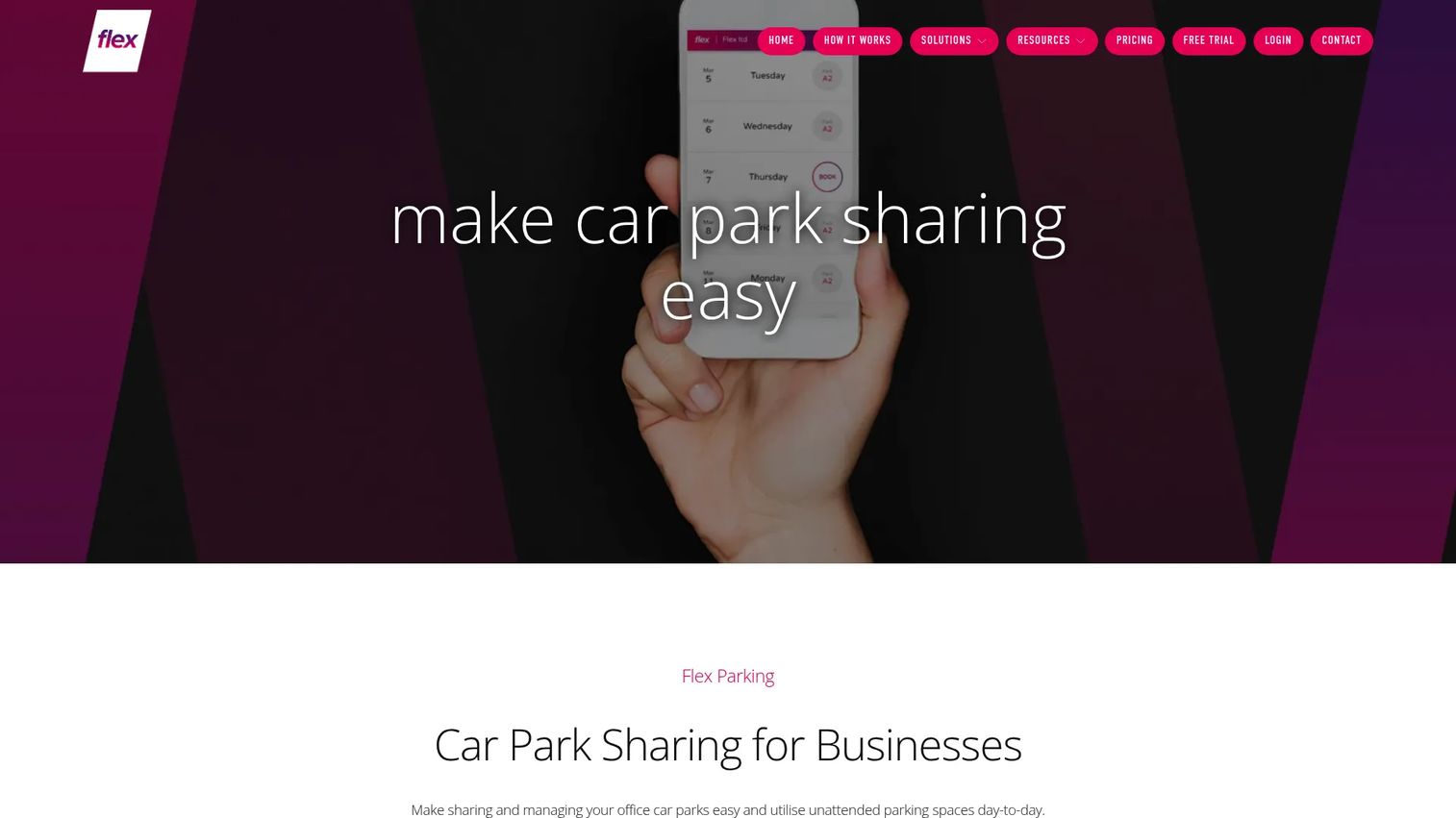
Flex Parking is workplace car park sharing and management software for hybrid teams. The idea is simple: parks sit empty when people work from home, so let employees release and book them peer to peer. Booking, release, and loaning happen from a mobile-friendly interface, with calendar-based rostering and real-time updates so nobody double-books.
Admin controls, SSO, reporting, maps, and fair-use settings sit underneath, which keeps the sharing model orderly rather than chaotic. It is a practical middle ground between flexibility and operational visibility.
Best for: Businesses that want to share and manage workplace parking across hybrid schedules.
Key strengths
- Mobile-friendly booking and release
- Peer-to-peer car park loaning
- Calendar-based booking and rostering
- Admin controls, SSO, reporting, maps, and fair-use settings
Why choose Flex Parking: It balances flexibility with control, which suits hybrid workplaces where occupancy swings day to day. Transparent per-park pricing is a plus for buyers tired of quote-only vendors.
Flex Parking pricing: Plans start at $5 per park per month billed monthly, or $4 per park per month billed annually (NZD, with other currencies available). All plans include unlimited parks and unlimited users, with a minimum charge of $50 per month and a 30-day free trial.
Flex Parking does not have a verified G2 rating available at the time of writing.
5. Tidaro
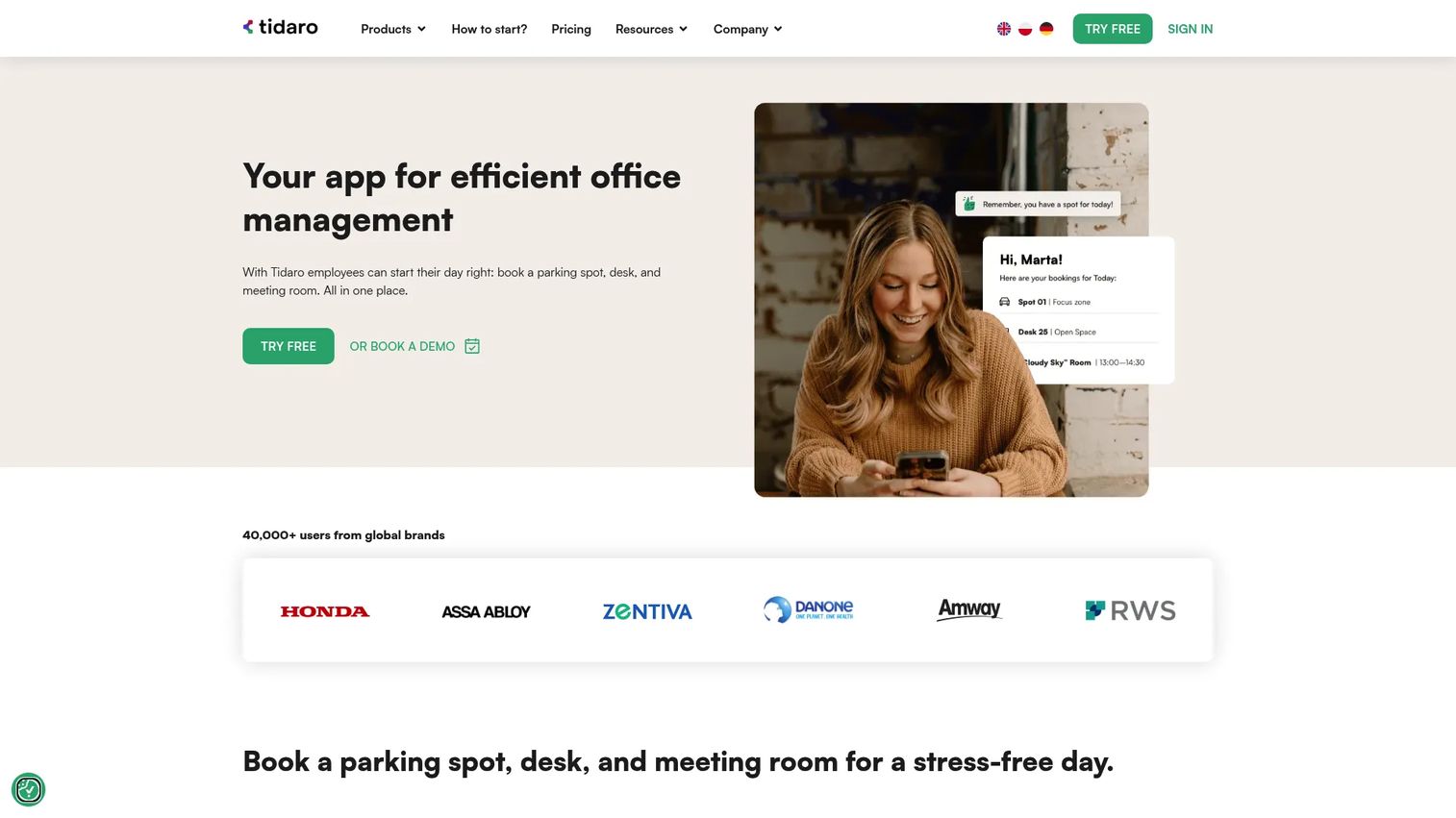
Tidaro is workplace booking software for desks, rooms, and parking spots in one tool. That breadth is the point: if you already manage hybrid desk and room booking, parking becomes another resource in the same system rather than a separate purchase. Employees book a parking spot the same way they book a desk, and admins report on all of it together.
For office operations teams juggling hybrid work patterns, that consolidation cuts tool sprawl and gives a single view of who is in the building and where they are parked.
Best for: Office operations teams managing parking alongside desks and meeting rooms.
Key strengths
- Parking spot booking
- Desk booking
- Room booking
- Self-service portal and reporting
Why choose Tidaro: It is strongest when parking is one piece of broader workspace operations, not a standalone concern. One tool for desks, rooms, and parking reduces the number of systems your team maintains.
Tidaro pricing: Room booking starts at €15 per month, with desk and parking packages priced by user tier from €69 to €179 per month depending on plan and headcount. Enterprise is custom, and the pricing page lists a 14-day free trial with free setup.
Tidaro holds a 4.8 out of 5 rating on G2.
6. Wayleadr
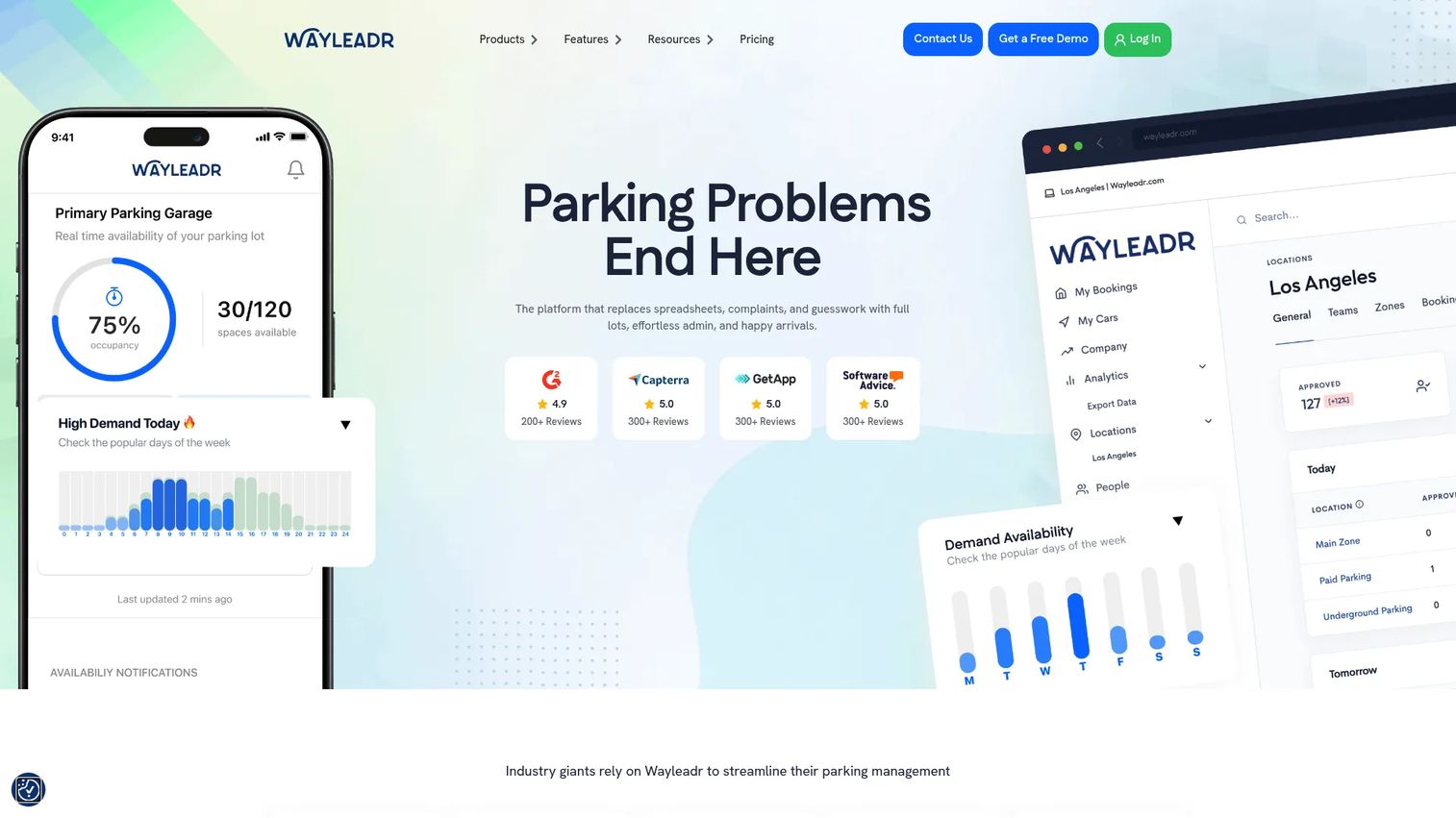
Wayleadr is workplace parking and arrival management software built for larger organizations. It handles parking allocation, visitor management, and EV charging across multiple sites, which is where enterprise parking gets complicated. AI-powered space allocation matches demand to supply automatically, so employees at a distributed company get fair access without a facilities manager arbitrating every request.
The platform treats parking as one part of workplace logistics, alongside arrival flows and charging rotation. That systems view fits enterprises managing parking as infrastructure, not a perk.
Best for: Enterprises and property teams managing parking, visitors, and EV charging across multiple sites.
Key strengths
- AI-powered space allocation
- Visitor management
- EV charging management and rotation
- Analytics across sites
Why choose Wayleadr: It suits distributed operations where parking is one piece of a wider workplace mobility problem. The AI allocation and EV charging features matter most at enterprise scale.
Wayleadr pricing: Wayleadr cost is quoted based on features, employee count, spaces, add-ons, and any hardware integrations, across its Flex, Work, and Home offerings.
Wayleadr holds a 4.9 out of 5 rating on G2.
7. ParkHub
ParkHub is parking management software and services for operators and venues, built around event-day throughput. Where office and residential tools optimize for steady allocation, ParkHub optimizes for spikes: a stadium, arena, or festival that fills a lot in an hour. Mobile point-of-sale, digital passes, and payment processing keep lines moving when volume peaks.
Business intelligence and real-time reporting sit on top, so venue teams can track revenue and utilization as an event unfolds rather than after it ends.
Best for: Event operators and venue teams where parking throughput drives the operation.
Key strengths
- Mobile point-of-sale for parking operations
- Business intelligence and real-time reporting
- Digital passes and payment processing
- Vehicle tracking for high-volume lots
Why choose ParkHub: It is the pick when event-day coordination and throughput matter more than office-style permit management. The mobile POS and reporting are built for high-traffic, time-boxed demand.
ParkHub pricing: ParkHub doesn't list its pricing online. Since every venue has different event volumes and needs, they work out costs directly with each client.
ParkHub does not have a verified G2 rating available at the time of writing.
Considerations
Before you shortlist, pressure-test each platform against how your parking actually runs.
Permits and approvals
Look closely at the permit workflow. Can residents or employees self-serve applications and renewals, or does every request still route to a person? Check whether eligibility rules auto-enforce, how guest passes work, and whether revocations propagate instantly. The whole point of a digital permit is removing the approval bottleneck, so confirm the system does that rather than digitizing the same manual loop.
Enforcement and LPR
If enforcement matters, test the accuracy of plate matching. License plate recognition is only useful if it reads plates reliably and flags mismatches against your permit list without a flood of false positives. Ask how the system handles exceptions, temporary permits, and disputes. Weak LPR creates more work than a patrol.
Reporting and analytics
Real-time reporting is the difference between reacting to complaints and planning ahead. Check for live occupancy dashboards, historical utilization trends, and clean export options. If you run multiple lots, confirm you can see them individually and in aggregate. Data you cannot export or segment is data you cannot act on.
Integrations and APIs
Parking software rarely lives alone. Confirm the platform connects to gates and access control, your payment gateway, building systems, and identity tools. Ask about API access if you plan custom workflows. A system that cannot integrate becomes another silo.
Multi-location scalability
One lot is a project. Ten lots is an operation. Check how the platform handles site-level rules, central reporting, and user permissions across locations. Enterprise parking needs both local control and a global view, so confirm the tool scales without forcing a separate instance per site.
Conclusion
The right car park software depends entirely on what breaks first in your operation.
If permits and enforcement are the pain, ParkingPass leads with LPR and digital approvals. If you need live occupancy tied to hardware, ParkHelp brings sensors and guidance. For workplace allocation, Parkable and Flex Parking both fit, with Flex Parking offering transparent per-park pricing and Parkable strong on fairness at portfolio scale. Tidaro wins when parking sits inside desk and room booking. Wayleadr handles enterprise parking across sites with AI allocation and EV charging. ParkHub is the event and venue specialist.
The next step is not a demo of all seven. Pick the two or three that map to your primary problem, then compare them against your current workflows and required integrations. Test the permit flow, the enforcement accuracy, and the reporting depth with your own data. That is where the real fit shows up, well before a contract does.
FAQs
The terms overlap, but they are not identical. "Parking software" can mean anything from a single booking widget to a payment app. "Parking management software" usually implies the full operational stack: permits, enforcement, occupancy management, payments, and reporting in one system. If a vendor only reserves spaces, it is a booking tool, not a management system.
License plate recognition, also called ANPR, uses cameras to read vehicle plates as they enter or sit in a lot. The system matches each plate against your permit or eligibility list and flags anything that does not belong. That supports enforcement (catching unauthorized vehicles) and access control (opening a gate for a recognized plate) without manual checks.
Good multi-location platforms do, but confirm the specifics. Look for central reporting that aggregates every site, site-level rules so each lot can enforce its own policies, and user permissions that scope access by location. Enterprise parking needs a global dashboard and local control at once. If a tool forces a separate setup per site, factor that into the cost.
The core stack is permits, occupancy management, parking payments, notifications, and reporting. Permits control who parks, occupancy shows how full you are, payments capture revenue, notifications keep users informed, and reporting turns all of it into decisions. Enforcement and LPR sit on top when compliance matters. Everything else is nice to have.
Yes, especially where spaces are limited. Allocation logic distributes scarce spots fairly, booking lets employees reserve and release, and visitor parking workflows handle guests without a front-desk scramble. Tools like Parkable, Flex Parking, Tidaro, and Wayleadr are built for exactly these environments, with Tidaro extending into desk and room booking.
Parking software pricing splits into public and quote-based. Transparent vendors like Flex Parking (from $5 per park per month) and Tidaro (from €15 per month) publish rates. Others price per community or per deployment, which suits variable setups but means you cannot compare on a spec sheet. When evaluating, look past entry price to implementation fees, per-site or per-seat billing, and add-ons like hardware or LPR.
It should replace most of the manual admin, especially approvals and renewals. A digital permit system lets users apply and renew through self-service, auto-checks eligibility, and issues permits without someone retyping data. Paper permits and email approvals disappear. The goal is removing the approval bottleneck entirely, not moving the same clipboard workflow onto a screen.