If you are comparing Apty alternatives, the trigger is usually specific: Reps are not learning CRM workflows fast enough, adoption of a newly rolled-out tool is stalling, or the training content your team built six months ago no longer reflects how the product works. The global digital adoption platform market reached $792.3 million in 2025 and is projected to hit $3.5 billion by 2032 (Research and Markets, 2026), which means more vendors, more categories, and more noise to cut through.
This list covers three distinct categories: Interactive guide platforms, enterprise digital adoption platforms (DAPs), and product-led SaaS onboarding tools. Guideflow is the top pick for teams that need fast internal training guides, employee onboarding, and SOPs. Enterprise DAP buyers should compare Lemon Learning, WalkMe, Whatfix, Userlane, Knowmore, and K-NOW. Teams focused on SAP or Oracle deployments should evaluate SAP Enable Now and Oracle Guided Learning. Product-led SaaS onboarding belongs with Pendo, Appcues, UserGuiding, Userpilot, and Gainsight PX.
TL;DR
- Best for internal training guides and SOPs: Guideflow lets enablement teams record software once and share interactive demos employees follow at their own pace. Free plan available; paid plans from $35/user/month.
- Best enterprise DAP programs: WalkMe (4.6/5 on G2) and Whatfix (4.6/5) are the strongest enterprise-grade digital adoption choices, both quote-only.
- Best for European enterprise enablement: Lemon Learning offers a heavily supported DAP rollout with quote-based application or corporate licences.
- Best for SaaS customer onboarding: Appcues (4.6/5), Userpilot (4.6/5), and UserGuiding (4.7/5) are built for product-led onboarding, not employee software adoption.
- Best for product usage analytics: Pendo (4.6/5) combines product analytics with in-app messaging for customer-facing adoption.
- Pricing reality: Enterprise DAP vendors price by quote; product adoption tools publish entry tiers. Appcues starts from $9,000/year; UserGuiding from $249/month; Userpilot from $299/month.
What's inside
- Why teams compare Apty alternatives
- How digital adoption platforms, interactive guide platforms, and product onboarding tools differ
- A 14-tool comparison table with category labels, ratings, and pricing
- Ranked cards for each alternative
- Use-case routing by job type
- FAQs for Sales Enablement Managers comparing Apty competitors
What is Apty?
Apty is an AI-powered digital adoption platform used for improving work execution inside enterprise applications. Its core job is in-app guidance: Contextual tooltips, guided workflows, real-time validations, and adoption analytics layered on top of live business systems like CRM, ERP, HCM, and ITSM platforms. Teams use it to onboard employees to new software, enforce process compliance, and measure how well adoption is tracking across applications.
Apty earns a 4.7/5 on G2 and positions itself primarily around enterprise application adoption rather than SaaS customer onboarding. Its strengths include cross-application guidance, workflow automation, and usage visibility.
Why teams look for Apty alternatives
Teams typically compare Apty alternatives when the job shifts, the budget changes, or the internal skillset available to manage the tool does not match what the platform requires.
Internal training needs outgrow the platform
Sales Enablement Managers often need interactive guides for rep onboarding, CRM hygiene workflows, quoting procedures, and launch enablement. A full enterprise DAP with deep system integration may exceed what those jobs require. Teams end up paying for governance infrastructure they do not use while still struggling to get guides built and updated quickly.
Content maintenance becomes the hidden cost
WalkMe's State of Digital Adoption (2025) found that employees waste an average of 36 working days per year on technology frustrations, partly because training assets go stale faster than teams can update them. Any platform that requires dedicated admin time per guide update creates an ongoing maintenance burden. G2 reviewers of several enterprise DAPs describe update cycles that slow down when product releases hit.
Fit for the specific application stack varies
Buyers with Oracle or SAP as their primary system of record often find that embedded tools built for those ecosystems outperform generic DAPs on those applications. Teams without those constraints may be over-investing in application-specific features.
Employee adoption and customer adoption are different jobs
An enterprise DAP runs guidance inside live business applications for internal employees. A product onboarding tool runs in-app messages inside a SaaS product for external customers. Mixing those two jobs into one procurement decision usually means one use case wins and the other gets underfunded.
Pricing models drive the shortlist
Enterprise DAPs from WalkMe, Whatfix, Lemon Learning, Userlane, Knowmore, and K-NOW all price by quote, with costs influenced by number of applications, user count, implementation support, and governance tier. Product adoption tools like Appcues, UserGuiding, and Userpilot publish starting prices based on monthly active users. The two models serve different budget conversations.
How we picked these Apty alternatives
Each tool was evaluated for relevance to Apty's replacement or supplementation, fit for internal training, employee onboarding, software adoption, or product onboarding, category clarity, pricing model, and review presence on G2 or Capterra. Pricing was drawn from each vendor's own pricing page. G2 ratings reflect current headline figures. The list spans three categories, labeled throughout so Sales Enablement Managers can tell an enterprise DAP swap from an interactive guide platform from a product-led SaaS onboarding tool.
Apty alternatives at a glance
Guideflow is the strongest Apty alternative for teams that need fast internal training guides, SOPs, and employee onboarding. Enterprise DAP programs should compare WalkMe, Whatfix, Lemon Learning, and Userlane. SAP and Oracle deployments have dedicated embedded tools. Product-led SaaS onboarding teams should look at Appcues, UserGuiding, Userpilot, Pendo, and Gainsight PX.
| # | Tool | Category | Best for | G2 rating | Free plan | Starting price |
|---|---|---|---|---|---|---|
| 1 | Guideflow | Interactive guide platform | Internal training, SOPs, employee onboarding | 5.0 | Yes | $35/user/month (annual) |
| 2 | Lemon Learning | Digital adoption platform | Enterprise software training, supported rollout | 4.8 | No | Custom pricing |
| 3 | WalkMe | Enterprise digital adoption platform | Large enterprise DAP programs | 4.6 | No | Custom pricing |
| 4 | Whatfix | Digital adoption platform | Enterprise adoption, simulation, process guidance | 4.6 | No | Custom pricing |
| 5 | Userlane | Digital adoption platform | Employee adoption, enterprise application guidance | 4.7 | No | Custom pricing |
| 6 | Pendo | Product experience platform | Product analytics and in-app product adoption | 4.6 | Yes (up to 500 MAU) | Custom pricing |
| 7 | Appcues | Product onboarding platform | SaaS user onboarding and in-app messaging | 4.6 | No | From $9,000/year |
| 8 | UserGuiding | Product adoption platform | No-code SaaS onboarding flows | 4.7 | No | From $249/month |
| 9 | SAP Enable Now | Enterprise application training platform | SAP-centered training and enablement | 4.3 | No | Custom pricing |
| 10 | Oracle Guided Learning | Enterprise application guidance | Oracle application adoption | 4.7 | No | Included with Oracle Fusion Cloud; Premium by quote |
| 11 | Knowmore | Digital adoption platform | Process guidance, enterprise software support | 5.0 | No | Custom pricing |
| 12 | K-NOW | Digital adoption platform | Enterprise application performance support | 4.6 | No | Custom pricing |
| 13 | Userpilot | Product growth platform | SaaS onboarding and product adoption experiments | 4.6 | No | From $299/month |
| 14 | Gainsight PX | Product experience platform | Product usage analytics and customer success signals | 4.4 | No | Custom pricing |
The best Apty alternatives in 2026
1. Guideflow (interactive guide platform)
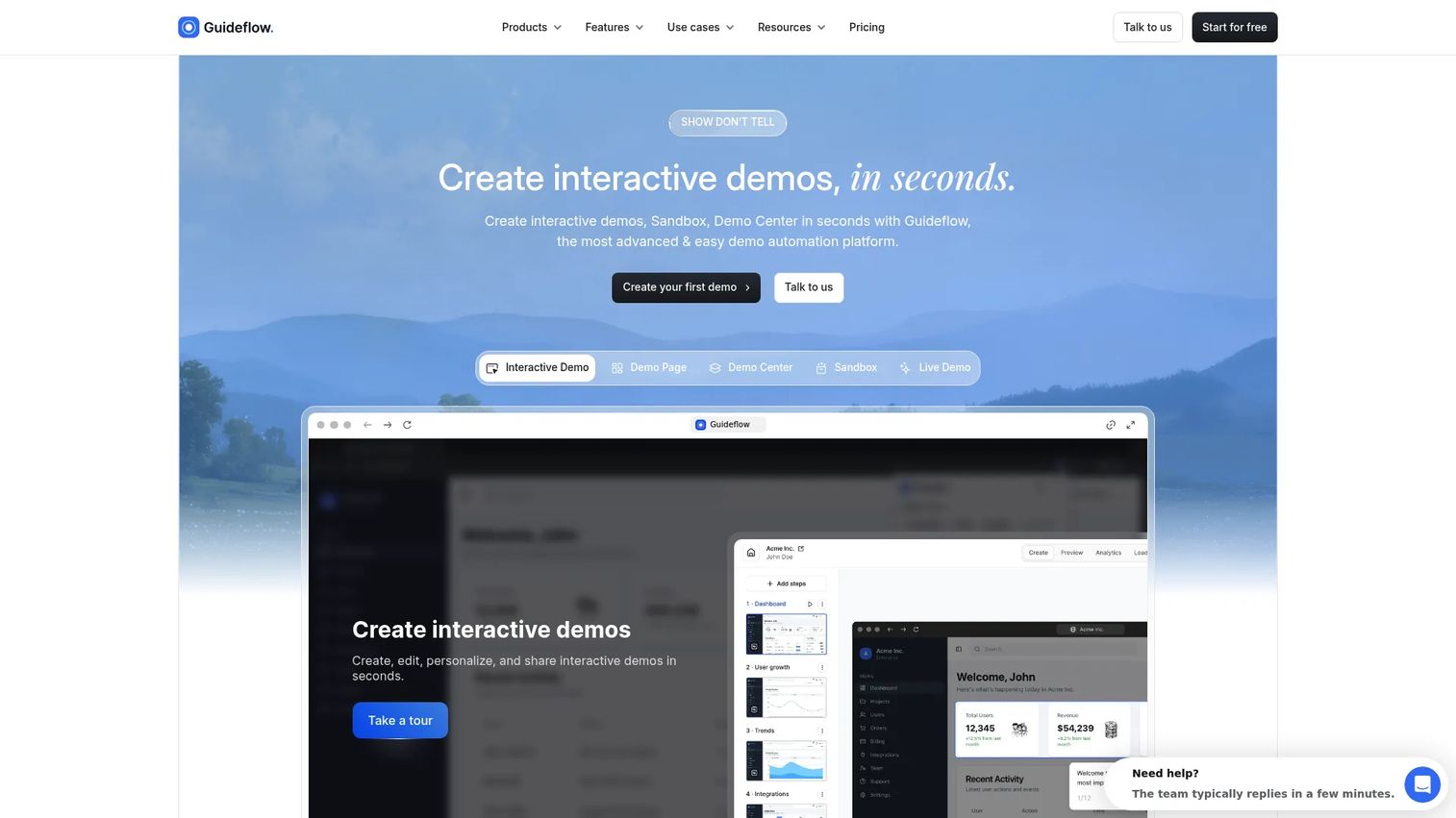
Guideflow is a demo automation platform that lets enablement and operations teams record software once and share interactive demos employees follow step by step. For Sales Enablement Managers, the primary use case is building reusable internal guides: CRM onboarding, opportunity workflow training, quoting procedures, launch enablement, and SOPs that employees can follow independently without booking a live training session.
Best for: Sales enablement, RevOps, L&D, and operations teams that need fast internal interactive demos without engineering involvement.
What it is: Guideflow is a demo automation platform with six formats: Interactive demos, demo pages, demo centers, sandboxes, live demos, and mobile demos. For internal enablement, the focus is on interactive demos used as step-by-step software guides for onboarding and process documentation.
Key features:
- Capture through the Chrome extension or the native app, with screenshot, HTML, and video modes
- Step content and CTAs written automatically after capture
- Editor for text, images, graphs, and branching logic
- Translation into more than 30 languages
- Step-level completion, drop-off, and viewer flow analytics
- Integrations with HubSpot, Salesforce, Pipedrive, Zoho, and Marketo
Where Guideflow falls short: Look elsewhere if your primary requirement is a full enterprise DAP that overlays guidance inside live business applications across dozens of enterprise systems. Teams whose main job is product usage analytics across an existing customer base will also want a dedicated tool. Guideflow performs best when the team can commit to structured, reusable interactive demos rather than ad-hoc one-off recordings.
Pricing: Free plan available. Solo is $35/user/month (annual). Growth is $499/month (annual). Advanced is $1,499/month (annual). Enterprise starts from $2,999/month (annual) and adds SSO, advanced governance, and enterprise security.
G2 rating: 5.0
How it compares to Apty: Guideflow is the stronger choice when the job is fast interactive demo creation for internal training, SOPs, and self-serve learning assets. Apty fits teams that need live in-app guidance overlaid inside running enterprise applications.
2. Lemon Learning (digital adoption platform)
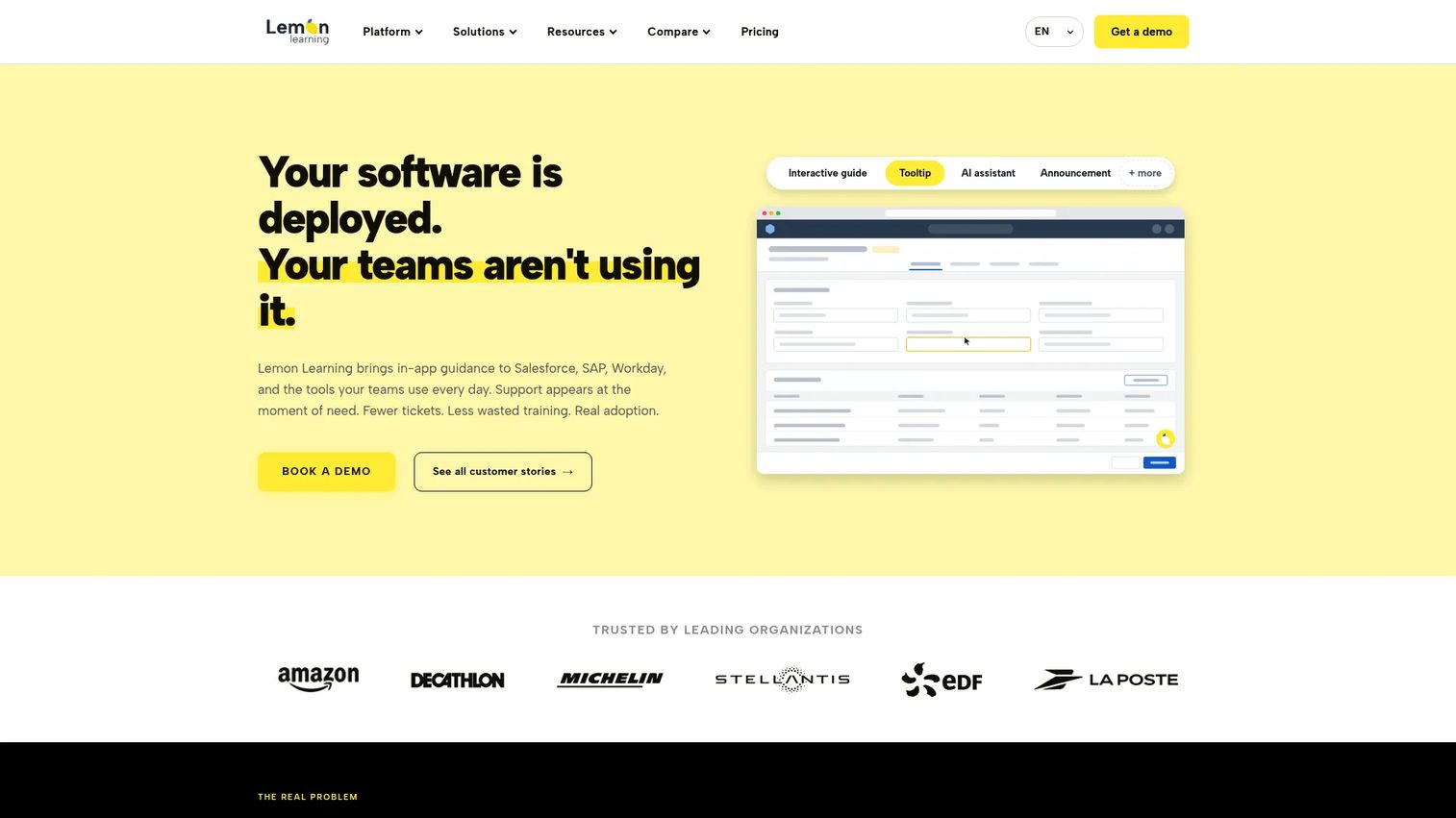
Lemon Learning positions itself as a supported enterprise DAP rollout, particularly for European organizations or those with governance and multilingual requirements. Where Apty focuses on workflow compliance and cross-application analytics, Lemon Learning emphasizes implementation partnership alongside the platform.
Best for: Enterprises seeking a heavily supported DAP deployment with multilingual guidance, especially across European markets or regulated environments.
What it is: A digital adoption platform for in-app guidance, adoption analytics, employee onboarding, and enterprise application enablement. All platform features are included in both licence tiers. Implementation is a paid service included in the quote.
Key features:
- No-code interactive guide creation
- Contextual tooltips, announcements, and resource center
- Adoption analytics with usage, journeys, and drop-off tracking
- User segmentation and localization support
- AI guide creator and AI assistant
Where Lemon Learning falls short: Lemon Learning does not publish numeric pricing, so buyers must go through a sales process to get costs. Its Capterra profile shows 4.6/5 based on a small review sample. Teams that want to self-serve a trial or evaluate without a sales conversation will not find that option here.
Pricing: Quote-based. Two models: Application licence (priced by application type and user count) and Corporate licence (unlimited applications, priced by total user count). No free trial.
G2:4.8
How it compares to Apty: A close comparison for buyers who prioritize a supported European DAP rollout over self-managed deployment. Teams that want to build guides independently without an implementation engagement may find Lemon Learning's model heavier than needed.
3. WalkMe (enterprise digital adoption platform)
WalkMe is one of the most recognized names in enterprise DAP and acquired by SAP in 2024, which now connects it to SAP's broader enterprise application ecosystem. For large organizations running complex multi-application environments, it carries strong governance and automation capabilities.
Best for: Global enterprises that need mature DAP infrastructure across many applications, with behavioral segmentation, workflow automation, and cross-system analytics.
What it is: A cloud-based digital adoption platform for in-application guidance, workflow automation, analytics, and contextual AI assistance. Supports web, desktop, and mobile deployment. G2 rating: 4.6/5.
Key features:
- In-app guidance and interactive walkthroughs
- Workflow automation and personalized onboarding sequences
- Application, workflow, and form analytics
- AI-powered content authoring and contextual assistance
- Behavioral segmentation and targeted communications
Where WalkMe falls short: G2 reviewers note that WalkMe requires dedicated admin expertise to set up and maintain, with some describing a steep implementation curve. Pricing is fully quote-based with no published tiers, making budget planning difficult upfront. Teams without internal WalkMe expertise often need professional services to get value.
Pricing: Quote-based only.
G2 rating: 4.6
How it compares to Apty: WalkMe and Apty overlap significantly on enterprise DAP features. WalkMe may have an advantage for SAP-centric stacks given the SAP acquisition. Apty may fit teams that want a DAP with stronger workflow compliance focus outside the SAP ecosystem.
4. Whatfix (digital adoption platform)
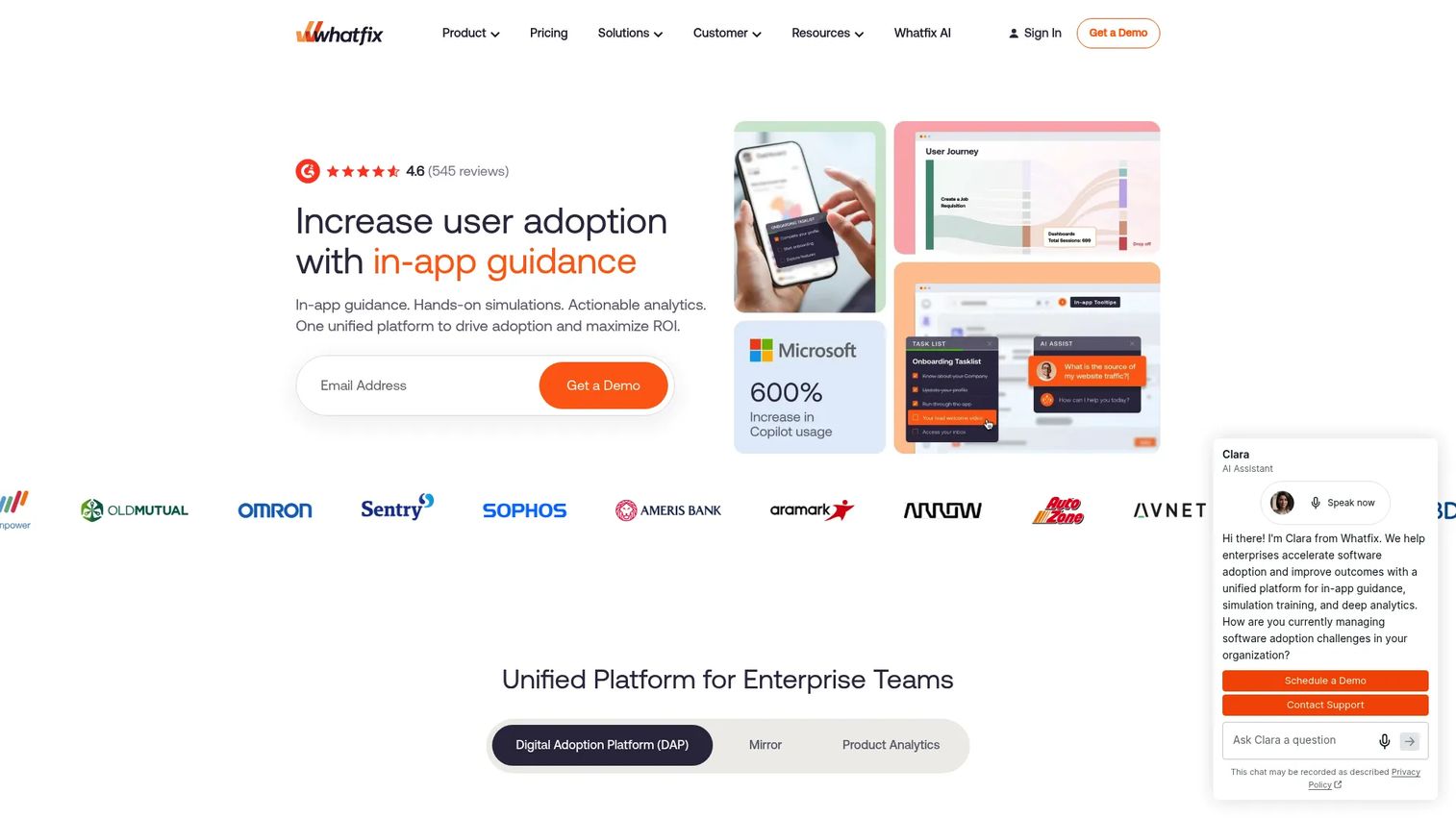
Whatfix earns a 4.6/5 on G2 and covers a similar footprint to Apty: In-app flows, simulations, analytics, and enterprise process guidance. Its content lifecycle management tools, including approvals, QA, version control, and rollback, stand out for enablement teams managing governance across large asset libraries.
Best for: Enterprises that need digital adoption, embedded simulations, structured content governance, and process guidance across multiple enterprise applications.
What it is: An AI-powered digital adoption platform for in-app guidance, self-service support, simulations, analytics, and enterprise process enablement. Supports web, desktop, mobile, and virtual desktop applications.
Key features:
- In-app Flows, Smart Tips, Pop-Ups, and Task Lists
- Application simulations and AI roleplay for training without live environments
- Guidance and workflow analytics
- Content lifecycle management with approvals, version control, and rollback
- Support for virtual desktop and legacy application deployment
Where Whatfix falls short: G2 reviewers mention that pricing is complex and that advanced features can require significant implementation effort. Some report that the editor experience has a learning curve, particularly for non-technical content creators. Pricing is entirely custom, with no published tiers.
Pricing: Flat per-application fee plus user license fees. Custom pricing across Standard, Premium, and Enterprise tiers.
G2 rating: 4.6
How it compares to Apty: Whatfix is a strong direct comparison for buyers evaluating enterprise DAP options. Its simulation capability and content governance tools give it an edge for teams that need training in environments where live application access is restricted.
5. Userlane (digital adoption platform)
Userlane's differentiator is its HEART Score framework for measuring adoption, compliance, and task success across business applications, which gives IT and enablement teams a structured way to report adoption progress to leadership.
Best for: Mid-market and enterprise teams that need measurable employee adoption of web-based business applications, with structured reporting on adoption health.
What it is: An enterprise software adoption platform combining application intelligence with contextual, in-app guidance. Offers Application, Department, and Organization pricing tiers, all contact-sales. G2 rating: 4.7/5.
Key features:
- HEART Score for adoption, compliance, and task success measurement
- Application discovery and portfolio overview
- Interactive in-app guidance via the Userlane Assistant
- Validators to prevent incorrect data entry
- Contextual actions, announcements, and tooltips
Where Userlane falls short: G2 reviewers note limited customization options for guide styling and that integrations outside core enterprise systems can require extra setup. No free trial is published, and all pricing requires a sales conversation.
Pricing: Application, Department, and Organization tiers, all contact sales.
G2 rating: 4.7
How it compares to Apty: Userlane prioritizes adoption measurement and reporting alongside guidance, which suits teams that need to defend adoption ROI to leadership. Apty emphasizes workflow compliance and cross-application automation.
6. Pendo (product experience platform)
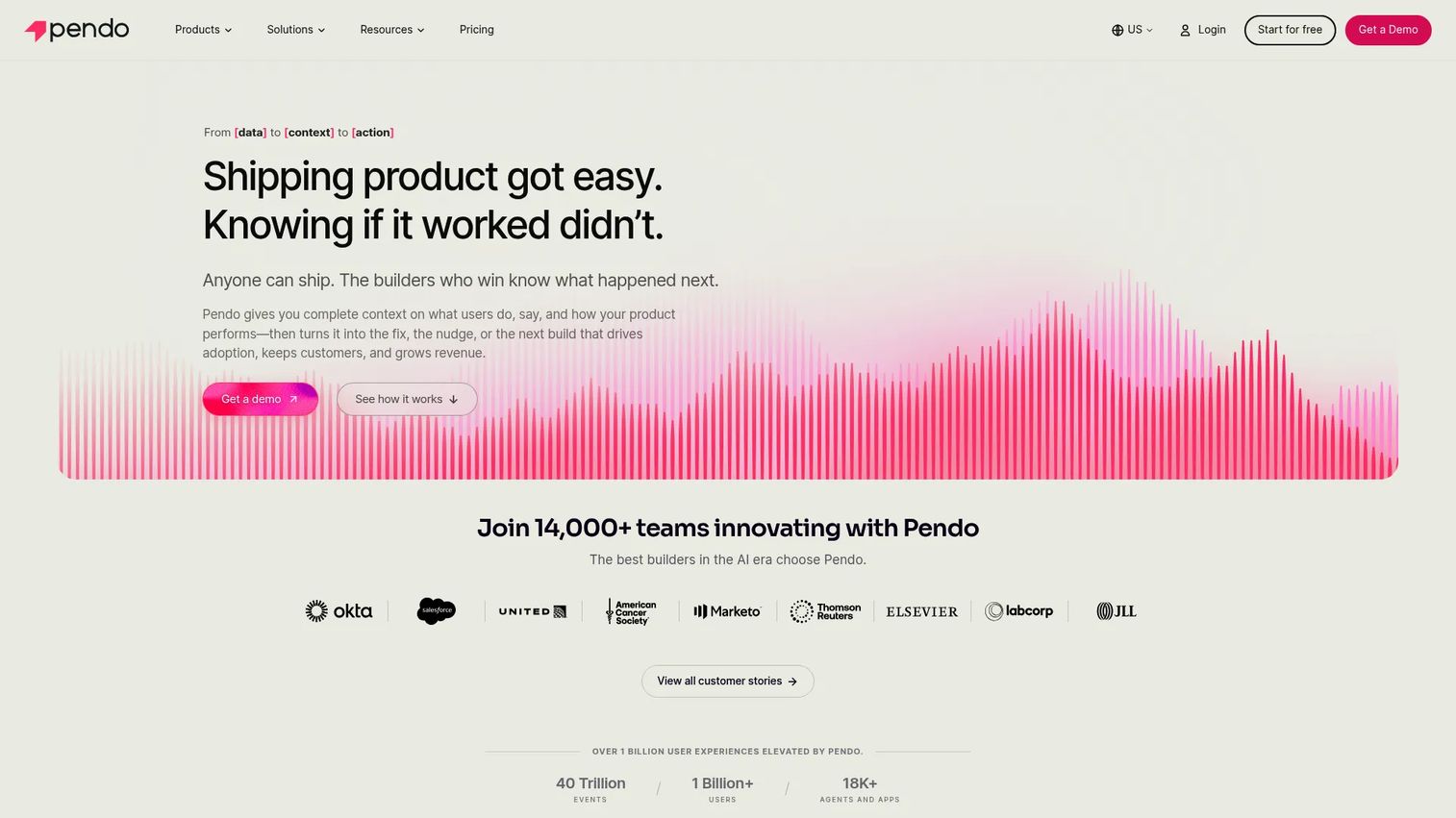
Pendo's core strength is product analytics, not employee software adoption. It measures how external users navigate a SaaS product, then layers in-app guides and feedback tools on top of those insights.
Best for: SaaS product, growth, and customer success teams that need product usage analytics plus in-app messaging for customer-facing onboarding.
What it is: A software experience management platform for analyzing product usage, guiding users in-app, and collecting customer feedback. Combines analytics, session replay, NPS surveys, and in-app guides in one platform.
Key features:
- Product analytics and usage reporting
- In-app guides and segmented messaging
- Session replay
- NPS and survey tools
- Journey orchestration and roadmap features
Where Pendo falls short: G2 reviewers describe implementation complexity and a data setup workload that can delay time to value. Paid plans require contacting sales with pricing based on monthly active users and selected functionality. Some reviewers note that advanced features require significant configuration.
Pricing: Free plan available for up to 500 monthly active users. Paid Base, Core, and Ultimate plans require contacting sales for pricing based on MAU volume.
G2 rating: 4.6
How it compares to Apty: Pendo is a different category. It suits customer-facing product adoption and analytics. Apty fits employee software adoption inside internal enterprise applications. Teams comparing the two are likely solving different problems.
7. Appcues (product onboarding platform)
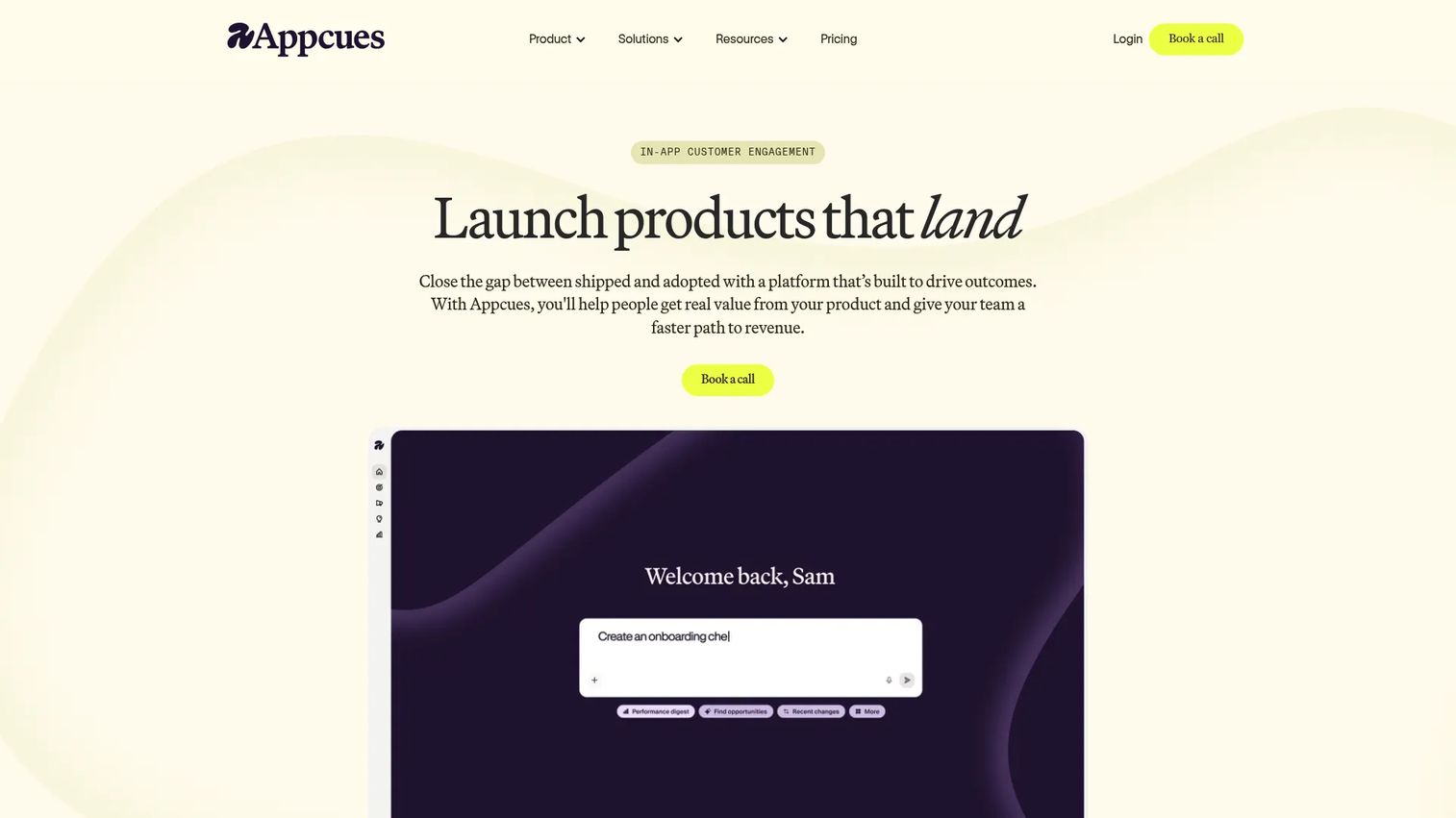
Appcues publishes pricing transparently, which makes it easier to budget than most DAP alternatives. The Grow plan starts at $9,000/year and supports up to 50,000 monthly active users with 25 published experiences.
Best for: SaaS product and growth teams that want targeted customer onboarding flows, feature announcements, and in-app engagement without ongoing engineering work.
What it is: A product onboarding platform for creating in-app modals, tooltips, checklists, slideouts, banners, NPS surveys, and embeds. Built for external customer onboarding inside a SaaS product.
Key features:
- In-product flows, checklists, and launchpads
- Audience targeting by user attributes, behavior, and segment
- Product analytics with funnels, retention, and campaign objectives
- NPS and survey tools
- A/B testing for onboarding experiences
Where Appcues falls short: Appcues does not offer a free plan. The Grow plan starts at $9,000/year, which is a significant commitment for smaller teams. G2 reviewers note that mobile support and advanced analytics depth are areas where the platform lags behind competitors.
Pricing: Grow plan from $9,000/year (annual, up to 50,000 MAU). Enterprise pricing is custom. A free trial is available.
G2 rating: 4.6
How it compares to Apty: Appcues is built for SaaS customer onboarding, not employee software adoption. Teams comparing both are evaluating different categories. Appcues wins when the goal is in-product customer activation; Apty wins when the goal is internal enterprise application adoption.
8. UserGuiding (product adoption platform)
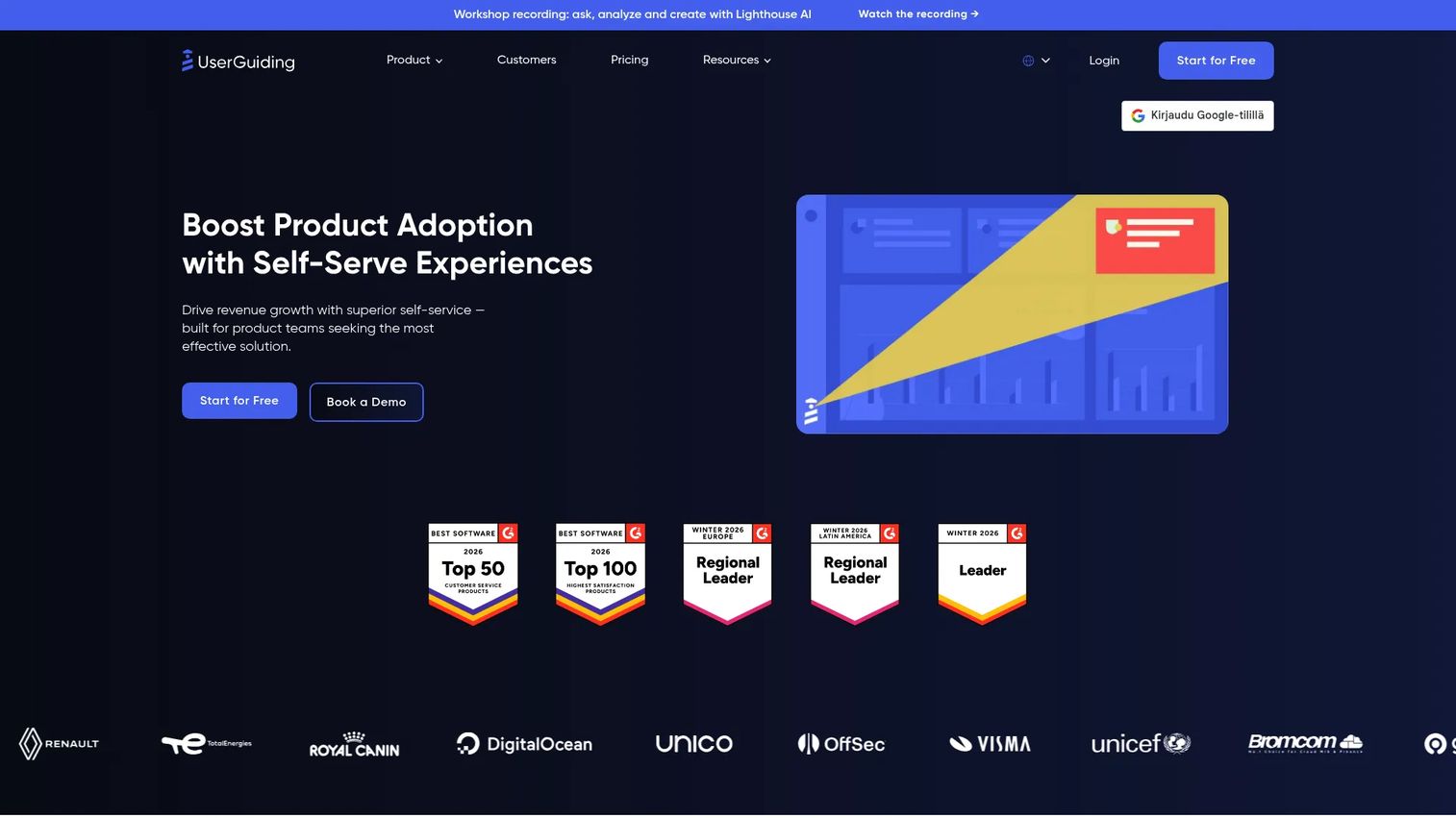
UserGuiding publishes clear monthly pricing and offers a 14-day free trial, which removes most of the friction from getting started. Its no-code builder suits small and mid-sized SaaS teams that need customer onboarding without engineering resources.
Best for: Small and mid-sized SaaS teams that need no-code customer onboarding flows, resource centers, and in-app product adoption without developer involvement.
What it is: A no-code product adoption platform for onboarding flows, checklists, in-app surveys, NPS, resource centers, session replay, and product updates. G2 rating: 4.7/5.
Key features:
- Product guides, hotspots, and tooltips
- Onboarding checklists and in-app surveys
- Knowledge base and resource centers
- Segmentation and analytics
- Session replay and AI assistant
Where UserGuiding falls short: G2 reviewers note design and styling customization limits and that analytics depth is lighter than dedicated product analytics tools. The platform is built for SaaS customer onboarding, so teams with complex enterprise application adoption needs will reach its ceiling quickly.
Pricing: Starter plan from $249/month. Growth plan from $499/month. Enterprise pricing by quote. No free plan; a 14-day free trial is available.
G2 rating: 4.7
How it compares to Apty: UserGuiding fits SaaS customer onboarding and product adoption. Apty fits internal enterprise application adoption. The audience each tool is designed for does not overlap.
9. SAP Enable Now (enterprise application training platform)
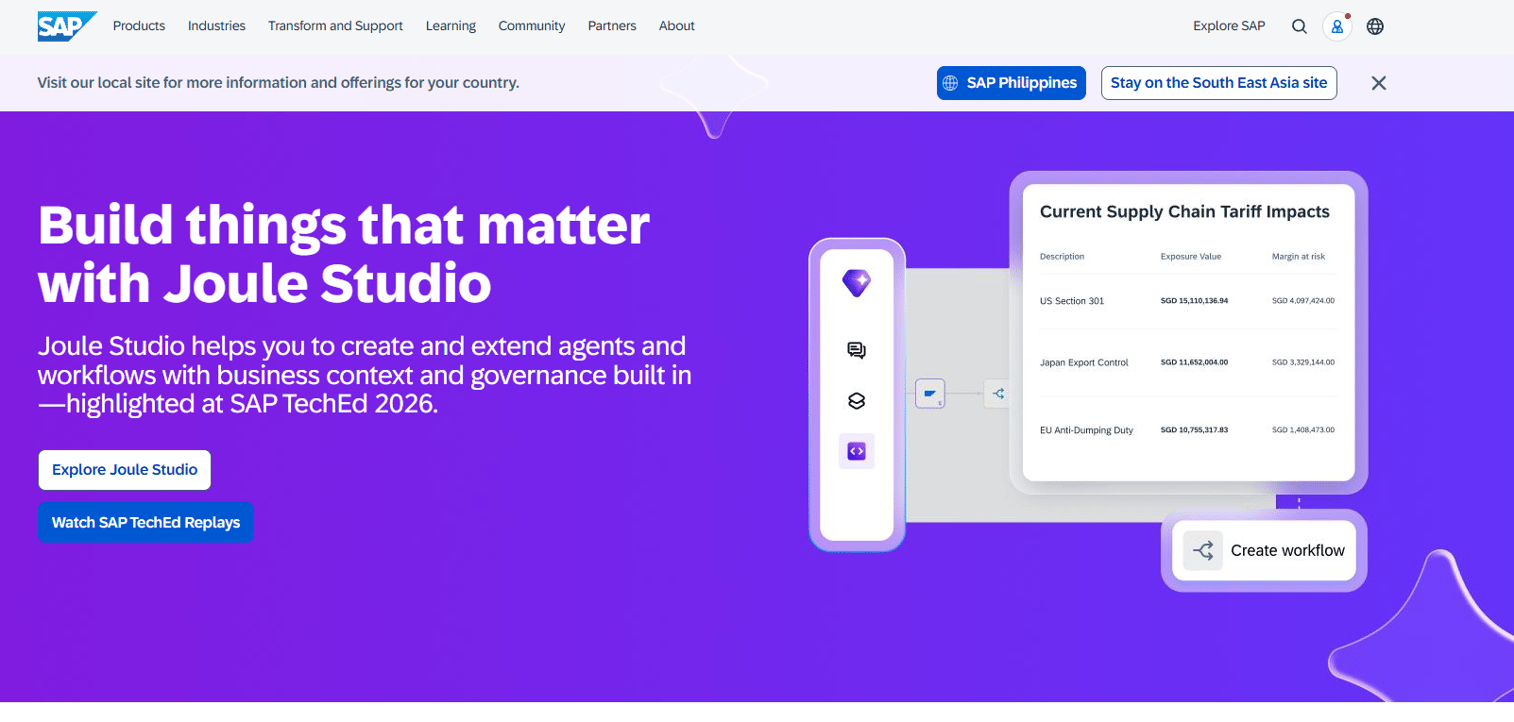
SAP Enable Now is a training and documentation creation tool built specifically for SAP application users. Important context: SAP has stated that SAP Enable Now is transitioning to WalkMe and that the product's final release is 2503. Teams evaluating it today should factor that migration roadmap into the decision.
Best for: Organizations already using SAP applications that need structured training, role-based guidance, and documentation creation within the SAP ecosystem.
What it is: A digital enablement solution for creating interactive e-learning, guided tutorials, documentation, and role-based user guidance. Integrates with SAP Signavio and SAP Cloud ALM.
Key features:
- Interactive e-learning and guided tutorial creation
- Integration with SAP Signavio and SAP Cloud ALM
- Content management with versioning, localization, templates, and reporting
- Role-based user guidance
Where SAP Enable Now falls short: G2 reviewers note that the platform is tightly scoped to SAP environments and lacks flexibility for non-SAP applications. SAP's own product roadmap signals a migration to WalkMe, which creates continuity risk for teams committing to new SAP Enable Now deployments now.
Pricing: Contact SAP sales for current terms.
G2 rating: 4.3
How it compares to Apty: SAP Enable Now is the stronger choice when SAP applications are the primary training environment. Apty covers a broader cross-application footprint. Given the SAP Enable Now end-of-life signal, teams with long planning horizons may evaluate WalkMe directly.
10. Oracle Guided Learning (enterprise application guidance)
Oracle Guided Learning is included with Oracle Fusion Cloud Applications at no additional cost, which makes the entry point different from every other tool on this list. Teams running Oracle Cloud ERP, HCM, or SCM can access in-application guidance without a separate procurement process.
Best for: Enterprises using Oracle Cloud applications that need embedded, role-based contextual guidance for Oracle workflows.
What it is: A digital adoption platform delivering in-application process guides, tours, simulations, Smart Tips, beacons, and adoption analytics across Oracle Cloud applications.
Key features:
- In-application process guides, simulations, and step-by-step guides
- Contextual Smart Tips, beacons, banners, and personalized launchers
- In-app messaging, surveys, and feedback collection
- Adoption analytics
Where Oracle Guided Learning falls short: G2 reviewers note that the platform's value is tightly tied to Oracle applications and that extending guidance to non-Oracle systems requires separate tooling. The Premium tier is fee-based and priced per pillar, with no published numeric price.
Pricing: Included with Oracle Fusion Cloud Applications at no additional cost. Premium tier is a fee-based service priced by pillar; contact Oracle for terms.
G2 rating: 4.7
How it compares to Apty: Oracle Guided Learning is the logical choice when the adoption problem lives primarily inside Oracle applications. Apty covers a broader range of enterprise applications but requires separate procurement where Oracle Guided Learning may already be available.
11. Knowmore (digital adoption platform)
Knowmore is a European-headquartered DAP covering ERP, CRM, HRIS, PLM, and SaaS applications. Its suite includes K-NOW (contextual in-app guidance) alongside training simulation and adoption analytics, so it bundles two related capabilities under one vendor.
Best for: Large organizations that need contextual step-by-step guidance inside business applications, combined with simulation-based training and real-time adoption reporting.
What it is: A digital adoption suite providing contextual guidance inside business applications, no-code guide creation, interactive simulations, and adoption analytics with customizable dashboards. G2 reports a 5.0/5 rating from a small review base.
Key features:
- Contextual step-by-step guidance inside applications
- No-code guide and simulation creation
- Digital adoption analytics with real-time KPIs
- Customizable dashboards and adoption reporting
Where Knowmore falls short: Knowmore has a limited public review footprint on G2, which makes it harder to evaluate at scale. No pricing page or public figures are available; buyers must contact sales. The small review base means less peer-sourced validation than larger platforms on this list.
Pricing: Contact Knowmore sales.
G2 rating: 5.0
How it compares to Apty: Knowmore sits in the same enterprise application adoption family as Apty. Its European base and combined simulation plus contextual guidance offering may appeal to organizations with European headquarters or strong SAP and ERP footprints.
12. K-NOW (digital adoption platform)
K-NOW is the contextual in-app guidance product within the Knowmore portfolio. It focuses on targeted messages by profile, job, or region alongside step-by-step in-application assistance, making it the more lightweight of the two Knowmore offerings.
Best for: Organizations that need targeted, profile-based in-app assistance and step-by-step guidance for enterprise application users.
What it is: A digital adoption platform providing contextual guidance, targeted in-app messages, no-code guide creation, usage dashboards, tracking, and feedback collection for business applications.
Key features:
- Contextual step-by-step guidance
- Targeted messages by profile, job, or region
- No-code guide creation and publishing
- Built-in business information and resource delivery
- Usage dashboards, tracking, and feedback
Where K-NOW falls short: K-NOW has no confirmed G2 rating, and limited public review data makes independent peer validation difficult. Pricing is fully quote-based with no public figures. Its market presence is smaller than Apty, WalkMe, or Whatfix.
Pricing: Contact Knowmore sales.
G2: 4.6
How it compares to Apty: K-NOW fits teams where the guidance need is profile-specific and the organization already works within the Knowmore ecosystem. Apty has broader market presence and a larger review base. Teams outside existing Knowmore relationships should weight that difference.
13. Userpilot (product growth platform)
Userpilot publishes pricing by MAU tier, which makes it one of the more budget-transparent options in the product adoption category. Its Starter plan at $299/month covers up to 2,000 monthly active users with a 14-day free trial.
Best for: Product-led SaaS teams that need in-app onboarding, feature discovery, user segmentation, and product analytics in one platform.
What it is: A no-code product growth and analytics platform for in-app onboarding flows, feature adoption, user feedback, session replay, workflows, and email engagement. G2 rating: 4.6/5.
Key features:
- In-app onboarding and feature adoption flows
- Product analytics and funnel reporting
- User feedback and NPS surveys
- Session replay
- Mobile engagement and AI agent analytics
Where Userpilot falls short: G2 reviewers note that the platform is focused on SaaS customer-facing onboarding and that internal employee software adoption is outside its design intent. Some reviewers describe analytics customization limits at lower tiers. No permanent free plan is available.
Pricing: Starter from $299/month (up to 2,000 MAU). Growth from $849/month. Enterprise by custom pricing. 14-day free trial available.
G2 rating: 4.6
How it compares to Apty: Userpilot is built for external SaaS user onboarding and product-led growth, not internal employee software adoption. Teams evaluating both are likely solving different problems.
14. Gainsight PX (product experience platform)
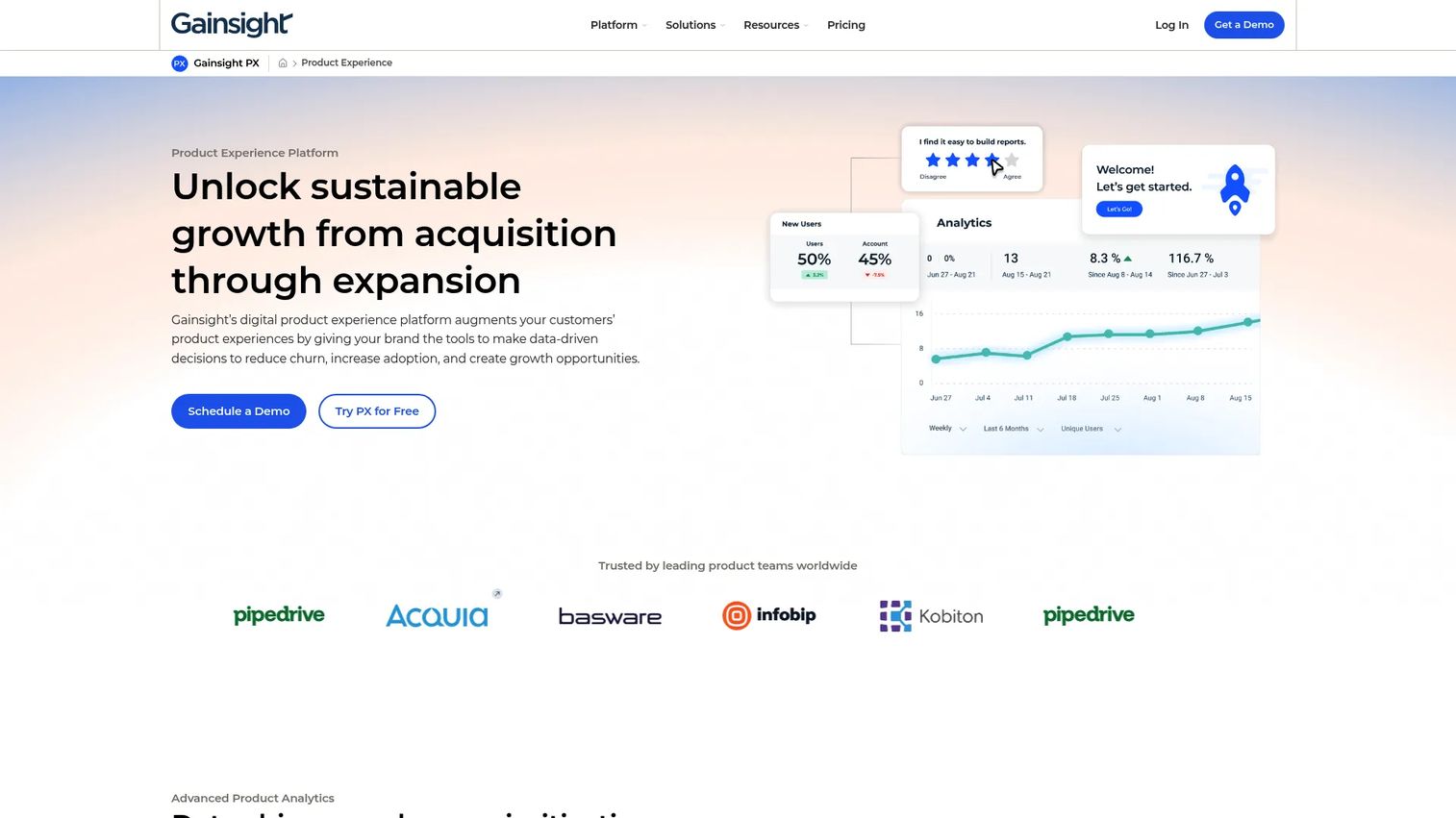
Gainsight PX connects product usage behavior to customer success workflows, which makes it valuable for SaaS organizations where the CS team needs to act on adoption signals. The PX Essentials tier includes analytics, in-app guides, and a Knowledge Center bot; Enterprise adds localization, advanced integrations, and expanded security.
Best for: SaaS product teams that need to connect product usage analytics with customer success signals for adoption, expansion, and churn prevention.
What it is: A product analytics and in-app engagement platform for understanding user behavior, driving adoption, and collecting feedback. G2 rating: 4.4/5.
Key features:
- Product usage analytics and reporting
- Personalized in-app onboarding guides and self-service assistance
- In-product surveys and feedback collection
- Knowledge Center bot
Where Gainsight PX falls short: G2 reviewers note implementation complexity and that the platform requires meaningful setup to get analytics working accurately. No public numeric pricing is available for either tier. Gainsight PX is focused on external SaaS adoption, not internal enterprise employee training.
Pricing: PX Essentials and PX Enterprise tiers. No public numeric pricing; contact Gainsight for terms.
G2 rating: 4.4
How it compares to Apty: Gainsight PX targets customer-facing product adoption and CS alignment. Apty targets internal enterprise application adoption. The two tools rarely compete for the same budget.
Which Apty alternative is best for internal training?
Guideflow is the top pick for internal training. Enablement teams record software flows once and share interactive demos employees follow independently, covering CRM onboarding, sales process SOPs, quoting workflows, and launch enablement. For teams where the adoption problem is specifically tied to SAP applications, SAP Enable Now remains relevant despite its migration roadmap. Oracle Guided Learning handles Oracle-specific training without additional procurement when Oracle Fusion Cloud is already in use. Lemon Learning suits teams that want a supported rollout with multilingual internal training across a range of enterprise applications.
What is the best Apty alternative for enterprise digital adoption?
WalkMe and Whatfix lead for enterprise DAP programs. Both carry 4.6/5 on G2 and cover cross-application governance, analytics, and content lifecycle management. Lemon Learning is a strong pick for European organizations or buyers who want a heavily supported implementation. Userlane's HEART Score framework suits teams that need structured adoption reporting. Knowmore and K-NOW fit organizations already working within European enterprise DAP ecosystems. Guideflow fits enablement teams that need fast interactive demos for internal training, not a full enterprise DAP program.
Which Apty competitor is best for product-led SaaS onboarding?
Appcues, UserGuiding, Userpilot, Pendo, and Gainsight PX are the right choices here. These tools are built for external customer-facing onboarding inside a SaaS product. Pendo leads on product analytics depth. Appcues and Userpilot suit teams that need structured in-app flows with MAU-based pricing. UserGuiding fits smaller teams that want no-code onboarding with a lower entry price. None of these tools are designed for internal employee software adoption, which is Apty's core category.
Which Apty alternative has the clearest pricing?
Product-led onboarding tools publish the clearest pricing. UserGuiding starts at $249/month. Userpilot starts at $299/month. Appcues starts at $9,000/year. Enterprise DAP vendors including WalkMe, Whatfix, Lemon Learning, Userlane, Knowmore, K-NOW, SAP Enable Now, and Gainsight PX all price by quote. Guideflow publishes its full plan structure: Free at $0, Solo at $35/user/month, Growth at $499/month, Advanced at $1,499/month, and Enterprise from $2,999/month (all annual rates).
Which Apty alternative is best for SOP creation?
Guideflow is the strongest fit for SOP creation when the SOP describes a software process. Teams use it to document CRM hygiene workflows, lead routing procedures, opportunity stage requirements, quoting processes, and internal tool onboarding, all as interactive demos employees follow step by step. The personalize capabilities let teams adapt those guides by role or region. The analyze tools show step-level completion and drop-off, which tells the content owner where the guide needs improvement.
When should you stay with Apty?
Stay with Apty if the existing DAP rollout is working and your critical enterprise applications are covered. If your team already has ownership structures, governance workflows, and adoption analytics that leadership trusts, the switching cost of a migration will likely outweigh the gain from a new tool. Apty also remains the right call when the core need is real-time workflow compliance monitoring inside running business applications, a job the platform is specifically designed for. If the problem you are trying to solve is speed of guide creation for enablement purposes rather than deep enterprise application governance, adding a lighter tool alongside Apty may serve better than replacing it.
Why teams switch from Apty to Guideflow
The pattern is consistent: An enablement team needs to get a CRM onboarding guide into reps' hands before the next wave of new hires, the IT team is fully occupied with the enterprise DAP rollout, and there is no time to wait for a full implementation cycle. Guideflow fits that moment because capture runs through the Chrome extension or native app and step content is generated automatically. An interactive demo for a rep's first week in Salesforce is built in about two and a half minutes.
The format also travels well. Guides built in Guideflow share via link, embed into Notion, Slack channels, or an LMS, and sit inside a demo center for self-serve access. That means reps find the right guide at the right moment in their workflow rather than hunting through a shared drive.
The integrations with HubSpot, Salesforce, Pipedrive, Zoho, and Marketo mean engagement data flows to where the enablement team already works. Step-level completion and viewer flow feed back into guide improvement without a separate reporting layer.
Guideflow is not trying to replace a full enterprise DAP. It is the right choice when the job is fast interactive demo creation for internal training, SOPs, and self-serve onboarding, and when the team needs to publish and iterate without waiting on IT.
Start your journey with Guideflow today!
Conclusion
The right Apty alternative depends on the job. For internal training guides, employee onboarding, and SOPs, Guideflow is the clearest fit. For enterprise digital adoption programs across multiple business applications, WalkMe and Whatfix lead, with Lemon Learning and Userlane as strong picks for European or employee-centric rollouts. SAP Enable Now and Oracle Guided Learning serve organizations where the adoption problem is concentrated in those specific application ecosystems. Pendo, Appcues, UserGuiding, Userpilot, and Gainsight PX belong in a different evaluation: Customer-facing SaaS product onboarding and product usage analytics.
Sales Enablement Managers who need faster ramp, maintainable training assets, and analytics that show which guides employees use should start with Guideflow.
FAQs
Guideflow is the strongest Apty alternative for internal training guides and SOPs. It lets enablement teams capture software flows and share step-by-step interactive demos employees follow independently, covering CRM onboarding, process documentation, and launch enablement. For enterprise application-specific training tied to SAP or Oracle, SAP Enable Now and Oracle Guided Learning remain relevant within their respective ecosystems.
WalkMe, Whatfix, Lemon Learning, and Userlane are the strongest enterprise DAP comparisons. WalkMe and Whatfix both carry 4.6/5 on G2 and cover cross-application governance, analytics, and content lifecycle management. Lemon Learning suits supported European rollouts. Knowmore and K-NOW fit organizations already in that vendor ecosystem. All price by quote.
Guideflow is a demo automation platform, not an enterprise DAP. It supports internal training and employee onboarding through interactive demos used as step-by-step software guides. It is not positioned as a full enterprise DAP for deep system-wide workflow compliance monitoring or cross-application employee behavior analytics.
A digital adoption platform typically overlays guidance directly inside a live running business application, triggering tooltips and flows based on user behavior in real time. An interactive guide platform lets teams capture software flows and share guided, clickable experiences for training, SOPs, and onboarding, without requiring deployment inside the live application.
Appcues, UserGuiding, Userpilot, Pendo, and Gainsight PX are purpose-built for SaaS customer-facing onboarding and product adoption. They are designed for external users learning a SaaS product, not internal employees adopting enterprise business applications. Teams evaluating Apty for internal employee adoption and these tools for customer onboarding are comparing different categories.
SAP Enable Now is the native training tool for SAP applications, though SAP has signaled it is transitioning to WalkMe with a final release in 2503. Oracle Guided Learning is included with Oracle Fusion Cloud Applications at no additional cost and covers in-application guidance, simulations, and adoption analytics across Oracle Cloud workflows.
Start by defining the job. For rep onboarding and SOPs, prioritize speed of guide creation, maintainability after product changes, sharing across communication channels, and step-level analytics. For enterprise application adoption programs, prioritize governance, access control, multilingual support, implementation resources, and integration with the specific application stack. The two jobs have different tooling requirements.
If Apty handles enterprise DAP requirements well and the team maintains the content, adding a lighter interactive guide platform for fast internal training and SOP creation makes more sense than replacing it. If Apty is failing core adoption goals because guide creation is too slow, maintenance overhead is too high, or the rollout model does not fit the team's resources, compare full DAP alternatives like WalkMe or Whatfix alongside a faster-moving option like Guideflow.