Your clinicians finish a wound assessment, then spend as long again writing it up. Measurements drift between visits because two nurses eyeball the same ulcer differently. A payer requests documentation from six weeks ago, and someone burns an afternoon reconstructing a chart that should have been audit-ready the moment it was signed.
None of that is a clinical problem. It is a workflow problem, and it eats margin the same way founder-led deals eat a sales quarter: quietly, repeatedly, and in a way that does not scale.
The right wound care software fixes the chain, not one link. It standardizes charting so notes are consistent across staff. It makes serial wound measurement repeatable instead of subjective. It ties documentation directly to reimbursement and audit readiness, so clean claims are the default rather than a scramble. And it surfaces healing analytics so a program leader can see what is working without stitching together five dashboards.
The category is growing for a reason. The global wound care management software market was valued at US$935.9 million in 2024 and is projected to reach US$2.5 billion by 2035, according to Wise Guy Reports. The wider digital wound care management market reached US$3.64 billion in 2025 on Datam Intelligence figures. Demand is real, and so is the sprawl of options.
This guide cuts that sprawl down to four platforms worth a serious look, and shows where each one earns its place.
What's inside
This guide is for clinic operators, wound program leaders, and healthcare buyers comparing wound care documentation software and wound management platforms. It focuses on the full workflow chain, not a feature dump.
We selected the four tools below on four criteria that matter in a real wound-care operation:
- Documentation and measurement consistency: standardized charting plus repeatable serial measurement.
- Compliance and reimbursement: clean coding, audit readiness, and defensible records.
- Analytics and oversight: healing timelines and program-level visibility.
- Integration depth: how well each connects to your existing EHR and clinical stack.
Pricing and ratings reflect what vendors publish. Where a figure is not public, we say so rather than guess.
TL;DR
Short on time? Here is the one-line read on each pick.
- Best for wound care EHR depth and reimbursement workflow: Intellicure, built around specialized documentation, billing, and clinical decision support.
- Best for an integrated EHR with AI charting and billing: OmniMD, an ambulatory platform pairing wound documentation with AI scribe and coding automation.
- Best for AI-powered mobile capture and wound imaging: WoundZoom, combining bedside measurement with a web portal and EHR sync.
- Best for calibrated imaging and program-level oversight: Carefabric, focused on point-of-care capture, risk alerts, and healing analytics.
If charting speed and reimbursement are your bottleneck, start with Intellicure or OmniMD. If measurement consistency and mobile capture are the gap, look at WoundZoom or Carefabric first.
What is wound care software?
Wound care software is a clinical system that helps teams document wounds, capture and track measurements, monitor healing over time, and produce records that support coding, billing, and compliance. It spans standalone wound documentation software, full wound care EHR and wound care EMR platforms, wound imaging software, and wound analytics layers that sit on top of clinical data.
The terms get used loosely, so it helps to separate them. A wound care EHR or wound care EMR manages the full patient record: scheduling, charting, orders, billing, and reporting. Wound documentation software focuses specifically on assessment, note capture, and wound charting. Wound measurement software and wound imaging software handle serial measurement, photo documentation, and image analysis. Wound analytics tools turn that captured data into healing timelines and program-level reporting.
Most teams end up wanting several of these capabilities at once, which is why the strongest platforms bundle them.
Core capabilities to expect from a modern platform:
- Standardized wound assessment software: structured templates so every clinician charts the same wound the same way.
- Serial wound measurement: consistent, repeatable measurement across visits, often with photo documentation.
- AI wound assessment: automated measurement and tissue analysis from images to reduce manual variability.
- Wound billing and coding: coding support and documentation that maps to reimbursement rules.
- Wound compliance software: audit-ready records, access controls, and defensible history.
- Remote wound monitoring: mobile capture and tele-wound care for follow-up outside the clinic.
- EHR integration: HL7 FHIR, Epic, and Oracle Health connectivity so wound data lives in the broader record.
A team that nails all seven stops treating documentation as overhead and starts treating it as an asset that protects revenue.
When to use wound care software
Not every clinic needs the same capabilities. Here is how to pattern-match your situation to the category.
Improve wound documentation and serial measurement
If two clinicians assess the same wound and produce different measurements, you have a consistency problem that compounds over time. Standardized wound charting software and serial wound measurement fix the drift. You want structured templates, repeatable measurement methods, and clear wound progression tracking so healing trends are real signal, not noise from inconsistent inputs.
Reduce time spent on charting and follow-up
When clinicians spend as long documenting as assessing, the workflow is the bottleneck. Point-of-care charting, mobile capture, and reusable templates cut the back-and-forth between bedside and admin. The goal is one assessment, captured once, that flows straight into the record without re-entry.
Improve reimbursement, compliance, and audit readiness
If documentation gaps are creating denied claims or exposure during program reviews, wound compliance software earns its cost fast. You want records that support wound billing and coding by default, plus defensible history for audits. Clean documentation at the point of care is cheaper than reconstructing charts later.
Support remote follow-up and mobile capture
When patients need follow-up outside the clinic, or clinicians assess wounds at the bedside across multiple sites, remote wound monitoring and tele-wound care matter. Mobile capture with photo documentation lets a clinician record a wound on a phone or tablet and sync it to the record without a laptop.
Comparison table
A quick read before the detail: Intellicure and OmniMD lean toward full EHR and reimbursement workflow, while WoundZoom and Carefabric focus on imaging, measurement, and program oversight. Match the intent column to your primary bottleneck.
| # | Product | Intent | Key differentiation | Pricing | G2 rating |
|---|---|---|---|---|---|
| 1 | Intellicure | Wound care EHR and reimbursement | Specialized wound EHR with SMART app integration and clinical decision support | Custom | Not published |
| 2 | OmniMD | Integrated ambulatory EHR | AI charting, billing automation, and patient portal in one platform | Custom | Not published |
| 3 | WoundZoom | AI wound imaging and mobile capture | AI-powered measurement with mobile app and web portal, EHR sync | From $99/user/month | Not published |
| 4 | Carefabric | Imaging and program oversight | Clinically calibrated imaging with risk alerts and healing dashboards | Not published | Not published |
1. Intellicure
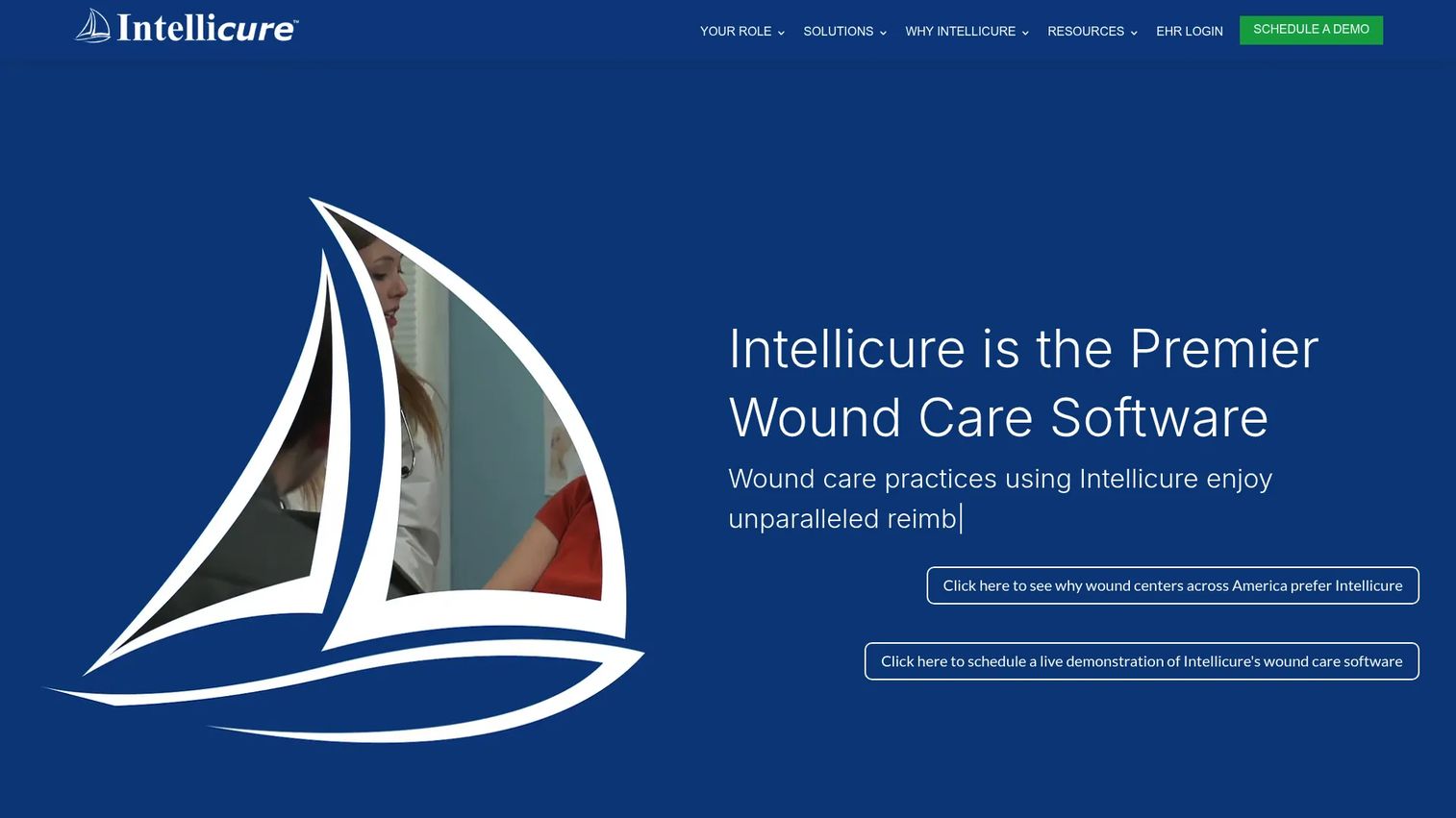
Intellicure is a wound care EHR and SMART app platform built specifically for documentation, billing, and clinical workflow in wound care. Rather than bolting wound features onto a general system, it centers the whole record on how wound centers and private practices actually operate: scheduling, registration, charting, billing, and reporting in one place. Its SMART app integrates inside hospital EHRs via HL7 FHIR, so wound data can live where the rest of the patient record does.
Best for: Wound care centers and private practices that need specialized wound care EHR software and documentation workflows.
Key strengths
- Purpose-built wound EHR: Scheduling, registration, charting, billing, and reporting designed around wound care rather than adapted from a general EHR.
- SMART app and FHIR integration: Runs inside hospital EHRs through HL7 FHIR, so wound documentation connects to the broader record.
- Clinical decision support: Care plan documentation and decision support built into the charting flow to keep records consistent and defensible.
Why choose Intellicure: If your primary pain is that charting is slow and reimbursement is leaky, a purpose-built wound care EHR removes the compromises of a general system. The clinical decision support and structured documentation are designed to make clean, codeable notes the default, which is exactly what protects revenue during payer review. It fits teams that want their wound program running on software shaped around wound work, not around generic ambulatory visits.
Intellicure pricing: Intellicure is offered as a custom solution. Its pricing page does not display a public number, so cost depends on your practice size and configuration. Contact the vendor for a quote scoped to your operation.
2. OmniMD
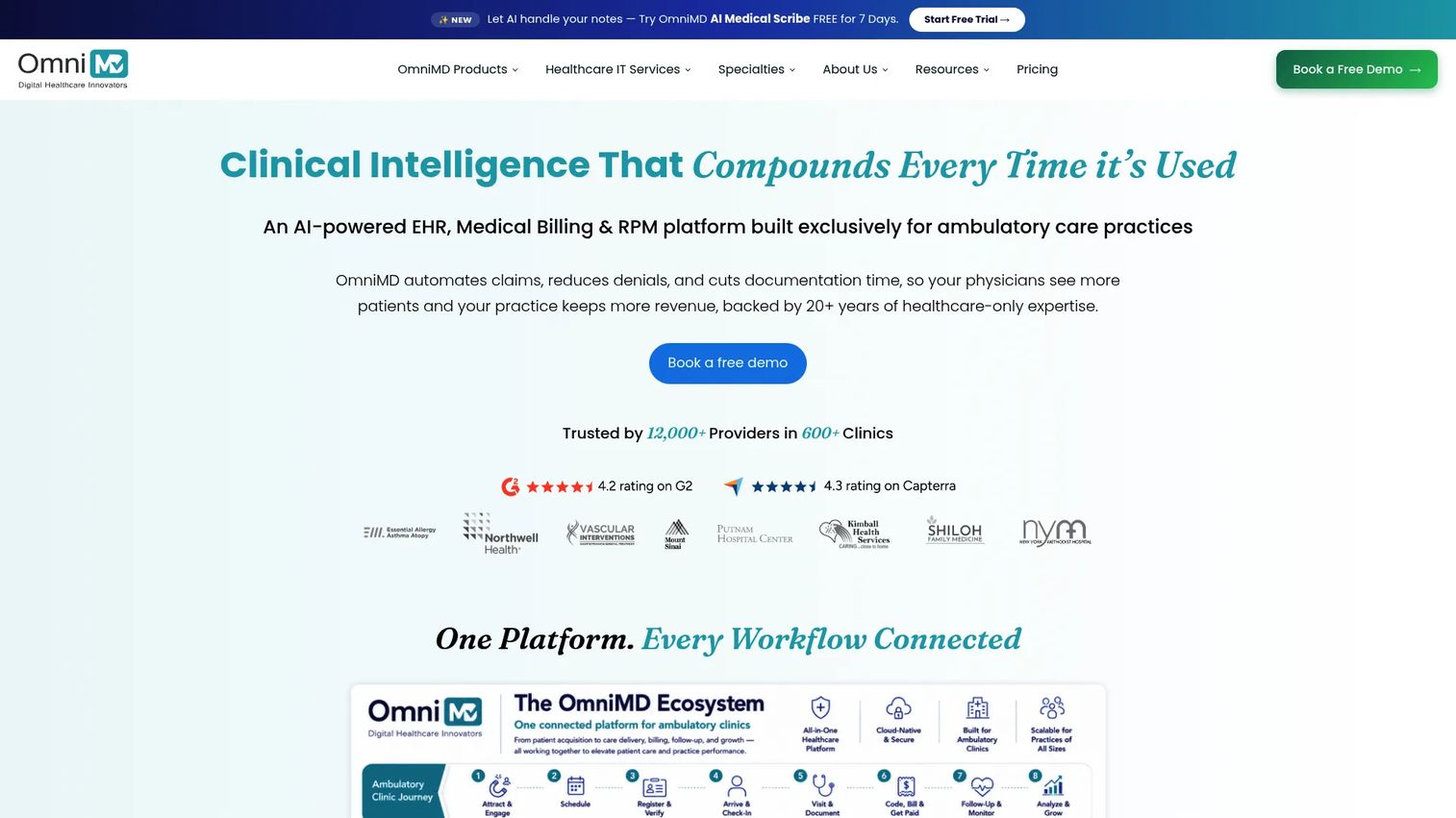
OmniMD is an AI-powered EHR, billing, and digital health platform for ambulatory medical practices. It is broader than a wound-only tool, which is the point: wound documentation lives inside a full clinical system with a patient portal, lab integration, and billing. For a wound program that sits within a larger practice, that breadth means one platform covers the wound workflow and everything around it.
Best for: Ambulatory clinics that need an integrated wound care EHR with billing and AI workflow in a single platform.
Key strengths
- AI charting and medical scribe: Ambient listening and NLP turn spoken assessments into structured notes, cutting time spent typing up wound documentation.
- Integrated billing and coding: Billing and wound billing and coding support sit inside the same platform as the clinical record, reducing handoffs.
- Patient portal and lab integration: 24/7 patient access to records and messaging, plus lab results tied into the EHR for a complete picture.
Why choose OmniMD: Choose OmniMD when the wound program is one part of a broader ambulatory practice and you want to avoid running a separate wound system alongside your main EHR. The AI charting is the standout for teams whose real bottleneck is documentation time, and the integrated billing keeps coding close to the clinical record. It suits multi-site operators who value consolidation over a single-purpose wound tool.
OmniMD pricing: OmniMD uses custom pricing across three plans: EHR Essentials, Growth Clinics Suite, and Enterprise & Multi-Location. The pricing page does not display public numbers, and cost is scoped to your provider count, patient volume, and modules. There is no free tier. Contact OmniMD for a tailored quote.
3. WoundZoom
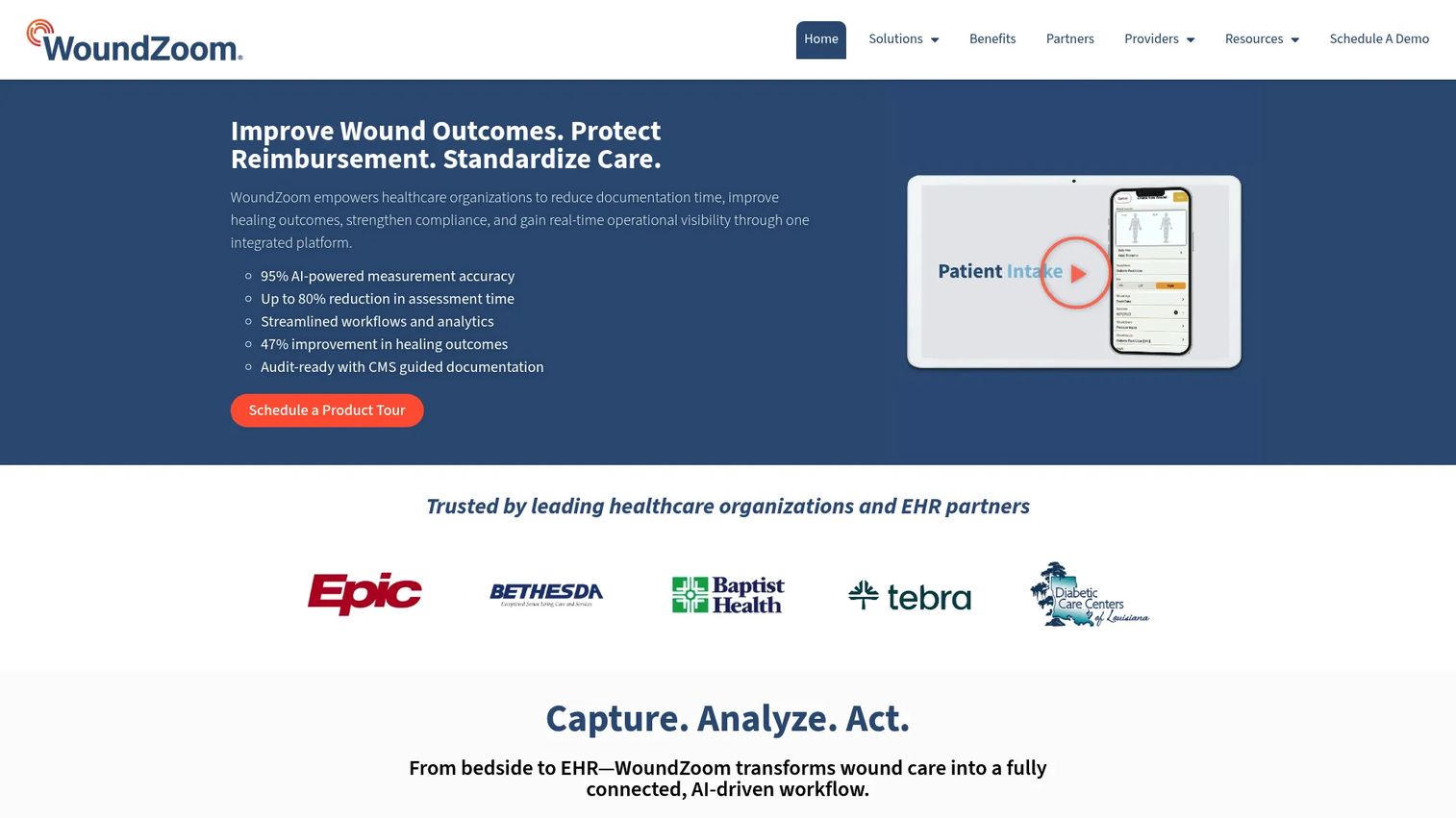
WoundZoom is AI-powered digital wound documentation and wound imaging software built for clinical workflows. Its model is capture, analyze, act: a clinician measures a wound at the bedside using the mobile app, AI handles the measurement, and the data syncs to a web portal and the EHR. That combination targets the two problems clinics feel most: measurement variability and the time cost of documentation.
Best for: Healthcare organizations that need wound care documentation, imaging, and reporting with strong mobile capture.
Key strengths
- AI-powered wound measurements: Automated measurement from images reduces the variability you get when different clinicians measure by hand.
- Mobile app plus CONNECT web portal: Bedside mobile capture pairs with a web portal for census and oversight, so field and admin work stay in sync.
- EHR/EMR integration: Wound data syncs into existing EHR/EMR systems rather than living in a silo.
Why choose WoundZoom: WoundZoom fits teams whose gap is consistency and mobile capture rather than a full EHR replacement. The AI wound assessment tackles serial measurement drift directly, and the mobile-plus-portal design supports point-of-care charting and remote wound monitoring across sites. Pick it when you want reliable measurement and operational visibility layered onto the clinical system you already run.
WoundZoom pricing: WoundZoom publishes a starting price of $99 per user per month for its LIGHT plan. Its CORE and PRO plans are not priced publicly and vary by solution, user count, and the analytics or integration you need. There is no free tier listed. Contact the vendor for CORE and PRO pricing.
4. Carefabric
Carefabric is positioned as the operationally minded option, focused on clinically calibrated imaging, simple point-of-care capture, and program-level oversight. Its narrative centers on accurate wound imaging software, risk alerts that flag deterioration early, and population-level dashboards that give a wound program leader visibility across patients. Where the EHR-first options lead with the full record, Carefabric leads with imaging accuracy and healing analytics.
Best for: Wound programs that want calibrated imaging, risk alerts, and population-level oversight without heavy setup.
Key strengths
- Clinically calibrated imaging: Accurate, calibrated wound imaging aimed at consistent measurement and reliable photo documentation.
- Risk alerts: Automated flags for wounds that are deteriorating, so intervention happens earlier rather than at the next scheduled visit.
- Population-level dashboards: Program-wide wound analytics and healing timelines that give leaders oversight across the whole caseload.
Why choose Carefabric: Carefabric suits program leaders who care most about imaging accuracy and operational visibility rather than replacing their EHR. The risk alerts and dashboards are built for oversight, helping a wound program spot problems and defend outcomes at the population level. Choose it when your priority is calibrated capture and healing analytics that support both care quality and litigation-risk reduction.
Carefabric pricing: Carefabric does not publish pricing details on its site. Cost is not publicly listed, so reach out to the vendor directly for a quote scoped to your program.
What to check before you buy
Four picks, one decision. Use this checklist to pressure-test any wound care software before you commit.
Documentation and measurement consistency
Confirm the platform enforces standardized wound assessment and repeatable serial wound measurement. Ask how it handles measurement variability between clinicians, and whether photo documentation and AI wound assessment are included or gated. Consistent inputs are what make healing timelines trustworthy.
Reimbursement and compliance fit
Check that documentation maps cleanly to wound billing and coding rules and that records are audit-ready by default. Ask how the vendor handles wound compliance software requirements, access controls, and defensible history. The right answer is that clean claims and audit readiness are the default, not extra work.
Integration depth
Verify how the platform connects to your existing stack. Ask about EHR integration specifics: HL7 FHIR support, and Epic integration or Oracle Health integration if you run those systems. Wound data that lives in a silo creates the same fragmentation problem you are trying to solve.
Mobile capture and remote monitoring
If your clinicians work at the bedside or across sites, confirm the mobile capture experience is genuinely usable, not a shrunken desktop screen. Ask about remote wound monitoring, tele-wound care, and how bedside images sync to the record.
Analytics and oversight
Look at the wound analytics: healing timelines, program-level dashboards, and reporting a leader can act on. Repeatable, measurable workflow improvement is what you are buying, so make sure the reporting proves it.
Conclusion
The four platforms sort cleanly by what hurts most in your operation. Intellicure is the pick when you want a purpose-built wound care EHR with reimbursement workflow and clinical decision support at the core. OmniMD fits when the wound program lives inside a broader ambulatory practice and you want AI charting and billing in one integrated system. WoundZoom is the choice when measurement consistency and mobile capture are the gap, pairing AI wound assessment with a web portal and EHR sync. Carefabric suits program leaders who prioritize calibrated imaging, risk alerts, and population-level oversight.
Your next step is simple. Name your single biggest bottleneck, charting speed, interoperability, measurement accuracy, or program oversight, then shortlist the two tools above that target it directly. Book scoped demos, run the same real wound through each, and compare the documentation output, the coding support, and the reporting. The platform that turns a messy workflow into audit-ready, measurable records is the one that protects both care quality and margin.
FAQs
Wound care software is used to document wounds, capture and track serial measurements, monitor healing over time, and produce records that support coding, billing, and compliance. It standardizes charting across clinicians and turns captured data into healing timelines and program-level reporting.
The features that matter most are standardized wound assessment, repeatable serial measurement, wound billing and coding support, audit-ready compliance records, and EHR integration. Strong wound care EHR software also includes clinical decision support and analytics that turn documentation into actionable healing trends.
Wound documentation software improves reimbursement by making records complete, consistent, and codeable at the point of care. When documentation maps directly to coding rules and stays audit-ready by default, claims are cleaner and denials from documentation gaps drop, which protects revenue during payer review.
The terms are often used interchangeably, but an EMR (electronic medical record) is generally the digital chart within a single practice, while an EHR (electronic health record) is designed to share data across providers and settings. In practice, most wound care EHR and wound care EMR platforms cover charting, billing, and reporting, so focus on integration depth rather than the label.
Yes. Many platforms support remote wound monitoring and tele-wound care through mobile capture, letting clinicians record wounds at the bedside or in the field and sync images to the record. This supports follow-up outside the clinic and keeps documentation consistent across care settings.
AI wound assessment automates measurement and tissue analysis from images, reducing the variability you get when different clinicians measure the same wound by hand. That consistency makes serial wound measurement more reliable and healing timelines more trustworthy for both care decisions and reporting.
A multi-site wound program should prioritize consistent documentation across locations, mobile capture for bedside work, population-level wound analytics, and integration with a shared EHR. Centralized dashboards and standardized templates keep measurement and charting consistent no matter which site or clinician records the wound.
EHR integration is critical because wound data siloed from the rest of the patient record creates the same fragmentation problem teams are trying to solve. Look for HL7 FHIR support and connectivity to systems like Epic or Oracle Health so wound documentation lives inside the broader clinical record and supports both care and reimbursement.