

A rep opens their commission statement, does the math, and it doesn't match what they thought they earned. Now they're in your Slack, not the CRM. Now their manager is pulling the deal apart line by line instead of coaching. Now Finance is defending a spreadsheet formula nobody remembers writing.
Commission disputes are not a math problem. They're a trust problem. And trust problems spread fast across a sales floor.
The sales force automation software market is projected to grow from $9.25B in 2022 to $17.94B by 2030 at an 8.7% CAGR, with large enterprises accounting for 62.6% of revenue, according to Grand View Research (2023). More comp plans, more accelerators, more integrations, and more reps who want to see exactly how their number gets calculated.
This guide is a buyer's guide, not a product pitch. It ranks seven tools that automate commission calculations, generate rep statements, keep an audit trail Finance can defend, and plug into the CRM, ERP, and payroll systems you already run. The goal is simple: help you pick software that makes payout logic visible enough for reps and managers to act on.
What's inside
This guide is for RevOps, Finance, and Sales Enablement teams choosing incentive compensation management software. It covers what spiff software does, when it earns a place in your stack, and how seven tools compare on the things that matter.
We selected tools based on four criteria:
- Commission automation: how well the tool calculates payouts across tiers, accelerators, and multiple plans
- Transparency and auditability: rep statements, dispute handling, and a commission audit trail Finance can stand behind
- Reporting and analytics: commission reporting that leaders and managers can actually use
- Integration fit: connections to CRM, ERP, HRIS, and payroll without breaking finance rules
TL;DR
- Best for Salesforce-centric teams: Salesforce Spiff. Native fit, real-time visibility, and a commission estimator reps can check themselves.
- Best for complex plans without heavy overhead: Visdum. Strong commission automation with straightforward administration.
- Best for compensation ops depth: CaptivateIQ. Flexible modeling for teams that redesign plans often.
- Best for large enterprise governance: Xactly. Mature incentive compensation management with forecasting and territory planning.
- Best for finance and RevOps control: Performio. No-code plan changes and built-in data management.
- Best for modern rep transparency: Everstage. Clean dashboards, dispute workflows, and plug-and-play integrations.
- Best for lighter-weight commission tracking: QuotaPath. Public pricing, fast setup, and transparent payout visibility.
What is spiff software
Spiff software is sales compensation software that automates commission calculations, generates rep statements, and reports on payouts across your sales team. It is a form of incentive compensation management (ICM) software built to replace spreadsheets and homegrown commission logic.
The name comes from "SPIFF," a short-term sales incentive. In practice, the category now covers full commission plan management: base commissions, accelerators, bonuses, quotas, and multi-plan structures.
Core capabilities you should expect:
- Commission calculation automation: a commission calculator that runs tiers, accelerators, and split logic without manual formulas
- Statements and rep visibility: clear commission statements so reps see how each payout was earned
- Audit trails and dispute handling: a commission audit trail that traces every number back to its source data
- Integrations: connections to CRM, ERP, HRIS, and payroll so data flows without re-keying
- Forecasting and estimator tools: a way for reps to project earnings and for Finance to model plan costs
Good commission software does more than pay people correctly. It makes commission transparency a default, which is where the enablement value lives. When reps trust the number, they stop auditing it and start selling toward it. When managers trust the number, they coach behavior instead of refereeing disputes.
When to use spiff software
Replace spreadsheets and manual commission tracking
Spreadsheets work until they don't. One plan, five reps, one comp admin: fine. Add accelerators, mid-quarter plan changes, clawbacks, and 40 reps across two regions, and every month becomes a reconciliation project.
Manual commission tracking breaks at scale because the logic lives in one person's head and one fragile file. Spiff software moves that logic into a system with rules, versioning, and a repeatable calculation run.
Improve rep trust and reduce payout disputes
Most payout disputes are not fraud. They're confusion. A rep can't see how the number was built, so they assume it's wrong.
Sales commission automation fixes this with transparent statements and traceability. When a rep can click a payout and see the deals, rates, and accelerators behind it, the dispute usually ends before it reaches your desk. That's rep payout visibility doing its job.
Support complex plans and compliance needs
Tiers, accelerators, multiple plans per role, and quota-and-accelerator structures pile up fast. Finance also needs clean commission reporting for revenue recognition standards like ASC 606 and IFRS 15.
When you're managing that level of complexity, you need software that handles the calculation and produces the audit trail. This is where a real commission management software platform separates from a spreadsheet.
Comparison table
Here's how the seven tools compare on best fit, differentiator, pricing, and G2 rating. Pricing reflects publicly listed values where available; several vendors quote custom pricing based on headcount and plan complexity.
| # | Product | Best for | Key differentiator | Pricing | G2 rating |
|---|---|---|---|---|---|
| 1 | Salesforce Spiff | Salesforce-centric teams | Native Salesforce fit, real-time commission visibility | $75/user/month, billed annually | 4.6/5 |
| 2 | Visdum | Complex plans, lean admin | AI-assisted plan building | Custom quote | 4.8/5 |
| 3 | CaptivateIQ | Compensation ops depth | SmartGrid calculation engine | Custom quote | 4.7/5 |
| 4 | Xactly | Large enterprise governance | Revenue intelligence and planning | Custom quote | 4.2/5 |
| 5 | Performio | Finance and RevOps control | No-code plan changes | Custom quote | 4.4/5 |
| 6 | Everstage | Modern rep transparency | Rep dashboards and dispute workflows | Custom quote | 4.8/5 |
| 7 | QuotaPath | Lighter-weight tracking | Public pricing, AI Plan Builder | From $35/user/month | 4.7/5 |
Best spiff software for 2026
1. Salesforce Spiff
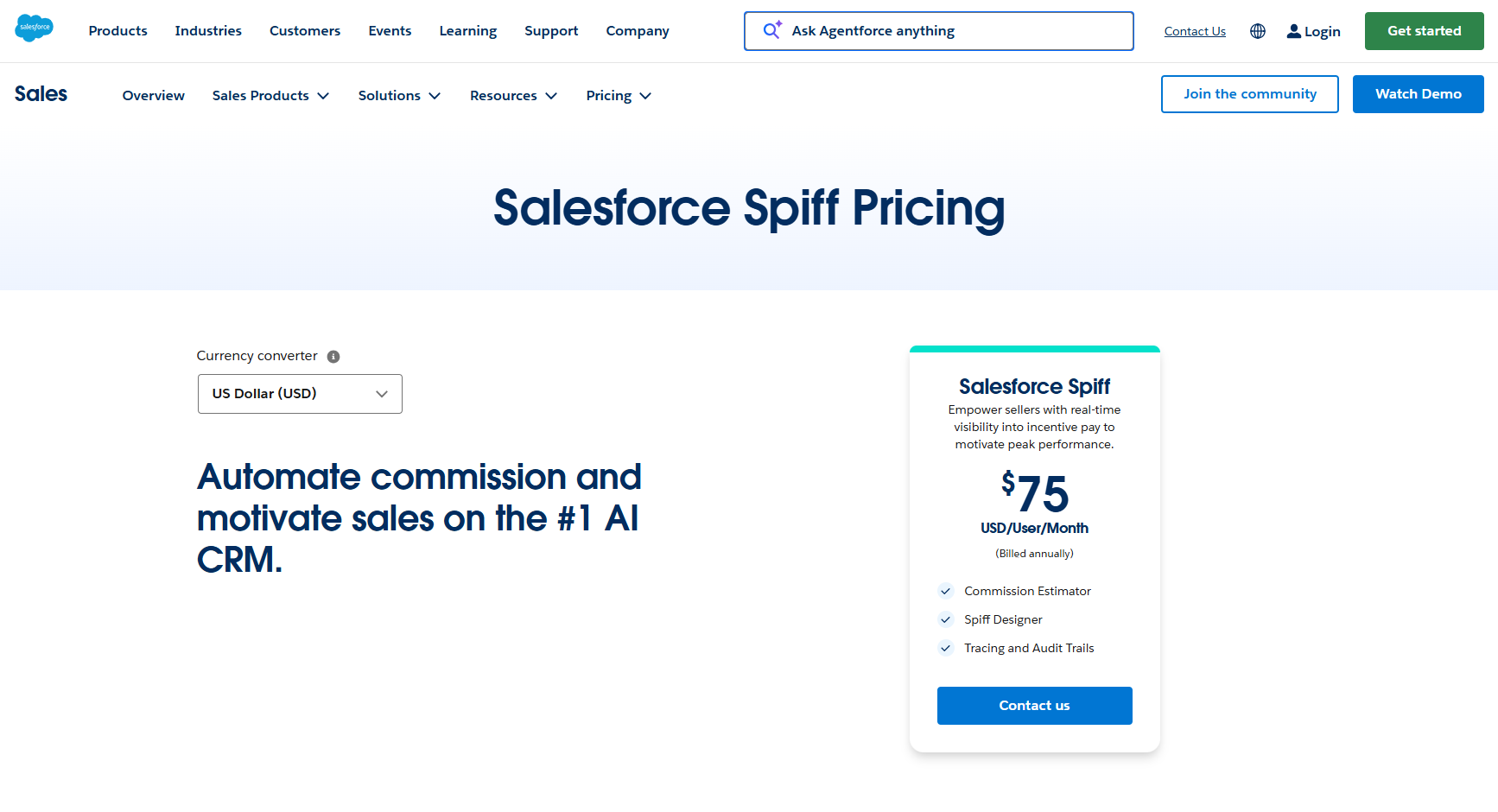
Salesforce Spiff is incentive compensation management software that automates commissions and gives sellers real-time visibility into earnings. Salesforce acquired Spiff and folded it into Sales Cloud, so the pitch is a native fit for teams already living in Salesforce. Reps check earnings without leaving the CRM, and admins design plans against data that already sits in the system.
Best for: Sales teams that need automated commission management and rep payout transparency inside a Salesforce-centric stack.
Key strengths
- Real-time commission visibility for reps
- Commission Estimator for projecting earnings
- Spiff Designer for building comp plans
- Native fit with Salesforce Sales Cloud
- Audit trails and tracing for payout logic
Why choose Salesforce Spiff: If your CRM is Salesforce, the native connection removes a data-sync headache and keeps commission logic close to the source records. The Commission Estimator lets reps self-serve their own math, which cuts the "is this right?" questions before they start. That's real value for a Sales Enablement Manager trying to keep reps focused on pipeline, not payout audits.
Salesforce Spiff pricing: Salesforce Spiff is listed at $75 USD per user per month, billed annually, as a single publicly listed edition. No free tier is listed on the pricing page.
2. Visdum

Visdum is sales compensation and commission management software for automating plan design, calculation, payout, and compliance. It leans on AI-assisted plan building to get complex comp structures live faster, and it connects across the systems where your revenue and headcount data already live.
Best for: Mid-market and enterprise teams managing complex sales commission plans without a large comp ops function.
Key strengths
- AI-assisted plan building and comp-plan design
- Commission calculation, tracking, and payout workflows
- Integrations with CRM, ERP, payroll, billing, and HRIS
- Compliance-oriented reporting
- Rep statements for payout visibility
Why choose Visdum: Visdum fits teams that carry genuine plan complexity but don't want a heavy internal admin burden to run it. The AI-assisted plan builder shortens the path from plan design to a working calculation, which matters when comp plans change every quarter. Reviewers rate it highly on G2, which signals a smooth experience once it's live.
Visdum pricing: Visdum uses quote-based pricing with two fees: a recurring subscription billed per payee and a one-time setup and implementation fee. The company states that a typical first-year investment starts in the low five figures. No free tier is listed.
3. CaptivateIQ

CaptivateIQ is sales performance management software for commissions, planning, reporting, and payout workflows. Its calculation engine is built for teams that model and remodel plans often, and its data management keeps the inputs clean before they hit the math.
Best for: Mid-market to enterprise teams managing complex sales compensation and revenue performance.
Key strengths
- SmartGrid ELT and calculation engine
- Real-time modeling and data management
- AI-powered assist and dashboarding
- Flexible plan design for frequent changes
- Reporting for Finance and RevOps
Why choose CaptivateIQ: CaptivateIQ suits compensation ops teams that treat plan design as an ongoing discipline, not a once-a-year event. The modeling depth lets you test a plan change before you roll it out, so you see the payout impact before reps do. That's useful when leadership keeps adjusting quotas and accelerators mid-year.
CaptivateIQ pricing: CaptivateIQ uses custom pricing. The pricing page directs buyers to contact sales for a quote and describes seat-based pricing with a one-time setup fee and an optional ASC 606 add-on subscription. No free tier is listed.
4. Xactly
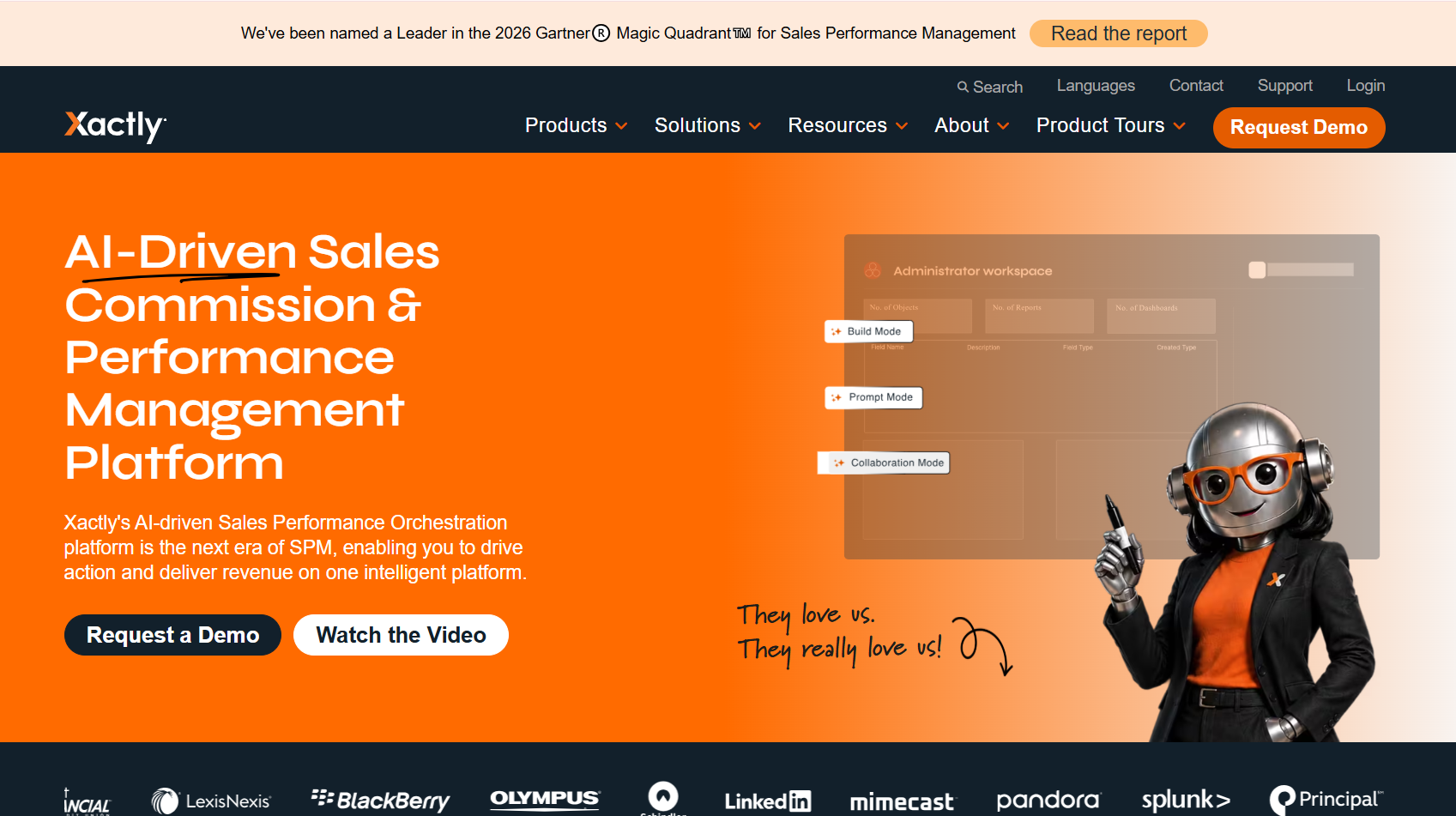
Xactly is an AI-powered revenue intelligence and sales performance management platform. It's one of the more mature names in enterprise incentive compensation, pairing commission management with forecasting and territory planning under one roof.
Best for: Enterprises managing complex sales compensation and revenue planning.
Key strengths
- Incentive compensation management
- Sales forecasting
- Territory and sales planning
- Enterprise-grade governance and reporting
- Broad integration support
Why choose Xactly: Xactly fits large organizations that need governance, auditability, and reporting depth across many plans and geographies. The combination of comp, forecasting, and planning appeals to Finance and RevOps leaders who want the compensation system to connect to broader revenue models. It's a heavier platform aimed at scale, not a lightweight rollout.
Xactly pricing: Xactly does not display public pricing. The pricing page directs visitors to request a quote and states that pricing depends on headcount and plan complexity. No free tier is listed.
5. Performio

Performio is sales and incentive compensation software built for complex commission plans. It emphasizes no-code plan changes and built-in data management, so comp admins can adjust logic without waiting on engineering or exports.
Best for: Mid-market and enterprise teams managing complex sales commission programs.
Key strengths
- No-code plan changes
- Built-in data management
- End-to-end automation
- Reporting for Finance and RevOps
- Support for tiered and accelerator plans
Why choose Performio: Performio appeals to Finance and RevOps teams that want operational control over the comp process without heavy technical dependencies. No-code plan changes mean an admin can update logic in-app when a plan shifts, which keeps payouts accurate through mid-year changes. That control is the selling point for teams scaling across larger sales orgs.
Performio pricing: Performio uses quote-based pricing determined by team size and implementation scope. The pricing page does not display a public price.
6. Everstage

Everstage is an AI-native revenue transformation platform for enterprise sales compensation, planning, and CPQ. It pairs a full ICM calculation engine with rep-facing dashboards, approvals, and dispute workflows that make payout logic easy to follow.
Best for: Enterprise teams managing sales commissions and incentive compensation programs.
Key strengths
- ICM calculation engine with plan management
- Rep dashboards for payout visibility
- Approvals and dispute workflows
- Native and plug-and-play integrations with CRM, payroll, and collaboration tools
- Per-payee pricing with enterprise support
Why choose Everstage: Everstage stands out for rep-facing transparency, which is exactly what reduces disputes and keeps sellers focused. The dispute workflow gives reps a structured path to raise a question instead of pinging a manager, and the dashboards make the answer self-evident. For a Sales Enablement Manager, that clarity translates into less distraction on the floor. Everstage also earns strong G2 ratings.
Everstage pricing: Everstage uses custom, per-payee pricing. The pricing page itemizes a platform license, enterprise support, and onboarding and implementation before signing. No public numeric price is shown.
7. QuotaPath
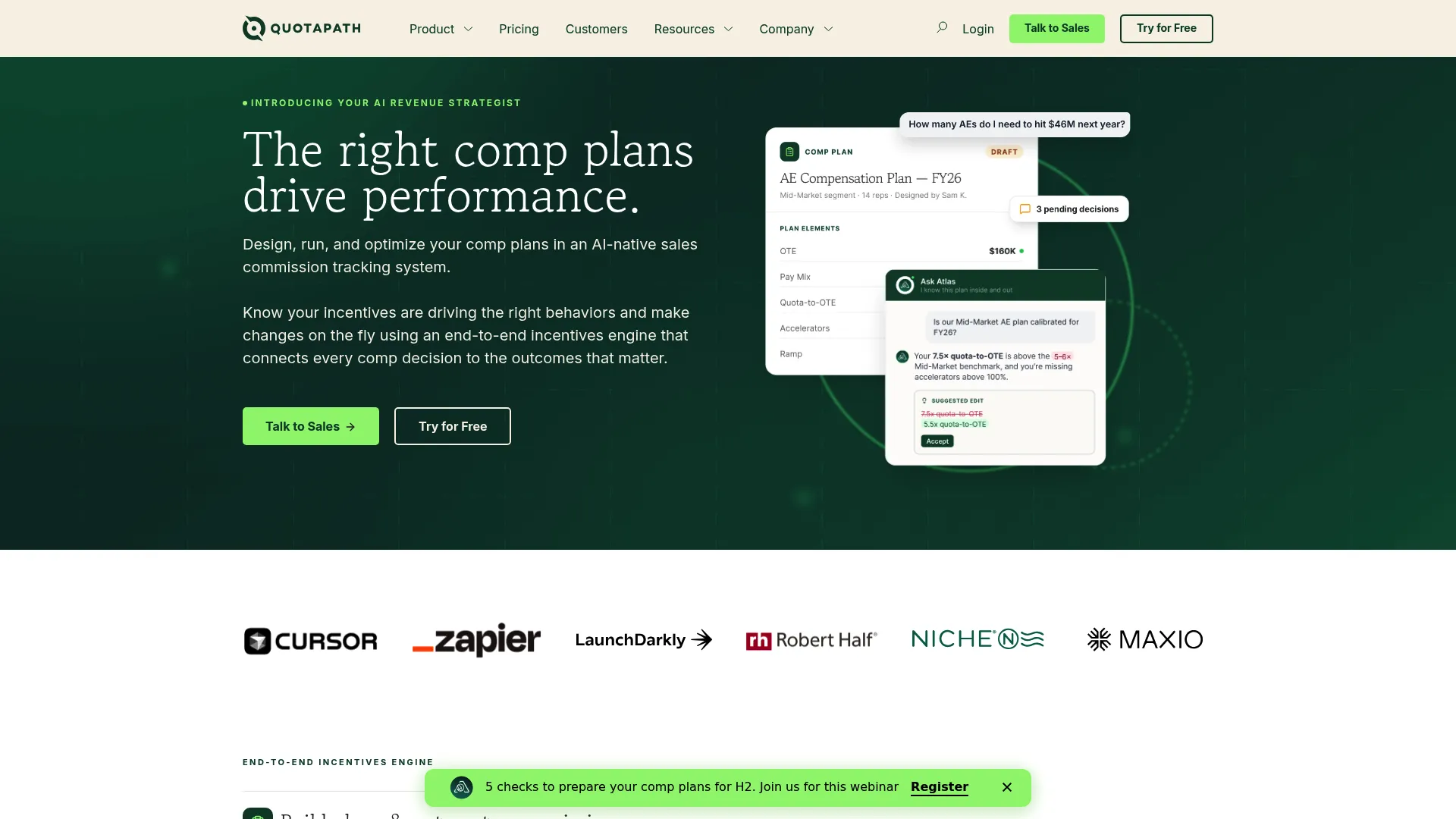
QuotaPath is sales compensation management software for building, tracking, and running commission plans. It's the most transparent on pricing of the group, with public tiers and an AI-powered Plan Builder that gets teams live quickly.
Best for: Revenue teams that need transparent sales commission management and payout automation without a heavy implementation.
Key strengths
- AI-powered Plan Builder
- Commission tracking and payouts
- Integrations with CRM, accounting, HRIS, and data warehouse tools
- Public, transparent pricing
- Rep-facing earnings visibility
Why choose QuotaPath: QuotaPath fits teams that want a lighter-weight commission workflow and clear pricing they can evaluate without a sales call. The Plan Builder speeds up setup, and the public tiers make budgeting predictable. It's a strong pick for growing teams that want commission transparency without committing to a large enterprise platform.
QuotaPath pricing: QuotaPath lists public pricing. Growth is $35 per user per month plus a $525 monthly platform fee, and Premium is $50 per user per month plus an $800 monthly platform fee, both billed annually. A Strategic tier is listed as custom. A free trial is available.
Considerations
Before you sign anything, verify the practical stuff that determines whether the tool works in your environment.
Integration fit
Confirm the tool connects to your exact CRM, ERP, HRIS, and payroll systems, not just "Salesforce" in general but your instance and objects. Ask how data syncs and how often. Broken or laggy integrations are the fastest way to reintroduce the spreadsheet you're trying to kill.
Plan complexity
Map your real plans, including accelerators, splits, clawbacks, and multi-plan roles, and ask the vendor to model one live during evaluation. A demo on a simple plan tells you nothing. Watch how the tool handles your ugliest comp scenario.
Transparency and auditability
Check that reps get clear commission statements and that every payout traces back to source data through a real commission audit trail. Finance needs to defend numbers during audits and revenue recognition. Reps need to trust them day to day.
Reporting and analytics
Look at the actual commission reporting outputs, not the marketing screenshots. Can managers see attainment and payout by rep, team, and plan? Can Finance model plan cost? Reporting is where sales performance management earns its keep.
Admin burden and permissions
Ask who maintains plans after go-live and how plan changes get made mid-cycle. No-code plan editing matters when quotas shift. Confirm security and permissions so reps see their own data and admins control the rest.
Conclusion
Pick based on your stack and your plan complexity, not the longest feature list.
Salesforce Spiff is the benchmark for Salesforce-centric teams that want native fit and real-time visibility. Visdum and CaptivateIQ suit teams carrying genuine plan complexity, with Visdum leaning toward lean administration and CaptivateIQ toward deep modeling. Xactly is the enterprise governance choice, and Performio gives Finance and RevOps operational control through no-code changes. Everstage wins on modern rep transparency and dispute handling, and QuotaPath is the lighter-weight, transparently priced option for growing teams.
Here's the practical next step: shortlist two or three vendors, then make each one model one real commission plan during evaluation, ideally your most complex one. Compare the rep statements and reporting outputs side by side. The tool that produces the clearest, most defensible payout for your ugliest plan is the one your reps and Finance will both trust.
FAQs
Spiff software automates commission calculations, generates rep statements, and reports on sales payouts. Teams use it to replace spreadsheets, cut payout disputes, and give reps and managers visibility into how commissions are earned. It's a form of incentive compensation management software.
Salesforce Spiff is one product within the incentive compensation management (ICM) category. ICM is the broader discipline of designing, calculating, and paying sales commissions. Salesforce Spiff delivers that through commission automation, a Commission Estimator, and native Salesforce integration.
Pricing varies widely. QuotaPath lists Growth at $35 per user per month plus a platform fee, and Salesforce Spiff lists $75 per user per month billed annually. Several vendors, including Visdum, CaptivateIQ, Xactly, Performio, and Everstage, use custom pricing based on headcount and plan complexity.
Commission automation, transparent rep statements, and a commission audit trail come first. After that, weigh integrations with your CRM, ERP, HRIS, and payroll, plus commission reporting your managers and Finance can actually use. Prioritize the features that reduce disputes and keep reps selling.
Yes. Most tools connect to CRM, ERP, HRIS, and payroll to pull deal data and push payout data without re-keying. Salesforce Spiff offers native Salesforce integration, while tools like Visdum, Everstage, and QuotaPath support broad connections across the stack. Always confirm your exact systems during evaluation.
A commission audit trail traces every payout back to its source: the deals, rates, accelerators, and plan rules that produced the number. Good software timestamps changes and shows who adjusted what. This lets Finance defend payouts during audits and revenue recognition under standards like ASC 606.
Commission software focuses on calculating and paying commissions. Sales performance management (SPM) software is broader, often adding forecasting, territory planning, and quota management. Tools like Xactly and CaptivateIQ sit closer to full SPM, while lighter tools focus on commission tracking and payouts.
It depends on plan complexity and integration scope. Simpler, transparently priced tools can go live in weeks, while enterprise platforms with many plans and deep integrations often run longer and include a setup and implementation fee. Ask each vendor for a timeline based on your actual plans, not a generic estimate.