Your analytics dashboard says revenue grew 12% last quarter. Sales swears it was 8%. Finance has a third number. Nobody trusts any of them.
That standoff is what messy data transformation looks like from the inside. Raw records land in the warehouse with inconsistent formats, duplicate rows, mismatched schemas, and no shared definition of a metric. Someone cleans it by hand in a spreadsheet. Someone else writes a one-off SQL script. The next person reruns both and gets a different answer.
The market has noticed. The global data transformation software market was valued at USD 5.2 billion in 2024 and is projected to reach USD 12.4 billion by 2033 at a 10.5% CAGR, according to Market Research Intellect (2024). That growth tracks a simple reality: product, analytics, and data teams lose real hours every week cleaning, mapping, and governing data that should have been standardized once, upstream.
The right data transformation platform turns that manual scramble into a repeatable, tested, documented workflow. The wrong one adds another maintenance headache. This guide helps you tell them apart.
What's inside
This guide is for product managers, analytics leads, and data engineers choosing data transformation tools for a modern cloud data stack. It covers seven platforms, explains how ETL vs ELT plays out in warehouse and lakehouse setups, and gives you a decision framework instead of a feature dump.
We selected and compared each tool on four criteria:
- Architecture fit: how well it matches warehouse-native, lakehouse, or hybrid setups
- Transformation flexibility: SQL, visual, low-code, or code-first
- Governance and lineage: testing, documentation, versioning, and CI/CD support
- Team skill and maintenance burden: who can run it and what it costs to keep alive
TL;DR
- Best for analytics engineering: dbt, for SQL-first modular transformation with tests, docs, and version control
- Best for managed connectors: Fivetran, for low-maintenance ingestion that pairs with warehouse-native transformation
- Best for visual warehouse-native workflows: Matillion, for cloud data teams who want drag-and-drop plus orchestration
- Best for governed enterprise transformation: Coalesce, for column-aware automation and built-in catalog and quality
- Best for low-code integration at scale: Informatica Cloud Data Integration, for enterprise breadth and hybrid deployment
- Best BigQuery-native option: Google BigQuery Dataform, for GCP-first teams orchestrating SQL in the warehouse
- Best open-source option: Airbyte, for connector breadth and flexible cloud or self-managed deployment
What is data transformation software
Data transformation software converts raw source data into analysis-ready or operationally useful data through cleansing, mapping, joining, aggregation, loading, and orchestration. It sits between your source systems and the dashboards, models, and applications that consume clean data.
In a modern cloud data stack, most of this work happens after data lands in a warehouse or lakehouse. That shift, from transforming before load to transforming after, is the core of the ETL vs ELT debate covered later. Either way, the software's job is to make transformations repeatable, testable, and traceable instead of buried in one-off scripts.
Core capabilities to expect:
- Schema mapping: align source fields to target structures and handle type changes
- Data cleansing: dedupe, standardize, and fix inconsistent records
- Joins and unions: combine data from multiple sources into unified models
- Filtering and aggregation: slice, roll up, and summarize for analytics
- Scheduling and automation: run transformations on a cadence or trigger
- Logging, monitoring, and lineage: trace where data came from and how it changed
The strongest data transformation tools add governance on top: testing to catch bad data before it ships, documentation that stays in sync with models, version control, and CI/CD so changes ship safely. For a product manager, those governance features are what make analytics trustworthy enough to drive decisions.
When to use
Standardize messy source data
Use data transformation software when records arrive inconsistent and someone keeps cleaning them by hand. Different source systems format dates, currencies, and IDs their own way. A transformation layer standardizes all of it once, so every downstream report starts from the same clean base instead of a fresh manual scrub.
Build ELT workflows in the cloud
Use it when transformation should happen inside the warehouse or lakehouse. Modern ELT workflows load raw data first, then transform it in place using the warehouse's compute. This suits cloud data teams who want to scale transformation without moving data around, and it keeps the raw data available for reprocessing when logic changes.
Govern shared metrics and models
Use it when multiple teams depend on the same definitions. When "active user" or "revenue" means three different things across three dashboards, you need lineage, documentation, versioning, and testing to enforce one source of truth. Governance features matter most here, because they turn scattered logic into models a whole organization can trust.
Comparison table
Read this table by fit, not by brand familiarity. The most recognizable name is not automatically the right one for your architecture, your team's skill set, or your governance needs. Match the "best for" column to your situation first, then read the full sections below.
| # | Product | Best for | Key differentiator | Pricing | G2 rating |
|---|---|---|---|---|---|
| 1 | dbt | Analytics engineering teams | SQL-first transformation with tests, docs, and lineage | Free Developer plan; Starter $100/mo/seat | 4.7/5 |
| 2 | Fivetran | Managed ELT ingestion | 700+ fully managed connectors | Free plan; Standard usage-based | 4.3/5 |
| 3 | Matillion | Visual cloud pipelines | AI-assisted, credit-based data automation | Credit-based; Developer, Teams, Scale | 4.5/5 |
| 4 | Coalesce | Governed enterprise transformation | Column-aware automation with catalog and quality | Free plan; Starter $500/mo | 4.7/5 |
| 5 | Informatica Cloud Data Integration | Enterprise integration at scale | Serverless Spark, CLAIRE optimization, CDC | Consumption-based; free entry point | 4.3/5 |
| 6 | Google BigQuery Dataform | GCP-first SQL workflows | BigQuery-native orchestration and dependencies | Free service | Rating varies |
| 7 | Airbyte | Open-source flexibility | 600+ connectors, cloud or self-managed | Free Core plan; paid tiers usage-based | 4.4/5 |
Best 7 data transformation software tools for 2026
1. dbt
dbt is an analytics engineering platform for transforming, testing, deploying, and governing data pipelines with SQL. It brought software engineering practices to the warehouse: modular models, version control, automated tests, and generated documentation. Instead of one giant SQL script, you build small, reusable models that reference each other, and dbt figures out the dependency order.
For analytics engineering teams, this is the reference tool. It runs where your data already lives, so transformations use the warehouse's compute, and every change ships through the same review and CI/CD flow your engineers already know.
Best for: Teams that want a SQL-first platform to build and operate governed analytics pipelines.
Key strengths
- SQL-based data transformation
- Orchestration and deployment
- Catalog, lineage, and observability
Why choose dbt: If your team writes SQL and wants tested, documented, version-controlled models, dbt is the closest thing to a standard. It fits engineers and analysts who treat data models like code.
Pricing: Developer plan is free. Starter is $100 per month per seat. Enterprise and Enterprise+ are custom pricing. dbt State is billed at $0.094 per billable DATT, monthly.
2. Fivetran
Fivetran is an automated data movement platform for moving, managing, and transforming data into cloud destinations. Its strength is ingestion: hundreds of prebuilt, fully managed connectors pull data from your sources into the warehouse and keep syncing on a schedule, with schema changes handled automatically. That removes most of the connector maintenance that eats data-engineering time.
Fivetran pairs naturally with warehouse-native transformation. It lands raw data reliably, then you transform it in the warehouse, including through its dbt Core integration.
Best for: Teams that want managed ELT and data replication into cloud warehouses with minimal connector maintenance.
Key strengths
- 700+ fully managed connectors
- 200+ managed activation destinations
- 15-minute syncs and unlimited users
- Role-based access control and dbt Core integration
Why choose Fivetran: Choose it when connector upkeep is your bottleneck and you want ingestion to run itself. It handles the EL of ELT so your team spends time on the T.
Pricing: A free plan is available. The Standard plan is usage-based, with pricing driven by consumption. Detailed paid pricing is shown through examples rather than a fixed public starting number.
3. Matillion
Matillion is a cloud data integration and AI data automation platform for building and managing data pipelines. Its visual builder lets teams design warehouse-native transformation and orchestration through a drag-and-drop canvas, with scheduling, lineage, and API integrations built in. Its Maia AI features assist with pipeline design for teams that want acceleration without hand-writing everything.
For cloud data teams that prefer a visual interface over code, Matillion covers connectivity, transformation, and orchestration in one place.
Best for: Teams needing cloud-native data pipeline automation with AI-assisted data engineering.
Key strengths
- AI Data Automation with Maia
- Pre-built and custom connectors
- Transformation, orchestration, scheduling, and lineage
Why choose Matillion: Choose it when you want warehouse-native pipelines built visually rather than in SQL files. It fits teams blending engineers and less technical builders.
Pricing: Matillion uses a credit-based, consumption model across Developer, Teams, and Scale editions, billed annually. You pay for work done through credits. A public numeric starting price is not shown on the pricing page; a free trial is available.
4. Coalesce
Coalesce is a governed data transformation, catalog, and quality platform for building and operating data pipelines. Its column-aware approach means the platform understands your schema at the column level, so you build reusable templates that generate consistent, standardized transformations. Catalog handles lineage and discovery; Quality handles testing, monitoring, and fixes.
For modern cloud warehouse workflows where governance is non-negotiable, Coalesce combines building pipelines with cataloging and quality monitoring in one governed environment.
Best for: Data teams that want a governed platform for transformation, cataloging, and quality monitoring.
Key strengths
- Transform: build, validate, deploy, and orchestrate governed pipelines
- Catalog: lineage, metadata, and discovery
- Quality: test, monitor, observe, and fix data issues
Why choose Coalesce: Choose it when reusable, standardized transformation and built-in governance matter more than raw code flexibility. It fits enterprise teams enforcing one source of truth.
Pricing: A free tier is available and development is always free. Starter is $500 per month and includes 2,000 credits monthly. Enterprise and Business Critical are custom pricing.
5. Informatica Cloud Data Integration
Informatica Cloud Data Integration is cloud data integration and engineering software for ingesting, integrating, cleansing, and replicating data at scale. It brings enterprise breadth: hundreds of connectors, low-code and no-code mapping, change data capture, and serverless Spark for heavy workloads. Its CLAIRE engine adds AI-driven optimization, and it supports hybrid deployment across cloud and on-premises systems.
For enterprises with sprawling systems and strict requirements, this is data integration software built for scale, with mapping, metadata, and lineage as first-class features.
Best for: Enterprise teams needing scalable cloud data integration and replication.
Key strengths
- High-performance ELT, ETL, replication, and CDC
- Low-code and no-code integration with hundreds of connectors
- Serverless Spark and CLAIRE-powered optimization
Why choose Informatica: Choose it when enterprise scale, hybrid deployment, and broad connectivity outweigh the need for a lean, single-warehouse tool. It fits large data organizations.
Pricing: Informatica uses flexible, consumption-based pricing measured in IPUs. A free Cloud Data Integration entry point is available. No public numeric starting price is shown; quotes are provided on request.
6. Google BigQuery Dataform
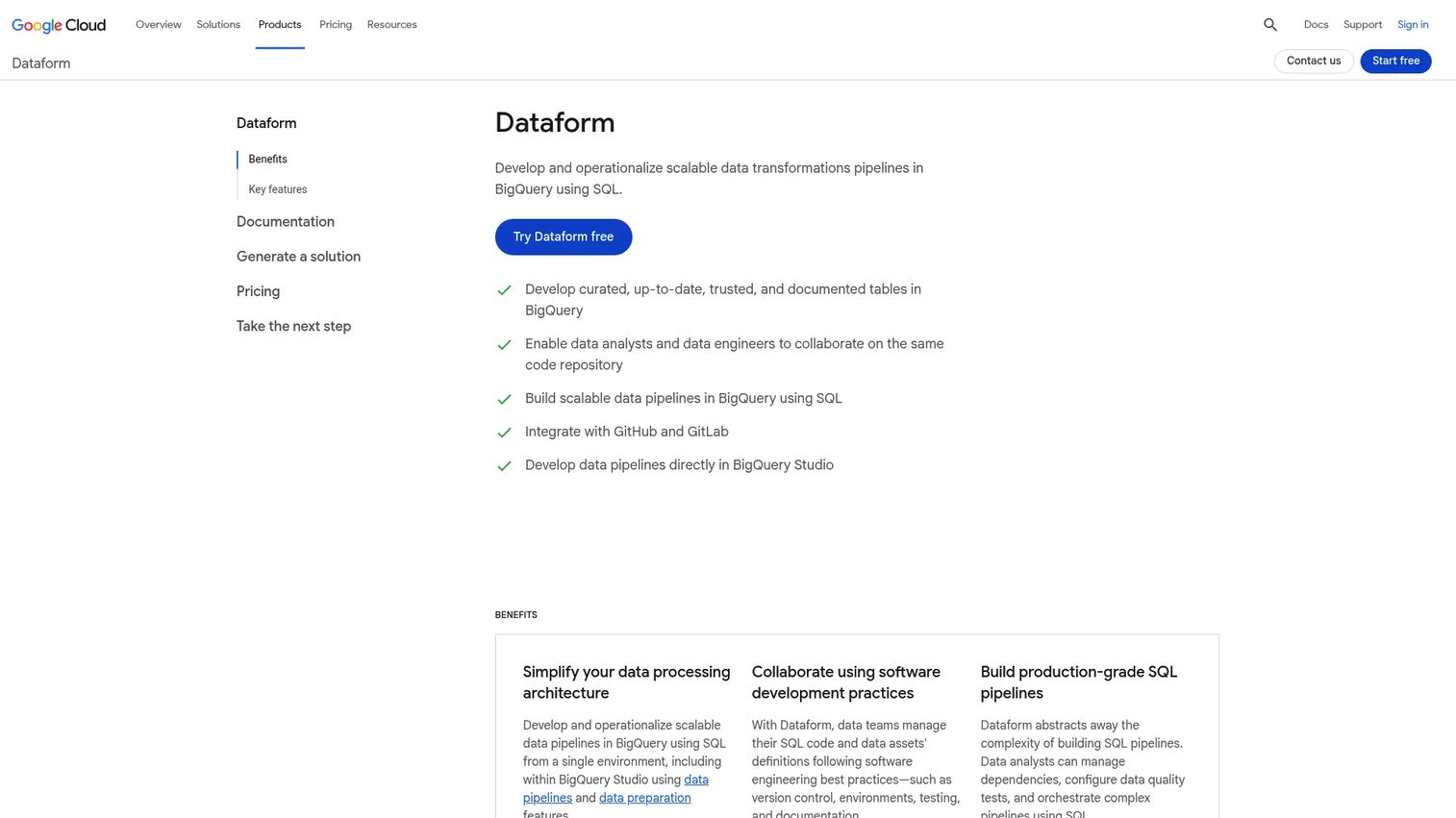
Google BigQuery Dataform is a Google Cloud service for building and orchestrating SQL-based data transformation pipelines in BigQuery. It lets teams define transformations as SQL workflows with dependency management, Git-based version control, and data quality assertions, all inside the BigQuery environment. For GCP-first teams, it removes the need for a separate transformation tool.
Because it runs natively in BigQuery, orchestration and dependency resolution happen where the data already sits, keeping the stack simple for teams already committed to Google Cloud.
Best for: Teams building and scheduling BigQuery SQL transformation workflows.
Key strengths
- SQL-based transformation workflows
- Git-based collaboration and version control
- Orchestration with dependency management and quality assertions
Why choose Google BigQuery Dataform: Choose it when BigQuery is your warehouse and you want native SQL transformation without adding another vendor. It fits GCP-committed teams.
Pricing: Dataform itself is a free service. Charges may still apply for related Google Cloud services such as BigQuery compute and Cloud Logging.
7. Airbyte
Airbyte is an open-source data integration and AI data movement platform for syncing data across systems. Its open-source roots mean broad connector coverage and the freedom to run it in the cloud or self-managed, with the option to build custom connectors when a source is not covered. Change data capture and integrations through API, Terraform, and PyAirbyte give engineering teams flexible control.
For teams that value flexibility and want to avoid connector lock-in, Airbyte offers deployment options that fit both hosted and self-hosted preferences.
Best for: Teams that need a flexible data integration platform with many connectors and both cloud and self-managed deployment options.
Key strengths
- 600+ connectors
- Change data capture (CDC)
- API, Terraform, PyAirbyte, and workflow integrations
Why choose Airbyte: Choose it when open-source flexibility, custom connectors, and deployment control matter most. It fits engineering-led teams comfortable managing their own infrastructure.
Pricing: The Core plan is $0 per month. Standard is volume-based and Pro is capacity-based, with no public numeric price shown on the pricing page. Enterprise Flex is custom, quote-based.
Considerations
Architecture fit
Match the tool to where your data lives. If you run a single cloud warehouse, warehouse-native transformation like dbt or Dataform keeps the stack lean. If you operate a lakehouse or hybrid environment, evaluate how the tool handles compute and storage across systems. The wrong architecture fit shows up later as workarounds and duplicated logic.
Governance and lineage
Decide how much governance, lineage, testing, and CI/CD you need before you shortlist. Teams with multiple stakeholders depending on shared metrics should weight this heavily. Look for automated testing, documentation that stays in sync with models, column-level lineage, and version control. These features are what make analytics trustworthy for decision-making.
Team skill set
Be honest about who will run this. SQL-first tools reward teams that already write SQL. Visual and low-code tools open transformation to analysts and less technical builders. Open-source tools reward engineering teams comfortable with infrastructure. The best tool for a strong data engineering team may frustrate a lean analytics team.
Automation and maintenance
Every tool carries a maintenance cost after launch. Managed connectors reduce upkeep; self-managed deployments trade cost for control. Evaluate scheduling, orchestration, and how the tool handles source schema changes. For a product manager, low maintenance burden means fewer ongoing engineering interrupts.
Pricing and scaling
Pricing models differ sharply here: per-seat, consumption-based credits, usage tiers, and free open-source cores. Model your expected data volume and team size against each, because a low entry price can scale into a large bill as usage grows. Factor in warehouse compute costs, since warehouse-native tools push that spend to your cloud provider.
Conclusion
There is no single best data transformation platform, only the best fit for your architecture, team, and governance needs.
If your team writes SQL and wants tested, documented, version-controlled models, dbt is the analytics engineering standard. If connector maintenance is your bottleneck, Fivetran handles ingestion so you can focus on transformation. For visual warehouse-native pipelines, Matillion fits cloud data teams. When governance is non-negotiable, Coalesce brings catalog and quality together. For enterprise scale and hybrid deployment, Informatica Cloud Data Integration delivers breadth. GCP-first teams get native SQL transformation from Google BigQuery Dataform. And teams wanting open-source flexibility and deployment control should evaluate Airbyte.
Start by matching the "best for" column to your real situation, then run a trial with your own data before committing. The right data transformation solutions pay for themselves in trustworthy analytics and fewer manual scrambles.
Start your journey with Guideflow today!
FAQs
Data transformation software is used to convert raw source data into clean, analysis-ready data through cleansing, mapping, joining, aggregation, and loading. Teams use it to standardize inconsistent records, build repeatable pipelines, and produce trustworthy analytics. It replaces manual spreadsheet cleanup and one-off scripts with tested, documented, automated workflows.
ELT is usually the better fit for modern cloud stacks. It loads raw data into the warehouse first, then transforms it in place using the warehouse's compute, which scales well and keeps raw data available for reprocessing. ETL still makes sense when you must cleanse or mask data before it lands, or when compliance requires transformation before storage.
The features that matter most are schema mapping, data cleansing, joins and aggregation, scheduling, and lineage. For teams sharing metrics across departments, governance, testing, documentation, and CI/CD matter even more, because they keep analytics trustworthy. Match the feature set to your architecture and how many stakeholders depend on the output.
It depends on the tool. SQL-first platforms like dbt and Dataform expect you to write SQL. Visual and low-code tools like Matillion open transformation to analysts and less technical builders. Open-source options like Airbyte reward engineering teams comfortable managing infrastructure, so choose based on your team's actual skill set.
Governance and lineage become decisive when multiple teams depend on the same data definitions. Column-level lineage, automated testing, version control, and documentation prevent conflicting metrics and let you trace how data changed. If one dashboard says one number and another says something different, prioritize a data transformation tool with strong governance built in.
dbt is widely treated as the standard for analytics engineering teams. It brings modular SQL models, automated tests, generated documentation, version control, and CI/CD to the warehouse. Teams that treat data models like software code get the most value from its workflow.
Choose warehouse-native tools when your team writes SQL and you want transformation to run where your data already lives, keeping the stack lean. Choose low-code and visual tools when you want analysts and less technical builders to contribute, or when a drag-and-drop workflow speeds delivery. Your team's skill set and maintenance appetite should drive the decision more than the tool's popularity.
Data integration focuses on moving and combining data from multiple sources into one place, often through connectors and replication. Data transformation focuses on reshaping that data through cleansing, mapping, joining, and aggregation so it is analysis-ready. Many data transformation solutions cover both, but the distinction matters when you are matching a tool to whether your bottleneck is ingestion or modeling.