Your central data team is the bottleneck. Every dashboard request, every schema change, every cross-domain join queues behind one overloaded group. Business units wait weeks for data they should own themselves.
That is the friction a data mesh architecture is built to remove. Instead of routing every analytics request through one team, domains own their own data products, publish them for others to consume, and govern access through shared rules rather than a single gatekeeper.
The market is moving fast. The global data mesh platform market was valued at $3.8B in 2025 and is forecast to reach $21.6B by 2034 at a 23.4% CAGR, according to MarketIntelo (2025). Around 23% of large enterprises have initiated formal data mesh projects, up from 16% in 2024.
But "data mesh" is an operating model, not a single product you buy. The platforms below cover different layers of that model: query federation, governance, cataloging, transformation, and observability. This guide breaks down 11 data mesh platforms so you can match the right stack to your architecture.
What's inside
This guide is written for data architects, analytics leaders, and presales teams who need to evaluate data mesh platforms without overcommitting to a single vendor story. We picked platforms based on four criteria:
- Governance depth: support for federated governance, policy enforcement, and domain ownership
- Self-service: how well the platform enables a self-serve data platform for domain teams
- Metadata and discoverability: cataloging, lineage, and search across distributed data
- Interoperability: fit with warehouses, lakes, streaming, and BI tools you already run
Every entry includes verified pricing where public, a G2 rating where available, and clear notes on where each tool fits in a mesh.
TL;DR
- Best for governed enterprise data sharing: Starburst or Databricks handle federated query and lakehouse governance across distributed sources.
- Best for data catalog and governance depth: Collibra or Alation give enterprises stewardship workflows and policy at scale.
- Best for observability and trust signals: Monte Carlo or DataHub keep data products reliable with monitoring and lineage.
- Best for analytics and execution breadth: Domo or Snowflake pair governed sharing with broad platform reach.
- Best for transformation and modular ownership: dbt or Dremio operationalize trusted data products and fast self-service access.
- Best for platform teams building the foundation: Atlan or DataHub provide the metadata backbone a mesh runs on.
What is a data mesh platform?
A data mesh platform is software that supports a decentralized data architecture where individual business domains own, build, and serve their own data products, governed by shared rules rather than a single central team.
The concept, introduced by Zhamak Dehghani, rests on four principles: domain ownership, data as a product, self-serve data infrastructure, and federated governance. No single tool delivers all four. A real mesh stitches together several platforms across these layers.
Core building blocks of a data mesh platform:
- Domain ownership: business teams own their data end to end, from ingestion to published data products
- Data products: discoverable, versioned, documented datasets treated as products with owners and SLAs
- Self-serve infrastructure: a self-serve data platform so domains ship data without central engineering queues
- Federated governance: policies applied consistently across domains, enforced through automation rather than manual review
Here is how the main platform layers map to those principles:
| Layer | What it does | Mesh principle it serves |
|---|---|---|
| Query and compute | Federated SQL, lakehouse processing across sources | Self-serve access to data products |
| Catalog and metadata | Search, lineage, documentation, data catalog | Data as a product, discoverability |
| Governance | Policy, stewardship, access control | Federated governance |
| Transformation | Modeling, testing, data contracts | Data as a product, quality |
| Observability | Freshness, anomaly detection, incidents | Trust in data products |
Most organizations assemble two or three of these into a working mesh. The trick is choosing tools that interoperate cleanly rather than duplicating each other.
When to use a data mesh platform
Scale analytics across business domains
When your central data team can no longer keep pace with requests from marketing, finance, product, and operations, centralization becomes the constraint. A data mesh architecture pushes ownership to domains that understand their own data best. You gain autonomy without losing governance, because shared policy still applies across every domain.
Replace brittle cross-team pipelines
Point-to-point pipelines break every time a schema changes upstream. A data mesh platform standardizes how domains publish and share data products, so consumers rely on documented, versioned interfaces instead of fragile hand-built joins. Reliability improves because ownership is explicit and contracts define what consumers can expect.
Create governed self-service access
When discovery and access controls matter more than raw central throughput, a mesh model wins. Domain teams publish data products into a data catalog, and consumers find trusted data through search and metadata rather than Slack messages. Federated governance ensures self-service never means ungoverned.
Data mesh platforms comparison
The table below sorts platforms by relevance to a data mesh architecture. Pricing reflects verified public figures where available; several enterprise platforms use consumption or contact-sales models, noted accordingly. Use this as a shortlist starting point, then dig into the sections that follow for fit.
| # | Product | Best for | Key differentiator | Pricing | G2 rating |
|---|---|---|---|---|---|
| 1 | Domo | Business-facing analytics and governance | All-in-one BI, integration, and app layer | Consumption-based, free trial | 4.3/5 |
| 2 | Starburst | Federated query across sources | Trino-based SQL over distributed data | Free tier; usage-based per credit | 4.4/5 |
| 3 | Databricks | Lakehouse foundation with governance | Unified data, analytics, and AI platform | Pay-as-you-go, 14-day trial | 4.6/5 |
| 4 | Snowflake | Governed sharing and marketplace | Consumption cloud data platform | From $2.00 per credit | Not listed |
| 5 | Dremio | Fast self-service on distributed data | Semantic layer with query reflections | From $0.20 per DCU | 4.6/5 |
| 6 | dbt | Transformation and data contracts | Analytics engineering workflow | From $100/mo/seat | Not listed |
| 7 | Collibra | Enterprise governance at scale | Policy, stewardship, and catalog | Contact sales | 4.2/5 |
| 8 | Alation | Discovery and data catalog | Catalog with governance workflows | Contact sales | 4.4/5 |
| 9 | Atlan | Modern data operating model | Metadata graph with active governance | Contact sales | 4.5/5 |
| 10 | DataHub | Open metadata backbone | Extensible open-source lineage and catalog | Open source; Cloud available | 4.4/5 |
| 11 | Monte Carlo | Data product reliability | Data observability and incident triage | Contact sales | 4.3/5 |
1. Domo
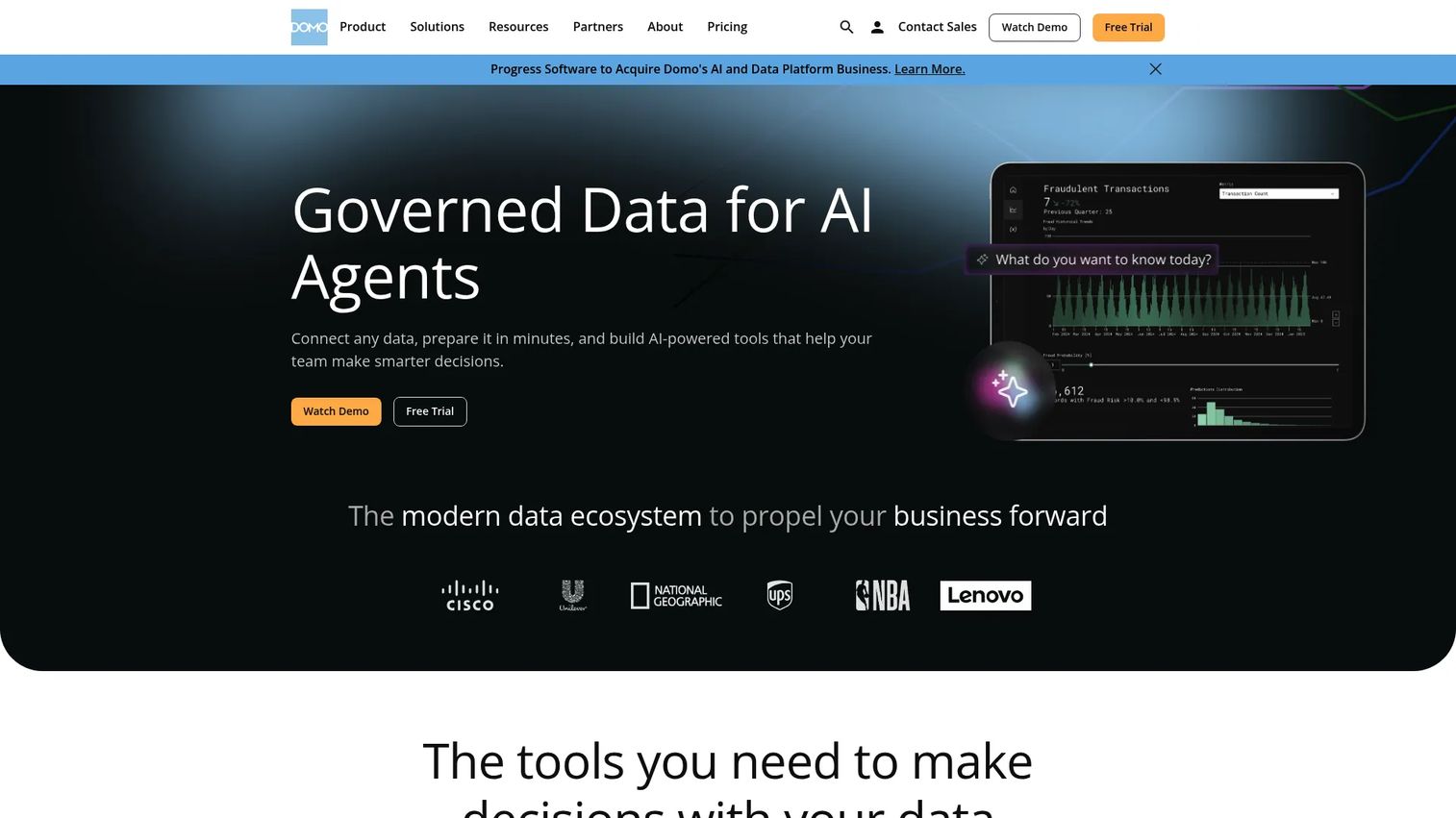
Domo is a cloud-based data experience platform that combines BI, data integration, AI-driven workflows, and app creation in one governed environment. In a data mesh context, Domo works well as the business-facing consumption layer where domain teams build dashboards, alerts, and lightweight apps on top of published data products. It leans toward accessibility for business users rather than deep engineering control.
Best for: Teams that want a governed all-in-one platform for BI, data integration, and AI-driven workflows.
Key strengths
- 1000+ pre-built connectors for source integration
- Built-in BI, dashboards, and alerting
- App creation with security and governance controls
- Business-friendly self-service analytics
Domo fits organizations where the mesh needs a strong consumption surface that non-technical domain owners can operate. It shines when business teams want to publish and consume data products without a heavy engineering dependency, though it pairs best with dedicated catalog and governance tools for federated governance at scale.
Domo pricing: Domo uses consumption-based pricing. User seats are free and organizations purchase credits over a contract period. A 30-day free trial is available. Public numeric starting prices are not listed on Domo's pricing pages.
2. Starburst
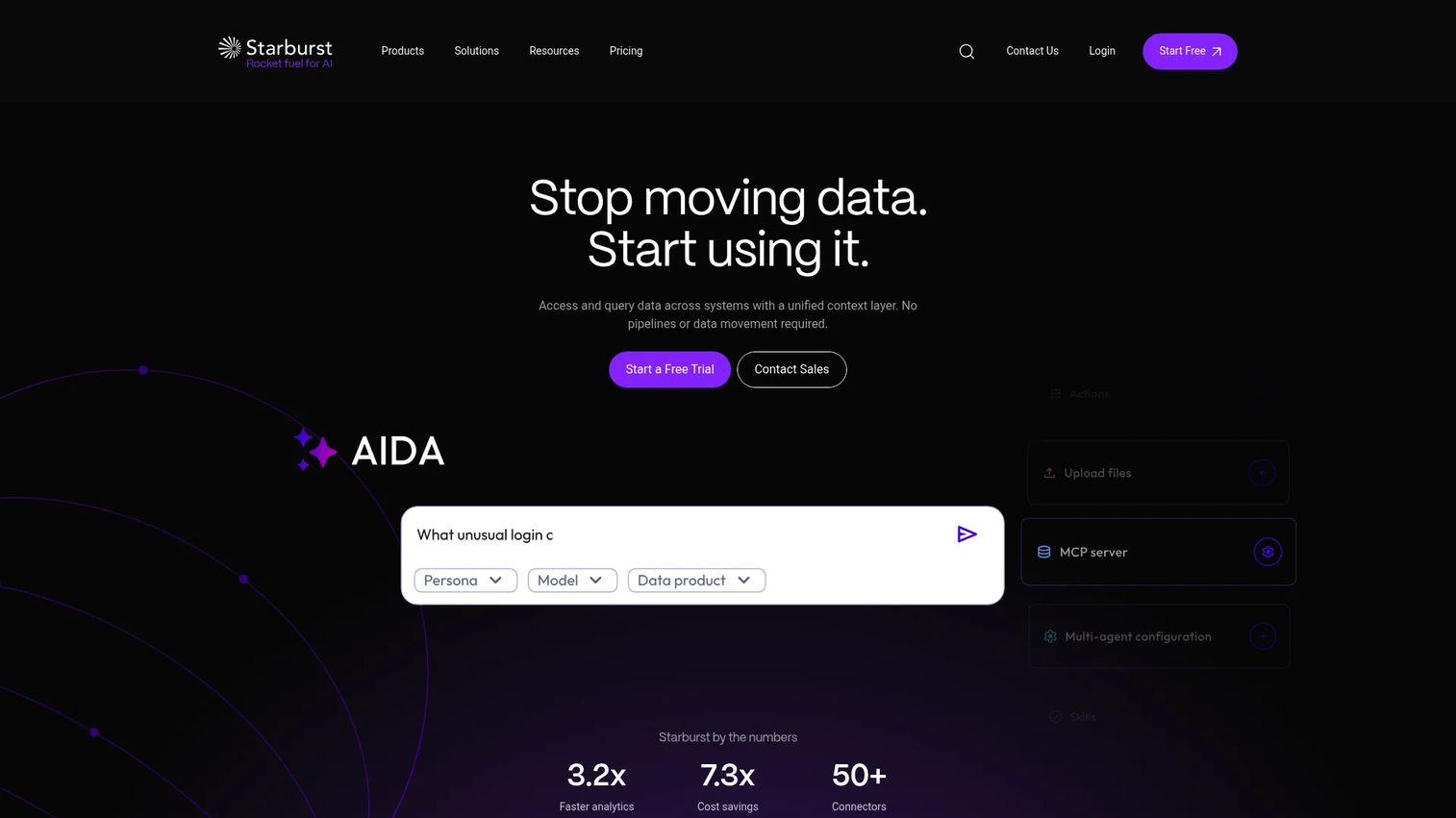
Starburst is a data platform for federated analytics and AI across cloud and on-premises sources, built on the Trino query engine. It maps directly onto a core data mesh pattern: query data where it lives, across domains, without forcing everything into one central store. For teams that need cross-domain analytics over distributed systems, Starburst is one of the closest fits to mesh access principles.
Best for: Enterprises needing governed SQL access across distributed data sources.
Key strengths
- Federated SQL query engine built on Trino
- Managed cloud and self-managed deployment options
- Governance including RBAC, ABAC, and data products
- Cross-domain analytics without central consolidation
Choose Starburst when your domains already sit in different systems and you need one governed query layer over all of them. Its native data products concept and access controls support federated governance directly, which matters when consumers span many teams and clouds.
Starburst pricing: Starburst offers a free tier. Usage-based pricing runs per credit: Pro starts at $0.50 per credit, Enterprise at $0.75 per credit, and Mission-Critical at $1.00 per credit.
3. Databricks
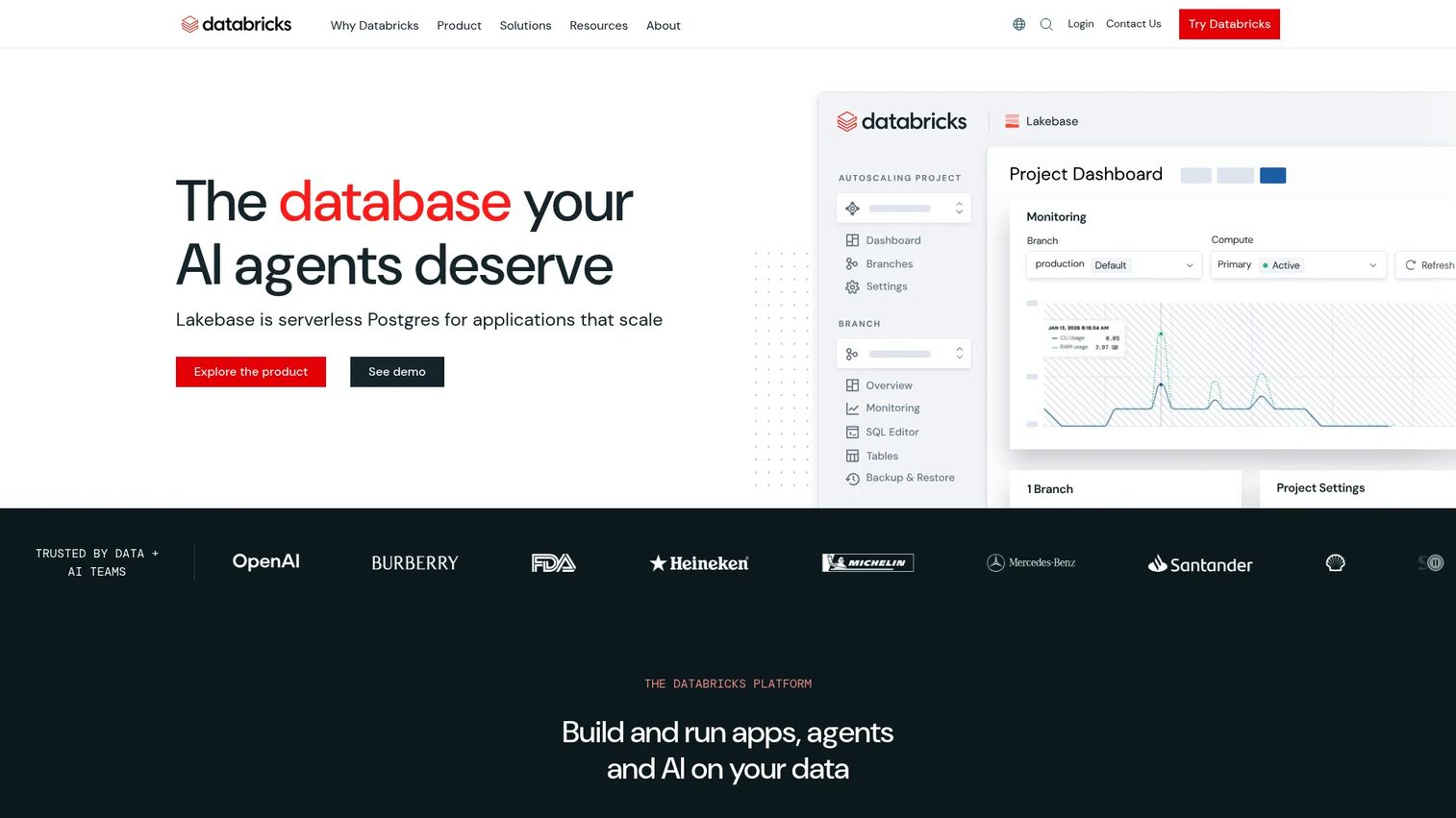
Databricks is a unified data and AI platform for building, governing, and scaling analytics, machine learning, and AI applications on a lakehouse foundation. With Unity Catalog for governance and Delta Sharing for cross-domain data exchange, it provides a strong engineering base for domains that produce and consume data products at scale.
Best for: Enterprises building governed data, analytics, ML, and AI apps on one platform.
Key strengths
- Unified lakehouse for data, analytics, and AI workloads
- Pay-as-you-go pricing with per-second granularity
- Databricks Apps for secure data and AI applications
- Governance and sharing across domains
Databricks is stronger than a pure catalog tool when domains need to build and run heavy data and ML workloads themselves. It supplies the compute and governance foundation for a mesh, while catalog-first platforms handle broad organizational discovery. Many mesh stacks pair Databricks compute with a dedicated metadata layer.
Databricks pricing: Databricks uses pay-as-you-go pricing and offers a 14-day free trial. Detailed per-SKU prices are not exposed publicly on its pricing pages.
4. Snowflake
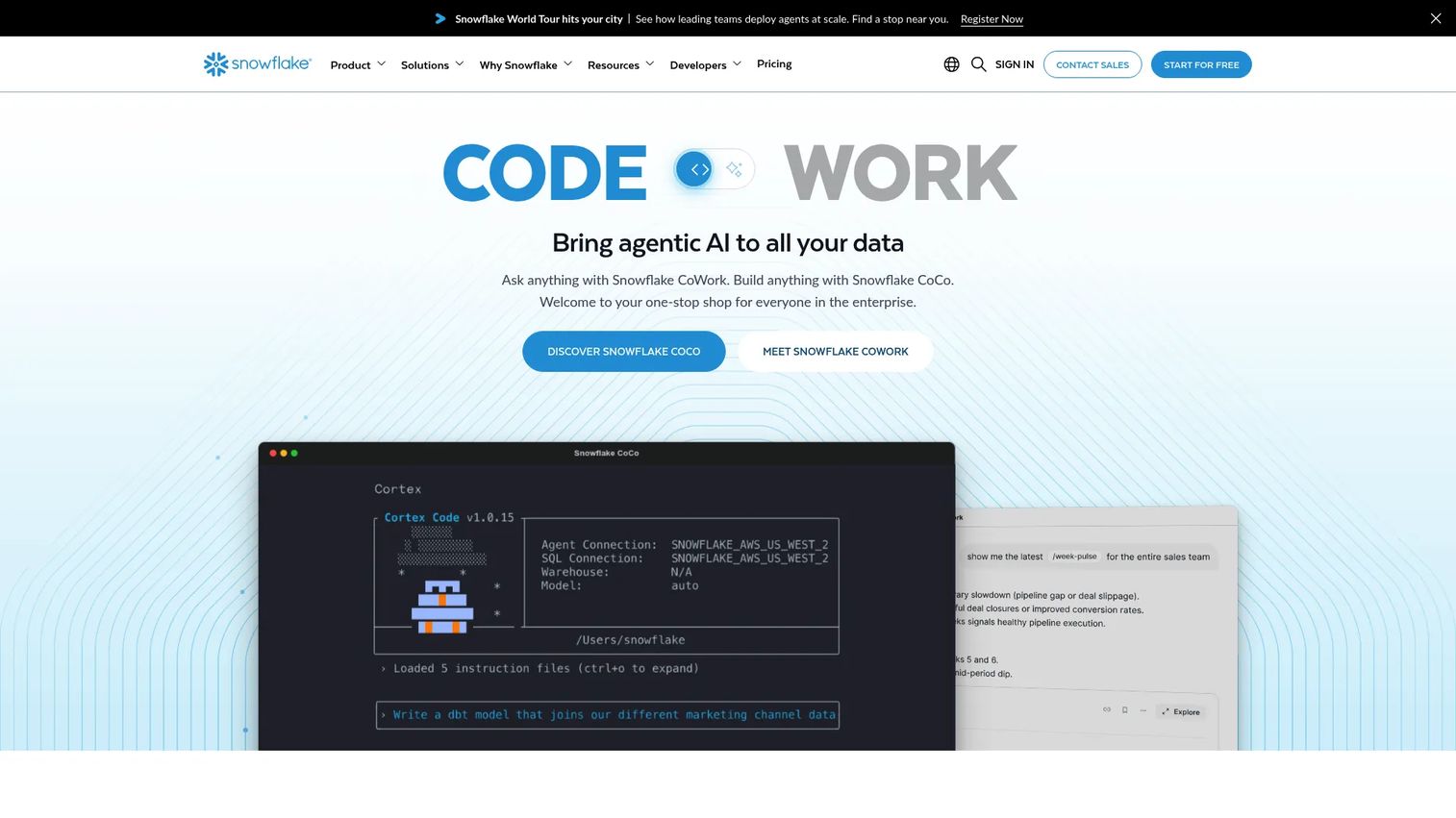
Snowflake is a cloud data platform for storing, processing, sharing, and analyzing data across governed workloads. Its data sharing and Marketplace features fit mesh principles well: domains can publish governed data products and share them across teams or externally without copying data. For organizations already standardizing on Snowflake, it becomes a natural backbone for cross-domain collaboration.
Best for: Enterprises needing a scalable cloud data platform with governed sharing and AI features.
Key strengths
- Consumption-based pricing across editions
- Data sharing and Marketplace for data products
- Snowflake Cortex AI and machine learning
- Standard, Enterprise, and Business Critical editions
Snowflake supports mesh principles through secure sharing that lets domains expose data products without central duplication. It works best when your organization is already committed to Snowflake infrastructure and wants governed sharing plus AI features on top of a single lakehouse-style platform.
Snowflake pricing: Snowflake uses consumption-based pricing per credit. On-demand pricing starts at $2.00 per credit for Standard, $3.00 for Enterprise, and $4.00 for Business Critical, varying by cloud and region, plus separate storage pricing.
5. Dremio
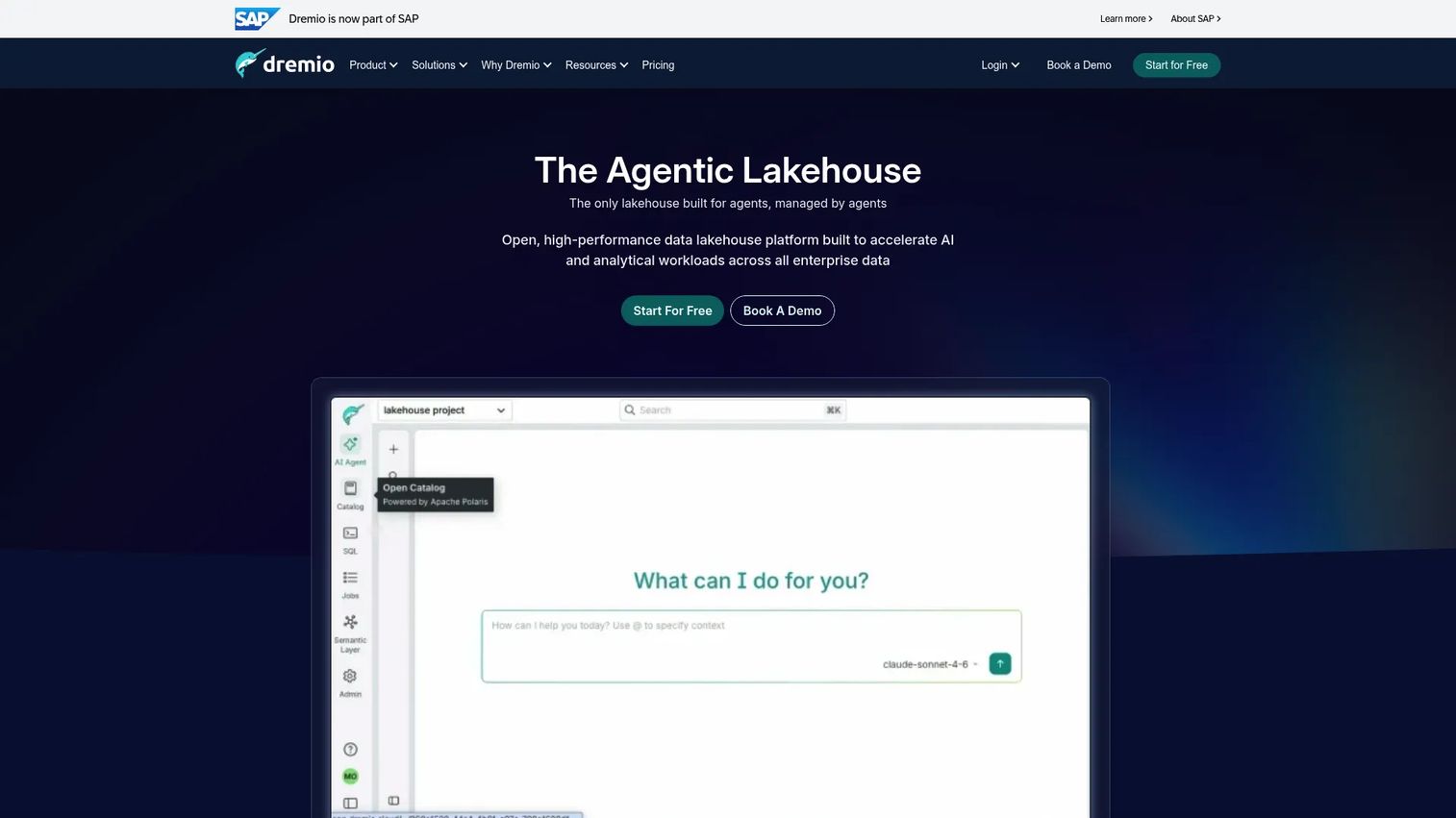
Dremio is an agentic lakehouse platform for analytics and AI on governed data, with a semantic layer and autonomous query reflections that accelerate self-service access. In a mesh, Dremio supports the consumption pattern where domain teams need fast, governed access to distributed data without moving it into a warehouse first.
Best for: Teams needing a governed lakehouse with self-service analytics and AI on their existing data.
Key strengths
- AI Agent with natural-language analytics
- AI Semantic Layer for consistent definitions
- Intelligent Query Engine with federated queries
- Autonomous reflections for query acceleration
Dremio fits mesh-like consumption where speed and self-service matter. Its semantic layer gives domains consistent definitions of shared data products, and federated queries reach distributed sources directly. It integrates well alongside catalog and governance tools that handle broader metadata management.
Dremio pricing: Dremio Cloud is pay-as-you-go at $0.20 per DCU and includes a 30-day free trial with $400 in credits. Dremio Enterprise uses contact-sales pricing.
6. dbt
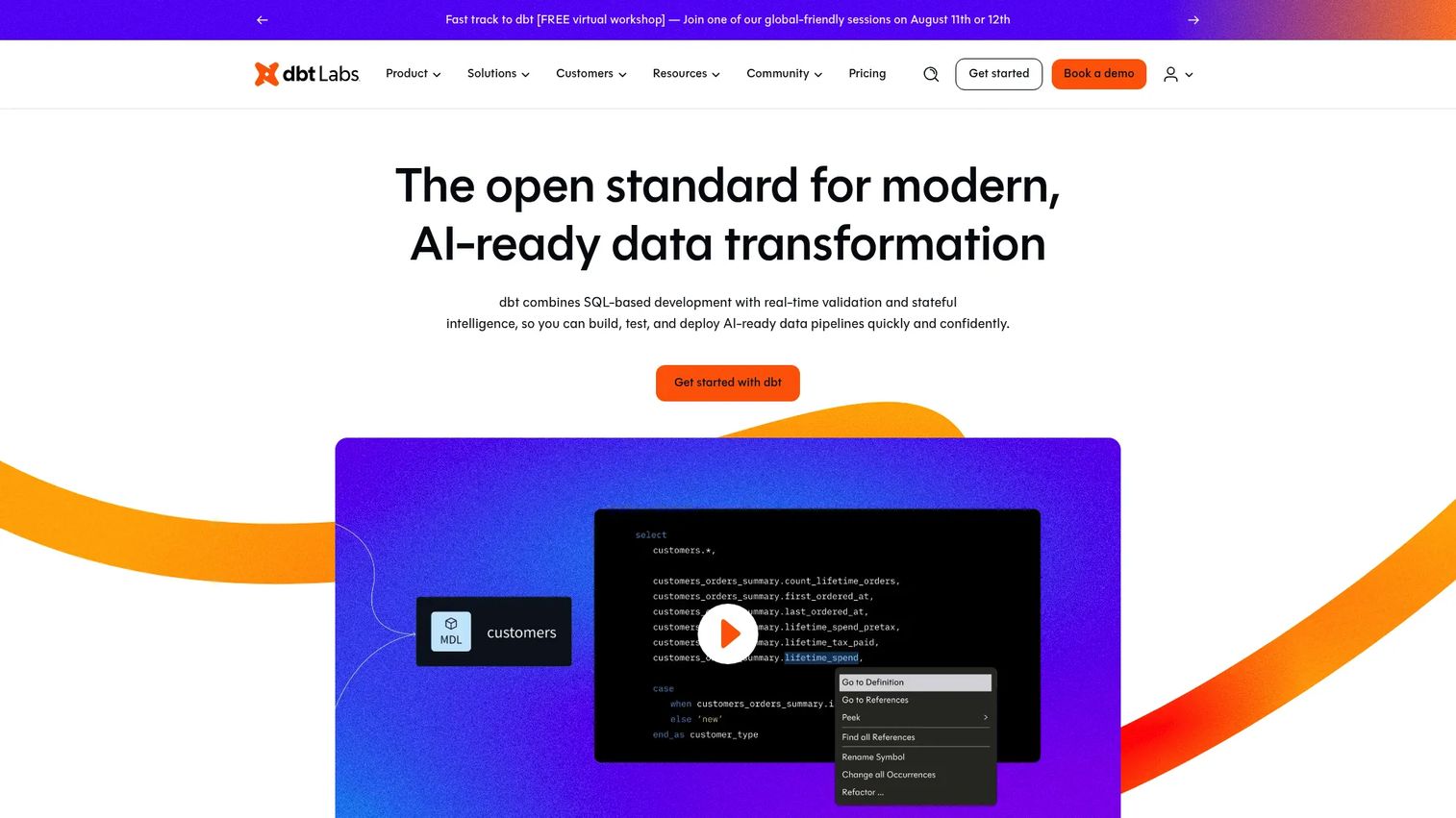
dbt is a data transformation and analytics engineering platform for building, testing, and deploying trusted data products. It is not a whole mesh, but it is a major building block: dbt gives domain teams a version-controlled, tested workflow for turning raw data into documented, contract-backed data products.
Best for: Analytics engineering teams standardizing transformation, testing, and governed data workflows.
Key strengths
- SQL-based data transformation
- Testing and version control
- Orchestration, observability, and cataloging
- Support for data contracts between domains
dbt fits domain-owned pipelines because each domain can own its own transformation project while sharing testing and contract standards across the organization. Data contracts in dbt define the shape and guarantees of published data products, which supports federated governance at the transformation layer.
dbt pricing: dbt offers a free Developer option. Starter is $100/mo/seat. Enterprise and Enterprise+ use custom pricing. dbt State is billed at $0.094 per billable DATT, monthly.
7. Collibra
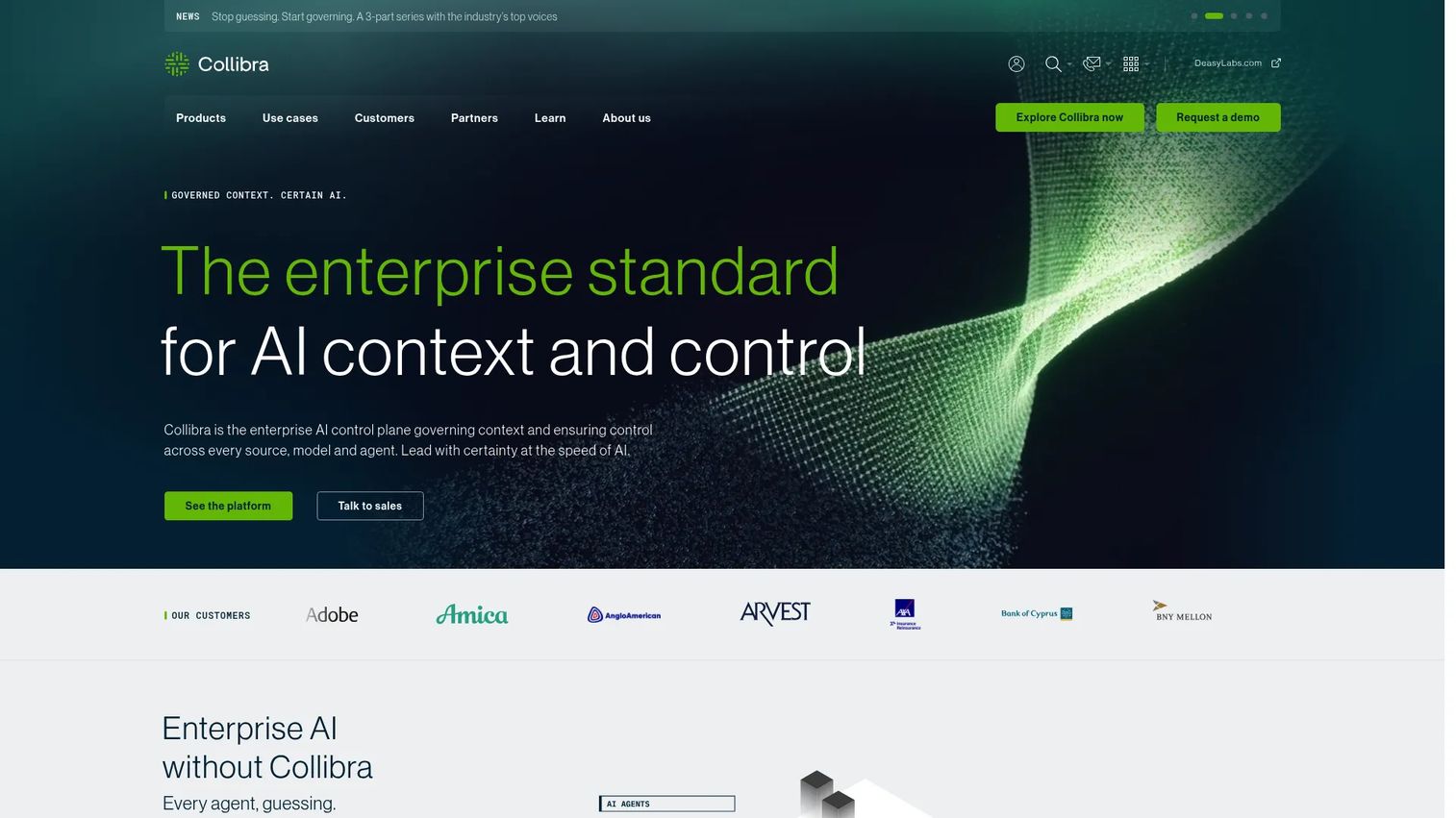
Collibra is an enterprise governance and data intelligence platform with cataloging, policy, stewardship workflows, and an AI control plane. In a mesh, Collibra provides the federated governance layer that keeps domain autonomy from turning into chaos. Policies, stewardship roles, and a data catalog apply consistently across every domain.
Best for: Large enterprises standardizing data and AI governance across many systems.
Key strengths
- AI Command Center for governing AI use cases and models
- Data catalog, governance, quality, and lineage
- Data Marketplace for discoverable data products
- Semantic graph with 100+ native integrations
Collibra fits enterprises where governance at scale is the priority and many systems must follow the same policy. Business teams benefit most through its Data Marketplace, where they discover and request governed data products. It works alongside compute and transformation platforms rather than replacing them.
Collibra pricing: Collibra does not publish public pricing. Its site directs prospects to a sales conversation for pricing options.
8. Alation

Alation is a data intelligence platform for cataloging, governing, and finding trusted data. Discovery is central to any mesh: if consumers cannot find and trust a domain's data products, the model fails. Alation's data catalog, search, and governance workflows make published data products discoverable across technical and business users.
Best for: Enterprises needing a governed data catalog and AI-ready data intelligence platform.
Key strengths
- Data catalog and discovery
- Data governance and policy workflows
- AI and agentic analytics automation
- Search across distributed data products
Discovery matters in a mesh because domains publish independently, and consumers need one place to find trusted data. Alation fits both technical users who need lineage and business users who need plain-language search. It pairs naturally with compute and transformation layers that produce the data products it catalogs.
Alation pricing: Alation does not display public pricing. Its documentation directs prospects to contact an account manager for pricing options.
9. Atlan
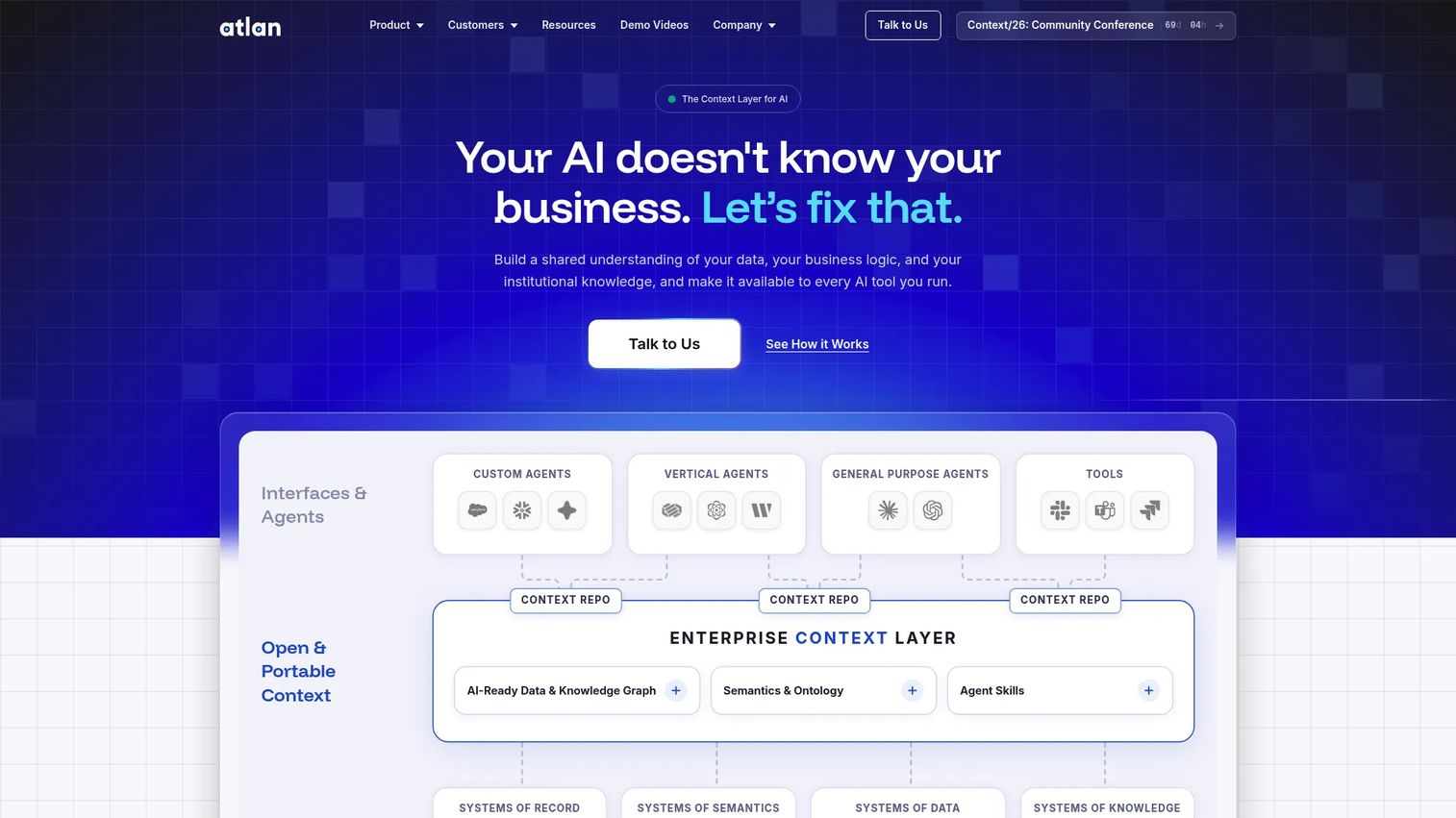
Atlan is a context layer that connects enterprise data, business knowledge, and governance into one platform, built around an Enterprise Data Graph with 80+ connectors. For teams building a modern data operating model, Atlan brings metadata, lineage, collaboration, and active governance into the daily workflow rather than a separate audit tool.
Best for: Enterprises that need governed data discovery, lineage, and AI-ready context.
Key strengths
- Enterprise Data Graph with 80+ connectors
- Column-level data lineage
- Context Agents and Atlan AI
- Collaboration built into governance workflows
Atlan fits domain-oriented ownership because it makes metadata and context a shared, collaborative asset rather than a central bottleneck. It is often evaluated alongside governance platforms because it blends active governance with the collaboration and discovery that domain teams use every day.
Atlan pricing: Atlan does not publish public pricing on its site. Pricing follows an enterprise, contact-sales model.
10. DataHub
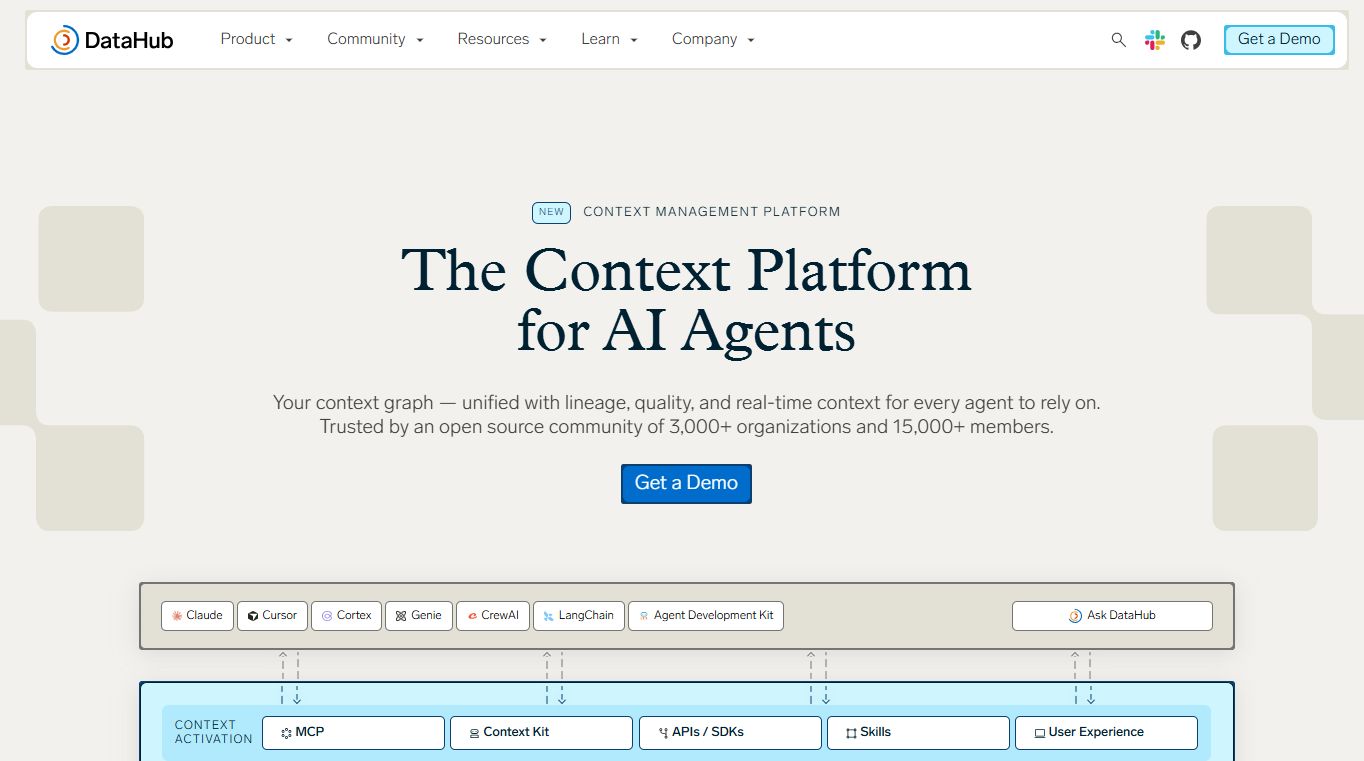
DataHub is an open-source and enterprise metadata platform for data discovery, lineage, governance, observability, and AI context. Its extensibility makes it a favorite for platform teams that want control over the metadata backbone rather than a closed system. In a mesh, DataHub often serves as the open metadata layer that ties domains together.
Best for: Teams needing a metadata platform for data discovery, lineage, governance, and AI context.
Key strengths
- AI-powered discovery, governance, and observability
- Trusted lineage and impact analysis
- Context management for agents and enterprise AI
- Open, extensible architecture
DataHub suits engineering-led organizations that want to shape metadata management to their own model. As an open-source core with a managed DataHub Cloud option, it gives platform teams the flexibility to build the mesh foundation on their terms while still layering discovery and observability on top.
DataHub pricing: DataHub Core is open source. DataHub Cloud is available as a managed option. Public numeric pricing is not listed on the site.
11. Monte Carlo
Monte Carlo is a data and AI observability platform for monitoring, lineage, incident triage, and root-cause analysis. Data products only matter if consumers trust them. Monte Carlo watches freshness, volume, and quality across domains so a broken upstream table gets caught before it corrupts downstream data products.
Best for: Enterprise data teams that need data observability, lineage, and incident response.
Key strengths
- Automated data quality monitoring and profiling
- Field-level lineage across systems
- Incident triage, resolution, and root-cause analysis
- Cross-domain freshness and anomaly detection
Observability supports data-product confidence: domains publishing to a shared mesh need proof their products stay reliable. Monte Carlo complements rather than replaces core platform layers. It sits above your compute, catalog, and transformation tools, watching the data products those layers produce and alerting owners when something breaks.
Monte Carlo pricing: Monte Carlo offers Start, Scale, and Enterprise plans with usage-based pricing. Public numeric starting prices are not listed; the vendor uses contact-sales pricing.
Considerations
Governance model
Verify how the platform enforces ownership, policy, and stewardship across domains. Federated governance works when policies are defined centrally but applied automatically at the domain level, so every data product follows the same rules without a central team reviewing each one. Ask whether policy enforcement is automated or manual, and how stewardship roles map to your domains.
Data product lifecycle
Check how the platform handles versioning, testing, and release management for data products. A mature mesh treats data like software: contracts define interfaces, tests catch regressions, and versioning lets consumers depend on stable outputs. Confirm whether the tool supports data contracts and how it manages breaking changes between domain producers and consumers.
Discoverability and metadata
Evaluate search, lineage, and data catalog depth. Users need to find trusted data fast, understand where it came from, and see who owns it. Weak discovery quietly kills a mesh because consumers fall back to asking central teams. Confirm lineage granularity, whether it reaches column level, and how well the catalog surfaces documentation and ownership.
Interoperability and integration
Verify fit with your warehouse, lake, streaming, and BI stack. A mesh spans many systems by design, so a platform that only integrates cleanly with one vendor undercuts the model. Check connector coverage, open standards support, and how the tool handles data that stays in place across clouds rather than being consolidated.
Observability and trust
Confirm how the platform tracks freshness, anomalies, incidents, and alerts. Domain-owned data products need operational confidence, and observability provides it. Ask how anomalies get detected, how incidents route to owners, and whether alerts reach the domain teams responsible rather than a central queue that becomes its own bottleneck.
Conclusion
Data mesh is an operating model, and no single platform delivers all four of its principles. Your stack depends on where your bottleneck sits today.
For governed federated query across distributed sources, Starburst and Databricks lead. For governance and cataloging depth at enterprise scale, Collibra and Alation are the strongest picks. For metadata backbones, Atlan and DataHub give platform teams the foundation. For transformation and data contracts, dbt is the building block, while Dremio speeds self-service consumption. Monte Carlo keeps data products trustworthy, and Domo and Snowflake bring broad analytics and governed sharing.
Next step: map your four mesh principles against your current stack, identify the weakest layer, and pilot one platform against a single high-value domain before rolling out across the organization. Start narrow, prove the model, then scale ownership outward.
Whichever layer you evaluate first, prioritize interoperability. The tools that win in a mesh are the ones that play cleanly with the rest of your stack, not the ones that try to own every layer.
FAQs
A data mesh is an organizational and architectural model built on decentralized domain ownership, where teams own and serve their own data products. A data fabric is a more technology-centric approach that uses integrated metadata and automation to connect data across systems from a more centralized layer. Data mesh vs data fabric mostly comes down to ownership philosophy: mesh distributes it to domains, fabric emphasizes a unified connective layer.
A data mesh platform should support domain ownership, data products, a self-serve data platform, and federated governance. In practice that means query or compute, cataloging and metadata management, policy enforcement, transformation with data contracts, and observability. No single tool covers all of it, so most organizations assemble two or three platforms that interoperate.
Yes, in practice. A data catalog is what makes distributed data products discoverable, which is the whole point of a mesh. Without one, consumers cannot find or trust data owned by other domains, and they fall back to asking a central team, recreating the bottleneck the mesh was meant to remove. Tools like Alation, Atlan, Collibra, and DataHub fill this role.
Business domains own their data in a mesh. That means the marketing team owns marketing data products, finance owns financial data products, and so on, each responsible for quality, documentation, and access. This distributed ownership replaces the model where one central data team owns everything and becomes the constraint on every request.
Data contracts define the shape, schema, and guarantees a domain promises for a published data product. They let consumers depend on stable interfaces even as producers change what happens upstream. Tools like dbt support contracts at the transformation layer, which is how federated governance gets enforced on data quality rather than left to manual review.
Yes. Both provide strong foundations for a mesh: Databricks through its lakehouse, Unity Catalog governance, and Delta Sharing, and Snowflake through consumption-based compute, governed data sharing, and its Marketplace. Neither is a complete mesh on its own, since both usually pair with a dedicated catalog or governance layer for full cross-domain discoverability and federated governance.
Federated governance means policies are defined once, centrally, but enforced automatically across every domain, rather than a central team reviewing each dataset by hand. It balances domain autonomy with organizational consistency, so each domain owns its data products while every product follows the same rules for security, quality, and compliance. Platforms like Collibra and Atlan operationalize this at scale.
Measure time-to-data for new consumers, the number of published and actively used data products, reduction in central-team request queues, and data product reliability through freshness and incident metrics. Success shows up as domains shipping trusted data products without waiting on a central team, and consumers finding and using them through discovery rather than direct asks.