Your facilities team tracks power and cooling in one system. IT maintains asset records somewhere else. Meanwhile, the CMDB already differs from what sits inside the cage.
Then an expansion request lands. Nobody can confidently prove whether the proposed racks have enough space, power, cooling, or network capacity.
The pressure is growing. The International Energy Agency reported in 2026 that data center electricity demand grew 17% during 2025. Demand from AI focused facilities rose 50%.
Data center management software brings physical infrastructure data into a shared operating model. The right platform can support technical validation, capacity proof, RFP evidence, change control, and multisite visibility.
The hard part is choosing the right scope. Some platforms cover full data center infrastructure management. Others focus on discovery, infrastructure monitoring, electrical systems, connectivity, or continuous asset tracking.
What's inside
This guide compares 15 data center management software and DCIM software options for physical and hybrid estates.
- Who this is for: Data center managers, infrastructure teams, facilities leaders, colocation operators, and presales engineers
- What we evaluated: Asset inventory, capacity models, power and cooling visibility, workflows, and integrations
- How to use this guide: Start with the decision shortcuts, then build a shortlist from the comparison table
- What to verify: Deployment model, device coverage, security controls, integration depth, and total cost
TL;DR
- Best overall for enterprise DCIM: Nlyte covers asset lifecycle management, capacity planning, monitoring, workflows, and ITSM synchronization
- Best for facilities focused estates: Schneider Electric EcoStruxure IT combines infrastructure monitoring with power and cooling context
- Best for visual DCIM operations: Sunbird DCIM covers rack views, floor visualization, connectivity, capacity, and environmental data
- Best for discovery and dependency mapping: Device42 connects infrastructure inventory with application and service context
- Best for cloud based DCIM: Hyperview supports distributed sites through asset based SaaS pricing
- Best technical shortlist: Compare the first five platforms using the same capacity, integration, and asset lifecycle scenario
What is data center management software?
Data center management software helps teams monitor, model, track, and optimize physical infrastructure across assets, racks, power, cooling, space, connectivity, and operational workflows.
The category commonly overlaps with data center infrastructure management software, usually shortened to DCIM software. These platforms create a shared operational view for IT, facilities, security teams, and infrastructure leadership.
A DCIM record should represent more than an asset name and rack position. A server also consumes power, cooling, ports, weight capacity, and operational attention. Effective data center asset management software connects those constraints.
Core capabilities often include:
- Asset inventory: Ownership, location, status, warranty, and retirement records
- Rack visualization: Floor plans, cabinet views, and equipment placement
- Power monitoring: UPS, rack PDU, circuit, branch, and device consumption data
- Environmental monitoring: Temperature, humidity, airflow, and sensor readings
- Capacity planning: Space, power, cooling, weight, port, and circuit availability
- Change workflows: Requests, approvals, work orders, and audit trails
- Connectivity management: Ports, cables, circuits, dependencies, and physical paths
- Sustainability reporting: Energy use, PUE, efficiency trends, and planning data
- System integration: ITSM, CMDB, BMS, APIs, sensors, and reporting platforms
- Estate visibility: Enterprise sites, edge facilities, colocation spaces, and hybrid infrastructure
Data center monitoring software often concentrates on health, alarms, and performance. Full DCIM tools add modeling, planning, asset lifecycle records, and change governance.
The boundary matters during technical discovery. A network monitoring platform may prove device health, while a facilities platform models electrical and cooling conditions. Your requirements matrix should identify which operational record must stay authoritative.
When to use data center management software
Replace spreadsheets before capacity breaks
Spreadsheets become unreliable when equipment moves faster than teams update rows. The same problem affects manually maintained floor plans and rack diagrams.
Use data center capacity planning to test whether proposed equipment fits current space, power, cooling, port, and weight limits. During technical validation, ask each vendor to model the same expansion scenario.
Monitor power and cooling risk continuously
Data center power monitoring connects electrical conditions with infrastructure demand. Cooling monitoring adds temperature, humidity, airflow, and hot spot visibility.
This context supports uptime discussions and facilities planning. Uptime Institute reported an average annual PUE of 1.54 in 2025, virtually unchanged across six consecutive years.
Connect physical infrastructure to IT workflows
Infrastructure changes often involve facilities, IT operations, procurement, and security teams. Disconnected records slow approvals and weaken audit evidence.
Use data center management tools when physical changes must update tickets, configuration records, service maps, and operational reports. Presales teams should test the complete workflow rather than accepting an integration logo.
Data center management software comparison
The table below compares 15 platforms across their strongest use case, differentiation, pricing, and G2 rating. Several products span full DCIM, while others focus on discovery, monitoring, automation, energy intelligence, or asset location.
Use the table to create a shortlist. Then test each candidate against your actual device estate and change process.
| # | Product | Best for | Key differentiator | Pricing | G2 rating |
|---|---|---|---|---|---|
| 1 | Nlyte | Enterprise DCIM and hybrid infrastructure | Asset lifecycle, capacity, workflows, and ITSM synchronization | Custom pricing | 4.5/5 |
| 2 | Schneider Electric EcoStruxure IT | Distributed and facilities focused estates | Multivendor monitoring with power and cooling context | Custom pricing, 30 day trial | 4.5/5 |
| 3 | Sunbird DCIM | Visual DCIM and daily operations | Integrated monitoring and operations with 3D visualization | From $5.50 per node monthly | 4.6/5 |
| 4 | Device42 | Discovery and dependency mapping | Continuous discovery with CMDB and service context | Custom pricing | 4.7/5 |
| 5 | Hyperview | Cloud based DCIM across distributed sites | Asset based SaaS deployment | $3 per asset yearly, 500 asset minimum | 4.8/5 |
| 6 | FNT Command | Complex infrastructure documentation | Physical, logical, and service relationship mapping | From €99 per user monthly, annual billing | 4.4/5 |
| 7 | Cormant-CS DCIM | Campus and data center infrastructure | Combined IT and facilities infrastructure records | Custom pricing | 4.4/5 |
| 8 | ManageEngine OpManager Nexus | Network first infrastructure monitoring | Unified visibility across networks, servers, and applications | From $3,095 perpetual | N/A |
| 9 | Vertiv Trellis | Existing Trellis environments | Critical infrastructure monitoring and planning | Custom pricing | 3.7/5 seller profile |
| 10 | Sunbird dcTrack | Asset and capacity operations | Cabinet based asset, connectivity, and change management | $19.50 per cabinet monthly | 4.6/5 |
| 11 | Eaton Data Center Performance Management software | Electrical and infrastructure performance | Power focused monitoring with digital twin views | Custom pricing | N/A |
| 12 | ABB Ability Data Center Automation | Facilities automation and control | Integrated BMS, EPMS, and DCIM capabilities | Custom pricing | N/A |
| 13 | CommScope iTRACS | Connectivity and physical layer mapping | 3D visualization with cabling intelligence | Custom pricing | 4.5/5 seller profile |
| 14 | Modius OpenData | Energy and infrastructure analytics | Unified operational technology and IT monitoring | From $10,000 yearly | 4.5/5 |
| 15 | RF Code Asset Management | Continuous physical asset tracking | Active RFID location and automated inventory audits | Custom annual subscription | 4.4/5 |
Best 15 tools for data center management software
1. Nlyte
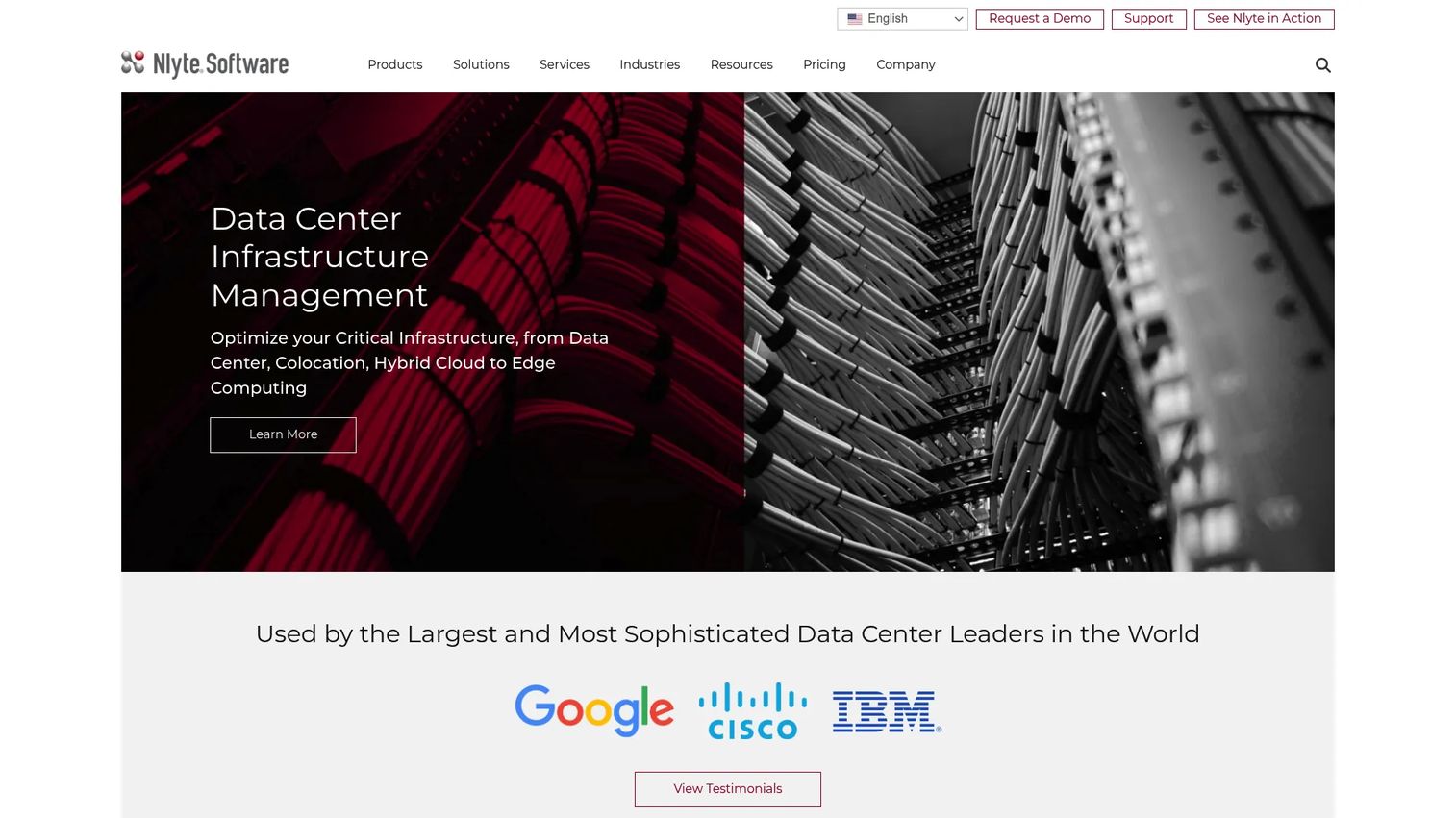
Nlyte provides data center infrastructure management software for physical and hybrid compute estates. It brings asset records, capacity data, infrastructure monitoring, change processes, and system synchronization into one operational platform.
Its scope fits technical committees that need shared evidence across IT and facilities. Compliance reporting and energy analysis also support governance discussions.
Best for: Enterprise teams managing complex data centers, colocation infrastructure, hybrid estates, or edge locations.
Key features
- Asset lifecycle management and tracking
- Space, power, and cooling capacity planning
- Environmental and energy monitoring
- Workflow automation and change management
- ITSM and CMDB synchronization
Why choose Nlyte: Choose it when the evaluation requires enterprise DCIM depth across planning, operations, and governance. Its hybrid infrastructure coverage also supports multisite requirements.
Nlyte pricing: Custom pricing. Contact Nlyte for a quote.
G2 rating: 4.5/5.
2. Schneider Electric EcoStruxure IT
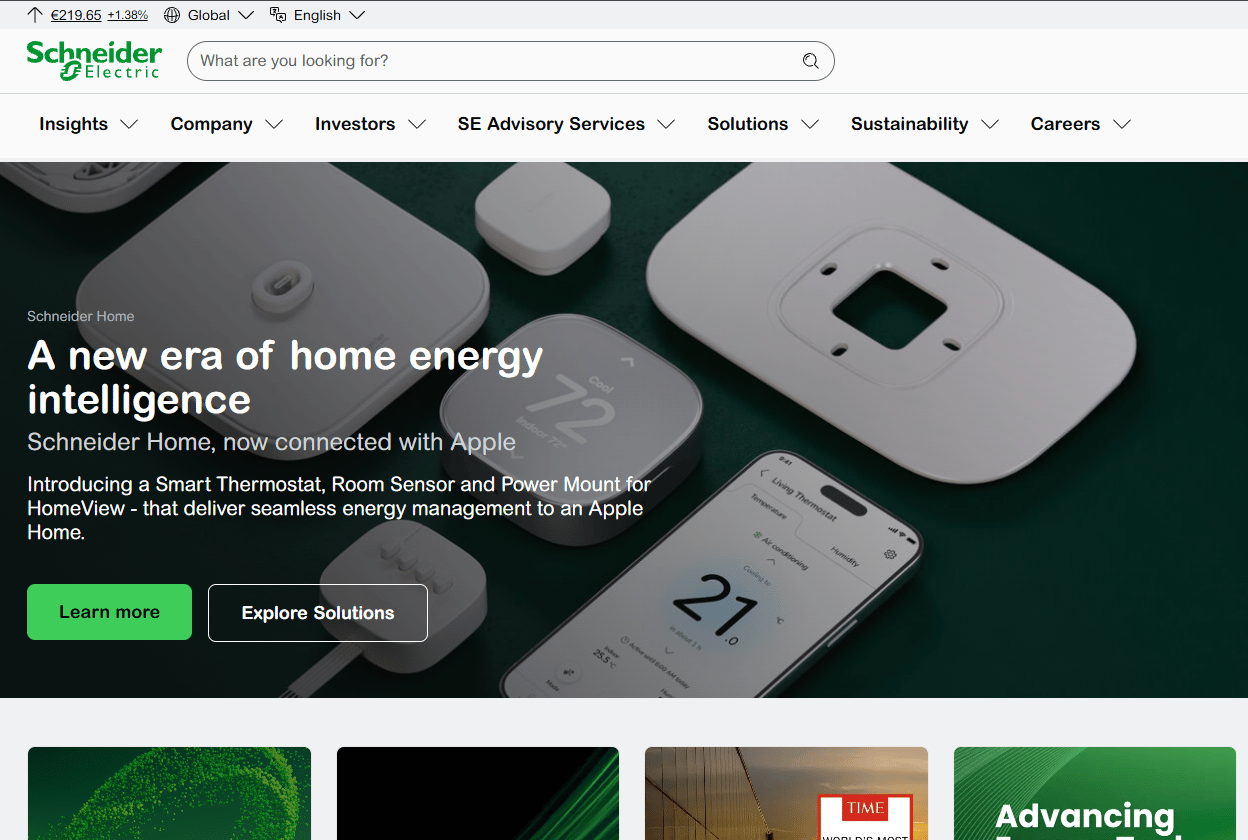
Schneider Electric EcoStruxure IT monitors and manages IT assets alongside power, cooling, security, and environmental conditions. It supports centralized alarms and multivendor infrastructure visibility.
Planning capabilities include capacity modeling and digital twin functions. That combination suits facilities stakeholders who need operational context beyond a standard device inventory.
Best for: Distributed, hybrid, edge, colocation, or multivendor estates with critical facilities requirements.
Key features
- Unified infrastructure monitoring
- Centralized alarms and notifications
- Power and cooling visibility
- Capacity planning and modeling
- Multivendor infrastructure support
Why choose Schneider Electric EcoStruxure IT: Pick it when power systems and cooling conditions drive the evaluation. It provides facilities context for resiliency and capacity discussions.
Schneider Electric EcoStruxure IT pricing: Custom pricing. Subscription terms include one, three, or five years, and a 30 day trial is available.
G2 rating: 4.5/5.
3. Sunbird DCIM
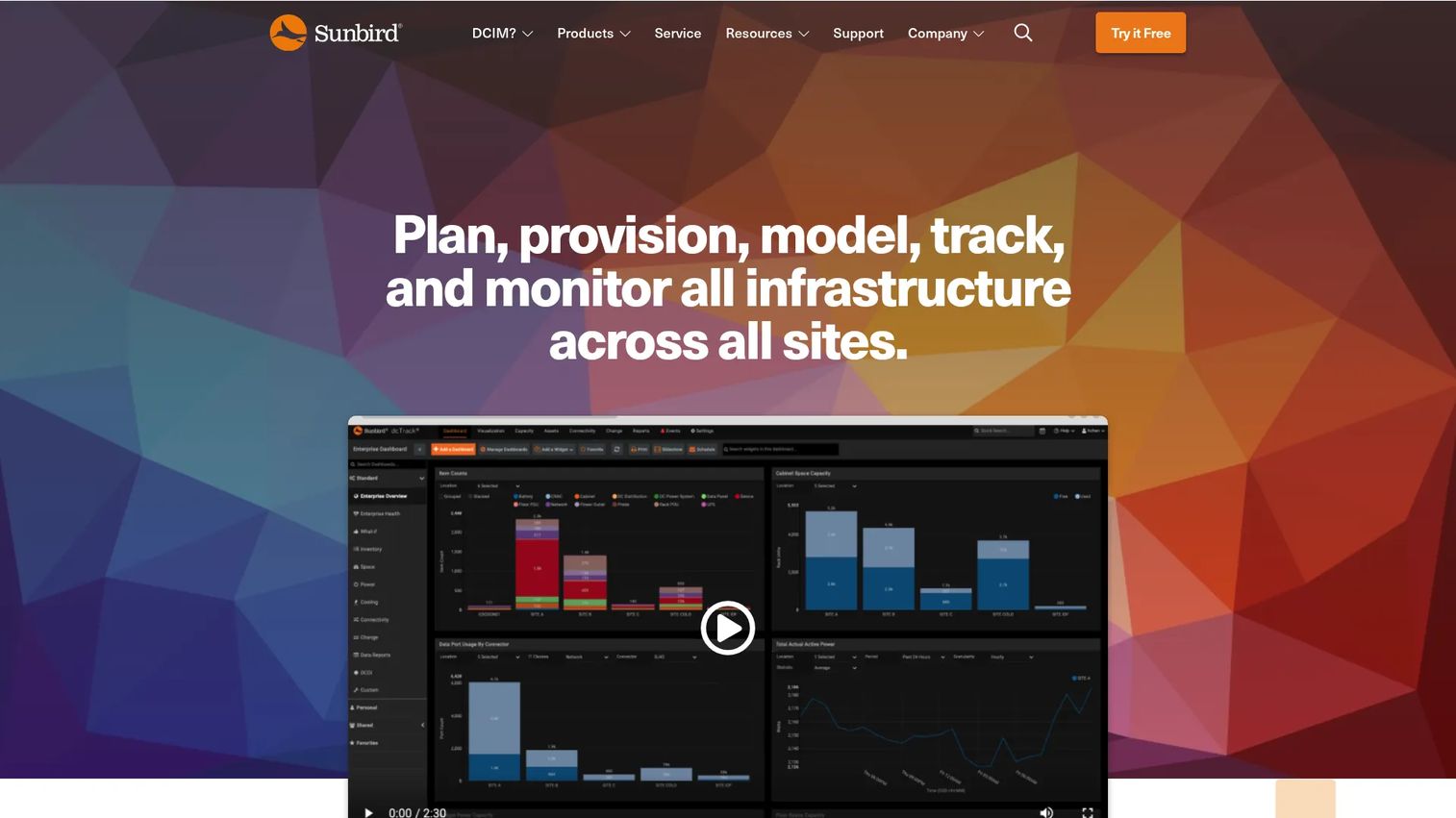
Sunbird DCIM combines data center operations with power and environmental monitoring. Its scope covers assets, capacity, change workflows, connectivity, and 3D infrastructure visualization.
The platform suits operators who need clear rack and floor context during daily work. It can also support data center environmental monitoring across multiple sites.
Best for: Operators managing assets, racks, connectivity, power, environmental conditions, and infrastructure changes.
Key features
- Asset and capacity management
- Change and workflow management
- Power and environmental monitoring
- 3D data center visualization
- Connectivity and cable management
Why choose Sunbird DCIM: Choose it when visual operations and infrastructure records carry equal weight. Its combined suite supports both monitoring and operational control.
Sunbird DCIM pricing: Power IQ starts at $5.50 per node monthly. The combined suite starts at $27.50 per cabinet monthly.
G2 rating: 4.6/5.
4. Device42
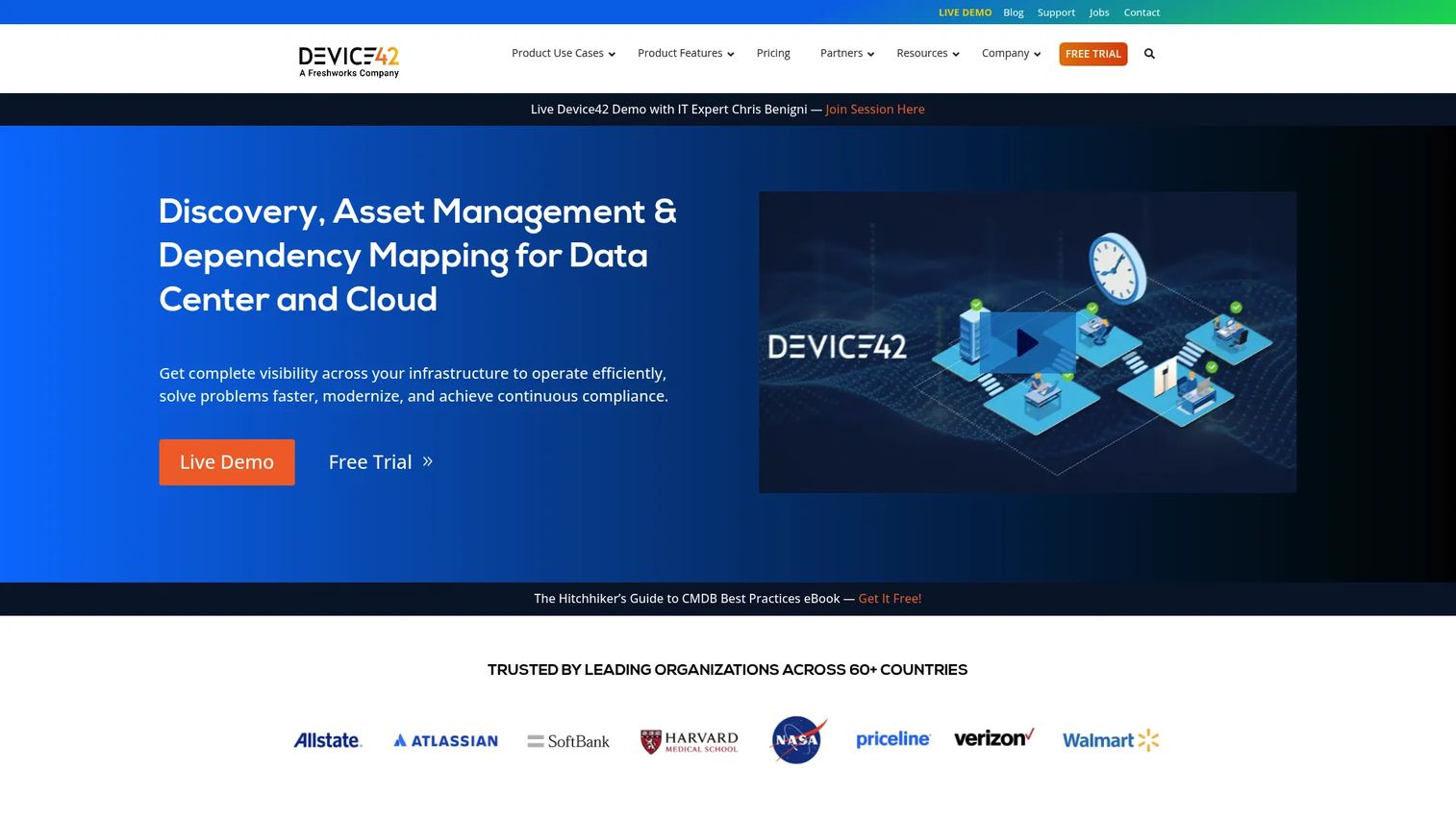
Device42 focuses on hybrid IT discovery, dependency mapping, CMDB records, and asset management. Its data center functions include layouts, racks, patch panels, power, and capacity.
This approach connects physical infrastructure with applications and service dependencies. Presales teams can use that context when migration impact or service mapping drives technical validation.
Best for: IT teams prioritizing continuous discovery, dependency mapping, migration planning, and CMDB enrichment.
Key features
- Hybrid infrastructure discovery
- Application and device dependency mapping
- Built in CMDB and asset management
- Rack, power, and capacity management
- IP address management
Why choose Device42: Select it when discovery and service context matter more than facilities control. It helps explain what infrastructure supports each application.
Device42 pricing: Custom pricing through an annual subscription. Licensing uses devices or licensing units.
G2 rating: 4.7/5.
5. Hyperview
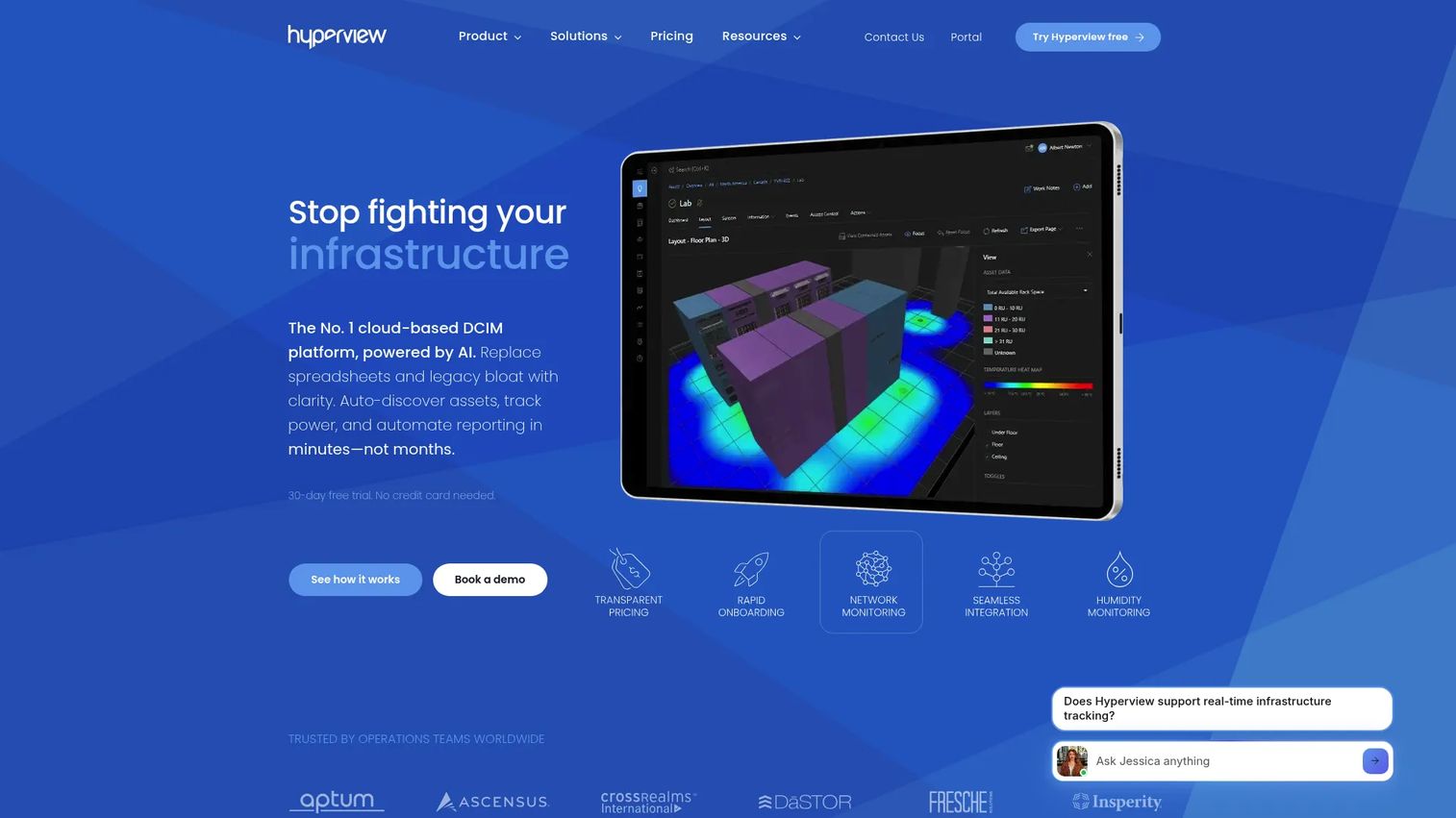
Hyperview is cloud based DCIM software for monitoring and managing distributed infrastructure. It covers asset discovery, lifecycle records, power, temperature, humidity, capacity analysis, alerts, and reporting.
Its SaaS model supports remote operations across data centers and edge sites. Optional modules add connectivity, reporting, control, additional sensors, and asset tracking.
Best for: IT, facilities, and infrastructure teams seeking SaaS DCIM across distributed locations.
Key features
- Agentless asset discovery
- Power and environmental monitoring
- Capacity planning and analytics
- Dashboards, heat maps, and alerts
- REST APIs and integrations
Why choose Hyperview: Pick it when centralized remote visibility matters and an on premises rollout is undesirable. Asset based pricing also creates a clear evaluation baseline.
Hyperview pricing: Starts at $3 per asset yearly with a 500 asset minimum. A 30 day trial is available.
G2 rating: 4.8/5.
6. FNT Command
FNT Command documents physical, logical, and virtual infrastructure in a central repository. It connects assets with locations, cables, network resources, services, contracts, and lifecycle records.
The platform is useful when infrastructure documentation extends beyond racks. Relationship mapping helps technical teams explain service impact and cross domain dependencies.
Best for: Organizations documenting complex data center, telecommunications, network, and service infrastructure.
Key features
- Central infrastructure repository
- Asset lifecycle and location records
- Cable and connectivity documentation
- Relationship and dependency mapping
- Reporting and visualization extensions
Why choose FNT Command: Consider it when documentation depth is the primary requirement. Its modular structure can cover assets, data centers, cables, applications, and telecommunications resources.
FNT Command pricing: Asset Inventory starts at €99 per user monthly with annual billing. The Data Center Management module costs €199 per user monthly.
G2 rating: 4.4/5.
7. Cormant-CS DCIM
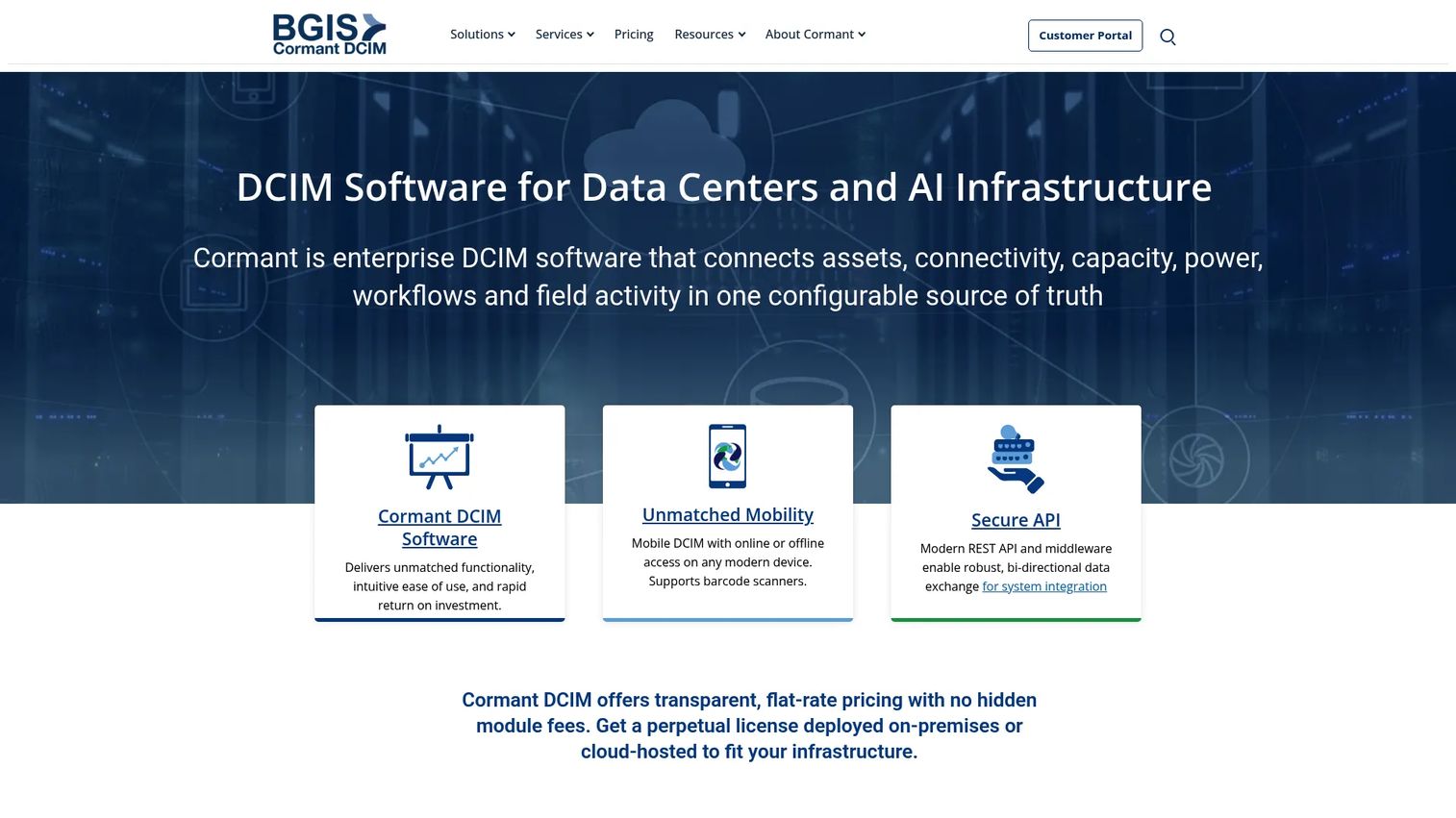
Cormant-CS DCIM manages infrastructure assets across data centers and campus environments. Its operational scope covers facilities equipment, IT assets, networks, power records, and environmental data.
This positioning fits teams seeking shared infrastructure records across facilities and IT. During evaluation, validate the current product modules against your workflow requirements.
Best for: Organizations managing complex data center or campus infrastructure across IT and facilities.
Key features
- Infrastructure asset records
- Facilities equipment inventory
- Network infrastructure data
- Power information management
- Environmental data visibility
Why choose Cormant-CS DCIM: Evaluate it when field operations and infrastructure documentation must use the same records. Test mobile workflows and device coverage during technical validation.
Cormant-CS DCIM pricing: Custom pricing. Contact Cormant for current licensing details.
G2 rating: 4.4/5.
8. ManageEngine OpManager Nexus
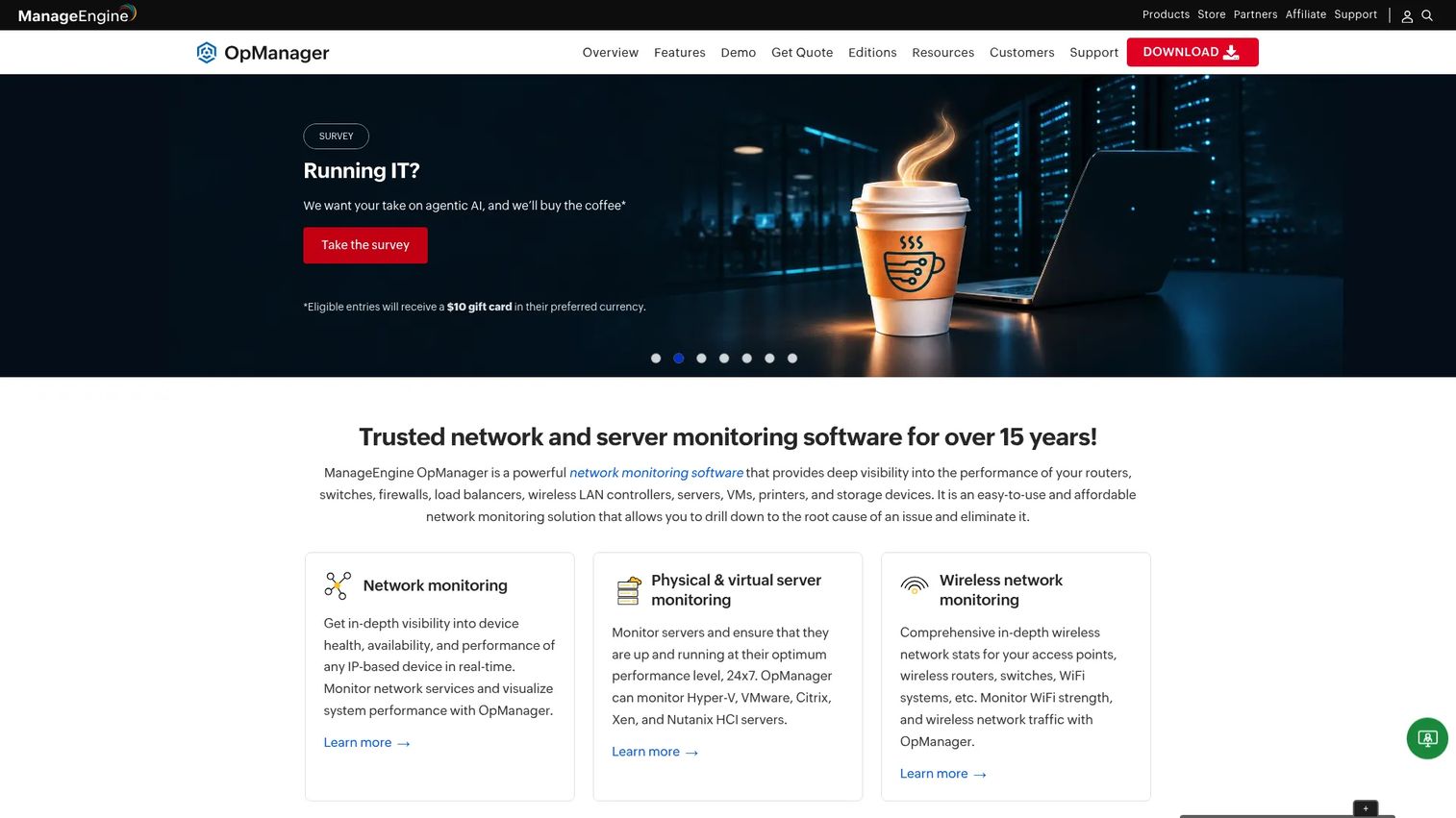
ManageEngine OpManager Nexus provides monitoring across networks, physical servers, virtual infrastructure, storage, and applications. It also covers traffic analysis, configuration management, firewall visibility, and switch port management.
Its focus is broader IT operations monitoring rather than facilities centered DCIM. Network first teams can use it to consolidate infrastructure health views.
Best for: IT operations teams seeking unified monitoring across hybrid infrastructure and applications.
Key features
- Network performance monitoring
- Physical and virtual server monitoring
- Traffic and bandwidth analysis
- Network configuration management
- Application performance monitoring
Why choose ManageEngine OpManager Nexus: Choose it when infrastructure health and network operations lead the evaluation. Facilities teams needing rack capacity models should validate coverage carefully.
ManageEngine OpManager Nexus pricing: Perpetual licensing starts at $3,095 for 50 devices, two users, and one firewall. Subscription and cloud editions use custom pricing.
9. Vertiv Trellis
Vertiv Trellis is a modular DCIM platform for monitoring, managing, and planning critical infrastructure. Its capabilities include asset records, connections, floor space, capacity, power, cooling, and environmental visibility.
Thermal monitoring includes 3D heat maps and hot spot identification. Vertiv identifies Trellis Enterprise products as discontinued, making current support status a central evaluation question.
Best for: Existing Trellis environments assessing continuity, migration, or retained operational coverage.
Key features
- Infrastructure monitoring
- Asset and connection management
- Capacity and floor space planning
- Thermal monitoring and heat maps
- Power and cooling visibility
Why choose Vertiv Trellis: Existing customers may retain it while planning their next platform. New buyers should validate availability, support timelines, and migration options.
Vertiv Trellis pricing: Custom pricing.
G2 rating: 3.7/5 for the broader Vertiv seller profile.
10. Sunbird dcTrack
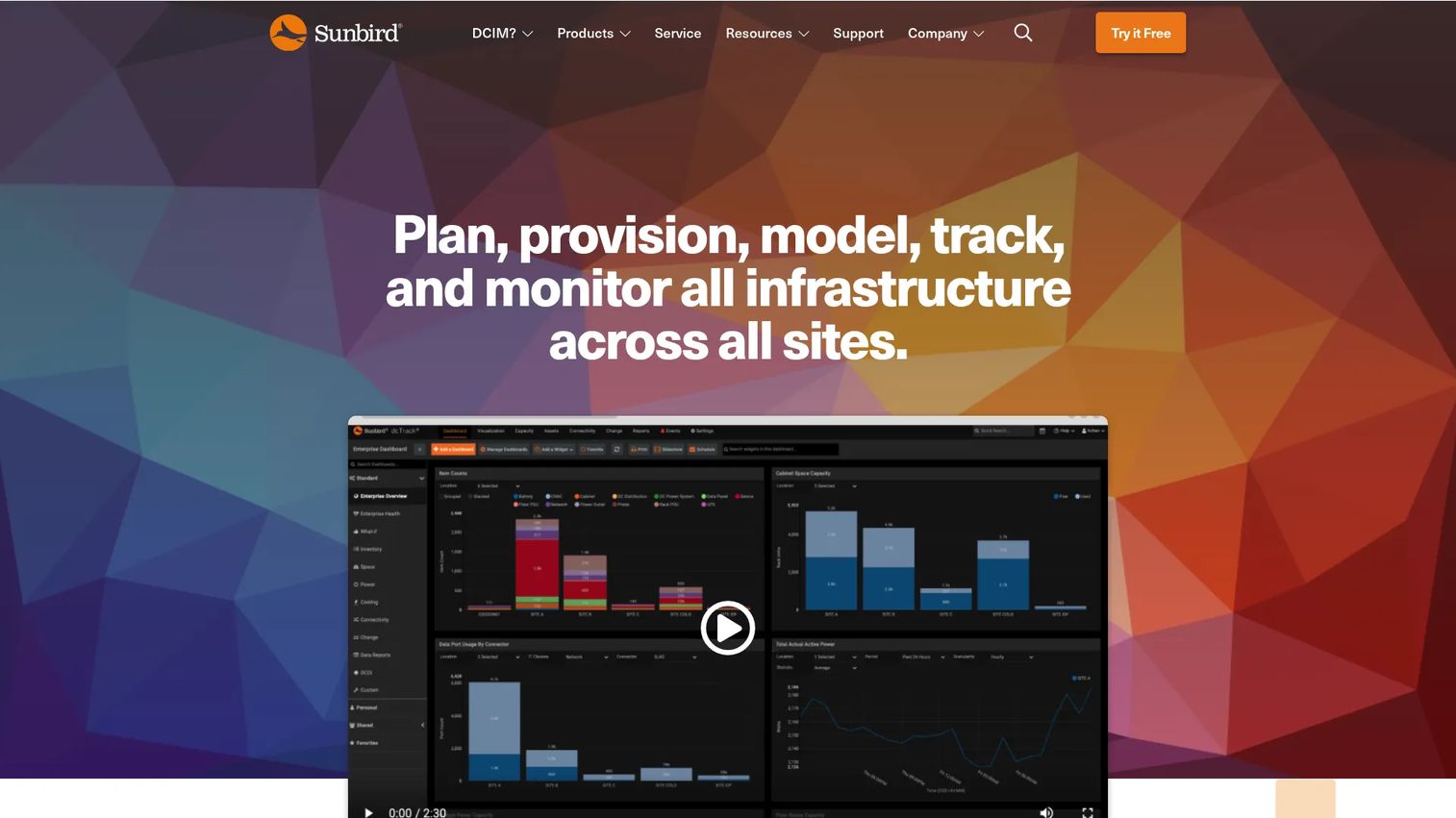
Sunbird dcTrack is the operations component of Sunbird’s DCIM portfolio. It handles assets, rack capacity, power capacity, cooling constraints, connectivity, change processes, and what if analysis.
Visual tools include 3D floor maps and rack views. This narrower operational focus distinguishes dcTrack from the combined monitoring and operations suite.
Best for: Data center operators focused on asset, capacity, connectivity, and change records.
Key features
- Asset inventory and lifecycle records
- Space, power, and cooling capacity
- 3D floor maps and rack views
- Power and network connectivity tracking
- Dashboards and what if analysis
Why choose Sunbird dcTrack: Select it when the priority is operational data center asset management software. It provides cabinet based pricing for straightforward comparison.
Sunbird dcTrack pricing: Starts at $19.50 per cabinet monthly or $234 per cabinet annually. A free test drive is available.
G2 rating: 4.6/5.
11. Eaton Data Center Performance Management software
Eaton Data Center Performance Management software, now named Brightlayer DCIM, manages power, space, connectivity, cooling, and IT assets. It supports multivendor monitoring, historical data, alarms, dashboards, capacity planning, and digital twin visualization.
Its electrical infrastructure context suits estates where power availability drives operational decisions. Visual rack building and floor planning support capacity reviews.
Best for: Enterprise, colocation, hyperscale, or edge operators managing power intensive infrastructure.
Key features
- Multivendor infrastructure monitoring
- Asset lifecycle management
- Visual racks and floor plans
- Capacity planning and what if analysis
- 2D and 3D digital twins
Why choose Eaton Data Center Performance Management software: Consider it when electrical visibility and infrastructure planning share the same evaluation. Use the Brightlayer DCIM name when requesting current product information.
Eaton Data Center Performance Management software pricing: Custom pricing across Essential and Advanced editions.
12. ABB Ability Data Center Automation

ABB Ability Data Center Automation integrates control, monitoring, and optimization across mechanical, electrical, and IT infrastructure. Its scope combines BMS, EPMS, and DCIM capabilities.
The platform covers alarms, historical trends, forecasting, incident reporting, and infrastructure automation. Open bidirectional communication connects mechanical and electrical systems with IT operations.
Best for: Enterprise, colocation, and edge operators with automation heavy facilities environments.
Key features
- Integrated BMS, EPMS, and DCIM
- Power and cooling automation
- Historical trends and forecasting
- Capacity and energy planning
- Root cause analysis and reporting
Why choose ABB Ability Data Center Automation: Evaluate it when facility control is central to the requirement. Its integrated approach suits technical committees spanning operations and electrical engineering.
ABB Ability Data Center Automation pricing: Custom pricing. Contact ABB for purchase information.
13. CommScope iTRACS
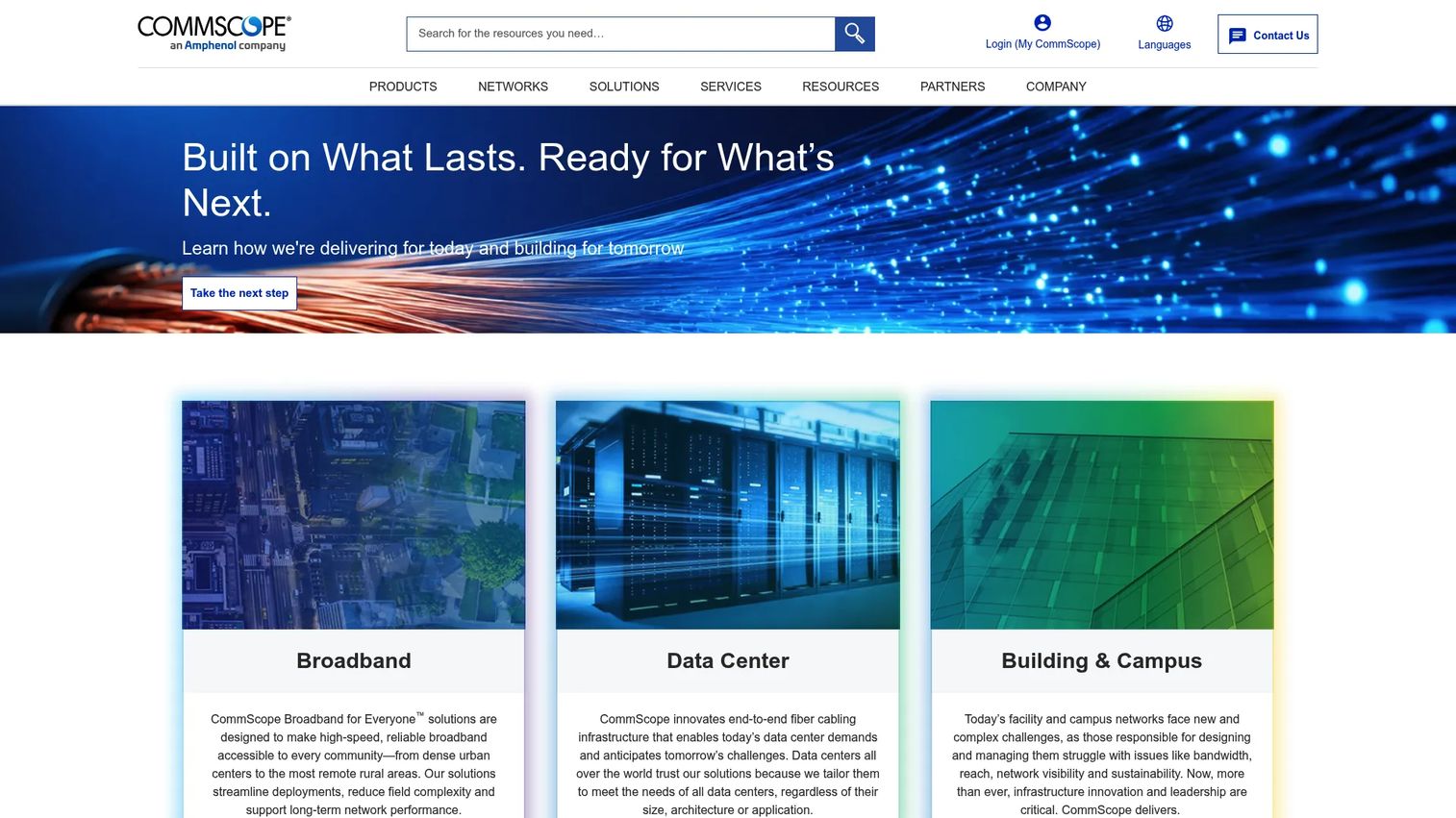
CommScope iTRACS provides visibility across physical and logical data center infrastructure. It covers asset inventory, 3D cabinet visualization, connectivity mapping, power insights, mobile updates, and API access.
Its physical layer emphasis fits complex cabling environments. Natural language access through TRACi supports queries against iTRACS data.
Best for: Large organizations managing complex connectivity, cabling, physical assets, space, and power records.
Key features
- Asset and infrastructure inventory
- 3D cabinet visualization
- Connectivity mapping and reporting
- Mobile connection verification
- RESTful API integration
Why choose CommScope iTRACS: Choose it when physical layer intelligence drives the project. Ask the vendor to prove cable tracing and connection updates using your naming standards.
CommScope iTRACS pricing: Custom pricing. Request a quote through CommScope.
G2 rating: 4.5/5 for the iTRACS seller profile.
14. Modius OpenData
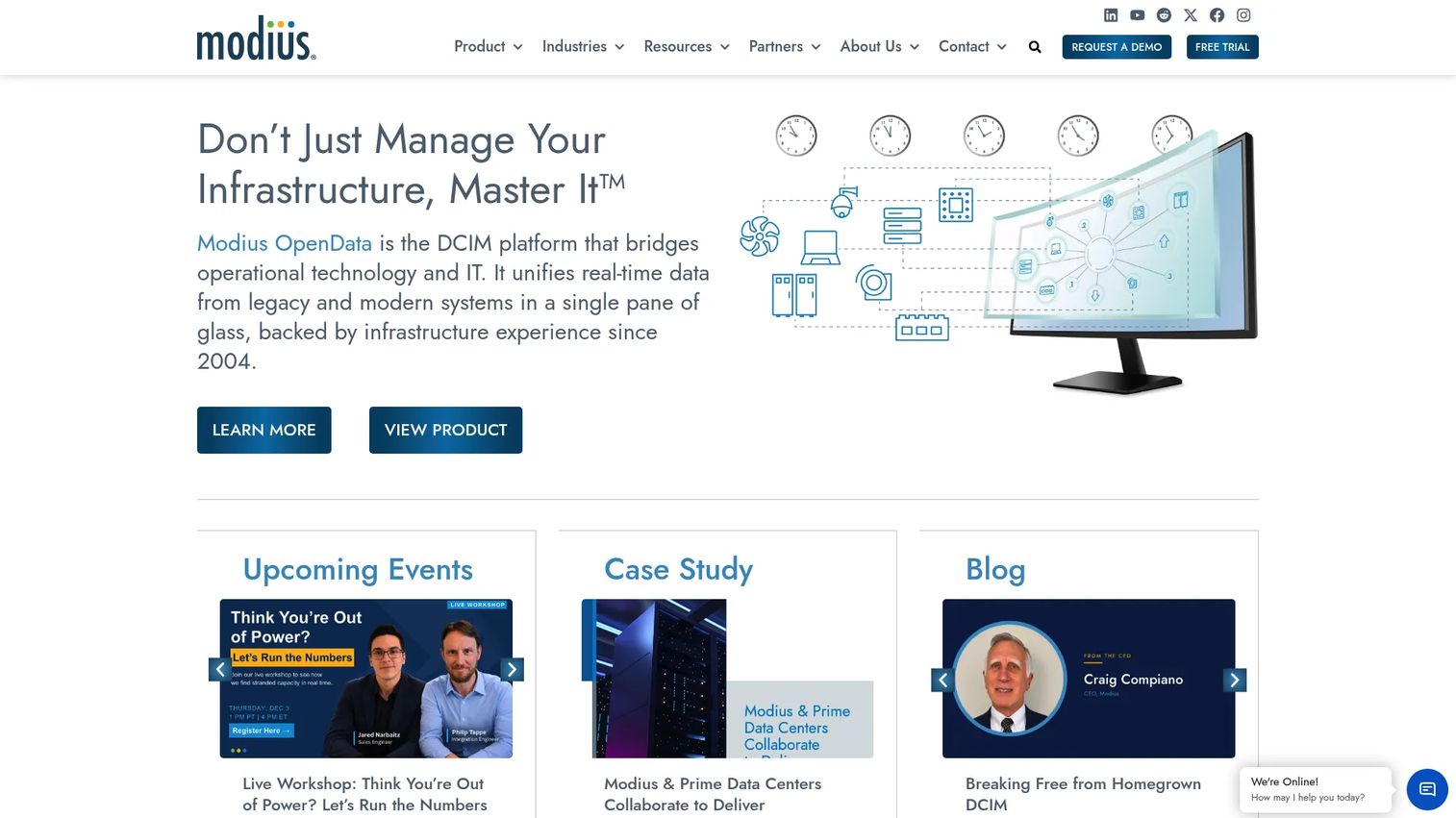
Modius OpenData unifies operational technology and IT infrastructure data across critical facilities. It monitors power, cooling, environmental conditions, and IT equipment in real time.
Custom dashboards support operational analysis across legacy and current infrastructure. Predictive analytics, capacity planning, and digital twin functions add planning context.
Best for: Data center, telecommunications, and critical facility teams prioritizing energy intelligence and infrastructure analytics.
Key features
- Power and cooling monitoring
- Unified operational technology visibility
- Customizable infrastructure dashboards
- Predictive analytics
- Capacity planning and digital twins
Why choose Modius OpenData: Consider it when energy performance and operational analytics lead the business case. Its monitoring scope supports data center sustainability software evaluations.
Modius OpenData pricing: OpenData Essentials costs $10,000 yearly. Broader deployments use custom pricing, and a free trial is available.
G2 rating: 4.5/5.
15. RF Code Asset Management
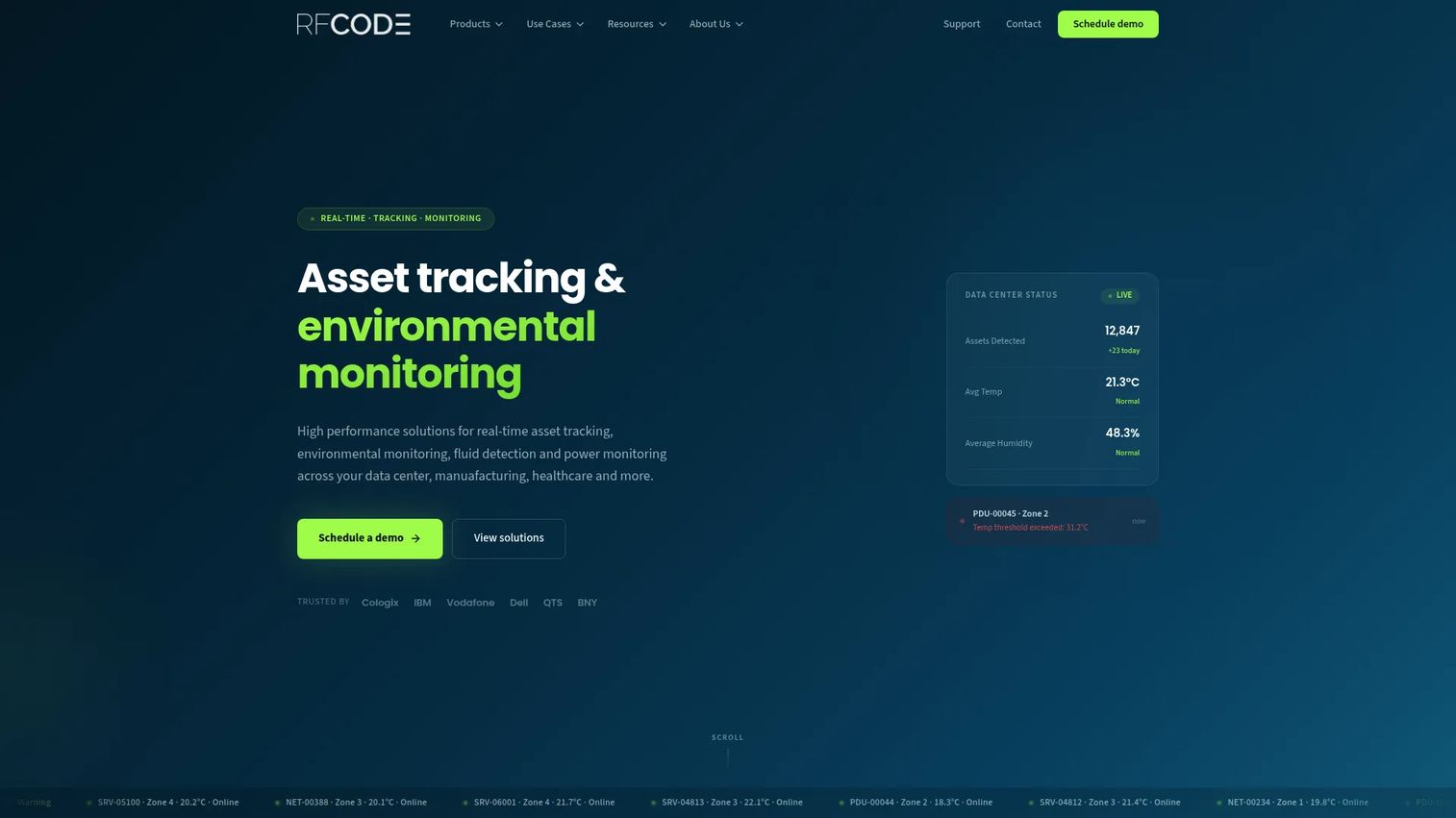
RF Code Asset Management uses active RFID to track physical assets across racks, rooms, zones, loading docks, and disposal stages. It automates inventory audits and maintains asset lifecycle records.
The platform integrates with DCIM, ITSM, and BMS systems through common protocols and REST APIs. Customer data remains within the on premises environment.
Best for: Infrastructure teams needing continuous physical asset location and automated inventory accuracy.
Key features
- Active RFID asset tracking
- Continuous automated inventory audits
- Asset lifecycle and custody records
- Environmental sensor data
- DCIM, ITSM, and BMS integration
Why choose RF Code Asset Management: Pick it when physical inventory accuracy is the main gap. Teams seeking full DCIM can connect its location data with broader operations platforms.
RF Code Asset Management pricing: Custom annual subscription priced per rack or location. Bundles include hardware, software, support, and maintenance.
G2 rating: 4.4/5.
Considerations when choosing data center management software
Match the platform to your estate type
Map requirements across enterprise data centers, colocation environments, edge sites, and distributed facilities. A strong single site platform may handle remote locations differently.
Presales teams should document site count, ownership model, staffing pattern, and deployment constraints before vendor demonstrations.
Validate asset and device coverage
List the equipment that matters: Racks, UPS systems, PDUs, cooling units, sensors, servers, storage, network devices, and cabling.
Check manufacturer libraries and supported protocols. Device coverage determines whether monitoring starts quickly or requires custom connector work.
Test capacity planning before committing
Ask each vendor to model one proposed deployment using your current constraints. Include rack space, power, cooling, weight, network ports, and circuit availability.
The demonstration should prove the capacity model rather than display a polished dashboard.
Check ITSM, CMDB, and facilities integrations
Review how the platform exchanges assets, status, tickets, ownership, and change data. A named integration does not prove field mapping or update direction.
Test CMDB integration with conflicting records. Also confirm how the platform connects with service management, BMS, sensor, and reporting systems.
Review governance and change workflows
Evaluate role based permissions, approvals, audit trails, documentation standards, and change controls. These functions matter when several teams modify the same estate.
Ask vendors to demonstrate a complete move, add, or change request. The process should show ownership and record updates.
Conclusion
The right data center management software depends on the operating problem you need to solve.
Nlyte provides broad enterprise DCIM coverage across hybrid infrastructure. Schneider Electric EcoStruxure IT fits estates where power, cooling, and facilities conditions dominate the evaluation.
Sunbird DCIM is a strong candidate for visual operations and integrated monitoring. Device42 suits discovery led projects that need dependency context. Hyperview offers cloud based DCIM with transparent asset pricing.
Build a requirements matrix before requesting demonstrations. Pick three to five candidates, then give each vendor the same technical scenario.
Include:
- One capacity planning request
- One asset move with approval steps
- A power or environmental alarm
- One ITSM or CMDB synchronization test
Capture gaps, implementation work, security requirements, and pricing in the same scorecard. This makes stakeholder alignment easier and gives procurement defensible evidence.
FAQs
Data center management software monitors, tracks, models, and optimizes physical infrastructure. It commonly covers assets, racks, space, power, cooling, connectivity, environmental conditions, and change workflows.
Broader platforms can also connect physical infrastructure data with service management and configuration records.
The terms often overlap. DCIM software specifically focuses on data center infrastructure management across IT equipment and facilities systems.
Data center management software can describe a broader set of products. That group may include network monitoring, automation platforms, asset discovery, or energy analytics.
Start with asset inventory, capacity planning, rack visualization, power monitoring, cooling data, workflows, reporting, and integration depth. Device libraries and supported protocols also matter.
For technical validation, test the platform with your equipment list and an actual capacity scenario. Avoid evaluating only sample dashboards.
Prioritize platforms with multisite visibility, remote monitoring, asset discovery, edge support, and integrations across IT and facilities systems.
Nlyte, Schneider Electric EcoStruxure IT, Sunbird DCIM, Device42, and Hyperview are practical shortlist candidates. The final choice depends on whether facilities control, discovery, or DCIM operations leads the project.
Pricing models include per asset, per node, per cabinet, per user, perpetual licenses, and annual subscriptions. Many enterprise vendors use custom pricing.
Request a quote that separates software, implementation, connectors, training, hardware, and ongoing support. Compare the same deployment assumptions across vendors.
Yes, when several teams manage changing asset, power, capacity, or connectivity records. Spreadsheets become difficult to govern across sites and frequent infrastructure changes.
A DCIM platform adds structured relationships, permissions, workflows, monitoring, and audit history. Smaller teams should still confirm that the operational value justifies implementation work.
DCIM and CMDB integrations can synchronize assets, configuration items, ownership, location, status, and change data. Some platforms also share dependency or service context.
Test which system controls each field. Bidirectional synchronization without clear ownership can create duplicate or conflicting records.
Smaller facilities may not need a full enterprise suite. They can still benefit when they manage critical uptime, remote sites, dense racks, audits, or recurring capacity changes.
A focused monitoring or asset management product may fit better than broad DCIM. Base the decision on operational complexity rather than building size.