Your rankings report looks healthy. Then leadership forwards an AI answer recommending a competitor and asks why your brand is missing.
Answering that question with screenshots creates another reporting job. AI search analytics tools replace scattered checks with repeatable evidence about what buyers see inside answer engines.
The audience is already there. Pew Research Center reported in 2026 that 42% of U.S. adults use AI chatbots to search for information.
For growth marketers, the challenge is connecting that discovery behavior to decisions. Which content deserves an update? Where is your positioning being misread? Does better AI brand visibility produce qualified traffic?
Useful AI search monitoring tools help investigate those questions without treating every mention as revenue. The buying decision starts with the workflow you want to replace.
What’s inside
This guide compares 15 tools for growth marketers, SEO teams, and agencies evaluating answer-engine measurement.
The selection focuses on four buying criteria:
- Visibility coverage: Relevant engines, tracked prompts, and competitive presence
- Source analysis: Citation evidence that informs content priorities
- Operational fit: Integrations and recommendations your team can use
- Reporting quality: An AI search analytics dashboard that supports leadership or client conversations
The list includes dedicated monitoring platforms alongside broader search intelligence products. Their differences matter more than rank order.
Pricing and rating information comes from vendor pages and G2 sources dated November 24, 2026. Entries distinguish product-specific ratings from broader vendor scores.
TL;DR
- Best overall starting point: Peec combines focused AI visibility measurement with competitor benchmarking and source analysis.
- Best for agency monitoring: Otterly offers prompt research and citation tracking. Its Standard plan supports unlimited workspaces.
- Best for enterprise programs: Profound combines answer intelligence with marketing workflows and AI-sourced traffic analysis.
- Best for existing SEO workflows: Semrush AI Visibility and Ahrefs Brand Radar bring answer-engine data into familiar search intelligence environments.
- Best for optimization work: Scrunch connects measurement with site audits and page improvements. AthenaHQ also offers a free Essential plan.
- Best for specialized context: Similarweb adds market intelligence; Yext Scout focuses on location-level visibility. Match AI search visibility tracking to your operating model.
What is ai search analytics?
AI search analytics measures how brands and content appear in AI-generated answers, including mentions, citations, competitive presence, and sentiment.
Traditional SEO analytics tracks rankings, impressions, clicks, and page performance. Answer-engine measurement adds another view of discovery, including visibility that produces no website visit.
A brand mention and a citation represent different evidence. The first shows inclusion in an answer; the second identifies a source supporting it.
For example, ChatGPT visibility tracking can reveal whether a brand appears for a category prompt. Perplexity citation tracking can identify the pages cited in an answer.
Neither result proves that someone became a customer. Keep exposure metrics separate from AI referral traffic and downstream conversions.
Core metrics AI search analytics tools track
- Brand mentions and recommendation position
- Share of voice against selected competitors
- Citation share and cited URLs
- Prompt-level visibility by engine
- Sentiment and brand framing
- Historical changes in answer inclusion
- AI referral traffic where supported
AI search prompt analytics also needs a defined sample. A prompt library should represent the questions buyers ask at different decision stages.
Keep that baseline stable enough to compare results over time. Adding unrelated queries changes what your overall score represents.
Key features to look for
- Multi-engine coverage
- Repeatable prompt tracking
- Citation and source attribution
- Competitor benchmarking
- Exportable trend history
- Reporting integrations
- Action recommendations
AI search analytics platforms differ in their emphasis. Some prioritize recurring checks; others add content production or broader market research.
Evaluate the handoff from observation to action. Your marketer should be able to identify a relevant gap and explain what to investigate next.
What ai search analytics is not
Generative search analytics complements rank tracking, social listening, and web analytics. Each answers a different measurement question.
Answer engine optimization analytics provides evidence for content decisions. Revenue reporting still needs website behavior and customer data.
The useful output is a documented marketing decision, supported by inspectable answers and sources. A rising visibility score alone cannot establish pipeline impact.
When to use ai search analytics tools
Monitor brand visibility across AI answers
Use AI search tracking when buyers research your category through generated answers. Include questions such as “best CRM for startups” alongside problem-aware searches like “how to reduce churn.”
Separate branded queries from discovery prompts. Otherwise, strong results for your company name can obscure weak inclusion when buyers have not selected a vendor.
Benchmark competitors and share of voice
Track a consistent competitor set to understand relative inclusion. Examine whether rivals appear more frequently or receive stronger recommendations for commercially important questions.
Share of voice in AI search becomes useful when grouped by buyer intent. A gap around implementation questions calls for different work than missing category recognition.
Use those distinctions to prioritize campaigns rather than reacting to an isolated answer.
Turn citations into content priorities
Citation analysis helps identify the sources answer engines reference. Review whether those URLs support current positioning or repeat outdated information.
Then assign the appropriate action, such as refreshing a comparison page or correcting a third-party listing. Keep an owner and completion date beside each task.
AI search visibility tracking earns its place when recurring observations produce a manageable weekly backlog.
AI search analytics tools comparison
The table is a starting point for shortlisting AI search analytics tools. Engine coverage and prompt allowances matter alongside the subscription price.
These products also serve different jobs. Dedicated AI search monitoring tools emphasize answers and citations, while broader platforms add SEO execution or market intelligence.
Before comparing AI search analytics platforms, define your required reporting output. An agency managing client workspaces has different requirements from an enterprise investigating market-level demand.
For AI search competitor tracking, inspect how each vendor calculates inclusion and sentiment. Ask to see the answer behind an aggregate score.
“N/A” means no usable G2 rating was established in the research. ZipTie and Knowatoa had listings without reviews; their displayed zero averages are not customer evaluations.
| # | Product | Best for | Key differentiator | Pricing | G2 rating |
|---|---|---|---|---|---|
| 1 | Peec | Focused SEO and growth monitoring | Brand perception and cited-source analysis | From $95/month | 4.7/5 |
| 2 | Otterly | Agency reporting workflows | Prompt research and multi-workspace monitoring | From €29/month | 4.7/5 |
| 3 | Profound | Enterprise AI marketing programs | Answer intelligence plus marketing agents | Custom pricing | 4.5/5 |
| 4 | Semrush AI Visibility | Existing SEO operations | AI visibility and site-readiness auditing | $99/domain/month, billed annually | N/A |
| 5 | Ahrefs Brand Radar | Brand and search intelligence | Broad discovery data plus custom prompts | Custom prompts from $50/month; index from $199/month | 4.5/5, Ahrefs |
| 6 | Scrunch | Measurement and website optimization | Monitoring linked to page-level improvements | From $250/month | 4.6/5 |
| 7 | ZipTie | Configurable monitoring programs | Adjustable engines and refresh frequency | From $25.65/month | N/A |
| 8 | Similarweb | Market and traffic intelligence | AI insights alongside competitive web data | Custom pricing | 4.4/5 |
| 9 | Orchly | Monitoring and content operations | SEO agents alongside visibility analysis | From $49/month | N/A |
| 10 | AthenaHQ | SEO and PR collaboration | Citation analysis and PR workflows | Free; paid from $295/month | 4.9/5 |
| 11 | SE Visible | Structured client reporting | Prompt classification and reporting connectors | From €64/month, billed annually | 4.5/5 |
| 12 | Knowatoa | Answer monitoring and bot access | Visibility analysis plus AI crawl testing | From $59/month | N/A |
| 13 | SearchAnalytics.ai | Prioritized SEO execution | GSC, GA4, and competitor evidence | From $299/month | N/A |
| 14 | Amadora.ai | Search optimization and publishing | AI visibility connected to content execution | From $99/month | 5.0/5 |
| 15 | Yext Scout | Multi-location brands | Location-level competitive intelligence | Custom pricing | 4.4/5, Yext |
Best 15 tools for ai search analytics
1. Peec
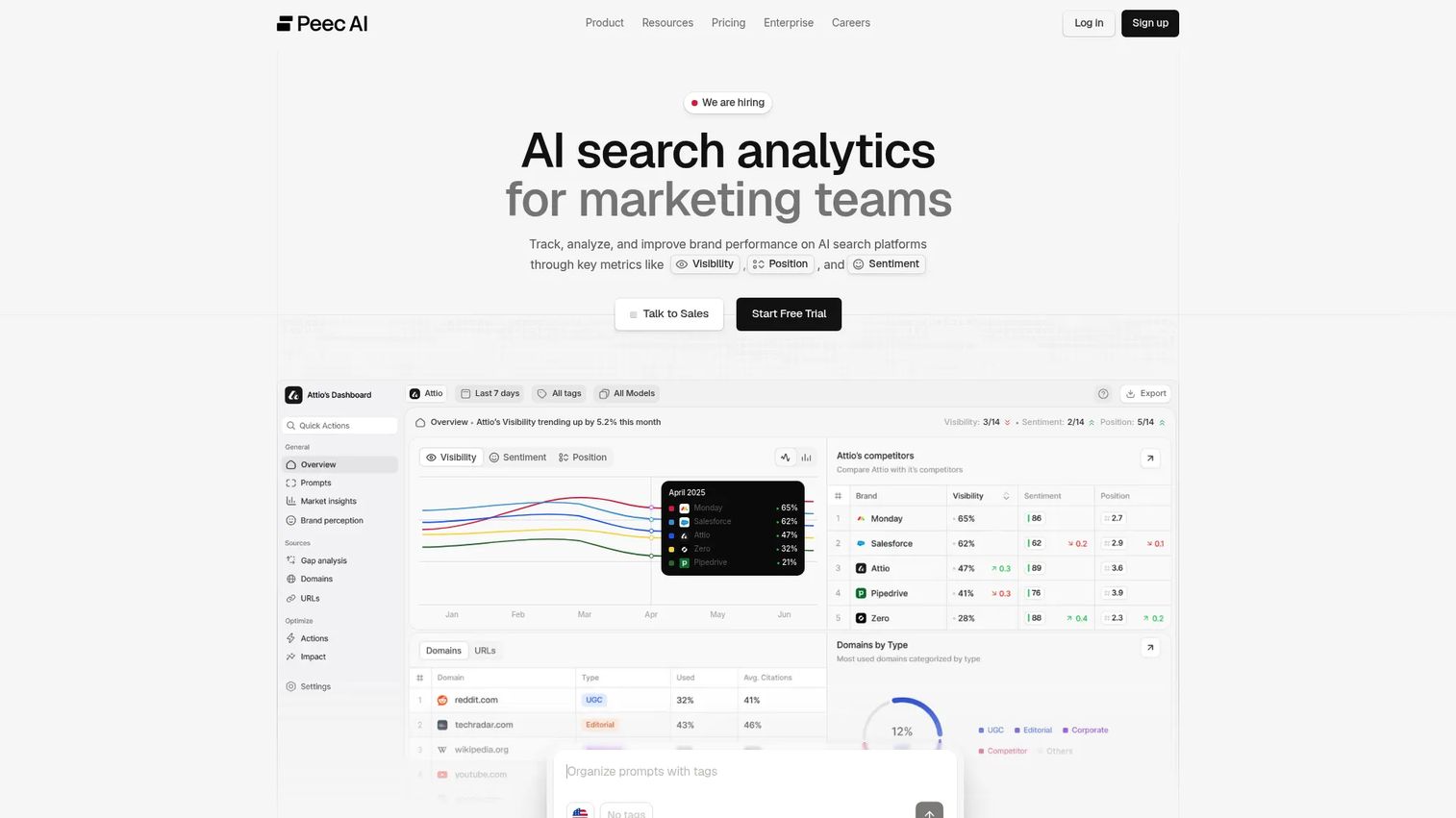
Peec is a dedicated AI search analytics platform for tracking brand performance across answer engines. Its measurement includes visibility and sentiment alongside competitive share of voice. Source analysis shows which third-party sites influence answers, while perception tools examine claims and objections associated with your brand.
That combination suits a marketer who needs to explain why inclusion changed, rather than deliver another screenshot. An incorrect product claim and a missing recommendation require different responses.
Best for: SEO and growth teams building a focused, recurring AI visibility program.
Key features
- Prompt tracking and competitor benchmarking
- Citation and source analysis
- Brand perception and claim checking
- AI shopping and agent analytics
- API, MCP, and integrations
Why choose Peec: It provides a category-specific starting point when manual answer checks have become a recurring reporting burden. Its perception analysis also gives brand teams a reason to participate.
During evaluation, bring a question where an engine describes your product incorrectly. Ask how the evidence moves from that answer into a task for your content owner.
Also inspect the additional-model charges. Compare the full coverage you require rather than assuming every engine sits inside the entry subscription.
For leadership reporting, request a view that separates presence from favorable positioning. Being named frequently does not automatically mean your product is being recommended for the right buyer.
Peec pricing: Starter costs $95/month; Pro costs $245/month, while Advanced costs $495/month. A free trial is available, and annual billing offers a 15% discount.
G2 rating: 4.7/5.
2. Otterly
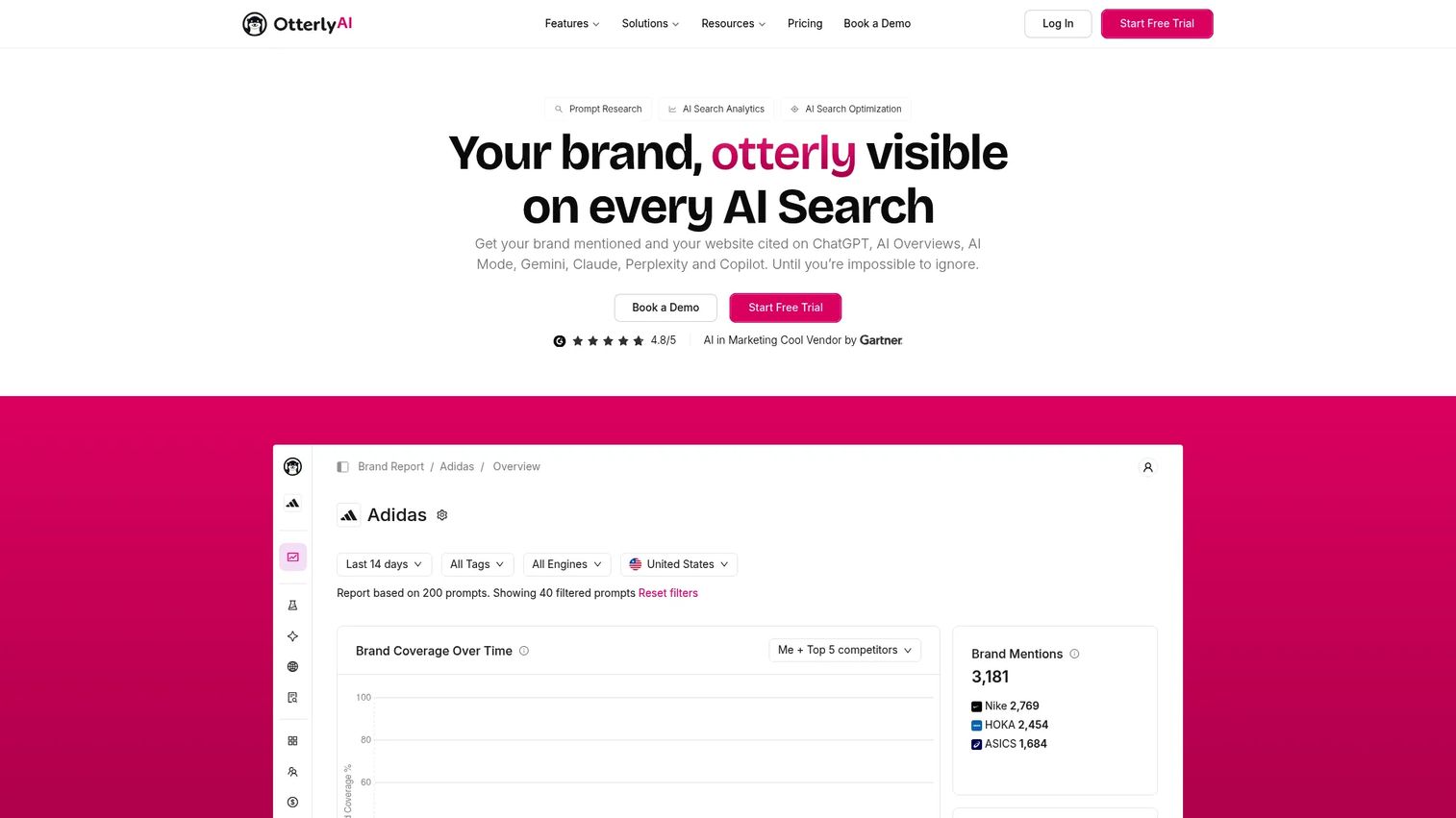
Otterly monitors brand visibility and citations across AI search engines. It combines prompt research with source-domain ranking and optimization recommendations. Agencies can use its workspace structure to organize recurring checks across clients.
The practical appeal is a repeatable reporting process. Instead of rebuilding a spreadsheet for each account, evaluate whether the platform supports a consistent research and review routine.
Best for: Agencies and marketing teams managing recurring AI visibility reporting.
Key features
- AI prompt research
- Citation-source tracking and domain ranking
- Generative Engine Optimization audits
- AI search optimization recommendations
- Paid-plan API and MCP access
Why choose Otterly: Its monitoring and audit capabilities fit teams selling ongoing analysis rather than occasional visibility snapshots. Workspace allowances are especially relevant to agency budgeting.
Plan selection changes the operating model. Lite includes 16 prompts and one workspace; Standard expands to 120 prompts and unlimited workspaces.
Premium provides 403 prompts with daily or weekly tracking. Those allowances deserve attention before importing every keyword from your traditional SEO account.
For an agency trial, use separate client examples with different category language. Check whether the resulting reports preserve those differences without requiring extensive manual explanation.
Then ask an account manager to present the findings. The report should make a client decision clearer, including which cited source deserves investigation and why.
Keep optimization recommendations accountable to evidence. Review the supporting answer before turning an automated suggestion into billable implementation work.
Otterly pricing: Lite costs €29/month; Standard costs €189/month, and Premium costs €489/month. A free trial is available.
G2 rating: 4.7/5.
3. Profound
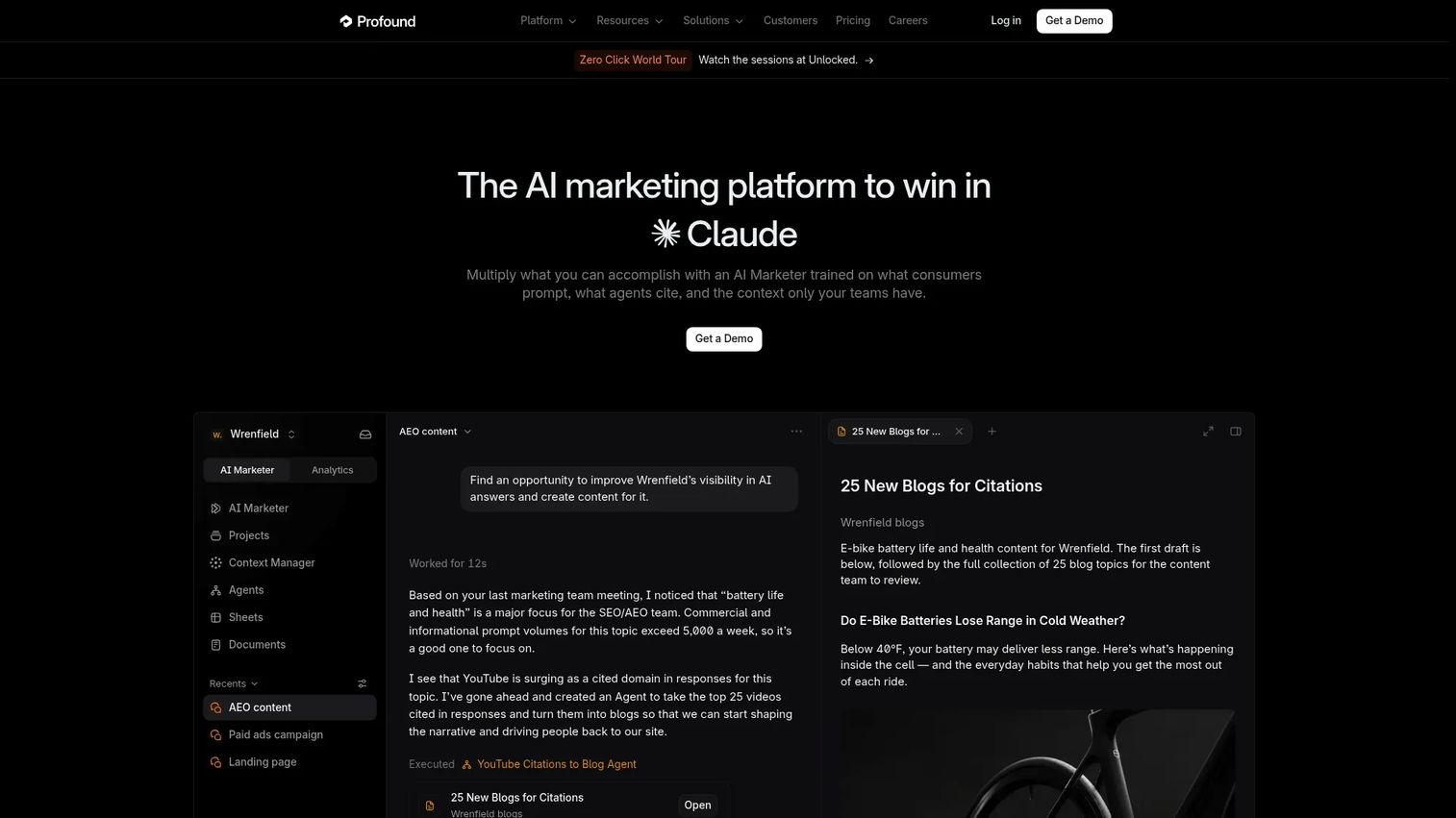
Profound combines AI answer intelligence with marketing agents and workflows. Answer Engine Insights measures brand and competitor visibility, while Prompt Volumes supports demand research. Agent Analytics addresses AI-sourced traffic and attribution, giving enterprise teams additional context beyond answer inclusion.
Its breadth changes the evaluation. You are assessing how research reaches execution and reporting across departments, rather than buying a prompt checker alone.
Best for: Enterprise marketing organizations coordinating AI visibility, content operations, and executive reporting.
Key features
- Answer Engine Insights
- Prompt Volumes analysis
- Agent Analytics
- ChatGPT Shopping tracking
- Context Manager for brand knowledge
Why choose Profound: It fits organizations that need AI search intelligence connected to a wider marketing program. The enterprise package also addresses procurement requirements through SSO/SAML and dedicated support.
Current packaging includes custom prompt tracking and up to 10 answer engines. Earlier Starter and Growth plans were retired in September 2026.
For an evaluation, involve the people who will own content changes and the stakeholders who will consume the reporting. Give each a specific task.
Ask the analytics lead to inspect how an AI-sourced visit enters the attribution workflow. Have the brand owner review whether the stored company context reflects approved positioning.
Finally, connect a visibility finding to a proposed campaign action. A broader platform earns its budget when those handoffs improve, rather than simply expanding the dashboard inventory.
Keep success criteria explicit. Your purchase should support a defined decision process, with agreed owners for research and implementation.
Profound pricing: Custom pricing for Enterprise.
G2 rating: 4.5/5.
4. Semrush AI Visibility
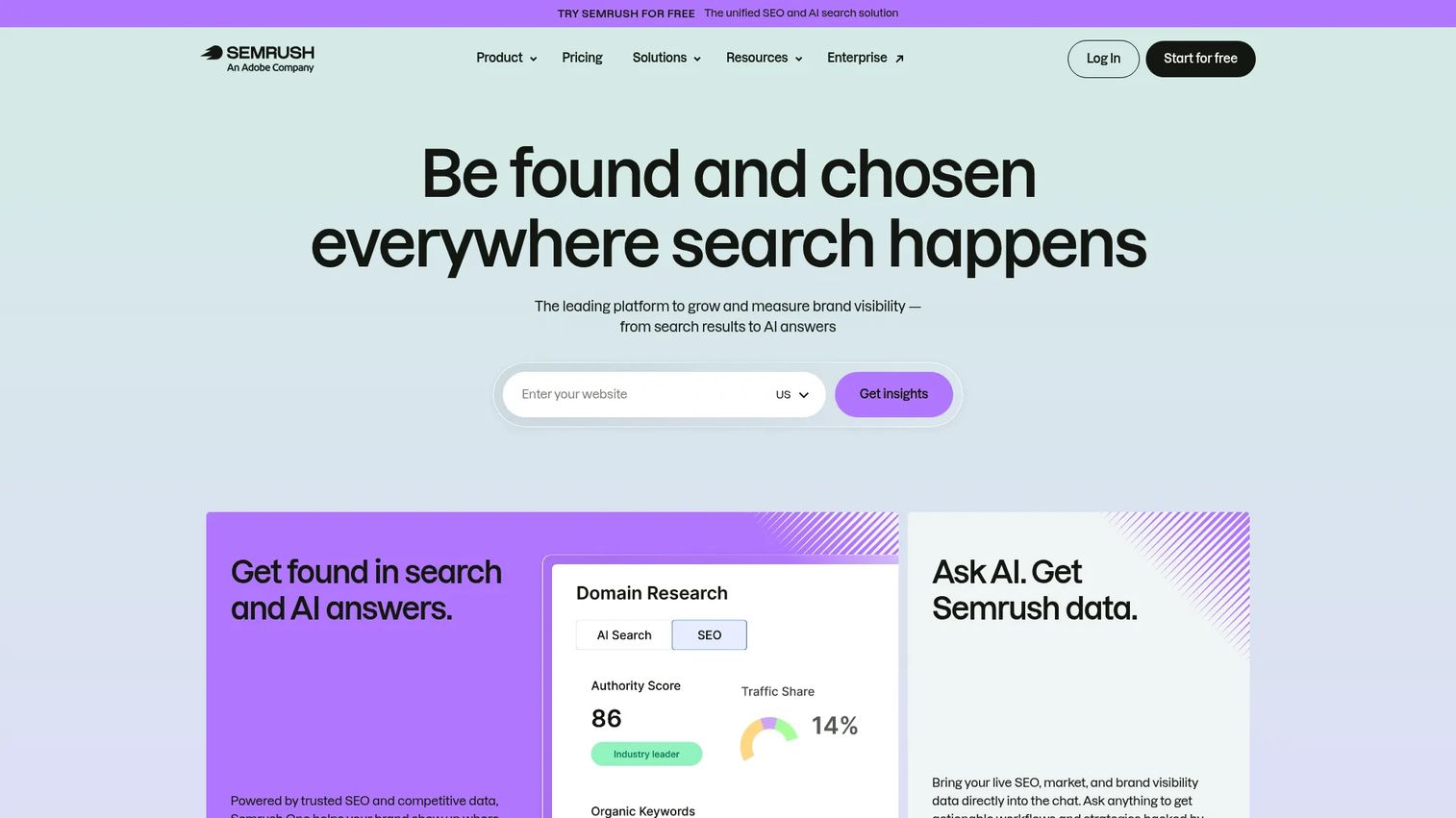
Semrush AI Visibility measures how brands appear across ChatGPT, Google AI, Gemini, and Perplexity. Custom prompt tracking sits alongside competitor analysis and brand narrative monitoring. The product also audits AI crawler accessibility and site readiness.
For existing Semrush users, the appeal is workflow continuity. Evaluate whether the additional measurement improves current content planning rather than creating a separate reporting habit.
Best for: SEO teams connecting AI answer visibility with established search operations.
Key features
- Custom prompt tracking
- Competitor visibility-gap analysis
- Brand sentiment and narrative monitoring
- AI-readiness Site Audit
- Share-of-voice reporting
Why choose Semrush AI Visibility: It suits marketers who want answer-engine evidence beside broader SEO work. That context can help assign technical findings to the people already maintaining the website.
The Base package covers 25 custom prompts and one domain for Brand Performance. Its reports include daily, weekly, and monthly updates.
Use the evaluation to distinguish standard market reporting from your own tracked questions. Both are useful, but they should not be treated as interchangeable samples.
Bring a page that performs well in conventional search but rarely appears in generated answers. Ask how the platform helps investigate that difference.
For budget planning, count domains before discussing rollout. A portfolio of regional sites creates a different purchasing requirement from a single brand website.
Finally, test whether the output supports your existing reporting definitions. Consolidation only helps when your team can explain how the new metrics relate to established search KPIs.
Semrush AI Visibility pricing: Base costs $99 per domain/month, billed annually. Enterprise uses custom pricing.
5. Ahrefs Brand Radar
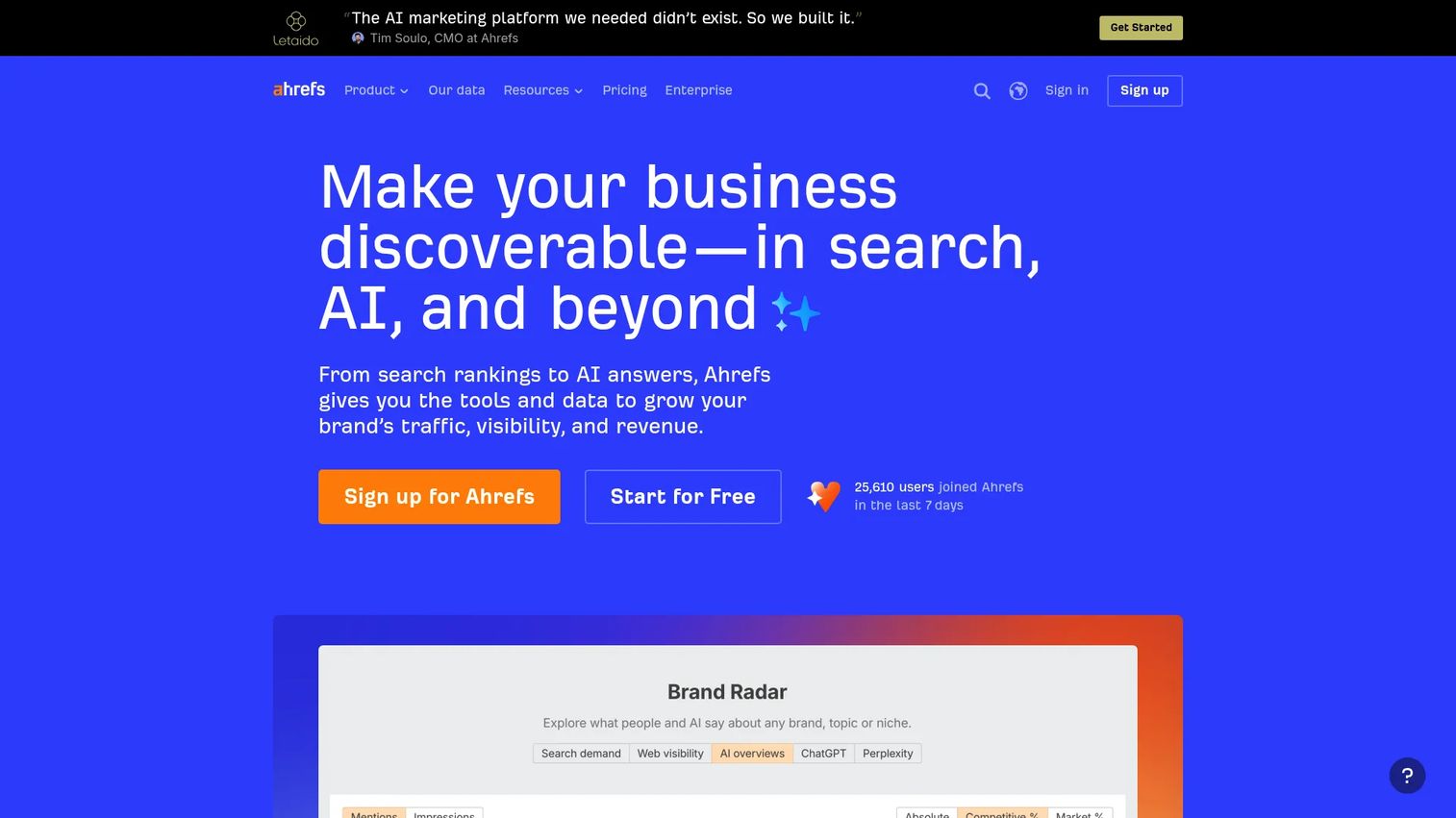
Ahrefs Brand Radar measures brand mentions and citations across AI answers and related discovery channels. It supports competitive benchmarking alongside configurable custom prompts. Its broader analysis includes search demand and visibility across web, video, and community surfaces.
This makes it useful when your question extends beyond whether a brand appeared in a saved answer. You can evaluate AI visibility within a wider discovery strategy.
Best for: SEO teams combining answer-engine monitoring with brand and search intelligence.
Key features
- Brand mentions and citation tracking
- Competitive AI share of voice
- Custom prompt locations and refresh settings
- Cited-page and domain analysis
- Cross-channel discovery analysis
Why choose Ahrefs Brand Radar: It fits teams investigating how market presence connects across different discovery channels. Existing Ahrefs users also have a familiar environment for adjacent research.
Separate index access from custom prompt tracking during procurement. They represent different ways of exploring the market and carry different prices.
Your tracked questions provide a controlled baseline. Broader index research helps investigate topics beyond the initial list, but its totals need their own interpretation.
During a trial, compare a branded query with an unbranded category question. Ask which sources explain the gap between recognition and recommendation.
Also inspect the refresh configuration for your target locations. A campaign expanding into another market needs evidence that matches that market.
For reporting, preserve the distinction between mentions and linked citations. Combining them into one number can conceal whether your own pages are influencing the answer.
Ahrefs Brand Radar pricing: Custom prompts start at $50/month; AI Visibility Index starts at $199/month. The all-platform option costs $699/month.
G2 rating: 4.5/5
6. Scrunch
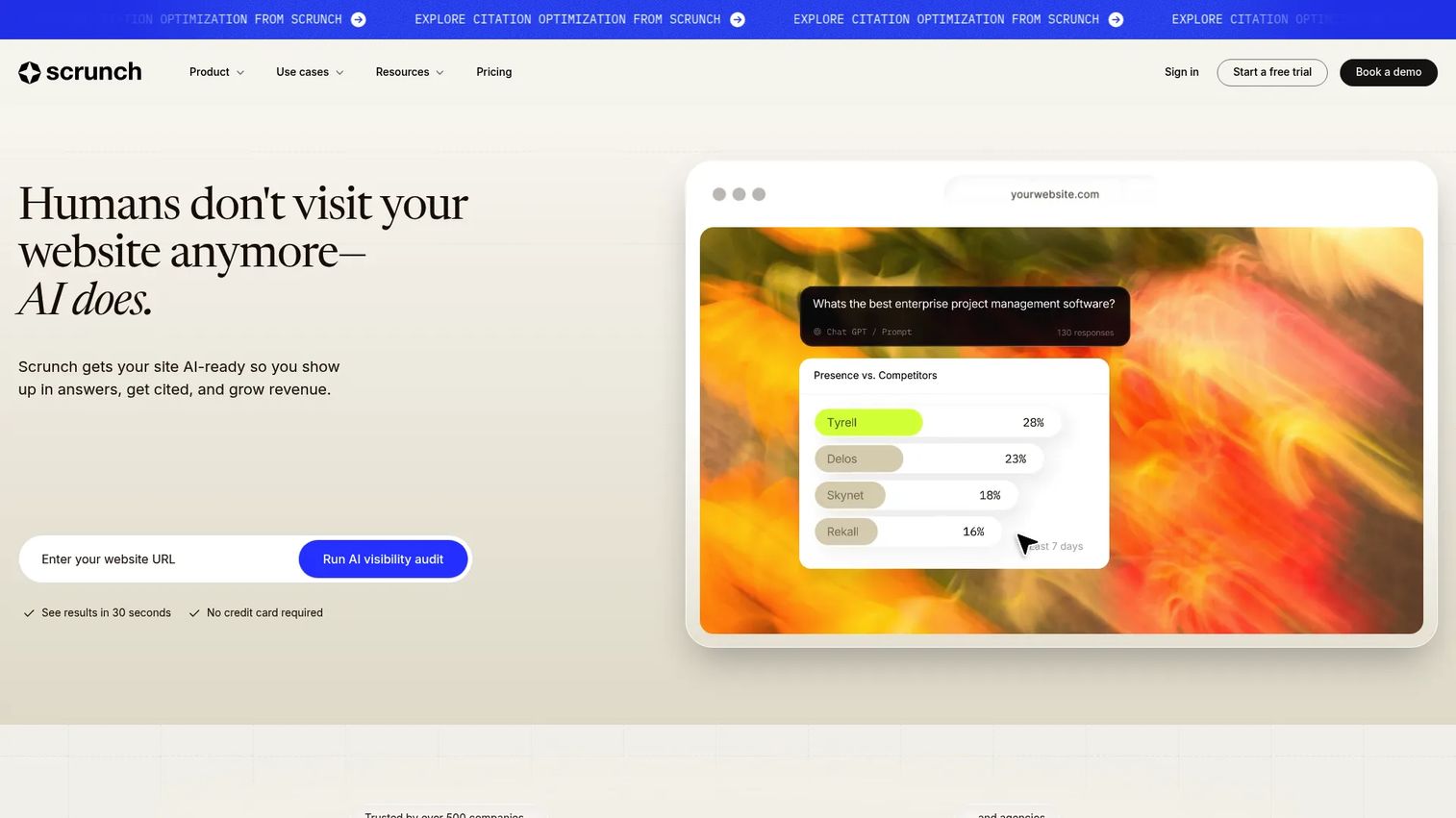
Scrunch combines AI visibility monitoring with website optimization. Its coverage includes major conversational engines and Google’s generated-answer surfaces. Beyond mentions and sentiment, it analyzes bot traffic and AI referrals.
The distinguishing buying question is whether your team needs help executing changes. Measurement connects with site audits, page optimization, content generation, and citation-target tracking.
Best for: Brands and agencies that want visibility findings connected to website improvements.
Key features
- Multi-platform answer monitoring
- AI bot and referral analysis
- Site audits and page optimization
- Citation-target tracking
- Signals, Explorer, and Scrunchie analysis
Why choose Scrunch: It suits teams whose reporting already identifies gaps but leaves implementation unresolved. The optimization workflow creates a reason for content and technical owners to participate.
Core includes one brand and five seats. Its monthly allowances cover 15,000 AI responses alongside defined limits for citation targets and content work.
Agencies should examine that brand allowance before assuming an entry subscription covers multiple clients. Enterprise expands limits and adds API access and SSO.
A useful evaluation starts with an existing page, not a blank content brief. Ask the platform to identify a visibility issue and explain the proposed change.
Then review whether the recommendation preserves your product’s factual positioning. Automated content work still needs an accountable editor.
For reporting, separate observed changes from completed tasks. Publishing an update is an operational milestone; improved inclusion requires subsequent measurement under comparable conditions.
Scrunch pricing: Core costs $250/month, with a seven-day free trial. Enterprise uses custom annual pricing.
G2 rating: 4.6/5.
7. ZipTie
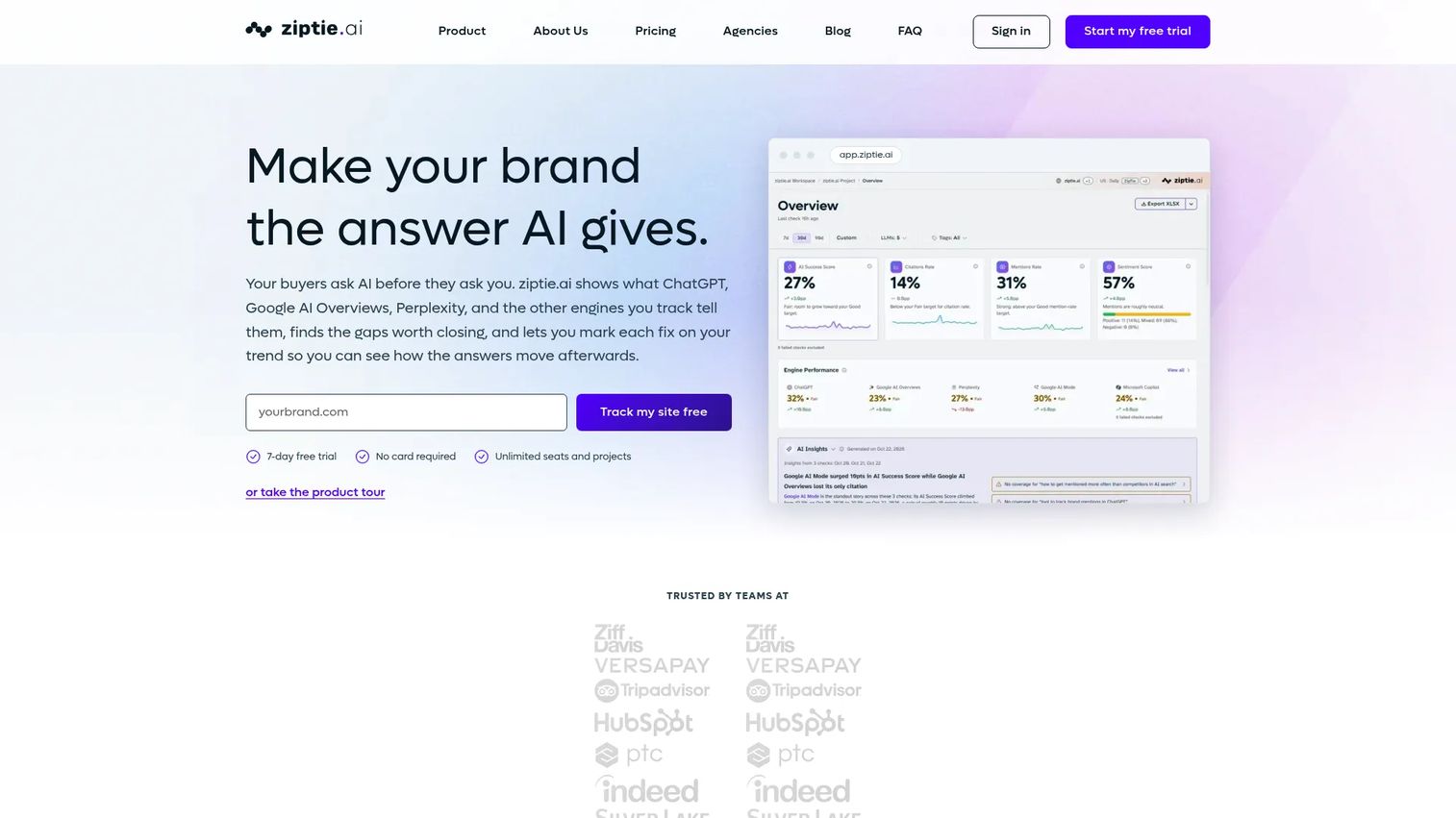
ZipTie monitors brand mentions, citations, and sentiment across up to seven AI engines. Its Action Center prioritizes visibility gaps. Additional analysis examines how user-generated sources influence answers.
Its strongest fit is configurable monitoring with an action layer. Evaluate the combination of prompt volume and refresh frequency against the decisions your team makes.
Best for: SEO and agency teams that want adjustable monitoring coverage.
Key features
- AI Success Scores
- Competitor and cited-source analysis
- Prioritized Action Center
- UGC Impact Analysis add-on
- REST API and MCP access
Why choose ZipTie: It gives teams flexibility over how much they monitor and how frequently they collect answers. That is useful when your baseline is still developing.
The entry amount is a starting configuration, rather than a universal cost for every monitoring program. Adding engines or increasing collection frequency changes the purchase.
Optional UGC analysis adds 80%, while content generation adds $20/month per context. API and MCP access carry a $10/month add-on.
For evaluation, select one prompt where a community discussion appears among the cited sources. Ask what the platform reveals about that source’s role.
Next, inspect the Action Center’s prioritization. A useful recommendation should identify a meaningful gap rather than merely flag every absent mention.
Avoid buying monitoring frequency you cannot act on. Weekly planning and daily incident investigation have different data requirements, even when they share the same prompt library.
ZipTie pricing: Starter begins at $25.65/month, with configurable usage. A seven-day trial includes 25 daily prompts across ChatGPT, Google AI Overviews, and Google AI Mode.
8. Similarweb
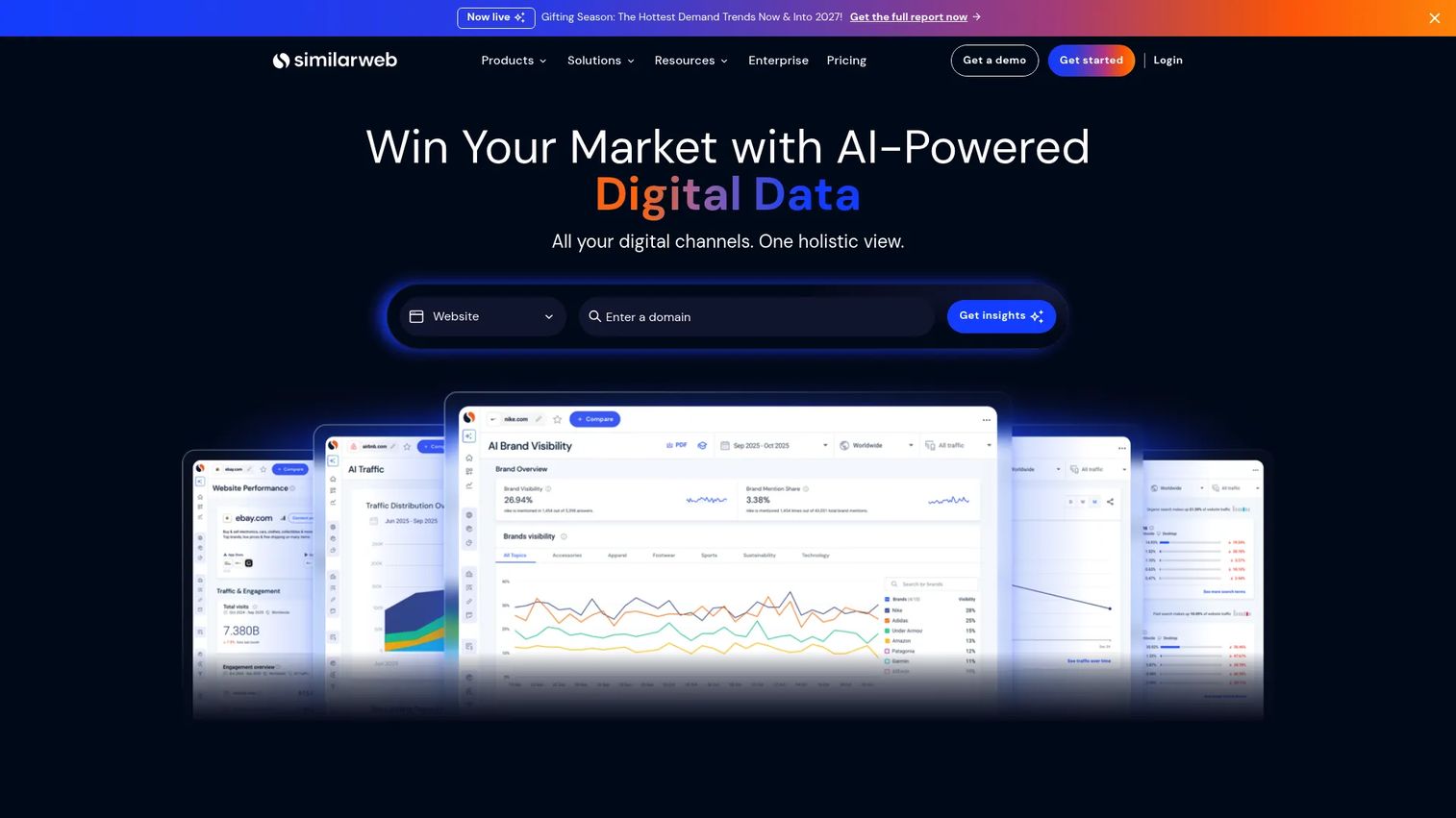
Similarweb is a digital intelligence platform with AI search and brand-visibility insights. Its broader offering covers competitive traffic, audience behavior, market demand, and advertising. That scope supports questions about AI discovery within the wider acquisition mix.
Treat it as a market intelligence purchase with relevant AI capabilities. Its value proposition extends beyond maintaining a fixed list of prompts.
Best for: Marketing and strategy teams connecting AI visibility with competitive web performance.
Key features
- Competitive traffic and channel analysis
- Market demand research
- Audience intelligence
- AI search and brand-visibility insights
- API and MCP integrations
Why choose Similarweb: It fits teams that need context around channel shifts and competitor growth. That perspective supports budget discussions extending beyond search optimization.
Official packages include Competitive Intelligence and Competitive Intelligence & SEO. Similarweb for Businesses provides another packaging route.
During a sales evaluation, specify the exact AI reporting questions you need answered. Ask which package covers them and how they connect to the broader dataset.
For example, investigate whether a visibility change coincides with changing referral patterns. Keep those observations separate until the evidence supports a relationship.
Also distinguish competitor estimates from first-party website measurements in executive presentations. A shared chart should explain what each data source represents.
The purchase becomes easier to justify when it replaces overlapping research work. List existing traffic and market reporting subscriptions before adding another platform.
Similarweb pricing: Custom pricing across its described business packages.
G2 rating: 4.4/5.
9. Orchly
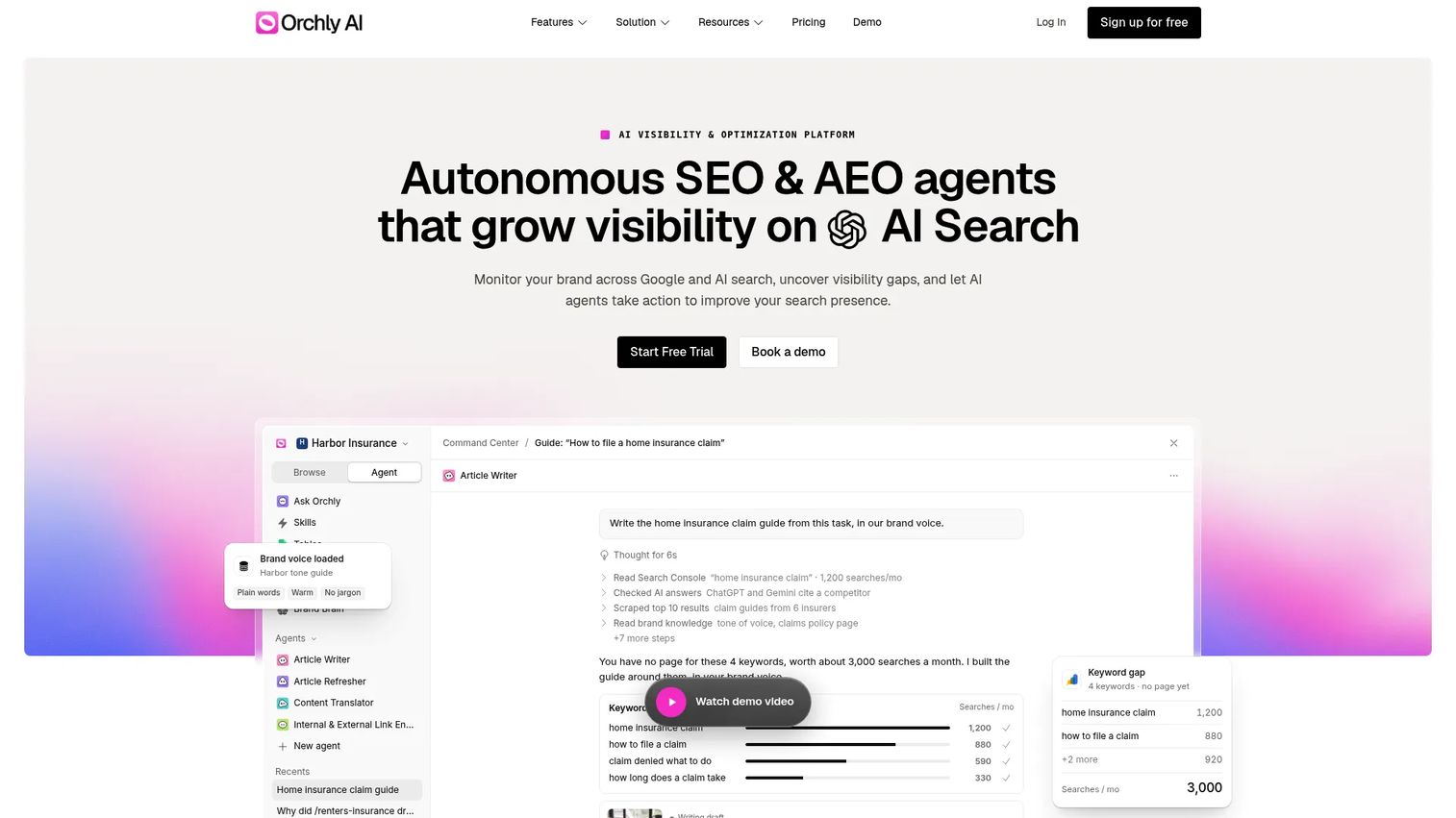
Orchly combines AI visibility monitoring with SEO and content operations. It tracks citations and competitors across engines including ChatGPT, Perplexity, Gemini, and Claude. Query fan-out analysis and AI traffic reporting add context to answer-level observations.
Marketing agents extend the workflow into content refreshes and publishing. That makes ownership and review processes important parts of the evaluation.
Best for: Small marketing teams and agencies connecting monitoring with ongoing execution.
Key features
- AI visibility and citation tracking
- Query fan-out analysis
- AI traffic analytics
- Content creation and refresh agents
- Site-health and publishing workflows
Why choose Orchly: It suits marketers seeking a working backlog rather than another passive reporting destination. The combination is relevant when content operations already consume substantial manual effort.
Essential covers one website and 25 tracked AI prompts. Pro expands those allowances to three websites and 100 prompts.
Start an evaluation with a page your team already plans to refresh. Follow the proposed work from the visibility finding through the draft recommendation.
Inspect where a person reviews factual claims and approves publication. Automation should fit your editorial process, including responsibility for product accuracy.
For an agency, test the same workflow across different client positioning. Shared execution tools still need clear boundaries between brand instructions.
Finally, compare the platform with what you already pay for. If the content tooling duplicates your existing stack, evaluate monitoring on its own contribution.
Orchly pricing: Essential costs $49/month, while Pro costs $125/month. All plans offer a seven-day trial, and annual billing saves 25%.
10. AthenaHQ
AthenaHQ supports AI search visibility measurement and optimization across more than 11 language models. Its capabilities include citation analysis and competitive share of voice. PR monitoring and press-kit tools extend the workflow beyond on-site content.
That broader remit suits teams where earned media influences the search strategy. SEO and communications can evaluate the same evidence without treating every source gap as a website issue.
Best for: Marketing organizations coordinating AI visibility work across SEO and PR.
Key features
- Cross-platform visibility tracking
- Automated content recommendations
- Citation analysis and link building
- PR monitoring and press kits
- Executive reporting
Why choose AthenaHQ: It connects answer-engine measurement with off-site visibility work. The free Essential plan also provides an entry point for evaluating the analysis.
Essential includes 300 credits. Starter raises the allowance to 3,600 credits and adds integrations and exports alongside optimization tools.
Credits deserve a practical test. Ask how your planned prompt set and reporting activity consume the allowance across a normal operating month.
For the evaluation, bring a category question where third-party coverage influences recommendations. Review whether the proposed action belongs with content, PR, or another owner.
Enterprise adds controls such as SSO and multi-region support. Those requirements should enter the procurement discussion before the team commits to a reporting process.
Keep the executive view concise. Leadership needs the business question and the supporting evidence, rather than an unexplained collection of model-specific scores.
AthenaHQ pricing: Essential is free, and Starter costs $295/month. Enterprise uses custom pricing.
G2 rating: 4.9/5.
11. SE Visible
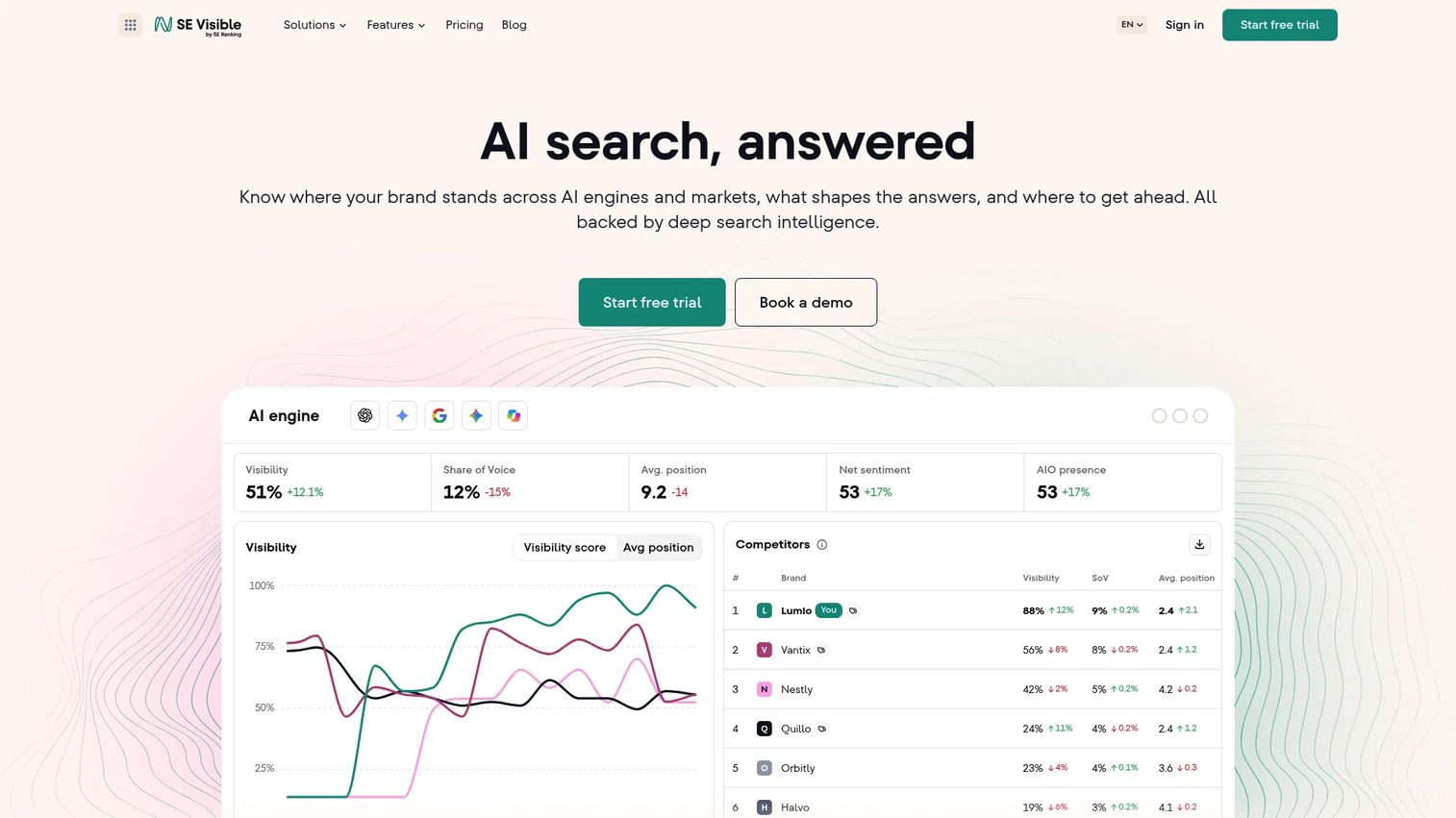
SE Visible tracks how brands are mentioned and cited across AI search engines. Its prompt organization includes topic and intent classification alongside funnel stage and branded status. Competitive reporting covers visibility and average position, with sentiment adding context.
This structure is useful for explaining where performance differs. A single blended score can conceal a gap in commercially important questions.
Best for: SEO teams and agencies organizing AI search reporting by buyer intent.
Key features
- Classified prompt research and tracking
- Competitive visibility and sentiment benchmarking
- Cited-domain and page analysis
- Data Studio connector and CSV export
- API, MCP, and client access
Why choose SE Visible: Its classification and reporting connections fit teams building repeatable client or stakeholder reports. Project allowances also make account structure a clear purchasing consideration.
Basic includes 75 tracked prompts across five projects. Core provides 200 prompts and 10 projects, while Agency expands to 1,000 prompts and 30 projects.
Use a trial to separate discovery questions from purchase-stage comparisons. Ask whether a stakeholder can identify the weaker group without interpreting every answer individually.
Then test the reporting destination your team already uses. Export availability matters less than whether the fields support your established definitions.
For agencies, review client access alongside internal workflows. The people presenting results need a clear explanation of what changed and which evidence supports the recommendation.
Retain a consistent baseline when introducing new topics. Otherwise, changes in prompt composition can complicate the story you tell about performance.
SE Visible pricing: Basic starts at €64/month, billed annually. A 14-day free trial is available.
G2 rating: 4.5/5
12. Knowatoa
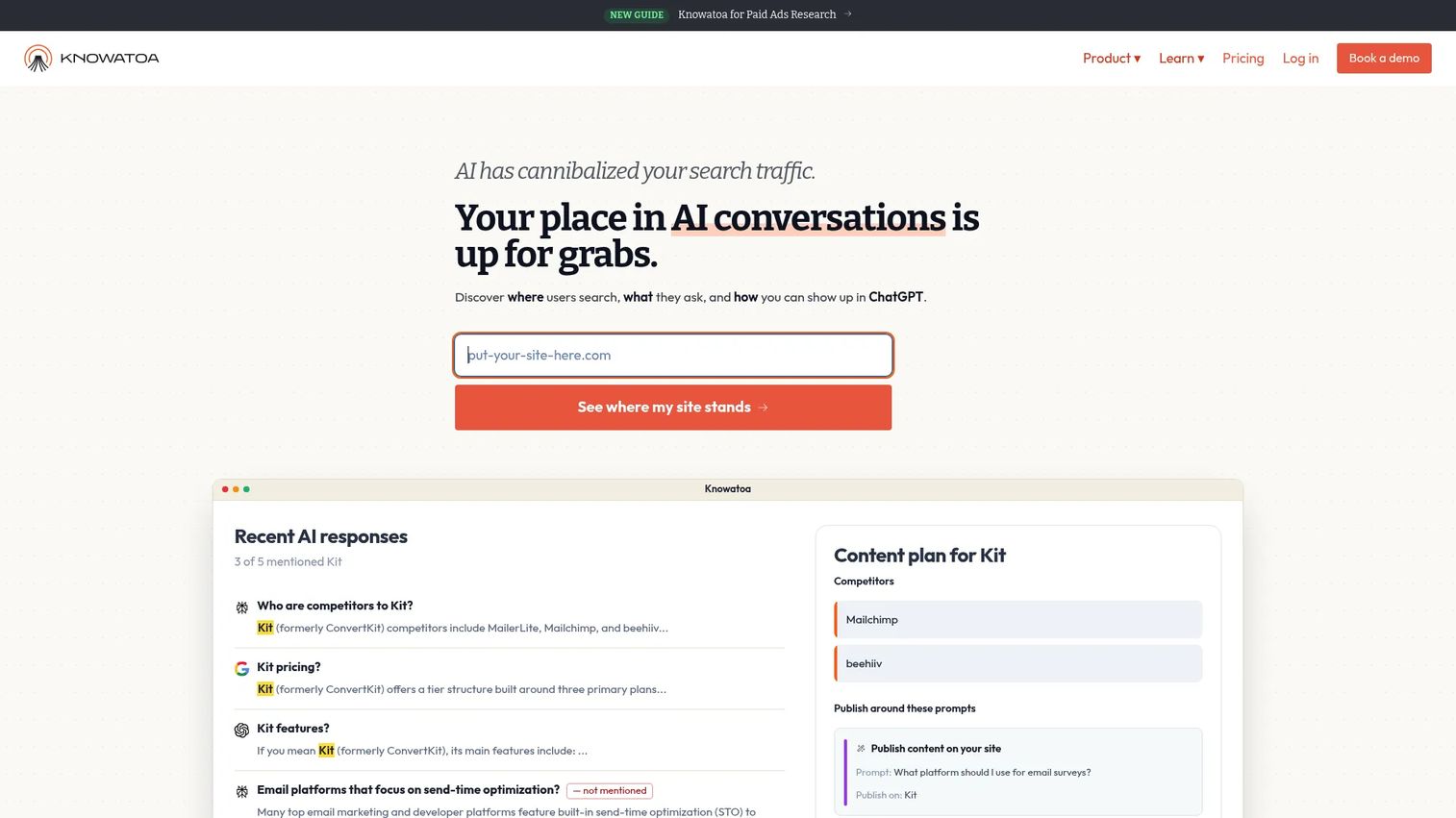
Knowatoa combines AI answer monitoring with technical access testing. Its AI Search Console examines real-time access and crawling across more than 15 AI bot types. The broader platform includes content generation and reporting integrations.
This creates a useful pairing for teams investigating both discovery and accessibility. Answer inclusion and crawler access remain separate measurements, even when they appear in the same workflow.
Best for: Teams coordinating AI visibility analysis with technical SEO investigation.
Key features
- Custom questions and historical monitoring
- Citation and sentiment analysis
- AI bot access and crawl testing
- Location targeting
- Reporting and spreadsheet integrations
Why choose Knowatoa: It suits teams that want to investigate access questions alongside brand presence. Reporting connections also support agencies that maintain existing client dashboards.
Starter monitors ChatGPT, Google AI Overviews, and Google AI Mode. Growth extends coverage to all seven supported services and includes reporting integrations.
The distinction matters if your buyers use engines outside the entry package. Define required coverage before comparing subscription costs.
During evaluation, bring a page whose accessibility you want to investigate. Review the technical evidence separately from whether that URL appears in an answer.
A successful crawl test should not be presented as proof of future inclusion. Your reporting needs to preserve that distinction for both developers and marketing leadership.
Also test the data handoff into your reporting system. The platform supports destinations including Looker Studio and Google Sheets, but your required fields should drive the acceptance test.
Knowatoa pricing: Starter costs $59/month, and Growth costs $199/month. Enterprise uses custom pricing.
13. SearchAnalytics.ai
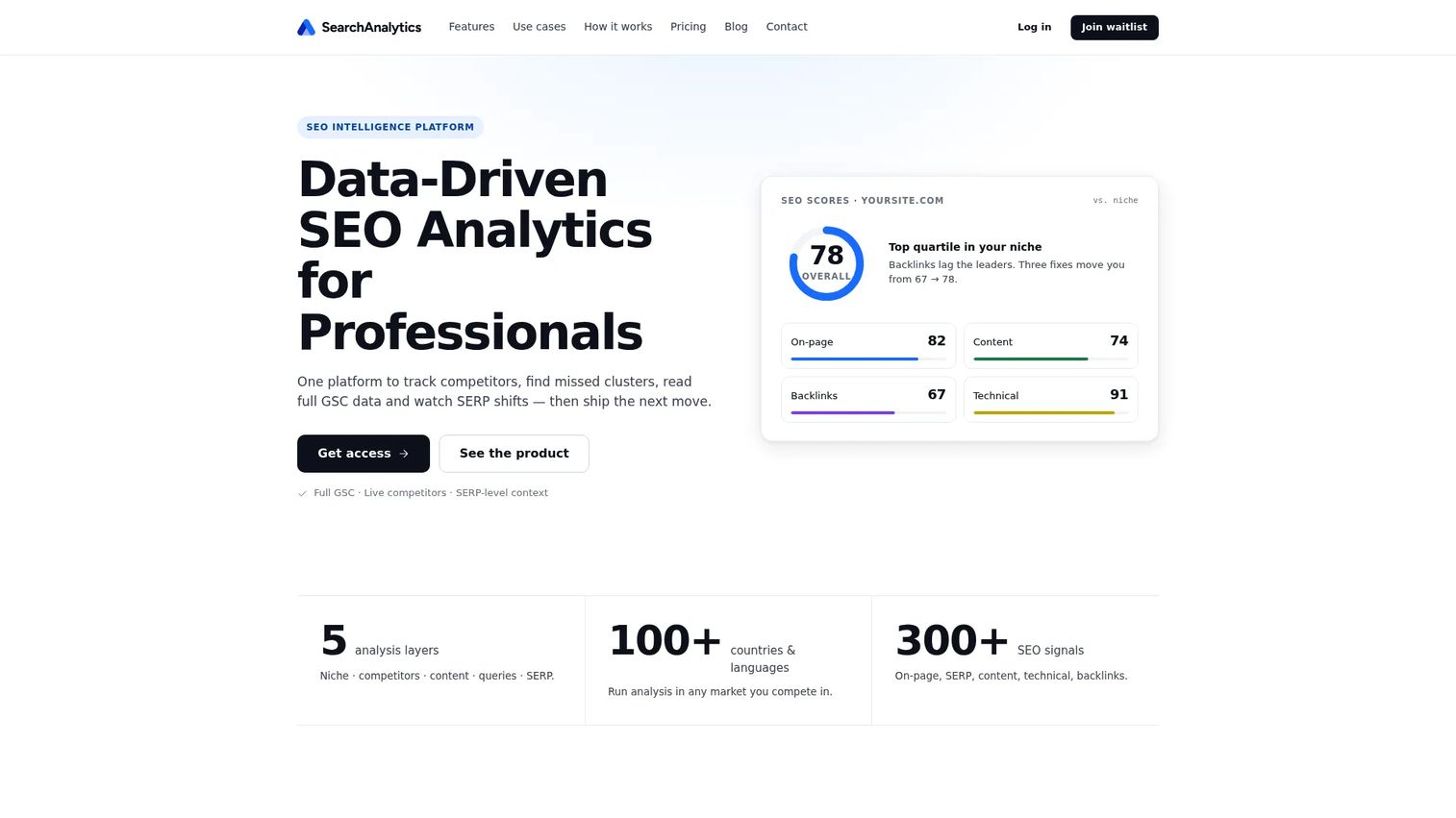
SearchAnalytics.ai is an SEO intelligence platform centered on competitor and search-performance data. It combines GSC and GA4 dashboards with SERP evidence and technical analysis. A recommendations engine turns those inputs into a ranked backlog of SEO actions.
Its documented emphasis is broader SEO decision-making. Evaluate it for that role rather than assuming equivalent answer-engine monitoring to every dedicated platform here.
Best for: SEO and growth teams prioritizing implementation from existing search evidence.
Key features
- GSC and GA4 dashboards
- Competitor growth and decay tracking
- Page-level change detection
- Technical and backlink intelligence
- Ranked SEO recommendations
Why choose SearchAnalytics.ai: It fits teams whose immediate problem is deciding which search work to execute next. The consolidated evidence can support an existing AI visibility initiative.
Content intelligence identifies missing sections and FAQ themes from SERP evidence. Technical tracking examines changes to schema and canonical signals.
Bring a decaying page to the evaluation. Ask the platform to explain the proposed action using observable changes rather than a generic optimization checklist.
Then inspect whether the backlog matches your team’s capacity. A prioritized task is useful only when its expected contribution and implementation owner are clear.
For procurement, distinguish AI-assisted analysis from analytics about AI answers. Those capabilities address different questions despite similar naming.
If prompt-level monitoring is mandatory, make it a separate acceptance criterion. Do not infer coverage from the presence of an AI agent or MCP connection.
SearchAnalytics.ai pricing: Basic costs $299/month; Standard costs $599/month, and Premium costs $999/month. Their allowances are 16,000, 40,000, and 100,000 credits respectively.
14. Amadora.ai
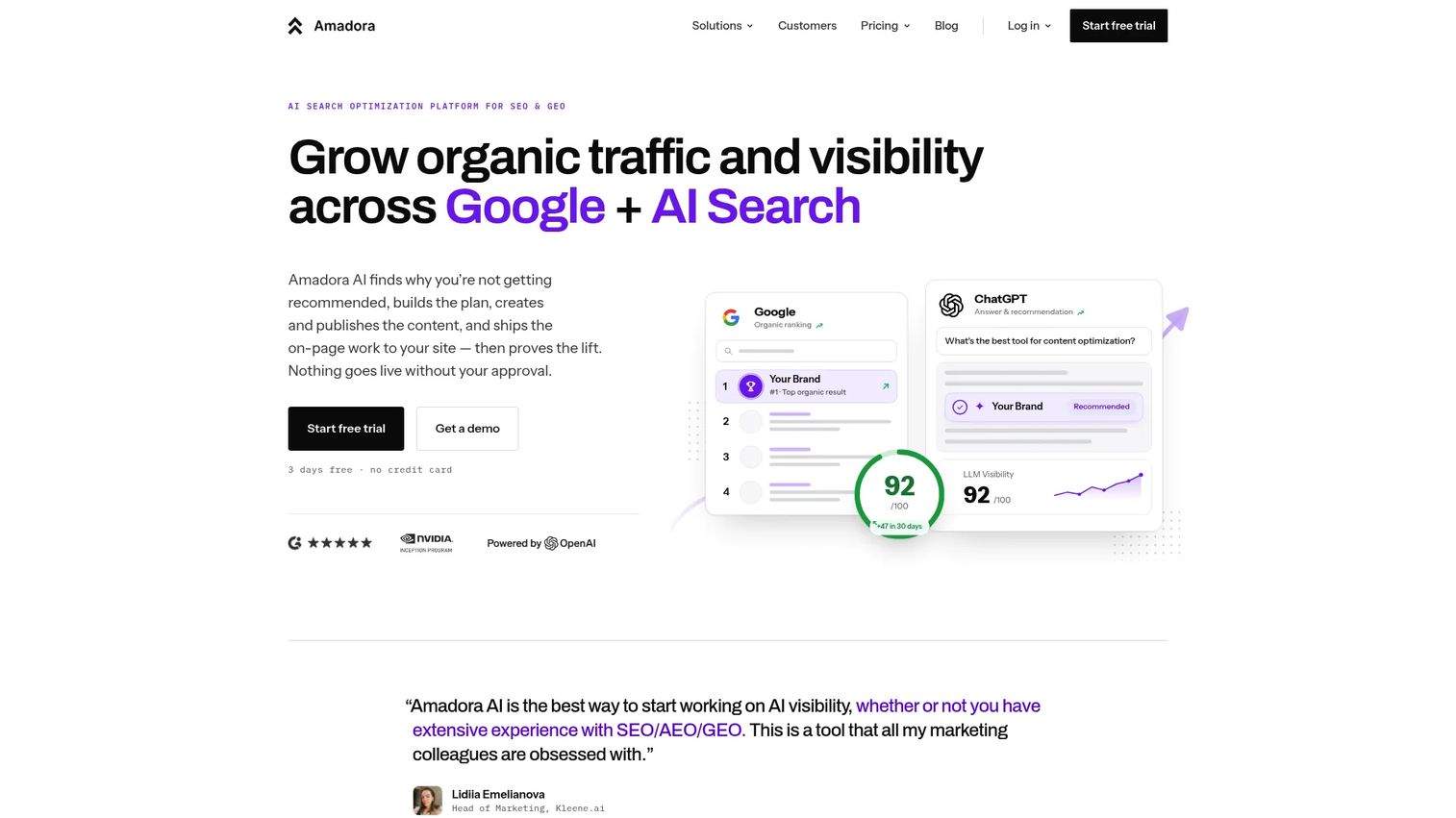
Amadora.ai connects AI visibility tracking with search optimization and content publishing. It supports prompt research and citation analysis across several search surfaces. GSC and GA4 integrations provide additional context for evaluating website performance.
The product addresses both observation and execution. Teams considering it should assess how content work moves through their existing approval process.
Best for: Marketing teams and agencies combining visibility measurement with publishing workflows.
Key features
- Keyword and prompt research
- AI source and citation analysis
- Technical and on-page SEO
- CMS auto-publishing
- GSC and GA4 integration
Why choose Amadora.ai: It suits teams trying to reduce handoffs between research and content production. Separate brand and agency packaging also reflects different operating models.
API access is available on Pro, Growth, and Agency plans. Include that requirement early if external reporting is central to the purchase.
For a trial, choose a page with a specific visibility gap. Follow the evidence through the proposed update and inspect what remains under human review.
Next, evaluate whether the publishing workflow fits your CMS responsibilities. The content owner should retain accountability for factual claims and product positioning.
Agencies should assess their package separately from the brand plans. A subscription designed for one marketing organization may not match client-service operations.
Treat the review score cautiously. It reflects one G2 review, which provides much less evidence than an established pattern across many customers.
Amadora.ai pricing: Starter costs $99/month or $990/year, while Pro costs $299/month or $2,990/year. A three-day free trial requires no credit card.
G2 rating: 5.0/5, based on one review.
15. Yext Scout
Yext Scout measures brand performance across Google and AI search with a location-level focus. It combines competitive benchmarking with sentiment and citation analysis. Prioritized recommendations can connect findings to actions across Yext products.
For a multi-location business, geography changes the measurement question. Strong national recognition does not answer whether a specific branch appears in local recommendations.
Best for: Enterprise brands managing visibility across multiple business locations.
Key features
- AI and Google search monitoring
- Location-level competitor benchmarking
- Competitor win-rate analysis
- Sentiment and citation-source tracking
- Prioritized actions across Yext products
Why choose Yext Scout: It fits organizations where digital presence information and local competition shape discovery. Location-level analysis gives regional teams a more relevant view than a national average.
Build the evaluation around representative branches with different competitive conditions. A national overview alone will not test the reporting your local operators need.
Ask how the platform distinguishes a widespread brand issue from a location-specific gap. The answer should help assign work to corporate marketing or a regional owner.
Also inspect the handoff from recommendation to execution. Establish who approves a change and which Yext products participate in that process.
Scout can be purchased standalone or within a package. Compare the proposed scope against your existing listings and digital presence contracts.
Keep measurement definitions consistent across branches. Local reporting should support comparison without ignoring differences in the questions buyers ask in each market.
Yext Scout pricing: Custom pricing, available standalone or in a package.
G2 rating: 4.4/5
Considerations when choosing ai search analytics tools
Engine coverage
Match coverage to your buyers, including Google AI Overviews or AI Mode and conversational engines such as ChatGPT, Perplexity, Claude, Gemini, and Copilot. Ask which surfaces are included in your proposed package.
Require a sample collection from each priority engine. Product names alone do not explain how monitoring works.
Prompt library design
Start your AI search tracker evaluation with 10 to 15 stable prompts. Include category discovery and problem-aware questions alongside comparisons and relevant local searches.
Keep an unchanged baseline while testing new queries separately. Record the purpose of each question before importing it.
Citation and source attribution
Inspect the exact cited domains and URLs. Ask whether the supporting answer and relevant passage remain available for review.
Choose a finding and identify who would act on it. Source data should support a specific content or outreach decision.
Reporting and stakeholder fit
Build a sample executive report during the trial. Test exports and scheduled delivery, plus client branding requirements where relevant.
Keep AI search visibility analytics separate from conversion reporting. Add AI referral traffic and downstream outcomes without presenting correlation as attribution.
Accuracy and volatility
Ask whether collection uses consumer interfaces or APIs, and record the model, location, and refresh cadence. Logged-in state and prompt phrasing can also affect comparability.
Repeat the same test before judging a change. Useful AI search reporting makes its sampling method understandable.
Conclusion
The best AI search analytics tools replace a specific manual workflow and produce decisions your team can repeat.
Peec is a strong starting point for focused visibility analysis. Otterly suits recurring agency monitoring, while Scrunch connects findings with website improvements.
Profound fits broader enterprise AI marketing programs. Semrush AI Visibility and Ahrefs Brand Radar deserve attention when existing SEO operations already rely on those environments.
Similarweb adds market and traffic context. Yext Scout addresses the location-level questions that national reporting can miss.
Keep the shortlist small enough to evaluate properly. Choose a stable prompt set and run it through two or three candidates.
Ask each vendor to explain a missing mention and an influential citation. Then build the report you would send to leadership.
Your final decision should account for the full monitoring configuration and the work required after collection. A lower entry price means little if essential coverage sits elsewhere.
Pick the platform your team will use weekly, with a named owner for turning findings into action.
FAQs
AI search analytics measures how brands appear in generated answers, including mentions, citations, competitive presence, and sentiment. It helps marketers inspect which questions produce visibility and which sources influence the response. The resulting evidence supports content planning and brand monitoring. Business impact still requires separate analysis of traffic and customer outcomes.
Traditional SEO analytics measures rankings, impressions, clicks, and website performance. AI search analytics examines the answer itself, including whether a brand is recommended and how it is described. A business can receive visibility without a visit, or gain traffic through a cited source. Keep those outcomes distinct when explaining performance to leadership.
Prioritize prompt-level inclusion and cited URLs, with competitor context and inspectable answer history. Your required engine coverage should reflect buyer behavior rather than the longest vendor checklist. Add sentiment analysis when reviewers can inspect the language behind the score. Reporting should preserve enough context to explain a change and assign the next action.
Start with 10 to 15 stable prompts as a practical evaluation baseline, rather than treating that range as a universal benchmark. Map each question to a buying situation and retain the original wording. Expand into additional segments after your team can interpret the initial results. Keep experimental questions separate so they do not silently change your baseline.
Generated answers can vary with model updates, retrieval sources, location, and collection time. Prompt wording and user context can introduce further differences. Compare repeated observations under consistent conditions before treating a change as meaningful. Ask vendors to explain their sampling method so your reporting reflects what was measured.
Google Search Console provides search-performance context, but it does not fully explain cross-engine brand mentions or answer framing. Use it alongside dedicated answer analysis to investigate how visibility relates to website performance. GA4 can add referral and conversion context for visits that reach your site. Neither report captures every discovery event that ends without a click.
Share of voice describes a brand’s relative presence within a defined set of AI answers or mentions. Vendors may calculate it differently, including separating mention share from citation share. Ask for the denominator and treatment of repeated brand references before comparing scores. Also inspect results by intent, since a blended percentage can hide an important purchase-stage gap.
They are worth evaluating when recurring checks consume time or AI discovery raises questions your existing reports cannot answer. Start with a narrow monitoring scope and assign someone to act on findings. If the channel has little relevance to current buyers, occasional manual checks may be sufficient. Judge the subscription by useful decisions and work replaced, rather than dashboard activity alone.