Your paid social dashboard says scale. Finance says prove it. Your CRM credits email. Meanwhile, three other channels are fighting over the same conversion.
None of those views can answer the budget question on their own. Marketing mix modeling software exists because platform reporting and last-click attribution never could. According to a 2025 Google/HBR Analytic Services study, 87% of marketers say MMM is important to their organization, yet most teams are still making spend decisions from dashboards that measure what happened, not what caused it.
Cookie deprecation accelerated the problem. As signal loss grows, aggregate modeling approaches matter more, not less. A 2025 EMARKETER/TransUnion report found that 46.9% of U.S. brand and agency marketers plan to invest in MMM over the next year, and 27.6% already consider it their most reliable measurement method.
This guide cuts through the noise. Here are 21 MMM software options for 2026, ranked by buyer fit.
What's inside
This guide compares 21 marketing mix modeling software options across enterprise suites, causal MMM platforms, open-source frameworks, and attribution-adjacent tools. It is written for growth marketers, demand gen leaders, and marketing analytics managers who need defensible budget decisions, not statistical theory.
Selection criteria:
- Channel coverage: Online and offline measurement breadth
- Modeling approach: Transparency, causal capability, and methodology clarity
- Planning workflow: Scenario planning, budget optimization, and forecast output
- Implementation model: Self-serve software, managed service, or open-source build
Pricing and G2 ratings were verified before publishing.
TL;DR
- Best for enterprise marketing teams: Adobe Mix Modeler, Circana, Nielsen Marketing Mix Modeling
- Best for causal MMM and incrementality: Haus, Measured
- Best for open-source MMM: Meridian, Robyn, PyMC, LightweightMMM
- Best for growth teams needing budget decisions fast: Lifesight, Ruler Analytics, Keen
- Best for agency and analytics-led organizations: Gain Theory ROVA, Ipsos Unified Marketing Mix Modeling, Marketscience Studio
What is marketing mix modeling software?
Marketing mix modeling software analyzes historical marketing, sales, pricing, promotion, and external data to estimate how different channels contribute to business outcomes and how budget should shift next.
It answers the question every finance team eventually asks: Which spending actually moved the number?
Key capabilities
- Data ingestion and normalization: Pulls spend, sales, impressions, pricing, promotions, and external variables into a unified dataset
- Adstock and lagged-effect modeling: Accounts for the fact that ad exposure drives results days or weeks later
- Diminishing-return curves: Shows where adding budget stops producing proportional returns
- Incrementality and causal validation: Tests whether channels are driving outcomes or merely correlating with them
- Scenario planning and forecasting: Simulates budget changes before committing spend
- Budget optimization: Recommends where the next dollar produces the highest marginal return
- External-factor controls: Isolates the effect of seasonality, pricing, promotions, competition, and macro conditions
- Model refreshes and reporting: Keeps outputs current as market conditions shift
How it works
- Pull historical spend, sales, media, and external data
- Normalize across channels and time periods
- Model channel contribution and saturation curves
- Control for non-media factors
- Simulate budget changes
- Recommend allocation shifts
MMM vs. attribution vs. incrementality testing
These three approaches are complementary, not interchangeable. MMM is strongest for strategic budget allocation across channels, including offline and upper-funnel media where user-level tracking is unavailable. Attribution works best for user-level journey analysis where consented, first-party tracking exists. Incrementality testing validates causal lift in specific channels or campaigns through controlled experiments.
A platform dashboard tells you what your media vendor says happened. MMM tells you what actually moved sales.
When to use marketing mix modeling software
Allocate budget across channels
MMM helps you decide whether to move money between paid search, paid social, TV, retail media, podcast, out-of-home, and affiliates. Each channel hits diminishing returns at different spend levels. MMM surfaces those curves so you can find the allocation where marginal returns are highest across the full mix, not just within one channel's dashboard.
Measure channels attribution misses
Offline media, upper-funnel brand spend, retail and marketplace activity, podcast advertising, and influencer campaigns leave no click trail. If your measurement stack only reads cookies and click IDs, those channels appear to contribute nothing. MMM models aggregate outcomes against all spend inputs, filling the gap that platform attribution cannot reach.
Forecast the impact of spend changes
Finance asks what happens to pipeline if paid social drops 15% and that budget moves to retail media. MMM gives you a defensible answer before the quarter starts. Teams use it in annual planning cycles, mid-year budget reviews, and board presentations where "our dashboard looks good" is not sufficient evidence.
Marketing mix modeling software comparison
The table below covers all 21 tools in this guide. Pricing reflects verified figures from each vendor's pricing page or confirmed quote-based models. G2 ratings are from each tool's current listing; open-source libraries often carry no G2 profile.
| # | Product | Best for | Key differentiator | Pricing | G2 rating |
|---|---|---|---|---|---|
| 1 | Adobe Mix Modeler | Enterprise teams in Adobe ecosystem | AI-powered MMM inside Adobe measurement workflows | Contact sales | 5.0/5 |
| 2 | Haus | Causal MMM and incrementality teams | Experiment-based causal measurement combined with MMM | Contact sales | 4.8 |
| 3 | Circana | Retail, CPG, and omnichannel brands | Deep retail and consumer behavior data context | From $499/story (Liquid Data Go) | 4.6 |
| 4 | Measured | DTC and ecommerce incrementality teams | MMM plus incrementality testing in one platform | Contact sales | 4.9/5 |
| 5 | Nielsen Marketing Mix Modeling | Enterprise brands needing established MMM expertise | Longstanding MMM methodology and global measurement coverage | Contact sales | 3.6 |
| 6 | Dentsu Market Mix Modelling | Brands using agency-led media planning | Connects MMM with agency planning and media services | Contact sales | 4.5 |
| 7 | Gain Theory ROVA | Large brands needing managed analytics | WPP-linked marketing effectiveness with ROVA App and Python Notebooks | Contact sales | 4.7 |
| 8 | Ipsos Unified Marketing Mix Modeling | Research-driven marketing organizations | MMM linked to broader market research and brand measurement | Contact sales | 3.8/5 |
| 9 | Marketscience Studio | Advanced in-house analytics teams | Transparent Bayesian econometric modeling with SaaS or managed delivery | Contact sales | 4.4 |
| 10 | Lifesight | Growth teams needing causal measurement | Causal MMM plus geo-based incrementality and attribution-adjusted outputs | Contact sales | 4.2/5 |
| 11 | Robyn | Technical teams building open-source MMM | Meta-backed open-source MMM with ridge regression and budget allocation | Free | 5 |
| 12 | Meridian | Technical teams using Google measurement workflows | Google open-source Bayesian MMM with geo-level and reach-frequency inputs | Free | 3 |
| 13 | PyMC | Data scientists building Bayesian MMM from scratch | Flexible probabilistic programming library for custom model design | Free | 4.4 |
| 14 | Ruler Analytics | Revenue-focused B2B marketers | Attribution and MMM-oriented reporting connecting spend to CRM revenue | From $400/month | 4.6/5 |
| 15 | Cassandra | Teams wanting approachable MMM planning | Budget optimization and forecasting with accessible planning workflows | Contact sales | 4.1 |
| 16 | Keen | Marketers focused on predictive planning | Predictive marketing planning and budget optimization | Contact sales | 4.4/5 |
| 17 | Leavened | Teams wanting AI-assisted MMM | AI-enabled MMM with self-serve, partial, and fully managed delivery | Contact sales | 4.8 |
| 18 | Maximus | Government and large enterprise analytics | Technology-enabled analytics and digital modernization services | Contact sales | 5 |
| 19 | Orbit | Community and growth teams | Member intelligence, analytics, and engagement automation | From $50/seat/month (annual) | 4.0/5 |
| 20 | LightweightMMM | Data scientists building lightweight Bayesian models | Archived open-source Bayesian MMM library from Google | Free | 4.6 |
| 21 | C5i Demand Drivers | Enterprise teams with broader demand analytics | Always-on MMM with incremental impact measurement across media and business factors | Contact sales | 4.2 |
Best 21 marketing mix modeling tools for 2026
1. Adobe Mix Modeler

Adobe Mix Modeler (now also called Adobe Marketing Campaign Analytics) is an AI-powered marketing measurement and planning application built for enterprise teams already running Adobe Experience Cloud. It combines marketing mix modeling with multi-touch attribution into a unified measurement layer, covering paid, owned, and earned channels across online and offline media. Budget scenario planning and in-flight optimization tie back directly into Adobe's broader data infrastructure.
Best for: Enterprise marketing teams measuring incremental channel performance within an Adobe-centric stack.
Key features
- Unified measurement across paid, owned, and earned channels
- AI and machine learning models combining MMM and multi-touch attribution
- Budget scenario planning and in-flight optimization
- Cross-channel data harmonization
- Adobe ecosystem alignment
Why choose Adobe Mix Modeler: If your analytics workflows already run through Adobe, this removes the data wrangling that standalone MMM tools require. Teams outside the Adobe ecosystem will find the integration value significantly lower.
Adobe Mix Modeler pricing: Pricing goes through Adobe sales and depends on your existing Adobe product mix, data volume, and implementation scope.
G2 rating: 5.0/5
2. Haus
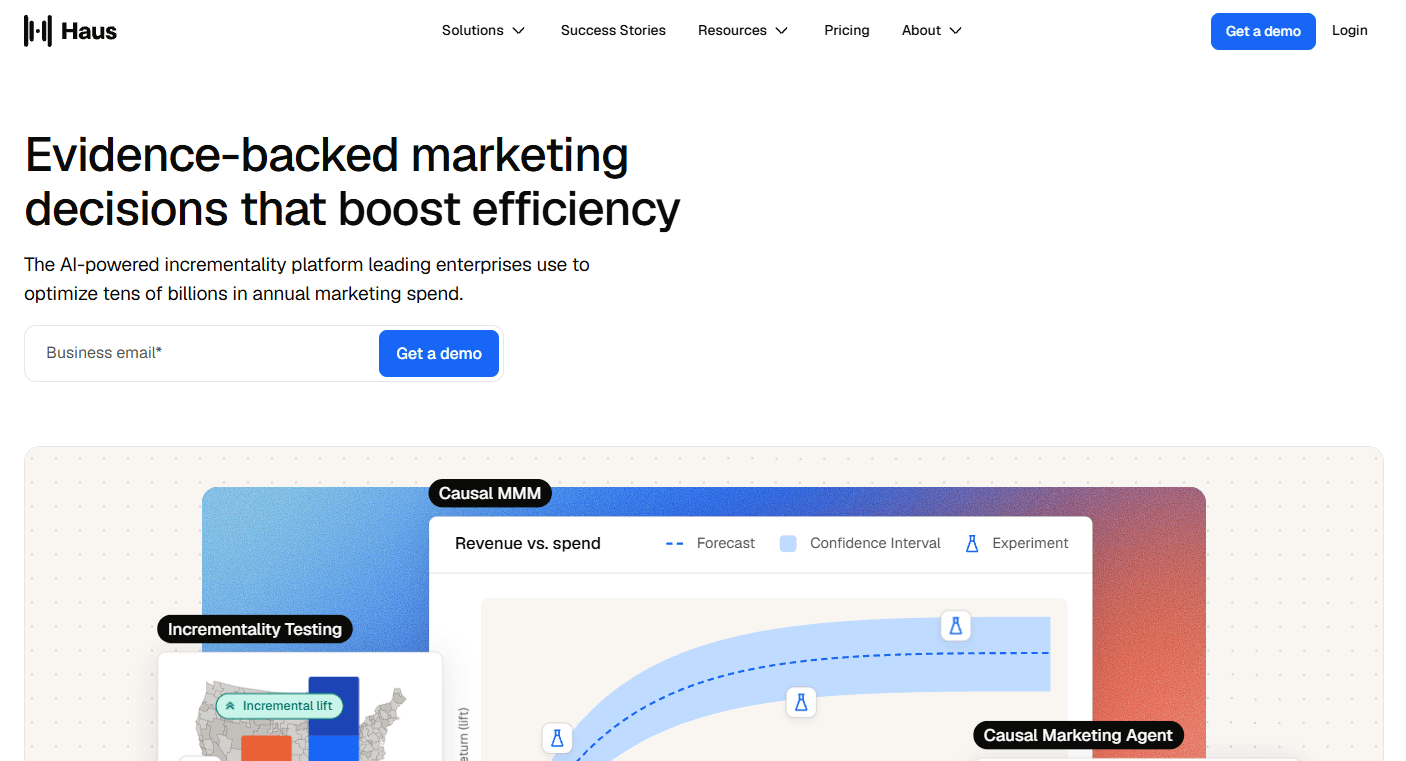
Haus is an AI-powered incrementality platform that combines causal marketing mix modeling with experiment-based measurement. Rather than relying on correlation alone, Haus uses geo-based incrementality testing as an input to its MMM, so the model outputs are grounded in actual causal evidence. Teams use it to run controlled experiments across major ad platforms, then feed those results into scenario planning and budget optimization workflows.
Best for: Enterprise and growth marketing teams that distrust correlation-only models and want experiment-informed MMM.
Key features
- Causal marketing mix modeling
- Geo-based incrementality testing across ad platforms
- Causal attribution for granular measurement
- Scenario planning and budget recommendations
- Channel contribution analysis
Why choose Haus: Haus is the right fit when your CMO or CFO challenges whether channels are actually driving outcomes. The causal methodology gives you a defensible answer. Teams need sufficient spend scale and historical data to get useful experiment results.
Haus pricing: Haus offers Basics, Core, Plus, and Enterprise plans. Numerical prices are not displayed; you go through their sales team for a proposal based on measurement scope and experimentation needs.
G2 rating: 4.8
3. Circana

Circana provides consumer, market, retail, and marketing data analytics for brands that need media measurement grounded in real purchase behavior. Its platform integrates POS, retail, foodservice, and consumption data alongside marketing mix inputs, giving retail and CPG teams a measurement context that generic MMM tools lack. Marketing Foresight and AI-driven simulations help brands model spend scenarios against real market data.
Best for: Retail, CPG, and omnichannel brands where shopper behavior and retail data matter as much as media spend.
Key features
- Omnichannel consumer behavior and purchase analysis
- POS, retail, foodservice, and consumption data integration
- Market measurement, forecasting, and promotion analytics
- AI-driven scenario simulations
- Assortment and pricing analytics
Why choose Circana: If your MMM needs to reflect what happens at shelf level, not just in ad dashboards, Circana's retail data context is a genuine differentiator. Smaller SaaS or direct-to-consumer teams will find the platform more enterprise-oriented than their situation requires.
Circana pricing: Circana's Liquid Data Go packages start at $499 per story. Broader analytics engagements use custom pricing through sales. Scope, market coverage, and data complexity drive the final cost.
G2 rating: 4.6
4. Measured
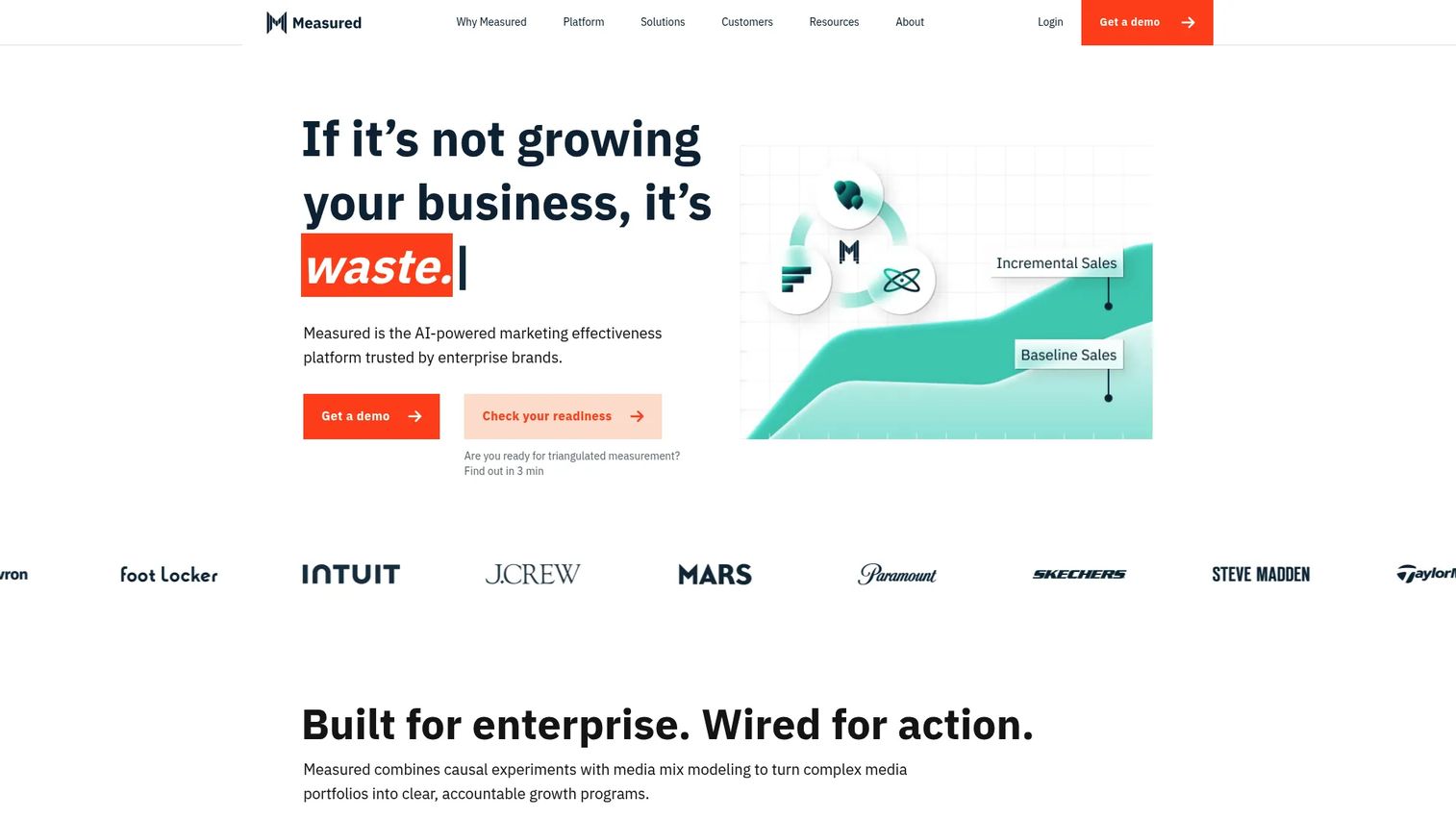
Measured is an AI-powered marketing effectiveness platform that puts incrementality testing and media mix modeling inside the same system. For DTC and ecommerce brands running performance marketing at scale, that combination matters: You can test whether a channel is incremental, then model how that answer should shift the full budget. Measured also provides benchmarks and cross-channel reporting to contextualize what your spend is doing against category norms.
Best for: Enterprise DTC and ecommerce brands that want MMM and incrementality testing in a single measurement conversation.
Key features
- Incrementality testing
- Media mix modeling
- Media plan optimization
- Cross-channel reporting and benchmarks
- Channel contribution analysis
Why choose Measured: Teams that want to cut media waste without cutting channels that are actually working will find Measured's experiment-plus-model approach more trustworthy than standalone MMM. Disciplined testing and clean data processes are prerequisites for getting useful results.
Measured pricing: Pricing is quote-based through the Measured sales team. Cost drivers include spend scale, number of channels, testing cadence, and analytics support requirements.
G2 rating: 4.9/5
5. Nielsen Marketing Mix Modeling

Nielsen Marketing Mix Modeling brings decades of established MMM methodology to enterprise brands and media organizations. The platform models how marketing investments affect revenue and profit across online, offline, and external demand factors, with scenario simulation and budget optimization built in. Nielsen serves advertisers, agencies, publishers, and ad platforms that need a measurement provider with global reach and category depth.
Best for: Enterprise brands that value established methodology, service depth, and global market coverage.
Key features
- Sales and profit impact modeling
- Online, offline, and external demand-factor analysis
- Scenario simulation and budget optimization
- Brand measurement context
- Global market coverage
Why choose Nielsen Marketing Mix Modeling: Teams that need a measurement provider with decades of category benchmarks and service depth will find Nielsen's track record reassuring. Teams looking for self-serve, fast-deploy software should evaluate lighter platforms alongside this option.
Nielsen Marketing Mix Modeling pricing: Pricing is enterprise sales-led. The original Nielsen MMM URL currently redirects to Circana, so contact Nielsen directly to confirm current packaging and scope.
G2 rating: 3.6
6. Dentsu Market Mix Modelling

Dentsu Market Mix Modelling is a bespoke econometric measurement service for brands that want MMM integrated directly into their media planning and buying strategy. Dentsu's approach measures the impact of price, promotion, marketing activity, seasonality, and economic factors on sales, using multiplicative modeling to capture interactions between variables. Its dual adstock methodology handles both short-term and long-term carryover effects, and it supports Google Meridian MMM capabilities where relevant.
Best for: Enterprise brands already working with Dentsu for media services who want measurement connected to activation decisions.
Key features
- Multiplicative modeling of marketing, pricing, and economic factors
- Short-term and long-term dual adstock modeling
- Sales and market-share driver quantification
- Incrementality calibration support
- Google Meridian MMM capabilities
Why choose Dentsu Market Mix Modelling: The strongest case is when you want MMM to directly inform how your agency buys media, not just report on it after the fact. Teams building an independent, in-house analytics function should assess how much they want advisory layers built into the measurement.
Dentsu Market Mix Modelling pricing: Services-led and bespoke. Pricing depends on measurement scope, number of markets, modeling cadence, and the broader Dentsu engagement.
G2 rating: 4.5
7. Gain Theory ROVA

Gain Theory ROVA is an advanced analytics platform for marketing measurement that uses machine learning and statistical modeling to surface commercial insights from complex data. The ROVA App provides interactive interfaces for exploring model outputs, while connected Python Notebooks allow teams to automate and extend analysis. Models can be hosted by Gain Theory or deployed behind the client's own firewall, which matters for enterprise data governance requirements.
Best for: Large enterprise brands that need rigorous analytics plus the strategic interpretation to act on model outputs.
Key features
- Machine learning and statistical modeling
- Hierarchical models for strategic and performance questions
- Bayesian modeling for granular insights
- ROVA App with interactive user interfaces
- Connected Python Notebooks for automation and custom deployment
Why choose Gain Theory ROVA: Gain Theory suits organizations that want both a robust model and an analytics partner who can explain what the numbers mean to the board. Teams that want self-serve software with minimal advisory involvement should weigh how much service support fits their operating model.
Gain Theory ROVA pricing: Quote-based. Fees are specified in customer-specific order forms. Pricing depends on scope, number of markets, modeling cadence, and service-layer requirements.
G2 rating: 4.7
8. Ipsos Unified Marketing Mix Modeling

Ipsos Unified Marketing Mix Modeling brings together marketing effectiveness measurement and market research under a single analytical framework. The offering covers holistic modeling of marketing, sales, operational, economic, competitive, pricing, promotion, and weather factors, with real-time simulation and scenario planning through its SaaS-based Activate platform. For research-driven organizations that want MMM embedded in a broader brand and consumer insight picture, Ipsos provides that integration.
Best for: Large, research-heavy marketing organizations that want MMM tied to consumer insights and brand measurement.
Key features
- Holistic modeling of marketing, sales, economic, and external factors
- Real-time simulation and optimization through Activate platform
- Integrated marketing data management, cleansing, and harmonization
- Predictive statistical models using client-specific data
- Historical contribution analysis across business variables
Why choose Ipsos Unified Marketing Mix Modeling: The case is strongest when your measurement agenda spans media effectiveness and broader consumer or brand questions, and you want both answered by the same provider. Teams only seeking a focused software tool for media budget decisions may find the broader research context more than they need.
Ipsos Unified Marketing Mix Modeling pricing: Consultative and custom-priced through Ipsos. Scope, markets covered, and research integration drive the engagement cost.
G2 rating: 3.8/5
9. Marketscience Studio

Marketscience Studio is a marketing mix modeling and optimization platform built for analytics teams that want transparency and control over their models. It handles data extraction, cleaning, harmonization, and visualization, then runs dynamic hierarchical Bayesian econometric modeling across channels, products, markets, and regions. Output includes full system decomposition with contribution, lift, ROI, and response-curve views. The product is available as SaaS, fully managed consulting, or under a DIY licensing model.
Best for: Marketing and analytics teams that want model transparency and in-house control rather than black-box outputs.
Key features
- Dynamic hierarchical Bayesian econometric modeling
- Data extraction, cleaning, and harmonization workflows
- Full contribution, lift, ROI, and response-curve decomposition
- Marketing investment simulation and optimization under constraints
- Marketing-performance reporting with drillable dashboards
Why choose Marketscience Studio: Teams with internal analytics skill who want to see inside the model and run their own sensitivity analyses will find the transparency valuable. Non-technical marketing teams typically need analyst support to get value from the platform.
Marketscience Studio pricing: Available as SaaS, managed service, or DIY license. No numerical pricing is displayed on the site; contact Marketscience directly for a proposal based on delivery model and scope.
G2 rating: 4.4
10. Lifesight

Lifesight is an agentic unified marketing measurement platform combining causal marketing mix modeling, geo-based incrementality testing, and incrementality-adjusted attribution. Its Performance plan focuses on online measurement; Precision adds experiment-informed MMM, scenario planning, forecasting, and budget optimization; Enterprise extends to multi-brand and multi-country measurement with custom AI-agent workflows. The platform targets mid-market and enterprise consumer brands that need causal, full-funnel measurement without building a data science function from scratch.
Best for: Mid-market and enterprise consumer brands that need causal measurement and budget optimization without in-house modeling resources.
Key features
- Causal marketing mix modeling
- Geo-based incrementality testing
- Incrementality-adjusted attribution
- Scenario planning, forecasting, and budget optimization
- Multi-brand and multi-country measurement (Enterprise)
Why choose Lifesight: Growth marketers who want practical measurement outputs with a causal foundation, without running open-source pipelines, will find Lifesight's packaged approach faster to deploy. Technical buyers should validate methodology transparency and confirm which channels the geo experiments support.
Lifesight pricing: Annual subscription with custom pricing across Performance, Precision, and Enterprise plans. Cost varies by business scale, number of channels, measurement goals, data setup, and delivery support.
G2 rating: 4.2/5
11. Robyn
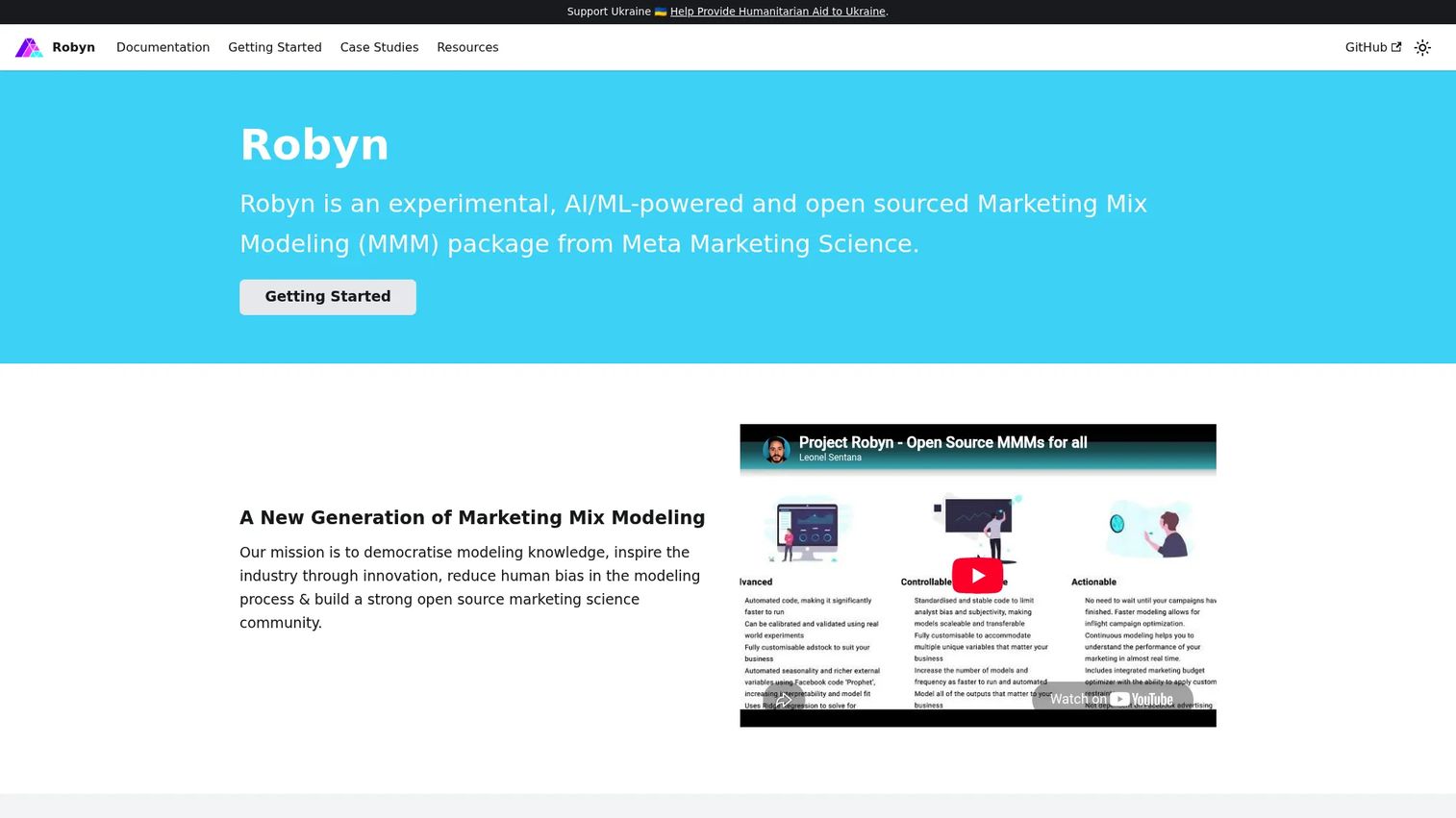
Robyn is an open-source, AI/ML-powered marketing mix modeling package from Meta Marketing Science. It uses automated multi-objective hyperparameter optimization through evolutionary algorithms, ridge regression for model fitting, and gradient-based budget allocation. Teams can calibrate models using causal experiments, run time-series decomposition for trend and seasonality, and generate one-page model reports for stakeholders. Because Robyn requires no PII, cookies, or pixel data, it works in privacy-constrained environments.
Best for: Data science and analytics teams that want full model control, customization, and no license fees.
Key features
- Automated hyperparameter optimization using evolutionary algorithms
- Ridge regression for model fitting
- Causal experiment calibration
- Gradient-based budget allocation
- Privacy-friendly modeling without PII or cookies
Why choose Robyn: If your team has data science resources and wants to own the full model, Robyn eliminates vendor dependency. The tradeoff is that implementation time replaces license cost, and ongoing maintenance requires continued analyst investment.
Robyn pricing: Free open-source software. Budget for data science time, infrastructure, and model maintenance.
G2 rating: 5
12. Meridian
Meridian is Google's open-source marketing mix modeling framework, built on causal inference principles with Bayesian modeling at its core. It supports geo-level hierarchical modeling, reach and frequency inputs, Google Query Volume integration, and calibration through GeoX experiments. Customizable priors and control variables give technical teams the flexibility to adapt the model to their specific media mix and business context.
Best for: Marketing measurement teams and data scientists building causal MMM with Bayesian methods, particularly those running Google-heavy media.
Key features
- Causal-inference-based Bayesian MMM
- Geo-level hierarchical modeling
- Reach and frequency modeling
- Google Query Volume integration
- Meridian GeoX experiment calibration
Why choose Meridian: Meridian is the right choice for technical teams that want a credible, well-documented open-source framework with active support from Google. It is not a turnkey platform; non-technical marketers without data science partners should start with packaged software instead.
Meridian pricing: Free open-source library. Costs are internal implementation, data engineering, and analyst time.
G2 rating: 3
13. PyMC
PyMC is a probabilistic programming library for Python, used by data scientists building Bayesian statistical models from first principles. While not an MMM product, it is widely used to construct custom Bayesian marketing mix models with full control over priors, likelihood functions, and inference methods. PyMC supports MCMC algorithms including NUTS, variational inference, Gaussian processes, and multiple computational backends including JAX and Numba.
Best for: Quantitative researchers and data scientists who want maximum flexibility in building custom Bayesian MMM architectures.
Key features
- Python API for Bayesian model building
- MCMC algorithms including NUTS
- Variational inference including ADVI
- Gaussian processes and ABC
- JAX and Numba computational backends
Why choose PyMC: Marketers who want to build highly customized models, test novel specifications, or publish reproducible research use PyMC. Teams without quantitative modeling expertise should choose a packaged MMM tool rather than starting from a probabilistic programming library.
PyMC pricing: Free open-source library. Data science labor is the primary cost.
G2 rating: 4.4
14. Ruler Analytics

Ruler Analytics is a marketing measurement and attribution platform that connects marketing touchpoints, customer journeys, CRM data, and revenue in a single reporting layer. It offers multi-touch attribution, first-party tracking, advanced segmentation, and marketing mix modelling capabilities, alongside integrations with CRM, advertising, analytics, BI, and data warehouse tools. For B2B growth teams that need spend tied to pipeline outcomes rather than click-level ad stats, Ruler closes that gap.
Best for: B2B and considered-purchase businesses connecting marketing activity and CRM revenue, with MMM-oriented reporting.
Key features
- First-party tracking and conversion tags
- Multi-touch attribution
- Marketing mix modelling
- CRM and revenue integration
- BI and data warehouse connections
Why choose Ruler Analytics: Revenue-focused B2B marketers who want channel spend mapped to pipeline will find Ruler's CRM-revenue connection more directly actionable than pure MMM outputs. Buyers focused primarily on deep media mix modeling with scenario planning and budget simulation should verify the depth of Ruler's MMM functionality against their specific requirements.
Ruler Analytics pricing: Plans start at $400/month for up to 10,000 monthly visits, $668/month for up to 50,000, $1,326/month for up to 100,000, and $2,000/month above that. Annual billing saves 10%.
G2 rating: 4.6/5
15. Cassandra

Cassandra is positioned as an MMM platform with accessible budget optimization and forecasting workflows. The site was unavailable for direct verification at time of writing, so feature details and pricing could not be confirmed from first-party sources. Buyers should visit cassandra.ai directly to validate current capabilities, pricing, and G2 standing before including it on a shortlist.
Best for: Teams wanting approachable MMM planning and budget optimization workflows, pending verification.
Key features
- MMM modeling
- Budget forecasting
- Scenario planning
- Channel optimization
- Planning dashboards
Why choose Cassandra: The platform's positioning targets marketers who want MMM output usable in planning meetings without deep technical overhead. Confirm current product depth and pricing through direct outreach before making a shortlist decision.
Cassandra pricing: Pricing requires direct contact with the Cassandra team.
G2 rating: 4.1
16. Keen

Keen describes itself as a fully managed event streaming and analytics platform. Its marketing-facing capabilities center on real-time event data collection, analytics with query and compute functions, and embedded white-labeled dashboards. If you are evaluating Keen specifically for media mix modeling and predictive budget planning, verify those capabilities directly with the Keen team, as the primary product positioning is around event analytics and developer-facing data infrastructure.
Best for: Developers and product teams building real-time, customer-facing analytics into applications.
Key features
- Real-time event streaming and data collection
- Real-time analytics with query and compute functions
- Embedded white-labeled dashboards and visualizations
Why choose Keen: Keen suits teams building analytics into their own product, not marketing teams primarily seeking a standalone MMM planning tool. If your requirement is predictive budget planning and media mix modeling, confirm the product scope covers that before committing.
Keen pricing: Subscription-based with usage tiers, but current numerical plan prices are not publicly displayed. Contact Keen for current pricing based on event volume and feature requirements.
G2 rating: 4.4/5
17. Leavened

Leavened provides marketing measurement and marketing mix modeling with AI-enabled analytics, forecasting, optimization, and strategic services. It covers online and offline channel analysis without PII, placement-level insights for digital, audio, linear, and OTT media, and AI-assisted model configuration. Delivery options range from self-service to fully managed, which lets teams scale involvement based on internal analytics capacity.
Best for: Brands, agencies, and analysts wanting customizable MMM with flexible delivery from self-serve to fully managed.
Key features
- Marketing mix modeling with cross-channel online and offline analysis
- Placement-level insights for digital, audio, linear, and OTT
- AI-assisted model configuration and forecasting
- Scenario planning and media investment optimization
- Self-service, partially managed, and fully managed delivery options
Why choose Leavened: Teams that need easier adoption than open-source but more customization than a fixed commercial platform will find Leavened's delivery flexibility useful. Buyers should confirm onboarding requirements, model transparency documentation, and pricing through a direct trial or demo.
Leavened pricing: Free trials are available; ongoing pricing is tailored and not publicly displayed. Contact Leavened for a proposal based on your channels, measurement goals, and delivery preference.
G2 rating: 4.8
18. Maximus

Maximus is a technology-enabled services company providing AI, advanced analytics, cloud migration, cybersecurity, data management, and omnichannel contact center capabilities primarily for government agencies. Its core market is large-scale public sector technology modernization, not commercial marketing mix modeling. Buyers evaluating Maximus for MMM should verify whether a marketing measurement product exists under this brand, as the homepage does not position it in the marketing analytics category.
Best for: Government agencies seeking large-scale technology modernization, digital services, and analytics support.
Key features
- AI and advanced analytics
- Cloud migration and digital modernization
- Data management and governance
- Cybersecurity
- Omnichannel contact center
Why choose Maximus: Maximus is built for public sector contracts, not commercial marketing teams. Confirm product scope directly before treating this as an MMM platform.
Maximus pricing: Custom pricing through enterprise sales contracts. Standard SaaS pricing is not applicable to this product.
G2 rating: 4.6
19. Orbit
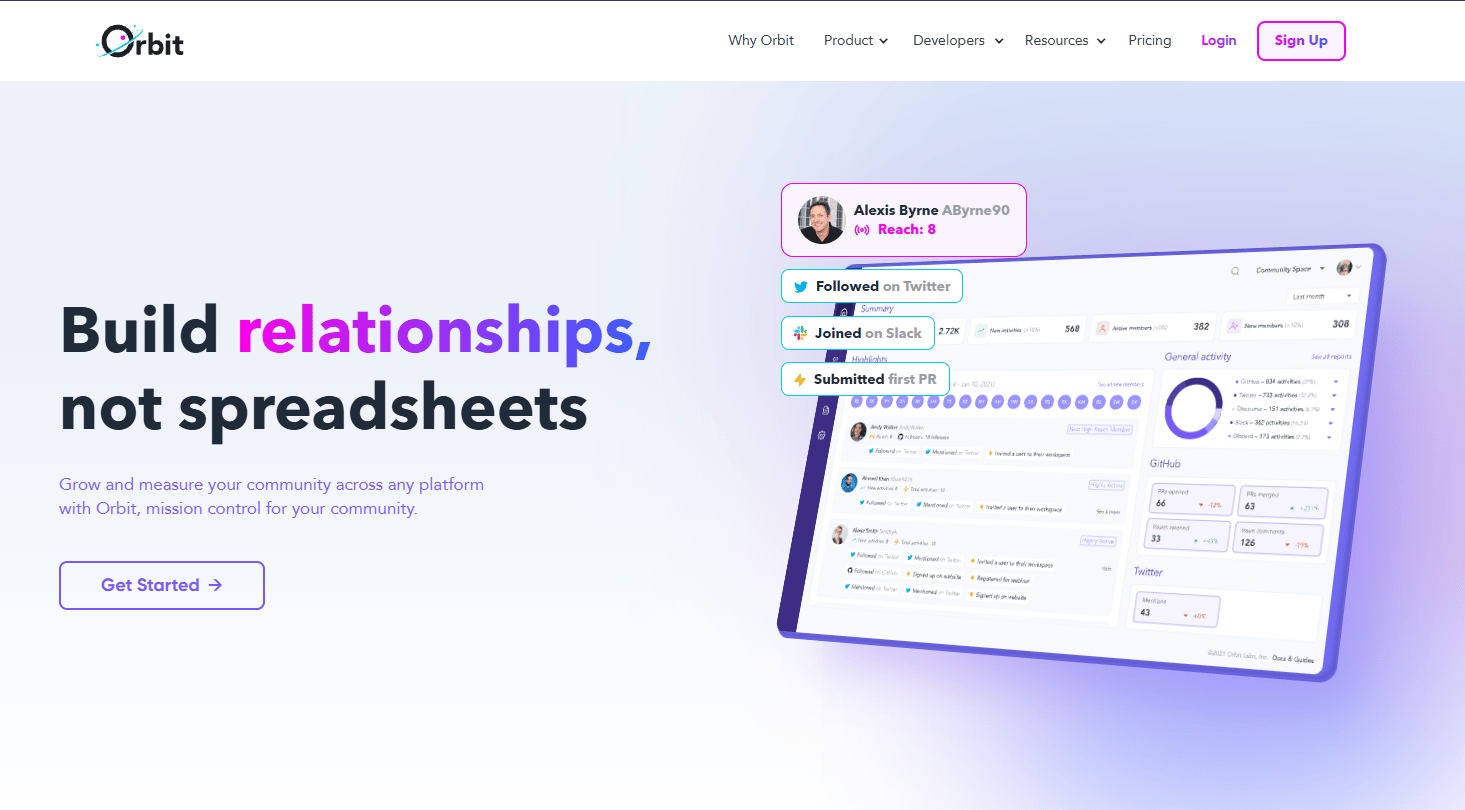
Orbit is a community data platform for understanding members, measuring community activity, and automating engagement workflows. It provides member profiles, activity reports, task automation, identity resolution, and integrations with Slack, GitHub, HubSpot, and Salesforce. Orbit is not an MMM platform. Buyers evaluating it for marketing mix modeling or media budget optimization should note that the product's focus is community analytics and member engagement, not cross-channel spend attribution or scenario planning.
Best for: Community and growth teams needing unified member intelligence and engagement automation.
Key features
- Member profiles and activity timelines
- Reports and member filters
- Task automation and engagement workflows
- Identity resolution and real-time alerts
- Integrations with Slack, HubSpot, Salesforce, GitHub, and Zapier
Why choose Orbit: Choose Orbit when your measurement need is community engagement, not media mix. It is a strong community analytics product and a poor substitute for channel-level budget modeling.
Orbit pricing: Starter plan is free. Growth costs $50/seat/month billed annually ($60/month billed monthly). Enterprise pricing is custom.
G2 rating: 4.0/5
20. LightweightMMM
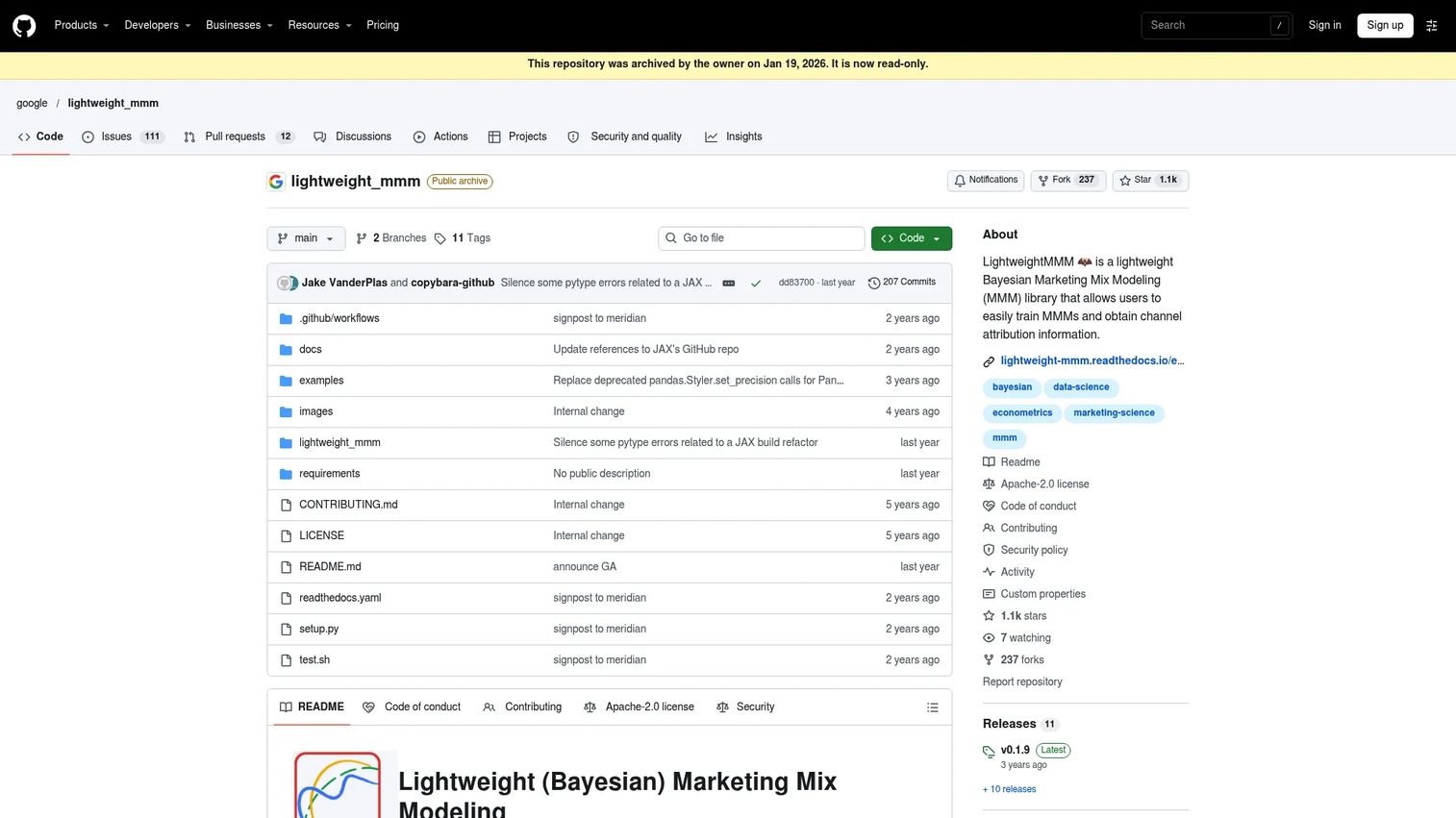
LightweightMMM is an open-source Python library for Bayesian marketing mix modeling, originally developed with Google involvement. It supports national-level and geo-level hierarchical models, media adstock and Hill-adstock transformations, media effectiveness and ROI estimation, and budget allocation optimization. The official GitHub repository is now archived, meaning active development has ended and the library is no longer maintained. Teams starting new MMM builds should evaluate Meridian instead.
Best for: Data science teams that need a lightweight Bayesian MMM library, noting that Meridian is the actively supported successor.
Key features
- Bayesian marketing mix modeling
- National-level and geo-level hierarchical models
- Media adstock, Hill-adstock, and carryover transformations
- Media effectiveness and ROI estimation
- Budget allocation optimization
Why choose LightweightMMM: If you have an existing LightweightMMM implementation and want to maintain it, the library remains functional. For new projects, Meridian is the actively supported replacement and the better starting point.
LightweightMMM pricing: Free open-source library. Costs are internal data science time and infrastructure.
G2 rating: 4.6
21. C5i Demand Drivers

C5i Demand Drivers is an AI-powered marketing mix modeling platform that measures demand drivers and optimizes marketing effectiveness for enterprise commercial teams. It delivers always-on MMM with incremental impact measurement across media, pricing, promotions, distribution, and broader business factors. Budget optimization, market-scenario simulation, forecasting, and conversational AI insights round out the platform. For enterprise teams where marketing modeling needs to account for factors beyond media spend, C5i extends the analysis to the full demand picture.
Best for: Enterprise marketing and commercial teams optimizing omnichannel investment and modeling marketing ROI alongside broader demand drivers.
Key features
- Always-on marketing mix modeling
- Incremental impact measurement across media, pricing, promotions, and distribution
- Budget optimization and market-scenario simulation
- Forecasting workflows
- Conversational AI insights
Why choose C5i Demand Drivers: Enterprise teams whose budget decisions depend on understanding pricing, promotions, and distribution alongside media spend will find C5i's demand-driver scope more relevant than media-only MMM. Smaller teams or those primarily optimizing digital media may prefer a narrower, faster-deploying platform.
C5i Demand Drivers pricing: Custom pricing through C5i sales. Contact the team directly for scope-based proposals.
G2 rating: 4.2
Considerations when choosing marketing mix modeling software
Modeling approach and transparency
Ask how the model handles adstock, saturation, seasonality, multicollinearity, and external factors. If your CFO or board will challenge the output, a black-box recommendation will not survive scrutiny. Demand a model you can explain, not just present.
Data readiness
MMM needs clean historical spend, outcome, calendar, pricing, promotion, and external data going back at least two years for most channel configurations. Poor data creates false confidence faster than it creates insight. Audit your data before evaluating vendors.
Planning workflow
Look for scenario planning, marginal return curves, budget simulations, and clear allocation recommendations. A model that only explains the past will not help you answer next quarter's budget question. The output should be actionable, not just descriptive.
Implementation model
Compare self-serve software, managed service, cooperative models, and open-source builds. Each trades vendor cost against internal analyst time. A startup with one marketer needs a different answer than an enterprise team with a modeling function already in place.
Integration and governance
Assess fit with your CRM, ad platforms, BI stack, data warehouse, and finance workflows. Enterprise teams should verify permissions, audit trails, security documentation, and data residency requirements before committing.
Conclusion
Marketing mix modeling software is no longer a niche capability for large CPG companies. With signal loss accelerating and attribution fights consuming more and more analyst time, it has become a practical tool for growth teams that need budget decisions leadership will actually trust.
The right choice depends on your operating model:
- Enterprise teams with Adobe workflows: Adobe Mix Modeler keeps measurement inside your existing data infrastructure
- Causal MMM and incrementality: Haus and Measured combine experiments with modeling for a defensible measurement foundation
- Technical teams building in-house: Meridian is the actively maintained open-source starting point, with Robyn a strong alternative
- Growth and planning teams: Lifesight and Ruler Analytics provide practical outputs without requiring a data science function
- Analytics-led and research organizations: Gain Theory ROVA, Ipsos Unified Marketing Mix Modeling, and Marketscience Studio offer depth and advisory support
Before committing to any platform, audit your data readiness, decide between software and managed services, shortlist three tools against your team's maturity, and verify pricing and model transparency directly with each vendor.
Start your journey with Guideflow today!
FAQs
Marketing mix modeling software analyzes historical marketing, sales, pricing, promotion, and external data to estimate how different channels contribute to business outcomes. It models the relationship between spend inputs and revenue outputs at an aggregate level, then recommends where budget should shift to improve marginal returns. The output is a defensible, channel-level allocation recommendation rather than a last-click attribution report.
Attribution typically operates at the user or touchpoint level, tracing individual journeys where consented tracking data exists. MMM operates at the aggregate level, modeling total spend against total outcomes across all channels, including offline and upper-funnel media where user tracking is unavailable. Attribution works best for optimizing digital journeys; MMM works best for strategic budget allocation across the full mix. Incrementality testing validates causal lift in specific channels through controlled experiments and complements both.
A working MMM needs historical spend by channel, impressions or GRPs, sales or revenue outcomes, pricing, promotions, and campaign calendars. External variables such as seasonality, distribution, competitor activity, and macroeconomic conditions improve accuracy. Most models need at least 18 to 24 months of weekly data, with longer histories producing more reliable saturation and adstock estimates. Data granularity and consistency across the full history matter as much as volume.
Open-source tools including Meridian, Robyn, and PyMC are genuinely capable for technical teams with data science resources. The tradeoff is that implementation time, infrastructure management, and ongoing model maintenance replace the license cost. For non-technical marketing teams without internal modeling support, packaged software or managed-service MMM is usually faster to value. Many teams start with an open-source framework to understand the method and then move to a managed platform for operationalization.
Implementation timelines vary significantly by tool type and data readiness. Open-source builds can take weeks to months depending on data engineering requirements. Managed-service engagements from agencies or platforms typically run six to twelve weeks for initial model delivery. Self-serve software with clean data inputs can produce first outputs faster. The main drivers are data cleanliness, number of channels modeled, number of markets covered, internal analytics bandwidth, and the refresh cadence the team needs.
Yes. Measuring channels that attribution misses is one of MMM's core strengths. TV, out-of-home, radio, print, podcast advertising, retail media, affiliate programs, and influencer campaigns all lack the click-level tracking that digital attribution requires. MMM treats every channel as an input against a shared outcome variable, so it can estimate the contribution of a TV campaign run in one market against the same outcome tracked across all channels simultaneously. This aggregate view is what makes MMM useful for large mixed-media budgets.
Refresh cadence depends on spend scale, planning cycle, and tool capability. Some teams run monthly updates to track in-flight optimization; others refresh quarterly to align with budget planning cycles. Weekly refreshes are possible on platforms designed for it but require clean, timely data feeds. The risk of over-refreshing is overreacting to short-term noise that the model cannot reliably separate from true signal. Align the refresh cadence to the decisions the model needs to inform, not the fastest interval the platform supports.
Retail brands should evaluate platforms with strong retail and consumer data context, including Circana and Nielsen Marketing Mix Modeling. Circana's integration of POS, shopper, and consumption data alongside media inputs provides a measurement context that generic MMM tools lack. For enterprise retail teams with complex omnichannel mixes, Ipsos Unified Marketing Mix Modeling and C5i Demand Drivers also address broader demand factors beyond media. Validate retailer-specific data coverage, category depth, and geographic market availability directly with each vendor before shortlisting.
The two terms are often used interchangeably, but marketing mix modeling is the broader concept. It covers all marketing inputs including pricing, promotions, and distribution alongside media spend. Media mix modeling typically refers specifically to the media allocation component. The UK spelling of "modelling" (double L) is common in British and European markets but describes the same analytical approach. Most commercial platforms cover both.