


You onboarded a new vendor last quarter. Someone emailed them a security questionnaire. The answers landed in a shared inbox. A spreadsheet tracked the risk score, until it didn't. Six months later an auditor asks for evidence, and nobody can find the SOC 2 report or remember who signed off on the exception.
That is the state of vendor risk work at most companies. It lives in inboxes, one-off follow-ups, and spreadsheets that go stale the day someone stops updating them. And the stakes keep climbing. The vendor risk management market was valued at roughly USD 13.47 billion in 2025 and is projected to reach USD 23.87 billion by 2030 at about a 12% CAGR, according to Mordor Intelligence (2025). That growth reflects a simple reality: third-party risk management software has moved from a nice-to-have to a control that regulators, boards, and customers expect you to run.
The problem with manual third party risk management software workarounds is not effort. Teams work hard. The problem is that spreadsheets don't monitor continuously, don't score consistently, and don't leave an audit trail. When a vendor's security posture changes on a Tuesday, a point-in-time review from eight months ago tells you nothing. A real vendor risk management platform closes that gap by turning onboarding, assessment, monitoring, and reporting into one connected workflow instead of a chain of disconnected tasks.
This guide compares the platforms worth shortlisting. If your team also evaluates adjacent controls, it can help to look at audit management software, contract lifecycle management, and AI security posture management tools alongside your VRM decision.
What's inside
This article compares 7 vendor risk management solutions selected for lifecycle coverage, automation depth, continuous monitoring, risk scoring, reporting, and integrations. We favored platforms that help teams move from vendor onboarding through offboarding without losing evidence or context along the way.
The list is built for security, GRC, procurement, IT risk, and compliance buyers who are shortlisting tools right now. Each entry covers what the platform does well, who it fits, verified pricing where public, and its current G2 rating. We skipped generic feature checklists in favor of workflow fit, because that is what actually determines whether a tool sticks.
TL;DR
- Best overall for end-to-end lifecycle automation: ProcessUnity, for teams that want a configurable program from onboarding to reporting.
- Best for continuous monitoring and risk scoring: Bitsight, for objective, real-time security ratings across your vendor portfolio.
- Best for AI-assisted evidence review: Vanta, for automated evidence collection and trust center retrieval.
- Best for enterprise governance and privacy-adjacent risk: OneTrust, for teams orchestrating risk, privacy, and third-party oversight together.
- Best for teams standardized on one operations platform: ServiceNow, for embedding vendor risk workflows in a broader enterprise system.
- Best for mature, dedicated TPRM programs: Prevalent, for deep operational assessment and remediation depth.
- Best for fast external risk visibility: Panorays, for quick vendor onboarding and continuous cyber monitoring.
What is vendor risk management software?
Vendor risk management software is a platform that helps organizations assess, onboard, monitor, and report on the risk that third-party vendors and suppliers introduce. It replaces manual questionnaires, email chains, and spreadsheets with a structured workflow that runs across the full vendor lifecycle.
The category spans five connected stages: onboarding and intake, due diligence and assessment, continuous monitoring, remediation and issue management, and offboarding. Strong vendor management software keeps evidence, ownership, and decisions in one place so nothing gets lost between stages.
Core capabilities most buyers evaluate:
- Vendor inventory and lifecycle tracking: A single source of truth for every vendor, their tier, and where they sit in the assessment cycle.
- Questionnaire and evidence automation: Templated assessments, automated distribution, and evidence collection that reduce manual chasing.
- Continuous monitoring and alerts: Ongoing signals on breaches, security posture changes, and rating shifts, not just an annual snapshot.
- Risk tiering and scoring: Consistent risk scoring that ranks vendors by inherent and residual risk so teams focus attention where it matters.
- Audit-ready reporting and integrations: Traceable records, board-level dashboards, and connections to GRC, procurement, and security systems.
The best vendor risk management tools treat these as one motion, not five disconnected modules. That integration is what separates a real platform from a questionnaire tool with a dashboard bolted on.
When to use vendor risk management software
When vendor spreadsheets stop scaling
The signs are consistent. Assessments take weeks because evidence lives in different inboxes. Nobody agrees on which spreadsheet is current. Repeat assessments start from scratch every year because last year's context is gone. When vendor volume grows past what one analyst can track by hand, manual workflows break in predictable ways. A platform standardizes intake, reuses prior answers, and keeps the full history in one place.
When you need continuous monitoring
A point-in-time review tells you a vendor was compliant on the day you checked. It says nothing about the breach they disclose three months later. Continuous monitoring changes the model: the platform watches for security posture changes, new vulnerabilities, and breach signals, then alerts you when a vendor's risk profile shifts. For any vendor touching sensitive data, ongoing cybersecurity risk visibility is the difference between finding out from your tool and finding out from the news.
When compliance teams need audit-ready reporting
Auditors and boards want the same thing: proof. Who approved this vendor? What was the risk rating? Where is the evidence? When was the last review? Manual processes struggle to answer these on demand. Audit-ready reporting gives you traceability, clear ownership, and dashboards that translate vendor risk into board-level language. If your team also runs formal audit cycles, pairing VRM with dedicated audit management tooling keeps the evidence trail consistent.
Comparison table
The table below helps you compare workflow fit, scoring approach, and reporting strength at a glance. Use it to narrow the list, then read the item sections for the platforms that match your lifecycle needs. Pricing reflects publicly available information at the time of writing; most enterprise VRM vendors quote custom pricing based on vendor count and modules.
| # | Product | Intent | Key differentiation | Pricing | G2 rating |
|---|---|---|---|---|---|
| 1 | ProcessUnity | End-to-end lifecycle automation | Global Risk Exchange plus configurable TPRM workflows | From $25,000 (SMB); custom otherwise | 4.5/5 |
| 2 | Bitsight | Continuous monitoring and scoring | Objective, real-time security ratings | Request pricing | 4.5/5 |
| 3 | Vanta | AI-assisted evidence review | Automated evidence collection and Trust Center | Request pricing | 4.6/5 |
| 4 | OneTrust | Enterprise governance and privacy | Unified privacy, risk, and third-party management | Custom (usage-based) | 4.4/5 |
| 5 | ServiceNow | Workflow-embedded vendor risk | Vendor risk inside a broader operations platform | Custom quote | 4.4/5 |
| 6 | Prevalent | Dedicated, mature TPRM programs | Full-lifecycle assessment and remediation depth | Custom | 4.5/5 |
| 7 | Panorays | Fast external risk visibility | AI assessments plus attack surface monitoring | Request pricing (free tier available) | 4.3/5 |
1. ProcessUnity
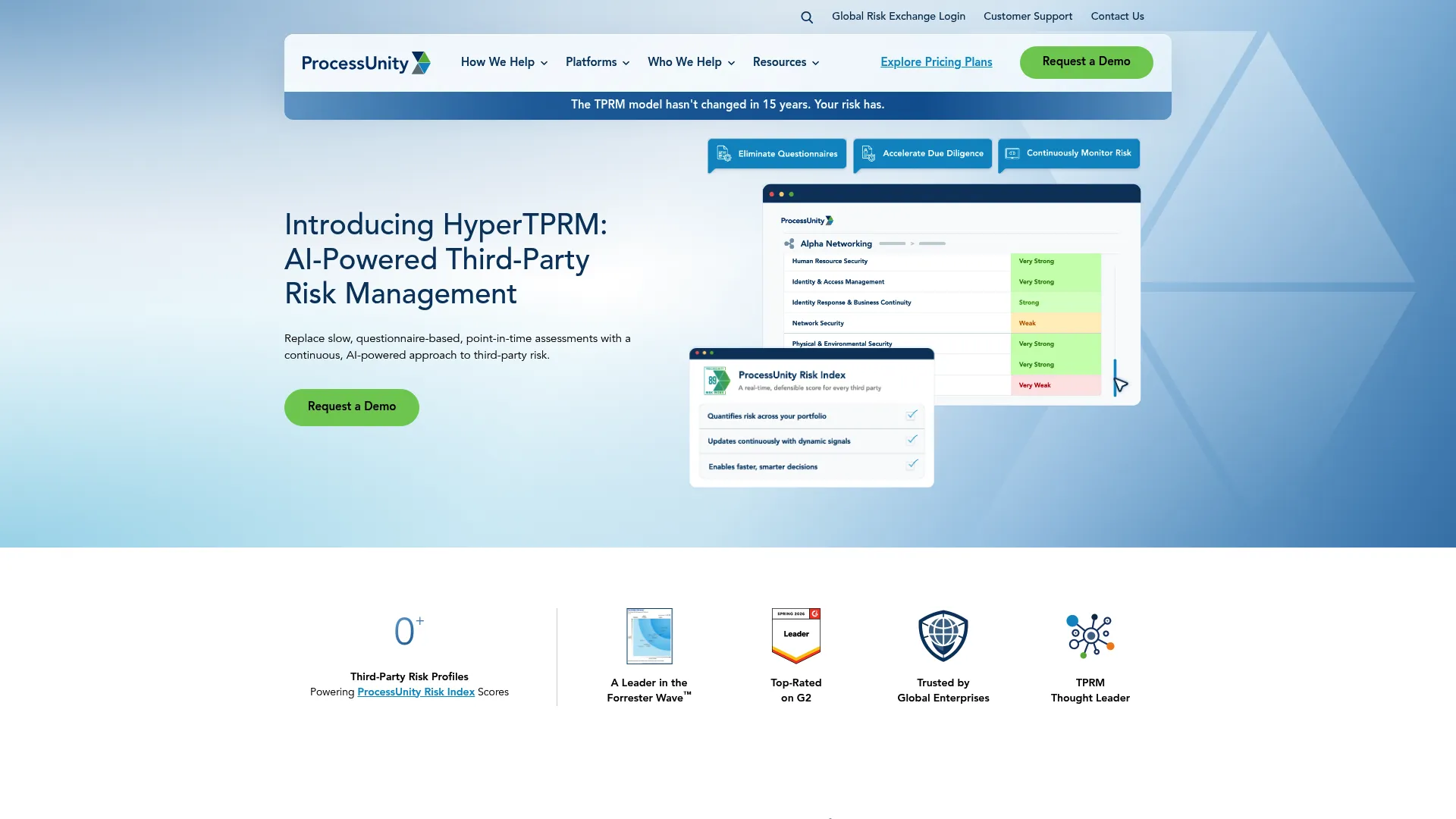
ProcessUnity is a cloud platform for third-party risk management and broader risk and compliance workflows. It covers the full vendor lifecycle: onboarding, due diligence, continuous monitoring, issue management, and reporting. The platform pairs configurable workflows with a Global Risk Exchange, a shared repository of vendor risk data that reduces the assessment burden on both sides of the relationship.
Best for: Enterprises and SMBs that want to build a structured, configurable vendor risk program rather than assemble one from point tools.
Key strengths
- Global Risk Exchange: Access to shared vendor risk data cuts down repeat questionnaire chasing across your portfolio.
- AI-powered assessment autofill: Automated evidence evaluation and answer autofill speed up due diligence and reduce manual review time.
- Configurable lifecycle workflows: Onboarding, monitoring, issue management, and reporting map to your program instead of a fixed template.
Why choose ProcessUnity: If your team wants a program you can shape around your own risk tiers, approval chains, and reporting cadence, ProcessUnity is built for that. It rewards teams with a defined process and the maturity to configure workflows, and it scales as your vendor count and regulatory obligations grow.
ProcessUnity pricing: Public pricing is limited. The one verifiable public figure is a small- and medium-sized business package starting at $25,000, per ProcessUnity's SMB pricing page. Other plans are quote-based and gated behind a sales conversation. There is no free tier. ProcessUnity holds a 4.5/5 rating on G2.
2. Bitsight
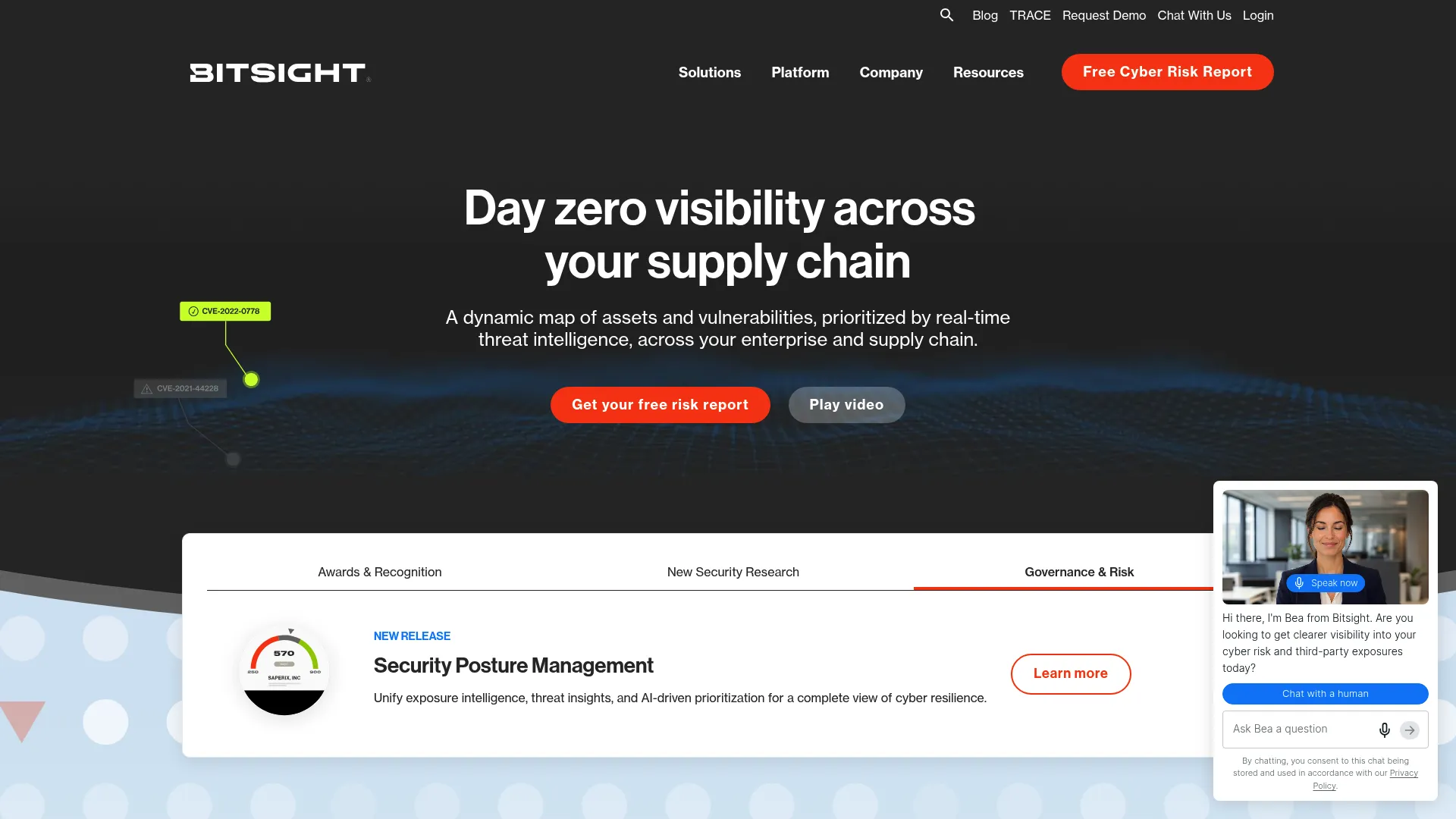
Bitsight is a cyber risk intelligence platform spanning security, third-party risk, and attack surface management. Its differentiator is objective, continuous scoring: rather than relying only on what a vendor tells you in a questionnaire, Bitsight measures external security posture in real time and expresses it as a rating. That makes portfolio-wide risk scoring consistent and comparable across hundreds of vendors.
Best for: Enterprises that want continuous monitoring backed by objective security ratings, not just self-attested questionnaire data.
Key strengths
- Continuous monitoring and real-time scoring: Ongoing external measurement flags posture changes as they happen, not at annual review time.
- Attack surface intelligence: External exposure mapping surfaces vulnerabilities across your vendors' internet-facing assets.
- Vendor risk workflow automation: Assessment and security workflows tie the monitoring data into repeatable processes.
Why choose Bitsight: For teams that have been burned by questionnaire answers that don't match reality, objective outside-in scoring is the appeal. Bitsight suits monitoring-first programs where the priority is knowing when a vendor's security degrades, backed by a defensible, data-driven rating.
Bitsight pricing: Bitsight publicly lists multiple packages, including Basic, Standard, Advanced, Continuous Monitoring, and a combined Continuous Monitoring plus Vendor Risk Management tier. All shown plans require contacting sales for pricing; no public numeric figure is displayed on the pricing page. Bitsight holds a 4.5/5 rating on G2.
3. Vanta
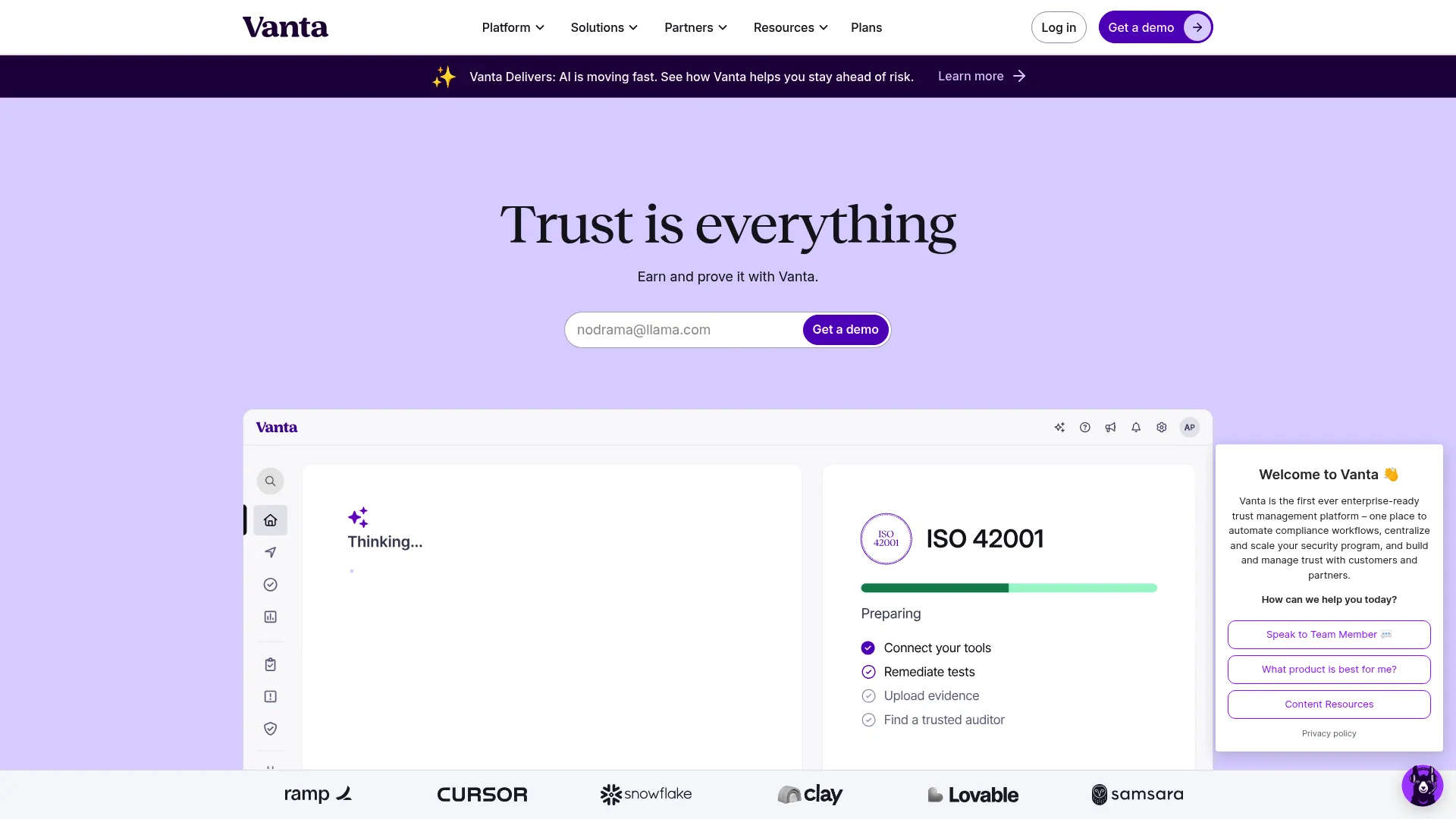
Vanta is an agentic trust platform for compliance, risk, and security workflows. On the vendor risk side, it leans hard into automation: automated evidence collection, questionnaire automation, and Trust Center retrieval that pulls a vendor's security documentation without a manual back-and-forth. With more than 300 pre-built integrations, it connects into the stack most teams already run.
Best for: Teams that already use Vanta for compliance or security trust work and want third-party risk to live in the same system.
Key strengths
- 300+ pre-built integrations: Broad connectivity means vendor data and evidence flow in from tools you already use.
- Automated evidence collection: Audit workflows and evidence gathering run continuously rather than as a manual scramble.
- Trust Center and questionnaire automation: Vendor security documentation and assessment responses are retrieved and organized automatically.
Why choose Vanta: If speed of response is your priority and you value automation over heavy manual configuration, Vanta fits. Teams already inside the Vanta ecosystem for SOC 2 or ISO work get third-party risk management software that shares the same evidence base and integrations.
Vanta pricing: Vanta's pricing page lists plan tiers, Essentials, Plus, Professional, and Enterprise, but does not display public prices. The page directs visitors to request a demo for personalized pricing based on company size and needs. Vanta holds a 4.6/5 rating on G2, the highest in this comparison.
4. OneTrust
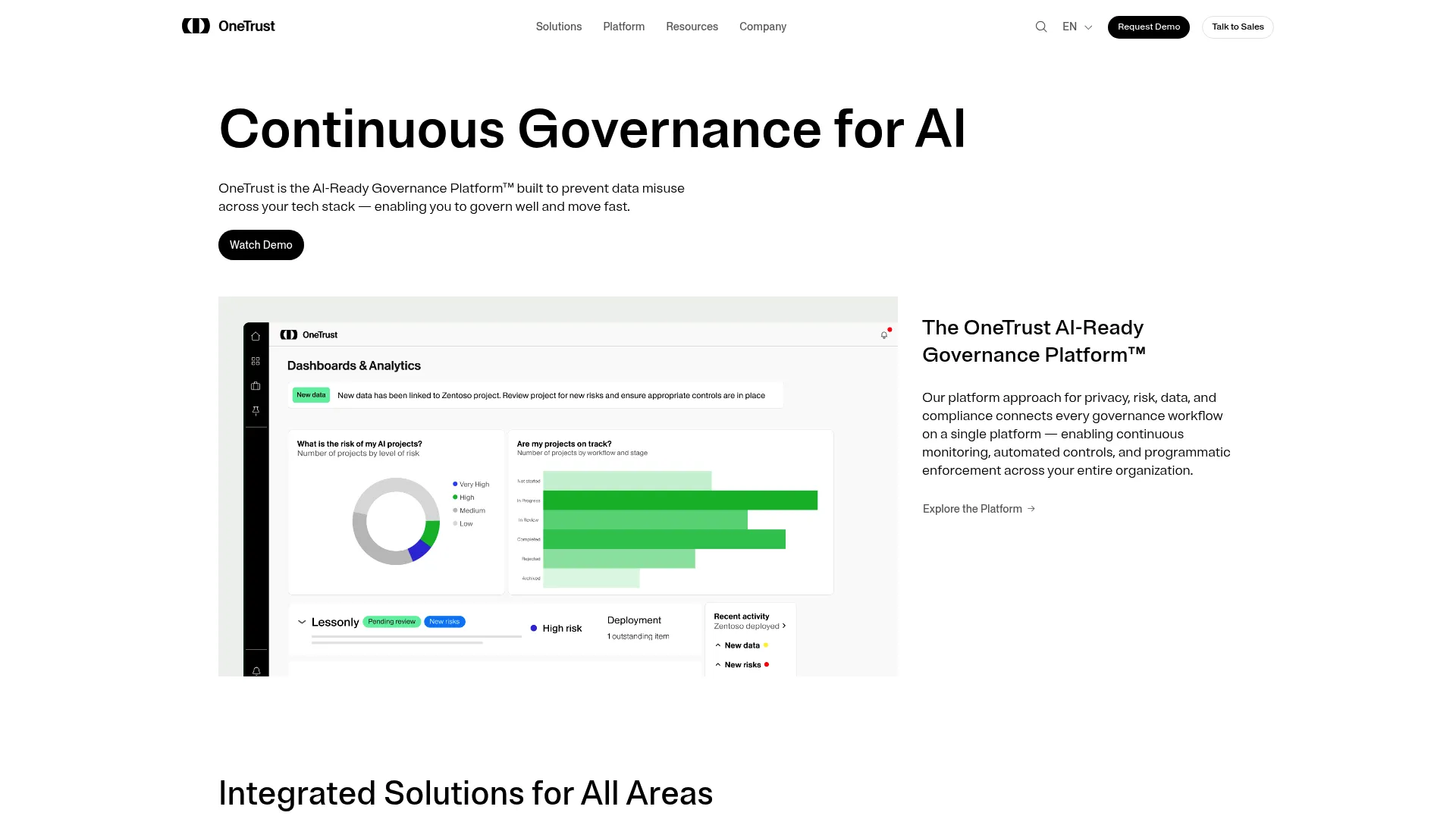
OneTrust is an AI-ready governance platform covering privacy, consent, data use, risk, and third-party management. Its strength for vendor risk buyers is breadth: third-party risk workflows sit alongside privacy automation, AI governance, and consent management in one platform. For organizations where vendor risk, data privacy, and regulatory obligations overlap, that consolidation reduces tool sprawl.
Best for: Enterprises that want governance, privacy, risk, and third-party management orchestrated in a single platform rather than stitched together.
Key strengths
- Third-Party Risk Management workflows: Vendor assessment, monitoring, and remediation run inside the broader governance platform.
- Privacy Automation: Vendor risk connects directly to privacy and data-use obligations, useful for GDPR and similar regimes.
- AI Governance controls: Monitoring and controls for AI use extend risk oversight into emerging regulatory territory.
Why choose OneTrust: If your compliance program already spans privacy, consent, and regulatory reporting, running vendor risk in the same platform keeps governance consistent. OneTrust fits teams that want enterprise workflow depth and a single control plane across adjacent compliance domains.
OneTrust pricing: OneTrust states that pricing is customized and based on usage meters such as admin users, inventory size, visitors, profiles, or data volume. No public numeric price is shown, and there is no free tier. Pricing is requested directly through the vendor. OneTrust holds a 4.4/5 rating on G2.
5. ServiceNow
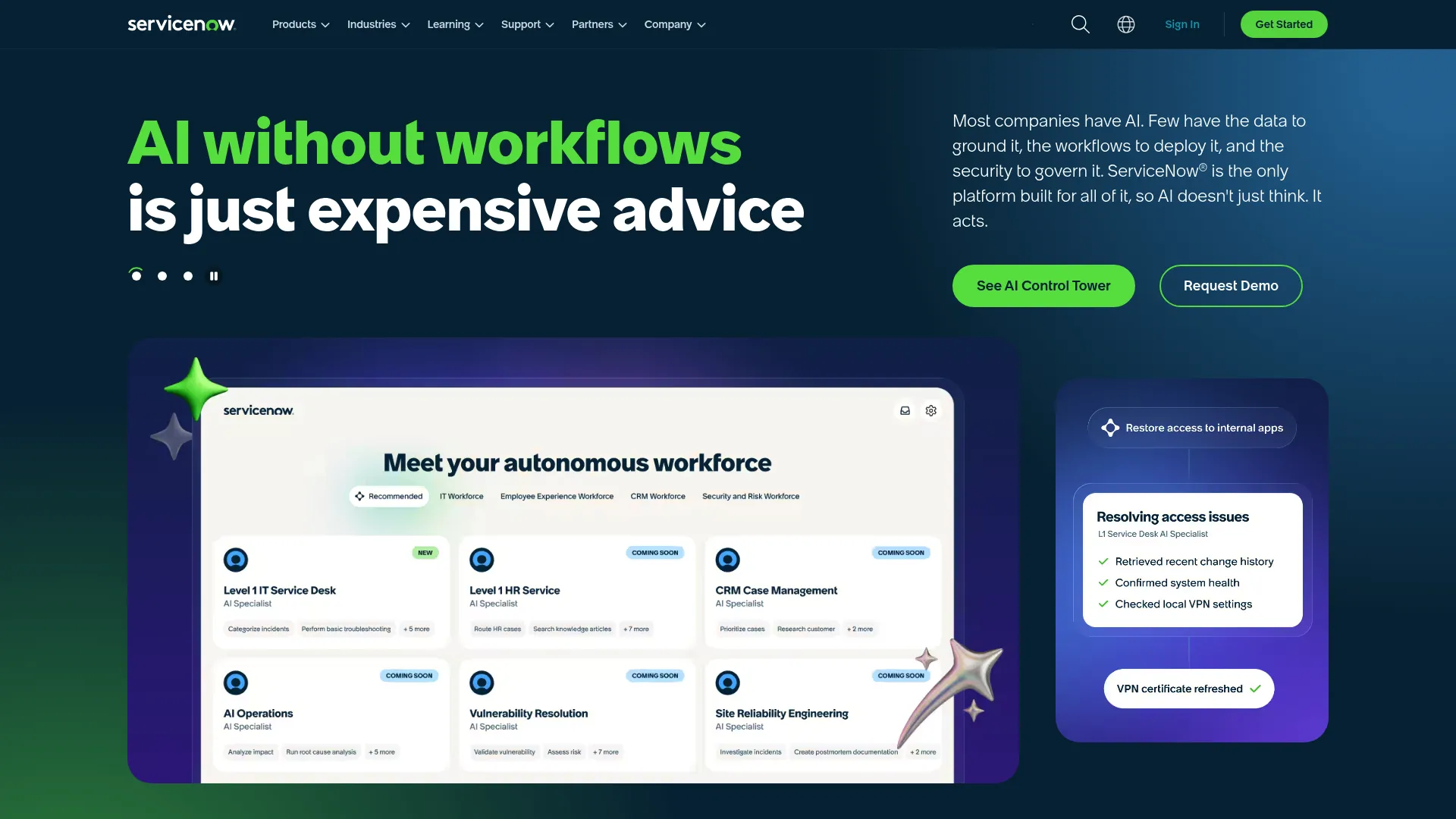
ServiceNow is an enterprise AI and workflow automation platform spanning IT, HR, customer service, security, and more. Vendor risk lives inside that broader operations layer, which is exactly the point for organizations already standardized on ServiceNow. Assessments, workflows, and reporting run alongside the rest of your enterprise processes, with the same automation, low-code customization, and integration depth.
Best for: Large enterprises already running ServiceNow that want vendor risk workflows inside their existing operations platform.
Key strengths
- Workflow automation: Vendor risk assessments and approvals plug into the same automation engine that runs your other enterprise processes.
- AI agents and skills: Built-in AI handles routing, triage, and repetitive assessment steps across workflows.
- Low-code app development: Customize vendor risk workflows and reporting without heavy engineering lift.
Why choose ServiceNow: The case is consolidation. If your enterprise already lives in ServiceNow, adding vendor risk avoids another siloed tool and lets risk data flow into existing reporting and workflows. It fits organizations with the scale and platform commitment to justify a unified approach.
ServiceNow pricing: ServiceNow's public pricing page shows package names for its ITSM products, including ITSM Foundation, Advanced, and Prime, but no public numeric price. Pricing is delivered through a custom quote based on modules and scale. ServiceNow holds a 4.4/5 rating on G2.
6. Prevalent
Prevalent, now part of Mitratech, is a dedicated third-party risk management platform for assessing, monitoring, and remediating vendor and supplier risk. Where broader suites treat vendor risk as one module among many, Prevalent is purpose-built for TPRM. That focus shows in its operational depth: standardized assessments, continuous monitoring, and structured remediation management across the full vendor lifecycle.
Best for: Security and compliance teams running mature TPRM programs that need dedicated assessment and remediation depth.
Key strengths
- Automated standardized risk assessments: Consistent, repeatable assessment templates reduce manual effort and improve comparability.
- Continuous third-party risk monitoring: Ongoing monitoring keeps vendor risk profiles current between formal review cycles.
- Remediation management: Structured issue tracking and remediation workflows carry findings through to resolution across the lifecycle.
Why choose Prevalent: For teams that want a platform built specifically for vendor risk rather than a general GRC suite, Prevalent's operational depth is the draw. It suits organizations with an established TPRM function that need rigorous, lifecycle-wide assessment and remediation as a first-class capability.
Prevalent pricing: Prevalent does not publish pricing on its Mitratech product pages, and no public plan tiers or figures were confirmed. Pricing is arranged directly with the vendor based on program scope. Prevalent holds a 4.5/5 rating on G2.
7. Panorays
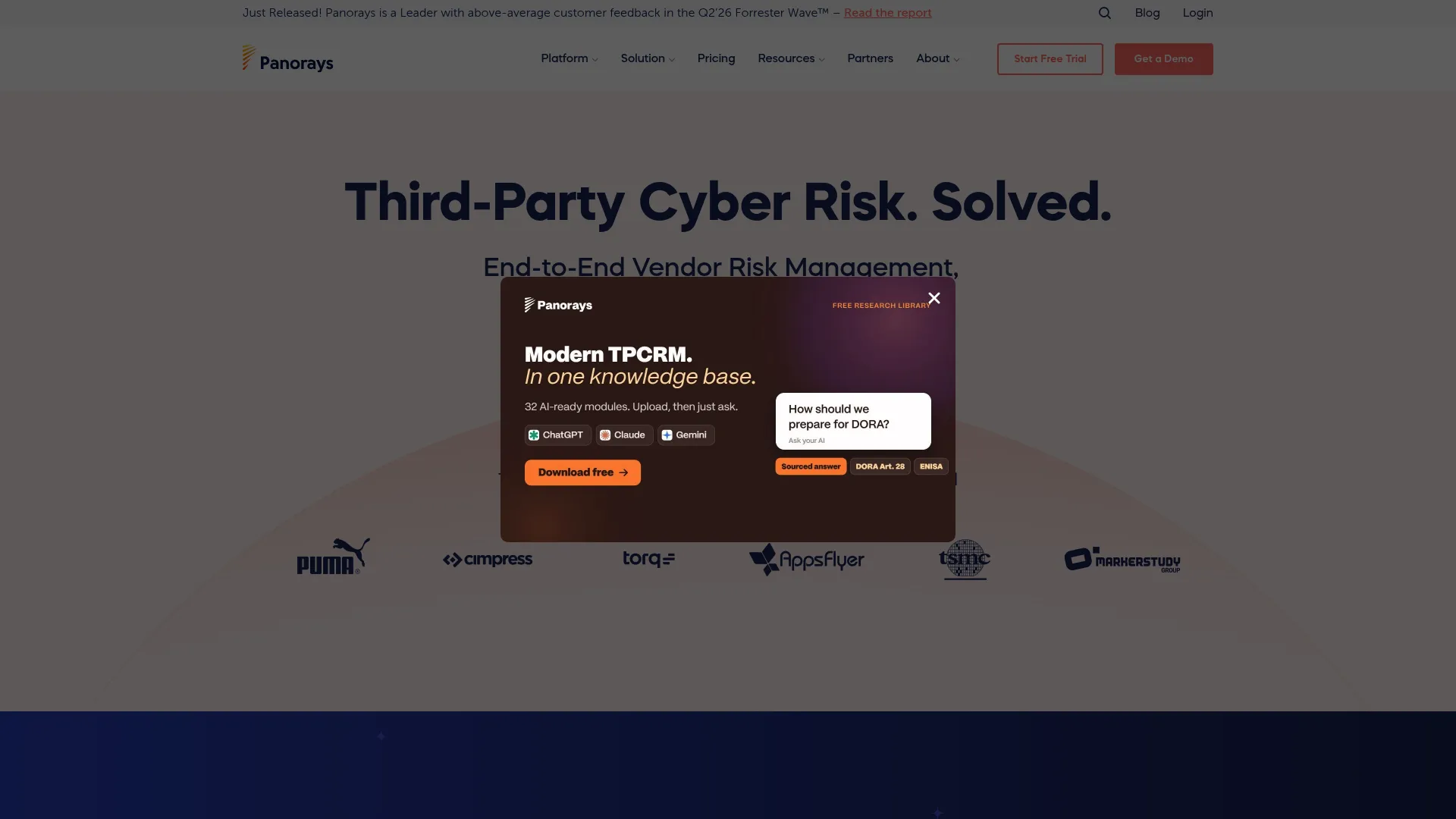
Panorays is a third-party cyber risk management platform focused on vendor risk, attack surface monitoring, and continuous supplier security assessments. Its strength is speed and clarity: AI-powered assessments and external attack surface management get vendors evaluated quickly, and continuous monitoring keeps oversight running afterward. For teams that want fast vendor onboarding without sacrificing ongoing visibility, that combination fits.
Best for: Organizations that prioritize fast vendor onboarding paired with continuous third-party cyber monitoring.
Key strengths
- AI-powered risk assessments: Automated assessments accelerate vendor evaluation and reduce manual questionnaire overhead.
- External attack surface management: Outside-in visibility maps a vendor's exposed assets and cyber exposure.
- Continuous monitoring and remediation: Ongoing monitoring and remediation workflows keep vendor risk current after onboarding.
Why choose Panorays: If your bottleneck is how long it takes to onboard and clear a new vendor, Panorays is built to compress that. It pairs a quick assessment motion with continuous cyber monitoring, which fits teams that need vendor risk assessment software that moves fast and keeps watching.
Panorays pricing: Panorays does not display public pricing; the site directs visitors to a pricing request form. A free account entry point is available on the site, though full plan details are quote-based. Panorays holds a 4.3/5 rating on G2.
What to look for when choosing vendor risk management software
Lifecycle coverage
Map the tool against your full vendor journey, from intake and onboarding through offboarding. A platform that automates assessment but leaves monitoring and offboarding manual only solves part of the problem. Confirm that evidence and context carry across every stage without re-keying.
Continuous monitoring depth
Decide how much you need outside-in monitoring versus questionnaire-based assessment. Monitoring-first platforms surface real-time posture changes, while workflow-first platforms excel at structured process. Many mature programs run both. Match the emphasis to your risk profile and the sensitivity of the data your vendors touch.
Risk scoring consistency
Look at how the platform tiers and scores vendors. Consistent, defensible risk scoring lets you prioritize attention and justify decisions to auditors. Check whether scoring blends inherent risk, residual risk, and continuous monitoring signals, and whether you can configure it to your own risk appetite.
Audit-ready reporting
Verify that the platform produces traceable records: who approved what, when, and on what evidence. Board-level dashboards and compliance reporting should be exportable and clear. Strong audit-ready reporting is what turns a vendor risk program into something you can defend under scrutiny.
Integration and governance
Confirm the tool connects to your GRC, procurement, security, and identity systems. Check governance controls too: versioning, ownership, approval chains, and permissions. If your stack already includes tools like contract management or a customer data platform, integration depth determines whether VRM adds signal or adds another silo.
Conclusion
The right vendor risk management platform depends less on feature counts and more on how your lifecycle actually runs. For teams that want a configurable, end-to-end program, ProcessUnity leads on lifecycle automation. If your priority is objective, real-time visibility, Bitsight and Panorays bring monitoring-first strength, with Panorays skewing toward fast onboarding. Vanta wins on automation and evidence speed, especially for teams already in its ecosystem. OneTrust and ServiceNow fit enterprises consolidating vendor risk into broader governance or operations platforms, and Prevalent stands out for dedicated, mature TPRM programs.
Evaluate against the criteria that matter: lifecycle coverage, continuous monitoring depth, risk scoring consistency, audit-ready reporting, and integration and compliance reporting fit. Then shortlist two or three tools and run them against your real vendor list, not a demo dataset. The platform that keeps evidence, ownership, and monitoring in one connected workflow is the one that will still be useful when the auditor calls. For adjacent controls, review options like loyalty management software and marketing resource management software as your broader stack evolves.
FAQs
Vendor risk management software is a platform that helps organizations assess, onboard, monitor, and report on the risk that third-party vendors introduce. It works by centralizing vendor inventory, automating assessments and evidence collection, running continuous monitoring, and producing audit-ready reporting across the full vendor lifecycle. The goal is to replace spreadsheets and email chains with one connected workflow.
Most platforms use templated questionnaires, automated distribution, and evidence collection to remove manual chasing. Many now add AI-driven autofill and answer evaluation, plus questionnaire automation that reuses prior responses so repeat assessments don't start from scratch. Some also pull vendor security documentation directly from trust centers, reducing the back-and-forth entirely.
The features that matter most are lifecycle coverage, continuous monitoring, consistent risk scoring, audit-ready reporting, and integration depth. Buyers should prioritize how these capabilities connect as one workflow rather than counting standalone modules. A tool that automates one stage but leaves the rest manual only solves part of the problem.
A point-in-time assessment captures a vendor's risk on a single date, typically through a questionnaire. Continuous monitoring keeps watching, alerting you to breaches, posture changes, and new vulnerabilities as they happen. Point-in-time reviews establish a baseline; continuous monitoring catches the changes that happen between reviews, which is where most surprises hide.
Yes. Strong platforms cover the full lifecycle, from vendor intake and onboarding through assessment, monitoring, and offboarding. Good offboarding matters because it ensures access is revoked, data handling is confirmed, and the evidence trail stays intact. Platforms that lose context between onboarding and offboarding leave gaps auditors will find.
Start with lifecycle fit and integration. Confirm the platform maps to your actual vendor journey and connects to your GRC, procurement, and security systems. From there, evaluate scoring consistency and audit-ready reporting, since those determine whether you can defend decisions under audit. Match monitoring depth to the sensitivity of the data your vendors handle.
Risk scoring models typically combine inherent risk (the risk a vendor introduces by category and data access) with residual risk (what remains after controls) and, in monitoring-first tools, continuous external signals. The best models let you configure scoring to your own risk appetite and produce a defensible, comparable rating across your vendor portfolio for consistent prioritization.
The terms are used interchangeably most of the time. Third-party risk management software is sometimes framed as broader, covering any third party including partners and suppliers, while vendor risk management focuses specifically on vendors. In practice, the leading platforms cover both, and buyers evaluating either category will see the same tools on their shortlist.



.avif)