


A country code changes in one system and not another. A product category gets renamed in the ERP but the BI dashboards still show the old label. Someone edits a currency lookup in a spreadsheet, emails it around, and three teams end up working from three versions. This is reference data drift, and it quietly corrupts reporting long before anyone notices the numbers are wrong.
Reference data is the small, slow-changing lists that everything else depends on: country codes, currencies, status values, product categories, chart-of-accounts segments. It rarely gets the attention that customer or product master data receives, yet when it fractures, every downstream report inherits the damage. The global reference data management software market sat at $2.8 billion in 2024 and is projected to reach $7.5 billion by 2033, a 14.2% CAGR through 2033, according to LinkedIn Pulse (2024). Teams are investing because manual reconciliation does not scale.
If you own a product, a data platform, or a governance program, the real question is not whether you need to control reference data. It is which tool centralizes validation, stewardship, and publishing without creating a brittle new process that rots the moment your systems change. This guide compares nine options so you can match a tool to your maturity, your governance depth, and your integration reality. If your broader stack evaluation also touches on adjacent categories, our roundups of the best customer data platform options and data visualization tools pair well with this one.
What's inside
This guide covers nine reference data management software platforms, spanning pure-play RDM capabilities and broader master data management suites with strong reference data features. We selected tools based on four criteria that matter for operational buyers: governance depth (policy, approval workflows, roles), publishing and distribution to downstream systems, the stewardship experience for business users, and auditability including lineage and change history. Integration breadth and deployment flexibility were tiebreakers. Pricing for this category is almost universally quote-based, so we note ratings and fit rather than guessing at numbers no vendor publishes.
TL;DR
- Best overall for enterprise governance: Ataccama, for AI-assisted validation, publishing, and business-user stewardship at scale.
- Best for MDM-led reference data programs: Profisee, when RDM is one piece of a broader master data strategy.
- Best for governance-first teams: Collibra, for policy, accountability, and stewardship workflows.
- Best for cross-functional stewardship: Semarchy, for federated governance and rapid multidomain rollout.
- Best for strong publishing and distribution: TIBCO EBX, for hierarchy management and controlled data distribution.
- Best for a broad data management platform: Informatica, when reference data lives inside a larger data quality and governance ecosystem.
What is reference data management software?
Reference data management software is a system that centralizes, validates, governs, approves, and publishes reference data (the standardized codes, categories, and lookup values that downstream applications rely on) so every system reads from one trusted source. It replaces the spreadsheets and one-off mapping tables that cause reference codes to drift apart across ERP, CRM, and analytics.
Reference data management overlaps with master data management but is not the same thing. Master data describes the core business entities (customers, products, suppliers, locations) that change frequently and carry rich attributes. Reference data is the smaller, slower-changing set of allowed values those entities point to: a country code, a unit of measure, an account status. RDM is often a discipline inside an MDM program, which is why several tools on this list are MDM platforms with dedicated reference data capabilities. The master data management market is projected at $21.63 billion in 2026, per Mordor Intelligence (2026), and RDM rides inside that larger governance investment.
Core capabilities you should expect:
- Validation: enforce business rules, format checks, and controlled value sets so bad reference codes never enter circulation.
- Stewardship: give data stewards a workspace to review, correct, and own reference values without writing SQL.
- Governance: apply policies, roles, and permissions so the right people control the right domains.
- Reference data publishing: distribute approved values to downstream systems on a schedule or via API.
- Lineage: trace where a value originated and every place it flows to.
- Auditability: keep an immutable record of who changed what, when, and why, for compliance and rollback.
What reference data management software should do
Strip away the marketing and a reference data management tool has one job: make one version of every code the trusted version, and keep it that way as your systems change. That breaks down into a handful of capabilities worth pressure-testing in any demo.
Centralization comes first. The tool needs a single authoritative store for reference values, with domains and hierarchies that mirror how your business actually thinks about codes and categories. Without a real system of record, you are just moving spreadsheets into a nicer interface.
Rules and validation come next. Good reference data governance means the software enforces allowed values, cross-field logic, and format constraints at entry, not after the fact. Reference data validation should catch a bad currency code before it publishes, not surface it in a broken quarterly report three weeks later.
Then stewardship and approval workflows. Business users, not just engineers, need to propose changes, route them for review, and see status. Approval workflows with clear roles turn reference data stewardship into a repeatable process instead of a Slack thread. This matters for a product manager watching maintainability: a tool that requires an engineering ticket for every code change will decay the moment release cadence picks up.
Finally, downstream publishing and transparency. Approved values have to reach ERP, CRM, BI, and every consuming app, ideally through both scheduled distribution and API. And every change needs an audit trail. If you cannot answer "who changed this and why" in one click, you do not have data quality and governance, you have a shared folder with extra steps. Tools that handle sensitive controlled vocabularies should also pair well with your audit management software and broader AI governance tools.
When teams use reference data management software
Standardize codes, categories, and lookup lists. When the same concept lives under different labels in different systems, reporting becomes unreliable. RDM tools create one canonical set of reference codes and map local variants to it, so a "status" means the same thing everywhere.
Publish approved values to downstream systems. Teams adopt RDM when they need approved reference data to flow automatically into ERP, CRM, BI, and operational apps. Reference data publishing on a schedule or via API removes the manual copy-paste that introduces errors and version confusion.
Support compliance-heavy environments. In regulated industries, auditors want to know who changed a value, when, and under what approval. RDM software with full lineage and audit trails turns a compliance scramble into a query. This is where governance depth stops being a nice-to-have.
Reduce manual reconciliation between systems. The clearest ROI signal is the disappearance of the monthly reconciliation meeting where three teams argue about whose spreadsheet is right. Centralized, governed reference data removes the drift that made those meetings necessary. If you are also standardizing content assets, a component content management system solves a parallel problem for structured content.
Comparison table
Pricing across this category is quote-based, so the table reflects verified G2 ratings and fit rather than list prices no vendor publishes. Use it as a shortlist filter, then validate against your own domains and integration requirements.
| # | Product | Intent | Key differentiation | Pricing | G2 rating |
|---|---|---|---|---|---|
| 1 | Ataccama | Enterprise governance | AI-assisted quality, observability, and MDM in one platform | Quote-based | 4.2/5 |
| 2 | Profisee | MDM-led RDM | Configurable MDM with matching and golden records | Quote-based | 4.4/5 |
| 3 | Collibra | Governance-first | Catalog, policy workflows, and accountability | Quote-based | 4.2/5 |
| 4 | Semarchy | Cross-functional stewardship | Federated governance, multidomain, fast rollout | Free trial available | 4.8/5 |
| 5 | Informatica | Broad data platform | IDMC cloud suite with 50,000+ connections | Quote-based | 4.3/5 |
| 6 | IBM | Large complex environments | Enterprise data and hybrid cloud breadth | Product-specific | 4.3/5 |
| 7 | TIBCO EBX | Publishing and hierarchies | Multidomain MDM with reference data mastering | Quote-based | Not disclosed |
| 8 | Stibo Systems | Multi-domain operations | Multidomain MDM/PIM with governance | Quote-based | 4.1/5 |
| 9 | Reltio | Cloud-native operations | Real-time entity resolution and 360 views | Quote-based | 3.3/5 |
1. Ataccama

Ataccama is enterprise data trust software that combines data quality automation, observability, cataloging, lineage, governance, and master data management in one platform. Its recent positioning leans hard into AI-assisted and agentic capabilities, which shows up in how quickly stewards can profile, validate, and correct reference values without hand-writing rules. For reference data specifically, that means automated anomaly detection on your controlled value sets and publishing that keeps downstream systems in sync.
Best for: Large enterprises that want governed, AI-ready reference data managed alongside broader quality, observability, and MDM in a single platform.
Key strengths
- Data quality automation and monitoring: catches bad reference values and drift before they publish downstream.
- Observability and anomaly detection: surfaces unexpected changes in reference sets so stewards act on signal, not spreadsheets.
- Catalog, lineage, governance, and MDM: ties reference data to full lineage and policy in one system.
Why choose Ataccama: If your team wants one platform rather than a stitched-together stack, Ataccama earns the shortlist. The AI-assisted layer genuinely reduces the manual rule-writing that makes reference data stewardship tedious, which matters when you are proving operational impact rather than adding headcount. It fits organizations far enough along in maturity to want governance, observability, and MDM under one roof.
Ataccama pricing: Ataccama does not publish a public price. Its site describes transparent licensing and directs buyers to contact sales for a license cost. Expect an enterprise quote scoped to your data volume and modules. Ataccama holds a 4.2/5 rating on G2.
2. Profisee

Profisee is enterprise master data management software built to manage trusted master and reference data together. Its strength is the MDM-to-RDM bridge: if you are already governing customers, products, suppliers, and locations, adding reference data into the same platform gives you centralized control, consistent publishing, and reporting from one governed source. Matching, merging, survivorship, and golden-record management carry directly into how reference values get resolved and distributed.
Best for: Enterprises building reference data management into a broader MDM and data strategy rather than deploying a standalone tool.
Key strengths
- Multi-domain MDM: manages reference data alongside customer, product, supplier, and location domains.
- Matching, merging, and survivorship: produces golden records and clean, deduplicated reference values.
- Flexible deployment: runs as SaaS, PaaS, IaaS, hybrid, or on-prem to fit your environment.
Why choose Profisee: Profisee makes the most sense when reference data is one piece of a larger master data program, not the whole job. Teams that want configurable governance, strong matching, and a single platform for master and reference data get a coherent operating model instead of two disconnected tools. Its deployment flexibility helps when IT has firm hosting requirements.
Profisee pricing: Profisee does not disclose public pricing. Its pricing page describes an Enterprise edition and an Application edition, with cost driven by edition, data volume, and deployment choice, and directs buyers to request a quote. Profisee holds a 4.4/5 rating on G2.
3. Collibra
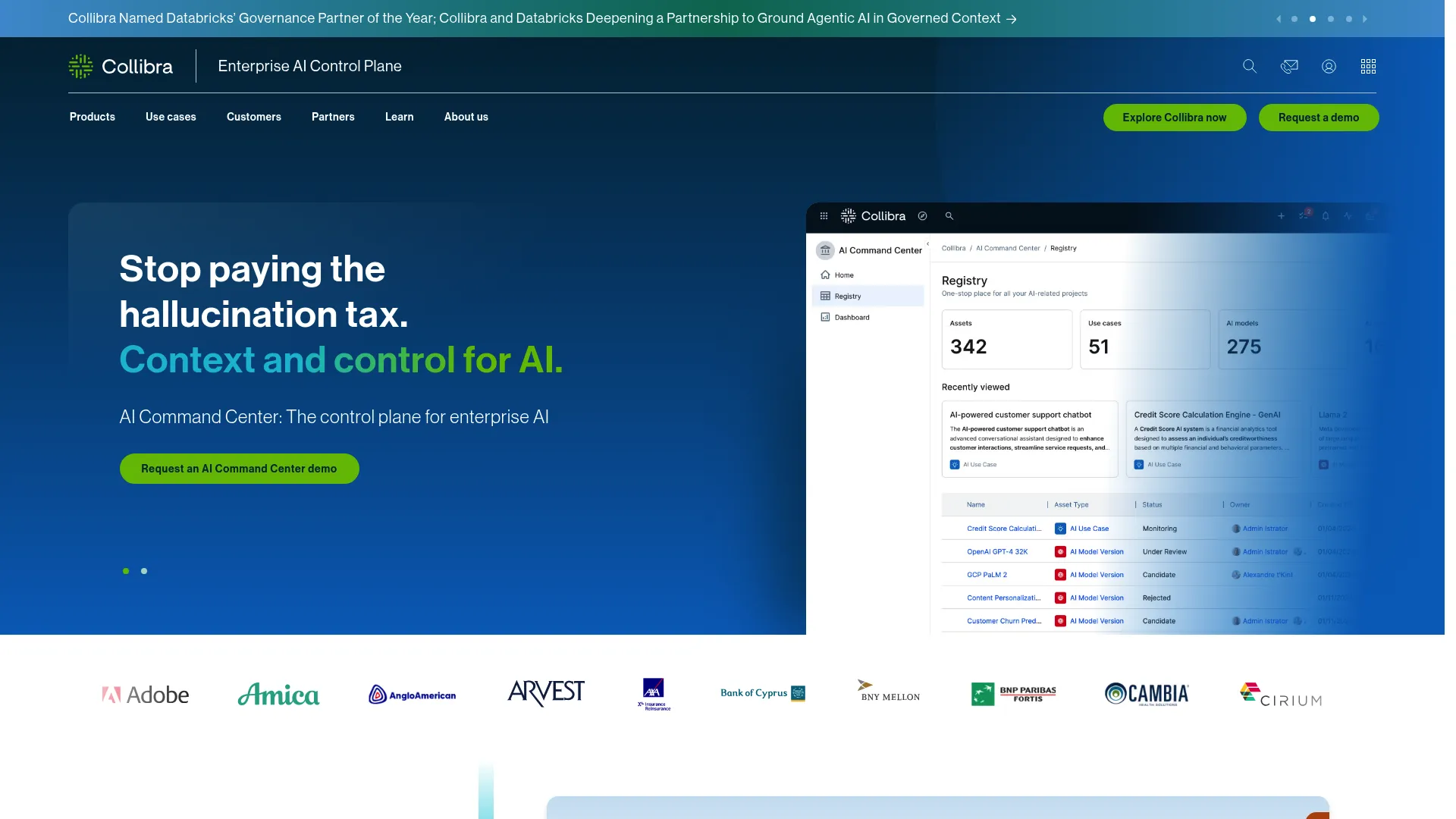
Collibra is an enterprise data governance platform spanning catalog, lineage, quality, privacy, and marketplace capabilities. It is the pick for teams that want governance first: policy definition, stewardship accountability, and a shared catalog where reference data sits inside a broader governed data estate. Rather than leading with mastering mechanics, Collibra leads with who owns what, which policies apply, and how changes get approved.
Best for: Large enterprises standardizing data governance and accountable, policy-driven access across complex environments.
Key strengths
- Data catalog and discovery: makes reference data findable and understood in context.
- Governance and policy workflows: enforces ownership, approvals, and accountability across domains.
- Data quality and observability: monitors trusted values so governance is measurable, not aspirational.
Why choose Collibra: Choose Collibra when the primary problem is governance maturity, not just reference value storage. It excels at policy, stewardship roles, and the accountability workflows that satisfy auditors and align cross-functional owners. Teams that pair it with a dedicated mastering tool get catalog-driven governance layered over their reference data. It complements broader AI governance tools work in regulated environments.
Collibra pricing: Collibra does not expose public pricing and routes buyers to demo and contact flows for a scoped quote. Expect enterprise packaging aligned to users and modules. Collibra holds a 4.2/5 rating on G2.
4. Semarchy

Semarchy offers the Semarchy Data Platform for master data management, data governance, and data products, with reference data handled as a first-class domain alongside customer, product, supplier, and location. Its differentiator is federated governance with rapid rollout: teams can stand up governed reference data and stewardship workflows quickly, then expand across domains without a multi-year program. Automated data quality, validation, enrichment, and golden records back the whole model.
Best for: Enterprises that want cross-functional stewardship and multidomain reference data governance without a lengthy implementation.
Key strengths
- Multidomain MDM: governs reference data across customer, product, supplier, location, and reference domains.
- Federated governance: distributes stewardship and policy enforcement with full auditability.
- Automated data quality: validates, enriches, and creates golden records across domains.
Why choose Semarchy: Semarchy suits teams that need stewards and business users collaborating on reference data without waiting on a central IT queue. Its federated model and fast rollout make it a strong fit for organizations early in their governance journey that still want enterprise-grade auditability. The high satisfaction score reflects that steward experience.
Semarchy pricing: Semarchy does not publish subscription pricing, but it offers a 30-day free trial and requests contact for evaluation. Cost is scoped to your domains and deployment. Semarchy holds a 4.8/5 rating on G2, the highest in this roundup.
5. Informatica

Informatica delivers reference data management inside its Intelligent Data Management Cloud (IDMC), a broad enterprise suite covering catalog, integration, data quality, MDM, governance, and marketplace services. Reference data here is one governed capability inside a much larger ecosystem, which is the point: if your organization already runs Informatica for integration and quality, keeping reference data in the same platform means shared lineage, connections, and governance.
Best for: Large enterprises needing a unified cloud platform where reference data lives inside broader integration, quality, and governance.
Key strengths
- Intelligent Data Management Cloud: unifies reference data with catalog, integration, and quality.
- Broad service coverage: spans MDM, governance, API integration, and marketplace in one platform.
- Massive connectivity: offers 50,000+ metadata-aware connections across multi-cloud and hybrid.
Why choose Informatica: Informatica fits when scale and integration breadth outweigh the desire for a lightweight standalone tool. Its connectivity and governance maturity make it a safe choice for complex, multi-cloud estates where reference data must interoperate with dozens of systems. Teams already invested in IDMC get reference data governance without adding a separate vendor.
Informatica pricing: Informatica does not display public pricing and uses consumption-based packaging, directing buyers to request a quote or sample price range. Cost tracks usage across the modules you enable. Informatica holds a 4.3/5 rating on G2.
6. IBM
IBM brings enterprise data governance and long-running MDM capabilities to reference data management, backed by decades of large-scale data platform work. Its strength shows in the biggest, most complex environments: organizations with sprawling system landscapes, strict governance requirements, and a need for consistency and controlled distribution across hundreds of consuming applications. Reference data sits within IBM's broader data, AI, and hybrid cloud portfolio.
Best for: Large organizations with complex, heavily governed environments needing enterprise data management and hybrid cloud breadth.
Key strengths
- Enterprise data and AI platforms: governs reference data within a broad data and AI stack.
- Hybrid cloud products: distributes trusted values across on-prem and cloud consuming systems.
- Database and integration software: connects reference data to the wider operational estate.
Why choose IBM: IBM is the pick when your environment is genuinely large and complex, and vendor stability, hybrid deployment, and governance depth matter more than a lightweight footprint. Teams already standardized on IBM infrastructure gain stewardship, consistency, and downstream distribution without introducing a new vendor relationship.
IBM pricing: IBM pricing is product-specific rather than a single reference data SKU. As a first-party example of its packaging, IBM MQ starts at USD 312.00 on a minimum one-year term, with SaaS options and a free Lite tier for MQ SaaS; reference data and MDM offerings are quoted separately. IBM holds a 4.3/5 seller rating on G2.
7. TIBCO EBX

TIBCO EBX is master data management software built for governing, managing, and sharing critical business data across multiple domains, with reference and metadata management as core capabilities. It is a strong fit for organizations with structured governance needs: hierarchy management, role-based workflows, and controlled reference data publishing to downstream systems. EBX treats reference data as a governed asset with versioning and approval built in.
Best for: Enterprises needing governed, multidomain reference data with strong hierarchy management and controlled distribution.
Key strengths
- Multidomain MDM: manages reference data alongside other master data domains.
- Workflow and data quality: enforces role-based approvals and validation on reference values.
- Reference and metadata management: masters reference codes and hierarchies with versioning.
Why choose TIBCO EBX: EBX shines when hierarchy management and publishing are central to the job. Teams that need to model complex reference structures, route changes through approval workflows, and distribute controlled values downstream get a purpose-built governance engine. Its configurable applications let stewards work in interfaces shaped to their domains.
TIBCO EBX pricing: TIBCO does not display public pricing for EBX; its product page describes capabilities and directs buyers to download materials or contact sales for a quote. A current overall G2 rating was not clearly published at the time of writing, so treat fit rather than score as the signal here.
8. Stibo Systems
Stibo Systems is enterprise master data management software for governing and sharing trusted data across multiple domains, with strong product and reference data patterns. It fits operational data management programs where reference data underpins product, supplier, and location information at scale. Governance, auditability, and prebuilt connectors make it a workhorse for consistency across large operational estates.
Best for: Large enterprises needing governed, multi-domain MDM and PIM where reference data supports operational product and supply data.
Key strengths
- Multi-domain master data management: governs reference data alongside product, supplier, and location.
- Governance and auditability: tracks changes and enforces policy across domains.
- Prebuilt connectors and interoperability: publishes trusted values to operational systems.
Why choose Stibo Systems: Stibo fits when reference data is inseparable from product and supply chain data, and scale plus consistency are the priorities. Teams running large operational or PIM-heavy programs get stewardship, governance, and reliable distribution built for volume. It rewards organizations with mature, multidomain data operations.
Stibo Systems pricing: Stibo Systems does not publish core platform pricing and directs buyers to contact sales for a scoped quote. Cost reflects domains, volume, and deployment. Stibo Systems holds a 4.1/5 rating on G2.
9. Reltio
Reltio is a cloud-native context intelligence and master data management platform focused on unifying and activating enterprise data in real time. Its value for reference data sits alongside broader data unification work: entity resolution, data quality, and integration feed 360-degree profiles, with reference values supporting that cross-domain operation. Reltio suits modern enterprise data teams that prioritize real-time operations and cloud-native architecture.
Best for: Enterprises needing real-time master data management and 360-degree profiles, with reference data supporting cross-domain unification.
Key strengths
- Entity resolution: unifies records across domains in real time.
- Data quality: keeps unified profiles and their reference values accurate.
- Data integration: connects cloud-native data operations across the estate.
Why choose Reltio: Reltio fits teams whose primary goal is real-time, cloud-native data unification, with reference data governed as part of that motion rather than in isolation. Organizations modernizing toward always-on data operations benefit from its architecture and 360-degree profiles. Evaluate it where real-time activation matters more than a standalone reference data console.
Reltio pricing: Reltio does not publish a public pricing page with visible numbers and scopes cost to an enterprise quote. Reltio holds a 3.3/5 rating on G2 based on a small number of reviews, so weight your own proof-of-concept over the aggregate score.
Considerations before you buy
A shortlist is easy. Matching a tool to your operating reality is the hard part. Run every candidate through these criteria before you commit.
Governance depth and stewardship experience
Look past feature checklists and ask who actually does the daily work. Can a business steward propose and approve a reference value change without an engineering ticket? Are roles, policies, and approval workflows configurable to your org, or do you bend your process to the tool? A tool that only data engineers can operate will bottleneck at your slowest queue.
Publishing and downstream distribution
Reference data has no value trapped in one system. Verify how the tool publishes approved values to your ERP, CRM, BI, and operational apps, both on a schedule and via API. Ask about failure handling: what happens when a downstream system rejects a value, and how do you roll back?
Auditability, lineage, and compliance
If you operate in a regulated environment, treat lineage and audit trails as non-negotiable. You should be able to answer "who changed this value, when, and under what approval" in one click. Confirm the audit record is immutable and exportable for auditors.
Integration and maintainability
For a product manager, maintainability is the quiet killer. Confirm the tool fits your existing data and analytics stack, and ask how reference data definitions survive frequent releases and system changes. The best tool is the one your team still uses cleanly a year after rollout. Tools with strong integration breadth age better.
Conclusion
Reference data drift is not a spreadsheet problem you can discipline your way out of. It is a governance problem, and the right software makes one version of every code the trusted version and keeps it that way as your systems change.
Match the tool to your maturity. For AI-assisted validation and enterprise governance in one platform, Ataccama leads. When reference data is part of a broader master data program, Profisee gives you a coherent MDM-to-RDM operating model. Governance-first teams get the most from Collibra's policy and accountability workflows, while Semarchy wins on cross-functional stewardship and fast rollout. For publishing and hierarchy management, TIBCO EBX is purpose-built, and Informatica, IBM, Stibo Systems, and Reltio each fit large, complex, or cloud-native estates where reference data lives inside a wider platform.
Next step: shortlist two or three tools that match your governance depth and integration reality, then run a proof of concept against your own reference domains. Measure how quickly a steward can propose, approve, and publish a change. That single workflow tells you more than any feature matrix.
FAQs
Reference data management software centralizes, validates, governs, approves, and publishes the standardized codes, categories, and lookup values that downstream systems depend on. It replaces scattered spreadsheets with a single trusted source, so every application reads the same values. The goal is to eliminate reference data drift and make reporting reliable.
Master data management governs core business entities like customers, products, and suppliers, which change frequently and carry rich attributes. Reference data management governs the smaller, slower-changing set of allowed values those entities point to, such as country codes and status values. RDM is often a discipline inside a broader MDM program, which is why many MDM platforms include reference data capabilities.
At minimum, expect centralized storage, business-rule validation, stewardship and approval workflows, downstream publishing, lineage, and full auditability. Strong tools let business users, not just engineers, propose and approve changes. Publishing should reach ERP, CRM, and BI systems both on a schedule and via API.
Spreadsheets have no validation, no approval workflow, no audit trail, and no controlled publishing, so multiple versions drift apart across teams and systems. Reference data management tools enforce rules at entry, route changes through governance, and distribute one approved version everywhere. That removes the manual reconciliation that spreadsheets make inevitable.
RDM software records who changed each value, when, and under what approval, in an immutable audit trail. Lineage shows where a value originated and every downstream system it reaches. In regulated environments, that turns a compliance scramble into a single query and supports controlled rollback.
Reference data typically flows to ERP systems, CRM platforms, BI and analytics tools, data warehouses, and operational applications. Any system that uses controlled codes, such as country, currency, or status values, is a consumer. Good RDM tools publish to these systems on a schedule or through APIs.
Yes. Reference data governance is a core part of a broader data governance program, and RDM tools enforce policies, roles, approval workflows, and audit trails on controlled values. Several platforms on this list, including Collibra and Semarchy, lead with governance capabilities. Strong reference data governance improves overall data quality and governance maturity.
Choose a governance-led or dedicated approach when reference data is your primary problem and you want fast, focused stewardship. Choose a broader MDM platform like Profisee, Informatica, or Stibo Systems when reference data is one piece of a larger master data strategy covering customers, products, and suppliers. The deciding factor is whether reference data stands alone or must interoperate with rich master data domains across your stack.


.avif)