You crossed economic nexus in four new states last quarter. Nobody flagged it. The spreadsheet your finance lead built in year one still runs the calculations, and it worked fine when you sold into two states. Now it is a liability with your name on it.
That is the moment most scaling SaaS companies discover that sales tax is not a math problem. It is an operational risk problem. Every unregistered jurisdiction, every uncollected dollar, every missed filing deadline compounds quietly until an audit or a due diligence review surfaces it, usually at the worst possible time. The global sales tax software market was valued at USD 10.38 billion in 2024 and is projected to reach USD 20.53 billion by 2032, growing at a CAGR of 8.90%, according to Data Bridge Market Research (2024). That growth is not vendor hype. It reflects how many companies have decided manual tax handling is no longer worth the exposure.
The right sales tax software turns compliance into a system that runs without routing every exception through you or your finance lead. It calculates in real time, monitors nexus, files returns, manages exemption certificates, and holds records an auditor will actually accept. If you are also rebuilding the rest of your revenue stack, our roundups of the best marketing automation software tools and best ai sales tools pair well with this one. For finance-adjacent controls, audit management software and best contract lifecycle management software round out the picture.
What's inside
This is a buyer's guide to sales tax software for finance leaders, RevOps, and founders who need calculation, filing, integrations, and audit protection in one system rather than a stack of manual workarounds. We evaluated each platform on four criteria that matter most for a scaling business: automation depth (how much runs without human touch), integration coverage (ERP, billing, and ecommerce fit), compliance scope (jurisdictions, returns, exemptions, use tax), and support quality (implementation help and audit backup). We pulled pricing and ratings from first-party pages and G2 as of 2026, and wrote around any figure a vendor does not publish.
TL;DR
- Best for broad compliance depth: Avalara covers sales and use tax, returns, and exemption certificates across a wide jurisdiction footprint.
- Best for ecommerce: TaxJar automates calculation, nexus monitoring, and filing for commerce-heavy businesses.
- Best for enterprise scale: Vertex handles global indirect tax determination and end-to-end lifecycle automation.
- Best for complex multi-system stacks: Thomson Reuters ONESOURCE centralizes tax, trade, and reporting workflows.
- Best for SaaS and subscription revenue: Anrok is built for recurring revenue and billing-stack fit.
- Best for leaner teams: TaxCloud keeps sales tax automation software simple to adopt.
- Best for governance-heavy compliance: Sovos covers broad global tax and regulatory obligations with audit readiness.
What is sales tax software?
Sales tax software is a cloud-based platform that automatically calculates, reports, files, and remits sales and use tax across every jurisdiction where a business has an obligation. It acts as a central tax engine that sits between your billing, ecommerce, or ERP systems and the tax authorities, so the right rate is applied at checkout and the right return lands on time.
The category exists because sales tax rules are not static. Rates change, nexus thresholds shift, product taxability varies by state, and exemption rules differ by customer type. Sales tax compliance software absorbs that complexity so your team does not have to track it manually.
Core capabilities you should expect from any serious sales and use tax software:
- Real-time tax calculation at the point of sale, based on address, product type, and current rates
- Nexus and jurisdiction updates that monitor where you have crossed economic thresholds
- Filing and returns preparation, submission, and remittance across states
- Exemption certificate management to collect, validate, and store exemption documents
- ERP and ecommerce integrations so tax data flows without manual export
- Audit support with records, reports, and documentation an auditor will accept
The strongest sales tax reporting software also surfaces liability by jurisdiction in real time, which matters when you are preparing board metrics or a fundraise and need clean numbers fast. Cloud deployments now dominate the category, capturing 59.75% of global tax software revenue in 2025 and growing at a 13.61% CAGR through 2031, per Mordor Intelligence (2026).
When to use sales tax software
When manual calculations start failing
Spreadsheets and native ecommerce tax settings work when you sell into one or two states. They stop working the moment you cross economic nexus in multiple jurisdictions, each with its own rate, filing cadence, and product taxability rules. A single missed threshold can create back-tax liability plus penalties. If your finance lead is manually checking rates or your checkout applies a flat rate everywhere, you have already outgrown the manual approach.
When your stack spans multiple channels
Most scaling companies sell through more than one surface: a self-serve checkout, a sales-led motion with invoicing, a billing platform for subscriptions, and sometimes a marketplace. When tax logic lives in each system separately, reconciliation becomes a monthly fire drill. Sales tax management software gives you one system of record that connects ecommerce, invoicing, billing, and ERP, so liability is calculated consistently everywhere.
When audit exposure and filing complexity rise
As transaction volume grows, so does the surface area for error. More jurisdictions mean more returns, more exemption certificates to track, and more records to defend if an auditor comes knocking. This is the point where returns automation, certificate management, and clean record-keeping stop being nice-to-haves and become the difference between a routine audit and a painful one.
Comparison table
The seven platforms below differ mainly by scale, integration depth, and automation scope. Some are built for ecommerce-first businesses that want filing off their plate. Others are enterprise tax engines designed for global indirect tax and multi-system environments. A few specialize by revenue model, like SaaS subscriptions. Use the table to shortlist, then read the item sections for fit.
| # | Product | Intent | Key differentiation | Pricing | G2 rating |
|---|---|---|---|---|---|
| 1 | Avalara | Broad compliance depth | Wide jurisdiction coverage, returns, exemption certificates | From $699 state/year | 4.0/5 |
| 2 | TaxJar | Ecommerce compliance | Real-time calculation plus AutoFile filing automation | From $39/mo | 4.7/5 |
| 3 | Vertex | Enterprise determination | Global indirect tax, e-invoicing, compliance reporting | Custom (revenue-based) | 4.4/5 |
| 4 | Thomson Reuters ONESOURCE | Multi-system enterprise | End-to-end tax, trade, and reporting workflows | Custom | 3.8/5 |
| 5 | Anrok | SaaS and subscriptions | Built for recurring revenue and billing-stack fit | From $100/market/mo | 4.4/5 |
| 6 | TaxCloud | Leaner-stack fit | Simple calculation, filing, and registration | Free trial available | 4.5/5 |
| 7 | Sovos | Governance-heavy compliance | Global tax, e-invoicing, reporting, withholding | Custom | 4.2/5 |
1. Avalara
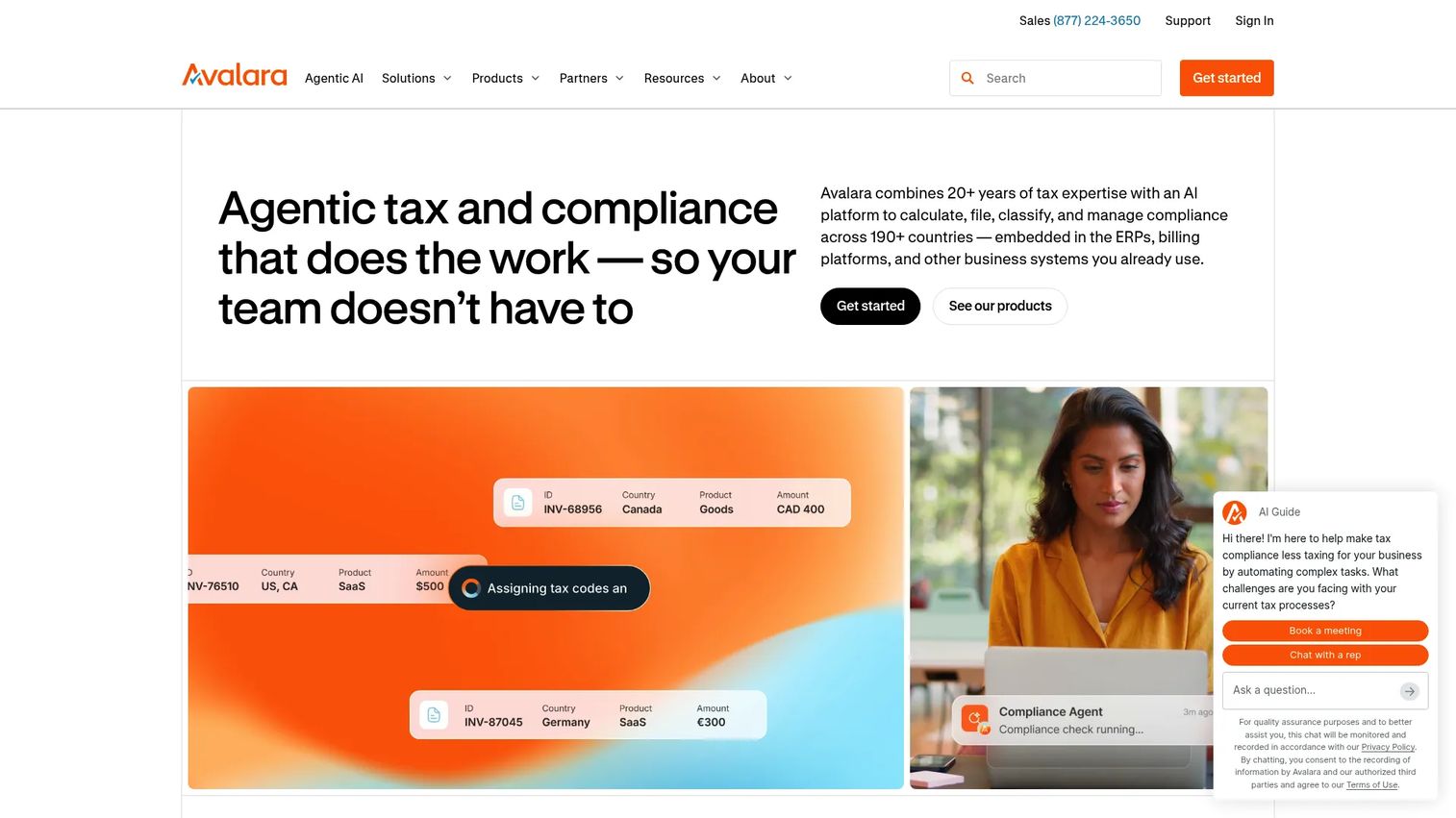
Avalara is a tax compliance platform that automates sales and use tax, VAT, e-invoicing, returns, and related compliance workflows. Finance and operations teams pick it for the breadth: it covers a wide jurisdiction footprint and connects to a large ecosystem of ERP, ecommerce, and billing systems. If your obligation spans many states and product types, Avalara is built to keep pace without manual rate lookups.
Best for: Businesses needing automated tax compliance across sales, use tax, and global jurisdictions.
Key strengths
- Automated sales and use tax calculation: Applies the correct rate at the point of sale based on address and product taxability.
- Returns and remittance: Handles returns preparation, filing, remittance, and notice management so deadlines stop being a manual scramble.
- Exemption certificate management: Collects, validates, and stores exemption documents for audit-ready records.
Why choose Avalara: The depth is the draw. If you sell into dozens of jurisdictions with varied product taxability and need mature compliance infrastructure that finance can trust in due diligence, Avalara's coverage and integration breadth are hard to match. It suits companies that have outgrown lightweight tools and want one platform to consolidate calculation, filing, and certificate management.
Avalara pricing: Avalara publishes set pricing for its Core compliance plan and a Core Compliance plus SST Services option, with entry pricing starting around $699 per state per year based on its public pricing page. A Custom quote-based plan is available for broader needs. Avalara also notes that select services, such as license guidance and registration, carry their own set pricing. There is no free tier.
2. TaxJar
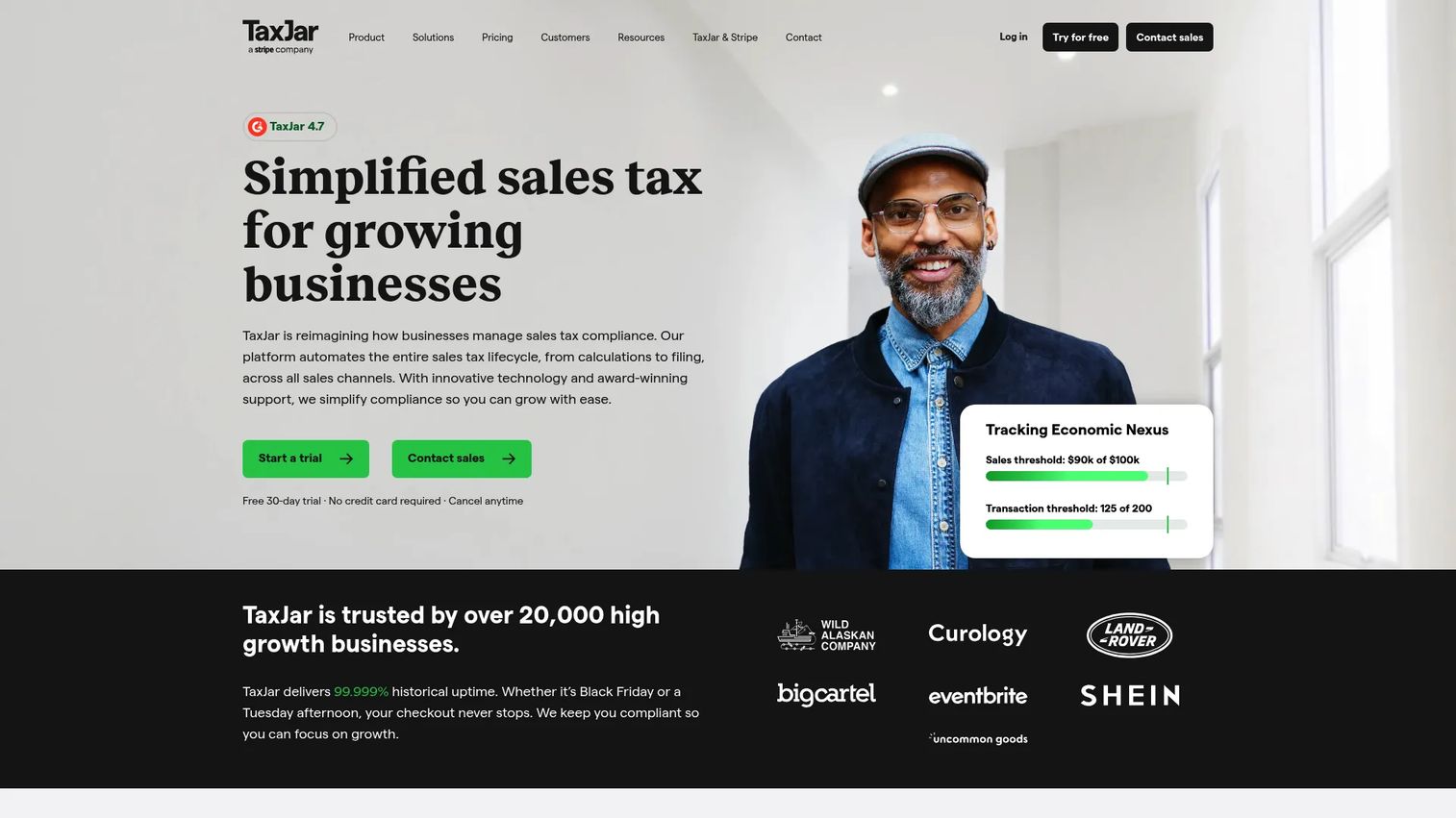
TaxJar is sales tax compliance software built for US ecommerce and multi-channel businesses, with calculation, reporting, filing, and remittance automation. It is a practical fit if most of your revenue runs through commerce platforms and you want fewer manual steps between a sale and a filed return. TaxJar's AutoFile feature handles the filing itself, which removes a recurring monthly task from your finance team's plate.
Best for: Ecommerce businesses needing automated US sales tax compliance.
Key strengths
- Real-time sales tax calculation: Applies accurate rates at checkout across the jurisdictions you sell into.
- Nexus monitoring and reporting: Tracks where you have crossed economic thresholds so registration decisions are informed, not reactive.
- Automated filing and remittance: AutoFile submits returns and remits payments on schedule without manual intervention.
Why choose TaxJar: For commerce-heavy businesses, TaxJar hits the sweet spot between automation and ease. It carries a strong 4.7/5 on G2, and its nexus monitoring gives scaling teams early warning before an obligation becomes a liability. If your priority is getting filing off your team's plate without an enterprise implementation, it is a clean fit.
TaxJar pricing: TaxJar's Starter plan begins at $39 per month, with a Professional plan at $99 per month; Professional is also available via contact sales for larger needs. The platform offers a 30-day free trial and annual pricing savings. There is no free tier.
3. Vertex
Vertex is enterprise tax compliance software for automating indirect tax determination, e-invoicing, and compliance reporting at scale. It is built for large businesses with global indirect tax obligations and complex ERP environments. Where lighter tools focus on domestic sales tax, Vertex is designed for end-to-end lifecycle automation across many systems and tax types, including procurement and use tax.
Best for: Large businesses needing global indirect tax automation and compliance.
Key strengths
- Tax determination: Applies accurate rates across jurisdictions and product categories at transaction time.
- E-invoicing: Supports compliant electronic invoicing workflows across regions.
- Compliance reporting: Centralizes reporting for indirect tax across the business.
Why choose Vertex: Scale and audit defense are the reasons enterprises choose Vertex. If you operate across borders, run a heavy ERP stack, and need a tax engine that holds up under complex determination logic and audit scrutiny, Vertex is purpose-built for that reality. Its implementation and support resources are geared toward enterprise deployments.
Vertex pricing: Vertex uses revenue-based pricing with multi-year price-lock options rather than a public plan table. No fixed dollar amount is published on its site, so expect a custom quote tied to your transaction volume and scope. Reach out to Vertex directly for a scoped estimate.
4. Thomson Reuters ONESOURCE
Thomson Reuters ONESOURCE is cloud automation software for corporate tax, trade, and financial reporting. It centralizes tax determination, ERP integration, and invoice-centric workflows for large organizations that need control across multiple systems and geographies. If your environment spans direct tax, indirect tax, and global trade, ONESOURCE is designed to run them from one place.
Best for: Large enterprises needing centralized tax, trade, and reporting compliance automation.
Key strengths
- End-to-end workflows: Covers tax, trade, and financial reporting in a single connected system.
- Cloud-based automation with integrations: Connects to ERP and financial systems to reduce manual handoffs.
- Broad compliance support: Handles indirect tax, direct tax, and global trade processes together.
Why choose Thomson Reuters ONESOURCE: For complex international or multi-system environments, ONESOURCE offers centralized tax engines and workflow control that lighter tools do not attempt. It fits enterprises where tax, trade, and reporting need to operate as one governed process rather than separate tools. The tradeoff is that it is built for scale, so it suits organizations ready for an enterprise implementation.
Thomson Reuters ONESOURCE pricing: Public pricing is not provided. ONESOURCE directs prospective buyers to contact sales for a quote scoped to their tax, trade, and reporting requirements. Expect enterprise-oriented packaging rather than a self-serve plan.
5. Anrok
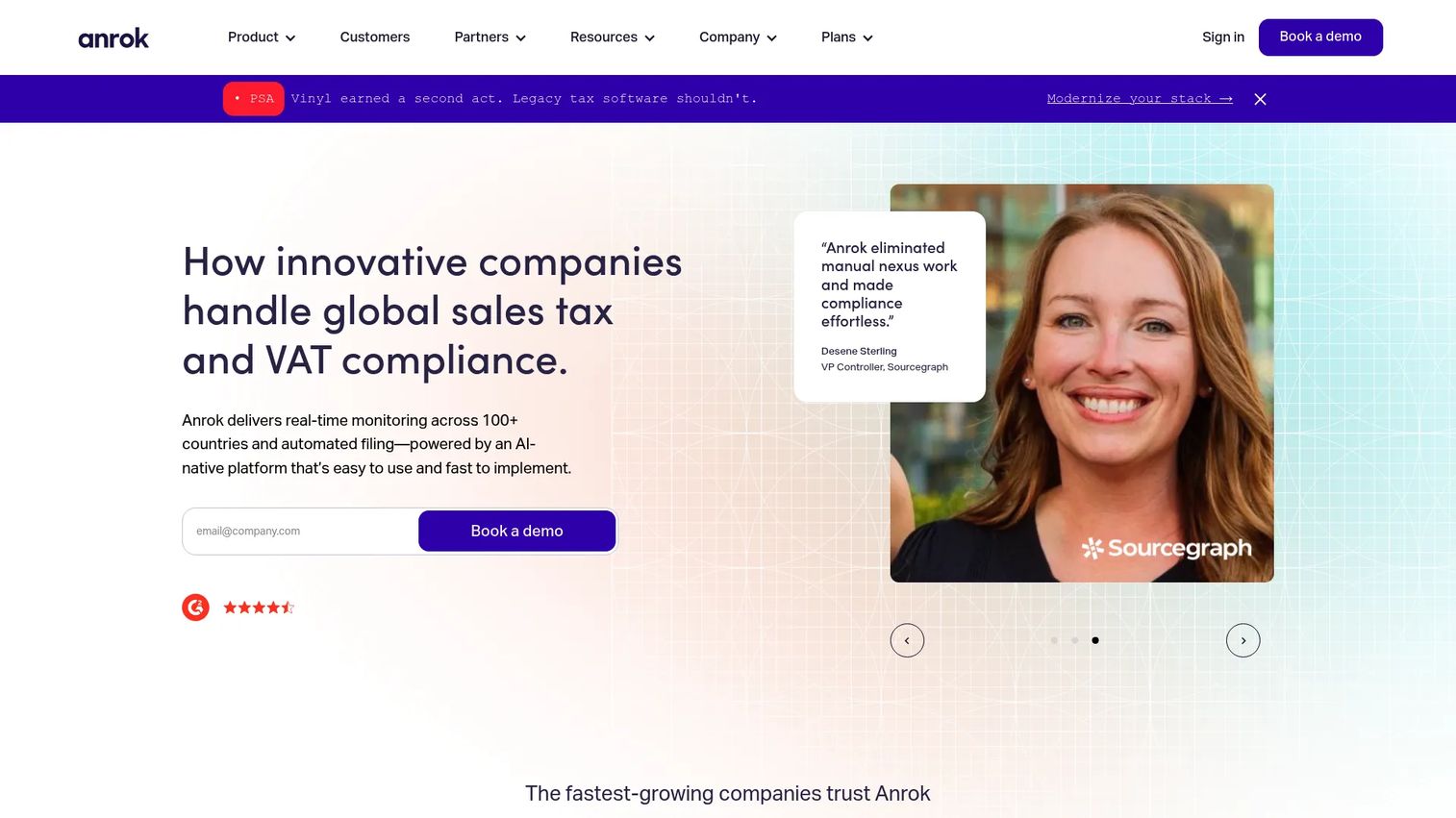
Anrok is a sales tax and VAT automation platform built for modern, subscription-based businesses. This is the specialist choice for SaaS: it is designed around recurring revenue workflows and connects cleanly into the billing stack that SaaS finance teams already run. Where ecommerce-first tools optimize for cart checkouts, Anrok optimizes for the way software revenue actually flows.
Best for: Companies needing automated sales tax and VAT compliance across multiple markets.
Key strengths
- Real-time tax calculation: Determines the correct rate across markets at the moment of billing.
- Filing and remittance: Automates returns and payments so filing is not a manual monthly task.
- Exemption certificate management: Collects and stores exemption documents for compliant, audit-ready records.
Why choose Anrok: SaaS finance teams evaluate tax tools differently from ecommerce operators, and Anrok is built for that difference. If your revenue is recurring, spans multiple markets, and runs through a modern billing stack, Anrok's fit reduces the reconciliation drag that generic tools create. It suits founders and finance leaders who want tax to scale with subscription growth without constant manual correction.
Anrok pricing: Anrok's Starter plan begins at $100 per market per month, with a Custom quote-based plan for broader needs. Pricing scales with the number of markets you sell into, which keeps early-stage costs proportional to footprint. There is no free tier.
6. TaxCloud
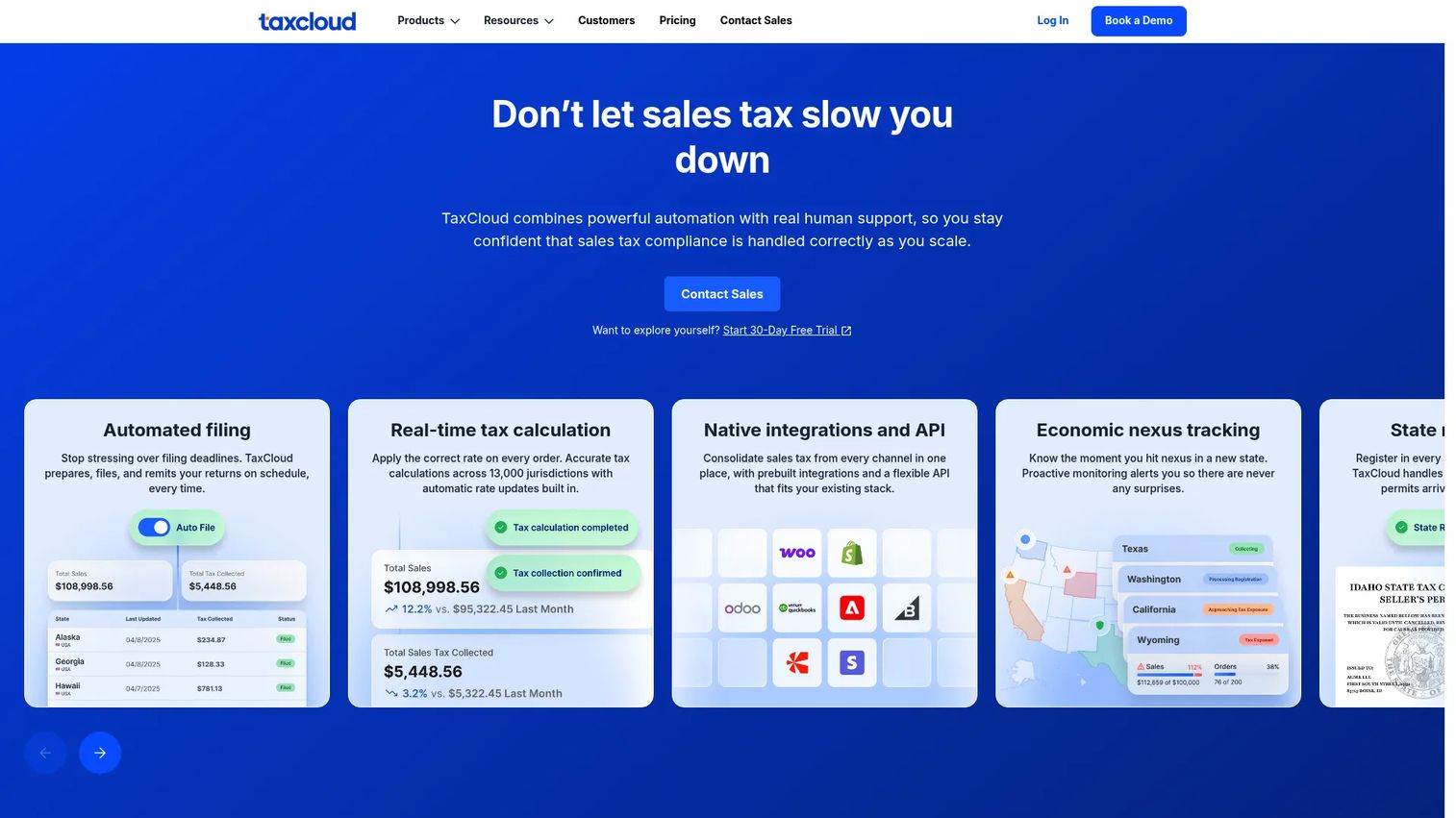
TaxCloud is sales tax compliance software for calculation, filing, registration, and related compliance workflows. It is aimed at ecommerce and SaaS businesses that want practical automation without a heavy suite. For leaner finance teams, TaxCloud keeps sales tax automation software approachable: calculate, file, register, and get audit support without a long implementation cycle.
Best for: Ecommerce and SaaS businesses needing US sales tax automation and filing.
Key strengths
- Real-time sales tax calculation: Applies accurate rates at the point of sale.
- Sales tax filing and remittance: Handles filing and payment, available as a subscription or pay-as-you-go option.
- State registration and audit support: Assists with registration and provides audit backup.
Why choose TaxCloud: TaxCloud fits teams that want compliance handled without the overhead of an enterprise platform. It carries a 4.5/5 on G2 and offers a 30-day free trial, so you can validate fit before committing. Relative to larger suites, it trades breadth for ease of adoption, which is exactly what a smaller or fast-moving team often wants.
TaxCloud pricing: TaxCloud lists Starter and Premium plans, billed monthly or annually, plus a 30-day free trial. Plan prices were not exposed on the source captured, though filing is described as a separate subscription or pay-as-you-go option and some services are quote-based. Check TaxCloud's pricing page for current plan figures.
7. Sovos
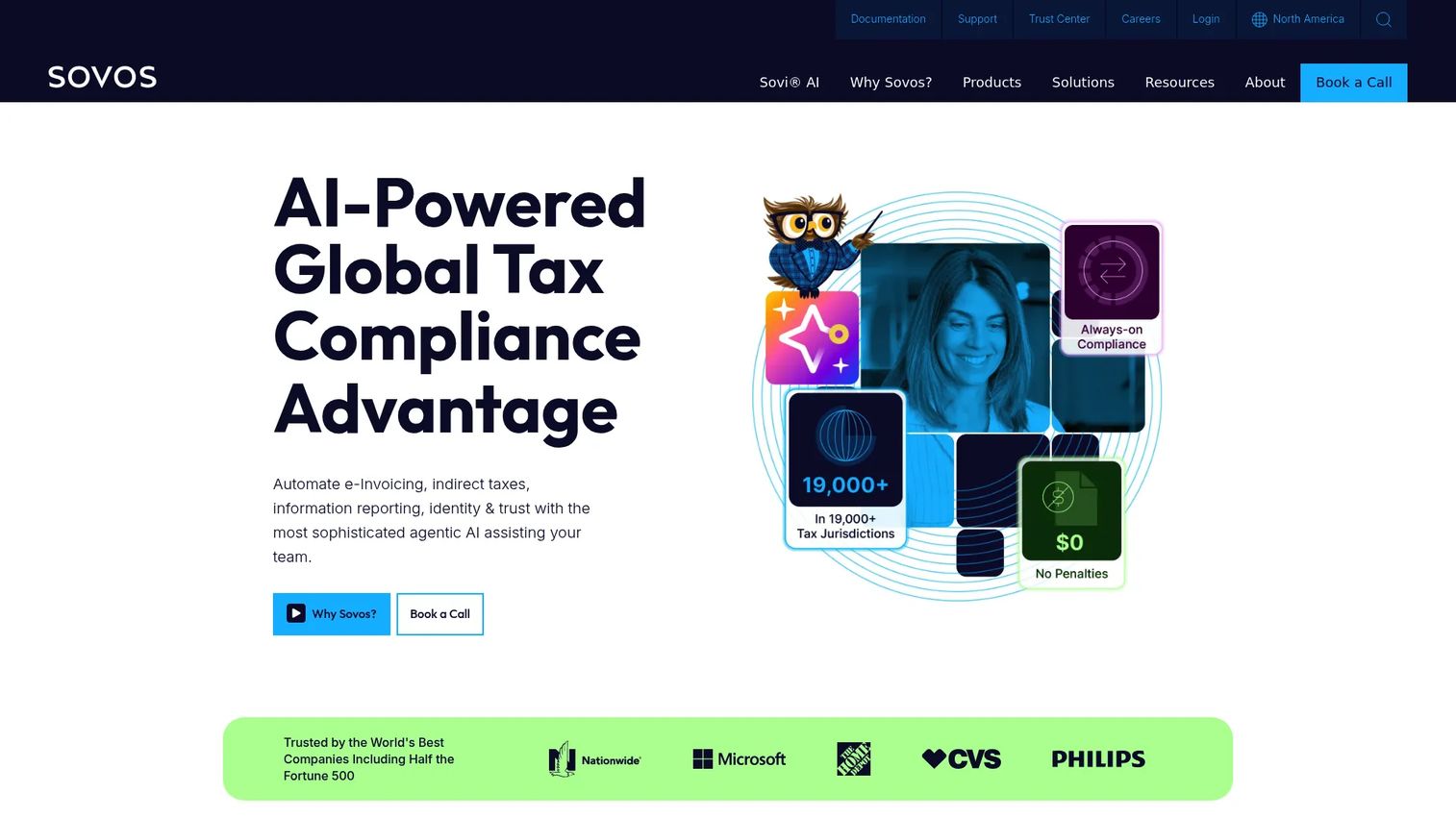
Sovos is a global tax compliance software and services provider covering indirect tax, e-invoicing, reporting, withholding, and related regulatory obligations. It is built for mid-market and enterprise teams where governance and audit readiness matter more than lightweight setup. If compliance obligations span multiple countries and regulatory regimes, Sovos is designed to manage that breadth from one platform.
Best for: Mid-market and enterprise teams needing global tax and regulatory compliance automation.
Key strengths
- AI-powered global tax compliance platform: Automates tax obligations across regions and regulatory regimes.
- Indirect tax, e-invoicing, filing, and reporting suites: Covers the full compliance lifecycle in one platform.
- Information reporting and withholding: Handles specialty compliance products beyond core sales tax.
Why choose Sovos: Consider Sovos when governance, regulatory breadth, and audit readiness outweigh the appeal of a simple setup. It suits organizations with global obligations and compliance teams accountable for defending records across jurisdictions. Its 4.2/5 G2 rating reflects a platform built for operational control rather than plug-and-play speed.
Sovos pricing: Public pricing is not shown on the product pages reviewed; Sovos uses custom pricing and directs prospects to book a call or talk to an expert. Expect packaging scoped to your regulatory footprint and compliance requirements.
Considerations before you buy
Shortlisting is easy. Choosing well means pressure-testing each platform against your actual stack and growth trajectory. Run through this checklist before you commit.
Integration coverage
Confirm the platform connects natively to your billing system, ecommerce platform, and ERP. A tax engine that requires manual export defeats the purpose. Ask for the specific connectors, not a generic "integrates with everything" claim.
Automation depth
Look past calculation. The real time savings come from automated filing, remittance, nexus monitoring, and certificate management. Map how much of the compliance lifecycle runs without human touch, because that is where operational drag disappears.
Compliance scope and jurisdictions
Match the platform's coverage to where you actually owe tax now and where you will owe it in twelve months. Ecommerce-focused tools cover US sales tax well; enterprise engines handle global indirect tax, use tax, and e-invoicing. Buy for your trajectory, not just today.
Audit support and records
When an auditor arrives, records win or lose the case. Verify how the platform stores exemption certificates, transaction records, and filing history, and whether it provides audit backup. This is where a cheap tool can cost you far more than its price.
Support and implementation
For a scaling team, implementation speed and support quality determine whether the tool earns its place in the first quarter. Ask about onboarding timelines, dedicated support, and how the vendor handles edge cases specific to your revenue model.
Conclusion
The right sales tax software depends less on features than on your stack complexity, filing volume, and support needs. For broad compliance depth across many jurisdictions, Avalara is the mature choice. Ecommerce-first businesses that want filing handled will find TaxJar a clean fit. Enterprises with global indirect tax and heavy ERP environments should look at Vertex or Thomson Reuters ONESOURCE. SaaS companies running recurring revenue get a purpose-built fit in Anrok. Leaner teams that want practical automation without an enterprise rollout will get value from TaxCloud. And where governance and regulatory breadth dominate, Sovos is built for that reality.
The next step is simple: map your channels, count your filing jurisdictions, and pick the platform whose automation depth and integration coverage match where your business is headed, not just where it is today. Get tax off the founder's plate before an audit forces the issue.
If you are also tightening the rest of your revenue systems, our guides to best ai sales assistant software, best contract management software tools, and best business intelligence software are worth a read. And if buyer-facing product experiences are on your roadmap, Guideflow helps teams turn their product into self-serve interactive demos in minutes.
FAQs
Yes. Most sales tax software is designed to connect natively with ERP systems, billing platforms, and ecommerce carts so tax data flows without manual export. Enterprise engines like Vertex and Thomson Reuters ONESOURCE emphasize deep ERP connectivity, while ecommerce-focused tools like TaxJar prioritize commerce-platform integrations. Always confirm the specific connectors you need before buying.
Calculation is the entry point. Strong platforms also automate nexus monitoring, returns preparation, filing and remittance, exemption certificate collection and validation, and audit-ready record-keeping. The value comes from how much of the full compliance lifecycle runs without human intervention, which is what removes recurring monthly work from your finance team.
For most scaling SaaS companies, yes. Once you cross economic nexus in multiple states, manual tracking becomes a liability that grows with volume. Sales tax software for small business, such as TaxCloud or Anrok, keeps compliance affordable and proportional to footprint while removing the risk of missed filings and back-tax exposure.
It reduces audit risk in two ways. First, accurate real-time calculation and automated filing lower the chance of errors that trigger scrutiny. Second, it stores transaction records, exemption certificates, and filing history in an organized, retrievable form, so if an audit happens, you can defend your position with clean documentation instead of scrambling through spreadsheets.
Prioritize four things: integration coverage with your existing stack, automation depth across the full compliance lifecycle, compliance scope that matches where you owe tax now and soon, and support quality including audit backup. Weight them by your own reality: an ecommerce business and a global enterprise will rank these differently.
If you sell to tax-exempt customers, such as resellers, nonprofits, or government entities, yes. Exemption certificate management collects, validates, and stores the documents that justify not charging tax on those sales. Without it, an auditor can disallow the exemption and hold you liable for uncollected tax plus penalties, so it is a core capability for any business with exempt customers.
Enterprise tools like Vertex, Thomson Reuters ONESOURCE, and Sovos handle global indirect tax, use tax, e-invoicing, and multi-system ERP environments with deep determination logic and governance controls. Ecommerce-focused tools like TaxJar and TaxCloud optimize for US sales tax, checkout calculation, and filing automation with faster setup. The right choice depends on your geographic footprint, revenue model, and how many systems your tax data must span.