


Your alumni data lives in five places. The advancement CRM holds giving history. The email tool owns the newsletter list. The event platform tracks last spring's reunion RSVPs. A mentoring spreadsheet floats around a shared drive. And somewhere, someone still exports contact records to Excel before every campaign.
That fragmentation is the real job. Alumni relations teams are not paid to maintain databases. They are paid to turn alumni data into repeat engagement: more mentors, more event attendance, more volunteers, more gifts. But you cannot run a segmented campaign, prove which touch drove a gift, or route a warm prospect to a gift officer when the record is scattered across four systems that do not talk to each other.
The stakes are getting harder to ignore. Only 19 to 20% of alumni actively engage with their institution across communications, events, volunteering, or giving, according to industry benchmarks cited by Almabase in 2026. Meanwhile the alumni management software market is projected to grow from USD 1.2 billion in 2025 to USD 2.4 billion by 2034, a 9.8% CAGR, per MarketIntelo (2024). Institutions are investing because the manual approach caps out fast.
The right alumni management platform centralizes the record, powers segmented outreach, and connects engagement to giving so you can defend the outcome. This guide is close in buyer logic to how a growth marketer evaluates a stack: reduce tool sprawl, prove impact, and improve conversion from engagement to participation. If you also run reunions and giving days, an event management tool and loyalty management approach are worth cross-referencing, and if your program leans on chapters and groups, community management software overlaps heavily with what follows.
What's inside
This guide compares the best alumni management software tools for universities, colleges, and alumni relations teams heading into 2026. We selected platforms built for higher education and advancement, not generic CRMs retrofitted for alumni. Each tool was assessed against the criteria that actually decide fit: database quality and directory, communications and segmentation, community and networking, events, fundraising, mentoring and career services, integrations with CRM and SIS, and analytics. We included only tools with real higher-ed or advancement relevance, verified ratings, and clear buyer positioning.
TL;DR
- Best for advancement and donor intelligence: EverTrue, for teams that already think in fundraising signals and stewardship.
- Best all-in-one for universities: Almabase, for engagement, events, and giving in one system.
- Best AI-enabled engagement plus giving: Gravyty, for outreach, mentoring, and donation flows under one roof.
- Best education-first platform with buyer clarity: Gradnet, for institutions comparing options in a university context.
- Best branded community hub: Hivebrite, for larger alumni networks that want a self-serve portal.
- Best lean, streamlined setup: ToucanTech, for small to mid-sized teams that want database plus comms in one place.
- Best budget option for associations: Wild Apricot, when membership management and simplicity matter most.
What is alumni management software?
Alumni management software is a purpose-built system that centralizes alumni records and powers engagement across communications, events, community, mentoring, and fundraising for schools, universities, and advancement teams. It is the connective layer between a scattered alumni database and the outcomes an advancement office is measured on.
Unlike a generic CRM, an alumni management system is designed around the alumni lifecycle: graduation, early engagement, career milestones, volunteering, mentoring, giving, and legacy relationships. A good alumni management platform treats each of those as a trackable touch and ties them back to a single record.
Core capabilities of alumni database software and engagement platforms:
- Centralized alumni database and directory: a single source of truth for contact data, degrees, employment, and engagement history, powering searchable alumni directory software for self-serve networking.
- Segmentation and outreach: filter by class year, region, industry, giving tier, or engagement score to run targeted alumni communications.
- Community and networking: branded portals, groups, chapters, and member-to-member messaging.
- Event management: registration, ticketing, payments, and attendance tracking for reunions, galas, and regional meetups.
- Alumni fundraising software: giving pages, campaigns, donor stewardship, and gift tracking.
- Mentoring and career services: alumni mentor matching software, job boards, and volunteer programs.
- Analytics: engagement scoring, campaign reporting, and giving attribution.
- Integrations: clean syncs with advancement CRM, SIS, email, and payment systems.
The difference from a plain CRM matters. A CRM stores contacts and deals. An alumni engagement software platform is built for relationship management across a lifetime, with the directory, community, events, and giving workflows an advancement team needs out of the box rather than bolted on.
When to use alumni management software
Centralize scattered alumni data
If your records live across the CRM, a newsletter tool, an event platform, and spreadsheets, you are losing time reconciling and losing signal at every handoff. A centralized alumni database software layer gives you one record per alum, so a mentor sign-up, a reunion RSVP, and a gift all attach to the same profile. That single view is the prerequisite for everything else.
Run segmented alumni communications
Blasting the entire list produces low opens and higher unsubscribes. When you can segment by class year, geography, industry, or engagement score, outreach lands. Alumni communications software with real segmentation turns the newsletter from a broadcast into a set of targeted, relevant touches that actually drive clicks and RSVPs.
Launch engagement programs that connect to giving
The whole point of alumni engagement software is the path from participation to support. If a first-time volunteer or event attendee cannot be scored, routed, and eventually stewarded toward a gift, you are leaving pipeline on the table. Use a platform when you need engagement and alumni donor management working as one funnel, not two disconnected motions.
Build mentoring and career pathways
Mentoring and career networking are among the highest-retention engagement types. If you want structured alumni mentor matching software, a career job board, or a searchable alumni directory software experience, you need a platform that treats these as first-class features rather than an afterthought.
Support event-heavy alumni relations workflows
Reunions, giving days, regional chapters, and galas generate constant registration, payment, and follow-up work. A platform with native alumni event management software removes the spreadsheet chaos and ties attendance back to the alumni record automatically.
Comparison table
We ranked these tools by higher-ed and advancement relevance, breadth of engagement and fundraising features, integration depth, and verified user ratings. Every tool below is built or widely used for alumni relations, not repurposed from an unrelated category. Pricing across this alumni association software category is largely quote-based, which is normal for institutional buyers; where a public figure exists, we list it.
| # | Product | Intent | Key use case | Pricing | G2 rating |
|---|---|---|---|---|---|
| 1 | EverTrue | Advancement and donor intelligence | Fundraising signals, engagement, stewardship | Custom quote | 4.6/5 |
| 2 | Almabase | All-in-one alumni engagement | Engagement, events, and giving in one system | Custom quote | 4.6/5 |
| 3 | Gravyty | AI-enabled engagement plus giving | Outreach, mentoring, donation flows | Custom quote | 4.4/5 |
| 4 | Gradnet | Education-first alumni CRM | Directory, events, fundraising, mentoring | Custom quote | 4.7/5 |
| 5 | Hivebrite | Branded community platform | Community, directory, events, segmentation | Custom quote | 4.4/5 |
| 6 | ToucanTech | Streamlined community and CRM | Database, comms, events, website | Pro Bono option; quote-based | 5.0/5 |
| 7 | Wild Apricot | Membership and association software | Membership, events, email, portal | From $66.00/mo | 3.8/5 |
| 8 | 360Alumni | Alumni networking and community | Networking, directory, events, fundraising | Custom quote | 4.5/5 |
1. EverTrue
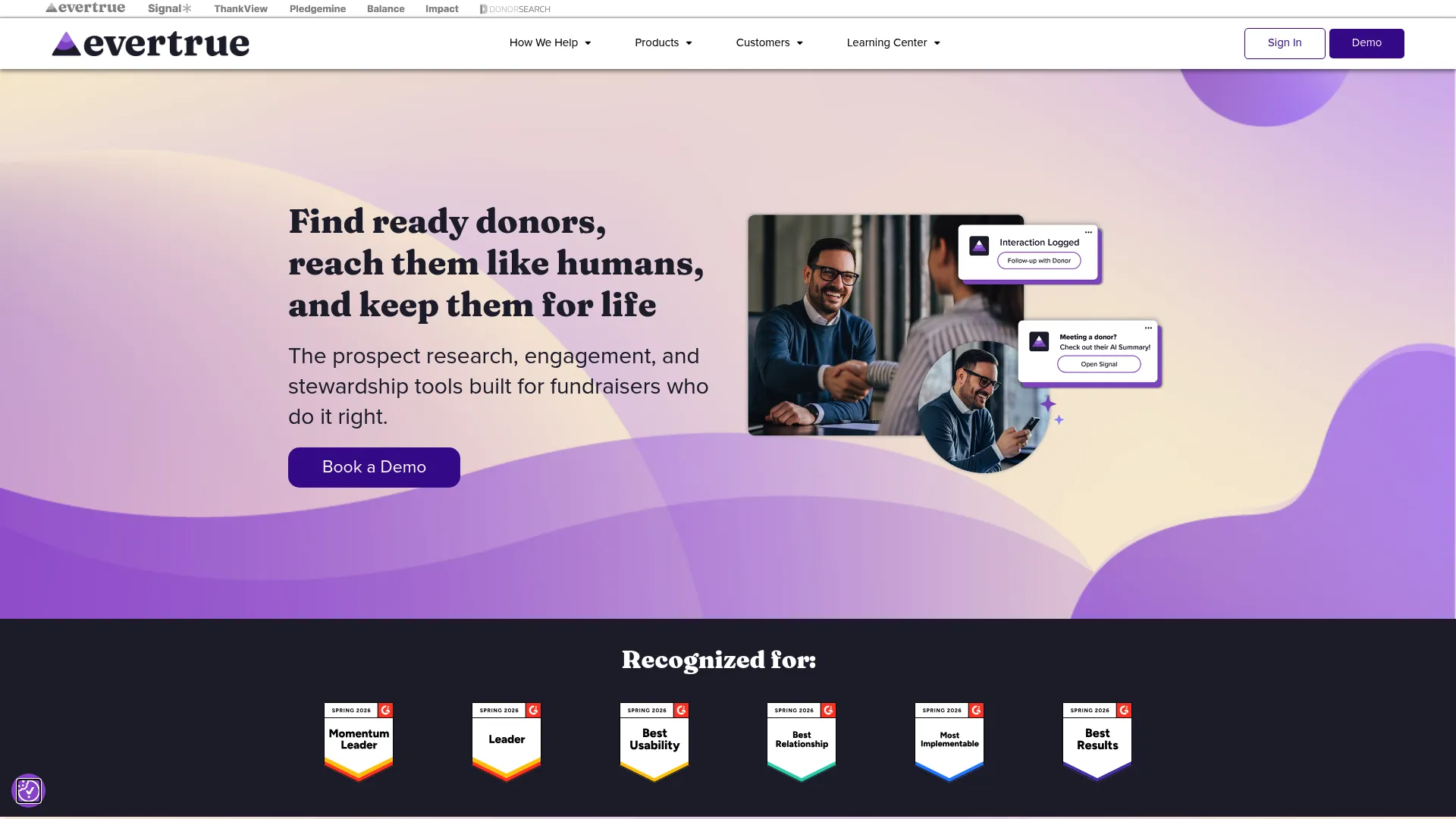
EverTrue is fundraising and donor engagement software for nonprofits, higher education, healthcare, and advancement teams. It positions squarely in the advancement lane, layering donor intelligence and prospect discovery on top of engagement and stewardship workflows. For institutions that already frame alumni relations in fundraising terms, EverTrue speaks the native language of gift officers.
Best for: Advancement and fundraising teams that need donor intelligence plus engagement and stewardship workflows.
Key strengths
- AI-powered donor intelligence: surfaces prospects and giving signals so gift officers prioritize the right alumni first.
- Multi-channel donor engagement: reach alumni through video, direct mail, and messaging from one place.
- Endowment accounting and reporting: track and report on funds without leaving the platform.
Why choose EverTrue: If your team's core objective is moving alumni from engaged to giving, EverTrue's donor intelligence is the differentiator. It fits institutions that treat advancement as the center of gravity and want engagement data feeding straight into stewardship and prospect prioritization. Teams that want networking and community as the primary motion may weigh it against broader community-first platforms.
EverTrue pricing: EverTrue does not publish a public price. The company states each product has its own price point and directs prospective buyers to request a demo for a quote. Expect a custom, institution-specific proposal rather than a self-serve tier, which is standard for advancement software at this level.
2. Almabase
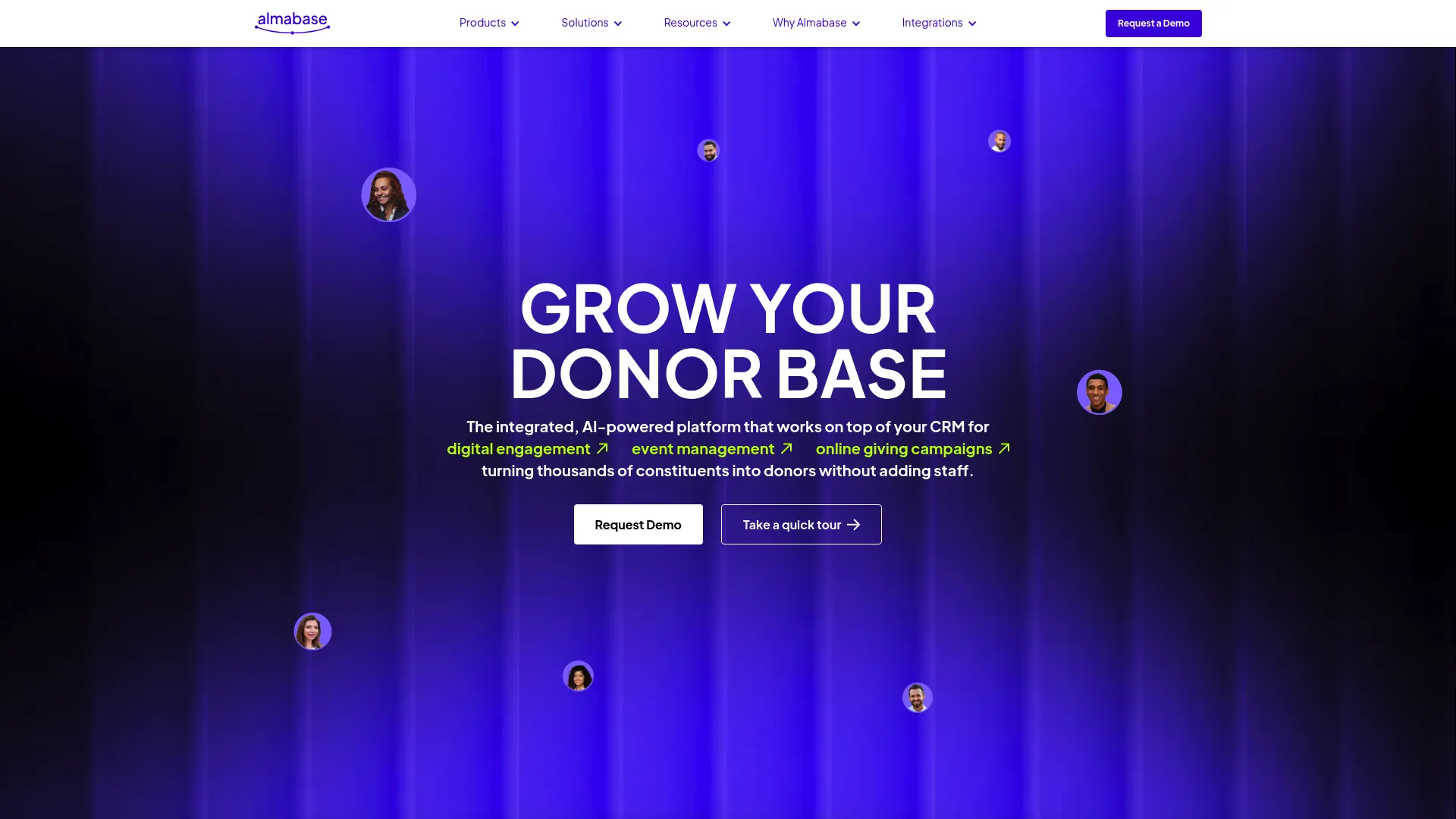
Almabase is an all-in-one alumni engagement and fundraising platform for advancement teams. It bundles giving, events, communications, and an alumni directory into a single system, which makes it a practical fit for universities that want breadth without stitching together point tools. It is frequently the default shortlist entry for higher-ed buyers evaluating an alumni management platform.
Best for: Schools, universities, and nonprofit advancement teams needing alumni engagement, events, and giving in one system.
Key strengths
- Online giving and fundraising pages: launch campaigns and giving-day pages as native alumni fundraising software.
- Event management: handle tickets, attendees, and payments for reunions and regional events in one flow.
- Targeted email and directory: run segmented alumni communications and offer a searchable directory for networking.
Why choose Almabase: Almabase earns its spot when you want one system covering the everyday advancement workflow rather than a specialist tool for a single job. It suits teams that value practical breadth: run the newsletter, host the reunion, and drive the giving day from the same record. Institutions with deep, specialized donor-intelligence needs may pair it with a dedicated prospecting layer.
Almabase pricing: Almabase uses quote-based pricing. The company notes cost depends on institution size and the modules you enable, with no public number published. Request a quote scoped to your enrollment and feature needs to get an accurate figure.
3. Gravyty

Gravyty is AI-powered engagement and fundraising software for higher education, nonprofits, and K-12. It brings student, alumni, and donor engagement together with AI-assisted outreach, so lean teams can personalize at scale without adding headcount. The pitch resonates if you want engagement and giving working under one roof.
Best for: Institutions seeking an AI-enabled platform for student, alumni, and donor engagement.
Key strengths
- AI-powered engagement: drafts and prioritizes personalized outreach so gift officers cover more alumni per week.
- Fundraising and donor outreach: campaigns and donation flows tie engagement directly to giving.
- CRM and SIS/LMS integrations: connect to the systems of record already in your stack.
Why choose Gravyty: Gravyty fits teams that want AI doing the repetitive outreach work so staff focus on relationships. It is a strong choice when engagement volume outpaces the team's capacity and you want the AI to close that gap while feeding a giving motion. Teams that prefer to keep messaging fully manual may prioritize the human-crafted approach instead.
Gravyty pricing: Gravyty does not list public pricing. The company says cost depends on institution size and needs, and directs visitors to contact sales for a personalized quote. Budget for a custom proposal shaped by your student, alumni, and donor engagement scope.
4. Gradnet
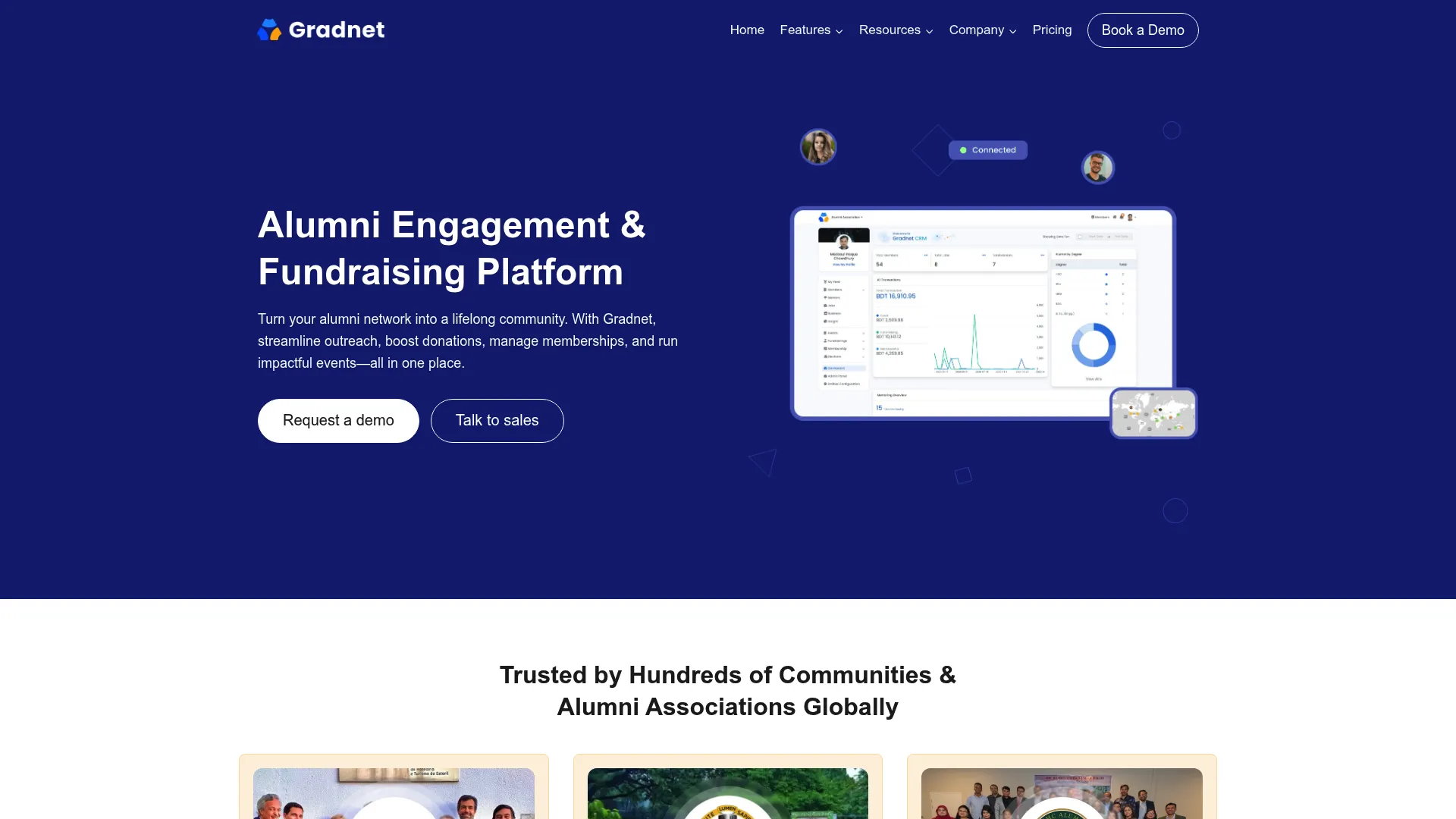
Gradnet is alumni management software for institutions and communities, built with a clear education-first orientation. It packages a branded alumni CRM and community platform with the core workflows most advancement teams need, and it is often praised for transparent evaluation guidance during the buying process.
Best for: Educational institutions and alumni associations needing a branded alumni CRM/community platform.
Key strengths
- Member directory and mentoring: a searchable directory plus mentoring to power alumni networking.
- Event ticketing and management: run paid and free events with registration built in.
- Fundraising and online voting: native giving plus governance features like online voting for associations.
Why choose Gradnet: Gradnet is a good fit when you want an education-focused platform and appreciate clarity while you compare options. Its combination of directory, events, fundraising, mentoring, and voting covers the practical range an institution or association runs day to day. Its 4.7/5 G2 rating reflects strong reviewer sentiment among a smaller review base.
Gradnet pricing: Gradnet uses custom, quote-based pricing. The company says it crafts a tailored plan and reaches out with a quote rather than publishing set tiers. Request pricing scoped to your community size and required modules.
5. Hivebrite

Hivebrite is an all-in-one branded community management and engagement platform. It is built for organizations that want a fully branded private network, which makes it a natural fit for larger alumni communities that need a self-serve hub rather than a purely staff-driven system. Alumni relations is one of its most common use cases.
Best for: Organizations building a fully branded private community or alumni network.
Key strengths
- Branded private communities: a self-serve, fully branded portal alumni actually want to log into.
- Member directory and messaging: searchable directory plus member-to-member messaging for networking.
- Events, news, and content modules: run events, publish news, and share content from one hub.
Why choose Hivebrite: Hivebrite is strong when community is the primary motion and you want alumni engaging with each other, not just receiving broadcasts. It suits engagement-led and community-first institutions with the scale to sustain an active branded network. Teams whose core need is advancement-grade donor intelligence may pair it with a dedicated fundraising layer.
Hivebrite pricing: Hivebrite does not publish public pricing on its primary pages, and its terms indicate fees are invoiced via an order form, which points to a quote-based model. Expect a custom proposal based on community size and the modules you enable.
6. ToucanTech
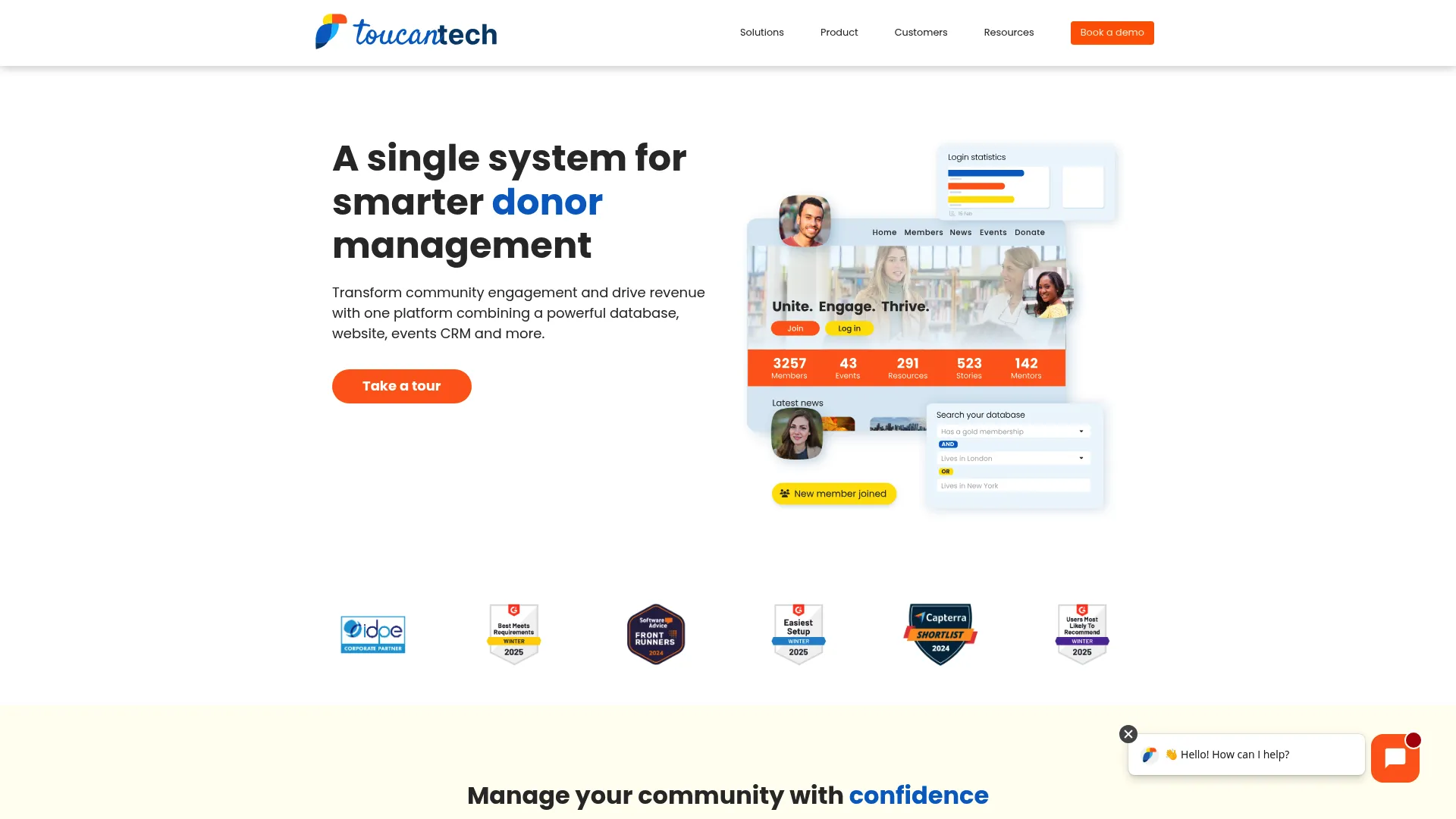
ToucanTech is cloud-based community, CRM, website, communications, events, and fundraising software for schools, universities, nonprofits, and associations. Its single-record architecture keeps the database clean, and the integrated website builder means lean teams can run the alumni portal and the CRM in one place.
Best for: Schools, universities, nonprofits, and associations needing an all-in-one community platform.
Key strengths
- CRM/AMS with single-record architecture: one clean record per alum, avoiding duplicate-data headaches.
- Integrated website builder: run the alumni portal software and the CRM from the same system.
- Comms hub: email campaigns and segmentation for targeted alumni communications.
Why choose ToucanTech: ToucanTech is a practical option for small to mid-sized teams that want database, website, and communications working together without heavy setup overhead. Its single-record model keeps data trustworthy, which is exactly what lean advancement shops need. Its 5.0/5 G2 rating reflects strong sentiment among reviewers.
ToucanTech pricing: ToucanTech does not publicly display standard pricing, which appears quote-based. Notably, it publicly offers a Pro Bono program with a two-year complimentary license, which makes it worth a look for qualifying organizations exploring free alumni management software options. Beyond that, request a quote for the core license.
7. Wild Apricot
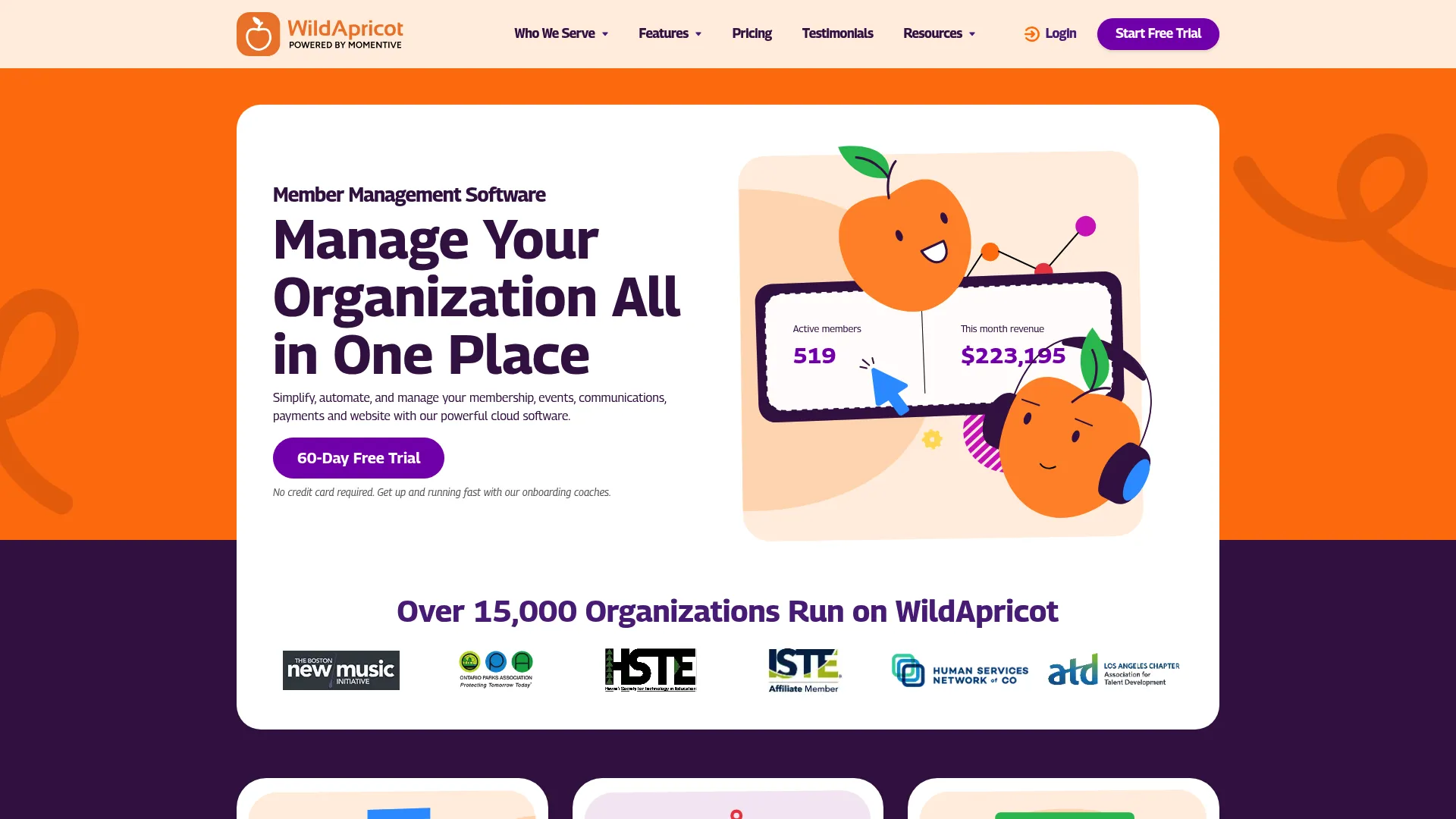
Wild Apricot is all-in-one membership management software for associations, nonprofits, clubs, and other membership-based organizations. It is not a purpose-built advancement suite, but for smaller alumni associations and chapters it covers memberships, events, email, and a member website at an accessible, transparent price.
Best for: Membership-based organizations that need an all-in-one platform for memberships, events, emails, and a website.
Key strengths
- Membership management: dues, renewals, and member records for association-style alumni groups.
- Event registration and payments: run paid and free events with built-in registration.
- Website builder and member portal: stand up an alumni portal software experience without a separate site.
Why choose Wild Apricot: Wild Apricot is best when budget and simplicity matter most. Smaller alumni associations that run on membership dues and a handful of events each year get a complete, self-serve toolkit without an enterprise contract. Larger university advancement teams focused on donor intelligence will likely need a more advancement-specific platform.
Wild Apricot pricing: Wild Apricot publishes transparent, contact-based pricing. Plans start at $66.00/mo for 100 contacts on monthly billing, dropping to $59.40/mo with annual pre-pay and $56.10/mo on a two-year pre-pay. A 60-day free trial is available, and all prices are in USD.
8. 360Alumni
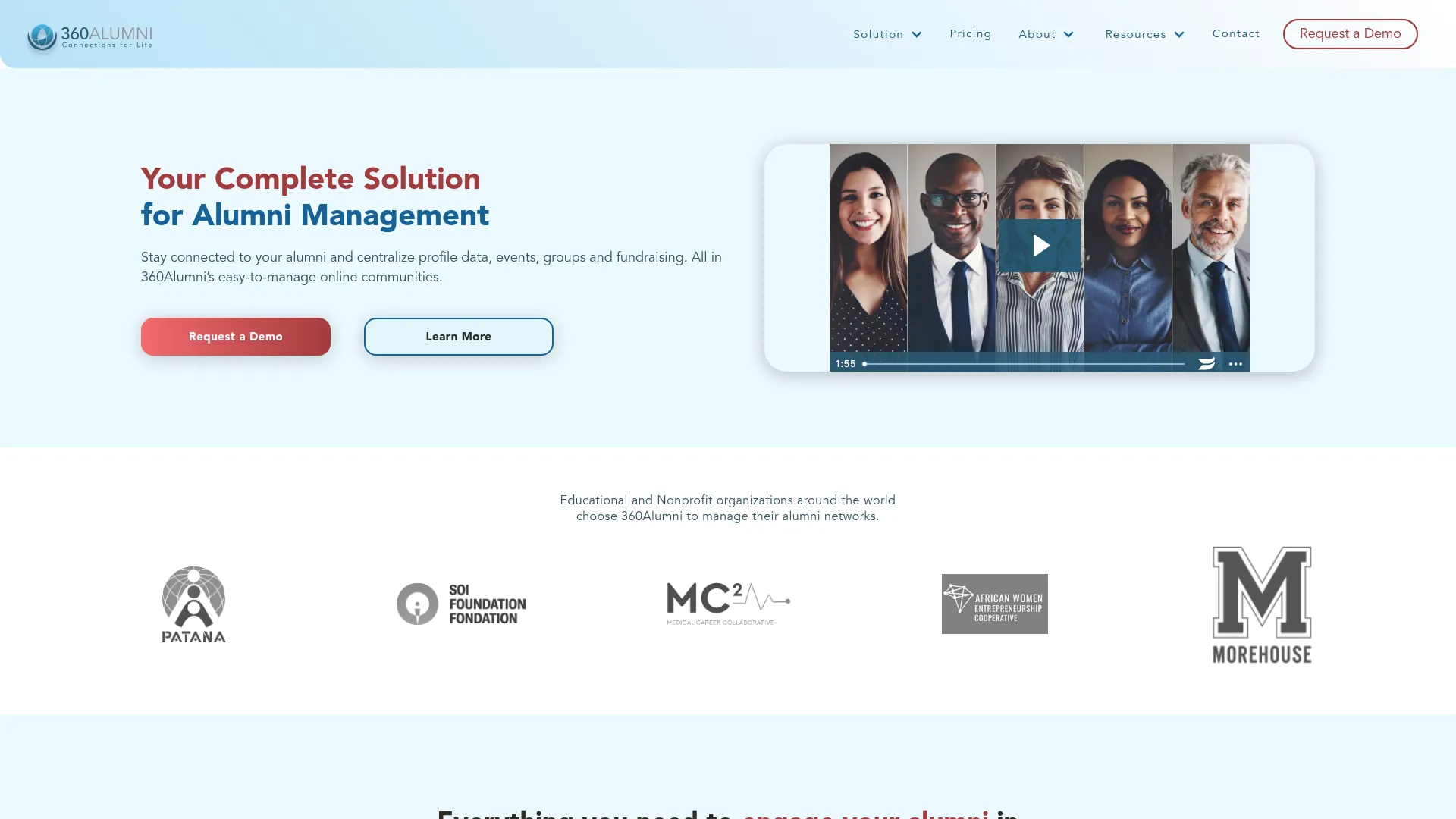
360Alumni is an alumni management and community engagement platform for schools, nonprofits, and membership organizations. Its emphasis on networking, directory, groups, and chapters makes it a fit for teams whose core objective is relationship-building among alumni rather than a fundraising-first motion.
Best for: Organizations needing a branded alumni/community portal with directory, events, fundraising, and engagement tools.
Key strengths
- Alumni directory and map: a searchable, mappable directory that powers discovery and networking.
- Event management: registration and event workflows tied back to the alumni record.
- Groups and chapters: structured spaces for regional, class-year, and affinity communities.
Why choose 360Alumni: 360Alumni is a good fit when connection is the core goal and you want alumni finding each other, forming chapters, and engaging in groups. The directory-and-map experience plus groups and chapters make it strong for relationship-led programs. Teams that lead with large-scale donor stewardship may weigh it against advancement-first suites.
360Alumni pricing: 360Alumni uses custom pricing based on record count. Its public pricing page lists an initial setup fee, an annual subscription, and a transaction fee of a 3% credit card processing charge plus a service charge, but no public starting subscription amount. Request a custom quote scoped to your record volume.
Considerations before you buy
Shortlisting is where most of the value is. Use these criteria to pressure-test any alumni management platform before you sign.
Data model and directory quality
Ask how the platform handles a single record per alum across engagement, events, and giving. Duplicate records quietly poison segmentation and reporting. A clean directory and a true single source of truth are the foundation everything else depends on.
Engagement-to-giving path
The platform should let you score engagement, route warm alumni, and connect participation to alumni donor management. If engagement and fundraising live in separate silos, you cannot prove which touch drove the gift. Insist on a demonstrated path from first touch to stewardship.
Integrations with CRM and SIS
Alumni relationship management only works when the platform syncs cleanly with your advancement CRM, SIS, email, and payment systems. Confirm which integrations are native versus add-on, and how records reconcile. A broken sync recreates the exact fragmentation you are trying to escape. Adjacent stacks like a customer data platform or marketing resource management can inform how you think about clean data flows.
Security, privacy, and compliance
Alumni records are personal data. Verify data ownership, access controls, and compliance posture before committing. This belongs in the main selection logic, not a footnote, especially for public institutions with strict privacy obligations.
Total cost and support
Most alumni association software is quote-based, so compare implementation, training, and ongoing support alongside license cost. Ask for references from institutions of your size and check that support is responsive during giving-day crunch. A contract management review of the agreement terms is worth the time before signing.
Conclusion
The right pick depends on what your team prioritizes. If you lead with fundraising and donor intelligence, EverTrue and Gravyty put giving signals at the center. If you want an all-in-one alumni engagement software suite for a university, Almabase and Gradnet cover the everyday workflow in one system. If community and networking are the point, Hivebrite and 360Alumni build the branded hub alumni actually use. And if budget and simplicity rule, ToucanTech and Wild Apricot deliver practical breadth for lean teams and associations.
There is no universal best alumni management software, only the best fit for whether you prioritize data, engagement, fundraising, or community. Before you commit, do the unglamorous work: request demos scoped to your real workflows, call references at institutions your size, and confirm integrations with your CRM and SIS in writing. That is how you avoid buying a system that recreates the fragmentation you started with.
Start your journey with Guideflow today!
FAQs
Alumni management software is a purpose-built system that centralizes alumni records and powers engagement across communications, events, community, mentoring, and fundraising. It gives schools, universities, and advancement teams one source of truth and the workflows to turn alumni data into participation and giving. Unlike a spreadsheet or generic tool, it is built around the alumni lifecycle.
At minimum, look for a centralized alumni database and directory, segmentation, communications, community and networking, event management, alumni fundraising software, mentoring and career services, analytics, and clean integrations. The best platforms treat mentoring and directory access as first-class features, not add-ons. Security and compliance controls should be part of the core, not an afterthought.
A CRM stores contacts and tracks deals or opportunities. An alumni management system is built for lifelong relationship management, with directory, community, events, mentoring, and giving workflows designed around the alumni lifecycle. Many teams integrate an advancement CRM with a dedicated alumni engagement platform rather than forcing a generic CRM to do both jobs.
There is no single answer; it depends on priorities. Almabase and Gradnet are strong all-in-one picks for universities wanting engagement, events, and giving in one system. EverTrue and Gravyty lead when donor intelligence and fundraising are central. Hivebrite and 360Alumni stand out for community and networking.
Yes. Most platforms in this category include native alumni event management software for registration, ticketing, and payments, plus alumni fundraising software for giving pages, campaigns, and gift tracking. The stronger systems tie event attendance and giving back to the same alumni record so you can measure engagement-to-giving.
Many do. Platforms like Gradnet and 360Alumni offer alumni mentor matching software, directories, and groups that power career networking. Mentoring and career pathways tend to drive high retention, so treating them as first-class features rather than an afterthought is worth prioritizing during evaluation.
Most alumni association software is quote-based and scoped to institution size, record count, and modules enabled, so request a proposal matched to your real needs. Compare implementation, training, and ongoing support alongside license cost. Wild Apricot is a notable exception with transparent contact-based pricing, and ToucanTech offers a Pro Bono license for qualifying organizations exploring free alumni management software.
The critical integrations are your advancement CRM, SIS, email platform, and payment processor. Clean, native syncs keep the alumni record accurate and make alumni relationship management reliable across systems. Confirm which integrations are native versus add-on and how duplicate records reconcile before you commit.