


Your lab runs on samples, and samples run on trust. A misplaced accession number, a broken chain of custody, a result that lands in the wrong report: any one of those turns a routine audit into a bad week. When the tracking lives in spreadsheets and the workflow lives in people's heads, turnaround time slips and data integrity becomes a hope rather than a control.
That is the gap laboratory information system software fills. The global laboratory information system market is projected to grow from USD 2.65 billion in 2026 to USD 4.90 billion by 2031, a 13.08% CAGR, according to Mordor Intelligence (2026). Cloud-based delivery already accounts for 54.32% of that market. The category is growing because manual lab operations do not scale, and because regulators keep raising the bar on traceability.
Choosing between a LIMS, a LIS, and an ELN is a high-stakes software decision. It shapes your throughput, your audit readiness, and how much of your team's time gets swallowed by data entry instead of science. If you are weighing that choice the way you would weigh a contract lifecycle management software purchase or an audit management software rollout, the same discipline applies: define the workflow, define the compliance surface, then shortlist against real criteria. This guide gives you that shortlist.
What's inside
This guide covers seven laboratory information system software platforms used for sample management, workflow automation, reporting, compliance, and integrations. It spans broad LIMS software for research and industrial labs, clinical and pathology LIS software, and enterprise-grade laboratory informatics.
We selected tools based on four criteria that matter to lab operators: core functionality (accessioning, sample tracking, results management), industry fit (clinical, research, food, water, or multi-vertical), interoperability (HL7, FHIR, ASTM, and standard file exports), and compliance support (audit trails, revision control, regulated reporting). We also flagged vendor credibility and deployment flexibility. Before you shortlist, the guide clarifies how a LIMS, a LIS, and an ELN differ so you buy the right category.
TL;DR
- Best broad LIMS for configurable sample management: Labworks, for labs that want proven sample lifecycle tracking, automation, and inventory in one system.
- Best configurable LIMS across industries: Autoscribe Informatics, for labs that need no-code workflow configuration without custom development.
- Best clinical and pathology LIS: LigoLab, for diagnostic labs that want an all-in-one LIS plus revenue cycle management.
- Best enterprise lab informatics breadth: Thermo Fisher Scientific, for organizations standardizing instruments, software, and services together.
- Best for regulated multi-site scale: STARLIMS, for enterprise labs governing workflows across many locations.
- Best for clinical diagnostics interoperability: Clinisys and Orchard Software, for healthcare labs prioritizing reporting, connectivity, and usability.
What laboratory information system software is
Laboratory information system software is a category of platforms that manage the full lifecycle of laboratory samples and data, from accessioning through testing, reporting, and archival, while enforcing traceability and compliance. It replaces the patchwork of spreadsheets, paper logs, and disconnected instrument outputs that make lab operations slow and error-prone.
The category splits into three related but distinct tools. A laboratory information management system (LIMS) is built for sample-centric workflows: research, industrial, food, water, and environmental labs that track large volumes of samples through defined tests. A laboratory information system (LIS) is built for patient-centric clinical and pathology labs, where results tie to a patient record and often to billing. An electronic laboratory notebook (ELN) is built for experiment-centric documentation: capturing methods, observations, and unstructured research data. Many labs run more than one, and some LIMS platforms include ELN functionality.
Understanding the distinction early prevents an expensive mismatch. A clinical lab that buys a research LIMS will fight it on patient reporting; a research lab that buys a clinical LIS will fight it on flexible sample types.
Core capabilities you should expect
- Sample accessioning and tracking: register samples, assign unique identifiers, and follow each specimen through its full lifecycle.
- Chain of custody and barcoding: barcode labels and custody logs that record every handoff for legal and regulatory defensibility.
- Workflow automation: rules-based routing, scheduling, and status transitions that reduce manual steps and cut errors.
- Instrument integration and data exchange: connect analyzers and exchange data via HL7, FHIR, ASTM, XML, CSV, and PDF.
- Reporting, certificates, and dashboards: generate certificates of analysis, patient reports, and analytics dashboards on turnaround time and throughput.
- Audit trail and revision control: immutable logs of who changed what and when, with versioned records for data integrity.
- Security and role-based access: granular permissions that match regulatory and privacy requirements.
When to use laboratory information system software
You need to track samples end to end
Once your volume grows past what a spreadsheet can hold, a laboratory management system becomes mandatory. Accessioning assigns each sample a unique identity at intake. Barcoding ties that identity to a physical label so scans replace transcription. Chain of custody logs every handoff. If your lab handles legal, forensic, clinical, or regulated samples, that unbroken custody trail is not optional, it is the evidence that your results hold up.
You need to reduce manual lab operations
Manual data entry is where turnaround time goes to die. Workflow automation routes samples through their defined steps without someone shepherding each one, and instrument integration pulls results directly from analyzers instead of a technician retyping them. That combination raises throughput and removes a whole class of transcription errors. The Astrix Technologies survey cited by Coherent Market Insights (2020) found 61% of organizations reported increased efficiency after implementing a LIMS or LIS.
You need to prove compliance and traceability
When an auditor or regulator asks who ran a test, when, on which instrument, and whether the record was altered, you need an answer in seconds. Audit trails, revision control, and regulated reporting exist for exactly that moment. Labs operating under ISO 17025, GMP, GLP, FDA 21 CFR Part 11, CAP, or CLIA cannot rely on manual documentation. The same evidence-first mindset that drives teams toward dedicated audit management tooling applies here: the system, not the person, becomes the source of truth.
Comparison table
The table below differentiates the seven platforms on buyer basics: what each is built for, its core use case, public pricing signals, and G2 rating. Broad LIMS, clinical LIS, and enterprise informatics each show up so you can match a tool to your lab type before reading the full sections. Pricing in this category is largely quote-based, so treat public figures as directional and confirm with each vendor.
| # | Product | Intent | Key use case | Pricing | G2 rating |
|---|---|---|---|---|---|
| 1 | Labworks | Broad LIMS | Sample lifecycle, automation, inventory | Quote-based; implementations reported from $20,000 | 5.0/5 |
| 2 | Autoscribe Informatics | Configurable LIMS | No-code workflow configuration | Quote-based | Not listed |
| 3 | LigoLab | Clinical/pathology LIS | All-in-one LIS plus RCM | Tiered; entry under $2,000/month | 4.7/5 |
| 4 | Thermo Fisher Scientific | Enterprise informatics | Instruments, software, services | Quote-based | 4.3/5 |
| 5 | STARLIMS | Enterprise regulated LIMS | Multi-site workflow governance | Quote-based | 4.5/5 |
| 6 | Clinisys | Clinical and multi-sector LIMS/LIS | Configurable cloud workflows | Quote-based | 3.5/5 |
| 7 | Orchard Software | Clinical LIS | Clinical workflow, POCT, integration | Quote-based | 4.0/5 |
1. Labworks
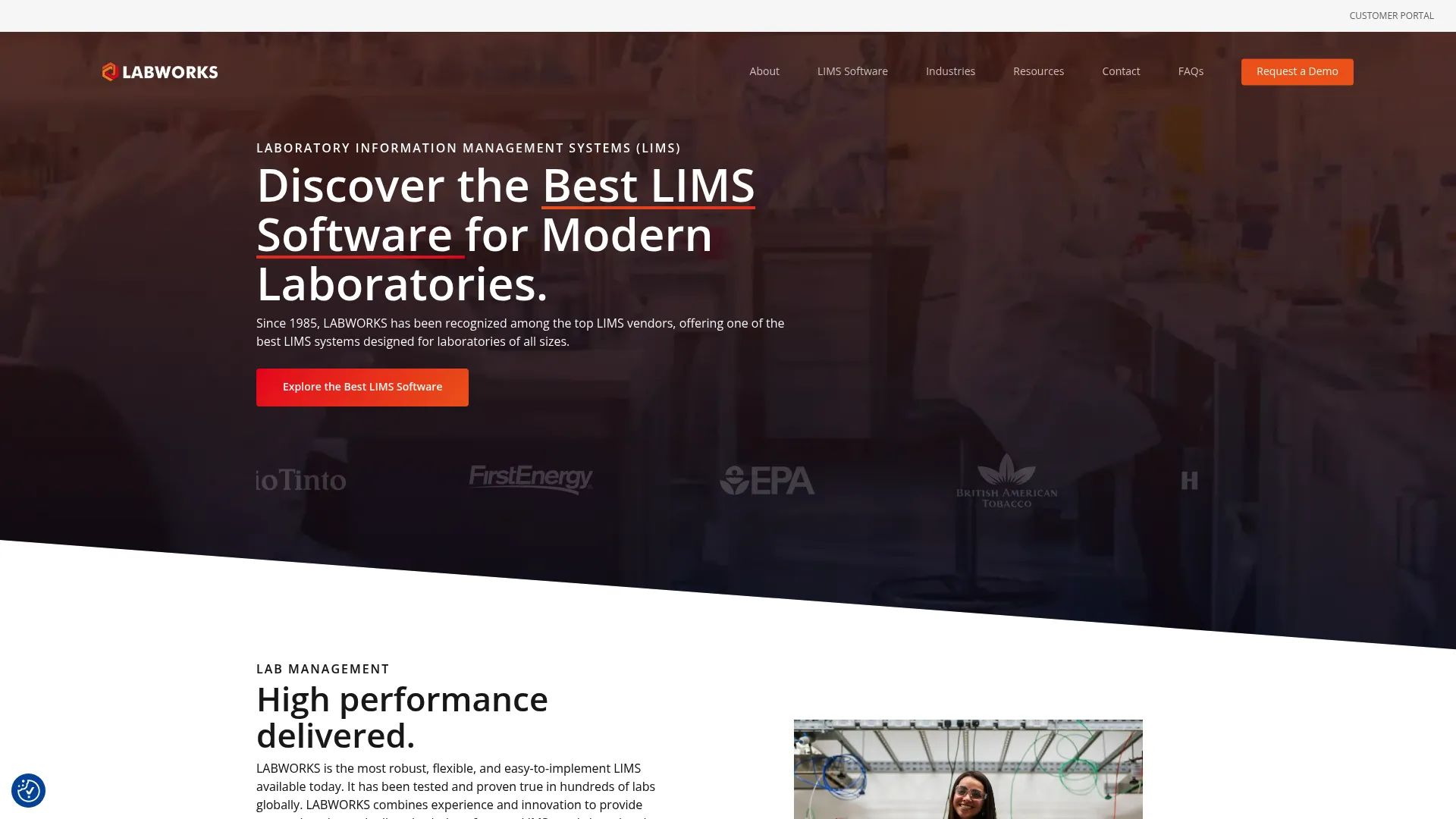
Labworks is a LIMS software provider focused on sample management, workflow automation, inventory, and compliance for research, industrial, and quality-control labs. It handles the full sample lifecycle, connects to instruments for results entry, and includes ELN functionality, so a single platform covers both structured sample data and less structured experiment notes. For a product manager evaluating time-to-value, that breadth means fewer systems to instrument and fewer handoffs to break.
Best for: Labs that want a configurable, proven LIMS for sample management and automation without stitching together point tools.
Key strengths
- Sample tracking and management: register, route, and follow every sample through its full lifecycle with clear status visibility.
- Workflow automation and scheduling: rules-based routing and scheduling that cut manual steps and raise throughput.
- Instrument integration and results entry: pull results directly from analyzers to reduce transcription errors and speed turnaround time.
Why choose Labworks: If your lab runs high sample volumes and wants sample tracking, inventory, and ELN in one configurable system, Labworks fits. It suits teams that value a mature, established platform over a newer entrant, and that want room to configure workflows to their own processes rather than bending processes to the tool.
Labworks pricing: Labworks does not publish standard plan prices on its site. It offers both subscription and perpetual licensing models. Its own pricing article notes that some implementations have started around $20,000, while larger deployments have exceeded $1 million, so total cost depends heavily on scope, modules, and integration work. There is no free tier. Labworks holds a 5.0/5 rating on G2.
2. Autoscribe Informatics
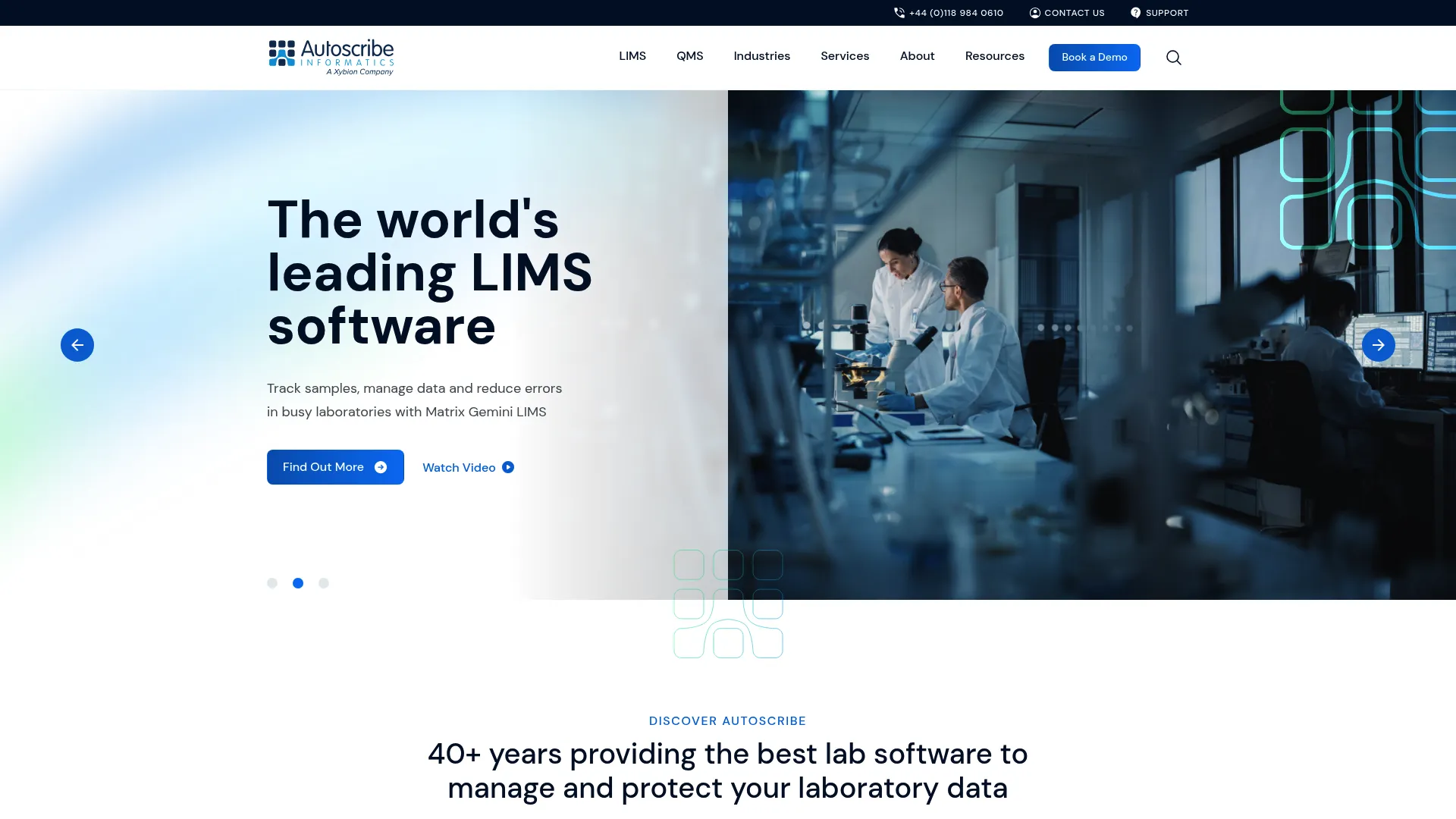
Autoscribe Informatics builds configurable laboratory information management software centered on its Matrix Gemini platform. Its defining pitch is configuration without custom coding: labs adapt workflows, screens, and data fields through a graphical configuration tool rather than developer time. That matters for a PM weighing engineering opportunity cost, because it keeps ongoing changes out of a development backlog.
Best for: Labs that need a highly configurable LIMS across multiple industries without depending on custom development.
Key strengths
- Configurable workflows with no custom coding: adapt processes, screens, and fields through configuration rather than code, so the system evolves as your lab does.
- Flexible deployment: run Matrix Gemini through a web browser interface, on-premise or in the cloud, to fit existing infrastructure and security posture.
- Broad compliance support: built to support ISO 17025, GMP, GLP, and FDA 21 CFR Part 11 requirements for regulated environments.
Why choose Autoscribe Informatics: Choose it when configurability and low maintenance are the deciding factors. Because changes happen through configuration rather than bespoke code, the system stays maintainable as your product and processes change, which is exactly the release-cadence concern a product manager watches. It suits labs that expect their workflows to evolve.
Autoscribe Informatics pricing: Autoscribe does not display public list prices on its site. It describes competitive, fixed-price quotations and offers proof-of-concept engagements, so pricing is quote-based and scoped to your configuration and deployment. Contact the vendor for a tailored quote.
3. LigoLab
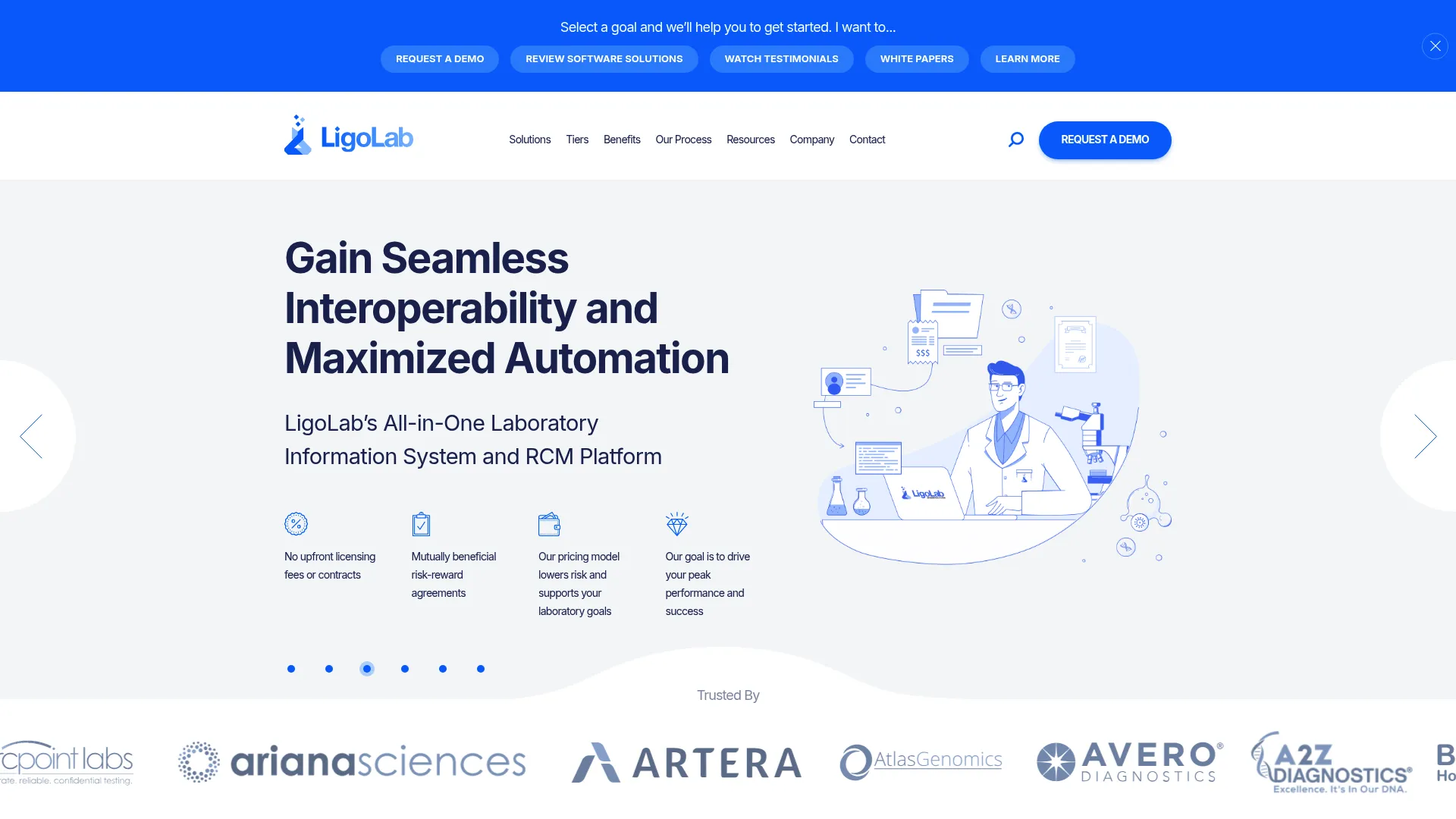
LigoLab is a laboratory information system and revenue cycle management platform built for clinical and pathology labs. This is where the LIS vs LIMS distinction gets concrete: LigoLab is patient-centric, tying specimen results to patient records and to billing, rather than the sample-centric model of a research LIMS. For a diagnostic lab, that means one platform covers accessioning, specimen tracking, result reporting, interoperability, and the lab revenue cycle.
Best for: Clinical and pathology laboratories that want a configurable LIS with integrated revenue cycle management.
Key strengths
- All-in-one LIS and RCM platform: unify diagnostic operations and billing so specimen data and revenue workflows share one source of truth.
- Specimen tracking and workflow automation: follow specimens end to end with automated routing that reduces manual handling and errors.
- Interoperability and report distribution: exchange and distribute results across systems so ordering providers get reports without manual rework.
Why choose LigoLab: Pick LigoLab when your lab is clinical or pathology-focused and you want operational efficiency and revenue outcomes from the same system. Combining LIS and RCM removes the seam between producing a result and getting paid for it, which is a persistent pain in diagnostic labs. It fits labs ready to commit to a configurable, integrated platform.
LigoLab pricing: LigoLab uses a tiered pricing model with Essential, Professional, Advanced, and Enterprise tiers. It states publicly that labs with budgets under $2,000 per month may not be the right fit, which sets the entry threshold. Named-tier prices above that are not published, so request a quote for your volume. LigoLab holds a 4.7/5 rating on G2.
4. Thermo Fisher Scientific
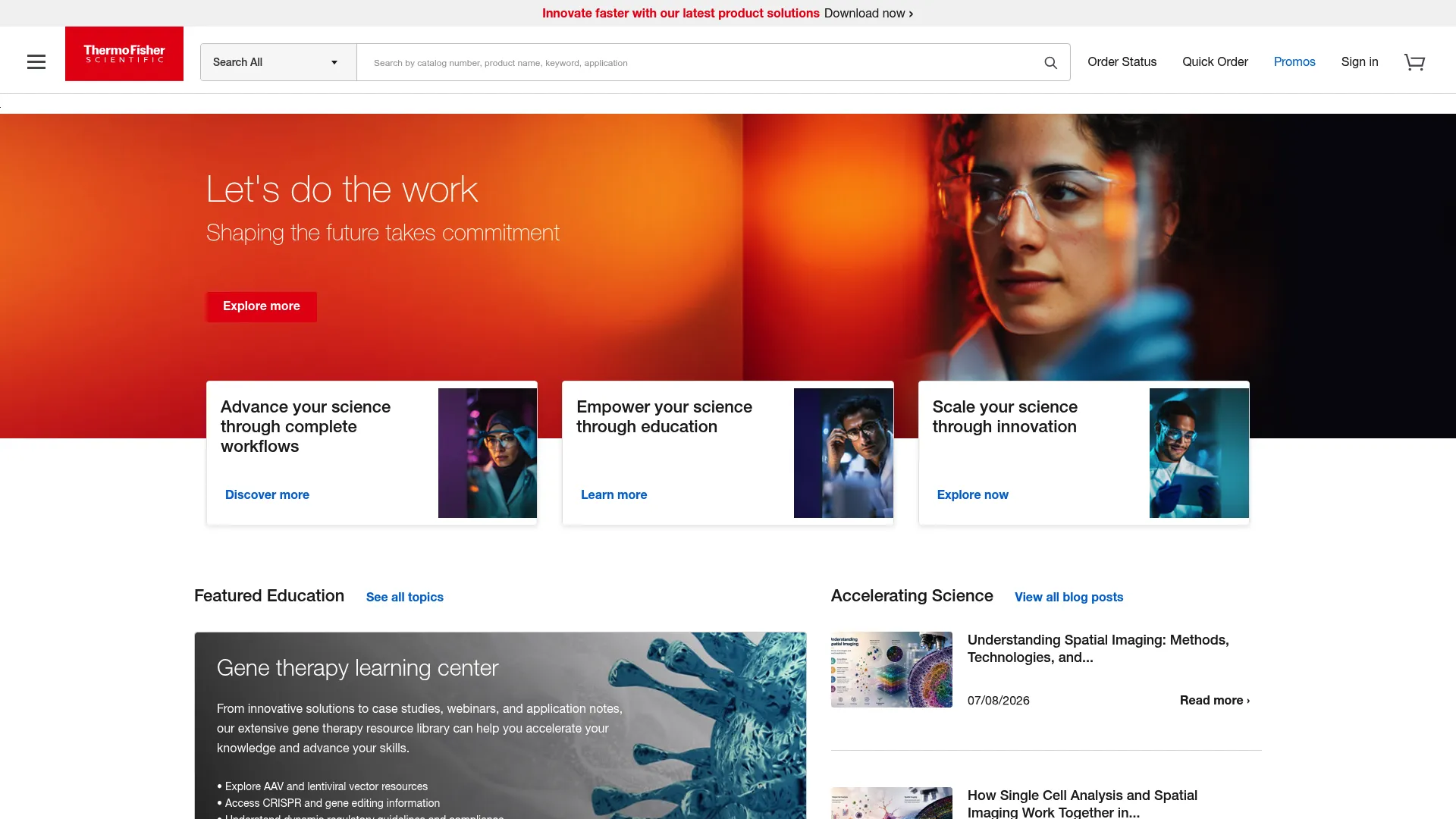
Thermo Fisher Scientific is a global life sciences company offering instruments, software, digital lab solutions, reagents, consumables, and services. In laboratory informatics, its value is breadth: an organization can source the analyzer, the software that manages its data, and the service contract from one vendor. For enterprise labs standardizing across many sites and instrument types, that single-vendor depth reduces integration friction.
Best for: Enterprises and labs that need scientific instruments, software, reagents, and services from one provider.
Key strengths
- Laboratory instruments and equipment: a broad analyzer and equipment catalog that pairs directly with its informatics software.
- Software and digital lab solutions: informatics that manage regulated workflows and connect instrument data across the lab.
- Reagents, consumables, and services: end-to-end supply and support that keep instruments and workflows running.
Why choose Thermo Fisher Scientific: Choose it when instrument-to-software integration depth and single-vendor accountability outweigh best-of-breed shopping. For large regulated environments, consolidating hardware, informatics, and service under one roof simplifies procurement and support escalation. It fits organizations operating at enterprise scale rather than single-lab teams.
Thermo Fisher Scientific pricing: Thermo Fisher is a broad conglomerate rather than a single SaaS product, and it does not publish company-wide pricing. Most product pages route to sales or catalog flows without visible list prices, so pricing is quote-based and depends on the specific instruments, software, and services you configure. Thermo Fisher holds a 4.3/5 rating on G2, though product-specific ratings vary across its portfolio.
5. STARLIMS
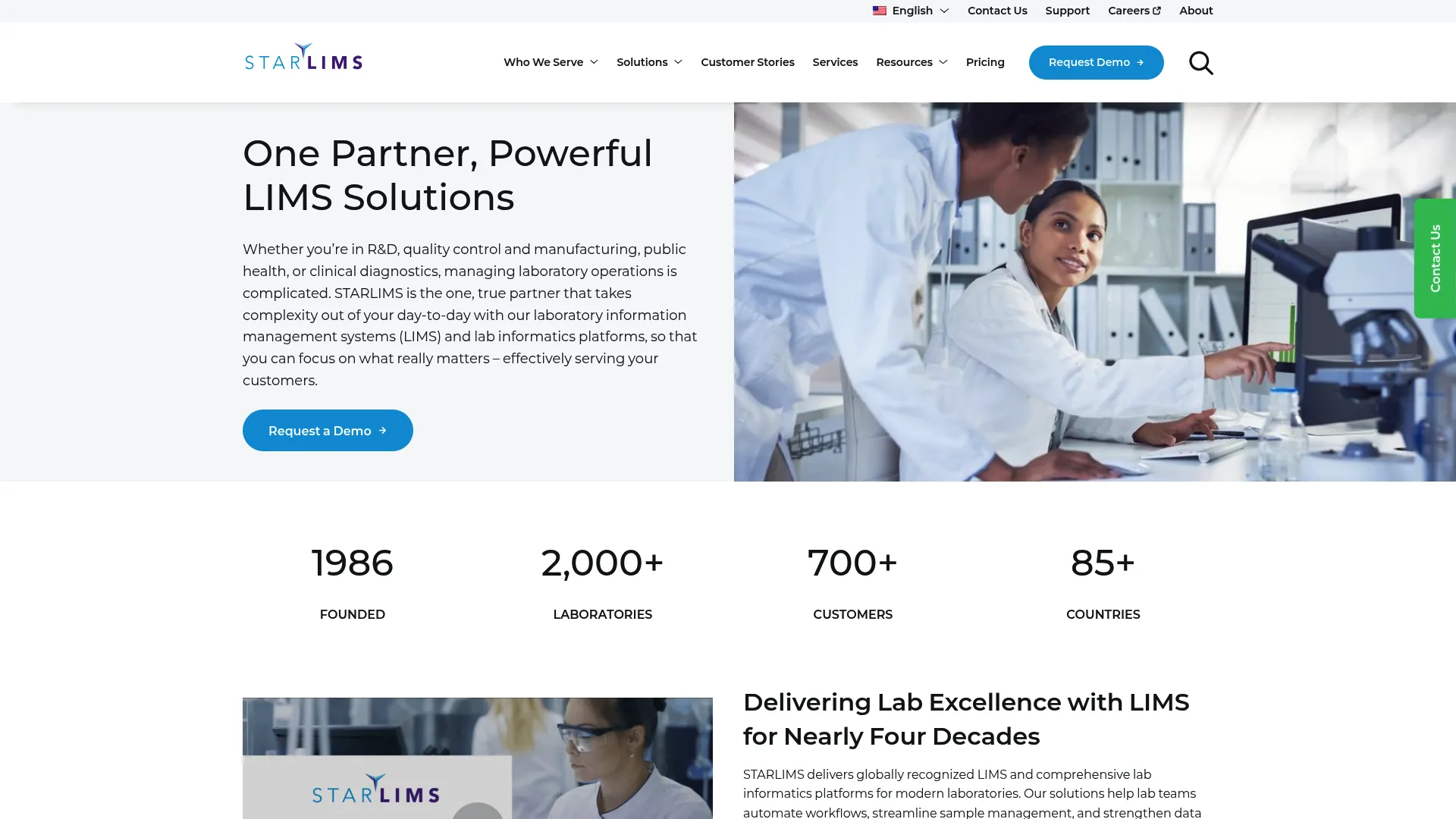
STARLIMS is a laboratory informatics platform spanning LIMS, ELN, LES, SDMS, and analytics for regulated labs. Its strength is governance at scale: standardizing sample management, traceability, and compliance across many sites and workflows from one configurable platform. For an organization that needs the same process enforced in ten locations, that consistency is the point.
Best for: Regulated laboratories that need a configurable enterprise LIMS platform across multiple sites.
Key strengths
- Sample management and traceability: end-to-end sample tracking with the traceability regulated labs depend on.
- Workflow automation and compliance support: standardized, automated workflows built to meet regulatory requirements.
- Integrated lab informatics platform: LIMS, ELN, LES, SDMS, and analytics in one system to reduce fragmentation.
Why choose STARLIMS: Choose STARLIMS when scale and governance are the priority. Bringing LIMS, ELN, and data management into one configurable platform helps enterprise labs enforce consistent process and compliance across locations, which is hard to do with disconnected tools. It suits organizations that need centralized control over distributed operations.
STARLIMS pricing: STARLIMS does not display public pricing and uses a quote-based model through its sales team. Cost scales with modules, sites, and configuration, so plan for an enterprise procurement cycle rather than a self-serve signup. STARLIMS holds a 4.5/5 rating on G2.
6. Clinisys
Clinisys provides laboratory informatics software with configurable cloud-based LIMS and LIS solutions across healthcare, public health, food, water, and other lab sectors. That multi-sector reach makes it relevant to both clinical diagnostics and non-clinical testing, with sample and specimen management, workflow automation, and reporting handled in one configurable platform.
Best for: Labs that need enterprise laboratory informatics spanning clinical and non-clinical workflows.
Key strengths
- Configurable cloud-based workflows: adapt LIMS and LIS workflows to your sector and processes through a cloud-delivered platform.
- Sample and specimen management: track samples and specimens end to end across clinical and non-clinical settings.
- Workflow automation, reporting, and data management: automate routing and generate the reports and data controls labs rely on.
Why choose Clinisys: Choose Clinisys when you operate across healthcare and non-clinical lab environments and want one informatics provider that supports both. Its cloud-based, configurable model fits labs standardizing on modern deployment. It suits diagnostic and public-sector labs that value interoperability and reporting depth.
Clinisys pricing: Clinisys does not publicly display pricing on its site, so cost is quote-based and scoped to your sector, deployment, and configuration. Contact the vendor for a tailored proposal. Clinisys holds a 3.5/5 rating on G2, so weigh reviewer feedback alongside a hands-on evaluation of workflow fit.
7. Orchard Software
Orchard Software is a laboratory information system provider focused on clinical lab workflows, point-of-care testing, integration, and analytics. Its emphasis is clinical operations and usability, which makes it a strong fit for healthcare labs that want reporting, connectivity, and day-to-day workflow support without enterprise complexity they do not need.
Best for: Clinical laboratories that need LIS workflow, point-of-care testing management, and integration support.
Key strengths
- Laboratory information system solutions: clinical LIS workflows built around the realities of diagnostic lab operations.
- POCT management and integration: manage point-of-care testing and connect systems for cleaner data flow.
- Analytics and reporting: dashboards and reports that surface turnaround time and operational performance.
Why choose Orchard Software: Choose Orchard when your priority is clinical workflow and usability rather than multi-sector breadth. Labs that want a system their staff can operate confidently, with strong POCT and integration support, tend to fit well here. It suits clinical labs focused on efficient, everyday operations.
Orchard Software pricing: Orchard does not publish pricing on its site, so cost is quote-based and depends on your workflow, integrations, and support needs. Contact the vendor for a scoped proposal. Orchard Software holds a 4.0/5 rating on G2.
Considerations before you buy
The right shortlist depends less on feature checklists than on how a system fits your actual workflow, stack, and compliance surface. Use these criteria to pressure-test each vendor.
Category fit: LIMS, LIS, or ELN
Confirm you are buying the right category before comparing features. Sample-centric labs need a LIMS, patient-centric clinical labs need a LIS, and experiment-centric research needs an ELN. Buying across the line creates friction you will fight for years. Some platforms blur the boundary, so map your primary workflow first.
Interoperability and integration
Check exactly which standards and instruments a system supports: HL7, FHIR, ASTM, XML, CSV, and PDF, plus your specific analyzers. Interoperability is where implementations stall, so verify connections to the systems you already run rather than trusting a generic "integrates with everything" claim. The same integration diligence applies whether you are evaluating lab software or a marketing automation platform.
Compliance and data integrity
Match the system's audit trail, revision control, and reporting to your regulatory obligations, whether that is ISO 17025, GMP, GLP, FDA 21 CFR Part 11, CAP, or CLIA. Ask how the audit trail is enforced and whether records are truly immutable. Treat this with the rigor you would bring to contract management or event management tooling where the record itself is the deliverable.
Configuration and maintainability
Favor systems that configure without custom code so changes do not consume an engineering backlog. A configurable platform stays maintainable as your processes and product evolve, which lowers the long-term opportunity cost. Ask whether your team can adapt workflows or whether every change routes through the vendor.
Deployment and total cost
Decide between cloud and on-premises based on your security posture and IT capacity, then get scoped quotes. Since most vendors in this category price by quote, total cost of ownership, including implementation and integration, matters more than any headline figure.
Conclusion
There is no single universal winner in laboratory information system software, only the right fit for your lab type. For broad LIMS needs, Labworks and Autoscribe Informatics lead on sample management and configurable workflows. For clinical and pathology LIS, LigoLab stands out with integrated revenue cycle management, while Clinisys and Orchard Software serve diagnostic and multi-sector labs. For enterprise and regulated environments, Thermo Fisher Scientific and STARLIMS bring the breadth and governance that multi-site operations demand.
Rather than chasing one platform, build a shortlist of two or three that match your category and workflow, then evaluate them the way you would any high-stakes purchase: score them on interoperability with your existing stack, compliance fit against your regulatory obligations, and implementation support. Ask each vendor for a scoped quote and a reference from a lab like yours. The system you choose will shape your turnaround time and audit readiness for years, so treat the evaluation as seriously as the operation it will run.
Start your journey with Guideflow today!
FAQs
A laboratory information management system (LIMS) is software that manages the full lifecycle of laboratory samples, from accessioning through testing, reporting, and archival. It handles sample tracking, workflow automation, instrument integration, reporting, and compliance controls like audit trails. In practice, it replaces spreadsheets and paper logs with a single source of truth for sample data.
A LIMS is sample-centric and built for research, industrial, food, and environmental labs. A LIS is patient-centric and built for clinical and pathology labs, tying results to patient records and often to billing. An ELN is experiment-centric and captures methods and observations. Many labs run more than one, and some LIMS platforms include ELN functionality.
Expect sample accessioning and tracking, chain of custody and barcoding, workflow automation, instrument integration, reporting and dashboards, audit trails with revision control, and role-based security. Interoperability through HL7, FHIR, ASTM, XML, CSV, and PDF is essential for connecting to your existing systems. Match the feature set to your workflow rather than buying the longest list.
Each sample is registered at accessioning and assigned a unique identifier, usually printed as a barcode. Staff scan that barcode at every handoff, so the system logs custody, location, and status automatically. That barcode-driven chain of custody replaces manual transcription and gives you an unbroken, defensible record from intake to result.
It depends on your lab type. Research and industrial labs commonly need ISO 17025, GMP, GLP, and FDA 21 CFR Part 11. Clinical labs typically need CLIA and CAP. Confirm the system enforces audit trails, revision control, and immutable records that map to your specific obligations before shortlisting.
Start by confirming the category: LIMS for sample-centric labs, LIS for clinical labs, ELN for experiment documentation. Then score candidates on interoperability with your instruments and systems, compliance fit, configurability, and implementation support. Get scoped quotes and a reference from a comparable lab, since most vendors price by quote.
Both models exist, and many vendors offer either. Cloud-based delivery accounted for 54.32% of the laboratory information system market in 2025, according to Mordor Intelligence, and is growing faster than on-premises. Choose based on your security posture, IT capacity, and data residency requirements.
Implementation varies widely with scope, from a few months for a focused deployment to a year or more for a large multi-site enterprise rollout with heavy integration and configuration. Instrument integration and data migration are the usual bottlenecks. Budget for configuration and validation time, not just the license, when you plan.