


Every enterprise runs on thousands of small decisions a day. Approve or decline this loan. Flag or clear this transaction. Route this claim to a human or auto-settle it. Offer this customer a discount or hold the line. Most of these decisions are repeatable, high-volume, and governed by rules that live in someone's head, a spreadsheet, or fifteen lines of legacy code no one wants to touch. When those decisions drift, the cost is not one bad call. It is thousands of inconsistent calls a week, each one a compliance risk, a revenue leak, or a customer you did not need to lose.
The global decision management market is projected to grow from USD 8.05 billion in 2026 to USD 24.26 billion by 2034, a 14.78% CAGR, according to Fortune Business Insights (2025). That growth reflects a real shift. Teams are moving decision logic out of application code and manual judgment and into dedicated systems that model, automate, govern, and improve those decisions at scale. That software layer is what this guide covers.
If you are a product manager or operations leader, the problem is not a single broken process. It is a systems problem: rules, data, and human judgment that no longer agree, with no instrumentation to tell you where. Getting the category right early matters, which is why comparing options against clear criteria beats reading vendor marketing. The same discipline applies whether you are evaluating business intelligence software, a customer data platform, or a decisioning engine. Below, we compare nine decision management tools and the decision intelligence platforms buyers most often shortlist in 2026.
What's inside
This guide is a practical buyer's walkthrough, not a glossary. It covers a plain-English definition of decision management software, the situations where it earns its place, the criteria that separate serious platforms from point tools, a side-by-side comparison table, and nine named options.
We selected tools using four filters: category fit (does it actually automate operational decisions), decision automation depth (rules plus analytics plus execution), governance and auditability, and enterprise readiness. We also included one research-and-review lens so buyers can validate shortlists against peer feedback before committing budget.
TL;DR
- Best for AI-infused enterprise decisioning: IBM, the closest match to the category anchor, pairing business rules with predictive models and decision lifecycle management.
- Best for peer-review validation: Gartner Peer Insights, to pressure-test your shortlist against verified buyer reviews.
- Best for rules-first, governed decision automation: FlexRule, an open decision intelligence platform built on DMN standards.
- Best for high-stakes risk and fraud decisioning: FICO, where predictive scoring and rules work together in regulated environments.
- Best for analytics-led, governed decisions: SAS, for teams prioritizing model management and enterprise analytics.
- Best for customer decisioning at scale: Pega, connecting real-time decisions to broader workflow automation.
If you are evaluating enterprise decision management software, start with this shortlist, then narrow by governance depth, integration fit, and deployment model.
What is decision management software?
Decision management software is enterprise software that codifies, automates, governs, and improves repeatable operational decisions using business rules, predictive analytics, workflow, and AI. Instead of hard-coding decision logic into applications or relying on manual judgment, teams model decisions once, execute them consistently at scale, and monitor the outcomes.
A decision management platform typically combines several capabilities into one governed layer:
- Rule authoring: Business analysts and subject-matter experts write and edit decision logic without deep engineering support, often using business rules management and DMN-style modeling.
- Decision modeling: Complex decisions get broken into reusable, testable components rather than tangled conditional code.
- Real-time execution: A rule engine or decision engine software runs decisions at transaction speed, supporting real-time decisioning across live workflows.
- Predictive analytics: Models score inputs (risk, fraud likelihood, propensity) and feed those scores back into the decision.
- Monitoring and auditability: Every decision is versioned, logged, and traceable, so governance and auditability hold up under regulatory review.
It helps to separate a decision management system from broader decision support software. Decision support tools surface data and analysis to help a human decide. Decision management systems automate the decision itself, at scale, with governance built in. The overlap with decision intelligence platforms is real: decision intelligence usually emphasizes composing data, context, and AI to inform decisions, while decision management leans harder into codifying and executing them. Most modern suites blend both, which is why decision lifecycle management now spans design, deployment, monitoring, and continuous improvement.
When to use decision management software
Automating high-volume operational decisions
When you make the same class of decision thousands of times a day, manual handling does not scale and application code becomes brittle. A decision management platform lets you centralize that logic, execute it in real time, and change it without a release cycle. Think loan approvals, claims routing, pricing tiers, or eligibility checks where volume and speed both matter.
Reducing inconsistency and manual error
Two analysts looking at the same case should reach the same decision. When they do not, you get inconsistent customer treatment, disputes, and rework. Codifying the logic in a rule engine removes the variance. It also creates a single place to fix a policy, rather than retraining dozens of people and hoping it sticks.
Governing decisions across regulated workflows
In banking, insurance, and healthcare, you have to prove why a decision was made, sometimes years later. Decision management software gives you versioned rules, audit trails, and approval workflows, so governance and auditability are structural rather than reconstructed after the fact. This is often the trigger that moves a team from spreadsheets and code to a dedicated platform.
Comparison table
We grouped these tools by what they are strongest at: AI-infused enterprise decisioning, research and peer review, rules-first automation, analytics-led decisioning, customer decisioning, event-driven decisioning, and decision intelligence. Pricing across this category is almost entirely sales-led, so we note packaging status rather than invented figures, and cite G2 ratings only where a current listing was confirmed.
| # | Product | Intent | Key differentiation | Pricing | G2 rating |
|---|---|---|---|---|---|
| 1 | IBM | AI-infused enterprise decisioning | Operational Decision Manager plus Automation Decision Services across the decision lifecycle | Product-specific; some free tiers/trials | Not published |
| 2 | Gartner Peer Insights | Peer-review comparison | Verified buyer reviews and category comparisons for decision intelligence platforms | Free to use | Not published |
| 3 | FlexRule | Rules-first decision management | Open decision intelligence platform on DMN CL3, with live debug and simulation | Contact vendor | 4.5/5 |
| 4 | Experion Global | Services-led decisioning | Product engineering and implementation support for decision systems | Contact vendor | 4.5/5 |
| 5 | FICO | High-stakes risk and fraud decisioning | Applied analytics plus decision automation for credit, risk, and fraud | Contact vendor | 4.1/5 |
| 6 | SAS | Analytics-led governed decisioning | Model management and decision execution on a cloud-native AI platform | 14-day trial; contact sales | Not published |
| 7 | Pega | Customer decisioning and workflow | Real-time customer decisioning tied to case management and automation | Contact vendor | 4.2/5 |
| 8 | TIBCO | Event-driven decisioning | Complex event processing and streaming analytics for real-time responsiveness | Contact vendor | 4.5/5 |
| 9 | Quantexa | Decision intelligence and context | Entity resolution and graph analytics for connected decision context | Contact vendor | Limited reviews |
The 9 best decision management software for 2026
1. IBM
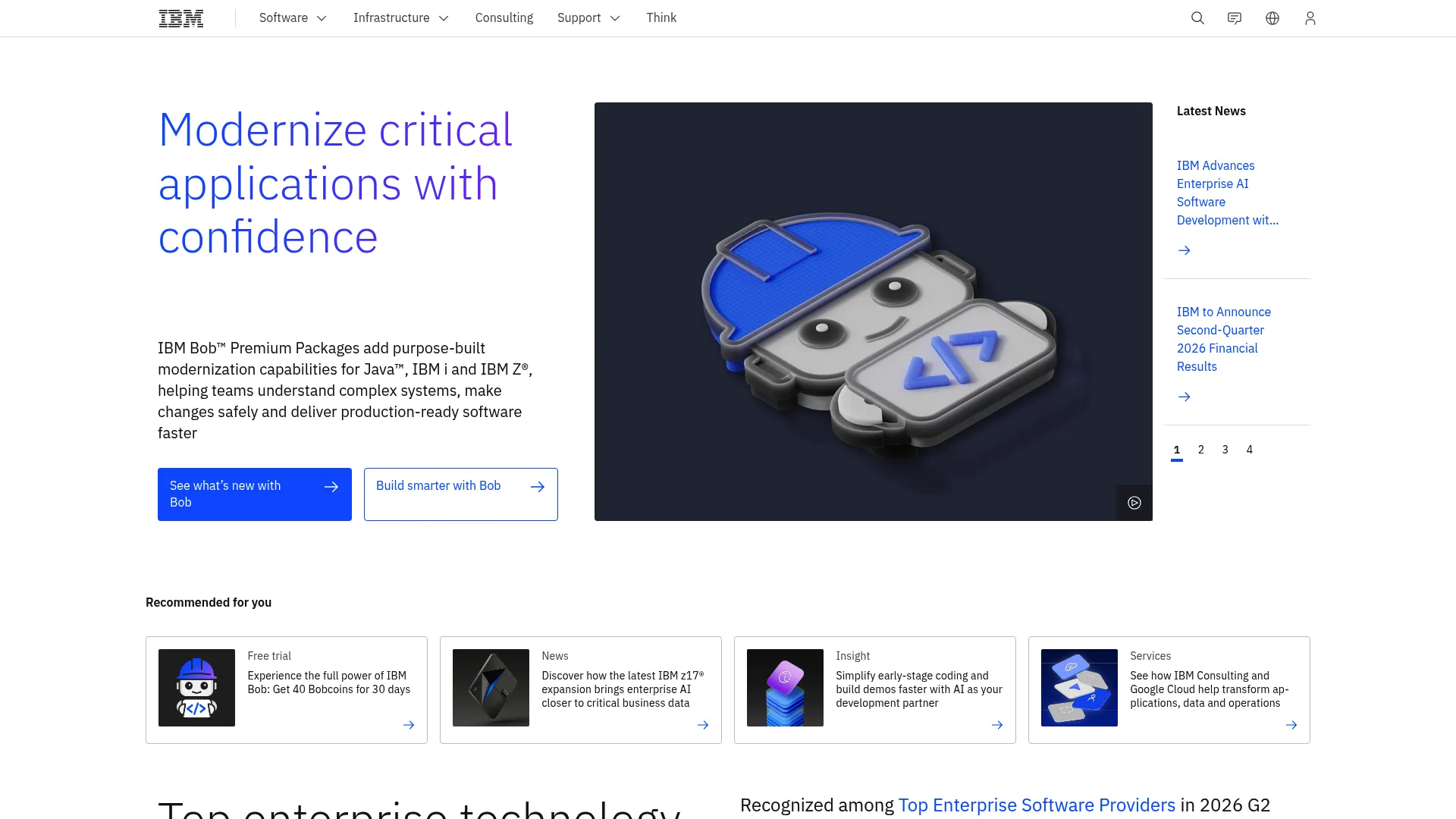
IBM anchors the category. Its decision management suite spans Operational Decision Manager for business rules and IBM Automation Decision Services for combining rules with predictive models. IBM frames decision management around AI-infused decisioning, business rules management, predictive modeling, and full decision lifecycle management, from authoring through monitoring. For teams that already run IBM infrastructure, it slots into an existing enterprise stack rather than sitting beside it.
The practical appeal is breadth. You can author rules, score with models, execute in real time, and audit the whole chain in one governed environment.
Best for: Large enterprises that need AI, rules, and governance in one decision management suite.
Key strengths
- Rules plus AI in one place: Operational Decision Manager and Automation Decision Services let you blend deterministic rules with predictive scoring.
- Decision lifecycle coverage: Authoring, testing, deployment, and monitoring live under one governed roof.
- Enterprise integration depth: Fits banking, insurance, licensing, and customer operations workflows already running on IBM systems.
Why choose IBM: If your organization needs regulator-grade governance and wants rules and machine learning managed together, IBM is the most complete anchor for the category. It suits banks scoring credit, insurers routing claims, and public-sector teams automating licensing and eligibility decisions.
IBM pricing: IBM prices at the product level rather than as a single decision management bundle. Some products offer free tiers or trials, while others list starting prices or route you to a quote. Confirm packaging for Operational Decision Manager and Automation Decision Services directly with IBM, since figures vary by deployment.
2. Gartner Peer Insights
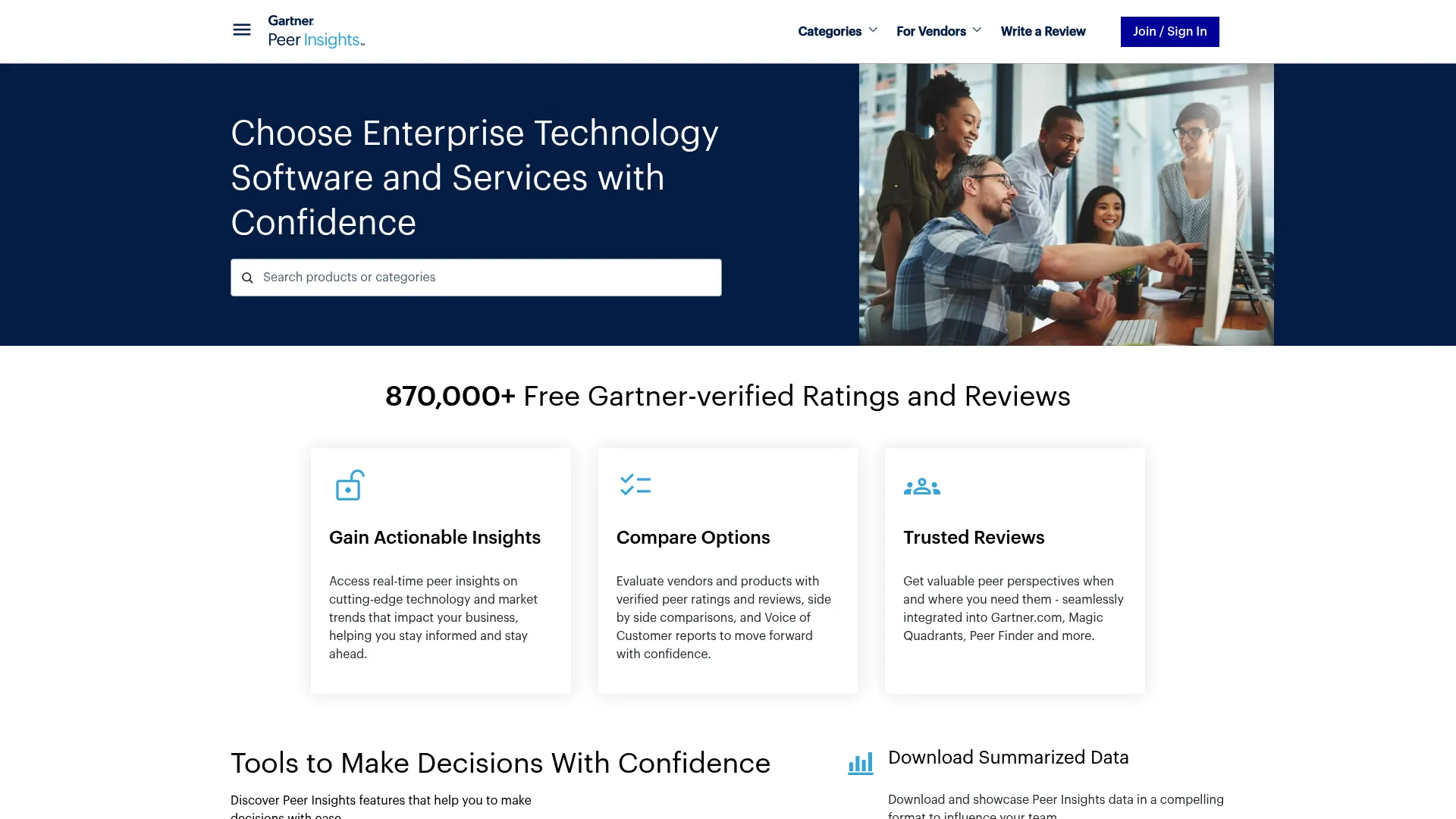
Gartner Peer Insights is not a decisioning vendor. It is the research-and-review lens that helps you validate everything else on this list. It aggregates verified peer reviews, product comparisons, and Voice of the Customer reports for decision intelligence platforms and related enterprise software.
Use it to pressure-test a shortlist. Before you commit budget, you can see how peers in your industry rate a platform's governance, support, and real-world reliability, then read the patterns in critical reviews.
Best for: Buyers who want peer validation and category comparisons before selecting a decisioning platform.
Key strengths
- Verified peer reviews: Ratings come from confirmed users, which filters out marketing noise.
- Category comparisons: Side-by-side views help you build and defend a shortlist to stakeholders.
- Research reports: Voice of the Customer and Peer Lessons Learned add context beyond star ratings.
Why choose Gartner Peer Insights: It performs best for research and comparison, not execution. Pair it with the vendors above: use Peer Insights to narrow the field, then run a proof of concept with your top two or three platforms.
Gartner Peer Insights pricing: The platform describes itself as a complimentary, self-service resource, free to join and free to use. No paid tier was found for buyer access.
3. FlexRule
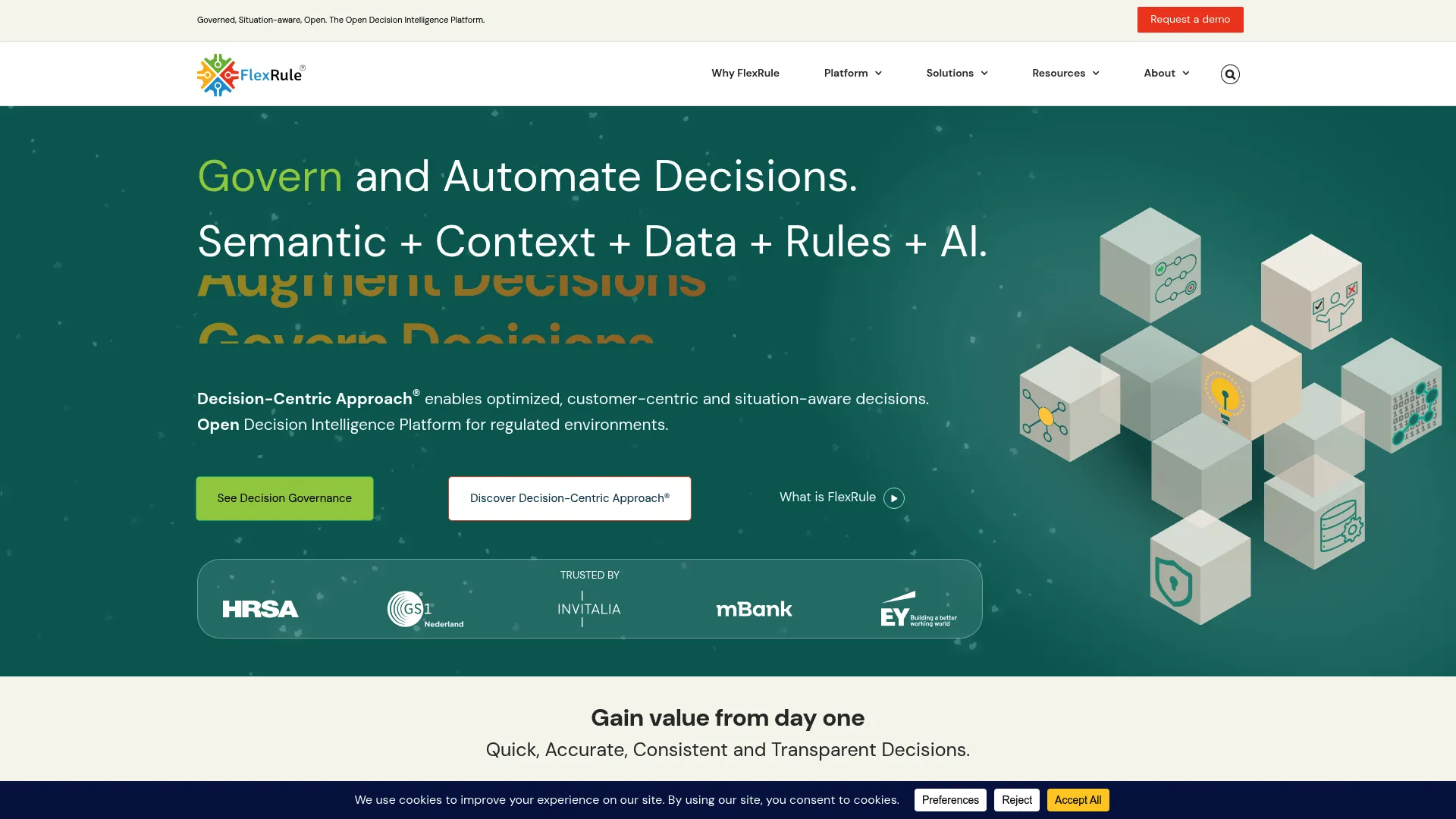
FlexRule treats decision management as a discipline, not just a feature. Its open decision intelligence platform is built on the DMN CL3 standard, with open architecture, APIs, and an SDK, plus live debug and simulation so teams can test decision logic before it goes live. That standards-first approach matters for buyers who want portable, auditable decision models rather than vendor-locked logic.
FlexRule fits repeatable, auditable decisions where flexibility in the logic layer is the priority. Low-code modeling lets analysts own the rules, while the open architecture keeps engineers in control of integration.
Best for: Regulated enterprises that want standards-based, governed decision automation.
Key strengths
- Open standards: DMN CL3 modeling keeps decision logic portable and auditable.
- Live debug and simulation: Test decisions against scenarios before deploying to production.
- Open architecture: API and SDK access let the platform integrate cleanly with existing systems.
Why choose FlexRule: If governance and auditability sit at the top of your requirements and you want to avoid proprietary lock-in, FlexRule's standards-first model is a strong fit. It holds a 4.5/5 rating on G2, reflecting solid sentiment among reviewers.
FlexRule pricing: FlexRule describes a transparent, flat-fee licensing model but does not publish figures on its site. Contact the vendor for pricing tied to your deployment.
4. Experion Global
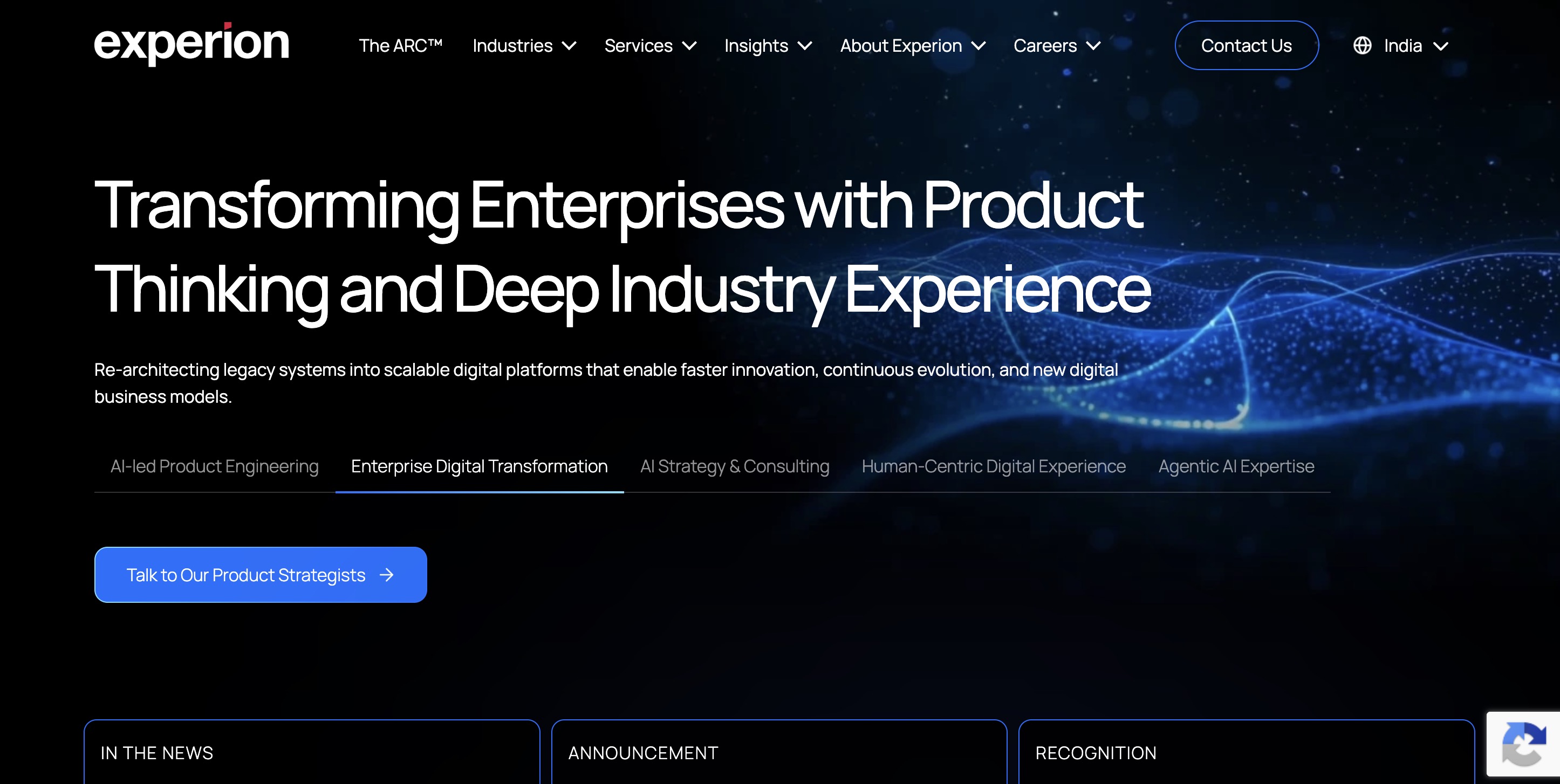
Experion Global is the services-led entry on this list. Rather than a boxed decision management product, Experion is a product engineering and digital transformation firm that builds enterprise software and AI-enabled digital products, including decision systems and their surrounding architecture. That makes it relevant when the challenge is less "which platform" and more "who builds and integrates it."
Experion's material on decision management systems is educational and implementation-focused: definitions, architecture, rule engines, governance, and enterprise use cases. For buyers weighing platform concepts against implementation realities, that framing is useful.
Best for: Enterprises that need custom development and implementation support around decision systems.
Key strengths
- AI-led product engineering: Builds decisioning and analytics capabilities into custom software.
- Digital transformation services: Supports the architecture and integration work platforms alone do not cover.
- Experience and quality engineering: Rounds out the build with design and testing discipline.
Why choose Experion Global: Choose Experion when your gap is delivery capacity, not product selection. It suits teams that have chosen a decisioning direction but need engineering help to design, integrate, and govern the system. Experion holds a 4.5/5 rating on G2.
Experion Global pricing: As a services firm, Experion does not publish productized pricing. Engagements are scoped and quoted per project, so contact the team directly.
5. FICO

FICO is a heavyweight in high-stakes decisioning. Beyond its well-known consumer credit scores, FICO's platform brings together data connection, applied analytics and machine learning, and decision automation with business rules. That combination is built for decisions where the cost of being wrong is high: credit, risk, and fraud.
For regulated industries, the value is that predictive scoring and rules operate together. A fraud model can score a transaction while rules enforce policy and thresholds, all inside one governed decisioning environment.
Best for: Financial services and regulated enterprises needing AI-driven risk, credit, and fraud decisioning.
Key strengths
- Applied analytics and ML: Predictive models score risk, fraud, and propensity at transaction speed.
- Decision automation with rules: Business rules and models work together in a single decision.
- Data connection and ingestion: Pulls the signals decisions depend on into one platform.
Why choose FICO: When decisions carry regulatory weight and real financial exposure, FICO's depth in analytics-plus-rules decisioning is hard to match. It suits banks, insurers, and lenders that need explainable, governed decisions at scale. FICO holds a 4.1/5 rating on G2.
FICO pricing: FICO does not publish public pricing. Its FAQ states pricing varies by solution and deployment and directs buyers to contact FICO for a quote.
6. SAS
SAS brings its analytics heritage to decisioning through SAS Intelligent Decisioning. The pitch is governed, analytics-led decision automation: strong model management, decision execution, and tight integration with enterprise analytics on a cloud-native data and AI platform. For organizations that already treat analytics as a core competency, SAS keeps decisions and the models behind them in one governed environment.
Model governance is the standout. When your decisions depend on machine learning, SAS gives you the lineage, monitoring, and control to keep those models trustworthy over time.
Best for: Large organizations prioritizing advanced analytics and governed model management in their decisions.
Key strengths
- Model governance: Track, monitor, and control the models driving decisions.
- Decision execution: Deploy analytics-driven decisions into live operational workflows.
- Open integration: Cloud-native architecture works with open-source models and flexible deployment.
Why choose SAS: If you are already in the SAS ecosystem or analytics maturity is your differentiator, SAS keeps decisioning and model management under one roof with enterprise-grade governance. It fits regulated, analytics-heavy operations well.
SAS pricing: SAS offers a free 14-day SAS Viya trial and a request-pricing flow. No public list price is shown on its official pricing page, so plan to request a quote.
7. Pega
Pega approaches the category from customer decisioning and process automation. The Pega Platform combines real-time decisioning, journey orchestration, and low-code workflow design, so decision logic connects directly to the operational processes it drives. That makes it a strong fit for teams that want decisions and workflow automation in one system rather than stitched together.
Real-time customer decisioning is the headline. Pega can decide the next best action for a customer mid-interaction, then trigger the workflow that acts on it, with AI and case management working together.
Best for: Large enterprises connecting real-time customer decisions to broader workflow automation.
Key strengths
- Real-time decisioning: Determine next-best actions during live customer interactions.
- Journey orchestration: Tie decisions to end-to-end customer workflows and case management.
- Low-code and AI: Design governed, AI-driven automation without heavy custom code.
Why choose Pega: When operational decisions and customer-facing workflows need to move as one, Pega's decisioning-plus-automation model is a strong fit. It suits banks, insurers, and service organizations orchestrating decisions across the customer journey. Pega Platform holds a 4.2/5 rating on G2.
Pega pricing: Pega's pricing is sales-led rather than publicly listed. Contact Pega to scope a plan for your workflow and decisioning needs.
8. TIBCO
TIBCO brings event-driven decisioning through TIBCO BusinessEvents and its broader real-time platform. The strength here is complex event processing and streaming analytics: detecting patterns across high-velocity data streams and making operational decisions in the moment. For environments where the signal arrives fast and the decision cannot wait, that responsiveness matters.
TIBCO also carries deep integration and messaging heritage, so decisions can act on data moving across hybrid systems. That suits monitoring, alerting, and real-time operational responses.
Best for: Large enterprises making decisions on high-velocity event streams across hybrid environments.
Key strengths
- Complex event processing: Detect and act on patterns across live data streams.
- Streaming analytics: Apply dynamic learning to real-time decisions in the moment.
- Real-time integration: Move and act on data across distributed, hybrid systems.
Why choose TIBCO: When your decisions depend on events happening now, not batch data from last night, TIBCO's event-driven model excels. It fits fraud monitoring, IoT operations, and any workflow where real-time decisioning drives the outcome. TIBCO Integration holds a 4.5/5 rating on G2.
TIBCO pricing: TIBCO references a simplified subscription model but does not publish numeric pricing on its site. Contact the vendor for a quote tied to your deployment.
9. Quantexa
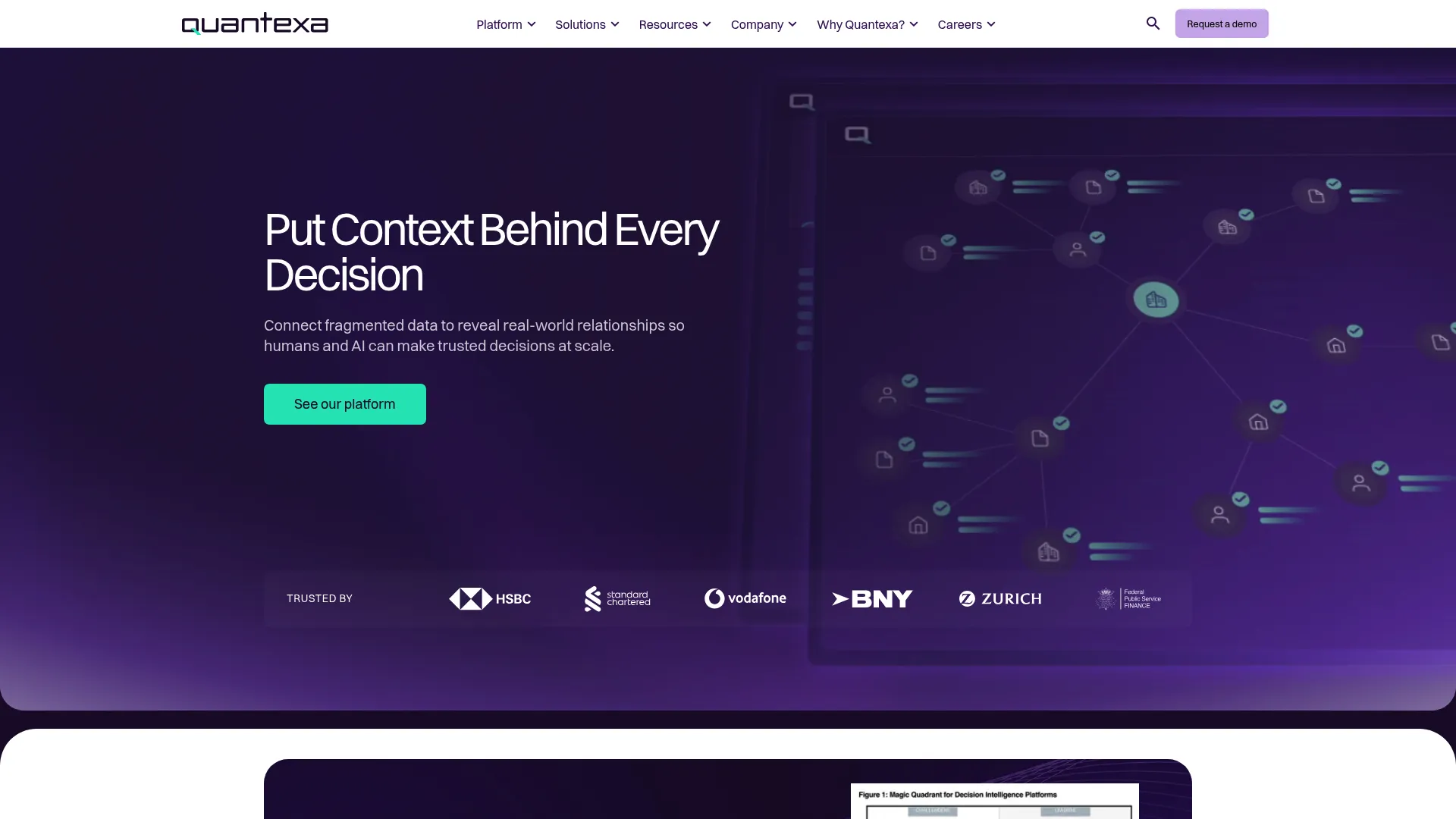
Quantexa sits at the decision intelligence end of the spectrum. Its platform focuses on entity resolution and graph analytics: connecting fragmented data into a single view of people, businesses, and their relationships, then using that context to inform decisions. Before you automate an action, Quantexa helps you understand the full picture behind it.
That context layer is especially valuable for risk, fraud, and financial crime, where the right decision depends on connections that isolated records hide. Quantexa's emphasis on explainable, contextual decisioning fits teams that need to defend how a conclusion was reached.
Best for: Enterprises that need connected data and context before automating risk or fraud decisions.
Key strengths
- Entity resolution: Resolve fragmented records into a single, accurate view.
- Graph analytics: Surface relationships and networks that drive better decisions.
- Contextual insight: Ground decisions in explainable, connected data.
Why choose Quantexa: When your decisions hinge on understanding context and relationships, not just individual data points, Quantexa's decision intelligence platform adds a layer the rules-first tools do not. It suits financial crime, risk, and customer intelligence use cases. G2 currently shows limited review coverage, so validate fit through a proof of concept.
Quantexa pricing: Quantexa routes pricing inquiries to its contact-sales flow and does not publish figures. Request a scoped quote for your use case.
Considerations before you buy
Naming a shortlist is the easy part. Here is what to verify before you sign, framed for the reality of running enterprise decision management software in production.
Rule governance and auditability
Ask how the platform versions rules, logs decisions, and reconstructs why a specific decision was made. In regulated industries, you may need to explain a decision years later. Confirm the audit trail is automatic, not something you bolt on. This is where a strong decision management suite earns its keep.
AI and predictive model integration
Decide whether you need rules, AI, or both, then confirm the platform supports your answer. Check how models are deployed, monitored for drift, and governed alongside deterministic rules. A platform that treats models as first-class citizens ages better than one that bolts scoring on.
Real-time execution and latency
Batch decisions and transaction-speed decisions are different problems. If you need real-time decisioning inside a live workflow, verify latency under realistic load, not a demo dataset. Ask about throughput ceilings and how the decision engine scales.
Integration with BPM, RPA, and data systems
Decision management rarely stands alone. It usually plugs into an existing automation stack alongside BPM, RPA, and hyperautomation initiatives. Confirm clean integration with your CRM, data warehouse, and process tools so decisions can consume the right data and trigger the right actions.
Industry fit and compliance
A platform strong in banking may not map cleanly to healthcare or retail. Verify prebuilt accelerators, compliance certifications, and reference customers in your industry. Peer reviews on Gartner Peer Insights are a fast way to check whether the fit is real or just marketing.
Conclusion
The nine platforms here solve the same problem from different angles. IBM, FICO, and SAS lead on AI-infused and analytics-led decisioning where rules and models run together under enterprise governance. FlexRule leans rules-first and standards-based. Pega ties customer decisions to workflow automation. TIBCO handles event-driven, real-time decisioning. Quantexa adds the decision intelligence context layer. Gartner Peer Insights sits alongside all of them as the validation lens.
Choose based on three things: decision volume and latency, governance and compliance requirements, and how well the platform fits your existing stack. A rules-heavy, regulated workflow points one direction; a real-time, event-driven or context-rich problem points another.
Do not try to boil the ocean. Shortlist two or three tools, map each against one real workflow you run today, and run a proof of concept with your own data. That single exercise tells you more than any feature matrix. If you want to sharpen your evaluation habits across adjacent categories, our guides to audit management software, contract lifecycle management, and enterprise search software apply the same discipline.
Start your journey with Guideflow today!
FAQs
Decision management software is enterprise software that automates repeatable operational decisions using business rules, predictive analytics, workflow, and AI. It lets teams model a decision once, execute it consistently at scale, and govern the whole process with versioning and audit trails, rather than relying on manual judgment or logic buried in application code.
They overlap heavily. Decision management focuses on codifying, executing, and governing repeatable decisions. Decision intelligence platforms usually emphasize the broader composition of data, context, and AI to inform decisions, as tools like Quantexa do with entity resolution and graph analytics. Most modern suites blend both disciplines, so the line is often a matter of emphasis.
Banking and financial services lead adoption, especially for credit, risk, and fraud decisions. Insurance uses it heavily for claims and underwriting, and healthcare for eligibility and care pathways. Retail, HR, and customer support also apply it to pricing, screening, and case routing. Anywhere decisions are high-volume and rule-governed, the category fits.
Most modern systems combine both, and that is usually the right answer. Business rules give you control, transparency, and easy policy changes. AI and predictive analytics add adaptability for patterns rules cannot easily capture, such as fraud signals. Together, rules enforce policy while models handle nuance, which is why platforms like IBM, FICO, and SAS support both.
Focus on instrumentation, integration, governance, maintainability, and measurable impact. You want clear visibility into how decisions perform, clean integration with your data and workflow stack, audit-ready governance, and the ability to change logic without an engineering release. Then tie it back to a metric: fewer errors, faster cycles, or better consistency on a real workflow.
Not quite. A business rules management system (BRMS) is a core component of many decision management platforms, but the full category usually adds predictive analytics, decision modeling, real-time execution, monitoring, and lifecycle management. A BRMS handles the rules; a decision management system orchestrates rules, models, data, and governance together.
It makes governance structural rather than manual. Platforms provide audit trails, rule versioning, transparent decision logic, approval workflows, and policy enforcement, so you can prove exactly why a decision was made and when the logic changed. That traceability is what regulators expect and what spreadsheets and embedded code cannot reliably deliver.
Yes, and it often does. Decision management typically complements a broader automation stack, sitting alongside BPM, RPA, and hyperautomation efforts. The decision layer decides what should happen, while BPM orchestrates the process and RPA executes the repetitive actions, so the three work together rather than compete.