Your policies live in three shared drives. Your evidence lives in someone's inbox. Your last audit ate two weeks of manual screenshot collection, and the auditor still asked for proof you couldn't find fast enough.
That is the state of compliance work at most growing companies. And it gets worse as frameworks stack up. SOC 2, ISO 27001, HIPAA, GDPR, PCI DSS, plus whatever your biggest customer's security team demands this quarter. Each one wants its own controls, its own evidence, its own review cadence. Managed by hand, that workload compounds until compliance becomes a full-time firefight instead of a background process.
The market reflects the pressure. The global compliance software market is projected to grow from roughly $40.82 billion in 2026 to $74.12 billion by 2031, a 12.67% CAGR, according to Mordor Intelligence (2024). Cloud deployments already accounted for about 69% of market share in 2025. Teams are buying software to make this manageable, and the spend is climbing fast.
The catch: not every platform solves the same problem. Some automate evidence collection for fast-moving startups. Some map controls across a dozen frameworks for enterprise GRC teams. Some are built specifically for the regulatory intensity that banks and credit unions face. Picking the wrong one means paying for depth you don't need or hitting a ceiling you didn't see coming.
If you evaluate governance-adjacent tooling, it helps to see how related categories handle the same operational rigor. Compliance work shares DNA with audit management software, contract lifecycle management, and modern AI security posture management tools. The same traits that matter there (workflows, ownership, version control, evidence) matter here too.
What's inside
This guide compares eight compliance management platforms built for policy management, regulatory change tracking, audit readiness, workflow automation, evidence management, and multi-framework support. We selected tools based on four criteria: automation depth (how much manual work the platform removes), framework coverage (how many standards it maps out of the box), workflow and ownership controls (how well it assigns and tracks accountability), and fit by company size and industry. Pricing and G2 ratings are included where publicly verifiable. Each entry states who the tool serves best so you can shortlist by fit, not marketing.
TL;DR
- Best overall for automation and ease of use: Vanta, for continuous evidence collection and fast audit readiness.
- Best for centralized compliance operations: Hyperproof, for cross-framework mapping and control-to-risk linkage.
- Best for financial institutions: Ncontracts, for regulatory intelligence and exam readiness built for banks and credit unions.
- Best for enterprise GRC depth: MetricStream, for federated data models and continuous control monitoring at scale.
- Best for broad governance programs: OneTrust, for privacy, consent, and risk in one platform.
- Best for configurable workflows: LogicGate, for no-code risk and compliance process design.
- Best for SAP-native enterprises: SAP GRC, for access governance inside an existing SAP footprint.
What is compliance management software?
Compliance management software is a system that centralizes policies, controls, evidence, and audits so organizations can meet regulatory and framework requirements with less manual effort.
The core job breaks down into five functions. Get these right and compliance shifts from a scramble to a repeatable process.
- Centralize policies, controls, and evidence. One source of truth replaces scattered drives, spreadsheets, and inboxes. Every control has an owner, a status, and linked proof.
- Automate reminders, workflows, and testing. The system nudges owners before reviews lapse, routes approvals, and runs automated control tests instead of relying on someone to remember.
- Track regulatory changes and impact. Regulatory compliance software monitors changing rules and flags which of your controls or policies each change affects.
- Prepare for audits and exams faster. Auditors ask for proof. A good compliance management system produces evidence on demand instead of triggering a two-week hunt.
- Map requirements across frameworks. A single control often satisfies SOC 2, ISO 27001, and HIPAA at once. Cross-framework mapping means you test once and apply everywhere.
Strong compliance management tools also layer on analytics and compliance reporting software so leadership can see program health at a glance: open findings, overdue tasks, control coverage, and audit status. That visibility is what turns risk and compliance management software from a filing cabinet into an operational dashboard.
When to use compliance management software
Not every team needs a platform on day one. These three situations are the clearest signals that manual compliance has hit its ceiling.
Reduce manual compliance administration
When policies live in shared drives, evidence lives in email threads, and approvals happen over Slack, compliance becomes a coordination tax nobody wants to pay. People forget review dates. Versions drift. Nobody knows which spreadsheet is current. Compliance software tools replace that chaos with automated reminders, version control, and a single system where every control and its status live in one place. If your team spends more time chasing proof than improving controls, that is the trigger.
Prepare for audits and regulatory exams
Audits punish disorganization. When an auditor requests evidence, the cost of a manual program shows up as frantic screenshot collection and missed deadlines. Centralized evidence, task tracking, and compliance tracking and reporting turn that into a controlled process. You pull proof from a library instead of reconstructing it. For regulated industries facing exams, this is often the reason a platform gets approved.
Operationalize policy and control ownership
Compliance breaks down when accountability is fuzzy. A compliance management platform assigns each policy and control to a named owner, sets review cycles, versions every change, and tracks who approved what and when. That governance layer, the same discipline behind good contract management and marketing resource management, is what keeps a program defensible under scrutiny.
Comparison table
The table below summarizes each platform by buyer intent, primary use case, publicly available pricing, and current G2 rating. Pricing for most enterprise GRC tools is quote-based, so we note that where no public figure exists. Use this as a shortlist starter, then read the sections that match your fit.
| # | Product | Intent | Key use case | Pricing | G2 rating |
|---|---|---|---|---|---|
| 1 | Vanta | Automation-first compliance | Continuous evidence collection and audit readiness | Quote-based (Essentials, Plus, Professional, Enterprise) | 4.6/5 |
| 2 | Hyperproof | Centralized compliance ops | Cross-framework mapping and control-to-risk linkage | Quote-based; free trial available | 4.5/5 |
| 3 | Ncontracts | Financial-services compliance | Regulatory intelligence and exam readiness | Quote-based (core platform) | 4.7/5 |
| 4 | MetricStream | Enterprise GRC | Framework mapping and continuous control monitoring | Quote-based | 3.8/5 |
| 5 | OneTrust | Broad governance and privacy | Privacy, consent, and risk workflows | Usage-based, quote | 4.4/5 |
| 6 | LogicGate | Configurable workflows | No-code risk and compliance process design | Quote-based | 4.6/5 |
| 7 | TeamMate | Mid-market GRC | Unified risk, compliance, and audit management | Quote-based | 4.2/5 |
| 8 | SAP GRC | SAP-native enterprise | Access governance and controls in SAP environments | Quote-based | 4.2/5 |
1. Vanta
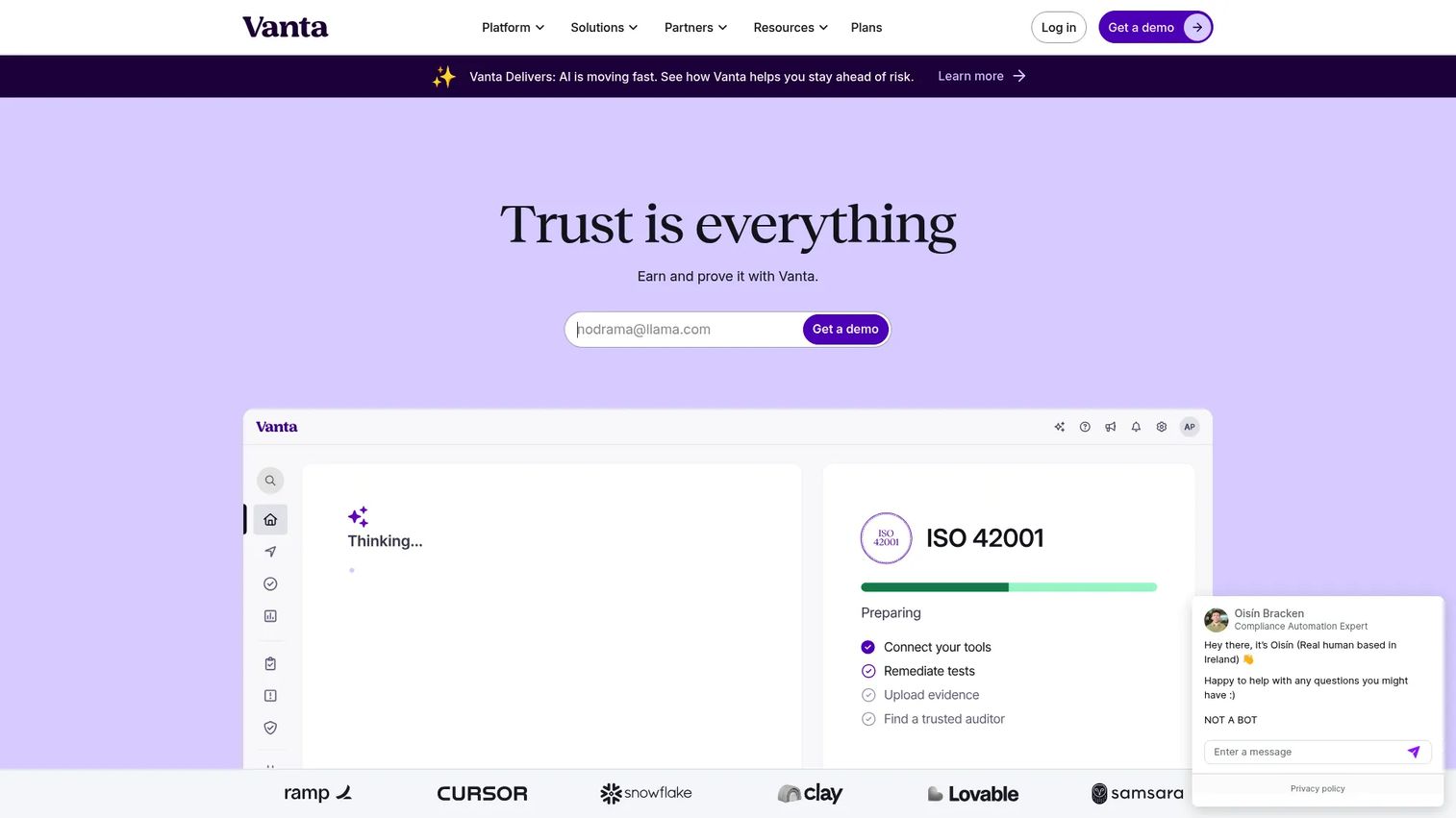
Vanta is an agentic trust platform built around continuous compliance automation. It connects to your stack through 300+ pre-built integrations, pulls evidence automatically, and monitors controls in real time so audit readiness becomes an ongoing state rather than a quarterly project. For fast-moving teams chasing their first SOC 2 or ISO 27001, it is the most direct path from zero to audit-ready.
Best for: Companies that need continuous compliance automation and a public trust report without building a program from scratch.
Key strengths
- 300+ pre-built integrations: Evidence collection runs automatically across your cloud, identity, and HR systems instead of manual screenshots.
- Trust Center: A shareable, always-current page that answers security questions for prospects before their team even asks.
- Questionnaire Automation: Security questionnaires get answered from a maintained knowledge base, cutting the response time that stalls deals.
Why choose Vanta: If your compliance team is small and your priority is passing audits quickly while proving trust to buyers, Vanta removes the most manual parts of the job. It pairs continuous monitoring with vendor risk management and access reviews, so the program stays current between audits instead of decaying.
Vanta pricing: Vanta does not publish dollar figures. Its pricing page lists four plans, Essentials, Plus, Professional, and Enterprise, and directs buyers to request a demo for personalized pricing. Expect pricing to scale with company size, framework count, and integrations. Vanta holds a 4.6/5 rating on G2.
2. Hyperproof
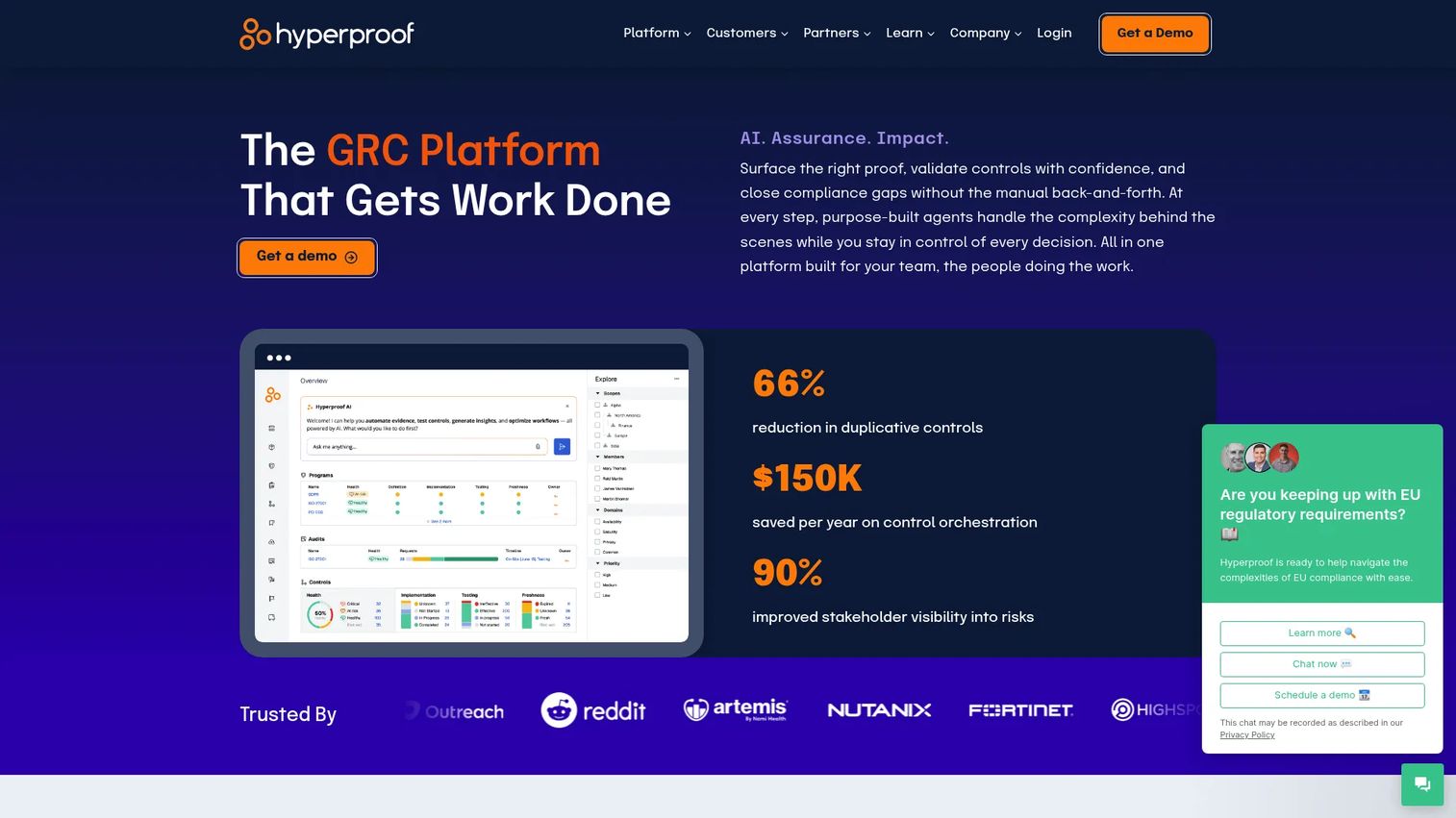
Hyperproof is an AI-powered GRC platform that centralizes compliance operations across frameworks. Its strength is treating compliance as connected operations: controls link to risks, risks link to evidence, and evidence maps across every framework you maintain. Instead of running each standard as a separate project, teams manage one control library that satisfies many requirements at once.
Best for: Security, compliance, and risk teams that need a single hub to run multiple frameworks with clear control-to-risk relationships.
Key strengths
- Cross-framework mapping: One control satisfies overlapping requirements across SOC 2, ISO 27001, and more, so you test once and apply everywhere.
- Risk and control linkage: Every control connects to the risks it mitigates, turning compliance into visible risk management, not just checkbox work.
- Audit and trust workflow automation: Tasks, approvals, and evidence requests route automatically, keeping owners accountable without manual chasing.
Why choose Hyperproof: Teams that have outgrown a single-framework tool and need to manage compliance, third-party risk, and audits in one place choose Hyperproof for its operational depth. The connective tissue between controls, risks, and evidence is what separates it from lighter tools.
Hyperproof pricing: Hyperproof does not display public dollar pricing. Its third-party risk management line publicly shows a Free Trial, TPRM Core, and TPRM Advanced, with platform pricing available on request. Hyperproof holds a 4.5/5 rating on G2.
3. Ncontracts
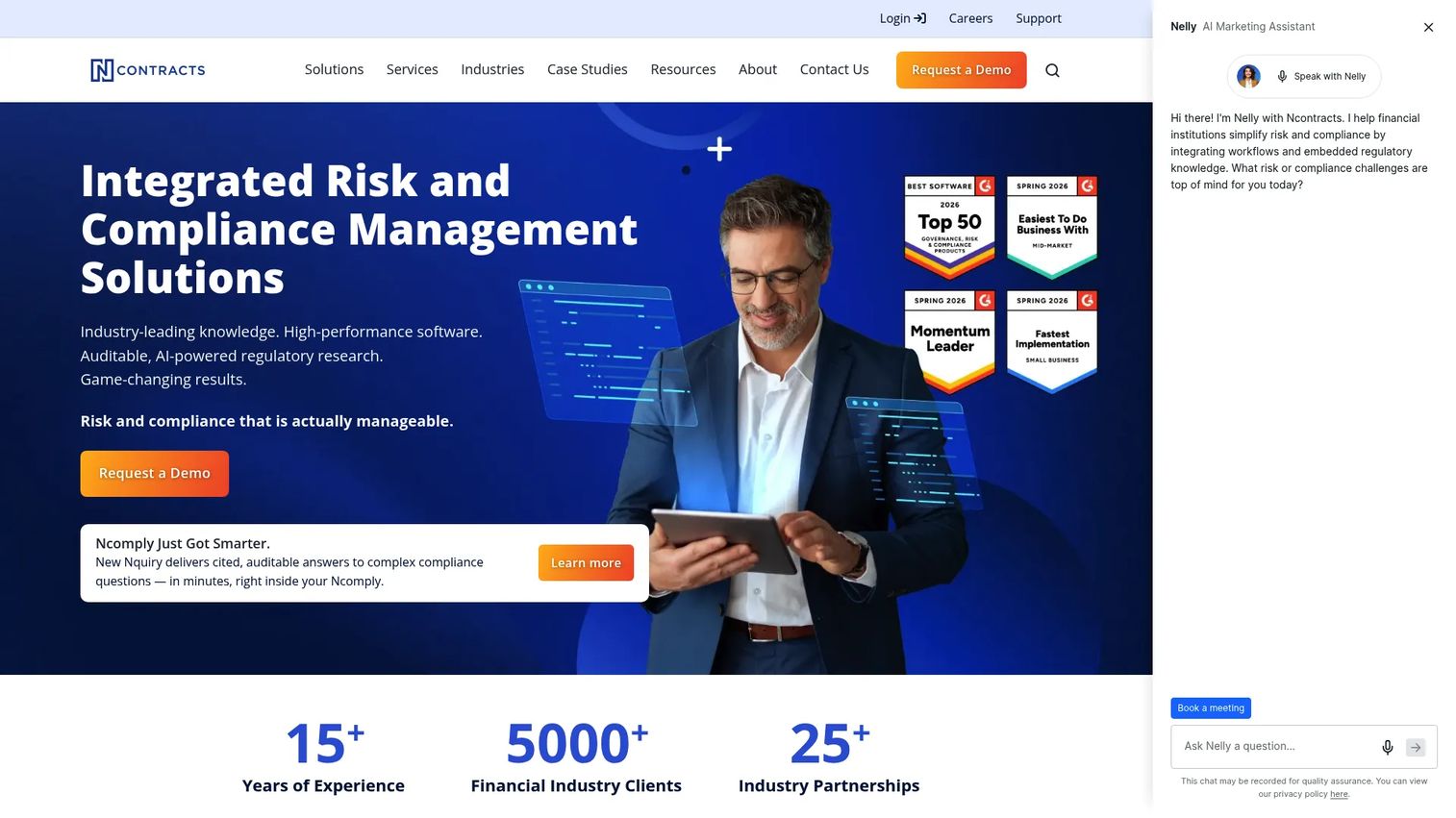
Ncontracts is a SaaS platform built specifically for financial institutions, covering risk management, compliance, vendor management, findings, audit, continuity, and contract management. Banks and credit unions face a different compliance reality than SaaS companies: regulatory exams, consumer complaint tracking, and constant rule changes from multiple agencies. Ncontracts is built around that reality.
Best for: Banks, credit unions, and other financial institutions that need an integrated GRC and third-party risk platform tuned to regulatory exams.
Key strengths
- Compliance management with regulatory alerts: Regulatory intelligence flags rule changes and ties them to affected policies and controls, so nothing slips.
- Complaint handling: Consumer complaint management is built in, a requirement examiners scrutinize in financial services.
- Vendor and third-party risk management: Contract and vendor risk live alongside compliance, giving examiners a complete picture in one system.
Why choose Ncontracts: Generic GRC tools rarely speak the language of a bank exam. Ncontracts does, pairing regulatory intelligence with a services layer that helps institutions interpret and act on changes. For a compliance officer preparing for an FDIC or NCUA exam, that specialization is the whole point.
Ncontracts pricing: Core platform pricing is quote-based and not publicly listed. The one public figure is its Nstitute Certified Vendor Management Professional certification at $1,695.00 as a one-time cost, which is a training program rather than the software itself. Ncontracts holds a 4.7/5 rating on G2, the highest in this list.
4. MetricStream
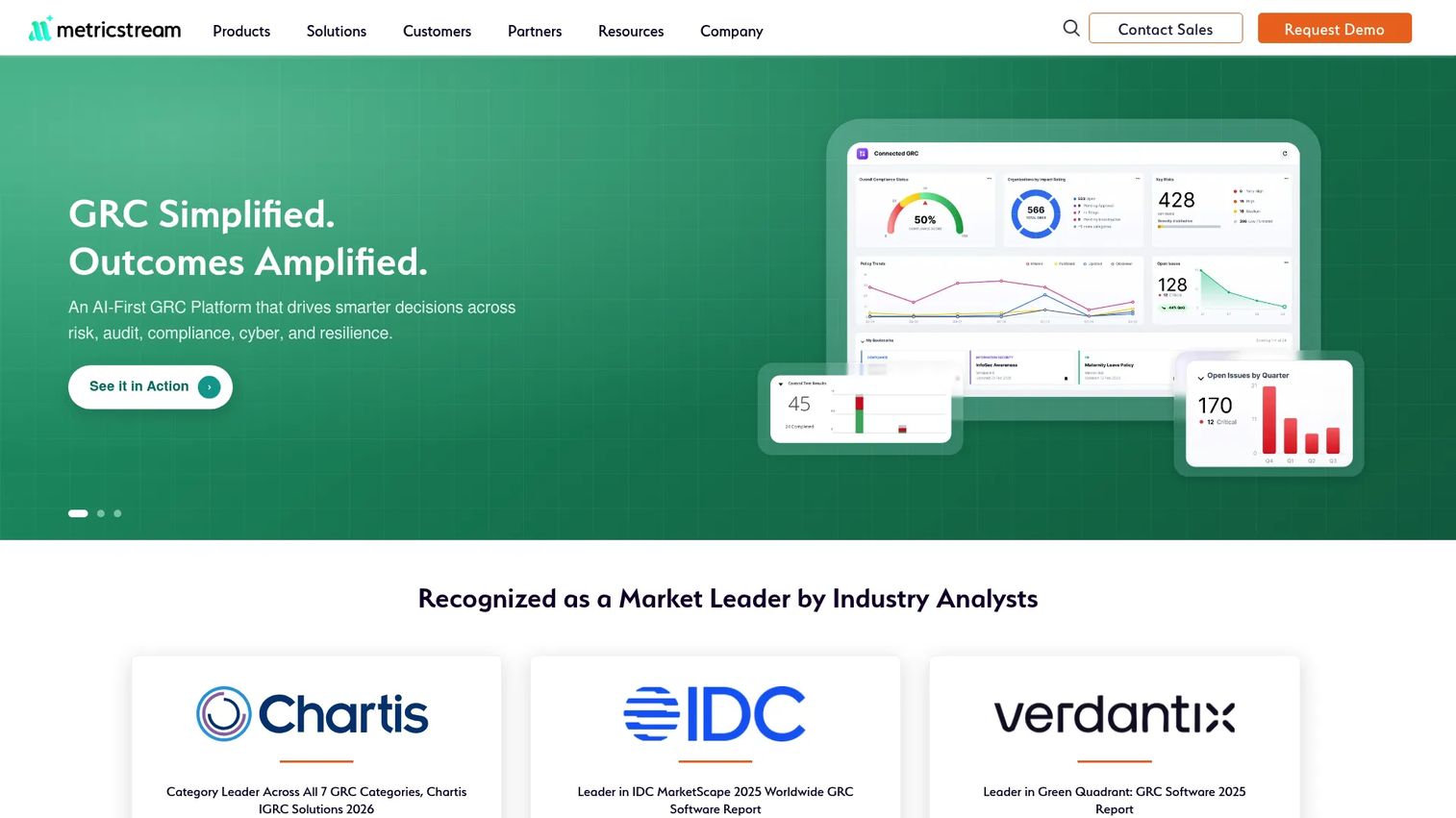
MetricStream is an enterprise GRC platform for risk, compliance, audit, and cyber risk management. It is built for large organizations with complex, cross-business-unit compliance obligations. Where lighter tools handle a handful of frameworks, MetricStream is engineered for breadth: many frameworks, many business units, and the reporting depth executives and boards expect.
Best for: Large enterprises that need an integrated GRC platform spanning risk, compliance, audit, and cyber risk in one federated system.
Key strengths
- Federated data model: A single data structure connects risk, compliance, and audit across business units, so reporting rolls up cleanly.
- Continuous control monitoring: Controls are tested continuously rather than periodically, surfacing failures before an audit does.
- AppStudio and APIs: No-code configuration and open APIs let large teams extend the platform to their exact processes and integrate with existing systems.
Why choose MetricStream: When compliance spans dozens of regulations across multiple divisions, spreadsheets and point tools break down. MetricStream is built for that scale, with the framework mapping, exam readiness, and reporting depth that enterprise governance programs require. Its artificial intelligence features add automation on top of that breadth.
MetricStream pricing: MetricStream does not publish pricing; its pricing page routes visitors to a request form, consistent with enterprise GRC selling. MetricStream holds a 3.8/5 rating on G2.
5. OneTrust
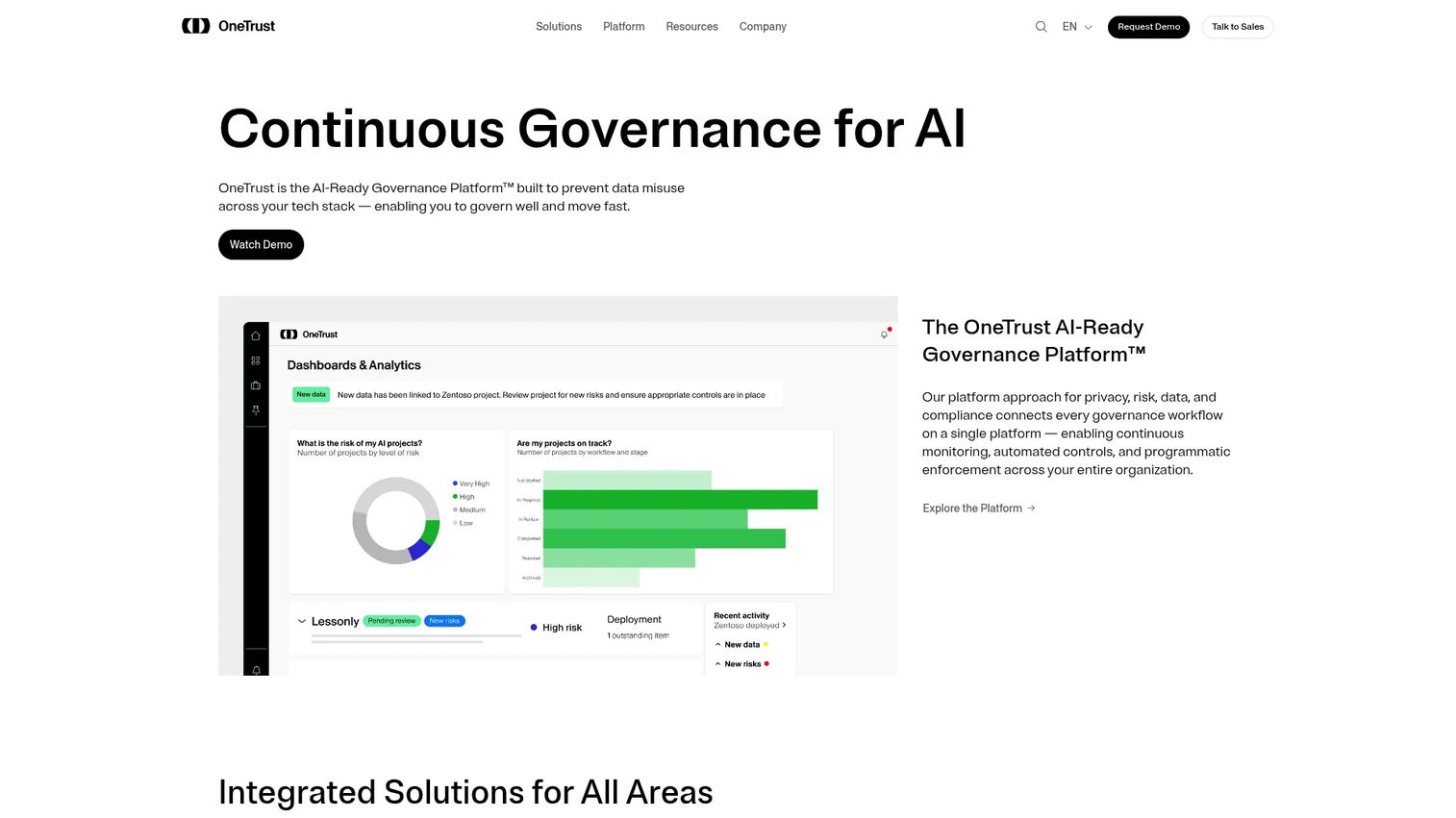
OneTrust is an AI-ready governance platform spanning privacy, consent, data use, and risk management. It stands out when compliance is inseparable from privacy: GDPR, CCPA, consent management, and data governance handled alongside broader risk workflows. For organizations where regulatory compliance means data privacy first, OneTrust fits the shape of the problem.
Best for: Enterprises that need a unified platform for privacy, consent, and governance rather than a security-framework-only tool.
Key strengths
- Privacy automation workflows: Data subject requests, assessments, and privacy tasks run through automated workflows instead of manual handling.
- Consent and preferences management: Consent is captured, tracked, and enforced across web properties, a core requirement under GDPR and CCPA.
- Third-party and tech risk management: Vendor and technology risk sit in the same platform as privacy, connecting governance across domains.
Why choose OneTrust: If your compliance obligations center on how you collect, use, and protect personal data, OneTrust is purpose-built for that job. It fits naturally into broader governance programs where privacy, security, and risk need to share one system rather than three.
OneTrust pricing: OneTrust describes tiered, usage-based pricing tied to usage meters, but publishes no dollar figures on its pricing page. Buyers request a quote based on modules and volume. OneTrust holds a 4.4/5 rating on G2.
6. LogicGate
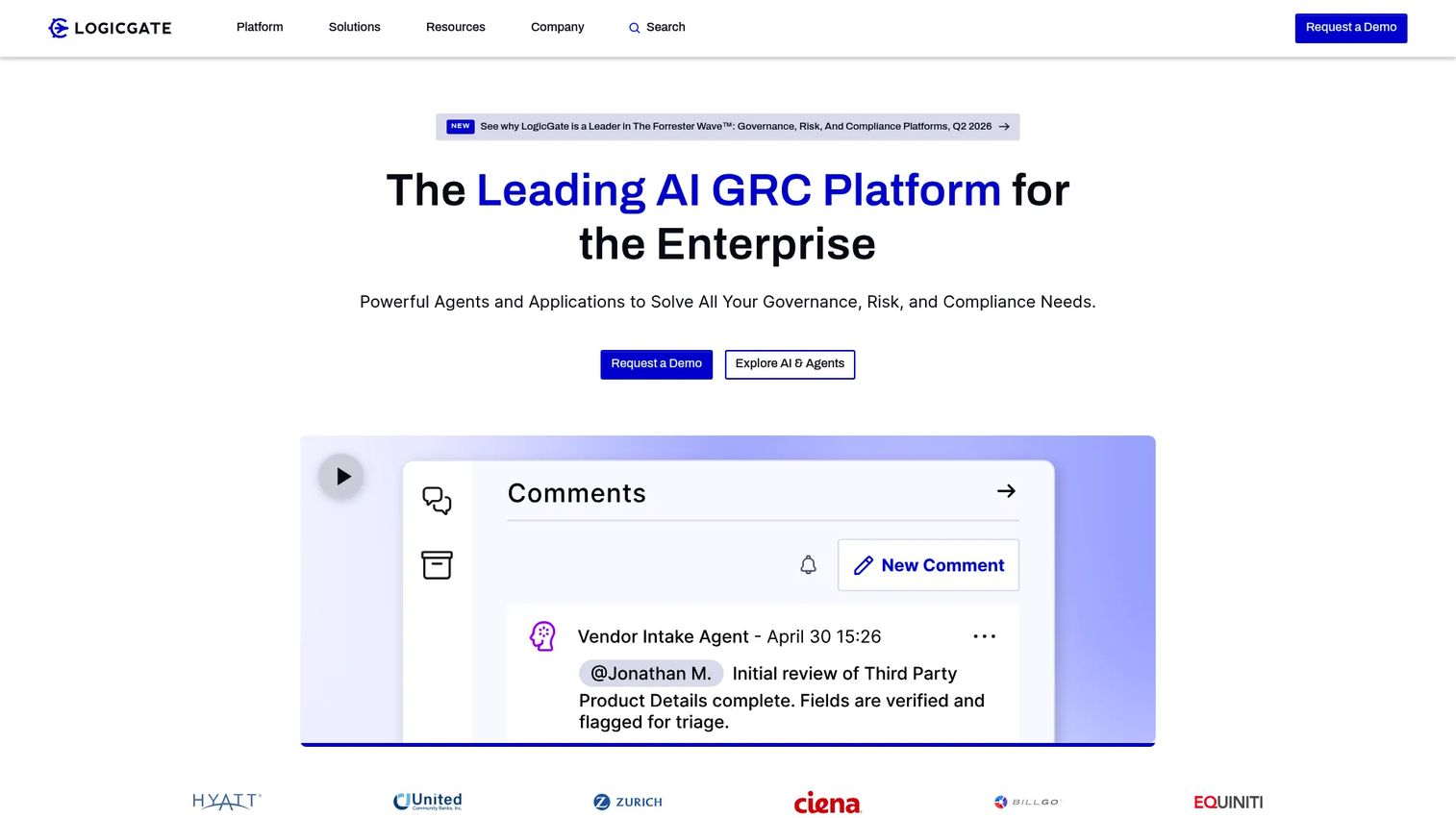
LogicGate is an AI GRC platform built around configurable workflows for enterprise governance, risk, and compliance teams. Its differentiator is flexibility: a no-code graph database lets teams design compliance and risk processes that match how they actually work, rather than bending their process to fit rigid software. If your program has non-standard workflows, that adaptability matters.
Best for: Enterprises that need configurable GRC workflows and risk management they can shape without writing code.
Key strengths
- No-code flexible graph database: Teams model their own risk and compliance relationships without engineering support.
- Workflow automation: Approvals, tasks, and escalations route automatically through processes the team designs.
- Automated evidence collection: Evidence gathers into the right controls automatically, cutting manual documentation work.
Why choose LogicGate: Organizations with governance processes that don't fit a template choose LogicGate for its build-it-your-way flexibility. The trade-off against more opinionated tools is that you invest in design up front, but you get workflows and operational visibility mapped to your exact program.
LogicGate pricing: LogicGate uses custom, quote-based pricing built on Applications and Power User licenses; it publishes no public dollar figures and directs buyers to request pricing. LogicGate holds a 4.6/5 rating on G2.
7. TeamMate
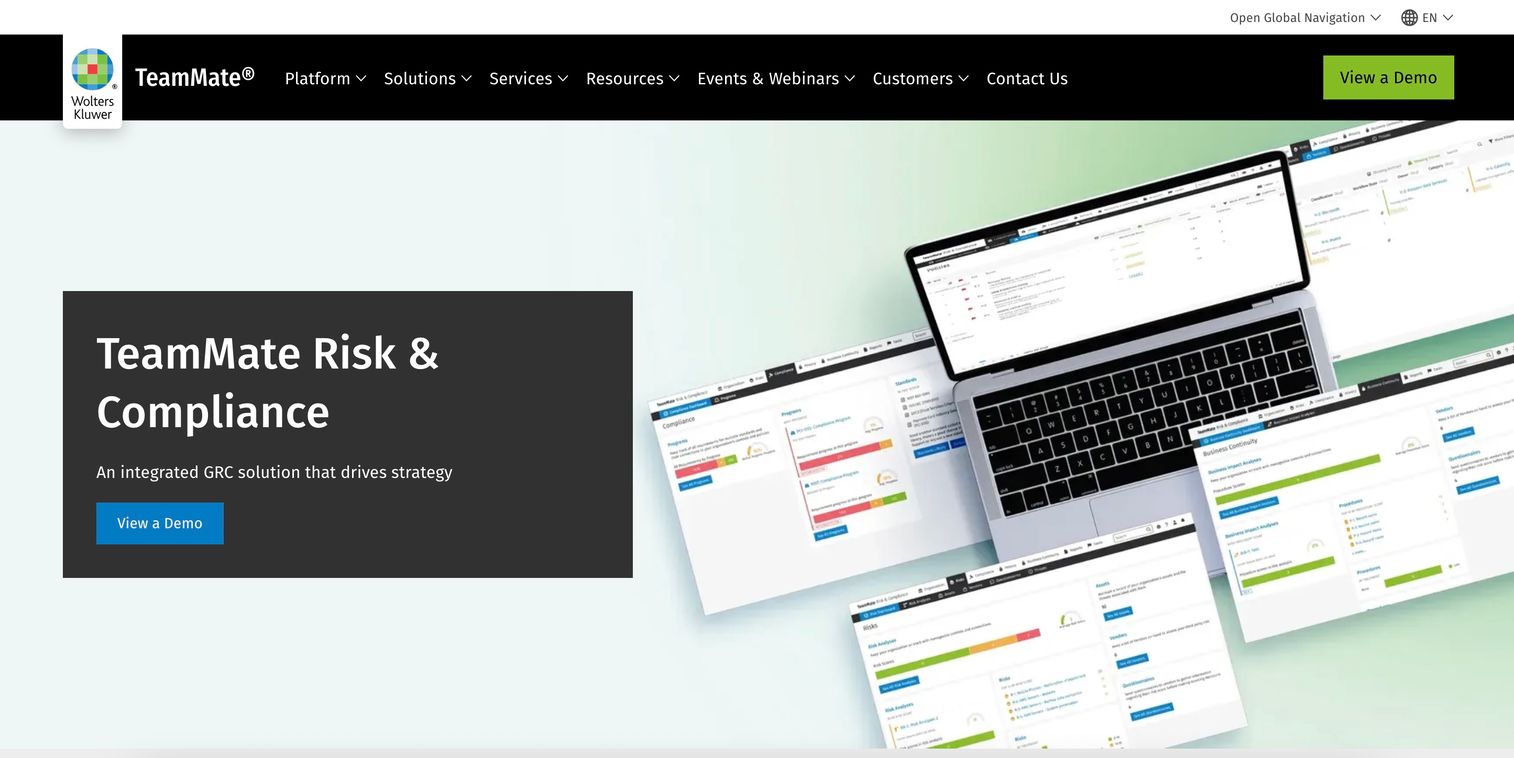
TeamMate is cloud-based GRC software for managing risk, compliance, vendors, controls, and audits. Its appeal is practical governance without the weight of enterprise platforms. Mid-market teams that need real GRC structure, but not a six-month implementation, find it delivers the core functions cleanly and without overengineering.
Best for: Mid-market teams that need a unified GRC platform covering risk, compliance, and audits without enterprise complexity.
Key strengths
- Control and audit management: Controls, evidence, and audit workflows live in one place, keeping smaller teams organized and audit-ready.
- Risk management: Risks are tracked, scored, and linked to controls, giving leadership a clear view without a dedicated risk analyst.
- Vendor and third-party risk management: Vendor assessments run inside the same platform, avoiding a separate tool for third-party risk.
Why choose TeamMate: For a lean compliance function that wants structure without the overhead of a large enterprise suite, TeamMate hits the middle ground. It gives you ownership, versioning, and audit support in a package a small team can actually maintain.
TeamMate pricing: A current public price was not available on a readable first-party pricing page during research, and pricing appears to be quote-based. TeamMate holds a 4.2/5 rating on G2.
8. SAP GRC
SAP GRC is SAP's governance, risk, and compliance suite covering risk and control management, identity and access governance, and cybersecurity and data protection. Its natural home is large organizations already running SAP, where access governance and controls need to sit inside the same ecosystem as the ERP and financial systems they protect.
Best for: Large enterprises that need an integrated, SAP-native GRC suite tied into their existing SAP landscape.
Key strengths
- Risk and control management: Enterprise risk and control processes run natively alongside SAP financial and operational systems.
- Identity and access governance: Access risk analysis and segregation-of-duties controls are built for complex SAP authorization environments.
- Cybersecurity and data protection: Security and data protection controls extend governance across the SAP footprint.
Why choose SAP GRC: For organizations with deep SAP investment, keeping GRC inside the SAP ecosystem simplifies access governance and controls that touch financial systems. The value is native integration; if you don't run SAP, the fit is weaker than a standalone platform.
SAP GRC pricing: SAP does not publish public pricing for its GRC suite and uses demo and quote-based selling. On G2, SAP Risk Management (one product within the broader suite) holds a 4.2/5 rating.
Considerations before you buy
The right platform depends less on feature counts than on fit. Evaluate against these criteria before you sit through a single demo.
Framework coverage and mapping
Confirm the platform supports every framework you maintain today and the ones on your roadmap. The higher-value question is cross-framework mapping: does one control satisfy overlapping requirements across standards, or do you re-document the same control for each? Test-once, apply-everywhere mapping is what saves real hours.
Automation depth
Ask exactly what the platform automates versus what still lands on a person. Continuous evidence collection, automated control testing, and regulatory change alerts remove the most manual work. A tool that only stores evidence you gather by hand is a filing cabinet, not automation.
Workflows, ownership, and governance
Every control and policy needs a named owner, a review cadence, version history, and an approval trail. Check how the platform assigns accountability and whether it nudges owners before deadlines lapse. This governance layer is what keeps a program defensible when an auditor or examiner shows up.
Integrations and reporting
The platform should connect to your cloud, identity, HR, and ticketing systems so evidence flows automatically. Then check the reporting: can leadership see open findings, overdue tasks, and control coverage without exporting to a spreadsheet? Compliance reporting software earns its keep at the dashboard.
Fit by size and industry
A bank needs regulatory intelligence and exam readiness. A Series B SaaS company needs fast SOC 2 automation. A large enterprise needs federated data and continuous monitoring. Match the tool to your maturity, not to the longest feature list.
Conclusion
The best compliance management software is the one that matches your size, industry, and compliance maturity, not the one with the most modules.
For fast-growing teams that need SOC 2 or ISO 27001 quickly, Vanta leads on automation and audit readiness. Hyperproof is the pick for teams running multiple frameworks that want control-to-risk linkage in one hub. Ncontracts is purpose-built for banks and credit unions facing regulatory exams. MetricStream and SAP GRC serve large enterprises, with SAP GRC the natural choice inside an existing SAP footprint. OneTrust fits governance programs anchored in privacy, LogicGate suits teams that need configurable no-code workflows, and StandardFusion delivers practical GRC for lean mid-market functions.
Before committing, shortlist two or three tools that match your fit, then run a scoped evaluation on a single framework you already maintain. Bring your real controls and evidence to the demo so you see how the platform handles your actual program, not a canned example. The tool that removes the most manual work from your specific workflow is the one worth buying.
Start your journey with Guideflow today!
FAQs
Compliance management software centralizes policies, controls, and evidence, automates reminders and workflows, tracks regulatory changes, and prepares organizations for audits and exams. It replaces spreadsheets, shared drives, and email approvals with a single system where every control has an owner, a status, and linked proof. The result is less manual work and faster, more defensible audit readiness.
Fast-growing teams usually prioritize speed to first audit and low manual overhead. Vanta is a common choice because it automates evidence collection across hundreds of integrations and gets a small team to SOC 2 or ISO 27001 readiness quickly. TeamMate is another fit for lean teams that want unified GRC structure without enterprise complexity.
It keeps evidence collected continuously rather than gathered in a last-minute scramble. When an auditor requests proof, the platform produces it from a maintained library, ties each piece of evidence to the control it supports, and shows a clear approval trail. That turns a two-week manual hunt into a controlled, on-demand process.
Start with automation depth, cross-framework mapping, and ownership workflows. Automation removes the most manual labor, mapping means one control can satisfy several frameworks at once, and ownership workflows keep the program accountable and defensible. Integrations and reporting matter next, since they determine whether evidence flows automatically and whether leadership can see program health.
Yes. Most modern compliance management tools support multiple frameworks and map a single control to overlapping requirements across SOC 2, ISO 27001, HIPAA, GDPR, and others. This test-once, apply-everywhere approach is a core reason teams move off spreadsheets. Hyperproof and MetricStream are built specifically around this cross-framework mapping.
It is often the difference between a program that runs itself and one that depends on people remembering. Automated reminders, approval routing, control testing, and regulatory change alerts remove the repetitive coordination work that causes controls to lapse. Without automation, a compliance platform becomes an expensive storage system rather than an operational engine.
Financial institutions face regulatory exams, consumer complaint tracking, and constant rule changes from multiple agencies, which generic GRC tools rarely address well. Purpose-built platforms like Ncontracts add regulatory intelligence, complaint handling, and exam readiness tuned to bank and credit union requirements. That specialization matters most when an examiner arrives expecting industry-specific proof.
Shortlist two or three platforms that match your size, industry, and framework needs, then run a scoped evaluation on a single framework you already maintain. Bring your real controls and evidence to the demo so you see how the tool handles your actual program rather than a polished sample. The platform that removes the most manual work from your specific workflow is the right buy.