You missed a stormwater sampling deadline last quarter. Not because anyone was careless, but because the reminder lived in one person's calendar, the evidence lived in a shared drive, and the report itself lived in a spreadsheet three revisions out of date. By the time anyone noticed, the window had closed.
That is the real problem environmental teams are solving. It is rarely a knowledge gap. It is a tracking gap. Obligations are scattered across sites, deadlines drift, and audit evidence has to be reconstructed under pressure instead of captured as work happens. The teams that stay ahead of it are not working harder, they have moved off email and spreadsheets and onto software built for the job.
The category is growing fast because the pain is universal. The global environmental compliance software market was worth roughly USD 3.8 to 3.94 billion in 2025 and is projected to reach around USD 10.6 billion by 2035, growing near a 10.1% CAGR, according to Meticulous Research (2024). North America holds the largest share, driven by EPA enforcement and a wave of digital adoption across manufacturing, chemicals, and utilities.
Good environmental compliance management software does more than store documents. It centralizes obligations, automates reminders, tracks who owns what, and makes reporting defensible when an inspector shows up. If you are comparing environmental risk management software in 2026, the question is not whether to digitize. It is which system fits your sites, your regulatory footprint, and your field teams. If your evaluation touches adjacent categories, our guides to audit management software and contract lifecycle management cover related workflows.
What's inside
This guide is for environmental, EHS, operations, and compliance leaders comparing environmental compliance software for operational use, not generic ESG marketing content. We chose eight real platforms and evaluated each on four things that matter in daily work: regulatory coverage across air, water, and waste; reporting and evidence quality; mobile and field usability; and integrations plus automation. The list spans industrial facilities, higher education, mobile field teams, and enterprise governance, so you can pattern-match to your own environment before you book a single sales call.
TL;DR
- Best for industrial facilities and mobile field teams: Mapistry, built around per-facility compliance calendars, mobile inspections, and real-time analytics.
- Best for a unified EHS and sustainability platform: EHS (VelocityEHS), covering safety, chemical management, and environmental compliance in one place.
- Best for deadline and evidence-driven teams: ERA Environmental, focused on stormwater, permitting, and inspection support.
- Best for higher education: CampusOptics, with chemical inventory, hazardous waste, and a barcode-scanning mobile app.
- Best for enterprise governance: Intelex, Enablon, and Cority each offer broad EHSQ suites for large, multi-site organizations.
- Best for fast field adoption: SafetyCulture, a mobile-first inspection and checklist platform with a free tier.
What is environmental compliance software?
Environmental compliance software is a system that centralizes an organization's environmental obligations, deadlines, inspections, and reporting so teams can prove they meet regulations like the Clean Air Act and Clean Water Act. Instead of tracking permits in spreadsheets and chasing evidence over email, teams manage the entire compliance lifecycle in one place.
Most environmental compliance tracking software shares a core set of capabilities:
- Permit and obligation management to track Title V air permits, NPDES water discharge permits, and RCRA waste requirements in one register.
- Compliance calendars and alerts that trigger reminders before deadlines, so nothing slips through a personal inbox.
- Mobile inspections with photo capture, checklists, and offline data collection for field crews.
- Regulatory reporting for filings like TRI Form R, Title V annual certifications, and discharge monitoring reports.
- Evidence collection that attaches proof to each obligation as work happens, not the night before an audit.
- Dashboards and KPI reporting for real-time visibility across sites, teams, and media.
- Integrations with ERP systems, sensors, data historians, and lab data via API.
The category maps cleanly onto the compliance media most facilities manage: air emissions tracking, water and stormwater, and waste management. Broader environmental management software then rolls those workflows into performance reporting and, for some vendors, ESG disclosure. The adjacent environmental management systems market is expected to grow from USD 29.81 billion in 2026 to USD 80.17 billion by 2036, per Future Market Insights (2024), a signal that demand for these tools is compounding, not fading.
When to use environmental compliance software
Centralize obligations across sites
Spreadsheet and email tracking works until it doesn't. Once you manage more than one facility, or more than a handful of permits per site, the seams show. One engineer holds the deadlines in their head, another owns the evidence folder, and no one has a single view of what is due this week. This is the point where an environmental compliance management system earns its place: a shared register where every obligation, owner, and due date lives together.
Reduce manual reporting work
Recurring reports quietly eat teams alive. Monthly discharge monitoring reports, quarterly emissions summaries, annual TRI filings, each one means pulling data from multiple sources and reformatting it under a deadline. When that assembly work starts consuming days instead of hours, automation pays for itself. Good software collects the underlying data continuously and generates the report, so filing becomes review-and-submit instead of build-from-scratch.
Improve field execution
If your compliance lives at the facility level, so does your risk. Inspections get skipped, logged late, or recorded on paper that never makes it into the system. Mobile inspections with offline access, photo capture, and barcode scanning close that gap. Field crews record what they see when they see it, and the evidence syncs the moment they reconnect. That is the difference between audit-ready and audit-anxious.
Comparison table
Here is how the eight platforms compare on intent, differentiation, pricing, and rating. Use it to shortlist two or three before reading the detailed sections below.
| # | Product | Intent | Key differentiation | Pricing | G2 rating |
|---|---|---|---|---|---|
| 1 | Mapistry | Industrial multi-site compliance | Per-facility calendar, mobile inspections, real-time analytics | From $10,998/yr per location | 4.9/5 |
| 2 | EHS (VelocityEHS) | Unified EHS + sustainability | Broad platform across safety, chemical, environmental | Quote-based; 3D SSPP from $2,000 | Not listed |
| 3 | ERA Environmental | Deadline and evidence workflows | Stormwater, permitting, inspection support | Quote-based | Not listed |
| 4 | CampusOptics | Higher-education EH&S | Chemical inventory, hazardous waste, mobile scanning | Quote-based | Not listed |
| 5 | Intelex | Enterprise EHSQ | Configurable suite, SSO, offline, API access | From $44/user/mo | 4.1/5 |
| 6 | Enablon | Enterprise sustainability + risk | Integrated EHS, risk, sustainability at scale | Quote-based | 4.1/5 |
| 7 | Cority | Enterprise EHS+ | Converged EHS, occupational health, sustainability | Quote-based | 4.0/5 |
| 8 | SafetyCulture | Mobile-first inspections | Inspections, checklists, fast field adoption | Free; Premium from $24/seat/mo | 4.6/5 |
1. Mapistry
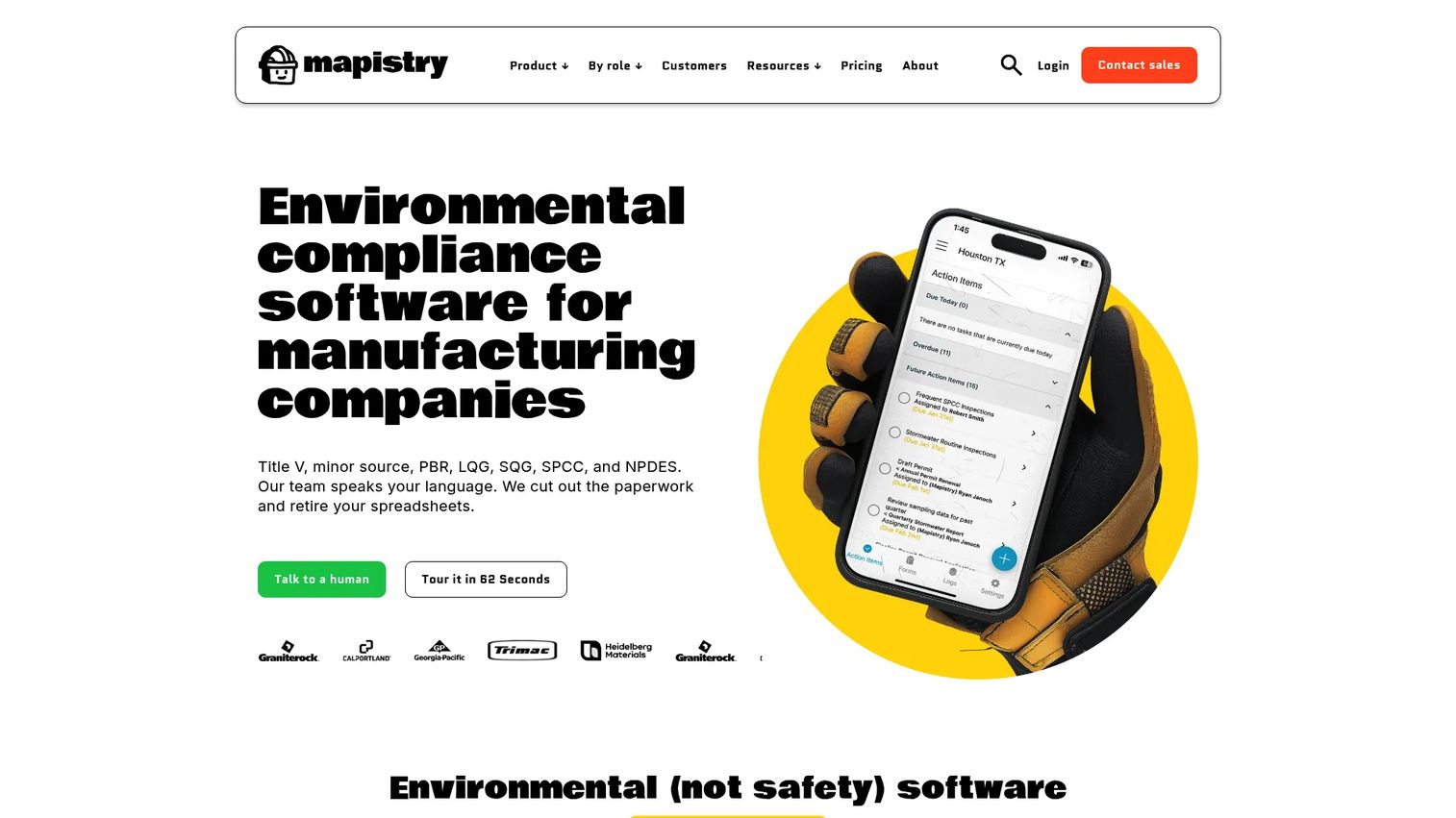
Mapistry is environmental compliance software built for industrial facilities, and it shows in the design. Where generic EHS suites treat environmental compliance as one module among many, Mapistry starts from the facility and the permit. Each location gets its own compliance calendar, its own inspection schedule, and its own analytics, which is exactly how a multi-site operations or environmental lead actually thinks about the problem. If you run compliance across several plants, this is the tool that maps to your mental model without forcing you to bend it.
Best for: Industrial teams managing environmental compliance across multiple facilities.
Key strengths
- Compliance calendar: A per-facility view of every obligation and deadline, so nothing depends on one person's memory.
- Mobile inspections: Field crews run inspections on a phone, capture photos, and log findings on site instead of on paper.
- Real-time analytics: Dashboards surface compliance status and trends across locations without manual report assembly.
Why choose Mapistry: The pricing model tells you who it is for. Mapistry charges per location with unlimited seats in every package, which fits industrial operators who want every technician, engineer, and manager in the system without seat-count math. That structure rewards adoption, the opposite of per-seat tools that quietly punish you for onboarding the field. For a compliance lead whose biggest risk lives at the facility level, that alignment matters.
Mapistry pricing: Three paid tiers, priced per location with unlimited users. Essentials starts at $10,998 annually per location, Advanced at $18,998, and Enterprise at $26,998. There is no free tier. Pricing is published openly on the Mapistry site, which is rare in this category and worth noting if transparent budgeting matters to you.
2. EHS (VelocityEHS)
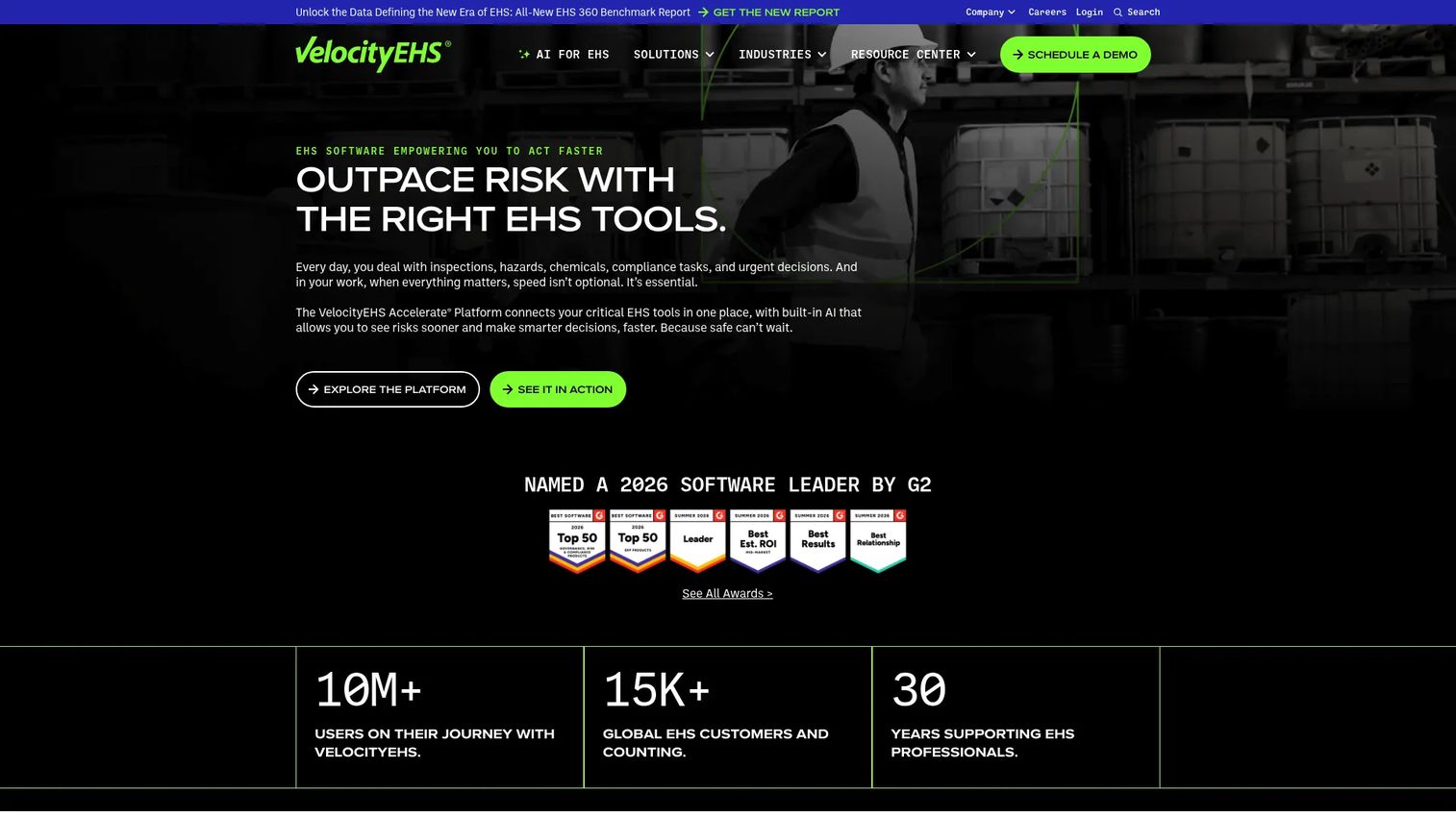
EHS, the VelocityEHS platform, is the broad-coverage option on this list. Environmental compliance sits alongside safety management, ergonomics, chemical management, contractor safety, operational risk, and sustainability in a single platform. For a team that wants one system of record across the entire EHS function rather than a point tool for environmental alone, that breadth is the whole argument. You are buying a suite, and environmental compliance is one strong pillar within it.
Best for: Mid-market to enterprise teams needing a unified EHS and sustainability platform.
Key strengths
- Safety management: Incidents, inspections, audits, observations, training, and compliance tracked in one connected system.
- Chemical management: SDS access, inventory tracking, and chemical compliance, which ties directly into air and waste reporting.
- Ergonomics tools: Industrial ergonomics, office ergonomics, and 3D SSPP for teams whose scope extends beyond environmental.
Why choose EHS: The value is consolidation. If your organization is trying to reduce tool sprawl and give safety, environmental, and sustainability teams a shared platform, VelocityEHS covers more ground than a single-media environmental tool. The trade-off is that you are adopting a full suite, so it fits best when environmental compliance is part of a larger EHS mandate rather than a standalone project.
EHS pricing: Public pricing is shown only for the 3D SSPP ergonomics tool, which starts at $2,000 for an academic license and $2,500 for a single-user license as one-time fees. General platform pricing for the broader environmental and EHS modules is quote-based, so plan on a sales conversation to scope your footprint.
3. ERA Environmental

ERA Environmental leans into the workflows that keep teams ahead of deadlines rather than scrambling behind them. Its focus sits squarely on stormwater management, erosion control, and the compliance support that construction and infrastructure teams need most: Storm Water Pollution Prevention Plans, Storm Water Management Plans, and the inspections, permitting, and water quality sampling that keep those plans defensible. If your compliance burden concentrates around water and site-level obligations, this is a focused fit.
Best for: Construction and infrastructure teams needing stormwater and erosion compliance support.
Key strengths
- SWPPP and SWMP support: Storm Water Pollution Prevention Plans and Management Plans built and maintained to match site conditions.
- Compliance inspections: Scheduled inspections, permitting workflows, and documented evidence collection tied to each site.
- Water quality testing: Sampling and testing support that feeds directly into discharge and permit reporting.
Why choose ERA Environmental: For teams whose regulatory exposure is dominated by stormwater and site-level water compliance, a specialized provider beats a broad suite that treats water as one checkbox. ERA pairs software workflows with compliance expertise, which suits teams that want a partner on complex permitting rather than a self-serve tool alone. It fits best when water is your primary compliance risk.
ERA Environmental pricing: No public pricing is published on the ERA site, which offers a quote and contact path instead. Expect to scope your sites and permitting needs with their team to get a figure. If transparent, self-serve pricing is a hard requirement for your evaluation, factor that in.
4. CampusOptics
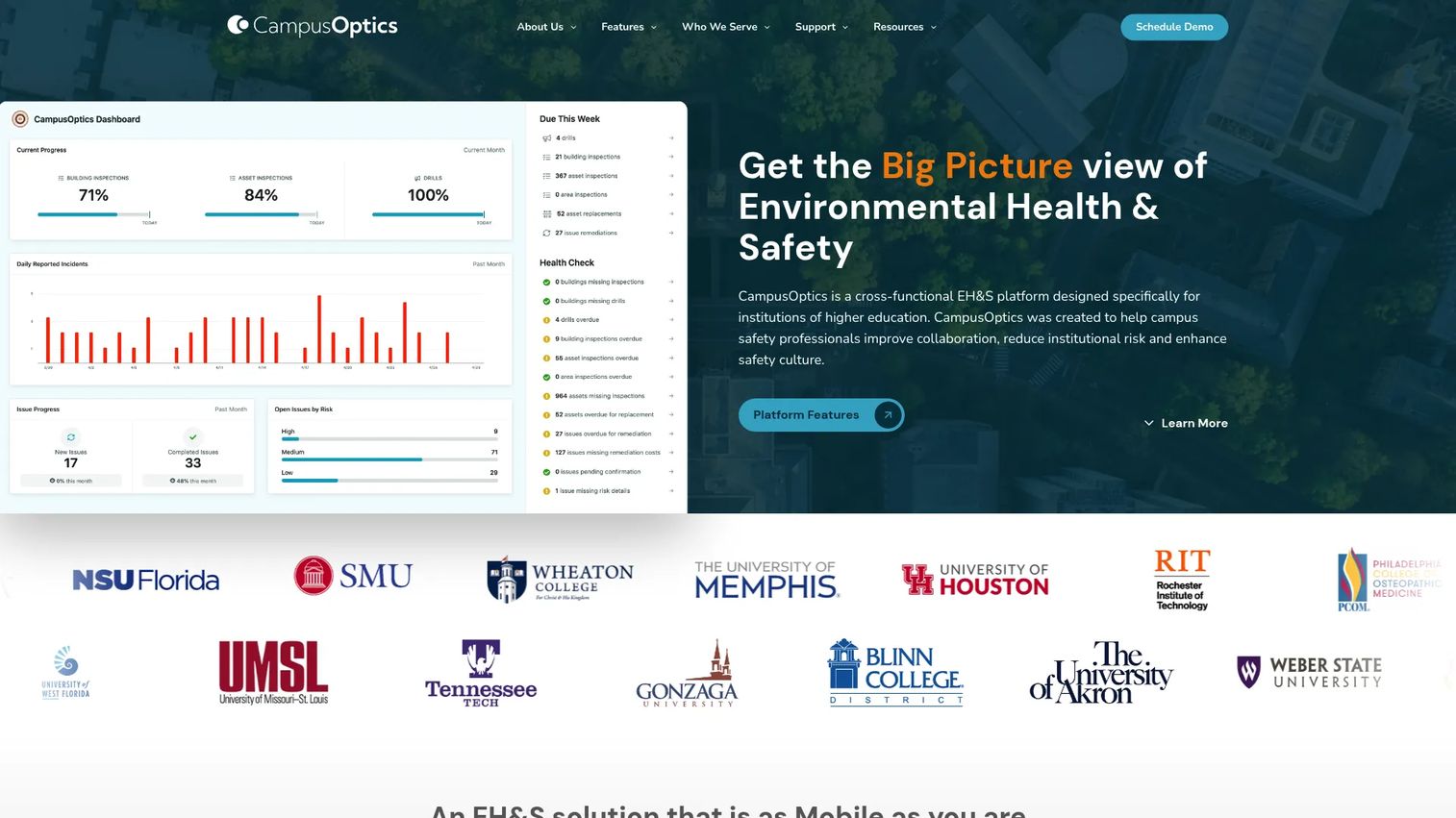
CampusOptics is built for a specific and underserved buyer: higher-education EH&S teams. Colleges and universities carry compliance obligations that look nothing like a factory's. Chemical inventories scattered across dozens of labs, hazardous waste generated in research buildings, and distributed workflows owned by faculty and staff who are not compliance professionals. CampusOptics designs for that reality with a cross-functional platform and a mobile app that makes field data capture approachable for non-experts.
Best for: Colleges and universities managing EH&S, safety, and compliance workflows.
Key strengths
- Chemical inventory management: Track chemicals across labs and buildings, which is often the single hardest compliance problem on a campus.
- Hazardous waste management: Manage waste generation, accumulation, and disposal to stay within RCRA generator limits.
- Mobile app with scanning: Barcode and QR scanning speeds up inventory and inspection work in the field, even offline.
Why choose CampusOptics: The higher-education focus is the differentiator. Distributed campus workflows, research chemical management, and adoption by non-specialist staff are genuinely different problems, and a purpose-built tool handles them better than a repurposed industrial suite. If you run EH&S for an institution rather than a plant, that specialization pays off in adoption.
CampusOptics pricing: No public pricing figure is published. CampusOptics notes that pricing depends on campus size, user count, and features selected, so you will need a scoped quote based on your institution.
5. Intelex
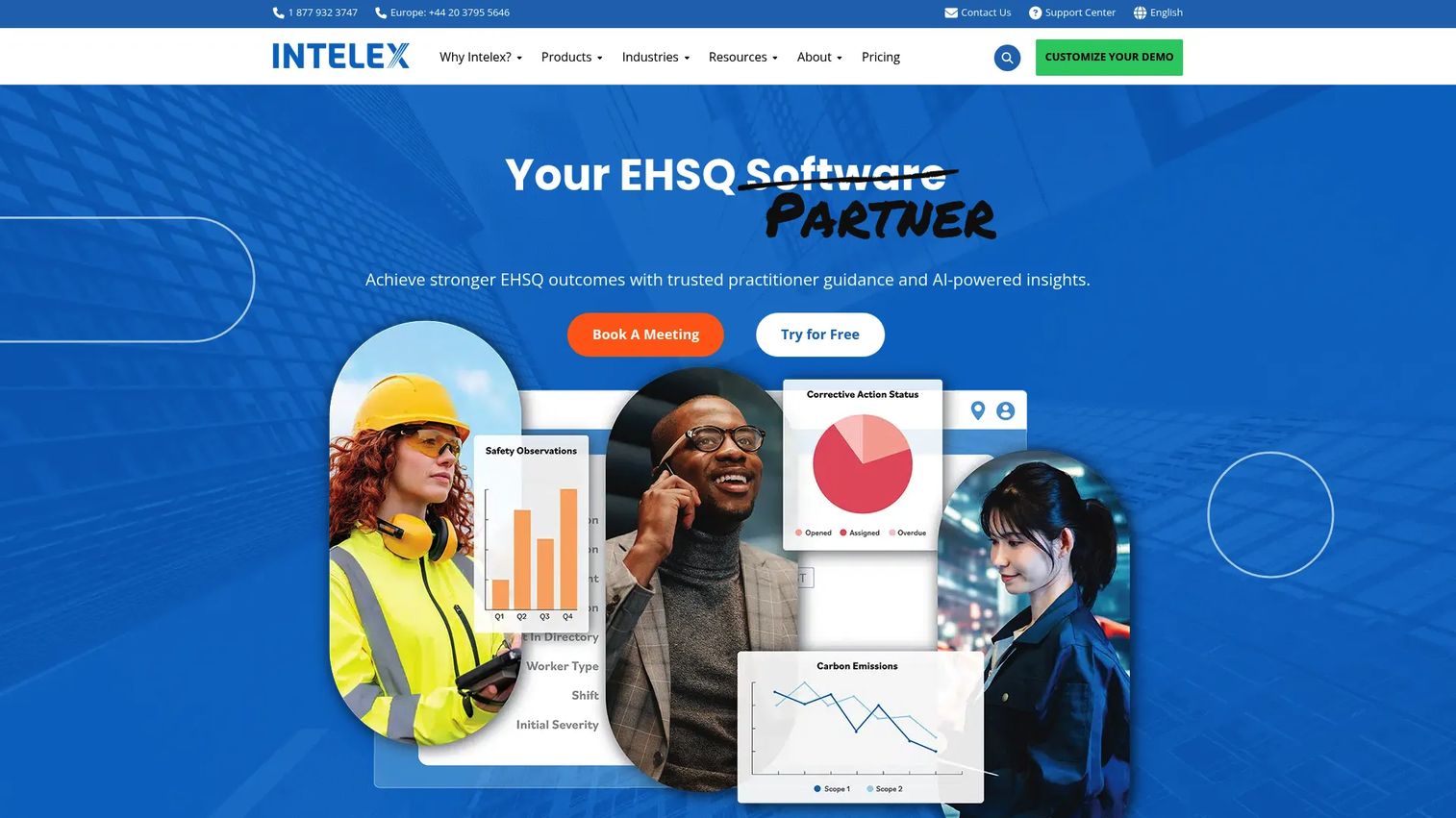
Intelex is a configurable EHSQ platform covering safety, quality, environmental, and compliance management. It sits at the enterprise end of the market, where multi-site organizations need governance, access control, and integration depth alongside the compliance workflows themselves. The environmental modules plug into a broader suite, which suits organizations that want to standardize how every site tracks obligations and evidence under one configurable system.
Best for: Mid-to-large organizations needing an EHSQ platform for safety and compliance workflows.
Key strengths
- Mobile and offline capability: Field teams collect data and run inspections without a connection, then sync when they reconnect.
- Document control: Version-controlled evidence and records, which is exactly what auditors want to see.
- SSO and API access: Single sign-on and API access make it fit cleanly into an enterprise IT stack and integrate with existing systems.
Why choose Intelex: Intelex fits organizations that have outgrown single-purpose tools and need configurability, enterprise security, and integration breadth. The G2 rating of 4.1/5 reflects a mature, established platform. It performs best when you are standardizing compliance across many sites and need governance controls, not just a tracker.
Intelex pricing: Safety Essentials starts at $44 per user per month, with a minimum of 25 users, billed annually. Advanced and Enterprise tiers require a conversation with sales. There is no free tier. The published entry price gives you a usable anchor for budgeting even before you scope the higher tiers.
6. Enablon
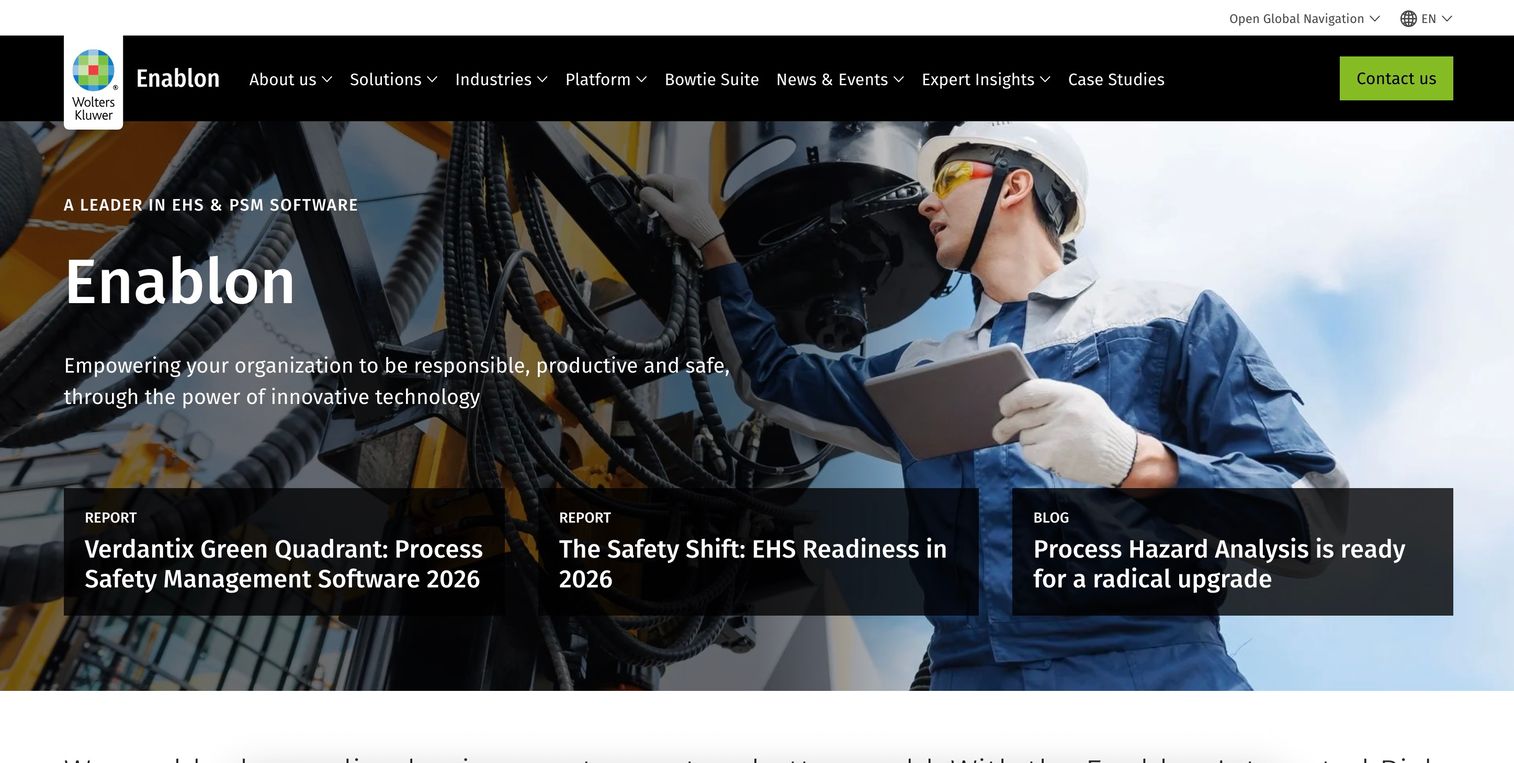
Enablon, a Wolters Kluwer business, targets large organizations that need sustainability, EH&S, and operational risk management working together at scale. This is enterprise software in the fullest sense: broad module coverage, deep reporting, document control, and analytics designed for complex, multi-national compliance footprints. If your organization files across many jurisdictions and needs integrated risk and sustainability reporting alongside environmental compliance, Enablon is built for that weight class.
Best for: Large organizations needing integrated sustainability, EHS, and risk management software.
Key strengths
- Sustainability management: Environmental performance and sustainability reporting integrated with compliance data.
- EH&S management: Environmental, health, and safety workflows unified across sites and business units.
- Operational risk management: Risk workflows that connect compliance obligations to broader operational and enterprise risk.
Why choose Enablon: Enablon suits the largest, most complex organizations, where compliance is inseparable from enterprise risk and sustainability disclosure. Its G2 rating of 4.1/5 reflects a serious enterprise platform. Choose it when you need one system spanning environmental compliance, risk, and sustainability across a global footprint rather than a focused environmental tool.
Enablon pricing: No public pricing is published on the Enablon site. As with most enterprise EHS suites, pricing is scoped to your organization's size, modules, and deployment through a sales process. Expect a formal procurement path rather than self-serve signup.
7. Cority
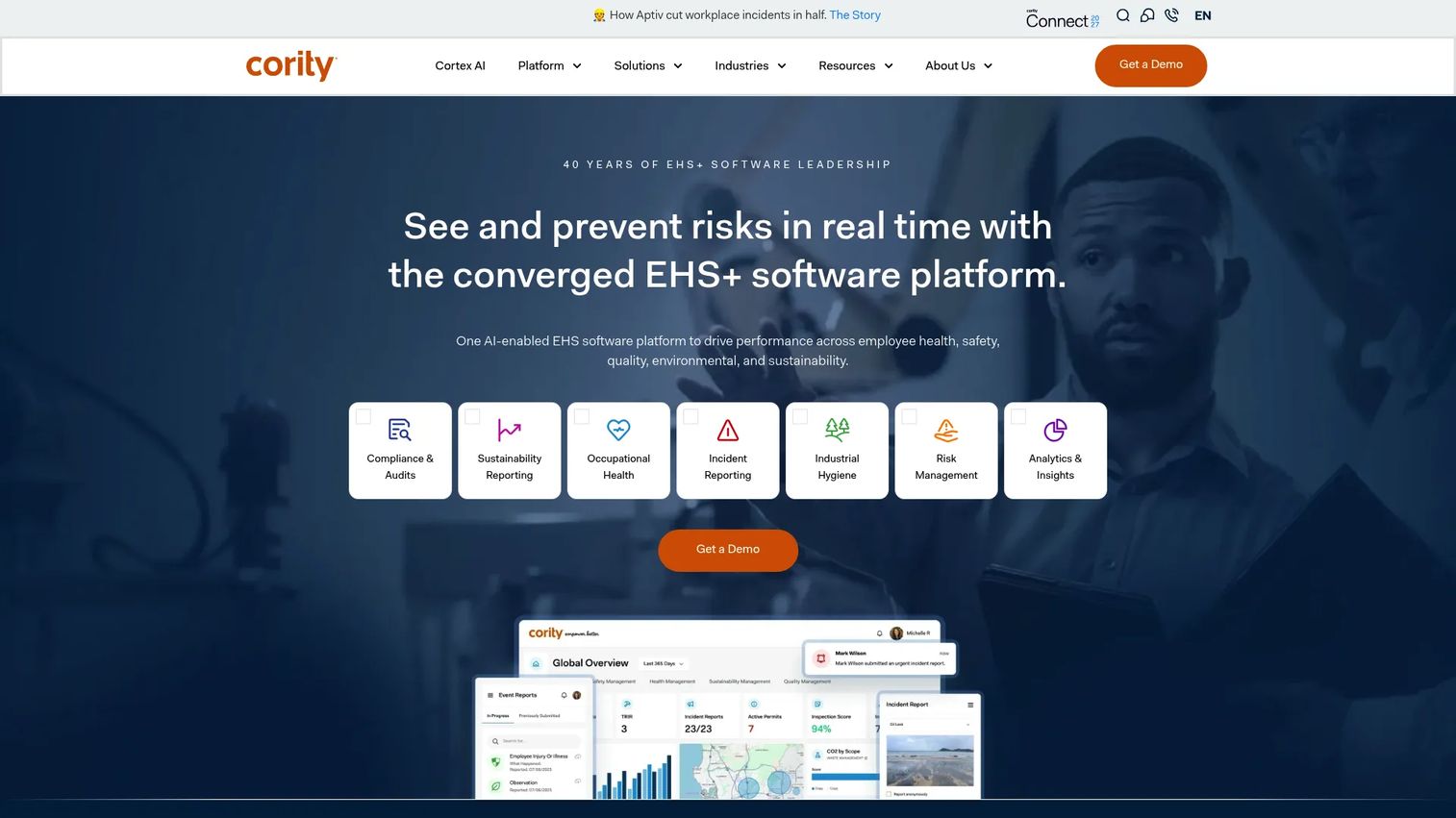
Cority markets a converged EHS+ platform spanning safety, health, environmental, quality, and sustainability management. Its distinguishing angle is occupational health, which fewer competitors handle deeply, alongside standard environmental compliance workflows, incident reporting, and risk management. For large organizations that need environmental compliance to sit next to occupational health and enterprise sustainability reporting in one system, Cority covers unusually broad ground.
Best for: Large organizations needing a unified EHS+ platform.
Key strengths
- Converged EHS+ platform: Environmental, safety, health, quality, and sustainability managed in one connected system.
- Incident reporting and risk management: Structured workflows that tie compliance obligations to incidents and operational risk.
- Occupational health and sustainability reporting: Health data and sustainability disclosure alongside environmental compliance, a broader scope than most.
Why choose Cority: Cority fits large organizations that want environmental compliance embedded in a wider EHS and occupational health platform rather than run as a standalone function. Its G2 rating of 4.0/5 reflects an established enterprise suite. It performs best when multi-team visibility across health, safety, and environmental data is the goal.
Cority pricing: No public pricing is published. Cority uses demo and contact-sales paths, so pricing is scoped to your organization through a sales conversation. Plan for an enterprise procurement cycle rather than a quick self-serve purchase.
8. SafetyCulture
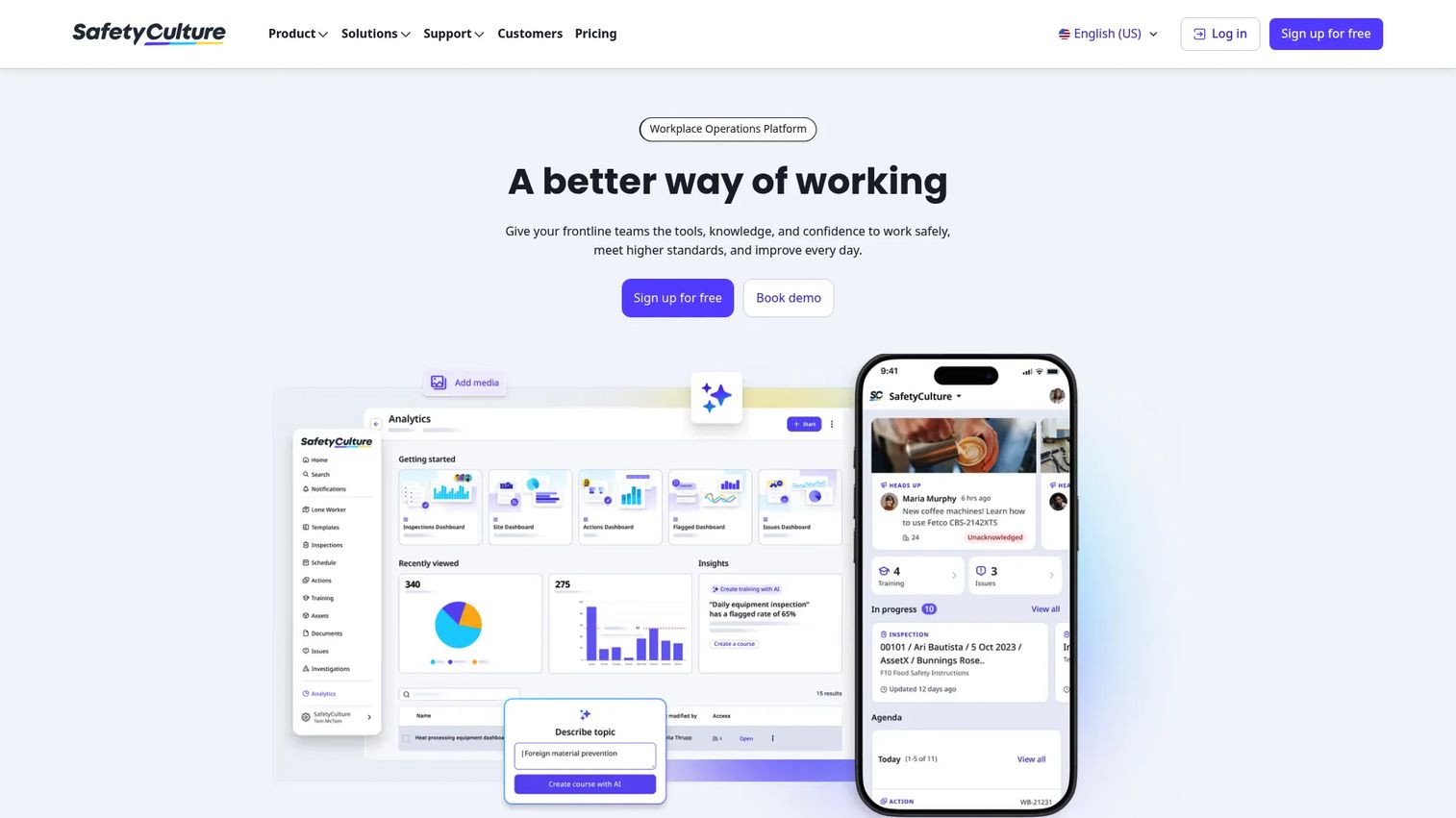
SafetyCulture approaches compliance from the field first. It is a workplace operations platform built around inspections, audits, checklists, training, assets, and issue management, and its reputation rests on how quickly teams actually adopt it. Where enterprise suites take months to configure, SafetyCulture gets crews running mobile inspections almost immediately. For environmental compliance, it works best as the field-execution layer: capturing inspections, evidence, and issues on mobile, then feeding that data into your reporting.
Best for: Teams needing a mobile-first operations and inspection platform.
Key strengths
- Inspections and checklists: Build and run inspection templates that field teams complete on mobile, with photos and findings attached.
- Task and issue management: Turn a failed inspection into a tracked corrective action so problems get closed, not forgotten.
- Analytics and integrations: Dashboards on inspection data plus integrations that push results into wider systems.
Why choose SafetyCulture: Fast adoption is the whole story. If your priority is getting field teams collecting compliance evidence on mobile with minimal setup, SafetyCulture's 4.6/5 G2 rating and free tier make it easy to start. It performs best as a field-execution and inspection layer, especially for teams that want operational simplicity over exhaustive regulatory module coverage.
SafetyCulture pricing: There is a free plan at $0 per seat. Premium runs $24 per seat per month, and Enterprise is custom-priced through sales. Annual billing offers discounted Lite seats from around $5 per seat per month. The free tier and low entry price make it the easiest platform on this list to trial before committing.
Considerations before you buy
Once you have a shortlist, pressure-test each option against how your team actually works. These criteria separate a tool that earns its place from one that adds a tab no one opens.
Regulatory coverage that matches your footprint
Map your real obligations first: Title V air permits, NPDES discharge permits, RCRA waste rules, TRI Form R filings. Then check that the platform handles the media you actually manage. A tool strong in stormwater may be thin on air emissions tracking, and vice versa. Buy for your regulatory reality, not a generic feature list.
Field usability and offline inspections
If compliance happens at facilities, adoption happens on phones. Test the mobile app the way your crews will use it: offline inspections, photo capture, and barcode scanning in a building with no signal. A platform that field teams abandon is worse than the spreadsheet it replaced.
Reporting and audit readiness
The point of the system is defensible evidence on demand. Check how the tool generates regulatory reporting and how it attaches evidence to each obligation over time. Strong audit readiness means an inspector's request is a five-minute export, not a two-week scramble.
Integrations and data flow
Compliance data does not live alone. Confirm the platform connects to your ERP, sensors, data historians, and lab systems through an API. The less manual data entry, the fewer errors and the more trustworthy your dashboards. If you are also evaluating adjacent tooling, our roundup of contract management and event management platforms can help you plan the wider stack.
Conclusion
The right choice comes down to where your biggest bottleneck lives. If it is at the facility level across multiple industrial sites, Mapistry maps directly to that with per-location calendars, mobile inspections, and transparent pricing. If you need one platform for safety, environmental, and sustainability together, EHS (VelocityEHS) covers the widest ground. Deadline-driven and water-heavy teams get a focused fit from ERA Environmental, and higher-education institutions have a purpose-built option in CampusOptics.
For enterprise governance across many sites and jurisdictions, Intelex, Enablon, and Cority each bring broad EHSQ and risk coverage, with Cority reaching furthest into occupational health. And if fast field adoption is the priority, SafetyCulture's free tier and mobile-first design let you start collecting compliance evidence this week.
Your next step is not a demo. It is a page: write down the single compliance workflow that fails most often today, reporting, field collection, or enterprise oversight, then shortlist the two tools above that solve exactly that. Buy for the bottleneck, and the rest follows.
FAQs
It is used to track environmental obligations, deadlines, and evidence in one place so an organization can prove it meets regulations. Typical jobs include managing permits, scheduling inspections, collecting field data, sending compliance alerts before deadlines, and generating regulatory reports for air, water, and waste.
The core features are permit and obligation tracking, a compliance calendar with automated alerts, mobile inspections with photo and offline capture, evidence collection tied to each obligation, dashboards for KPI reporting, and integrations with ERP, sensor, and lab systems. Prioritize the features that match your heaviest recurring workflow.
It captures evidence as work happens instead of the night before an audit. Every inspection, reading, and report attaches to its obligation with a timestamp and owner, so responding to an inspector becomes a quick export rather than a scramble. That continuous evidence trail is what audit readiness actually means.
Manufacturing, chemicals, oil and gas, utilities, construction, and higher education see the biggest gains, because they carry dense, multi-media obligations across many sites. Any organization managing permits under the Clean Air Act, Clean Water Act, or RCRA benefits from moving off spreadsheets.
Environmental management software focuses on environmental performance and compliance: air, water, waste, and reporting. EHS software is broader, adding employee health and safety, incidents, and often quality and sustainability. Many platforms blend the two, so define your scope before comparing suites.
They are essential wherever compliance happens in the field. Crews often work in facilities or remote sites with no signal, so offline inspections with photo and barcode capture keep data accurate and timely. Without a mobile app that works offline, field data lags, and lagging data undermines the whole system.
Look for connections to your ERP, environmental sensors, data historians, and lab data systems, usually through an API. Strong integrations reduce manual data entry, cut transcription errors, and keep dashboards trustworthy. The fewer places data is rekeyed, the more defensible your reporting becomes.
Yes. Most platforms support air emissions tracking for Title V, water and stormwater reporting for NPDES discharge monitoring, and waste management for RCRA and TRI Form R filings. The system collects the underlying data continuously and generates the report, turning filing into review-and-submit instead of build-from-scratch.