


A near-miss gets logged in a spreadsheet on one site. An inspection finding sits in an email thread on another. A corrective action never gets assigned an owner. Three months later, an auditor asks for a full incident history, and nobody can produce one without a scramble.
That is the real problem EHS software solves. Fragmented safety workflows do not just slow teams down. They create reporting gaps, missed follow-ups, and risk exposure that leadership cannot explain in a board meeting or a due diligence review. When incident data, audits and inspections, training records, and regulatory reporting live in different places, the organization loses the one thing it needs most: a clean operating view of its own risk.
The category is growing fast because that problem is expensive. Global spending on EHS software reached $1.9 billion in 2023 and is forecast to grow at a 14.6% CAGR to $4.5 billion by 2029, according to Verdantix (2023). North America holds the largest share of the environmental health and safety market at 37.6% of global revenue in 2024, per Grand View Research (2025). Companies are replacing manual processes with a unified platform for one reason: fewer surprises and better control.
This guide compares eight EHS software companies buyers actually shortlist. If you are evaluating adjacent operational software too, our roundups on audit management software and best contract lifecycle management software cover related governance and compliance workflows.
What's inside
This guide is for EHS managers, safety leaders, operations executives, and founders choosing environmental health and safety software that scales across sites. We compare the best EHS management software for teams that need incident management, audit workflows, compliance tracking, and reporting in one place.
We selected platforms based on four criteria that matter most to operations-heavy buyers:
- Platform breadth across safety, compliance, and risk modules
- Workflow depth for incidents, audits, inspections, and corrective actions
- Mobile usability for field teams working offline or on the move
- Analytics and trust signals, including verified G2 ratings and dashboard quality
The shortlist reflects buyer relevance, not popularity alone. For related evaluation frameworks, our guides on best community management software and best event management software use the same decision-first structure.
TL;DR
- Best for broad EHS coverage: VelocityEHS, with a unified platform spanning safety, ergonomics, chemical management, and operational risk.
- Best for mobile-first field teams: EHS Insight, with strong offline mobile workflows and configurable modules.
- Best for fast adoption and inspections: SafetyCulture, built around mobile inspections, checklists, and training.
- Best for compliance-heavy, ops-led programs: KPA EHS Software, with a federal and state compliance library and automated audits.
- Best for enterprise EHS and analytics: CorityOne, Enablon, Intelex, and Benchmark Gensuite for large, regulated, multi-site operations.
- Cost note: Most EHS software companies use quote-based pricing; a few publish entry tiers, which we flag below.
What is EHS software?
EHS software is a system that centralizes environmental, health, and safety programs so teams can report incidents, run audits and inspections, track corrective actions, manage training, and produce regulatory reporting from a single source of truth. It replaces spreadsheets, email threads, and paper forms with structured workflows and shared visibility.
Also called EHS management software or safety management software, a serious platform handles a consistent set of jobs across sites and teams.
Core capabilities you should expect:
- Incident management: Log injuries, near-misses, and observations, then route them to owners with corrective and preventive actions.
- Audits and inspections: Build recurring checklists, capture findings on mobile, and track follow-ups to closure.
- Action management: Assign, escalate, and verify corrective actions so nothing falls through.
- Compliance and regulatory reporting: Maintain document control, track obligations, and generate reports for regulators and leadership.
- Training management: Track certifications, assign courses, and flag expirations before they become gaps.
- Dashboard and analytics: Surface leading and lagging indicators so leaders can see risk trends across the organization.
- Risk management: Assess hazards, score risk, and prioritize mitigation across facilities.
The best EHS compliance software connects these functions so a single incident feeds the action log, the training record, and the compliance report without manual re-entry. That connective tissue is what separates a real platform from a point tool.
When to use EHS software
Not every team needs a full platform on day one. These are the moments when the switch pays for itself.
Track incidents without spreadsheet chaos
When incident reports live in separate files across sites, follow-up breaks down and trends stay invisible. You outgrow manual reporting the moment you cannot answer a simple question fast: how many recordable incidents happened last quarter, and were the corrective actions closed? A dedicated system gives you one record for every incident, one owner for every action, and one view of what is actually improving.
Standardize audits and inspections across locations
Recurring inspections get messy at scale. Different sites use different forms, findings sit in inboxes, and follow-ups depend on memory. EHS software standardizes the checklist, captures findings on mobile, and auto-generates corrective actions with due dates. The value compounds: every location runs the same process, and leadership sees inspection completion and open findings in one dashboard.
Centralize compliance and reporting
There is a specific moment when compliance stops being manageable by hand. Regulatory obligations multiply, document control gets critical, and task ownership needs a real system. When an auditor or regulator asks for a full history, you want to export it in minutes, not reconstruct it over days. Centralized regulatory reporting turns compliance from a fire drill into a routine.
Comparison table
Use this table as a quick filter before the deep dives. It ranks tools by fit for operations-heavy buyers evaluating EHS software, not alphabetically. Pricing and G2 ratings reflect verified values where publicly available; several vendors use quote-based pricing.
| # | Product | Intent | Key differentiation | Pricing | G2 rating |
|---|---|---|---|---|---|
| 1 | VelocityEHS | Broad unified EHS platform | Safety, ergonomics, chemical management, and operational risk in one platform | Quote-based; 3D SSPP license from $2,500 | 4.4/5 |
| 2 | EHS Insight | Mobile-first, modular EHS | Offline mobile app and configurable compliance tracking | From $5k/year (SMB); enterprise quote-based | 4.7/5 |
| 3 | SafetyCulture | Fast-adoption inspections | Mobile inspections, checklists, and training | Free plan; Premium $24/seat/month | 4.6/5 |
| 4 | KPA EHS Software | Compliance-heavy, ops-led | Federal and state compliance library plus automated audits | Custom pricing | 4.7/5 |
| 5 | CorityOne | Enterprise EHS and health | Unified EHS+ platform with Cortex AI | Quote-based | 3.9/5 |
| 6 | Enablon | Enterprise risk and ESG | Integrated EHS, ESG, and operational risk workflows | Quote-based | - |
| 7 | Intelex | Configurable EHSQ | Incident, audit, and compliance with configurable workflows | Safety Essentials from $44/user/month | 4.0/5 |
| 8 | Benchmark Gensuite | AI-native enterprise EHS | Genny AI embedded across EHS, sustainability, and quality | Quote-based | 4.0/5 |
1. VelocityEHS
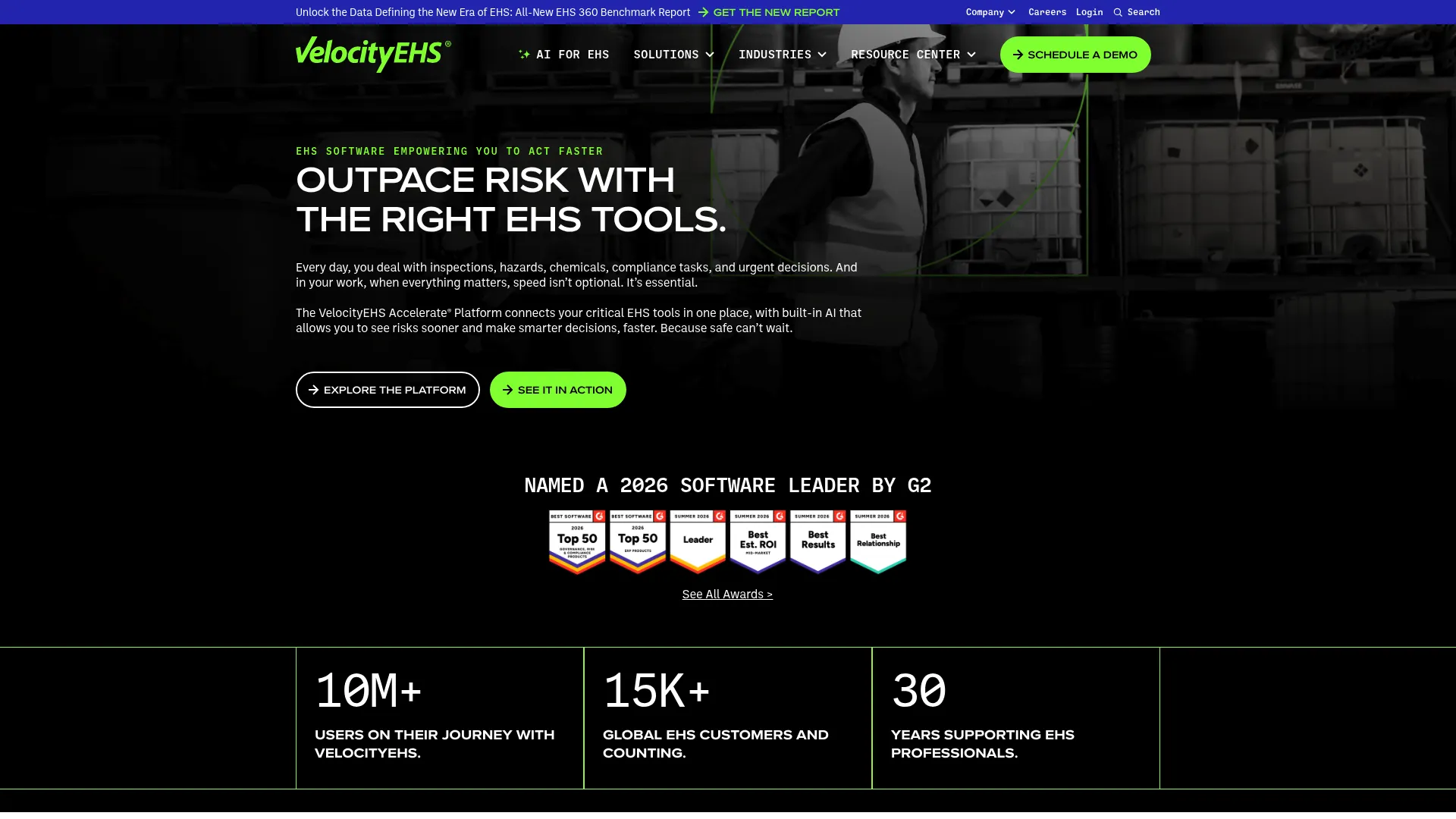
VelocityEHS is one of the broadest EHS software companies on the market, built for teams that want a single operating system rather than a stack of point tools. Its Accelerate Platform unifies EHS workflows and layers AI-powered risk detection on top, so safety data does not just get logged, it gets analyzed. The breadth is the point: safety, ergonomics, chemical management, contractor safety, operational risk, environmental compliance, and sustainability all run in one place.
That range makes it a strong fit for mid-market and enterprise teams standardizing programs across multiple sites. Instead of separate systems for incident management, chemical inventory, and industrial hygiene, everything feeds a shared data model and a common set of dashboards.
Best for: Mid-market and enterprise teams centralizing safety, chemical, ergonomics, and operational risk programs across sites.
Key strengths
- Unified Accelerate Platform: Runs safety, compliance, and sustainability workflows on one data model, so an incident, an SDS update, or an inspection finding all connect.
- AI-powered risk detection: Surfaces risk patterns and recommendations from your own data, moving teams from reactive logging to proactive mitigation.
- Deep module coverage: Chemical management with SDS, inventory, labeling, and regulatory reporting sits alongside ergonomics and contractor safety in a single suite.
Why choose VelocityEHS: If your risk lives across chemicals, ergonomics, and operational hazards, a broad platform beats stitching together narrow tools. VelocityEHS fits teams that want one vendor, one login, and one reporting layer across the full EHS program, especially where chemical management and industrial hygiene are core.
VelocityEHS pricing: The core platform uses quote-based pricing routed through a demo request, with no public price and no free tier confirmed. The only publicly listed figure is for its standalone 3D SSPP ergonomics tool, which starts at a $2,500 one-time single-user license and $2,000 for an academic license. VelocityEHS holds a 4.4/5 rating on G2.
2. EHS Insight
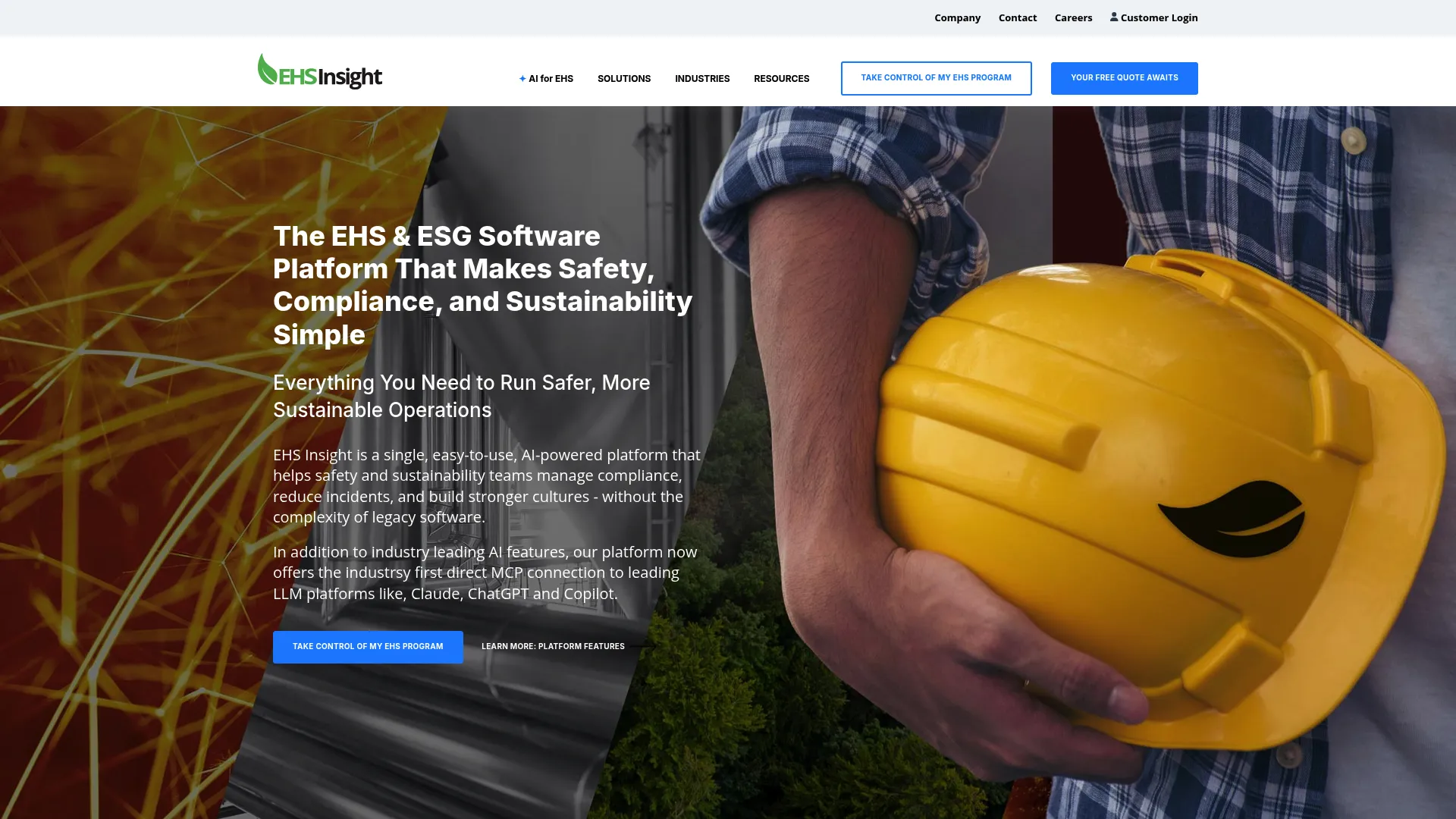
EHS Insight is cloud-based environmental health and safety software built for teams that live in the field as much as the office. Its modular design covers incident management, audits, inspections, and corrective actions, and its mobile app works offline so frontline workers can log issues without a signal. AI tools handle analysis, reporting, and data quality, which helps connect field activity to leadership decisions.
The platform earns its spot for organizations that want configurable compliance tracking without paying for modules they do not use. You select the modules that fit your program, then scale as needs grow.
Best for: Organizations that need modular EHS software with strong offline mobile workflows and configurable compliance tracking.
Key strengths
- Offline mobile app: Field teams capture incidents, inspections, and observations without connectivity, then sync when back online.
- Modular configuration: Pay for the incident, audit, and reporting modules you need, and expand without replatforming.
- AI-assisted reporting: Built-in analysis and data-quality tools turn raw field data into decision-ready reporting.
Why choose EHS Insight: If your workforce is distributed across job sites, plants, or remote locations, offline mobile usability is not a nice-to-have, it is the difference between real data and missing data. EHS Insight suits teams that want field usability and data-connected decision-making without enterprise-only pricing to start.
EHS Insight pricing: Its small and medium business solution starts at $5,000 per year, billed annually, with pricing tailored by module selection and employee count. Enterprise pricing is quote-based. A free trial is available, and the platform holds a 4.7/5 rating on G2, among the highest in this roundup.
3. SafetyCulture
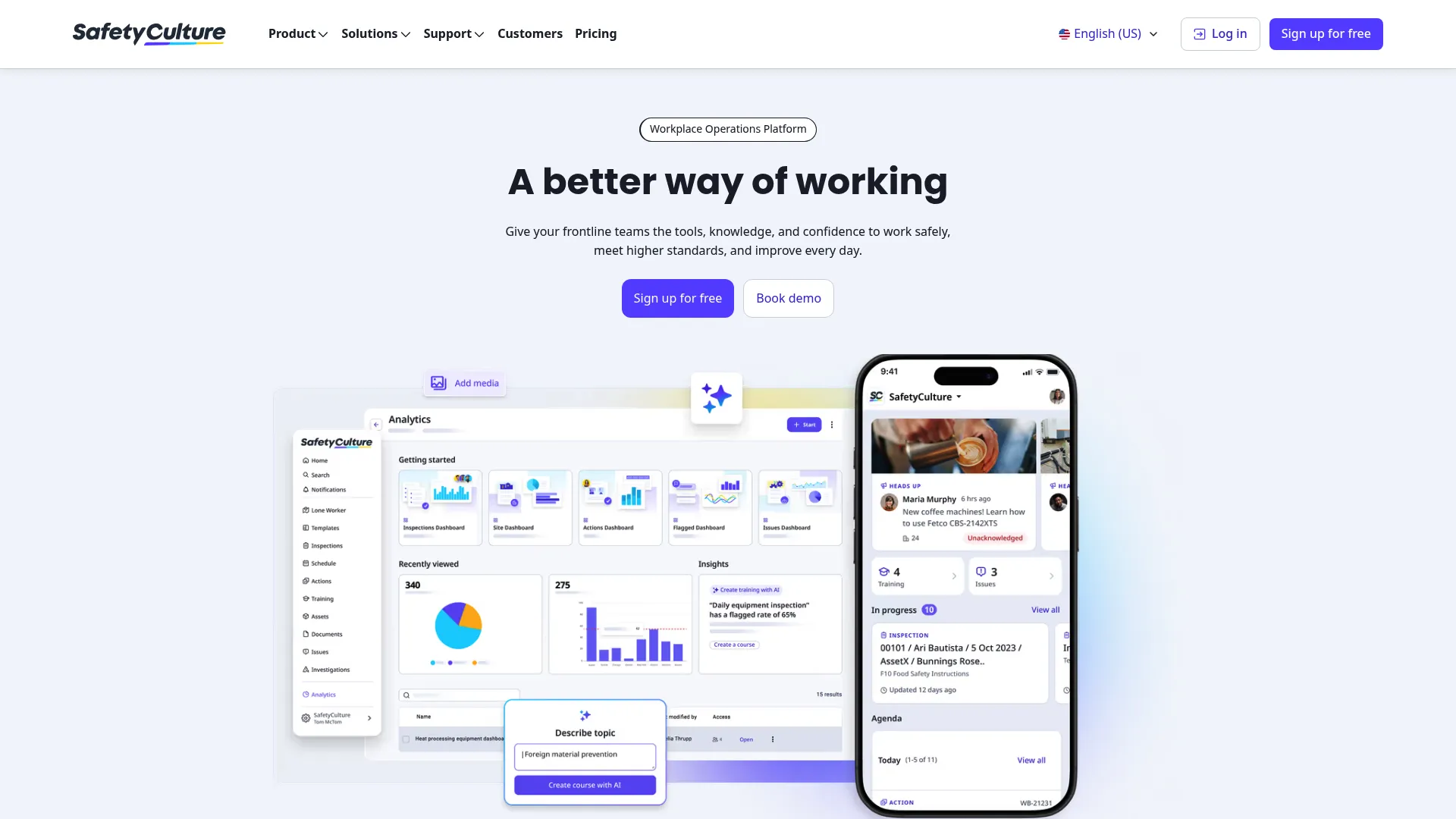
SafetyCulture is a workplace operations platform known for making inspections and checklists fast to adopt. It digitizes audits and inspections, schedules recurring checks, routes actions and issue reports, and layers on training and analytics. The mobile-first design means teams can start capturing standardized processes on day one without a long rollout.
Where heavier platforms ask for structured implementation, SafetyCulture leans into operational simplicity. That makes it a common pick for teams that prioritize speed and want inspections running before a quarter-long deployment.
Best for: Teams that need mobile-first inspections, audits, and operational checklists with fast adoption.
Key strengths
- Template-driven inspections: A large library of digitized checklists gets audits and inspections live quickly, with custom templates for site-specific needs.
- Actions and issue reporting: Findings convert to assigned actions with scheduling, so follow-up does not depend on memory.
- Training and analytics: Built-in training delivery and dashboards connect frontline capture to management visibility.
Why choose SafetyCulture: When the priority is getting standardized process capture into the hands of field teams fast, SafetyCulture removes friction from adoption. It fits operations-led teams that want inspections, actions, and training working together without a complex compliance build.
SafetyCulture pricing: A free plan supports up to 10 seats. The Premium plan is $24 per seat per month, Lite seats start at $5 per seat per month when billed annually, and Enterprise is custom. That public, tiered pricing is unusual in this category and helps smaller teams start without a sales cycle. SafetyCulture holds a 4.6/5 rating on G2.
4. KPA EHS Software
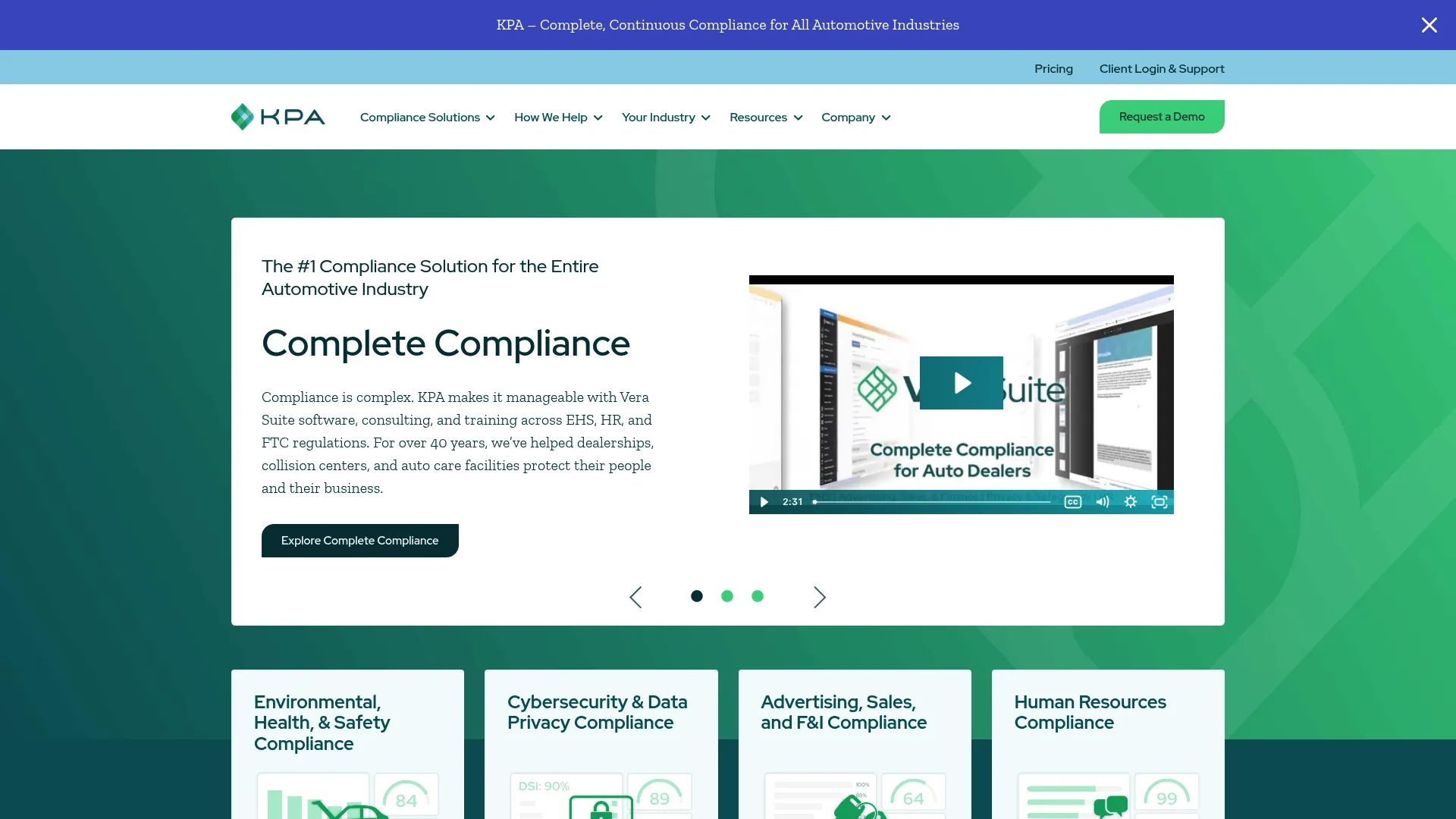
KPA EHS Software is a configurable EHS compliance software platform aimed at operations-led teams with heavy regulatory obligations. It pairs a federal and state compliance library with automated compliance audits and incident management, and its mobile app lets frontline workers report issues and reach compliance tools on site. KPA also brings training and consulting alongside the software, which appeals to teams that want a program partner, not just a login.
The platform is a strong fit where compliance governance is the priority and workflows need structure rather than open-ended flexibility.
Best for: Automotive and auto-adjacent businesses needing EHS compliance software plus training and consulting support.
Key strengths
- Compliance library: Built-in federal and state regulatory content keeps obligations current without manual research.
- Automated audits: Scheduled, structured audits reduce the manual load of staying inspection-ready.
- Mobile issue reporting: Field workers log incidents and reach compliance tools directly from a phone.
Why choose KPA EHS Software: For teams in regulated, ops-heavy industries, KPA combines software with the training and consulting layer that keeps a program compliant over time. It fits organizations that want structured workflows and safety governance rather than a fully open, build-it-yourself platform.
KPA EHS Software pricing: KPA uses custom pricing. You select solutions, book a demo, and receive a tailored quote, with no public numeric price listed. On G2, the product family (listed as Novara Flex/KPA Flex) holds a 4.7/5 rating.
5. CorityOne
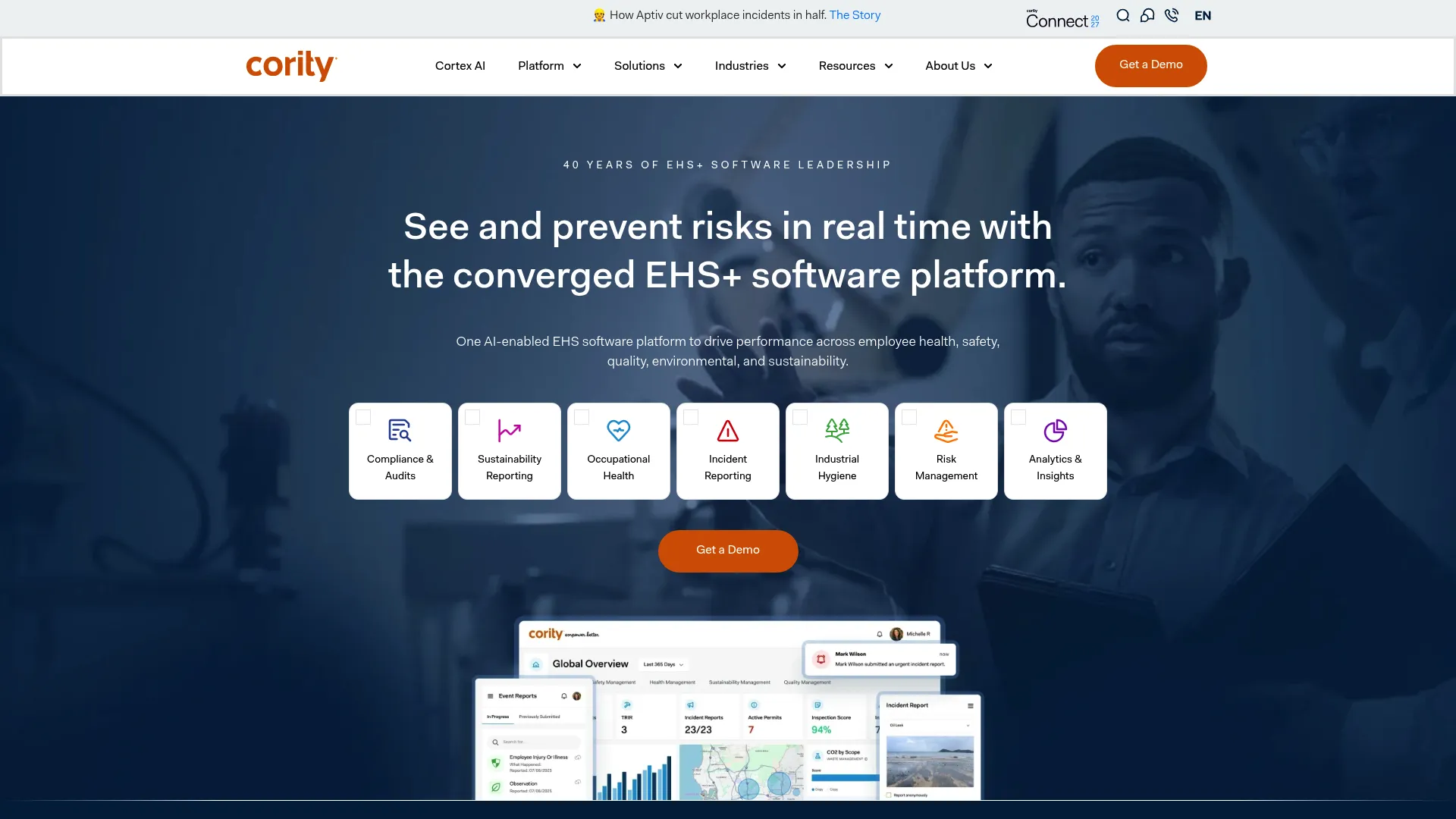
CorityOne is an enterprise EHS+ platform that spans safety, occupational health, environmental, quality, and sustainability. Its Cortex AI layer supports analysis across those domains, and the platform is built for large organizations that need configurable workflows and deep reporting. Occupational health is a genuine differentiator here, which matters for industries where medical surveillance and hygiene monitoring are core compliance requirements.
The platform fits regulated environments where a single system has to serve many stakeholders and produce audit-grade reporting on demand.
Best for: Large organizations that need a configurable enterprise EHS+ platform with strong occupational health coverage.
Key strengths
- Unified EHS+ scope: Safety, health, environmental, quality, and sustainability run in one configurable platform.
- Cortex AI: Applies analytics across the EHS+ data set to surface risk and reporting insights.
- Occupational health depth: Medical surveillance and hygiene workflows support regulated, health-heavy industries.
Why choose CorityOne: If your compliance profile includes occupational health and complex regulatory reporting, CorityOne offers the breadth and configurability enterprises need. It fits larger teams that value depth over quick setup and want one platform to govern risk across many functions.
CorityOne pricing: Cority uses request-a-demo and contact-sales flows, with no public price displayed. Plan on a quote-based enterprise engagement. CorityOne holds a 3.9/5 rating on G2.
6. Enablon

Enablon, part of Wolters Kluwer, is an integrated risk-management platform that unifies EHS, ESG, and operational risk. It is built for large enterprises running complex, multi-site programs where governance and reporting cannot be fragmented. The SaaS platform is cloud-native, with analytics, APIs, and a configurable enterprise framework that adapts to established processes rather than forcing new ones.
The value here is consolidation at scale: one platform connecting EHS with sustainability and operational risk, so leadership sees the full risk picture in one place.
Best for: Large enterprises that need a configurable EHS, ESG, and operational risk platform in one system.
Key strengths
- Integrated risk workflows: EHS, ESG, and operational risk share one platform, so reporting spans the full risk profile.
- Configurable enterprise framework: Adapts to complex, established processes across many sites and business units.
- Analytics and APIs: Cloud-native architecture connects EHS data to the broader enterprise data stack.
Why choose Enablon: For multinationals that treat EHS, sustainability, and operational risk as one governance mandate, Enablon consolidates them into a single reporting layer. It fits complex organizations that need enterprise-grade configurability and cross-domain visibility over fast, out-of-the-box setup.
Enablon pricing: Pricing is not publicly displayed; the site routes to request-a-demo and contact-sales flows, consistent with enterprise procurement. A verified G2 rating for the Enablon Platform product was not available at publication, so we have omitted it rather than estimate.
7. Intelex
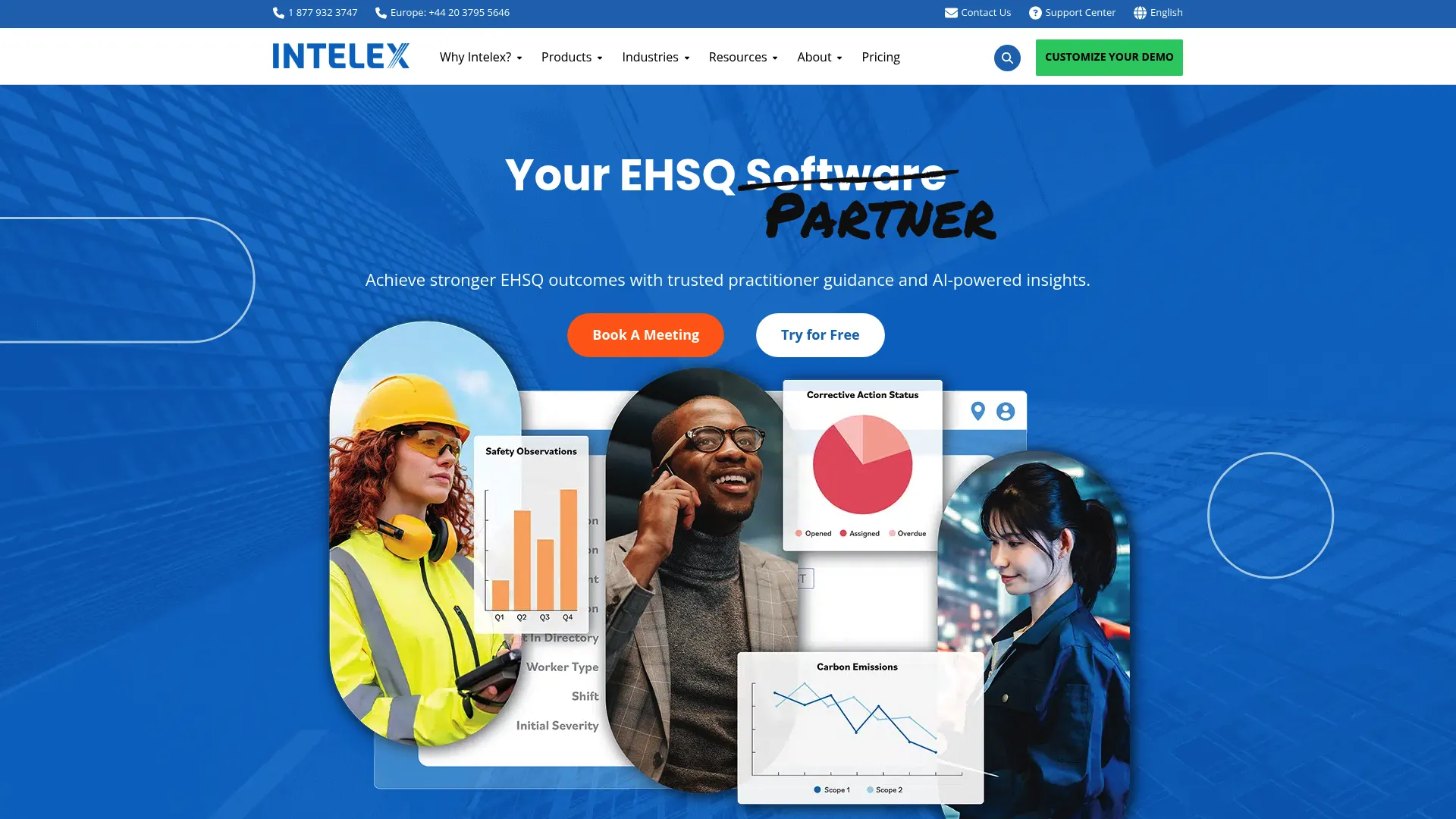
Intelex provides configurable EHSQ software for managing safety, compliance, incidents, audits, and reporting. Its strength is process standardization: incident management and near-miss reporting, audits and inspections with corrective actions, and dashboards that track compliance across the organization. The configurable workflows appeal to companies that want to shape the system around their processes rather than adapt to a rigid template.
Intelex sits in a practical middle ground, offering broad EHS coverage with the depth of an enterprise platform and clearer entry-tier pricing than most.
Best for: Organizations that need enterprise EHSQ management with configurable workflows and compliance tracking.
Key strengths
- Incident and near-miss management: Structured reporting captures the full range of safety events, not just recordables.
- Audits and corrective actions: Inspections tie directly to corrective actions, closing the loop on findings.
- Dashboards and analytics: Compliance tracking and reporting give leadership a consistent operating view.
Why choose Intelex: If you want configurable workflows and broad EHS coverage without a fully custom enterprise build, Intelex offers a balanced path. It fits companies that value process standardization and want a published starting price to anchor the evaluation.
Intelex pricing: The public Safety Essentials plan starts at $44 per user per month, billed annually with a 25-user minimum. Additional plans are quote-based. There is no free tier. Intelex holds a 4.0/5 rating on G2.
8. Benchmark Gensuite
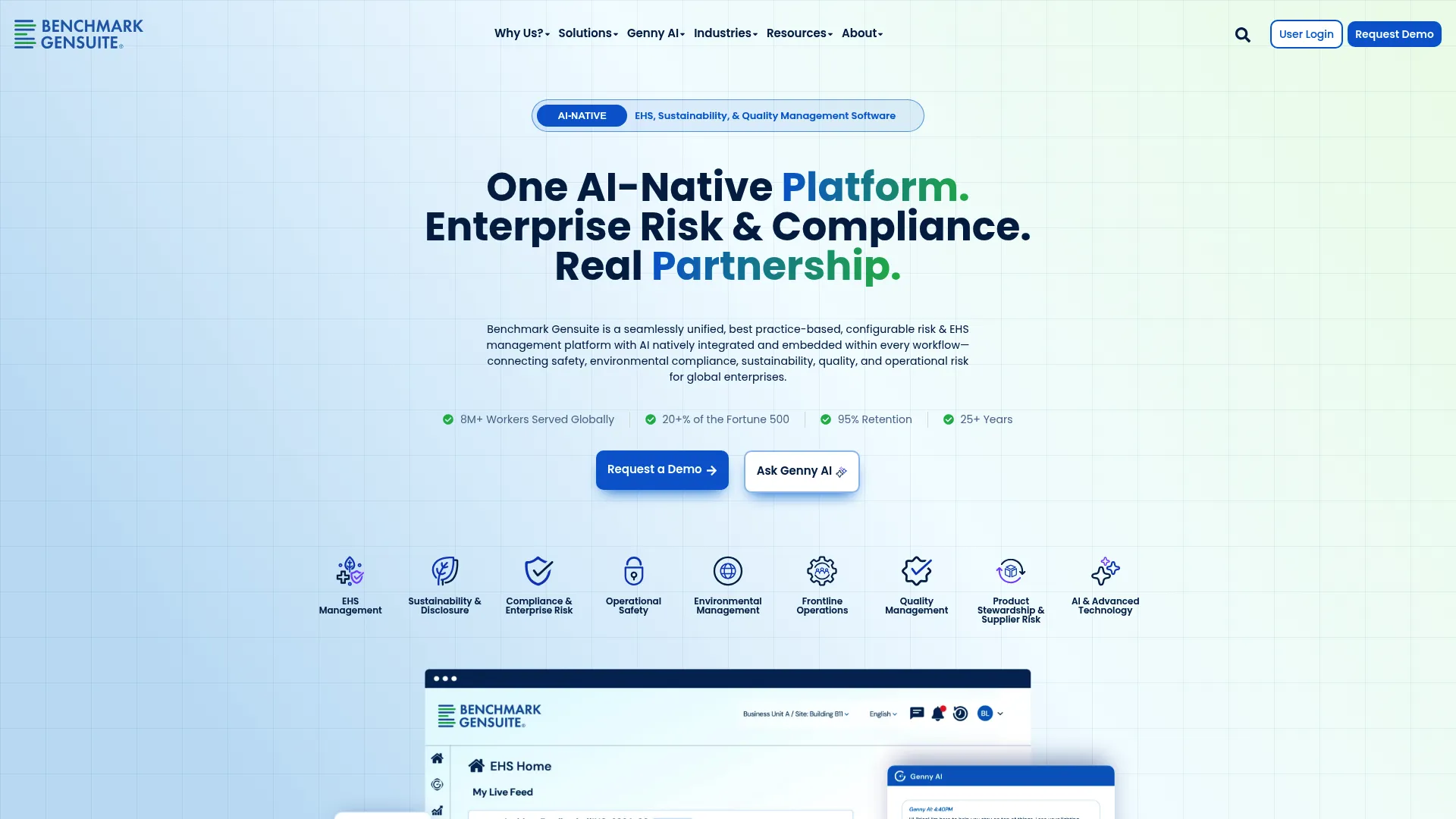
Benchmark Gensuite is an AI-native EHS, sustainability, quality, and enterprise risk management platform built for global organizations. Its Genny AI is embedded across workflows rather than bolted on, and the platform pairs that with dashboards, analytics, and reporting for program-wide visibility. The breadth suits large teams that need integrated reporting across safety, risk, and compliance in one system.
For enterprises managing many sites and business units, the platform's configurability and AI layer aim to reduce the manual overhead of running a large EHS program.
Best for: Large enterprises that need configurable EHS and compliance workflows with analytics and embedded AI.
Key strengths
- Genny AI across workflows: AI is embedded throughout the platform, assisting with everyday EHS and compliance tasks.
- Unified EHS, sustainability, and quality: One platform covers safety, sustainability, and quality for program-wide visibility.
- Dashboards and reporting: Analytics give leadership integrated visibility across sites and functions.
Why choose Benchmark Gensuite: For global enterprises that want AI woven into daily EHS work and a single platform spanning safety, sustainability, and quality, Benchmark Gensuite delivers integrated program visibility. It fits large teams that need configurable workflows and cross-functional reporting at scale.
Benchmark Gensuite pricing: Pricing is not publicly displayed; the site routes to a demo request, consistent with enterprise sales. Benchmark Gensuite holds a 4.0/5 seller rating on G2.
Considerations before you buy
The right EHS software depends less on feature counts and more on how the platform fits your operational reality. Use this checklist to pressure-test any shortlist.
Platform breadth versus point depth
Decide whether you need a broad platform or a focused tool. If your risk spans chemicals, ergonomics, and occupational health, a unified platform like VelocityEHS or CorityOne reduces integration headaches. If inspections are the core need, a focused tool can win on adoption speed.
Mobile and offline usability
Field teams do not always have connectivity. If frontline workers log incidents and run audits and inspections on site, verify offline mobile support and how cleanly data syncs. This is where EHS Insight and SafetyCulture stand out.
Compliance and reporting depth
Confirm the platform maintains a current regulatory library and produces the exact regulatory reporting your auditors expect. EHS compliance software should let you export a full incident and action history in minutes, not days.
Analytics and G2 ratings
Look past feature lists to dashboard quality and how the tool surfaces leading indicators. Cross-check vendor claims against verified G2 ratings and reviews from teams in your industry. A high rating with relevant reviewers is a stronger signal than any marketing page.
Total cost and pricing model
Most EHS software companies use quote-based pricing, so budget for a sales cycle. Where public pricing exists, like SafetyCulture, EHS Insight, and Intelex, use it to anchor negotiations and understand seat versus module economics.
Conclusion
The decision rule is simple. If you need unified workflows across safety, chemical management, ergonomics, and risk management, platform breadth matters most, and VelocityEHS, CorityOne, Enablon, and Benchmark Gensuite are built for that scale. If speed of adoption and mobile inspections are the priority, SafetyCulture and EHS Insight get field teams productive fast. If compliance governance leads your requirements, KPA EHS Software and Intelex bring structured workflows and strong compliance depth.
The practical next step: shortlist two or three tools that match your operational complexity, then compare them on the workflows that actually drive risk down. Run the same incident, the same inspection, and the same compliance report through each, and see which platform gives your team the cleanest operating view with the least manual effort. That side-by-side test tells you more than any feature matrix. Pick the platform that turns fragmented safety data into decisions you can defend.
FAQs
EHS software centralizes environmental, health, and safety programs so teams can report incidents, run audits and inspections, track corrective actions, manage training, and produce regulatory reporting from one system. It replaces spreadsheets and paper forms with structured workflows and shared visibility, reducing missed follow-ups and compliance gaps.
Look for incident management, audits and inspections, action management, training tracking, compliance and regulatory reporting, and dashboard and analytics. A serious platform connects these so a single incident automatically feeds the action log and the compliance report. Mobile and offline access matters if you have field teams.
Prioritize platform breadth, configurable workflows, and reporting that rolls up across locations into one dashboard. Confirm mobile and offline usability for field staff, check that the regulatory library covers your jurisdictions, and validate vendor claims against G2 ratings and reviews from your industry. Then run a side-by-side test on real workflows.
Yes. Field teams often work where connectivity is poor, so offline mobile capture is the difference between complete data and missing data. Tools like EHS Insight and SafetyCulture let workers log incidents, run inspections, and reach compliance tools on site, then sync automatically when back online.
Safety management software focuses mainly on workplace safety, incidents, and inspections. EHS software is broader, adding environmental compliance, occupational health, chemical management, and often sustainability. Many platforms in this guide cover both, so the distinction is largely about scope: safety-only versus a full environmental health and safety software suite.
Most EHS software companies use quote-based pricing tied to modules, employee count, and implementation needs. Where public pricing exists, SafetyCulture offers a free plan and Premium at $24 per seat per month, EHS Insight starts at $5,000 per year for its SMB solution, and Intelex Safety Essentials starts at $44 per user per month with a 25-user minimum.
Manufacturing, construction, energy, chemicals, transportation, healthcare, and automotive are heavy users because they carry significant regulatory obligations and physical risk. Any organization with multiple sites, contractor safety requirements, or complex regulatory reporting benefits from centralizing incident management and audits and inspections in one platform.
Yes. EHS compliance software maintains regulatory libraries, tracks obligations, controls documents, and generates the reports auditors and regulators expect. The strongest platforms let you export a full incident and corrective-action history in minutes, turning compliance from a periodic fire drill into a routine part of daily operations.