


Most associations run on a stack that was never designed to work together. Membership records live in a spreadsheet. Dues get chased through email and a separate payment processor. Event registration sits in a third tool. Renewals slip because nobody owns the reminder. Reporting means exporting four files and hoping the numbers reconcile.
That patchwork costs staff hours every week, and it hides the data leaders actually need to defend budgets and prove member value.
Association management software fixes the root problem: it centralizes membership, dues, events, portals, reporting, and finance into one system of record. The category is growing fast for a reason. The global association management software market reached about $2.61B in 2025 and is forecast to hit $4.64B by 2030 at an 11.8% CAGR, according to The Business Research Company (2026). Cloud-based platforms already held 72.62% of the market in 2025, per Mordor Intelligence (2026), which tells you where the buying is heading.
If you are evaluating vendors, the same consolidation logic applies whether you are choosing an AMS, a CRM, an event management platform, or a community management tool. The question is always "what does this replace, and does the data finally live in one place?" This guide answers that for AMS specifically.
What's inside
This guide covers the eight best association management software tools for 2026, chosen for the operational realities associations actually face. We ranked and described each platform against four criteria: membership and dues management, event and conference tooling, reporting and analytics depth, and vendor fit across usability, pricing transparency, and support.
Every pricing figure and G2 rating here is pulled from the vendor's own pricing page or live G2 listing. Where a vendor keeps pricing behind a sales conversation, we say so rather than guess. The goal is a buyer's guide, not a feature dump, so each entry tells you which association profile it fits best.
TL;DR
- Best for large, complex associations: iMIS, for enterprise-grade membership, reporting, and integrations.
- Best for Salesforce-based orgs: Fonteva, built natively on Salesforce for teams already standardized on that platform.
- Best for small teams and clubs: WildApricot, with contact-based pricing and a 60-day free trial.
- Best for QuickBooks-centric finance: Novi AMS, with two-way QuickBooks sync built in.
- Best all-in-one for chambers and associations: GrowthZone, with public entry pricing and strong engagement tooling.
- Best for complex membership structures: MemberSuite, for orgs that have outgrown simpler tools.
Background: what is association management software?
Association management software (AMS) is a centralized platform that runs the core operations of a membership organization: member records, dues, events, self-service portals, accounting, reporting, and automation, all in one system.
Think of it as the association equivalent of an ERP. Instead of stitching together a database, a billing tool, an events app, and a website, an association management system holds the whole member lifecycle in a single place with one source of truth.
Most AMS software includes a consistent set of building blocks:
- Membership database: a central record for every member, chapter, company, and contact, with segmentation and history.
- Dues management: recurring billing, renewals, invoicing, proration, and lapsed-member workflows.
- Event management: registration, sessions, abstracts, sponsorships, badges, and exhibitor tools.
- Member portal: self-service login where members update profiles, renew, register, and access benefits.
- Financial management and payment processing: invoicing, revenue recognition, and integrated payments or accounting sync.
- Reporting and analytics: dashboards for retention, renewals, revenue, and engagement.
- Automation and workflows: renewal reminders, onboarding sequences, and status-based triggers.
- Integrations: connections to email, accounting, community, and analytics tools.
Professional associations led the market with a 32.85% revenue share in 2025, per Mordor Intelligence (2026), which shaped how most of these platforms prioritize dues cycles, chapters, and certification workflows.
AMS vs CRM: what is the difference?
This is the most common point of confusion in the category. A CRM tracks relationships and pipeline. It is built for sales motions, deals, and contact history. An AMS is built for association-specific workflows a generic CRM never handles natively: dues renewals, chapter management, event registration, member portals, and non-dues revenue.
Some associations try to force a CRM to behave like an AMS and end up with heavy custom builds. Others run both. The right answer depends on your data model and workflows, which we cover in the FAQs below.
When to use association management software
Centralize membership and dues
Spreadsheets and generic CRMs work until they don't. The tipping point usually hits when renewals start slipping through the cracks, when you cannot answer "how many members lapsed last quarter and why" without a manual export, or when dues billing depends on one person remembering to send invoices.
An AMS automates renewals, recurring dues, proration, and lapsed-member outreach, and keeps every member record current in one place. That is the difference between reactive admin and a system that runs itself.
Run events, conferences, and exhibits
Associations live on recurring events. When you are managing registration, session scheduling, abstract submissions, sponsorship packages, badge printing, and exhibitor booths across separate tools, the reconciliation alone eats days.
An AMS with strong event management ties registration directly to member records and billing, so an event registrant is instantly linked to their membership status, discounts, and payment history. That connection is what standalone event tools cannot replicate.
Improve reporting and member experience
Leaders eventually need answers, not spreadsheets. When the board asks about retention trends, non-dues revenue, or engagement by chapter, you need dashboards that pull from live data, not a monthly export ritual.
Members expect the same self-service ease they get everywhere else: mobile-first portals, one-click renewal, and instant access to benefits. Better member experience drives retention, and better reporting frees staff to work on strategy instead of data cleanup.
Comparison table
Here is how the eight platforms compare on intent, primary use case, verified pricing, and current G2 rating. Tools are sorted by relevance to larger, more complex association needs first, then by fit for leaner teams.
| # | Product | Intent | Key use case | Pricing | G2 rating |
|---|---|---|---|---|---|
| 1 | iMIS | Enterprise AMS | All-in-one membership and engagement for complex orgs | From $7,200/yr (Professional) | 4.2/5 |
| 2 | Fonteva | Salesforce-native AMS | Membership and events for Salesforce-based orgs | Custom (annual license) | 4.4/5 |
| 3 | WildApricot | Small-org AMS | Memberships, events, and payments for lean teams | From $66/mo | 3.8/5 |
| 4 | MemberClicks | All-in-one AMS/CRM | Members, events, and communications | Custom quote | 3.8/5 |
| 5 | MemberSuite | Configurable AMS | Complex membership structures and workflows | Custom quote | 4.0/5 |
| 6 | YourMembership | Membership-focused AMS | Engagement and community for small to mid orgs | Custom quote | 3.3/5 |
| 7 | GrowthZone | All-in-one AMS | Associations and chambers of commerce | From $4,000/yr | 4.6/5 |
| 8 | Novi AMS | QuickBooks-native AMS | Membership, events, and accounting sync | From $2,750/mo | 4.8/5 |
1. iMIS
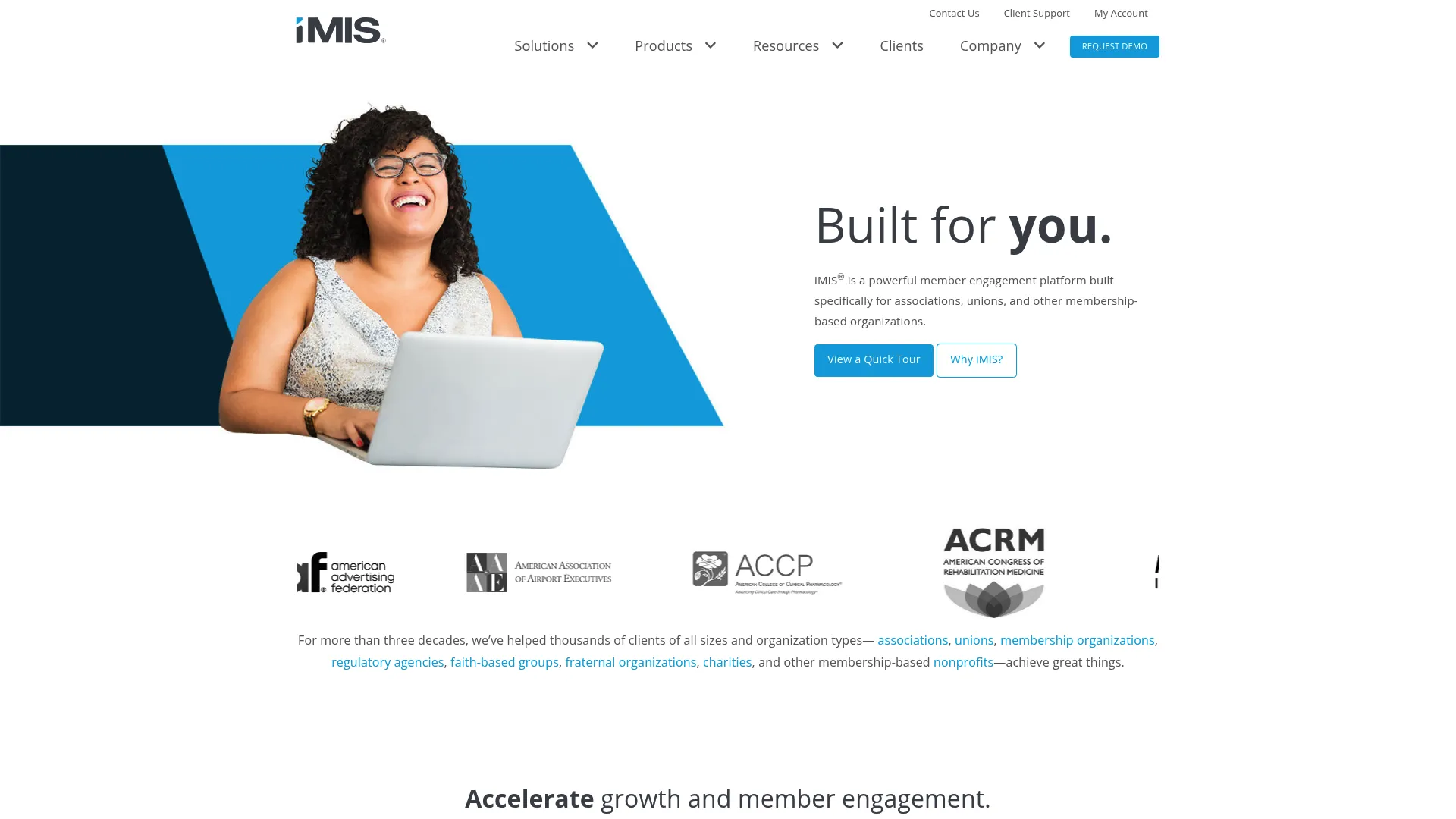
iMIS is an association management software and engagement management system built for member-based organizations that have outgrown lighter tools. It positions itself as an all-in-one platform for associations, unions, and nonprofits, pulling contact management, events, learning, commerce, accounting, and communications into a single system of record.
Best for: Larger, complex associations, unions, and nonprofits that need an enterprise-grade membership and engagement platform.
Key strengths
- Contact and data management: a unified member database that scales across chapters, companies, and complex membership tiers.
- Events, learning, commerce, and accounting: native modules that connect registration, education, non-dues revenue, and finance to member records.
- Communications and automation: built-in messaging, workflows, and AI content assistance to reduce manual staff effort.
Why choose iMIS: iMIS suits associations that need depth over simplicity. If you run multiple revenue streams, chapters, certification programs, and need reporting the board trusts, this is the tier of platform built for that scale. Smaller clubs will likely find it more than they need.
iMIS pricing: iMIS Professional starts at $7,200 USD/CAD per year for a minimum of three users, plus a one-time installation fee starting at $15,000 USD/CAD. iMIS Enterprise pricing is contact-sales only. There is no free tier. iMIS holds a 4.2/5 rating on G2.
2. Fonteva

Fonteva is a Salesforce-native association management platform for membership organizations and events. Because it is built directly on Salesforce, it inherits that platform's reporting, automation, and integration ecosystem, which makes it a natural fit for associations already standardized on Salesforce.
Best for: Associations and membership organizations already running on Salesforce that want their AMS to live inside the same environment.
Key strengths
- Membership management: member records, communities, and portals that sit natively on the Salesforce data model.
- Event management: registration, sessions, and event operations tied directly to member and billing data.
- eCommerce and payments: non-dues revenue, online stores, and revenue accounting within the same platform.
Why choose Fonteva: If your organization already invests in Salesforce, Fonteva lets you avoid a second data silo and reuse the dashboards, permissions, and integrations your team knows. Teams without a Salesforce commitment should weigh the platform cost that comes with it.
Fonteva pricing: Fonteva does not publish public pricing. The site indicates a single annual license fee and directs prospective buyers to contact sales. Fonteva holds a 4.4/5 rating on G2.
3. WildApricot
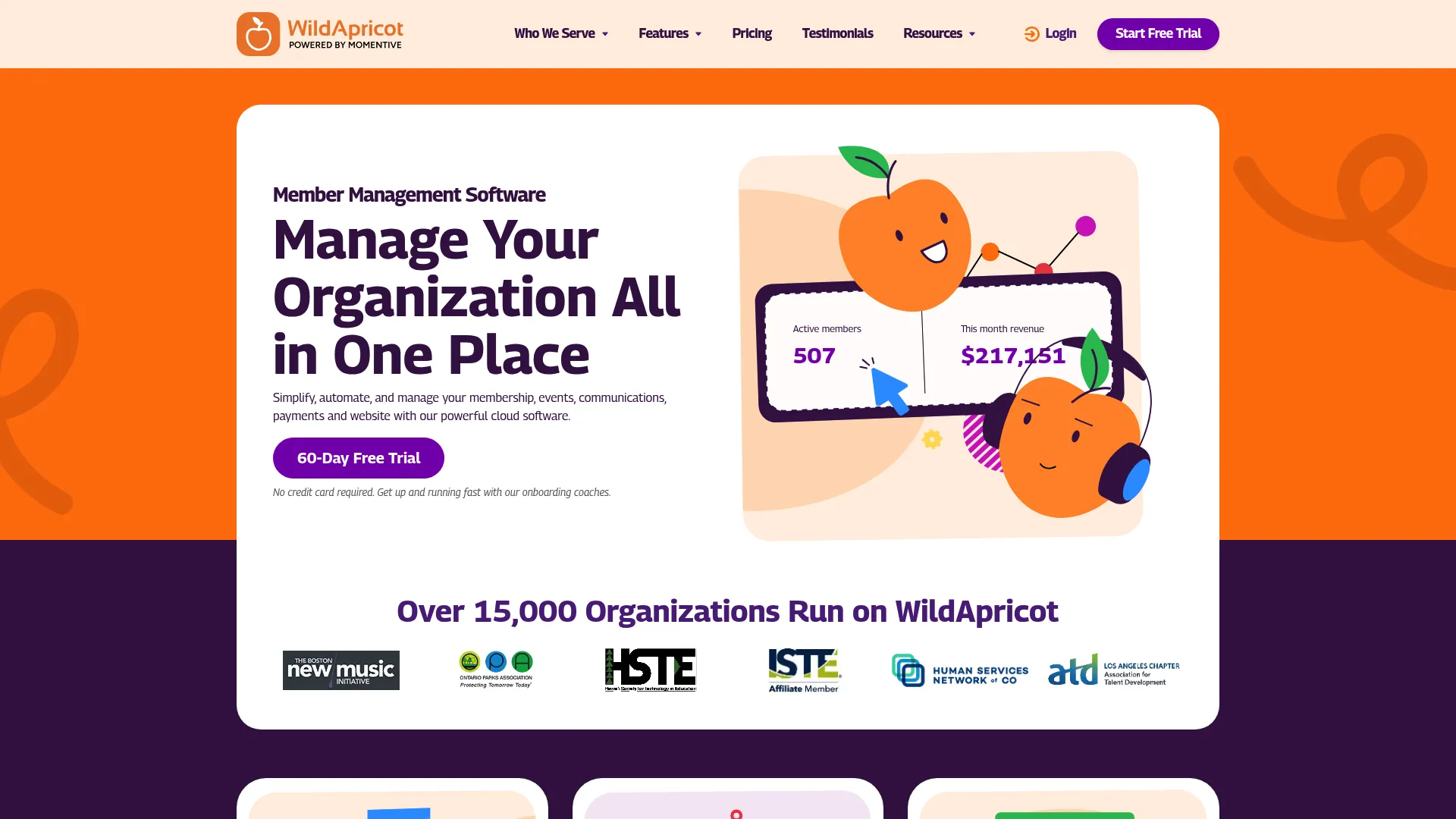
WildApricot is membership management software built for associations, nonprofits, clubs, and other member-based organizations that want a straightforward all-in-one tool without enterprise overhead. It bundles a website builder, member management, and event registration into one accessible package.
Best for: Small to mid-sized membership organizations and clubs that need memberships, events, and communications handled by a lean team.
Key strengths
- Website builder: create and host a member-facing site without a separate CMS or developer.
- Member management: a central contact database with automated renewals and self-service profiles.
- Event registration: online registration and payments linked to member records.
Why choose WildApricot: WildApricot is the practical pick when you have a small staff and a limited budget but still want to retire the spreadsheet-and-email approach. Its contact-based pricing scales with your membership rather than forcing you into an enterprise contract on day one.
WildApricot pricing: Pricing is based on number of contacts. The 100-contact plan starts at $66.00/mo billed monthly, $59.40/mo prepaid for one year, or $56.10/mo prepaid for two years, all in USD. A 60-day free trial is available. WildApricot holds a 3.8/5 rating on G2.
4. MemberClicks
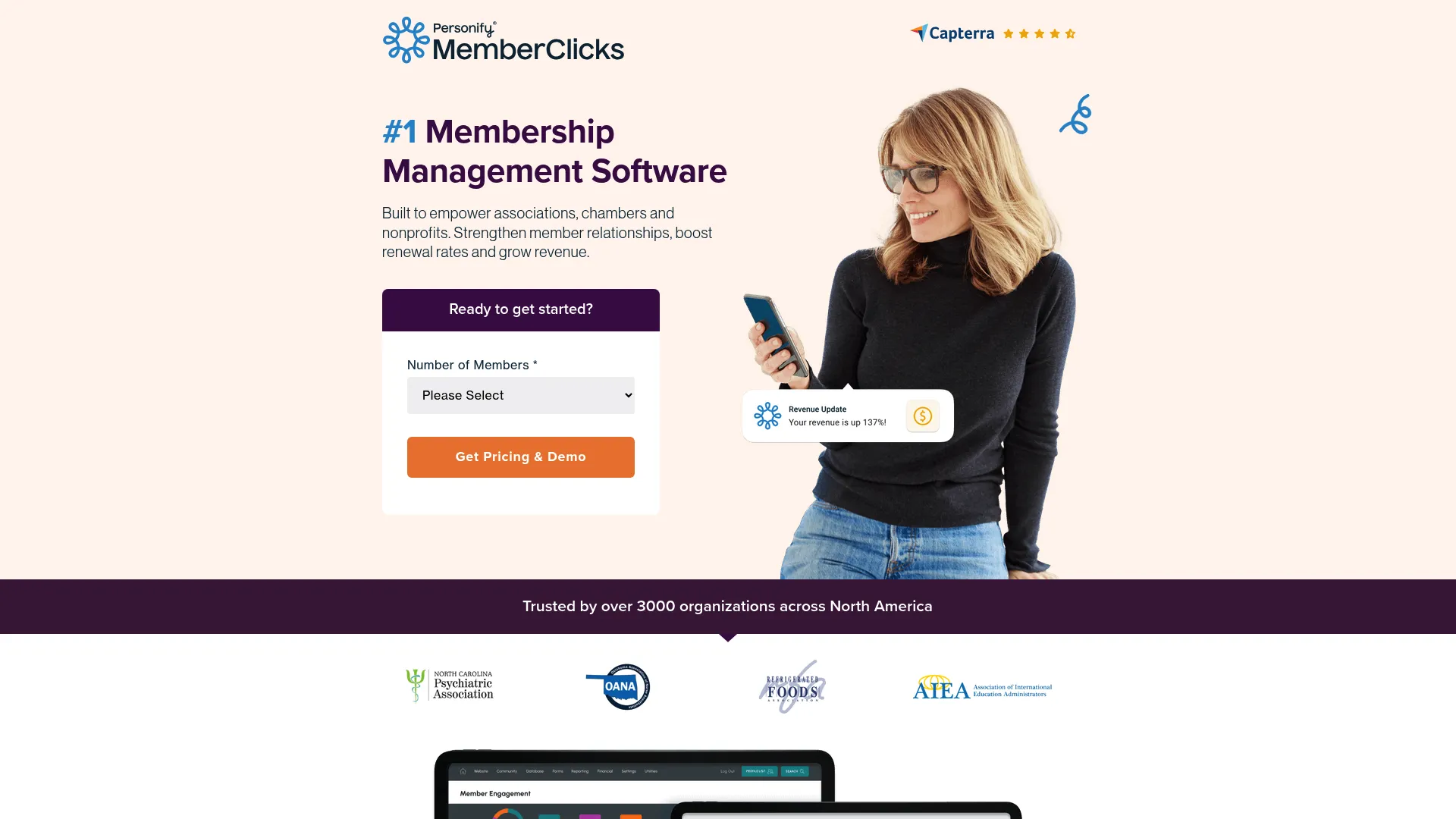
MemberClicks is membership management software for associations, chambers, and nonprofits that want a practical all-in-one AMS and CRM. It focuses on the day-to-day operations most member organizations share: a central member database, event and conference tooling, and communications.
Best for: Member-based organizations that want one system covering members, events, and communications without heavy configuration.
Key strengths
- Membership database: a single record for members, companies, and contacts with segmentation.
- Conference and event management: registration and event operations built for association calendars.
- Email marketing and communications: native messaging to keep members engaged and renewals on track.
Why choose MemberClicks: MemberClicks fits associations and chambers that value administrative efficiency and want a stack that covers the essentials without a long implementation. It is a solid middle ground between lightweight club tools and enterprise platforms.
MemberClicks pricing: MemberClicks does not publish public pricing on its site, using a "Get Pricing & Demo" flow instead. There is no publicly listed free tier. MemberClicks holds a 3.8/5 rating on G2.
5. MemberSuite
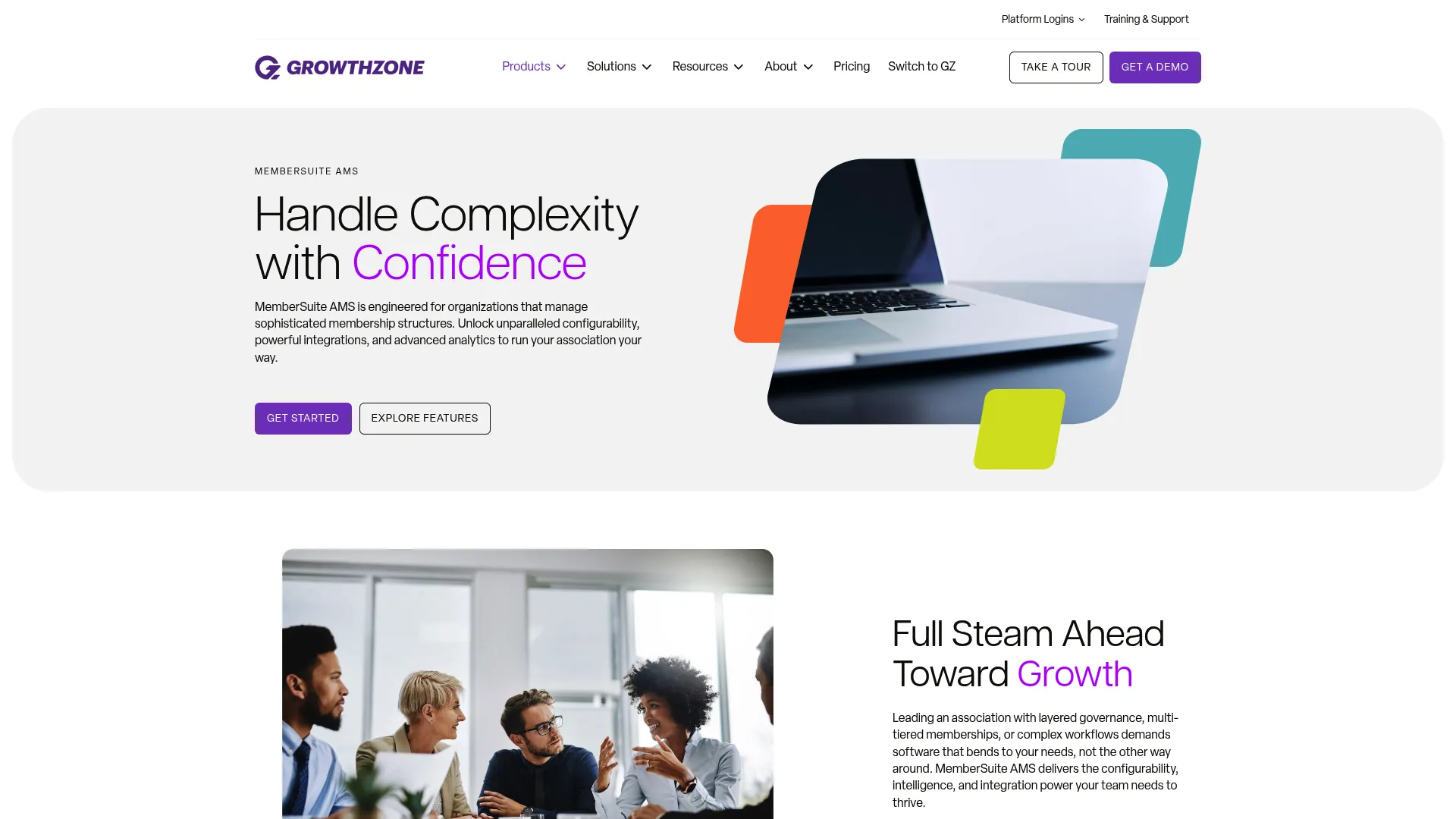
MemberSuite is association management software built for organizations with complex membership structures. It leans into configurability, which makes it a fit for associations whose workflows do not map cleanly onto more opinionated, out-of-the-box tools.
Best for: Mid- to upper-market associations with complex membership and workflow needs that have outgrown simpler platforms.
Key strengths
- Unmatched configurability: adapt membership types, workflows, and processes to your organization rather than the reverse.
- Advanced analytics and built-in data warehousing: deeper reporting and a data layer for organizations that live in their numbers.
- Automated renewals, invoicing, and reporting: dues and finance workflows that run without manual intervention, plus bi-directional API integrations and multi-layered membership management.
Why choose MemberSuite: MemberSuite fits the association that has hit the ceiling of a simpler tool and needs to model genuinely complex membership and revenue structures. The tradeoff is that configurability rewards teams willing to invest in setup. MemberSuite is now part of GrowthZone.
MemberSuite pricing: MemberSuite uses custom, quote-based pricing. The pricing page directs prospects to contact for a custom quote and does not display public plan prices. No free tier is listed. MemberSuite holds a 4.0/5 rating on G2.
6. YourMembership
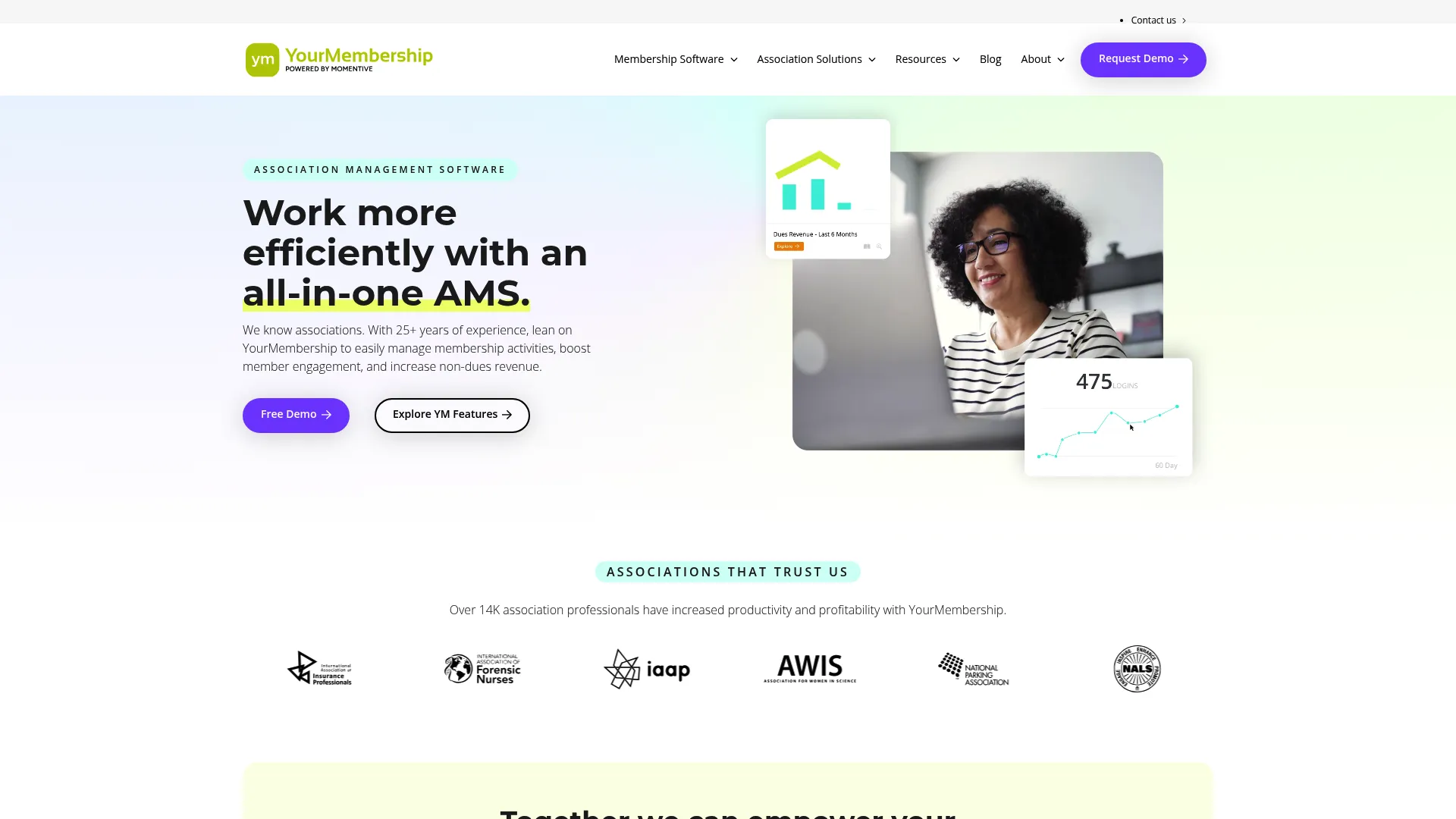
YourMembership is association management software for small to mid-sized member-based organizations, with a strong emphasis on member engagement and community. It targets associations that treat member experience and retention as the core of the operation.
Best for: Small to mid-sized associations and member-based organizations that prioritize engagement and community alongside core administration.
Key strengths
- Membership management: central member records, renewals, and self-service administration.
- Event management: registration and event operations connected to member data.
- Online community: built-in community and networking features that support engagement and retention.
Why choose YourMembership: YourMembership fits associations where member experience is the differentiator, not just a feature. If keeping members engaged between renewals is a strategic priority, the community and engagement tooling is the reason to shortlist it.
YourMembership pricing: YourMembership uses quote-based pricing. The pricing page asks users to request a personalized quote and does not display public prices. YourMembership holds a 3.3/5 rating on G2.
7. GrowthZone
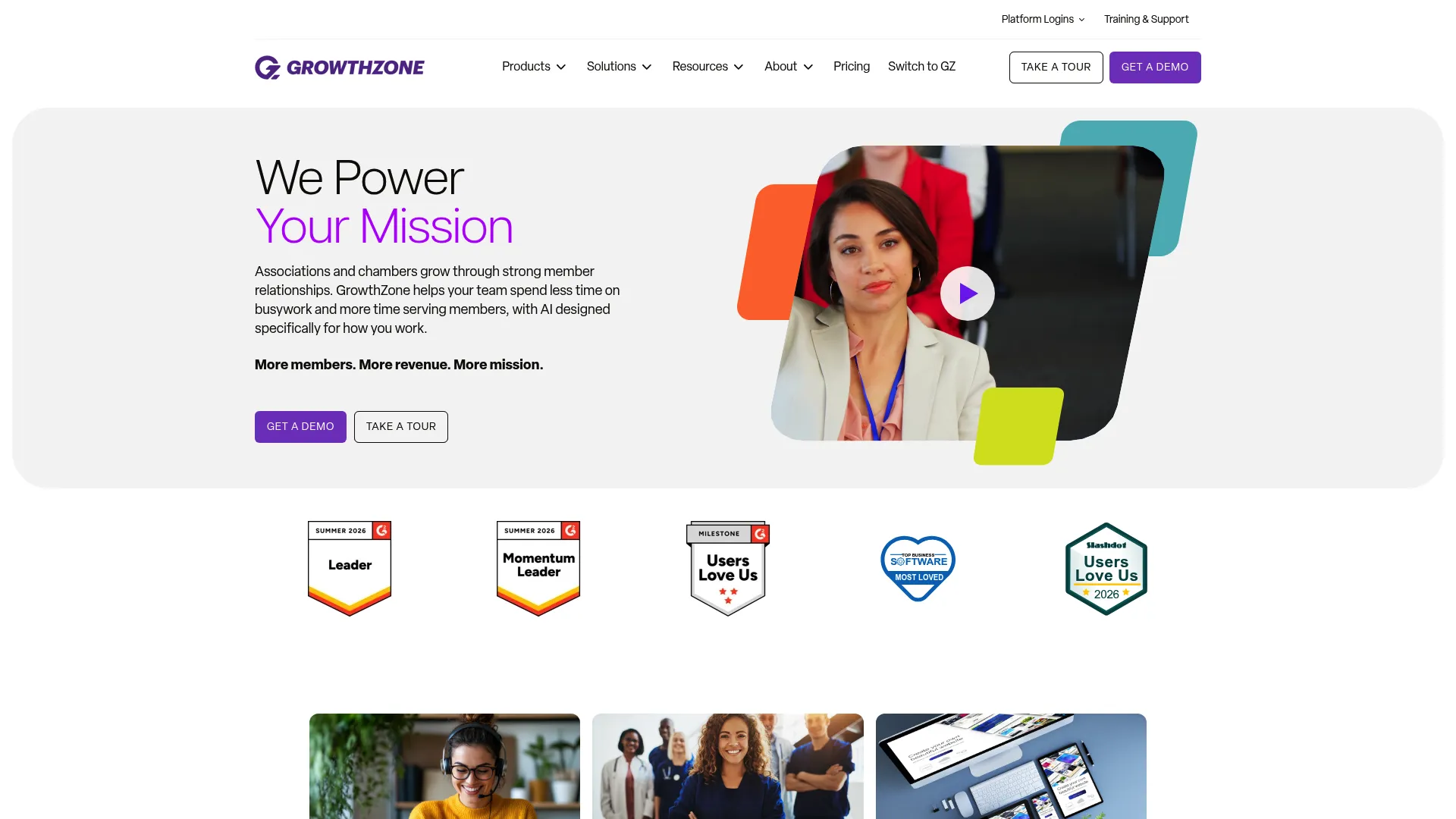
GrowthZone is association management software for associations and chambers of commerce that want integrated operations and engagement in one place. It combines CRM-style contact management, membership, events, and marketing automation, which earns it one of the strongest ratings in this list.
Best for: Associations and chambers that want an all-in-one AMS balancing administrative efficiency with engagement and automation.
Key strengths
- Membership and contact management: a unified database that handles members, prospects, and companies.
- Event management: registration and event operations tied to member records and billing.
- Marketing automation: automated outreach, renewals, and engagement workflows to reduce manual staff effort.
Why choose GrowthZone: GrowthZone belongs on the shortlist for associations that want to balance efficiency and member experience without jumping to enterprise pricing. Its public entry price and high G2 rating make it easy to evaluate before committing.
GrowthZone pricing: GrowthZone AMS starts at $4,000.00 per year. The pricing page also lists Starter, Engage & Grow, and Enterprise package names without public prices for those tiers. There is no free tier. GrowthZone holds a 4.6/5 rating on G2.
8. Novi AMS
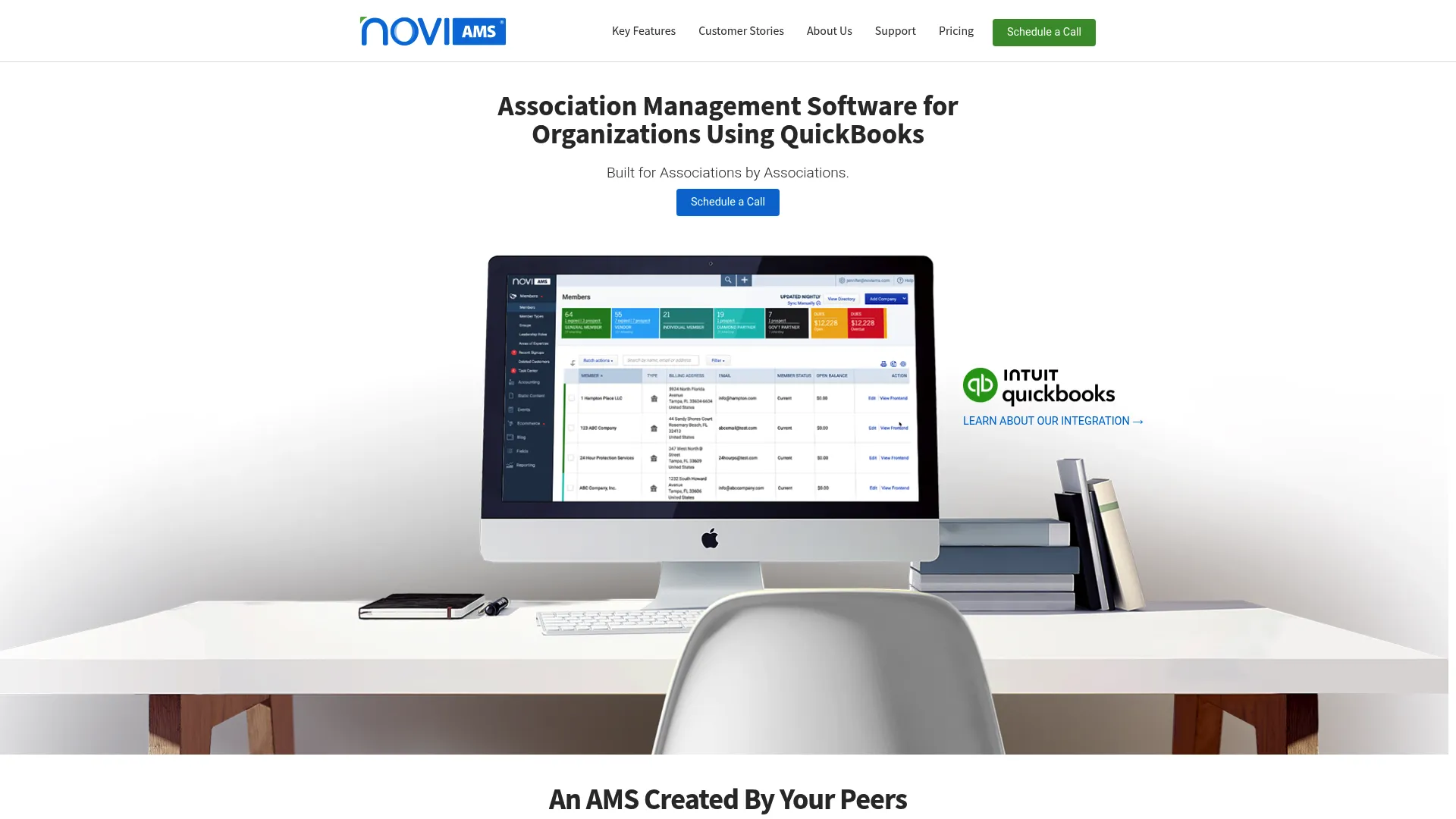
Novi AMS is association management software built around membership, events, accounting, website, ecommerce, and communications, with a standout differentiator: deep QuickBooks integration. It is the AMS for associations whose finance operations already run on QuickBooks and want their member data to sync cleanly with it.
Best for: Associations that need an AMS with tight QuickBooks integration plus built-in events, membership, and website tools.
Key strengths
- Two-way 24/7 QuickBooks sync: membership, dues, and revenue data stay reconciled with your accounting in real time.
- Membership database and events manager: segmentation, ticketing, and event operations linked to member records.
- White-label website and ecommerce: a member-facing CMS plus commerce and communication tools in one platform.
Why choose Novi AMS: If QuickBooks is the backbone of your finance operation, Novi AMS removes the manual reconciliation that plagues associations using disconnected accounting. It holds the highest G2 rating in this list, which reflects strong customer sentiment.
Novi AMS pricing: The publicly shown Novi Advanced plan starts at $2,750/mo billed annually, with subscriptions based on organizational annual revenue, plus a one-time onboarding fee of $13,900. There is no free tier. Novi AMS holds a 4.8/5 rating on G2.
Considerations before you buy
The right AMS depends less on feature checklists and more on how a platform fits your operational reality. Run every shortlisted vendor through these criteria.
Membership and dues fit
Map your actual membership model before demos. Individual, organizational, chapter-based, tiered, and lapsed-member workflows all behave differently across platforms. Ask how the AMS handles proration, auto-renewal, and grace periods, because those edge cases are where generic tools break.
Financial operations and payments
Decide whether you need native accounting, integrated payment processing, or a sync to an existing system like QuickBooks. Misaligned finance handling creates reconciliation work that never goes away. Confirm how revenue recognition and non-dues revenue are tracked.
Reporting and analytics depth
You need dashboards leadership trusts, not raw exports. Evaluate whether reporting is live, segmentable by chapter and member type, and exportable for the board. Weak reporting is the most common reason associations replace an AMS within three years.
Implementation, support, and total cost
Look past the sticker price. Installation fees, onboarding costs, minimum seat counts, and support tiers all move the real number. Ask for a full first-year cost, migration timeline, and what support looks like after go-live.
Conclusion
The pattern across this list is clear: match the platform to your size, complexity, and finance stack, not to the longest feature list.
Large, complex associations with multiple revenue streams and chapters gravitate toward iMIS or Fonteva, especially if Salesforce is already in the picture. Mid-market organizations with complex membership structures should look hard at MemberSuite and GrowthZone. Small teams and clubs get the fastest time-to-value from WildApricot, while YourMembership rewards associations that lead with community and engagement. If QuickBooks runs your finances, Novi AMS is the cleanest fit.
Your next step: shortlist two or three platforms that match your membership model and finance stack, then book demos with a written list of your hardest edge cases. The tool that handles your renewals, chapters, and reporting without custom work is the one worth buying.
FAQs
Association management software (AMS) is a centralized platform that runs the core operations of a membership organization, including member records, dues, events, portals, accounting, reporting, and automation. It is used by professional and trade associations, nonprofits, chambers of commerce, unions, and clubs that need one system of record instead of a patchwork of disconnected tools.
A CRM tracks relationships and sales pipeline, built around contacts, deals, and activity history. An AMS handles association-specific workflows a generic CRM does not natively support: dues renewals, chapter management, event registration, member portals, and non-dues revenue. The distinction matters because forcing a CRM to behave like an AMS usually means expensive custom development.
Prioritize membership and dues management, event management, reporting and analytics, automation and workflows, payment processing, and integrations with your existing tools. The right feature set depends on your membership model and finance stack, so weight the features that map to your actual workflows rather than the longest list.
Pricing varies widely by organization size, modules selected, and support level. Some vendors publish entry pricing, such as WildApricot from $66/mo, GrowthZone from $4,000/yr, iMIS from $7,200/yr, and Novi AMS from $2,750/mo, while others like Fonteva, MemberClicks, MemberSuite, and YourMembership use custom quotes. Factor in one-time installation and onboarding fees, which can add significantly to the first-year total.
Small associations and clubs usually get the best fit from platforms with pricing transparency and fast setup. WildApricot is a common pick thanks to contact-based pricing and a 60-day free trial, while GrowthZone offers a public entry price with strong engagement tooling. Prioritize ease of setup and total cost over enterprise depth you will not use.
Large, complex associations typically need stronger reporting, deeper integrations, and configurability to handle multiple chapters, revenue streams, and certification programs. iMIS is built for that enterprise scale, Fonteva fits organizations standardized on Salesforce, and MemberSuite suits associations with genuinely complex membership structures. The deciding factor is usually how well the platform models your specific workflows.
Some AMS platforms include CRM-like relationship and contact management, and for many associations that is enough to avoid running two systems. The fit depends on your data model and workflows: if your organization has a heavy sales-style motion, you may still want a dedicated CRM. Evaluate whether the AMS can hold both your member operations and your relationship data cleanly.
Focus the demo on your hardest workflows, not the polished happy path. Ask how the platform handles data migration, renewal and dues automation, complex membership structures, event registration tied to billing, mobile and self-service member experience, and reporting the board will actually use. Bring your real edge cases so you see how the AMS behaves under your conditions, not the vendor's.