


A failed audit costs more than the corrective action. It stalls shipments, triggers customer questions, and puts your certification at risk. Yet most food operations still run compliance on binders, spreadsheets, and a plant manager who remembers where the last temperature log went. The global food safety HACCP software market was valued at USD 1.6 billion in 2024 and is projected to reach USD 2.8 billion by 2030, growing at a 9.7% CAGR, according to Strategic Market Research (2024). That growth is not marketing noise. It reflects a real shift: manual recordkeeping does not survive modern audit scrutiny.
If you run a food manufacturing, processing, or multi-site operation, you already feel the drag. Every audit becomes a scramble. Every recall becomes a fire drill. Every new regulation becomes another manual process someone forgets. Food safety software fixes the underlying problem, which is not effort but fragmentation. When your HACCP plans, digital checklists, supplier documents, and temperature logs live in one system, audit readiness stops being an event and becomes a state you maintain by default.
The economics matter too. Around 44% of U.S. food enterprises have deployed AI-enabled safety and compliance tools, and 42% have adopted cloud-hosted HACCP platforms to improve scalability and data access, per Global Growth Insights (2025). The tools below approach food safety compliance software from different angles. Some lead with traceability, some with plant-wide quality, some with pricing transparency for smaller teams. Evaluating them the way you would evaluate any part of your stack means asking one question first: what operational drag does this remove?
What's inside
This guide is for food manufacturers, processors, multi-site operators, and compliance leads comparing food safety software solutions in 2026. We reviewed seven tools that surfaced consistently across buyer research, review platforms, and vendor documentation.
We selected and ranked each tool on four criteria that matter operationally:
- Audit readiness: how well it keeps you inspection-ready without a scramble
- Traceability depth: lot, batch, and supplier tracking for fast recalls
- Implementation effort: how quickly a team gets to first value
- Pricing clarity: whether costs are transparent or quote-gated
We pulled pricing and ratings from first-party pages and G2 where verifiable, and wrote around anything a vendor gates.
TL;DR
- Best for manufacturers wanting AI-native workflows: FoodReady, with an AI HACCP builder and lot traceability.
- Best for modular compliance depth: Smart Food Safe, with a suite you assemble by workflow.
- Best for pricing transparency and smaller teams: FoodDocs, with published per-site plans and a free trial.
- Best for plant-wide manufacturing operations: SafetyChain, with facility-based pricing and production tools.
- Best for regulated enterprise FSMS: Safefood 360°, with deep supplier and audit controls.
- Best for traceability-first buyers: FoodLogiQ Connect, with supplier compliance and recall workflows.
- Best for frontline paperless checklists: Safe Food Pro, with digital forms and temperature monitoring.
These are food safety software solutions for different operating models, not a single winner. Match the tool to your audit burden and traceability needs.
What is food safety software?
Food safety software is a category of food safety management system software that digitizes and centralizes the workflows food businesses use to stay compliant, traceable, and audit-ready. It replaces paper logs, spreadsheets, and disconnected documents with a single system that manages HACCP plans, monitoring, corrective actions, supplier records, and traceability data.
At its core, a food safety management software platform helps food manufacturers, processors, and food service operators meet regulatory and certification requirements while reducing the manual overhead of compliance. It sits at the intersection of quality, compliance, and operations.
Most food safety and quality management software includes a consistent set of capabilities:
- HACCP software: digital hazard analysis, critical control point tracking, and plan building
- FSMA compliance: tools aligned with the FDA Food Safety Modernization Act, including preventive controls
- Digital checklists: paperless forms for sanitation, receiving, and pre-op inspections
- Temperature monitoring: manual or sensor-based logging with automated alerts on excursions
- Traceability software: lot and batch tracking upstream and downstream for food recall management
- Supplier management: approved supplier lists, document requests, and certificate tracking
- Document control: version-controlled SOPs, specifications, and records
- CAPA workflow: corrective and preventive action tracking with accountability
- Audit management: internal and external audit scheduling, evidence collection, and reporting
The strongest platforms also support certification frameworks like SQF software requirements, BRCGS software standards, ISO 22000, and broader GFSI compliance. AI-native food safety software adds automated plan generation, anomaly detection, and document parsing. Around 41% of manufacturers now run real-time monitoring systems and 33% have increased traceability integration for faster recalls, according to Global Growth Insights (2025). The category exists to make audit readiness a continuous state rather than a quarterly panic.
When to use food safety software
Not every operation needs the same depth. Use these patterns to place yourself before you compare tools.
Prepare for and pass audits without the scramble
If your team spends the week before an SQF or BRCGS audit assembling evidence, you need audit management built in. Software keeps records timestamped, version-controlled, and retrievable on demand. Inspection management moves from reactive to continuous, which is the difference between passing and passing comfortably.
Trace product and manage recalls fast
If a contamination event or supplier issue would force you to reconstruct lot history from paper, you need traceability software. Lot traceability that maps ingredients to finished goods turns food recall management from a multi-day reconstruction into a query. For any operation with a complex supply chain, this is the highest-stakes capability.
Replace manual logs and digitize daily compliance
If sanitation checks, receiving logs, and temperature monitoring still run on clipboards, digital checklists remove the transcription errors and missing records that sink audits. Sensor-based temperature monitoring adds automated alerts, so a cooler failure surfaces immediately instead of at the next manual check.
Comparison table
Here is how the seven tools compare on intent, differentiation, pricing, and rating. Pricing and ratings reflect first-party pages and G2 where publicly verifiable. Several vendors gate pricing behind a quote, which is common in food safety compliance software procurement.
| # | Product | Intent | Key differentiation | Pricing | G2 rating |
|---|---|---|---|---|---|
| 1 | FoodReady | Manufacturers wanting AI-native workflows | AI HACCP builder, lot traceability, supplier approvals | Quote-based; free trial | 4.7/5 |
| 2 | Smart Food Safe | Modular compliance and quality | Modular suite, unlimited users, no upfront cost | Quote-based (modular) | 4.6/5 |
| 3 | FoodDocs | Smaller teams needing transparency | Published per-site pricing, fast setup | From $79/site/mo | 4.9/5 |
| 4 | SafetyChain | Plant-wide manufacturing | Facility-based pricing, production and OEE tools | Request pricing (per facility) | 4.5/5 |
| 5 | Safefood 360° | Regulated enterprise FSMS | Deep FSMS and supplier quality controls | Inquiry-based | 4.2/5 |
| 6 | FoodLogiQ Connect | Traceability-first buyers | Supplier compliance, traceability, recall workflows | Contact vendor | 5.0/5 |
| 7 | Safe Food Pro | Frontline paperless compliance | Digital forms, Bluetooth temperature probes | From $102 AUD/site/mo | Rating pending |
1. FoodReady
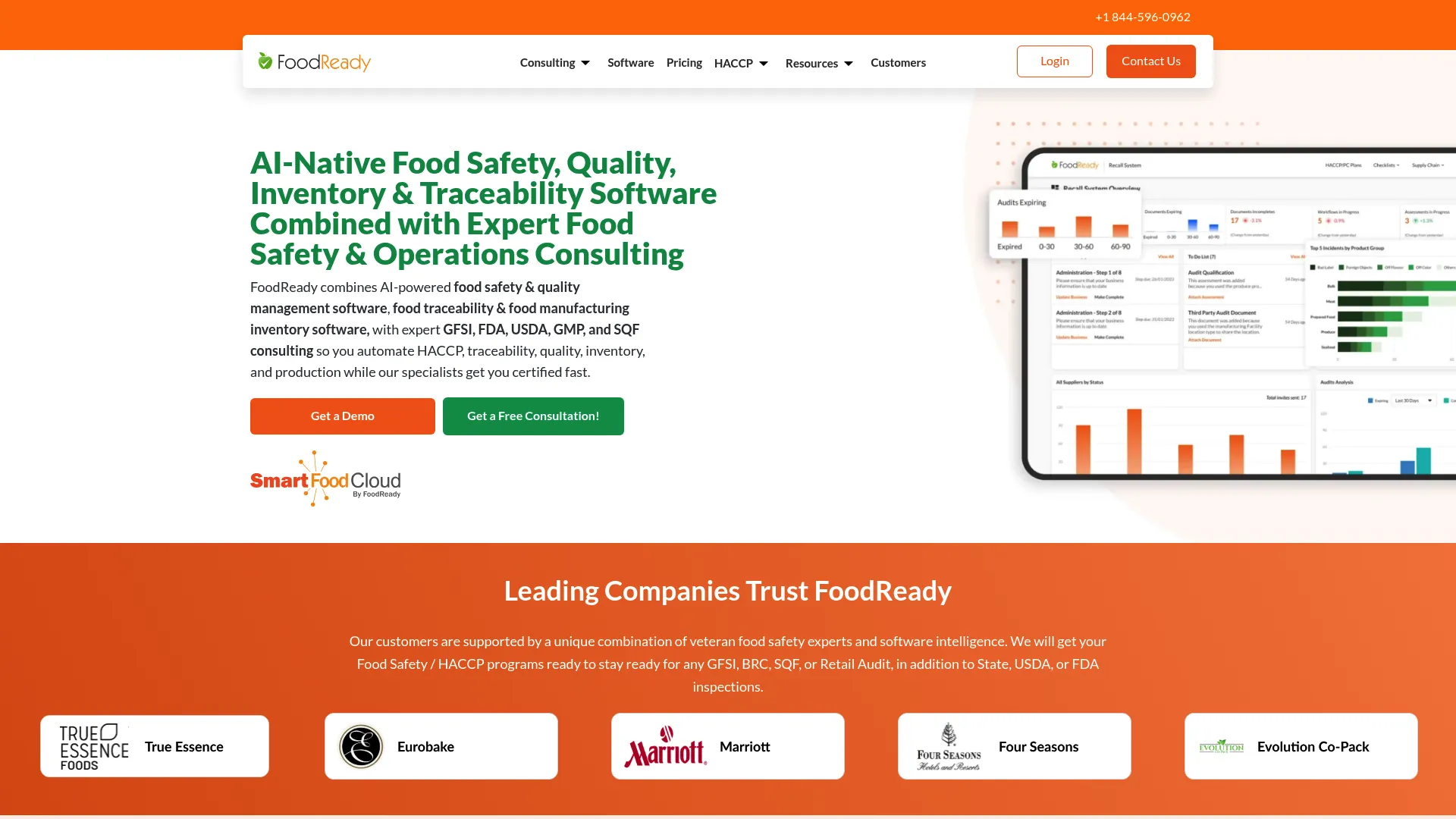
FoodReady is AI-powered food safety, traceability, inventory, and quality management software built for food operations. It leans hard into automation, using AI to build HACCP plans and manage compliance documentation that would otherwise take a consultant days. The platform combines food safety planning, lot and batch traceability, and supplier management in one system, with a mobile app for frontline logging.
Best for: Food manufacturers and processors that need audit-ready food safety and traceability workflows without a large compliance team.
Key strengths
- AI HACCP builder: Generates hazard analysis and food safety plans, cutting plan creation from days to hours.
- Lot and batch traceability: Tracks lot traceability with inventory management for fast food recall management.
- Supplier approvals: Automates document requests and approved-supplier tracking to keep records audit-ready.
Why choose FoodReady: If your operation is scaling faster than your compliance headcount, FoodReady's AI-native approach removes the manual drag of HACCP software and document control. It fits manufacturers pursuing GFSI compliance through BRC, SQF, ISO, or GMP frameworks, and supports FSMA compliance for FDA, USDA, and state-regulated operations. The consulting layer helps teams that want expert backup without hiring in-house.
FoodReady pricing: FoodReady uses quote-based pricing across three packages: one for restaurant, grocery, and food service HACCP; one for manufacturer and processor compliance covering FDA, USDA, and state rules; and an enterprise tier for GFSI, BRC, SQF, ISO, and GMP. Annual plans are available, and some product pages reference a 14-day free trial. No public numeric starting price is listed, so request a quote for exact figures. FoodReady holds a 4.7/5 rating on G2.
2. Smart Food Safe
Smart Food Safe is AI-powered digital food safety, quality, compliance, and traceability software for the food supply chain. Its defining trait is modularity: rather than one monolithic product, it offers a suite of modules you assemble around your actual workflows, from product release and specifications to audits, CAPA, supplier management, HACCP, and lab data.
Best for: Food manufacturers and processors that want to build a food safety and quality management software stack module by module.
Key strengths
- Modular architecture: Deploy only the modules you need, adding audit management or supplier management as you grow.
- Unlimited users: No per-seat pricing, so frontline teams and QA can all work in the system without cost friction.
- Automated workflows: Product release, specifications, CAPA workflow, documents, and lab data run on structured automation.
Why choose Smart Food Safe: The modular model fits operations that dislike paying for capabilities they will not use. You start with the compliance workflows you need today and layer in more as certification requirements grow. The unlimited-user structure suits plants where dozens of frontline staff need to log data, and the breadth supports GFSI compliance across multiple frameworks.
Smart Food Safe pricing: Smart Food Safe uses modular pricing and does not publish a numeric starting price. The company states there is no upfront cost, no hidden fees, and a cost-cap guarantee, with unlimited users included. Because pricing scales with the modules you select, you contact sales for a quote tailored to your workflows. Smart Food Safe holds a 4.6/5 rating on G2.
3. FoodDocs

FoodDocs is food safety management software focused on HACCP, monitoring, and traceability with a rare trait in this category: published pricing. It targets teams that want to get compliant fast without a long implementation cycle, offering guided HACCP plan creation, monitoring tasks, and traceability data in a clean interface.
Best for: Smaller food businesses, restaurants, and manufacturers that want transparent pricing and fast setup.
Key strengths
- HACCP plan creation: Builds compliant HACCP software plans quickly with guided templates.
- Monitoring and task management: Digital checklists and scheduled tasks keep daily compliance on track.
- Traceability and recall data: Captures traceability records to support food recall management.
Why choose FoodDocs: For a founder or operator who wants to see the cost before a sales call, FoodDocs is the clear pick. The published per-site pricing and fast implementation mean you can evaluate ROI in days, not quarters. It fits smaller teams that need real food safety compliance software without enterprise complexity or gated pricing.
FoodDocs pricing: FoodDocs publishes three plans billed annually: Lite at $79/site/month, Standard at $167/site/month, and Professional at $250/site/month. Each plan includes a free 14-day trial, and monthly billing options are also shown on the pricing page. This transparency is unusual in food safety software and makes budgeting straightforward for multi-site operators. FoodDocs holds a 4.9/5 rating on G2, among the highest in the category.
4. SafetyChain
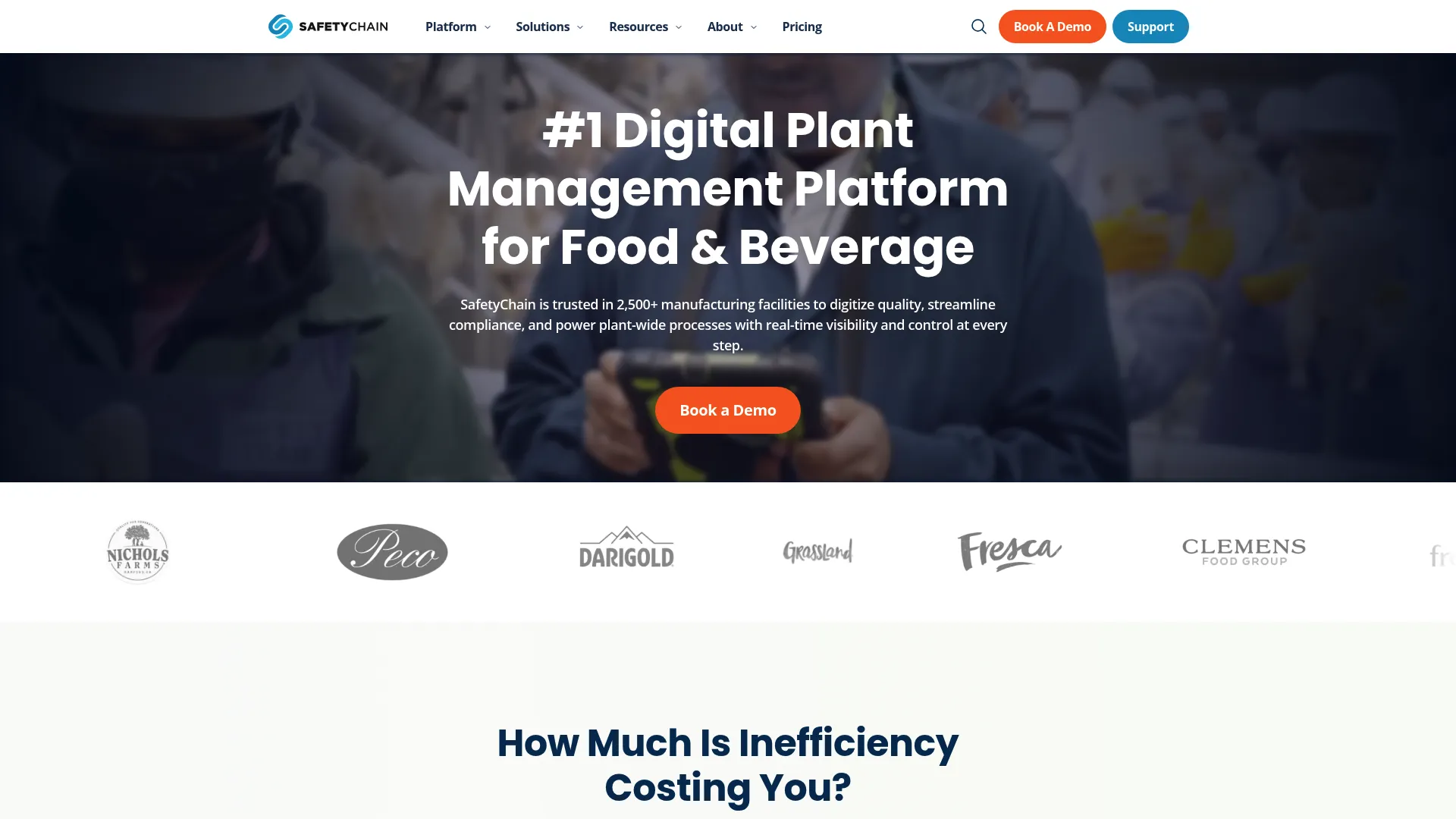
SafetyChain is digital plant management software for food and beverage manufacturers. It goes beyond compliance into production performance, combining audit-ready quality workflows with operational data like OEE. That makes it a fit for operations that want food safety and plant efficiency in one platform rather than two.
Best for: Food and beverage manufacturers that need plant-wide quality, compliance, and production management across facilities.
Key strengths
- Digital forms and audit workflows: Audit-ready compliance forms keep facilities inspection-ready continuously.
- Mobile with offline capture: Frontline teams log data on a mobile app even without connectivity, then sync.
- CAPA and production tools: CAPA workflow, reporting, integrations, and OEE tie quality to plant performance.
Why choose SafetyChain: SafetyChain fits multi-facility manufacturers that want one system spanning food safety compliance software and production management. The facility-based pricing model aligns cost with plant count rather than user count, which suits larger operations. If audit readiness and production efficiency both sit on your board's dashboard, the combined view is the draw.
SafetyChain pricing: SafetyChain uses facility-based SaaS pricing with tiered packages: Essential, Advanced, and a Supplier tier. Pricing is per facility on a monthly subscription, with no user-based pricing listed. Public numeric figures are gated behind a request-pricing flow, so you contact sales for a quote scoped to your facilities. SafetyChain holds a 4.5/5 rating on G2.
5. Safefood 360°
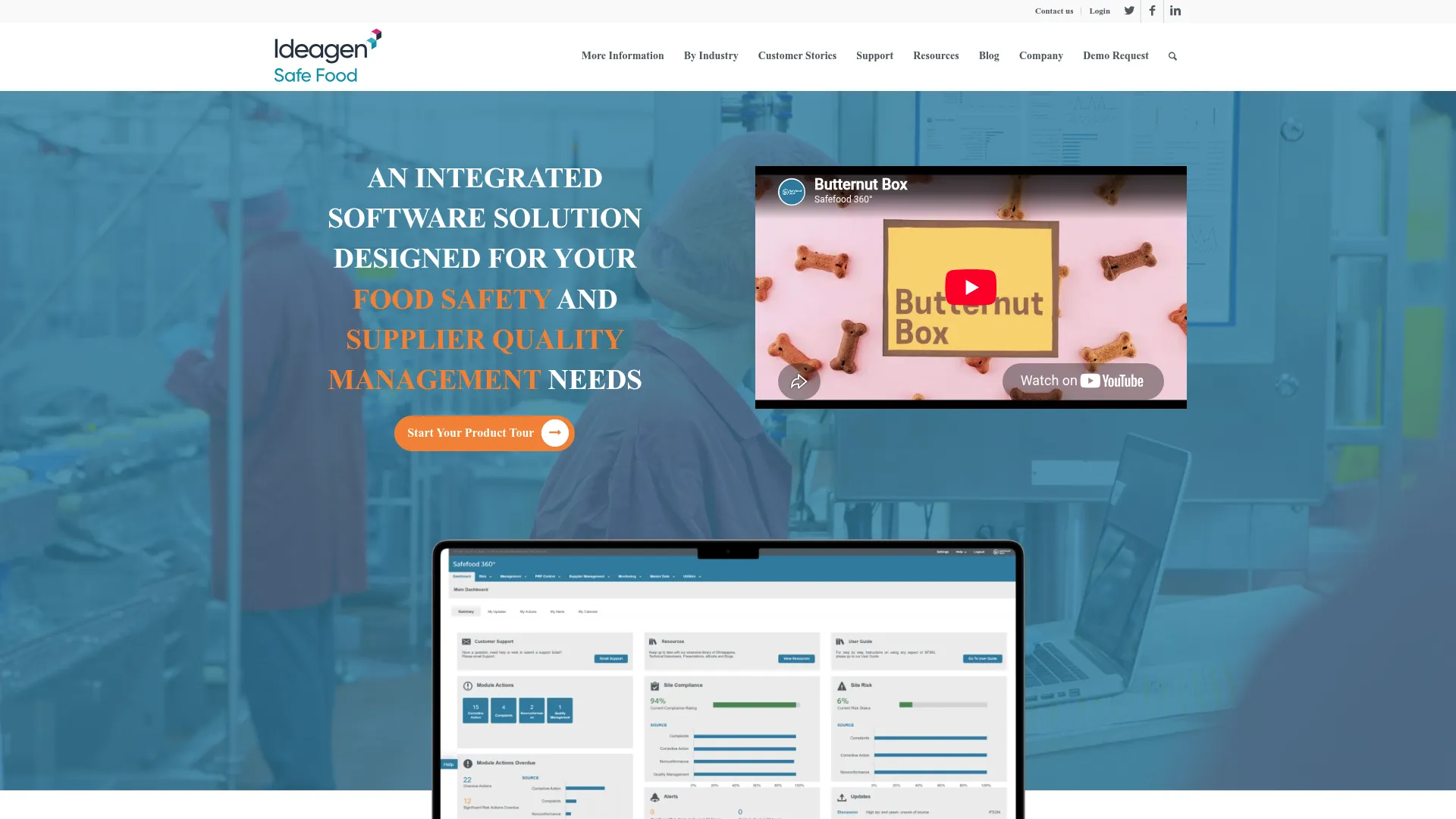
Safefood 360° is food safety and supplier management software built for regulated food businesses that need a full food safety management system software with deep supplier controls. It pairs a Food Safety Management Solution with Supplier Quality Management, covering HACCP, audits, corrective actions, document control, and reporting in one cloud platform.
Best for: Larger food manufacturers and regulated operations needing a cloud FSMS with strong audit and supplier controls.
Key strengths
- Full FSMS: Manages HACCP software, food safety plans, and preventive controls in one system.
- Supplier quality management: Dedicated supplier management with document and certificate tracking.
- Audit and document control: Audit management, corrective actions, and version-controlled document control for audit readiness.
Why choose Safefood 360°: Safefood 360° suits enterprises that treat supplier risk as a first-class concern. The dedicated SQMS module goes deeper on supplier compliance than most all-in-one tools, which matters for operations with sprawling ingredient supply chains. It supports GFSI compliance frameworks and fits regulated manufacturers that need documented, auditable control across every process.
Safefood 360° pricing: Safefood 360° uses inquiry-based pricing across its listed plans: FSMS Professional, SQMS Premium, and SQMS Enterprise. No public numeric price is disclosed, so you contact the vendor for a quote scoped to your operation and modules. Independent review data on Capterra places it around 4.2/5, reflecting a platform built for depth in regulated environments.
6. FoodLogiQ Connect
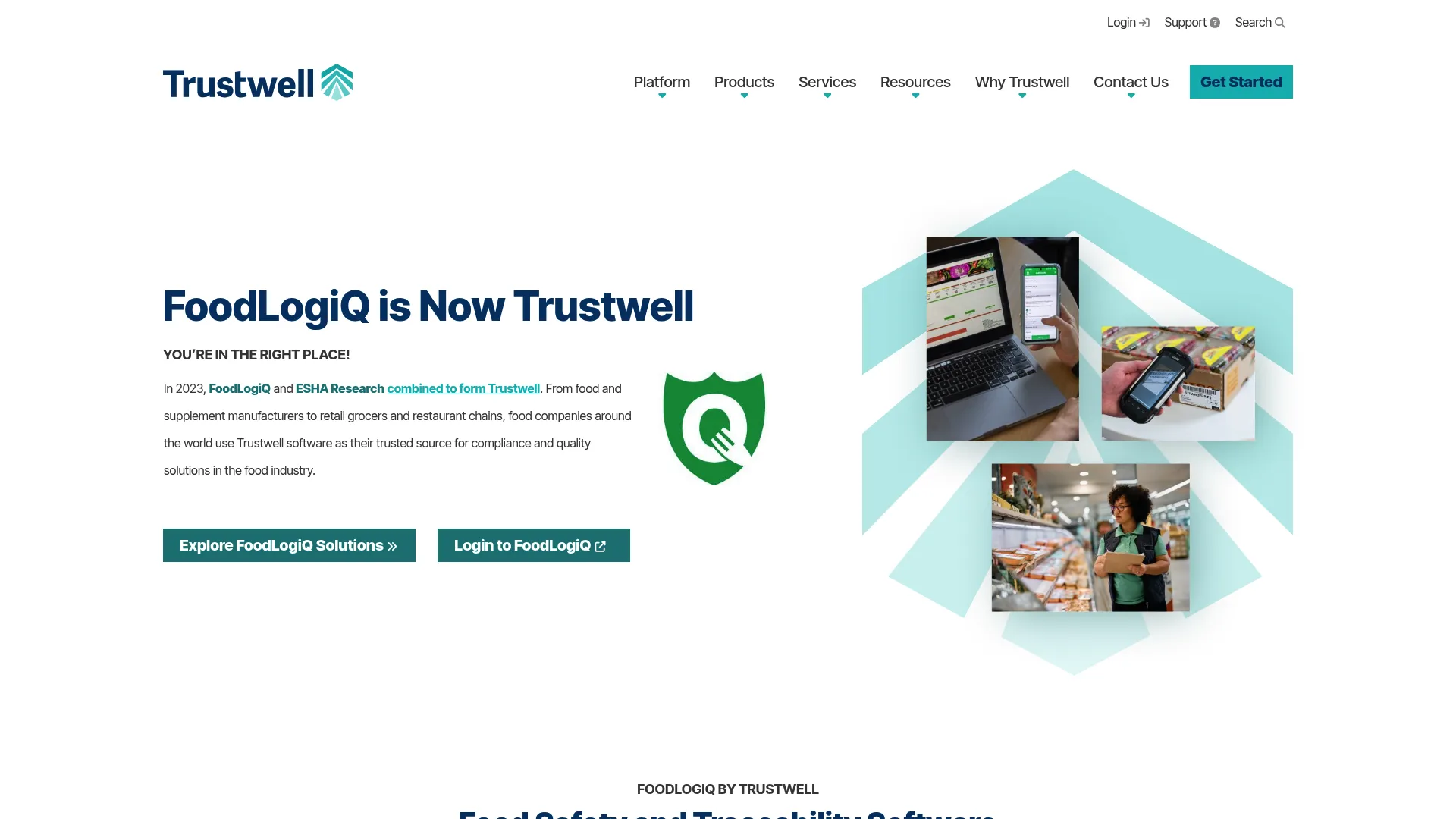
FoodLogiQ Connect is a food safety and traceability software platform, now presented by Trustwell as FoodLogiQ. It is the traceability specialist on this list, built around supplier compliance, end-to-end traceability, and recall workflows for companies whose primary risk sits in the supply chain.
Best for: Food companies that need supplier compliance, deep traceability, and fast recall workflows across a distributed supply chain.
Key strengths
- Supplier management: Centralizes supplier documents, compliance status, and certificate tracking.
- Traceability: Maps product movement upstream and downstream for full lot traceability.
- Recall management: Structured food recall management workflows to act fast when an issue surfaces.
Why choose FoodLogiQ Connect: If traceability and recall readiness are your top priorities, FoodLogiQ Connect is purpose-built for that job. Its Compliance, Quality Management, Traceability, and Recall modules give supply-chain-heavy operations the visibility a general FSMS may not match. It fits brands managing many suppliers where a single contamination event could span dozens of lots.
FoodLogiQ Connect pricing: FoodLogiQ Connect does not publish pricing on its own domain, which now redirects to Trustwell. There is no public numeric price or self-serve tier, so pricing is scoped through a sales conversation based on your supplier network and traceability needs. The platform carries strong review sentiment, with a 5.0/5 rating shown on its G2 seller page from a limited number of reviews.
7. Safe Food Pro
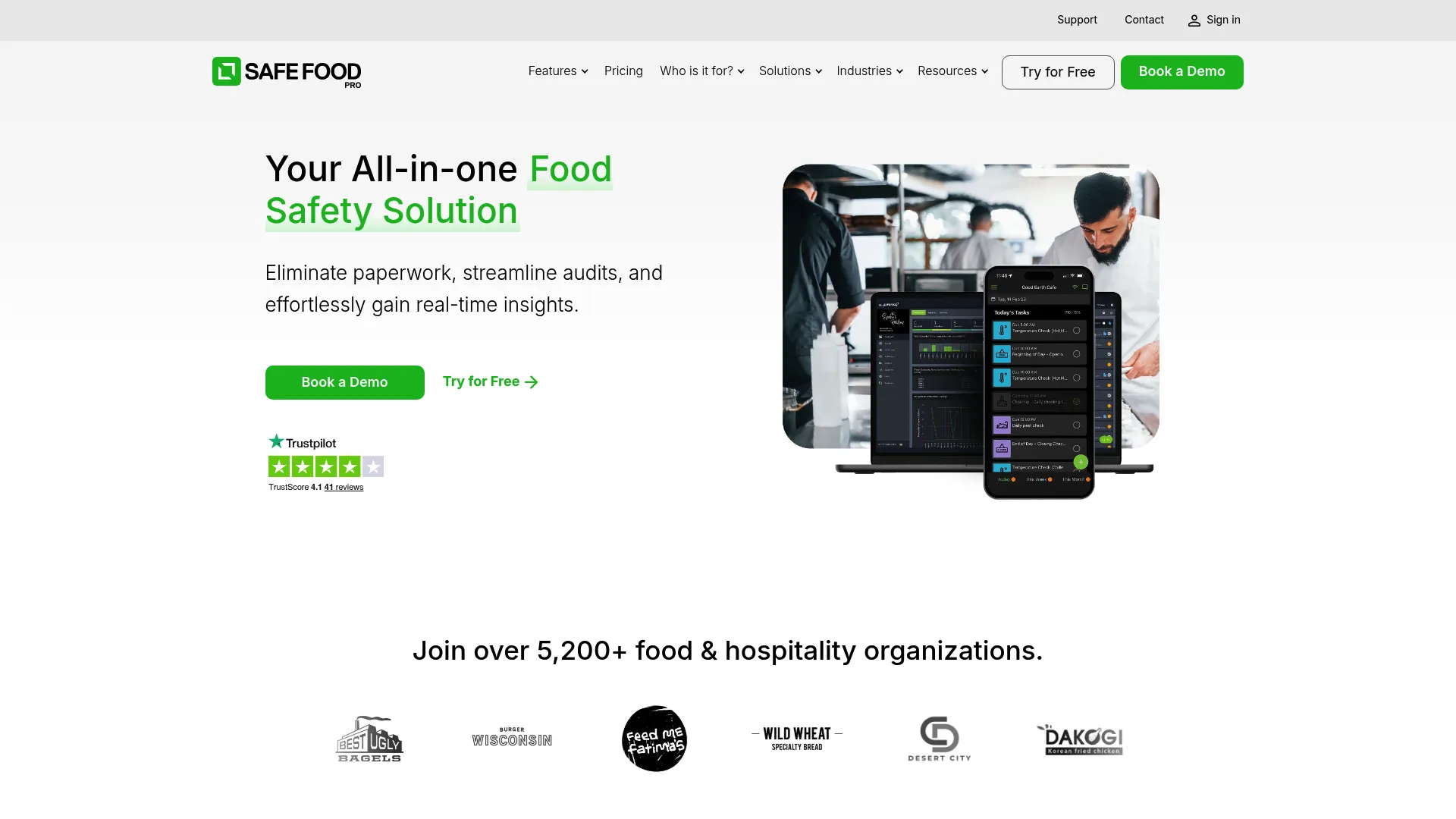
Safe Food Pro is food safety management software for food businesses that want a practical, paperless workflow: digital forms, audits, and monitoring without heavy setup. It is the frontline-first option on this list, built for teams that mainly need to digitize daily checks and temperature logs.
Best for: Food businesses that want a straightforward paperless food safety and compliance workflow.
Key strengths
- Digital form builder: Build paperless food safety forms and digital checklists to replace clipboards.
- Automatic temperature monitoring: Bluetooth probe integration captures temperature monitoring data automatically.
- Audit-ready reporting: Verifier-ready reports, dashboard reporting, and scheduled tasks support inspection management.
Why choose Safe Food Pro: Safe Food Pro fits operations that want fast wins on daily compliance rather than a deep FSMS. The Bluetooth temperature probe integration removes manual logging, and the verifier-ready reports keep you inspection-ready. It suits restaurants and smaller processors prioritizing simplicity and frontline usability over enterprise breadth.
Safe Food Pro pricing: Safe Food Pro publishes pricing on its Australian site. The Professional plan is $102 AUD per site per month, or $91 AUD per site per month paid annually, both excluding GST. A Premium tier for multi-site businesses is priced on application. There is no free tier listed. Public G2 review data is limited at this time, so weigh the transparent pricing and feature fit over rating volume.
Considerations before you buy
Before you commit, run food safety software candidates through this checklist. The wrong fit adds drag instead of removing it.
Audit and certification fit
Confirm the platform supports your specific frameworks, whether that is SQF software requirements, BRCGS software standards, ISO 22000, or broader GFSI compliance. A tool that maps evidence to your certification saves days during audits. Ask how it handles internal audits, corrective actions, and evidence retrieval under time pressure.
Traceability depth
If a recall would force manual reconstruction, prioritize lot traceability that links ingredients to finished goods. Test how quickly the system can trace a lot upstream and downstream. Fast food recall management is the capability you hope to never use and cannot afford to lack.
Implementation effort and time to value
A platform only helps once it is live. Ask how long onboarding takes, whether digital checklists migrate cleanly, and what frontline adoption looks like. For founders watching burn, first-week setup and fast time to value matter as much as feature depth.
Pricing transparency
Food safety software pricing ranges from published per-site plans to fully quote-gated models. Neither is wrong, but transparency affects budgeting speed. If you need a number before a sales call, tools with public pricing shorten the evaluation. For quote-based tools, ask about total cost including modules, users, and facilities.
Integration and document control
Check how the tool connects to your ERP, quality, and supplier systems. Strong document control with version history keeps SOPs and records audit-ready. Fragmented data is the problem you are solving, so avoid tools that create a new silo.
Conclusion
The right food safety software depends on your operating model, not a leaderboard. FoodReady fits manufacturers wanting AI-native HACCP and traceability. Smart Food Safe suits teams that want to build a modular food safety and quality management software stack. FoodDocs wins on pricing transparency for smaller teams and restaurants. SafetyChain fits plant-wide manufacturing operations that want quality and production in one view. Safefood 360° serves regulated enterprises needing deep supplier and FSMS controls. FoodLogiQ Connect is the traceability and recall specialist. Safe Food Pro is the frontline-first choice for paperless daily compliance.
Choose based on audit burden, traceability needs, implementation effort, and pricing clarity, in that order. Shortlist two or three tools that match your certification frameworks, then run a trial or scoped demo against a real workflow like a mock recall or a pre-op inspection. The tool that removes the most fragmentation, not the one with the longest feature list, is the one that earns its place in your stack.
FAQs
Food safety software digitizes and centralizes the compliance, monitoring, and traceability workflows food businesses use to stay audit-ready. It replaces paper logs and spreadsheets with HACCP plans, digital checklists, temperature monitoring, supplier records, and traceability data in one system. The goal is continuous compliance rather than last-minute audit scrambles.
FoodReady stands out for HACCP software with its AI-driven plan builder that generates hazard analysis and food safety plans quickly. FoodDocs also offers strong guided HACCP plan creation with transparent pricing, and Safefood 360° delivers deep HACCP within a full FSMS. The best fit depends on whether you want AI automation, pricing clarity, or enterprise depth.
Prioritize HACCP support, digital checklists, temperature monitoring, traceability, supplier management, CAPA workflow, document control, and audit management. If you pursue certification, confirm support for SQF, BRCGS, ISO 22000, or GFSI frameworks. The right feature set matches your certification requirements and daily operational reality, not a generic checklist.
Yes, especially tools with transparent, per-site pricing like FoodDocs or Safe Food Pro. Smaller teams gain the most from digital checklists and automated temperature monitoring, which remove the manual recordkeeping that sinks audits. The return shows up in passed audits and hours saved, not just feature counts.
It keeps records timestamped, version-controlled, and retrievable on demand, so evidence is ready whenever an auditor asks. Instead of assembling documentation the week before an inspection, your HACCP plans, corrective actions, and monitoring logs stay continuously organized. That turns audit readiness into a maintained state rather than a recurring project. Tools that combine this with strong audit management make external reviews far less stressful.
Food safety software specializes in compliance, HACCP, traceability, and audit workflows, while ERP software manages broad operations like finance, inventory, and production planning. Some overlap exists in traceability and inventory, but food safety compliance software goes far deeper on regulatory frameworks and audit readiness. Many operations run both and integrate them.
FoodLogiQ Connect is purpose-built for traceability and food recall management, with dedicated supplier compliance and recall modules. FoodReady offers strong lot traceability tied to inventory, and SafetyChain supports traceability within plant-wide workflows. For supply-chain-heavy operations where a single event could span many lots, a traceability specialist is worth prioritizing.
Start by separating transparent per-site pricing, like FoodDocs, from quote-based models common among enterprise tools. For quote-gated vendors, ask about total cost including modules, users, and facilities, since pricing structures vary widely. Weigh food safety software pricing against implementation effort and the audit or recall risk the tool removes, not the sticker figure alone.


.avif)


.avif)