


A purchase request lands in someone's inbox. It sits there. The requester pings on Slack three days later. The budget owner forwards it to finance. Finance asks who approved it. Nobody did, because nobody knew it was their turn.
That is the daily reality on teams still running purchasing through email threads and shared spreadsheets. Requests get lost, approvals stall, and no one has a clean answer to a simple question: what did we commit to spend, and who signed off?
The cost of that fog is growing. The global procurement software market is projected to expand from roughly USD 8.6 to 9.8 billion in 2024 to 2025 up to around USD 18 to 23 billion by 2032 to 2035, at a 9 to 11% CAGR, according to Databridge Market Research (2024) and Precedence Research (2025). Cloud deployment already leads market share, and North America accounts for about 38 to 39% of global revenue. Companies are not buying this software because it is trendy. They are buying it because manual approval workflows do not scale.
Purchase requisition software fixes the structural problem: it turns ad hoc requests into a routed, auditable workflow with clear ownership at every step. If you have ever tried to instrument an internal process without adding maintenance overhead, this category will feel familiar. It is intake, routing, and decision logging, done consistently. The same discipline that makes a good contract lifecycle management system valuable applies here: structure beats memory, every time.
What's inside
This guide is for procurement managers, finance operators, and operations leaders at SaaS and mid-market companies who are ready to replace email-and-spreadsheet purchasing with a real requisition system. We evaluated tools on six criteria that actually matter when request volume grows:
- Centralized request intake with custom request forms and dynamic fields
- Approval workflow automation with threshold-based routing and budget checks
- Spend control and audit trails for policy enforcement and compliance
- Real-time status tracking and notifications so nothing stalls silently
- Reporting and analytics that survive a finance review
- Integrations with ERP, accounting, and catalog systems
Each tool below is scored against those criteria, with honest notes on where it fits and where it is more platform than point solution.
TL;DR
- Best for collaboration and ease of use: Procurify, for teams that want mobile approvals and clear request visibility without a heavy rollout.
- Best for decentralized teams and spend control: Precoro, for finance-heavy workflows that need custom forms, budget checks, and 3-way matching.
- Best lightweight requisition system: Team Procure, for SMBs that want a direct request-to-PO flow without extra weight.
- Best research resource: Software Connect, a free advisory service for shortlisting tools, not a system of record.
- Best for enterprise governance: Coupa, for large organizations with complex purchasing controls and sourcing needs.
- Best for finance and payables adjacency: Tipalti, when requisitions sit inside a broader AP and global payments motion.
- Best for guided, catalog-style buying: Order.co, for teams that want easier request-to-purchase coordination.
What purchase requisition software is
Purchase requisition software is a tool that captures internal purchase requests, routes them through approval workflows, and tracks their status until they become approved purchase orders. It replaces manual requisition intake, email routing, and spreadsheet-based approval tracking with a single, auditable requisition system.
At its core, purchase request software connects four things that usually live in separate places: the request form, the approval chain, the status trail, and the reporting layer. That connection is what turns "who approved this?" from a Slack archaeology project into a one-click answer.
Core capabilities buyers should expect
Good purchasing requisition software covers a predictable feature cluster. When you evaluate options, check for:
- Custom request forms with dynamic fields that adapt to category, department, or cost center
- Approval routing with threshold-based workflows tied to amount, budget, or team
- Spend control with budget checks that flag over-limit requests before they route
- Audit trail logging every action, approver, and timestamp
- Real-time status tracking and notifications so requesters and approvers always know the next step
- Reporting and analytics for spend by category, vendor, and department
- ERP integration with accounting and finance systems
- Catalog purchasing and PunchOut catalogs for repetitive, pre-approved buying
- Mobile approvals so budget owners can act from anywhere
Not every team needs all of it. A five-person ops team does not need PunchOut. A 500-person company with three cost centers probably does. The discipline of matching request forms, approvals, and reporting mirrors what teams already expect from contract management and audit management systems: structured intake plus a clean record.
How it differs from adjacent tools
Purchase requisition software is often confused with two neighbors: AP automation and full procure-to-pay suites.
Requisition software owns the front of the process. It handles the request, the approval, and the handoff to a purchase order. AP automation owns the back end: matching invoices, scheduling payments, and closing the books. Procure-to-pay suites cover the whole arc, from request through payment, in one platform.
The practical question is scope. If your pain is "requests get lost and approvals stall," a focused requisition tool solves it. If your pain runs deeper into invoicing, 3-way matching, and payment reconciliation, you need broader finance automation. Buying a full procure-to-pay platform to solve a routing problem is like buying an ERP to track your reading list.
When to use purchase requisition software
Replace email and spreadsheets
The moment request volume outgrows manual tracking, email and spreadsheets start leaking. Requests get buried, approvers forget, and finance loses visibility into committed spend. Purchase requisition tracking software captures every request in one place, routes it consistently, and shows real-time status. This matters most when you cross roughly 20 to 30 requests a month across more than one approver.
Enforce approvals and policy
Threshold-based approvals and budget checks stop rogue spend before it happens. A request over a set amount routes to the right approver automatically. A request that breaks a budget gets flagged before it moves. Every action lands in an audit trail. That combination of policy enforcement and auditability is what turns procurement from a trust exercise into a controlled process.
Standardize procurement across teams
Multi-department companies and decentralized teams struggle with inconsistent buying. One team uses a form, another uses email, a third just expenses it. Requisition management software gives everyone the same intake path. Catalog purchasing and guided buying help when purchase behavior is repetitive, so requesters pick from pre-approved items instead of writing free-text requests that need cleanup later.
Comparison table
Here is how the seven tools compare on intent, primary use case, pricing, and rating. Pricing reflects publicly listed values at the time of writing; several vendors gate pricing behind a sales conversation.
| # | Product | Intent | Key use case | Pricing | G2 rating |
|---|---|---|---|---|---|
| 1 | Procurify | Procure-to-pay with strong PR intake | Mid-market spend control and approvals | Not publicly listed | 4.6/5 |
| 2 | Precoro | PR-first spend control | Decentralized teams and finance workflows | From $499/month | 4.7/5 |
| 3 | Team Procure | Lightweight procurement | SMB request-to-PO workflows | From $250/month | 5.0/5 |
| 4 | Software Connect | Software advisory service | Shortlisting and vendor research | Free to buyers | 4.6/5 |
| 5 | Coupa | Enterprise business spend management | Complex governance and sourcing | Not publicly listed | Not listed |
| 6 | Tipalti | Finance automation and payables | Requisitions inside AP and payments | From $99/month | 4.5/5 |
| 7 | Order.co | Guided purchasing and spend | Catalog-style request-to-purchase | Not publicly listed | 4.4/5 |
1. Procurify
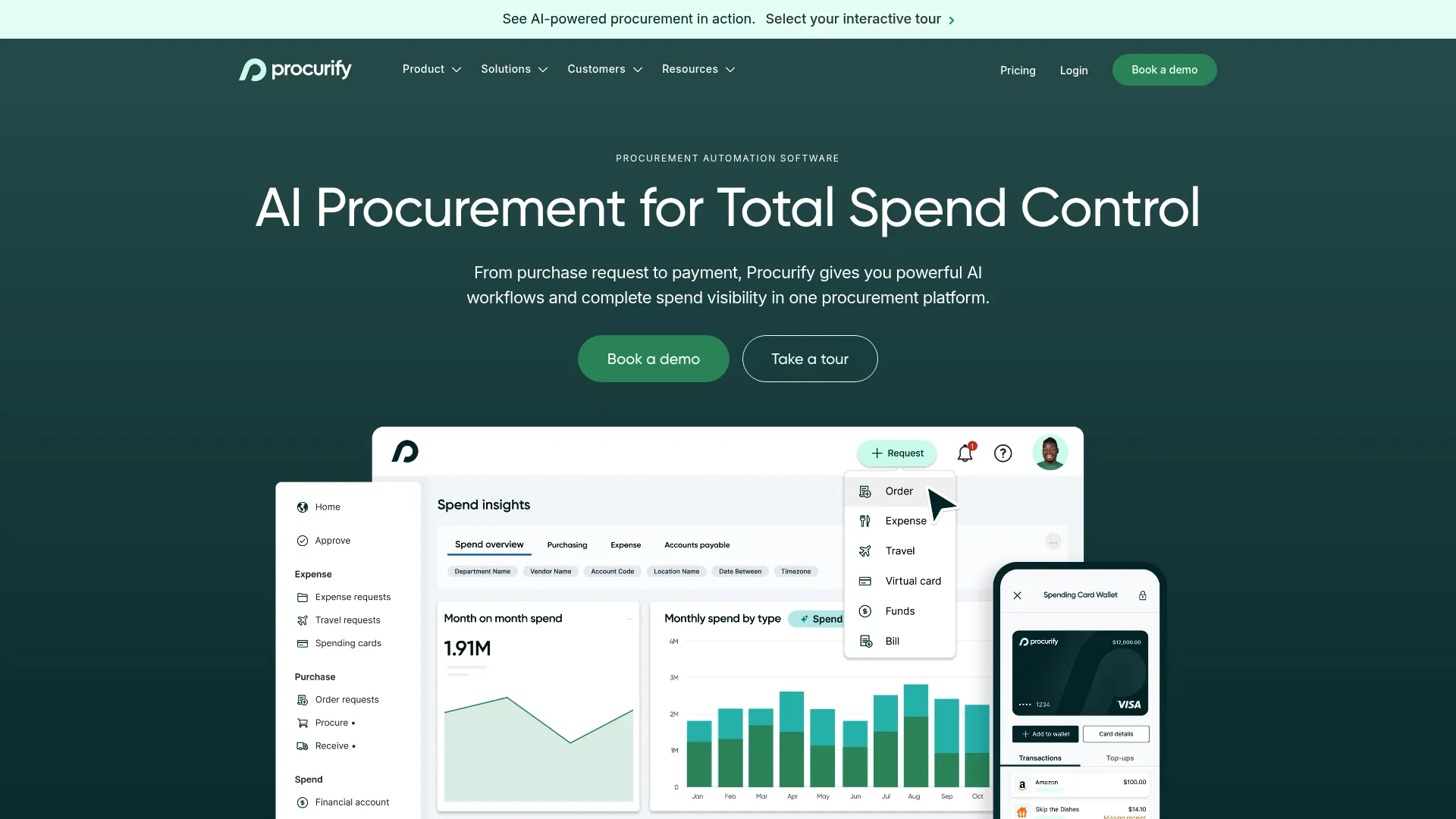
Procurify is an AI-powered procure-to-pay platform built for mid-market organizations that want centralized procurement, AP, and spend control in one system. Its purchase requisition workflow is the front door: requesters submit through custom forms, approvers act from mobile or desktop, and finance keeps a clean line of sight into committed spend. The product leans hard into usability, which matters when the people submitting requests are not procurement specialists.
Best for: Mid-market teams that want a user-friendly requisition workflow with real approval visibility, not a heavy implementation.
Key strengths
- Mobile approvals: Budget owners approve or reject requests from their phone, so nothing waits on someone being at their desk.
- AI intake and catalogs: AI-assisted request creation plus catalog and PunchOut support reduce free-text requests and speed up repetitive buying.
- Collaboration and visibility: Requesters, approvers, and finance see the same real-time status, comments, and history on every request.
Why choose Procurify: If your primary pain is scattered requests and slow approvals, Procurify gives operations and finance a shared, clear workflow without demanding a long rollout. It is more than a pure requisition tool, since it extends into AP automation, spend analytics, and spending cards, which is a strength if you want room to grow and worth noting if you only need request routing today.
Procurify pricing: Procurify does not publish pricing. Its site states every customer starts with the Procurify Platform plus Purchasing and can add Accounts Payable, Contracts, and Expense & Card modules. Pricing is described as flexible based on features and support, with a one-time implementation fee tied to use cases and integrations. Expect a sales conversation to get a number.
2. Precoro
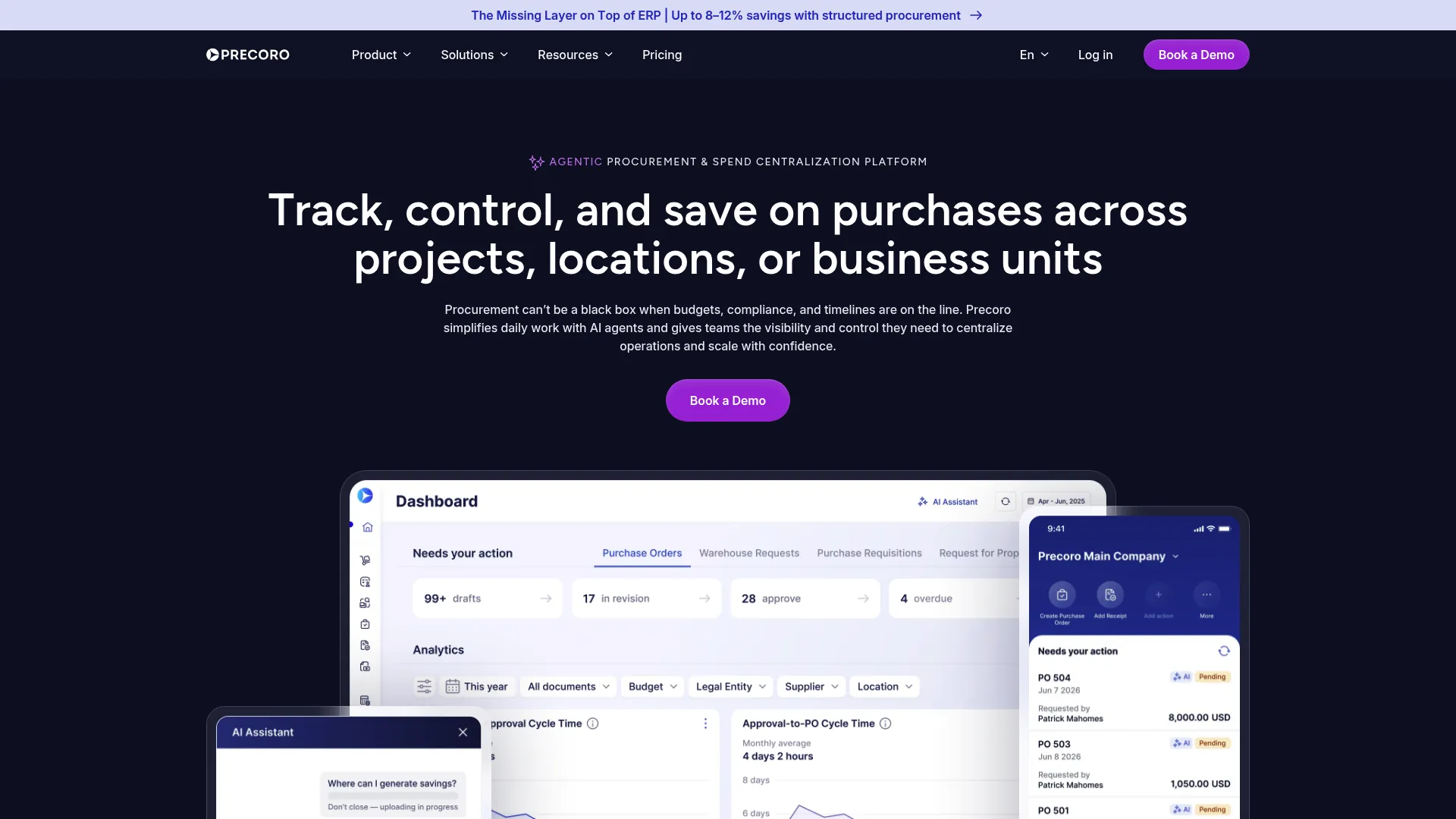
Precoro is procure-to-pay and AP automation software built around spend control, and it treats the purchase requisition as the anchor of the whole workflow. It fits teams that want strong request intake plus the broader procurement stack: POs, receipts, invoices, and matching. For decentralized organizations where requests come from many locations and departments, Precoro's centralized intake and custom forms keep everything consistent.
Best for: Decentralized teams and finance-heavy workflows that need custom forms, budget checks, and 3-way matching in one place.
Key strengths
- Custom request forms and budget control: Dynamic forms plus real-time budget checks flag over-limit requests before they route for approval.
- Approval workflows and audit trails: Threshold-based routing and complete audit logging support policy enforcement and compliance out of the box.
- End-to-end coverage: Purchase requisitions, POs, receipts, invoices, and 2- and 3-way matching, with AI and OCR document capture and a supplier portal.
Why choose Precoro: Precoro is the pick when you want requisition discipline and broader procure-to-pay coverage without stitching together separate tools. Its spend-control framing suits finance operators who care as much about the audit trail as the request itself.
Precoro pricing: Precoro lists pricing publicly. The Core plan starts at $499/month billed annually, the Automation plan starts at $999/month billed annually, and the Enterprise tier is custom. There is no free tier. Public, tiered pricing is rare in this category, which makes budgeting easier before you talk to sales.
3. Team Procure
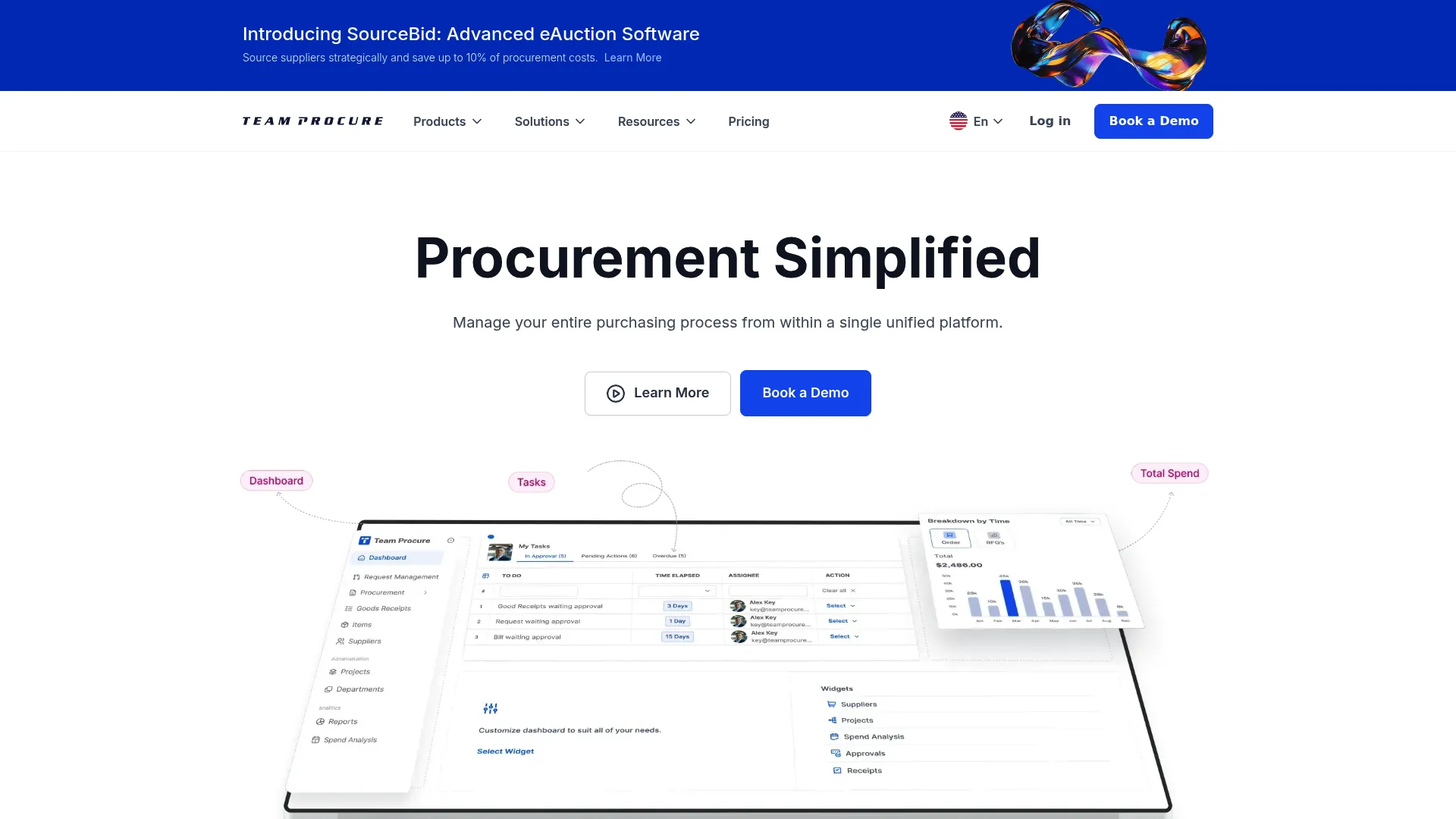
Team Procure is procurement and sourcing software built for growing teams that want centralized purchase requests without carrying the weight of an enterprise suite. It handles the core job well: create a request, route it through approvals, convert it to a purchase order, and report on it. The lighter operational footprint is the point. You get structure without a three-month implementation.
Best for: SMBs that want a direct, easy-to-understand request-to-PO workflow with modular add-ons.
Key strengths
- PR and PO management: Purchase requisitions, approval workflows, budgets, and request-to-PO conversion in a clean, direct interface.
- Supplier and sourcing modules: An optional Supplier Portal with branding and multilingual support, plus an RFQ module for negotiation and price comparison.
- Reporting and integration: Built-in reporting and QuickBooks integration cover the essentials most growing teams need.
Why choose Team Procure: If a full procure-to-pay platform feels like overkill, Team Procure gives you a real requisition system with a smaller footprint. The modular structure lets you add a supplier portal or RFQ tooling only when you actually need them, which keeps cost and complexity aligned with your stage.
Team Procure pricing: Team Procure publishes self-serve pricing. The Procurement Suite starts at $250/month and includes 3 users. The Supplier Portal and RFQ modules each start at $500/month, and the SourceBid tier is quote-based. A 14-day free trial is available, so you can validate the workflow before committing.
4. Software Connect

Software Connect is not procurement software. It is a B2B software discovery and advisory service that helps businesses shortlist tools across many categories, including purchase order requisition software. Include it in your process as a research resource, not a system of record. If you are early in evaluation and want a human to help narrow the field, this is where it fits.
Best for: Buyers who want free, guided help shortlisting requisition and procurement tools before committing to demos.
Key strengths
- Free advisory consultations: One-on-one phone consultations to help match your requirements to specific tools.
- Broad directory: A software directory covering 190+ categories, useful for cross-referencing adjacent tools.
- Editorial guidance: Reviews and buyer guidance that add a comparison lens across vendors.
Why choose Software Connect: When you are not sure which requisition tools even belong on your list, an advisory service compresses the research phase. It will not run your approvals, but it can save you weeks of scattered vendor calls by pointing you at fitting options first.
Software Connect pricing: The service is free to buyers. It is funded through annual membership fees paid by vendors, so there is no buyer-facing paid plan. That model is worth knowing, since recommendations come from a network of paying members.
5. Coupa
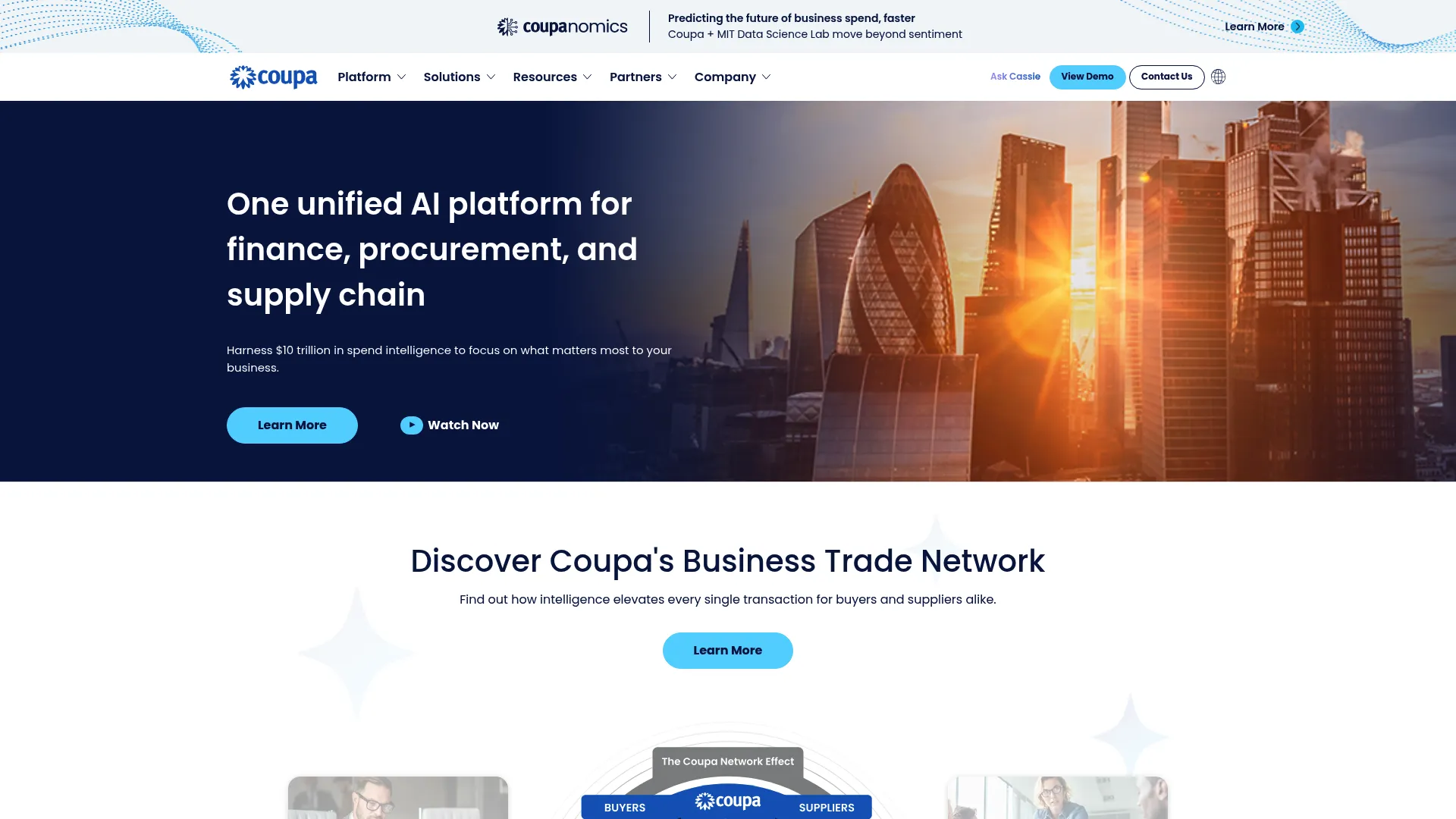
Coupa is a cloud-based business spend management platform covering procurement, invoicing, supply chain, and payments. Requisitions live inside a much larger system built for governance at scale. For enterprises with complex purchasing controls, layered approvals, and sourcing needs, Coupa is designed to be the spine of the entire spend motion, not a single-purpose requisition tool.
Best for: Large organizations that need enterprise-grade approval governance, policy control, and sourcing alongside requisitions.
Key strengths
- Business spend management platform: A unified system spanning procurement, invoicing, supply chain, and payments.
- Procure-to-pay workflows: End-to-end coverage from request through payment, with deep approval and policy controls.
- Supplier enablement: A supplier portal and enablement tooling for managing vendor relationships at scale.
Why choose Coupa: Choose Coupa when the requirement is enterprise governance across the full spend lifecycle, not just request routing. It is more platform than point solution, which is exactly what a large, controls-heavy organization wants, and more than a small ops team needs. Match the tool to the scope of your compliance and policy enforcement requirements.
Coupa pricing: Coupa does not publish public pricing. Its model is sales-led and subscription-based, with packaging tied to modules and scale. Plan for a full sales and scoping process, which is standard for platforms at this tier.
6. Tipalti
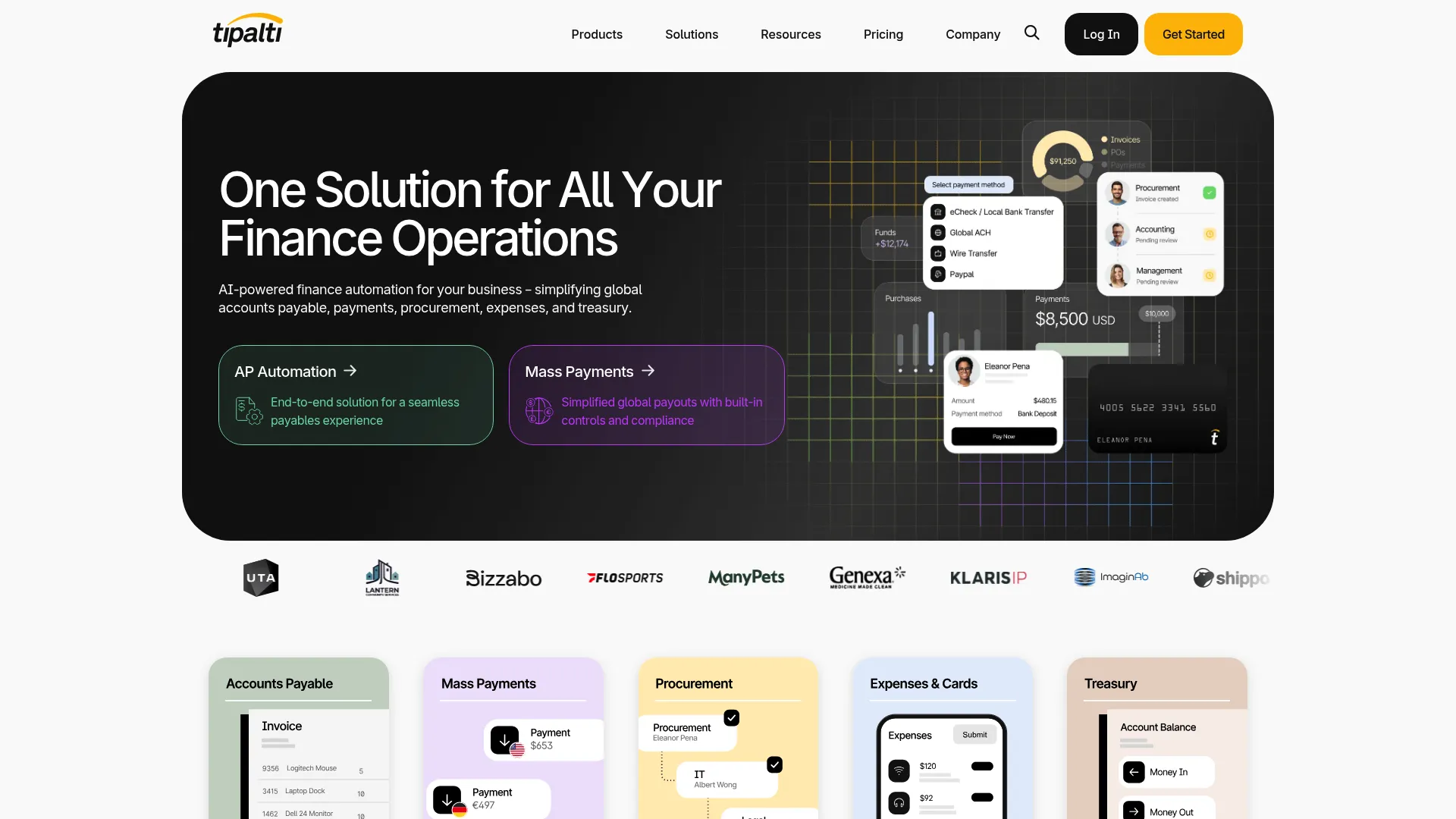
Tipalti is AI-powered finance automation for accounts payable, mass payments, procurement, expenses, and treasury. It fits teams that need requisitions as one piece of a broader payables and payments motion. If your buying process is inseparable from how you pay suppliers globally, Tipalti's strength is the finance adjacency, not a standalone requisition workflow.
Best for: Mid-market and enterprise finance teams that want requisitions connected to global AP and payout automation.
Key strengths
- Accounts payable automation: Invoice capture, matching, and approval flows that connect procurement to payment.
- Mass payments: Global payout capability across methods and currencies from one system.
- Global payee onboarding: Payee onboarding and tax compliance built in for cross-border operations.
Why choose Tipalti: Tipalti suits teams expanding beyond requisitions into full finance automation. If your real pain is the payables and payments side, and requisitions are just the front of that process, the adjacency is the value. Teams that only need request routing may find the payments depth more than they use today.
Tipalti pricing: Tipalti publishes starting prices. Accounts Payable starts at $99/month and Mass Payments starts at $249/month, with additional fees and custom quotes for advanced usage and modules. There is no free tier. The entry price is accessible, but scope grows with usage.
7. Order.co
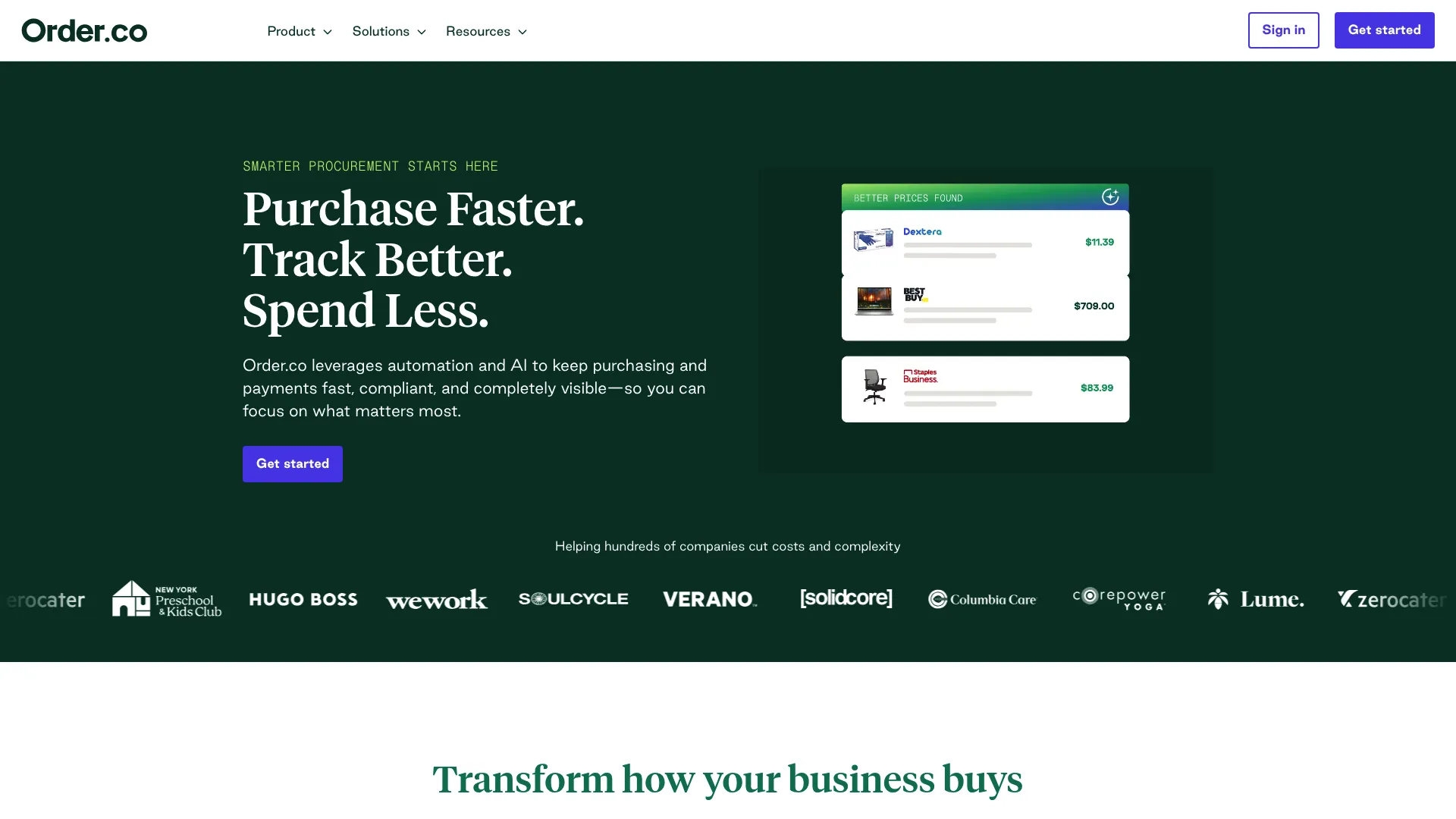
Order.co is an AI-powered procurement and spend management platform focused on centralizing purchasing, controls, and AP workflows. Its strength is guided, catalog-style buying: requesters shop from curated catalogs, approvals route automatically, and purchasing stays coordinated. For teams that want to make request-to-purchase feel more like online shopping than form-filling, Order.co is built for that experience.
Best for: Mid-market and enterprise teams that want centralized, catalog-driven purchasing with built-in controls and AP workflows.
Key strengths
- Procurement automation: Centralized purchasing with approval routing and spend controls in one place.
- AI sourcing and catalog management: AI-assisted sourcing plus catalog management that supports repetitive, guided buying.
- Spend management and AP automation: Spend visibility and AP workflows connected to the purchasing process.
Why choose Order.co: Order.co fits when the goal is a smoother buying experience for requesters, with catalogs and guided purchasing reducing back-and-forth. The platform coordinates request, approval, and purchase in one flow, which cuts the coordination tax on high-volume, repetitive buying.
Order.co pricing: Order.co does not publish public pricing. The site prompts visitors to schedule a demo or get started, so expect a sales conversation to scope your requirements and get a quote.
Considerations before you buy
The right tool depends less on feature checklists and more on how your team actually works. Before you shortlist, evaluate against these criteria.
Request volume and approval complexity
Count your monthly requests and map your approval chains. A team with simple, single-approver flows and modest volume is served well by a lighter requisition system. A team with threshold-based routing across multiple cost centers needs deeper approval workflow automation. Buying above your complexity adds maintenance without adding value.
Integration and ERP fit
Your requisition tool has to talk to your accounting and finance stack. Check for native ERP integration and accounting connectors before you commit. A tool that forces manual re-entry into your ledger recreates the exact busywork you are trying to remove.
Reporting and audit requirements
If finance or auditors need spend reports by category, vendor, or department, confirm the reporting layer produces them cleanly. A complete audit trail matters most in regulated environments and during compliance reviews, so verify that every approval and change is logged.
Catalog and PunchOut needs
If your team buys the same items repeatedly, catalog purchasing and PunchOut catalogs cut request cleanup dramatically. If your buying is one-off and varied, catalogs matter less. Match the capability to your actual purchase patterns, not a hypothetical future.
Conclusion
The best purchase requisition software is the one that matches your team's control, visibility, and finance-automation needs, not the one with the longest feature list. Procurify and Precoro lead for teams that want strong requisition intake with room to grow into full procure-to-pay. Team Procure keeps things light for SMBs. Coupa and Order.co scale into enterprise governance and catalog-driven buying, while Tipalti fits teams anchoring requisitions to a broader payables motion. Software Connect helps you shortlist before you commit.
Your next step is simple: pick two or three tools based on your approval complexity and integration requirements, then run a short trial or scoped demo with real requests. The workflow either removes friction on day one or it does not. That is the only test that matters.
FAQs
Purchase requisition software is a tool that captures internal purchase requests, routes them through approval workflows, and tracks their status until they become approved purchase orders. It replaces manual request intake, email routing, and spreadsheet-based approval tracking with a single requisition system that logs every action.
A requester submits a purchase request through a custom form. The software routes it to the right approvers based on rules like amount, budget, or department. Approvers act from desktop or mobile, the status updates in real time, and the approved request converts to a purchase order. Reporting then captures spend by category, vendor, and team.
Look for custom request forms, threshold-based approval routing, spend control with budget checks, a complete audit trail, real-time status tracking and notifications, reporting and analytics, and ERP integration. Teams with repetitive buying should also check for catalog purchasing and PunchOut support.
Requisition software focuses on the front of the process: capturing requests, routing approvals, and creating purchase orders. Procure-to-pay software covers the full arc, adding invoice matching, payment scheduling, and reconciliation. If your pain is stalled approvals, a requisition tool is enough. If it extends into invoicing and payments, you need broader finance automation.
Many tools do. Catalog purchasing lets requesters pick from pre-approved items instead of writing free-text requests, and PunchOut catalogs connect directly to supplier storefronts. Guided buying matters most when purchase behavior is repetitive, since it reduces request cleanup and keeps spend on approved vendors.
Yes. Policy enforcement through threshold-based approvals stops over-limit requests before they route, and a complete audit trail logs every approver, action, and timestamp. That combination gives finance and auditors a clean record and turns compliance from a manual reconstruction into a built-in byproduct of the workflow.
Start with your request volume and approval complexity, then weigh reporting needs and integration requirements. Lighter requisition management software suits simple, lower-volume flows, while finance-heavy or decentralized teams benefit from deeper spend control and full procure-to-pay coverage. Shortlist two or three tools and trial them with real requests before deciding.

.avif)



.avif)