

You know your line dropped 40 minutes yesterday. You just don't know why, when, or which machine started the cascade. The shift lead scribbled a reason on a clipboard. Someone typed it into a spreadsheet three days later. By the time the number reaches the morning meeting, it's stale, incomplete, and impossible to act on.
That gap between what happened on the floor and what leadership sees is where most OEE improvement dies. Manual tracking hides the losses that matter most, micro-stops, unrecorded slow cycles, and quality scrap that never makes it into a report. Reactive root-cause work follows, always a week behind the event.
The market has responded. The OEE software category was valued at roughly USD 3.1 billion in 2024 and is projected to reach USD 6.4 billion by 2032 at about a 9.4% CAGR, according to Business Research Insights (2024). Manufacturers are moving away from clipboards and toward real-time capture for a simple reason: you can't fix a loss you can't see.
This guide compares the tools worth shortlisting. We rank each by how fast it captures data, how clearly it surfaces downtime, and how well it connects losses to action. If you build onboarding flows or product tours in your day job, some of the same evaluation logic applies here: strong instrumentation, clean segmentation by shift or site, and low ongoing maintenance are what separate a tool your team uses from one they abandon. For teams evaluating measurement stacks more broadly, our roundup of application performance monitoring tools covers adjacent territory, and the same buyer discipline shows up in how teams choose email tracking and outbound call tracking software.
What's inside
This guide covers the best OEE software for manufacturing teams that need real-time monitoring, automated data capture, and better loss analysis. It's written for operators, plant managers, continuous improvement leads, and ops buyers who are replacing manual tracking or comparing vendors before committing budget.
We selected and ranked platforms on four criteria that decide whether OEE software actually improves throughput: setup speed and shop-floor adoption, data collection options (sensors, PLCs, and manual reason codes), dashboard and report depth, and fit for the buyer's operating reality, whether that's a single line or a multi-site network. Every tool below ties to a concrete manufacturing outcome, not a feature list.
TL;DR
- Best overall for fast setup and broad adoption: Evocon, cloud-based, real-time, and quick to launch across shifts.
- Best for turnkey OEE discipline and plant-floor scoreboards: Vorne XL Platform.
- Best for maintenance-linked improvement: Maintmaster, where OEE and CMMS workflows sit together.
- Best for enterprise operations teams: ABB OEE Software, built for MOM-scale visibility.
- Best for quality-driven plants: GainSeeker Suite, pairing SPC with OEE.
- Best modular monitoring: GlobalReader and TEEPTRAK for real-time visibility across assets.
What is OEE software?
OEE software is a manufacturing monitoring system that measures overall equipment effectiveness by capturing production data from machines and operators, then calculating losses in real time so teams can reduce downtime and improve throughput.
Overall equipment effectiveness rests on three pillars, and good software tracks all three continuously:
- Availability: the share of scheduled time a machine actually runs. Captures unplanned stops, changeovers, and setup losses.
- Performance: how fast the machine runs against its ideal cycle. Captures micro-stops and reduced speed that spreadsheets almost never catch.
- Quality: the share of good units against total units produced. Captures scrap, rework, and startup rejects.
Multiply the three and you get the OEE percentage. Modern overall equipment effectiveness software does more than the math, though. Most tools now include:
- Real-time dashboards for shift, line, and factory views.
- Automated data capture from sensors, PLCs, and IoT devices, so numbers aren't waiting on manual entry.
- Downtime tracking with operator reason codes for fast root cause analysis.
- Alerts that flag stops and threshold breaches as they happen.
- Historical trends for benchmarking across shifts, lines, and sites.
- Reporting that translates raw events into the losses leadership will act on.
The strongest OEE monitoring software makes the data trustworthy enough that the morning meeting argues about fixes, not about whether the number is right.
When to use OEE software
Not every plant needs the same depth. Here's how to pattern-match your situation to the category.
Track machine and line performance in real time
If your team only sees performance after the shift ends, you're always reacting. Real-time OEE gives supervisors live shop-floor visibility, so a stall gets attention in minutes, not at the end of the day. Shift-level performance tracking also makes handovers cleaner, because the incoming crew sees exactly what the outgoing one struggled with.
Replace manual downtime logging
Clipboards and end-of-day spreadsheets lose the small losses that add up most. Automated data capture plus structured reason codes turns fuzzy notes into clean, comparable data. When operators tag a stop at the machine, downtime tracking becomes a dataset you can trust for root cause analysis, not a guess you defend in a meeting.
Connect OEE to maintenance and improvement
Measurement alone doesn't move the number. The teams that improve fastest turn losses into actions: a recurring stop triggers a work order, a pattern feeds the preventive maintenance schedule, a trend becomes a CI project. OEE management software that links to CMMS integration closes the loop between seeing a loss and fixing its cause.
Comparison table
Nine tools, ranked by how well they fit a serious buyer shortlist. Guideflow is not on this list because it's a demo automation platform, not a manufacturing OEE tool, so we've kept the comparison to true category players. Pricing reflects publicly listed starting figures where available; where a vendor prices by scope or engagement, we've noted that instead of guessing.
| # | Product | Intent | Key use case | Pricing | G2 rating |
|---|---|---|---|---|---|
| 1 | Evocon | Fast, broad rollout | Cloud OEE and production monitoring | From $189/machine/month | 4.7/5 |
| 2 | Vorne XL Platform | Turnkey plant-floor OEE | Real-time monitoring and scoreboards | From $4,290 one-time | Not listed |
| 3 | Maintmaster | OEE + maintenance | CMMS-linked OEE workflows | From €265/month | Not listed |
| 4 | ABB OEE Software | Enterprise operations | MOM-scale OEE and downtime analysis | Custom | 5.0/5 |
| 5 | GainSeeker Suite | Quality-driven plants | SPC plus OEE monitoring | Custom | Not listed |
| 6 | GlobalReader | Modular monitoring | Real-time OEE and analytics | From €109/machine/month | Not listed |
| 7 | TEEPTRAK | Fast-deploy visibility | Real-time OEE and downtime capture | By scope | Not listed |
| 8 | OEEasy | Compact, browser-based | Automated OEE measurement | Not published | Not listed |
1. Evocon
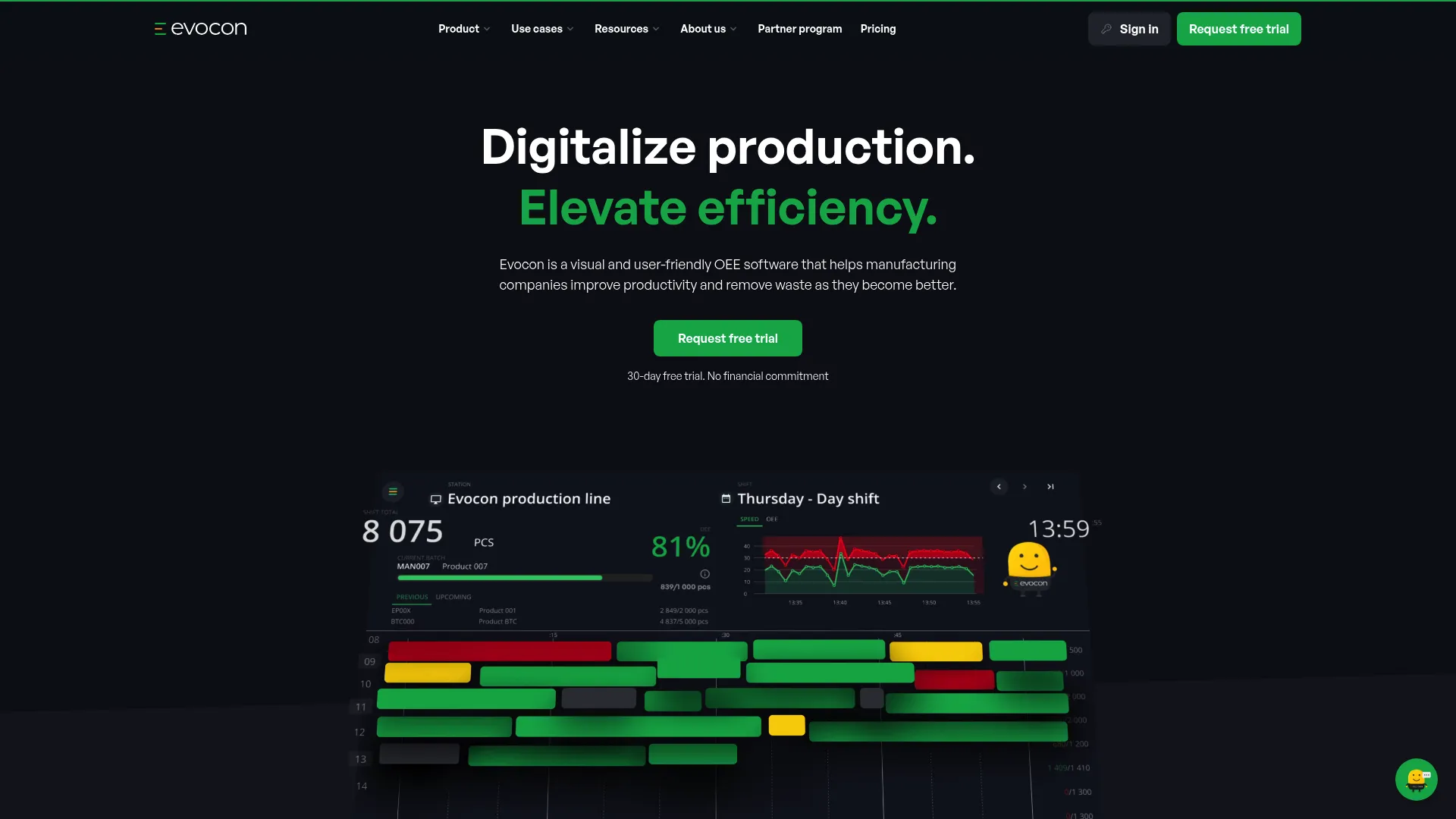
Evocon is cloud-based OEE and production monitoring software built to get teams from install to insight quickly. It captures machine data automatically, layers operator reason codes on top, and surfaces the result in real-time dashboards that a supervisor can read at a glance. The platform is known for how fast it lands on the floor, which is exactly what matters when you're trying to prove value before the next budget cycle.
Best for: Manufacturers that need real-time OEE and production visibility rolled out across shifts without a long implementation.
Key strengths
- Real-time shift tracking: Live production status by shift and line, so stalls get attention in minutes rather than at end of day.
- Dashboards and reports: Clean production dashboards and historical reporting that make trends and benchmarking obvious to operators and managers alike.
- Alerts, checklists, API, and SSO: Threshold alerts, digital checklists, API access, and single sign-on for teams standardizing across sites.
Why choose Evocon: For a product manager mindset, Evocon wins on time-to-value and adoption. It instruments the floor fast, segments cleanly by shift and machine, and keeps ongoing overhead low, the same traits you'd want in any onboarding or monitoring stack. If your priority is getting a trustworthy number in front of the morning meeting soon, this is the strongest starting point on the list.
Evocon pricing: Evocon publishes three plans priced per machine. Basic starts at $189/month, Professional at $249/month, and Enterprise at $319/month, each billed annually on a 3-year agreement (shorter terms are also shown). There is no free tier, but pricing is transparent, which is rare in this category and helpful when you're building a business case.
2. Vorne XL Platform
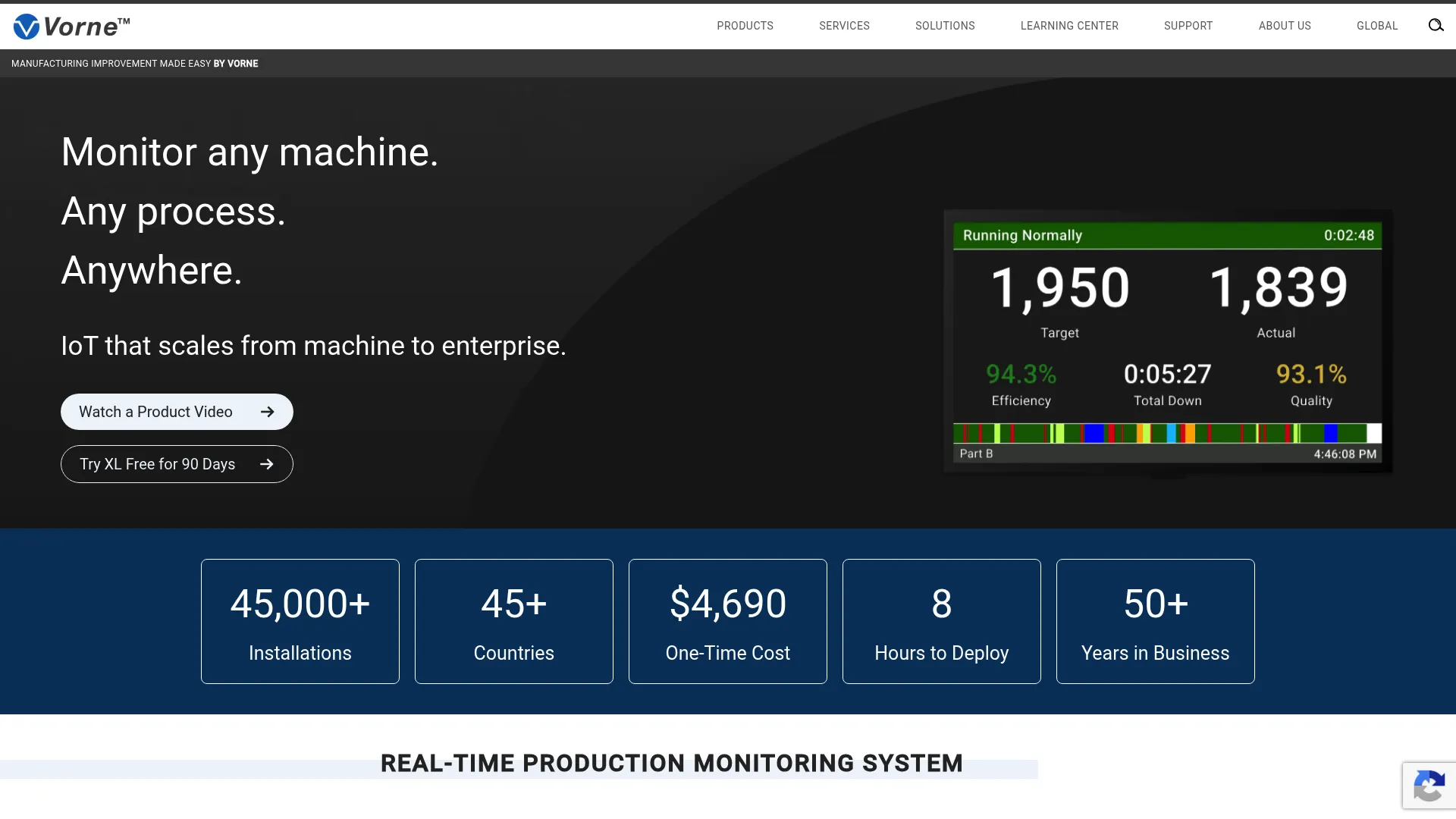
Vorne XL Platform is an industrial production monitoring platform delivered as a turnkey appliance. It combines real-time production monitoring, built-in and custom reporting, and operator scoreboards into a system designed to live on the plant floor. Vorne leans hard into structured OEE methodology, including TEEP framing, so teams learn to see the full spectrum of losses, not just the obvious stops.
Best for: Manufacturers wanting a turnkey OEE and production monitoring system with strong plant-floor scoreboards and disciplined loss analysis.
Key strengths
- Real-time production monitoring: Continuous machine and line status that operators watch on scoreboards, driving accountability shift by shift.
- Built-in and custom reporting: Standard reports plus the flexibility to build views for shift-level performance tracking and cross-line benchmarking.
- Alerts and email reports: Threshold alerts and scheduled email reports that push the right numbers to the right people without anyone logging in.
Why choose Vorne: Vorne suits teams that want the discipline of a defined OEE and TEEP framework baked into the tool. The scoreboard approach makes losses visible to everyone on the floor, which changes behavior faster than a dashboard only managers see. If your improvement culture is still forming, that visibility is a real asset.
Vorne pricing: Vorne prices its XL productivity appliances as a one-time hardware purchase. The XL HD model starts at $4,290, with the XL810-1 at $4,490, XL HD+ at $4,690, and XL Touch at $4,990. Volume discounts are available, and Vorne offers a free 90-day trial, so you can validate fit on a real line before committing capital.
3. Maintmaster
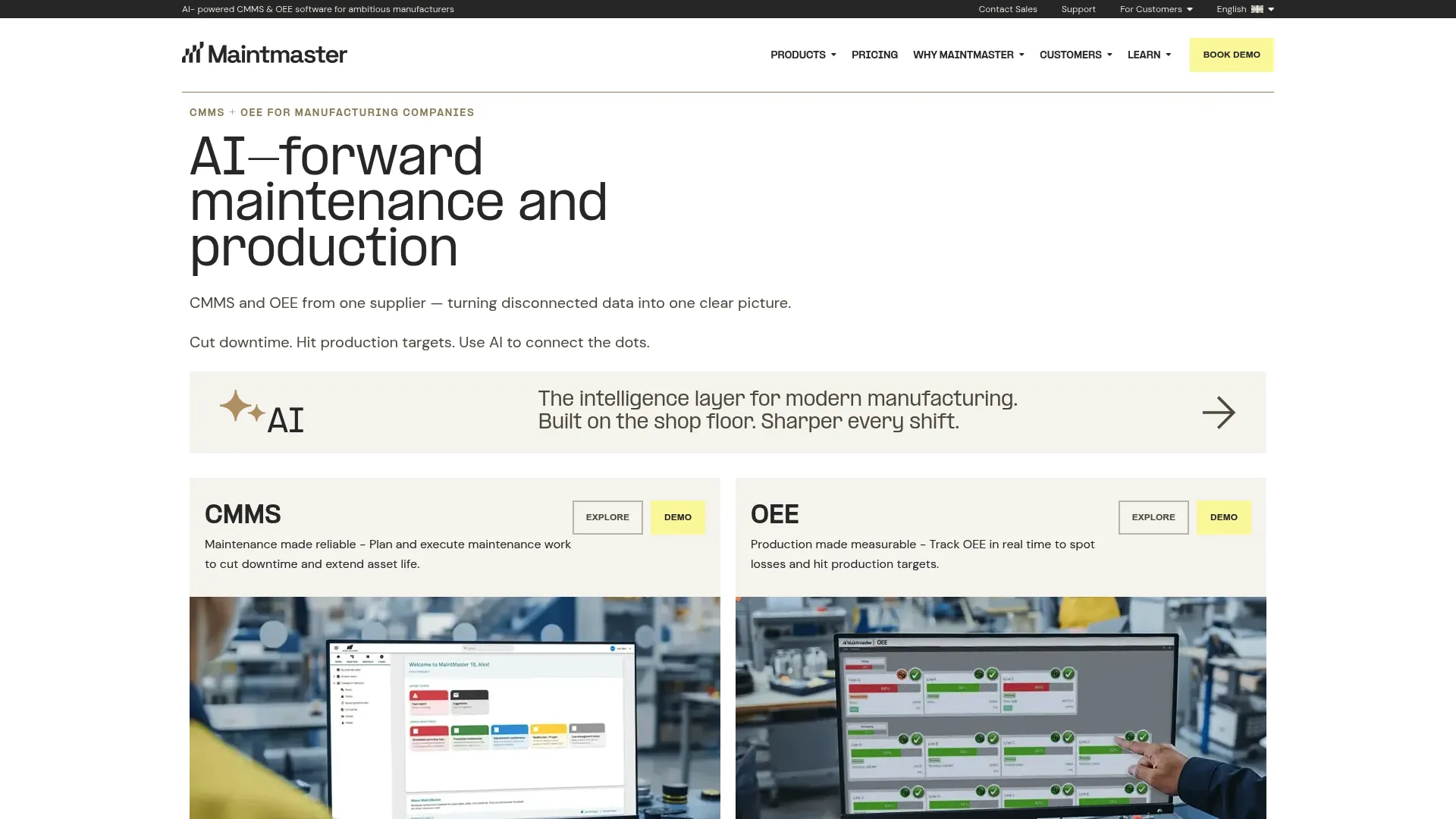
Maintmaster is cloud-based CMMS and OEE software that treats maintenance and production monitoring as one workflow. It captures downtime and losses with real-time visibility, then connects those losses directly to work orders, assets, and spare parts. That linkage is the whole point: a recurring stop doesn't just show up on a chart, it becomes a maintenance task.
Best for: Manufacturers that want a configurable CMMS plus OEE and operational improvement tools in a single system.
Key strengths
- CMMS for maintenance operations: Work orders, asset management, spare parts, and KPI tracking, so maintenance and OEE data live in the same place.
- OEE monitoring: Downtime, loss capture, and real-time production visibility that feed directly into maintenance planning.
- Manufacturing intelligence and IoT: Support for recurring-issue detection and earlier intervention, turning patterns into preventive maintenance before failures cascade.
Why choose Maintmaster: If your losses are mostly maintenance-driven, seeing OEE next to the work order that fixes it removes the handoff that usually slows everything down. Maintmaster fits teams whose improvement lever is asset reliability, not just scheduling. The CMMS integration is native, not bolted on, which keeps the loop tight.
Maintmaster pricing: Maintmaster publishes CMMS pricing across four tiers. Starter is €265/month and Standard is €580/month, both with public monthly prices, while Premium and Enterprise require contacting the vendor. Currency selectors cover EUR, GBP, and SEK. There is no free tier listed.
4. ABB OEE Software

ABB OEE Software calculates and analyzes overall equipment effectiveness from production data inside ABB's broader manufacturing operations management environment. It's built for plants that already think at the operations layer, offering real-time and historical OEE analysis, downtime event analysis, and equipment comparison with data auditing. This is the enterprise end of the category.
Best for: Manufacturers wanting OEE visibility and downtime analysis within a larger MOM or MES-adjacent operations context.
Key strengths
- Real-time and historical OEE analysis: Live monitoring paired with deep historical views for benchmarking across equipment and time.
- Downtime event analysis: Structured analysis of stops and their causes, supporting rigorous root cause analysis at scale.
- Equipment comparison and data audit: Cross-asset comparison plus data auditing, which matters when governance and data trust are non-negotiable.
Why choose ABB: ABB fits enterprise operations teams that need OEE as one layer inside a governed, plant-wide system rather than a standalone tool. If you're already invested in ABB Ability MOM, keeping OEE in the same environment reduces integration friction and centralizes reporting. G2 shows a 5.0/5 rating, though from a very small sample, so weigh it against a hands-on evaluation.
ABB pricing: ABB does not publish standalone pricing for its OEE application, which tracks with enterprise MOM packaging. Expect a scoped, quote-based engagement tied to your broader operations footprint. Plan for a procurement conversation rather than a self-serve signup.
5. GainSeeker Suite
GainSeeker Suite is PQ Systems' statistical process control software suite for monitoring and improving manufacturing quality, with OEE positioned alongside its SPC core. Where most tools on this list start from availability and downtime, GainSeeker starts from quality data and analysis, then extends into effectiveness. For quality-driven plants, that emphasis is the differentiator.
Best for: Manufacturers whose losses are dominated by quality and variation, and who want SPC and OEE in one analytical toolset.
Key strengths
- Statistical process control charts: Real-time SPC charting that catches variation before it becomes scrap, the foundation of quality-led improvement.
- Data collection and analysis: Structured capture and analysis that turn shop-floor data into operational intelligence.
- Alarm and exception monitoring: Threshold alarms and exception tracking that flag out-of-control conditions as they emerge.
Why choose GainSeeker: If quality variation drives more loss than raw downtime, an SPC-first platform gives you a sharper lens than a downtime-first OEE tool. GainSeeker fits plants where quality and OEE improvement are the same conversation. It pairs statistical rigor with operational reporting in a way pure monitoring tools don't.
GainSeeker pricing: PQ Systems does not publish public pricing for GainSeeker Suite. Expect a quote-based engagement scoped to your data collection points and analysis needs. Budget a vendor conversation to size it accurately.
6. GlobalReader

GlobalReader is manufacturing software for real-time factory monitoring, OEE tracking, planning, maintenance, and ERP integration. Its modular design lets teams start with core monitoring and add capabilities as they mature, which keeps the entry point light while leaving room to grow into planning and maintenance.
Best for: Factories wanting modular, real-time production visibility and OEE improvement without buying every module on day one.
Key strengths
- Real-time OEE and production analytics: Live effectiveness tracking and analytics across assets, so visibility scales as you add machines.
- Operator downtime reason capture: Structured reason codes at the machine that make downtime tracking and root cause analysis reliable.
- Planning, maintenance, and ERP integration: Production scheduling, maintenance tracking, and Smart Factory ERP integrations that connect the floor to the rest of the business.
Why choose GlobalReader: The modular model fits teams that want real-time monitoring now and the option to layer planning, maintenance, and ERP later. You instrument what matters first, then expand without re-platforming. That path suits a PM-style rollout: prove value on a segment, then scale.
GlobalReader pricing: GlobalReader publishes pricing per machine per month. Monitoring Core Starter is €109/machine/month, optional features start at €23/machine/month each, and add-ons start at €11/machine/month each. Annual billing saves 5%, and the site notes a free version is available, though exact free-tier terms aren't fully specified.
7. TEEPTRAK
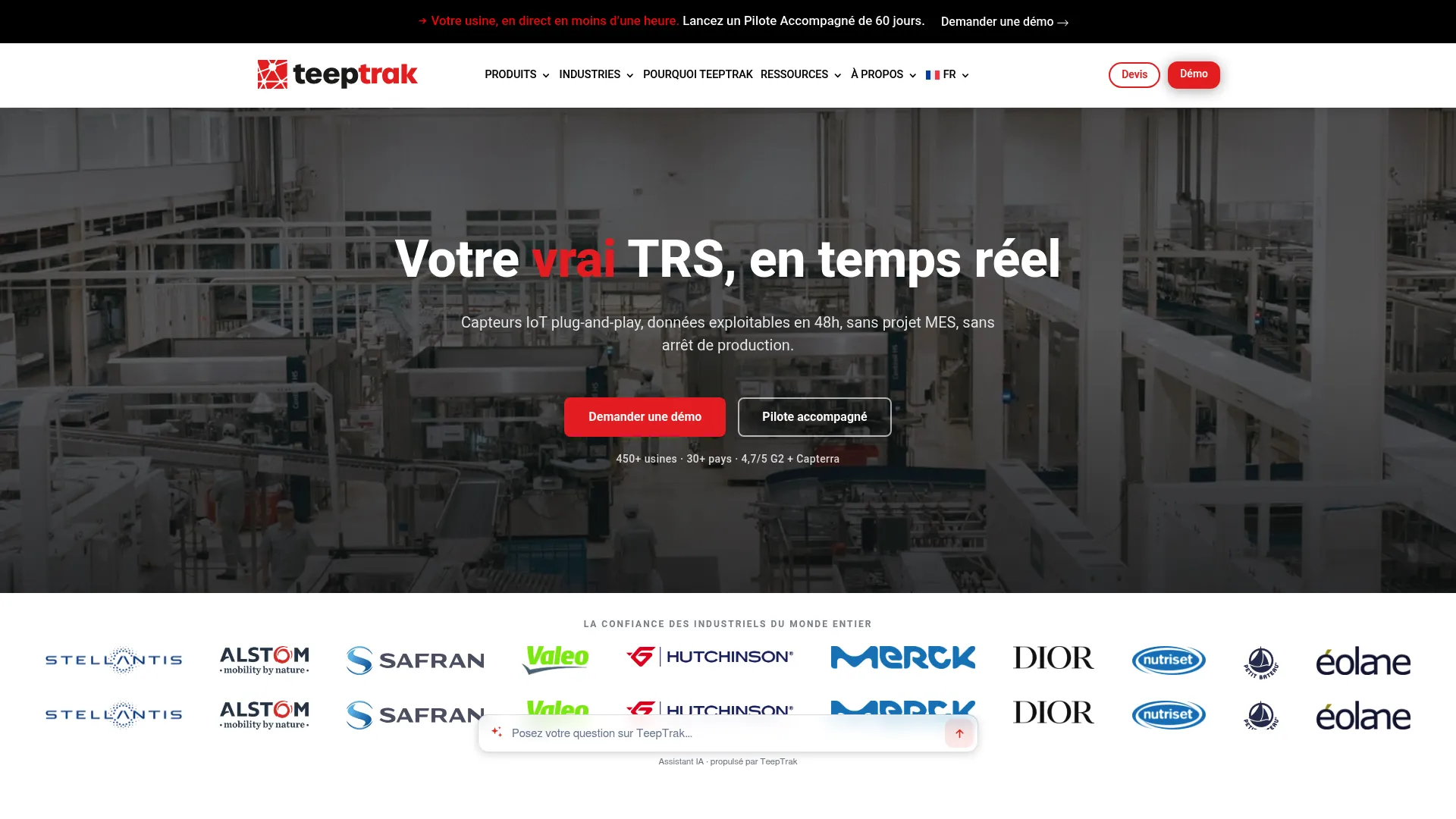
TEEPTRAK is industrial real-time OEE and production monitoring software built for fast deployment across one or more production lines. It captures downtime and micro-stops, prompts operators to qualify causes, and rolls everything up into multi-plant dashboards. The design goal is visibility on the floor quickly, without a heavy IT project.
Best for: Manufacturers needing fast-deploy OEE and downtime visibility across a single line or a multi-plant network.
Key strengths
- Real-time OEE monitoring: Live effectiveness tracking that gives supervisors immediate visibility into performance losses.
- Downtime and micro-stop capture: Automated detection of short stops that manual logging misses, plus operator cause qualification for clean data.
- Multi-plant dashboards and integrations: Cross-site dashboards with SAP, Oracle, and Power BI integrations for teams standardizing reporting across facilities.
Why choose TEEPTRAK: TEEPTRAK suits teams that want real-time production monitoring live fast and rolled out across sites without a long implementation. The micro-stop capture is a genuine advantage where small losses dominate. Combined with SAP, Oracle, and Power BI integrations, it slots into an existing reporting stack rather than replacing it.
TEEPTRAK pricing: TEEPTRAK prices by scope, based on the number of lines, machines, and modules you deploy. No public numeric price is listed, so expect a scoped quote. That model tends to fit both single-line pilots and multi-plant rollouts.
8. OEEasy
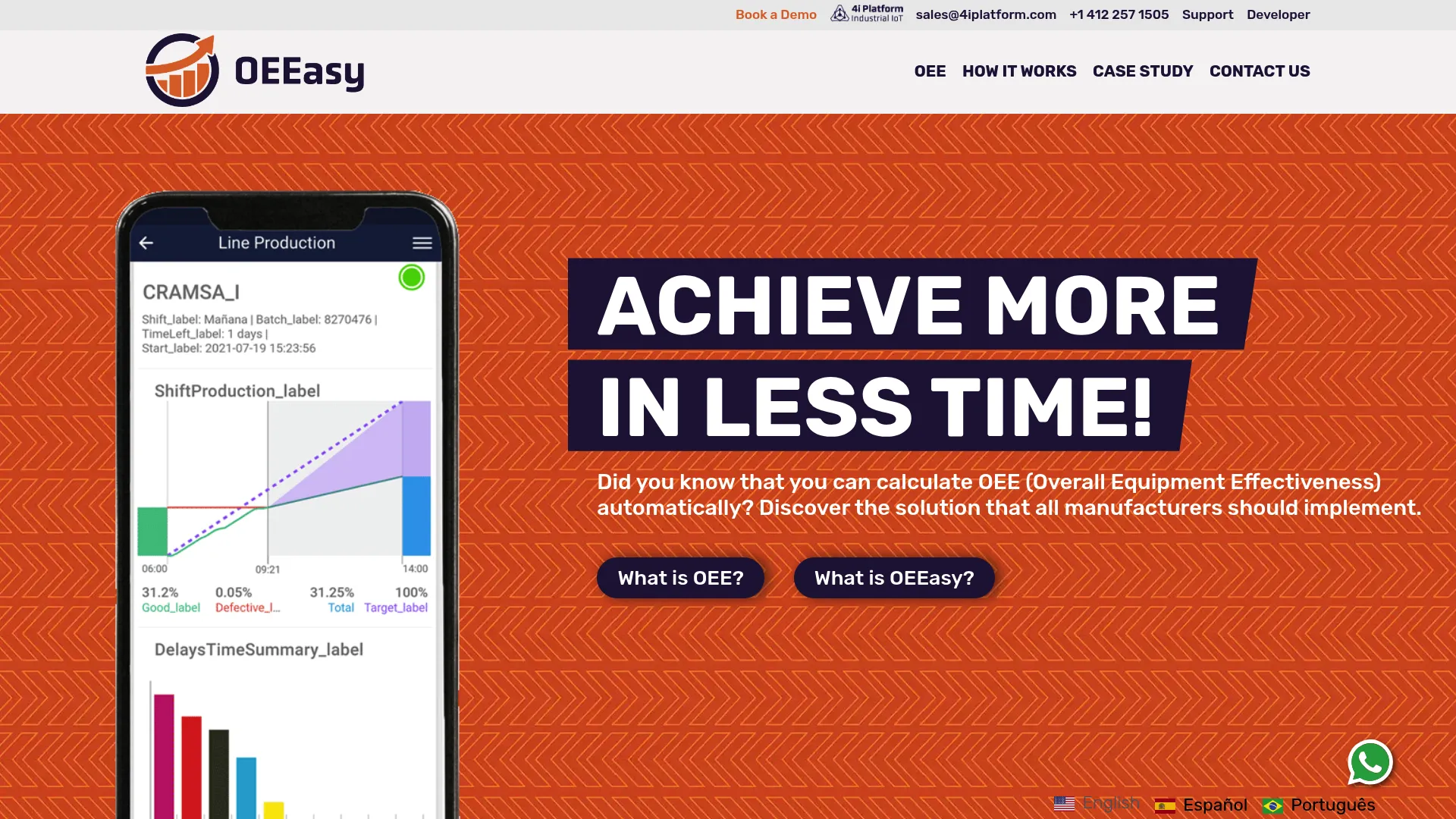
OEEasy is a compact, browser-based option for teams that want automated OEE measurement across availability, performance, and quality without a heavy platform. It's positioned for buyers evaluating a focused, lightweight tool rather than a full manufacturing operations system.
Best for: Small or focused teams wanting a simple, browser-based way to measure OEE across the three pillars.
Key strengths
- Browser-based access: No heavy install, so teams can reach OEE data from any device on the network.
- Automated OEE measurement: Availability, performance, and quality tracked automatically to keep the calculation current.
- Compact footprint: A focused tool for teams that want the core OEE number without broader operations complexity.
Why choose OEEasy: When the goal is a clean OEE number and nothing more, a compact browser-based tool keeps the decision simple. OEEasy suits small manufacturers or single-line operations testing the value of automated tracking before scaling. Treat it as a lightweight entry point into the category.
OEEasy pricing: Public pricing was not verifiable at the time of writing. Contact the vendor directly to confirm current plans and terms before committing.
Considerations before you buy
Before you sign, pressure-test each shortlisted tool against the realities of your floor.
Data collection fit
Confirm how the tool captures data from your specific machines. Direct sensor or PLC connections give you automated data capture with the least operator effort, while manual reason codes fill the gaps machines can't see. Ask which of your assets connect natively and which need retrofitting.
Setup speed and adoption
A tool operators ignore produces no value. Evaluate how fast it lands on the floor and whether the operator interface is simple enough that reason codes actually get entered. Shift-level performance tracking only works if the people on shift trust and use it.
Dashboard and report depth
Look past the demo dashboard. Check whether you can build views for your real segments: by shift, line, product, and site. Historical trends and benchmarking matter as much as the live view, because improvement lives in the comparison over time.
Maintenance and system integration
Decide early whether you need CMMS integration, ERP connections, or BI export. If your losses are maintenance-driven, native work-order linkage saves a costly manual handoff. If you standardize reporting in Power BI or an ERP, confirm the integrations exist and are supported.
Conclusion
The right OEE monitoring system depends on where your team sits today. For fast setup and broad adoption across shifts, Evocon is the strongest starting point, transparent pricing included. If you want turnkey scoreboards and disciplined OEE and TEEP methodology, Vorne XL Platform delivers that on the plant floor. When losses are maintenance-driven, Maintmaster keeps OEE and CMMS workflows in one loop, and for enterprise operations already running MOM, ABB OEE Software fits the governed, plant-wide picture.
For quality-led plants, GainSeeker Suite brings SPC and OEE together, while GlobalReader and TEEPTRAK give modular, real-time monitoring that scales across assets and sites. OEE Tracker and OEEasy are lean, focused entry points when you want the core number without a broad platform.
Your next step is simple: pick the two tools that match your dominant loss type and operating scale, then run a short trial on one real line. Measure whether the data changes what your morning meeting argues about. That's the only benchmark that matters.
FAQs
OEE software is used to monitor manufacturing performance in real time, analyze losses across availability, performance, and quality, and drive continuous improvement. It replaces manual tracking with automated capture, so teams can spot downtime as it happens and turn recorded losses into corrective action rather than after-the-fact guesswork.
Most OEE software collects data automatically from machine sensors, PLCs, and IoT devices, then supplements it with operator-entered reason codes for stops the hardware can't classify. Some tools also pull from APIs or accept manual input where automated capture isn't practical. The best real time OEE tools combine automated signals with lightweight operator input for clean, trustworthy data.
Prioritize setup speed and shop-floor adoption, flexible data collection that fits your machines, dashboards you can segment by shift and site, alerts for live stops, and a clear path from a recorded loss to a maintenance or improvement action. A tool operators actually use beats a feature-rich one they ignore.
No. MES (manufacturing execution systems) manage and orchestrate production across scheduling, work orders, and traceability, while OEE software focuses specifically on measuring and improving equipment effectiveness. They overlap, and some platforms bundle both, but OEE tracking software is narrower and typically faster to deploy for teams whose first goal is visibility into losses.
Yes. Many OEE platforms offer CMMS integration so a recurring downtime event can trigger a work order or feed a preventive maintenance schedule. Tools like Maintmaster combine OEE and CMMS natively, which removes the manual handoff between spotting a loss and dispatching the fix. This linkage is where measurement turns into reliability gains.
It varies widely by tool and scope. Cloud-based options such as Evocon are designed to launch quickly across shifts, while turnkey appliances like Vorne offer trial periods to validate fit before rollout. Enterprise deployments tied to a broader MOM or MES environment take longer because of integration and governance requirements. Confirm timelines with each vendor against your machine count and connectivity.
Smaller teams usually want simple, fast-to-launch tools with transparent pricing. Evocon is strong for quick cloud-based rollout, GlobalReader offers a modular entry point you can expand later, and OEE Tracker and OEEasy provide focused, lightweight OEE tracking without a broad platform commitment.
Enterprise plants need governance, scale, and integration with existing operations systems. ABB OEE Software fits teams already running a manufacturing operations management environment, and TEEPTRAK supports multi-plant dashboards with SAP, Oracle, and Power BI integrations. For quality-intensive enterprises, GainSeeker Suite adds statistical process control alongside OEE.