

You ran a launch. Traffic ticked up. Sales says pipeline feels warmer. Your CMO asks the obvious question: "Did anyone actually notice us?" And you realize you have five dashboards, none of which answer it.
That is the core problem with brand awareness. It does not live in one place. Search demand sits in one tool, direct traffic in another, mentions somewhere else, and audience recall nowhere at all unless you go ask people directly. No single number proves awareness moved. You have to triangulate.
The stakes are real. The global brand monitoring tools market hit $4.96B in 2023 and is projected to reach $12.5B by 2032, growing at a 15.43% CAGR, according to Wise Guy Reports (2024). And 92% of marketers planned to maintain or increase brand awareness investment in 2025, per SeoProfy (2025). More spend, more scrutiny, and still no easy way to answer whether people know you exist.
For product marketing managers, this is a measurement problem, not a vibe. If you can show that a launch lifted branded search, drove more direct sessions, and moved unaided recall in a survey, you have a defensible story. If you cannot, "brand" stays the line item leadership cuts first. The tools below help you build that proof loop. If you also track how buyers perceive your product versus competitors, a brand intelligence or brand advocacy workflow pairs naturally with the stack here.
What's inside
This guide is for PMMs, growth marketers, demand gen leads, and founders who need to measure and report brand visibility without leaning on vanity metrics. We picked tools across the four signals that actually indicate awareness: search demand, web traffic, public mentions, and audience research.
We chose each tool on four criteria: measurement breadth (what signals it captures), ease of use (can a small team run it), reporting depth (can you defend the output in a board deck), and go-to-market fit (does it slot into a PMM workflow). The list covers both brand tracking, watching signals over time, and point-in-time measurement, capturing where awareness stands right now.
TL;DR
- Best for search demand: Google Trends for relative interest and Semrush for absolute branded search volume.
- Best for monitoring mentions: Brand24 for social listening with sentiment, Google Alerts for a free lightweight starting point.
- Best for perception and recall: SurveyMonkey for aided and unaided awareness surveys you can run over time.
- Best for connecting awareness to behavior: Google Analytics for direct traffic, branded landing pages, and referral patterns.
- Best for social reach and reporting: Hootsuite and Sprout Social for engagement, share of voice, and campaign-level lift.
- The honest answer: No single tool measures brand awareness. You combine three or four into one repeatable dashboard.
What is brand awareness and how do you measure it?
Brand awareness is the degree to which people recognize and recall your brand and associate it with a category or need. It is not one metric. It is a spectrum, from a vague sense that a name exists to naming your brand first when someone thinks of the category.
A few terms matter here, because the tools you pick depend on which one you are measuring:
- Brand recognition: the ability to identify your brand when shown a cue, like a logo or product screenshot. This is aided awareness.
- Brand recall: the ability to name your brand unprompted when given a category or need. This is unaided awareness, and it is harder to earn.
- Top-of-mind awareness: the first brand a person names in a category. The strongest position, and the one launches aim to move.
The gap between brand recognition and brand awareness trips up a lot of teams. Recognition means "I've seen that before." Awareness includes whether people can actually place you in the right context and reach for you when it counts.
Because awareness spans passive familiarity to active recall, you cannot measure it with one signal. You measure it as a multi-signal system. The core signals worth tracking:
- Search demand: branded search volume and interest over time.
- Direct traffic: people typing your URL or navigating straight to you.
- Referral traffic: visits driven by mentions and links elsewhere.
- Brand mentions: how often your name shows up across social, news, blogs, and forums.
- Sentiment: whether that conversation is positive, neutral, or negative.
- Share of voice: your slice of category conversation versus competitors.
- Survey recall: aided and unaided awareness from direct audience research.
Read those together and you get a picture no single dashboard delivers. That is the whole job of a brand awareness measurement stack.
When to use brand awareness tools
Measure launch lift
A launch is the clearest moment to prove awareness moved. Before you ship, capture a baseline: branded search volume, direct traffic, weekly mention count, share of voice. After launch, watch the same signals for a spike. If branded searches climb, direct sessions rise, and mentions cluster around your announcement, you have measured lift, not guessed at it. This is the difference between "the launch felt big" and a slide that survives a board meeting.
Track market visibility over time
Awareness is a trend, not a snapshot. Ongoing brand tracking watches branded search, recurring mentions, and share of voice month over month. You are looking for direction: is the category conversation shifting toward you, holding steady, or drifting to a competitor? Consistent tracking also catches slow decay, the quiet erosion of visibility that never shows up in a single report but compounds over quarters.
Validate perception with audience research
Passive analytics tell you what happened. They do not tell you what people think. Surveys and interviews close that gap by measuring recognition, recall, and category association directly. When you need to know whether your target audience actually names you unprompted, or whether they connect you with the right problem, you ask them. Longitudinal survey work turns perception into a number you can chart alongside the behavioral signals.
Comparison table
Use this to narrow by the job you need done, not by feature count. Search tools, monitoring tools, analytics, and survey platforms answer different questions. Most teams end up combining two or three.
| # | Product | Intent | Key use case | Pricing | G2 rating |
|---|---|---|---|---|---|
| 1 | Google Trends | Search demand | Relative branded search interest and trend spotting | Free | 4.6/5 |
| 2 | Google Alerts | Mention monitoring | Lightweight web and news mention alerts | Free | N/A |
| 3 | Google Analytics | Behavioral signals | Direct traffic, branded pages, referral patterns | Free (360 custom) | N/A |
| 4 | SurveyMonkey | Perception research | Aided and unaided awareness surveys | Free; paid from $30/user/mo | 4.4/5 |
| 5 | Brand24 | Social listening | Mentions, sentiment, and share of voice | From $199/mo | 4.6/5 |
| 6 | Hootsuite | Social measurement | Reach, engagement, and campaign reporting | From $99/mo | 4.3/5 |
| 7 | Semrush | Search visibility | Branded search volume and competitor comparison | Free; paid from $165.17/mo | 4.5/5 |
| 8 | Sprout Social | Social intelligence | Engagement reporting and audience trends | From $79/seat/mo | 4.4/5 |
1. Google Trends
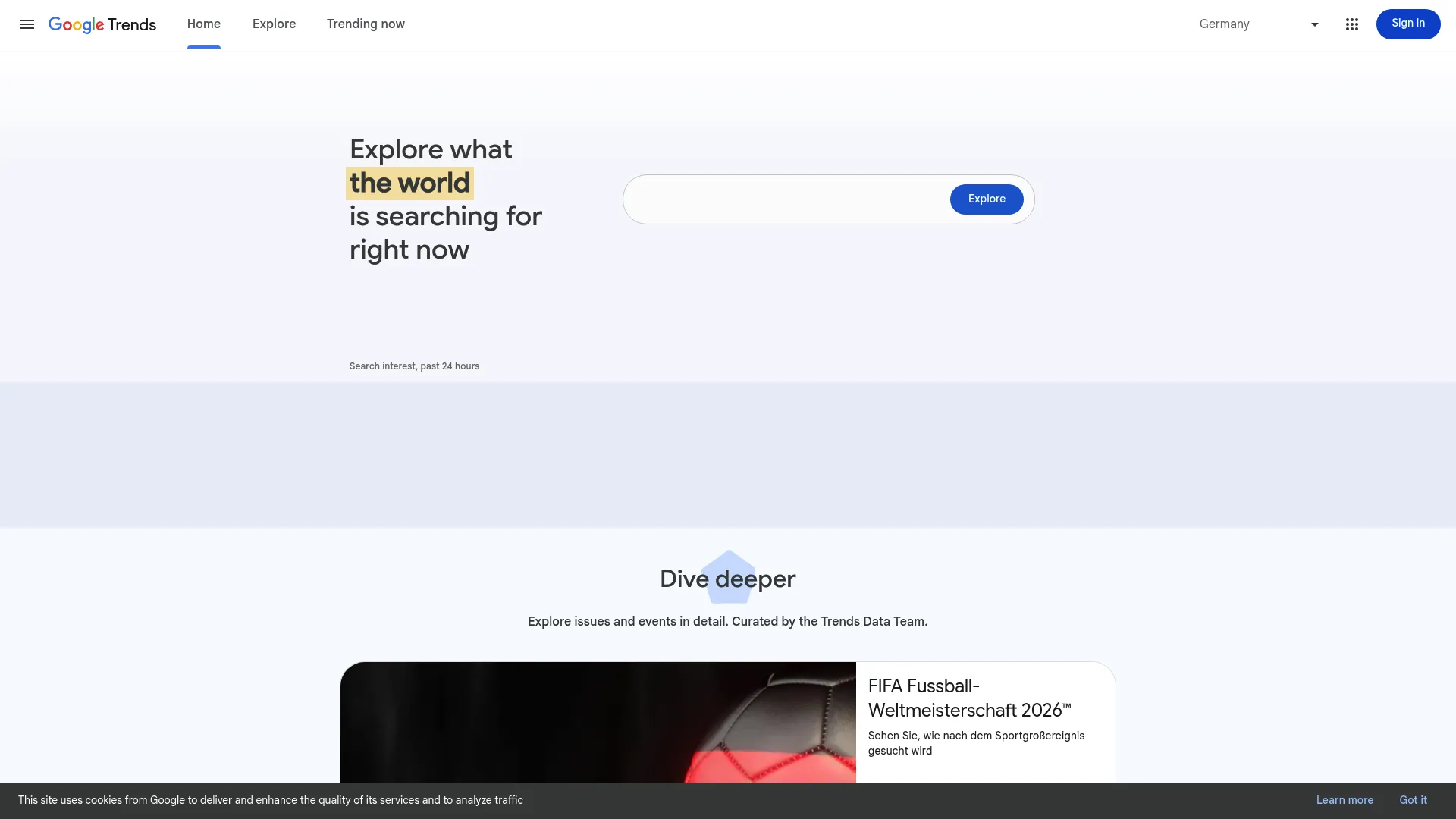
Google Trends is Google's free tool for exploring what people are searching for in real time. You can chart search interest for your brand by topic, region, and time period, compare it against competitors, and spot emerging spikes before they show up anywhere else. For a PMM, it is the fastest read on whether a launch or campaign moved search demand.
Best for: Marketers, founders, and researchers tracking relative search interest and emerging topics without a budget.
Key strengths
- Search interest over time: See how demand for your brand name rises and falls across any window you pick.
- Comparative demand: Chart your brand against competitors side by side to gauge relative visibility.
- Trending Now and related searches: Catch current spikes and discover what people search alongside your brand.
Why choose Google Trends: It is the quickest way to answer "did interest in us go up?" without instrumentation or spend. The catch worth naming: Trends shows relative interest on a 0 to 100 scale, not absolute volume, and small brands can look flat simply because their search share is thin. Pair it with a tool that reports real numbers when you need magnitude.
Google Trends pricing: Free. Google describes Trends as a no-cost exploration tool, and there is no public paid tier. That makes it a natural first stop for teams measuring brand awareness on zero budget.
2. Google Alerts
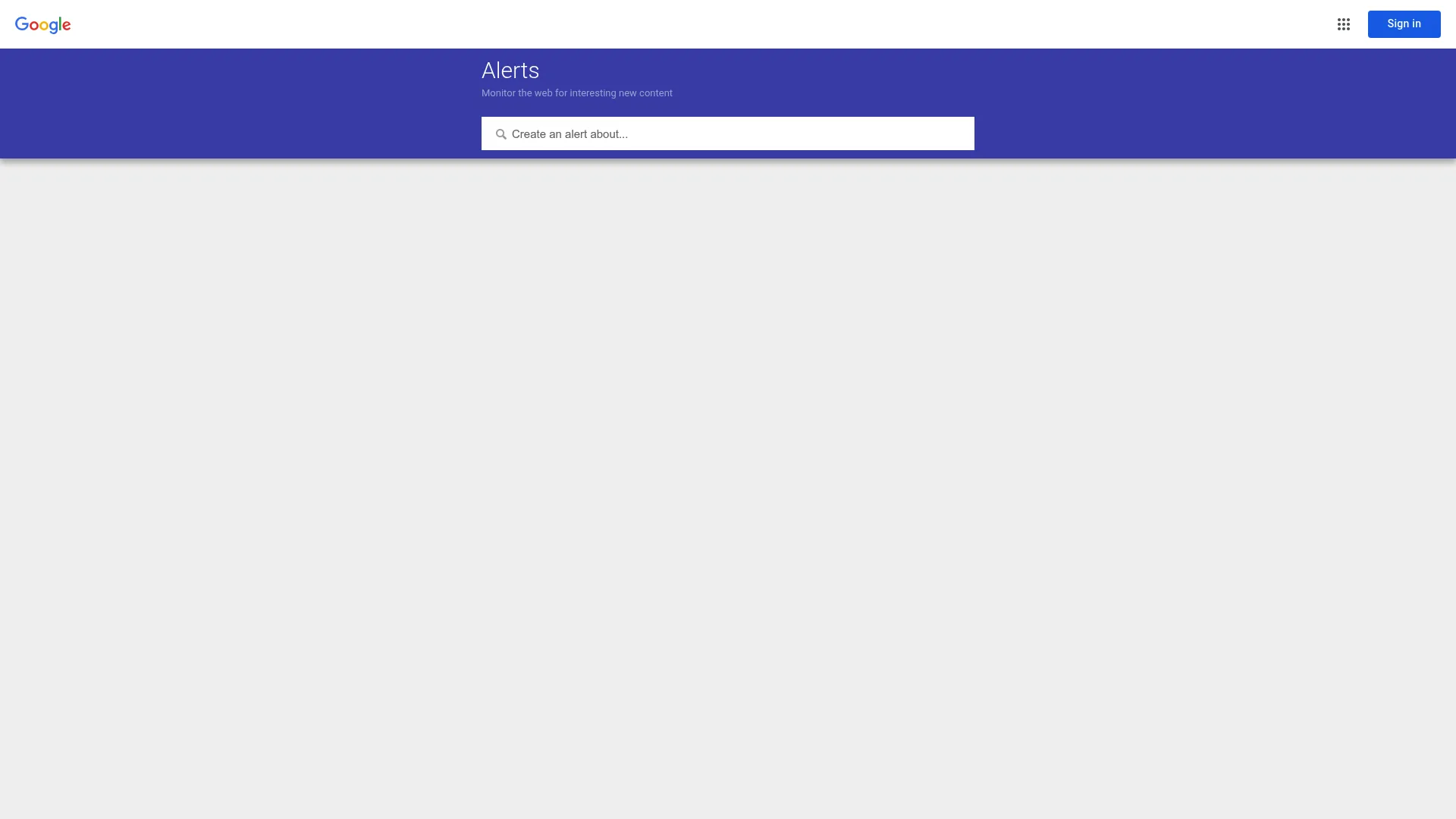
Google Alerts is a free Google service that emails you whenever new web results match a topic you set, like your brand name, a product, or a competitor. You configure the query, pick frequency and sources, and Google pushes matching mentions to your inbox across news, blogs, web, and video.
Best for: Individuals and small teams who want a zero-cost way to catch brand mentions and reputation signals as they appear.
Key strengths
- Email alerts on new mentions: Get notified the moment fresh content matches your brand or topic.
- Customizable scope: Tune frequency, language, region, sources, and result volume to cut noise.
- Broad coverage: Monitors news, blogs, web, video, discussions, and more from a single query.
Why choose Google Alerts: It is the lightest possible entry point for mention tracking, and free. Teams tend to outgrow it once they need sentiment, social coverage, or historical mention volume, since Alerts is notification-only and does not aggregate or quantify. Use it early, then layer a dedicated listening tool when you need to measure conversation, not just spot it.
Google Alerts pricing: Free. There is no public paid tier or usage cap that Google publishes. That makes it an easy addition to any brand tracking setup, even alongside more advanced tools.
3. Google Analytics

Google Analytics is the web and app analytics platform for measuring traffic, behavior, and conversions. For brand awareness, it is where you read the downstream effect: direct traffic (people who typed your URL or navigated straight to you), branded landing page behavior, and referral patterns that show mentions turning into visits.
Best for: Teams that need free web and app analytics with a path to enterprise scale through Analytics 360.
Key strengths
- Direct and referral traffic: Track people arriving without a search or ad, a strong proxy for awareness.
- Event-based measurement: See how branded visitors behave once they land and whether they convert.
- BigQuery export: Pipe raw data out for custom awareness dashboards and deeper analysis.
Why choose Google Analytics: It connects awareness to action better than any pure monitoring tool, showing whether a lift in visibility actually produced sessions and conversions. The caveat every PMM should note: direct traffic is a messy bucket, catching untagged links, app clicks, and bookmarks alongside true type-ins, so treat it as a directional signal, not a clean count. Attribution across channels also blurs, which is why you triangulate.
Google Analytics pricing: The standard product is free. Google Analytics 360 exists as an enterprise tier with higher limits, but Google does not publish its price openly. For most teams measuring brand awareness, the free tier covers direct traffic and branded page analysis fully.
4. SurveyMonkey
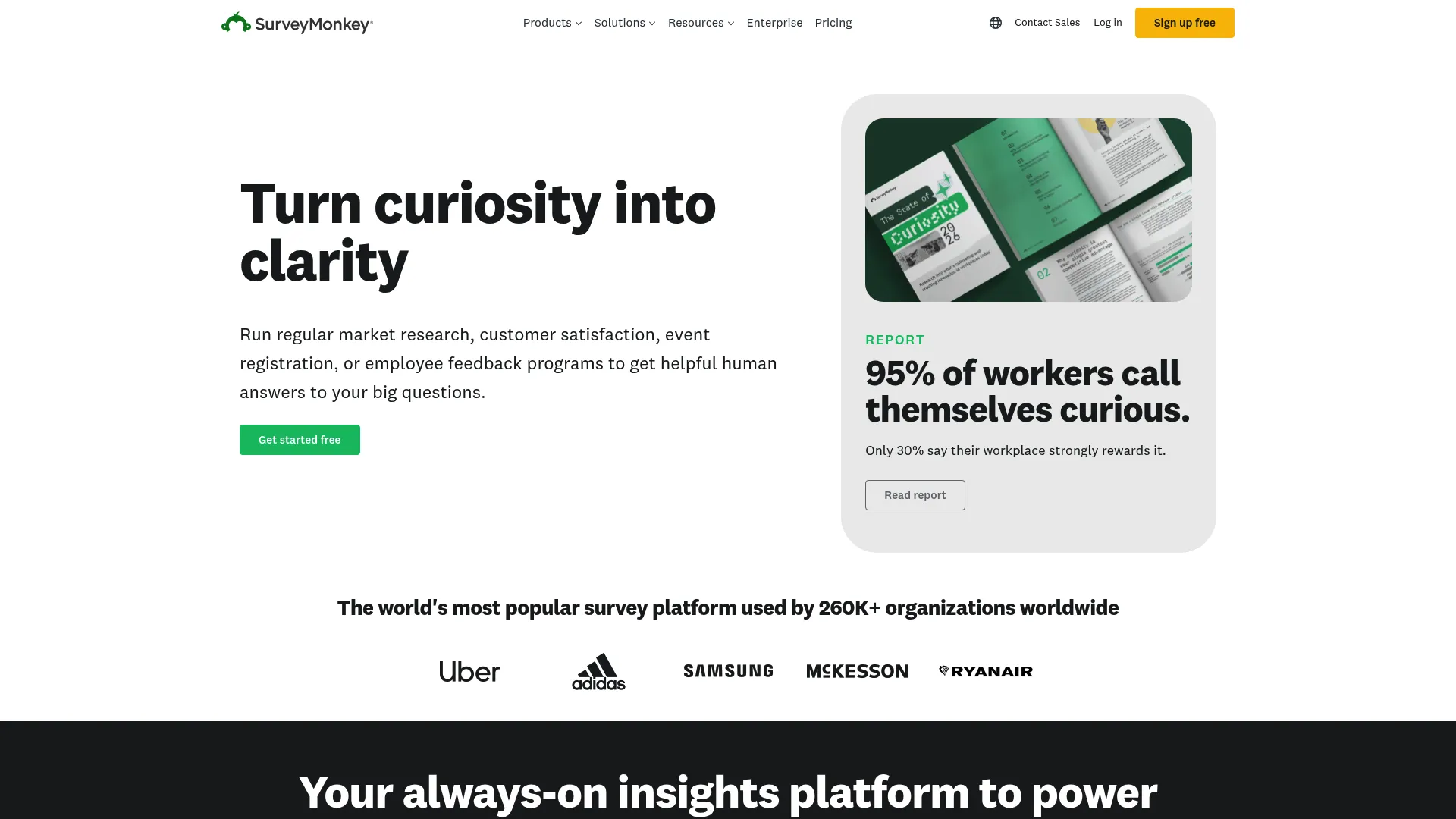
SurveyMonkey is a survey and forms platform for collecting feedback, analyzing responses, and sharing insights. It is the tool that answers the question analytics cannot: do people actually recall your brand? You can run aided awareness questions ("which of these have you heard of?") and unaided recall ("name a tool for X"), then repeat the same survey quarterly to chart perception over time.
Best for: Teams that need a mature survey platform with templates, collaboration, and AI-assisted analysis for brand tracking.
Key strengths
- AI survey creation and analysis: Build awareness surveys fast and surface patterns in open-ended responses.
- 400+ templates: Start from proven question sets instead of writing recall questions from scratch.
- 200+ integrations: Push survey data into your analytics and reporting stack via API and connectors.
Why choose SurveyMonkey: Surveys capture the one thing passive data misses: perception. When you need to prove that unaided recall rose after a campaign, or that your category association shifted, a longitudinal survey is the only tool that delivers it. It is better than analytics when the question is "what do people think," not "what did people do." Sample quality and consistent question design matter, so lock your methodology before you start tracking.
SurveyMonkey pricing: A free Basic plan is available. Paid Team Advantage starts at $30 per user per month and Team Premier at $92 per user per month, both billed annually starting at three users. The free tier is enough to pilot a simple awareness survey before committing.
5. Brand24
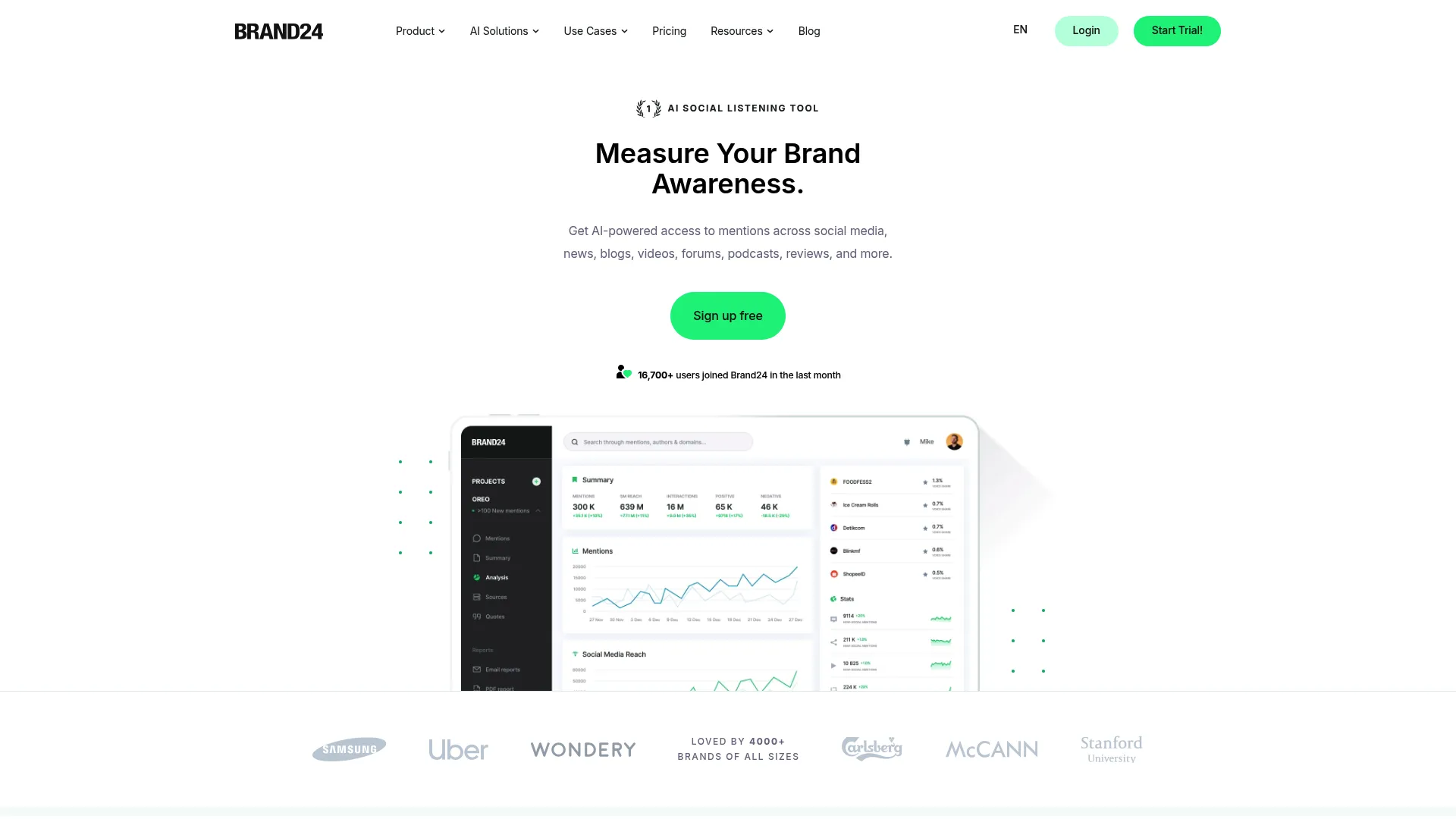
Brand24 is AI-powered media monitoring and social listening software. It captures brand mentions across social, news, blogs, forums, and podcasts, then layers sentiment analysis and share of voice on top. This is where you get the context raw traffic data misses: not just that people are talking, but what they are saying and how the tone is trending.
Best for: Teams that need social listening, sentiment tracking, and AI-assisted media insights in one place.
Key strengths
- Real-time alerts: Get notified the moment a spike or negative mention appears, useful for PR and reputation.
- Sentiment analysis: See whether conversation about your brand skews positive, neutral, or negative.
- AI Brand Assistant: Summarize mention trends and surface insights without manually reading every result.
Why choose Brand24: Analytics tell you traffic moved. Brand24 tells you why the conversation is shifting, which is the missing half of an awareness picture. It captures share of voice against competitors and flags reputation risks before they compound. For PMMs, it turns "we got mentioned" into a measurable, sentiment-scored trend line you can report.
Brand24 pricing: Plans start at $199 per month (Individual, billed annually) or $249 monthly. Team runs $299 annually, Pro $399, Business $599, and Enterprise from $1,499. A 14-day free trial is available across tiers.
6. Hootsuite
Hootsuite is a social media management and social intelligence platform. Beyond scheduling and publishing, its analytics and listening features make it a measurement layer for social media engagement: reach, impressions, engagement rate, and campaign performance across every connected network. For awareness, it doubles as both a channel to build visibility and a place to prove it moved.
Best for: Teams managing multiple social accounts that need publishing, inbox, analytics, and listening in one place.
Key strengths
- Scheduling and publishing: Run awareness campaigns across networks from a single calendar.
- Unified inbox: Handle messages and mentions in one view for faster response and engagement.
- Listening and benchmarking: Track social conversation and compare performance against competitors.
Why choose Hootsuite: It supports both sides of the awareness loop, building reach and measuring it, so campaign lift and social engagement live in the same tool. That consolidation matters for lean teams who do not want a separate listening subscription. If your awareness strategy leans heavily on organic and paid social, Hootsuite keeps publishing and reporting under one roof.
Hootsuite pricing: Paid plans start at $99 per month for Standard, $199 for Professional, and $399 for Advanced, all billed annually. Enterprise is custom. A 14-day free trial is offered, though there is no permanent free tier.
7. Semrush
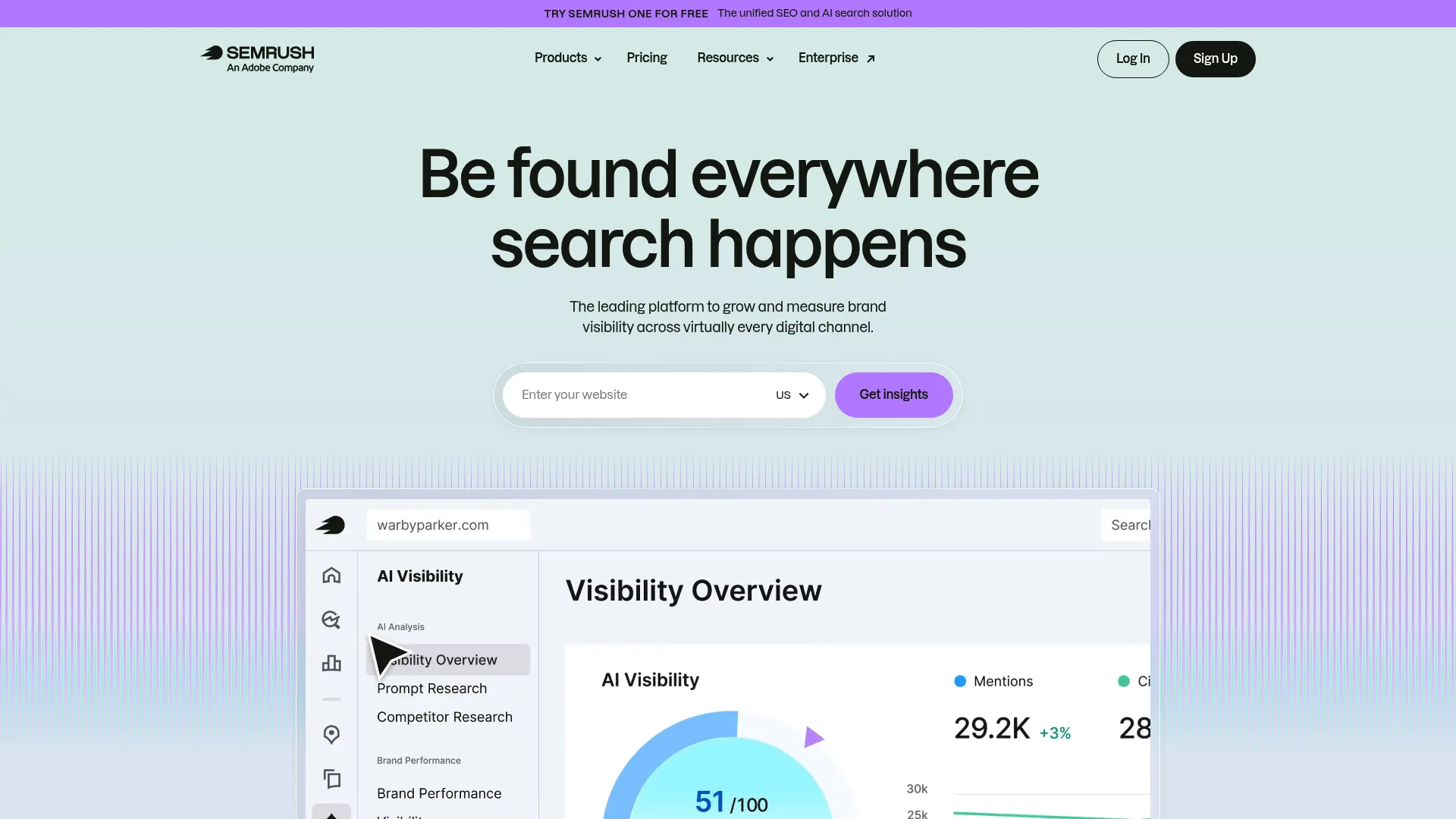
Semrush is an online visibility platform for SEO, AI search, content, paid media, social, and PR workflows. For brand awareness, it delivers what Google Trends cannot: absolute branded search volume, keyword visibility, and side-by-side competitor comparison. You can see exactly how many people search your brand name each month and whether that number is climbing.
Best for: Marketing teams and agencies that need SEO and AI search visibility tied to discoverability.
Key strengths
- Branded keyword volume: Track real monthly search counts for your brand, not just relative interest.
- Rank tracking and site audit: Monitor where you surface for branded and category terms.
- Competitive analysis: Compare your search visibility and share against direct competitors.
Why choose Semrush: When you need magnitude, not direction, Semrush gives you the absolute numbers that make a search-demand story defensible in a board deck. It connects awareness to discoverability, showing whether rising visibility translates into people actually finding you. The depth comes at a cost, and the interface rewards a learning curve, but for search-led awareness measurement it is hard to beat.
Semrush pricing: A free plan is available. Paid tiers run $165.17 per month for Starter, $248.17 for Pro+, and $455.67 for Advanced, all billed annually. Enterprise is available by demo. The free plan is enough to check branded search volume before upgrading.
8. Sprout Social
Sprout Social is a social media management and intelligence platform for publishing, engagement, analytics, listening, and employee advocacy. It leans harder into reporting and collaboration than most social tools, which makes it a strong fit for teams that need to package social awareness data for stakeholders. Engagement reporting, audience trend analysis, and social monitoring all sit in one suite.
Best for: Teams that need an all-in-one social suite with polished reporting and multi-user collaboration.
Key strengths
- Smart Inbox: Unify messages and mentions across networks for faster engagement.
- Publishing and approvals: Schedule campaigns with review workflows built for larger teams.
- Analytics and reporting: Produce presentation-ready reports on reach, engagement, and share of voice.
Why choose Sprout Social: Where some tools stop at raw metrics, Sprout is built to turn social performance into reports a PMM can hand to leadership without reformatting. Its listening and engagement data cover the social slice of awareness, and its collaboration features suit teams that share reporting across functions. The seat-based pricing sits at the premium end, which is the honest trade to weigh.
Sprout Social pricing: Essentials starts at $79 per seat per month, Professional at $299, and Advanced at $399, billed annually. Enterprise is custom. A 30-day free trial is available, though there is no permanent free plan.
Considerations before you pick a stack
You are not buying one tool. You are assembling a measurement system. Here is what to weigh before committing.
Signal coverage
Map each tool to the signal it captures: search, traffic, mentions, or recall. The goal is coverage across all four, not depth in one. A stack that measures search demand and social mentions but never surveys perception is still blind to recall.
Baseline before launch
Any awareness tool is only as useful as the baseline you capture before a launch or campaign. Lock in your starting numbers first, branded search, direct traffic, weekly mentions, so lift is measurable and not a guess after the fact.
Reporting you can defend
PMMs live and die by the board deck. Favor tools whose output you can export, chart, and explain without hand-waving. Absolute numbers and consistent methodology beat pretty dashboards that fall apart under a follow-up question.
Free versus paid fit
Several strong signals are free: Google Trends, Google Alerts, and standard Google Analytics cost nothing. Reserve paid budget for the gaps free tools leave, usually sentiment, share of voice, and longitudinal survey work.
Conclusion
Brand awareness is measurable. It is just not measurable with one number. The strongest approach combines a search tool for demand, an analytics tool for behavior, a listening tool for mentions and sentiment, and a survey tool for recall.
If you want the simplest defensible setup, start free: Google Trends for search interest, Google Analytics for direct traffic, and Google Alerts for mentions. Add SurveyMonkey when you need to prove recall, and layer Brand24, Hootsuite, Semrush, or Sprout Social when you need sentiment, absolute volume, or social reporting depth.
The real next step is not buying more tools. It is building one dashboard that pulls search, traffic, mentions, and survey recall into a single view, captured before every launch and reviewed after. That is how brand awareness tracking stops being a vibe and becomes brand lift you can prove.
FAQs
Brand awareness tools help teams track how visible and recognizable a brand is across search, traffic, mentions, and audience perception. They span search demand platforms, web analytics, social listening software, and survey tools. Most teams combine several, since no single tool captures every awareness signal.
You measure it with a mixed model, not one metric. The core signals are branded search demand, direct traffic, social media engagement and mentions, share of voice, and survey-based recall. Read together, they show whether familiarity and recognition are rising, holding, or slipping.
Awareness is broad familiarity, whether people know your brand exists and can place it in the right category. Recognition is narrower: the ability to identify your brand when shown a cue like a logo or product screenshot. Recognition is one component of awareness, measured through aided-awareness questions.
It depends on the job. For launches, branded search lift and mention spikes matter most. For long-term tracking, share of voice and survey recall carry more weight. Across most teams, branded search, direct and referral traffic, brand mentions, and unaided recall are the four to watch.
Track ongoing signals like branded search and mentions monthly, and run deeper survey-based measurement quarterly. Around launches or major campaigns, review campaign-level spikes as they happen so you can attribute lift while the context is fresh. Consistency matters more than frequency.
Yes, indirectly. Google Analytics captures direct traffic (people navigating straight to you), branded landing page behavior, and referral patterns from mentions. Direct traffic is a strong awareness proxy, though it is a messy bucket, so treat it as directional and pair it with search and survey data.
They answer different questions, so neither replaces the other. Surveys capture perception and recall, what people think and remember, while social listening captures public conversation, sentiment, and share of voice in real time. The strongest measurement combines both: listening for context, surveys for recall.
It depends on the signal. For search demand, Google Trends is the best free starting point. For catching brand mentions, Google Alerts is the lightest free option. Standard Google Analytics is free too and covers direct and referral traffic, so a capable zero-budget stack combines all three.