A customer emails your sales team a security questionnaire. Forty questions, then a request for your SOC 2 report. The deal is real, the budget is approved, and now it hinges on a document you do not have. So someone on your team starts screenshotting AWS console settings, pasting them into a shared drive, and pinging engineering for evidence that a control exists. That scramble is the exact tax SOC 2 compliance software exists to remove.
The pressure is not hypothetical. Roughly 70 to 85% of enterprise RFPs now request a SOC 2 report from B2B technology vendors, according to SOC2Auditors.org (2026). And 60 to 70% of first-time SOC 2 organizations use a compliance platform to automate the work, per GetAgency (2026). The manual path, spreadsheets and shared folders and quarterly panic, does not scale past your first few enterprise deals. It leaves evidence gaps, control drift, and an audit scramble that pulls founders and engineers away from the roadmap right when momentum matters most.
SOC 2 compliance tools solve a specific problem: they turn a one-time audit project into year-round audit readiness. They connect to your cloud stack, pull evidence automatically, monitor controls continuously, and hand your auditor a clean package instead of a folder full of screenshots. For a Series B founder, that means fewer stalled deals, less founder attention spent on compliance, and a security posture you can actually defend in a board meeting. This guide compares the seven strongest options for 2026, with an eye on repeatability over hype.
What's inside
This guide compares six SOC 2 software platforms for teams that need automated evidence collection, control monitoring, audit readiness, and cross-framework support without a dedicated GRC department. We selected tools based on four criteria: automation depth (how much evidence the platform collects without manual effort), integration coverage (how well it connects to your cloud and SaaS stack), reporting and auditor workflow (how cleanly it hands off to an auditor), and framework breadth (whether it scales beyond SOC 2 to ISO 27001, GDPR, and HIPAA). The list favors fast-moving SaaS teams over enterprise risk departments, though two picks serve broader GRC programs.
TL;DR
- Best overall for most SaaS teams: Vanta, the most recognizable automation-first platform with deep integrations and a strong trust center.
- Best for strong automation plus broad framework coverage: Drata, built for cloud-first teams that want continuous monitoring across many frameworks.
- Best for a guided workflow and strong support: Secureframe, with structured control mapping and AI-assisted onboarding.
- Best for speed to readiness and clarity: Sprinto, with founder-friendly onboarding and pre-mapped frameworks.
- Best for broader GRC programs: AuditBoard and LogicGate, for organizations where SOC 2 sits inside a larger risk and audit function.
If you want to see how compliance software connects to adjacent operational tooling, our roundups of audit management software and the best AI security posture management tools cover neighboring categories worth a look.
What SOC 2 compliance software is
SOC 2 compliance software is a platform that automates the evidence collection, control monitoring, and reporting a company needs to earn and maintain a SOC 2 attestation. Instead of manually gathering proof that security controls work, teams connect their cloud infrastructure and SaaS tools, and the software continuously verifies controls against the framework.
SOC 2 is an auditing standard developed by the AICPA that evaluates how a service organization manages customer data. It is built around the five Trust Services Criteria:
- Security: protection of systems against unauthorized access, the only mandatory criterion.
- Availability: systems are available for operation and use as committed.
- Processing integrity: system processing is complete, valid, accurate, and timely.
- Confidentiality: information designated as confidential is protected.
- Privacy: personal information is collected, used, retained, and disposed of appropriately.
There are two report types. A SOC 2 Type I report attests that controls are designed correctly at a single point in time. A SOC 2 Type II report attests that those controls operated effectively over a period, usually three to twelve months. Type II is what most enterprise buyers want to see, because it proves the controls actually run, not just that they exist on paper.
Good SOC 2 automation matters because manual compliance breaks down predictably. Screenshots go stale. A control that passed in January drifts out of policy by March. Evidence lives in five different tools and no one owns the full picture. When the audit arrives, the team burns weeks reassembling proof. Compliance software replaces that pattern with continuous compliance: control monitoring runs in the background, evidence is collected on a schedule, and framework mapping lets one set of controls satisfy multiple standards at once.
Core capabilities to expect from a modern platform:
- Automated evidence collection from cloud providers, identity systems, and SaaS apps
- Continuous control monitoring with alerts when a control fails
- Pre-built framework mapping across SOC 2, ISO 27001, GDPR, and HIPAA
- Policy management templates and version control
- Vendor risk management and security questionnaire automation
- An auditor workflow that packages evidence for review
- Compliance reporting dashboards and a customer-facing trust center
When to use SOC 2 compliance software
Not every team needs a platform on day one. Here is when the switch pays off.
Replace spreadsheets and shared drives
If you are tracking controls in a spreadsheet and storing evidence in a shared folder, you have already outgrown manual compliance. The moment two or more people touch the process, ownership blurs and evidence goes stale. Software gives you a single source of truth, automatic evidence collection, and a clear record of who changed what and when. That shift alone removes most of the founder-level firefighting.
Prepare for enterprise security reviews
When deals start stalling on vendor questionnaires and audit requests, compliance drag is directly costing you revenue. A platform with questionnaire automation and a trust center lets prospects self-serve your security posture instead of waiting on your team. That keeps sales momentum intact during a SOC 2 audit cycle and shortens the time between a security review and a signed contract.
Maintain year-round readiness
SOC 2 is not a one-time project. A Type II report covers a monitoring window, so your controls have to keep operating between audits. Continuous compliance software watches controls year-round, flags drift the day it happens, and keeps you in a state of permanent audit readiness. That means the next audit is a formality, not a fire drill, and renewal season stops eating your engineering calendar.
Comparison table
Here is a side-by-side look at the seven platforms. Public pricing is rarely displayed for this category, most vendors use demo-based, custom quotes, so the pricing column reflects what each vendor discloses rather than a fixed number.
| # | Product | Intent | Key use case | Pricing | G2 rating |
|---|---|---|---|---|---|
| 1 | Vanta | Best overall | Automated compliance, trust center, audit readiness | Custom (demo-based) | 4.6/5 |
| 2 | Drata | Automation + breadth | Continuous monitoring, framework mapping, vendor risk | Custom (demo-based) | 4.7/5 |
| 3 | Secureframe | Guided workflow | Control mapping, AI-assisted audit readiness | Custom (quote-based) | Not listed |
| 4 | Sprinto | Speed to readiness | Pre-mapped frameworks, continuous GRC automation | Custom (demo-based) | 4.8/5 |
| 5 | AuditBoard | Enterprise GRC | Unified audit, risk, and compliance platform | Custom | 4.6/5 |
| 6 | LogicGate | Configurable GRC | No-code GRC workflows with AI automation | Custom | 4.6/5 |
For a founder, the table splits into three groups. Vanta, Drata, Secureframe, Sprinto, and Scytale are purpose-built SOC 2 automation platforms, choose among them on automation depth, support model, and how fast you need to reach readiness. AuditBoard and LogicGate are broader GRC platforms that make sense when SOC 2 is one piece of a larger governance program. If SOC 2 is your primary goal and you want the least internal effort, start with the first group.
1. Vanta
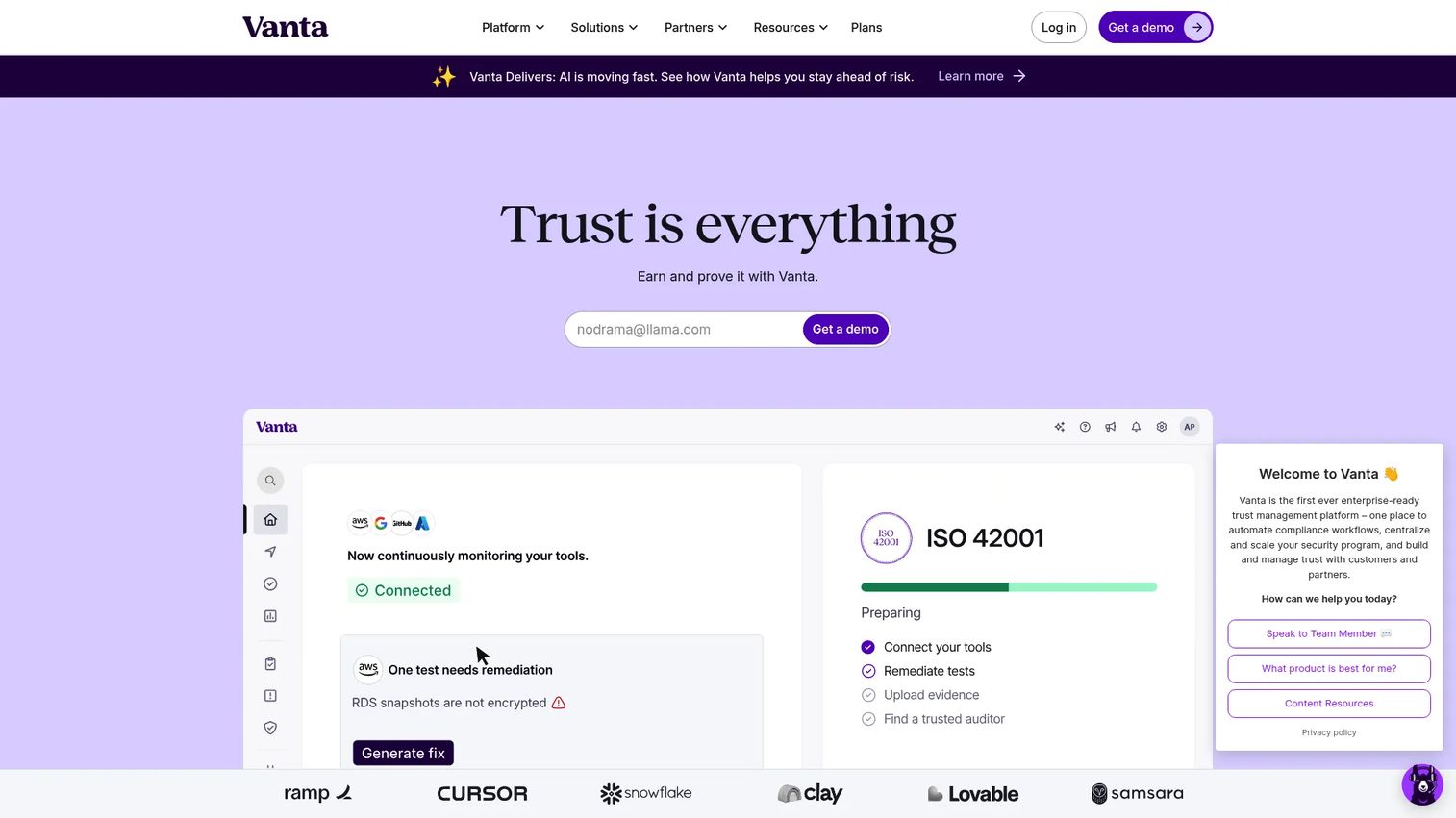
Vanta is the most recognized name in SOC 2 automation, positioned as a compliance and trust management platform that automates security, risk, and compliance workflows. It connects to your stack, monitors controls, collects evidence automatically, and packages everything for your auditor. For most SaaS teams evaluating this category for the first time, Vanta is the default reference point.
Best for: SaaS teams that want the most recognizable, automation-first path to SOC 2 with broad integration coverage.
Key strengths
- 300+ pre-built integrations: connects to cloud providers, identity systems, and SaaS tools so evidence collection runs without manual pulls.
- Automated evidence and audit workflows: continuously gathers proof and organizes it into an auditor-ready package.
- Trust Center and questionnaire automation: lets prospects self-serve your security posture, reducing back-and-forth on enterprise security reviews.
Why choose Vanta: If you want the platform your auditor, your investors, and your enterprise buyers already recognize, Vanta is the safe, well-supported choice. Its integration depth means less manual evidence chasing, and its trust center directly attacks the deal-stalling questionnaire problem. It fits founders who value a proven standard over a niche edge.
Vanta pricing: Vanta does not publish public prices. Its pricing page lists plan tiers named Essentials, Plus, Professional, and Enterprise, and directs visitors to request a demo for a personalized quote. Expect custom pricing scaled to company size, framework count, and integrations. There is no publicly listed free tier.
2. Drata
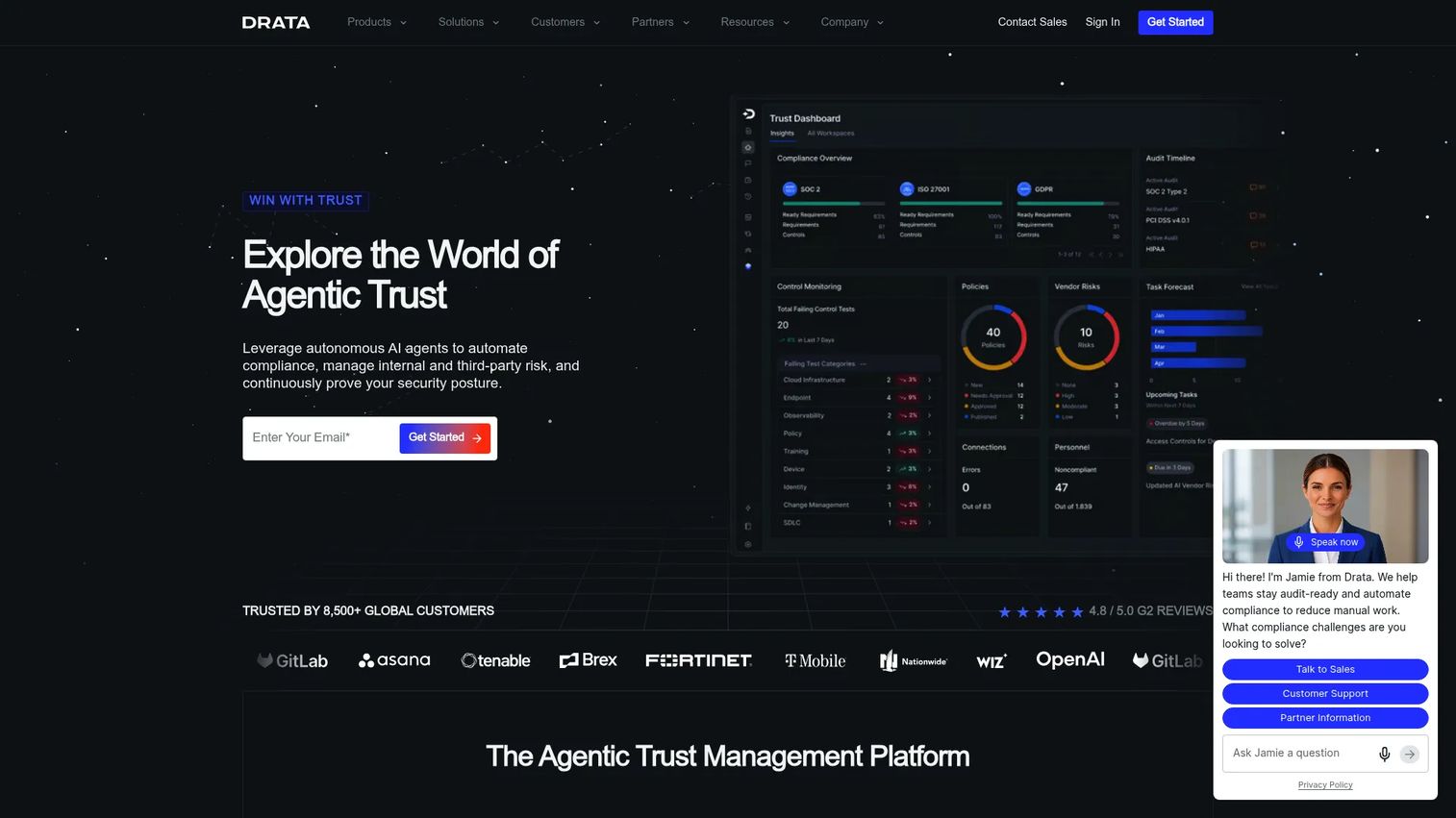
Drata is a security and compliance automation platform built around continuous trust management. It emphasizes always-on control monitoring, automated evidence collection, and framework mapping that scales past SOC 2 into ISO 27001, GDPR, and HIPAA. Cloud-first SaaS teams gravitate to Drata for its monitoring depth and clean workflow design.
Best for: Cloud-first teams that want strong automation paired with broad, multi-framework coverage from one platform.
Key strengths
- Continuous compliance monitoring: watches controls in real time and flags drift the moment a control falls out of policy.
- Trust Center for security posture: publishes your posture and documents so buyers can self-serve during reviews.
- Third-party risk management with AI questionnaire assistance: handles vendor risk and speeds up security questionnaire responses.
Why choose Drata: Where Vanta wins on name recognition, Drata often wins on workflow fit for engineering-led teams and on the breadth of frameworks it maps out of the box. If your roadmap already includes ISO 27001 or GDPR alongside SOC 2, Drata lets you reuse controls across all of them instead of running parallel projects. It suits founders planning for compliance breadth, not just a single report.
Drata pricing: Drata does not disclose public pricing. Its plans page lists Foundation, Advanced, and Enterprise tiers, with "Get Personalized Pricing" and "Contact Sales" calls to action rather than published numbers. Pricing is custom and scoped to your framework needs and company size. No public free tier is listed.
3. Secureframe
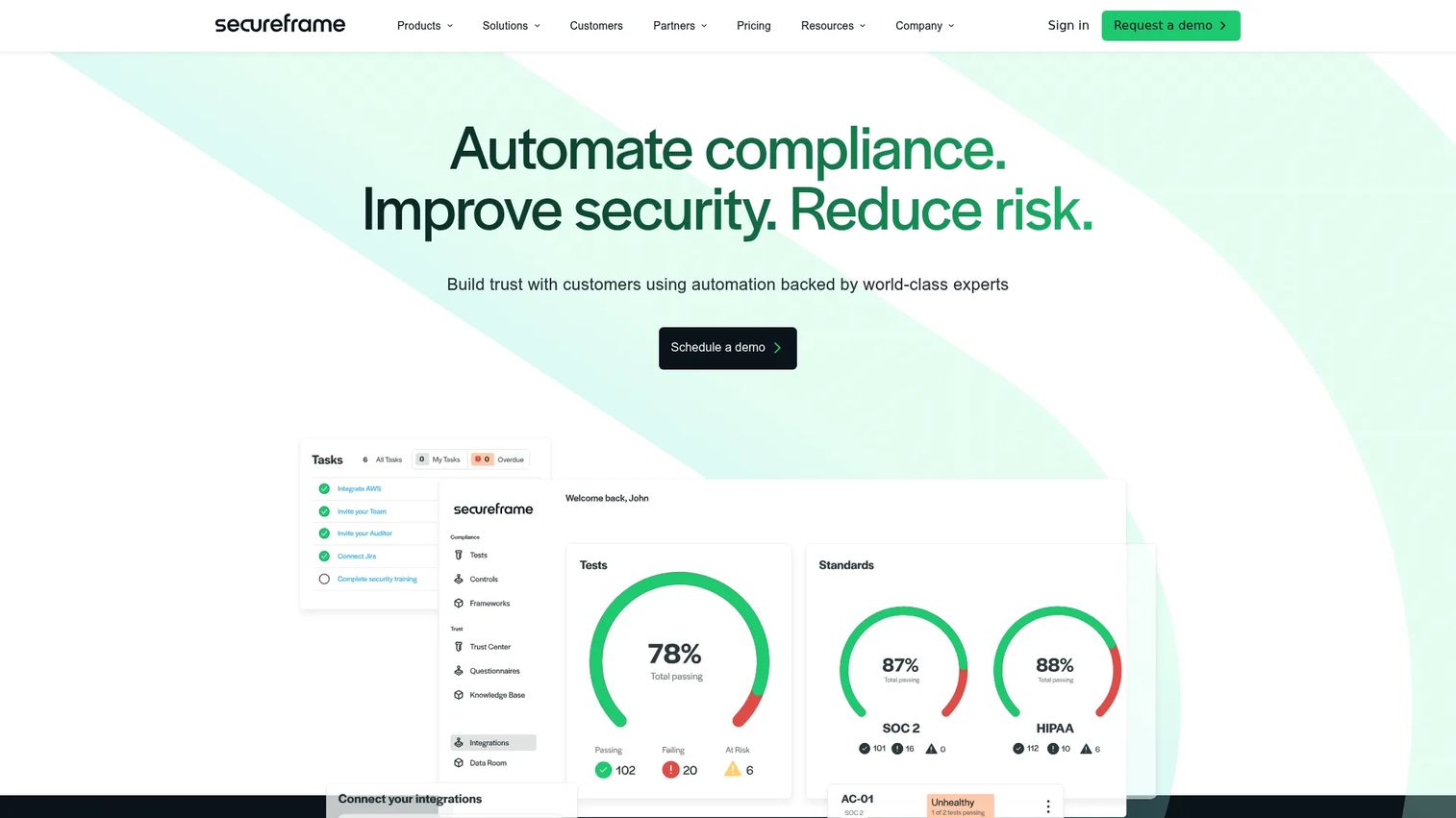
Secureframe is an integrated security compliance and audit-readiness platform that leans into guided workflows and AI assistance. It automates tests and evidence collection, monitors controls continuously, and gives teams structured remediation guidance so you always know what to fix next. Companies that want organized control mapping with a clear path to readiness tend to land here.
Best for: Teams that want a structured, guided route to SOC 2 with hands-on support and clear remediation steps.
Key strengths
- Automated tests and evidence collection: runs continuous checks and gathers proof without manual effort.
- Continuous monitoring with remediation guidance: flags failing controls and tells you exactly how to fix them.
- AI-assisted compliance workflows and Trust Center: speeds up questionnaires and publishes your posture for buyers.
Why choose Secureframe: Secureframe appeals to teams that want automation plus handholding, not just a tool that dumps a checklist on them. The guided workflow and remediation guidance lower the odds that a first-time team gets stuck mid-audit. It fits founders who want organized structure and responsive support over pure DIY automation.
Secureframe pricing: Secureframe does not publish public pricing. The site directs visitors to request a quote or schedule a meeting to get a scoped number. Pricing is custom, based on frameworks, company size, and support level. No public free tier is listed.
4. Sprinto
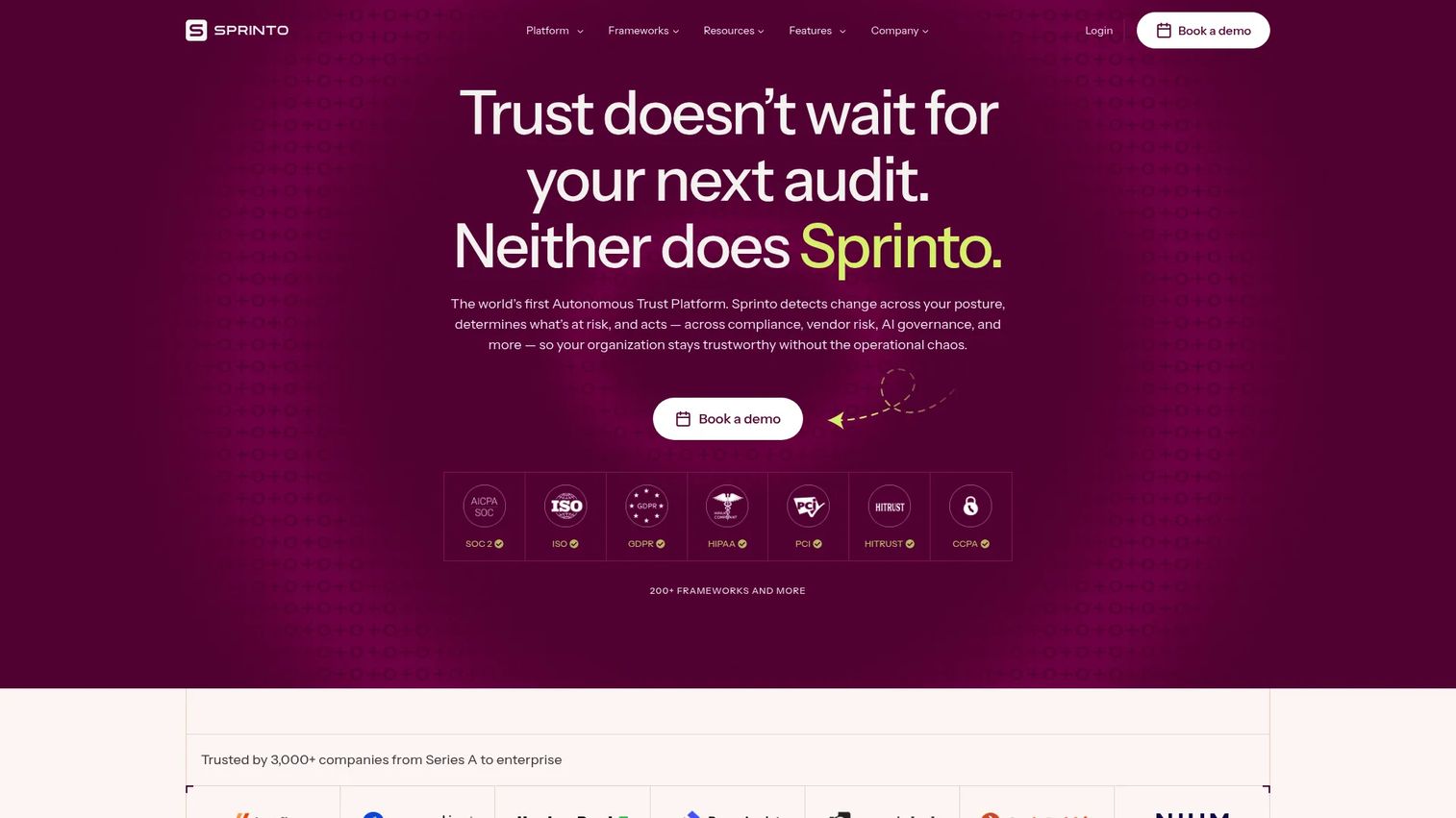
Sprinto is an autonomous trust platform focused on compliance, risk, and GRC automation, with a reputation for fast implementation. It ships with pre-mapped frameworks and baselines, automated evidence collection, and continuous monitoring, all tuned to get teams to readiness quickly. Founder-friendly onboarding and responsive support are recurring themes in reviews.
Best for: Cloud-first startups and mid-market SaaS teams optimizing for the fastest reasonable time to audit readiness.
Key strengths
- Pre-mapped frameworks and baselines: start from a configured baseline instead of building controls from scratch.
- 300+ integrations: connect your stack quickly so evidence collection begins on day one.
- Automated evidence collection with signed artifacts: produces tamper-evident evidence your auditor can trust.
Why choose Sprinto: For a Series B founder who needs a SOC 2 report to unblock a deal soon, Sprinto's speed to readiness is the headline. Its pre-mapped frameworks and guided onboarding compress the time between kickoff and audit, and its support model is built for teams without a dedicated compliance lead. It fits companies that value velocity and low internal effort.
Sprinto pricing: Sprinto does not display public prices. Its pricing page shows plans and module capabilities, including a Foundation tier, but no published numbers. Pricing is custom and scoped to your frameworks and scale. No public free tier is listed.
5. AuditBoard
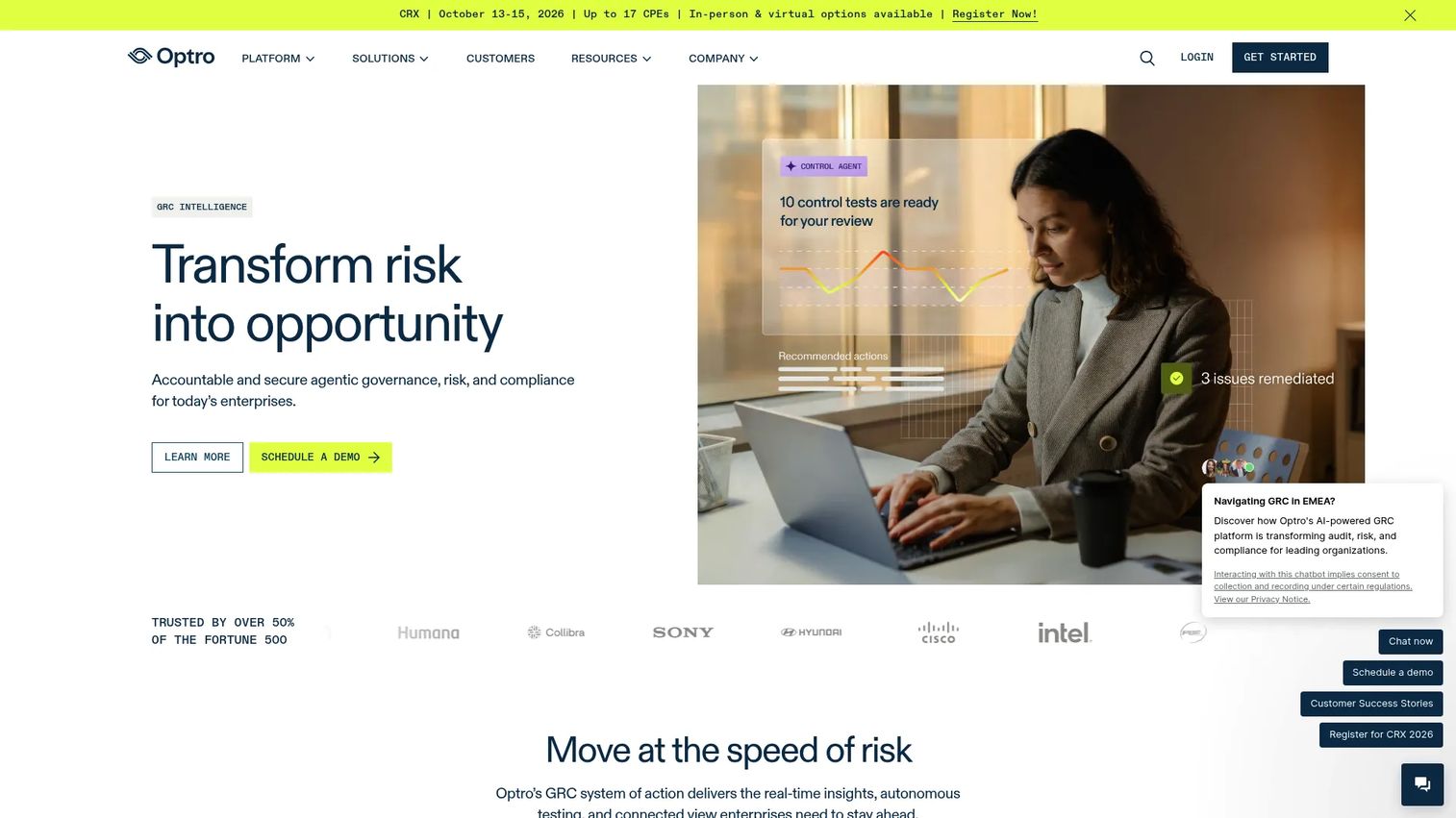
AuditBoard is a connected risk platform for audit, risk, compliance, ESG, and IT risk teams. It is broader than a pure SOC 2 tool, built for organizations where compliance reporting sits inside a larger governance and audit program. If SOC 2 is one line item in a wider risk mandate, AuditBoard centralizes it with everything else.
Best for: Larger organizations that need a unified audit, risk, and compliance platform where SOC 2 is one program among many.
Key strengths
- IT risk management and compliance workflows: manages SOC 2 alongside broader IT risk and control programs.
- Risk dashboards with action-plan tracking: gives leadership a live view of risk and remediation progress.
- Centralized audit, risk, and compliance platform: unifies AI, analytics, integrations, and reporting in one system.
Why choose AuditBoard: AuditBoard makes sense when SOC 2 is not your only compliance obligation and you need a single platform to run internal audit, enterprise risk, and multiple frameworks together. It is heavier than a point SOC 2 tool by design, which is exactly what a maturing organization with a real GRC function needs. It fits companies that have outgrown single-framework automation.
AuditBoard pricing: AuditBoard does not publish public pricing. Its materials direct prospective buyers to schedule a demo or contact a solutions advisor for a scoped quote. Pricing is custom and reflects the platform's enterprise scope. No public free tier is listed.
6. LogicGate
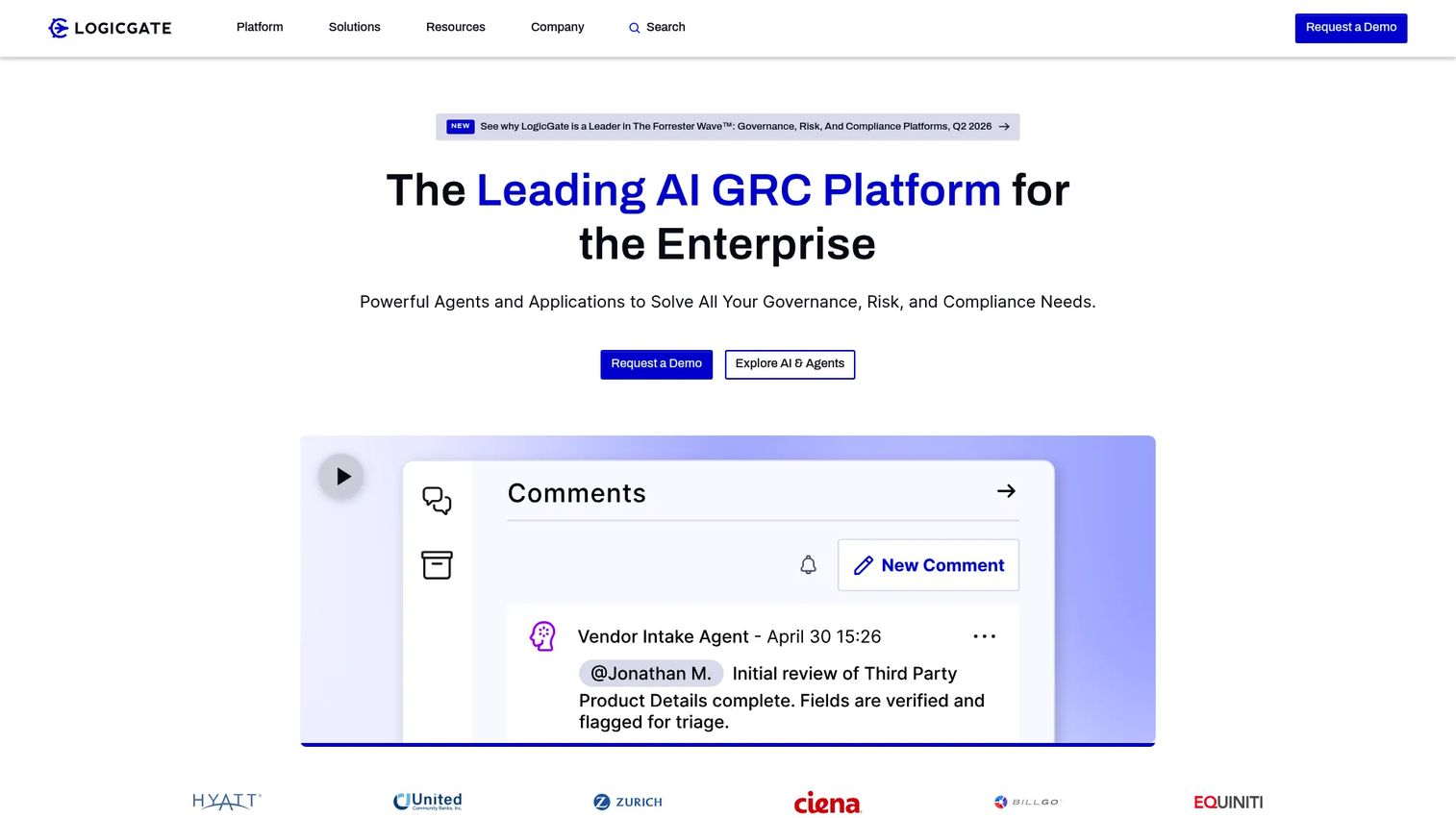
LogicGate is an AI-powered GRC platform built for governance, risk, and compliance teams that need configurable workflows. Its no-code, graph-database foundation lets teams model risk and compliance processes to fit how their organization actually operates. LogicGate shines when SOC 2 is part of a larger, customized governance program rather than a standalone report.
Best for: Enterprise teams that need a configurable GRC platform with automation and AI, where SOC 2 is one workflow among many.
Key strengths
- No-code workflow and graph-database platform: model compliance and risk processes without engineering effort.
- Reporting and analytics with role-based dashboards: deliver tailored views and AI-generated summaries to different stakeholders.
- Spark AI features: automate autofill, evidence testing, reporting insights, record linking, and text assistance.
Why choose LogicGate: LogicGate is the pick for buyers who need GRC depth and flexibility more than turnkey SOC 2 automation. Its configurability suits organizations with unusual processes or many overlapping frameworks that a rigid template cannot capture. It fits teams whose governance needs have outgrown point solutions and who want to shape the platform to their operating model.
LogicGate pricing: LogicGate does not publish public pricing. Its pricing page asks visitors to request custom pricing scoped to their needs. Expect enterprise-oriented, custom quotes reflecting configuration depth and scale. No public free tier is listed.
Considerations before you buy
Before you shortlist, run every candidate through these criteria against your actual stack and stage.
Automation and integration depth
The whole point is to stop chasing evidence manually. Check that the platform integrates with your specific cloud provider, identity system, and critical SaaS tools. A platform with 300 integrations still fails you if it misses the two that matter most for your environment.
Framework coverage and mapping
If ISO 27001, GDPR, or HIPAA is anywhere on your roadmap, prioritize framework mapping that reuses one set of controls across standards. Running parallel single-framework projects wastes time and creates drift. Cross-framework reuse is where the real leverage sits for a growing company.
Auditor workflow and support model
Ask how the platform hands off to an auditor and whether it works with your auditor or a partner network. For a first audit, evaluate the support model honestly, some teams want pure automation, others want expert guidance through the tricky parts. Match the tool to how much internal compliance expertise you have.
Total cost relative to stage
Since pricing here is almost always custom, get a scoped quote early and tie it to payback. The right question is not "what does it cost" but "how many stalled deals and how much founder time does it recover." Frame the spend against deal velocity, not just line-item budget.
Conclusion
SOC 2 is no longer optional for B2B SaaS, it is a gate on enterprise revenue. The right compliance software turns a recurring fire drill into background infrastructure that keeps you audit-ready year-round while your team stays focused on the product.
For most SaaS teams, Vanta is the safe, recognizable default. Drata wins when you want strong automation plus broad framework coverage. Secureframe suits teams that want a guided workflow with support. Sprinto is the pick for speed to readiness. Scytale adds expert guidance to automation. And when SOC 2 sits inside a larger governance program, AuditBoard and LogicGate bring the GRC depth to match.
Your next step is simple: shortlist two or three tools that fit your stack and stage, confirm they integrate with your cloud and SaaS tools, then run one audit-readiness walkthrough with your security team and your auditor before you commit. Choose the platform that recovers the most founder time and deal velocity, not just the cheapest quote.
Start your journey with Guideflow today!
FAQs
SOC 2 compliance software is a platform that automates the evidence collection, control monitoring, and reporting required to earn and maintain a SOC 2 attestation. It connects to your cloud and SaaS stack, continuously verifies that security controls are working, and packages everything for your auditor. The core job is replacing manual spreadsheets and shared drives with year-round audit readiness.
A SOC 2 Type I report attests that your controls are designed correctly at a single point in time, essentially a snapshot. A SOC 2 Type II report attests that those controls operated effectively over a monitoring period, typically three to twelve months. Type II carries more weight with enterprise buyers because it proves controls actually run, not just that they exist on paper.
With compliance software, a Type I readiness effort can often move in weeks rather than months, since the platform automates evidence collection and control monitoring. A Type II report then requires an observation window, usually three to twelve months, before the audit. Timing depends on your stack complexity, how many controls need remediation, and whether your team has a compliance lead.
Prioritize automation depth (how much evidence the platform collects without manual work), integration coverage with your specific stack, continuous control monitoring, and a clean auditor workflow. Framework mapping matters if you plan to add ISO 27001, GDPR, or HIPAA later. The support model is the tie-breaker: decide whether you want pure automation or expert guidance for a first audit.
Yes. Most modern platforms use framework mapping so a single set of controls can satisfy SOC 2, ISO 27001, GDPR, and HIPAA at once. That cross-framework reuse is a major reason to invest in software rather than run parallel manual projects. If multiple frameworks are on your roadmap, make coverage a top selection criterion.
For most Series B SaaS companies selling into enterprise, yes. When 70 to 85% of enterprise RFPs request a SOC 2 report, manual compliance directly costs deal velocity and pulls founders and engineers off the roadmap. The ROI shows up as faster security reviews, unblocked deals, and reclaimed founder attention, which usually outweighs the subscription cost.
Most SOC 2 compliance tools in this category do not publish public pricing. Vanta, Drata, Secureframe, Sprinto, Scytale, AuditBoard, and LogicGate all use demo-based or quote-based custom pricing scoped to your company size, framework count, and integrations. The practical move is to request scoped quotes from two or three shortlisted tools and compare them against the deal velocity and founder time each one recovers.