


A forklift operator smells something sharp near a leaking drum. The plant manager needs the safety data sheet for that chemical in seconds, not after digging through a three-inch binder, an old inbox thread, and a shared drive nobody has updated since 2023. That gap between "we have the SDS somewhere" and "we have it right now" is where chemical compliance turns risky.
OSHA's Hazard Communication Standard requires that safety data sheets be readily accessible to employees during their work shifts. Not filed away. Not in a manager's laptop. Readily accessible. When an inspector shows up or an incident happens, "readily accessible" is the difference between a clean record and a citation.
The market has responded. The global SDS management software market sits at roughly $1.2 billion in 2024 and is projected to reach $2.5 billion by 2033 at a 9% CAGR, according to LinkedIn's "Safety Data Sheet (SDS) Management Software Market Size" analysis (2024). Regulatory pressure and digital adoption are driving that growth. If you handle chemicals, the question is no longer whether to move off paper binders, but which platform fits your operational complexity.
This guide compares six safety data sheet software platforms on the criteria that actually change the buying decision. If you are evaluating adjacent compliance systems too, our roundups on audit management software and contract lifecycle management map to the same operator logic: reduce manual work, cut risk, and integrate cleanly.
What's inside
This guide is for operators who manage chemical inventories across one site or many, and who need SDS access, mobile retrieval, reporting, and compliance workflows to stop being a manual mess. It covers six platforms, from focused SDS libraries to full EHS suites.
We selected and compared each tool on six criteria:
- Compliance coverage: OSHA HazCom, GHS, and right-to-know support
- Access methods: QR codes, mobile apps, offline binders, and search
- Reporting depth: audit readiness, chemical inventory, and regulatory outputs
- Implementation fit: setup speed, migration help, and pricing transparency
TL;DR
- Best overall for compliance-focused teams: SDS Manager, for transparent SDS-based pricing, QR access, and migration help.
- Best budget-friendly free option: BackPack by Chemwatch, free for up to 50 SDS with automatic weekly updates.
- Best for broader safety workflows: SafetyCulture, when SDS handling sits inside inspections and frontline training.
- Best for a larger EHS stack: VelocityEHS when SDS management is one module among many.
- Best for enterprise governance: SpheraCloud, for product stewardship and operational risk at scale.
- Best for shipping and label workflows: Labelmaster, for hazmat documentation and dangerous goods compliance.
What is SDS management software?
SDS management software is a system for storing, searching, updating, and distributing safety data sheets so employees and regulators can access chemical hazard information quickly. It replaces paper binders and scattered files with a centralized, searchable library that stays current as manufacturers revise their sheets.
The core job is simple to state and hard to do manually: keep every SDS current, findable, and available at the point of need, whether that point is a plant floor, a field truck, or an OSHA inspection.
Most SDS management platforms share a common set of capabilities:
- Centralized SDS library: one source of truth for every chemical on site
- Search and retrieval: free-text search across SDS content, not just file names
- Mobile and offline access: QR codes, apps, and offline binders for frontline staff
- Label generation: secondary container labels and GHS-compliant outputs
- Reporting and audit support: chemical inventory reports and right-to-know documentation
- Risk and emergency workflows: fast hazard lookup during incidents
Strong safety data sheet management also handles version control automatically. When a manufacturer updates a sheet, the system flags or replaces the old version so employees never reference outdated hazard data. That single feature separates a real platform from a folder of PDFs.
The category overlaps with broader chemical safety software and EHS platforms, but a dedicated SDS tool stays narrow and deep: it does SDS access, labeling, and compliance reporting well, without asking you to buy an entire safety suite you may not need yet.
When to use SDS management software
Centralize compliance documents
For multi-site teams, the biggest risk is inconsistency. One location has the current SDS, another has a version two revisions old, and nobody knows which is which until an inspector asks. Centralizing your SDS library fixes access consistency and version control in one move. It also cuts retrieval time during inspections from minutes of frantic searching to a single search query. When a regulator wants proof that a sheet was accessible, timestamped access records make the case for you.
Support mobile and frontline access
Compliance dies on the plant floor if the only copy lives on an office computer. QR code access lets a worker scan a container and pull the SDS on their phone in seconds. Barcode scanning, mobile apps, and offline binders extend that reach to warehouses, field sites, and plants with spotty connectivity. This is where mobile access stops being a nice-to-have and becomes the whole point: the people closest to the chemical are the people who need the sheet fastest.
Reduce manual reporting and risk
Storing files is table stakes. The software earns its cost when it does more: generating chemical inventory reports, producing right-to-know compliance documentation, supporting exposure and incident workflows, and outputting the regulatory reports auditors expect. If your team spends hours each quarter assembling compliance reporting by hand, that is the workload the right platform removes.
Comparison table
The table below helps you compare these platforms on pricing visibility, mobile support, and category focus, so you can see at a glance whether you need a focused SDS library or a broader EHS platform.
| # | Product | Intent | Key differentiation | Pricing | G2 rating |
|---|---|---|---|---|---|
| 1 | SDS Manager | Focused SDS management and compliance | QR access, free-text search, migration help, SDS-based pricing | Free Basic tier; paid EHS plans from $9.99/employee/month | 4.9/5 |
| 2 | SafetyCulture | Safety workflows with SDS documents | Inspections, actions, and training in one platform | Free up to 10; Premium from $24/seat/month | Not available |
| 3 | SpheraCloud | Enterprise EHS and product stewardship | Operational risk insights, SSO, mobile | Request a demo | 4.0/5 |
| 4 | BackPack by Chemwatch | Free SDS library for small teams | Automatic weekly updates, free up to 50 SDS | Free (Limited); contact sales above 50 | Not available |
| 5 | VelocityEHS | Unified EHS platform | Chemical management, incidents, AI reporting | Book a demo | 4.4/5 |
| 6 | Labelmaster | Hazmat shipping and labeling | Dangerous goods compliance and label workflows | Product-level pricing | Not available |
The 6 best SDS management software platforms
1. SDS Manager
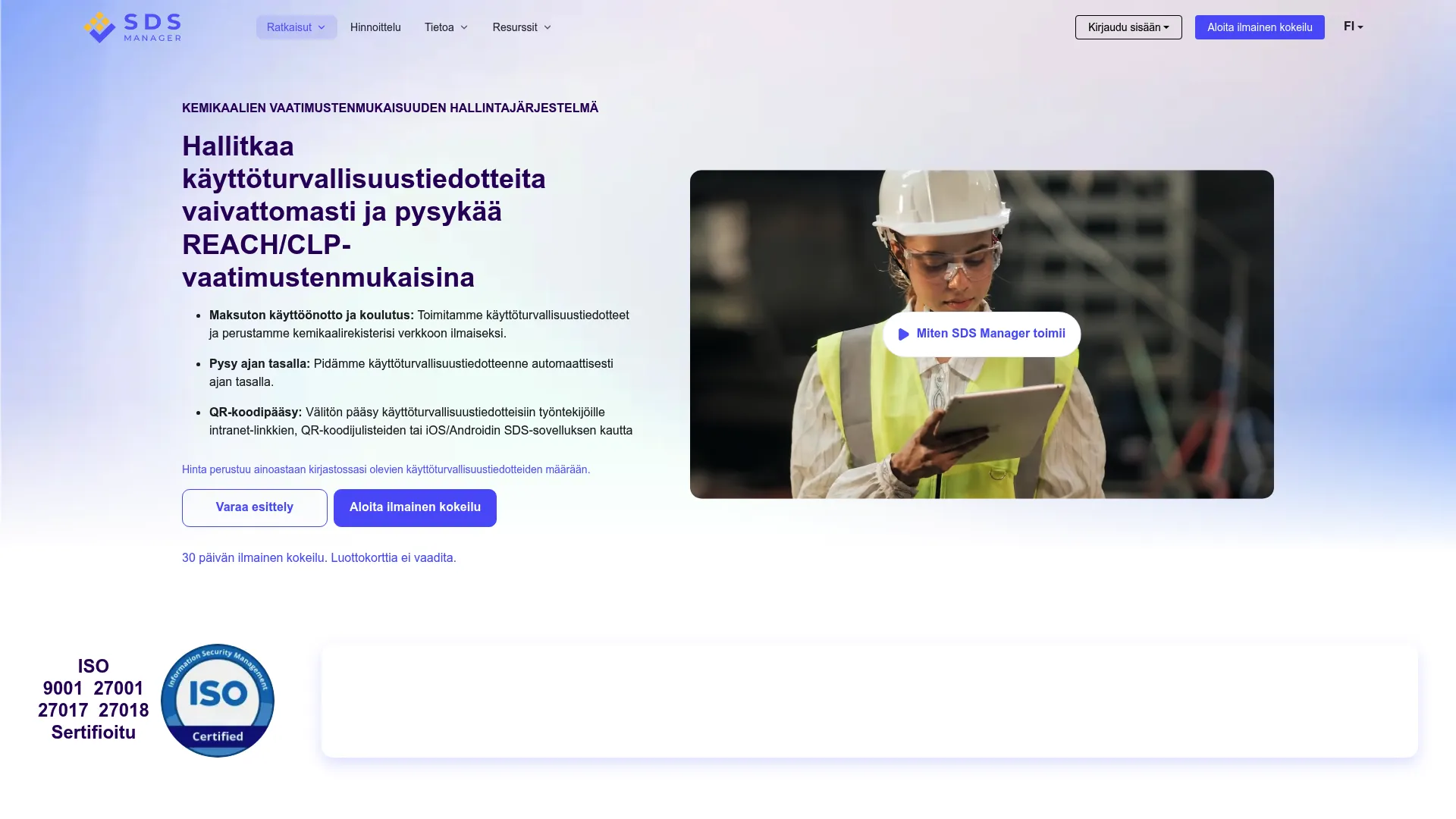
SDS Manager is cloud-based software built specifically for storing, searching, sharing, and managing safety data sheets and related compliance workflows. It is the rare tool in this category that leads with transparent, SDS-based pricing instead of routing every buyer to a sales call. For teams that want a focused system rather than a sprawling EHS suite, that clarity matters on day one.
The platform organizes your SDS library with QR-code access, so employees scan a container label and pull the current sheet on their phone. Free-text search runs across the actual content of each SDS, not just file names, which turns a five-minute hunt into a one-line query. Mobile and offline access through the iOS and Android app keeps frontline staff covered even when connectivity drops.
Best for: Organizations that want a focused SDS system with fast setup, QR access, and clear pricing rather than a broad safety platform.
Key strengths
- QR code access: Scan a container, pull the current SDS instantly, no login hunt.
- Free-text search: Search inside SDS content, not just file names, for faster retrieval.
- Mobile and offline access: iOS and Android app keeps sheets available when connectivity drops.
Why choose SDS Manager: The SDS-based pricing model and free Basic tier make it easy to start small and scale by the number of sheets you manage, not per seat. Migration help means you are not left importing hundreds of PDFs by hand. For a compliance-focused team that wants depth in SDS access, labeling, and reporting without buying an entire EHS suite, this is the cleanest fit.
SDS Manager pricing: The public pricing page shows a free Basic tier billed annually, alongside paid EHS plans at $9.99/employee/month and $12.99/employee/month. Authoring options such as $199/SDS and $1,499/year are also listed, plus contact-sales enterprise tiers. A free tier is available, which lowers the barrier for smaller teams to test the workflow before committing.
2. SafetyCulture
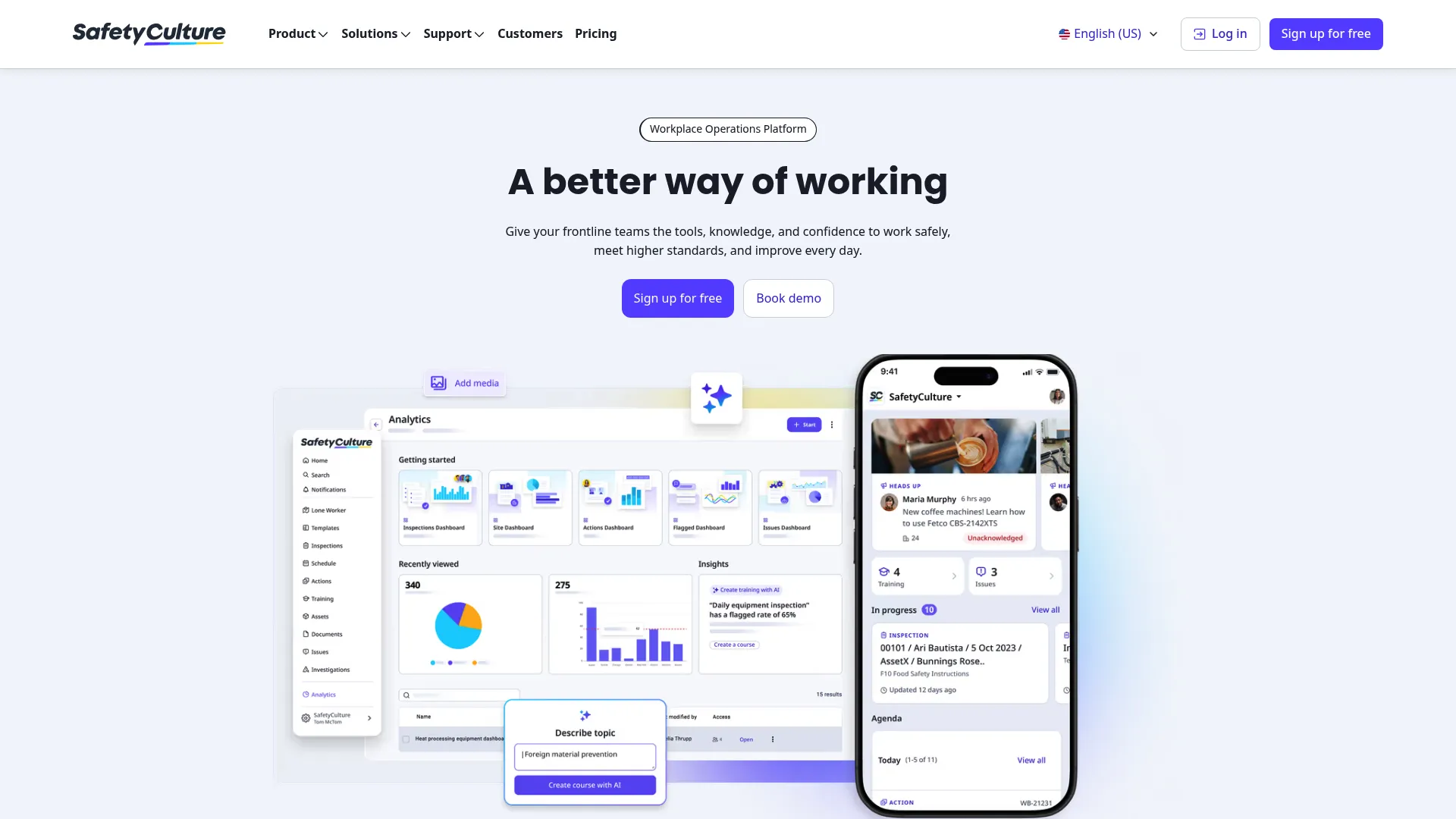
SafetyCulture is a workplace operations platform for inspections, tasks, training, and related workflows, with SDS document management folded into the broader safety picture. It fits teams that already run inspections and frontline training in one system and want their safety data sheets to live in the same place rather than a separate tool.
The strength here is context. When a checklist flags a chemical hazard, the corrective action, the training record, and the SDS all sit inside one platform. That said, SafetyCulture is a general safety management platform first. If your primary need is deep SDS-specific functionality like authoring or SDS-based inventory pricing, a dedicated library will go deeper on that single job.
Best for: Teams that need a single platform for inspections, corrective actions, and frontline training, with SDS documents alongside.
Key strengths
- Inspections and checklists: Digital forms and audits your frontline team runs from a phone.
- Actions and task tracking: Assign, track, and close corrective actions tied to findings.
- Training creation and tracking: Build and monitor safety training in the same system.
Why choose SafetyCulture: If SDS handling is one part of a wider safety operation, consolidating into one platform reduces tool sprawl and keeps hazard data next to the workflows that use it. The free tier for small teams lets you validate the fit before scaling seats.
SafetyCulture pricing: A free plan covers small teams up to 10 users. Premium starts at $24/seat/month billed annually or $29/seat/month billed monthly. Lite seats start from $5/seat/month billed annually, and Enterprise is custom pricing. The mobile app is central to the platform, which matters for frontline access.
3. SpheraCloud
SpheraCloud is Sphera's cloud-based operational intelligence platform spanning EHS, ESG, operational risk, and product stewardship. SDS access here is one piece of a governance-heavy platform built for larger, more complex organizations. If your compliance needs extend well beyond SDS storage into risk analytics and stewardship, this is the enterprise end of the spectrum.
The platform emphasizes a unified experience across solutions, mobile capabilities with single sign-on, and operational risk insights with predictive intelligence. Universal SDS access and approval workflows fit organizations that need governance and reporting across many sites and product lines, not just a searchable library.
Best for: Enterprises needing a cloud platform for sustainability, safety, and risk management workflows, with SDS as one component.
Key strengths
- Unified experience across solutions: One interface spanning EHS, ESG, and risk.
- Mobile capabilities and SSO: Secure access across a distributed enterprise.
- Operational risk insights: Predictive intelligence beyond static document storage.
Why choose SpheraCloud: For enterprises with broad governance needs, product stewardship obligations, and multi-site complexity, a platform that reaches past SDS storage into risk and reporting can consolidate several tools. Weigh the integration and reporting scope against your actual SDS-specific requirements so you are buying capability you will use.
SpheraCloud pricing: No public pricing is listed; Sphera directs visitors to request a demo. Given the enterprise positioning, expect custom pricing scaled to solutions and site count. It holds a 4.0/5 rating on G2. Confirm exactly which SDS and reporting modules are included in your quote.
4. BackPack by Chemwatch

BackPack by Chemwatch is an online SDS library and chemical management tool with automatic updates, backed by Chemwatch's deep chemical database and global compliance heritage. The standout detail: the Backpack Limited edition is completely free for life if you store 50 SDS or fewer. For small teams, that removes the cost objection entirely.
The library updates automatically on a weekly cycle, so your sheets stay current without manual effort. Unlimited folders let you organize by site, department, or process. Chemwatch's global reach and multilingual compliance depth make it a strong fit for regulated environments that span jurisdictions.
Best for: Small teams needing a free SDS library for up to 50 chemicals, with a clear upgrade path as inventories grow.
Key strengths
- Online SDS library: Centralized, searchable access to your chemical sheets.
- Automatic weekly updates: Sheets refresh on a weekly cycle without manual work.
- Unlimited folders: Organize by site, department, or process at no structural limit.
Why choose BackPack by Chemwatch: If you handle a modest chemical inventory and want to eliminate paper binders without a budget line, the free Limited edition is hard to beat. It also connects to Chemwatch's larger chemical management platform, so growing teams have somewhere to scale.
BackPack by Chemwatch pricing: Backpack Limited is free for life for companies storing 50 SDS or fewer. Above that threshold, Chemwatch directs you to sales for the full platform. Before scaling past the free tier, confirm the upgrade pricing model, what multilingual and global compliance coverage you need, and how authoring fits your workflow.
5. VelocityEHS
VelocityEHS is an EHS and sustainability software platform covering safety, ergonomics, chemical management, and operational risk. SDS and chemical management sit inside a unified suite, which suits buyers who want their safety systems under one umbrella rather than assembled from point tools.
The platform brings incident management, inspections, observations, and compliance workflows together, layered with AI-powered insights, dashboards, and cross-module reporting. For chemical compliance specifically, the chemical management module centralizes SDS access alongside the rest of your safety operation, so reporting spans modules instead of living in a silo.
Best for: Mid-market and enterprise teams needing a unified EHS platform where chemical management is one module of many.
Key strengths
- Chemical management module: Centralized SDS and chemical inventory inside the suite.
- AI-powered reporting: Dashboards and cross-module insights for audit readiness.
- Broad EHS coverage: Incidents, inspections, observations, and ergonomics in one place.
Why choose VelocityEHS: If you are consolidating safety systems and want chemical compliance to report alongside incidents and inspections, a unified platform reduces the number of tools your team maintains. It holds a 4.4/5 rating on G2, which signals solid user sentiment across a broad feature set.
VelocityEHS pricing: No public pricing is listed on the brand website; the site directs visitors to book a demo or contact sales. Expect custom pricing scaled to modules and users. Confirm which SDS and chemical management features are included at your tier, whether mobile access is standard, and how reporting exports work.
6. Labelmaster
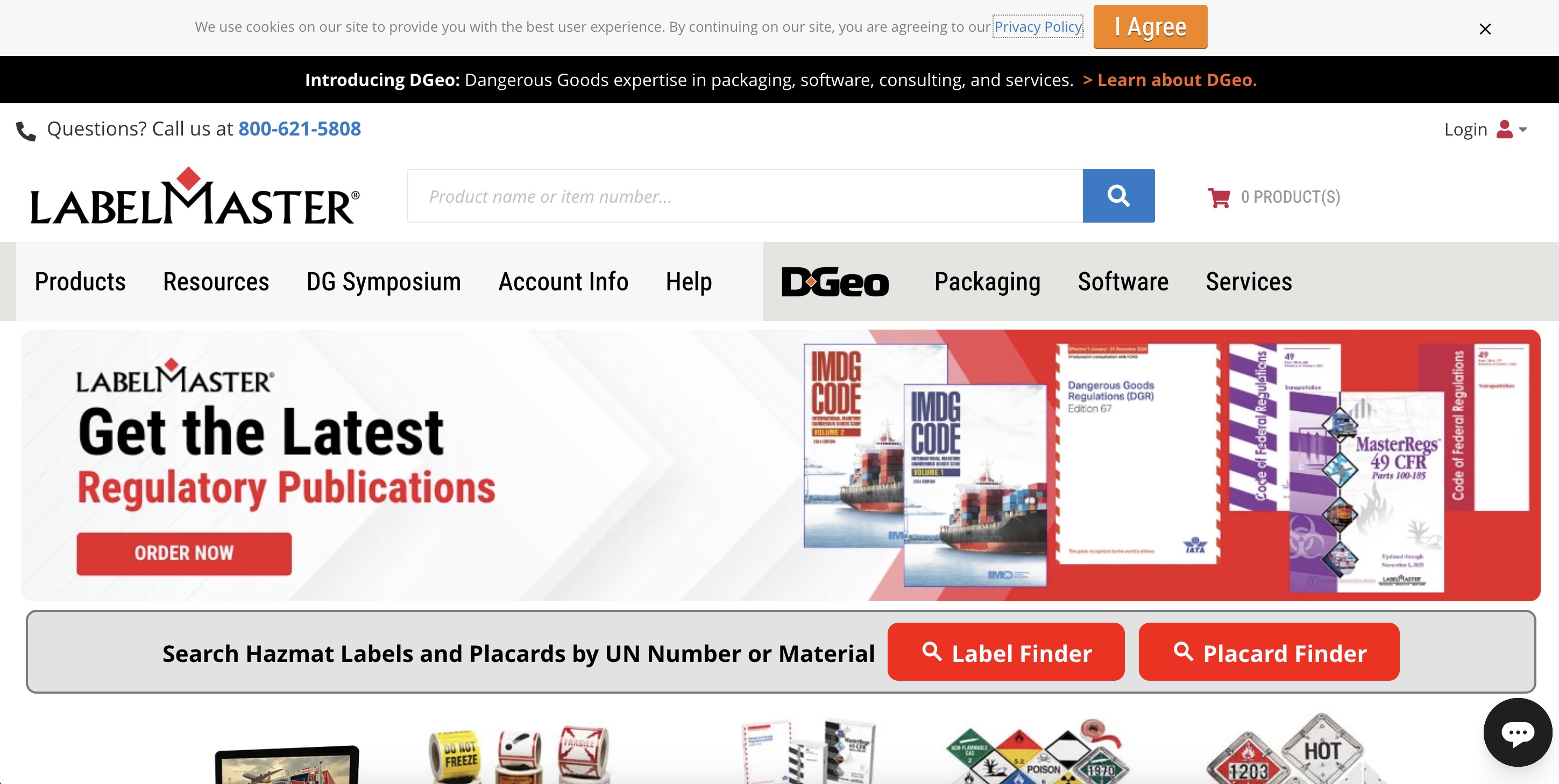
Labelmaster is a hazmat and dangerous goods shipping solutions provider with products, services, and software. Its strength sits in the documentation and labeling side of chemical compliance: transport labels, hazardous materials products, and shipping documentation for organizations that move dangerous goods.
For teams whose compliance burden centers on shipping hazmat, Labelmaster covers a different slice of the workflow than a pure SDS library. It offers a custom shipping and compliance software suite, plus regulatory consulting and training services. Label generation and transport documentation are the anchor, so pair it with a dedicated SDS library if you also need deep hazard-sheet search and access.
Best for: Organizations shipping hazardous materials that need compliant products, labeling, and documentation support.
Key strengths
- Hazmat compliance products: Physical and documentation products for shipping dangerous goods.
- Custom shipping and compliance software: Software suite for transport documentation.
- Regulatory consulting and training: Expert services alongside the product line.
Why choose Labelmaster: If your daily compliance reality is shipping hazardous materials and generating transport documentation, Labelmaster's specialization in labeling and dangerous goods is the fit. It is less a full SDS library and more a documentation and labeling backbone, so many teams run it alongside a dedicated SDS platform.
Labelmaster pricing: Publicly visible pricing appears at the product level, such as corrugated shipping boxes, but the software suite pricing is not publicly listed. Contact Labelmaster for software quotes. Confirm exactly which documentation and label generation features the software covers versus its physical product catalog.
Considerations before you buy
Pricing model and transparency
SDS tools price in wildly different ways: per seat, per employee, per SDS, or fully custom. Match the model to how your organization actually grows. A per-SDS model rewards teams with many users and few chemicals; a per-seat model suits the reverse. Insist on seeing the full pricing before committing.
Migration and setup speed
Moving hundreds of existing sheets by hand is the hidden cost. Ask whether the vendor imports your current SDS library for you and how long onboarding takes. For a multi-site rollout, implementation speed determines how fast you reach compliance across every location.
Mobile, QR, and offline access
Confirm how frontline staff retrieve sheets. QR code access, barcode scanning, native apps, and offline binders each solve different field conditions. If your sites have spotty connectivity, offline access is not optional.
Reporting and audit readiness
Decide what outputs you need: chemical inventory reports, right-to-know documentation, exposure records, and label generation. Reporting, analytics, and audit readiness are where software pays back the manual hours, so verify the exact reports each tool produces.
Standalone SDS tool versus broader EHS platform
The core decision is scope. A focused SDS library goes deep on access, search, and labeling. A full EHS platform folds SDS into incidents, inspections, and training. Buy for your current operational complexity, with room to grow.
Conclusion
The right choice depends less on which tool has the longest feature list and more on how your operation actually works. If you want focused SDS depth with transparent pricing, QR access, and migration help, SDS Manager is the cleanest standalone fit. If your chemical inventory is small, BackPack by Chemwatch's free tier removes the cost question entirely.
Teams that want SDS handling inside a wider safety operation should look at SafetyCulture for inspections and training, or Vector SDS and VelocityEHS when chemical management is one module in a larger EHS stack. Enterprises with product stewardship and governance obligations across many sites will find SpheraCloud built for that scale. And organizations whose compliance centers on shipping hazardous materials should evaluate Labelmaster for labeling and transport documentation.
Weigh five decision points: compliance depth, mobile and QR access, reporting, label generation, and whether you want a standalone SDS product or a broader platform. Then pick the tool that matches your operational complexity and how your frontline staff actually reach for a sheet when it counts.
FAQs
SDS management software is a system for storing, finding, updating, and sharing safety data sheets so employees and regulators can access chemical hazard information quickly. It centralizes your SDS library, keeps sheets current as manufacturers revise them, and supports compliance and audit readiness. The goal is that any employee can retrieve the right sheet at the point of need, whether during normal work or an emergency.
SDS management software is narrower: it focuses on storing, searching, updating, and distributing safety data sheets, plus labeling and compliance reporting. EHS software is broader, typically covering incidents, inspections, training, ergonomics, and wider safety workflows, with SDS handling as one module among many. If your primary need is deep SDS access and labeling, a dedicated tool goes deeper; if you want to consolidate multiple safety functions, an EHS platform covers more ground.
Yes. Most platforms offer QR code access, barcode scanning, and native iOS and Android apps so frontline staff can retrieve sheets from a phone in seconds. Many also support offline access, which matters for warehouses, field sites, and plants with unreliable connectivity. Confirm the specific mobile features each vendor includes, since not every plan bundles the same level of access.
Many SDS platforms generate secondary container labels and GHS-compliant outputs, and some produce transport and shipping documentation for hazardous materials. The document set varies by vendor, though. Dedicated SDS libraries tend to focus on secondary container and workplace labels, while shipping-focused tools like Labelmaster specialize in transport and dangerous goods documentation. Verify the exact outputs a tool produces against your actual compliance needs.
Focus on access control, search speed, mobile availability, reporting depth, and vendor support for migration. For multiple sites, version control and consistent access across locations are critical, since one outdated sheet can create a compliance gap. Implementation speed matters too: the faster a vendor imports your existing library and onboards each location, the sooner every site reaches compliance.
If a small business handles chemicals, faces inspections, or needs fast access during incidents, then yes. OSHA HazCom requirements apply regardless of company size, so readily accessible SDS is a legal obligation, not a nice-to-have. Free or low-cost options exist, such as BackPack by Chemwatch's free tier for up to 50 sheets and SDS Manager's free Basic plan, which make compliance affordable for smaller teams.
Check the pricing model (per seat, per employee, per SDS, or custom), migration support for your existing sheets, offline access for frontline staff, search quality, reporting depth, and regulatory coverage for OSHA HazCom, GHS, and right-to-know compliance. Confirm what labeling and document outputs are included, and how the vendor handles version updates when manufacturers revise sheets. Getting these details in writing before you commit prevents surprises after rollout.