


Your risk register lives in a spreadsheet. So do your RCSAs. Your KRI thresholds sit in a separate workbook someone updates when they remember. When the board asks for a single view of operational risk, you spend three days stitching tabs together and hoping nobody notices the version conflicts.
That is the moment most risk teams outgrow manual tracking. Spreadsheets do not enforce approvals, do not alert you when a KRI breaches, and do not give you an audit trail when a regulator asks who signed off on a control. As risk owners, approvers, and reporting requirements multiply, the cracks widen fast.
The market reflects the shift. [Verdantix valued the operational risk management software applications market at USD 1.75 billion in 2021](https://www.verdantix.com/venture/report/market-size-and-forecast-operational-risk-management-software-applications-2021-2026-(global), forecasting USD 3.46 billion by 2026 at a 14.6% CAGR. Cloud deployment is winning too: Mordor Intelligence reported that cloud accounted for 71.24% of integrated risk management spend in 2025. Teams are moving off local files and into governed platforms built for the full operational risk lifecycle.
This guide ranks 10 operational risk management platforms for 2026. If you are evaluating tools in adjacent categories, it can help to look sideways at how buyers assess audit management software and contract lifecycle management software, since ORM buyers face many of the same governance, workflow, and reporting questions.
What's inside
This is a buyer guide for teams replacing manual risk tracking or consolidating fragmented GRC workflows. We selected 10 operational risk management tools based on four criteria that matter most when you are cleaning up scattered processes: lifecycle coverage (identify, assess, mitigate, monitor, report), depth of RCSA and KRI monitoring support, loss-event and issue management, and the quality of dashboards, integrations, and usability. Every tool here supports operational risk work at scale, though several also stretch into broader enterprise risk management, resilience, and compliance. Pricing and ratings reflect what each vendor discloses publicly.
TL;DR
Short on time? Here are the decision shortcuts.
- Best overall for end-to-end ORM: Workiva, for unified risk, controls, and reporting.
- Best for full-lifecycle enterprise depth: MetricStream, for RCSA, loss events, quantification, and analytics.
- Best for no-code workflow flexibility: LogicGate, for teams with many adjacent GRC workflows.
- Best for regulated financial services: Ncontracts, for vendor, compliance, and resilience-heavy environments.
- Best for mid-market teams: Pirani, for approachable, fast-to-adopt operational risk workflows.
- Best for operational resilience: Fusion Framework System, for continuity and dependency mapping.
What is operational risk management software?
Operational risk management software is a GRC platform that helps teams identify, assess, mitigate, monitor, and report on the risks arising from failed internal processes, people, systems, and external events. It replaces spreadsheets and disconnected trackers with a governed system built around the operational risk lifecycle.
- Identify: Capture risks in a central register with owners, categories, and context.
- Assess: Run risk and control self-assessments (RCSAs) with consistent scoring and terminology.
- Mitigate: Assign controls, actions, and remediation workflows tied to each risk.
- Monitor: Track key risk indicators (KRIs) against thresholds with automated alerts.
- Report: Roll everything up into operational risk dashboards for executives and the board.
Core capabilities to expect from any serious operational risk management solution:
- RCSA workflows with versioning, approvals, and audit trails
- KRI monitoring software with thresholds, alerts, and trend tracking
- Risk register software to centralize and categorize every risk
- Loss event management software to capture, investigate, and quantify incidents
- Issue and action management for tracking remediation to closure
- Executive reporting and operational risk dashboards
- Integrations with source systems, ledgers, and GRC modules
- AI and automation for risk scoring, summarization, and pattern detection
The strongest ORM software connects these into one governed workflow, so the same data that feeds a KRI alert also feeds the board report without manual rekeying. That is the core difference between a spreadsheet stack and a real operational risk management platform.
When to use operational risk management software
Not every team needs a full platform on day one. Here is how to tell when the switch pays off.
Replace spreadsheets with a governed workflow
Manual tracking breaks the moment ownership spreads. When 5 risk owners, 3 approvers, and a board reporting cycle all touch the same register, spreadsheets stop being a tool and start being a liability. There is no locking, no approval chain, no history of who changed a rating and why. Software for operational risk management replaces that with role-based access, versioning, and a full audit trail. If you have ever emailed a workbook titled "RCSA_final_v7_USE_THIS," you already know the moment has arrived.
Standardize RCSAs and reporting
Consistency is where most manual programs fall apart. One business unit scores likelihood 1 to 5, another uses high-medium-low, and rolling them up means guessing. Risk and control self-assessment software enforces one taxonomy, one scoring model, and repeatable assessment cycles with locked audit trails. When your compliance and audit workflows depend on defensible, consistent evidence, standardization stops being nice-to-have.
Build stronger monitoring and response
Periodic review misses fast-moving risk. KRI monitoring software moves you from quarterly check-ins to continuous oversight: thresholds trigger alerts, breaches open issues, and issues route to owners with due dates. Pair that with loss-event capture and you build a real risk mitigation workflow, one where a near-miss today informs a control change tomorrow. This is also where operational resilience software earns its place, connecting risk signals to continuity planning.
Comparison table
We ranked this list by overall fit for operational risk buyers replacing manual tracking, weighting lifecycle coverage, RCSA and KRI depth, loss-event handling, and reporting. Broad enterprise GRC platforms with the deepest ORM modules rank highest; specialist tools follow, matched to the buyers they serve best. Pricing across this category is almost entirely quote-based, so verify current figures and module fit directly with each vendor.
| # | Product | Intent | Key use case | Pricing | G2 rating |
|---|---|---|---|---|---|
| 1 | Workiva | Unified risk, controls, and reporting | Enterprise ORM with connected data and audit trails | Custom | 4.5/5 |
| 2 | MetricStream | Full-lifecycle enterprise GRC | RCSA, loss events, KRI monitoring, quantification | Custom | Not listed |
| 3 | LogicGate | No-code configurable GRC | Flexible risk workflows and reporting | Custom | 4.6/5 |
| 4 | Protecht | Configurable risk and resilience | Risk, controls, incidents, vendor risk | Custom | 4.5/5 |
| 5 | Hyperproof | AI-powered risk and compliance | Controls, audit prep, third-party risk | Free trial available | 4.5/5 |
| 6 | Ncontracts | Financial services GRC | Vendor, compliance, and resilience workflows | Custom | 4.7/5 |
| 7 | Pirani | Approachable multi-domain risk | Operational risk, AML, compliance | Free tier available | 4.6/5 |
| 8 | Optro | AI-powered GRC system of action | Risk, audit, compliance, AI governance | Custom | Not listed |
| 9 | Aclaimant | Incident and claims RMIS | Incident, claims, safety, exposure | Custom | 4.9/5 |
| 10 | Fusion Framework System | Enterprise resilience | Risk, continuity, dependency mapping | Custom | 4.4/5 |
1. Workiva

Workiva is a cloud-based platform for connected financial, regulatory, and risk reporting, and it earns the top spot for teams that want operational risk, controls, and reporting living in one governed system. The pitch is data connection: risks, controls, and disclosures link across documents and spreadsheets, so a change in one place updates everywhere. For teams drowning in copy-paste reconciliation, that linked-data model is the headline.
Best for: Enterprises needing controlled financial, regulatory, and risk reporting in one connected platform.
Key strengths
- Connected data model: Links documents, spreadsheets, and data so reports stay in sync without manual reconciliation.
- Audit-ready workflows: Collaboration, automation, and a full audit trail across every reporting cycle.
- Reporting depth: Purpose-built for SEC, regulatory, and ESG disclosure alongside risk data.
Why choose Workiva: If your operational risk program feeds directly into regulatory and board reporting, Workiva collapses the gap between risk data and the report itself. It suits enterprises that value governance, traceability, and a single source of truth over lightweight, standalone risk tracking. The connected-data approach pays off most when reporting complexity is your real pain.
Workiva pricing: Workiva does not publish public pricing; it is quote-based and depends on scope and modules. Contact Workiva for an estimate. Its G2 rating sits at 4.5/5.
2. MetricStream
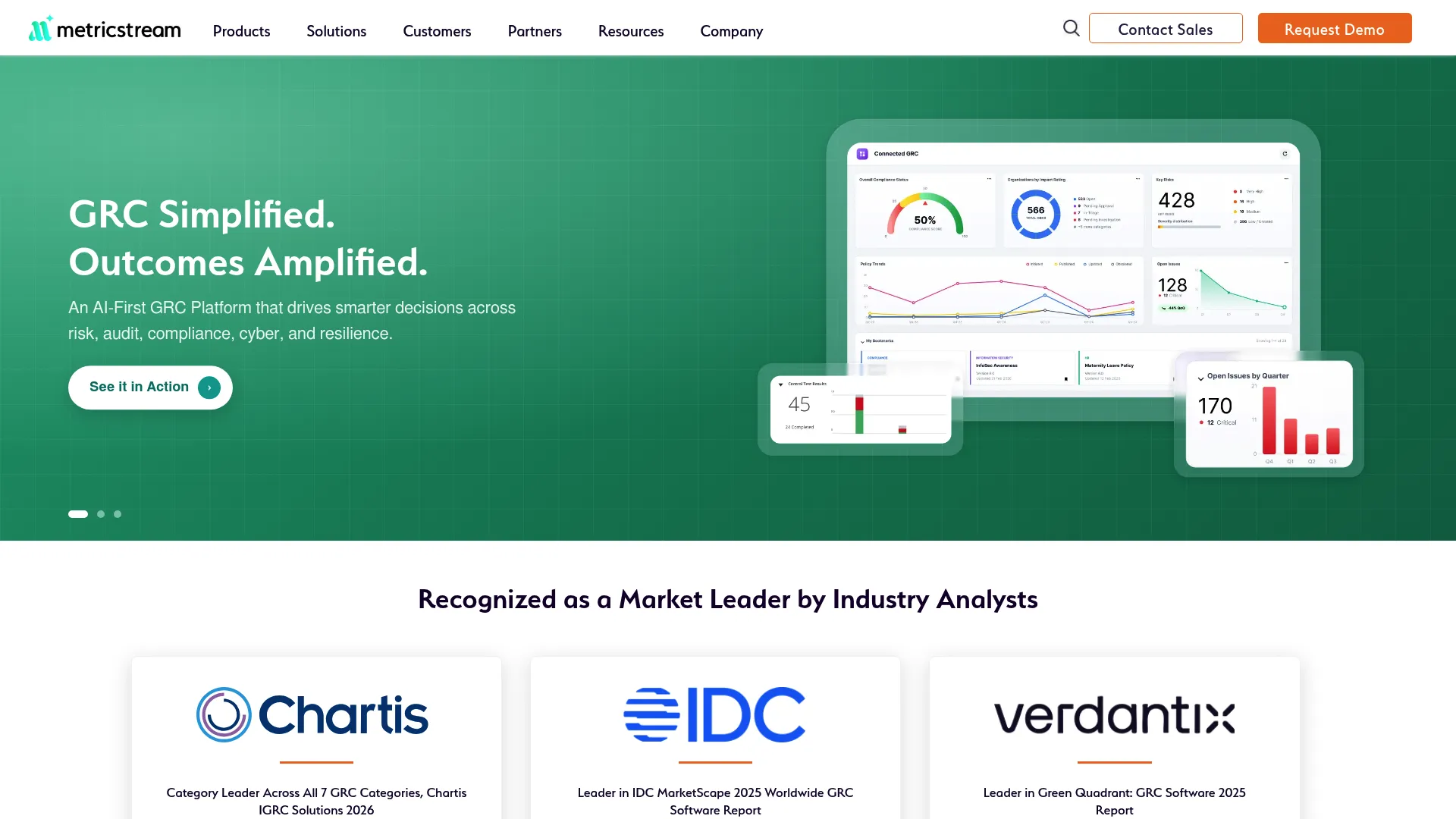
MetricStream is an AI-first GRC platform covering governance, risk, compliance, cyber, and resilience, and its operational risk depth is hard to match. This is the heavyweight enterprise option: RCSA, loss-event management, KRI, KCI, and KPI monitoring, issue management, risk quantification, and executive dashboards all sit inside one federated data model. For large programs with regulatory scrutiny, that breadth is the draw.
Best for: Large enterprises needing a configurable, full-lifecycle GRC and operational risk platform.
Key strengths
- Federated data model: Connects risk, compliance, and control data across business units without silos.
- AppStudio configuration: Build and extend risk apps to match your operating model and taxonomy.
- AI-powered workflows: Applies AI-powered risk management to scoring, summarization, and compliance tasks.
Why choose MetricStream: When your operational risk lifecycle spans RCSA, loss events, KRI monitoring, and quantification across many units, MetricStream handles the full scope in one platform. It fits large, regulated enterprises that need configurability and analytics depth more than fast, out-of-the-box simplicity. The federated model shines when consolidating fragmented risk data is the mission.
MetricStream pricing: MetricStream does not display public pricing; its pricing page directs prospects to contact the company. Expect enterprise, quote-based packaging tied to modules and scale.
3. LogicGate
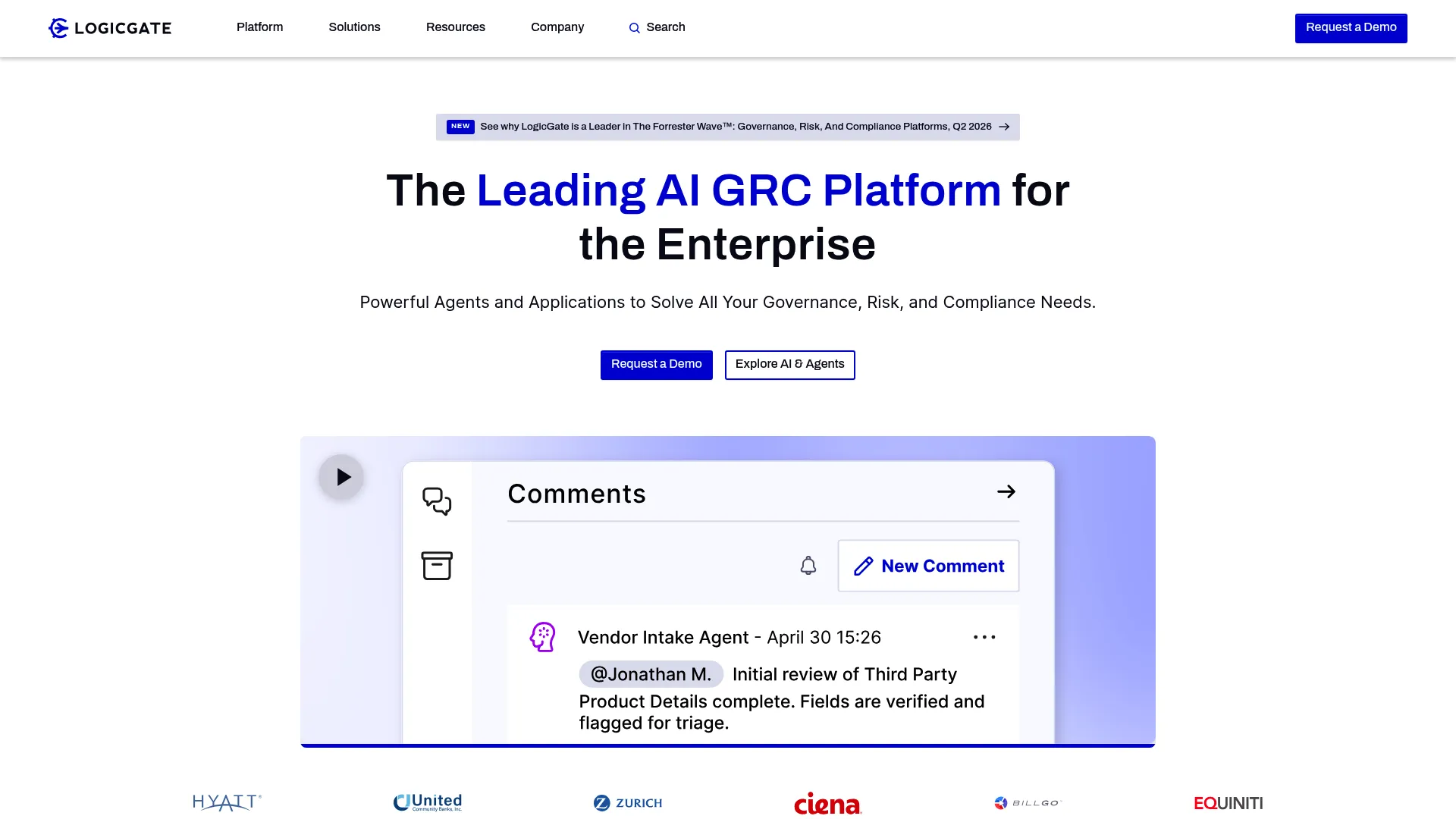
LogicGate is an AI-powered GRC platform built around no-code, configurable workflows, which makes it a strong fit for teams juggling many adjacent risk processes. Its Risk Cloud applications let you model operational risk, RCSA, and issue workflows without engineering, then adapt them as your program evolves. If your risk work keeps outgrowing rigid tools, the flexibility is the point.
Best for: Enterprise teams needing configurable GRC workflows and reporting across many risk domains.
Key strengths
- No-code workflow builder: Configure and change risk workflows without developer involvement.
- Reporting and analytics: Dashboards that surface risk posture across the register and controls.
- Spark AI: Applies automation and insights to speed up assessments and reporting.
Why choose LogicGate: LogicGate suits teams whose operational risk needs overlap with compliance, third-party risk, and other GRC workflows they want on one configurable platform. The no-code model means the tool bends to your process instead of forcing your process to bend to it. That flexibility matters most for programs still maturing their operating model. Its G2 rating is 4.6/5.
LogicGate pricing: LogicGate does not publish public prices. Its model is based on Applications, Power Users, and add-on features, with custom quotes. Contact LogicGate for pricing scoped to your program.
4. Protecht

Protecht delivers cloud-based GRC software spanning risk, compliance, resilience, and audit, with configurable assessments that make it a clean spreadsheet replacement. The platform handles risk registers, controls, incidents, vendor risk, and operational resilience, then rolls it into board-ready reporting. For teams graduating from workbooks to a real system, the configurability lands well.
Best for: Mid-market and enterprise teams needing configurable risk and compliance management.
Key strengths
- Configurable risk assessments: Adapt registers, controls, and RCSAs to your taxonomy and scoring.
- Operational resilience and BCM: Connect risk to continuity and disruption planning.
- Board reporting: Roll risk, controls, and incidents into executive-ready dashboards.
Why choose Protecht: Protecht fits teams that want configurable risk, compliance, and resilience in one platform without heavyweight enterprise overhead. Its modular structure lets you start with core operational risk and add resilience or vendor risk as you grow. That makes it a practical path off spreadsheets for organizations that expect their program to expand. Its G2 rating is 4.5/5.
Protecht pricing: Protecht states that pricing depends on organization requirements and advises contacting the team for an estimate. Its Academy training subscriptions come in Foundation and Professional options, also without public prices.
5. Hyperproof
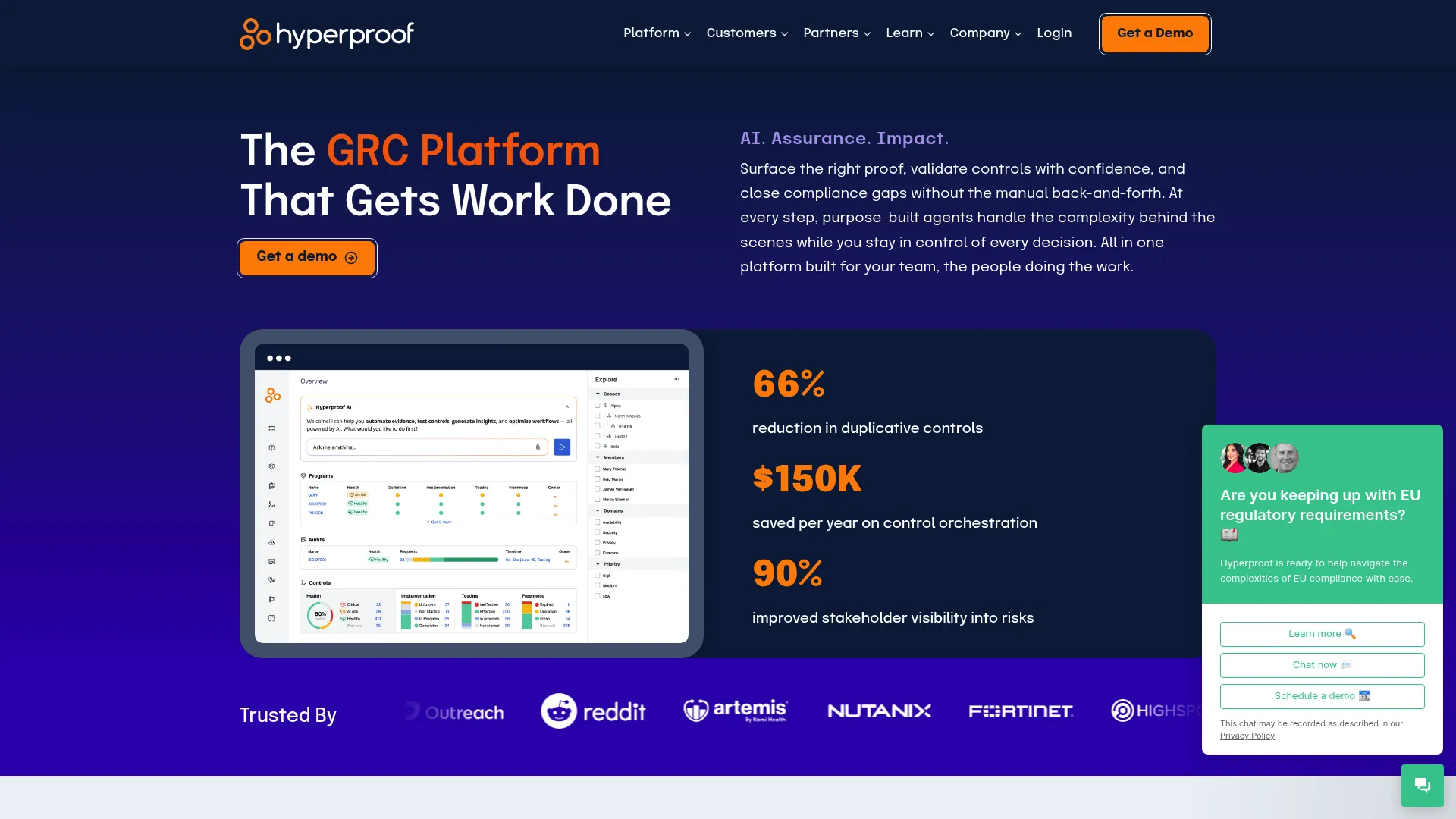
Hyperproof is an AI-powered GRC platform for compliance, risk, audit, trust, and third-party risk, and it appeals to teams that want modern automation around risk and controls. It automates control mapping, centralizes evidence collection, and streamlines audit preparation, so the busywork around compliance and risk shrinks. For teams tired of manually chasing evidence, that automation is the hook.
Best for: Mid-market and enterprise teams managing compliance, audit, and vendor risk in one platform.
Key strengths
- Automated control mapping: Maps controls across frameworks to cut duplicate compliance work.
- Centralized evidence: Collects and organizes audit evidence in one place for faster audit prep.
- Third-party risk monitoring: Runs vendor assessments and ongoing monitoring alongside internal risk.
Why choose Hyperproof: Hyperproof works best for teams whose operational risk sits close to compliance and audit, where automating control mapping and evidence collection saves real hours. Its third-party risk monitoring rounds out a platform aimed at reducing manual GRC effort. Choose it when audit and compliance workflows are as central as risk tracking itself. Its G2 rating is 4.5/5.
Hyperproof pricing: Hyperproof does not disclose public numeric pricing on its main pages. Its third-party risk management product offers a free trial and a paid Core subscription; FedRAMP pricing is based on customer needs.
6. Ncontracts

Ncontracts is integrated risk and compliance software built for financial institutions, which makes it the natural pick for banks and credit unions with heavy vendor and regulatory demands. It unifies regulatory compliance, third-party risk, enterprise risk, audit, findings, and business continuity in one platform tuned to financial services. For regulated lenders, that domain fit is the differentiator.
Best for: Banks, credit unions, and other financial institutions needing a unified GRC platform.
Key strengths
- Regulatory compliance management: Built around the rules and exams financial institutions face.
- Third-party risk management: Deep vendor risk workflows for institutions with large vendor books.
- Enterprise risk and continuity: Audit, findings, and business continuity workflows in one place.
Why choose Ncontracts: For financial institutions, operational risk rarely stands alone; it lives beside vendor, compliance, and resilience obligations. Ncontracts covers all of that in a platform designed for the regulatory reality of banking. Choose it when your operational risk program is inseparable from compliance and vendor oversight. Its G2 seller rating is 4.7/5.
Ncontracts pricing: Ncontracts does not publish public subscription pricing; it appears to be quote and demo based. Contact the vendor for a quote scoped to your institution.
7. Pirani
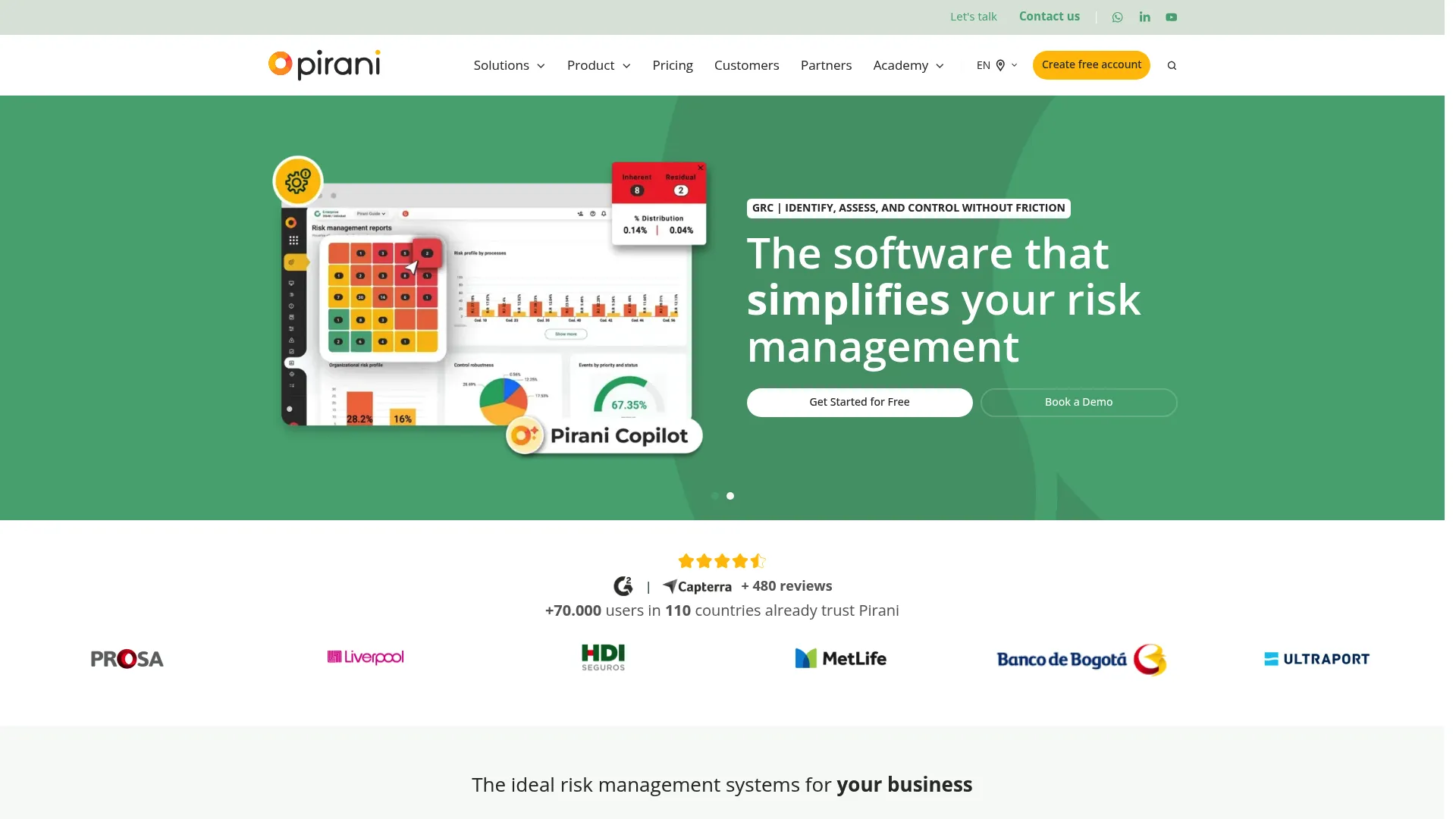
Pirani is risk management software covering operational risk, AML, compliance, audit, and information security, positioned as the approachable option for teams that want fast adoption. Its operational risk workflows, event reporting, and reporting depth cover the essentials without enterprise complexity, and a free start lowers the barrier to trying it. For mid-market teams, that accessibility is the appeal.
Best for: Organizations needing a configurable risk platform across multiple compliance and risk domains.
Key strengths
- Operational risk management: Registers, assessments, and event reporting in an accessible interface.
- AML and compliance: Extends into anti-money-laundering and broader compliance domains.
- Multi-domain coverage: One platform for operational risk, audit, and information security.
Why choose Pirani: Pirani fits teams that want practical operational risk workflows and quick time-to-value over exhaustive enterprise configurability. Its free start makes it easy to pilot before committing, and its multi-domain coverage grows with you. Choose it when usability and fast adoption rank above heavyweight depth. Its G2 rating is 4.6/5.
Pirani pricing: Pirani offers a free start with no credit card required. Beyond the free tier, public numeric pricing is not listed on its site, so contact Pirani for paid plan details.
8. Optro
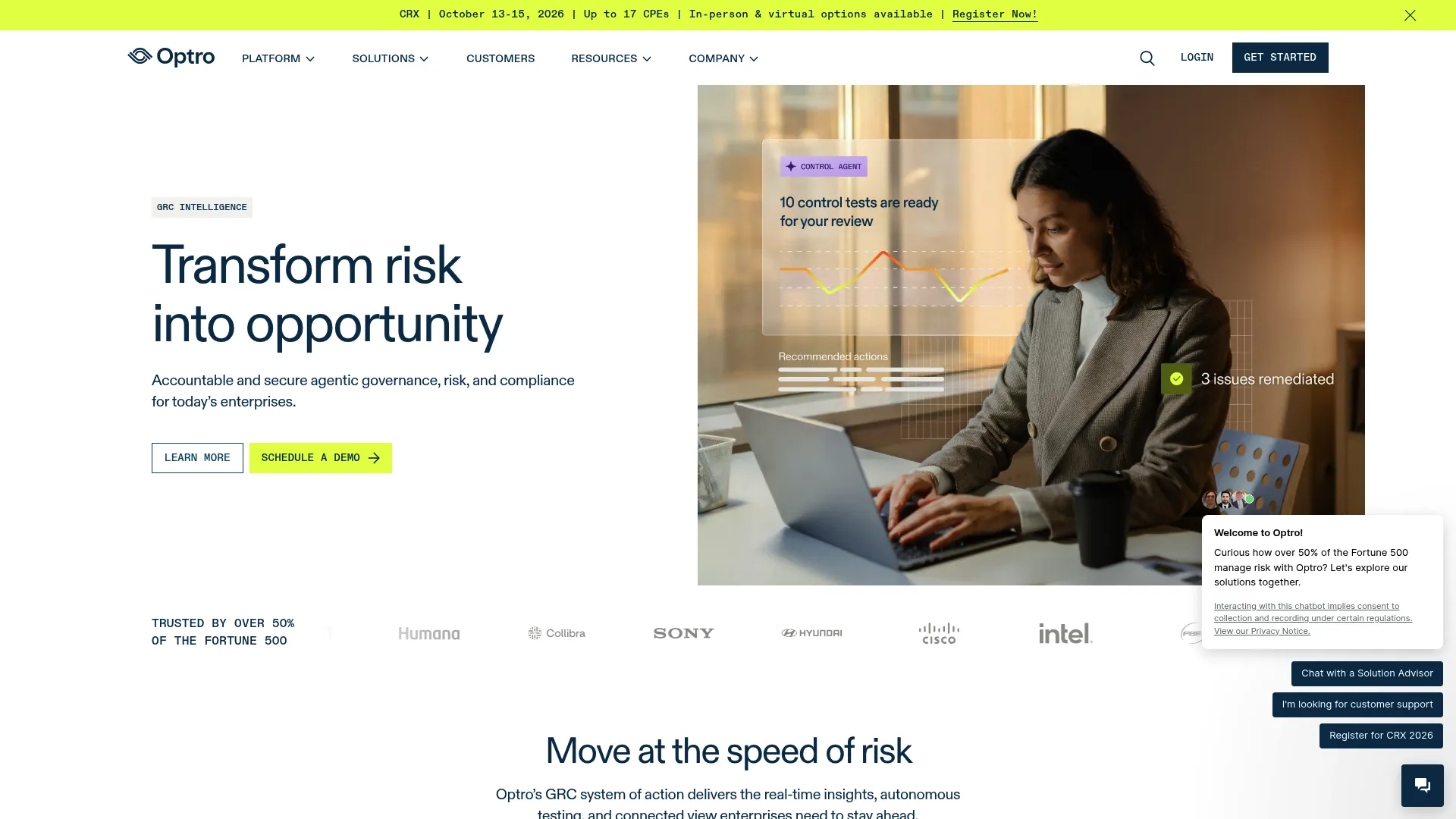
Optro is AI-powered GRC software for enterprise risk, audit, compliance, and AI governance, framed as a system of action rather than a static register. It manages frameworks and controls across 30-plus frameworks, ships with 200-plus out-of-the-box integrations, and leans hard into automation. For enterprises wanting a regulation-forward, integration-rich platform, that breadth stands out.
Best for: Large enterprises needing unified risk, audit, compliance, and AI governance workflows.
Key strengths
- AI-enabled system of action: Applies AI-powered risk management to drive workflows, not just record them.
- Frameworks and controls: Manages controls across 30-plus frameworks in one place.
- 200-plus integrations: Connects to source systems out of the box to feed risk data automatically.
Why choose Optro: Optro suits enterprises that want risk, audit, and compliance unified with emerging AI governance needs, backed by deep integration coverage. Its framework breadth and automation focus fit teams standardizing across many regulatory regimes. Choose it when integration depth and AI governance are strategic priorities alongside operational risk. Its integration count is a genuine differentiator for connected reporting.
Optro pricing: Optro describes flexible plans with no hidden fees on its pricing page, but does not show public prices. Contact Optro for a quote scoped to your frameworks and integrations.
9. Aclaimant
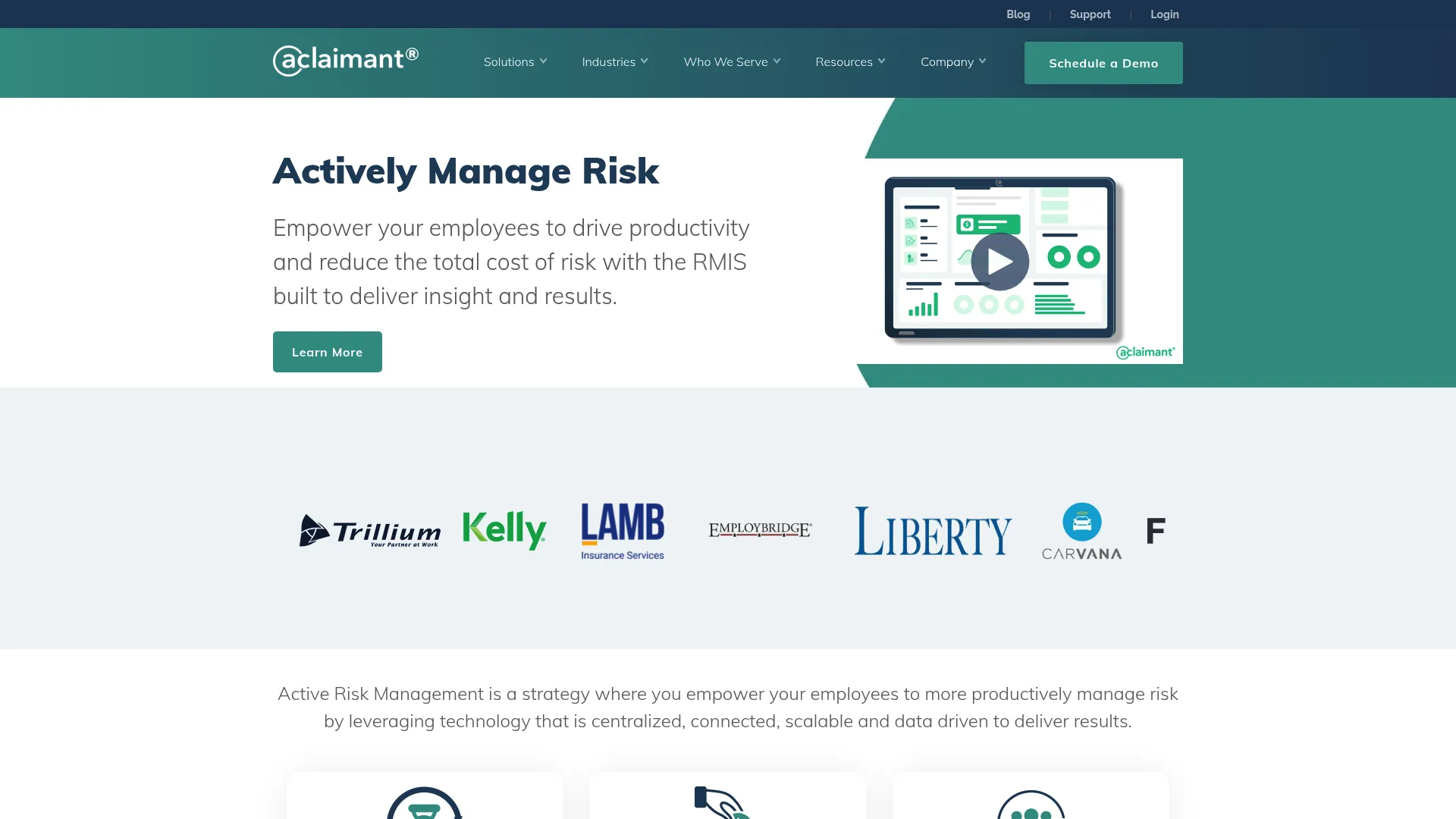
Aclaimant is RMIS software for incident, claims, safety, policy, and exposure management, with a specialty focus that makes it distinct from broad GRC platforms. Where most tools on this list center on risk registers and RCSAs, Aclaimant excels at the operational loss side: capturing incidents, managing claims, and analyzing safety data. For teams where operational risk means physical incidents and claims, that focus is exactly right.
Best for: Mid-market to enterprise teams needing configurable risk management and claims workflows.
Key strengths
- Incident and claim management: Capture incidents and manage claims end to end with analytics.
- Safety reporting: Purpose-built reporting for safety-driven operational risk.
- Assets and exposures: Track policies, assets, and exposures alongside incidents.
Why choose Aclaimant: Aclaimant is the right call when your operational risk profile is dominated by incidents, claims, and safety rather than framework-driven RCSAs. Its specialty coverage of loss events and claims runs deeper than most general GRC tools in that domain. Choose it when incident and claims workflows are the heart of your risk program. Its G2 rating sits at 4.9/5.
Aclaimant pricing: Aclaimant offers RMIS Basics, RMIS Core, and RMIS Enterprise plans plus a la carte modules, with demo prompts instead of public prices. Contact Aclaimant for a quote.
10. Fusion Framework System
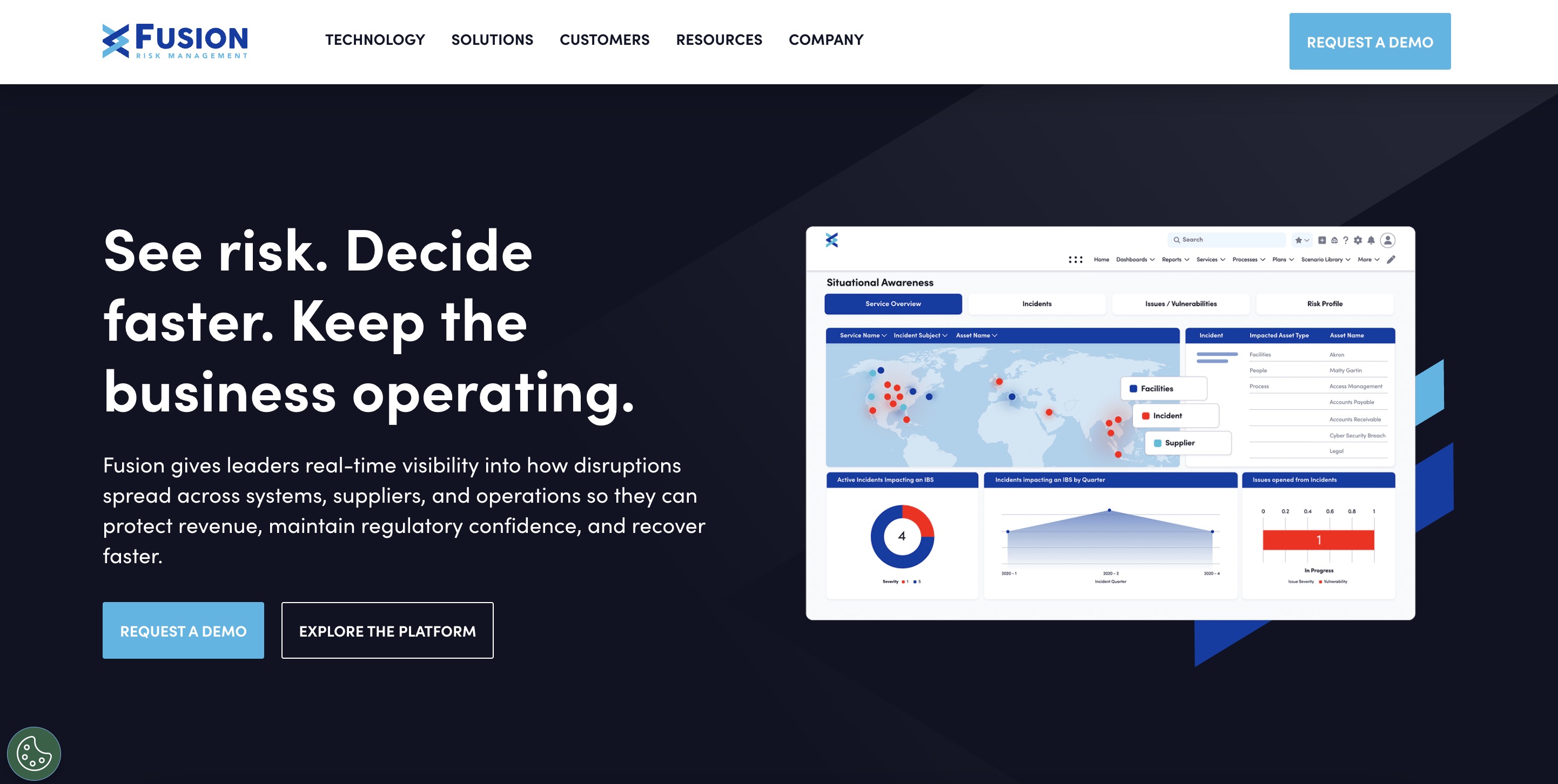
Fusion Framework System is enterprise resilience software for managing risk, continuity, disruption response, and recovery, built for organizations that need more than a basic risk register. It maps enterprise dependencies across systems, suppliers, sites, and services, simulates disruption scenarios, and coordinates response through guided workflows. For resilience-led programs, that dependency mapping is the standout.
Best for: Large organizations needing a unified enterprise resilience and operational risk platform.
Key strengths
- Dependency mapping: Maps how systems, suppliers, sites, and services connect across the enterprise.
- Scenario simulation: Models disruptions to surface cascading impacts before they happen.
- Guided response workflows: Coordinates recovery with automation and structured playbooks.
Why choose Fusion Framework System: Fusion fits organizations where operational risk and operational resilience are inseparable, and where understanding cascading impact matters as much as tracking individual risks. Its dependency mapping and scenario tools go well beyond a standard register. Choose it when continuity and resilience sit at the center of your operational risk strategy. Its G2 rating is 4.4/5.
Fusion Framework System pricing: Fusion Framework System does not publish public pricing, and no public pricing page was found. Contact the vendor for a quote scoped to your resilience program.
Considerations before you buy
Shortlisting is easier when you evaluate against your actual process pain, not a generic feature grid. Weigh these before committing.
Lifecycle coverage
Map each tool against your real workflow: identify, assess, mitigate, monitor, report. A platform that nails RCSAs but skimps on KRI monitoring or loss-event capture leaves you back in spreadsheets for the missing steps. Verify coverage end to end, not module by module in isolation.
RCSA and KRI depth
RCSA support and KRI monitoring are where operational risk work lives day to day. Check that scoring models, approval chains, thresholds, and alerting match how your team actually assesses and monitors risk. Consistent taxonomy and audit trails are non-negotiable for compliance and audit workflows.
Loss-event and issue management
Capturing loss events is only half the job; the tool must route issues to owners, track remediation, and quantify impact. Confirm the risk mitigation workflow closes the loop from event to control change, not just logs incidents in a database.
Integrations and reporting
Operational risk dashboards are only as good as the data feeding them. Check integrations with your source systems, ledgers, and existing GRC modules, and confirm executive reporting and risk reporting automation match what your board expects. Fewer manual exports means fewer version conflicts.
Deployment and pricing fit
Almost every platform here is quote-based, so scope carefully. Match modular deployment to your maturity: start with core operational risk, add resilience, vendor risk, or compliance as you grow. Confirm cloud deployment, security, and support terms before you sign.
Conclusion
The right operational risk management software depends on where your program sits today. For enterprises consolidating risk and reporting, Workiva and MetricStream lead on depth. LogicGate wins for no-code flexibility across many workflows, while Ncontracts fits regulated financial institutions and Pirani serves mid-market teams wanting fast adoption. Hyperproof and Optro suit compliance-heavy programs leaning into AI-powered risk management, Aclaimant owns incident and claims workflows, and Fusion Framework System anchors operational resilience.
Your next step: shortlist 2 to 3 tools that match your lifecycle needs, then verify module fit against your current process pain. Put RCSA, KRI monitoring, loss-event handling, and reporting workflows side by side with how your team works now. The gap between spreadsheets and a governed ORM platform closes fast once you see the workflow in action, so book demos and pressure-test each one against a real risk scenario before deciding.
FAQs
Operational risk management software is a GRC solution that helps teams identify, assess, mitigate, monitor, and report on risks from failed processes, people, systems, and external events. It replaces spreadsheets with a governed platform built around the operational risk lifecycle, including RCSA workflows, KRI monitoring, risk registers, and loss-event management.
ORM software focuses on operational risk specifically: process failures, human error, system outages, and external events, often with Basel-aligned RCSA and loss-event capabilities. Enterprise risk management software takes a wider view across strategic, financial, and operational risk. Many platforms on this list cover both, letting operational risk feed a broader ERM picture.
Prioritize full lifecycle coverage (identify, assess, mitigate, monitor, report), strong RCSA and KRI monitoring, loss-event and issue management, and operational risk dashboards. Integrations with source systems and risk reporting automation matter for accurate, low-effort reporting. Audit trails and versioning are essential for defensible compliance and audit workflows.
Yes, and that is the most common reason teams buy it. Spreadsheets lack approvals, version control, alerting, and audit trails, which fail the moment risk owners and reporting requirements multiply. ORM software replaces manual tracking with role-based access, automated KRI alerts, and a single governed risk register that scales.
Risk and control self-assessment software standardizes scoring models, taxonomy, and approval chains across every business unit, so results roll up consistently. It runs repeatable assessment cycles on a schedule, locks audit trails for defensibility, and links each assessment to the controls and actions it produces. That consistency is what manual RCSA workbooks cannot deliver.
KRI monitoring tracks key risk indicators against defined thresholds to give early warning of rising operational risk. KRI monitoring software automates data collection, triggers alerts when thresholds breach, and can open issues for remediation. It shifts teams from periodic review to continuous oversight, catching problems before they become loss events.
AI-powered risk management assists with risk scoring, summarizing large volumes of risk data, detecting patterns across loss events, and drafting reports. Several platforms apply AI to speed up assessments, control mapping, and compliance tasks, reducing manual effort. The goal is faster, more consistent risk work, with humans still owning judgment and decisions.
Financial services, including banks and credit unions, are the heaviest users given Basel-aligned operational risk requirements and vendor oversight demands. Insurance, healthcare, energy, manufacturing, and any regulated or safety-sensitive industry also rely on it. Broadly, any organization consolidating fragmented risk registers, RCSAs, and KRI monitoring into a governed GRC software platform benefits.