Your samples live in three spreadsheets, two shared drives, and one analyst's memory. A QC result gets logged late. An auditor asks for a chain of custody you can technically reconstruct, but it takes two days and a lot of guessing. None of this is a people problem. It is a system problem, and it compounds every time your lab adds throughput, a new instrument, or a new regulatory requirement.
The global LIMS market was worth about USD 1.8 billion in 2023 and is projected to reach USD 4.7 billion by 2033, growing at a 10.1% CAGR, according to Market.us (2026). That growth is not vanity. It reflects labs hitting the ceiling of manual tracking and spreadsheet-based data management, then reaching for a laboratory information management system that can enforce process, capture an audit trail, and connect instruments to reporting.
The problem is that "LIMS software" covers everything from a genomics-specific platform to a broad enterprise informatics suite to a free cloud tool a two-person lab can start using this week. Picking wrong wastes months. So this guide is built to help you match a laboratory information management system to your actual lab type, compliance load, and deployment reality, not to a generic feature checklist. If your work spans adjacent operational systems, you will also find that evaluation logic overlaps with tools like audit management software and contract lifecycle management software, where traceability and governance drive the same buying decisions.
What's inside
This guide is for lab operations leads, quality managers, and the product or IT people who get pulled into a LIMS decision. It covers eight LIMS providers across four buyer profiles: genomics-specific systems, broad enterprise suites, flexible mid-market platforms, and lower-barrier starting points.
Every tool was chosen and assessed against four criteria that matter most in real evaluations: workflow automation depth, instrument integration and data management, compliance features such as audit trails and electronic signatures, and deployment flexibility including cloud LIMS and on-premise options plus implementation support. Where public pricing or a verified rating exists, it is included. Where a vendor keeps pricing behind a sales conversation, that is stated plainly.
TL;DR
- Best for genomics and NGS labs: Clarity LIMS, built around sequencing sample traceability and Illumina instrument integration.
- Best for broad enterprise informatics: Thermo Scientific Core LIMS Software and LabVantage, both configurable platforms that sit inside a wider lab informatics stack.
- Best for demanding governance: LabWare and StarLIMS, mature enterprise LIMS systems built for regulated, quality-focused environments.
- Best for flexible, no-code configuration: Matrix Gemini LIMS, strong for multi-site and adaptable workflows without heavy coding.
- Best for approachable modern usability: Labworks LIMS, focused on sample lifecycle management with a practical footprint.
- Best low-barrier starting point: FreeLIMS, a free cloud LIMS for smaller labs testing the water before committing.
What is LIMS software?
A laboratory information management system (LIMS) is software that tracks samples, automates lab workflows, centralizes scientific data, and enforces compliance across the full sample lifecycle. In practice, a LIMS system replaces the spreadsheets, paper logs, and disconnected instrument exports that most labs outgrow, giving every sample a traceable record from receipt to result to archive.
A modern lab information management software platform typically handles:
- Sample tracking: unique IDs, chain of custody, status, and location for every sample from accessioning to disposal.
- QC centralization: standardized quality control steps, specification limits, and pass or fail logic in one place rather than per analyst.
- Reagent tracking and lot tracking: inventory, expiry, and lot-level traceability tied to the results a reagent touched.
- Workflow automation: configurable, repeatable protocols that route work, trigger next steps, and reduce manual handoffs.
- Instrument integration: direct connections to lab instruments so results flow in without manual transcription.
- Audit trail and electronic signatures: immutable records of who did what and when, with signature controls for regulated approvals.
- Reporting and data management: dashboards, certificates of analysis, and exports that turn raw records into decisions and evidence.
That definition matters because it separates a true LIMS from adjacent tools. An electronic lab notebook (ELN) documents experiments and scientific reasoning. A LIMS governs the operational flow of samples and data. Many labs run both, and increasingly the two live inside one lab informatics platform.
When to use LIMS software
Not every lab needs a LIMS on day one. The signal is usually operational friction that manual tracking can no longer absorb.
Replace spreadsheets and manual sample tracking
The clearest trigger is sample volume outrunning spreadsheets. When sample IDs collide, status is unclear, and one person becomes the single source of truth, error risk climbs fast. A LIMS system gives every sample a controlled record and enforces status transitions automatically. Labs with rising throughput and multiple analysts feel this pain first, and they see the fastest relief from workflow automation.
Centralize compliance and audit readiness
If you operate under ISO 17025, GMP, GLP, or FDA 21 CFR Part 11, audit readiness is not optional. Reconstructing an audit trail from memory or scattered files is slow and risky. A LIMS captures who touched each sample, applies electronic signatures to approvals, and keeps records immutable. Regulated pharmaceutical, clinical, and testing labs benefit most here, since compliance evidence becomes a byproduct of normal work rather than a fire drill.
Connect instruments, workflows, and reporting
When instrument output lives in exports that analysts retype into reports, you lose time and introduce transcription errors. Instrument integration pulls results straight into the sample record, and reporting turns those records into certificates and dashboards. High-throughput labs and those with many instrument types gain the most from connecting instruments, workflows, and reporting into one data management layer.
Comparison table
The table below ranks the eight LIMS providers by relevance to a typical buyer moving from spreadsheets to a real system. Read it as a shortlisting aid: match your lab type and compliance load to the "Intent" and "Key use case" columns first, then use pricing and rating as secondary filters. Pricing for most enterprise LIMS is quote-based, which is normal for this category.
| # | Product | Intent | Key use case | Pricing | G2 rating |
|---|---|---|---|---|---|
| 1 | Clarity LIMS | Genomics-specific LIMS | NGS sample traceability and Illumina instrument integration | Two annual plans, quote-based | Not published |
| 2 | Thermo Scientific Core LIMS Software | Enterprise informatics suite | Configurable R&D sample, data, and workflow management | Quote-based | Not published |
| 3 | LabVantage | Enterprise informatics platform | No-code LIMS plus ELN, LES, SDMS, and analytics | Quote-based | 3.8/5 |
| 4 | LabWare | Enterprise LIMS and ELN | Regulated labs needing deep configurability and compliance | Quote-based | 4.5/5 |
| 5 | Matrix Gemini LIMS | Flexible configurable LIMS | No-code, multi-site and regulated workflow configuration | Quote-based | 4.8/5 |
| 6 | StarLIMS | Regulated enterprise LIMS | Compliance-focused scientific and quality lab operations | Quote-based | 4.5/5 |
| 7 | Labworks LIMS | Modern usable LIMS | Sample lifecycle management with practical footprint | Quote-based | 5.0/5 |
| 8 | FreeLIMS | Free cloud LIMS | Low-barrier sample and workflow management for small labs | Free | 5/5 |
Best LIMS software for 2026
Each entry below covers what the tool is, who it fits best, its key strengths, why you might choose it, pricing guidance, and the kind of lab that should shortlist it. The order follows relevance to decision intent, starting with the most specialized fit and moving toward the broadest and most accessible.
1. Clarity LIMS
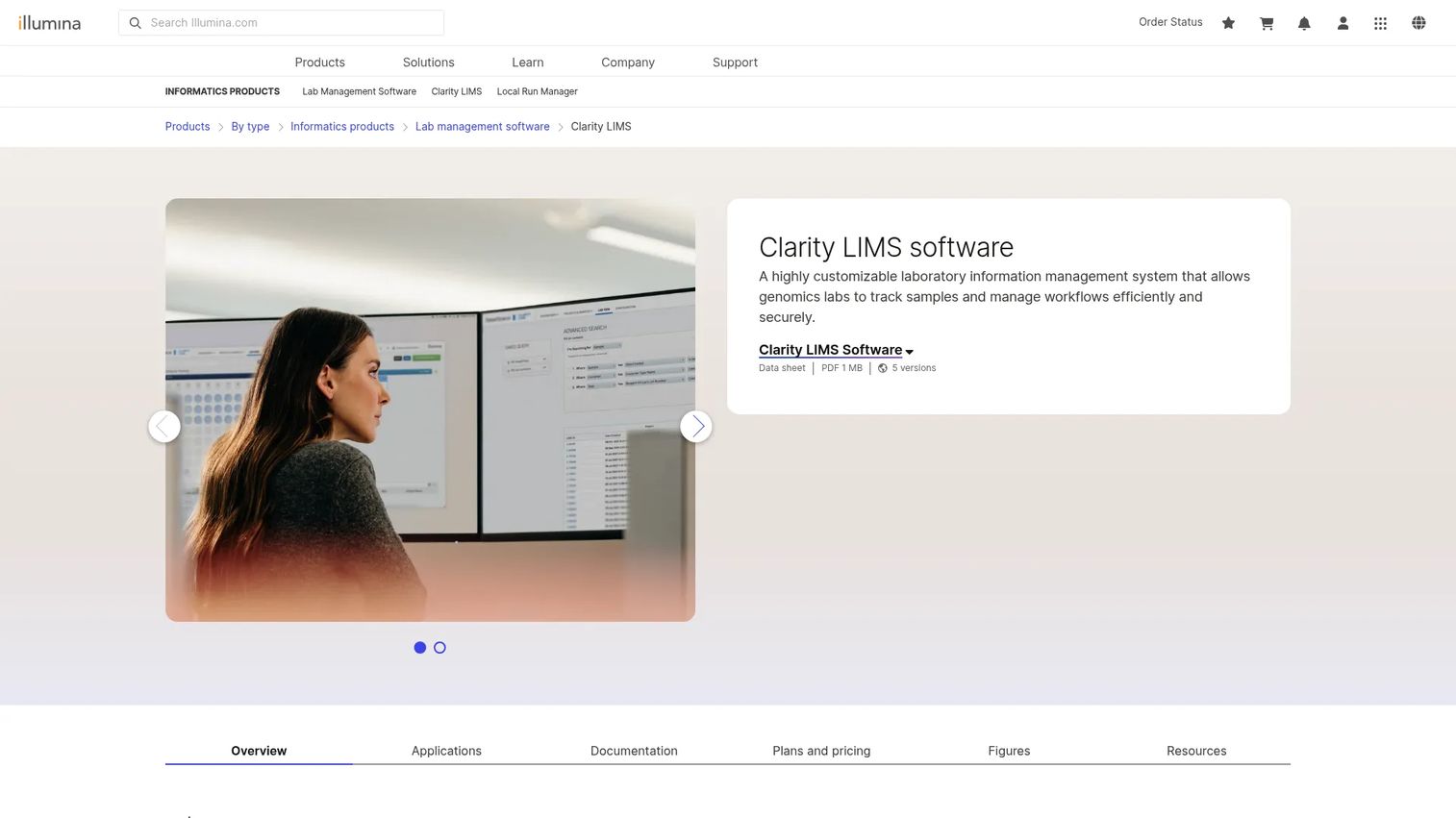
Clarity LIMS is a genomics-focused laboratory information management system built for sample tracking and workflow management in sequencing-heavy labs. It is designed around the realities of NGS work, where a single sample moves through many steps, gets split and pooled, and has to stay traceable the entire way. Preconfigured Illumina workflows and instrument integrations make it a natural fit for teams already running Illumina platforms.
Best for: Genomics and NGS labs that need regulated sample tracking and end-to-end workflow automation.
Key strengths
- End-to-end sample traceability: every sample keeps a complete record through complex, multi-step sequencing workflows.
- Preconfigured genomics workflows: Illumina instrument integrations and NGS workflow automation reduce setup for sequencing labs.
- Compliance controls: role-based permissions, an audit trail, and electronic signatures support regulated environments.
Why choose Clarity LIMS: If your lab lives in sequencing, a general-purpose LIMS forces you to build genomics logic from scratch. Clarity LIMS starts where you already are, with sample handling and instrument integration tuned for NGS. That specialization is the whole point, and it is why sequencing teams shortlist it first.
Clarity LIMS pricing: Clarity LIMS is available in two annual subscription plans, Professional and Enterprise. Illumina does not publish a public price and directs prospects to contact sales, which is standard for genomics LIMS at this tier.
Who should evaluate it: Core sequencing facilities, genomics service providers, and translational labs where NGS throughput and sample traceability are the daily reality.
2. Thermo Scientific Core LIMS Software
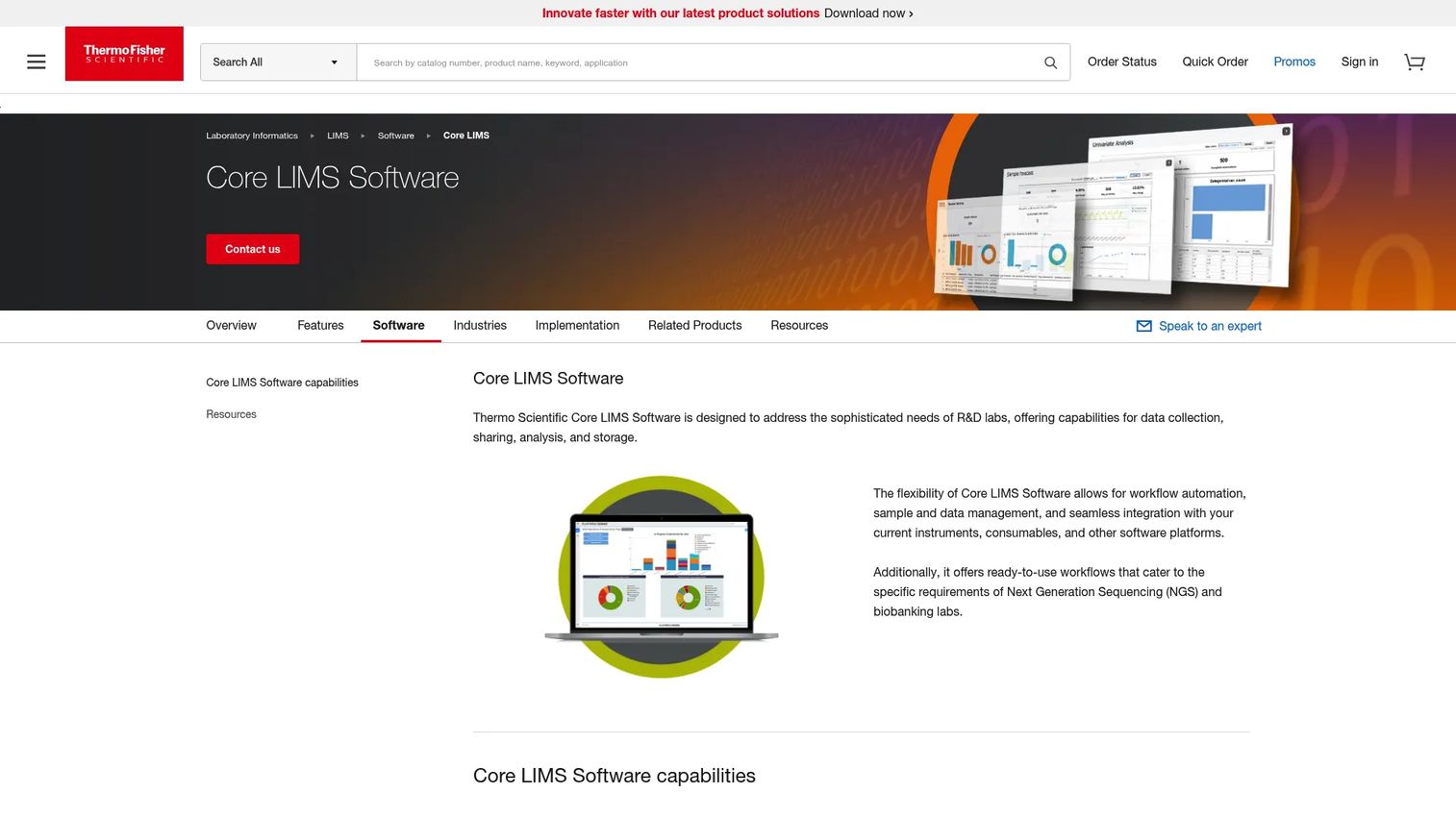
Thermo Scientific Core LIMS Software is LIMS software for R&D labs that need to collect, share, analyze, and store scientific data in one place. It sits inside Thermo Fisher's broader lab informatics portfolio, so it appeals to teams that want a LIMS as part of a wider suite rather than a standalone tool. Sample management, accessioning, instrument management, and prebuilt flexible workflows form the core.
Best for: R&D labs that need configurable sample, data, and workflow management inside a larger informatics stack.
Key strengths
- Sample management and accessioning: structured intake, tracking, and lifecycle handling across research samples.
- Instrument management: connects instruments into the data flow so results and metadata stay together.
- Prebuilt flexible workflows: configurable process templates speed up rollout without starting from zero.
Why choose Thermo Scientific Core LIMS Software: The pull here is breadth. If you expect to add ELN, analytics, or other informatics capabilities over time, buying into an established suite reduces integration headaches later. Teams that value implementation support and a vendor with deep instrument expertise gravitate to this option.
Thermo Scientific Core LIMS Software pricing: Thermo Fisher does not display public pricing for Core LIMS. The product page uses contact and demo CTAs, so pricing is quote-based and scoped to your lab's requirements. A vendor ROI calculator or scoping call is the usual next step.
Who should evaluate it: Research and development labs, and organizations that want a LIMS that can grow into a fuller lab informatics platform over time.
3. LabVantage
LabVantage is a laboratory informatics platform that pairs LIMS with ELN, LES, SDMS, analytics, and industry-specific solutions. It is browser-based and built on HTML5, and its no-code configuration lets labs adapt the system without deep development work. For organizations that want one platform spanning several informatics needs, LabVantage is a strong enterprise candidate.
Best for: Enterprise labs that need a configurable LIMS and informatics platform under one roof.
Key strengths
- No-code LIMS configuration: adapt workflows and data models without writing code.
- Integrated informatics: LIMS, ELN, LES, and SDMS in a single platform reduce tool sprawl and data silos.
- Browser-based HTML5 platform: modern, accessible interface with flexible deployment options.
Why choose LabVantage: The case for LabVantage is consolidation. Instead of stitching together separate systems for notebooks, execution, and data management, you get them on one configurable platform. That matters for large labs where scalability and integrated data management are as important as core sample tracking. It holds a 3.8/5 rating on G2.
LabVantage pricing: LabVantage does not publicly list product pricing, which is quote-based. Publicly visible pricing is limited to training, listed at a standard rate of USD 800 per student per day. Expect a scoped quote for the platform itself based on modules, users, and deployment.
Who should evaluate it: Enterprise and multi-function labs that want LIMS plus adjacent informatics capabilities on a single configurable platform.
4. LabWare
LabWare is an enterprise laboratory informatics provider focused on LIMS and ELN, with a long track record in regulated industries. Its strength is configurability paired with mature compliance support, which makes it a common choice for labs with demanding governance and process control needs. Workflow automation, ELN capabilities, and audit trail support anchor the platform.
Best for: Regulated labs that need configurable enterprise LIMS and ELN software.
Key strengths
- LIMS workflow automation: deep, configurable process automation across complex lab operations.
- ELN capabilities: experiment documentation and sample governance in the same ecosystem.
- Compliance and audit trail support: built for regulated environments where traceability is non-negotiable.
Why choose LabWare: LabWare tends to win when governance is the hardest part of the job. Its maturity and configurability let large, regulated labs model demanding processes precisely. That depth suits teams that would rather configure a proven enterprise LIMS than compromise on process fidelity. It carries a 4.5/5 rating on G2.
LabWare pricing: LabWare uses quote-based pricing and asks prospects to request a quote rather than publishing figures. This is typical for configurable enterprise LIMS, where cost depends on modules, seats, and implementation scope.
Who should evaluate it: Pharmaceutical, clinical, and other heavily regulated labs that need precise process control and strong compliance readiness at scale.
5. Matrix Gemini LIMS
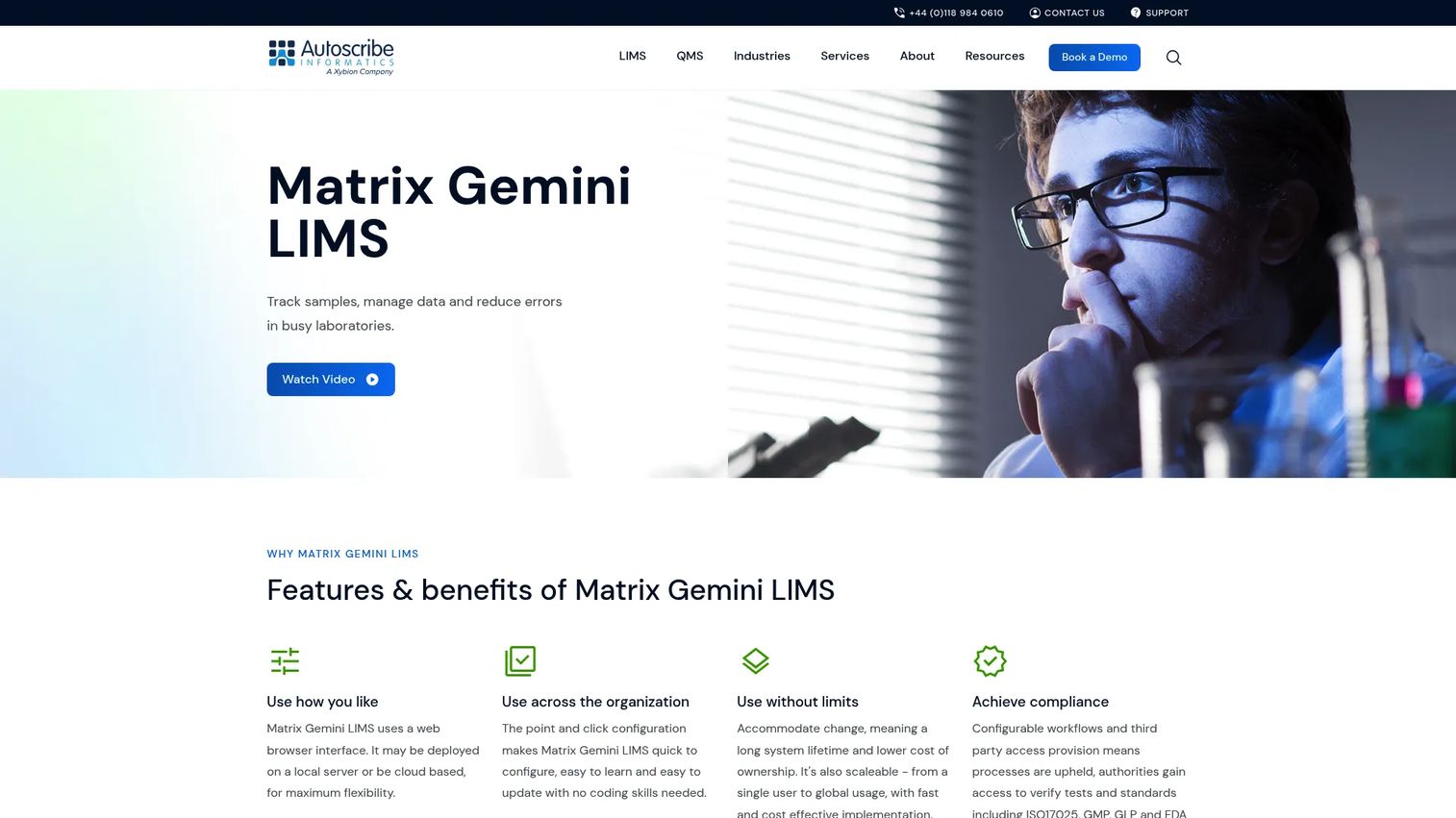
Matrix Gemini LIMS is a configurable laboratory information management system for tracking samples, managing data, and reducing errors. Its defining feature is point-and-click configuration that requires no coding, which lets labs adapt the system to their workflows rather than reshaping their workflows to fit the software. It runs in a web browser with local server or cloud deployment and supports standards including ISO 17025, GMP, GLP, and FDA 21 CFR Part 11.
Best for: Labs that need a highly configurable LIMS for multi-site or regulated workflows without overbuilding.
Key strengths
- No-code configuration: point-and-click setup means changes do not require developers.
- Flexible deployment: browser interface with either local server or cloud LIMS options.
- Broad compliance support: configurable workflows aligned to ISO 17025, GMP, GLP, and 21 CFR Part 11.
Why choose Matrix Gemini LIMS: The appeal is adaptability without heavy IT dependency. If your requirements shift across sites or change over time, point-and-click configuration keeps the system moving with you. Labs that want enterprise-grade flexibility without a large development effort favor this balance. It holds a strong 4.8/5 rating on G2.
Matrix Gemini LIMS pricing: Autoscribe Informatics does not publish public pricing for Matrix Gemini LIMS; it is contact-sales based. A scoping conversation determines cost based on configuration depth, sites, and deployment model.
Who should evaluate it: Multi-site labs and regulated teams that value configurability and want to adapt the system themselves rather than depending on ongoing development.
6. StarLIMS
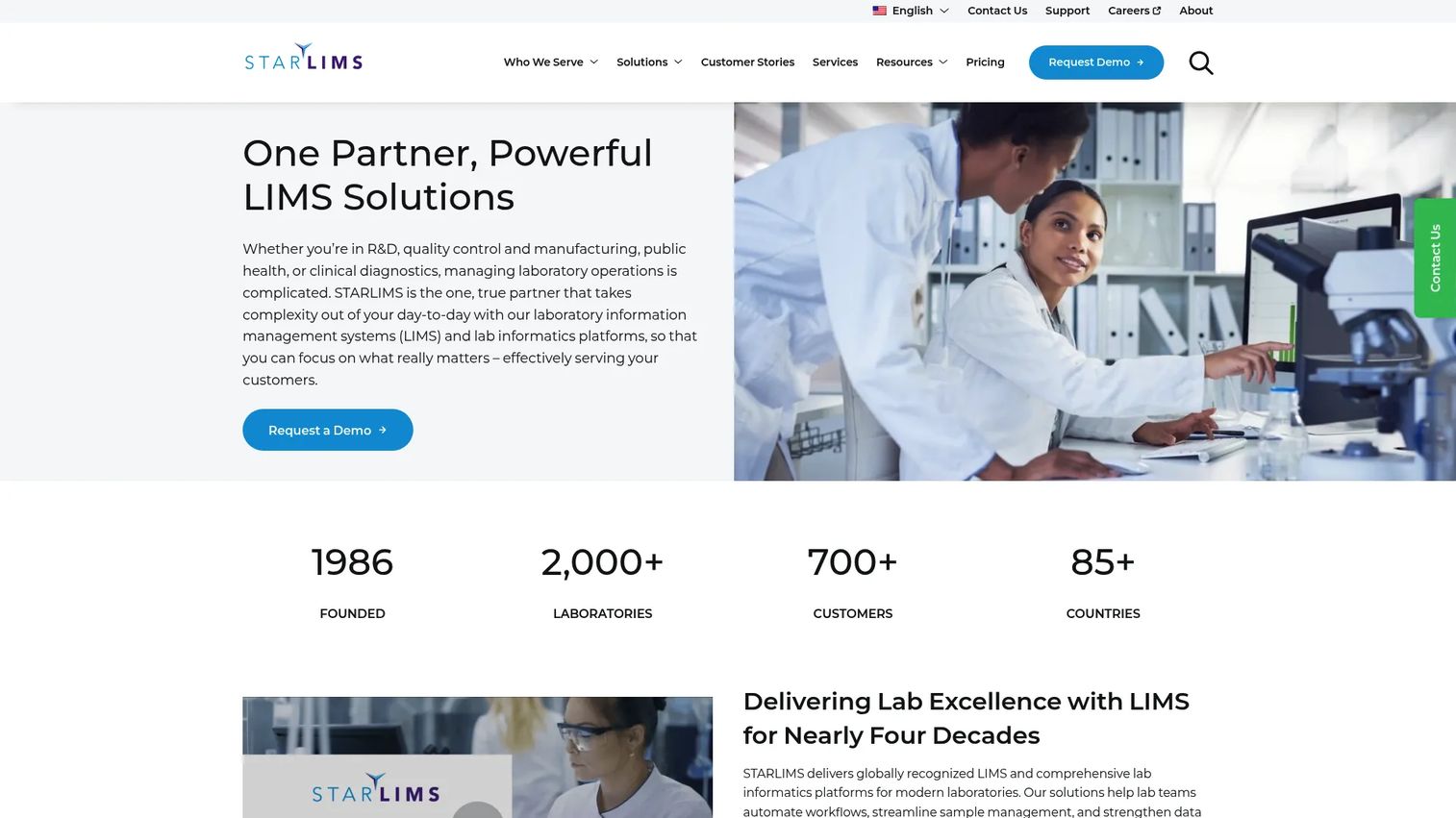
StarLIMS is a laboratory informatics provider offering LIMS and related lab workflow solutions, with a focus on regulated and quality-focused environments. It combines workflow automation, sample management, and analytics in a configurable platform aimed at enterprises that need compliance built into daily operations. For labs where quality and regulatory alignment drive the roadmap, StarLIMS is a serious candidate.
Best for: Enterprises and regulated labs that need a configurable, compliance-focused LIMS platform.
Key strengths
- LIMS and informatics platform: unified workflow and data management across regulated operations.
- Workflow automation and sample management: structured, repeatable processes that reduce manual steps.
- Analytics and data management: turns operational records into reporting and quality insight.
Why choose StarLIMS: StarLIMS fits when compliance is the organizing principle, not an afterthought. Its configurability lets quality-focused labs encode their standards into the system while keeping analytics and reporting close to the data. That combination appeals to teams operating under sustained regulatory scrutiny. It holds a 4.5/5 rating on G2.
StarLIMS pricing: StarLIMS does not publish a fixed public price. The vendor frames pricing as variable and sales-contact based, scoped to modules, users, and deployment, which is standard for enterprise LIMS.
Who should evaluate it: Regulated scientific, clinical, and quality labs that want compliance and analytics tightly integrated into a configurable LIMS.
7. Labworks LIMS
Labworks LIMS is enterprise LIMS software for sample lifecycle management, lab automation, and reporting, positioned as a more approachable system. It covers the full sample and analysis lifecycle, automation workflows, audit trail, and electronic signatures, alongside reporting and dashboards. For labs that want enterprise capability without an overwhelming learning curve, Labworks is worth a look.
Best for: Labs that want a configurable enterprise LIMS with strong workflow and compliance support and modern usability.
Key strengths
- Sample and analysis lifecycle management: tracks work from intake through result and archive.
- Automation, audit trail, and eSignatures: workflow automation paired with the compliance controls regulated labs need.
- Reporting and dashboards: built-in analytics turn lab data into usable output.
Why choose Labworks LIMS: Labworks aims to make enterprise LIMS feel practical rather than daunting. If your team wants sample lifecycle management, compliance controls, and reporting without a punishing rollout, its usability focus is the draw. It holds a 5.0/5 rating on G2, based on a small number of reviews.
Labworks LIMS pricing: Labworks does not publish a fixed starting price. Its resources discuss LIMS cost models and custom examples rather than a public number, so expect a scoped quote based on your workflows and deployment.
Who should evaluate it: Mid-market and enterprise labs that want capable sample lifecycle management and compliance features with an approachable experience.
8. FreeLIMS
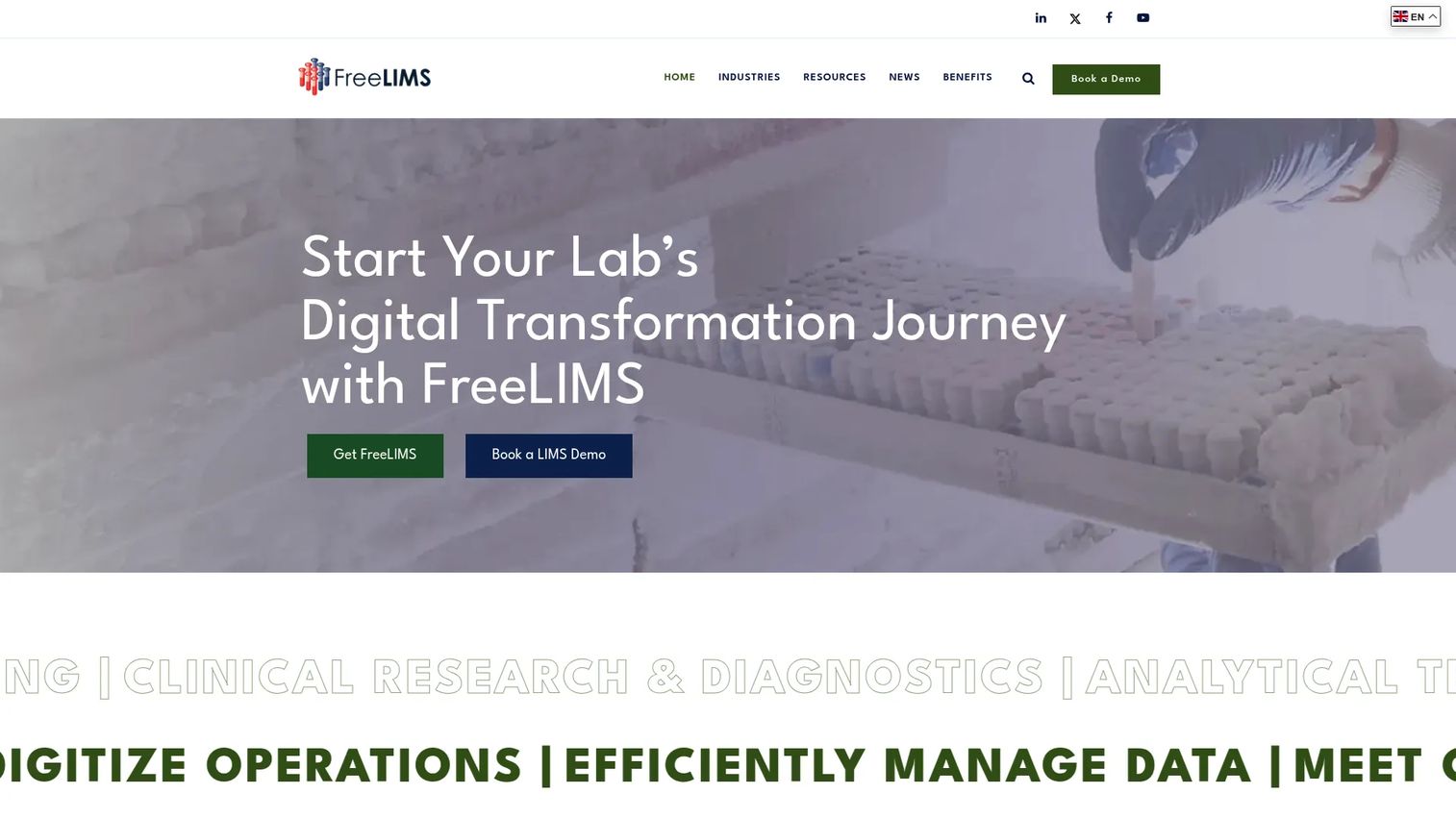
FreeLIMS is a free cloud-based laboratory information management system used by labs across multiple industries. It covers core LIMS functionality including sample management, patient management, and storage management, delivered as a cloud service at no charge. For small labs and teams exploring options before committing to enterprise software, it is the lowest-barrier way to experience a real LIMS system.
Best for: Smaller labs that want a free cloud LIMS for basic workflow and sample management.
Key strengths
- Sample management: core sample tracking without upfront licensing cost.
- Patient management: support for clinical and diagnostic workflows that involve patient records.
- Storage management: organized handling of sample storage and location.
Why choose FreeLIMS: The obvious reason is the price. A free cloud LIMS lets a small lab replace spreadsheets and learn what a LIMS system actually changes before spending a budget cycle on procurement. Treating it as a low-risk pilot is a smart way to build internal buy-in. It holds a 5/5 rating on G2, based on a small number of reviews. Premium plans are referenced in its terms, though no public paid price is shown.
FreeLIMS pricing: The product is currently provided free of charge. Premium or payable plans are mentioned in the terms of use, but no public paid price is listed.
Who should evaluate it: Small labs, startups, and academic teams that want to trial a LIMS with minimal commitment before evaluating enterprise platforms.
Considerations
Before you sign anything, pressure-test each shortlisted LIMS against the criteria below. These are the factors that separate a system that fits from one that becomes shelfware.
Lab type and workflow complexity
A genomics lab, a QC lab, and a clinical diagnostics lab have different needs. Map your real workflows first, including edge cases, then check whether the LIMS models them natively or forces workarounds. Configurability matters here: the more your processes deviate from a template, the more you need point-and-click or no-code configuration.
Compliance and audit requirements
If you operate under ISO 17025, GMP, GLP, or 21 CFR Part 11, verify that audit trails are immutable, electronic signatures meet your regulatory standard, and access controls are granular. Ask for documented evidence, not marketing claims. Compliance features vary by industry, so confirm the specific standards your auditors will check.
Integration with instruments and surrounding systems
Instrument integration is where LIMS value compounds or stalls. Confirm which instruments connect natively, how results and metadata flow in, and how the LIMS talks to your ELN, ERP, or data warehouse. Ask about integration effort and ongoing maintenance, not just whether a connector exists.
Deployment model and implementation effort
Decide between cloud LIMS and on-premise LIMS based on your security posture, IT capacity, and data residency rules. Then scope the implementation timeline honestly. A build vs buy conversation belongs here too: heavy customization can rival a build in cost and time, so weigh configurability against effort.
Configurability versus IT dependency
Some platforms let lab staff configure workflows directly; others route every change through IT or the vendor. The right answer depends on your team. If requirements shift often, favor no-code configuration so you are not stuck in a queue for every adjustment.
Reporting, analytics, and ROI visibility
A LIMS should make it easier to prove value, not harder. Check that reporting produces the certificates, dashboards, and exports your stakeholders need, and that you can measure impact such as error reduction and turnaround time. That visibility is what justifies the investment at renewal.
Conclusion
The right LIMS depends less on feature counts and more on fit. Genomics and NGS labs should start with Clarity LIMS for its sequencing-native traceability and Illumina integration. Enterprise teams wanting a broad informatics platform should evaluate LabVantage and Thermo Scientific Core LIMS Software. Labs where governance dominates should shortlist LabWare and StarLIMS for their compliance depth. Teams that value flexible, no-code configuration should look at Matrix Gemini LIMS, while Labworks LIMS suits those who want capable sample lifecycle management with modern usability. Smaller labs can start with FreeLIMS to replace spreadsheets at no cost.
The practical next step is simple: pick your top two candidates and pilot both against one real workflow you know cold. Run the same samples, the same QC steps, and the same reporting through each, then judge them on how cleanly they handle your actual process, your compliance load, and your instrument integration. That single comparison tells you more than any feature matrix, and it protects you from a decision you will regret three months into implementation.
FAQs
LIMS software manages samples, workflows, scientific data, QC, and reporting across the full sample lifecycle. It gives every sample a traceable record from intake to result to archive, enforces consistent workflows, and captures the audit trail that proves operational consistency and traceability. In short, it replaces the spreadsheets and paper logs most labs outgrow.
A LIMS focuses on sample and workflow management, tracking what happens to samples and enforcing process. An electronic lab notebook (ELN) focuses on documenting experiments and scientific reasoning. They solve different problems, and many labs run both, increasingly inside one lab informatics platform.
Focus on workflow fit, compliance features, instrument and system integrations, configurability, and reporting. Confirm the system models your real workflows without forced workarounds, supports the standards your auditors check, and connects to your instruments cleanly. Practical fit matters more than a long feature list.
Neither is universally better. Cloud LIMS reduces infrastructure overhead and speeds deployment, while on-premise LIMS gives you more direct control over data residency and security. The right choice depends on your security posture, IT capacity, and regulatory constraints, so evaluate both against your specific requirements.
The core ones are immutable audit trails, compliant electronic signatures, granular access controls, and support for the standards your industry requires, such as ISO 17025, GMP, GLP, or FDA 21 CFR Part 11. Requirements vary by lab type and industry, so confirm the specific standards your auditors will hold you to.
Timelines vary widely based on workflow complexity, the number of integrations, and how much configuration you need. A lighter cloud deployment can go live quickly, while a heavily configured enterprise LIMS with many instrument integrations takes considerably longer. Scoping a focused pilot first and confirming internal readiness keeps timelines realistic.
Yes, when manual tracking or compliance risk is already slowing you down. Small labs often benefit most from removing spreadsheet chaos and getting a real audit trail. Lighter systems, including free cloud LIMS options, are a low-risk way to start before committing to enterprise software.
Genomics labs need sequencing-specific automation, end-to-end sample traceability through complex split-and-pool steps, and tight instrument integration with sequencing platforms. High-throughput and multi-step NGS workflows demand a system built for that complexity, which is why sequencing teams favor genomics-focused LIMS over general-purpose platforms.