


Your plant floor generates more data every hour than most software teams touch in a month. The problem is that almost none of it moves. It sits inside PLCs, trapped in proprietary controllers, locked behind protocols that were never designed to talk to your cloud analytics stack or your ERP. You know the signal exists. You just cannot get it out in a form anyone can act on.
That gap is what an industrial IoT platform closes. It sits between the machines and the business, collecting real-time data at the edge, translating industrial protocols, contextualizing raw telemetry, and pushing usable information up to dashboards, analytics, and applications. Done right, it turns reactive maintenance into predictive maintenance, isolated assets into monitored fleets, and one-off equipment sales into product-as-a-service revenue.
The stakes are getting harder to ignore. The industrial IoT platform market is projected to grow from USD 49.36 billion in 2025 to USD 156.49 billion by 2035 at a 12.23% CAGR, according to Market Research Future (2024). Around 65% of companies are already implementing industrial IoT strategies to improve performance and cut operating costs, per SNS Insider (2024). If you are a product manager or an OT/IT lead evaluating vendors, the choice you make now shapes your data architecture for a decade.
This guide is written for the person who has to defend that choice in a room full of stakeholders. Not a glossary. A buyer's guide that treats architecture fit, protocol depth, security, and maintainability as first-class decision criteria, the same way you would evaluate any platform that touches your data stack. If you are also comparing how operational data flows into your analytics layer, our roundup of the best customer data platform options covers the downstream side of that pipeline.
What is an industrial IoT platform?
An industrial IoT platform is the software layer that connects industrial equipment to business systems by collecting, contextualizing, monitoring, analyzing, and acting on machine data across the edge and the cloud.
Think of it as the middle layer in an edge-to-cloud architecture. At the bottom you have sensors, PLCs, SCADA systems, and controllers producing raw signals. At the top you have dashboards, analytics engines, ERP, and MES systems that need clean, contextualized data. The platform bridges the two. It handles industrial connectivity and protocol translation, processes data locally at edge gateways when latency matters, stores and models it in the cloud when scale matters, and exposes it to the people and applications that turn it into decisions.
Core capabilities of an industrial IoT platform:
- Industrial connectivity: Ingests data from machines using OPC UA, Modbus, MQTT, and other plant-floor protocols.
- Edge processing: Runs local computation on gateways for low-latency filtering, normalization, and buffering.
- Data contextualization: Maps raw tags to asset models so a temperature reading becomes "Pump 3 bearing temperature."
- Cloud storage and analytics: Aggregates data across sites for historical analysis, machine learning, and cloud analytics.
- Visualization: Delivers real-time dashboards and operations views for engineers and leaders.
- OT/IT convergence: Feeds contextualized data into ERP, MES, and enterprise analytics stacks.
- Security and governance: Controls access, segments networks, and protects data in transit and at rest.
What's inside
This guide covers eight industrial IoT platforms that consistently show up on serious shortlists in 2026. We chose them based on four things product and operations teams actually weigh: architecture fit (cloud, edge, hybrid, on-prem), protocol and connectivity depth, security and governance controls, and scalability from pilot to multi-site rollout. Each entry includes what the platform does, who it fits, verified pricing where public, and G2 ratings where available. The order reflects relevance to the broad industrial IoT buyer, not a strict ranking, because the right pick depends heavily on your existing stack and the outcome you need first.
TL;DR
- Best for broad industrial transformation: PTC ThingWorx pairs application enablement with connectivity for teams building custom IIoT solutions.
- Best for manufacturing analytics: Siemens Insights Hub excels at OEE, energy optimization, and predictive learning models.
- Best for AWS-native teams: AWS IoT SiteWise fits organizations already standardized on AWS with pay-as-you-go pricing.
- Best for Microsoft-centric enterprises: Azure IoT connects device management, digital twins, and enterprise integration under one control plane.
- Best for edge-first operations: Litmus Edge collects, normalizes, and operationalizes OT data directly at the plant floor.
- Best for real-time operations data: AVEVA PI System is the historian of record for large industrial organizations.
- Best for configurable SCADA-adjacent work: Ignition offers unlimited tags and a flexible perpetual-license model.
What to look for in an industrial IoT platform
Feature lists are easy to skim and hard to act on. These five criteria are the ones that decide whether a platform survives contact with your real environment.
Edge-to-cloud architecture
Not every decision can wait for a round trip to the cloud. A vibration spike on a critical asset needs to be caught in milliseconds, at the edge, not seconds later after it has traveled to a data center. That is why edge-to-cloud architecture matters. Look at how the platform handles local processing on gateways, what it can filter and normalize before transmission, and how cleanly it pushes contextualized data up to cloud storage and visualization. Cloud-based industrial IoT platforms held about 60% of the market share in 2023 per LinkedIn market analysis, but the strongest deployments are hybrid: edge for latency and resilience, cloud for scale and analytics.
OT/IT integration
The value of a platform is measured by what happens after the data leaves the plant floor. OT/IT convergence means your machine data reaches the systems that run the business: ERP for planning, MES for execution, SCADA for supervision, and your broader analytics stack for decisions. Check how the platform models and exposes data, what connectors it ships for enterprise systems, and whether it can push events and context in both directions rather than just streaming telemetry one way.
Protocol support
This is where deployments succeed or stall. Your equipment speaks a mix of OPC UA, Modbus, MQTT, and often older or vendor-specific protocols. If the platform cannot translate what your machines actually output, nothing else matters. Evaluate the breadth of native protocol support, the quality of protocol translation, and how much custom work it takes to onboard a machine that does not fit a standard driver. A platform that handles your protocol mix out of the box saves months of integration work.
Security and governance
Industrial systems were not built for internet exposure, and connecting them raises real risk. Look for role-based access control, network segmentation, data protection in transit and at rest, and audit trails. Strong governance is what gives OT teams the confidence to connect production assets in the first place, and it is what your security review will scrutinize hardest. Tie every security capability back to a compliance requirement you actually have.
Scalability and maintainability
A pilot on three machines behaves nothing like a rollout across forty sites. Ask what multi-site management looks like, how updates propagate, and whether operators can maintain the system without a developer in the loop. Low-code app building and centralized fleet management keep the maintenance burden from ballooning as you scale. For a product manager, this is the opportunity-cost question: every hour spent hand-maintaining connections is an hour not spent on outcomes.
When to use an industrial IoT platform
The platform is a means, not an end. These are the outcomes that justify the investment.
Reduce downtime and improve maintenance
Unplanned downtime is the most expensive problem on most plant floors. An industrial IoT platform enables predictive maintenance and remote condition monitoring by continuously watching asset health and flagging anomalies before failure. The shift is from reactive (fix it when it breaks) to proactive (fix it before it breaks), and it is usually where teams see the fastest, most defensible ROI.
Build remote service and data-driven support models
For machine builders and equipment OEMs, connected assets change the business model entirely. Remote monitoring lets you service equipment without a truck roll, diagnose issues before a customer calls, and open the door to servitization: product-as-a-service and equipment-as-a-service offerings where you sell uptime instead of hardware. That recurring revenue is often the strategic reason a platform gets funded.
Improve visibility across plants and assets
Leaders cannot manage what they cannot see. Real-time operations dashboards and cross-site monitoring give plant managers and executives a live picture of production, quality, and asset performance across every facility. When the same data feeds both the shop floor and the boardroom, decisions get faster and better aligned.
Support digital workforce productivity
Analytics are not the only payoff. Many platforms deliver digital work instructions and operator guidance directly to the frontline, improving execution and reducing errors. Connecting people to contextualized data, not just machines, is what turns a monitoring project into an operational advantage.
Comparison table
Here is a decision-focused view of all eight platforms. Pricing and ratings reflect verified sources at the time of writing; confirm current figures on each vendor's site before you commit, since industrial licensing changes often.
| # | Product | Intent | Key differentiation | Pricing | G2 rating |
|---|---|---|---|---|---|
| 1 | PTC ThingWorx | Industrial apps | Application enablement plus connectivity for custom IIoT solutions | Contact sales | 3.9/5 |
| 2 | Siemens Insights Hub | Asset analytics | Manufacturing analytics, OEE, and predictive learning models | Contact sales | 4.6/5 |
| 3 | AWS IoT SiteWise | Cloud-first | Managed AWS service with asset modeling and pay-as-you-go | Free tier; $200/gateway/month for Data Processing Pack | 4.5/5 |
| 4 | Azure IoT | Cloud-first | Device management, digital twins, chip-to-cloud security | Calculator-based | Not available |
| 5 | Cumulocity IoT | Plant visibility | Self-service AIoT with device management and digital twins | From €215/month billed annually | 4.3/5 |
| 6 | Litmus Edge | Edge-first | Edge data collection, normalization, and OT/IT integration | Free Developer Edition | Not available |
| 7 | AVEVA PI System | Historian integration | Real-time operations historian and data contextualization | Subscription-based | Not available |
| 8 | Ignition | SCADA-adjacent operations | Unlimited tags, cross-platform, perpetual license | From $13,500 (one-time) | 5/5 |
1. PTC ThingWorx
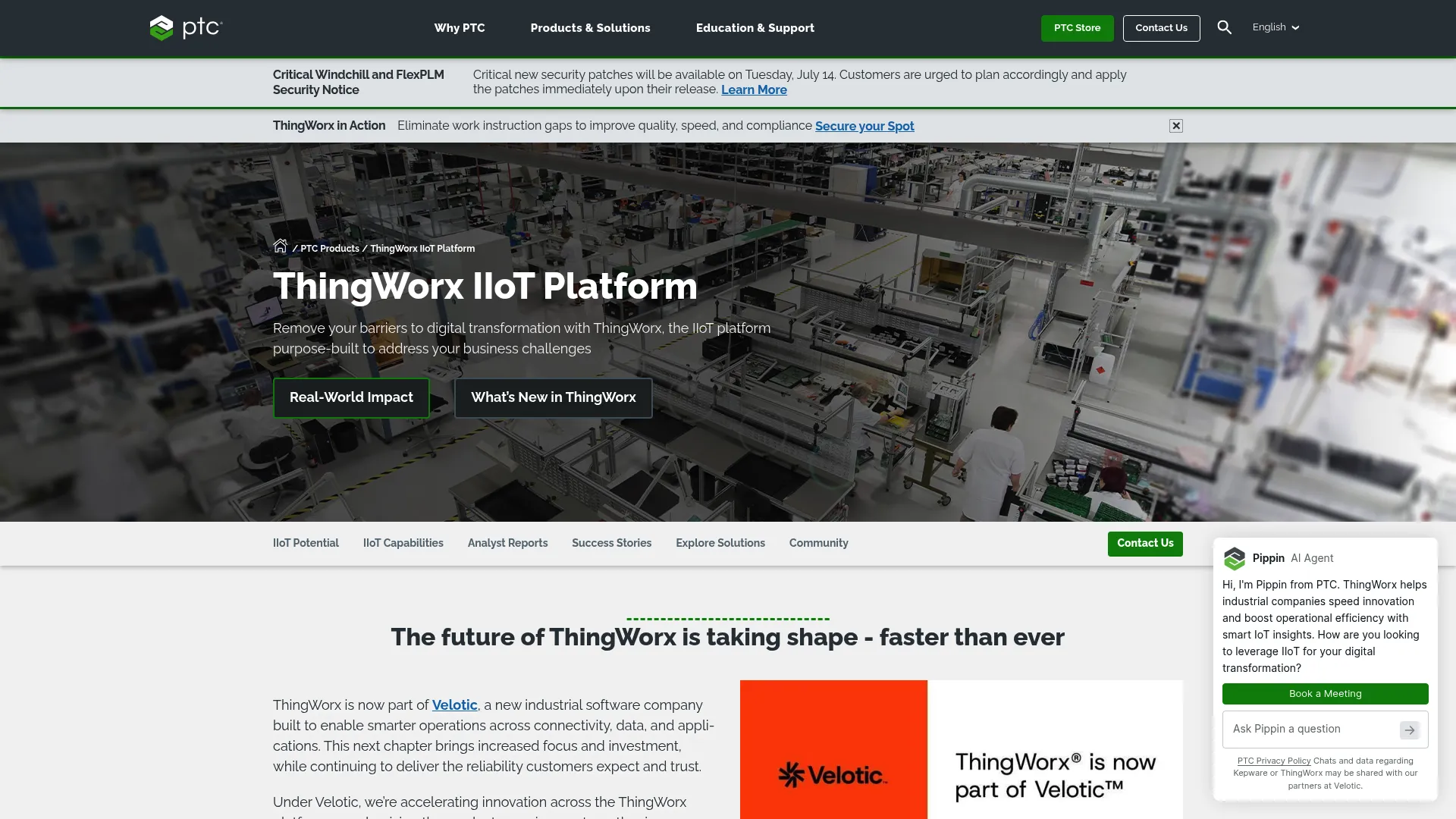
PTC ThingWorx is one of the most established names in industrial IoT, built as an IIoT and AI platform for connecting, managing, analyzing, and building industrial solutions. It connects disparate devices and applications to multiple data sources, ships pre-built tools for constructing IIoT applications, and analyzes industrial data for real-time insights and operational optimization. For teams that want to build something custom rather than adopt a fixed set of dashboards, ThingWorx gives you the application enablement layer to do it.
Where ThingWorx stands out is breadth. It is less a single-purpose monitoring tool and more a development platform for industrial transformation, which is why it appears on shortlists for smart manufacturing, connected products, and service-oriented business models. If your ambition extends beyond monitoring into building your own applications on top of your machine data, that flexibility is the draw.
Best for: Industrial teams needing a configurable IIoT platform for connected assets and operational analytics.
Why choose PTC ThingWorx: Choose ThingWorx when your roadmap includes building custom industrial applications, not just consuming pre-built dashboards. It suits technical teams, manufacturing operations, and service-oriented organizations that want application enablement, broad connectivity, and analytics in one platform. The trade-off is that this flexibility rewards teams with the engineering capacity to use it.
PTC ThingWorx pricing: PTC does not publish first-party pricing for ThingWorx. Its community responses confirm pricing is handled through sales conversations, so plan to scope your deployment with PTC directly. ThingWorx carries a 3.9/5 rating on G2.
2. Siemens Insights Hub
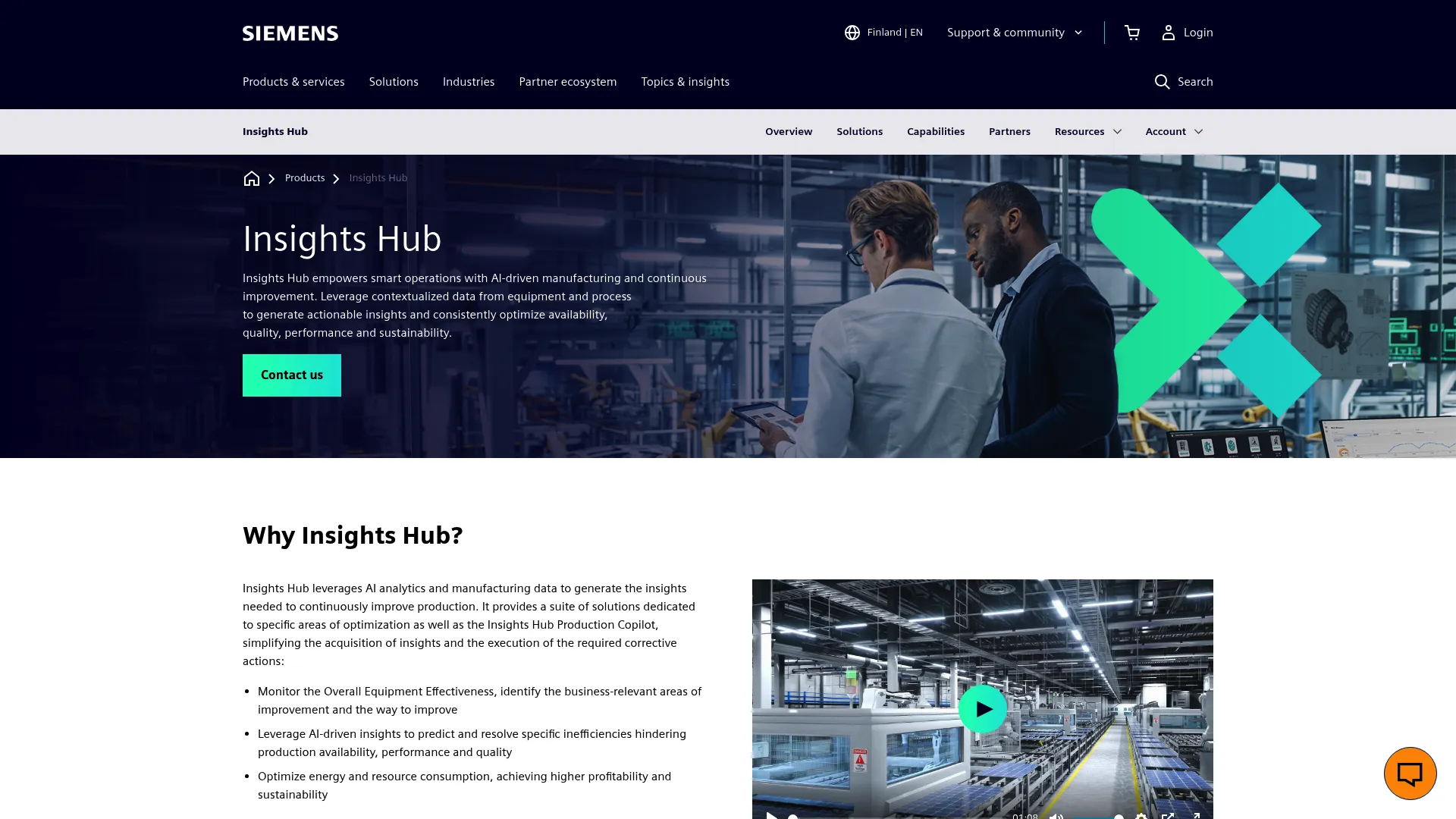
Siemens Insights Hub is Siemens' industrial IoT application suite for generating actionable insights from operational data. It offers advanced connectivity and scalable cloud applications, continuous insights through edge and cloud analytics, and custom dashboards backed by predictive learning models and AI-driven optimization. The platform evolved from Siemens' earlier MindSphere positioning and now sits at the center of the company's industrial software ecosystem, with a natural tie-in to Industrial Edge.
For manufacturers, the appeal is depth in the metrics that matter on a plant floor: overall equipment effectiveness, maintenance, energy, and production optimization. It is built for operational visibility, sustainability tracking, and equipment monitoring rather than as a blank-canvas development platform.
Best for: Manufacturers needing industrial IoT analytics, OEE, maintenance, and energy optimization.
Why choose Siemens Insights Hub: Choose Insights Hub when you want manufacturing-grade analytics and predictive models without building the analytics layer yourself. It fits teams focused on asset performance, production optimization, and service models, especially those already invested in the Siemens ecosystem. The low-code application building lowers the bar for operations teams to extend it.
Siemens Insights Hub pricing: Siemens directs buyers to contact sales or request a quote; no public price is listed on its product pages. Insights Hub holds a strong 4.6/5 rating on G2, the highest in this list.
3. AWS IoT SiteWise
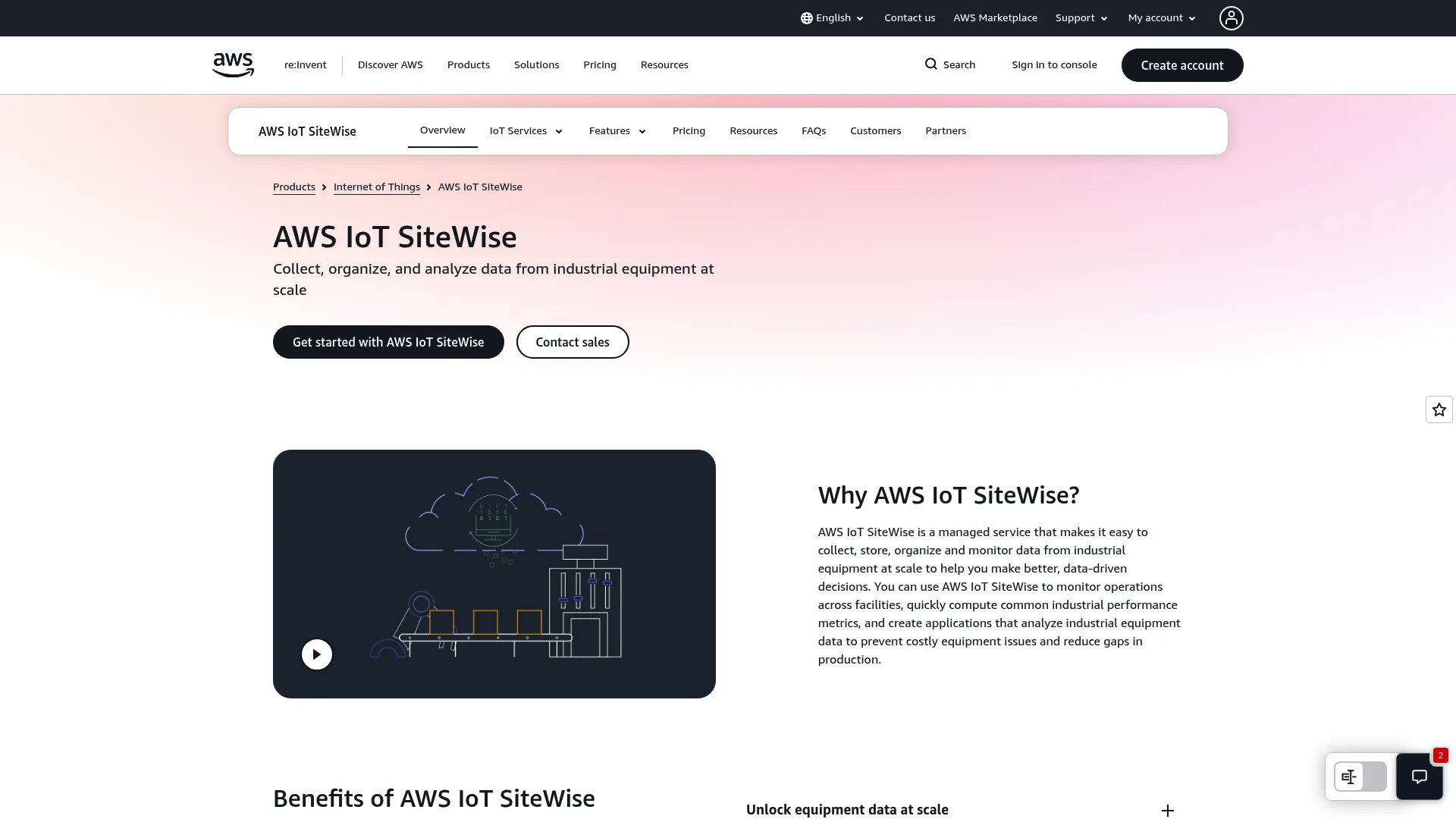
AWS IoT SiteWise is a managed AWS service for collecting, organizing, processing, and analyzing industrial equipment data at scale. It handles industrial data collection and monitoring, asset modeling and hierarchies, and edge processing through AWS IoT SiteWise Edge. Because it is a native AWS service, it slots directly into the rest of the AWS analytics and machine learning stack, which is exactly why it appears on so many cloud-first shortlists.
The asset modeling is a standout. SiteWise lets you build hierarchies that mirror your physical plant, so raw telemetry becomes structured, queryable data across facilities. For teams already running on AWS, the integration story removes a lot of the plumbing work that eats into industrial projects.
Best for: Industrial teams that need to collect, model, and monitor equipment data across facilities.
Why choose AWS IoT SiteWise: Choose SiteWise when your organization is already standardized on AWS and you want industrial data flowing into cloud-native analytics with minimal friction. The pay-as-you-go model suits teams that prefer usage-based cost over large upfront licensing. Factor in that the architecture assumes a cloud-first posture from day one.
AWS IoT SiteWise pricing: SiteWise uses pay-as-you-go pricing with separate charges for messaging, data processing, storage, export, Monitor, Edge, and alarms. The Data Collection Pack is free, and the Data Processing Pack costs $200 per active gateway per month. SiteWise holds a 4.5/5 rating on G2.
4. Azure IoT
Azure IoT is Microsoft's cloud-to-edge platform for connecting, managing, securing, and scaling IoT devices and solutions. It lets teams connect, manage, and scale billions of devices, operate from a single control plane, and secure environments from chip to cloud. As a product family rather than a single service, it spans device connectivity, data ingestion, digital twins, and deep enterprise integration across the Microsoft ecosystem.
For Microsoft-centric industrial IT teams, that ecosystem gravity is the whole point. Azure IoT connects naturally to the data, identity, and analytics services many enterprises already run, and the chip-to-cloud security model gives security reviewers a familiar framework to evaluate.
Best for: Enterprises building secure, scalable IoT solutions on Microsoft Azure.
Why choose Azure IoT: Choose Azure IoT when your organization runs on Microsoft and wants industrial IoT to inherit that identity, security, and integration foundation. Its digital twin capabilities and single control plane suit multi-cloud planners and large enterprises managing device fleets at scale. The component-based structure means you assemble the services you need rather than buying one bundle.
Azure IoT pricing: Azure IoT is a product family with component-specific pricing. The overview pages direct buyers to the pricing calculator or a sales specialist rather than showing a single starting price, so model your expected usage through the calculator before committing.
5. Cumulocity IoT
Cumulocity IoT is an enterprise AIoT platform for connecting, managing, and analyzing IoT devices and data. It provides device management and over-the-air updates, digital twin and fleet monitoring, and real-time dashboards and analytics. Deployment flexibility is a core selling point: Cumulocity ships in multiple plan families across cloud and edge variants, which makes it a fit for global or hybrid industrial teams that need options.
The self-service angle matters here. Cumulocity is built so that teams can stand up connected assets without a lengthy custom build, which shortens the path from pilot to production. That combination of device management depth and deployment choice is why it shows up in evaluations across many industries.
Best for: Manufacturers and industrial teams needing a self-service AIoT platform for connected assets.
Why choose Cumulocity IoT: Choose Cumulocity when you want device management, digital twins, and analytics in a platform that adapts to cloud, edge, or air-gapped deployment. It suits teams that value getting to production quickly and running across mixed environments. Feature availability can vary by deployment family, so match your plan to your architecture early.
Cumulocity IoT pricing: The Starter plan is fixed at €215 per month billed annually, with Business, Enterprise, Connected, and Air-Gapped plans priced custom. A 30-day free trial is available. Cumulocity holds a 4.3/5 rating on G2.
6. Litmus Edge
Litmus Edge is an industrial edge software platform for collecting, contextualizing, and operationalizing OT data at the edge. It connects to PLCs, historians, SCADA, MES, sensors, and more, and lets teams build and test real pipelines, models, dashboards, and analytics directly at the plant floor. For teams whose center of gravity is the edge rather than the cloud, that local-first approach is the differentiator.
The value is in normalization at the source. Litmus Edge collects heterogeneous OT data, contextualizes it, and pushes clean, structured data to whatever downstream systems you choose. That makes it a strong integration layer for OT/IT convergence, particularly when you want processing to happen close to the machines before anything travels upstream.
Best for: Manufacturers needing edge data collection, contextualization, and industrial OT/IT integration.
Why choose Litmus Edge: Choose Litmus Edge when your priority is edge analytics and plant-floor integration, with broad connectivity to industrial protocols and systems. It fits teams that want to collect and normalize OT data at the source and feed it cleanly to downstream analytics or cloud platforms. The free Developer Edition lets you validate the fit before committing.
Litmus Edge pricing: Litmus offers a free Developer Edition with full feature access in two-hour sessions that reset as often as you like, which is useful for hands-on evaluation. Paid pricing is not published publicly, so contact Litmus to scope a production deployment.
7. AVEVA PI System
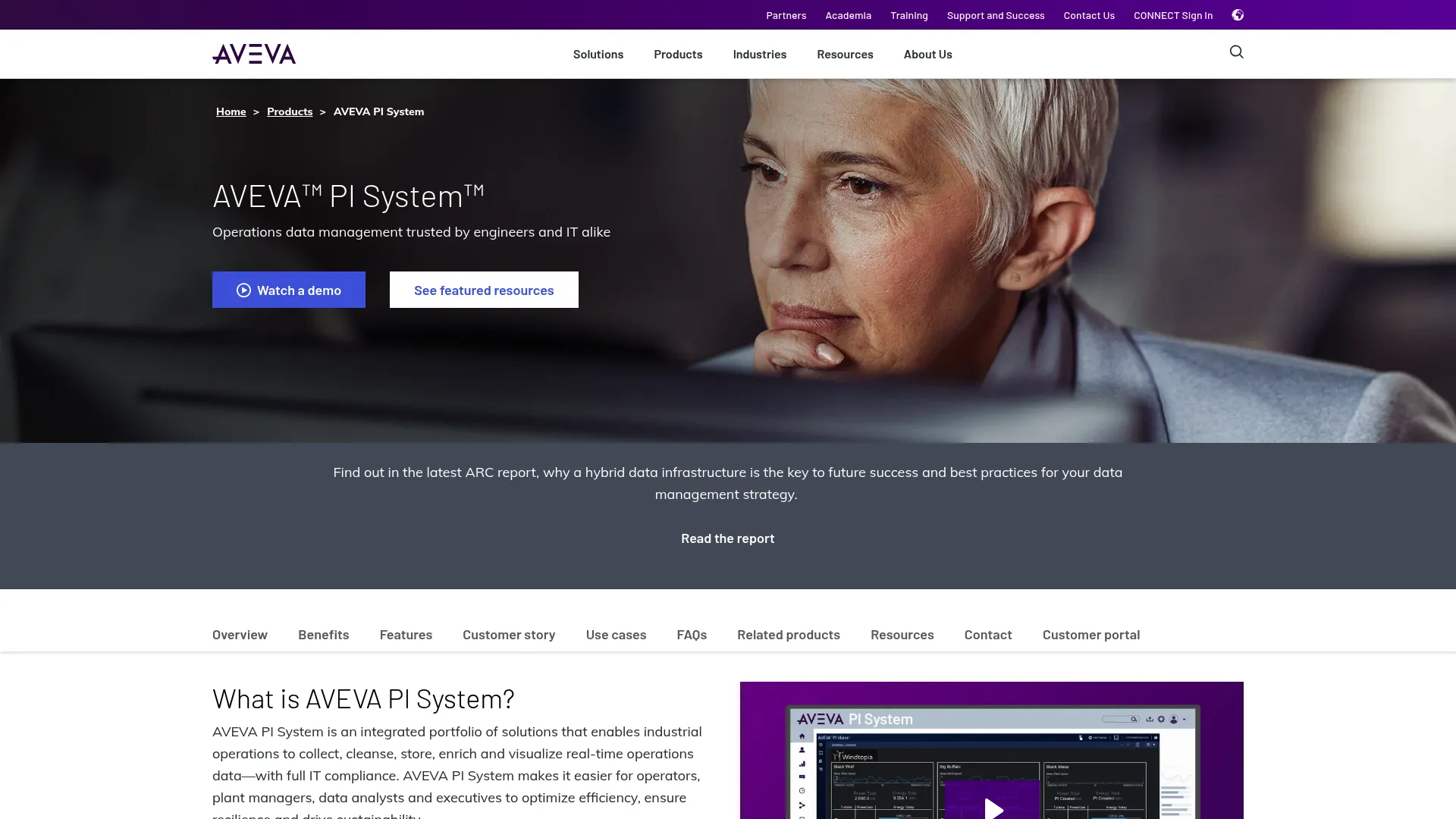
AVEVA PI System is industrial operations data management software for collecting, storing, enriching, and visualizing real-time operations data. It is the historian of record in many heavy industries, built for vendor-neutral data collection, a high-volume real-time data archive, asset framework contextualization, data buffering with high availability, and edge-to-cloud data management. When operations intelligence across sites is the goal, PI System is the platform many teams already trust.
Its strength is durability at scale. PI System is engineered to capture enormous volumes of time-series data reliably and make it queryable years later, which is exactly what industries with long asset lifecycles and strict operational records require. The asset framework turns that raw archive into contextualized, analyzable information.
Best for: Large industrial organizations needing a real-time operations data historian and contextualization platform.
Why choose AVEVA PI System: Choose PI System when your priority is reliable, high-volume real-time data capture and long-term operations intelligence across multiple sites. It fits large industrial organizations that need a vendor-neutral historian with strong contextualization and enterprise visibility. The high-availability and buffering features are built for environments where data loss is not an option.
AVEVA PI System pricing: AVEVA sells PI System through a subscription-based commercial model, but does not publish a public price on its product page. Contact AVEVA to scope pricing for your deployment.
8. Ignition
Ignition by Inductive Automation is an industrial automation software platform spanning SCADA, HMI, IIoT, MES, and more. It offers unlimited tags and connections, a cross-platform architecture built on SQL, Python, OPC UA, and MQTT, and unlimited Ignition Designers and clients. For OT teams that want a highly configurable operations layer they can shape to their exact workflows, Ignition is a longtime favorite.
What sets Ignition apart is its licensing and flexibility. Unlimited tags and clients remove the per-connection cost math that constrains many platforms, and the scripting-first, open-protocol foundation lets teams build SCADA-adjacent workflows, visualization, and connectivity without artificial limits. It sits closer to the plant floor than the cloud-native IIoT services, which is precisely why so many integrators reach for it.
Best for: Manufacturers and industrial operators needing a flexible SCADA/IIoT platform.
Why choose Ignition: Choose Ignition when you want a configurable industrial operations layer with unlimited tags, open protocols, and scripting freedom. It fits teams that prefer to build their own visualization and workflows rather than adopt fixed dashboards, and its perpetual-license model appeals to organizations that favor one-time purchase over recurring subscription. It differs from cloud-centric IIoT platforms by living where the machines are.
Ignition pricing: Standard Ignition and Ignition Edge are perpetual one-time-purchase licenses, while Ignition Cloud Edition is usage-based. The pricing page shows at least one solution suite priced at $13,500 USD, along with a free trial. Ignition holds a 5/5 rating on G2.
Considerations before you choose
The platform that wins your evaluation should match your reality, not the vendor's demo environment. Run every candidate through this checklist.
Match the platform to your deployment model
Cloud, edge, hybrid, and on-prem are genuinely different architectures with different cost, latency, and resilience profiles. Decide what your operations actually require before you fall for feature richness. A cloud-first platform in a low-connectivity plant, or an edge-only tool where you need enterprise-wide analytics, will fight you for years. Architecture fit comes first.
Check protocol and system compatibility
Confirm the platform natively handles your protocol mix, including OPC UA, Modbus, and any vendor-specific standards on your floor. Then verify it integrates with the systems that consume the data: SCADA, MES, ERP, and your historians. A gap here is not a minor inconvenience; it is custom integration work that never fully ends.
Evaluate security and governance
Look for role-based access control, network segmentation, and operational controls that satisfy both your OT team and your security reviewers. Tie each control to a real risk or compliance requirement. Strong governance is what makes long-term support sustainable and what keeps a connected plant from becoming an attack surface.
Measure implementation effort
Be honest about time to pilot, the data-mapping work required, and ongoing maintenance overhead. For a product manager, this is opportunity cost in disguise: every engineering hour spent wiring connections is an hour not spent on the outcomes that justified the project. Favor platforms that keep maintenance low as you scale across sites.
Look for measurable business outcomes
Tie the purchase to a specific outcome: reduced downtime, faster maintenance, remote service revenue, or hard cost savings. Ask vendors for proof, not promises, and design your pilot to measure the metric you care about most. A platform that cannot demonstrate impact on your number is a platform you cannot defend.
Conclusion
There is no single best industrial IoT platform, only the best fit for your architecture, protocols, and the outcome you need first. If you are building custom industrial applications, PTC ThingWorx and Ignition give you room to build. If manufacturing analytics is the goal, Siemens Insights Hub delivers depth in OEE and predictive maintenance. Cloud-first teams gravitate to AWS IoT SiteWise or Azure IoT depending on their existing stack, while edge-first operations lean on Litmus Edge. For high-volume operations data across many sites, AVEVA PI System remains the historian of record, and Cumulocity IoT fits teams that want deployment flexibility across cloud and edge.
Start with your data stack, not the feature matrix. Pick the two or three platforms that match your deployment model and protocol reality, then run a scoped pilot on a handful of real assets to measure the outcome that matters most. Let the pilot, not the sales deck, decide.
FAQs
An industrial IoT platform is software that connects industrial equipment to business systems by collecting, contextualizing, monitoring, analyzing, and acting on machine data across the edge and the cloud. It handles industrial connectivity, protocol translation, data storage, visualization, and OT/IT convergence so raw plant-floor signals become usable information.
It ingests data from sensors, PLCs, and SCADA systems using protocols like OPC UA, Modbus, and MQTT, then processes it at the edge for low-latency needs and in the cloud for scale. The platform contextualizes raw tags into asset models, stores the data, and exposes it to dashboards, analytics engines, and enterprise systems such as ERP and MES.
IIoT software reduces unplanned downtime through predictive maintenance and remote condition monitoring, improves visibility across plants and assets, and enables new business models like product-as-a-service and equipment-as-a-service. It also connects OT and IT so operational data drives faster, better-aligned decisions across the organization.
Edge processing runs computation locally on gateways near the machines, which matters when latency, bandwidth, or resilience are constraints. Cloud processing aggregates data across sites for large-scale storage, historical analysis, and machine learning. Most mature deployments use a hybrid edge-to-cloud architecture that combines local responsiveness with cloud-scale analytics.
For manufacturing analytics like OEE, energy, and predictive maintenance, Siemens Insights Hub is a strong fit. Teams building custom industrial applications often choose PTC ThingWorx or Ignition, while cloud-first manufacturers standardized on a hyperscaler lean toward AWS IoT SiteWise or Azure IoT. The best choice depends on your architecture and existing stack.
Yes, protocol support for OPC UA and Modbus is standard across the leading platforms, and most also handle MQTT and other industrial protocols. The important thing to verify is native support and protocol translation for your specific machine mix, including any vendor-specific standards, since gaps translate directly into custom integration work.
They continuously collect real-time data on asset health, such as vibration, temperature, and cycle counts, then apply analytics and machine learning to detect anomalies before failure. This shifts maintenance from reactive to proactive, cutting unplanned downtime and extending equipment life, which is often where teams see the fastest return.
Evaluate deployment model fit (cloud, edge, hybrid, or on-prem), protocol and system compatibility, security and governance controls, and implementation effort including maintenance overhead. Above all, tie the purchase to a measurable business outcome and run a scoped pilot on real assets to prove impact before committing to a full rollout.