


Your fridge temperature log lives on a clipboard by the walk-in. Your HACCP plan is a Word doc someone updated in 2022. When an auditor shows up, someone spends three days pulling paper records, reconciling handwriting, and hoping nobody skipped a check. If a supplier recall hits, you trace lot numbers by memory and prayer.
That is the reality most food operators are trying to escape when they search for HACCP software. And the market is moving with them. The global HACCP software market reached USD 2.11 billion in 2024 and is forecast to hit USD 4.50 billion by 2035, growing at a 7.1% CAGR through 2035, according to WiseGuy Reports (2025). More telling: cloud-based HACCP deployments already accounted for over 68% of the market in 2024, per Strategic Market Research. Paper is not just slower. It is becoming the exception.
A digital HACCP system replaces the clipboard-and-binder workflow with something you can search, timestamp, and export on demand. The right platform combines a HACCP plan builder, real-time critical control point monitoring, traceability, and audit-ready records in one place. This guide compares the eight HACCP compliance software platforms worth shortlisting in 2026, with verified pricing and G2 ratings where public, so you can match a tool to your operation instead of guessing.
If you evaluate software in adjacent categories, our roundups of audit management software and best digital adoption platforms use the same operational lens applied here.
What's inside
This guide is for food safety managers, QA and FSQA teams, operations leaders, restaurant groups, central kitchens, and multi-site food businesses replacing paper-based food safety software with a digital system. We selected the eight platforms below on four criteria: depth of HACCP plan and monitoring features, audit readiness and record-keeping, fit for single-site versus multi-location operations, and pricing transparency. Every pricing figure and G2 rating here was checked against the vendor's live pricing page or current G2 listing. Where a vendor gates pricing behind a sales conversation, we say so rather than guess.
TL;DR
- Best overall digital HACCP system: FoodDocs. A built-in plan builder, monitoring, and traceability in one workflow, with public pricing and a strong G2 rating.
- Best for flexible inspections and frontline workflows: SafetyCulture. Template-driven checklists, offline mobile capture, and a genuine free tier.
- Best for modular food safety and quality depth: Smart Food Safe. Pay-as-you-go modules for hazard analysis, lab, supplier, and regulatory workflows.
- Best for plant-wide manufacturing control: SafetyChain. Quality, compliance, and production management for food and beverage manufacturers.
- Best for AI-assisted plan building and traceability: Food Ready. Automated document requests, supplier approval, and inventory in one system.
- Best for broad ISO and QHSE compliance: Effivity. FSMS alongside QMS, EMS, and HSE modules at a low per-user entry point.
What is HACCP software?
HACCP software is a digital food safety management system that helps food businesses build HACCP plans, monitor critical control points, record compliance activity, maintain traceability, and stay audit-ready without paper logs. HACCP stands for Hazard Analysis and Critical Control Points, the internationally recognized framework for identifying and controlling food safety risks.
Most HACCP management software combines these core components:
- HACCP plan builder: Guided templates for hazard analysis, process flow diagrams, critical control points, and preventive controls.
- Monitoring system: Digital checks for temperature, cleaning, receiving, and other control points, with reminders and alerts when a reading falls out of range.
- Traceability: Lot tracking, supplier records, and recall data so you can trace an ingredient forward or backward in minutes.
- Records and logs: Timestamped HACCP logs stored in the cloud, replacing handwritten sheets.
- Reporting and analytics: Real-time dashboards that surface missed checks, trends, and compliance gaps before an auditor does.
- Mobile workflows: A mobile food safety app so frontline staff log checks on a phone or tablet, on or offline.
Paper versus digital is the underlying decision. Paper HACCP is cheap to start and familiar, but it is slow to audit, easy to falsify, and impossible to search across locations. A digital HACCP system costs a subscription but pays back in audit time saved, cloud storage for food safety records, and multi-location food safety visibility. The 68% cloud adoption figure above reflects where operators are already voting with their budgets.
When to use HACCP software
Digitize HACCP plan creation
If your HACCP plan lives in a document that nobody wants to touch, a HACCP plan builder standardizes it. Guided templates walk you through hazard analysis, process flow diagrams, and critical control point definitions, so a new site or product line reuses a proven structure instead of starting from a blank page. This matters most when you run multiple menus, recipes, or facilities that should share one compliant baseline.
Monitor critical control points in real time
Manual logs capture what someone remembered to write down. Real-time critical control point monitoring captures what actually happened, with a timestamp. Digital checks trigger reminders, flag out-of-range temperatures, and route alerts to a manager the moment a control point fails. That is the difference between finding a problem during the shift and finding it during an audit.
Centralize audit-ready records
Audit-ready HACCP software keeps every log, corrective action, and plan version in cloud storage with version control. When an inspector asks for six months of receiving temperatures, you export a report instead of digging through binders. Centralized records also survive staff turnover, which paper systems rarely do.
Support multi-site operations
For groups and franchises, the value is rollups. Location-level dashboards show which sites are compliant and which are drifting, without a phone call to each manager. Multi-location food safety visibility turns a scattered set of clipboards into one operational view leadership can act on weekly.
Comparison table
We ranked these platforms by breadth of HACCP capability, audit readiness, and fit across single-site and multi-location operations, leading with the most complete all-in-one system. Pricing and G2 ratings below were verified against each vendor's live pages; where a vendor does not publish a price, we note that directly.
| # | Product | Intent | Key differentiation | Pricing | G2 rating |
|---|---|---|---|---|---|
| 1 | FoodDocs | All-in-one digital HACCP | Plan builder, monitoring, and traceability in one workflow with IoT sensor integration | From $79/month (billed annually) | 4.9/5 |
| 2 | SafetyCulture | Frontline inspections and safety | Template-driven checklists, offline mobile capture, broad operations coverage | Free plan; Premium $24/seat/month | 4.6/5 |
| 3 | Smart Food Safe | Modular food safety and quality | Pay-as-you-go modules with unlimited users across the suite | Get a quote | 4.6/5 |
| 4 | HACCP Now | HACCP-specific compliance | Straightforward HACCP planning and monitoring focus | Not publicly listed | Not enough reviews |
| 5 | SafetyChain | Plant-wide manufacturing control | Quality, compliance, and production management per facility | Request pricing | 4.5/5 |
| 6 | Food Ready | AI-assisted plans and traceability | AI plan building, supplier approval, and inventory in one system | Get a quote | 4.5/5 |
| 7 | Effivity | Broad ISO and QHSE compliance | FSMS alongside QMS, EMS, and HSE modules | From about $1/user/day | Not listed |
| 8 | Food Safety Guru | Consulting and training support | Audit prep, HACCP and HARPC assessment, FSMA training | Not publicly listed | Not listed |
1. FoodDocs

FoodDocs is a food safety management software platform that bundles HACCP plan creation, monitoring, traceability, and compliance into a single workflow. It is built for food businesses that want to move off paper fast, whether they run one kitchen or a chain of them. The plan builder generates a compliant HACCP plan from your process, then monitoring, verification, and cloud document storage keep it running day to day. Integrations with smart devices and IoT temperature sensors mean some checks log themselves.
Best for: Food businesses that want a complete digital HACCP and food safety system across one or multiple locations without stitching tools together.
Key strengths
- HACCP plan builder: Generates a compliant plan from your operation, so setup takes days, not weeks.
- Real-time monitoring and verification: Digital checks, reminders, and IoT sensor integration replace manual temperature logs.
- Traceability and recall data: Lot tracking and supplier records make forward and backward tracing fast when it counts.
Why choose FoodDocs: The appeal is centralized visibility with a short setup. For a multi-site operator drowning in binders, FoodDocs pulls plan, logs, traceability, and reporting into one place, with AI reports that summarize compliance status. The cloud document storage and dashboard combination is what makes it audit-ready rather than merely digital.
FoodDocs pricing: Public pricing covers three tiers billed annually: Lite at $79/month, Standard at $167/month, and Professional at $250/month. Enterprise is custom pricing through sales. A 14-day free trial is available with no credit card required. FoodDocs holds a 4.9/5 rating on G2.
2. SafetyCulture
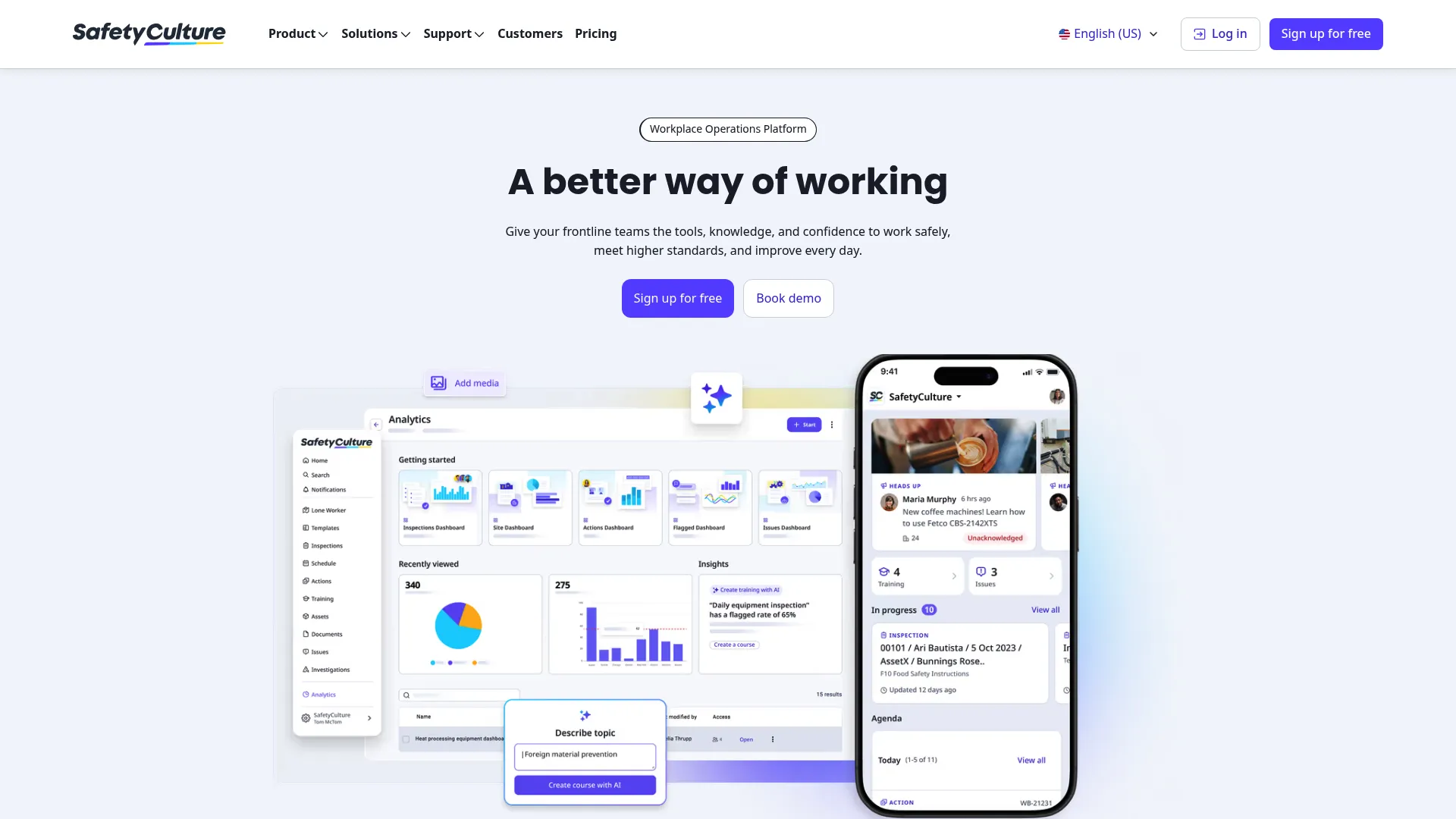
SafetyCulture is a workplace operations platform built around inspections, and it adapts well to HACCP checklists and food safety monitoring. Rather than a HACCP-only tool, it covers templates, schedules, actions, training, assets, and sensors across the whole operation. Food teams use it to run digital checklists on any device, capture data offline in a walk-in or loading dock, and sync when back online. Analytics roll up what got done and what got missed.
Best for: Teams that want flexible inspections and broad safety workflows in one platform, not just HACCP.
Key strengths
- Templates and inspections: Build or import HACCP checklists and run them on a mobile food safety app.
- Offline capture: Log checks without signal, then sync automatically, useful in cold storage and back-of-house.
- Actions and analytics: Route corrective actions and surface trends through real-time dashboards.
Why choose SafetyCulture: If your food safety monitoring is one part of a wider operations picture, SafetyCulture consolidates it. The free tier lowers the barrier to going digital, and the template flexibility means you are not locked into a rigid HACCP structure. It suits operators who value adaptable checklists over a prescriptive plan builder.
SafetyCulture pricing: The Free plan includes up to 10 seats. Premium is $24/seat/month with a 30-day free trial, and Lite seats start from $5/seat/month when billed annually. Enterprise is custom pricing. SafetyCulture holds a 4.6/5 rating on G2.
3. Smart Food Safe

Smart Food Safe is a modular food safety and quality management platform aimed at food manufacturers and processors. Instead of one fixed product, it offers a suite of modules covering hazard analysis, documentation, lab management, supplier controls, and regulatory workflows. You add the modules your operation needs. Unlimited users and unrestricted access across modules mean the whole team works in the system without seat-count math.
Best for: Food manufacturers and processors that need configurable, module-based food safety and compliance depth.
Key strengths
- Modular product suite: Hazard analysis, risk matrix, process flow diagrams, lab, supplier, and regulatory modules you combine as needed.
- Unlimited users: Unrestricted access across modules, so cost does not scale with headcount.
- Audit-ready document management: Workflows, dashboards, reporting, and notifications built for regulatory alignment.
Why choose Smart Food Safe: The bundle depth is the draw. For a quality team that owns more than HACCP, the modular approach means one vendor for food safety, compliance, supplier management, and lab work. The pay-as-you-go model lets you start narrow and expand, which fits growing processors that do not want to buy everything on day one.
Smart Food Safe pricing: Smart Food Safe does not publish numeric pricing. The site describes a transparent pay-as-you-go, modular model with no upfront cost, and directs buyers to request a quote. Smart Food Safe holds a 4.6/5 rating on G2.
4. HACCP Now
HACCP Now positions itself as a straightforward HACCP compliance software for food businesses that want a focused tool rather than a sprawling platform. Its remit centers on HACCP plan creation, monitoring, and compliance management. For operators whose primary need is a clean, HACCP-specific workflow without adjacent quality or ERP modules, that narrower focus can be a feature rather than a gap.
Best for: Food businesses that want a dedicated HACCP compliance tool without a wider operations suite.
Key strengths
- HACCP-specific focus: Built around plan creation and compliance rather than a broad operations platform.
- Monitoring and compliance management: Core HACCP workflows in one place.
- Simple scope: A focused tool for teams that want HACCP without extra modules.
Why choose HACCP Now: The case for HACCP Now is simplicity. Teams that find broad platforms overbuilt for their needs may prefer a tool scoped to HACCP alone. Because public detail is thinner than the larger platforms here, treat it as a candidate to evaluate directly rather than one to buy on spec.
HACCP Now pricing: HACCP Now does not publish pricing on its site, and its G2 seller page does not yet carry enough reviews for a meaningful rating. Request pricing and a demo directly, and confirm feature depth against your HACCP requirements before committing.
5. SafetyChain
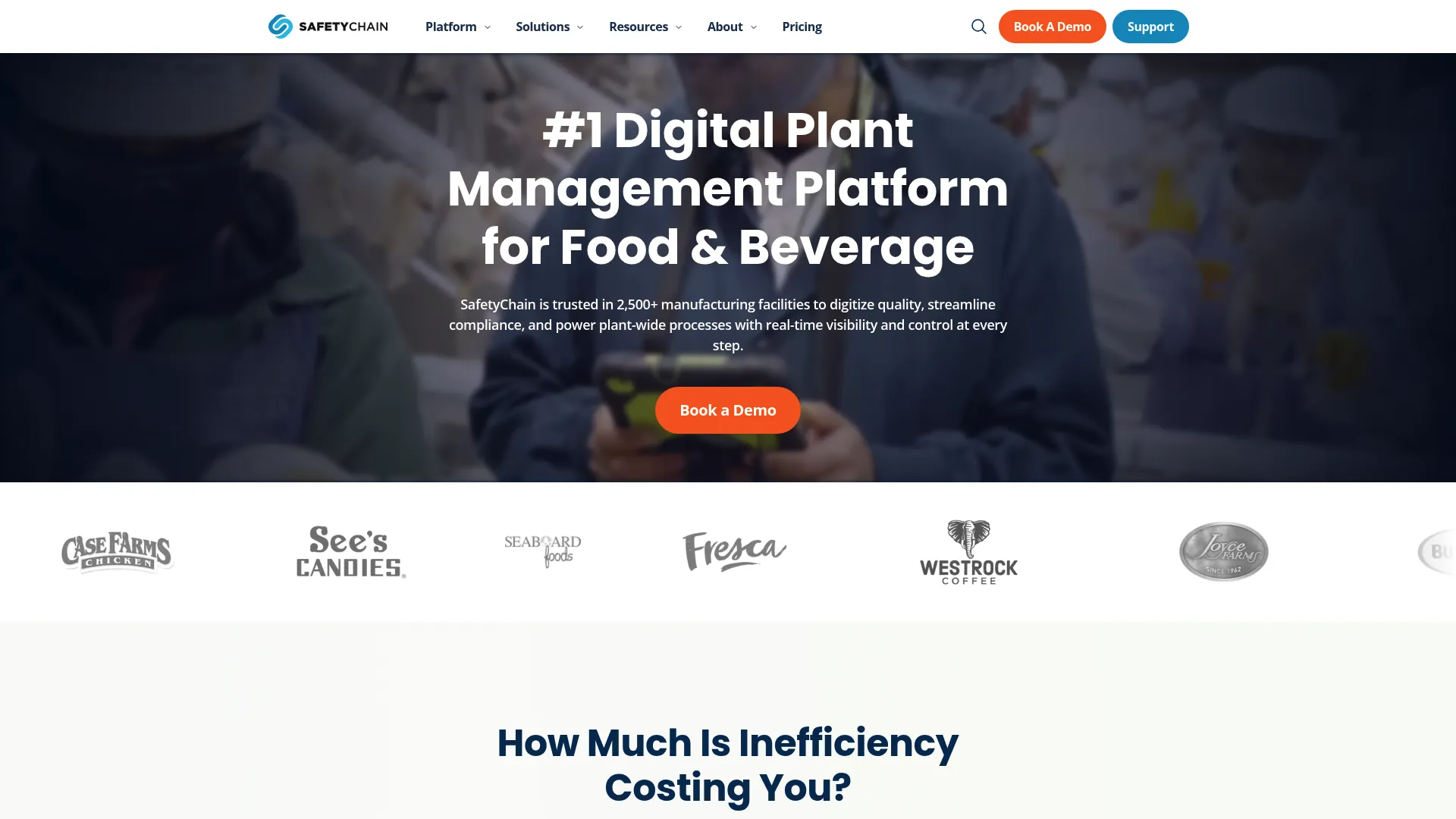
SafetyChain is digital plant management software for food and beverage manufacturers, spanning quality, compliance, production, and supplier management. It is the heaviest-duty option on this list, built for plant-wide process control rather than a single kitchen. Digital forms, audit programs, offline mobile data capture, and integrations through APIs and a Power BI connector let large operations run compliance and production data together.
Best for: Food and beverage manufacturers that need plant-wide quality, compliance, and production control across facilities.
Key strengths
- Digital forms and audit programs: Structured compliance workflows built for manufacturing scale.
- Offline mobile data capture: Log data on the plant floor without a live connection.
- Integrations: APIs and a Power BI connector tie compliance data into existing systems.
Why choose SafetyChain: SafetyChain fits when your operation is process-heavy and multi-facility. The per-facility model and enterprise integrations suit manufacturers that need audit readiness alongside production control, not just food safety logs. For a large, regulated processor, that depth is the point; for a small kitchen, it is more platform than the job requires.
SafetyChain pricing: SafetyChain uses tiered SaaS pricing per facility across Essential, Advanced, and Supplier offerings, shown as request-pricing only, with a one-time setup fee mentioned. No public dollar figure is listed. SafetyChain holds a 4.5/5 rating on G2.
6. Food Ready
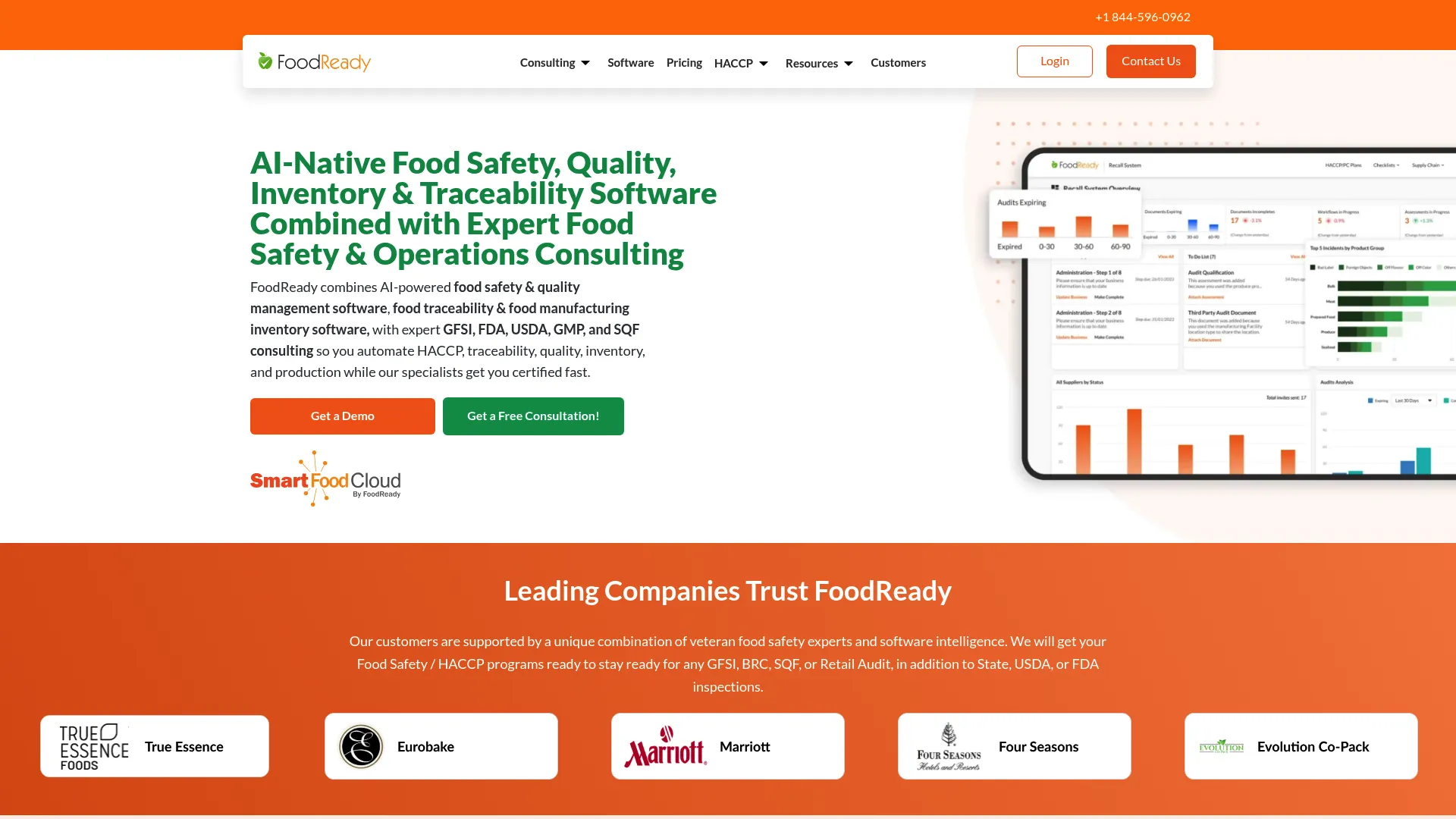
Food Ready is AI-powered food safety, quality, and traceability software with consulting support, aimed at manufacturers, processors, and distributors. Its differentiator is AI-assisted HACCP and preventive control plan building, which speeds up the heaviest part of getting compliant. Beyond plans, it handles traceability, inventory, and supplier approval with automated document requests, so the record-chasing that eats QA time gets automated.
Best for: Food manufacturers, processors, and distributors that want audit-ready food safety and traceability workflows with AI assistance.
Key strengths
- AI-assisted plan building: Automates HACCP and preventive control plan creation to cut setup time.
- Traceability and inventory: Lot tracking and inventory management in one system.
- Supplier approval automation: Automated document requests keep supplier records current without manual chasing.
Why choose Food Ready: The combination of AI plan building and consulting support suits teams that want help getting to audit-ready, not just software to log into. For GFSI, BRC, SQF, or ISO targets, the packaged approach plus traceability software in one platform reduces the number of tools a growing processor has to run.
Food Ready pricing: Food Ready shows quote-based packages by segment: Restaurant, Grocery, and Food Service HACCP; Manufacturer and Processor compliance for FDA, USDA, and state requirements; and Enterprise for GFSI, BRC, SQF, ISO, and GMP. No public numeric prices are displayed. Food Ready holds a 4.5/5 rating on G2.
7. Effivity
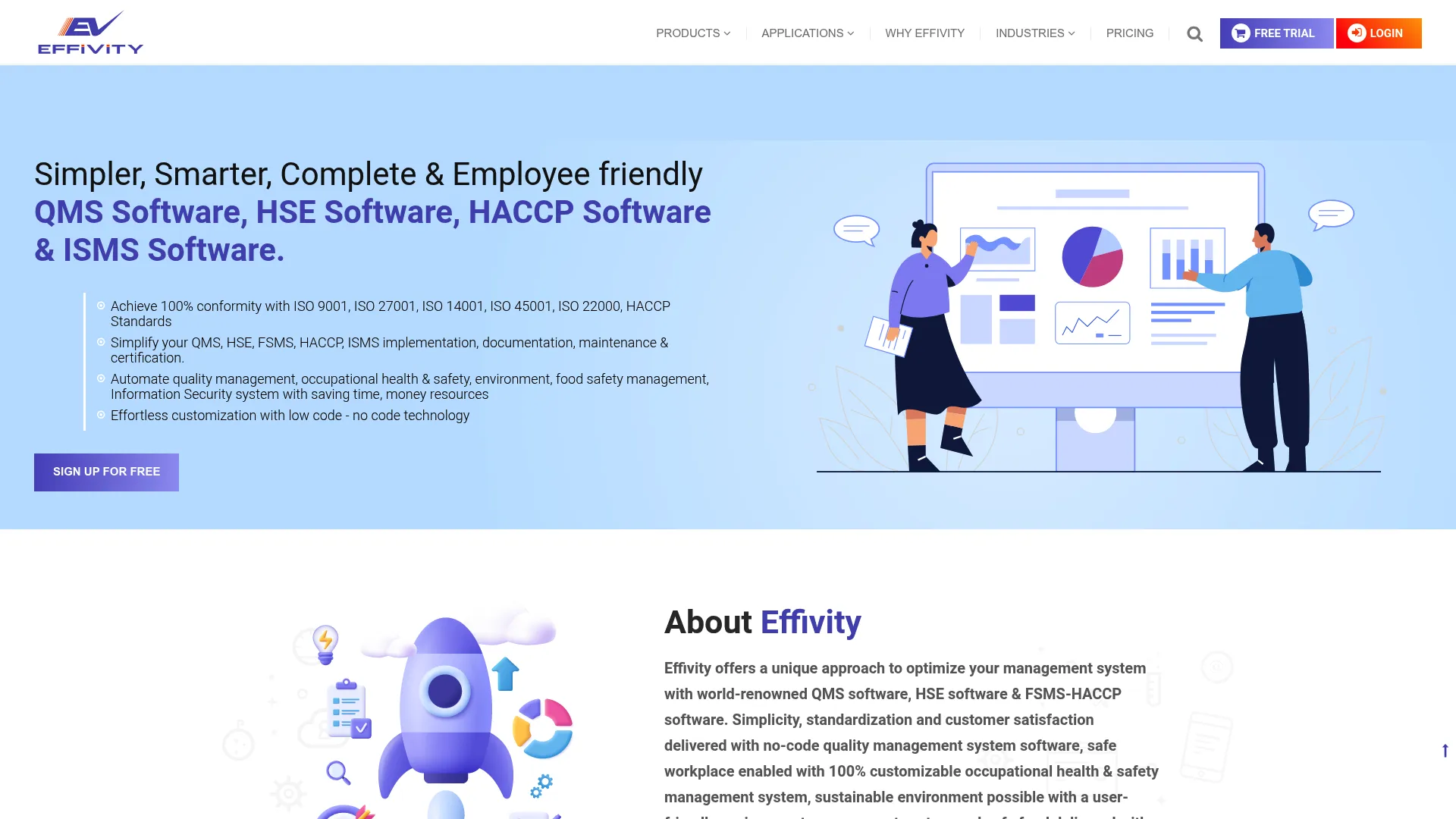
Effivity is cloud-based QHSE and ISO compliance software that manages quality, safety, environment, and food safety systems together. Its FSMS module handles HACCP and food safety, but the broader value is running that alongside QMS, EMS, HSE, and ISMS modules in one system. Cloud and on-premise deployment, customizable workflows, dashboards, and role-based access make it a fit for organizations that treat food safety as one part of a wider compliance program.
Best for: Organizations that need configurable ISO and QHSE compliance software spanning more than food safety alone.
Key strengths
- Multi-standard modules: QMS, EMS, HSE, FSMS, and ISMS in one platform for broad regulatory alignment.
- Flexible deployment: Cloud or on-premise to fit IT requirements.
- Configurable workflows: Customizable dashboards and role-based access across the system.
Why choose Effivity: Effivity distinguishes itself from HACCP-only tools by covering the full ISO compliance stack. If your team owns quality and environmental compliance in addition to food safety, one configurable platform beats several point tools. The low per-user entry price makes it accessible for organizations standardizing compliance broadly.
Effivity pricing: Effivity offers a 15-day free trial and personalized pricing through sales. The homepage states subscriptions start as low as about $1 per user per day. Exact plan pricing is handled through a personalized quote.
8. Food Safety Guru
Food Safety Guru is a food safety consulting and training service for food industry businesses, with support for HACCP management alongside expert guidance. It leans more toward consulting and hands-on help than a self-serve software platform. The offering covers audit prep and documentation review, HACCP and HARPC assessment, and FSMA compliance with on-the-job training.
Best for: Food businesses that want consulting and training support alongside basic HACCP management, rather than a standalone software platform.
Key strengths
- Audit prep and documentation review: Hands-on help getting records inspection-ready.
- HACCP and HARPC assessment: Expert review of your hazard analysis and preventive controls.
- FSMA compliance training: On-the-job training to build internal capability.
Why choose Food Safety Guru: The fit is teams that need expertise more than software. If your gap is knowing how to build and defend a HACCP plan rather than where to store logs, the consulting-first model helps. Public detail is thinner than the software platforms above, so scope the engagement directly and confirm what is included before you commit.
Food Safety Guru pricing: Food Safety Guru does not publish pricing or plan prices on its site, and it does not carry a G2 listing. Because it is consulting-led, expect scoping to be quote-based. Contact them to define the engagement and cost.
Considerations before you buy
Plan builder and monitoring depth
Confirm the tool actually builds a HACCP plan, not just stores one. Look for guided hazard analysis, process flow diagrams, and critical control point definitions, plus monitoring with reminders and out-of-range alerts. A plan builder that generates a compliant baseline saves weeks over a blank template.
Audit readiness and record-keeping
Ask how records are stored, exported, and versioned. Audit-ready HACCP software should produce a clean report of any date range in minutes, with timestamps and corrective actions attached. Cloud storage for food safety records that survives staff turnover is the whole point of going digital.
Multi-location visibility
If you run more than one site, verify location-level rollups and real-time dashboards. Multi-location food safety visibility means leadership sees which sites are compliant without calling each manager. Single-site tools rarely scale to this cleanly, so test it early.
Mobile and offline capture
Frontline staff log checks on phones and tablets, often in walk-ins and loading docks with no signal. Confirm the mobile food safety app captures offline and syncs later. Without it, digital checks stall exactly where they matter most.
Pricing and total cost
Weigh published subscription pricing against quote-based models and setup fees. A transparent per-month price is easier to budget than a request-pricing process, but modular and per-facility models can fit larger operations better. Match the pricing structure to how your operation actually scales.
Conclusion
The right HACCP software depends on your operation, not a leaderboard. For a complete digital HACCP system with a plan builder, monitoring, and traceability in one workflow, FoodDocs is the strongest all-in-one pick, and its public pricing makes it easy to evaluate. If you want flexible inspections and broad safety workflows with a free entry point, SafetyCulture fits. For modular food safety and quality depth, Smart Food Safe scales by the module. Manufacturers running plant-wide process control should look at SafetyChain, while Food Ready suits teams wanting AI-assisted plan building and traceability together. Effivity is the pick when food safety is one part of a wider ISO and QHSE program.
Your next step: shortlist two platforms that match your complexity, run each through a free trial or scoped demo using your own HACCP plan and one real monitoring workflow, and check how fast you can export an audit-ready report. That single test surfaces more than any feature list.
FAQs
HACCP software is used to build HACCP plans, monitor critical control points, record compliance activity, maintain traceability, and keep records audit-ready. It replaces paper logs and spreadsheets with a searchable, timestamped digital food safety management system that food teams can access across locations.
A strong HACCP plan builder should include guided hazard analysis, process flow diagrams, critical control point identification, preventive controls, and a risk matrix. It should generate a compliant plan from your process and let you version it as recipes, menus, or facilities change, rather than starting from a blank document each time.
Yes. Auditors accept digital records provided they are timestamped, complete, and traceable, and digital systems often make audits faster because you can export any date range on demand. Cloud storage for food safety records with version control and attached corrective actions is generally easier to defend than paper logs.
HACCP software with traceability software built in tracks lot numbers, supplier records, and ingredient movement so you can trace a product forward or backward in minutes. During a recall, that means identifying affected lots and notifying the right parties quickly instead of reconstructing the chain from memory or paper.
HACCP software focuses specifically on the Hazard Analysis and Critical Control Points framework: plans, monitoring, and compliance. Food safety management software is broader, often covering supplier management, quality, lab, and regulatory workflows in addition to HACCP. Many platforms, like the all-in-one and modular options in this guide, blur the line by doing both.
Multi-site teams should prioritize location-level rollups, real-time dashboards, standardized plan templates that apply across sites, and role-based access. Multi-location food safety visibility, where leadership sees compliance across every site in one view, is the feature that separates a chain-ready platform from a single-site tool.
For most operations, yes. Frontline staff log checks in walk-ins, loading docks, and back-of-house areas where a desktop is impractical, so a mobile food safety app with offline capture keeps monitoring consistent. Without mobile, digital checks tend to lapse exactly where compliance matters most.
Match the tool to your operational complexity. A focused HACCP tool fits single-site operations whose main need is plans, monitoring, and audit-ready records. An all-in-one or modular platform makes sense when you also own supplier management, quality, lab, or multi-facility compliance, and want one vendor instead of several point tools.