


You approved a design change last Tuesday. Manufacturing built to the old revision anyway. Nobody synced the BOM, the approval lived in someone's inbox, and now you have scrap on the floor and a procurement team ordering parts that no longer fit.
That is the real cost of engineering change management gone wrong. Not the paperwork. The downstream errors, the version confusion, the approvals that stall because three people are waiting on a fourth who never got the notification.
The category is growing because manufacturers finally treat this as a system problem, not a spreadsheet problem. The engineering change management software market sat at roughly USD 3.2 billion in 2023 and is projected to reach USD 10.63 billion by 2032, a 14.27% CAGR, according to Introspective Market Research (2024). Cloud-based deployments already hold 64% of market share, per Business Research Insights (2026), and 54% of companies now run structured change management tools rather than manual coordination.
If you own product outcomes and sit between engineering, operations, quality, and procurement, this problem is yours whether you asked for it or not. Approval bottlenecks, poor traceability, and revision chaos all show up as missed dates and margin leaks on your dashboards. The tools below fix that, but they fix it in very different ways. Some are PLM-first. Some are ERP-native. One is BOM-first and light enough to roll out without a nine-month implementation. Choosing well starts with knowing which system should own the change. The same "system of record" logic shows up in adjacent categories too, from contract lifecycle management to audit management, where control and traceability decide the winner.
What's inside
This guide compares seven engineering change management software platforms for teams that need better revision control, approvals, BOM governance, and traceability, without guessing which tool actually fits their stack.
We selected and ranked platforms on five criteria that matter to buyers evaluating engineering change control:
- Workflow depth: support for ECR, ECO, and ECN flows plus review-board approvals
- BOM and version control: revision locking, effectivity, and multi-level BOM handling
- Cross-functional collaboration: how well engineering, quality, and procurement share one process
- Auditability: searchable change history, audit trails, and exportable reports
- System fit: whether the tool is PLM-first, ERP-native, or BOM-first
TL;DR
- Best for lightweight, BOM-first change control: OpenBOM, if you want practical revisions and approvals without an enterprise PLM rollout.
- Best for Microsoft ERP-native teams: Dynamics 365 Supply Chain Management, when change and release management live inside your existing ERP.
- Best for manufacturers on Salesforce: Rootstock, for ERP-native engineering change control with CCB governance.
- Best for enterprise PLM depth: PTC Windchill and Siemens Teamcenter, for complex product organizations that need full lifecycle traceability.
- Best for Oracle or SAP ecosystems: Oracle Fusion Cloud PLM or SAP PLM, when you are standardizing product data governance across an existing enterprise suite.
- Rule of thumb: pick your system of record first (PLM, ERP, or BOM-first), then validate approval and revision depth.
What is engineering change management software?
Engineering change management software is a system for requesting, reviewing, approving, and releasing changes to products, parts, BOMs, and documentation, with full traceability across every revision.
In practice, it replaces email threads and shared spreadsheets with a controlled engineering change process. A change starts as a request, moves through review and sign-off, then becomes a released, effective revision that downstream teams can trust. The best platforms tie that flow directly to the BOM, so a change to one part propagates to every assembly it touches.
The core capabilities every engineering change management system should cover:
- Revision control: locked revisions, clear version history, and controlled promotion from draft to released states so no one builds to the wrong drawing.
- BOM governance: structured, multi-level BOM management where part changes cascade to parent assemblies and effectivity is tracked.
- Approvals and review boards: configurable change request approval workflows, including change control board (CCB) sign-off with role-based routing.
- Traceability and auditability: a searchable audit trail showing who changed what, when, and why, exportable for compliance and troubleshooting.
- Downstream synchronization: change data flows to ERP, procurement, quality, and manufacturing so operations act on the current revision, not last month's.
The terminology matters here. An ECR (engineering change request) proposes a change. An ECO (engineering change order) authorizes and executes it. An ECN (engineering change notice) communicates the released change to everyone who needs it. ECR software, ECO software, and ECN software are usually the same platform handling three stages of one workflow. The category overlaps heavily with product lifecycle management and product data management, which is why several tools on this list are full PLM suites.
When to use engineering change management software
Not every team needs enterprise PLM. But most teams past a certain complexity need more than a spreadsheet. Here is how to tell.
When change requests are falling through the cracks
Manual handoffs are where changes die. An engineer proposes a fix in Slack, a manager approves it in email, and the drawing gets updated, but the release note never reaches procurement. Now you have three versions of the truth. Dedicated engineering change control gives every request a single status, a routing path, and a clear owner, so nothing sits unapproved because the notification landed in the wrong inbox.
When BOM updates affect multiple teams
A single part revision ripples outward. Engineering changes the spec, quality has to re-validate, procurement re-sources, and manufacturing updates work instructions. When those teams work from disconnected records, a BOM update in one system silently contradicts another. One shared workflow with strong revision control software keeps operations, engineering, quality, and procurement aligned on the same effective revision.
When you need auditability and release control
Regulated industries and quality-driven manufacturers need to prove what changed and why. A searchable audit trail, documented sign-offs, and controlled release states turn a compliance scramble into a lookup. If you cannot answer "who approved revision C and when" in under a minute, you need release control and a proper change control board process behind it.
Comparison table
Here is how the seven platforms compare at a glance. Pricing and ratings are drawn from vendor pricing pages and G2 where publicly available; enterprise PLM vendors typically use quote-based pricing.
| # | Product | Intent | Key differentiation | Pricing | G2 rating |
|---|---|---|---|---|---|
| 1 | OpenBOM | BOM-first change control | Cloud BOM, PDM, and ECO workflows without a heavy PLM rollout | Free trial; from $30/seat/mo billed yearly | 4.2/5 |
| 2 | Microsoft Dynamics 365 Supply Chain Management | ERP-native change and release | Engineering change and release management inside Microsoft ERP | From $210/user/mo, paid yearly | 3.7/5 |
| 3 | Rootstock | ERP-native on Salesforce | Manufacturing change control with CCB governance on Salesforce | Quote-based | 4.0/5 |
| 4 | PTC Windchill | Enterprise PLM | PLM-grade ECR/ECO/ECN workflows and part intelligence | Quote-based | 4.1/5 |
| 5 | Oracle Fusion Cloud PLM | Enterprise PLM | Product data governance across the Oracle SCM suite | Quote-based | Not listed |
| 6 | SAP Product Lifecycle Management | Enterprise PLM | Change control tied to SAP ERP and supply chain | Quote-based | 3.8/5 |
| 7 | Siemens Teamcenter | Enterprise PLM | Digital twin-enabled PLM with deep revision control | Quote-based | Not listed |
The ranking runs from lightest to heaviest by design. OpenBOM leads because it is the most approachable entry point for teams that want real change control without an enterprise commitment. The PLM suites sit lower not because they are weaker, but because they suit larger, more complex product organizations.
1. OpenBOM
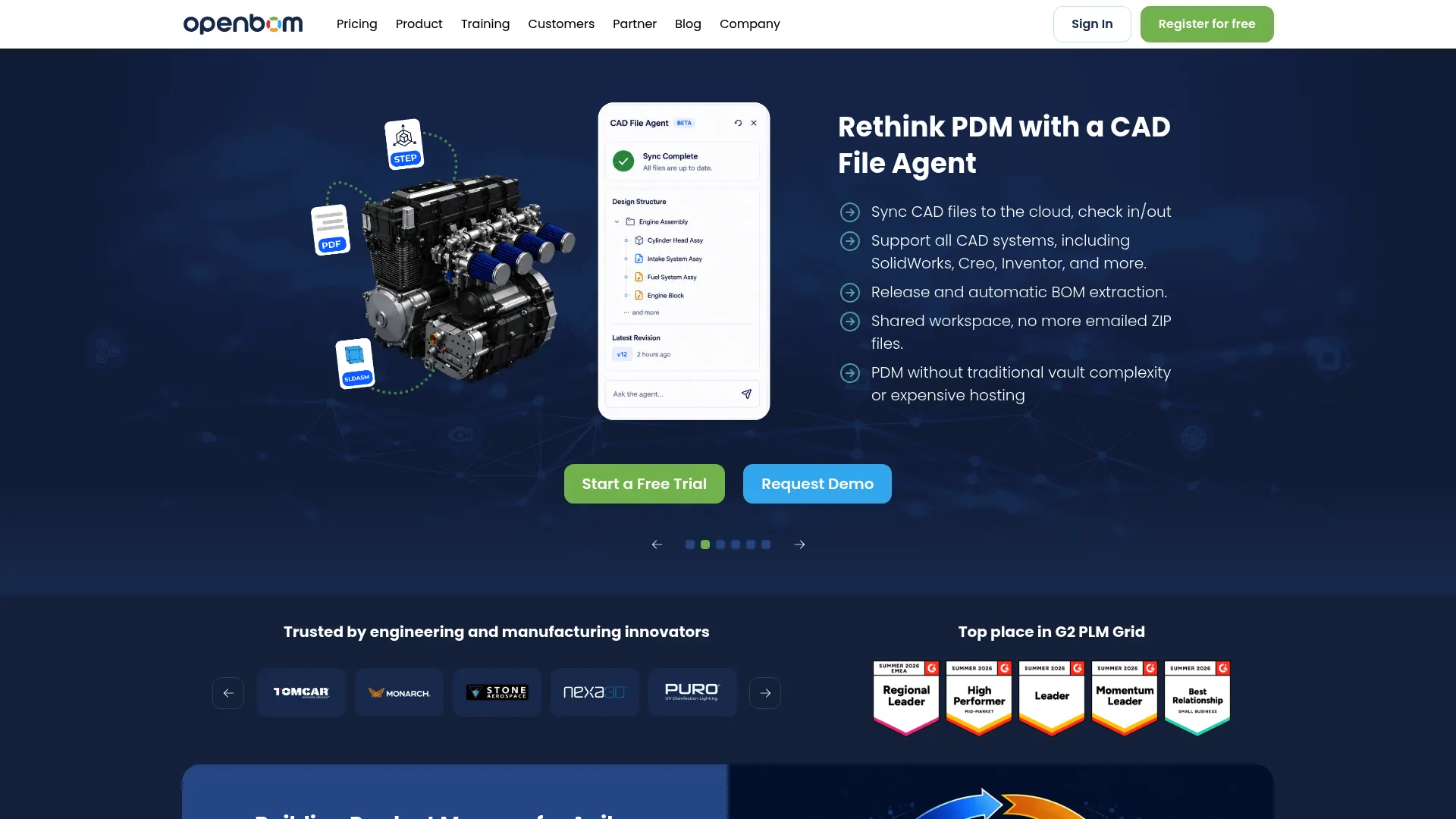
OpenBOM is cloud-native BOM, PDM, and lightweight PLM software built for engineering and manufacturing teams who want practical change control without standing up a full enterprise system. It centers everything on the BOM, then layers change history, revisions, change reports, and approval workflows on top. For a product manager who needs traceability and approval visibility fast, it is the least intimidating way to move off spreadsheets.
Best for: Engineering and manufacturing teams managing BOMs, CAD data, and change workflows who want to start controlling changes this quarter, not next year.
Key strengths
- BOM-centric change control: Revisions and ECO workflows attach directly to the BOM, so a part change cascades to every assembly that uses it.
- Change history and reporting: A clear, searchable record of who changed what and when, exportable as change reports for reviews and audits.
- Fast, collaborative rollout: Cloud-native with unlimited free read-only users, so stakeholders in quality and procurement can see revisions without a full seat.
Why choose OpenBOM: If your real problem is version confusion and missed approvals, not a lack of enterprise PLM, OpenBOM gets you controlled revisions and approval routing without a long implementation. It fits teams that outgrew spreadsheets but are not ready to commit to a PLM platform rollout. The BOM-first approach means your change process and your parts data live in the same place.
OpenBOM pricing: OpenBOM offers a free trial for one user. Paid Professional Team seats run $55/seat/month billed monthly or $30/seat/month billed yearly. The Company tier is $165/seat/month monthly or $90/seat/month yearly, and Enterprise is custom. Pricing has two dimensions, user licenses and data records, and unlimited read-only users are free across plans.
2. Microsoft Dynamics 365 Supply Chain Management
Microsoft Dynamics 365 Supply Chain Management is cloud supply chain software covering planning, procurement, manufacturing, and order operations, with engineering change management built into its product engineering module. It handles the change overview, configuration prerequisites, number sequences, product maintenance modes, and release management as a native part of the ERP. For teams already running Microsoft ERP, that native fit is the whole point.
Best for: Mid-market to enterprise teams needing integrated cloud supply chain operations where engineering changes and releases live inside the same ERP as procurement and manufacturing.
Key strengths
- ERP-native change and release: Product versions, engineering changes, and controlled releases run inside the same system as procurement and shop floor management.
- Structured release management: Maintenance modes and number sequences give changes a governed lifecycle from draft to released and effective.
- Deep supply chain integration: Change data flows straight into planning, sourcing, and manufacturing without a separate integration layer.
Why choose Dynamics 365 Supply Chain Management: If your operations already run on the Microsoft stack, keeping engineering change control inside the same ERP removes a whole category of sync problems between systems. Setup is configuration-based, with prerequisites and number sequences to define, which is normal for ERP-grade change control. The payoff is that a released change is immediately visible to planning and procurement.
Dynamics 365 Supply Chain Management pricing: The base Supply Chain Management plan is $210.00/user/month, paid yearly. Supply Chain Management Premium is $300.00/user/month, paid yearly. Microsoft also offers Intelligent Order Management and Copilot Studio options on the same pricing page. There is no free tier.
3. Rootstock
Rootstock is an AI-native cloud ERP for manufacturing and product-centric companies, built on the Salesforce Platform. Engineering change control lives inside the ERP alongside plan-to-produce, procure-to-pay, and inventory workflows, which makes it a strong fit for manufacturers who want change management, CCB governance, document control, and multi-level BOMs in one operational system. Because it sits on Salesforce, teams already using that platform get native connectivity between CRM and ERP.
Best for: Manufacturers and product companies running on Salesforce that want ERP-native engineering change control with strong operational visibility.
Key strengths
- ERP-native change control: Change orders connect directly to production, inventory, and procurement, so an approved change updates what the shop floor builds.
- CCB and document governance: Configurable change control board approvals and document control keep sign-offs traceable and effectivity accurate.
- Salesforce-native foundation: Runs on the Salesforce Platform, so CRM and ERP data share one environment with a familiar interface.
Why choose Rootstock: For manufacturers whose operational center of gravity is ERP rather than PLM, Rootstock keeps engineering change control close to the production and financial data it affects. Effectivity, multi-level BOMs, and change orders are handled where the work actually happens. It appeals most to teams already invested in Salesforce who want to avoid a separate PLM system.
Rootstock pricing: Rootstock does not publicly list pricing; its site routes evaluators to a demo or contact form, which is common for ERP platforms. Reviewers report an annual, quote-based model tied to modules and users. Confirm scope and seat counts directly during evaluation.
4. PTC Windchill
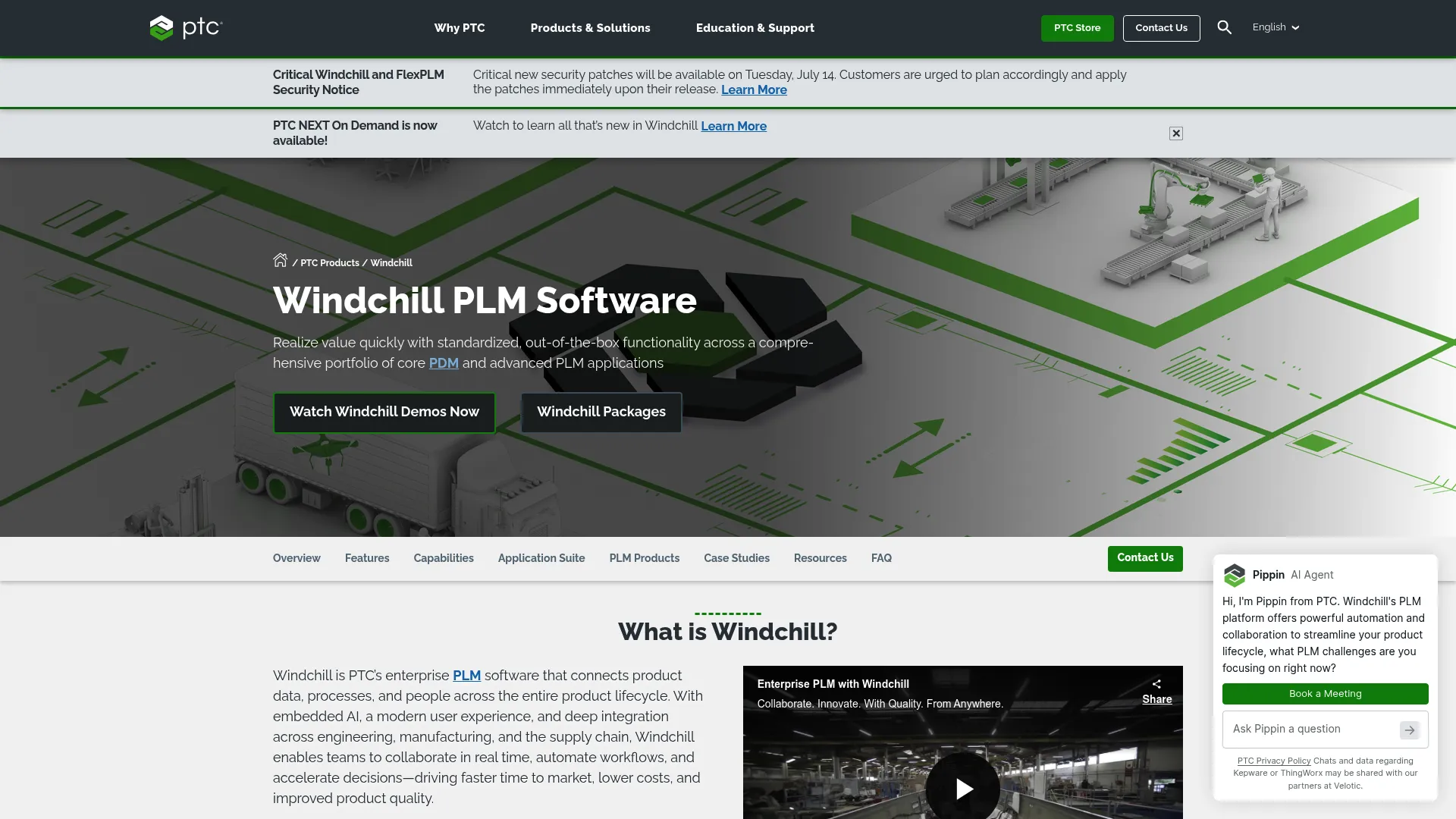
PTC Windchill is enterprise PLM software for managing product data, processes, and collaboration across the full product lifecycle. Change management is a first-class capability, with structured ECR, ECO, and ECN workflows, deep traceability, and auditability designed for regulated, complex product development. AI-driven part intelligence and cloud or SaaS deployment options round out a platform built for scale.
Best for: Large manufacturers needing enterprise PLM with CAD integration, lifecycle collaboration, and rigorous change governance.
Key strengths
- PLM-grade change workflows: Full ECR/ECO/ECN process automation with configurable routing and review-board approvals.
- Traceability and auditability: Complete change history tied to parts, documents, and CAD, exportable for compliance and quality audits.
- Cross-functional collaboration: Engineering, quality, manufacturing, and suppliers work from one governed source of product truth.
Why choose PTC Windchill: When product complexity is high and traceability is non-negotiable, Windchill provides the governance depth that lighter tools do not target. It fits organizations where a single change may touch hundreds of parts and multiple regulatory requirements. The trade-off you accept is a more involved implementation, which is expected for enterprise PLM.
PTC Windchill pricing: PTC does not publish a public price for Windchill; pricing is quote-based and typically scoped to modules, users, and deployment model. Cloud and SaaS options are available. Request a tailored quote through PTC to evaluate cost against your part count and user base.
5. Oracle Fusion Cloud Product Lifecycle Management
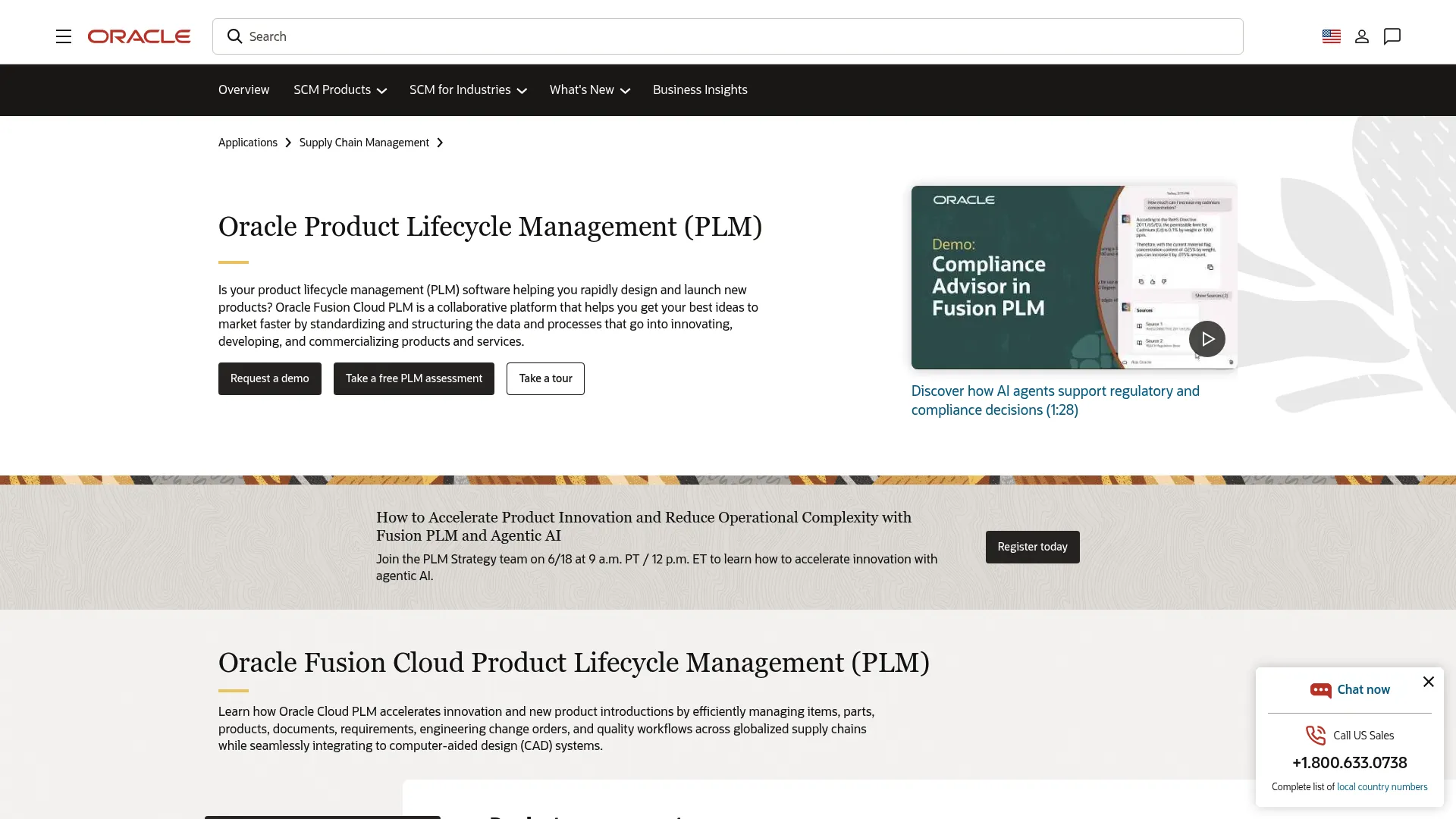
Oracle Fusion Cloud Product Lifecycle Management is cloud PLM software for managing product ideas, requirements, changes, quality, and product data across the lifecycle. It handles enterprise change control alongside product data governance, innovation management, quality management, and configurator modeling. For organizations standardizing product processes inside the Oracle ecosystem, it ties change orchestration directly to the broader Oracle SCM suite.
Best for: Enterprises needing a unified PLM platform tied to Oracle SCM and consistent product data governance.
Key strengths
- Change orchestration: Structured approval routing and change control that connect to quality and requirements management.
- Product data integrity: Centralized governance keeps revisions, attributes, and structures consistent across the enterprise.
- Oracle SCM integration: Native connectivity to Oracle supply chain and manufacturing modules for downstream synchronization.
Why choose Oracle Fusion Cloud PLM: If your enterprise already runs Oracle for supply chain and finance, standardizing product lifecycle and change control on the same cloud keeps product data consistent end to end. It fits organizations that value one governed source of product truth over a best-of-breed patchwork. Approval orchestration and quality integration are the standout capabilities for change-heavy operations.
Oracle Fusion Cloud PLM pricing: Oracle does not publish a public price for Fusion Cloud PLM on its product site. Pricing is quote-based and typically scoped to modules and users within a broader Oracle Cloud SCM agreement. Contact Oracle directly to scope licensing against your deployment.
6. SAP Product Lifecycle Management
SAP Product Lifecycle Management is SAP's PLM offering for defining, developing, delivering, and managing products across the digital supply chain. Change control, BOM integration, release governance, and compliance capabilities align tightly with SAP ERP, making it a natural fit for SAP-centric manufacturing and operations teams. Product development and system integrations are built to keep engineering changes synchronized with the wider SAP landscape.
Best for: Enterprises needing PLM tied directly to SAP ERP and supply chain processes for coordinated change and release.
Key strengths
- SAP ERP alignment: Change control and BOM data integrate with SAP ERP, keeping engineering and operations on the same revision.
- Release governance: Structured release management moves changes through controlled states with downstream synchronization.
- Compliance support: Built-in compliance capabilities help regulated manufacturers document and defend changes.
Why choose SAP PLM: For manufacturers whose entire operation runs on SAP, keeping PLM and change control in the same landscape eliminates the integration friction of a separate system. Enterprise coordination and downstream synchronization are the core strengths. It fits large, process-driven organizations that prioritize a unified SAP backbone over standalone tooling.
SAP PLM pricing: SAP does not display public pricing for its PLM offering; the product and SCM pages route to contact sales. Pricing is quote-based and scoped to modules, users, and the broader SAP agreement. Engage SAP directly to size licensing for your environment.
7. Siemens Teamcenter
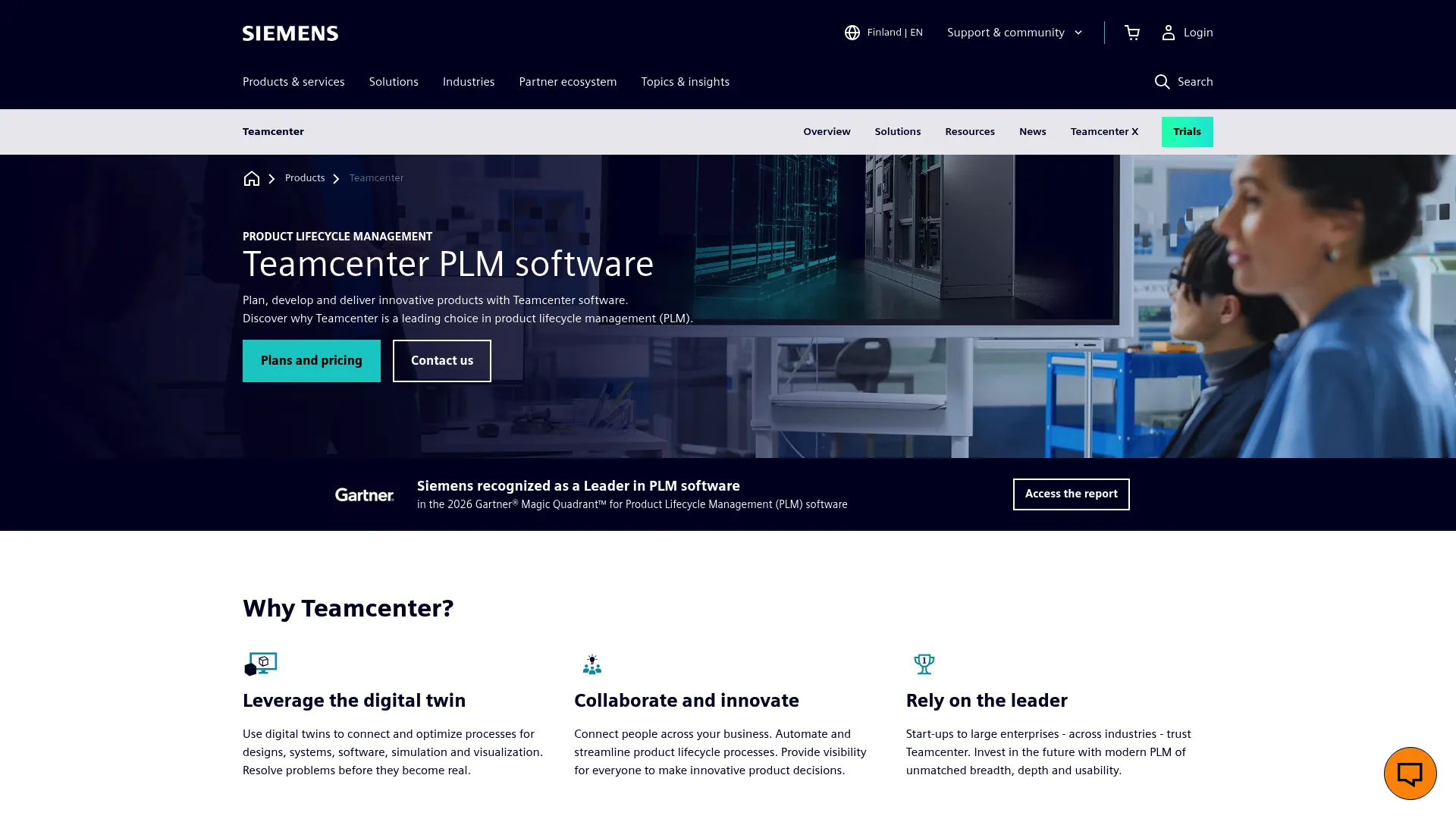
Siemens Teamcenter is enterprise PLM software for planning, developing, and delivering products across design, engineering, manufacturing, and service. It provides deep revision and version control, structured change workflows, and manufacturing collaboration for complex, multi-department product organizations. Digital twin-enabled workflows and AI built for PLM through Teamcenter Copilot position it for large-scale, sophisticated product development.
Best for: Manufacturers needing enterprise PLM across design, engineering, manufacturing, and service with broad lifecycle alignment.
Key strengths
- Deep revision and version control: Rigorous control over revisions, effectivity, and released states across complex product structures.
- Enterprise change workflows: Configurable change processes with traceability that spans engineering through manufacturing.
- Broad lifecycle alignment: Connects design, engineering, manufacturing, and service teams around one product record.
Why choose Siemens Teamcenter: For large organizations with intricate products and many contributing departments, Teamcenter provides the breadth to align the entire lifecycle around one source of truth. Traceability and revision control at scale are its defining strengths. It suits enterprises ready to invest in a comprehensive PLM backbone rather than a focused change tool.
Siemens Teamcenter pricing: Siemens publishes Teamcenter X tier names, Essentials, Standard, Advanced, and Premium, but no public price; the site directs visitors to request a quote or try it. Pricing is quote-based and scoped to tier and users. Request pricing through Siemens to match a tier to your needs.
Considerations before you buy
Before you shortlist, run every candidate through these five checks. They separate a tool that fits your process from one that forces you to change it.
Define your system of record
Decide where the truth lives before you evaluate features. If product development drives your organization, a PLM-first platform makes sense. If operations and finance dominate, an ERP-native option keeps change control close to the transactions it affects. If you mainly need clean revisions and approvals without enterprise overhead, a BOM-first tool is the right scope.
Check approval depth
Confirm the tool supports your actual engineering change process, not a generic workflow. Look for distinct ECR, ECO, and ECN stages, role-based routing, and change control board sign-off. If your approvals require conditional logic or multiple review gates, verify the platform handles that without custom development.
Confirm revision and effectivity handling
Revision rules and effectivity logic are where change control succeeds or breaks. Make sure the tool locks released revisions, tracks version history, and lets you set when a change becomes effective in production. Effectivity mismatches are how the wrong revision ends up on the line.
Validate integrations
Change data has to move. Check native integrations with your ERP, PLM, CRM, and document management systems, and confirm downstream synchronization actually pushes released changes to procurement and manufacturing. A change that stops at the PLM boundary is a change that never reached the floor.
Assess change visibility and auditability
Confirm that change history, reports, and traceability are searchable and exportable. You want to answer "who approved this and when" in seconds, not spend an afternoon reconstructing it. Strong audit trails turn compliance reviews and root-cause investigations from projects into lookups.
Conclusion
There is no single best engineering change management software, only the best fit for where your product truth lives. If you want practical change control without a heavy rollout, OpenBOM is the most approachable BOM-first entry point. If your operations run on Microsoft or Salesforce ERP, Dynamics 365 Supply Chain Management and Rootstock keep change control native to the system you already use. For enterprise product organizations with high complexity and strict traceability, PTC Windchill, Siemens Teamcenter, Oracle Fusion Cloud PLM, and SAP PLM deliver full lifecycle governance.
The next step is simple. Shortlist two or three platforms based on your stack fit, then validate the parts that actually decide the outcome: approval depth, revision and effectivity handling, and downstream synchronization. Run those workflows in a demo or trial with your own change scenario before you commit. The tool that models your real engineering change process, not a generic one, is the one worth buying.
FAQs
An ECR (engineering change request) proposes a change and captures the reason for it. An ECO (engineering change order) authorizes and executes the approved change, including which revisions and BOMs it affects. An ECN (engineering change notice) communicates the released change to everyone downstream. Most engineering change management software handles all three as stages of one workflow.
Spreadsheets work until they don't. Once multiple people touch revisions, approvals get lost in email, or a wrong BOM version reaches the floor, manual tracking becomes a liability. A lightweight, BOM-first tool gives small manufacturers real revision control and approval visibility without an enterprise PLM commitment, which is usually the right first step.
It depends on where your system of record sits. PLM is stronger when product development, CAD, and complex lifecycle traceability drive the business. ERP-native change control is stronger when operations, procurement, and finance dominate and you want changes close to production transactions. Many enterprises run both and integrate them.
It locks released revisions so no one edits a version that manufacturing is already building to. Every change creates a traceable version history, and BOM management propagates a part change to every parent assembly it affects. Downstream visibility ensures procurement and the shop floor always see the current effective revision.
A solid change request approval workflow includes structured review, role-based sign-off, and a change control board where required. It should capture the reason for the change, the affected parts and BOMs, and clear release criteria. Every step needs traceability so you can prove who approved what and when.
Shared workflows with defined statuses and task assignments keep engineering, quality, procurement, and manufacturing on the same change. Each stakeholder sees the current state, their pending actions, and the affected records. Status reporting and dashboards give leadership visibility without chasing individuals for updates.
Effectivity defines when a change takes effect, whether by date, serial number, lot, or unit. It matters because a change is not just approved, it becomes active at a specific point in production. Getting effectivity right prevents building new units to old revisions or scrapping in-progress work unnecessarily.
An audit trail records who changed what, when, and why, creating an accountable, searchable history. For regulated manufacturers it is the evidence that satisfies compliance reviews. For everyone else it turns troubleshooting into a lookup, letting you trace a field failure or quality issue back to the exact revision and approval that caused it.