

A dashboard breaks. A revenue number in a board deck does not match the one in the CRM. An analytics engineer changes a column name and three downstream reports quietly go stale. Nobody notices for a week. By then, decisions have already been made on numbers nobody can trace.
That is the real cost of missing lineage. It is not abstract governance theater. It is the moment a product manager stops trusting the activation dashboard, or a data team spends two days answering "where did this number come from?" instead of shipping.
The problem is getting harder, not easier. As of 2025, Market.us reports that 51% of organizations have adopted business data lineage, and among the most data-mature organizations (Level 4), 93% run business lineage and 92% run technical lineage. Regulatory compliance and audit now drive 48.3% of data lineage applications. Lineage stopped being a nice-to-have the moment AI models started training on data nobody could fully explain.
If you own a metric, you own its provenance. When instrumentation trust erodes, experimentation credibility goes with it, and cross-team alignment gets expensive. The same discipline applies whether you are building a customer data platform or trying to make a data visualization layer that people actually believe. This guide ranks nine tools that make data trustworthy again.
What's inside
This guide is for data leaders, analytics engineers, governance teams, BI owners, and product managers who need to trace data from source to consumption. We evaluated tools that qualify as data lineage software: platforms and open standards that map where data originates, how it transforms through ETL and ELT pipelines, and where it lands in BI tools and models.
We ranked each tool against five criteria that matter for real buying decisions:
- Automation: how much lineage is captured automatically versus mapped by hand
- Visualization: clarity of the lineage graph, including column-level detail
- Auditability: audit trail depth for compliance and traceability
- Integrations: coverage across ETL, ELT, BI, and custom pipelines
- Scalability: fit for growing data estates and multiple teams
TL;DR
- Best for enterprise governance: Collibra combines catalog, glossary, lineage, and AI governance in one platform.
- Best for data discovery plus lineage: Alation ties automated lineage capture to a searchable, collaborative catalog.
- Best for AI explainability: IBM watsonx.data intelligence links source-to-consumption lineage with AI trust context.
- Best open-source governance framework: Apache Atlas gives engineering-heavy teams metadata management and lineage APIs.
- Best open standard: OpenLineage is the vendor-neutral foundation when you want a standard, not a single tool.
- Best for observability plus lineage: Acceldata pairs enterprise-scale root cause analysis with operational reliability.
What is data lineage?
Data lineage is the record of where data comes from, how it moves and changes across systems, and where it is ultimately used. It maps the full journey of a data element from its source, through every transformation, to the reports, dashboards, and models that consume it.
A data lineage solution typically captures and represents:
- Source-to-target tracking: the path from raw source systems through ETL and ELT transformations to final destinations
- Datasets, jobs, and runs: the objects, the processes that act on them, and each execution instance
- Lineage graphs: a visual map of dependencies, often supporting column-level lineage for granular tracing
- Root cause analysis: tracing upstream to find what broke a downstream report
- Impact analysis: tracing downstream to see what a proposed change will affect before you ship it
- Compliance and audit trail: provable records of how regulated data was handled and transformed
Two flavors matter. Technical lineage tracks the physical movement of data through pipelines and code. Business lineage translates that into terms a stakeholder understands, connecting a metric on a dashboard back to its governed definition. The strongest data lineage tools serve both.
Lineage matters more now because of AI. When a model produces an output nobody can explain, the first question is what data trained it and where that data came from. Explainable AI depends on traceability. Data governance depends on it too. Without lineage, "trust the data" is a request, not a fact.
When to use data lineage software
Trace data changes before they break reporting
Someone renames a column, deprecates a table, or reworks a transformation. Without lineage, you find out when a dashboard goes blank or a number looks wrong. With impact analysis, you see every downstream dependency before you merge the change. For a PM, this is the difference between a controlled release and a Monday-morning fire drill in the activation funnel.
Prove compliance and auditability
Regulated teams need to show auditors exactly how sensitive data flowed and transformed. With 48.3% of lineage applications tied to regulatory compliance and audit per Market.us in 2025, this is often the primary buying trigger. A complete audit trail turns a multi-week audit scramble into a query.
Build confidence in analytics and AI outputs
When a stakeholder questions a number, lineage lets you answer with a graph, not a shrug. This is what makes experimentation credible and instrumentation trustworthy. If your model or your metric cannot be traced, its output is an opinion. Lineage turns it back into evidence.
Comparison table
Use this table to shortlist two or three tools that match your data stack complexity and governance requirements, then read the detailed sections below. Public pricing is not listed for most of these vendors, which is common in enterprise data governance. Sort your shortlist by fit, not by row order.
| # | Product | Intent | Key differentiation | Pricing | G2 rating |
|---|---|---|---|---|---|
| 1 | Collibra | Enterprise governance | Unified data and AI governance with catalog, glossary, lineage | Contact sales | 4.2/5 |
| 2 | Alation | Discovery plus lineage | AI-powered catalog with automated lineage capture | Contact sales | 4.4/5 |
| 3 | IBM watsonx.data intelligence | AI explainability | Source-to-consumption lineage with AI trust context | Free trial available | 4.2/5 |
| 4 | Apache Atlas | Open-source governance | Metadata management and lineage APIs, Hadoop heritage | Free, open-source | 4.5/5 |
| 5 | Atlan | Modern data teams | Collaborative metadata with lineage and impact analysis | Contact sales | 4.5/5 |
| 6 | OpenLineage | Open standard | Vendor-neutral lineage event API for pipelines | Free, open standard | Not listed |
| 7 | Acceldata | Observability plus lineage | Data observability with enterprise-scale RCA | Free trial available | 4.4/5 |
| 8 | DataHub | Developer-friendly | Open-source metadata platform with graph model | Free, open-source | 4.4/5 |
| 9 | OpenMetadata | Metadata platform | Open-source lineage, discovery, and governance built in | Free SaaS tier | Not listed |
1. Collibra
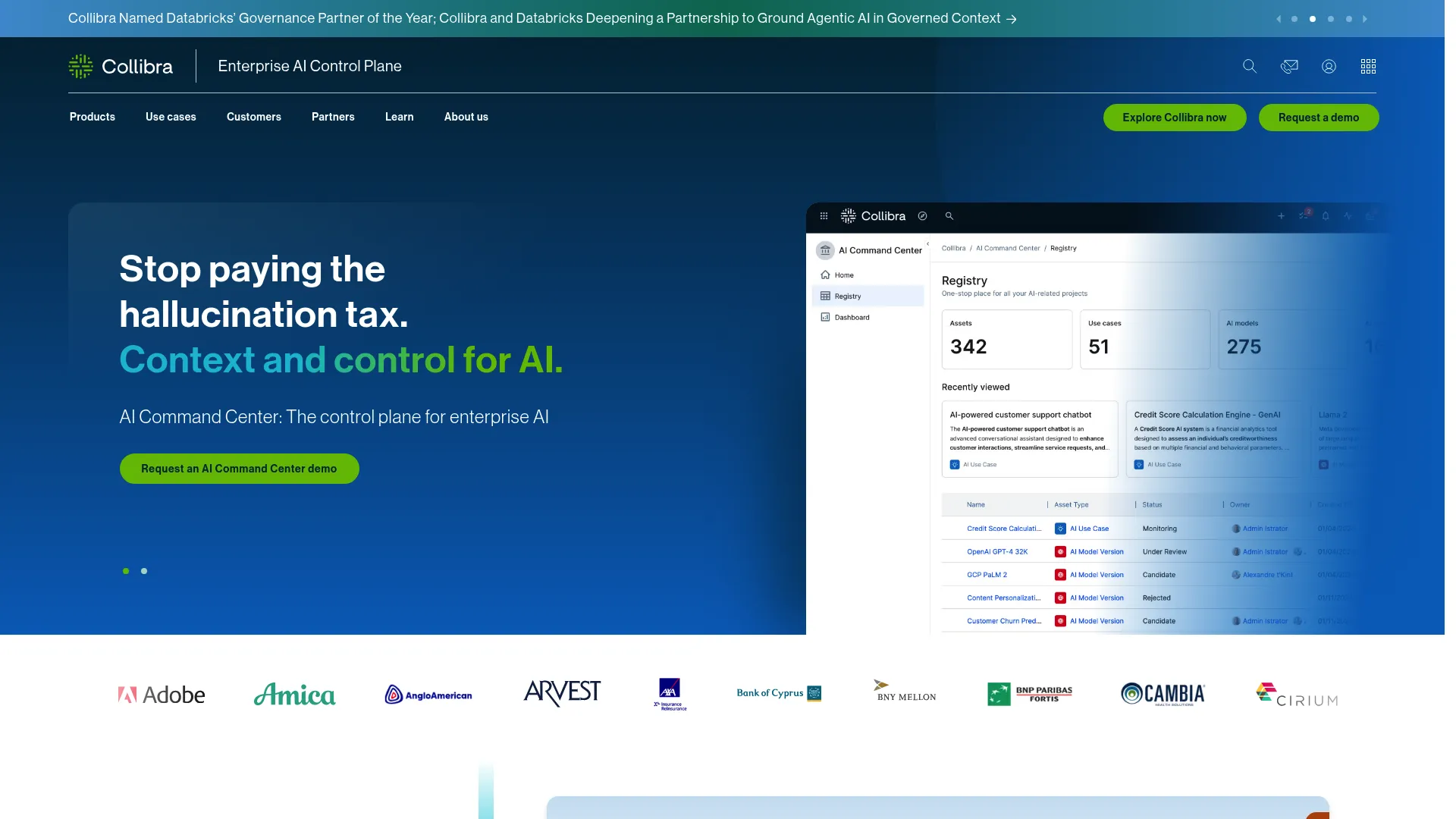
Collibra is an enterprise data and AI governance platform built for large organizations that need governed discovery, stewardship, and lineage in one place. It unifies cataloging, business glossary, and automated lineage extraction so governance teams can trace data across the estate without stitching together separate tools. Collibra positions lineage as part of a broader governance fabric rather than a standalone feature, which is why it resonates with regulated enterprises.
Best for: Large enterprises needing governed data discovery, stewardship, and AI governance in a single platform.
Key strengths
- Unified governance platform: Catalog, glossary, lineage, and workflow live together, so lineage is connected to policy and ownership.
- AI governance and AI-assisted discovery: Governance controls and AI-assisted discovery help teams manage data and AI risk in one system.
- End-to-end lineage with workflow: Automated lineage extraction ties into stewardship workflows for accountability and traceability.
Why choose Collibra: If your organization treats governance as a program rather than a project, Collibra fits. It suits teams with dedicated stewards, compliance mandates, and the appetite to run governance at scale. It is a governance-first choice, so lighter teams may find it more platform than they need on day one.
Collibra pricing: Collibra uses subscription and contract-based pricing. Public price figures are not listed on its site, so plan on a sales conversation to scope your deployment. On G2, Collibra holds a 4.2/5 rating.
2. Alation

Alation is a data intelligence platform for finding, understanding, and governing enterprise data. Its strength is connecting lineage to discovery: automated lineage capture, including SQL log analysis, feeds a searchable catalog where analysts can see not just what a dataset is but where it came from. Alation Anywhere pushes that context into the tools people already work in, which reduces the "ask the data team" bottleneck.
Best for: Enterprises that need governed data discovery and cataloging with AI-ready metadata management.
Key strengths
- AI-powered catalog and search: Discovery and lineage work together so users trace data provenance while they search.
- Automated lineage and governance: Lineage capture from query logs reduces manual mapping and keeps the graph current.
- Alation Anywhere: Lineage and catalog context surface inside existing workflows, not just the catalog UI.
Why choose Alation: Choose Alation when discovery is the primary pain and lineage is the trust layer underneath it. It fits governance-heavy teams that want analysts self-serving trustworthy data rather than filing tickets. Teams that only want raw lineage without a catalog may find the discovery focus broader than their immediate need.
Alation pricing: Alation does not publish public pricing; the site routes to sales and demo requests to scope a plan. On G2, Alation holds a 4.4/5 rating.
3. IBM watsonx.data intelligence

IBM watsonx.data intelligence adds business context to enterprise data so it is more usable, trustworthy, and valuable for both AI and people. It combines a governed catalog, data quality, and end-to-end data lineage with automated scanning and visualizations. The standout angle is AI explainability: source-to-consumption traceability that helps teams answer what data fed a model and how it was transformed along the way.
Best for: Enterprises needing governed catalog, lineage, and quality context for AI and analytics across hybrid environments.
Key strengths
- End-to-end lineage: Automated scanning maps data from source to consumption with detailed visualizations.
- Data governance and catalog: Governance and cataloging give lineage the business context stakeholders need.
- Data quality context: Quality signals sit alongside lineage so teams judge trust, not just origin.
Why choose IBM watsonx.data intelligence: Choose it when AI trust and hybrid integration breadth are central. It fits organizations already invested in IBM's ecosystem or those where explainable AI is a board-level concern. Teams outside that ecosystem should weigh integration fit against their existing stack.
IBM watsonx.data intelligence pricing: IBM offers a free trial. Public plan prices were not readable on the IBM Cloud catalog at the time of writing, so scope pricing directly with IBM. On G2, it holds a 4.2/5 rating.
4. Apache Atlas
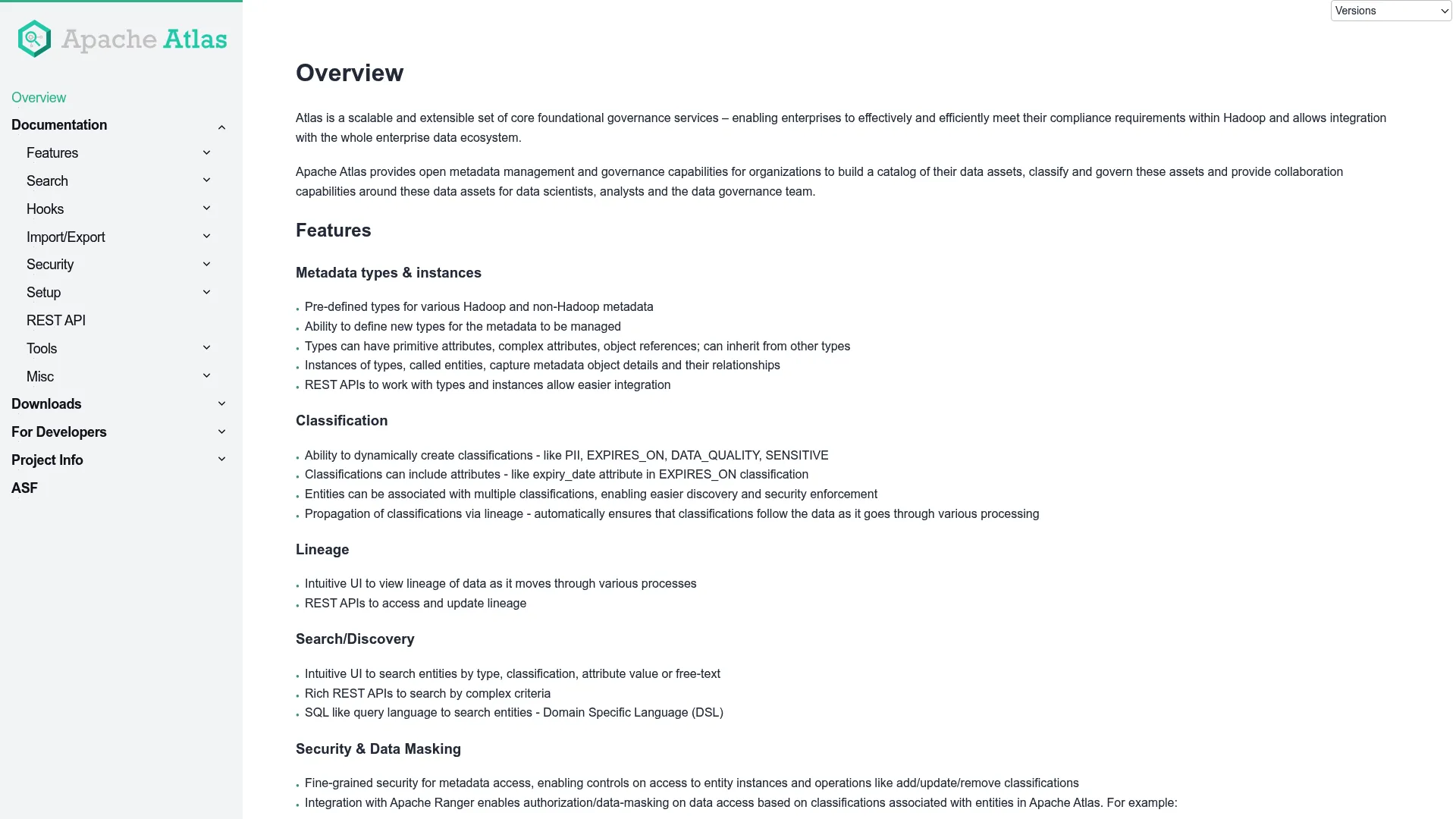
Apache Atlas is an open-source metadata management and governance framework with deep roots in the Hadoop ecosystem. It models metadata types and instances, propagates classifications across lineage, and exposes lineage through APIs that engineering teams can extend. For organizations that want to own their governance stack rather than buy it, Atlas is a proven foundation.
Best for: Engineering-heavy teams that want open-source data governance, lineage, and metadata cataloging with internal ownership.
Key strengths
- Metadata types and instances: A flexible type system models the entities and relationships your estate actually contains.
- Classification propagation and lineage: Tags and classifications flow along lineage, so sensitivity travels with the data.
- Search, discovery, and security controls: Discovery and access controls round out the governance picture.
Why choose Apache Atlas: Choose Atlas when you have the engineering capacity to run and extend open-source infrastructure and want full control. It fits teams with Hadoop heritage or a strong internal platform group. Teams without dedicated engineering ownership will get more out of a managed option.
Apache Atlas pricing: Apache Atlas is free and open-source; there are no license fees. On G2, it holds a 4.5/5 rating.
5. Atlan
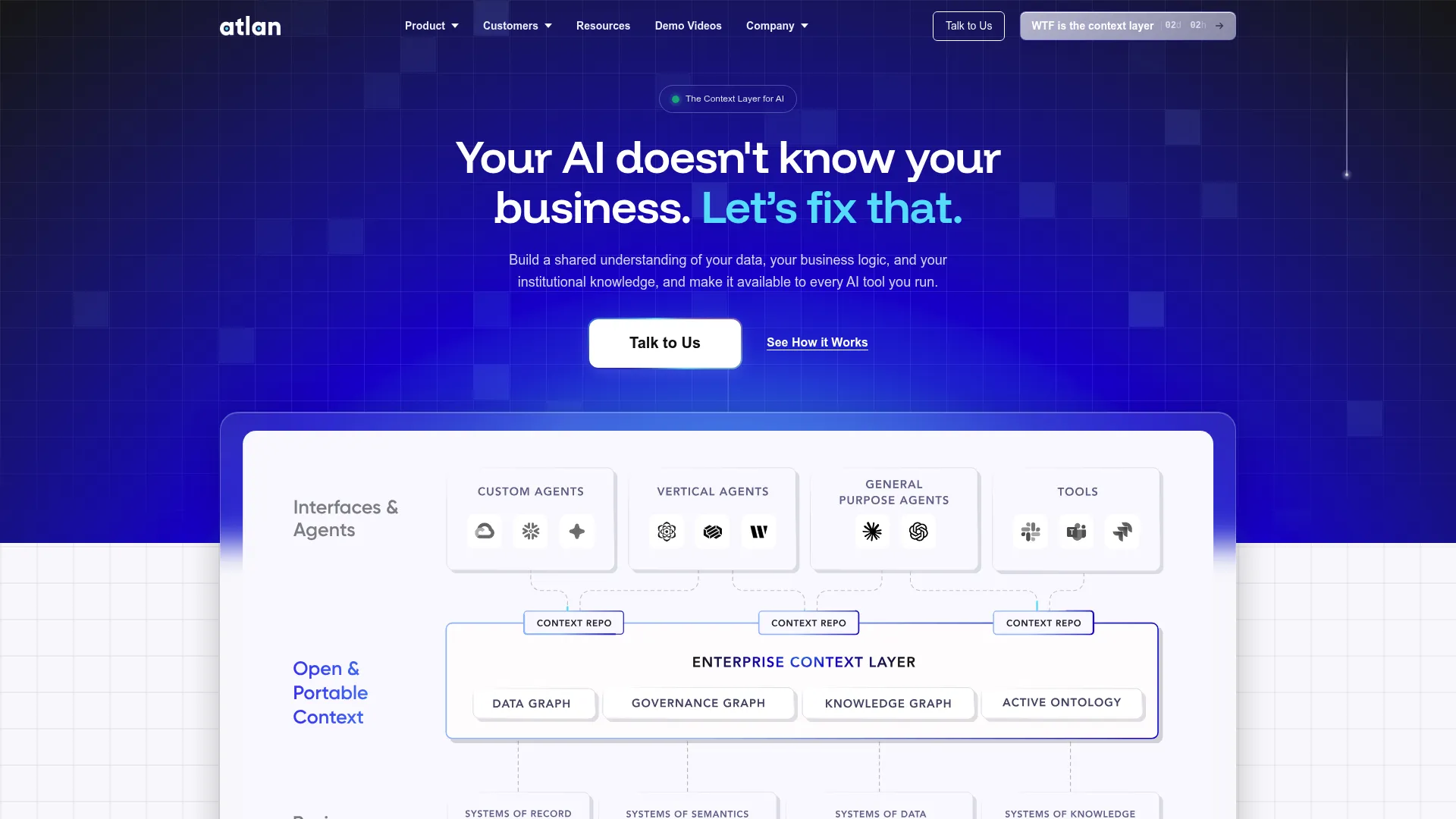
Atlan is an enterprise data catalog and context layer built for modern data teams. Its lineage graphs support root cause analysis and impact analysis, and API-based ingestion plus export options make it flexible across a diverse stack. Atlan leans into collaborative metadata workflows, so lineage becomes something teams work with together rather than a static diagram.
Best for: Modern data teams that want a governed catalog with AI-ready context and collaborative metadata workflows.
Key strengths
- Data lineage with RCA and impact analysis: Lineage graphs support both upstream root cause tracing and downstream impact analysis.
- Discovery and search: A searchable catalog makes data findable alongside its provenance.
- Business glossary and governance: Glossary and governance connect technical lineage to business meaning, including multi-hop business lineage.
Why choose Atlan: Choose Atlan when your team wants a modern, collaborative catalog and treats metadata as a shared workflow. It fits fast-moving data teams that value API ingestion and open integration. Teams wanting a heavily prescriptive, top-down governance program may prefer a more traditional platform.
Atlan pricing: Atlan does not publish public pricing; the site routes to sales and demo requests. On G2, Atlan holds a 4.5/5 rating.
6. OpenLineage
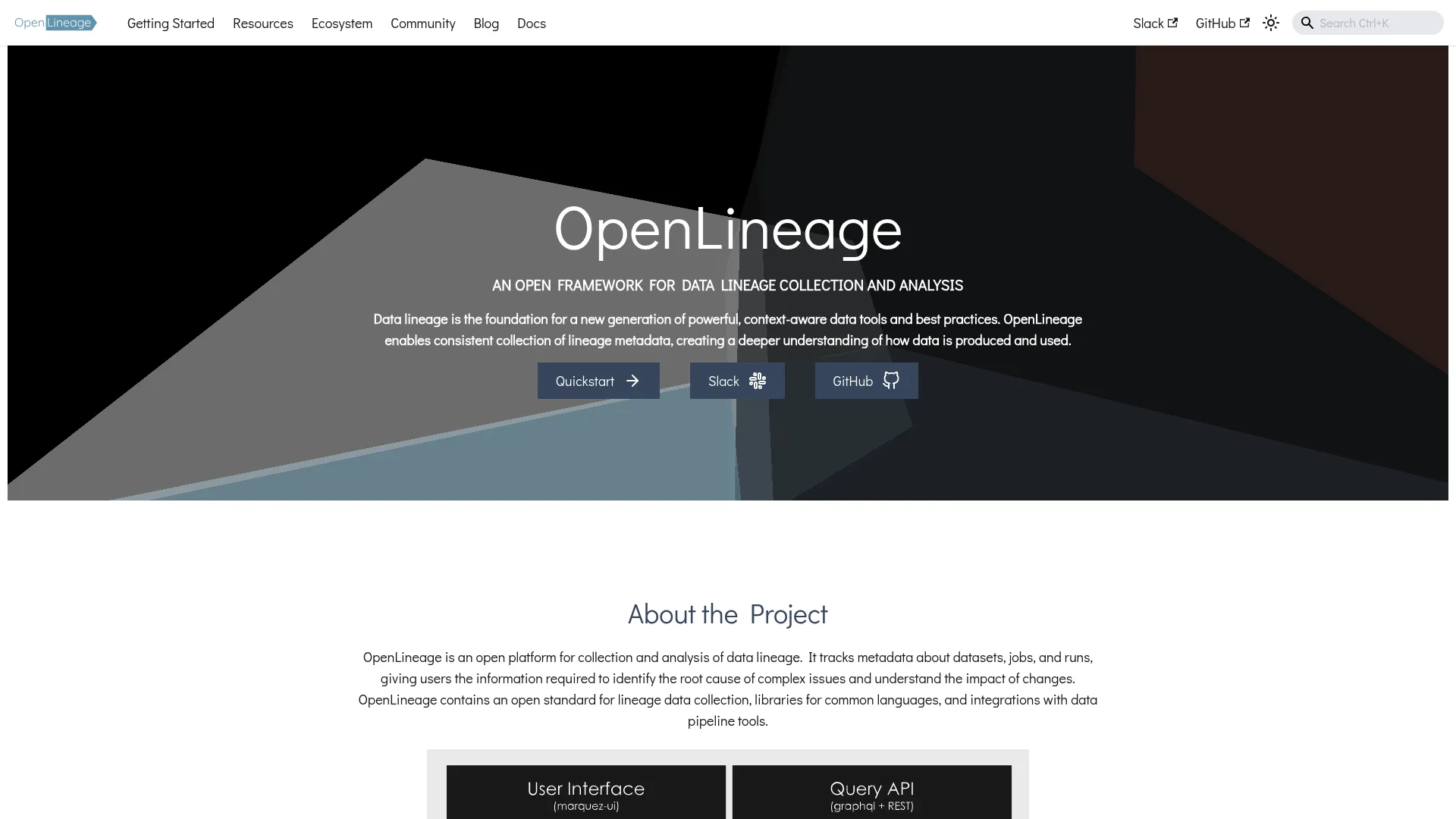
OpenLineage is an open framework and standard for collecting and analyzing data lineage. Rather than a single product, it defines a vendor-neutral API for emitting lineage events, modeling datasets, jobs, and runs, and integrating with the pipeline tools you already use. It supports extensible facets so teams can capture the metadata that matters to them without waiting on a vendor roadmap.
Best for: Teams that want an open lineage standard and integrations for their data pipelines rather than a single vendor's format.
Key strengths
- Open standard API: A vendor-neutral event API means lineage is portable across the ecosystem.
- Datasets, jobs, and runs model: A clear object model captures what ran, on what, and when.
- Ecosystem interoperability: Broad integration support and extensible facets keep lineage flexible.
Why choose OpenLineage: Choose OpenLineage when you want a standard rather than a walled garden, and when interoperability across pipeline tools matters more than a packaged UI. It is the right foundation for teams building their own lineage layer. Many organizations adopt it alongside a governed platform that consumes its events, since OpenLineage is the standard, not a full governed interface by itself.
OpenLineage pricing: OpenLineage is a free, open project and standard with no license cost. It does not carry a verified G2 rating.
7. Acceldata
Acceldata is an enterprise data and AI platform for observability, governance, and automation across hybrid environments. Lineage sits inside a broader observability story, which means when a pipeline breaks, you get root cause analysis with the operational context to fix it fast. For teams that live in incident response, pairing lineage with observability shortens the path from alert to answer.
Best for: Large teams needing unified data observability and governance across hybrid data estates.
Key strengths
- Data and AI observability: Monitoring and lineage together surface where and why data reliability breaks.
- Agentic data engineering: Automation and agentic capabilities reduce manual reliability work.
- Governance and cataloging: Metadata context connects observability signals to governed definitions.
Why choose Acceldata: Choose Acceldata when operational reliability is as important as governance, and you want lineage in service of troubleshooting. It fits large teams managing complex, hybrid estates with real uptime pressure. Teams that only need cataloging and lineage without observability may find it broader than required.
Acceldata pricing: Acceldata offers a free trial on its PRO cost-optimization plan, with PRO and Enterprise plans available via contact sales; no public numeric price is listed. On G2, it holds a 4.4/5 rating.
8. DataHub
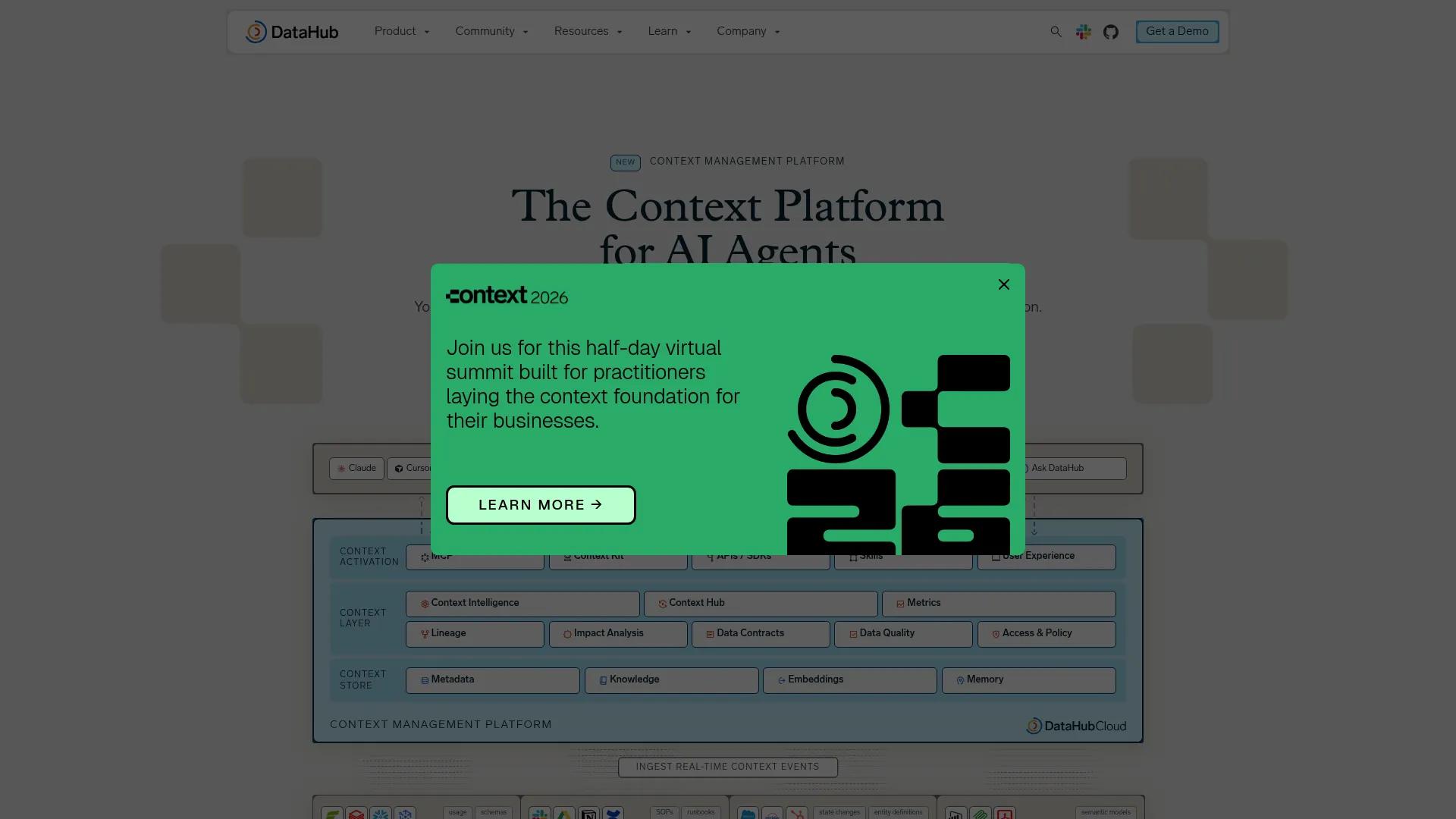
DataHub is an open-source metadata and data context platform for discovery, governance, observability, and lineage. Its graph model spans datasets, dashboards, ML models, and files, which makes lineage genuinely end-to-end across a modern stack. Developer-friendly and highly extensible, DataHub appeals to teams that want to shape their metadata platform rather than accept a fixed one.
Best for: Teams wanting an open-source data catalog and context platform, with a commercial cloud option available.
Key strengths
- Data discovery across assets: Discovery spans datasets, dashboards, ML models, and files, so lineage covers the full stack.
- Data governance with ownership and PII tracking: Ownership and PII tracking keep sensitive data accountable.
- Data quality and observability: Automated anomaly detection, assertions, and data contracts add reliability on top of lineage.
Why choose DataHub: Choose DataHub when you have the internal implementation maturity to run and extend an open-source platform, and want broad asset coverage. It fits developer-led data teams comfortable with configuration. A DataHub Cloud option exists for teams that want the platform without self-hosting.
DataHub pricing: The open-source project is free to self-host. DataHub Cloud and enterprise offerings are demo-based with no public price listed. On G2, DataHub holds a 4.4/5 rating.
9. OpenMetadata
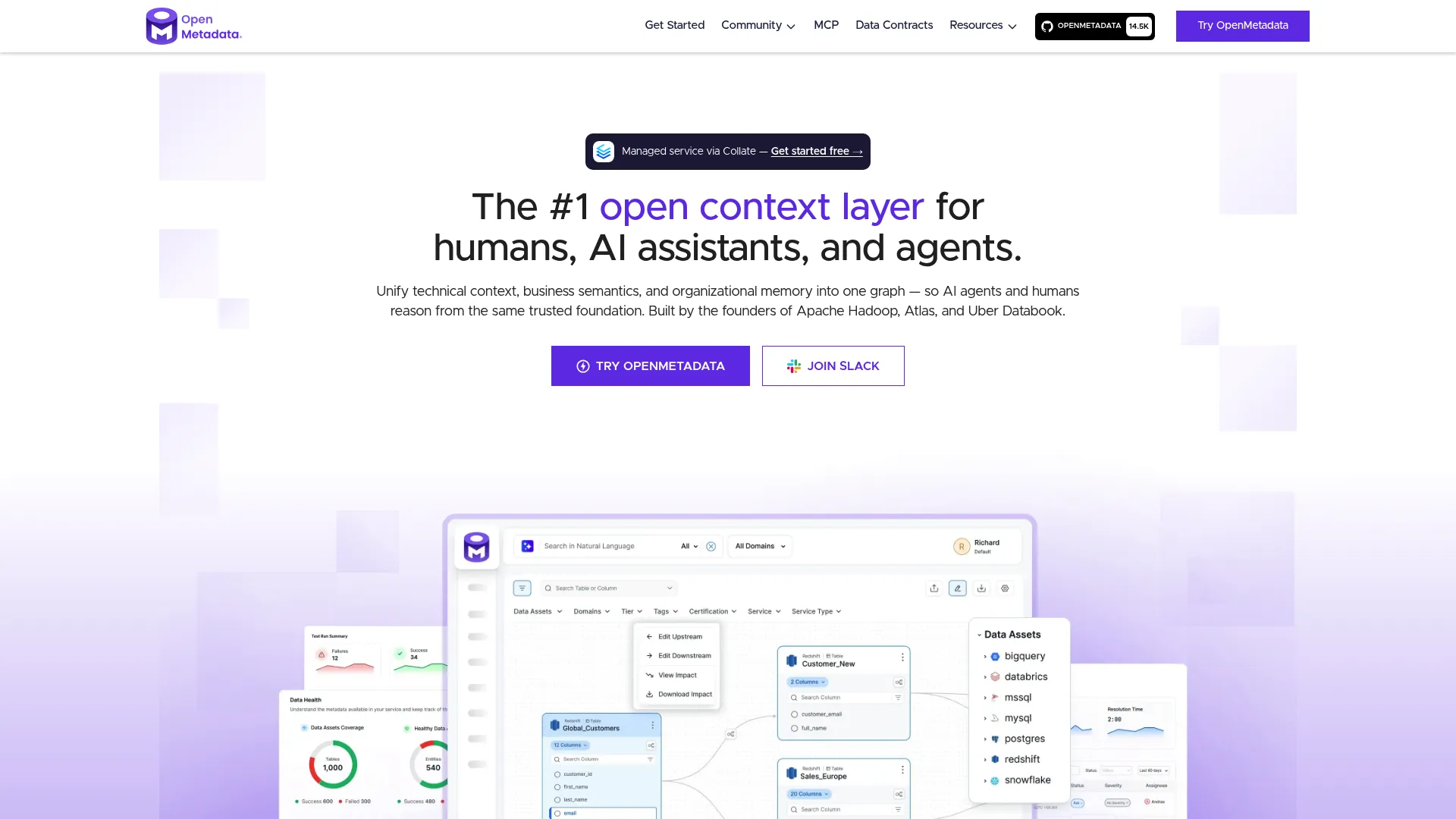
OpenMetadata is an open-source metadata management platform covering discovery, governance, lineage, quality, observability, and collaboration. It offers end-to-end lineage with manual editing and dbt integration, plus advanced search across tables, dashboards, pipelines, ML models, and tags. For teams that want a metadata platform with lineage built in rather than bolted on, it is a practical, active open-source option.
Best for: Teams that want an open-source metadata platform with AI context, governance, and lineage capabilities.
Key strengths
- End-to-end lineage: Lineage supports manual editing and dbt integration for accurate, editable graphs.
- Data discovery and advanced search: Search spans tables, dashboards, pipelines, ML models, and tags.
- Governance and collaboration: RBAC, glossary terms, owners, tags, activity feeds, and notifications support shared workflows.
Why choose OpenMetadata: Choose OpenMetadata when you want an open-source platform where lineage, discovery, and governance are integrated from the start, and you value a collaborative, active project. It fits teams comfortable running open-source who want quick access through a free cloud service. A free OpenMetadata cloud service lowers the barrier to trying it before self-hosting.
OpenMetadata pricing: OpenMetadata offers a free cloud service with your own data, plus deploy and live-sandbox options; no public paid price is listed. A current G2 rating was not verified.
Considerations before you buy
Shortlisting is easier when you know what to interrogate. Use these criteria to pressure-test any data lineage solution before committing.
Automation versus manual mapping
Ask how much lineage is captured automatically versus hand-drawn. Automated lineage from query logs, pipeline metadata, and connectors stays current as your stack changes. Manual mapping decays the moment someone ships a change without updating the diagram. For a team shipping on a fast release cadence, automation is the difference between trustworthy lineage and lineage rot.
Coverage across your actual stack
Lineage is only useful if it spans your real pipelines. Verify coverage across ETL and ELT tools, your warehouse, BI tools, and any custom or in-house pipelines. A tool that maps the warehouse beautifully but goes dark at the BI layer leaves the exact gap where trust questions surface.
Column-level and business lineage
Table-level lineage tells you two datasets are connected. Column-level lineage tells you which field broke the report. Confirm the depth you need, and whether the tool translates technical lineage into business lineage a stakeholder can read. Both matter for cross-team alignment.
Auditability and compliance fit
If compliance is a driver, examine the audit trail. Can you prove how regulated data flowed and transformed, and export that evidence for auditors? With nearly half of lineage applications tied to compliance, this is often the criterion that decides the purchase.
Maintainability and total cost
Open-source tools carry no license fee but need engineering ownership. Managed platforms cost more but reduce operational overhead. Weigh the opportunity cost honestly against your team's bandwidth and release velocity.
Conclusion
The right data lineage software depends on how your team is built and what it must prove. For enterprise governance programs, Collibra and IBM watsonx.data intelligence lead, with IBM standing out for AI explainability. Alation and Atlan fit teams that want lineage tied to discovery and collaborative metadata workflows. Acceldata is the pick when observability and operational reliability sit alongside governance.
For teams that want openness and control, Apache Atlas, DataHub, and OpenMetadata offer strong open-source metadata platforms with lineage built in, while OpenLineage provides the vendor-neutral standard many of these tools speak.
The decision lens stays constant: governance depth, automation, openness, visualization, and operational fit. Shortlist two or three tools based on your data stack complexity and governance requirements, then run each against your real pipelines, not a demo dataset. Lineage you can trust is lineage you have tested on your own data.
FAQs
Teams need it to trace where data comes from, how it changes, and what breaks when something upstream changes. Without lineage, root cause analysis and impact analysis become guesswork, and trust in reporting erodes. As of 2025, 51% of organizations have adopted business lineage, per Market.us, precisely because untraceable data makes decisions expensive.
A data catalog inventories what data assets exist and helps people find and understand them. Data lineage traces how those assets connect and flow, from source through transformation to consumption. Most modern platforms combine both: the catalog answers "what is this?" and lineage answers "where did it come from and what depends on it?"
Collibra and IBM watsonx.data intelligence are strong enterprise governance choices, combining catalog, glossary, lineage, and policy in one platform. Alation and Atlan also serve governance-heavy teams by tying lineage to discovery and collaborative metadata. The right pick depends on whether AI explainability, discovery, or stewardship workflows are your primary driver.
Yes, provided you have the engineering ownership to run and secure it. Apache Atlas, DataHub, and OpenMetadata offer lineage, classification, and audit capabilities that regulated teams use. The trade-off is operational: you own uptime, security, and extension work that a managed vendor would otherwise handle.
When a report breaks, lineage lets you trace upstream through every transformation and job to find the exact change that caused it. Column-level lineage narrows it to the specific field, not just the table. This turns a multi-hour investigation across pipelines into a targeted trace.
Yes. Explainable AI depends on knowing what data trained a model and how it was transformed. Source-to-consumption lineage, like the traceability IBM watsonx.data intelligence emphasizes, provides that evidence. When a model output is questioned, lineage lets you show the data provenance behind it rather than treating the model as a black box.
Map your actual stack first, then check each tool against it. Confirm automated capture for your ETL and ELT tools, warehouse, and BI tools, and ask specifically how custom or in-house pipelines are handled, often through APIs or the OpenLineage standard. The gaps usually appear at the BI layer and in custom code, which is exactly where trust questions arise.
A PM should care about instrumentation trust, maintainability, and impact measurement. Lineage protects the credibility of activation, retention, and experiment metrics, and impact analysis prevents a schema change from silently breaking an onboarding dashboard. Prioritize automation and coverage so lineage stays accurate across frequent releases without becoming another high-maintenance system.